434 - WOOD COUNTY, OHIO.
BIOGRAPHICAL.
CAPT. LUTHER BLACK, of Bowling Green, is one of the most prominent citizens of Wood county, throughout which he is known and esteemed, not only as a successful business man, but also for his high character, and his splendid record as a brave soldier in the war of the Rebellion. On his father's side he is of Irish descent, his great-grandfather having emigrated from Ireland to this country at an early day. His grandfather Black was killed by accident while raising his barn in Perry county, Ohio. On the mother's side the grandfather was of Pennsylvania-Dutch stock, while the grandmother, who was a Miss Oatley, was a native of Scotland. From these sturdy ancestors our subject has inherited the best traits-traits that have manifested themselves in his long career of useful activity.
Capt. Black was born in Washington township, Wood Co., Ohio, May i8, 1836, and is a son of John and Phoebe (Skinner) Black, the former of whom was born in Mercer county, Penn., when ten years of age moving with his parents to Perry county, Ohio. In 1831 he took up his residence in Wood county, and was one of the first three pioneers of Washington township, where at that time over one thousand Indians dwelt. While living in Perry county he married and had two children, and on removing to this county he took up some unimproved land which he cleared and converted into a productive farm, in the meantime experiencing all the trials and privations incident to the life of early settlers. In politics he was a Democrat, in religious faith an Old-school Presbyterian, and he was a man of irreproachable character. He died August 21, 1861, his wife passing away at Hull Prairie in 1883, and both are buried at Tontogany, Wood county. To this worthy couple were born seven children, of whom the following record is given: (1) William resides in Newport, Mich., where he has held the offices of deputy sheriff and collector of the port; during the Civil war he enlisted at Olmsted Falls, Minn., and proved a brave soldier. (2) Elizabeth A. married A. P. Treadwell, and lives at Hull Prairie, Wood county. (3) Minerva J. became the wife of Joseph Jeffers, and died at Waterville, Lucas Co., Ohio. (4) Calvin lives at Washington, Kans. (5) Luther is the subject of this review. (6) Catherine married Dr. A. Eddmon, and lives at Tontogany. (7) Mary is the wife of Dr. E. R. Wood, of Belle Plaine, Kansas.
Luther Black grew to manhood on his father's farm in this county, attending the schools of that locality and those at Waterville, and also the seminary at Maumee. After leaving school, he for four years taught in the district schools of Wood county, and for two years in Champaign, 111. About this time the whole world was electrified by the outbreak of the Civil war, and the partiotism of the young teacher induced him to lay aside his ferule for an army musket, and offer his services in defense of the stars and stripes. On April 27, 1861, he enlisted in Company B, 21st O. V. I., three-months' service, which was passed in Virginia, at the termination of which, his father having died in the meantime, he was obliged to return home in order to take charge of the family. There he remained until 1864, on May 4 of which year he organized Company B, 144th O. V. I., of which company he was made captain. While at Berryville, Va., he and seven of his men were taken prisoners by the Rebels and sent to Lynchburg, thence to Libby prison where they suffered the horrors of slow starvation, and where all except himself and one other fell victims to cruel treatment. Three months after his capture, Capt. Black was released by exchange, and his patriotic zeal being still unabated, in spite of the terrible scenes through which he had passed, he raised another company, of which he was also made captain. This was Company K, 185th O. V. I., which afterward saw much service in Kentucky in the vicinity of Cumberland Gap, where they had frequent skirmishes with the guerrillas. The regiment was mustered out at Lexington, Ky., in September, 1865.

Luther Black
WOOD COUNTY, OHIO. - 435
His career as a soldier being ended by the cessation of hostilities, and the return of peace to the land, Capt. Black returned to private citizenship, and, having in the meantime purchased the old homestead, carried on farming there for two years. At the end of that time he engaged in the drug business, in Tontogany, which he conducted some eighteen years, and then, being elected county treasurer on the Republican ticket, he, in 1881, removed to Bowling Green. That responsible office he held for two terms, or four years, such being the limit of the law, fulfilling its duties in a most creditable manner. The Captain then established himself in the clothing business, and some six or seven years ago became interested in the oil wells of Wood county. ' On February 20, 1894, he sold out his clothing establishment, since when he has given all his attention to his oil interests. He is now a part owner in sixty-one wells in this county, and a member of various firms connected therewith, the most prominent of which is that of Black, Reese & Hazlett, who own a number of productive wells, and are doing an extensive business. He is also cultivating a couple of farms which he owns in the vicinity.
In 1860 Capt. Black was married to Miss Sarah J. Camron, a native of New York State, who died three years later, leaving one child, Frank H., who was killed by a railroad accident when fourteen years old. On January 16, 1873, the Captain married Miss Georgie A.. Cooper, who was born in St. Lawrence county, N. Y., daughter of James and Almira (Brooks) Cooper, who were married in 1840. James Cooper traces his ancestry back to the year 1661, as follows:
(1) James Cooper, of Stratford-on-Avon, England, born in 1661, died in 1732; came to Philadelphia, Penn., in 1682 ; had eight children Esther, James, Joseph, (2) Samuel, William, Benjamin, Isaac and Rebecca. James Cooper owned a lot on Chestnut street, Philadelphia, opposite Marble Custom-house. (2) His son William had six children-Rebecca, (3) Thomas, James, Joseph, Samuel, and Letitia. He died in 1736. (3) His son (3) James was twice married, and had fifteen children; by his first wife, Hannah (Hibbs), he had eight children-Susanna, (4) James, William, Letitia, Levi, and Benjamin; by his second wife, Elizabeth (Wager), (3) James had seven children-Amelia, Marmaduke, Meshach, Laodosia, Naboth, Noah and Alpheus.
(4) James Cooper, son of (3) James, and grandfather of Mrs. Capt. Luther Black, was born in Moreland, Montgomery Co., Penn., March 6, 1753; served in the navy and army of Pennsylvania in the Revolutionary war, and participated in the battles of Monmouth and Germantown. He was married three times: first to Naomi Nelson, by whom he had three children - Hannah, Naomi and Caroline; by his second wife, Mary (Albertson) he had no children; by his third wife, Sarah (Comely), he had children-Courtland, (5) James, Henry, William, Nancy, Hamilton, George and Amos. The father of these died May 1, 1849, in his ninety-seventh year. He was a man of strong likes and dislikes, served as judge on the bench, and was a large land holder, owning property whereon a portion of the city of Philadelphia now stands. He and his wife were both Quakers.
(5) James Cooper, son of. (4) James Cooper, and father of Mrs. Black, was born November 23, 1795, in Philadelphia. He was own cousin to James Fennimore Cooper, the distinguished American novelist. James Cooper was twice married; first time to Sarah Rice, by whom he had six children-Esther, Ezra, Ruth, Hannah, William and Alonzo; by his second wife, Almira (Brooks), he had two children Georgie A. (Mrs. Black), and James B., an inventor who resides in Minneapolis. The sons, Ezra, Alonzo and James B., were all soldiers, making for themselves an enviable military record. The father of these was a mar. of superior education and acknowledged ability, for which, indeed, the entire family have been noted. He was a pronounced Abolitionist, and an outspoken advocate of the cause of freedom to all mankind. Migrating to Ohio about the year 1844, he settled at Waterville, Lucas county, where for many years he served as a magistrate. During his busy lifetime he owned several flouring-mills and sawmills, doing an extensive business in both those lines of industry. He died there in 1868, honored and respected by all who knew him. His widow, who is now passing her declining years at the home of her daughter, was born, in 1812, in the town of Champion, Jefferson Co., N. Y., daughter of Joseph Brooks, a Revolutionary soldier from Massachusetts. She was a cousin of Amos Kendall, who was post in aster-general under President Jackson's administration, and when a young man taught in the family of Gen. Clay, afterward holding many offices of honor and trust. He became an able attorney at law, and was influential in the establishment of the first Deaf and Dumb Asylum at Washington, D. C.
To Capt. and Mrs. Black have been born two children: Marie C. and James L., the latter of whom at present is a student at Oberlin College. The Captain is a consistent member of the
436 - WOOD COUNTY, OHIO.
Presbyterian Church, in which he is an elder; socially, he is affiliated with the F. & A. M., Wood County Lodge, No. 112; is a member of Crystal Chapter, No. 157, and of Toledo Commandery, K. T., at Toledo, Ohio. In politics he has always been an ardent Republican, his first vote being cast for Abraham Lincoln, and he has never failed to deposit his ballot, save twice-first when he was in Libby prison, and again, in 1880, when he was too ill to go to the polls. Capt. Black was delegate to the State Convention, and was honored with election as alternate delegate to the National Convention, to be held at St. Louis in June. He has served as president of the school board and of the gas board, and is a director of the American Foundry & Machine Co., also of the First National Bank, of Bowling Green. During the past year he has been interested in gold mining in California, being identified with a joint-stock company. In every relation in life, Capt. Black has borne an honorable part as an upright, patriotic, loyal citizen, and is justly classified among the social representative men of Wood county.
JOHN K. HANKEY, the well-known capitalist of Bowling Green, has, by his varied business enterprises, done much to develop the natural resources of this region, and to open up its commerce. In judgment of human nature, and statesmanlike manipulation of a complex situation, he has few equals; but his shrewdness is combined with rare kindliness of heart, shown in many ways characteristic of the man. It has been said that if simple justice were to rule the business world, there would be no need for "charity," and the subject of this sketch is one of the first to try to bring this high ideal of human brotherhood into practical effect in his relations with his employes. In his large planing-mill at Bowling Green he inaugurated, some years ago, the co-operative system, issuing stock to his men and carrying it for them until such time as they could pay for it from their savings, and paying back money, so invested, at any time at the request of the shareholder. This plan has succeeded admirably, and to the lasting profit of all parties concerned.
The members of the Hankey family, living in Bowling Green, are descended from Louis Hankey, a native of Germany, who emigrated to America at an early day. It is related that he had just enough money to pay his way across the Atlantic and furnish his own provisions. The vessel he set sail in lost her course at sea, and the passage consumed so much more time than was anticipated, that his stock of food became exhausted long ere he reached land again, that he became indebted to the ship for part of his board. On reaching New York, he was " sold " by the ship's company, or agents, as was the custom in those days, they getting the money for his time, which he worked out with a farmer. He afterward became a minister of the Evangelical Church, and also followed agricultural pursuits. He married a Miss Less, whose father served in the Revolutionary war seven years, and our subject remembers hearing his grandmother often tell of how she could trace the path the soldiers took by the blood left on the ground from their shoeless feet. In later life Louis Hankey lived in both Stark and' Summit counties, Ohio, in which latter he and his wife passed their last days. This estimable couple were the parents of seven children, as follows: John, father of the subject proper of this sketch; Catherine, married to John Himmelright, of Summit county; Jacob, who lived in Summit county, Ohio, near Akron; Lydia, married to Rev. Miller, a minister of the Reformed Church; Sarah, married to a Mr. Hawk; Louis, living in Wayne county, Ohio; and Samuel, a farmer, residing at Copley, Ohio.
J. R. Hankey is a native of Ohio, born in Wayne county, March 16, 1843, a son of John and Polly (Fostnight) Hankey, the former of whom was born in Schuylkill county, Penn., in 1814. He was a farmer and merchant by occupation, and early in life came to Ohio, first locating in Wayne county, during the war of the Rebellion moving to Medina county, where he died in 1868. He was three tunes married; first to Miss Polly Fostnight, who was born in Stark county, Ohio, in 1819, and by her he had seven children, as follows: Solomon died in infancy; Sarah married William Shammo, and is deceased; Lewis W. is a minister of the Evangelical Church at Tiffin, Ohio; John R., the subject proper of this memoir, comes next; then I. L. ; two died in infancy. The mother of these departed this life in Wayne county in 1854, and Mr. Hankey subsequently married Miss Margaret Reach, who died fifteen months after marriage; she had one child that died in infancy. For his third wife he wedded Miss Sarah Strouse, of Richland county, Ohio, by which union there were two children: Isaiah S., of Bowling Green, and Sarah Katherine, wife of A. L. Sourwine, a farmer in Crawford county, Ohio.
Our subject lived on a farm until he was eleven years old, when he went to Marshallville. He received his education in the common schools, and when fifteen years old went to Wooster,

John R. Hankey
WOOD COUNTY, OHIO. - 437
Ohio, where he entered the arena of business in the capacity of clerk in a clothing store. While so engaged the war of the Rebellion broke out, and at the first call by the President for three years men to defend the Union, the lad, fired with the spirit of true patriotism, enlisted June 4, 1861, in Company E, 4th O. V. I., which was attached to the army of the Potomac, Gen. Sumner's corps, under Gen. McClellan ('' Little Mac"). Private Hankey participated in many battles and skirniishes, and established for himself the record of a good, dutiful, and brave soldier. He took part in the battles of Winchester, Port Royal, Port Republic, and in all the engagements in front of Richmond in 1862; was at the siege of Yorktown, the battle of Fair Oaks, the seven-days' retreat, battles of second Bull Run and Antietam, up to and including that of Fredericksburg. At second Bull Run he had a very narrow escape from death, his haversack being blown to pieces by an exploding shell. His personal injuries were not serious, but his rations were entirely lost, and for several days he had to depend upon the generosity of his comrades for food. After the battle of Fredericksburg Mr. Hankey was stricken with typhoid fever, necessitating his removal to the hospital, whence on his recovery he was transferred to the Invalid Corps, in which he served at different localities until his honorable discharge from the army, June 4, 1864, after an arduous and loyal service of three years, during which he never shirked his duty, but cheerfully and without a selfish thought risked his young life-amid shot and shell, in dreary and wearisome marches and countermarches, in the trenches and at the storming of bastions-that the integrity of the Union might be preserved.
Returning to Wooster, Ohio, Mr. Hankey found his old position in the store awaiting him, and that his salary had recommenced from the day of his discharge. He did not remain much longer, however, with the firm, for on the first day of January, 1867, we find him engaged by a Philadelphia woolen-goods house to represent them " on the road," a line of life better suited to his natural energy and push, and no doubt palatable to a certain love he had for " adventure," inoculated into him by his army experience. With this firm he remained ten years, in all, during which time, in January, 1869, he and another established a clothing and merchant tailoring store in Findlay, Ohio (at the same time retaining his connection with the Philadelphia firm, as traveler), and they conducted the same conjointly till 1871, when Mr. Hankey sold out his interest to his partner, and removed with his family to Wooster.
In August, 1874, he and Mr. White established a clothing business at Bowling Green, Wood county, under the firm name of Hankey & White, which they successfully carried on up to January 1, 1877, at which time our subject discontinued commercial traveling. On April 1, same year, he removed with his family to Bowling Green, where they have since made their home. In that city he has become identified with various undertakings, among them being the planing-mill already referred to; he has also been interested in gas and oil enterprises, the firm of Hankey Brothers being among the most extensive promoters in that line in this region. He assisted in organizing, and was a heavy stockholder in, both the Bowling Green and the Crystal Glass Works, formerly located at Bowling Green; and stockholder in the Foundry and Machine Shop. He was one of the founders of the First National Bank of that city, and is still vice-president thereof. He has been an extensive dealer in real estate, much valuable property in and about Bowling Green having changed hands with him. He built and owns the fine new Opera House block on Main street, the Hankey block, north of the Opera block, besides the National Bank and Exchange Bank buildings. Indeed, it can be truly said of him that he has stood ready with his energy and means to assist in any and every measure tending to the development of the industries of northwestern Ohio, more especially Wood county and the city of Bowling Green, whose present prosperity is due to him more than any other one person. For thirty-nine years he has not been a day idle, having been either in the employ of others, or in business for himself.
In 1867, at Wooster, Ohio, Mr. Hankey was united in marriage with Miss Emma T. Van Houten, who was born in Wooster, in 1846, daughter of the late Philo S. and Elizabeth (Bartol) VanHouten, and three children have graced this union: Rufus P. (married to Miss Nettie Long, of Bowling Green), Harry G. and Philo S.; of whom, Rufus P. and Harry G. have an interest in their father's planing-mill; Philo S. was employed in a bank at Bowling Green, but at present, owing to impaired health, is sojourning in the "Sunny South. "
Philo S. Van Houten, father of Mrs. Hankey, was born in Merciless, N. Y., December 25, 1810, and by assiduous industry, strict integrity and indomitable perseverance rose from comparative obscurity to be cashier of the Wayne County Bank (now the Wayne County National Bank),
438 - WOOD COUNTY, OHIO.
Wooster, Ohio, an incumbency he filled with fidelity and ability for the long period of nearly a third of a century-in fact up to his death, which occurred April 9, 188 1. He was a man of irreproachable private character, whose domestic life and habits were of that quiet and unostentatious kind so well calculated to endear him to family and friends.
On January 2, 1840, Mr. Van Houten married Miss Elizabeth Bartol, who was born in Elizabethtown, Lancaster Co., Penn.,. in 1820, daughter of Mathias and Elizabeth (Jontz) Bar tol, both also natives of the Keystone State. They were the parents of three sons and three daughters-George and John (who died in Ohio); Abraham (who died in California); Elizabeth; Margaret (Mrs. William Still), and Sarah (Mrs. Michael Rahn), all now deceased. The parents moved to Wayne county, Ohio, in the summer of 1831, and there passed the rest of their honored lives. The father was called to his final rest in 1843 at the age of sixty-two, the mother dying in 1863, aged seventy-two. Mrs. Elizabeth VanHouten was a girl of eleven years when her parents removed to Wayne county, and as will be seen was nineteen at the the time of her marriage. Nine children were born to her and her husband, only four of whom survive, namely: Mary (Mrs. Wellington Curry, now of Chicago); Emma (Mrs. John R. Hankey); Edward, in California, and Anna (Mrs. Frank Eshelman), of Pittsburg, Penn. Those deceased are Jane (Mrs. Lee Scobey, who died in Wooster), Harry, Charles, John, and Caroline (who died in infancy). The mother of these was called from earth February 12, 1895. Like her husband she vas a sincere and consistent member of the Methodist Episcopal Church; was an ardent advocate of the cause of temperance, and a member of the organization known as the Evergreen Social Temple. By everyone who knew her she was justly held in the highest esteem, and is affectionately remembered for her many good qualities.
In his political preferences, Mr. Hankey is an uncompromising Republican, ever taking a lively interest in the affairs of the party as a recognized leader in its ranks, in Ohio, his ability, wealth and public spirit securing for him a powerful influence in the party councils. Never an office seeker himself, yet, such is his popularity and usefulness, he has oft-times been sought after to fill positions of honor and trust. He has served as township treasurer twelve years; as member of the school board; and as trustee of the State Blind Asylum, five years. In local politics he is an honest but hard fighter, and his all-round influence enables him to assist a friend or effectually bar the way to any adversary. For years he has been one of the most zealous factors on the county executive committee, and, while honorably aggressive, has on all occasions proven himself to be a most liberal and generous opponent, true to his colors `and promises, and securing alike the acclamation of his friends, and the respect of his rivals. In the fall of 1895 he was elected to the Thirty-third District of Ohio in the State Senate, the first time he has been called by election to any State office. Socially, he is a member of the 1 . & A. M., Royal Arcanum, I. O. O. F. and G. A. R. The family have an elegant home in Bowling Green, surrounded by an atmosphere of comfort and refinement, and enjoy the respect and esteem of a wide circle of warm friends.
ERASMUS D. PECK, M. D., deceased. Among the able and cultured people who came from the East in the early days, and settled in Perrysburg, giving to its society a notably refined and intellectual tone, none took higher rank than did the late Dr. Peck and his estimable wife.
The Doctor was born in Stafford, Conn., September 16, 1808, a member of one of the old Colonial families, and was educated in the schools of Munson, Mass., and at Yale College, where he was graduated from the Medical Department in 1829, and was well fitted for the leadership, wherever his lot might be cast. The Peck family is of English origin, and the first of the American line, William Peck, settled in Connecticut in 1720. Dr. Peck's father, Daniel Peck, was a prominent physician in his day, and married a descendant of a well-known New England family, Miss Persis Ladd, by whom he had six daughters and four sons. After his graduation Dr. Peck came to Ohio, for some time living in Portage county, but in 1834 he came to Perrysburg, where for over forty years he practiced his chosen profession. He formed a partnership, at first with Dr. E. T. Tremaine, and later with Dr. James Robertson, but in 1854 his nephew, Dr. H. A. Hamilton, joined him in practice. This partnership continued until Dr. Peck's death, which occurred December 25, 1876. A man of commanding influence in all lines of effort, Dr. Peck took a prominent place in the councils of the Republican party, which he entered on the disorganization of the old Whig party. He was a member of the Ohio Legislature in 185 5-57, and in 1870 was elected to Congress, serving in the Forty-first and Forty-second sessions. He
WOOD COUNTY, OHIO. - 439
then retired from active participation in politics, and resumed his professional work. He was married in 1834 to Miss Mary Thorndyke Lincoln, a native of Jeffrey, N. H., who was born in 1808 and died in 1873.
H. E. PECK, the only child of these honored pioneers, was born in Perrysburg, April 30, 1838. He was educated in the schools of his native place, and has made his home there except one year he spent in the South, and one year in New York State. For twenty-five years he was engaged in the mercantile business, and on retiring from that he served four years as deputy collector of customs of this district. In 1873 he was married to Miss Mary C. Robinson, who was born in Middlebury, Ohio, and they have two children: Charles L. and Augustus H., the latter of whom is at school in New York.
COLLISTER HASKINS. Among that dauntless set of Eastern men who, ambitious to carve out for. themselves homes from the then wilds of the West, and who left peaceful firesides and braved the dangers and privations incident to a frontier life, is he whose name introduces this memoir. Born of good parentage at North Prescott, Mass., August 25, 1799, young Haskins was early educated to habits of virtue, morality, order, industry and economy, and was therefore well prepared for the' task before him. He removed to the Maumee river, settling at Waterville in 1817, and, June 16, 1818, was married to Miss Fanny, daughter of Martin Gunn, of that place, the ceremony being performed by Seneca Allen, a justice of the peace. The mother of Collister Haskins, a woman of many virtues, was an own cousin to President Franklin Pierce. The parents of Mrs. Haskins-Martin and Sarah (Winslow) Gunnwere from Massachusetts, becoming early settlers in the Maumee Valley; the Gunns were of Scotch descent.
To the marriage of our subject and wife were born children, as follows: Two (a boy and a girl) who died in infancy; Delia, who died unmarried at Portage; Wealthy, the wife of John DeWitt, a farmer of Wood county; Sarah, the wife of Joseph Clark, a resident of Missouri; Henry, a resident of Butler, Ind., whose first wife was Hannah Fernside, and whose present wife was a Miss Hutchinson; Chrissa, who married Isaac Van Gordner, and resides in Portage, Wood county; Cynthia, the wife of Capt. James W. Knaggs, who resides near Portage; Charles, deceased; Eunice, the wife of Jesse Lane Roller, a prominent druggist and business man of Toledo.
Pioneer Haskins, it will be observed, was only a boy of eighteen years at the time of his marriage; but, possessed of a good constitution, and being of a resolute and determined will, he at once set out to make for himself; and family a home. During his stay on the Maumee river, he passed some three years on what is known as Granger's Island. In July, 1824, he entered, from the government, land in Section 12, Liberty township, this county, and in September following removed to the east half of the northeast quarter of the same section. When his cabin was ready to be raised, his friends came from Waterville, twelve miles distant, to assist him. This cabin was built of logs, and stood near the bank of a creek, not far from the old stockade made by Gen. Hull in 1812, and which was occupied by a few soldiers during the war, as an advance post on the " middle route " to the Foot of the Rapids. Here Mr. Haskins began trading with the Indians. He kept a variety store, being supplied with such goods as were then in demand, and purchasing his goods from Gen. John E. Hunt, of Maumee City. During the first four years of his residence in Wood county, Mr. Haskins' nearest neighbor was at Miltonville, twelve miles north, and his next, twenty-two miles south. Through his efforts a post office was-established at "Haskins Place," in January, 1829. He laid out the village of Portage in 1836, and was an honored citizen of that place and vicinity throughout his life. For some years after Mr. Haskins settled on the site of Portage, the Indians still lingered in their old homes, retaining almost undisputed possession of their sugar camps and hunting-grounds, although the whites were rapidly appropriating the sites of their villages and their favorite fishing-grounds. A description of the Indians of this vicinity as they were from 1825 to 1840, which is of great interest, was given to history by our subject. The death of Mr. Haskins occurred at his residence in Portage, May 7, 1872, after a life of great usefulness to the pioneer people among whom he passed the vigor of his manhood. He had lived a pious life, and when death came it had no terrors for him, his last words being: " It is all right; glory to God."
With other early pioneers, Mr. Haskins passed through the hardships and privations incident to such a life, and performed the labors, which fell to his lot, with patience and cheerfulness, never murmuring at his misfortunes or losses, but ever laboring to make others happy, sacrificing his own means, ease and quiet for others without reserve. His enemies, if he had any, were few, and his
440 - WOOD COUNTY, OHIO.
friendship was constant and sincere. He was a member of the Baptist Church. He was careful in his words and acts, calm in his demeanor, intelligent in his conclusions, and outspoken in his sentiments, when he deemed it duty to speak thus, yet always mindful lest he might needlessly give pain or offense. Such a character was not formed hastily, resembling rather the oak which is the growth of centuries. In the death of an old man, whose memory is retentive and pure, much that is valuable to society dies with him.
A. E. ROYCE. The successful career of this leading business man and capitalist, who now holds the position of president of the Commercial Banking Company, of Bowling Green, proves the truth of the old saying. " There is always room at the top. " The story of the lives of such men can not too often be told, that it may become an incentive to others whose early opportunities were no greater, and whose chances for success are fully equal to those of the subject of this sketch.
Mr. Royce was born in Huron county, Ohio, July 25, 1844, and is the only child of William and Elizabeth (Scammon) Royce. His father was born in New Hampshire in 1822, removing from that State to New York, and thence to Huron county, Ohio, where he located in Fairfield township. The greater part of his life he spent in the lumber business. In 1871 he located in Bowling Green, where his death occurred in 1884. He was a Democrat, and a member of the Methodist Episcopal Church. Elisha Royce, the father of William, was a lumberman in New England, but after removing to Huron county followed farming until his death, which occurred when he was at an advanced age. The Royce family are of Scotch and Irish extraction. The mother of our subject was born in Cayuga county, N. Y., November 23, 1824, and is still living, strong in body and mind. She makes her home in Bowling Green.
Mr. Royce spent his boyhood days in Huron county, attending the common schools and working on his grandfather's farm in his leisure hours, the first money he ever earned being made in this way. On the death of his grandfather, however, the property was divided among the heirs, and he was thrown out of employment. He was then about seventeen years of age, and with the few dollars he had saved he went to Toledo, Ohio, to seek employment and to carve out his fortune. He began in a very humble way, hiring out as a common laborer, and carrying plank into a chair factory to be modeled by more skillful hands into furniture, receiving for this work seventy-five cents per day. The grit and pluck of his sturdy Scotch ancestors were soon manifested in this young lad, for he made himself so useful that at the end of ten years he was still in the employ of the same company, but no longer as a common laborer. At this time he was the chief engineer, at a salary of $110 a month.
It was during the latter part of his services in this factory, that what Mr. Royce regards as the most important event in his life occurred. Almost every evening as he went home from work, carrying his tin dinner-pail, he would meet upon the street the then opulent wholesale grocer, Peter Berdan, returning after his evening meal to look after the interests of his large business. The quiet demeanor of this successful merchant attracted the attention of our subject, and he philosophised that even Mr. Berdan must have started in an humble manner, and concluded that others with sufficient tenacity of purpose could do the same. Evening after evening he passed the old merchant in his regular walk to the store, and gradually Mr. Royce formed his resolution to give up his salary and position, and start in business for himself. Thus, without having the slightest knowledge of it, Mr. Berdan wielded a strong influence over our subject, who often points out this incident as an illustration of the unconscious power each individual in society exerts for good or evil upon the younger generation around him.
With the courage of his convictions, Mr. Royce resigned his position, and with money he had saved up, purchased a horse and wagon, made his own harness, and began business as a huckster. This he carried on in Toledo, then removing to Bowling Green, where he rented a vacant room and started a grocery store. He hauled his entire stock of goods, about $150 worth, from Toledo at one load, in his one-horse wagon, put them up on the shelves of his room at night, and at early dawn had the doors opened to customers. Thus the first great step in the career of one of the most successful men in northern Ohio had been attained, and his first ambition, which was to have a business of his own, was gratified. It was on a small scale, to be sure, but from this humble beginning Mr. Royce has built up a large and flourishing trade. As his means increased he extended his operations in various directions, investing largely in property in Bowling Green, which then village he foresaw was destined to become a place of importance in trade in northern Ohio, especially as a grain center. He sold out his grocery stock

A. E. Royce
WOOD COUNTY, OHIO. - 441
in 1884. Prior to this he had embarked in the grain business, buying a car-load of corn, had it shelled by hand, and shipped it to Tontogany on the little railroad which was at that time the only one running through Bowling Green. He was obliged to act himself as fireman in order to get this shipment to market at Toledo, and thus may well lay claim to being the pioneer grain shipper of that section of the county. Subsequently Mr. Royce built a small corn crib, which was afterward converted into an elevator, run by horse power, which he operated alone for some years, finally taking in as a partner Mr. J. J. Coon, of Toledo. The manner in which this business has succeeded is best told by its present condition, this firm now owning two large elevators, besides a mill in Bowling Green, and a mill in each of the following places: Tontogany, Custar, Hoyt's Corner, North Baltimore, and Dunbridge. Mr. Royce has entire charge of the business, and has enlarged it from that one car-load of corn, shelled by hand, to 110 car-loads per week.
Soon after selling out his grocery business, in 1885 Mr. Royce organized the banking firm of Royce, Smith & Coon, and opened a private bank in Bowling Green, which was re-organized in 1890, under the laws of the State, as a stock company with $100,000 capital. This is one of the soundest financial institutions in Ohio, and Mr. Royce is its first and only president. He also owned the second oil well drilled in this county, but finding he had already all the business he could attend to, he soon disposed of his interests in that direction. He owns a large amount of property in Bowling Green, and erected what is known as the Royce Building.
Our subject was married October 31, 1867, to Elizabeth Curson, who died in 1877. One child was the result of this union, Maud, who was born November 29, 1871, and is the wife of F. E. Whitaker, a merchant of Bowling Green. The present wife of Mr. Royce, to whom he was married January 31, 1888, was Miss Hattie Cargo, and they have one child named Ethel.Mr. Royce is a Republican in politics, but in local affairs is not bound by party lines, voting for the men he considers the best for the offices. Socially he belongs to the I. O. O. F. and the Royal Arcanum, and is prominent in all philanthropic work and enterprises which have for their object the welfare of the community.
HON. ASHER COOK (deceased) was born in Luzerne county, Penn., May 3, 1823. In early childhood he came with his parents to Richland county, Ohio, and a few years later moved to Perrysburg, in Wood county. After a few years residence there, the family removed to Chicago (then a mere village), but not liking the place they soon returned to Perrysburg, where the subject of this sketch spent the remainder of his life. The journey from Chicago to Perrysburg, about 250 miles, was overland, and Asher, who was a mere lad, traveled. the whole distance on foot, driving a few cattle, which, with a team, constituted the bulk of his father's possessions. The father was a stone mason and plasterer by occupation, and the son learned and followed the same trades for a short time. He worked as a common laborer in the construction of the Mad River railway (now the Sandusky division of the Cleveland, Cincinnati, Chicago & St. Louis railway); also served for a time as a common sailor upon the lakes. His ambition and thirst for knowledge, however, soon led him into a higher and broader sphere of usefulness. Without means, other than the earnings of his daily labor, he acquired a thorough knowledge of the common branches of learning, as well as several of the higher, and he had an especial liking for the study of languages. Without the benefit of a college training he was able to read, with ease, Latin, French, German and Spanish. His large private library contained no less than 275 volumes in those languages, and he spoke German and French almost as fluently as he did the English language.
Having acquired the necessary general education, he studied law, and in 1849 was admitted to the bar. In the practice he was associated with, and pitted against, the ablest lawyers in northwestern Ohio, and was second to none of them in ability and knowledge of the law. The late Chief Justice Waite once said of him: " In knowledge and understanding of the fundamental principles of law, Asher Cook has no equal in the Maumee Valley." Immediately on his admission to the bar, our subject was elected prosecuting attorney of his county, and in 1852 was elected probate judge.
In 1853, judge Cook was married to Miss Amanda Hall, youngest daughter of judge Jairus Hall, of Vermont. She died during the cholera epidemic, of 1854. Soon after her death judge Cook went to Europe, and spent a year in study at Paris and Heidelberg, after which he returned to Perrysburg and resumed the practice of law. In 1858 he was married to Miss Sophia Hitchcock, eldest daughter of W. J. Hitchcock, then a prominent merchant of Perrysburg.
In politics, judge Cook began life as a Democrat, and when his party became divided on the
442 - WOOD COUNTY, OHIO.
Slavery question, he cast his lot with that branch of it known as the "Free Soil Party." He took an active part in the organization of the Republican party, being a member of the Pittsburg Convention, at which that party, as a National organization, had its birth. Several months before the Pittsburg Convention, a public meeting was held at Portage, in-Wood county, at which resolutions were adopted embodying the principles contained in the Pittsburg platform. In calling this meeting, and in framing the resolutions which it adopted, judge Cook was the leading spirit. The organization formed at that meeting is claimed, and believed to have been, the first of the local organizations out of which sprang the party which has cut so large a figure in American history. At the. opening of the Rebellion, Judge Cook raised, and commanded Company C, 21st O. V. I., during its service under the first call for volunteers, and commanded his. company at the battle of Carrick's Ford and in other engagements. He afterward raised and commanded Company F, 144th O. V. I. From 1862 to 1864 he represented Wood and Ottawa counties in, the Fiftyfifth General Assembly of Ohio. He was a delegate to the Convention which nominated Gen. Grant for the Presidency in 1868. In 1873 he was elected to the Convention to revise the State Constitution, and was made chairman of its committee on education. He showed marked ability in the deliberations and debates of the Convention, and was recognized as among the best constitutional lawyers in that body of able men.
Throughout his professional and political career, judge Cook's great ability, his unquestionable integrity, his genial courtesy and fairness won for him the profound respect and esteem of his associates and competitors. Fond of travel, he in 1879 spent a year traveling with his wife over Great Britain and Continental Europe, and in 1883 he did the same, extending his travels to Egypt and Palestine. As a Free Mason he was active and prominent, and in his daily life exemplified all that is best in the doctrines and teachings of the Order. His domestic and social life was full of tenderness and sympathy for others, and filled with unostentatious acts of charity which were known at the time only to himself and the recipients of his bounty. He continued in the active practice of his profession until his death, which occurred January 1, 1892.
W. M. RICHARD, one of the prosperous farmers of Perry township, is a descendant of that old pioneer family of Jacob Richard, who came from Ashland county, Ohio, to Wood county in 1851 . That gentleman was the grandfather of our subject, and his parents were John and Catherine Richard. In Eagleville, this county, he was born July 13, 1857, and after completinghis education at Pleasant Grove school in Perry township, he gave his entire time to the cultivation of the old homestead. There his first ideas of farming were obtained under the able direction of his father, and after the latter's death he took entire charge of the place, which he now owns and operates.
After the removal of his widowed mother to Bloomdale, where she-now resides, Mr. Richard kept ''bach " for several years; but on April 22, 1894, he was joined in wedlock with Mrs. Alice Black, widow of Lafayette Black, and daughter of John and Charity (Reigle) Sherwood. She was born in Wyandot county, Ohio, July 29, 1856, and by her former marriage has one child-May, born January 9, 1880.
Mr. Richard has been quite successful in his life work, and his neat farm shows the thrift and enterprise of the owner, who is an unassuming gentleman of excellent character, upright and honorable in all things. He is a member in good standing of the Church of Christ, at Eagleville, as are also his wife and daughters, and he uniformly supports the principles of the Republican party. On the 1st of March, 1889, he met with quite an accident while sawing wood, losing three of the fingers off his right hand, and, although handicapped to some extent, he has become able to perform almost all kinds of farm labor.
HARMON SWERLEIN, an enterprising young agriculturist, residing near Weston, was born in Wyandot county, Ohio, September 26, 1857, a son of John and Theresa Swerlein, both natives of Germany, and pioneer settlers of Wyandot county. Our subject was educated in the district schools of the vicinity of his birthplace, and worked upon his father's farm until he attained his majority. In 1880 he bought a farm of 135 acres, partly in Weston township and partly in Grand Rapids, which he has improved, remodeling the house and barns, and cultivating the land after the most approved methods.
In 1879 he was married to Miss Ellen Speck, of Wyandot county, who was born April 27, 1852, in New Pittsburg, Wayne Co., Ohio, the only child of John and Ann Speck, who were born in Chambersburg, Penn., the former of whom died in 1869, the latter in 1859. Mrs. Ellen Swerlein was a student of Heidelberg College, and for many years a prominent teacher of
WOOD COUNTY, OHIO. - 443
Wyandot and Seneca counties. Our subject and wife have no children. Mr. Swerlein's industry, integrity and good sense have secured to him, in an unusual degree, the respect of his community. In politics he is a Democrat.
WILLARD V. WAY. We quote from the address of D. K. Hollenbeck, Esq., delivered at the dedication of the Way Library and its presentation to the people of Perrysburg, November 23, 1892 (and from which this sketch is taken), our subject being the donor, and to whom reference is made:
" We are now met to call to remembrance the acts, and in a fitting manner to do honor to the name of another, whom I believe I am fully justified, in the words of the poet, in designating as ' One of the few, the immortal names, that were not born to die.' I feel that upon us, as residents of this village by reason of the benefits and advantages, which do, and will, accrue to us personally in this instance as the ' favored few,' is imposed the duty, and to us is granted the pleasure and opportunity of recognizing in a befitting manner, one of the greatest benefactors our village has ever known, and ' one whom we should delight to honor;' and it has been deemed quite proper and appropriate that at the time of transferring this building to the care and custody of the council of this village, for the use and benefit of whose citizens it has been provided, some record be made of its origin and present condition, and also that proper recognition be awarded to him whose generosity has conferred upon the present and future residents of our village this library building, the several thousand volumes of books already provided and to be placed therein, and the many thousand more of volumes which as time passes will find places on these shelves.
"Willard V. Way was born in Springfield, Otsego Co., N. Y., August 3, 1807. His father, Samuel Way, was a farmer in very moderate circumstances, and the early life of the son was spent on the farm, he periodically attending the country schools, such as they were at that early date, as his condition of health would permit (he in his young days suffered from ill health). Before reaching his majority, the family were fully convinced of the fact that he would be unable to earn a livelihood, and his attention was turned to acquiring an education, hoping that by his head, so to speak, he might be enabled to accomplish that which he was precluded from doing with his hands. After taking a preparatory course in Hardwick Academy, one of the popular educational institutions of its class of that day, at the age of twenty-three, he entered Union College, from which he graduated in due course, after being subjected to many privations and hardships in providing the means for his college expenses, made necessary by reason of his father's limited means. His case is but another one of the many thousands in proof of the old but true saying that, ' where there's a will there's a way.' On leaving college Mr. Way entered the law office of Bangs & Haskell in the village of LeRoy, in the State of New York, but his legal studies were completed in the office of Payne & Wilson, in Painesville, Ohio, and he was admitted to practice in this State in 1832, from which date he soon became and was widely known as an honored member of that most honorable profession. After having been thus admitted, and after having traveled over several of what were then known as the Western States,' Ohio included, in search of a location, in 1834, he settled in Perrysburg, no doubt to a greater or less extent drawn hither by the beautiful location of the village on the banks of the beautiful river now so aptly and appropriately called, the ' Hudson of the West;' and here he remained until his death, and he now sleeps in the cemetery at the foot of the granite shaft erected to designate his resting-place to future generations.
"Soon after his location in Perrysburg, Mr. Way was married to Miss Sophia Hodge, then living in Buffalo, N. Y., who survived him until September 20, 1892, when she departed this life at Mansfield, in this State, at the age of eightyfive years. Several years since, after her removal to Mansfield, as the result of a fall, Mrs. Way became and remained almost helpless, and a great sufferer until her final departure, and she is now at rest beside her husband
Sleeping the sleep that knows not breaking,
Morn of toil, nor night of waking.
"If there are any who were living in this vicinity at the time of Mr. Way's location here, we need not remind them that those were ' pinching times,' and Mr: Way was obliged, with the other pioneers of this then comparatively new country, to endure all the privations and hardships incident to that early day, and in the years immediately following, as the occasions were presented, like some of his contemporaries who thought a position of affluence would thereby sooner be attained, than by a strict attention to the business of his chosen profession, he was lured into the whirlpool of speculation, and for the time being, financially ruined. But he 'would not down. His reverses seemed but to incite him to more vigorous action, and to
444 - WOOD COUNTY, OHIO.
create in him a more settled purpose and firm determination to recover the ground he had thus lost, and to attain that position for which he had been striving; and, as the result of after years of toil, privations and hardships, he found himself in independent circumstances, and we, his friends and neighbors, now know that all his labors and self-denials were not alone to accumulate means for his own self-gratification, but, as well, to advance our interests individually, as the interests of our village. Mr. Way's attachment for the home of his adoption seems never to have weakened or wavered, and the time that elapsed between the date of the execution of his will and the date of his death shows conclusively that the final disposition of his estate was not the result of any hasty conclusion, but rather made after calm and mature deliberation. If, in the words of another, I was asked
Breathes there a man with soul so dead,
Who never to himself hath said,
This is my own, my native land?
I would answer, possibly there does, but I am certain that, in the light of recent events, you would unite with me in the earnest protest that Mr. Way was imbued with an entirely different spirit.
" Mr. Way was a strictly honest man, and withal prudent and economical, and, while living, was sometimes charged by his more inconsiderate friends and fellow citizens with being inclined to carry his ideas of economy, at least in public matters, to that extreme, that the work in hand was sometimes weakened, rather than profited by by his suggestions. However, when one calls to mind the circumstances surrounding him in the early years of his residence in our village, and the struggles he then passed through, I think his peculiarity in this regard is very easily and satisfactorily accounted for, and subsequent events lead me to say that Mr. Way was evidently misjudged.
"Willard V. Way departed this life on August 25, 1875, now more than seventeen years since, leaving a Last Will and Testament, with the conditions of which, no doubt, you are all more or less familiar. After making certain bequests amounting in the aggregate to over $15,000.00 by the 8th item in his will Mr. Way devises and bequeaths to this village all the remainder of his estate (except what is given for a public park), to be used in establishing a public library in this village for the use of its inhabitants under such regulations as may be prescribed by the council of the village, subject to the following conditions: $15,000.00 of his estate shall be in vested in safe public interest-bearing securities, to remain a perpetual fund belonging to said village, the interest of which, only, is to be used in the purchase of books and works properly belonging to a public library. The remainder of the bequest for the use of a public library may be used as the council of said village may deem most for the interest of the library in the purchase of a lot, and erection of a suitable building for the library and literary halls, and purchase of books, and for no other purpose. It was to give effect to the conditions in this latter clause that the council, on March 25, 1890, requested the executors to purchase a site and erect a library building thereon, and that duty having been performed, it now remains for them, and becomes their duty, to give some account of their stewardship.
"Mr. Way also left $5,000, the interest of which to be used to defray the expenses of a scholar to any college he may choose, the scholar, to receive the benefits, to be the one from the graduating class of the Perrysburg High School standing the highest every fourth year. In politics, Mr. Way was a Democrat, and in his younger life he took quite an active part in political affairs. At one time he served the people of the county as prosecuting attorney.
"For many years prior to his death he was a confirmed invalid, and suffered greatly, although during, those latter years he traveled a great deal, searching for some relief or specific whereby the hand of death might possibly be stayed ' yet a little longer.' "
L. C. COLE, of Bowling Green, who has more than a local reputation as a lawyer, orator, politician, and business man, is a descendant of an old English family, the American branch being traced to three brothers--Joshua, Elijah and Ezekiel--who came over to Maryland in the time of Lord Baltimore. They were Baptists in faith, and did not remain in that colony during the struggles which resulted in religious toleration, but went to other sections, one to New England, one to Virginia, where his descendants still live, and the other, the ancestor of L. C. Cole, to Washington county, Penn., whence, as the country developed, later generations came west, settling in Ohio.
Thomas Cole, the father of our subject, was born in 1808, in Jefferson county, Ohio, where he spent his life in agricultural pursuits, and died in 1859. He married Miss Mary Jackman, a native of the same county, born in 1814, who survived him many years, dying in 1882. Four children were born to them: Caroline, who mar-

C. C. Cole
WOOD COUNTY, OHIO. - 445
ried I. J. Jackman, of Wellsville; L. C., whose name introduces this sketch; Isaac, who died at the age of fourteen; and Elizabeth, the wife of W. P. Cooper, of Wellsville..
The subject of this sketch first saw the light September 14, 1849, and grew to manhood at the old home in Jefferson county. He attended college at Mount Union and Richmond, and afterward read law with judge Robert Martin, of Steubenville, Ohio. In 1872, at Newark, Ohio, he was admitted to the bar, and began the practice of his profession at Massillon, Ohio, where he remained from June, 1893, to April, 1887, when he came to Bowling Green. His ability soon won him the confidence of the people of Massillon, and he was elected to various important official positions. From 1875 to 1880, he was city solicitor until his election in 1884 to the State Legislature, in Stark county, where he served two terms. Being an influential and outspoken Democrat, his side of the House nominated him for Speaker, and came within one vote of electing him.
Having become interested in the Bowling Green Glass Co., Mr. Cole decided to locate there, the better to look after that and other business enterprises. The glass factory burned down in 1891, and as the gas was exhausted in that vicinity the company did not rebuild. Mr. Cole is at present president of the Swayzee Glass Co., at Swayzee, Ind., and looks after the financial interests of that concern. He is a director of the First National Bank, of Bowling Green, and a member of several leading oil companies, operating in Wood county and in Tennessee. Aside from his prominence in business and professional circles, Mr. Cole is an enthusiastic Democrat, takes an active interest in political affairs, in which his influence as a leader in that party is widely recognized. He was a member and secretary of the State Central Committee six years; member of the Executive Committee four years, and secretary of the same during the memorable campaign of McKinley and Campbell, in 1881. Being urged by his political friends to permit himself to be nominated for probate judge of Wood county, in 1894, he consented-unwillingly on his part, on account of the extent of his private business-but at the election, though running well ahead of his ticket, he was defeated. Socially, Mr. Cole is a member of the F. & A. M., Order of Elks, Knights of the Maccabees, Royal Arcanum and K. of P. In religious faith he and his family are members and active workers in the M. E. Church.
In his amiable and cultured wife, formerly Miss Martha J. Douglass, to whom he was married in 1872, Mr. Cole has a true helpmeet. She was born in 1849, in Richmond, Ohio, where they were fellow students, and where they formed an attachment in which intellect as well as heart found congenial companionship. They have had two children, Tom D. (aged sixteen) and Nellie S., the latter of whom died in June, 1895, at the age of fourteen. Mrs. Cole is the daughter of Thompson and Rebecca (Dougherty) Douglass, the former of whom was born at Pittsburg, Penn., and was a son of Robert Douglass, a native of Scotland, and, on his mother's side, a direct descendant of the' Stuarts. Thompson Douglass was thrice married, first time to Martha Johnson, by whom he had one child, Emery Pyle, who served in the war of the Rebellion, and died in the army. The second wife of Mr. Douglass was Rebecca Dougherty, who bore him six children: Leonidas, who enlisted in the Union army at the age of eighteen, and died of sickness in 1862; Homer, deceased in 1881; Martha J. (Mrs. Cole); Mary, who died in 1882; Theodore, living at the old home in Richmond, Ohio; and Ida, wife of G. McIntyre, a farmer of Carroll county, Ohio. The third wife of Thompson Douglass was Emeline Wallace, now his widow, and still living at the old home.
Mr. Cole stands in the front rank of the leading business men of Wood county, and is one of the most prominent and prosperous. His fame as an erudite and accomplished scholar, a ripe lawyer, a brilliant orator and a close student of political economy, is not confined to the city of his adoption, but extends throughout the entire county, and even far beyond its limits.
JACOB RICHARD, deceased. Between 1740 and 1750 two distinguished families came from Europe and settled in southern and southeastern Pennsylvania-the paternal ancestors from Germany, the maternal from Switzerland. Fleeing from oppression and persecution in the Fatherland, they sought homes and happiness in the New World, where some of them joined their destinies in business and marital relations.
Jacob Richard was born July 31, 1803, near Pleasant Unity, Unity township, Westmoreland Co., Penn., the second child but first son of John and Mary (Poorman) Richard. His grandparents were Jacob and Polly (Radebaugh) Richard, both of whom were residents of Franklin county. His grandfather was married five times, and had children by four of his wives. The old homestead was in Letterkenny township, Franklin county, and is quite fully described in the public
446 - WOOD COUNTY, OHIO.
records. He died upon it at the age of eighty-three. His children, in the order of birth, we're: (1) John, the father of the subject of this memoir, born in Franklin county, and died there in May, 1835. (2) Mary (called ''Polly") married Peter Poorman, of Hamilton township, same county. (3) George, who lived in Somerset, Perry Co., Ohio, and died July 31, 1864, in his eighty-fourth year; he was a wealthy, patriotic merchant, and a zealous Republican and Methodist. (4) Elizabeth, married to Jacob Humbarger. (5) Susannah, married to Jonathan Foltz, an uncle of M. A. Foltz, present proprietor and editor of the Public Opinion, of Chambersburg. (6) Jacob. (7) Sarah, married to Henry Snider. (8) Daniel.
John Richard, the eldest son, was married in 1800 to Mary Poorman. He died in May, 1835, and his widow in January, 1847. They had seven children, viz.: (1) Elizabeth, married to Jacob Mykrantz. (2) Jacob, our subject. (3) Catherine, married to Rudolph Sease. (4) Polly, married to Joseph France. (5) John, now living in Gratiot county, Mich. (6) George, who died several years ago in Pittsburg. (7) Margaret, married to George Bear.
Jacob Richard, the second in the above mentioned family, removed with his parents to Westmoreland county, Penn., sometime prior to 1811, and spent his youth upon the farm, acquiring the rudiments of an English education, consisting of reading, writing and arithmetic. The study of the New Testament and the reading of U. S. History were obligatory; English grammar and geography were not taught. On November 4, 1823, he was joined in matrimony to Rebecca, youngest daughter of Charles and Elizabeth (Stough) Richard. She was born in what is called "Culbertson's Row," Franklin Co., Penn., December 16, 1804. Her father, Charles Richard, was one of a family of two brothers, John and Jacob, a half-brother, Conrad, and three full sisters: Maria, married to a Sullenberger; Catherine, married to a Lose; and Rebecca, married to Henry Crow.
Charles Richard was born in Berks county, Penn., September 27, 1755, and died in Westmoreland county, same State, August 17, 1852, in his ninety-seventh year. He was married April 22, 1774, to Elizabeth Stough, who died January 13, 1826, in her sixty-ninth year. After his marriage he entered the Revolutionary army, and was with Washington at Long Island, White Plains, Trenton and Valley Forge. He crossed the Delaware with Washington, and aided in the capture of the Hessians, on Christmas Day, 1776; passed through the siege and horrors of Valley Forge during the memorable winter of 1777-78. With a furlough in his pocket, and a pair of new shoes in his knapsack, he lay down on the night of December 23, 1777, intending to start home the next morning, but during the night his shoes were stolen. Undaunted, he started, as planned, and traveled fifty miles in his stockings, leaving bloody tracks to mark his route. From the marriage referred to sprang eight children, viz.: George; Charles; Molly, married to Henry Smith; William; Elizabeth, married to George Fortney; John; Sarah, married to Jonathan Fry; and Rebecca, who married Jacob Richard, and died May 6, 1881.
Returning again, Jacob and Rebecca had three sons born to them in Westmoreland county: John, July 14, 1825, deceased October 8, 1878; Reuben, May 23, 1829, lost on the ill-fated Sultana," April 27, 1865; and Charles, October 3, 1831, now residing at Bloomdale, Ohio. In 1835 the family removed to Ashland county, Ohio, where they resided until March 26, 1851. Five other sons were born at Ashland, viz.: William S., a resident of Bloomdale; George, November 28, 1837, killed at the raising of a barn near Eagleville, May 18, 1861; Franklin, March 27, 1841, a resident of Bloom township; J. Fraise, a sketch of whom follows; and Simon, March 29, 1846, at present residing in Bloomdale.
In 1851, the Richard family was removed from Ashland county to Wood county, arriving, March 29, at their destination on what is now the farm owned by W. S. Richard, a mile northeast of Bloomdale. All was wilderness and discouragement. The little round-log, one-story cabin stood in the midst of a dense forest. Without, on every hand, were water, and frogs, and owls, and wild game in short, all the elements of pioneer life in a new country. With brave heart and resolute will, assisted by a loyal wife and industrious boys, the father went to work to establish a home and hew out a fortune. Gradually, as by magic, the heavily timbered forest was converted into fertile fields and blooming orchards, and the very elements of discouragement became sources of rich development and substantial comfort.
Time passed on. The family of boys became one of men. Mr. Richard, the father, was honored by his neighbors with their confidence, and several times he served them in the responsible position of township assessor. The trying period of war came. Five sons went into the service of their country-Reuben in Company B, 102nd O. V. I.; John, Charles and J. Fraise
WOOD COUNTY, OHIO. - 447
in Company B, 111th O. V. I.; and W. S. in Company E, 144th O. V. I. The first four entered the service in the autum of 1862, and all returned except Reuben, who, as an exchanged prisoner from the Cahaba death-pen, was a victim of the " Sultana" disaster.
Jacob Richard was a man of good judgment, somewhat impulsive, but generous, kind, honest, industrious and law-abiding. Politically, he was reared a Democrat, and supported Douglas for the Presidency in 186o. When the war broke out, and his sons and neighbors entered the service of their country, he abandoned his old party and became first an ardent Unionist, and afterward, by necessity, a determined Republican. Religiously, he was reared a Presbyterian, but some five years prior to his death he was immersed and joined the Church of Christ, at Eagleville, in whose faith he peacefully expired on the night of April 1, 1891.
Rebecca, his wife, was reared a member of the Reformed Church, but during her residence at Ashland, Ohio, she became a member of the Presbyterian Church, of which her husband was a deacon at that time. She was kind, affectionate, industrious, devoted to her family, and a considerate and peaceable neighbor. She was known in the community as "Aunt Becky," and was universally beloved. She had no enemies. Her later life was saddened by several trying events: first by the sudden death of her son George, on May 18, 1861, by a falling plate in the raising of a large barn at the home of Robert Jacobs, two and one-half miles north of her home; secondly, by the enlistment of her five sons in the army; thirdly, by the tragic death of Reuben; fourthly, by the death of John, October 8, 1878, after enduring, unhurt, the experiences of an active soldier's life for three years; and, lastly, by the death of her life partner, as related.
It may not be amiss to note a peculiarity or two respecting these families. (1)-On the paternal side Jacob and John were favorite names. In the present instance Jacob had two sons whom he named John and Jacob. He was the son of John, who, in turn, was the son of Jacob, and so on. (2)-So far as the record goes, the two ancestral families were always law-abiding citizens, not one of them having ever been convicted of a heinous crime. {3)-On the maternal side three generations had representatives in three wars, all of whom were named Charles-all musicians: Charles Richard was a fifer in the Revolution, his son Charles in the war of 1812, and his grandson Charles in the war of the Rebellion. (4)-All of them have been intensely American and patriotic in their sentiments. [Contributed by Prof. J. Fraise Richard, of Washington, D. C.
PROF. J. FRAISE RICHARD, Educational Evangelist, historian and literary writer, was born near Ashland, Ohio, January 18, 1844, and is the seventh son of Jacob and Rebecca Richard.
At the age of seven our subject removed with his parents to Bloom township, Wood county, and his youth was spent in clearing up and working the farm which 'Squire W. S. Richard now possesses, near Bloomdale. His education prior to the war was secured in the district school known as " Hopewell," and included the ordinary English branches. His intense thirst for knowledge was not gratified, however, by simple school studies. He read all the books and papers which came within his reach, and did his most effective study in front of the fireplace whose light was furnished by burning chips and hickory bark. By these aids he was enabled to teach his first school at Eagleville, in the winter of 186o-6i, he being then but sixteen years of age. The autumn of 1861 was spent by hint at Seneca County Academy, under Prof. Aaron Schuyler, the prince of mathematicians, logicians and psychologists.
On the 5th of August, 1862, his books packed to return to the Academy, Prof. Richard responded to President Lincoln's call for troops, and enlisted as a member of Company B, 111th O. V. I., and went with his regiment to the field, serving in Kentucky and Tennessee. Unsolicited on his part, he was made postmaster of the regiment, and served successfully as chief clerk at brigade, division corps, army and department headquarters, a portion of the time for Gens. Cox, Foster, Stoneman, Schofield and Palmer. He was twice offered a captain's commission, the latter time as assistant adjutant-general in the regular army. All such military honors he declined, however, and in September, 1865, he returned to civil life, to enter upon his educational work which had been interrupted for three years. He attended the Northwestern Christian (now Butler) University, at Indianapolis, and after one year's study of language, mathematics and logic, transferred his studies to Lebanon, Ohio, where he graduated from the business, scientific and classic courses at the National Normal University, in August, 1869. He was an instructor in the institution until August, 1870, when he organized the Northwestern Normal School at Republic, in the building previously oc-

J. C. Lincoln
448 - WOOD COUNTY, OHIO.
cupied by Profs. Thos. W. Harvey and Aaron Schuyler. This institution soon outgrew its facilities; and, the citizens neglecting to supply ampler apartments, it was, upon the request and assurance of Charles Foster and other citizens, removed to Fostoria in the autumn of 1874. The attendance the first year in the new site was 5o8 students, exceeding the facilities possessed. Owing to lack of suitable buildings, the school was consolidated, in the autumn of 1875, with the Normal School at Ada, which fact gave that school its strength and efficiency. The Republic school was the progenitor of the large schools at Valparaiso and Angola, Ind., and of others in the West. It was an educational leaven, whose influence has extended from ocean to ocean.
Prof. Richard superintended the public schools at Alliance, Ohio, in 1877-78; was principal of a flourishing Normal School at Mansfield from 1878 to 1882; lectured in institutes in a number of States from 1882 to 1885; spent his time in historical writing from 1885 to 1889; and since 1890 has been employed in the City of Washington (his present home) in official, educational and literary work. For thirty-five years he has been a writer for the secular, religious and educational press, his writings being published in mediums of general circulation.
On October 6, 1867, our subject was married, at Freeport, to Miss Emma D. Strong. From this union have issued two sons: Livy S., and Vernon I. The former is editor-in-chief of the Scranton (Penn.) Tribune; the latter is a mere boy, living with his mother in Ohio.
Prof. Richard's first vote was cast in 1864, at Knoxville, Tenn., for Lincoln and Johnson. Since then his affiliation has been with the Republican party. He is a stanch Republican, but does not belong to the party in a servile sense. Religiously, he has been identified with the Church of Christ since June 2, 1862. He has never smoked a cigar nor chewed a quid of tobacco in his life, nor has he tasted a drop of any intoxicants, even beer, since May, 1859. Indeed it can truly be said his life work has been a source of inspiration and encouragement to the young.
J. C. LINCOLN, M. D., who is one of the best known and most highly respected physicians and surgeons of Bowling Green, where he also carries on an extensive drug business, was born in Albany, N. Y., May 22, 1844.
Leonard Lincoln, the father of our subject, was also a native of Albany, where he was born in 1812, and where he was married, in 1835, to Miss Ada Boughton. The Lincoln family were among the early settlers of New York State, as were also the ancestors of Mrs. Lincoln, among the latter being Maj. Reuben Boughton, a hero of the Revolution. Mrs. Lincoln was born in the same city and the same year as her husband, and was the only daughter among eighteen children, her father having been married three times. In 1844 Dr. Lincoln's parents came west, settling first in Watertown, Wis., where the father followed farming until 1852, when his wife died and he removed to Winona, Minn. There he resided about ten years, when he went to Marshalltown, Iowa, where he still lives. He belonged to the Democratic party until the war of the Rebellion, when he became a Republican; in religious faith he is a member of the Baptist Church.
Our subject is the youngest of two children. His elder brother Charles was born in 1841, and the story of his life reads like a romance, although similar to that of many who took part in the trying scenes of the war between the North and South. At that time the family was living in Minnesota, and he joined the first regiment of volunteers, going at once to the front and taking part in the first fatal battle of Bull Run. There he was taken prisoner, with a number of others, and carried first to Richmond, afterward confined in the. terrible stockade at Andersonville, and later at Castle Pinckney, where he was finally exchanged and sent home. Three times during this period he made his escape, hiding in the forest, and for days living upon raw and parched corn. Each time he was recaptured, the last time when within only two or three miles of the Federal lines. This was a few days previous to his exchange, and when he was released he was sent to the hospital at Washington completely broken down in health, and a shadow of his former self, being reduced, by a course of slow starvation, from a strong young man weighing 190 pounds, to an emaciated invalid whose weight was but eighty pounds. When sufficiently recovered, he returned to Minnesota, and during the Indian troubles in that State, in 1863, he assisted in organizing the Second Minnesota Cavalry, of which he was made first lieutenant, afterward promoted to captain, and which was stationed at Fort Ridgely, where he died from the effects of hardships endured during his life in Confederate prisons.
Dr. Lincoln made his home with his parents, and had commenced the study of medicine when the Civil war broke out. After the battle of bull Run, in which his only brother, above mentioned,
WOOD COUNTY, OHIO. - 449
was engaged, and whose name was reported in the list of the killed, our subject determined to offer his services to the cause for which his brother had sacrificed his life. He accordingly recruited 347 men for the 1st Minnesota Regiment, the same in which his brother had served, and joined the command at Camp Stone as assistant surgeon. A year had passed since Charles had been taken prisoner, and the family was still under the impression that he was dead, as his letters to the members had been intercepted by the Rebel authorities. Dr. Lincoln was at this time camped with his regiment near Savage Station, when an officer informed him that a boat-load of Federal prisoners was being exchanged, and he received intimation that his brother was among them. The boat, however, passed out of sight just as he reached the landing, and he was unable to confirm the report. Some time later Dr. Lincoln was seriously wounded at the battle of Fair Oaks, and was sent to hospital in New York City, where he remained three months, it afterward transpiring that his brother was in the same city all the time, although neither knew of the other's presence.
On recovering from his wound, Dr. Lincoln returned to his home in Minnesota, after which he became a student in Lawrence University, at Appleton, Wis., remaining there three years. He then read medicine for a year with Dr. Ford, of Winona, after which he entered Rush Medical College, at Chicago, from which he was graduated with the degree of M. D. in 1871. In Franklin county, Iowa, he began the practice of his profession, but, the climate not agreeing with him, he came to Ohio and located near Fostoria, where he remained until 1873. Since that date he has been a resident of, Bowling Green, where he has built up a large and lucrative practice, identifying himself also with the leading interests of the city, taking a leading place in all matters pertaining to its advancement. He has been a member of the city council and of the board of education; was medical pension examiner under President Harrison, and. was the unanimous choice of Wood county for congressman some two years ago. He has large property interests in Bowling Green, among which is his handsome residence, one of the best in the city, built at a cost of $14,000, and the fine brick structure occupied by his large and well-kept drugstore and office. He is also half-owner of the Lincoln & Tuller block, and it is chiefly due to his enterprise that these handsome structures have been erected. He is a member of the State Medical Society, and also of the American Medical Association, and belongs to the I. O. O. F., the. G. A. R., and F. & A. M.
Dr. Lincoln has been twice married, his firstwife being Miss Emma Norris, of Fostoria, Ohio„ who was born November 1, 1854, and died December 12, 1883. Two children were born of this union: John H., a graduate of the high school of Bowling Green, and now a partner in his father's drug store; and Eudora, who graduated from the Bowling Green High School, in 1895, and is now a student in Oberlin College. The second wife of Dr. Lincoln, who was Miss Nettie Willard, is a cousin of Miss Frances E. Willard, of W. C. T. U. fame. Dr. Lincoln and his wife are popular in society, and their charming home is the abode of refined and cultured hospitality.
E. B. BEVERSTOCK, a prominent agriculturist of Washington township, living near Tontogany, was born in Rutland county, Vermont, October 5, 1835.
His grandfather Beverstock came from England in the latter part of the last century, but of his history and that of his family but little is known. Daniel Beverstock, our subject's father, was born in Swanzey, N. H., in 1793, and during the war of 1812, he took charge of the family of his brother Silas, who entered the army. Among the family relics treasured by our subject are two artistically designed specimens of Indian workmanship, a peace club and a war club, captured from the savages by his uncle, Silas. Daniel Beverstock, who was a farmer by occupation, married Miss Sabrina Barney, a native of Vermont, and came to Ohio in 1855. After one year passed in Wood county, he located in Richland county, where he died in 1876; his wife in 1865. He had been a Democrat throughout his life, but his last vote was cast for Hayes. There were nine children in his family, namely: Alma S. is the widow of Asa Spaulding, of Richland county; Constant resides near St. Paul; Lyman W. died in Vermont; J. B. (deceased) was formerly a grain dealer in Richland county, and later in Huron, Ohio; Silas is a farmer at Lexington, Ohio; Fannie is the wife of Homer Wells, of Cass county, Mich.; Loraine, who never married, lives in Cassopolis, Mich. ; our subject comes next; and Ann lives in Lexington.
E. B. Beverstock, to use his own words, ''graduated out of a. spelling book at the common schools of Vermont," and his parents being poor, he commenced working at the early age of eight years. He was nineteen years old when he came with his parents to Wood county, and for
WOOD COUNTY, OHIO. - 450
some time worked by the month; but finally settled on a farm of his own on the confines of the present village of Tontogany, where he now owns 150 acres of land. On December 8, 1859, he married Miss Victoria Virginia Kuder, a native of this county, born June 12, 1839, a daughter of Solomon Kuder, a sketch of whom appears elsewhere. She died January 14, 1882, leaving seven children: Otis, a well-known resident of Bowling Green; Edward and Ella (twins), the former a rising young attorney of Bowling Green, member of the firm of James & Beverstock, while Ella is the wife of Reuben Johnson, of Tontogany; Arthur J., born March 24, 1866, and married March 1, 1890, to Miss May Klinepeter; Belle, born November 13, 1867; Clarence, born September 4, 1877; and Edna, born January 25, 1880, are all at home.
Mr. Beverstock entered the army in 1862, enlisting in Company G, 1st Regiment, O. L. A., assigned to the Army of the Cumberland, first in the Fourth, and later in the Fourteenth army corps. He took part in over thirty battles and skirmishes, among them the engagements at Stone River, Chickamauga, Lookout Mountain, Missionary Ridge, Franklin and Nashville. At Stone River he received two bullet wounds within five minutesone in the ankle and one in the instep-on which occasion eight men and twenty-two horses were killed, twenty-two men wounded, and four guns and two caissons were taken by the enemy. Returning home, in June, 1865, he resumed the peaceful occupation of farming, which he still continues. His present residence, a fine building, was erected in 1878. A Republican in politics, he is a leader in his party. He served as county commissioner six years, and was one of the four appointed by the judge of the Common Pleas court, in March, 1894, to act on the building and furnishing of the new court house, which cost in the neighborhood of $300,000; for several years he also served as township trustee. Socially, he is a member of the I. O. O. F., K. of P., and G. A. R., has been president of the agricultural society and is now its treasurer. Mr. Beverstock is a man of superior intelligence, a great student of the Bible and of the better class of literature, and he takes an interest in all progressive measures, both at home and abroad.
EDSON GOIT (deceased), for many years a prominent and successful member of the Wood County Bar, and an extensive merchant and land owner, was born in Oswego county, N. Y., October 17, 1808.
While he was yet an infant his father died, and during his boyhood he found but little time or opportunity to improve his mind by the aid of books, but such chances as presented themselves he availed himself of, and by the time he was twenty years old he was capable of teaching, and did teach a district school. Before he was of age he started for the Western country, as Ohio was then called, at which time, when there were neither railroads or canals, and but few wagon roads, a journey from New York thither was of no small magnitude. However, with all his worldly effects tied up in a bundle, young Goit surmounted all difficulties, '' took the road," and soon found himself at Tiffin, in Seneca county. Here he worked at odd jobs, taught school both there and in Fremont, comparatively insignificant villages in those early days, in the meantime reading law with Abel T. Rawson. In due course he was admitted to the bar to practice law, and, being desirous of seeking the best possible place for a young attorney to establish himself at, he chose Findlay to commence business in, a village some thirty-five miles distant. Mr. Goit had but little money, but plenty of energy and muscle, so with his rather scanty wardrobe and a few law books tied up in a package, he set out on foot for his new destination. On his arrival at Findlay, then the small country town of Hancock county, which had recently been set off from Wood county, he took up his abode with the family of the late L. Q. Rawson, and became the pioneer of the legal profession in that part of the State. But there was no demand for his services; Blackstone and Coke were at a discount, and by the end of six months, nearly all his means being gone, he decided to leave the place. However, things suddenly took a turn for the better, prospects gradually brightened; business came, clients increased in number, and all thoughts of leaving Findlay vanished from his mind. Mr. Goit now went to board with William Taylor, who kept the tavern. While he was here Mrs. Taylor's sister, Jane Patterson, and brother, arrived from Pennsylvania on horseback, and not long afterward (February 21, 1833), Mr. Goit and Miss Patterson were married. From that time on his fortune seemed to be made. Frank, straightforward and generous, he made friends with all with whom he came in contact; settlers began to come in very fast, and business rapidly increased. By the year 1840 he had accumulated quite a competence, at that time owning nearly 2,000 acres of the best land in and about Findlay, besides having over ten thousand dollars in ready cash.
Owing to close application to business and
WOOD COUNTY, OHIO. - 451
overwork, his health began to fail, so he decided to vary his occupation somewhat, which proved to be an unfortunate step. He engaged extensively in mercantile business, and, besides a large store in Findlay, he opened branch establishments in Bluffton, Gilboa and Ottawa, all of which he had to entrust largely to the management of clerks, for he was still carrying on considerable law practice, as well as much other business, and taking an active part in politics, and in every public enterprise in the town and county. He endorsed notes, and went bail for young men who were trying to get a start in business, than which nothing seemed to afford him more pleasure, for he was a man of broad generosity, and had a large confidence in his fellow men. Such, and other generous traits in his character, led him, unfortunately, into much pecuniary difficulty, and in 18 57, when the financial panic swept over the country, he found himself but ill-prepared for it, and by the time the dark clouds had passed he beheld his fortune a mere wreck. In the midst of all this others as well as himself had been ruined, and where he happened to be bondsman, creditors fell back on .him, so that he found himself harrassed from all sides. But he did not succumb to the storm, and at this point is where his manhood and sterling honesty shone brightest. He made no assignment, nor did he go into bankruptcy, but went to work with renewed power and energy. Every one had faith in his integrity, and as he went on converting his property into means whereby to pay debt after debt, dollar for dollar, he found himself at the end with but little of his former fortune left. It is a satisfaction to know that in spite of all his misfortunes, Mr. Goit had in his later days a comfortable competence left for himself and remaining family, and as he himself said a short time before his death, '' After so many ups and downs in my life, I am glad that if I do not get well I shall at least die square with the world. "
To the marriage of Mr. Goit with Miss Patterson were born Edson Goit, Jr., January 8, 1838; William, June 26, 1840; Laquirna, April 14, 1843, and Theodosia, April 8, 1846. Mrs. Goit's death occurred April 24, 1863, at Findlay, Ohio, and on December 19, 1865, Mr. Goit was married to Sara Ann McConnell, and to the marriage were born: Ida Mary, May r9, 1867-died June 29, 1869; and Theodoro E., September 11, 1869-died January 9, 1886.
Edson Goit, Jr., in 1885, was married to Mary Beck, and they are residents of Kincaid, Kans. William Goit, on January 27, 1861, married Mary K. Freeman, and to them was born one son, L. C. William died September r, 1896. Theodosia Goit, on March 29, 1866, was married to George W. Trichler, M. D. Dr. Trichler was a native of Bellefontaine, Logan Co., Ohio. He was a gallant officer of the 57th O. V. I. during the late Civil war, serving as captain of Company G, and after the war removed to Riga, Mich., where he practiced his profession for twenty-three years, and where he was actively and prominently identified with the affairs of the place. He served several terms as postmaster, and for years conducted a drug store. In 1889 he removed to Bowling Green, Ohio. His death occurred September 27, 1890. To the marriage of Dr. Trichler and Miss Theodosia Goit were born: W. S. Trichler, December 29, 1867, now a practicing physician, who, on October 9, 1893, was married to Theresa Thiel (born May 4, 1867), and to them was born, October 7, 1895, a daughter- Lucile; Alice, born September 30, 1871, was on June 23, 1890, married to E. C. Lossing, of Bowling Green, associate editor of the Tribune, and they have two children-Milton, born April 2, 1891, and Gladys, born September 20,.1894; and Theodosia May, born May 1, 1879.
It is said of Mr. Goit by all his clients, that he would not, for the sake of money, encourage litigation. In his professional capacity he was a peace-maker among men, always counseling the settlement of difficulties, without going into court, if it was consistent with the honor of both parties. He was a sincere friend, and in his most prosperous days never forgot those who were his friends at the beginning, when he was poor. He died in 188o, at the age of seventy-two years, revered and honored as an upright, earnest, honest man, with but few blemishes, few enemies, and almost numberless devoted friends. In religious faith he was a member of the Presbyterian Church; in social connection, he was affiliated with the I. O. O. F., subordinate lodge; in politics he was an ardent Republican.
Mr. Lossing, whose name is mentioned in connection with this family, is a native of the State of Michigan. He was engaged as a teacher for several years before coming to Bowling Green, some half dozen years ago. He was one of the practical men connected with the Glass Works, and since the establishment of the Evening Tribune, August 22, 1892, he has been identified with that paper, first as reporter, and since August, 1894, as associate editor. Mr. Lossing is a bright young man, and we predict for him a
452 - WOOD COUNTY, OHIO.
future. He is a cousin of Benson J. Lossing, the historian.
A. J. MANVILLE, M. D., was for many years a well-known druggist of Bowling Green, and, in former years, a leading medical practitioner of that place. He first saw the light May 9, 1834, in Plain township, in what is now the city of Bowling Green, and was the second white child born in that township. His parents were Eli and Elizabeth (Maginnis) Manville, and his paternal grandparents were pioneers. of Delaware county, Ohio, where his father probably was born.
Eli Manville was also a physician, and took his first course in medicine at the medical college at Lexington, Ky., in the days when Henry Clay, then in his prime, was a patron of that institution. He subsequently was graduated and took the degree of M. D. from the Ohio Medical College, Cincinnati. His first permanent location was at Terre Haute, Ind., where he formed a partnership with an old-established physician, and practiced his profession for a short time. Dr. Manville was soon afterward elected a member of the Indiana Legislature, and became to some extent engaged in general business. He owned two flat-boats, which he loaded with all kinds of produce, shipping to New Orleans; this enterprise, however, proved a disastrous one, as both the boats and their cargoes were sunk in the Mississippi. This crippled him financially, and, returning to Delaware county, Ohio, he there resumed his medical practice, and shortly afterward was married to Elizabeth Maginnis. In 1834 Dr. Manville removed to Wood county, and settled on the prairie which was afterward the site of the township to which he gave the name of Plain. Here he practiced for a number of years; but as the place was sparsely settled, and the opportunities for making money were few, he joined the western tide of emigration, going to Illinois and locating in a small town, finally removing to Chicago, where he died in 1865.
The mother of our subject, who was of Irish descent, was born September 28, 1813, in Virginia, her parents having temporarily located in that State on the way from their home in Pennsylvania to their final destination in Knox county, Ohio. There were three children in the family of Mr. and Mrs. Eli Manville, namely: A. J., the subject of this sketch; Ann Maria, deceased wife of John Mears; and Amanda E., who died when about seventeen years old.
The early days of our subject were also the pioneer days of Bowling Green, which was then but a small settlement, and his advantages for an education were only such as could be derived from the primitive schools of that time. At the age of fifteen, owning forty acres of wild land, worth about one hundred dollars, given him by his mother, he commenced life in earnest. He began by occupying his land, building a log cabin, and working as much as he was able at clearing off the heavy growth of timber with which it was covered, and otherwise improving it. By industry and economy he was enabled to purchase twenty acres of land adjoining the original forty acres. He continued the occupation of farming until November, 1863, when, by the advice of his mother, he commenced the study of medicine with Dr. G. J. Rogers, a pioneer physician of Bowling Green, who gladly accepted him as a pupil, and who proposed that they buy a small drug store which was then offered for sale. This they did, and the young student spent his time in reading up for his profession and in attending to the store, in the latter way acquiring a knowledge of drugs and the compounding of medicines so necessary to physicians. In October, 1864, he entered the Medical College at Ann Arbor, Mich., studying there for one year, then returning to the drug store for another year, after which he entered the Bellevue Hospital Medical College, New York City, graduating from that institution in 1866 with the degree of M. D. During his course at the latter college he studied under some of the most famous professors in America, among them being Drs. Austin Flint, senior and junior, Surgeon-General Hammond, Lewis A. Sayers and Dr. Frank H. Hamilton, all of whom are of international repute.
After his graduation Dr. Manville returned to Bowling Green, and entered into partnership with Dr. Rogers, carrying on a drug store at the same time. He had an extensive practice from 1866 until 1875, when, on account of failing health, he was forced to gradually withdraw from active work in his profession, and from that time on devoted his time chiefly to the drug business, which was finally carried on under the firm name of Bolles & Manville. He was engaged in the drug business from 1863 until January 1, 1896, when he sold out his interest, and during part of that time was interested in two stores. Dr. Manville is one of the most widely known citizens of Wood county, and has always taken an active part in public affairs. He was instrumental in having Bowling Green made the county seat, and was treasurer of the Bowling Green & Toledo Railroad Company, which built the short line between Tontogany and Bowling Green. In pol-

Andrew J. Manville
WOOD COUNTY, OHIO. - 453
itics he is a Democrat; socially he is a prominent member of the Masonic Order. He belongs to the Wood County Medical Association and the Northwestern Ohio Medical Association.
On January 17, 1872, Dr. Manville was married to Miss Alice J. Sholes. They have one child, Iona, born September 11, 1875, in Bowling Green, who is attending the female college at Glendale, Ohio, where she is taking a special course in art and music, and expects to finish her education; she is a most estimable young lady. The Doctor has always invested all his spare means in real estate, and in addition to his fine home in the city, which comprises one block, is the owner of several town lots and also some farm lands in the county. He spent the winter of 1895-96 in Florida.
EDWIN H. SIMMONS, an enterprising farmer of Perrysburg, is a native of Huron county, where he was born November 2, 1855. He came to Wood county when eight years old, and went toschool at Thompson's school house, in District No. 3. He remained at home on the farm until 1883, and then went to Dakota and Wisconsin for a while to view the western country, subsequently returning to Wood county.
On January 25, 1888, Mr. Simmons was married to Miss Mary Hundley, whose birth took place in Perrysburg, September 22, 1865. Two children have been born to them, Alma, and Ray. After his marriage our subject settled down in Perrysburg, having bought forty acres of land, on which, in 1887, he built a substantial house. In politics he was a Democrat, and was elected trustee of Perrysburg township last spring, by the largest majority (180) ever given to the candidate for that office in that township. He is a member of Fort Meigs Lodge, I. O. O. F., at Perrysburg, and has been given the position of agent for the Lime City Farmers Mutual Fire Association. He is up to date in all matters pertaining to his business, and the Association has secured a valuable man in Mr. Simmons. He is energetic and progressive, and has numerous friends both in a business way and personally.
Robert Simmons, the father of our subject, was born in Cambridgeshire, England, May I0, 1832. In 1852 he was united in marriage with Miss Sarah Jane Van Sickle, who was born in Delaware county, Ohio, February 27, 1836. They came to Wood county in 1863, and Mr. Simmons bought a farm in Perrysburg township, then full of timber, and he had to clear a space large enough to build a house upon. Later he increased his property, and became an extensive land owner. Mr. and Mrs. Simmons are both living, and reside in the town of Perrysburg. This couple had four children, namely: Edwin, our subject; Ira C., born June 18, 1860; Adelbert, born March 18, 1864; Florence May, born December 29, 1866. All are married except Florence.
Mrs. Simmons is a descendant of the Holland Dutch, who settled in New York State. The progenitor's name was Ferdinand Van Sickle, who was born in Holland about the year 1638, and came to America when a young man.
JOHN AULT, one of the leading citizens of Wood county, and a resident of Lime City, was born in Bavaria, Germany, March 1, 1843, and is the son of George and Anna (Pinsil) Ault. Both parents were also natives of Bavaria, where they married in 1841, coming to America in 1852. Four children were born to them: John, Anna, Joseph, and Martin.
Our subject spent his boyhood in Lime City, and attended the district schools, supplementing this education by three years at a college. He was married May 18, .1875, to Miss Barbara Munger, who was born in Perrysburg in 1847, and they had nine children, as follows: Mary, Elizabeth, George, Frank, Joseph, Bertha, Edmund, Helen, and William. Mr. Ault has always resided near Lime City, settling first on the old homestead of forty acres, which he afterward sold. He now has a substantial house on 200 acres of land adjoining his old home. His energies have been well directed, and he is recognized as one of the leaders in Wood county. For five years he has been a trustee of the township, and secretary of the Lime City Farmers Mutual Benefit Fire Association, of which he was one of the chief promoters. He is a member of the commission appointed for building the county court house. ' In religious faith he is a member of the Roman Catholic Church. Mr. Ault is intelligent and progressive, and an earnest worker in the interest of the community in which he lives.
CHARLES E. AUVERTER has led an industrious and useful life, and has worked his way upward step by step, until he now occupies a leading position among the substantial and prominent farmers of Wood county. He has spent his entire life in this county, his birth having occurred in Henry township, January 1, 1856. His parents, Michael and Rachel (Milbourn) Auverter, are now living retired in North Baltimore.
454 - WOOD COUNTY, OHIO.
To the public-school system our subject is indebted for his educational privileges. At the age of nineteen he began to learn the carpenter's trade, but made his home under the parental roof until his marriage. On the 13th of February, 1883, in Henry township, was solemnized the marriage of Charles Auverter and Miss Della Beatty, who was born February 22, 1862, and is a daughter of Hiram and Delila (Willford) Beatty. The young couple began their domestic life upon their present farm, Mr. Auverter having purchased forty acres of land in the fall of 1882, and in the spring of 1883 he erected a pleasant dwelling. Farming, however, is not his chief occupation, as he gives the greater part of his attention to carpentering. He has also worked to a limited extent in the oil fields, and has been a very industrious and energetic man. Upon his own land he has developed ten oil wells, four of which are now running.
In his political affiliations, Mr. Auverter is a Democrat, and for some years has served as supervisor. He has also filled the office of school director, and the cause of education has found in him a stanch friend. In fact he is the champion of all movements that he believes calculated to advance the general welfare, and is therefore a valued citizen of the community.
JUDGE HENRY H. DODGE, a leading attorney of Bowling Green, and for many years judge of the Court of Common Pleas, was born in the town of Pompey, Onondaga Co., N. Y.., February 4, 1830.
His grandfather, Ezra Dodge, a native of Windsor, Conn., and a soldier in the Revolutionary war, removed to New York State in 1800, taking up a " Soldier's Claim" in the township of Pompey, where he died in 1816, at the age of sixty-two.
David F. Dodge, our subject's father, was born at Windsor, Conn., September 8, 1787, and when thirteen years old accompanied his parents to their new home, where he spent the remainder of his life, dying at eighty-two years of age. He was a Whig until that party disbanded, when he became a Democrat. During the war he joined the Union party. He married Ada H. Roberts, a lady of Huguenot descent, and a native of Windsor, Conn., where her father had located after being driven from France by the revocation of the Edict of Nantes. She was born in 1797, and died in 1878. Our subject's parents were both Presbyterians in early life, but in 1838 they were converted to the Catholic faith, to which their surviving children adhered. They had three daughters and one son, our subject. Diane, deceased, was the wife of Francis Manahan, a hardware merchant of Utica, N. Y.; Mary, deceased, was the wife of Daniel G. Wheaton, a farmer of Pompey, N. Y.; and Cynthia became a sister of charity. She died in 1893 at Mount St. Vincent's Academy on the Hudson, in New York City, after more than forty years of devoted service. She was known as Sister Maria, and was one of the chief officers of the institution, performing the combined duties of secretary and treasurer for many years. For a few years before her death she held the arduous office of Prefect of studies in the school.
The judge was educated in the old Pompey Academy, at Pompey Hill, until at the age of sixteen he was sent to St. John's College, New York City, where he was graduated in 1849. He spent the next two years working on his father's farm, and then began the study of law with Victory Birdseye, of Pompey. In the fall of 1852 he came to Perrysburg, Wood county, and finished his preparation for the bar in the office of Spink & Murray. After his admission in 1855, he went into partnership with James Murray, Mr. Spink having died, and continued in practice with him until Mr. Murray was elected Attorney-General of Ohio, in 1859. Our subject then formed a partnership with the late James R. Tyler, which lasted until 1869. Afterward he had as a partner, for a short time, Edson Goit, of Bowling Green, now deceased, and later was associated in the practice of law with Jasher Pillars. In 1877 he was elected judge of the Court of Common Pleas. He was on the Bench for ten years, making an enviable record for judicial ability, and on his retirement in 1888 he resumed his law practice, taking as a partner John W. Canary.
In 1857 Judge Dodge married Sarah Wilkison, who was born December 20, 1837. Of their two children, the eldest, Mary, born in 1860, married Ernest G. Miller, and went to Creede, Col., where she died December 12, 1893, leaving two children, Hobart and Mary D., who now live with our subject. Frederick D., our subject's son, is the General Agent for Bloch Bros'. Tobacco Co., of Wheeling, W. Va. Judge Dodge is an influential member of the Democratic party, and has been a leader in many progressive movements in the community.
CAPTAIN DAVID WILKISON (deceased), of Perrysburg, was born at or near Buffalo, in February, I B00, and at an early age went on the Lake as a sailor. In 1815 he sailed up the Maumee river on the schooner "Blacksnake," commanded by
WOOD COUNTY, OHIO. - 455
his uncle, Jacob Wilkison. This was a small craft to venture upon the lake, being but twentyfive ton burden. At that time nothing but a wild forest was to be seen where Perrysburg now stands. The "Blacksnake " brought up as passengers the family of Mulhollen, who later kept the noted tavern, "Vienna;" also a Mr. Hunter and family, Scott Robb, and a Mr. Hopkins, who settled on land above the present village of Perrysburg. At that time Fort Meigs contained about forty soldiers, who were taken to Detroit by the schooner on her return trip.
In 1817, the "Blacksnake " was in command of Capt. David Wilkison, and made several trips to the Maumee, bringing new settlers, goods, etc., and carrying back fish. In 1818, Capt. Daniel Hubbell bought a controlling interest in the schooner '' Pilot," and Capt. Wilkison was placed in command, running between Buffalo and the Maumee Rapids. By that time the Valley of the Maumee began to produce a surplus of corn, and the " Pilot" was well loaded on her return trips with corn and fish. Capt. Wilkison continued upon the lakes, running in connection with the Maumee trade until 1828, at which time he removed his family to Perrysburg. Up to this time he had been in command, successively, of the schooners "Blacksnake," " Pilot, " '' Mary Jane," "President," " Superior," '' Guerriere " and "Eagle," the latter being a schooner of sixty tons, built at Port Lawrence, now Toledo, in 1828, at a cost of $3,000. The " Eagle " continued under the command of Capt. Wilkison until 1835, doing a profitable business, as was the case with all lake vessels at that period. Capt. Wilkison left the " Eagle " to take command of the new steamer, " Commodore Perry," continuing in charge of her until 1845, when he took command of the steamer " Superior," running between Perrysburg and Buffalo. He continued to run this steamer until the close of navigation in 1852, when he retired after having spent thirty-seven years upon the lakes, in all of which time he never lost a vessel or steamer, nor did he ever meet with any serious accident. His remarkable success as a navigator was owing to his superior judgment, his coolness under most trying circumstances, and his perfect knowledge of the lake.
After retiring from the lakes Capt. Wilkison devoted himself to the cultivation of his farm adjoining Perrysburg, until he lost his sight. Subsequently his sight was partially restored, and, some years prior to 1873, he was placed in charge of the lighthouse just below Manhattan, the duties of which he discharged until about the year 1872, when he returned to Perrysburg very much broken in health. In the prime of his life he possessed qualities of mind and heart which commanded the respect and secured the friendship of all who knew him, and no man sailed on the lakes who was better known. The Captain was an ardent Whig up to the time of the disruption of that party, and he then became a Republican. At the time of the great celebration at Fort Meigs in 1840, the Captain brought Gen. Harrison to the fort in his steamer Commodore Perry, and entertained a large number of visitors who came to take part there. Although somewhat bluff and a little austere in manner, Capt. Wilkison had the kindest of hearts, and no one ever appealed to him in vain for sympathy or aid in misfortune. His death occurred September 8, 1873.
The widow of Capt. Wilkison, Caroline M. (formerly Forbes), survived him, dying in 1877. He left five children, all but one of whom are still living. William D. Wilkison, the eldest son, was an invalid for many years prior to his death. John E. Wilkison was a partner of Charles Foster and the general manager of the bank of Foster & Co., of Fostoria, until the disastrous failure of Mr. Foster carried the bank down with him. The failure was not in any manner owing to any mismanagement of the bank affairs, as the books showed that the bank was prosperous, and had been making money up to the date of the failure of Mr. Foster. Mr. Wilkison is now engaged in the Insurance business at Cleveland. Capt. Wilkison's eldest daughter is the wife of Isaac P. Thompson, and now resides in Perrysburg. Mr. Thompson was a part owner, and his partner, C. C. Roby, was the master of the steamer ' ` Griffith, " which was lost on Lake Erie in 1850, accompanied by a loss of life that spread mourning over the land. Sarah, the second daughter, is the wife of judge Henry H. Dodge, and now resides at Bowling Green, Ohio. Caroline, the youngest daughter, is the wife of Earl W. Merry, the well-known banker of Bowling Green.
C. L. HUDDLE, proprietor and editor of the North Baltimore Times, is a native of Tiffin, Ohio, born October 23, 1866. He is the son of Louis and Ellen (Hershberger) Huddle, both of whom were born in Bloom township, Seneca Co., Ohio. Mr. Huddle lived with his parents during the early part of his life, and attended the Sidney (Ohio) High School. He then went to work in the office of the Shelby County Democrat, at Sidney, and learned the printer's trade, after which he was employed as foreman on the
456 - WOOD COUNTY, OHIO.
Mt. Gilead Sentinel for a year, and then worked two years as foreman of the job printing department of the Lima Republican. At the end of that time the Republican and Gazette consoli dated, forming the Lima Republican-Gazette, with which our subject still retained the position of foreman of the job printing department. In January, 1891, he accepted a position as foreman on the Fostoria Times, which he held until July 1, 1893, at that time moving to North Baltimore, where he secured control of the North Baltimore Times, which he, has run successfully ever since. It is Democratic in principle, and is one of the most popular and extensively read papers in southern Wood county. Mr. Huddle is an energetic worker, knows what will interest the people of his community, and, as a consequence, has materially increased the circulation of the Times within the last two years.
The parents of our subject lived in Bloom township until 1871, when they went to Shelby county, going from there in 1886 to Lima, and thence to Fostoria, locating finally in Tiffin, where they reside at present. Mr. Huddle is a machinist by trade. He is a member of the I. 0. 0. F., and in politics upholds the principles of the Prohibitionists. , Mrs. Huddle is a member of the Baptist Church. Four children were born to them: Hershel J. lives in Cincinnati, and is a stenographer for the Union Central Life Insurance Company; Benjamin C. is located at Gann Valley, S. Dak., where he is States attorney, C. L. is our subject; Adelma C. resides at North Baltimore, and is connected with the Times.
WILLIAM S. HASKELL, the popular and efficient retiring mayor of Bowling Green, and member of. the well-known law firm of Mears & Haskell, has been a resident of the city some twenty years, and well deserves prominent mention in the pages of this volume.
Mr. Haskell is a native of Michigan, born in Detroit, April 11, 1850, and is a son of Rev. Samuel and Elizabeth (Granger) Haskell, who had five children, as follows: William S., whose name introduces this sketch; Samuel, deceased at the age of three years; Frank D., secretary of a paper manufacturing company, with residence at Kalamazoo, Mich.; Belle, who died at the age of eleven months; and Henry ( married), chief clerk in the office of the Grand Rapids & Indiana railroad, with residence at Kalamazoo, Michigan.
Rev. Samuel Haskell, D. D., was born March 20, 1818, in Maine, where he was reared to early manhood, receiving a good common school education. At the age of eighteen, the then "Far West" presenting many attractions to youths of ordinary ambition, our subject set out, alone and on horseback, from his Eastern home for Illinois, arriving in due course at Cairo. Entering land from the government near Rock river, near where now stands the city of Rockford, he made his home there for some three or four years, then, selling out, returned to the East, Suffield, Conn., being his objective point. Here he prepared himself for college, in time entering Brown University at Providence, R. I., where he graduated in the class of '45. After this he commenced a course of study at the Theological University of Hamilton, N. Y., a Baptist institution, graduating in the class of '47, thoroughly equipped, intellectually speaking, for the pulpit or platform. Mr. Haskell was then called to the First Baptist Church, of Detroit, Mich., his first charge, where he remained from 1847 to 1852; from there he was called to the First Baptist Church, of Kalamazoo, which he served as pastor from 1852 to 1871, from the latter date up to 1888, filling a similar position with the First Baptist Church at Ann Arbor, Mich. Being now seventy years of age, Rev. S. Haskell resigned his pastoral labors, and was elected Professor of Biblical research at Kalamazoo College, which professorship he still retains, although he is now in his seventy-ninth year. A man of high literary training and attainments, he has left indelible footprints of his ability that will be visible long after the original has withdrawn from the arena of life. In 1895 he wrote a work on Heroes and Hierarchs, and during his active lifetime has issued many pamphlets, etc., including a " Pioneer History of the Baptist Church of Michigan," and "Pioneer Addresses on Michigan History, " besides contributing a mass of literary matter to various Baptist periodicals and newspapers throughout the country. In his political preferences he was originally a Whig, and since the organization of the party has been an equally zealous Republican. Socially he is a member of college societies, and he is universally respected and esteemed. His wife Elizabeth (Granger), the mother of William S. Haskell, died in 1887 at Ann Arbor, Mich.; she was related to the Grangers of historic renown, one of whom was in President Harrison's cabinet in 1841, and the other served in I801 under Jefferson and Madison; each was postmaster-general.
William S. Haskell, of whom this sketch more particularly relates, was two years old when his parents moved from Detroit to Kalamazoo, Mich., at the common schools of which latter

William S. Haskell
WOOD COUNTY, OHIO. - 457
city he received his elementary education, then taking a two-years' course at the high school. In 1865 he commenced studies at Kalamazoo College, taking the Freshman and Sophomore years, then taught two years, after which he entered the junior year at the University of Michigan, Ann Arbor, graduating there in the classical course in 1872. Mr. Haskell. then commenced teaching school at Three Rivers, Mich., where he was superintendent one year, after which he taught at Middletown, Ind., from 1873 to 1877, in August of which latter year he came to Bowling Green. Here he served as superintendent of schools from 1897 to 1883, during which time he organized the present system, and graduated the first two classes-of '82 and '83. Desiring to retire from educational work, Mr. Haskell declined re-election to the office of superintendent of schools, and commenced the study of law in the office of Cook & Troup, passing his examination and being admitted to the bar in 1885. At once commencing the practice of his profession at Bowling Green, he continued in the same until 1887, in which year he was appointed secretary-treasurer of the Hankey Lumber Co., transacting all the legal business of that firm, in which he is now a stockholder. In July, 1894,, he resigned his position with that company, in order to enter his present partnership with Mr. Mears, in the practice of law, Mears & Haskell being recognized as one of the strongest legal firms in northwestern Ohio, and enjoying a wide and influential clientele.
In 1875 Mr. Haskell was married in Vigo county, Ind., to Miss Eliza Weeks, who was born in Hartford, that State, daughter of Harvey and Mary (Piety) Weeks, the father a native of Kentucky, the mother of Virginia; he died in 1865, and she is now a resident of Terre Haute, Ind. To Mr. and Mrs. Haskell have been born four children, named respectively: Stella, Frank, Mary and George. Mrs. Haskell is a member of the Baptist Church, a member and president of the school board of Bowling Green, elected thereto in 1895
A Republican in politics, our subject has been a life-long supporter of the principles embodied in the platform of that party. He has served in various offices of trust and honor; member of the school board two terms from 1884; member of the Wood county board of examiners two terms; member of the city council two terms, and while serving his second term was appointed mayor of Bowling Green to fill the unexpired term of A. B. Murphy. In 1894, such is his popularity and superior administrative qualifications, he was reelected to that incumbency which he filled with characteristic ability and zeal through the term. Socially, Mr. Haskell is a member of the F. & A. M., Wood County Lodge No. 112, and of the K. of P., Kenneth Lodge No. 158. By perseverance, energy and assiduous application, he has successfully surmounted many difficulties in the course of 'his career from boyhood, and has worked his way up steadily to an honorable position in professional life.
DANIEL WEBSTER LEVERS is one of the native sons of Wood county, born in Plain township, May 11, 1861. His parents were William H. and Liddy (Vernon) Levers. He obtained his education in the district schools of the neighborhood, and at the age of nineteen laid aside his text books to learn, in life's school, the difficult lessons of experience. Throughout his boyhood he spent his vacation months in work on the home farm, and was thus employed until his marriage.
On October 22, 1890, in Bowling Green, Mr. Levers led to the marriage altar Miss Della Bordner, who was born July 13, 1870. He purchased from his father forty acres of land, erected thereon a good substantial dwelling, and has made many other excellent improvements. In the spring of 1895 he purchased an additional forty acres, and now has a valuable farm which in return for his care and cultivation yields to him a good tribute. He is an intelligent, enterprising agriculturist who follows progressive methods, and is regarded as one of the substantial citizens of the community. In politics he is a Republican, and has served for three terms as supervisor, but has never been active in political affairs, preferring to devote his time and energies to his business pursuits.
CAPTAIN THOMAS MAWER, a prominent and well-known agriculturist of Washington township, was born in Montreal, Canada, March 14, 1835. His father, William Mawer, was born in Leeds, England, in 1789, and was a butcher by trade. He married Jane Thompson, and they had twelve children: William (1), who died in infancy; William (2), who lived in Illinois, and died in 1893, aged eighty-one years; Matthew (1), died in infancy; Matthew (2), who died in 1838, aged eighteen; John, died in 1839 at the age of sixteen; George (I), died in 1827, aged eight years; Septimus, a farmer in Washington township; Jane (1), who died in infancy; Jane (2), wife of Jacob Huff, of Milton Center; Margaret, who married Philip Smith, and after his death
WOOD COUNTY, OHIO. - 458
wedded D. Lashley, but is now deceased; George (2), who died in the army, aged thirty-one; and Thomas. On October 7, 1830, the parents and six children took passage on a sailing vessel for Canada, and on reaching that country remained until 1837, then lived in New York State a year, and in 1838 came to Ohio, where the father engaged in the building of a canal, and,' purchasing the Indian island from a board of missions, he there made his home until his death in 1843. His wife died in 1858.
Our subject acquired his early education in the old log school house near his home, in Washington township, Wood county. When a child of eight years his father died, and two years later he began work at four dollars per month; the following year he received five dollars a month, then took up the cooper's trade, which he followed while fitting himself for the profession of school teaching, to which he devoted his energies some two years. At the breaking out of the Civil war he was the first man in Washington township to enlist, becoming a member of Company B, 21st Regiment O. V. I., under Capt. Carr and Col. Norton. He enlisted in the three months' service, and from Cleveland, Ohio, went to Charlestown, W. Va., and in August, 1861, returned home. On July 15, 1862, he re-enlisted, received a commission, raised a company, which became Company A of the 100th Regiment, O. V. I. For meritorious service he was promoted from the rank of second lieutenant to that of first lieutenant, then to captain. He was mostly engaged in skirmish duty and border warfare in Kentucky, and participated in the battles of Hickman, Ky., and Limestone, Tenn., at which latter engagement he was taken prisoner, and was held in captivity some fifteen months. He was in Libby prison at a time when the Union soldiers were given only one-fourth of the regular rations. From Richmond he was sent to Macon, Ga., where he was kept in a stockade during the months of May, June, July, until about August 1, 1864, and was allowed there two ounces of beef and two teaspoonfuls of beans for a meal About August 1 he was removed and taken to Charleston, S. C., with 1,700 officers, and placed in different parts of the city for the purpose of protecting it from the bombardment of the Federal forces. " Here they were kept about three weeks, when the Union commander placed a like number of Confederate prisoners on the parapets of his fort, who would be kept there under fire as long as the Union prisoners were. " Lieut. Mawer was first placed in the Charleston jail, but in a short time was removed to the jail yard, which was enclosed with a high stone wall. While confined in the latter place a terrific storm occurred and the water stood a foot deep in the jail yard. He, with the other prisoners, was compelled to lie in the water (for it did not pass away for twenty-four hours) and sleep, if they could. " Owing to the exposure he experienced, Mr. Mawer was taken sick, and had to be sent to Rickerville hospital, when many of the patients had yellow fever, which he fortunately escaped. In November of that year he, with some others, was sent to Savannah, Ga., and there paroled." Lieut. Mawer was sent to Annapolis, Md., and placed in the hospital, and was so emaciated that he weighed but eighty pounds. His mind was so affected he hardly realized he was within the Federal lines; was afflicted with scurvy and other diseases common to prison life (was fifteen months a prisoner of war). He remained in the hospital about two months, then was sent home. In February, 1865, he was offered a lieutenantcolonelcy of a new regiment being organized at the time, but on account of not being exchanged he could not accept it. He returned to his command in North Carolina as soon as he was exchanged. During the time he was a prisoner he was promoted to the rank of captain, and on his return to the regiment he took charge of his company, and was present when Gen. Johnston surrendered, the 100th Regiment, O. V. I., taking charge of Johnston's arms and ordnance, and remaining until mustered out, June 22, 1865, thence was sent to Cleveland, Ohio, was paid, and discharged July 3, 1865.
On his return home in July, 1865, Capt. Mawer purchased 180 acres of land, forty of which he afterward sold. It was covered with timber and water, the former of which he cut into lumber and sold. He drained and tiled h-is land, and as fast as possible transformed it into productive fields. He now has a fine house upon the place, three acres in orchard, a good barn and tool house, a granary and a cooper shop.
On October 15, 1865, he was married to Helen Jane Batt, who was born in New York, October 29, 1843, a daughter of John and Ann (Watkins) Batt, natives of the Empire State, who came to Ohio in 1855. The father was a cooper by trade, which he followed for many years. He died in Waterville, Ohio, in 1891, his wife in 1890. They had five children: Levi, deceased; Mrs. Mawer; William, a cooper of Waterville; and John and Bert, deceased. Mrs. Mawer for seven years prior to her marriage engaged in teaching at Waterville, and is a lady of culture and refine-
WOOD COUNTY, OHIO. - 459
ment. They have five children: John V., born May 24, 1867, married Harriet Roe, and operates the home farm; Anna, born October 27, 1868, is the wife of Erwin Ellsworth, a harness-maker of Oak Harbor, Ottawa Co., Ohio, and they have one son-Erwin; George C., born October 19, 1871, married Anna Lao, and is now a veterinary surgeon at Oak Harbor, a graduate of Ohio University-they have one child, Helen; Elbert C., born December 9, 1878, is at home; Frank, born October 6, 1881, died August 17, 1882. Capt. Mawer is a member of the Masonic fraternity and the Grand Army of the Republic. For three years he served as a justice of the peace, and then resigned; for fifteen years he was a school director; for fifteen years member of the township board, and has also been supervisor. In politics he was formerly a Republican, but is now a Democrat. In 1883 he ran on the Democratic ticket for representative, and, though defeated, ran ahead of his ticket; he also made the race for member of the State Board of Equalization, but was not elected.
OWEN W. MALONEY, the well-known tank manufacturer of Bowling Green was born in Crawford county, Penn., June 4, 1865. He is of Irish descent on the father's side, while his mother's ancestors were Scotch, and he combines in an unusual degree the best qualities of both races, his sound judgment and unyielding perseverance being accompanied by geniality and pleasing humor.
Henry Maloney, his father, was also a native of Crawford county, Penn., but now resides in West Virginia where he has been engaged in the milling business for many years. He is a Democrat in politics, and a prominent member of the Baptist Church. He married Miss Hannah J. Troutman, a native of Perrysville, Clarion Co., Penn., by whom he had four children: Mary, who died in childhood; Owen W., our subject; Carrie M. and William (twins), the former now the wife of Charles Silkes, of Sisterville, W. Va., an oil operator; the latter is in the mining business in Missouri.
Owen W. Maloney spent the greater part of his boyhood in Cabell county, W. Va., and attended the schools of Milton. His first business venture was in gardening, but after two years of this he went to Emlenton, Penn., and secured employment in the oil fields, as pumper. In 1888 he came to Wood county, and began the business of tank building at Cygnet, where he remained until 1891, when he transferred his business to Bowling Green. His time is now occupied with his constantly increasing work in this line, manufacturing his tanks from the rough, and employing two men steadily, and eight during the busier seasons. He is also interested in an oil company now operating at Haskins. He was married July 29, 1889, to Miss Malinda jolly, a native of Emlenton, Penn., born June 29, 1867, and they have three children: Roy, George and Wayne, all of whom are at home. Politically Mr. Maloney is a Prohibitionist, and he belongs to the I. O. O. F. and the K. O. T. M. Lodges.
JUDGE EDWIN TULLER (deceased) was one of the oldest pioneers of Wood county, and, as a leading factor in many events that have marked her progress, he has left the impress of his strong personality upon the history of this region. The family is of Scotch and English origin, the first of the American line being the Rev. John Tuller, who settled in New England at an early day. Roswell Tuller, our subject's father, was born near Simsbury, Conn. He was a soldier in the war of 1812, and took part in the battle of Fort Meigs and that of the Thames, at the latter being shot, bayoneted and left for dead on the field; but he recovered from his wounds, and finally came with his family to Delaware county, Ohio, where he was killed by lightning in 1824. His first wife was a native of Connecticut, and died in Ohio, leaving a large family of children. His second wife, Mrs. Sarah (Holcomb) Harrington, who was also born in Connecticut, was a widow with four children. Two sons were born of this union, George, who died in infancy, and our subject. The mother died in Monroe, Mich., in 1858, and of the three families of children, Judge Edwin Tuller was the last.
Our subject was born in Delaware county, Ohio, July 28, 1821, and after the death of his father accompanied his mother to Worthington, Ohio, remaining until the age of fourteen, when, in October, 1835, he came to Maumee City, and clerked in the store of a canal contractor. Later a half-brother and brother-in-law opened a store there, under the firm name of Harrington & Hunter, and he worked for them until 1840, when they sold out. After two years passed in the store of Horace Waite, he, in December, 1842, went to Otsego (where he had already bought land) with a stock of goods of his own, remaining two years, and then bought a farm and settled down to agricultural pursuits and milling for a time. He had already begun to read law, in the office of James Coffinberry, of Maumee; was active in local politics, and one of the participants in the famous mass-meeting at Fort Meigs in
WOOD COUNTY,. OHIO. - 460
1840, " hard cider and log cabin" campaign. He remembers meeting Henry Clay at Columbus, clad in his " Kentucky jeans. "
On March 22, 1846, the judge married Miss Catherine Kuder, who was born near Circleville, August 8, 1824, and six children came of this union: (1) Alice A., March 26, 1848, married Marshall F. Pennywell, and has two childrenMaggie (who married John Losh, and has two sons-Arthur and Edwin), and Eva, the wife of Dr. Lee Willard. (2) Catherine C., August 12, 1850, married Adelbert L. Petteys, of this county, and has one son-Charles. (3) Martha Jane, born November 24, 1.855, died October 3, 1860. (4) Flora M., February 6, 1857, married Lester Hoover, of Union. county, and has two living children-Flossie and Eva. (5) Harriet Ellen, November 10, 1859, married John J., Donald, of Wells, Minn. (6) Melvinia, born November 17, 1861, died April 14, 1864. The mother of this family died in 1871; and on June 8, 1887, the judge married Miss Nellie Paul, who was born in Rochester, N. Y., October 13, 1856, and was educated in Columbus, Ohio, where her parents were prominent people. She is an active worker in the Presbyterian Church.
In 1863 our subject was appointed probate judge, and was re-elected two terms; in 1865 he was admitted to the bar. During his third term as probate judge he resigned on account of impaired health. He then began the , practice of law in connection with James R. Tyler, and resided in Perrysburg some eighteen months when he moved to Tontogany, where--he continued his practice for many years. In political circles he was an influential worker, first as a Whig, and later as a Republican, and his well-known abilities caused him to be called many times to the service of the people. He was postmaster at Otsego for several years, and justice of the peace of his township some thirteen terms; was Internal Revenue assessor, appointed in 1861, and served till his appointment as probate judge in 1863. Since 1872 he has been a member of the F. & A. M. His death occurred August 29, 1896, at the age of seventy-five years, and a large circle of friends and acquaintances were left to mourn the loss of this grand old man.
JACOB EBERLY (deceased), a worthy member of the noble army of pioneers of Wood county, was a native of Pennsylvania, born in Huntingdon county, July 14, 1804, and departed this life in his Wood county home, on the Portage river, October 31, 1894.
When he was a boy of some eight or nine summers, his widowed mother removed with her family from Huntingdon county, Penn., to Dublin, Franklin Co., Ohio, where she passed the rest of her days, dying March 14, 1868, at the advanced age of ninety-four years. Of her children, those who reached their majority were John, Jacob and Nancy-John by four years the senior, and Nancy two years the junior, of Jacob, all now deceased. Nancy married George Evans, and, as did also her brother John, remained at Dublin during her life. Hon. Eli P. Evans, now occupying the common pleas bench in Columbus, Ohio, is the fourth son of Nancy.
Jacob Eberly remained at Dublin, Ohio, until of age, and then set out to commence life for himself, first stopping at Fremont, Ohio, for a few months, then proceeding farther, reached Waterville (at that time in Wood county) on March 3, 1826. Here he made the acquaintance of Elizabeth Cox, whom he married October 28, 1827. In this "Village on the Maumee'' Mr. Eberly remained, carrying on his trade of blacksmithing, until 1833, when he removed upon 127 acres of land pleasantly located upon the Portage river, one mile northeast of the town of Portage, in Wood county, where he thereafter resided. Here he also engaged at his trade, and for fifteen years or more applied himself with much energy, realizing a liberal income, for that day. A large factor in the success which attended his efforts, however, was the untiring energy, perseverance, ingenuity and economy of his faithful life companion. Through their joint labor, at the expiration of some fifteen years, aside from keeping up the excessive doctor bills growing out of the new and undrained condition of the country, and maintaining a large family, they had paid for and largely improved and drained, the homestead. As the avails of the farm increased, the cares and responsibilities grew lighter, so that during the balance of his life, aside from superintending the farm. Mt. Eberly devoted much time to reading, keeping well informed upon current events, and the political issues of the times. Personally quiet, even-tempered, generous and thoughtful, he enjoyed the esteem and confidence of his neighbors. In earlier life he was ( though against his wish) elected township treasurer; served the term, and was re-elected for twenty-five years thereafter; was requested to become a candidate for more responsible places, but preferred the quiet domestic life he lived.
Over sixty-one of the sixty-seven years of the married life of this honored couple, and extending to the year 1894, were passed in peace and happiness upon the old homestead, in which year, on

Jacob & Elizabeth Eberly

William S. Eberly
WOOD COUNTY, OHIO. - 461
the 31st day of October, Mr. Eberly passed away in his ninety-first year, and seventeen days thereafter, in her eighty-ninth year, his companion followed. Six children survive them: Joseph C., Matilda Johnson, William S., Elliott, Harriet E. Doud, and Benjamin C.
A graphic description of the homestead and its occupants at an early day is given by O. P. Jaques, a nephew of Mrs. Eberly, in a letter written to a member of the family a few days after the death of Mr. Eberly. Mr. Jaques, who is a prominent citizen of Warsaw, Ind., had made a visit at their home a short time prior to the death of Mr. Eberly, and this sketch will close with the following extract from his letter, which is dated Warsaw, Ind., November 7, 1894;
"When I last saw the dear old man, how plain was it to be seen that he was fast nearing the end of his long life; and I fancy that when he saw that Aunt could not recover, he did not care to live. A plain, good, honest man; a. true and devoted father and husband has gone. * What a remarkable married life! and how I am moved when thinking of them! Called back in memory, to the beginning as it were, of my life, one of the first places on earth impressed on my young mind, was the home of Aunt and Uncle Eberly, and although near sixty years have passed since that time, how visibly every feature of that pioneer home, with all of its environments at that time, presents itself to me now! A large two story hewed-log house, with brick chimney; a double round-log barn; four or five small fields cleared out of the dense wilderness; a garden fenced with pickets near the house; another smaller log cabin near the steep bank of the creek; the well in the yard with the old-fashioned windlass. In the cabin near the creek was Uncle's smith shop, where he could nearly always be found so full of life and energy, happy and cheerful, and so industriously carrying on his business. In and about the house could always be seen the prominent figure of Aunt, surrounded by her large family of little children (the oldest but little older than myself), so full of vigor and perseverance, with her strong will-power, faithfully and industriously doing and discharging the duties of a true young wife and mother, in a new country. I love to reflect upon her noble traits of good, true womanhood."
WILLIAM S. EBERLY, senior member of the well-known firm, in Bowling Green, of Eberly & Son, merchants, was born near Portage, Wood Co., Ohio, December 19, 1836, and is a son of the late Jacob and Elizabeth (Cox) Eberly.
Our subject passed his boyhood days working on his father's farm during the summers, and at tending the district school in winter time. At the age of twenty he began to teach, winters, thus securing means whereby he was enabled to avail himself of better schools, at the close of each winter term. He taught some four or five winters, attending Fostoria Academy for a time, and also Otterbein College; but his school course was interrupted by his acceptance of the office of deputy clerk of the common pleas court, which had been tendered him by the clerk. During the three years or more he was employed in this office, he at odd times studied law, under the preceptorship of Hon. Asher Cook, of Perrysburg, and he was admitted to the bar August 7, 1868. Opening a law office in Bowling Green, he continued for a short time, then removed to Fostoria, where he soon built up a good practice. Here, about the year 1874, he formed a partnership with Alex. Brown, attorney at law, but Mr. Eberly, after a few years, retiring from the partnership, returned to Bowling Green, and in the fall of 1877 was elected clerk of the common pleas court of Wood county, at the expiration of the term being re-elected the two terms extending from February, 1878, to February, 1884. In the latter year he again opened an office at Bowling Green for the practice of law, but in a few days he was seized with a severe attack of pleurisy, from the effects of which, after a long prostration, he w as partially restored to health, yet the effect upon his nervous system rendered him unfit to again engage, in his profession, or, indeed, in any business, until the discovery of the great oil field of Wood county. Owning eighty acres of land in the heart of this field, his attention was for several years engaged in its development, since which time he has secured a lucrative income from its product.
Mr. Eberly and his son, Joseph F., under the firm name of Eberly & Son, are carrying on a leading retail boot and shoe business at Bowling Green, in a valuable brick block, of which our subject is the owner. He resides in a pleasant, commodious home, embracing eleven acres, and situated in the outskirts of the thrifty and progressive town of Bowling Green. A lover of reading, Mr. Eberly devotes much time to his extensive library of well-selected books, embracing history, biography, science, and all the subjects that interest modern thinkers.
Early in the summer of 1866 Mr. Eberly met and made the acquaintance of Miss Hattie A. Chubb, of Perrysburg, Ohio, upon her return from Delaware, where she had been attending
462 - WOOD COUNTY, OHIO.
college. On the 30th of July, in the following year, they were joined in marriage at the home of her father, Rev. R. H. Chubb, then in Perrysburg. Educated, intelligent, graceful in movement, charming in conversation, refined by instinct and by discipline, beloved and venerated by her family, Mrs. Eberly lived her life of fortyseven years, when, after a long sickness, on August 5, 1893, she passed away. The children of this union all survive, viz.: Charles B., Lora O., Joseph F., Ralph J., and W. Neil.
ANDREW J. GARDNER, M. D., of Grand Rapids, was born July I9, 1827, in Hubbard, Ohio, which has been the home of his family since the year 1801, when his grandfather, John Gardner, a native of North Ireland, settled upon a farm in the then frontier region of Trumbull county. He married Elizabeth Pothour, a native of Pennsylvania, and their son Andrew, our subject's father, was born in Hubbard, in 1805. He married Emeline Roberts in 1826, also a native of Hubbard, whose parents came from Connecticut. She was born in 1804. He was an auctioneer, and later in life also followed farming. He (since 1860) was a Republican in politics, and he and wife, from early life, were united with the M. E. Church. He died at Hubbard January 26, 1868, and his widow still resides there at the age of ninety-two years. Of their six children our subject was the eldest; Lydia, next younger, resides with her mother; Harmon G. was a soldier in the artillery service during the Civil war, and died at Memphis, Tenn.; Caroline married Rev. N. G. Luke, and died in Pennsylvania; Mary Ann is the wife of J. F. Corll, of Hubbard; Dillon P. enlisted at Youngstown, in 1861, in Company B, 19th O. V. I., under Col. Beattie, and served four years. He now resides near Martinsville, Indiana.
Dr. A. J. Gardner lived at Hubbard until he was ten years of age, when he accompanied his father to Youngstown, and there attended school for several years. He read medicine for some time with Drs. Woodbridge and Garlick, and then entered the Medical Department of Western Reserve College, graduating in 1848. For a few months he practiced his profession in Sharon, Penn., and five years at Youngstown and Cleveland, Ohio. In 1853, he came to Grand Rapids, Ohio, where he has since resided, and for thirty-six years has conducted a drug store.
On May 5, 1850, the Doctor was married, at Cleveland, Ohio, to Miss Meribah S. Denison, a native of Norwich, Conn., born June 30, 1830. She passed away July 3, 1894, at Grand Rapids, Ohio. There is one child, Lydia Leanora, now at home. In all measures for local improvement the Doctor has always been a leader. He is a member of the Presbyterian Church, as was also his wife. Politically he is a Republican, not particularly active, however, in party affairs in seeking office. He was a delegate to the State convention that nominated John Brough for governor. He is a Royal and Select Mason, belonging to Council No. 33, at Toledo.
MELVIN L. DEVORE is one of the enterprising merchants of Wood county. He was born at Tidioute, Warren Co., Penn., December 11, 1869, and is of French lineage. His grandfather, however, was a native of the Keystone State, and his father, Luke Devore, was born near Meadville, Crawford Co., Penn., where he was reared to manhood. In Warren county, he married Sophia A. Garret, who was born in Pennsylvania, and they have since lived in that county, owning there a farm of 138 acres. They have three children-Garret, a farmer of Warren county; Melvin L., and Alfred, at home.
Our subject first attended school in his native county, and completed his education by a collegiate course in Erie, Penn. Up to his sixteenth year he assisted his father in the work of the home farm, and then engaged in teaching school in Warren county for two terms. Subsequently he engaged in clerking in a grocery store in his native county for about four years, and in the fall of 1893 he came to Wood county, where he purchased a half interest in his present business, which is now conducted under the firm style of Devore & Otterback. He is an enterprising merchant, progressive in his methods, and keeping fully abreast with the times in all particulars.
Mr. Devore was married in Tidioute, Penn., in 1893, to Miss Eva Henry, who was born in Erie county, in November, 1870. Their only child died in infancy. Mr. Devore is a Democrat in politics, and a member of both the subordinate lodge and encampment of the I. O. O. F. of Tidioute. He and his wife occupy an enviable position in social circles, and are leading young people of the community in which they reside, while Mr. Devore occupies a prominent position in commercial circles.
ALFRED THURSTIN, who has the honorable distinction of being the oldest living pioneer of Bowling Green, Ohio, was born in Chenango county, N. Y., April 20, 1806, and is the son of Eli and Margaret (Koons) Thurstin. Eli Thurstin was born in New York City, and
WOOD COUNTY, OHIO. - 463
married in Livingston Manor. He came to Ohio in 1835, and subsequently bought a large tract of land in De Kalb county, Ind., and a portion of his family went there with him. He and his wife remained there awhile, finally returning to Ohio, taking up their residence with our subject and his first wife, near Bowling Green, where they eventually departed this life, he at about the age of sixty-sever[ years, and she when about eighty.
Alfred Thurstin, our subject, grew up in New York State, and came to the site of what is now Bowling Green, in October, 1833. He secured some land on which he built a log house, and then returned to New York where he married Miss Emily O. Pike. She accompanied him to his new home, where she died in 1879. To them were born the following children: (1) A. A., born in 1836, married, and lives in Bowling Green. He has one son, Frank, who is also married, and has a son, Myron. (2) Wesley S., born in 1838, and has had six children, all but one of whom are living: Jesse, Wilbur, Alice, Wesley, Ethel, Mattie, who is deceased. (3) Alfred Earl, born October 1, 1847, married Miss Edna Foot, who was born in Vermont October 18, 1855. Their children are: Nellie, wife of Andrew Shulson (their marriage took place February 20, 1875); Dora, died January 16, 1885, when seven years old; Alfred, died in 1887, when four weeks old. (Andrew Shulson is a contractor by occupation, and was in Florida for several years, but has recently returned to Bowling Green). (4) R. S., born in 1852, married Miss Ada Fairchild, and they have three children, Dora, Robbie and Ada. R. S. is with the Snow Flake Lime Co. Dora married W. B. Cornwell, and is deceased.
Our subject's second marriage took place January 11, 1888, his wife being Mrs. Martha Louise VanTassel, a woman of education and intelligence, and unusual business capacity.
Mr. Thurstin's farm was located on the east side of what is now Main street. He laid out and sold the first lots, and built the first house in the town. The town now occupies the land used by him as a farm, on which he lived twenty-five years before Bowling Green was started. He. together with his sons and others, got up the first petition to have the county seat moved to Bowling Green. He was originally a Whig and afterward became a Republican, casting his first vote in New York for Governor DeWitt Clinton. He attended the great mass meeting held at Fort Meigs during the " hard cider " and log-cabin campaign.
J. H. WHITEHEAD, M. D. This prominent physician, and well-known citizen of Bowling Green, is a native of Wood county, his birth having taken place in Plain township, July 20, 1841.
The parents of our subject, John and Eunice (Purden) Whitehead, were natives of New Jersey, the former born in 1806, the latter in 1811. They were married in Brooklyn, N. Y., and had a family of five children, as follows: J. H., our subject; Daniel P., a farmer in Lucas county, Ohio; Theodore D., a carpenter, residing at Storm Lake, Iowa; Ellen F., wife of David Hartman, a farmer of Wood county; and Charlotte E., widow of John J. Parsons, who was killed at Deep Bottom, Va., in the war of the Rebellion. The mother of this family died in 1867, the father on May 12, 1895, at the age of eighty-four years. He was a carpenter by trade, and came to Wood county in 1833, locating at the old Mission, on the Maumee river. Later he removed to within a mile and a half of Bowling Green, where the subject of this sketch was born. He erected many of the residences and other buildings put up in the county in an early day, and was one of the prominent citizens of this community.
Dr. Whitehead attended the village schools during his early boyhood, and was a student in the high school at Bowling Green at the time of the breaking out of the Civil war. In 1861, at the age of nineteen years, he enlisted in Company H, 67th O. V. I., under Col. A. C. Voris, now judge Voris, of Akron. The Doctor served throughout the entire war, was with Gen. Shield in -the West Virginia campaign, with Gen. Gilmore in South Carolina, and with Gen. Ord at Appomattox. He participated in twenty-two battles and skirmishes, including the first battle of Winchester, siege of Fort Sumter, charge on Fort Wagner, Morris Island, and charge at Fort Gregg. In front of Petersburg, while under Gen. Butler, May 9, 1865, he was wounded, in consequence of which he was sent to Newark, N. J., and after an absence of some five months was promoted to lieutenant and adjutant. At Appornattox he was in command of a company, having risen by merit from private through all the grades, including corporal, sergeant, orderly sergeant and first lieutenant. At the close of the war, in which he made an enviable record as a brave and faithful soldier, our subject returned home and resumed his studies, in the school at Perrysburg, of which Prof. Ewing was then superintendent. After completing his course at this school, he engaged in-teaching, a vocation he followed several years.
WOOD COUNTY, OHIO. - 464
In 1871 the Doctor began reading medicine with Dr. John Osborne, of Portage, Ohio, subsequently entering the Cleveland Homeopathic College, from which he was graduated in 1874, and since that time he has been practicing in Portage and Bowling Green. For four years he was a member of the board of county school examiners, was also a member of the city council four years, and of the board of education three years. He is a member of the Ohio State Homeopathic Society, and local examiner for the Northwestern Life Insurance Company.
On July 2, 1867, Dr. Whitehead was married to Miss Susan Osborne, who was born, in 1842, in Tuscarawas county, Ohio, daughter of Dr. John and Julia (Buchtel) Osborne, the former of whom was born at Harpers Ferry, W. Va:, the latter at Bethlehem, Penn. They had a family of six children, as follows: Timothy, a farmer of Wood county; Parsey, wife of J. H. McMahan, a stockman of Wood county; Lavinia, wife of G. F. Munn, a farmer and oil man; Louisa, wife of F. M. Carr, a farmer of Wood county; Susan (Mrs. Dr. Whitehead); and Catherine,, deceased. Dr. Osborne died in 1887; his widow is yet living, now at the patriarchal age of ninety-six years. To Dr. and Mrs. Whitehead have been born two children: Kate, now the wife of Bert Case, and John, who was accidentally killed at the age of fifteen while hunting. The Doctor owns a business block in Bowling Green, besides numerous private residences, and has invested to some extent in the oil fields of Wood county. In his profession he holds high rank, has an extensive practice, and is highly regarded by his fellow citizens.
I. L. HANKEY, one of the successful oil producers of Wood county, and a director of the First National Bank of Bowling Green, was born in Wayne county, Ohio, July 7, 1849.
The members of the Hankey family living in Bowling Green are descended from Louis Hankey, a native of Germany who emigrated to America at an early day. It is related that he had just enough money to pay his way across the Atlantic, and furnish his own provisions. The ship lost its course at sea, and the passage consumed so much more time than was anticipated that his stock of food gave out, and he became indebted to the ship for board. On reaching New York City he was sold by the ship's company, as was the custom in those days, they getting the money for his time, which he worked out with a farmer. He afterward became a minister of the Evangelical Church, and also carried on farming. He married a Miss Less, whose father served seven years in the Revolutionary army, and our subject remembers hearing his grandmother often tell how she could trace the path of the soldiers by the blood left on the ground from their shoeless feet. In later years Louis Hankey lived in both Stark and Summit Counties, Ohio, in the latter of which he and his wife spent their last days. This estimable couple were the parents of seven children, as follows: John, father of our subject; Catherine married John Himmelright, of Summit county; Jacob lived in Summit county, near Akron, Ohio; Lydia married Rev. Miller, a minister in the Reformed Church; Sarah married a Mr. Hawk; Louis lives in Wayne county, Ohio; Samuel is a farmer, residing at Copley, Ohio.
John Hankey, father of our subject, was born in Schuylkill county, Penn., in 1814, and was three times married. His first wife was Miss Polly Fostnight, who was born in 1819, and died in 1854. She became the mother of seven children, viz.: Solomon died in infancy; Sarah married William Shammo, and is deceased; Lewis W. is a minister of the Evangelical Church at Tiffin, Ohio; John R. is fully represented elsewhere in this volume; I. L. is the subject of these lines; two died in infancy.
John Hankey followed farming until the death of the mother of these children, when he went into the dry-goods business with another man. He soon after bought out his partner, and a couple of years later sold out his store and purchased a stock of clothing with which he opened a store in West Salem, Wayne Co., Ohio, in 1859. In 1861 he removed to Burbank, in the same county, and some years later disposed of his business and went onto a farm in Medina county, Ohio, where he died in 1867. Like his father, he was an ordained minister in the Evangelical Church, but did not preach on account of bronchitis. Mr. Hankey's second wife was Miss Margaret Reach, who died fifteen months after marriage; she had one child who died in infancy. Mr. Hankey's third marriage was to Miss Sarah Strouse, of Richland county, Ohio, by whom he has two children: Isaiah S., of Bowling Green, and Sarah Katherine, who married A. L. Sourwine, a farmer of Crawford county, Ohio.
I. L. Hankey, whose name opens this sketch, is the architect of his own fortunes, and is a fine illustration of what carr be accomplished by pluck and energy. His childhood was shadowed by the death of his mother, after which sad event he went to live with an uncle, Jacob Hankey. When his father was again married he returned home; but his happiness there was cut short by the death of his step-mother, and the next day

I. L. Hankey
WOOD COUNTY, OHIO. - 465
he was taken back to his uncle's. There he remained until his father's third marriage, when he spent a short time with the family. After their removal to Medina county, our subject joined the family, and drove a team for his father during the construction of the Broad Guage railway through that county.
When about seventeen years old Mr. Hankey left home with one dollar in his pocket and went to Wooster, Ohio, where he found employment in a brick yard. He was next engaged in driving a wagon for a peddler, working for him some six or eight months, during which time he made a trip to Oil City, Penn., where for the first time he saw oil wells in operation. His next enterprise was to learn the trade of plumber and gas fitter, and from this he went to work on a farm, and later sold patent medicines through the country. He finally drifted into Bowling Green, where his first employment was as hack driver between Bowling Green and Haskins, and subsequently as a clerk in a grocery store.
On December 22, 1870, Mr. Hankey was married in Bowling Green to Miss Sadie Abbott, who was born in Huron county, Ohio, September 28, 1850. He then started a grocery store of his own, but this not proving a success, he began selling sewing and washing machines. In fact, he was a " hustler,'' and thoroughly tested anything at hand which seemed likely to lead to financial success. In 1874, Mr. Hankey established a clothing business, with his brother, J. R. Hankey, as partner, the firm name being Hankey Brothers. In this he was engaged for ten years, then sold out and went on the road for six years as traveling salesman for A. L. Gans & Co., of Philadelphia. During this time he became interested in the oil business in Wood county, his ventures being very successful. Four years ago Mr. Hankey gave up all other business to attend to his growing and valuable interests in this direction, and to-day he stands in the front rank of a few most successful oil producers in the Wood county field. He is connected with a series of gas and oil companies, and is also a director in the First National Bank of Bowling Green.
Mr. Hankey has taken an active part in all local affairs, and is a public-spirited citizen, whose worth is appreciated. He is a member from the Third ward in the city council, and has been a member of the school board. In politics he is a Republican, and socially he belongs to the I. O. O. F., Daughters of Rebekah, Royal R. A. C., K. O. T. M. He has always been very patriotic, and, when in his early manhood, was a member of the State Militia for five years. In 1863 he ran away from home and tried to enlist at Wooster, Ohio, but was rejected on account of his youth.
Mr. and Mrs. Hankey have had four children, of whom three are living: Minne W., wife of Harry Cook, agent of the T. & O. C. railway, residing at Bowling Green; John W., who is a partner with his father in the oil business (he married Bertha Brown, and they have one child, Don Brown); Ralph Blaine, at home; and Olive Octive, who died when three months old.
Mrs. Hankey's parents, Sylvester B. and Maryette (Caswell) Abbott, were both natives of New York State, the father born in 1812, near the Catskill mountains, the mother in 1813. They were married in Ohio, whither she came with her parents, and seven children were born to them, viz.: Reuben, of Bowling Green; Elizabeth (Mrs. Bryan Niles), of Blissfield, Mich.; Melville, of Bowling Green; George, a farmer in Gratiot county, Mich.; Sadie (Mrs. Hankey) ; Alice (Mrs. S. Ordway), of Bowling Green; and Louis, a farmer, in Wood county. Sylvester B. Abbott was first married to Abzina Morrey, and their son, John Abbott, is a doctor in Illinois. Mr. Abbott was a lawyer by profession. He came to Wood county in 1853, owned a fine farm here, and died in Bowling Green in January, 1890. His second wife dying in December, .1875, he subsequently wedded Helen Robins, by whom he had two children: Grace (who died when eleven years old), and Jerry (a farmer of Wood county).
B. F. SPILKER. The subject of this sketch is one of the young enterprising farmers of Perrysburg township. He was born in Perrysburg October 28, 1866, and is a son of Christian and Mary Ann (Budt) Spilker, the former of whom was born in Germany, and came to Wood county when twelve years old. He married in this county, and began farming in Perrysburg township, which he made his permanent home and died there in 1888. The wife still resides on the old homestead. Their children were ten in number, as follows: Christian H., resides in Perrysburg; Mary A., his twin sister, is now Mrs. Libbin, of Toledo; Olive married Mr. John Henry, of Perrysburg; Thomas Jefferson is a telegraph operator, and lives with our subject; W. F. is married, and lives in Perrysburg township; B. F., our subject; Edward resides in Perrysburg; Charles Peter is at home; Carstin is a resident of Toledo ; Flora is at home.
Our subject was reared in Perrysburg township, where he received his education. In 1889
466 - WOOD COUNTY, OHIO.
he bought his present farm of forty acres, which he has cultivated and improved, and on which he erected his residence in 1891. He was united in marriage in Perrysburg April 16, 189I, to Miss Anna L. Schaller, who was born in Perrysburg township July 10, 1870, and is the daughter of Daniel Benedict Schaller, an early pioneer of the township. Two children have been born to Mr. and Mrs. Spilker, namely: May E., who died August 29, 1892; and Orcel Benedict. Mr. Spilker is affiliated with the Democratic party, and, with his wife, is a member of the United Brethren Church at Dowling.
FRANK KABIG, one of the most enterprising and successful of the self-made men of Bowling Green, was born in Plymouth, Richland Co., Ohio, October 19, 1852. His father, Anthony Kabig, was a native of Neuberg, Germany, and was married there to Miss Magdalen, with whom he not long afterward crossed the Atlantic to find a home in America. He was a butcher by occupation, and carried on that business in several towns in Ohio- Wooster, Plymouth, Bettsville, Fort Seneca before finally locating in Bowling Green, where he died in 1886, at the age of seventy-two. His wife died in 1882. They were consistent members of the Lutheran Church from their youth. Their three children, Edward, Caroline (now Mrs. Christoph Lehmann) and Frank, are all living in Bowling Green.
Our subject's education was acquired in the public schools of the different towns in which his parents lived during his boyhood, and at the age of seventeen he began to learn the butcher's trade with Christoph Lehmann, then of Tiffin, now of Bowling Green. He worked for him ten years, and then entered into a partnership with him, which lasted for two years. In 1882 he bought a lot and built a market of his own, and for fifteen years has carried on a constantly growing trade, which has been developed by his own energy and rare business judgment. By careful investments in real-estate and other securities, he has greatly added to his wealth, and now owns 320 acres of land in Wood county, and many valuable pieces of property in the city of Bowling Green, including a half-interest in the Kabig & McKinsie block.
In 1880 he was married to Miss Fannie Micklee, a native of Wood county, born August 19, 1852. They have no children of their own, but are rearing a girl, who is now nine years of age. Mr. Kabig is a Democrat in politics, and takes a prominent part in all progressive local movements, wherein his shrewd practical judgment has been no less effective than in the business lines, in which he has made such a marked success. Socially he is a member of the I. O. O. F. at Bowling Green.
CAPTAIN J. W. KNAGGS, a well-known agriculturist and oil operator residing near Portage, was born May 22, 1832, at Maumee City, Ohio. His paternal grandfather, Whitmore Knaggs, was a native of England, who came to America in Colonial times and located at Detroit, where he engaged in farming. He gained the confidence of the Indians in his vicinity, and at the time of Hull's surrender he was taken to Quebec and kept in close confinement-the British refusing to exchange him because they feared his influence over his savage neighbors. His farm near Detroit was stripped of everything portable, and his buildings burned, leaving his family destitute. In later years he was an Indian Agent under the U. S. Government. He died at his old homestead. He and his wife were Roman Catholics, and all their descendants are followers of the same faith. They had five children: Whitmore, deceased; George, who died at Maumee City, in October, 1866; James, now a resident of College Hill, Ohio; Elizabeth, deceased, who married a merchant at Detroit; and John W., our subject's father, who was born near Detroit in 1800, and in early manhood engaged in trading with the Indians of northwestern Ohio, and later locating near Toledo, where he owned four farms.
Our subject's father married Miss Melinda Gunn, who was born in 1810, at Salem, Mass., and died in Toledo, in 1889. Seven children were born to them: Mortimer, who died at three. years of age; Eliza, who married Tim O'Connell, of Toledo, and died in 1842; Adaline, the wife of Dr. W. W. Jones, of Toledo; James W., our subject; Henry, a resident of Springfield, Mass.; Sophia, the wife of Henry Hitchcock, of Toledo; and. Maria, who married Mr. Valentine, the editor of a paper in New York City.
Capt. Knaggs attended schools during boyhood in Toledo, and later assisted his father in the management of his farms. He came to Wood county in 1845 to see some land, and there met and married Miss Cynthia Haskins, who was born in Portage, February 6, 1832. After their marriage they spent one year at Toledo, and then returned to Portage where they have since resided. Their five children are all living. Lottie married G. Carlin; Forest, a
WOOD COUNTY, OHIO. - 467
farmer in Portage, is not married; Ivy is the wife of Charles Vandenburg, and has one childRuth; Mortimer lives at home; and Wellington, a farmer at Portage, is married to Cora Gunn, and has one daughter, Myrtle, and one son, George. When the war broke out Capt. Knaggs enlisted in Company C, 21st O. V. I., and was commissioned 1st lieutenant; and at Nashville, in 1862, he was promoted to the rank of captain and placed in command of Company B. He was wounded at Stone River and discharged for disability, but after a short stay at home he returned to the front only to find that he could not endure the strain of active service. Coming home, he again engaged in farming and. later in oil producing. He now owns 120 acres of land and four oil. wells. A patriotic and popular citizen, he is a prominent worker in the Republican party, and shortly after his return from the army he was elected clerk of the court of Wood county. He is a member of the F. & A. M.
I. V. WIREBAUGH, a prominent physician and surgeon of Prairie Depot, has been remarkably successful in his chosen calling owing to his ability, professional knowledge and skill. He is a native of Ohio, born in Tod township, Crawford county, August 11, 1863, a son of John and Elizabeth (Horner) Wirebaugh, well-to-do and successful farming people, the latter now living. Our subject was reared like most farmer boys, assisting his father in the labors of the field, and attending the district schools of the neighborhood. In 1886 he began the study of medicine under the direction of Dr. Chesney, of Bucyrus, Ohio, and the next year attended a course of lectures at the Western Reserve Medical College, from which he was graduated in March, 1890, after completing the three-years' course and continuing his studies during vacations with Dr. Chesney. He began practice at Tiro, Ohio, where he also owned an interest in a drug store, but gave most of his attention to his profession. In December, 1892, he sold out his business there, and on January 31, 1893, he closed a deal for property in Prairie Depot, and on March 4, following, opened an office there, where he has since been successfully engaged in practice. He is a talented and skillful physician, and has attained his present honorable position among the medical fraternity by his own unaided exertions. He gives the closest attention to his business, and surely an honorable career lies before him in his chosen calling.
On June 10, 1896, Dr. Wirebaugh was married to Celia Sage, a prominent young lady of Prairie Depot, who was for several years a successful teacher in the schools of that place.
The Doctor takes quite an active interest in civic societies, belonging to the Knights of Pythias, Independent Order of Odd Fellows, and the Knights of the Maccabees.
H. A. HAMILTON, M. D., of Perrysburg, one of the oldest and most honored members of his profession, is descended from a long line of physicians and surgeons. Of his ancestry the Centennial Edition of the Hartford County Medical Association says: "One of the most distinguished names upon the roll of physicians in our locality, whether during the last or the present century, is that of Hamilton. Early in the eighteenth century Josiah Hamilton, then a boy, came to Boston from Edinburgh, Scotland. He studied medicine and located for practice in the town of West Brookfield, Mass. He begat Josiah, Jr., who also became a physician, and followed his father in practice in the same town. About the middle of the century Josiah, Jr., begat Asa, who also studied medicine, and commenced practice at the age of seventeen or eighteen, so precocious was he in the art inherited from his father and grandfather. Dr. Asa Hamilton early left Brookfield and settled in Somers, Conn. He with his young wife and infant son made the journey on horseback. This Somers physician was the most distinguished of his family, and became an officer and surveyor in the Revolutionary army. He was a remarkably finelooking man, physically, and exceedingly popular in his professional capacity. He was one of the early members if not a charter member of this society. Although he lived only about twenty years after he commenced practice, his reputation for skill in surgery became extensive. On one occasion his services were sought from East Windsor Hill, a village only eight miles from Hartford. He lived about twice that distance in the opposite direction, and this call was worthy of note because it shows that his reputation enabled him to encroach upon the domains of the surgeons of a capital city. This fact seems to us quite remarkable, for their reputation is now so pronounced that we surgeons eighteen miles away can hardly keep our minor surgery out of their hands.
"Horatio Arnold Hamilton, who when an infant rode into Connecticut with his father, Dr. Asa, on horseback, early in or just before the Revolutionary war, in due time studied medicine also, and practiced in Somers until his two sons, Horatio Asa and Erskine Erasmus, who also
468 - WOOD COUNTY, OHIO.
studied medicine, were ready to practice, when he gave up the field to them and retired to Enfield. Here he built up a large practice, in which he continued to labor until his death, which occurred about the year 1850. He was a remarkable man in his way. He had quite a literary taste, and was proud of his professional pedigree, he being the fourth doctor in direct line from Dr. Josiah. He was anxious to continue the line in his posterity, and it is said that on one occasion when his only remaining son, Dr. Erskine Hamilton (Dr. Horatio having died), was inclined to give his time and attention to farming exclusively, he spent whole nights in violent lamentation. His vigorous protestations prevailed, and the line remains unbroken to this day. Dr. Horatio and Dr. Erskine each begat a son who studied medicine, and both of these are now in active practice; one, Dr. Horatio Arnold, in Perrysburg, Ohio, and the other, Dr. Theodore Erasmus, in Springfield, Mass. And still further, a son of Dr. Horatio Arnold (Harry Arthur) is practicing with his father, and a son of Dr. Theodore Erasmus is graduating this year (1892) from the College of Physicians and Surgeons in New York City."
As will be seen from the above, Dr. Horatio Arnold is the subject of this sketch. His father, Dr. Horatio Asa, who died at the age of forty, married Miss Clarissa Peck, a daughter of Dr. Peck, of Stafford, Conn., and had three children: Elizabeth married Dr. Royal Strickland, of Enfield, Conn., who despite his eighty years is still in practice; H. A. is our subject; and Marinda Eliza is the wife of James Murray, a prominent lawyer, once State's attorney of Ohio.
Dr. H. A. Hamilton was born in Somers, Conn., March 27, 1829, was educated in Suffield, Conn., and in the Medical Department of the University of New York, graduating from the latter school March 22, 1852, after a three-years' course. . He practiced three years in Springfield, Mass., and then, in 1854, came to Perrysburg and commenced practice along with the late Dr. Peck. Dr. Hamilton married October 3, 1855, Miss Delia Dewey, who was born in 1828, in Middleton, Conn. They have three children: Ida married W. J. Parks, of Toledo, and has four children-Grace, William, Hamilton and Harold; Harry Arthur, born January 27, 1862, is now practicing medicine with his father; Charles Murray, born July 1, 1866, is in the employ of the Milburn Wagon Co., of Toledo (he married Miss Anna Bryant, and has two children-Harry and Helen). Dr. Hamilton and his family are prominent in the social life at Perrysburg. He is a man of unusual robust physique, and although nearing the ordinary term of three score years and ten, no task is too difficult for him, and he displays an energy which puts time at defiance. He is a member of the American Medical Association, the Ohio State Medical Association, and the Northwestern Ohio Medical Association. He has been a Freemason for many years; in politics was originally a Whig, and has been a Republican since the formation of that party.
ARTHUR B. MURPHY, the able prosecuting attorney of Wood county, was born in Condit, Delaware Co., Ohio, December 15, 1860. Since coming to Bowling Green, in 1887, he has made rapid progress in his profession, his thorough legal training and fine oratorical gifts receiving prompt recognition.
Mr. Murphy's ancestors on both sides were among, the early settlers of the Buckeye State. His paternal great-grandfather, William Murphy, came from Maryland early in the century, and settled in Franklin county, Ohio. He was a prominent Democrat, and an extensive land owner, but was chiefly noted for his love of hunting and his large pack of fox hounds. He married a Miss Leaf. Their son Basil, our subject's grandfather, was born in Franklin county, in 1802, whence, in 1828, he moved to Delaware county, and bought a farm on Rattlesnake creek. He acquired a fine competence, and in later years retired to Delaware, Ohio, where he died at the age of seventy-nine. In early life he was a Democrat, but on the nomination of Fremont he joined the Republican party. He married Miss Rachel Algire, a lady of German descent, and a member of an old pioneer family living near Winchester, Fairfield county. She was greatly beloved for her good works. She was an aunt of the late John A. Shannon, a prominent attorney of Bowling Green, whom she reared. Basil Murphy and his wife had seven children, two of whom died in infancy. The others were Minerva, who married John Sinkey, of Delaware county; Mary, the wife of the late Abraham D. Adams, a well-known lawyer and a partner of Ex-Gov. Dennison; Charles Leaf, our subject's father; Linnie B., now residing in Delaware, and William, who went to Texas and died there.
Charles L. Murphy was born in 1837 at the old homestead in Delaware county, Ohio, where he now resides. He is a Republican with Prohibition tendencies. He married Martha S. Adams, a native of the same county, and a descendant of an old Connecticut family. Her parents, John
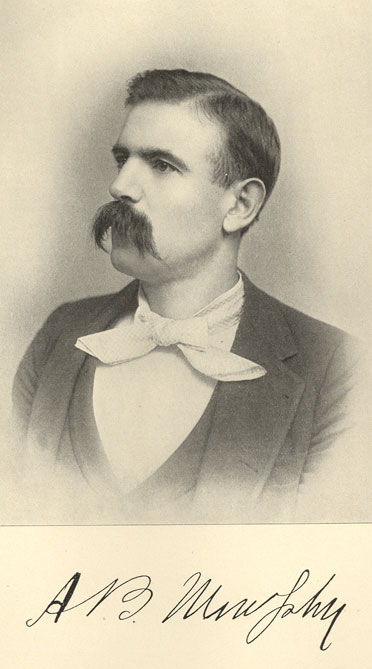
Arthur B. Murphy
WOOD COUNTY, OHIO. - 469
and Desire (Cook) Adams, came to Delaware county when that region was a wilderness. They were at first undecided whether to locate there on " Derby Plains " or at the present site of Columbus; but the finding of a peach tree growing in the woods at the former place turned the scale in its favor. They were devout Methodists, and their house was for many years a regular place of meeting for that society. Both lived to advanced age. Mrs. Adam's sister, Cassandra (Cook) Converse, was the mother of Hon. George L. Converse, of Columbus. Jay Cooke, the financier, was a relative of the family. John Adams and his wife reared a family of seven children named as follows: (1) Ursula, the widow of Dr. L. P. Sigler, formerly of Upper Sandusky, and later of Garden Grove, Iowa. (2) Calvin, a fruit grower in Placer county, Cal. (3) Abraham B., who married Mary Murphy, our subject's aunt. (4) Martha S. (Mrs. Murphy). James, deceased, formerly a resident of Delaware county. (6) John, the recorder of Placer county, Cal. (7) Elijah, formerly recorder of Delaware county, and now a resident of Columbus. Our subject is the eldest of a family of eight children, the others being: (2) Lovett, now in Washington. (3) Delano, who died at the age of twenty-two. (4) Grant, at home. (5) Ernest, deceased at the age of twenty-one. (6) Farrah, a student in the Ohio State University at Columbus. (7) Gertrude, married to George E. Thrall. (8) Cora, at home.
Mr. Murphy attended the district school until he was twelve years old, and then entered the Sunbury High School, and two years later the Ohio Wesleyan University, where he graduated from the scientific course in 1885, with the degree of A. B. He was one of the editors of the college paper, The Transcript. In 1884 he won the college prize for oratory, and in February, 1885, took the second place among eight contestants in the State oratorical contest at Oberlin, Gov. McKinley being one of the judges. He began the study of law with John S. Jones, of Delaware, and in 1886 entered the senior class of the Cincinnati Law School, graduating the following year. He also engaged in oratorical contests there, obtaining second place. On the advice of J. D. Cox, Secretary of the Interior in Grant's cabinet, he came to Bowling Green in the fall of 1887, and engaged in general practice. In November, 1890, he was appointed mayor to succeed Andrew Mears, and in the following April was elected to that office. In 1892 he was re-elected, but resigned to take the office of prosecuting attorney January 1, 1894. He is acknowledged to be the most polished speaker of his age in this part of Ohio. He is a close student, but occasionally breaks the routine of professional life by social diversions and hunting expeditions. Mr. Murphy is a Republican in politics; socially he is a member of the K. of P., the K. O. T. M., and the Phi Delta Theta.
On Thanksgiving Day, 1893, our subject was married to Miss Lizzie Kershner, a native of Liberty Center, Henry county, and they have one child, Nellie F., born January 28, 1895. Mrs. Murphy's parents, Andrew R. and Lanie (Andrix) Kershner, were natives of Pennsylvania, and were married in Ohio. They had eight children, viz.: Jennie and Alice, who both died in infancy; Kate, wife of Rev. W. P. Bender, a minister of the M. E. Church; Mrs. Murphy; George Washington, of Bowling Green; Zella, at home; Adaline, teaching in the Bowling Green schools; and one whose name is not given. The father was a hotel-keeper. He served in the 160th O. V. I., during the Civil war, and was wounded in the service. He died May 15, 1879; the mother resides at Fostoria. Mrs. Murphy was born August 16, 1868, was educated at Liberty Center under the superintendency of George H. Poulson, now of Cleveland, Ohio, and commenced teaching when sixteen. She taught four years in the Bowling Green schools.
GEORGE RETHINGER, of Custar, is a native of Ohio, born in Lucas county, February 13, 1848, a son of John and Mary C. (Long) Rethinger. Our subject passed his boyhood on his father's farm, receiving the usual winter school advantages, later taking a business course at Toledo. In early manhood he worked on a farm during the summer, teaching school in the winter season, till 1874, in which year he came to Custar, and entered the general merchandise store of Ingram, Keeler & Co., in the capacity of clerk and bookkeeper, remaining there some nineteen months, or until the firm was burned out. Mr. Rethinger then taught the parochial school of Custar for one winter, after which he embarked in the grocery trade, in course of time, in connection therewith, engaged in the grain and live-stock business, and expanding his grocery store into one of general merchandise. This he conducted some nine years, then selling out, and again taking up the profession of teaching, this time in the public schools, in which he continued for one winter. Once more he commenced general merchandising, including, as before, the grain trade, having a partner in the person of Abram Phenix; but at the end of one
WOOD COUNTY, OHIO. - 470
year our subject purchased his partner's interest, and conducted the business for his own account until the winter of 1895, when he retired from it. He is now representing Southworth & Co., in the grain business at Custar, managing their elevator, and buying grain.
On June 8, 1876, Mr. Rethinger was married to Miss Catherine Dunigan, daughter of Manus and Bridget (Burns) Dunigan, the former of whom died in 1877, and the latter resides in Springfield, Ohio. To Mr. and Mrs. Rethinger were born ten children, as follows: Charles J., Lucy R., Mary P. , Frederick J. , Bridget A., George Leo, Lawrence I., Anna G., Andrew Raphael, and Agnes C. (who died July 26, 1895, at the age of eight months). The entire family, including the parents, are members of the Catholic Church; socially Mr. Rethinger is affiliated with the Catholic Knights of St. John, and the Catholic Knights of Ohio.
GILBERT T. KNAUSS. Devoting his energies to farm work is this native son of Ohio, who now owns and operates a farm in Middleton township. He was born in Medina county, June 2, 1852, and is a son of George Knauss, one of the early settlers of this locality. When only two years of age he came with his parents to Wood county, and attended school in Plain and Center townships. He worked with his father on the farm, aiding in its development, and also learned the trade of a blacksmith, which he followed for two years in Plain township. At the age of nineteen he came to Middleton township, where he owned forty acres of land, and at once began the development and improvement of his property. He has erected a comfortable country home thereon at a cost of $1,500, -built good barns, laid many rods of tiling, and set out an excellent orchard. In connection with the development of this property, he has also engaged in conducting a blacksmith shop, and has been quite successful in his business. His son now cares for the farm, while he is devoting his energies entirely to the work in the smithy.
Mr. Knauss was married on June 18, 1871, to Frances Grover, who was born in Ballville township, Sandusky county, September 3, 1848. They now have four children-George Franklin, born September 26, 1872; Nora M., born February 20, 1877, now the wife of Allen Ewing, of Plain township; Florence May, born November 19, 1878; and Edna M., born August 9, 1889.
Mr. Knauss has ever been a loyal citizen, a fact which he demonstrated when only eleven years of age by attempting to enlist in the army, but on account of his extreme youth his father prevented him. He has for a number of years served as school director, and was instrumental in securing the establishment of a school near his home. In politics, he is a Republican, and in religious faith adheres to the United Brethren Church. He is a broad-minded man, possessed of excellent qualities, and is deservedly numbered among the leading citizens of the community.
FRANK A. REID, a well-known attorney of Bowling Green, was born at Ottokee, Fulton Co., Ohio, December 4, 1852. His grandparents, James and Priscilla Reid, were born near Edinburgh, Scotland, and a few years after their marriage they came to America, locating in Pennsylvania and later in Hancock county, Ohio, at a point since known as Reid's Corners, where Mr. Reid, who was a ship carpenter by trade, engaged in business as a housebuilder. He was also a justice of the peace for many years. Seven of their children grew to maturity; James, who lives in Van Wert Co., Ohio; William, a character sui generis, a carpenter, a shoemaker, a lawyer and world-wide traveler, who died at Sedalia, Mo.; John H., our subject's father; Raine, a resident of Paulding county, Ohio; Alexander G., living at North Baltimore, Wood county; Sarah P., the wife of Edward Koons, of Lawrence, Kans.; and Thomas C., who died at Bowling Green, Ohio, September 7, 1892.
John H. Reid was born in Pittsburg, Penn., February 11, 1823. Not being content with a common-school education and the carpenter's trade, he determined to enter Oberlin College, where, by working in the harvest field in summer, and doing odd jobs during term time, he succeeded in paying his expenses and graduating. He then read law in Findlay, and on being admitted to the bar located at Delta, Fulton county, where, in 1851, he was elected prosecuting attorney. There he remained until 1853, when he moved to Perrysburg, Wood county. He had previously married a native of this county, Miss Aurelia Augusta Howard, who was born at Grand Rapids January 30, 1826. On his appointment as postmaster in Perrysburg, his wife, a lady of fine mental ability, took charge of the office while he devoted his time to his profession. In 1863 he organized Company D, 86th Regiment, O. V. I., and went to the front as their captain. The company went through the campaign which resulted in the evacuation of Cumberland Gap, Capt. Reid receiving a severe sunstroke while in the mountains. His company had enlisted for
WOOD COUNTY, OHIO. - 471
six months, but were kept on duty nearly a year. After returning home he again entered the army, this time as quartermaster of the 144th O. V. I., in the 100-day service. Shortly after the regiment went to the front Frank A. joined his father at Fort Dix, Md.. and saw considerable of army life during that summer. They took part in the operations in the vicinity of Annapolis and Harper's Ferry. At the close of the war Capt. Reid resumed his practice at Perrysburg, and at the time of the contest over the county seat he was retained on the side of Bowling Green, whose interests he heartily espoused and earnestly defended in the highest courts of appeal. Victorious in spite of the array of learned counsel on the opposing side, he removed to Bowling Green, where he carried on his practice, the latter part of the time in partnership with our subject, until a stroke of paralysis gave warning of his approaching death, which occurred on November 1, 1885. As a judge he had few equals in soundness of logic and subtlety of analysis. As an advocate he was remarkably successful, and when occasion required he could rise to an impassioned yet graceful eloquence. So well balanced was he in his acquirements and gifts that it •is difficult to make a distinction, and mention any leading characteristic. Before the war he was a Democrat, but studying the issues of that time he became a Republican.
He and his wife, who survives him and resides at Chattanooga, Tenn., were members of the Presbyterian Church. Of their children, five grew to adult age, of whom Frank A. is the eldest; J. Howard, born May 13, 1860, died September 30, 1886; James R. and Richard WV. are clothing merchants at Chattanooga; Mary Augusta lives with her mother.
The Howard family, from whom our subject's mother descended, were prominent in the history of the Maumee Valley. Thomas Howard, our subject's great-grandfather came from Yates county, N. Y., in 1823 with his wife, a daughter, Sidney, who afterward became Mrs. Howard Davidson, and his three sons- Edward, Robert A., and Richard M. W.-with their respective families. Part of the family came by water, the rest taking the land route and driving their live stock. They first located at Fort Meigs, but later removed to the Rapids of the Maumee, Gilead, where they made their home for many years. Thomas Howard (who was born November 15, 1758), died there May 25, 1825. His son, Robert A. Howard, our subject's grandfather, was born November 10, 1798, and survived all the other members of the band of pioneers. His last years were spent in what is now Pike township, Fulton county, where he died November 26, 1872. The Toledo Commercial of December 4, 1872, gave an extended obituary notice, and mentioned his valued services as a justice of the peace in Fulton county, an office which he held for many years, and used as a means of quietly adjusting difficulties, his kindly advice as a man of well-known impartiality being as potent in its influence as his judicial decisions. After Fulton county was established he was employed to transcribe -the old records, and later was elected county recorder. His wife, formerly Miss Priscilla Nelson, was highly esteemed by all who knew her. After a half century of married life, they died within a year of each other. Of their nine children five are now living: A. A., of Mason, Mich.; Col. N. M., a prominent business man of Omaha; Edwin A., of Hillsdale, Mich., formerly an Indian agent in Dakota under President Grant; James W., of Fulton county, Ohio; and Aurelia Augusta (Mrs. Reid).
Frank A. Reid was less than a year old when brought to Wood county, and he received his elementary education in the public schools here. He then entered the Law School at Ann Arbor, where he was graduated in 1877. Until his father's illness he practiced with him, and since that time he has continued alone, conducting his extensive practice with unusual ability and marked success. He is an active and influential Republican, and during Garfield's campaign was organizer and president of the Garfield Club. On June 15, 1878, he was married to Miss Alice Lundy, born November 15, 1856, the daughter of Henry and Margaret (Smith) Lundy, who came from Pennsylvania to Wood county in . 1836. Mr. Lundy was prominent among the pioneers of Wood county, was for years a director of the County Infirmary, trustee of Center township, and took a leading part in securing the location of the county seat at Bowling Green, contributing generously toward the new court house. Mr. and Mrs. Reid have two children: Earl A., born August 30, 1879, and Helen A., born March 27, 1881.
LEONARD DANIELS (deceased), who was a highly respected citizen of the county, born in New York December 5, 1811, died at his home in Middleton township in 1871, esteemed by all who knew him. He was one of a family of ten children born to William and Prudence (Prior) Daniels. In his early life he learned the carpenter's trade, and followed that occupation for some years.
WOOD COUNTY, OHIO. - 472
On February 15, 1856, Mr. Daniels was united in marriage with Miss Martha Worth, a native of the Empire State, born on the 2d of May, 1817. She was one of a family of ten children, whose parents were Thomas and Mary Worth. By the marriage of Mr. and Mrs. Daniels were born nine children, namely: D. W., a farmer of Washington township; Prudence, wife of G. A. Simmons, of New York; Amon J., who is operating the old homestead; Herbert R., who is in the West; Jesse M., a carpenter; H. C., who is living in Bowling Green; D. L., a farmer; Alice M., wife of E. H. King; and Inez M., wife of V. R. Porter, of Bowling Green.
The subject of this review continued his residence in the East until 1866, when he came with the family to Wood county, where he purchased 100 acres of land, on which the widow now resides. It was then wild and unimproved, but he at once began to clear it, and worked long and earnestly in transforming it into richly cultivated fields. He continued his work until 1871, when death relieved him of his labors. He was a man of sterling integrity and commendable worth, and had the confidence and good will of all who knew him.
After his death Mrs. Daniels took up the work where her husband laid it down, and, with the help of her sons, has succeeded in clearing the farm and bringing it under a high state of cultivation. Many rods of tiling have been laid upon the place, and, thus drained, it has been transformed into richly cultivated fields. A good residence and barns add to its value, and it is now highly improved. Mrs. Daniels deserves great credit for carrying on the work as she has .done, and she is still, at the age of seventy-eight years, keeping house for her sons.
HON. BENJAMIN F. JAMES, a prominent young attorney of Bowling Green, of the firm of James & Beverstock, and ex-representative of Wood county in the State Legislature, was born near Mt. Gilead, Morrow Co., Ohio, April 30, 1863.
His paternal grandfather, Edmund James, a native of Wales, came to America when a young man, locating near Granville, Ohio, where he met and married Miss Esther Griffith. She had come from Wales in childhood with her parents, who settled at the '' Welsh Hills," in Licking county. After their marriage they remained some years in the same locality, and then moved to Chesterville, in Morrow (then Knox) county, where they spent the remainder of their lives. They had ten children, among whom was William D. James, our subject's father, who was born near Chesterville, December 22, 1815. He was a farmer and stock dealer by occupation, and an active politician, first in the Whig, and later in the Republican, party, being one of five in his locality to vote the latter ticket during the war. Strange to say, in 1894, each one of this little band was represented in the State Legislature; William D. James, by his son, the subject of this sketch; John McConica, by his son Senator Thomas H. McConica, of Findlay; Benjamin Philips and David Thomas (cousins of William D. James), by Senator Dudley B. Philips, of Manchester; while Hugh G. Rogers, one of the survivors of the quintette, was there in person as member from Morrow county.
Our subject's mother, Sarah (Meredith) James, was born in July 30, 1818, at Chcsterville, the seventh of the ten children of William and Mary (Farmer) Meredith. Their respective families had emigrated from England to America in 1800, and settled near Chesterville, where, after their marriage a few years later, Mr. Meredith and his wife also located upon a farm. Our subject's father died May 13, 1875, his mother on September 27, 1894. They also had ten children, of whom Benjamin F. is the youngest. Lucretia married T. H. Peterson, of Longley, Ohio. Milo, a private in Company D, Third O. V. C., died at Nashville, Tenn., September 10, 1862. Mary E. is the widow of Capt. James A. Moore, of Olathe, Kans., and now resides in Fulton, Ohio. James H. is a farmer in Fulton, Morrow county. Milton D. is the president of the Globe Building & Loan Association of Columbus, Ohio, and a prominent real-estate dealer there. Robert W., formerly a stock dealer at Marengo, Ohio, died May 9, 1883. Keturah is the wife of G. L. Donals, of Helena, Ohio. Jennie E. died July 9, 1883, the wife of A. A. Crawford, county commissioner of Morrow county. Ellsworth W., who died December 5, 1889, was a stock dealer in the same county.
Mr. James spent his boyhood upon his father's farm, and up to the age of fifteen was mainly employed in outdoor labor. But he was not one to be contented with the peaceful but monotonous life of a farmer, and he determined to secure an education and take a place in public life. The next six years were passed in different educational institutions, the Chesterville High School, the Ohio Wesleyan University, Dennison University, at Granville, and the Chicago University, where he was graduated June 11, 1884, at the age of twenty-one, with the degree of A. B. The following year he took the professorship in Latin and Greek in Burlington College, Burlington,

Benjamin F. James
WOOD COUNTY, OHIO. - 473
Iowa, which he resigned at the close of the year to enter Yale University, New Haven, Conn., although he was tendered the presidency of the college, which he declined. At Yale he took post-graduate and law studies, and on June 28, 1887, he received the degree of LL. B. In October of that year he began to practice his profession, first in partnership with judge G. C. Nearing, and later with Edward Beverstock, his present partner. Although the firm of James & Beverstock is one of the youngest in the county, they already have an extensive practice, having law offices both in Bowling Green and Toledo, Ohio.
Mr. James is highly gifted as an orator, and his speeches at the bar and before public assemblies are regarded as masterpieces by competent judges. He is a born politician, and his abilities were promptly recognized by the older members of the Republican party. In 1890 he was chosen vice-president of the Ohio Republican League, and a year later a vice-president of the National League. In local politics he was also a leader from the first, and in 1890 he was elected city solicitor, resigning that office in 1891, after his election to the General Assembly. His first term gave him a reputation as a tireless worker, and a fearless champion of any measure which he believed to be right, and he was re-elected in spite of strong partisan opposition. He has the happy faculty of making friends, seldom forgetting a face or a name, and there are few other men in this county who have as wide a circle of acquaintances. He is a 32° Mason, holding his membership in the Cincinnati Consistory, and he belongs to the Zeta Psi, a college fraternity, as well as the Phi Delta Phi, a legal fraternity, having been the founder of the Yale Chapter during his attendance there.
CHRISTOPHER FINKBEINER, ex-recorder of Wood county, and one of the most prominent residents of Bowling Green, was born June 9, 1845, in Wurtemberg, Germany, where his ancestors on both sides had for many generations been worthy and industrious citizens. His parents, Friedrich and Mary A. (Audee) Finkbeiner, came to America in 1847, settling finally in Perrysburg, Wood county. The father was a miller by trade, but after coming to this county found more profitable employment as a carpenter and contractor. He took a hearty interest in the welfare of his adopted country, and sent three of his sons to the defense of the Union. Previous to the war he was a Democrat, and then became an ardent Abolitionist and Republican. He died Jannary 17, 1863, aged forty-eight years, and his wife in 1865, at the age of fifty. Of their large family four lived to adult age: Frederick and John, who have been engaged in mining in Arizona and the West since the war closed; Christopher, our subject; and Mary, the youngest child, now the wife of Charles Church, of Toledo, Lucas Co., Ohio.
Our subject, who is the third son, was two years old when he came to this county, and his education was obtained in the common schools of Perrysburg. His first business venture was driving a dray, which occupation he followed until December 4, 1861, when he enlisted in Company E, 72nd O. V. I., under Gen. Sherman. During the advance upon Corinth, he contracted typhoid fever, and July 25, 1862, he was discharged for disability, and sent home. On July 1, 1863, he again enlisted, this time in Company L, 3d O. V. C., joining in time to take part in the battle of Chickamauga, the pursuit of Gen. Wheeler, and the engagements at Missionary Ridge and Knoxville. In the spring of 1864 his regiment joined Sherman's forces at Cartersville, Ga., and took part in his famous campaign. After the capture of Atlanta they followed Hood into Alabama, and in the last engagement with his troops, October 25, 1864, near Gadsden, our subject was wounded, necessitating the amputation of his right foot. Until March 16, 1865, he was a patient in various hospitals-at Rome, Chattanooga, Nashville, Jefferson Barracks, at St. Louis -and then declining to enter the Invalid Corps he came home. For a short time he worked in a stave factory in Perrysburg, later clerked in a store, and September 30, 1867, he opened a store of his own, dealing in books and notions. After four years he moved his stock to Napoleon, where he remained two years, and then sold out to take a position as traveling salesman for a firm of dealers in wooden ware. During the next seven years he visited in their interests points in Canada, and the northern States from Massachusetts to Colorado. Under Garfield's administration he was appointed postmaster at Perrysburg, and after four years and a half he opened a store for notions and gents' furnishing goods, which he carried on until his election to the office of county recorder in 1888. He served the people of the county in this capacity two terms, his faithful and efficient service having been rewarded in 1891 by a re-election.
On January 1, 1867, Mr. Finkbeiner was married to Miss Mattie A. Bellville, a native of Perrysburg, born November 8, 1847, and they have had four children: Fred J., born November 5, 1867,
WOOD COUNTY, OHIO. - 474
is living at Bowling Green, Ohio; William A., born September 13, 1869, is a merchant at Perrysburg (he married Miss Winnie See, and has one son-Donald A.); Helen Gertrude is now at home; and Jessie Belle is also at home. Mr. Finkbeiner is one of the influential Republicans of Wood county, and he is a member of the I. O. O. F., the N. U. and the G. A. R.
HENRY S. CHAPIN, editor and proprietor of the Democrat, Bowling Green, is a native of Connecticut, born January 4, 1835, at Collinsville, Hartford county, a son of Ariel S. and Mary D. (Jones) Chapin, natives of Berkshire county, Massachusetts.
Ariel S. Chapin was a son of Amos and Rebecca (Sheldon) Chapin, who were also of Berkshire county nativity. Mary D. (Jones) Chapin was a daughter of Barnabas and Ada (Harmon) Jones, of the same locality in Massachusetts, and on both sides of the house they followed agricultural pursuits. Both families (Chapin and Jones) moved in 1836 from Massachusetts to Lenox, Ashtabula Co., Ohio, where they bought land and cleared up farms. Ariel S. Chapin, father of our subject, lived in Collinsville, Conn., for a time, being there employed in some of the manufactories of that place, though his occupation in the main was that of a farmer. The son, Henry S., was a year old when his parents came to Ohio, and but seven years of age when his father died at Lenox; the mother passed from earth, in 1893, at the home of our subject in Bowling Green. They were the parents of two children: Harriet, who married J. C. Frankeberger, of Sidney, Shelby Co., Ohio, and died there in 1868; and Henry S., our subject, who has never married.
Henry S. Chapin attended the common schools ; also the Union school of Jefferson, Ashtabula Co., Ohio, and worked on a farm until he was seventeen years of age, when he commenced learning the printing business in the office of the Weekly Telegraph, Ashtabula. At the end of two and one-half years he left there, and during the succeeding two years attended the Union school at Bellefontaine, Ohio. Returning to the printer's trade, he, from 1856 to 1862, was a compositor on Cincinnati and St. Louis newspapers, and in October of the latter year, in connection with F. J. Oblinger, he purchased the Perrysburg journal, which they jointly conducted two and one-half years. In 1864, Mr. Chapin went with Company E, 144th O. V. I., Capt. Asher Cook, on the ,100-days' service. " In the spring of 1865 he bought the Republican, of Peru, Ind., and published the same until 1868, in which year he went to Toledo, and opened a job printing office, being associated therein with James Timmons. At Toledo, in 1872, he commenced the publication of the Sunday Journal, which later he sold to Sherwood & Canfield. On April 26, 1876, he commenced the publication of the Toledo Daily Bee, and had charge of that paper eight years, afterward becoming connected with the Toledo Post, which two years later was sold, and for a short time, in 1888, he was identified with the Toledo News. During the year 1889, and up to August, 1890, he was editor of the Post, of Columbus, Ohio, and on September 1, 1890, took charge of the Bowling Green Democrat, which he had purchased, and he has since conducted it with his well-known ability.
GEORGE WILLIAMS was born in Heistenbach, Province of Nassau, Germany, January 4, 1847. His father, Ludwig Williams, a native of Germany and a farmer by occupation, was twice married, first to Katharina Danzer, by whom he had two children, Anton and Clara. For his second wife he married Louisa Fischer, and to this marriage one child was born, George, the subject of this sketch, who remained at home until the age of fourteen years, attending school from the age of six until fourteen. November 1, 1858, the father died, and the widow and son were left with but little, and the former was of necessity compelled to work hard from day to day in order to make ends meet. March 15, 1861, when in his fourteenth year, himself and mother left the old home in Germany, and came to Washington township, Wood Co., Ohio, and made their home with a half-brother of the son, Anton Williams, who had come to this country several years before. The first three years after his arrival George remained with Anton, working on the farm, then for four years he worked for Anton Opperman, and one year for Nelson Kuder, farmers of the same township. Following this in 1869, he rented forty acres of land in Middleton township, on which himself and mother made their home for five years.
On October 5, 1873, at the age of twenty-seven, Mr. Williams was married to Emma Hartman, of Middleton township, and the union was blessed with one son, George Frederick, born April 2, 1884. March 1, 1874, he bought seventy-three acres of land near Haskins, Middleton township, at fifty-four dollars per acre, paying $800 down. The land was in a poor condition, only a few acres being cleared, and the improve-
WOOD COUNTY, OHIO. - 475
ments-buildings, fences, ditches, etc. were poor indeed, and Mr. Williams was required to work hard to clear and improve this land, and under the burden of 12 per cent. interest part of the time. The present buildings on the place are good and substantial, and the other improvements correspond. This simple record of actual achievements shows better than praise the industry and enterprise of the man. July 27, 1874, the mother died at the age of sixty-one years, having lived only four months and twenty-seven days with them in their own home. The wife's mother, aged seventy-four years, is spending the evening of her life with them. Mr. Williams is a member of the Lutheran Church, of which he is a trustee, and he has been superintendent of the Sunday-school since the organization of the Church, at Haskins, twenty-three years ago. He has been a school director for two terms, and assessor also for two terms.
Faithful in the discharge of every duty, energetic, and possessed of an unusual measure of common sense, Mr. Williams has won the esteem and confidence of all who know him.
JOSEPH E. BURNHAM, M. D., one of Wood county's rising young physicians, and junior member of the well-known firm of Sage & Burnham, of Prairie Depot, belongs to the homeopathic school of medicine. A native of New York, he was born at Pottsdam, St. Lawrence county, May 1, 1865, a son of Aaron and Sarah (Nesbit) Burnham, the former born at Augusta, Maine, and the latter in New York. The father was a citizen of Pottsdam, where he died at the age of seventytwo years, but his wife is still living at that place.
The Doctor is the third child and eldest son in the family, and was reared to manhood in his native town. His elementary education was obtained in the public schools, where he learned rapidly, and at the age of sixteen years entered the Pottsdam Normal School, an advanced institution, where he pursued his studies for two years and a half at different times, his attendance being interrupted by school teaching, which he followed very successfully. The illness of his father necessitated his leaving the Normal, where he had intended to take a full course, and then followed the profession of teaching in the West.
In 1889 our subject entered the office of Dr. H. D. Brown, of Pottsdam, one of the most successful practitioners of northern New York, and there began the study of medicine. In the fall of 1892 he became a student in the Cleveland Medical College, from which he was graduated with high honor in the class of 1895, standing second in a class of forty-two. He began practice at Port Clinton, Ohio, but on November 18, 1895, he located at Prairie Depot, and has since been associated with that successful old practitioner, Dr. Sage. He is a thorough student of his profession, keeping well informed on the recent discoveries in science, and his worth and merit have been justly recognized. Politically, he is identified with the Republican party.
W. H. WOOD, the well-known ex-surveyor of Wood county, and a prominent resident of Bowling Green, is a native of this county, born at Tontogany, July 13, 1836.
The family is of English origin, and the founders of the American line were early settlers in Virginia, where his grandfather, judge Joseph Wood, was born about 1768. He removed to Marietta, Ohio, where he surveyed the first seven ranges that were officially located in Ohio, being accompanied by a guard to keep the Indians at bay. In later years he served as probate judge of Washington county.
His son Emilius, our subject's father, born in 1793, was the third white child born in the old fort at Marietta. He was educated at the university at Athens, Ohio, and became a surveyor, and for twelve years was county surveyor of Perry county where he married his first wife, Miss Addie Fuller, who died in 1833 leaving two children-A. J., now in Oklahoma, and E. R., a resident of Belle Plaine, Kans. His second wife was Miss Sarah North, who was born in Philadelphia, Penn., in 1817, and came with her parents, Joseph and Catherine North, to Wood county in 1828, to settle in the wilderness. Her mother, after their arrival, was lost in the woods for three days and nights, staying in a tree at night to keep out of reach of the wolves. She found her way home by following a small stream to the river. Our subject was the eldest of eight children by the second marriage. The others were: Adeline Amelia, Caroline Aurelia (deceased), Catharine Lucelia, John R. (deceased), Josephine Adelia, Emeline Ophelia, and Angeline Fidelia. Our subject's father came to Wood county, in 1834, and settled at Tontogany, and for many years was engaged in surveying the wild and unbroken forests. During his later years he followed farming as an occupation. His death occurred in 1875 while on a visit in Iowa. (His wife had died in 1871 at the age of fifty-four). In politics he was a Republican, and he took a leading part in all the progressive movements in the community. The first Masonic lodge in the county was organized in his house where the
476 - WOOD COUNTY, OHIO.
lodge met for six years, and he was the second to hold the office of Master. At one time he rode to Zanesville on horseback, once to Marietta and once to Columbus, to attend Grand Lodge meetings.
Our subject's early education was acquired in the district schools near his home, and in the high school at Waterville and Maumee City. He taught for five terms, and in the intervals worked on the farm. In 1862 he enlisted in Company D. 111th O. V. I., and served in the army of the Cumberland. For some time he was detailed as hospital guard, having been sick and unfitted for more serious duty, and here his fine abilities as a musician were found useful. During the first and last years of the war he was with his regiment, and marched across Kentucky and Tennessee, taking part in the engagement at Fort Saunders, Tenn. He was mustered out at Salisbury, N. C., June 27, 1865, and discharged at Cleveland, Ohio, July 13, 1865. After the war closed he spent eighteen months in Missouri, and then returned to Wood county, where he has since been engaged in his profession. He has laid out over 15,000 miles of ditches, not to mention other work. He was elected county surveyor in 1871, and held the office for four terms, to the satisfaction of all concerned. In 1865 he married Miss Josepha R. Hoskins, who was born in Portage county, Ohio, in August, 1844. She is of the family of Morse, the inventor, and her grandfathers were in the Revolutionary war. Mr. Wood has for many years been the organist of the M. E. Church. He is a Republican, and a member of the G. A. R., No. 46, Wiley Post, and of the I. O. O. F.
R. S. PATTY, a highly esteemed citizen of Bowling Green, is one of the most extensive oil operators in the country, his interests being located in Pennsylvania, West Virginia, and Indiana. He began work in the oil fields when quite a young man, being first employed as a driller and pumper. Later he became a contractor for drilling wells, first doing business for himself as a member of the firm of Patty Brothers, their wells being located near Bradford, Penn. This firm afterward extended their operations to West Virginia, Indiana, and Kentucky, and in 1889 to Ohio.
Of late years the firm of Patty Brothers has also engaged in the gas business, and is at present conducting extensive plants at Weston, W. Va., under the name of the Weston Natural Gas & Fuel Co., and at Logan, Ohio, as the Logan Natural Gas & Fuel Co. The latter supplies the Boys' Industrial School at Lancaster, and is preparing to extend their line into Circleville and to Chillicothe. At Weston, W. Va., they supply, among other public institutions, the State Insane Asylum with light and heat. Our subject and his brother were the promoters of these companies, and now control them.
The subject of this sketch was born in Armstrong county, Penn., June 16, 1852, and was reared there, his education being limited to the common schools. He was married December 15, 1876, to Mary E. Smathers, who was born in Clarion county, Penn., March 15, 1859, daughter of Isaac (a lumberman) and Harriet (Reed) Smathers, both yet living, who are parents of eight children: Sarah, Lawson (who died when a young man), Mary E., Malinda, John, Robert, Amelia, and Palmer (deceased when young). Mrs. Patty is descended from the Hulling family, and her great-great-grandmother was a sister of Daniel Boone. Three children have been born to Mr. and Mrs. Patty: Harry L., Roy Levern, who died when young, and Eddie R. The family occupy a palatial residence in Bowling Green, whither they removed in 1889, Mr. Patty's main office being in the Times building, Pittsburg, Penn., where he directs the affairs of his extensive business. He is essentially the architect of his own fortune, a genial gentleman who has won his way to success by energy and enterprise, and to-day is conceded to be one of the best business men, and most successful operators in the oil fields of this or any other State. In his political predilections he is . a stanch Republican, but has no time to spare for office hunting or office holding. He is a member of the Presbyterian Church, of Parkers City, Penn.; Mrs. Patty of the Church of the same denomination at Bowling Green.
The parents of our subject, James ( a carpenter by trade) and Nancy (Speer) Patty, were both born in Pennsylvania, the father, in 1800, in Westmoreland county, of Scotch-Irish descent, the mother, in Armstrong county, in 1817. Both passed away in the latter county, she in 1864, and he in 1882. The father of James Patty, also named James, was a native of Westmoreland county, Penn., and one of the early settlers of Gettysburg, that State. Our subject was one of five children, namely: James, who was a member of the oil firm of Patty Brothers, and died in 1894; R. S.; Belle, who was a prominent school teacher in Armstrong county, Penn., and is now deceased; George, who, it is supposed, was murdered while drilling wells in the West; and Elizabeth, the wife of Samuel Blakely, of Marion, Indiana.

R. S. Patty
WOOD COUNTY, OHIO. - 477
T. T. ROSENDALE, M. D., one of Fostoria's rising young physicians and business men, is a native of West Millgrove, Wood county, the son of that well-known and successful practitioner, Dr. Charles R. Rosendale. His early education was obtained in the district school of his native village, his first teacher being Miss Sally Buckingham. In 1887 he entered the Northern Indiana Normal School, where he remained three years. He had previously read medicine with his father and Dr. C. A. Henry, of Fostoria, and in 1890 he entered Western Reserve Medical College at Cleveland, from which he was graduated with the degree of M. D. in 1893. In 1892 he made a trip to Europe in the interest of his profession, and immediately after graduation entered into active practice, taking an office in the opera block at Fostoria, where he is still located. In common with all young professional men he found it no easy matter at first to compete with older practitioners, but each year has found him steadily gaining in the confidence of the people, and he now enjoys a practice highly creditable for one of his years and experience. In 1894 he attended the University of California, where he pursued post-graduate work, giving special attention to dissecting.
On September 10, 1895, the Doctor was married to Miss Madge P. Harris, a native of Virginia, who is the daughter of V. H. and Augusta P. Harris. Mrs. Rosendale was graduated from the Fostoria, High School in 1885, and in the scientific course from Buchtel College, Akron, Ohio, in 1889.
Dr. Rosendale is one of the wide-awake, progressive young men of Fostoria, seeming to inherit the business tact and shrewdness of his father, whose success in life has but few parallels in Wood county. In addition to his practice he has extensive business interests, which receive careful attention. In 1895 he erected on Perry street one of the finest houses in the city, where he and his wife entertain their large circle of friends in a delightful manner. Politically he is a stanch Republican, taking an active part in the politics of the city.
CAPTAIN J. B. NEWTON, one of the most prominent citizens of Bowling Green, with the chief interests of which city he has for many years been identified, was born September 10, 1837, in Chenango county, New York.
His grandfather, Daniel Newton (1), a native of New England, born May 9, 1786, settled in Chenango county, N. Y., in early manhood, and married Miss Patty Bell, who was born in Connecticut, July 8, 1788. Their son, Daniel Newton (2), born October 12, 1810, married Miss Sarah Burdick, also a native of Chenango county, born February 10, 1810. They were married January 12, 1834, and six years later came west, located in Wood county, Ohio, first in Center township, and later (eight years afterward) in Bowling Green. In 1864 they removed to Roachton, but in 1876 they came back to Bowling Green, there to pass their declining years. They were both earnest and consistent members of the M. E. Church, and faithful workers in every line of Christian duty. Mr. Newton was originally a Whig, later a Republican, and was an intelligent student of public affairs. He died March 20, 1881, his wife having preceded hire to the grave, November 18, 1872. Of their six children, three grew to adult age: Louis M., born October 8, 1834, now a leading resident of Garnett, Kans.; J. B., our subject; and Jennie, who married L. D. Stearns, now of Willapa, State of Washington. The deceased are: Jeremiah C., born September 20, 1842, died August 19, 1849; James L., born August 9, 1846, died December 4, 1846; and Chloe E., born July 21, 1847, died July 31, 1847.
Capt. Newton's early education was restricted to an attendance at the district schools near his home. When the Civil war broke out he was among the first to enlist for the three-years' service, in August, 1861, joining Company A, 14th O. V. I. His regiment was assigned to the 14th Corps, army of the Cumberland, commanded by Gen. Thomas, and served through the campaigns in Kentucky, Tennessee, Mississippi, and Georgia, taking part in the historic march to the sea, and was present at the surrender of Johnston. Capt. Newton was promoted from private through the grades of corporal, sergeant-major, second lieutenant, first lieutenant, to the rank of captain; as second lieutenant he was detailed as adjutant, and served in that capacity until promoted to captain. During the latter part of his service he was detailed mainly on brigade staff duty. At the close of the war he went to Washington and participated in that ` Grand Review," and was finally discharged at Cleveland, Ohio, in July, 1865. He was never wounded, and never absent from his command, except once, by reason of sickness, in 1862.
In 1868 he married Miss Maggie Blackwood, who was born in Oakland county, Mich., January 23, 1844, and four children came of this union: Welles B., born April 17, 1869, now a druggist in Toledo; Clyde B., born May 22, 1874, a student at Alma, Mich.; Earl W., born June 8,
478 - WOOD COUNTY, OHIO.
1881; and Mary Belle, born November 27, 1882. Soon after his return from the army, Capt. Newton was elected county auditor, and served three terms of two years each. He then engaged in agricultural pursuits in Center township some fifteen years, during which time he did an extensive business in. feeding and shipping stock. When the gas boom came to Bowling Green, the Buckeye Glass Co. was among the first to utilize the new product, and selected him to manage the financial affairs of the company. The Ohio Flint Glass Co. was incorporated in 1891 for the manufacture of table glassware, and the attendant lines common to that branch of the business. When the natural gas, for fuel for manufacturing purposes, failed at Bowling Green, the company decided to remove their plant to the gas fields of Indiana. They selected Dunkirk for their location, and entrusted Capt. Newton with the management of the affairs of the company. In 1895 he was elected president thereof, and given charge with general management of its affairs, retaining his residence in Bowling Green. Politically he votes the Republican ticket, is very influential in party affairs, and takes a leading place in all public movements; he has always been ready to assist in any movement tending to advance the interests of the city, and was one of the early clerks of the corporation as soon as he became of age. Socially he is a member of the G. A. R., Wiley Post, No. 46; of the I. O. O. F. and Encampment, and a member of the Loyal Legion in the Ohio Commandery.
COLONEL M. F. MILES, a representative farmer of Montgomery township, was born in Chesterville, Morrow county (at that time Knox county), Ohio, December 10, 1838, and is a son of Davis and Julia A. (Denrnan) Miles. His grandfather, Enos Miles, was born in Chester county, Penn., July 3, 1786. He married Miss Elizabeth Frame, who was born April 3, 1790. They came to Ohio in an early day, bought up tracts of land, and Mr. Miles named Chester township, also Chesterville. A man of means, he erected a large brick hotel and other buildings, one of which he fitted out as a school and boardinghouse; but his ideas were far too advanced for those days, and his venture involved him in financial difficulties. Mr. Miles died in Chesterville, May 18, 1840, and his wife on August 18, 1871. Their children were Davis, Euclid, Enos, Jane and Catherine.
Davis Miles, the father of our subject, was born in Chester county, Penn., in 1814, came to Ohio with his parents, and was married in Chesterville in 1837. His wife was a daughter of Joseph Denman, a farmer. At the time of his father's death, Davis took charge of his affairs, which were much involved; but he took an extension of time, and was able to hold the property. He conducted the hotel business successfully, and when the property was divided it was not by a forced sale. At the organization of Morrow county Mr. Miles was chosen first sheriff. He owned considerable land adjacent to the village of Chesterville, and hired almost all of his work done, although in early life he was an active farmer. He was a man of excellent judgment and common sense, and possessed a strong natural intellect. He was a stanch Republican, a prominent man in his community, and served two terms in the Ohio Senate. The children of Mr. and Mrs. Miles were as follows: M. F., our subject; Enos W., a traveling salesman, of Mansfield, Ohio; and Mary C., who died young. Mr. Miles passed away August 6, 1865, and Mrs. Miles in 1876, and both are buried at Chesterville. They were members of the Baptist Church, in which, later in life, Mr. Miles took an active part; socially he was a member of the Masonic fraternity.
The early schooling of our subject was obtained in his native village schools. At the age of twenty he entered the Ohio Wesleyan University, at Delaware, where he remained one year. For two years he was a student in the University of Michigan, at Ann Arbor, and while there enlisted in the students' battalion, whose services were rejected on account of the quota of men being already filled. Mr. Miles returned home, and on September 14, 1861, enlisted in Company B, 43d O. V. I., under Gen. C. Smith, and went into camp at Mt. Vernon, Ohio, where he was appointed sergeant. On January 9, 1862, he was promoted to the rank of second lieutenant, and assigned to Company A, 49th Regiment, then camped at Green River, Ky. On February 14, 1862, the regiment was ordered to Bowling Green, Ky., and thence to Shiloh, advancing to the assistance of Gen. Grant. His regiment participated in that battle, and with other forces held their position from 11 A. M. to 4 P. M., when the enemy was obliged to retreat. The other battles in which our subject took part are as follows: Corinth, Lawrenceburg, Stone River, Liberty Gap, Crab Orchard, Chickamauga, Murfreesboro, Mission Ridge, Rocky Face Ridge, Cassville and Pickett's Mills. In the battle of the last mentioned place, which occurred May 27, 1864, the 49th entered the fight with 560 men, and lost 224. After the fall of Atlanta our
WOOD COUNTY, OHIO. - 479
subject returned with his regiment to Nashville, participating in the battles of Franklin and Nashville. On June 15, 1865, it was taken to Texas in order to quell any continuance of the Rebellion, it forming a part of the 4th Army Corps. On September 30, 1862, Mr. Miles was promoted to first lieutenant, and assigned to Company B, 49th Regiment. On March 2, 1863, he was made adjutant of the same regiment, and was then transferred to Company H, and promoted to the rank of captain of that company. On October 4, 1863, he was made major, and March 29, 1865, promoted to lieutenant-colonel. On June 26, 1865, he was mustered out, but in November of the same year he was sent to Victoria, Texas, and was not finally discharged until December 31, 1865.
After the close of the war, Col. Miles engaged in the lumber business at Logansport, Ind., for some time, and then went to Chicago and started in the retail drug trade on State street, at the corner of Taylor. He had a previous knowledge of this business, but failing health compelled him to give it up and return to Wood county. Here he was married, October 11, 1866, to Miss Maggie E. Diver, a native of Montgomery township, born June 30, 1843, the daughter of Osman and Esther F. (Robinson) Diver, the former of whom was born August 23, 180g, and the latter April 2, 1818. Mr. Diver was twice married, his first wife being Miss Margaret Kinnaman, who bore him three children, two of whom - Franklin and Laura - grew to maturity; by his second wife, Mr. Diver had three children -Maggie, Osman A., and Harriet M.
Col. Miles began the business of flour-milling in West Millgrove, Wood county, in 1868. The mill burned down in 1872, and he and O. A. Diver built on its site the present structure, with which our subject was connected for twelve years. Since retiring from that business he has resided in Montgomery township, in Section 29, where he has a comfortable home and carries on farming, having over 377 acres under his direction. He has always been a Republican, and in 1887 was elected sheriff of Wood county, serving two terms, but retaining his residence in Montgomery township during his service. Both he and his wife are members of the Christian Church, in which he has been an elder for many years. He is also secretary and treasurer of the 19th District Ohio Christian Missionary Society. Socially he belongs to the Masonic order in Fostoria, and to the G. A. R. Col. Miles, as he is always called, is a prominent citizen of Montgomery township, is a man with a keen conception of right and wrong, loyal and trusted, and a strong supporter and earnest advocate of whatever is for public good.
Mrs. Miles is State president of the Christian Woman's Board of Missions, an auxilliary to the Christian Church, which is a grand organization. She went to school at Fostoria, Ohio, and at Oberlin, later graduating at the Seminary at Mt. Vernon. She is a woman of considerable literary ability, her writings being mostly on religious subjects, which have been printed in the leading publications of that character.
GEORGE C. STEVENSON, a member of the firm of Matthews & Stevenson, leading grocers of Bowling Green, who is even better known as a breeder of blooded horses, was born June 2, 1844, in county Down, Ireland.
His grandfather, James Stevenson, was an officer in the British army, a quartermaster under Sir John Moore, and while in Ireland on a recruiting expedition he was so charmed with the beauty of the country that he resolved to return there to live, if it were possible to do so. Some time afterward, having been wounded in the battle of Waterloo, he was retired from service, and he purchased an estate in county Down, whereon he spent the rest of his life.
William Stevenson, the father of our subject, was born in Spain, eight days before the battle of Coruna, in which Sir John Moore was killed. His early life was passed mainly in Ireland. At the age of nineteen he came to America, but returned to Ireland, where he was married to Miss Jane McAlpine, a descendant of one of the oldest and most powerful of the Scottish clans. In 1851 he came to America again, bringing his family, and located first at Pittsburg, Penn., and finally settled in Ashtabula county, Ohio, where he engaged in the lumber business. Our subject was second in order of birth of six children: James, the eldest, lives in Seneca county, Ohio; Margaret is the wife of Charles Scoville, of Ashtabula; Mary (deceased) was the wife of V. L. Chapin; W. J. is a resident of Williams county, Ohio; William died in Pittsburg, Pennsylvania.
Our subject was educated in an academy at Ashtabula. When the Civil war began the martial spirit inherited from both paternal and maternal ancestry impelled him, though a boy in years, to join in the struggle. On August 20, 1861, he enlisted in Company K, 83d P. V. I., and served throughout the war, receiving his final discharge June i8, 1865. He was in the battles of Big Bethel, Yorktown, Malvern Hill, Cold
WOOD COUNTY, OHIO. - 480
Harbor, Spottsylvania, North Anna, Chancellorsville, Gaines Mills (where he was slightly wounded), Laurel Hill and Charles City Cross Roads. In 1862, at Malvern Hill, he was shot through the right lung, and the night after the battle his captain, who had hunted him up, got the surgeon to examine and dress his wounds; but Mr. Stevenson was then informed that he could not live till morning, as he was bleeding internally. Thus confronted with death, this worthy descendant of heroes declared that, having done his duty, he was satisfied. He could die in no better cause. About 7 o'clock the next morning, however, a negro discovered him, and, lifting him up, gave him a drink of whiskey, which so revived him that he managed to walk or crawl some five miles, when he was picked up and taken to Harrison's Landing. Thanks to his wonderful constitution, he recovered, and at the end of eleven months reenlisted in his old company. At Cold Harbor, in 1864, he fell on the field with two wounds. At Laurel Hill he was rendered unconscious by the concussion of a shell, and when found by his lieutenant he was bleeding from the mouth, nose and ears, but he soon had his external wounds dressed. After the close of the war, Mr. Stevenson engaged in the lumber business in Ashtabula county and that vicinity, and in 1874 located in Dunbridge, Wood county. In 1886 he began breeding fine horses, roadsters and trotters, a business in which he still continues, and he owns a fine stock farm in Middleton township. On May 22, 1895, he bought an interest in a grocery store in Bowling Green, formerly owned by Henry Hughes.
In 1866, Mr. Stevenson married Miss Viola L. Reeve, who was born in Ashtabula county, August 2, 1850. They have six children: E. K.; Jennie, who married O. N. Grover, a teacher at Dunbridge, and has one child-Genevra; Lamira L.; Ethel A.; George R., and Clyde V. The family reside at Bowling Green. They are members of the Presbyterian Church, and active in various forms of philanthropic work. Mr. Stevenson is a leading worker in the Republican party in this county. He served two years as trustee of Middleton township, and also as member of its board of education, of which he was president one year. Fraternally, he is a member of the F. & A. M., and of Kenneth's Lodge No. 158, K. of P., of Bowling Green; he also belongs to Robert Stewart Post No. 690, G. A. R., of Dunbridge. The Reeve family came from Connecticut. Mrs. Stevenson's parents, H. A. and Lamira (Peck) Reeve, were born in Ashtabula county, Ohio, where they were engaged in farming. The father is still living; the mother died in 1871. They had five children, three sons-Wells H., Ellsworth S. and Wilson-and two daughters-Viola L. (Mrs. Stevenson), and Celia Adele. The Reeves were noted Abolitionists in ante-bellum days, their home being a station on the famous " Underground Railroad." Capt. James Reeve, Col. Arthur Reeve, Harrison F. Reeve (all three of whom' died in the army during the Civil war), and Capt. L. C. Reeve, Mrs. Stevenson's uncles, were valiant defenders of the Union cause.
DANIEL MERCER (deceased), who in his lifetime was one of the most prominent of the pioneer citizens of Bowling Green, better known as ''Uncle Dan" throughout his wide circle of acquaintances, was born August 3, 1826, in Columbiana county, Ohio, where his ancestors were among the earliest settlers. He was of mixed German, English and Irish blood, and manifested the best qualities of each strain.
His father, William Mercer, was born in Columbiana county, and was there married to Miss Margaret Ikirt, a native of Pennsylvania. They came to Portage township, Wood county, in 1836, and settled in the woods where they made their first dwelling out of brush supported by a couple of trees. Our subject was ten years old at that time, and can well recall the howling of the wolves around them, and his fear lest they should break through the frail shelter. A log cabin was built later, and the land prepared for crops, the father seeking work after the seed was planted, in order to supply his family with food. He died at the early age of forty-three, and his wife at thirty-seven, the lives of both having been shortened by the privations and exertions of pioneer life. Of their fifteen children, twelve grew to maturity, our subject being the eldest: Elizanna married Josiah Milburn; Elizabeth married W. Johnson; Pierce was a farmer in Liberty township; Mary Ann married Cornelius Simons; Harriet married George Babcock; one son, Bielby, lived in Indiana; Margaret and Martha (twins), the former was Mrs. Robert Johnson, and the latter is now Mrs. Frederick Amos, of Portage township; Rufus is a farmer in Henry county; Euphemia married Russell Chilcote, of Perry township, and Caroline married John Boozer, of Bloom township. None of this large family are now living except Daniel and the four younger children.
Uncle Dan's early educational advantages were limited, but he made the most of them, and

Daniel Mercer
WOOD COUNTY, OHIO. - 481
at the age of seventeen gained an insight into the principles of arithemetic in seventeen days. He was twice married, first time at the age of twenty to Miss Susan Roberts, who died August 22, 1865. Ten children were born to this union. (1) Emeline, married Sheldon Welton (now deceased), formerly of Liberty township; they had twelve children-Emmett, who married and has one child; Norton; Lillie, who married and has one child; Della; Daniel; Myrtle, who married George Brubaker, and has one child, and John Edna, Ruth, Clayton, Anna and Clarence, the six last being still at home, except Ruth, who is deceased. (2) Delascos lives in Liberty township; he married Louisa Donsey, and has five living children-Lucy, married to James White, and has one child; Eddie, a student at Bethany (W. Va.) College; Clarence, Tillie and Abraham G.; two others died in early life. (3) Apalinda first married Samuel Whitaker (now deceased), and had two children-Thomas E. and Ella E. -both attending Bethany College; she afterward wedded John Knight, and had two children, one of whom, Deyo, is living. (4) Alcenus is a farmer in Liberty township; he married Ella Ducat, and has four children-Rosa, Libbie, Normia and Lloyd. (5) Elmira married Robert Place, of Liberty township, and has two living childrenAlfred, a student at Bethany College, and Alta. (6) Eugene married Jerusha Bay, and has three children Mable, Virnie and Edith. (7) Ruth married Robert Marbel, of Bowling Green, and has one son-Leonidas. (8) Cyrenus married Alice Dubbs, and has one son-Ira. (9) Flora and (i0) Florence (twins) are married, Flora to Milton Tellers, of Plain township, and Florence to Clarence Griner.
Mr. Mercer was married the second time, June 24, 1866, to Mrs. Lucy A. Aller, who was born in Genesee county, N. Y., July 23, 1828, daughter of Asahel and Lucy (Johnson) Martin. By her former marriage with Zacheus Aller she had nine children, of whom seven are living; (1) Margaret, married to Potterfield Mercer, and has five children-Frank, Ethel, Manley, Marian and Emma. (2) Nelson (now deceased), married to Julia Lowe (now deceased), and had three children-Millie, Leory and Porterfield. (3) Zerelza, married to James Miller, and has four children-Ernest, Grace, Royal and True. (4) Elliott, married to Cora Hunt, and has three children-Ernest, Bertha and Lucy. (5) Henry, married to Addie Swartz, and has two children Elmer and Blanche. (6) Amos; not married. (7) Rebecca, married to Dowling Mercer, and has three children-Lorenzo, Ina and Hazel. By his second marriage -Uncle, Dan" had two sons: (1) Leonidas, pastor . of the Christian Church at Ravenna, Ohio ; was educated at Bethany (W. Va.) College and Chicago University, and ordained in 1891 ; he is married to Jessie Green, of Alliance, Ohio. (2) Robert, a farmer near Bowling Green; he completed his education in Hiram College, Ohio, and is married to Miss Millie De Lano ; like his father, he is an ardent Prohibitionist. All of these nineteen children have been reared together by our subject, and all are members of the Church. He lately gave each of them $2,000, making $4,000 in all to each, he having previously given $2,000 to each one.
About two years after his second marriage Mr. Mercer bought a farm of 400 acres in Liberty township, where oil was afterward discovered, and at the time of his decease he had an income from sixty-five wells. In 1889 he retired to Bowling Green, there to spend his declining years, and he employed his time devising new ways to do good with his money. He was a liberal patron of the Christian Church, of which he had been a member some fifty-three years, and an elder for thirty years. He took the lead in the financial affairs of the Bowling Green society, and made large donations in other places, helping to build more than twenty churches. He also gave generously to Bethany College, Hiram College and other educational institutions, and was extremely liberal to Churches, regardless of creed. Politically, he was formerly a Democrat, but in later years was a Prohibitionist, taking an active interest in all temperance work. Daniel Mercer, the subject of this sketch, died September 23, 1896, and was buried in the cemetery at Rudolph.
MURRAY P. BREWER, one of the proprietors of the Wood County Sentinel, and editor of the same, is a native of Ohio, born November 23, 1849, and received his schooling at Westerville.
In 1868 he went to Toledo and engaged in the printing business as a practical printer, and in 1870 came to Bowling Green, here taking a position on the Wood County Sentinel-the official organ of the Republican party. In 1873 he became sole proprietor of the Sentinel by purchase from C. W. Evers, later selling to Rudulph Bros., and was then for one year one of the proprietors of the Wauseon Republican. In 1884 he again became one of the proprietors of the Sentinel, and has been its editor ever since. He is one of the ablest writers in Ohio, and always alert to the interests of his town and county. He has
WOOD COUNTY, OHIO. - 482
been mayor of Bowling Green two terms (1882 and 1884), and served ably and well on the school board many years, also in the city council 1877- 1879-1881-1885-1886-1894-1895 and 1896.
On January 8, 1873, Mr. Brewer was married to Miss Luella G., daughter of Norton and Ella R. (Wells) Reed, natives of Ohio and New York State respectively, the father being of Scotch origin. To our subject and wife have been born children as follows: Charles R., John W., Harry and Dixie.
E. L. SPAFFORD, the well-known young civil engineer of Bowling Green, is a descendant of one of, the earliest pioneers of this region, his greatgreat-grandfather, Major Amos Spafford, who was born in Sharon, Conn., April 11, 1753, having . been for some time deputy revenue collector at Perrysburg. The Major's eldest son, Samuel Spafford, our subject's great-grandfather, was commissioner of Wood county from 1822 to 1828; he died at Perrysburg in 1831, at the age of fifty-six. Amos Spafford, the grandfather of our subject, went to California during the -gold fever" of 1848-49, and was never heard from afterward. His son, Ara C. Spafford, our subect's father, was born in 1835, and in 1861 enlisted in Company C, 21st O. V. I., and served in the army of the Cumberland until he was stricken with yellow fever, from which he died October, 1864, at Camp Sorghum, South Carolina.
On the maternal side, also, Mr. Spafford is descended from a family which has held a prominent place in the history of northwestern Ohio, his mother, formerly Miss Amanda M. Baird, being the daughter of G. W. Baird, a man of recognized influence in business and political circles, and a representative in the Legislature from this District, in 1841-42. et. L. Spafford: is the second in a family of three children. The eldest, Clifton A., lives in Providence, R. I.; the youngest died in infancy. His mother, who was born September 18, 1838, is still living, and has contracted a Second marriage with F.. H. Thompson, of Perrysburg ; they have had two children-L. A. and Edward.
Our subject was born at the old homestead in Perrysburg July 8, 1861, and received his early education in the schools of that town. The foundation, thus laid, has been added to by subsequent reading and observation, until he has become noted for his broad and accurate information. His technical studies in engineering and surveying were pursued under the able guidance of Prof. Hubbard, at Perrysburg. At the age of nineteen he began teaching, and, after seven years of successful work in this county, he engaged in the practice of his chosen profession, working as an assistant to the county surveyor. His ability and skill, combined with absolute fair dealing in disputed cases, has brought him an extensive business in this and adjoining counties.
On May 4, 1894, Mr. Spafford was married to Miss Mildred Kramer, of Bowling Green, who is a worker in various philanthropical movements, and an active member of the M. et. Church. One son, James Francis, born January 1, 1896, has blessed this union. Mr. Spafford is a straight Republican in politics; socially, he belongs to the I. O. O. F. Lodge No. 77, of Perrysburg.
PROF. J. N. BAKER, a prominent educator, of Wood county, now residing in Bowling Green, was born near New Lisbon, Columbianna county, Ohio, May 9, 1843.
His father, Abraham Baker, was born in 1808, in Adams county, Penn., and calve to Ohio, with his parents, when a little boy; his mother, who was Miss Elizabeth Cope, before her marriage, was a native of Harper's Ferry, Va., and came to this State, with her parents, at the age of eighteen months-both families settling in the vicinity of New Lisbon. Poverty was no obstacle in the eyes of lovers in those days, and, in 1830, our subject's parents were married, although they had nothing to live upon but the young husband's wages as a day laborer. In 1850, they bought a farm of ten acres, which they sold four years later, when they removed to a farm in Section 31, Bloom township, Wood county. Here they spent the remainder of their days. They were Quakers in religion, with all the sterling moral qualities of that sect. Mr. Baker died May 27, 1888, aged eighty years; his wife August 15, 1894, aged eighty-six years. Of their six sons, five served in the Civil war, and the other had a willing spirit, but failed to pass the examination. Their two daughters married men who volunteered and went to the front. John C., the eldest son, enlisted in the 47th O. V. I. He now resides at the old homestead. Sarah A. married J. R. Slaughterback, of Hancock county, a private in Company et, 21st O. V. I. Joshua C., was drafted, but was discharged on account of physical disability; he now resides in Hancock county. Elisha M., served in Co. D, 5th Mo. Cav. during the war, and now lives in Auburn, Nebr. Jason C., a private in Co. et, 21st O. V. I. under Gen. Sherman, was killed at Vining Station, Ga., July 9, 1864. Isaac P. served in Co. G, 21st O. V. I., and died in the
WOOD COUNTY, OHIO. - 483
hospital at Nashville, February 6, 1863, of pneumonia, caused by exposure during the battle of Stone River. Mary C. married Frank Pattee, of White Beach, Wisconsin.
Our subject was the sixth child in-this patriotic family. He was about twelve years old when his parents came to Wood county, and he received his early education in the district schools of Bloom township, and in the high school at Findlay. Before completing his course, the war broke out, and August 9, 1862, he enlisted in Co. G, 99th O. V. I., taking the rank of corporal. He served under Buell, Rosecrans, and Sherman, and took part in the battles of Perryville, Ky. , Chickamauga, Lookout Mountain, Missionary Ridge, Buzzard's Roast, Resaca, Ringgold, Dalton, Dallas, and others of the Atlanta campaign. He was wounded at Kenesaw Mountain, June 21, 1864, and sent to Regimental Headquarters, but returned to duty in three weeks. After the capture of Atlanta, his regiment formed part of the force under Gen. Thomas, sent against Hood, and took part in the two day's struggle at Nashville, in which that campaign ended. The 99th was then consolidated with the 50th Ohio, and transferred to the East, and was engaged at the capture of Wilmington. They re-joined Sherman at Goldsboro, and were discharged from the U. S. service at Salisbury, when the war closed, and finally mustered out at Camp Dennison, Cincinnati, in June, 1865.
Returning to Findlay, Prof. Baker resumed his studies, finishing his course in the Findlay High School, in 1866. He has ever since been engaged in educational work, teaching two years in the A Grammar Grade at Findlay; three years as superintendent at Carey; two years at home, where he bought a farm and spent his spare time in cultivating it; nine years as superintendent at Portage; three years as superintendent at North Baltimore, and seven years in the A Grammar -school at Bowling Green. He then resigned, intending to retire from professional work, but was prevailed upon to take charge of the schools at Tontogany, where he spent last year. He is now resting. While attending school at Findlay, he taught three winters' terms in the country, making, in all, thirty years of work. He married Miss Levina Shellabarger, one of his pupils at Carey, who was born in that town, November 3, 1852. She has been a true helpmeet, sympathizing heartily in all his plans, and has taught with him in the schools of Portage, North Baltimore, grammar grade, and Bowling Green, in the A Primary grade. Prof. Baker has been a member of the board of county examiners for four years. He is a Republican in politics, and a member of the G. A. R., Wiley Post, of which he has been commander for two terms.
ROBERT STEWART DAVIDSON. The Davidson family is of Scotch origin, and the subject of this sketch, a prominent business man of Scotch Ridge, Webster township, traces his genealogy back to Robert Davidson, who was a farmer, born in Linlithgow, Scotland.
His son, Robert Davidson (2), grandfather of our subject, was also born in that country, and was one of seven children. He came to America in 1834, and settled at Perrysburg, Ohio. A few months later, going to Pennsylvania and buying a large tract of land. While on his journey homeward he died, when four miles from Fremont, on the Maumee and Western Reserve Pike.
His wife was a Miss Margaret Murdock, also a native of Scotland. Nine children were born to them: Robert, who is now a retired farmer, living at Scotch Ridge, William; Jeannette; James; Walter, father of our subject; Anna; Andrew; Thomas and Margaret.
Walter Davidson married Jane Stewart; both were natives of Scotland, born in 1822. They came to America in 1832, when children. For a time they lived in Perrysburg, Ohio, afterward removing to Webster township. Their family consisted of the following children: Robert Stewart, subject of this sketch; Maggie, born in 1845, married Thomas Shanks, and lives in Webster township; Mary, born in 1847; Sarah, born in 1849, married Frank Stevens, of Webster township; Andrew died when about two years old; Thomas, living in Webster township; Mattie is the wife of Charles Muir, of the same township. The father was county commissioner for six or seven years. He died April 14, 1891, aged sixty-nine years; his wife died some four years previous.
Robert Stewart Davidson was born in Scotch Ridge, Webster township, this county, April I, 1843. He attended the district school, which in those primitive days was held in a log school house with rough slabs for benches, a puncheon floor, and a slit in the side of the walls, covered with greased paper, doing duty as a window. When eighteen years old his patriotic impulses were stirred by the call to arms, and he offered his services to assist in putting down the Rebellion, enlisting on October 22, 1861, in Company H, 67th O. V. I., his regiment being assigned to the Eastern Division of the army. His term of service expiring, he re-enlisted in February, 1864, and remained until the close of the war,
484 - WOOD COUNTY, OHIO.
being mustered out December 7, 1865. Mr. Davidson took part in some of the most noted engagements of the war, among them being the battles of Winchester, Va. ; two battles at Fort Wagner, Chester Station, Va.; Bermuda Hundred; two battles at Wier Bottom Church, Va.; Petersburg and Appomattox. He was wounded at Fort Wagner and Chester Station, and has the record of a brave and faithful soldier, of which he may well be proud.
Mr. Davidson was married August 14, 1872, to Miss Alice Stevens, who was born January 28, 1850, in Monroeville, Huron Co, Ohio. Eight children have blessed this union, namely: Jennie May died when eighteen months old ; Walter is in business with his father; Maggie; Daisy; Bruce died when two years old; Frank; Arthur, and Laura. Mr. Davidson established a general merchandise business in Scotch Ridge, in 1872, being at the outset in partnership with his father, under the firm name of Davidson & Son, and which style is still used, although the senior partner died some years ago. Mr. Davidson erected the large building which he now occupies, in 1883, and has built up an extensive trade by his strict attention to the details of his business, his well known integrity, and genial personality also attracting to him many warm personal friends. He has been greatly prospered during the twenty-three years of his active business life, and is one of the highly esteemed residents of the township. Mr. Davidson has always taken an active part in politics, in which he affiliates with the Republican party. He has been treasurer of Webster township for twenty-four years, first being elected in 1869, and serving for twelve years; after an interval of two years he was again re-elected, and has held the position ever since. He is the treasurer and a stockholder in the Pemberville Creamery, and is the treasurer in the United Presbyterian Church, of which he is a member, and is now treasurer of the Wood County Farmers' Mutual Fire Association, which has an assessable stock of $1,000,000.00, and is steadily increasing. He is also a member of Wiley Post, G. A. -R.,, at Bowling Green, and is prominent in all public enterprises. He owns a farm of sixty-two acres near Scotch Ridge, on which he resides, where he has a delightful home.
FRANK W. DUNN, a well-known resident of Bowling Green, was born on the east coast of England, December 18, 1841, and is the eldest in the family of four children born to John F. and Miriam (Wright) Dunn.
The mother and two of the daughters died in 1847, and a few years subsequently the father emigrated to Canada, bringing with him his two remaining children-the subject of this sketch and his brother Robert. Members of the family on the paternal and maternal sides had previously emigrated from the mother country, some of them having settled in Canada, others in the United States. For a time, Frank lived with his uncle on a farm near Toronto, and afterward with an old friend of his father. After a residence of about two and a half years in Canada, the father and his two sons came to Ohio, settling in Bloom township,, this county, on a tract of land adjoining the village of Eagleville, were some of his father's relatives were then living. The land purchased was covered with heavy timber; the surrounding country was new; money was a scarce commodity, and a good deal of hard work was necessary to make a comfortable home.
With a view of earning money to assist his father in paying for and improving his land, our subject went to Lorain county, in the spring of each year, for several seasons, and worked on a farm, during the summer months, returning to Wood county in the fall. In September, 1862, while employed on a farm in Lorain county, he enlisted for three years, in the Hoffman Battalion, afterward merged into the 128th Regiment, O. V. I. He remained in the service until June, 1865, and was honorably discharged, by reason of the termination of the war. In September, 1865, he. went to Alpena, Mich., then a very small village, and spent the winter in the pineries north of that place. Returning to Ohio in the spring of 1866, he followed the pursuits of a farmer for several years, in Perry township, Wood county, and was twice elected assessor of the township, at the second election receiving every vote cast in the township. In the winter months, he usually taught a term of district school, in either Bloom or Perry township. In 1873 he came to Bowling Green, and has resided here ever since, excepting two years spent in western Kansas.
For several years Mr. Dunn was deputy sheriff of Wood county, and at intervals has been employed in all the various offices of the county. In 1880, he was one of the United States census enumerators, and was clerk of Center township, for two years. While living in Kansas he was elected and served as county recorder.
In the spring of 1888, our subject was married to Miss Emma J. Loomis, the eldest daughter of Daniel Loomis, of Bowling Green. She was deputy clerk of courts, in Wood county, for several years, and has the distinction of being the first lady legally appointed to an office in the

Frank W. Dunn
WOOD COUNTY, OHIO. - 485
county, the late judge Pillars making the appointment. Subsequently she filled the office of deputy recorder of the county. Mr. Dunn is a member of the firm of Robert & Frank W. Dunn, abstracters of land titles, who have made a specialty of this work for more than twenty years.
GEORGE W. GAGHAN, auditor of Wood county, and one of the most capable and popular business men of Bowling Green, was born in Whitehall, N. Y., May 3, 1850.
His parents, George and Mary (Finney) Gaghan, were born in Ireland, the father in 1816, the mother two years later. They came to America in 1849, settling in Whitehall, where they lived some eight years, in 1859 removing to Toledo, where they remained two years. In 1859 the family removed to Medina, Medina Co., Ohio, where they also resided two years, thence removing to West Millgrove, Wood county, where, in 1865, they rented a farm near Tontogany. Here they lived three years, at the end 0f that time buying a farm in Milton township, where Mr. Gaghan died. Politically he was a Democrat. An upright citizen, and an energetic worker, he never spared his strength when he set himself a task to accomplish. His life was extended beyond the limit of three-score and ten, his death occurring September 23, 1892. His wife, and six sons and, daughters survive him, of whom our subject is the eldest; Catherine is the wife of J. Dubbs, of Milton township; Mary married Nate Corhell, of Jackson township; James lives at the old home in Milton township; Rosa married Wesley Sharp, of Hammansburg, Wood county; Myrtle is the wife of. Caleb Roe, of Jackson township.
G. W. Gaghan acquired the rudiments of his education in the common schools near his home, and at about the age of fifteen came to Bowling Green, to find or make for himself a place in the business arena. For two years and a half he clerked in the general store of C. F. Button, and for four years with S. L. Boughton, in the same line. Possessing in a marked degree those innate qualities of character which win public confidence, he had by this time gained a host of friends, and on venturing to invest his savings in a stock of dry goods, his enterprise found ready support. He continued in business with a growing trade until late in the year 1887, when he was burned out with a loss of $3, 500. He then engaged in the oil business, in which he continued some two years. In 1888, he rebuilt the Gaghan Block, which is a fine property. In 1889, he was appointed postmaster of Bowling Green, receiving the appointment from Harrison without solicitation on his part, and held the office until January 1, 1894, when he gave it up, having been elected to his present position the previous November. Since October 15, 1894, he has ably discharged the duties of county auditor, to which office he was re-elected in November, 1896. He did not come to this work an untried and inexperienced official, having held many minor offices in which the public had learned his worth. As township clerk, and for ten years treasurer of Center township, and as a member of the city council for twelve years, his integrity, good judgment, energy and public spirit had been fully proven. What Mr. Gaghan lacked in collegiate training has been made up by close observation and private study, the love for which college life does not always develop. He has always been a recognized leader in the local ranks of the Republican party, for whose interests he has devoted both his time and means. He has served on the County Central Committee, and is regarded as one of the party's best men in Wood county.
Mr. Gaghan was married, March 14, 1872, to Miss Alice A. Pike, who was born in Bowling Green in 1853, and they have two children, Byrdie and Mabel. He is a member of the K. of P. and Modern Woodmen of America.
JOHN GAGHAN, who is one of the agriculturists of Jackson township, has lived an honorable and upright life. His career, however, is unmarked by events of thrilling experience, but is that of a man who has faithfully performed his duty. He was born in Wood county, January 15, 1868, of parents George and Mary (Finney) Gaghan, who for a time resided at West Millgrove, then in Washington and Milton townships respectively. In the latter our subject began his education, acquiring a fair knowledge of the English branches. He was brought up as a farmer's boy, and his training in that line of labor was not meager. He early displayed an industrious, energetic nature, and these qualities are among his marked characteristics, and have been important factors in his success.
Mr. Gaghan remained at home until twenty-four years of age, and then removed to his parents' farm, comprising eighty acres of land which was given him by his father. He was married in Milton township, Thanksgiving day, 1892, and at once took up his residence on his land, where he has since had a comfortable and pleasant home. The work of improving the property has all been accomplished by him, for it was an unbroken
486 - WOOD COUNTY, OHIO.
wilderness when it came into his possession. His characteristic energy, however, has transformed it into a fine farm, and he now has a valuable and richly improved tract of land.
Mrs. Gaghan bore the maiden name of Sarah Srohl. She was born in Ottawa county, Ohio, in January, 1873. By her marriage she has become the mother of one child, an interesting little daughter, Myrtle, born July 30, 1894. The parents are widely and favorably known in this locality, and have many warm friends. In politics, Mr. Gaghan is a Democrat, unswerving in his support of the principles of the party.
DANIEL W. HUFFMAN, farmer and fruit grower, Washington township, was born September 12, 1841, in Dauphin county, Penn., the third son of John and Nancy Huffman.
Our subject's boyhood was passed on his father's farm, which he assisted in clearing up, while in the winter months he also attended the district school. He was seven years old when he accompanied his parents front Pennsylvania to Weston township, Wood county, and when he attained his majority, he began to work for his father on wages. In 1867 he bought his first land, forty acres, and, when he had improved it to a considerable extent, sold it and bought sixty acres. On disposing of this last property, he bought eighty acres in Washington township, and has transformed it into a valuable farm, highly unproved. In 1872, he bought eighty acres adjoining, and now has a quarter section, all under a high state of cultivation. Thereon he erected a comfortable country residence, at a cost of $2,000.00, and has built commodious barns and other necessary out-buildings. In addition to the cultivation of grain he raises some fine varieties of fruits, which find a ready sale on the market. For the past ten years he has also engaged in stock raising.
On May 2, 1864, Mr. Huffman enlisted at Tontogany, in Company B, 144th O. V. I., under Capt. Black and Col. Miller. The regiment went to Columbus, Ohio, thence to Baltimore, Md., participated in the battle of Monocacy, July 9, 1864, and August 13 following, our subject was taken prisoner, by Col. Mosby, while he was guarding a wagon team en route from Harper's Ferry to Winchester. It was the more aggravating to Mr. Huffman, as on that very day his term of enlistment had expired, and he fully expected he would be sent home as soon as the wagon train should arrive in Winchester. After capture, he and three fellow prisoners (two of whom were John Phillips, of Tontogany, and Hugh Stewart, also of Wood county, were placed on mules and started off, under guard, to join the Rebel army at Culpeper, Va. At the end of some forty-eight hours' ride, however, Mr. Huffman succeeded in effecting his escape by hiding in the bush, his guard being not over ten feet from him when he made his dash for liberty. This was on a Monday morning, and the following Saturday night he found himself within the Union lines, near Alexandria. During the nights he tramped along with great caution, in daytime keeping close or resting himself, never once stopping at any house for fear of capture, but living on green apples and anything else he could find in the woods. He suffered much from hunger and exposure, which resulted in an attack of rheumatism. On September 14, 1864, he was honorably discharged at Columbus, Ohio.
In 1866, Mr. Huffman was married to Carrie Phillips, who was born April 27, 1844, a daughter of John Phillips, of Washington township. They had four children: Arthur, who died in infancy; Alice, wife of Charles Bassett, of Weston township, by whom she has three sons-Wayne, Clyde and Cecil; and Eva and Howard, both at home. The family is one of considerable prominence in the community, and the home is noted for its hospitality. Mr. Huffman has been school director for a number of years, and clerk of the board. He was also supervisor for some years, and is now serving his fourth term as trustee. He belongs to Walter A. Wood Post, G. A. R., of Tontogany, and in politics is a Republican. His possessions have been acquired entirely. through his own efforts, and his career demonstrates what can be accomplished through earnest labor.
NORTON REED, a prominent capitalist and real-estate holder of Bowling Green, has been a conspicuous factor in the growth and development of the commercial interests of this region. Coming to this county in 1865 with ample means, his energy and financial ability soon made him an acknowledged power. In the removal of the county seat from Perrysburg, he gave noteworthy evidence of those qualities which insure success in the business world.
Mr. Reed is of Scotch descent, his grand father, Samuel Reed, having come from Scotland to America in the last century, locating in Connecticut. His son, Samuel (2), our subject's father, was born in Hartford, in that State, in 1791, and in 1814 came to Ohio, settling first in Erie county, but finally in Huron county, where he died in 1865. He married Miss Hannah
RETURN TO THE TITLE PAGE