950 - HISTORY OF SCIOTO COUNTY.
success of those around him, and in whose welfare he nas interested himself. His friendships are marked and strong, and his animosities decided. There is no distance he will not go to oblige a friend, and he will go about as far to punish one who has done him a deliberate wrong. But he is quick to make reparation, if he finds himself in the wrong. He is what may be called a strict man of affairs, of sturdy honesty and of a positive, aggressive nature, yet most liberal and indulgent with his family and generous and helpful to all deserving persons with whom he comes in contact.
John Newton Dever
was born September 13, 1858. His father was George Dever and his mother Mary White, daughter of John White, one of the pioneers. His grandfather was Solomon Dever. He was born in Madison township. He received a common school education. He taught school from 1876 to 1895, most of the time in Madison township, but he taught two terms in Vernon township and one in Hamilton township, Jackson county. He was married July 1, 1881, to Clara Gertrude Rigley, daughter of John Rigley and Jane Titus, his wife. John Rigley enlisted in Company F, 91st 0. V. I. August 11, 1862, for three years, at the age of twenty-three. He was wounded at the battle of Stevenson's Depot, Virginia and was mustered out April 27, 1865, at Cumberland, Maryland. His death in 1869, was due to his army service.
Our subject’s children are: John Harrison, Blaine, Gertie Mahala. Amy Ethel, Ida Ione, Walter McKinley, Samuel Hobart and Roy Homer. Mr. Dever is a repubican and a member of the Christian church. He has never held any office except that of member of the Board of Education of his township for four years, and the president of the same board for two years. He is a fine looking specimen of the Scioto county farmer and as good as he looks. He has good health a great surplus of energy and industry, which he is capitalizing into property, and if he lives out his expectancy, he will die leaving a competency.
William Thomas Dever
was born in Morgan township, Scioto county Ohio, August 11, 1867. He is the son of Joseph Dever, grandson of William Dever, and great-grandson of John Dever. John Dever, the great-grandfather, and his two brothers, George and James, came from Virginia, and settled in Scioto county in 1800. He had three sons, William, James and John, who were born in Virginia. William Thomas Dever's great-uncle, John Dever, was a soldier in the war of 1812. William Dever, grandfather of William Thomas Dever, was born March 7, 1794, and died November 24, 1834. His wife, Asenath McDougol, was born in Ireland, October 12, 1797, married to him May 16, 1816, and died November. 1877.
Joseph M. and wife had seven children. Of their children, Joseph M. married Rebecca F. Wheeler, a native of Virginia; Belle, is the wife of Frank Simpson; Mary E. is the wife of G. F. Lauman; William T., our subject, and James F., sons, reside at Clifford, Ohio; Catherine, is the wife of Dr. M. J. Beard, of Lucasville, Ohio. Mrs. Blanche M. Dodds resides at Butler, Pennsylvania, and Louisa, deceased, was the wife of H. C. Starr.
William T. was reared in Morgan township, where he always resided. He has always been a farmer and makes a specialty of raising fine Chester White hogs. Since 1892, he has taken more than 400 premiums, at State and County fairs, for fancy swine add for three years past has taken first premiums at the Ohio State Fair. He is a democrat and his forefathers were democrats. Mr. Dever has been for several years a member of the Board of Education of Morgan township. He married Ida B. Harwood, daughter of Daniel and Hannah (Darlington) Harwood, December 27, 1888. They have one child Mary Frances. Mr. Dever is a representative man of his neighborhood and has the esteem of all for his sterling qualities. Honorable and upright, kind and courteous he makes friends wherever he goes.
John Dice
was born October 18, 1841 in Wurtemberg, Germany. His father was George Dice, and his mother's maiden name was Fredericka Horn. His parents emigrated to the United States when he was five years of age. They located in Cincinnati. He attended the public schools in Cincinnati until he was thirteen
BIOGRAPHICAL SKETCHES - 951
years of age, and was then apprenticed to Isaac and Benjamin Bruce to learn carriage making. He remained with them five years. From 1859 to 1864, he worked as a journeyman in Cincinnati, except during his army service. In 1864, he came to Portsmouth and opened a shop of his own and he has carried on that business in Portsmouth for thirty-eight consecutive years and is still in it, though he has also been concerned in other business.
He enlisted in Company G, 6th, 0. V. I. three months men, the Cincinnati Guthrie Greys, in April, 1861, but was rejected on physical examination at the camp of rendezvous and was thus deprived of a military career. In 1862 and 1863, he was in government service at Corinth, Mississippi, as an expert mechanic, for seven months. His first location in business in Portsmouth was on Jefferson street. In 1868, he built his three-story carriage factory on Second street. and has occupied that ever since. He went into the livery business in 1870, with Thomas T. Yeager, and has been in that business ever since except from 1893 to 1898. On November 6, 1898, his livery stable at the old Maklem stand on Market street was burned down, and he built the three story brick building now occupied by him at 16 and 18 East Fourth street. He went into the undertaking business in connection with his livery and is now conducting three businesses in Portsmouth; livery, undertaking and carriage repairing. He was married in 1863 to Elizabeth Lind, a native of Hesse, Germany. He has six children: John W., who is in business with him; Anna, at home; Kate, married to Harry Doty, son of Theo. F. Doty; Louis, in his fourth year at West Point, United States Military Academy; Jessie and Essie, twins; Jessie is at home, and Essie is a student at Smith College, Northampton, Massachusetts. Mr. Dice has always been a republican. He was a trustee of the City Water Works from 1893 to 1899.
George Allen Dickens
was born at Tiffin, Ohio, June 6, 1864, the son of Simon and Sarah L. Dickens. When our subject reached the age of six, his parents moved to Milwaukee, Wisconsin, where he attended the public schools for the following ten years. He then started on his business career, remaining in Milwaukee until reaching the age of nineteen when he moved to Minnesota and accepted the position of assistant secretary of the Minneapolis Chamber of Commerce, which pbsition he filled with marked ability for three years, after which time he moved to Chicago and received his first introduction into the stone business. He represented the company, with which he was then connected, at their various agencies and remained with them for eight years, when he severed his connection with them for a year’s trip abroad, during which time he visited England and South Africa.
On returning to America he again took up the stone business, locating in Chicago, where he remained one year. He then came to Scioto county, in 1897, as the representative of the McDermott Bros., and purchased the properties which have since been developed intp one of Scioto county's most important business industries, that of The McDermott Stoe Company at McDermott, Ohio. He has been a director and officer in this company since its organization. Mr. Dickens resides at McDermott and in politics is considered a staunch republican. He is a member of all the Masonic bodies, a Shriner and an Elk.
An associate in business says of him: "He possesses many enviable qualities both as a citizen and as a business man. In business he is eminently capable, honorable and successful, and as a citizen he stands high and ever ready to take an active part in whatever tends to advance the best interests of his town and county."
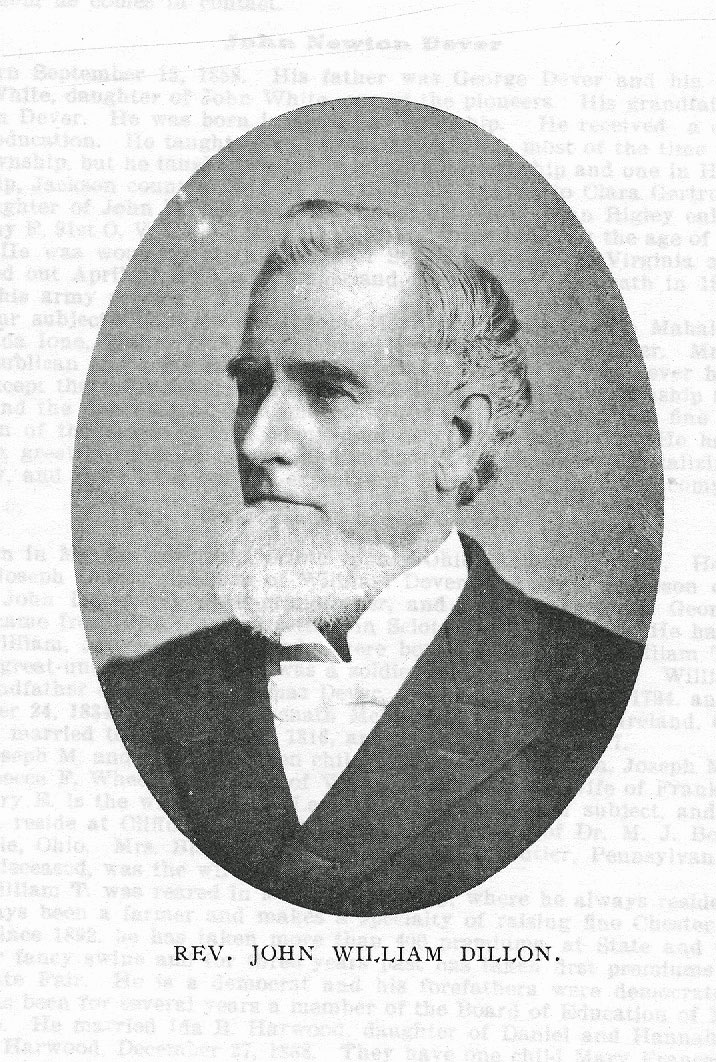
Rev. John William Dillon
was born October 18, 1835, in Mason township, Lawrence county, Ohio. His father was Samuel Dillon, son of Micajah and Mary Dillon, and was reared in Franklin county, near Rocky Mount. His mother Mary Dillon was the daughter of John and Nancy White and was born and reared in Fincastle, Botetourt county, Virginia. Both families came to Ohio in 1830 and settled in Lawrence county. August 14, 1832, Samuel Dillon and Mary White were united in marriage. Our subject was their second son. His early life was spent on the farm. At the age of fourteen, the family moved to Millersport. He had such educational advantages as the common schools afforded at that time. He was under the tutorship of Judge Sylvester McCown and Doctor I. T. Monaham for sometime. Later, under the direction of such critical and scholarly examiners,
952 - HISTORY OF SCIOTO COUNTY.
as Doctor George W. Brush and President Solomon Howard of the Ohio University, he mastered very thoroughly the tour years literary and theological course prescribed by the church.
In the fall of 1857, at the age of twenty-one years, he was admitted into the regular itinerant ministry of the Methodist Episcopal church. His appointments have been as follows: In 1857-8, Rockville; 1858-9, Jasper and Spencer M. E. church, now Sixth Street M. E. church, Portsmouth; 1859-60, Rockville; 1860-61, Waverly; 1861-3, Piketon circuit; 1863-6, Burlington; 1866-9, Ironton; 1869-72; Newark; 1872-5, Zanesville; 1875-7, Presiding Elder of Gallipolis District; 1877-9, pastor Gallipolis; 1879-81, Presiding Elder of Portsmouth District; 1881-4, Pastor Bigelow church, Portsmouth; 1884-6, St. Paul's Delaware; 1886-90, London; 1890-95, Lancaster; 1895-6 Gallipolis; 1896-98, Mt. Vernon Ave., Columbus; 1898 to the present, Presiding Elder of the Portsmouth District, now closing his fourth year. His term on the district will expire in September, 1904..
January 10, 1864, he was married to Mary C. Cox, eldest daughter of Martin and Catharine Cox of Sandy Springs, Adams county, Ohio. They have raised five children, two daughters and three sons: Mary C., is the wife of Morgan Mollohan of Marion, Kansas; Sarah J., is the wife of Gilbert D. Wait. superintendent of the Wait Furniture Company; John Grant, secretary and treasurer of the Wait Furniture Company; Edmond Bothwell is a lawyer in Columbus, Ohio; Benjamin Hood, president of the Wait Furniture Company. Mr. and Mrs. Dillon have eleven grandchildren, three girls and eight boys.
Mr. Dillon is in no way responsible for these comments and will not see them till he opens his copy of this work. He is the living, walking exemplification of all the Christian virtues, and to his friends, it seems to be natural for him to be such. He is kind hearted, sympathetic and ever ready to say words of balm which come from his heart and go to the hearts of those to whom he speaks. He is the ideal of the old fashioned itinerant Methodist minister, a class which is fast passing away. He is a good edition of St. John, the evangelist and beloved disciple. He loves the whole world and will do good to all with whom he can come personally in contact. His influence has always been for the best and for the advancement of Christianity. He does not deserve to have any enemies and has none. There was never anything in his composition which would invite strife or contention. His gospel has always been peace and love and to teach men to live as Christ, his master, taught. He has ordered his own life according to the teachings of the Master and that life is a standing, ever present invitation to others to do the same. In his church and in the community, he is a beacon light ever pointing the way Heavenward. He has reared a family of sons and daughters, of which not only he and his wife can be proud, but of which the whole community can be proud. The sons are not only magnificent specimens of physical manhood, but they are model citizens and first class business men. The writer believes that the minister who brings up his own children successfully is the best qualified Christian teacher, and as such the Reverend Dillon has no superior.
John Grant Dillon
was born in Burlington, Lawrence county, Ohio, November 21, 1863. His parents were Rev. John W. Dillon and Mary Catherine Cox, his wife. His boyhood and youth were passed, throe years at Ironton, three years at Newark, three at Zanesville and four at Gallipolis. He then came to Portsmouth and attended the public schools until he was twenty years of age. He took a course in book-keeping and since the organization of the Wait Furniture Company has been its secretary and treasurer. He has always been a republican and is a member of the Methodist church. He was married September 23, 1897, to Miss Estelle Tynes. They have one son, Donald Tynes Dillon.
Physically Mr. Dillon is built on a liberal plan. He could take the part of Milo and Hercules and fill it well. Nature has been as generous to him in the bestowal of mental qualities as she was of physical gifts. He is a man of keen, quick perception, of excellent judgment and large executive ability. As a business man he has succeeded well and has won him an excellent position among his cotemporaries. He is a strong factor in anything he undertakes and a most valuable citizen.
BIOGRAPHICAL SKETCHES - 953
Edmond Bothwell Dillon
was born at Ironton, Ohio, Feb. 9, 1869. His father was Rev. John W. Dillon and his mother's maiden name was Mary Cox. She was the daughter of Martin and Catherine Cox of Adams county. Mr. Dillon's early life is illustrative of the active American boy who is willing to work. At fourteen, he was messenger in the First National Bank of Portsmouth, 0., while the venerable John P. Terry was president, and whose constant advise to the young man was "promptness and honesty." He received a public school education in the various cities of the state where his father a Methodist minister, was from time to time located. In 1884, he entered the Ohio Wesleyan University at Delaware, Ohio. While attending school there he assisted himself -to a small extent in outside work. He was graduated in 1889.
He studied law in the office of Hon. S. W. Durflinge of London, Ohio, working as assistant postmaster from 6 a. m. until 7 p. m. and doing all his studying at night and on holidays. He was admitted to the bar of Ohio in 1891 and began the practice of law in Columbus, Ohio, though a perfect stranger to every person there. The Supreme Court of Ohio appointed him a member of the State Law Examining Committee in 1897 and continued to re-appoint him until 1901 when he was made Chairman of the Board. In politics, Mr. Dillon is a republican, but has only recently sought office. He is a member of the Columbus Board of Trade, the Columbus Civil Service Commission and numerous secret societies. For many years he has been counsel for the State Dairy and Food Department, which with his active membership in the Ohio State Bar Association has given him rather an extended acquaintance throughout the state. In 1898, Mr. Dillon was admitted to practice in the Supreme Court of the United States.
He was married May 9, 1895, to Marian D. Whitney, daughter of Calvin and Marian Dean Whitney of Norwalk, Ohio. There were two children born of this union: Edmond Whitney, aged five, and Mary C. aged two years. He is an able lawyer and possesses the confidence of all who know him. At the November election, 1902, he was elected a Judge of the Court of Common
Pleas of Franklin County, Ohio.
Benjamin Hood Dillon
was born in Newark, Ohio, Aug. 23, 1871, the son of Rev. John W. Dillon and Mary Catherine Cox, his wife. His boyhood and youth were passed at Newark, Delaware, Zanesville, Gallipolis, and London, Ohio. He graduated at Carmichael Business College, Delaware, Ohio, and came. to Portsmouth in 1889. He is president of The Wait Furniture Company. October 7, 1897, he was married to Miss Cora Waller Selby, daughter of George D. and Lydia (Webster) Selby, of Portsmouth, Ohio. They have one son, Edmond Selby Dillon.
Mr. Dillon is a gentleman esteemed by all who have the pleasure and honor of his acquaintance. He has a remarkable insight of business matters, which stands him well in his dealings with his fellowmen. He can come as near reading the thoughts of his associates as any man who ever lived. He is one of those fortunate men who cannot be imposed upon, and on whom it is useless to try imposition. He is not self conscious of the wonderful faculty he possesses and is a most engaging companion and a good neighbor.
Frank F. Dinsmore,
attorney-at-law, now of Cincinnati, Ohio, was born December 22, 1869, in the same city where he now resides. His father's name was Henry Dinsmore and his mother's maiden name was Rebecca Jane Watkins. His father was a native of county Antrim, Ireland, but of Scotch ancestry. He came to the United States in 1848. His mother's parents were among the first settlers at Portsmouth, coming from Virginia. His parents resided in Portsmouth for some years, afterwards removing to Cincinnati. They returned to Portsmouth in 1873. His boyhood and youth were spent there. He is a graduate of the Portsmouth High School. He was a clerk in the County Auditor's office under Filmore Musser from 1887 to 1890 during which time he taught a night school in Portsmouth and studied law with Theodore K. Funk.
He attended the Cincinnati Law School, graduated in May, 1891, and was admitted to the bar on graduation. He began the practice of law in Cincinnati.
954 - HISTORY OF SCIOTO COUNTY.
On the first of May, 1894, he was appointed Assistant Corporation Counsel of Cincinnati by Frederick Hertenstein, Corporation Counsel. He held this position until January 1, 1897, when he was appointed Assistant County Solicitor of Hamilton county under William Rendigs, County Solicitor. He held this position until January 1, 1900, since which time he has been in general practice of law in the Atlas Bank Building, Cincinnati.
He has always been a republican and has always taken great interest in political matters. In religion, he is a member of the Presbyterian church.
He was married at Ironton. June 24, 1896 to Miss Mary E. Campbell, daughter of Joseph H. Campbell. a granddaughter of Hiram Campbell. a well known iron-master of that city. He has had three children. the oldest. a boy, born in 1897, died in infancy. The second. Joseph Campbell, born March 29, 1899. and Jane, born March 26, 1900. He resides at 838 Hutchins avenue. Avondale.
Mr. Dinsmore has always been noted for his remarkable industry and energy in everything he has undertaken. In all his professional labors. he is thorough and is one of the most promising lawyers of the Hamilton county bar, for his age and experience. His word is as good as his bond and his bond is gold standard all the time. He is one of the directors of the new Cincinnati. Georgetown & Portsmouth Electric Railroad. He is a force and power in any enterprise with which he is associated. No one of his friends will ever be startled by any promotion he may obtain.
Here is what his tutor in law, Major H. P. Lloyd says of him, "He is a lawyer of unusual ability. He came to Cincinnati as a student in 1890, and entered my office. He applied himself with industry and unflagging zeal. He graduated from the Law School of the Cincinnati College with high honors, winning the first prize on general examinations, and also the tirst prize for best legal essay. This record had never been made by any other student. He early established a reputation for integrity and ability of a high order, and his moral character is unblemished. No one of his age ranks higher at the Hamilton county bar, and no one has a brighter future.
Ephraim Marion Dixon, M. D.,
was born November 9, 1866, in Scioto township, Jackson county, Ohio. His father was Griffe Dixon, and his mother's maiden name was Eliza Schellenger. They had four children, of whom our subject was the third. His father was a farmer and served in the Civil War in Company D, 43d 0. V. I. He entered that company March 25, 1864, and served until July 13. 1865.
Our subject had a common school education, and attended the Jackson Academy. He began teaching in the common schools at the age of nineteen, and taught six years in Jackson county. He began the study of medicine in 1890, with Dr. L. D. Allard of Flat Post Office, Pike county. Ohio. but now of the city of Portsmouth. He entered the Medical University at Louisville. Ky. in September, 1892. and graduated in March. 1894. He located immediately at Wilkesville, Vinton county, and practiced medicine there for two years. He located at Flat. now Stockdale, in June, 1896, where he has since resided. He married Hattie L. Brown, daughter of Nathan Brown. June 18. 1899. He is a republican, a member of the Methodist Protestant church. and of the Knights of Pythias. In the summer of 1902. he took a post-graduate medical course at Baltimore. Maryland, at the College of Physicians and Surgeons.
Josiah Carroll Dodds
was born in Butler county, Pennsylvania. November 5, 1829. His father was William Dodds. and his mother’s maiden name was Nancy Eakin. His parents had eleven children, ten sons and one daughter. and our subject was the eighth child. His father was a native of Pennsylvania. and followed the double occupation of farmer and brick-layer. The Dodds family came from Scotland into the north of Ireland, in 1614. and emigrated to America in 1748. Josiah received a common school education in Pennsylvania. He resided in Butler county. Pa., until he was twenty-one years of age. He taught school from 1850 to 1861. in Scioto, Pike, and Adams counties. Ohio. He was married April 14. 1853. to Margaret Hutchinson, of Clintonville. Pennsylvania.
He enlisted in the 179th Ohio Volunteer Infantry. Company E. at the age Of thirty-four, August 31, 1864, for one year. and was mustered out with the
BIOGRAPHICAL SKETCHES - 955
company June 17, 1865. He was a farmer at Mt. Joy, from 1853 to 1890. He has four children: Robert Clarence, a Presbyterian minister, located at Lansing, Michigan, married and has a family; William Homer a lawyer at Pittsburg, Pa., located at No. 518 Fourth Avenue; Armina, died at the age of nine years; Ann Blanche, married S. T. Vanmeter, residing at Mt. Joy, a farmer; John Gilmore, attending medical college at Chicago, Ill. In 1897, he left Mt. Joy and moved to Dayton, Ohio, where he remained fifteen months. From there he went to Pittsburg, and from there to Butler county, where on February 23, 1900, his wife died. He came to Portsmouth to reside April 25, 1900.
In his political views, he was first a whig, and then a republican. He is really a prohibitionist, but wants to see prohibition come through the instrumentality of the republican party. He takes life easily. His greatest ambition has always been to be a first class citizen and he has realized it. As a member of the United Presbyterian church, he lives up to its teachings and is ready to respond when the Master calls.
Robert Henley Dodds
was born September 25, 1850, at Baden, Beaver county, Pennsylvania. His father was Thomas Henley Dodds and his mother's maiden name was Elizabeth Charleston. They were both born in the county of Down, Ireland, and came to America, settling in Pennsylvania about 1844. They came to Scioto county about 1851, and settled in Madison township. Robert attended the public schools until the age of eighteen and then took a teacher's course at Lebanon, Ohio. He began the profession of teaching in 1872 and has continued it to the present time, with the exception of one year. He held the office of Clerk of Madison township five successive terms. He was School Examiner of Scioto county from 1887 to 1893. He was reared a democrat, but became a republican in 1872. He is a member of the Regular Baptist church. He married Rachel A. Lair, December 7, 1872. He has six children: Heber H., Charles C., Marion, Roscoe, Emma and Grover.
William Homer Dodds
was born near Mt. Joy, Scioto county, Ohio. His parents were Josiah C. and Margaret (Hutchison) Dodds, of Butler county, Pennsylvania, of Scotch-Irish descent. He began teaching in the public schools at the age of sixteen, first at New Lebanon, Lawrence county, then in Scioto county, at Henley, Simpson and Sedan. He entered the preparatory department at Westminster College, Pennsylvania in April, 1877, and graduated in the classical course in 1882 receiving the Bachelor's degree in the Arts course. Five years later, the same college conferred on him the Master's degree. After graduating he had charge of McElwain Institute, Mercer county, Pennsylvania, a college preparatory school, but resigned at the end of one year to accept the principalship of the High School of Alleghany City, Pennsylvania, where he taught for nine years, resigning in 1892 to pursue the study of law. He edited the "Pennsylvania Teacher" from 1883 to 1888; represented the Alleghany City educational exhibit at the Paris exposition 1889; and was for three years secretary of the University Extension Society of Western Pennsylvania. He read law with Hon. Walter M. Lyon, then Lieutenant Governor of Pennsylvania, but owing to ill health did not finish the course for three years, when he was admitted in 1895, to the Pittsburg bar, where he has since practiced. In politics he is a republican.
As a student he was faithful; as an educator he distinguished himself and took a leading position. As a lawyer he has taken high rank in his seven years practice. He has earned the respect of the members of the bar with whom he has practiced and of the judges before whom he has appeared as an advocate. He is a clear thinker, a sound lawyer and an esteemed citizen.
Jonathan Sherman Dodge
was born in Madison township, Scioto county, Ohio, April 9, 1867. His father was George Lyons Dodge and his mother’s maiden name was Sarah Louise Tibbs. He was educated in the common schools and afterwards attended the National Normal University at Lebanon, Ohio, graduating there in 1890 in the
956 - HISTORY OF SCIOTO COUNTY.
Classical course. In 1892, he graduated in the Cincinnati Law School at which he received the highest grade ever attained at that school, an average of 99.4. He stood at the head of a class of 90, and won a prize of $100 for best scholarship. He was married January 17, 1892, to Miss Mary A. Fritz, of Darke county, and located in the city of Portsmouth in September of that year. He built up a remunerative practice and was noted for his industry at the Portsmouth bar, but on account of his wife's health he left Portsmouth and opened a law office in El Paso, Texas, October 16, 1899, and is engaged in the practice of law there. He never held any public office. He was a candidate in El Paso, in 1901, for County Judge on the republican ticket, but had no show for election. His children are Alice Cora, Anna Louise and Charles Anderson. He is a member of the Presbyterian church. Mr. Dodge is one of the most active and energetic men who ever adorned or elevated the legal profession.
Theodore Doty
was born October 26, 1844, in Ross county, Ohio, the son of John M. Doty, a prominent democrat politician. His mother's maiden name was Sarah H. Jones. Until the age of 15 he attended the schools of Chillicothe. At he age of 21 years he entered the employ of the B. & 0. Railroad Company at Chillicothe, and remained in its employ till 1886, when he came to Portsmouth Ohio, and became freight agent of the Scioto Valley Railway Company and is holding the same position under the Norfolk & Western Railway Company. In 1893, he was president and one of the directors of the Scioto Fire Brick Company, of Sciotoville, Ohio. He was president of the Scioto County Agricultural Society for the years from 1890 to 1892. He was president of the Board of Trade from 1896 to 1901. He was a member of the City Council in 1896 and 1897, and was a member of the City Board of Education from 1898 to 1899. He was president of the Garfield Club from 1893 to 1894.
He was brought up a democrat, but when he came of age he became a republican and was active in political circles in Chillicothe while he lived there, and has been prominent in his party ever since his residence in Portsmouth. He has served on the Republican Executive Committee of his county. He is a Mason, Past Eminent Commander of Calvary Commandery, Knights Templar and a Past Exalted Ruler of the Elk lodge at Portsmouth.
He married Miss Martha E. Weaver, July 9, 1868, and has six children: Frank, Harry, Lucien and Charles; Elizabeth, wife of J. I. Hudson, superintendent of the Portsmouth Public Schools, and Edith, wife of Addison Minshall, a young lawyer of Chillicothe, Ohio. Mr. Doty is one of the foremost and most energetic citizens of Portsmouth. When any public enterprises are proposed he is always to the front and ready to do all he can for the public good.
Thomas W. Doty
was born at Clinton Furnace, Scioto county, Ohio, April 10, 1847. His father was William Doty, and his mother’s maiden name was Emeline Swarr. His parents were married in the year 1836. He attended the district schools at Etna Furnace and Ohio Furnace. At the age of seventeen, he left school and went to work and worked till he was twenty-one years of age. He attended school at Lebanon when he was twenty-two years of age for one year. He returned to Ohio furnace and became the overseer of the ore banks until he was twenty-eight years of age. Then for a year he was engaged in hauling ore for the Ohio furnace. He took charge of the Ohio furnace store in March, 1877, and held the position till September, 1878. From 1878 to 1882, he was foundryman of the same furnace. He was then foundryman of Vernon furnace for one year. He returned to Ohio furnace in the spring of 1884, and took charge of the store which he retained till 1885. He was elected Treasurer of Green township in 1884, and held the office for fourteen consecutive years. In 1885 he became book-keeper of Ohio furnace and remained as such till 1895. From 1891 to 1895, he was aso manager of the furnace. In the latter year, his son, Lewis, took charge of the books, and he continued manager till his death on September 5, 1900.
He was married May 5, 1874, to Julia Maria Shepard, daughter of Lewis Cass Shepard, Ex-Sheriff of Lawrence county, Ohio and Julia Frances K. (Eidwell) Shepard, his wife. Mr. Shepard died in 1901. The children of Mr. Doty were: Lewis William, store keeper at New Castle, Lawrence county, Ohio; Oli-
BIOGRAPHICAL SKETCHES - 957
ver Perry, student of mining engineering at the Ohio State University at Columbus, Ohio; Alfred Spalding, store clerk at Otway, Ohio; Thomas W., engaged at New Castle, Ohio. Mr. Doty was a republican in his political views, was a strong supporter of his party, and as true as steel to his friends. While not a member of any church, he was a loyal supporter and regular attendant. He was benevolent to all, never turning away the needy without help. He was a member of the Masonic order and held his membership at Wheelersburg, Ohio. He was killed accidentally on a tramway at Ohio furnace.
Elmer Dover,
secretary to United States Senator, M. A. Hanna, was born April 14, 1873, at McConnelsville, Morgan county, Ohio, the son of J. W. Dover and Frances (Winn) Dover. He received his education in the public schools of McConnelsville. Immediately after flnishing the course he entered the field as a newspaper reporter in McConnelsville. He left there in 1890 and engaged in newspaper work at Akron, Ohio, where he remained two years. From there he came to Portsmouth, Ohio, and was employed on the Portsmouth Times for five years. He was with the Republican National Committee during the campaigns of 1896 and 1900. After the former campaign he became secretary to Senator M. A. Hanna, in which capacity he still serves.
He was married to Martha Steele Peebles, daughter of John Peebles, January 25, 1898. They have one child Mary Elizabeth, born October 5, 1899. Our subject is a republican and a Presbyterian.
He is a young gentleman of the most versatile talents. He has demonstrated his ability to fill well one of the most difficult places in the government, that of secretary to Senator Hanna. Mr. Dover is a natural-born diplomat. He accords to every man the attention and consideration he deserves. There is no person mentioned in these pages whose life is more busy or active than his, nor are there any who deal with more complex and difficult questions, or who dispose of them more happily. Mr. Dover gives great promise of the highest success in political life.
Samuel Pangburn Drake
was born February 16, 1823, near Georgetown, Brown county, Ohio. He was raised on a farm until he was sixteen years of age. In 1839, he began his career as a printer on the Western Whig at Wilmington, Ohio, his brother Stephen being the owner of the paper and its founder. In 1840, he went to Hillsboro and was an apprentice of James Brown, publisher of the News. He finished his trade there and in 1843, he was in West Union as proprietor of The Intelligencer. He remained there but one year and then began teaching in a country school. He taught one year and then went back into the printing business.
In 1845 and 1846, there was an attempt to organize a new county to be. called Massie of which Bainbridge should be the center and county seat. He went there and started the Ohio Spectator which was to be the Whig organ of the new county. Everybody within the limits of the proposed county wanted to run for office in it, and their jealousies killed the measure. Le Grand Byington, a representative from Pike county, was to have put the bill through the legislature, but instead of that, he defeated it. When asked the reason of his unexpected action, he said that the people to be in the new county wanted everything, but did not want to pay for anything.
In 1848, Mr. Drake went to Washington, C. H., and started the Fayette Intelligencer. He sold out to George B. Gardner in less than one year and became foreman on the Clinton Republican at Wilmington. The next year he went to Georgetown and worked for W. B. Tomlinson on a newspaper there. In 1850, he was in Rainsboro, Highland county, keeping a country hotel. He remained there but a short time, and returned to Hillsboro and became foreman on the News. He went from there to the Hillsboro Gazette owned by Jonas R. Emrie.
In the winter of 1851 and 1852, he came to Portsmouth, where his brother Stephen had recently started the Scioto Valley Republican. Sam Burwell, afterward of the West Union Scion was a journeyman in the office and Tom McAllister, now an inmate of the County Infirmary, the "devil." Our subject afterwards went into partnership with his brother who went into the
958 - HISTORY OF SCIOTO COUNTY.
army and was killed by Mosby's men. He then conducted the paper alone.
In May, 1864 at the age of forty-two years, he enlisted in Company G. 141st Ohio Volunteer Infantry and was mustered out with the company September 3, 1864. On April 24, 1865, he became Second Lieutenant of the 198th Ohio Volunteer Infantry and served until May 8, 1865, when he was mustered out.
He was elected Treasurer of Wayne township in 1867. The vote was 614 for Drake and 585 for John Thompson, better known as "Coal" Thompson and "Sawdust" Thompson. Drake served two terms and was legislated out of office by the township being abolished. May 27, 1869, he was appointed postmaster at Portsmouth, through personal friendship with General Grant, but owing to local influence, the appointment was withdrawn He was a deputy United States Marshal at one time, and as such took the census in Portsmouth. February 11, 1847, he was married to Miss Sophia Kelley, of Ross county. He was a member of the Sixth Street church, a whig, a republican and a member of the Bailey Post. He died December 5, 1891.
Ulysses Grant Drake
was born in Portsmouth, Ohio, March 29, 1868, the son of Samuel Pangburn and Sophia (Kelley) Drake. He was named for Grant on account of the close friendship between his father and the President. Our subject spent his boyhood and youth in Portsmouth and attended the public schools until he was fifteen years old, when he commenced working with his father in the printing office. He continued at this business until 1890, and then took charge of the business. He is a republican and a member of the First Baptist church and one of its deacons. On September 3. 1889 he was married to Miss Eliza Mathews, daughter of J. R. Mathews, foreman of the "ad" composing room of the Blade office. He has five children: Grace, Grant, Madeline; Mabel and Harry M. Mr. Drake is one of the most industrious young men in Portsmouth. He is a model for others in his business to follow. He leads an exemplary life, is liked by all who know him and is a model citizen.
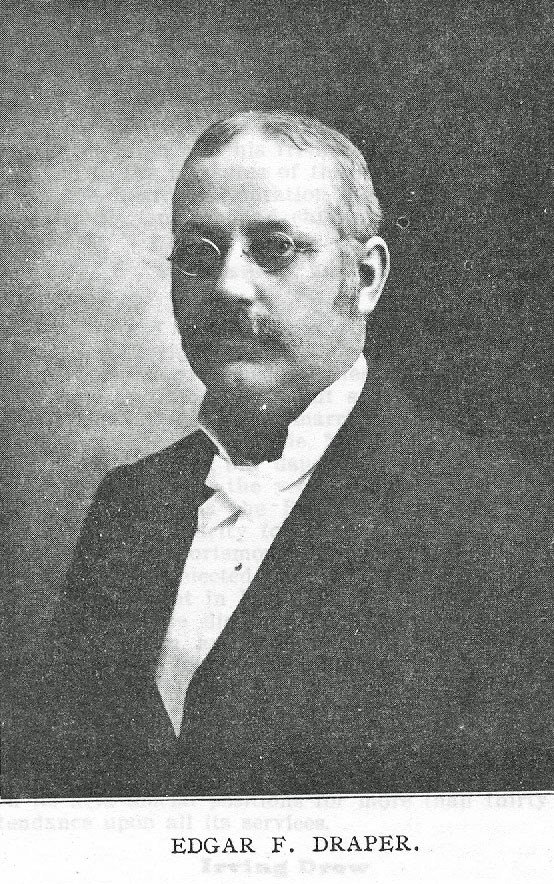
Edgar F. Draper,
one of the twelve children of A. E. and Lorenda (Hodge) Draper was born Mch. 23, 1846, at Akron, Erie county, New York. His father was born in 1808 and was the youngest of a family of two sons and six daughters. His paternal grandfather, Gideon Draper, moved from eastern New York to the western part of the state in 1828. He was brought up on a farm till he was sixteen and attended the common schools. After studying two years in Genesee College, Lima, New York he came to Portsmouth, November 4, 1864 and learned railroading under his brother, W. C. Draper, who was Chief Agent for the Portsmouth branch of the Marietta and Cincinnati railroad.
He was appointed agent of this railroad at Jackson in February, 1865, and served there one year when he was sent to Portsmouth. He was ticket agent and telegraph operator here for this road until 1890, when it was known as the Cincinnati, Washington & Baltimore. After leaving the railroad business he took up insurance and real estate. In 1892 he organized the Portsmouth German Building and Loan Association and has been its secretary and treasurer, since. He was treasurer of the Ohio Valley Agicultural Society many years and its secretary the last five years of its existence. From 1877 till 1893, and from 1895 to 1897, he was a member of the Board of Education and was its clerk from 1884 to 1886, and from 1888 to 1897, and its president in 1878-9.
He was married June 16, 1869, to Mary Ellen Adams, only daughter of Elmer W. Adams, a banker of North Canton, Connecticut, and Mary E. Smith, his wife, of Hatfield, Massachusetts. Her parents removed to Duquoin in southern Illinois shortly after their marriage, on account of the health of her father and purchased a large stock farm. Here Mrs. Draper was born. Her parents died before she was two years old and she was adopted by her mother's brother, a Presbyterian minister, then pastor pf a church in Belpre, Ohio, and later of Oxford, New Hampshire, where most of her childhood and youth was spent. She was educated at the Western College at Oxford, Ohio, but received her musical training, chiefly in Boston, Massachusetts, where for seven years she was under the tutelage of the best masters. She came to Portsmouth in 1864 as organist
BIOGRAPHICAL, SKETCHES - 959
at the First Presbyterian church and has been one of the leading organists in the city ever since During all this time she has been prominent not only in a social way but in all worthy causes where a woman’s aid and sympathy is needed. She has the most advanced ideas on the subjects of music, art and literature.
Mr. Draper is a member of the Second Presbyterian church. He has always been a republican. He is a Mason of long standing and a Past Presiding officer in all the Masonic bodies in the city. He always takes a great interest in any matters committed to his charge He was one of the most efficient members of the Board of Education the city ever had. The measures he proposed in the Board were adopted because they wero well considered and fpr the best interests of the schools. Mr. Draper has managed the German Building and Loan Association of which he is secretary and treasurer with great fidelity, skill and ability and has made it one of the best in the city. He has acquired the use of the German language to a degree attained by few Americans. Mr. Draper has cultivated literary tastes and devotes as much time as possible to their culture. He is a gentleman of fine physical presence and appearance and great natural dignity. As a public speaker, Mr. Draper is calm, deliberate and argumentative. When he speaks he is master of his subject. One great characteristic of Mr. Draper is his love of children and his friendships for them. He never misses an opportunity to add to the pleasures of the little people of his acquaintance. While a member of the Board of Education he personally knew a majority of the school children in Portsmouth and children are his welcome friends and companions at all times.
William C. Draper
was born near Akron, Erie county. New York, March 17, 1832. He spent his early life on the farm owned by his father, A. E. Draper who was one of the pioneers of western New York. William C. received a common school education and took a select course at Genesee College, at Lima. New York. At the age of twenty. he came to Ohio and taught school several years in Ross and Jackson counties. At the latter place he married Harriet Cavett. They had one son and three daughters: Frank E.. Jessie, Nellie and Hattie. His wife died in 1889, since which time he and his daughters kept house until his death which occurred April 1, 1902. In the year 1856, Mr. Draper was employed as conductor on what is known as the Baltimore & Ohio South-western railway. After serving in this capacity for quite a number of years, he was appointed agent of the road at Portsmouth and remained until 1890.
Soon afterward he was elected County Treasurer and served two terms which was his last engagement in business. His health soon failed and after several years of suffering, he died. Mr. Draper was widely and favorably known throughout this section, and enjoyed the confidence of his friends, who were legion. He was true to his friends and possessed a strong fraternal feeling for his fellow-beings, seeing their good qualities and overlooking their bad qualities. He never could see distress without endeavoring to relieve it. He had no enemies and deserved none. He was a strong temperance advocate and took a lively interest in everything good for his adopted city. At the time of his death. he was one of the oldest members of the Bigelow Methodist Episcopal church in which he held official positions for more than thirty years, and was punctual in attendance upon all its services.
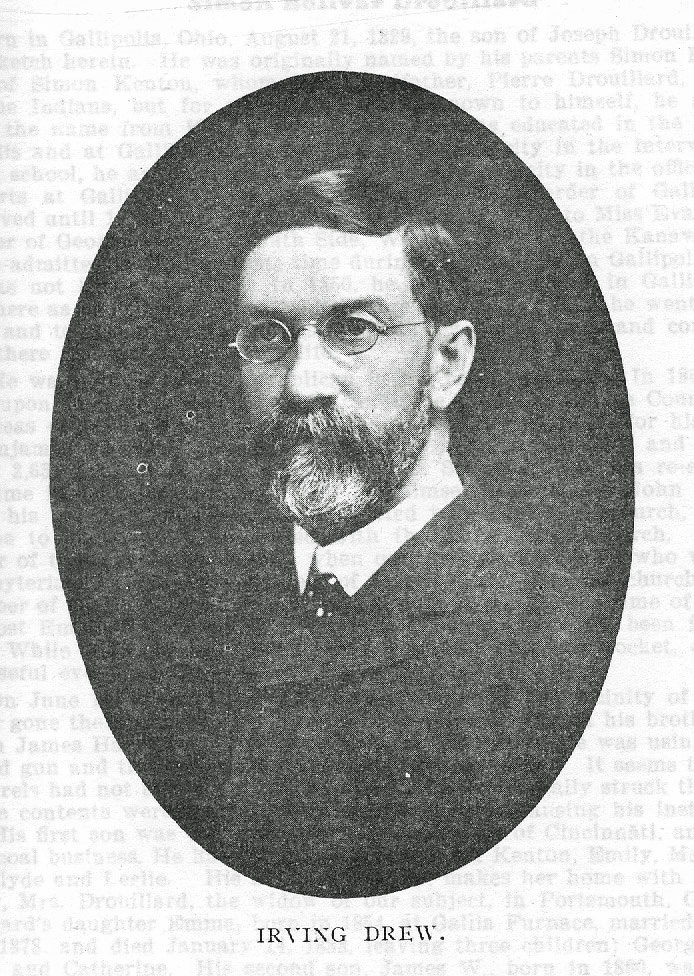
Irving Drew
was born at Rowley, Mass., July 27, 1849. His parents were Frederick Drew and Sarah G. Bailey, his wife. The ancestors of the Drews in this country first settled in New Jersey and afterwards moved to Portsmouth, New Hampshire, where the great-grandfather of Irving Drew. Samuel Drew. was born, his son being Joshua Drew, born in Durham, New Hampshire in 1793 and died in 1843. Frederick Drew, father of our subject was born at Durham, February 1. 1817 and died at Rowley, Massachusetts. October 17, 1896. His mother, Sarah G. Bailey, was a descendant of James C. Bailey, who came to Massachusetts about 1630. His descendants in a direct line were: John Bailey. Nathaniel Bailey, Deacon David Bailey, Ezekiel Bailey, Ezekiel P. Bailey and Sarah G. Bailey Drew, the mother of Irving Drew.
960 - HISTORY OF SCIOTO COUNTY:
Frederick Drew remained in his native place until eighteen years of age and then removed to Rowley, Massachusetts. He was married there November 27, 1843, and came to Portsmouth in 1851, where he was foreman for R. Bell, and remained about nine months, then he returned to Massachusetts. In March, 1854, he again went west, this time taking his family and locating at Ironton, Ohio, where he was engaged in the retail shoe business until 1862. Then he went to Granville, Ohio, where he was in the retail shoe business and farmed a part of the time. In 1869, he came back to Portsmouth and engaged in the employ of R. Bell & Company.
Our subject worked in the shoe factory from 1869 to 1871. His father then associated himself with the firm of Rifenberick, Drew & Gregg who succeeded to the manufacturing department of R. Bell & Company, with which he remained until January, 1874. Mr. Irving Drew then with others organized the Portsmouth Shoe Company of which he was secretary and treasurer and general manager. Henry Padan Was president, William Koblens, vice president. The other stockholders were: George Padan, Henry Cook, Frederick Drew, John Bourgholtzer, Nicholas Ames, Nicholas Reeg, Valentine Pressler and William Bierley. The capital stuck was $4,500. This company succeeded Rifenberick, Drew & Gregg. After a period of three years, Irving Drew and his father drew out of this company and left Henry Padan and others to operate it.
In January, 1877, Mr. Drew and his father organized the firm of Irving Drew & Company, composed of himself, his father, Bernard Damon and Henry Cook. They began operations in the third story of the Huston stone front on Second street and continued there for three years. About the close of the year 1879, the firm changed to Drew, Selby & Company. Mr. George D. Selby went into the firm, but did not take an active interest in it until 1885. From the organization of the Portsmouth Shoe Company in 1874 until 1885, Mr. Irving Drew was the managing spirit of the whole business. When Mr. Selby came into the business in 1885, Mr. Drew confined himself principally to buying and superintending the manufacturing department and Mr. Selby took charge of the correspondence, sales and credits. The success of this firm in business is related under the article, "Drew, Selby & Company."
Mr. Drew was married to Ella A. Gates, daughter of William Wallace and Alvira (Nye) Gates, June 30, 1879. They have seven children: Roy Irving, engaged in the factory of The Irving Drew Company and a director; Mabel Arelie. a graduate of the Western College, Oxford, Ohio; Marjorie Gates, a student at the same school; Rowena Nye, Hazel Bailey, Frederick Wallace and Everett Austin, at home.
He is a member and a ruling elder of the Second Presbyterian church of Portsmouth, Ohio. Prior to 1884, he was a republican, since that date he has been a prohibitionist. The only fraternal society he is a member of is the Royal Arcanum, an insurance society. In June, 1902, Mr. Drew was appointed a trustee of the Western College at Oxford, Ohio.
Mr. Drew is a gentleman who courts no public notice whatever. He prefers to attend to his business, in which he has been thoroughly absorbed, and to concentrate his efforts to making his business successful. He has encouraged others in the same line of manufacturing till shoe manufacturing has become the leading industry in Portsmouth. He prefers to leave other problems and schemes, both public and private, to be worked out by those more fa- Millar with them, believing that energy, system and perseverance, as applied to the cost, quality and endless detail of the shoe business, would lead to success for himself and associates and as a result largely beneficial to the city.
In his manners, he is quiet and reserved. He prefers that the one who is seeking him shall do the talking and shall present his case without any aid from him. He does his own thinking and is of positive convictions. His New England training, ingrained for ten generations, stands him well in hand. It enables him to reason correctly on every subject presented and to come to wise and just conclusions as well about matters of business as matters of public policy.
As a business man, he is conservative and takes the safe and sure course. He has been fortunate and successful in his business career because that career was governed by correct principles. Mr. Drew's most prominent characteristic, shown in his every day life, is his great earnestness and wonderful purpose.
BIOGRAPHICAL SKETCHES - 961
He sees the end from the beginning and his plans never fail, while his plan proceeds from beginning to accomplishment. He is surrounded by a most interesting family and his entire influence in the community is for Christian character and training. He believes that to be the foundation of all that is good, true and lasting, and all of his time, work and effort, outside of his business, goes in that direction; so he finds but little time for pleasures that do not legitimately come with a successful business, a happy home, reform and Christian work.
Simon. Bolivar Brouillard
was born in Gallipolis, Ohio, August 21, 1829, the son of Joseph Drouillard, who has a sketch herein. He was originally named by his parents Simon Kenton, in honor of Simon Kenton, whom his grandfather, Pierre Drouillard, ransomed from the Indians, but for some reason best known to himself, he saw fit to change the name from Kenton to Bolivar. He was educated in the schools of Gallipolis and at Gallia Academy. During his minority in the intervals of attending school, he assisted his father in a clerical capacity in the office of Clerk of Courts at Gallipolis. In 1848, he was elected Recorder of Gallia county and served until 1854. He was married November 27, 1850, to Miss Evaline Long, daughter of George I ong, of South Side, West Virginia, in the Kanawha valley. He was admitted to the bar some time during his residence in Gallipplis, but the date has not been preserved. In 1850, he took an interest in Gallia furnace, went there as book-keeper and resided there until 1858, when he went to Portsmouth and took a position in Dugan's bank, as book-keeper and continued to reside there the remainder of his life.
He was a whig and a republican in his political views. In 1863, he was placed upon the Republican ticket as candidate for Clerk of the Court of Common Pleas of Scioto county and received 2,263 votes to 1,745, for his competitor, Benjamin F. Cunningham. He was re-elected Clerk in 1866 and received a vote of 2,631 to 2,119 for his opponent, J. C. Stimmel. He was re-elected the third time in 1869, by a vote of 2,367 for himself to 2,283 for John W. Lewis. During his residence in Gallipolis, he united with the M. E. church, and when he came to Portsmouth, he united with the Sixth Street church. He was a member of that church until 1867, when on account of his wife who was reared a Presbyterian, he became a member of the First Presbyterian church. He was a member of all the Masonic bodies in Portsmouth and at the time of his death, was Most Eminent Commander of Knights Templar and had been for several years. While Clerk of the Courts, he published a lawyer's docket, one of the most useful ever devised.
On June 19, 1873, he was accidentally killed in the vicinity of Gallipolis. He had gone there some days before on a vacation, and with his brother-in-law, Captain James Harper, on that day had gone hunting. He was using a double barreled gun and thought he had discharged both barrels. It seems that one of the barrels had not been discharged and his foot accidentally struck the hammer and the contents were discharged through his head, causing his instant death.
His first son was George Long, now a resident of Cincinnati, and engaged in the coal business. He has six children: William Kenton, Emily, Martha, Clifford. Clyde and Leslie. His daughter, Emily, makes her home with her grandmother, Mrs. Drouillard, the widow of our subject, in Portsmouth, Ohio. Mr. Drouillard's daughter Emma, born in 1854, at Gallia Furnace, married John Miller in 1878. and died January 14, 1888, leaving three children: George Scudder, Evelyn and Catherine. His second son, James W., born in 1860, was educated in the Portsmouth public schools, studied law with Moore and Newman, was admitted to the bar in Columbus and went to Chicago to practice law in 1892, where he still resides.
When Mr. Drouillard was about to retire from the Clerk's office, the members of the bar, as a testimonial of their high appreciation of him, presented him with a gold watch and chain. As Clerk of the Common Pleas Court, he had no superior, if an equal, in the state, and the members of the bar who had business with his office have borne ample testimony to the efficiency with which he discharged the duties of his office. Mr. Drouillard was a man who never sought publicity in any thing, but he was always faithful to every duty imposed upon him. He was kind and considerate to all. As a book-keeper he had no super-
962 - HISTORY OF SCIOTO COUNTY.
ior. He devoted his whole waking time to whatever business he was engaged in. While he had as much capacity as any one for recreation and pleasure, he rarely indulged in it. Urged by his friends to take some rest, his attempt to do so in 1873, resulted in his death.
William Duis
was born August 18, 1833 in Lager, East Friesland, Germany. His father was Jacob Duis and his mother’s maiden name was Rosina Gruben. When a year old his father removed to Rina in Prussia. When he was five years old his father died. Five years later his mother married Frederick Sant. They came to the United States in 1845. They left Bremen on a sailing vessel and arrived at New Orleans March, 1845. In the party were his step-father, his mother and his brothers, Henry and Benjamin Duis and himself. He lost one sister in infancy and another at the age of ten years, in Germany. The emigrant party referred to came to Cincinnati where they remained but a few months. His stepfather and brother Henry, went to Hanging Rock to find work, and from there went to Lawrence Furnace, where they only stayed about a month. From there they went to Aetna Furnace and remained three years, after that they went to Vesuvius Furnace and lived for about three years; from there they went to Buckhorn Furnace living there two years. At the latter place our subject married on September 11, 1853, to Mary Ann Verigan, daughter of Henry Verigan.
He attended school in Germany for six years before coming to this country, and also attended school at Buckhorn Furnace. After his marriage he removed to Washington Furnace and in 1854. to Hamden Furnace. In 1855, he went to Limestone Furnace and remained there for the winter. From there he went to Madison Furnace and remained until March. 1859, when he removed to Lawrence Furnace. He remained until January. 1860, when he removed to Wheelersburg, where he has since resided. He purchased William McKinney's farm adjoining the village of Wheelersburg. and has resided on it ever since.
Mr. Duis is, par excellence, the model farmer of Scioto county. He has read all that is obtainable on the subject of farming. He takes the leading agricultural papers and magazines and tries to keep up with the times. Many of his neighbors think he has gotten slightly ahead of the times. He was converted years ago to, the theory of tile draining and has at least fourteen miles of tile drainage on his farm. When he bought his farm it was unimproved. He built a house on it, built all the barns and out buildings, and has improved the property fully two-hundred per cent and brought up his farm over two-hundred per cent in its productive capacity. Mr. Duis believes in machinery, tools and appliances; and he has all the modern machinery which a farmer could require. He keeps tools of all kinds on his farm; and is able to do about all of his repairing, which is a great saving of time and expense. He requires that his farm products should be the best, and usually attains that end.
His children are: Rosina, the deceased wife of Charles H. Ketter, of Ironton; William, deceased; Lida, the wife of W. W. Meeks of Santiago, Texas; Lizzie, wife of George Bell; Ann. the second wife of Charles H. Ketter; John, farming for himself; and Winifred. wife of Christian Herzog of Canton, 0.
Mr. Duis voted for Buchanan in 1850. which he said was due to ignorance, and which he has regretted many times since. In 1860. he became a republican and has continued such. He is a member of the Methodist church in Wheelersburg, and has been since 1860. He was reared a Lutheran and confirmed in that church. He has had several responsible offices in the church at Wheelersburg. Mr. Duis is a man noted for his honesty and integrity. He is also noted for his remarkable industry and energy. To know what kind of a farmer he is, one should visit his farm and inspect his buildings and fields. Everything is kept in perfect order and a self respecting weed will not grow any where on his place.
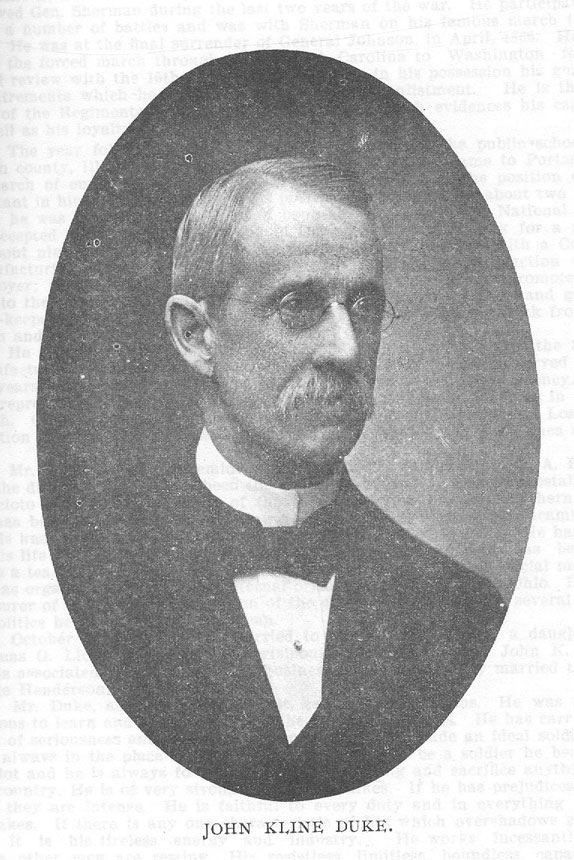
John. Kline Duke
was born at Piketon, Pike county, Ohio, August 20, 1844, the son of Samuel Duke and Elizabeth Ware, his wife. His father died in March, 1846. and left him in the care of his mother who died in May, 1883. His father was a Pennsylvania German, a radical old-line whig. and very active in support of that party. He came to Ohio and located in Piketon. in 1825. He was a man of excellent judgment and one whose opinions were much sought after. He was a hat
BIOGRAPHICAL SKETCHES - 963
maker by trade. He married Elizabeth Ware, a native of Virginia, born in 1832.
Mr. Duke's early life was passed in the quiet village of Piketon, Ohio, until the alarm of war, when at the age of 17, he enlisted, but was discharged on account of his youth. In the second year of the war, at the age of 19, he enlisted in Company F, 53rd 0. V. I., for three years, and was mustered out with the regiment at the conclusion of the war, August, 1865. He, with his regiment, followed Gen. Sherman during the last two years of the war. He participated in quite a number of battles and was with Sherman on his famous march to the sea. He was at the frnal surrender of General Johnson, in April, 1865. He also made the forced march through from North Carolina to Washington for the grand review with the 15th Army Corps. He has in his possession his gun and accoutrements which he carried throughout his enlistment. He is the author of the Regimental History of the 53d Ohio, which evidences his capacity as well as his loyalty to his command.
The year following the war, he was employed in the public schools of Logan county, Illinois, as a teacher. In October, 1866, he came to Portsmouth in search of employment and D. N. Murray tendered him the position of accountant in his hardware house. This position he occupied for about two years, when he was tendered the position of book-keeper in the First National bank. He accepted the same and remained in the employ of said bank for a period of about nine years. At that time he was tendered a position with a Chicago manufacturing plant, which he accepted and filled to the satisfaction of his employer; so much so, that at the end of the first year he was promoted and sent to the New York office of the same firm as financial manager and general book-keeper, which position he held until he, became a physical wreck from the strain and over-work of said office.
He returned to Portsmouth, in 1878, and took a position with the Singer Manufacturing Company as an accountant, in which position he served about five years. In 1883, he established an insurance and real estate agency. He now represents one of the largest agencies of this kind doing business in Portsmouth. On February 8, 1890, he inaugurated The Royal Savings and Loan Association Company. This financial institution is one of the solid ones of the city.
Mr. Duke occupies an eminent position in the ranks of the G. A. R. He has the distinction of having been the installing officer of every Post established in Scioto county, and in many of the surrounding counties of southern Ohio. He has been honored twice by being a delegate to the National Encampment, and is known as one of the great workers of Bailey Post No. 164. He has been all his life identified with the Methodist Episcopal church, and has been for years a teacher in the Sabbath school of Bigelow, as well as an official member. He has organized many of the fraternal organizations of southern Ohio. He was treasurer of the Board of Education of the city of Portsmouth for several years. In politics he is an ardent republican.
October 27, 1870, he was married to Miss Lola C. Lloyd, a daughter of Thomas G. Lloyd, a pioneer of Portsmouth. Their only son, John K. Duke, Jr., is associated with his father in business. He was recently married to Miss Jessie Henderson.
Mr. Duke, as a boy was earnest, serious and studious. He was always anxious to learn and wanted to know the reasons of things. He has carried his trait of seriousness and earnestness through life. He made an ideal soldier. He was always in the place of duty. When he ceased to be a soldier he became a patriot and he is always found ready to do anything and sacrifice anything for his country. He is of very strong likes and dislikes. If he has prejudices either way they are intense. He is faithful to every duty and in everything he undertakes. If there is any one characteristic of his which overshadows all others, it is his tireless energy and industry. He works incessantly and when other men are resting. His resistless, limitless, boundless, capacity to work and disposition to do so, coupled with his doing it, has made the Royal Building Association of Portsmouth, Ohio, the leading one in southern Ohio. He reminds the editor much of that sterling character of Whittier's, Abraham Davenport. Mr. Duke is noted for the purity of his life and for his high ideals of citizenship. His business character is built on the highest integrity and sense of honor. Mr. Duke has always been a strong republican. He is a power
964 - HISTORY OF SCIOTO COUNTY.
in the community for good, and he makes his influence in that direction felt in every organization with which he is connected. His influence is to build up and strengthen every organization with which he is connected. He is a strong and powerful factor in the community and it is hoped his career of usefulness may be a long one.
John Wesley Dunham
was born at Harper's Ferry, W. Va., in Jefferson county, June 18, 1815. His father was John Dunham, who came from Harper’s Ferry to Ohio and settled at Piketon, when our subject was only tive years old. His mother was Mary (Holliday) Dunham, who was born near Sheperdstown, W. Va., in 1797, and died in February, 1856. She was a member of the Holliday family which was prominent in that section of West Virginia. Her mother’s maiden name was Mary Carr. She was born near Herring Bay on the shores of Chesapeake Bay, thirty or forty miles from Annapolis. Mr. Dunham had only a common school education. In his younger days he was a clerk, but afterwards went into general mercantile business at Piketon for himself. During the time he was in business he had several partners, one of whom was James Jones. He continued in business at Piketon until 1864. About this time the county seat of Pike county was moved from Piketon to Waverly, which took all the business from Piketon to Waverly, and he was compelled to close down his business there which he did and came to Portsmouth. He clerked for C. D. Elden in the dry goods business for a few years, and afterwards engaged in the grocery business for himself. In 1875, he took charge of the dry goods department of the Gaylord rolling mill store, and was employed there until his death, June 1, 1881. He was a whig and a republican. He was never prominent in politics and never held office. He was a very prominent member and earnest worker in the Bigelow M. E. church and Sunday school.
He was married to Miss Jane Clough, daughter of Hon. Nathan K. Clough, (a sketch of whom is found elsewhere in this book,) May 14, 1846. Four children were born to them as follows: Edward Henry, died in Colorado, June 10, 1890; Mary Clough, widow of H. P. PurseII, now residing on west Fourth street in Portsmouth; George Holliday. died in his tenth year at Piketon, Ohio, and Charles Lodwick, now residing in Portsmouth.
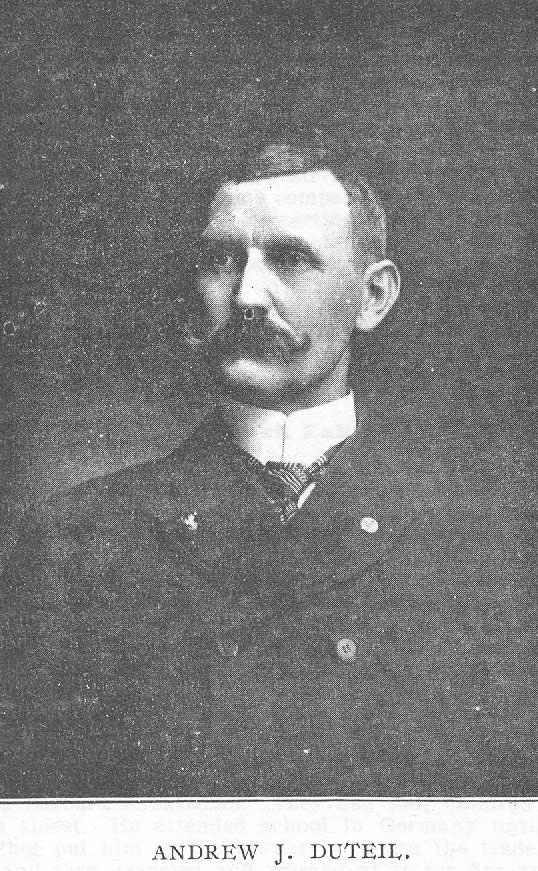
Andrew Jefferson Duteil
was born on a farm in Vernon township, Scioto county, Ohio, near Chaffin's Mill, June 25, 1859, the oldest son of John and Maggie (Gifford) Duteil. His father John Duteil was born in the French Grant May 13, 1826 and a grandson of Francis Charles Duteil, who drew lot No. 32 in the original French Grant. John Duteil was raised on a farm and during his early manhood bought the Chamberlain and Emory farms in Vernon township where he was engaged in farming and stock raising until his death on August 10, 1888.
Our subject was raised on a farm and attended the common schools at Chaffin's Mill until he was nineteen years of age, when he attended the National Normal University at Lebanon, Ohio, and prepared himself for a teacher; but not liking that profession he came back to his father’s farm where he was engaged in farming and buying and selling stock until December, 1885, when he entered the Iron City Business College of Pittsburg, Pa., and was graduated February 26, 1886. On September 7, 1886 he was employed by the Campbell Iron Company at Mount Vernon Furnace, Lawrence county, Ohio, as furnace clerk, which position he held up to January 1, 1894. In the year 1894 he and Colonel W. C. Amos leased the Vesuvius furnace in Lawrence county, Ohio, and operated it till December, 1894 when he sold his interest in the furnace and accepted a position as general manager of Madison furnace in Jackson county. Ohio, which position he held up to October 19, 1898, when he was appointed Receiver of the Clare, Duduit & Company which position he now holds.
He was Constable of Vernon township from 1881 to 1885 and Clerk of Decatur township, Lawrence county, Ohio, frpm April, 1888, to January. 1894, when he resigned on account of leaving the township. He was appointed Postmaster at Hempel, Jackson county, Ohio, January 29. 1898 which office he now holds. His political views have been republican and he takes an active part in
BIOGRAPHICAL SKETCHES - 965
Politics, being usually a member of the County Executiye Committee. He has never belonged to any church, but is a firm believer in the teachings of the Bible and always helps keep the church and Sabbath school up in his community. He belongs to the Masonic Order and Jackson Commandery No. 53 at Jackson, Ohio. He also belongs to the Benevolent and Protective order of Elks, Jackson Lodge, No. 466.
Charles Francis Detail
was born in Bloom township, Scioto county, Ohio, July 2, 1869. His father and mother are Lemuel Duteil and Ruhama (Emory) Duteil. His grandfather was Louis Duteil and his great-grandfather was Francis Charles Duteil, one of the original settlers of the French Grant. His father, Lemuel Duteil served from June 4, 1861 to June 19, 1864 in the Civil War, Company F, 2nd Kentucky regiment, V. I., participating in the battles of Chickamauga and Shiloh as well as other smaller engagements. At Shiloh, his brother, William, was wounded and as Lemuel was carrying him across a swamp, two stalwart "Rebs" came rushing up and demanded his surrender. Instead of complying with their request, he dropped his brother and acting under that impetuosity characteristic of him all his life he clubbed his musket and knocked one senseless; the other ran. Lemuel Duteil died in South Webster, November 18, 1899. William entered the service June 4, 1861, in the same company with Lemuel, and was discharged at Louisville, Kentucky, on surgeon's certificate of disability, November 23, 1862.
The subject of this sketch received a common school education. He is a republican and takes an active part in local affairs. He is a member of the Bloom Baptist Missionary church. He married Cloey B. Kuhner, August 17, 1897. Her father was a merchant at Bloom Switch for forty years. They have two children: Selma R. and Elizabeth C. Duteil. Mr. Duteil is an excellent young man, noted for his push and eergy. He is prosperous and has a very comfortable home in South Webster. He is a member of South Webster Dodge, Knights of Pythias, No. 724.
Mack Eakins
was born at Pine Grove Furnace, Lawrence county, Ohio, August 13, 1861. He is the son of William C. and Susan (Chatfield) Eakins. His great-grandfather came from Ireland and was one of the early settlers in Adams county. William Eakins is the son of a Thompsonian physician and has three brothers who are physicians. Our subject received a common school education at the Franklin Furnace school. He came to Sciotoville in 1887 and commenced the mercantile business. In 1894, he and his father commenced business under the name of W. C. Eakins & Son. They have now a large business which is rapidly increasing. The son is a repubilcan and a member of the Methodist Episcopal church. On June 14, 1888, he married Amasetta Price. They have two children, Elva and William.
Leo Ebert
was born in Klingerberg, Bavaria, on the Main, near Frankfort, Germany, June 28, 1837. His father was John Andon Ebert, a brewer, and his mother's maiden name was Barbara Krentzman. They had four children of whom our subject was the eldest. He attended school in Germany until his twelfth year, when his father put him in the brewery to learn the trade. He learned it in three years and then traveled and worked at it for five years, in Mannheim, Bremen and other places. He then went home and stood his chance in the conscription. He however drew a high number and got off. At the age of twenty, on January 6, 1858, he married Matilda Uilchin, daughter of John Uilchin. Then he brought his wife and came to the United States. He landed in New York and worked nine months at his trade. Then he went to Cincinnati, and worked in a brickyard one summer. He afterwards found a place in a brewery and in two months was made foreman. He worked in Cincinnati sixteen months as a foreman and then went to Ironton and started in business for himself, and has resided and been in business in Ironton ever since. He has six children: Fannie, married; Margaret, the widow of Michael Rauch; Matilda. the wife of Charles Jones; Emma, the wife of Frederick Wagner, a farmer on Pine creek near Powellsville; Bertha Hocke, widow of Andrew Hocke; Otto, in
966 - HISTORY OP SCIOTO COUNTY.
business with his father. Mr. Ebert was a republican till 1872, and since, has been a democrat. He is an Odd Fellow, Knight of Pythias, and an Elk. For seventeen years, he was in public office in Ironton, as Councilman, member of the School Board, and a member of the Board of Health. For eight years he was president of the Ohio Brewers' Association, and for two years has been president of the National Association of Brewers.
Jacob Arthur Eckhart
was born August 7, 1843, in Jackson county Ohio. His father was Jacob Eckhart, and his mother's maiden name was Mary Sherer. They had fourteen children, twelve of whom grew to maturity. Our subject was the third child. His parents moved to Madison township, Scioto county, when he was about three years old. He received all his schooling in Madison township. He enlisted in Company K, 91st 0. V. I., August 13, 1862, at the age of nineteen for three years. On May 9, 1864, at the battle of Lloyd’s Mountain, Va., a gun was discharged so near him that he lost the hearing in his right ear. On July 20, 1864, at the battle of Stevenson's depot, he was wounded in the right hip, and was sent to Maryland Heights hospital, where he remained for three months. He was never fit for any duty after that, and never rendered any service; but was discharged May 6, 1865 at Cumberland, Maryland on surgeon’s certificate of disability.
When he came home in December, 1865, he married Jermima Busier, a native of Carrol county, Ohio, but who then resided in Jackson, a daughter of Samuel Busier. He engaged in farming in Madison township, and followed it until March 20, 1900, when he moved to Harrison township, where he has lived ever since. He was appointed postmaster at Scioto (Harrisonville) July, 1900, and holds the office. He has had eight children. five of whom are living, three deceased. Daniel Webster, died at the age of fourteen years; George Washington, died at the age of eighteen years; Margaret Ellen, married Dr. S. W. Rickey, and both are deceased, leaving two children with our subject. Their names are Naffa Eckhart, aged eight years and Anna May, aged six years. Dr. Rickey, their father, was killed at Sinking Springs, in a runaway accident, August 2, 1900. The mother died May 11, 1901. The fourth child of our subject is John Franklin, aged thirty-two years, lives in Portsmouth, and conducts a broom factory; Minnie, married Warren Coriell superintendent of the fire brick works on Chillicothe pike, near the old Norfolk & Western railroad station. Another is Sampson Douglas, teacher of common schools on Lawson Heights. Andrew Jackson, a farmer who resides in Madison township, near Massie P. 0., and Bertha, married Russell Frowine, lives in Madison township.
Mr. Eckhart has been a member of the United Brethren church for twenty- eight years, and at present holds his membership at Harrisonville.
A comrade of his who was through the service with him, by his side, says he made a most excellent soldier; that he was always brave and ready for duty.
George Edmunds
was born in Tredegar, Wales, September 24, 1837. His father John Edmunds, came to the United States in 1840 and brought his son along. His mother's maiden name was Elizabeth Thomas. They remained in Toronto for two years and then came to Pittsburg, Pa., where they remained for ten years. In 1858 they removed to Centerville, Gallia county, Ohio. His father was a mechanical engineer and iron worker. After he removed to Centerville, he took stock in Limestone furnace, when it was organized. Then he sold out and went to Kansas, but on account of the troubles in Kansas, stopped short and located in Missouri, in Sullivan county, and was there when the Civil War broke out. He was a Union man and found it impossible to remain in Missouri, so he came to Gallia furnace and remained there until 1865. Then he moved to Sciotoville and lived there until his death.
In 1861 our subject went to the mines in Colorado and was there eighteen months, then he went into the Quartermaster service of the United States and remained in that until 1866, in which year he went to Richland Furnace, Vinton county, where he was an engineer. He remained there three years. In June, 1870, he went to South Webster to superintend the South Webster fire
BIOGRAPHICAL SKETCHES - 967
brick works, and was there until 1898. After a few years he became secretary and general manager of the works. He sold out his interest in 1898, went to Lucasville, engaged in the mercantile business and sold farming machinery. The firm is Martindale & Edmunds. He was married in September, 1869 to Susannah Hill. His children are: Olive, the wife of Charles Martindale, his partner; Carrie, the wife of Edward Butler; John, yard master for the Norfolk & Western railway of Portsmouth; Gertrude and George at home. He is a member of the Methodist Episcopal church and of the Masonic fraternity. He is a republican.
Daniel Henry Egbert
was born in Lawrence county, Ohio, May 20, 1854. His father’s name was Daniel Egbert, born May 8, 1824, in Hunteburg, Kingdom of Hanover. He came to Lawrence county on November 1, 1847. His mother's maiden name was Louisa Appel, born at Santover, Baden, March 25, 1831. She came to this country in 1849, with her parents. They were married October 26, 1849, in Lawrence county, Ohio. In October, 1858, they located in Valley township, Scioto county. Daniel, Senior, bought a farm of 124 acres on Millar's Run of Blackson Farmer, on which he has lived ever since. He has now 370 acres of land. He has had four children: William, resides at. Clifford, 0., Daniel H., our subject; Lucy, wife of John M. Johnson, resides on Beck street, Columbus, is connected with the street car business; George, was accidentally killed in 1897, and left a widow and five children. He was a resident of Valley township at the time of his death.
Daniel Egbert, Jr., was married October 27, 1880, to Mary B. Wooster, daughter of John Wooster. He has seven children: George, born December 19, 1881; Albert, born November 4, 1883, died June 13, 1886; John E., born December 17, 1885; Louella, born October 23, 1888; Walter, born April 26, 1890; Dora, born May 11, 1892; Marion, born September 15, 1895; Charley and Margaret, twins, born May 7, 1897; Margaret died July 12, 1897. Mr. Egbert is a democrat in his political views. He has been Trustee of the township and a member of the school board of his district a number of years. He is a member of the German Lutheran church at Portsmouth, Ohio.
Richard Burton Eglin
was born in Spencer, Medina county, Ohio, April 10th, 1868. His father was John Eglin, a native of England and his mother Harriett Ann Hendee. He was the second of a family of four children. He attended the public schools at Wellington, Ohio, and afterwards the Ohio Wesleyan University at Delaware, Ohio. In 1889 he went South engaging in manufacturing and exporting of hard wood staves from Arkansas and Texas, and later returned to Ohio and the stone business. In 1899 he entered the McDermott Stone Company becoming one of the directors and president of that company. He was married in 1889 to Miss Netta Santley of Wellington. Ohio. He has four children: Ralph Burton, Mary Evelyn, Harriet and Netta Elizabeth. Mr. Eglin is a republican and a member of Bigelow M. E. church.
The success he has already won in the business world is but the legitimate fruit of an honest, cultured man doing his duty both to himself and those associated with him. The domestic life of Mr. Eglin and his fine family is as ideal and beautiful as his business life has been successful.
He is a factor for good in the social, political, business and Christian activities of any communty in which he makes his home.
John Eisman
was born January 20, 1839, in the city of Forcheim, Kingdom of Bavaria, the son of Smiley Eismann and Eva (Friedmann) Eismann. He spent his boyhood in Forcheim and received his education in the public schools of that place. After leaving school at the age of eighteen, he learned the trade of a baker and followed this vocation at Frankfort and at Meinz until he was twenty.
He left his native land in the spring of 1861, and landed in the United States March 22. He proceeded at once to New Brunswick, New Jersey, where he worked at his trade for about a year; then, going to New York, he was employed on Bleeker street, at the same occupation for eight or nine months.
968 - HISTORY OF SCIOTO COUNTY.
From there he went to Scranton, Pa., where he remained about six months. His brother Leopold Eisman had come to America in 1859 and had established a clothing and dry goods business in Portsmouth, Ohio. At his request, his brother, our subject, came to Portsmouth in March, 1864, where he has since resided with the exception of a few months in 1865 when he resided in St. Louis, Missouri.
In 1865, the brothers formed a partnership branch store. Leopold still conducted his main store and John managed the branch store, which was located in the basement of the Taylor House which stood where the present Biggs House stands, but was destroyed by fire in 1871. The business was temporarily removed to the Spry block after the fire. Leopold then erected a three story brick building just below the Timmonds baker shop on Front street, and the entire business was removed to the new building, the brothers becoming equal partners in the business. The dry goods line was soon dropped and they carried on a clothing and merchant tailoring business exclusively. The sales were mostly retail, though a local wholesale business was done. The business flourished and the partnership continued until the death of the senior partner, Leopold, September 6, 1886, when our subject bought out the interest of the widow and assumed exclusive control of the establishment.
The business has since been run in the name of J. Eisman & Company, though Mr. Eisman is the sole owner. In 1895, he removed to the Brushart building on west Second street. The business continued to grow and wholesaleing was given more attention. In 1900, the quarters becoming too small a removal was made to Chillicothe street between Fourth and Fifth streets, where an extensive wholesale and retail clothing and gents furnishing business is carried on. It is one of the largest and most substantial business houses in Portsmouth.
Mr. Eisman has always been a republican in politics, but has never sought publicity in this line preferring to give his whole time and attention to his business. He is a member of the Jewish church congregation of Portsmouth and has always been one of its most liberal contributors. He held the presidency of lhe church for two years. He was united in marriage, January, 1869, with Fanny Meyer daughter of Jacob Meyer, of Portsmouth. She died, December, 1869. In April 1874, he was re-married to Eliza Dryfus, daughter of Wolf and Eva Dryfus, of Zanesville, Ohio. She died February 24, 1892, leaving four children, two sons and two daughters, all of whom are living, and have reached maturity. They all .reside with their father on west Fourth street. Carrie E., and Eda E., manage the home and the sons, Leon M., and Sidney J., are associated with their father in business. The sons show remarkable business ability and have a promising future.
Major David Elick
was born June 29, 1839 on the Damarin farm, in a house long since destroyed. It stood on the east side of the Damarin hill, with an orchard about it. His father. David Elick, and mother, Anna Leger, were stricken with cholera in 1854, both dying within a week, leaving six children, of which he was the oldest. The family was then divided, and David was taken into the home of Mr. Albert McFarland, Sr., then editor and proprietor of the Portsmouth Tribune. At the age of fourteen, he became carrier of the Portsmouth Tribune delivering the whole edition weekly on his little pony. As a boy, he was industrious and faithful, with great emphasis on these terms. He began at the bottom of the ladder, became office boy, roller boy, printer's devil, a fine expert compositor, and a job printer. He was then taken into partnership with Mr. Albert McFarland, Sr., and for many years owned a half interest in the Portsmouth Tribune, and continued as such until his removal to Minneapolis, Minn. Notwithstanding he was a newspaper man all his life, he never could tell a lie. That was a part of the business he could not learn. He was noted for his integrity. He was amiable and generous and if there ever was a Christian, he was one. Anything mean, low or wrong, shocked his entire nature. He never had an enemy because no man in his senses could be his enemy. He had all the virtues of a perfect character. He was a lover of poetry, and often quoted it. He gained the notoriety of being the author of a short poem, "Beautiful Snow." He served in the militia during the Morgan raid and by his comrades was given the title of "Major" by which he was afterwards known. On November 21, 1879, he was
BIOGRAPHICAL SKETCHES - 969
married to Miss Amelia Meyers, of Portsmouth, Ohio. In 1883, they removed to Minneapolis, Minnesota, where he and Mr. Alvord founded the "Commercial Bulletin," still in existence. In connection with this they published a musical journal, "The Church Choir," in which they were successful. No one ever left Portsmouth with more regret than he, for he was remarkably attached to his home and friends. In February, 1893, he contracted the grippe, bringing on other complications which terminated in an abscess of the left lung, thus causing his death, May 17, 1895, aged fifty-five years. He left a widow and two sons, Roy and Earl, the latter of whom died June 4, 1900, aged fifteen years and eleven months. Roy married Bessie, daughter of William A. Sherman of Milwaukee, Wis., January 1, 1903. Wherever Heaven is, the spirit of David Elick must be there for there would be no other suitable abode for it.
Hugh Ellis
was born July 12, 1852, on Brush creek, Union township, a son of James Ellis, who has a sketch herein. He attended the common schools of his vicinity and started out for himself in 1873. On the 12th of February of that year, he began work in the Burgess rolling mill at Portsmouth, Ohio, as a puddler of steel and had charge of a furnace until 1878. For eleven years, he remained with the Burgess rolling mill, working in the open-hearth department. He quit their employment on February 13, 1898 just twenty-five years from the time he began. From that time he has worked in many different rolling mills in the country, first at Indianapolis, then at Ensley, Alabama. In April, 1898, he took charge of the steel department in Birmingham, Alabama, at the Republic Steel and Iron Company, and was superintendent of the open hearth department for one year. He came back to Portsmouth in May, 1899. He then went to Pittsburg and worked for the Crucible Company for one month, and from there to Birmingham, where he worked for four months, but again he came back to Portsmouth, and went to Ensley, Alabama, in 1900. At this place he began with the Alabama Steel and Ship-building Company, April 1, 1900, and did efficient work for them during the period of his stay. He began work for the Portsmouth Steel and Iron Company, May 1, 1902, and is foreman of the open-hearth department.
Mr. Ellis is a single man. He resides with his brother William Ellis. He is a great student of Masonry, has taken the 32d degree, is a member of the Elks, and belongs to the Scioto Lodge of Odd Fellows, of Portsmouth. He is very fond of fraternal orders, and is a most useful man in them. He has never been a candidate for any office. He is a republican, a most congenial companion and a good friend.
He possesses high sense of honor and his dealings are most punctilious with all men. He is as good a representative of true manhood as can be found anywhere.
James Ellis
was born in 1817 in Ireland. He emigrated to New York in 1832. His father came later. On arriving at New York, he apprenticed himself to a marble cutter for seven years. In 1839, he came to Ohio. He married Margaret Garvin, daughter of Hugh Garvin, who came from Ireland, and directly after his marriage located on Brush creek on a farm. He had four sons: William, who works in the Portsmouth steel works; John Ellis, a foreman of the clay pottery works, at Findlay, Ohio; James, formerly an engineer of the Cincinnati division of the N. & W. railroad, but now a private watchman on Chillicothe street, and Hugh, a foreman of the open-hearth department of the Portsmouth steel works. Mr. Ellis gave up his farm in 1875 and resided in Portsmouth from that time until his death in 1884. His wife survived till 1893, when she died at the age of eighty-four years, ten months and fourteen days. They were both members of the First Presbyterian church of Portsmouth. He was a republican, a man of the highest character, noted for all the cardinal virtues, and a man respected by all his friends.
Philip Emmert
was born at Bloom Furnace, Scioto county, Ohio, May 24, 1864. His parents were Peter and Catharene (Werd) Emmert, who came from Hesse, Germany, in 1848. His father was a trained gardener, but worked at Scioto furnace as col-
970 - HISTORY OF SCIOTO COUNTY.
Lier. Philip's educational advantages were limited because he began hard work at an early age. His father died in 1874 and came to Portsmouth in 1876 and worked in the Ohio stove foundry for 12 years. He also worked some time at the Hanging Rock stove foundry and at the Portsmouth stove and range works. He left the foundry in 1890 and began business for himself in Portsmouth, where he remained two years and then went to New Boston at which place he has been the past ten years. In the spring of 1902, he and Charles Berchem opened a fine livery barn at New Boston. He has been a member of the school board of Clay township since 1898 and was elected trustee in 1901. He is a republican, and a member of the German Lutheran church. He married Emma Dielman, of Portsmouth, Ohio, daughter of John and Philipina Dieiman, March 20, 1888. They have five children: Carl, Alma, John H., Maggie and Wilbur. Mr. Emmert is liberal minded, free hearted and sociable, and is well liked by his neighbors.
Oliver E. Emory
was born near Chaffin's Mill in Vernon township, Scioto county, Ohio, December 11, 1845. He is the son of Dearborn G. and Juliette (Chamberlain) Emory. His mother was the daughter of Wyatt Chamberlain, a soldier in the war of 1812, who came from Vermont in 1817, and settled on Pine creek. His father was born on Pine creek, in Vernon township. His paternal grandfather came from Connecticut in 1815. When Oliver was eight years old, his parents removed to the French Grant, and remained there for ten years returning to Chaffin’s Mill in 1863. He attended the district schools in winter and worked at the furnace in the summer.
He earned his first hundred dollars by digging ore at Howard furnace, and spent it in order to finish his education at Wheelersburg. He taught school in 1867, and the same year opened a general store at Chaffin’s Mill, where he continued eighteen months and then rented the mill which he operated one year. He contracted at Howard furnace in furnishing charcoal for one year, and then removed to California, Pike county, and opened a general store on a capital of $1,500, and has been engaged in the mercantile business ever since. He was Clerk of Marion township, Pike county from 1872 to 1875, Assessor in 1881, Justice of the Peace from 1887 to 1896, Treasurer in 1897 and 1898, and was elected Auditor of Pike county in the fall of 1901. He is a democrat, a member of the Alhambra Lodge K. of P. at California and a trustee of the Freewill Baptist church of that place.
He married Amanda A. Adams, daughter of Dr. H. Adams, of South Webster, February 16, 1868. She is the niece of Dr. J. B. Ray, Sr. He has but one child living Charles Merton who is attending the Ohio Wesleyan University at Delaware, Ohio. He had a daughter, wife of Dr. William Samson, now deceased.
The following is from one who knows him well: "He is a man of honest convictions, unusual courage, public spirited, unselfish and progressive. Nature favored him with endowment of health, which he never wasted by dissipation, or idleness. He improved all his opportunities in youth to secure the best education he could obtain. He is regarded by all who know him, as well as those who have dealt with him, as a model business man."
Frank Bliss Enslon,
was born August 4, 1853, at Wheelersburg, Scioto county, Ohio. His father was Andrew J. Enslow and his mother Nancy Bliss. He had a common school education. He left home in 1869, and was a civil engineer and surveyor in Tennessee until 1871. In that year his father moved to Huntington, West Virginia, and attended Marshall College there in 1871 and 1872. In 1872, he engaged in railroad contracting on the Chesapeake and Ohio, grading and masonry.
In the fall of 1873, be began the study of law with the Hon. Eustace Gibbons and was admitted to the bar in August, 1876. While a law student, he attended the ice business to support himself. Upon admission he opened a law office in Huntington. The firm was Gibson, Sims & Enslow for one year, then it became Sims & Enslow and has so continued ever since. He has been counsel for the Chesapeake & Ohio and for C. P. Huntington, in West Virginia, and
BIOGRAPHICAL SKETCHES - 971
generally engaged in corporation practice ever since he began the practice of law. He never has been a candidate for any office. He has been a democrat all his life. He was chairman of the State Gold Democratic committee in 1896. He is a vestryman in the Episcopal church at Huntington. He was married on November 30, 1881, to Mrs. Julia Buffington. They had one child Frank Jackson Enslow, now aged twenty. She died August 31, 1899. He was married the second time on April 16, 1901, to Mrs. Juliet Baldwin.
Mr. Enslow is a man of sterling character and integrity, and one of the first men in his city. He is a good friend and always ready to assist his friends. As a lawyer he stands among the first in the state. He has an extraordinary will power and his energy is inexhaustible. When he takes up a subject he follows it to the end and his clients' interests are always safe in his hands and their interests receive every attention they deserve.
William C. Erwin
was born in Harrison township, Scioto county, Ohio, November 30, 1866. He is the son of Robert Erwin and a great-grandson of Robert Erwin, who came to Ohio from Pennsylvania. He was of Irish descent, and settled first in Scioto county, near Portsmouth, at Jeffordsville, and removed from that place to Madison township about 1835. His son, Robert Erwin, was one of a family of eight children, as follows: Andrew, Samuel, Margaret, Robert, William, Ellis, James, and Julia. The mother of our subject was Hulda Rockwell, daughter of Jonathan and Martha Brown Rockwell, from New York and Virginia respectively. The paternal grandmother of William was Elizabeth Wallace who died in Madison township, at the age of eighty-four. Robert Erwin, the father of William, was a soldier in the civil war, in Company F, Ninety-first 0. V. I. He entered the service August 22, 1862, and was mustered out with the company June 24, 1865. William spent most of his boyhood and youth in Madison township, where he received a common school education. He worked on the farm and attended school until 1890, when he engaged in business in an installment house at Columbus for about one year. He spent two years as a conductor and motorman on the street railroad at Portsmouth. In the spring of 1893, he removed with his parents to Harrison township. In 1899, he commenced the merchandise business which he still continues. He was Clerk of Harrison township in 1901 and 1902. He is a republican.
Julius Esselborn
was born in Duerkheim, in the Palatinate, Germany, in the year 1835. He came to the United State in 1850, and located in New York city, where he engaged in business, continuing it until 1865. The following year he repaired to Cincinnati, remaining there until he came to Portsmouth, which was in 1889. February 23, 1889, he purchased the local brewery of Conrad Gerlach associating himself in this business with Oscar Knorr. He was actively connected with the brewery the remainder of his life. By his business sagacity and enterprise, he succeeded in making this brewery the best of its kind in this section of the state. He organized and was president of the Portsmouth Brewing and Ice Company. He was married in 1870, to Miss Pauline Rehfuss, of Cincinnati, Ohio. They had four children: Emilie, the wife of Doctor Crane, of Cincinnati; Paul, Juliet and Laura. The only fraternal order of which Mr. Esselborn was a member, was the Elks. He was for many years an esteemed and active member of Portsmouth Lodge No. 154. He was a progressive man. He was always ready to do his share in public enterprises and more than his share, in fact. He was honorable and upright in all his business dealings and was respected and esteemed by those with whom he came in contact. He was a man of loveable character and he had the sincere affection of the circle of friends who knew him best and appreciated him as a cultured, refined and kindly gentleman. He died May 6, 1900,
Mitchell Evans
was born in Bracken county, Kentucky, October 29, 1820. His parents were Abraham and Esther (Turner) Evans, natives of Maryland, who died when he was very young. He remained in Kentucky until he was five or six years old,
972 - HISTORY OF SCIOTO COUNTY.
when he removed to Scioto county, Ohio, where he has since resided. He received a common school education. He has always been a farmer. He was township treasurer in 1868, and held that office a few years. He was township clerk for several years. He was a whig and is now a republican. He is a member of the Methodist Episcopal church at Friendship, Ohio. In November, 1854, he was married to Marra Bradford, daughter of Abel Bradford. He had three children by this marriage: Charles, deceased; Emory F., and Maria. the wife of James Thatcher, of Friendship, but now deceased. His wife died February 7, 1867.
In May, 1868, he was married to Miss Ella Murphy, daughter of David Whittaker, and Cynthia (McCall) Murphy. They have three children. His son Ernest graduated at the Ohio State University in the scientific course in 1892, and is now superintendent of the National Steel Company at Zanesville, Ohio. His son, William D. Evans, who was reared a farmer, is now engaged with the same company at Zanesville, Ohio. His daughter, Anna, has developed great talent in music. She is the organist of Bigelow M. E. church, and a teacher of music in the city of Portsmouth. Mr. Evans has one of the best farms in Scioto county, and devotes himself assiduously to its cultivation. He takes all the agricultural papers and magazines and tries to keep abreast with modern ideas in farming. He not only believes in doing his best in farming, but in the church and in the community as well. He keeps himself well informed on all subjects of current and general interest. He is an analytical reasoner on any subject he considers and his opinions on matters of public interest are always well considered and worthy of being followed. It is always pleasurable and profitable to converse with him. He is noted for his good judgment and wisdom in the every day affairs of life.
John William Evans
was born May 21, 1865, at Grayson, Carter county, Kentucky. His father was John Evans and his mother Mahala Ward. They were slaves and were freed by President Lincoln’s proclamation in 1863. He resided in Kentucky until he was six years of age, when he came to Portsmouth, and lived with old Jerry Washington, a blind Samson, who turned the presses for the Times, Tribune an Press. His mother died when he was only four years old and he came to Portsmouth alone. He attended school in Portsmouth from 1871 until 1877, and then went to the Biggs House as dish washer until 1880. That year he became second barber on the steamer Bostona, and was on her for nine years. In 1889, he became head porter at the Biggs House, under George Babcock, and was there until 1900, when he was appointed janitor at the Court House, which emplyment he still holds. He was married June 26, 1900, to Henrietta Justice, a teacher in the Portsmouth public schools. Since 1889, he has been a Blue Lodge Mason, Trinity Lodge, No. 9, and has been Master of the lodge seven years. He is also a member of the Knights of Pythias, Harmony Lodge, No. 33. He is a republican and is president of the Bruce Club, a republican political club, composed of colored men which was organized in 1897. He belongs on the outside of Allen chapel, M. E. church of Portsmouth. Mr. Evans is highly respected among the people of his race and possesses their confidence.
Ernest E. Everling
was born on Long Run, Scioto county, Ohio, January 19, 1864. He is the son of Ernest E. and Christine Everling, both of Hanover, Germany. His boyhood and youth were spent on the farm on Long Run, where he attended the district school near Peter Somer's. As a youth he was a farmer's helper. He is a democrat, a member of the Lutheran church and of the Portsmouth Lodge, A. 0. U. W. He married Miss Lou Shearer, daughter of Joseph Shearer, of Munn’s Run, March 1, 1878. They have six children: Gertrude, Geneva, Firman, Leslie, Howard and Gilbert. Ernest Everling has always been a hard worker. He settled on Munn's Run soon after his marriage, where he has cleared and improved a large area of land, most of which he cultivates in fruits. He has one of the best peach and apple orchards in the county and his strawberries are the finest in the market. He is a pleasant neighbor and well liked by those who know him best. He believes in the gospel of hard work and lives it. He makes no pretentions, but simply seeks to fill all his time with useful work. If he lives
BIOGRAPHICAL SKETCHES - 973
a long life, he will be rich and all the time will have set an example worthy of emulation.
Elmore Ellis Ewing
was born Feb. 16, 1840, at Ewington, Gallia county, Ohio. His father, George Ewing, was a farmer, mechanic, and merchant. His mother was Ann Knox, a (laughter of William Knox. For his ancestry see the Ewing family in the Pioneer Record. Our subject was reared on his father's farm until he was seventeen years of age, attending public schools during the winter. He attended the Ewington academy for one year. He taught and attended the public schools until he was twenty years of age, when he entered the Ohio University as a freshman.
On July 31, 1862, he enlisted as a private in Company A, 91st 0. V. I. He was made Second Lieutenant on July 13, 1863 and First Lieutenant on July 20, 1864. On July 24, 1864, while leading his company in the battle of Winchester, he was shot through the left lung and left by his comrades for dead. He was taken to the home of a Union man. John Cooper. who with his wife, nursed him back to comparative health. His friends in the meanwhile mourned him as dead. Upon reaching his home in Gallia county he found his mother preparing the church for his funeral sermon the next day. During the war he strove to uplift the camp life of his soldiers. As they sat by the camp fire, he instruced them in branches they had not learned. This instruction gave to many a thirst for education which was satisfied on their return from the war. He was engaged in all the battles in which the regiment participated up to the time of his wound. On December 4, 1864, he was discharged on account of his wound. Directly after his discharge, he came to Scioto county.
In September, 1865, he was married to Miss Minerva Folsom, daughter of James S. Folsom. In October. 1865, he was elected a teacher in the Portsmouth High School at a salary of $80.00 per mpnth. He taught less than one year, and then went into the retail and wholesale queensware business in Portsmouth. Ohio, and continued in it until 1895, a period of thirty years. He was a member of the City Council of Portsmouth in 1873 and 1874. In the same year he was trustee of the property assigned by Charles Slavens for the benefit of the city of Portsmouth. In 1875 and 1876, he was a member of the Board of Education. In 1876, he published his history of the schools of Portsmouth, which was published by the state and used at the Centennial Exposition at Philadelphia. On June 7, 1878, he was elected to the City Council of Portsmouth, to succeed John P. Terry, who had resigned. In April. 1880, he was elected a cemetery trustee of the city- of Portsmouth. for three years, and on June 1, 1883, was reappointed to the same position. On May 8, 1882, he was appointed a trustee of the Scioto county Children’s Home and served until March 1, 1893.
He was a republican in his political views. He was a member of the city Board of Elections in Portsmouth, from 1889 to 1895. He was a prominent member of Bigelow Methodist -Episcopal church in Portsmouth, during his entire life in the city and was superintendent of the Sunday schools of that church for twenty-seven years. He was Grand Regent of the Royal Arcanum of Ohio. from 1892 to 1893, and representative to the Supreme Council 1894 to 1896. He was always interested in his surviving comrades in the civil war, and took great interest in the Grand Army of the Republic. He served as Post Commander of the local Post. He was a member of the Loyal Legion. In 1895. he accepted a position with the Welsbach Commercial Company, and removed to the Pacific coast, where he became prominent in all the fraternal organizations to which he belonged in Ohio. Mr. Ewing was a man of fie and commanding presence. In all parliamentary bodies his genius shone. He was a fluent, easy speaker and could always command attention in any deliberative body or public meeting. His remarks were uniformly apropos and to the point. He was a born poet, and could compose poems whenever the occasion demanded. As a toastmaster at banquets and social functions, he was much in demand and there his talents for such occasions shone, resplendent. He has left poems of which any poet might be proud. He had fine literary tastes and cultivated them all the time. He was genial and courteous to all, a pleasant and agreeable companion. He was highly esteemed by the public as will appear by the numerous municipal offices he was called upon to fill; and he discharged the duties of all of them in the most complete and efficient manner. His church and fra-
974 - HISTORY OF SCIOTO COUNTY.
ternal work he took up on the Pacific coast with the same interest and zeal he manifested at his home in Ohio. In San Francisco,he was on the official board of the Central M. E. church, chaplain of the Grand Army Post, to which he belonged there, a District Deputy of the Royal Arcanum, an officer of the Ohio Society, etc. He was not happy except when fully employed, and social functions were his delight, and his part in the same was pleasing to all concerned. He was a man of a high sense of honor and of the most tender sensibilities. He died in the midst of his labors, October 20, 1900, and was interred in the Oak Grove cemetery at Delaware, Ohio. He left a widow and one daughter, an only child, Mrs. Jessie Ewing Stokes, wife of Professor Horace A. Stokes, superintendent of the schools at Delaware, Ohio.
James Henderson Farmer
was born November 10, 1850, at Hanging Rock, Ohio. His father was James William Farmer and his mother was Elizabeth (Griffin) Farmer. He is the third of fifteen children. His father is living at the age of seventy-seven and his mother also, at the age of seventy-two. Of the fifteen children there were five sons and ten daughters, of whom four sons are living and six daughters. The daughters are all married. He was raised at Pine Grove Furnace while John G. Peebles was manager, and attended the Sunday school of which Mr. Peebles was superintendent. He attended school at Pine Grove and received only a common school education. He entered the employ of Means, Kyle & Company at the age of twenty-three, as assistant manager of the furnace and remained three years. He then became book-keeper and storekeeper for the company at New Castle and was there seven years. During the year of 1883 he worked as salesman for J. J. Towell & Company, dry goods merchants. He was storekeeper at Little Aetna during 1884 and 1885. He farmed opposite Hanging Rock in Kentucky, from 1885 to 1888. He kept a general store in Haverhill from 1888 to 1894, and came to Portsmouth where he has since resided. He owned and operated the East End feed store till November, 1898, when it was burned. He then started a coal business and implement store which he gave up in 1901, and opened a general store.
He was married March 15, 1875. to Naomi M. Williams daughter of Henry Williams, of Greenup, Kentucky. She is a descendant of James Williams, a Revolutionary soldier. (See his sketch on page 214.)
They have five children: Henry, Jane Myrtle, Mary, Sarah and Elizabeth. Our subject is a republican and a member of the Manley M. E. church of Portsmouth, Ohio. He is a member of the Royal Arcanum and also of the Masonic order. Mr. Farmer is a citizen highly esteemed in the entire circle of his acquaintance.
Ira C. Farney,
one of the prominent citizens of Sciotoville, is a native of that place, born November 23, 1867. He is a son of Van B. Farey, who died November 5, 1872, and Minerva (Coriell) Farney, with whom he makes his bonne on a farm in the eastern part of the town. His father, Van B. Farney, was a native of Virginia,. born March 21, 1836, and came to Sciotoville with his parents when four years old. He obtained a good common school education, and at the age of 17 he entered the employ of the late Robert S. Wynn, a prominent contractor on public works in those days. At the age of eighteen, he commenced contracting himself and built many of the bridges, piers, etc. that were constructed during the fifties and sixties. At intervals, during the winters, he taught in the public schools of Sciotoville and Harrison township. He was the prime mover in the organization of, and the largest stockholder in the Salamander Fire Brick Company, which was operated by the partnership known as Farney, Murray & Company; and he was instrumental in organizing the corporation of the Scioto Fire Brick Company, which absorbed the Salamander and in which, he was a charter member.
His mother, Minerva (Coriell) Farney, was born in Harrison township September 3, 1838, and was the daughter of Ira and Serena (White) Coriell. She taught five years in the public schools, and was married to Mr. Farney September 30, 1860. She is a sister of William B. and Alfred J. Coriell of Harrison township, and Mrs. Harriet Wilcox, deceased.
BIOGRAPHICAL SKETCHES - 975
Ira C. Farney, the subject of this sketch, is one of five children, Viz: Mrs. Serena Shump, born August 30, 1861, wife of Theodore Q. Shump, of Portsmouth; Ella Winnifrede, who was born June 30, 1863, and died April 2, 1878; William L., who was born October 16, 1865, and is now living in Cincinnati; and Hattie Amelia, who was born October 24. 1869, and died June 20, 1901. He was reared on the farm and attended the public schools of Sciotoville, obtaining a good common school education. On January 1, 1890, he entered the employ of the Scioto Fire Brick Company as office assistant under the late C. P. Lloyd, president. On May 1. following, he was promoted to chief storekeeper. which position he filled until January 1, 1894, when he returned to the office and was given sole charge of the books. He continued in this capacity until January 1, 1900, when he became assistant superintendent and traveling salesman, which position he now fills.
Our subject is a member of the Christian church and is now and has been superintendent of the Sciotoville Christian Sunday school almost consecutively for the past fifteen years. In politics, he is a staunch republican.
Mr. Farney is a man of fine physical build and appearance. He is rather domestic in his habits and tenderly cares for his widowed mother. They together occupy the home of his boyhood days. He is an active Sunday school worker and cheerfully supports all movements for the improvement and elevation of society.
William Evert Feazel
was born at Barboursville, West Virginia, April 10, 1860. He is the son of William E. Feazel and Amancetta Virginia Lusher, his wife. He lived in West Virgina and received a common school education at Ceredo. He came to Scioto county in 1887 and located at Sciotoville. He married Elizabeth Kleffner, October 30. 1888. He engaged in the mercantile business in 1891, at tirst on a small scale, but now his business has grown until he has one' of the largest general stocks in the county and employs several salesmen. He is one of the live, active, pushing, driving, go ahead members of the community. He is progressive in business and is ever enlarging and extending. He has the talent of combining and would make an excellent manager of any extensive combination in business.
Daniel H. Feurt
is a farmer in the French Grant and was born in Lawrence county, Ohio. January 22, 1836. His father, Daniel Feurt, was the son of Francis and Mary Feurt of the French Grant. The mother of our subject was Frances Henry, daughter of James Henry, of Virginia, and granddaughter of Rev. John Lee, also of Virginia a pioneer Baptist preacher in southern Ohio, in the twenties and thirties. The parents of our subject moved from Lawrence county to the French Grant in 1848. where he spent his boyhood. He received a common school education, and on reaching his majority followed farming until the winter of 1863 and 1864 when he engaged in fiat-boating for one year. In the spring of 1865, he accepted a situation with James Forsythe & Company, of Empire Furnace as storekeeper, remaining with the firm until they decided to wreck the furnace and discontinue business.
In the spring of 1870, he accepted a position with the Charcoal Iron Company at Howard Furnace as book-keeper, which he held for two years. He was then given the position as manager of the furnace, holding the same for five years, and in the meantime purchasing stock in the concern to the amount of $2,000. He then sold his furnace stock and moved to the farm where he now resides. He remained on the farm for two years.
In the winter of 1879 and 1880, he accepted a position with Means, Kyle & Co. at Pine Grove Furnace as book-keeper and assistant manager, which position he held until March. 1884 when he returned to his farm where he still resides. in the fall of 1896, be engaged in the grocery. implement and hardware business with W. H. McCurdy, at Wheelersburg, Ohio, which business is carried on by Mr. McCurdy.
Our subject has always been a republican. He was raised a regular Baptist, but identified himself with the Methodist Episcopal church to which his wife and children belong.
976 - HISTORY OF SCIOTO COUNTY.
He was married to Caroline McNeal of Scioto county, September 24, 1857. They have five children, one of which died at the age of ten months. Their names are Mary Luella, married to G. W. Fay of Richmonddale, Ross county, Ohio; Carrie E., deceased; Frank Lee, of Seattle, Washington, married to Grace Mackintosh of Lawrence county, Ohio; Clara. C., married to W. H. McCurdy, Jr., and now resides at Wheelersburg; Bessie H., a teacher in the public school;.
Mr. Feurt is a citizen who always undertakes to do his part in the community and in the opinion of his neighbors, succeeds. He is a good example of munity and, in the opinion of his neighbors succeeds. He is a good example of what the American citizen should be.
Henry Clinton Feurt
was born October 7, 1839, in Scioto county, Ohio, in the French Grant. His father was Henry Feurt, and his mother's maiden name was Mary A. Winkler, a sister of John A. Winkler. His great-grandfather was Peter Feurt, a native of the state of New Jersey. His great-great-grandfather was Francis Feurt, a native of France who emigrated to this country before the Revolution. See notice of Francis Feurt, in the Pioneer Record in this work. Peter Feurt came to the Northwest Territory in 1795. He acted as an Indian Scout between Maysville and Pittsburg. He married Lavinia Critzen, in New Jersey. He brought his wife and settled in the French Grant where all of his children were born.
Henry Feurt. father of our subject was born October 6, 1815. and died October 6, 1873. His wife, Mary A. Winkler, was born in 1817, and is still living.
Henry Clinton had only a common school education, and was always a farmer. From his birth till 1865, he resided in Green township, in the French Grant. He resided in Clay township north of Portsmouth, twenty years. where he was a member of the School Board for nine years from 1875 to 1884. In 1885, he purchased one-half of lot 19, all of lot 20 and one-half of lot 14, in the French Grant, and moved to his present residence in Green township. He was married in January, 1867, to Caroline. a daughter of John D. Feurt. They have two children: Albert L., a farmer in the Scioto Valley, and Jennie 0.
Mr. Feurt is a member of Lucasville Lodge, 465, F. & A. M. He has always been a farmer and a successful one. He is a republican in his political views. In 1893, he was elected one of the Commissioners of Scioto county on the Republican ticket, by 4.356 votes, to 3,131 for his opponent, William H. Kinker. In 1896, he was re-elected by a vote of 5,463 to 2.671 for his opponent, William J. Bennett, Jr., and served until September 20, 1900. When his first term expired January 11, 1897, he was appointed to serve till September 20, 1897. He made a most efficient offrcer. As a citizen, Mr. Feurt believes in progress and public improvements. He tries all new methods and adopts the best. He is a useful citizen, highly respected by the entire circle of his acquaintance. As a farmer, he has been very successful and has set a good example to his neighbors.
William Oldfield Feurt
was born March 10, 1858, in Scioto county, Ohio. His father was John D. Feurt, and his mother's maiden name was Maria Oldfield. He was brought up a farmer, and resided on the same place all his life. He received a common school education. In 1878, he took a commercial course in a Pittsburg Business College, and since then has followed farming. He was married September 30. 1890, to Miss Fannie Crawford, daughter of Andrew Crawford. They have one child, a daughter, Catharine, born March 23, 1891. In his political views he is a republican, but is not a member of any secret societies.
Mr. Feurt is regarded as one of the model valley farmers. He knows how to manage and does it, and as a result has been very successful in his business. He possesses all of the domestic virtues and is the ideal citizen.
John Findeis
was born in Bavaria, Germany, December 17, 1827. His father was John Findeis. He came to the United States in 1851 and located in Pittsburg, remained there three years and went to Louisville, Kentucky, where he married Mary
BIOGRAPHICAL SKETCHES - 977
Hormikel, a native of Germany. He subsequently removed to Monroe, Ohio, and remained there seven years and then came to Portsmouth and went into the liquor business from which he retired in 1892. He has nine children: Charles; John; Lizzie; Mary, deceased, wife of George Fuchtinger; Margaret, deceased, wife of Herman Miller; Annie, wife of Charles Harwood; Minnie, wife of William Galtz; Jacob and Rosa at home. He is a member of the I. 0. 0. F. and Harugari societies. Mr. Findeis was always noted for honor and fair dealing with all whom he had business. He has a circle of old German friends whom he meets almost daily and when they get together they have most enjoyable times. The "fatherland" is not forgotten and the old German customs are duly observed. No one gets more pleasure from the society of his friends than Mr. Findeis and no one is respected more than they do him.
Andrew Jackson Finney
was born in Scioto county, Ohio, October 2, 1840, the son of George H. Finey, who was also a native of Scioto county, born in 1818. His mother's maiden name was Eliza Fullerton. His education was received in the common schools.
On the 20th of April, 1861, he enlisted for three months, in Co. D, 22nd 0. V. I. and served until August 19, 1861. On October 27, 1862. he enlisted for three years in the 8th Independent Company of Ohio Volunteer Sharp Shooters. He was appointed Sergeant, March 9, 1863, First Sergeant, November 19, 1864, and was mustered out with the Company, July 19, 1865. His father, George H. Finney, enlisted August 10, 1862, at the age of forty-four, for three years, in Co. D, First Ohio Heavy Artillery. He was appointed a Corporal on the 1st of October, 1864, and was afterwards made Sergeant. He was mustered out June 20, 1865.
Our subject engaged in farming until 1871, when he sold his farm and moved to Greenup county, Kentucky. He returned to Scioto county in 1872. In 1873 he became a merchant in Powellsville and remained there ten years. He was postmaster at Powellsville from January, 1873, until December, 1882, when he resigned. He was elected land appraiser of Vernon township in 1870 and served for one year. He served as Justice of the Peace in Greene township from 1873 to 1879. He was Treasurer of Greene township from 1881 to 1883. In 1882, he was elected Sheriff of Scioto county on the republican ticket. The vote for him was 3,286, and for his competitor, William B. Williams, 2,915, a majority for Finney of 371. In 1884, he was re-elected Sheriff, by a vote of 4,241 to 3,080 for his opponent John Neudoerfer, his majority being 1,161. He was a very obliging and capable officer and discharged the duties of the offrce to the satisfaction of every one.
Upon retiring from the Sheriff's office, he engaged as a clothing merchant for about sixteen months, when he entered the retail grocery business, continuing the same until 1892, when he established a wholesale department under the firm name of A. J. Finney & Sons. The members of the firm were Oscar T. Finney, traveling salesman; Walter A. Finney, city salesman; and Captain Finney, general manager. He was elected Clerk of the Common Pleas court, November 8, 1898. He received 3,984 votes to 2,847 for Thomas B. Lawson, majority, 1,137.
On February 22, 1862, he married Levina Wait, daughter of Benjamin Franklin Wait of Wait's Station. They have had eleven children, five of whom are deceased. Those surviving are: Eliza, the wife of James Chabot; Mary, the wife of Dustin W. Gustin, City Marshal; Frank B., an attorney of Portsmouth; Walter in the grocery business; Ora, engaged in the telephone business in Chicago and Clay.
"Jack" Finney, as he is best known, -is the most genial man in Scioto county. He knows everybody and all their relations. He is the greatest handshaker in the county, and it is all genuine and not put on. The fact that he has held numerous public offices and trusts, demonstrates that the people appreciate a man of his character; and with all this he has administered well every office he undertook, and has been true to every trust imposed upon him. At this time no one enjoys a greater measure of the confidence of the people or Scioto county than Capt. A. J. Finney.
978 - HISTORY OF SCIOTO COUNTY.
James H. Finney
was born May 27, 1868, in Scioto county. His father's name is George H. Finney, and his mother's maiden name was Alice Staten. His grandfather, George H. Finney, Sr., came from Vermont. When our subject was nie years old, his father moved to Sciotoville, where he attended the schools and obtained such an education as the Sciotoville schools could give him. He began teaching at the age of eighteen. His first school was in Union township, in the Vogel district. He continued district school teaching for six years, when he became superintendent of the Lucasville schools in 1893. He remained there until he resigned December 21, 1901, and took employment with the Mutual Life Insurance Company of New York. He was married to Miss Lillian C. Wheeler, August 1, 1894. They have one child James Vaughn born August 6, 1897. He is a republican in his political views, and a member of the Methodist church at Lucasville. He has been County School Examiner since August 1, 1899.
Mr. Finney is a progressive young American who believes in doing his best all the time and in every work before him. As a teacher he achieved distinguished success and in the insurance tield he bids as fair to achieve distinction as in the other. He will be found in the front rank in any enterprise he undertakes and combines all those happy elements which insure success.
Walter Andrew Finney
was born April 19, 1876. He rts the son of Andrew Jackson Finney, Clerk of the Court. His mother was Levina Wait, daughter of B. F. Wait. His father moved to Portsmouth when he was six years of age and he attended school in Portsmouth until he was fifteen. He then clerked in a retail grocery for his father for three and a half years when his father went into the wholesale busiess. He was clerk for him in that business for four years. He then went into business with James A. Chabpt, his brother-in-law, for one year. At the end of that time he went into partnership with his father in the wholesale grocery business as A. J. Finney & Son. He was manager of the Portsmouth Telephone Company from October, 1890 to 1891. He then went into the retail grocery business at 122 Gallia street and has been in that ever since. He was married May 6, 1897, to Cora Fullerton, daughter of William Fullerton. of Wheelersburg. Ohio. He pis a republican but not a secret society man. He is not a-member of any church but believes in the broad doctrines of humanity. and thinks he can make his fortune by attending to his own business and he is working on that line.
George Fisher
was born in Bavaria, Germany, April 31, 1830. His father, Joseph Fisher, was a farmer. He died in 1830, at the age of 38. Our subject came to the United States in the spring of 1847, and located in Portsmouth. He had learned the shoe-maker's trade in Germany and worked as a journey-man two years in Portsmouth. He then opened a shop in Greenupsburg, Kentucky, but not liking it, removed to Wheelersburg, Ohio. He remained here for 13 years and while there became acquainted with the late Dr. Cyrus M. Finch, and they became very intimate friends. While in Wheelersburg, Mr. Fisher carried on a shoe store.
On October 29, 1850, he was married to Louise Herndon Welch, a native of Bath county, Kentucky. She was born on September 26, 1828. Her parents located at Wheelersburg, in 1835. She was a sister of Mrs. George W. Flanders. They had no children but reared a niece, Miss Libby Kennedy, who married James T. McCormick. She died a few years afterwards, leaving two children.
On October 11, 1863, our subject enlisted in Co. M, of the 9th Ohio Cavalry as a private, was immediately made hospital steward, and served until the close of the war. He was mustered out at Lexington, North Carolina, July 20, 1865. Dr. Cyrus M. Finch was appointed surgeon of this regiment October 5, 1863, and as the surgeon was always allowed to choose his own steward. he selected Dr. Fisher.
The regiment participated in the following battles: Florence Ala., April 13, 1864; Center Star, Ala., May 16. 1864; Rousseau's Raid in Georgia and Alabama, July 22, 1864; East Point, Ga., Aug. 30, 1864; Waynesboro. Ga, Dec 4, 1864; near Savannah, Ga., Aug. 30, 1864; Aiken, S. C., Feb. 11, 1865; Winnsbor-
BIOGRAPHICAL SKETCHES - 979
ough, S. C. Feb. 22, 1865; Monroe's, N. C., March 10, 1865; Averysboro, N. C., March 16, 1865; Raleigh, N. C., April 13, 1865.
He developed quite a liking for his position in the service and on his return from war he studied medicine for a period of two years for the purpose of qualifying himself as an expert druggist. He opened up a drug store in Portsmouth, Ohio, in 1867, and continued the business on Second and Washington streets until 1871. In 1873, he purchased the property on the north-west corner of Sixth and Chillicothe streets and built a drug store, which he occupied. He continued in the business there along until February, 1890, when he entered into a partnership with Philip M. Stretch. The firm was known as Fisher & Streich. This business continued until July, 1901, when he sold out to Mr. Streich.
As a citizen and business man Dr. Fisher was very popular. He never had any enemies. He was always a democrat of the very strongest kind but never made himself offensive as such, to his friends in the opposite party. He was a candidate for member of the Board of Education in his ward in Portsmouth, Ohio, a number of times and was always elected, serving for a period of ten years. He was a very useful member, generally serving on the committee on school supplies and school buildings, and every duty connected with that office was faithfully performed by him. He was always at the command of his party and was a candidate for office whenever they needed him, but never for any office which would interfere with his business. He was a member of the city Hospital Board for several years. He was better (mantled for Cemetery Trustee than any man in Portsmouth, as he took a great interest in having the cemetery kept in the very best order. He was a candidate for that office in 1891 and 1897, hut owing to being a democrat he was defeated. He was a candidate for Water Works Trustee on the democratic ticket in 1898. He received quite a large vote, but was not elected. He is a member of the G. A. R. and has always took a great interest in the affairs of that organization. His heart is always warm for his comrades among the old soldiers of the Civil War.
He was uniformly successful in business and made a great deal of money. He was an excellent business man in everything he undertook. He was at one time president of the Central Savings bank of Portsmouth, Ohio, and afterwards vice-president of the same institution, and has been a member of the Board of Directors. His wife died August 6, 1891.
On September 30, 1895, he was married to Mrs. C. Bowers, of Cincinnati. Ohio, widow of William P. Bowers, who was born in Stark county, Ohio, and came to Portsmouth in 1871, to act as foreman in the Agricultural works. He had served for three years in the army in the 76th 0. V. I. He died September 4, 1884, in Portsmouth. His daughter, Lillian, married Charles W. Zell, of Newport, Ky., formerly of Portsmouth.
Since 1900, Dr. Fisher has been unable on account of failing health to attend to any business. He spends his winters in Florida and his summers at Portsmouth and takes life easy. He has a host of warm friends and no known enemies. He was never a man to provoke or create antagonisms. His course has been run and he is simply waiting the final call, but has had as much pleasure and enjoyment out of this life as any of his contemporaries.
Henry Folsom
was born February 10, 1847 at Junior Landing. His father was James Smith Folsom and his mother was Sarah Bennett. He was the youngest of ten children. He was brought up on his father's farm and attended the district school until he was 16 years of age. He then attended an academy at Sewickley, Pennsylvania, and then spent one year at the Ohio Wesleyan university at Delaware, Ohio.
In 1865, he engaged in farming on his father's farm and continued until 1878. In 1879 he went on the Vincent farm. From 1880 to 1887 he had charge of the flour and feed mill at Ironton, Ohio, which he operated. In the latter year, he returned to the Folsom home farm and has been there ever since. He farms 326 acres of the very finest land, located in the French Grant, Green township. He makes a business of raising Hereford cattle, and has been engaged in that for ten years. He has always been a republican.
980 - HISTORY OF SCIOTO COUNTY.
On October 22, 1879, he was married to Effie A. Marshall, daughter of Alfred Marshall, of Marietta, Ohio. They have nine children.: James Alfred; Anna M.; Edith who died at the age of 3 years; William Henry, died at the age of 18 months; Grace B.; Effie May; Pearl Louis, Nancy Helen, and Lucy Jeanette. Henry Folsom is today one of the substantial farmers of the county. He
is strictly honorable in all his dealings, in which he is very conscientious. He is always obliging, and his standing in the community where he lives, is the best. He is loyal, patriotic, public spirited, and always well up to the front in all matters for the good of mankind. He has a delightful family and home.
Abraham Forsythe
was born in Adams county, April 24, 1837. His father was Jacob Forsythe, and his mother's maiden name was Rebecca. Chapman, a daughter of John Chapman. He received a common school education. He was brought up a farmer. He studied surveying and taught school from 1855 to 1873, in Adams and Scipto counties. He came to Rarden in 1868, and has resided there ever since. He bought the farm where he now resides, in 1877. He served in the 141st Ohio Volunteer Infantry Company K. He was married April 25, 1861, to Mary Jane Moore. They have the following children: Sarah Rebecca married William Keyes, resides at Rarden; John Jacob, married, lives at Rarden; Mary Alice, married John Burkett, resides near Rarden; Minnie, married Franklin R. Wallace. resides at Rarden; William F., married, was killed in a stone quarry by accident in 1898, leaving a widow and four children; Evaline, married William Penn, and resides near Otway; Nola, married Grant Willard, resides at Otway, Ohio; Corda, married Truman Newman. resides at Rarden; Mabel, at home. Mr. Forsythe is a democrat in his political views, and is a believer in the Methodist doctrines.
John R. Foster
was born in Richland county, Ohio. near Mansfield, at the old family homestead of the Connolleys, in 1850. His father was William Foster and his mother's maiden name was Margaret Connolley, who died from cholera in 1851, leaving our subject and his little sister, Anna, to the mercy of relatives. His uncle Mr. James Connolley, brought them to Portsmouth, at the ages of six and four respectively. His education was obtained in the Portsmouth Public Schools. He was employed in his uncle's store in Portsmouth until he was twenty-five or twenty-six years of age. He then attended the Commercial College in Cincinnati, and was afterwards in the employ of Lehman, Richmond & Co., for two years. He lost his position here through a prolonged siege .of typhoid fever.
He visited Mr. J. C. Staggs, of Frankfort, Ross county, Ohio, and while there a partnership was formed under the name of Staggs & Foster. They bought the old and well established dry goods business of Mr. D. C. Anderson, in 1878. and here he met Miss Belle Gunning, a teacher in the Public Schools of Frankfort. She was a daughter of James A. Gunning. They were married June 3rd, 1880. Mr. Foster left Frankfort in 1884, and went to Chillicothe, and engaged in the wholesale hat business, under the firm name of Foster, Gunning & Fullerton.
In the fall of 1885, this firm discovered by mutual consent, and Mr. Foster and family moved to Portsmouth. In January, 1886, he engaged with the wholesale firm of Towell, McFarland & Sanford, as a traveling salesman, remained with the firm when it changed to Sanford, Varner & Co., and to Sanford, Storrs & Varner, and is still with them. In the sixteen years that he has been with this firm, he has played no small part in helping to build the solid foundation of their business.
He has two sons: Ralph Akin born October 31, 1881; Louis Adair. born July 28, 1890. Formerly he was a democrat, but since the Blaine campaign, he has been an out and out republican on national elections: hut in local elections, he votes for the best man. In his youth and early manhood, he was a member of All Saints church; but on going to Frankfort he united with the Presbyterian church of that village. While he lived in Portsmouth, he and his wife were members of the First Presbyterian church. Mr. Foster was always a
BIOGRAPHICAL SKETCHES - 981
prominent Sunday School worker, and was generally superintendent of the Sunday school wherever he was. In 1900 Mr. Foster removed with his family to Columbus, Ohio, where he now resides.
John Robert Foster
To use this name only, no one would understand who was intended, but when it is said this is "Boss" Foster, every citizen of Scioto county will think at once of the distinguished citizen of Carey's Run on the west side, who bears that pseudonym. In fact, Foster has borne the name of "Boss" so long and so persistently, that he thinks it is his real name and "John Robert" is a myth of his childhood. He was born March 8, 1844, at Maysville, Ky., but is not proud Of the fact. "Boss" is about the staunchest republican to be found anywhere and is not proud of Kentucky, his birthplace, because it is a democratic state. His father was Joshua Foster and his mother was Eliza Frizell, a cousin of the late Dr. Frizell, of Buena Vista.
Our subject spent the first four years of his life in Maysville, Ky., and then his parents took him to Black Oak Bottom, in Lewis county, Kentucky, opposite Buena Vista, and resided there till he was eight years of age. It was while residing at Black Oak Bottom that the name of "Boss" was fastened on to him. There were about a half dozen John Fosters in the neighborhood and it was perplexing to distinguish between them. One of these Johns discovered a masterful spirit in our subject and gave him the name of "Boss." Every one who knew the boy, recognized the appropriateness of the name and gave it to him. It is now a part of himself.
In 1852, his father removed to Scioto county, and our subject has resided in Washington township ever since. There he obtained his schooling and all the ideas which have dominated his subsequent life. His father was a Justice of the Peace of the township in 1857 and 1859, and it was then that "Boss" obtained his predilection for the administration of Justice. His father was also assessor of the township from 1857 to 1859, and died in 1862. Nothing ever went on in the community but what "Boss" Foster was in it.l So when the civil war broke out, he enlisted August 30, 1861, in Co. B, 22nd O. V. I. commanded by Capt. Oliver Wood. He remained in the service till November 1, 1865. He served as a private till October 31, 1864, when he was made a corporal and transferred to Co. B, 22nd Battalion. An error in the Ohio roster puts him as enlisted in September 1861, when he enlisted in August and it has August 28, 1865, as the date of his discharge, when he really served till November 1, 1865. He is proud of his military record and does not want it abbreviated in the slightest. Today he is physically oe of the best preserved of the survivors of the war of 1861.
"Boss" had an ambition for township honors and in 1876 and 1877, he was a constable of his township. Hanging about the throne of Justice in Washington township, made "Boss" ambitious to occupy it and he was Justice of the Peace from 1882 to 1897, a period of fifteen years. His administration of the office was unique. He would give parties justice whether they wanted it or not and woe to the offender to whom Justice Foster was called on to punish. Once while Justice, one of the Culp's went up the run with a howling jag. He was offending and terrifying every one. As he came opposite the residence of Justice Foster, the latter went out and commanded the peace. This only made Culp worse and Foster thereupon pounced on Culp and gave him one of the worst beatings he or any one ever had. Culp had Foster arrested for assault and battery. The writer defended "Boss" and had the complaint dismissed on the ground that when a Justice commanded the Peace, he had the right to maintain it by physical force. Foster worked a stone quarry till 1870. He then moved on Carey’s Run and has resided there ever since.
On February 25, 1872, he was married to Lydia Crain, daughter of Ora Crain. He has three children: Rachel, the wife of John Millison, who resides with him; Oscar R. and Nat V.
He was doorkeeper in the Ohio Senate in 1894 and 1896. "Boss" is a member of the Methodist Episcopal church. He does not aspire to be prominent in spiritual matters, but thinks his strongest point in religion is what he can do when the contribution box passes. "Doss" makes a first class citizen.
982 - HISTORY OF SCIOTO COUNTY.
He likes to be a leader and if Washington township should ever relapse into barbarism, "Boss" would be a chief over there. The newspapers are very fond of writing up "Boss's" peculiarities every now and then. They seem to enjoy it and so does "Boss." He is as impervious to newspaper criticism as a rhinocerous hide. He is never sensitive on any subject and is always willing to be criticized to any extent. He possesses an inexhaustible stock of self-confidence.
Otho Davis Foster, Sr.,
was born August 18, 1836, in Maysville, Kentucky. His parents were Joshua F. Foster and Alice (Flusant) Foster. He resided there until 1848, when his father moved to Black Oak Bottom, Ky., where he resided until 1852, when he came to Washington township, Scioto county, Ohio, where our subject was reared a farmer and followed that occupation until he enlisted in Battery L, First Ohio Light Artillery October 22, 1861, as a private. He was promoted to First Sergeant October, 1864, and to First Lieutenant February 10, 1865, and was mustered out July 4, 1865. The battles in which he participated will be found under the title "Battery L, First Ohio Light Artillery." After the war, he spent two years in Missouri. From 1867 until 1880, he was on a farm in Washington township. In 1880, he became city agent for Cuppett & Webb, lumber dealers, and remained in their employ until March, 1888, when he was made superintendent of the Infirmary. He held this position until his death.
September 9, 1860, he was married to Miss Lucinda Shaw. There were six children of this marriage, two deceased and four surviving: Otho D. Jr., Ora and James, living in Scioto county, and William in the west. Our subject had been a member of the Baptist church since 1882. He was a prominent Odd Fellow and an earnest member of the G. A. R. He died December 15, 1894. He was a man liked by everyone. His army history and his history in connection with the management of the county Infirmary demonstrated, that he was a man true to every duty. He was modest and retiring, but always did his duty in every situation.
Otho Davis Foster, Jr.,
son of Otho Davis Foster, whose sketch is above, was born in Washington township, Scioto county, February 22, 1862. Our subject attended the schools of Washington township. At sixteen, he began life on his own account as a farmer. Then he turned his attention to carriage painting. From 1885 to 1887, he worked at carriage and house painting in Lincoln, Omaha and Kearney, Nebraska. He was married March 22, 1887 in Omaha, Nebraska, to Euralia North of Franklin county, Missouri. They came to Portsmouth soon after where he has resided ever since. He has had two children; one died in infancy, his surviving child is Alma Virginia. He has always been a republican and is a member of the Baptist church and of the Ancient Order of United Workmen. He follows the trade of a house painter and is regarded as oe of the best workmen in the city. He is a member of the Commercial Club and is esteemed as oe of the best citizens.
James Gault Freeman,
of Otway, Ohio, was born at that place March 3, 1835. His father was Moses Freeman and his mother’s maiden name was Margaret McCormick. His father and mother were both born in Adams county. His grandfather, Michael Freeman, was born in Maryland. His father and mother had four children, three daughters and one son. Mary Jane, who married Joseph W. Tracy; Elizabeth H. Jones, wife of T. H. B. Jones, who resides near Otway, and Sarah E., married Joseph Reynolds, a resident of Otway. The father died August 10, 1851 at the age of 43 years and six months, of a fever. The mother survived until March, 1900.
Our subject was the fourth child. He had a common school education. He was one of the teachers of the public schools of the county for about twenty years. He began this occupation at the age of sixteen and gave it up at the age of thirty-six. During his life, from time to time, he has followed the occupation of farming, and later merchandising. He was a Justice of the Peace of Brush Creek township for eighteen years and Clerk of the township
BIOGRAPHICAL SKETCHES - 983
for twenty-seven years. He was made Clerk and Justice of the Peace of the township as soon as he became of age. In his political views he has always been a democrat. In 1873 he was the choice of the party for representative of the county, the late George Johnson being the republican candidate. The vote stood 2,510 Mr Johnson and 2,183 for Freeman, majority 327, a very complimentary vote to Mr. Freeman, and the number of votes he received was precisely the same number as for the democratic candidate for Governor, at the same election, the Hon. William Allen.
He was a member of the Methodist church from the age of thirteen until the age of thirty-five, then he severed his connection and became a member of the Christian Union church, and has been a member of it ever since. In the Methodist church, he held the office of circuit steward. In the Christian Union church, when each local organization had three elders, leading, financial and recording, he occupied in turn all three of these positions.
He was married September 11, 1856 to Eliza Tracy, and she died February 21, 1899. He has had five children, all sons, two of them died in infancy. His son, Joseph A„ survived until 1897, when he died at the age of thirty- three, unmarried, a most estimable young man. His son, James W., residing at Nocatee, Florida, is a gardener and orange grower. His son, William F., is a merchant and farmer at Otway.
Mr. Freeman has resided at Otway all his life except the years 1865 to 1867, when he was in the state of Iowa. He is most highly esteemed for his honesty, and integrity and high character. For about a year past, he has been a membcr of the County Board of Elections.
No man possesses the confidence of those who know him to any greater extent than he. His character is a tower of strength in the community of his residence, when he gives his word, it is sacred. He lives all he professes.
George Harrison Freshell
was born in Portsmouth, Ohio, January 10, 1852, the son of George and Josephine (Beaumont) Freshell. His father came from Germany in 1846 and his mother from France in .1847. He spent his boyhood in Portsmouth and attended the public schools. From 1862 to 1865, he was a general "roustabout" at the Green Post, kept by Amos Engils. From 1865 to 1869, he worked for Pat Kenrick at the Exchange on Market street. From 1869 to 1871, he was employed ,by "Dutch Mike" in the same business. From 1871 until 1876, he worked at various places in Portsmouth. From 1876 until 1879, he worked as steamboat cook between Cincinnati and Pittsburg. From 1879 to 1888 he was employed in his present place of business. In 1888 he commenced business for himself and has continued ever since.
In October, 1882, he was married to Jane Vernier. She died in March, 1889. He was married again to Elizabeth Redinger. He is a republican. He is industrious in his business and has been very successful. He is very generous and contributes to every good cause. He has one of the most popular restaurants in Portsmouth. He devotes himself to his patrons and they appreciate his efforts to please and serve them. No man has more friends than he and everyone of them will stand by him under any and all circumstances. The ability to command such devotion is Mr. Freshell's best recommendation.
Jacob Fritz
was born in Harford county, Maryland, February 25, 1845, three miles from the city of Baltimore. His father, Gottlieb Fritz, was born in October, 1811, and was a native of Wurtemburg, Germany. His mother's maiden name was Christina Zeller, who was born March 12. 1817, also a native of Wurtemburg, Germany. They were married June 27, 1841, and emigrated to Maryland about 1836. They had ten children, part of whom were born in Maryland, part in Pennsylvania and part in Ohio. The family came to Scioto county, Ohio in 1856, when our subject was eleven years of age. He was reared a farmer and received a common school education. When his parents came to this county they settled on Dogwood Ridge, where he has since resided. He entered company I, 140th regiment, 0 V. I., at the age of nineteen, May 2, 1864, ad served until September 8, 1864,
984 - HISTORY OF SCIOTO COUNTY.
He was married March 11, 1869, to Eliza Griver, daughter of Fred Griver and his wife, Sophia Ranshahous. They have the following children: George W:, born February 7, 1870, lives in Ironton, and is a commercial salesman for Green, Joyce & Co., of Columbus; Charles H., born May 17, 1872, conducting a farm near his father's home; Albert F., born August 10, 1874, a farmer with his father; Edward, employed in the office of the Heer shoe factory of Portsmouth, Ohio; and two daughters, Emma C., and Wilhelmina.
Our subject was engaged for seven years on the B. & 0. railroad from 1866 to 1873. He was a section hand except one year, when he was foreman. He helped to change the gauge of the Portsmouth branch of the B. & 0. It was done in five days; and while he was working on the railroad he helped to change the gauge of the Ohio & Mississippi to the standard gauge between Cincinnati and St. Louis. This work was done in a half day by distributing a sufficient force of men along the line, and by beginning work at the same time and ending it at the same time. Jacob Fritz is a good farmer, a good neighbor, a good Christian and a good citizen. This is the general verdict of all who know him.
James Savage Frizell, M. D.,
is the son of W. A. Frizell, M. D., and Artemisia Kenyon, his wife. He was born at Buena Vista, Ohio, January 3, 1848, and was educated, in the schools of that place. His grandfather, Joseph Frizell was a soldier of the war of 1812. He married, Mary Savage. Doctor Frizell attended the Ohio Medical College for three years and was graduated March 2, 1880. He practiced with his father for four years and then went to Philadelphia and took a course in Jefferson Medical College. He was graduated therefrom in 1884. When he had completed his medical education, he was $3,000 in debt, but managed to pay oat in three years. He has practiced at Buena ever since he began practice. He was appointed a member of the Board of Pension Examining Surgeons of Scioto county in 1902.
Mr. Frizell has been a democrat the most of his life and a very active worker but became a republican at the end of Cleveland’s first term on account of the policy of the Democrat party on the money question. He was Treasurer of Nile township in 1899.
He was reared a Methodist, but never joined the church. He has always been a contributor to the church and a worker in the Buena Vista Sunday school. He has filled every office and has taught every class in the Sunday school and has kept this up for a period of forty years. He is a Royal Arch Mason and an Odd Fellow.
He married Caroline Miller, eldest daughter of John Miller of Buena Vista, October 31, 1888. At the time of his marriage he had his home bought and furnished and moved into it immediately. On account of so much sickness in the neighborhood, he was compelled to forego the pleasure of a wedding trip. Dr. Frizell is a lover of out door sports and always has his dogs and guns and fishing, tackle and when the seasons are ripe, he takes a vacation whenever opportunity affords.
Doctor Frizell was born into the profession, his father having been a successful and well known practitioner in the town where our subject is ,now, and has for years followed his profession. Before commencing the practice of medicine, he fitted himself in an eminent degree for his work by taking his course in medicine in the best schools in our land. In his work he is active, careful and painstaking. Often thrown on his own resources in the most of his career he has had to paddle his own canoe and as a result is trained in the school of experience as well as that of theory. His relations with his patients are of the most cordial and sincere character. His opinions are asked for in civil and religious matters as well as in medicine. His good offices are extended to all men alike regardless of creeds, politics or station in life.
Robert Frowine
was born in Germany, in 1828. He came to the United States in 1849, with his brothers, William, Fred, Charles, August, and his father. The family located first in Texas, and then came to this County. They were all farmers. On August 14, 1862, Robert enlisted in Company C, 91st 0. V. I. and served
BIOGRAPHICAL SKETCHES - 985
till June 24, 1865. He was a Corporal of his Company, and carried the colors of the regiment and they were always in place, and at the front. He was wounded at the battle of Opequan, September 19, 1864. He was born to be a soldier and made a most excellent one. He lives a mile and a half southeast of Harrisonville and has a most delightful home. He married a Miss Kirschner after the war and his six daughters: Mary, wife of James White, of Portsmouth, Ohio; Flora, widow of Jenkins Pool; Rosa, wife of Henry Race; Minnie, wife of Samuel Moore, and Etta at home. Robert Frowine is a successful farmer and his farm indicates it to any one who visits ,him. He is honest to the core and cannot do too much for an old comrade of the civil war.
Albert Atwood Fuller
was born at Marietta, Ohio, September 15, 1846. As to his parents see sketch of A. J. Fuller. Our subject attended the public schools of Marietta until he was eighteen years of age, at which time he went in the dry goods business, and remained there until 1876. He was salesman and buyer and conducted the whole business. August 1, 1876, he came to Portsmouth with John G. Hathaway, and started a photograph gallery, as Fuller & Hathaway. They were in the Trotter building until 1879, and then Moved to the Vincent building. In the spring of 1882, our subject sold out to Hathaway and moved to Springfield. He remained there during the summer season, and then came back to Portsmouth, and bought out the Nichols undertaking business. He conducted that business alone until 1884, when he took in his brother, A. J. Fuller, and added furniture. They started in the Huston stone front building and remained there three years, then they moved to the Gerlach building and remained there until 1898, when they went into the building at No. 75 West Second street, which they built and own. They conduct one of the oldest undertaking businesses in the city. Our subject was married August 5, 1873 to Flora Protsman, daughter of Leroy Protsman. They have one child, Mrs. Flora Maher. They also lost one 'son at the age of four years. Mr. Fuller is, a republican, and a Mason.
Andrew Johnson Fuller
was born April 18, 1849, in Marietta. His father, Samuel Fuller, was born near Marietta, and his mother’s maiden name was Eliza Judd. His father was a cabinet maker and followed it until furniture making drove him out of business, and then he became an undertaker. Our subject attended the schools at Marietta and the Marietta College until 1869. He was clerk in the postoffice after he left school for three years. He was clerk in the rolling-mill store for one year. He went to Central, Indiana, and railroaded with General Dawes until 1874. In 1874, he came to Portsmouth with the intention of going into the postoffice as clerk, but went in the Wait Furniture Factory as book-keeper and salesman. In the fall of 1884, he engaged with his brother in the furniture and undertaking business, and has been in that ever since. He was married September 22, 1878, to Miss Mary Smith. They have three children, Gilbert, Floyd and Mary. He is a republican in his political views, and a member of the Bigelow Methodist church. He is a Mason and an Odd Fellow. He is a republican in his political views, and a member of the Bigelow Methodist church. He is a Mason and an Odd Fellow. Mr. Fuller's wife died January 17, 1886.
Joseph Warren Fulton, M. D.,
was born October 24, 1810, at Schenectady, New York, the son of Robert and Nancy (Hewitt) Fulton. His father was a cousin of Robert Fulton, the inventor. He moved to Ohio and settled at Cleveland and lived there during the war of 1812. His father removed from Cleveland to Athens county, in order to give his sons the advantage of the Ohio University at Athens, but died in 1825. His sons were unable to attend the Ohio University and each obtained only a common school education.
Our subject graduated at Jefferson Medical College in Philadelphia, in 1832, at the age of twenty-two. He commenced the practice of medicine in Fairfield county in 1832, and his first patients were victims of the cholera. He was very successful in his treatment of them. He practiced medicine until 1846. He then engaged in mercantile pursuits and carried on a large coal
mine in the Hocking Valley, at Nelsonville. In the spring of 1860, he moved to
986 - HISTORY OF SCIOTO COUNTY.
Greenup county, Kentucky, opposite Portsmouth, locating on the farm on which Fullerton is now situated.
When the war broke out, he formed the idea of raising a regiment among the miners in the Hocking Valley, and received authority for that purpose from Governor Dennison. He visited the Hocking Valley and found a 'regiment had been raised there. He helped raise the 53rd 0. V. I. but on account of his age, he declined the office of Colonel. He was appointed Quartermaster with the rank of First Lieutenant, September 6, 1861. He resigned December 11, 1862, because he could not endure the hardships of the service. At the time he was appointed, he was forty-eight years of age, or three years past the age required for military duty. He was engaged in the battle of Shiloh and during the same was assigned to special duty by General Buell who in his published account of the battle, gave him credit for having materially contributed to the success of the Federal Army. No man in the war was more intensely loyal than Doctor Fulton. His brother, Robert R. Fulton, was made Lieutenant Colonel of the 53rd 0. V. I. at the age of fifty-two and served for two years. His nephew, Joseph W. Fulton was First Lieutenant of Company B, and afterwards Captain of Company G, 53d 0. V. I. He had a brother Lorenzo Fulton, who was Captain of Company G, 53rd 0. V. I.
In 1867, Doctor Fulton removed to Springville, Kentucky and operated tan yard. He removed to Portsmouth, Ohio, in 1868, bought the Pacific Mills, near the Baltimore and Ohio station, and operated them for four years. Then he bought the Offnere Mill on Front and Chillicothe streets, and operated that until 1883. .In that year, he removed to Kentucky, to develop lands near Louisa, which he had purchased.
He was married May 22, 1843, at Chancy, Ohio, to Augusta M. Cutler, daughter of Colonel Charles Cutler. They had three sons: Doctor Charles C. and Robert, now of Elliott county, Kentucky, and Joseph M., of Columbus, Ohio.
In politics, Doctor Fulton was a whig and afterward a republican. He cast his first vote for Henry Clay in 1832. He was always active in politics. He was a forceful and entertaining speaker, but never aspired for an office. In the city of Portsmouth, he was a prominent member of the Board of Trade and was for a time a member of the City Council. He was an original thinker and advocated measures far in advance of the times. When the water works were first talked of in Portsmouth, he advocated a reservoir on bne of the hills instead of the Holly system. He advocated flood defenses thought unjudicious by others. He died in Elliott county, Kentucky, March 20, 1893. He was one of the most public spirited citizens who ever lived in Portsmouth and far ahead of his times. He had the courage to undertake what he recommended. His arguments in favor of projects presented by him were unanswerable. He was not appreciated as he should have been in his life time, but the citizens of Portsmouth realize now that he was one of the city's best friends.
Eugene Melvin Funk
was born in Greenup county, Kentucky, January 1, 1852. He is the son of Thornton A. and Anary (Gray) Funk. She was the daughter of John Gray of Kentucky. Mr. Funk's maternal great-grandmother died at the age of 114. Her husband was a soldier of 1812. On the paternal side, he is the great- grandson of Martin Funk, who settled on the land west of Lawson's Run or Funk's Gut. His son, John Funk, was our subject's grandfather. The boyhood of Mr. Funk, until he was six years old, was spent in Kentucky. His parents removed to Portsmouth and remained four years and returned to Kentucky. He received a common school education. He worked on the farm until 470 and began dealing in timber, fire clay, tan bark and general merchandise, which .business he continued until 1875, when he came to Portsmouth and went into the Portsmouth Planing mill on Gay street. He continued here six years and then engaged in the same business with H. Leet & Company which he continued until the present.
He has been elected city councilman for the fourth ward, three terms. He was defeated for Sheriff of Scioto county by W. G. Williamson. He is One of the prominent democrats of the county. On January 23, 1878, he was
BIOGRAPHICAL SKETCHES - 987
married to Amanda Turner, daughter of Robert and Sarah (Murphy) Turner, of Portsmouth, Ohio, and granddaughter bf Arnold Murphy, an early settler of Jefferson township, who came from Columbiana county, Ohio, about 1810. They have five children: Earl D., Mabel E., Richmond, Thornton and Carl. He is. one of our best citizens, a plain conscientious business man, well liked by his associates and the community in general.
Joshua Madison Gammon,
son of Joshua L., and Harriet (Stewart) Gammon, was born at Tygart, Ky., about four miles from Portsmouth, December 13, 1839, one of eight children. He received a common school education, working on his father's farm until 1865, when with several companions, among them, John Shackleford of Portsmouth, he started to the gold mines of Montana. He had reached as far as Sioux City, Iowa, he determined to return to his old home in Kentucky, and gave up his dreams of gold. Since then he has lived the life of a Kentucky farmer.
On the 13th of October, 1867, he married Louisa Kendall, second daughter of Milton and Ruth (Lawson) Kendall. They had nine children: Nellie Ruth, married M. F. Mackoy, on the 8th of March, 1893, and died October 3, 1895, leaving one child, Bessie Louisa, living with her grandparents, Mr. and Mrs. H. C. Mackoy ; Milton Smith, married, has two children; Elbert, married, living in Sciotoville, has one child; Olive, married Charles F. Aeh, who resides near Yorktown, Ohio, and is engaged in the dairy business. They have had two children, but one is deceased. Mr. and Mrs. Gammon have five children at home: Lola May, Clara Belle, Lilly Ione, Irma Alice, and George Madison. In politics, Mr. Gammon has always been a democrat, and he is earnest in his views and political conduct. He is a member of the Christian church of Siloam, Ky., and has been for many years a member of the Portsmouth Aurora Lodge of Masons. He is highly respected ;n the entire circle Of his acquaintances. In his manner, he is quiet aryl unostentatious. He is a good husband and father, a good neighbor and hIs rough side is his outside.
Samuel Glenn Garvin
was born in Scioto county, Ohio, July. 21, 1850. He is the son of William and Harriet Garvin. He was one of four children, three sons and a daughter. His mother died when he was a child and his father married again. There were four children of the second marriage, three daughters and a son. He attended the country schools and worked on his father’s farm. His father was also a cooper as well as a farmer. He died in 1861 at the age of fifty-five years. Samuel worked on a farm until 1872, and on July 12, 1872, he went to work in the Burgess rolling mill. He continued to work in the Burgess until 1898, and then he began to work in mills in different places. He was in Indianapolis, Indiana, from the fall of 1898 till the spring of 1899. He then went to Chester, Pennsylvania, and worked for eight months in the American Steel Casting Works. In 1901, he went to Pittsburg, remained there one month and went to Birmingham, Alabama, in the fall of 1901, and then came to Portsmouth and worked in the Portsmouth steel works. He started as a puddler, and worked for eight years. He then had charge of a forge for three years, and for another three years he worked at the open-hearth steel furnaces.
He was married March 15, 1877 to Catharine Bowman, daughter of Joseph Bowman. They have two children: Alma, married to William Wamser, pattern maker for the Drew-Selby Company, and Arthur, a laster at the Drew-Selby shoe factory. He has always been a democrat. He is a member of the Presbyterian church, and a member of Scioto Lodge of Odd Fellows.
Erastus Gates
was born July 28, 1829, in Portsmouth, Ohio. His father was Wilson Gates and his mother's maiden name was Elizabeth Kinney. He obtained his education in the Portsmouth schools and then went to clerking in his father's dry goods store, which was in a frame building on Brunner's corner. He was a
988 - HISTORY OF SCIOTO COUNTY.
"dude" then, though the term was not yet invented. In 1843, Wilson Gates took his family to Memphis and they lived there until 1849. His father died soon after their return to Portsmouth and Erastus then went as a steamboat clerk on the southern rivers. He was on the steamer Kate Fleming when she was blown up in the lower Ohio. He left the river and became a clerk in Henry R. Kinney's hardware store. On March 16, 1854, he was married to Mary Laura Thompson,. daughter of Washington Thompson of Kentucky. He farmed for awhile after his marriage. In 1855 he and Uncle Reuben Thompson and kept a confectionery store on Front street.
He enlisted in Company H, 56th 0. V. I. on December 9, 1861, and was made a Quartermaster Sergeant the same day. On September 5, 1862 he was made Second Lieutenant of Company G. He was promoted to First Lieutenant April 2, 1863, and resigned July 26, 1863. He died June 13, 1892.
William W. Gates, Jr.,
was born in Gallia county, Ohio, March 13, 1863, the son of William W. and Alvira (Nye) Gates. William W. Gates, Sr., was born near Marietta, Ohio, October 16, 1827 and is the son of Samuel Haskell and Mary (Wheeler) Gates and grandson of John Gates. Alvira (Nye) Gates is the daughter of Melzar and Phoebe (Sprague) Nye and granddaughter of Ebenezer Nye who came to Marietta in 1790 and lived for five years in the stockade there. He was born in Tolland, Connecticut. His sister was the first white woman to set foot in Marietta. In 1869, William W. Gates, Sr., moved from Gallia county, Ohio, to Cabell county, West Virginia, near Guyandotte, where he lived until 1876, when he moved to Scioto county, locating on a farm three miles east of the city.,
His son, William W. Gates, Jr., attended the Portsmouth public schools, helping his father on the farm during vacation, until he was seventeen years of age, when he entered the Drew-Selby shoe factory, October 26, 1880. After spending thirteen years there, during which time he had gained a general knowledge of shoe manufacturing, having been employed in the different departments, he became a member of ,the firm, continuing in this relation, until the firm's dissolution in 1902, when he, with Irving Drew and others, bought and reorganized the Star Shoe Company.
In politics he is a prohibitionist. He is a member of the Second Presbyterian church. In 1897, he was made an elder and has been clerk of the Session since 1898 and Sabbath school superintendent since 1900.
He was married in 1888, to Harriet S. Chick, daughter of Charles and Sarah (Lawson) Chick and great-granddaughter of William Lawson, a pioneer of Scioto county. She is of the sixth generation of the Lawson family in this, country, her great-great-great-grandfather, Thomas Lawson, an Englishman, having settled near York, Pennsylvania, about 1715. She is also the great-great-granddaughter of Joseph Moore, a native of New Jersey, who emigrated to Hampshire county, West Virginia, and then in 1790 to Adams county,. Ohio. He was the first preacher in the first Methodist church in Ohio.
Mr. Gates is one of the foremost business men of this city. He has been successful and prosperous in his business and his ambition is to do the most good he can for the opportunity about him.
John Frederick Gerding, Sr.,
was born May 10, 1818, in Bonte, in the province of Hunteburg, Germany. He attended school there until he was sixteen years of age, when he learned the cabinet-maker's trade. He came to the United States in 1839, in his twenty-first year, and landed at New York. He came to Pine Grove Furnace and was engaged at the furnace for several years, when he went to Junior furnace and became the engineer. He afterwards became a wagon-maker and followed that occupation for eleven years. He removed to Lawrence furnace in 1849, and lived there for eleven years when he bought the Ball farm in the French Grant on which he resided for thirty-five years.
He was married on March 7, 1844, to Julia Witte, in Cincinnati, Ohio, the' daughter of Claumer and Elizabeth B. Witte. They had four children: John F., who married Rosina J. Andre, and resides in Kentucky, near Portsmouth, Ohio; Lewis H., who married Caroline Messer and resides on "Dog-
BIOGRAPHICAL SKETCHES - 989
wood Ridge," in Porter township; Henry H., who married Hattie Stewart, and resides at Sciotoville, Ohio; Mary, who married William Reif, and resides at Wheelersburg, Ohio.
Mr. Gerding was a republican and a member of the Methodist Episcopal church. He died January 5. 1897, aged seventy-eight years, eight months and twenty-three days. His widow still survives and makes her home with her daughter, Mrs. William Reif. Mr. Gerding was an honest man, a law abiding citizen, a pleasant and obliging neighbor and a consistent christian. He accumulated a modest fortune, all by the toil of his hands. He brought up his children according to Solomon's ideas and they are a credit to his training. His dealings with his fellow men were all according to the Golden Rule. He left a memory, a comfort to his children, and a pleasant retrospect to his friends.
George Edward Gibbs
was born at Portsmouth, Ohio, September 5, 1853. His parents were Dr. George W. and Susan (Gilbert) Gibbs. His mother's people came from New York. His father’s people were of German ancestry and came from Pennsylvania. His mother was the daughter of Giles Gilbert, Sr. Edward’s boyhood was spent in Portsmouth, where he attended the public schools. From 1870 to 1875 he was clerk in the Marietta and Cincinnati freight offices. He was deputy recorder of Scioto county from 1873 to 1875. From 1875 to 1878 he worked in a railroad office at Chicago, Illinois. He was postal clerk of Portsmouth from 1878 to 1881. He was in the railroad service from 1881 to 1902. except during Cleveland’s first term. He is a republican and a member of the First Presbyterian church, of Portsmouth.
He married Miss Ella Dircks, daughter of Augustus Dircks, October 27, 1891. They have two children: Susan Louise and Jessie. Mr. Gibbs is wonderfully proficient in his occupation as railway mail clerk. He has traveled over the Portsmouth branch of the B. & 0. railroad, the fifty-six miles between Hamden and Portsmouth, till he knows almost every man, woman and child on the line. He travels 112 miles every day, 3.756 miles in a year and in the seventeen years of his service has traveled 63,852 miles, or as much as twice around the world and half way around the third time. He enjoys excellent health and tries to do the duty nearest him.
John Adam Giesler
was born January 22, 1845. in Westheim, Bavaria. His father was Andrew Giesler. There were six children of whom our subject was the eldest. From the time he was six until he was fourteen, he attended school in Germany, and then he was apprenticed to the butcher's trade until he was twenty-one years of age when he came to the United States. The same year he came to Portsmouth and worked with George Daum at his trade. In February, 1869, he went into the business for himself on Market street, and continued in it successfully an his life.
He was married March 4. to Elizabeth Rauter, daughter of Frederick Rauter. Their children are: Anna Maria. wife of Jacob Hetzel, engaged in the butcher business with Adam Geisler; Elizabeth, wife of Jacob Findeis; Adam, in business for himself at 221 Market street, as a butcher, and Lena, Frederick and Catharine died in infancy. Rosa died in 1895, at the age of seventeen. Mr. Giesler was a republican and a member of the Evangelical church at the corner of Fifth and Washington streets. He died February 19, 1901.
John Gilgen
was born in Ross county, near Kingston, in 1849. In 1866, he came to Portsmouth with his parents, and for awhile was employed at his father's liquor store, located in the house now occupied. by the Portsmouth Steam Laundry. Later he worked at the Johnson Hub & Spoke Works, and while there had his right hand nearly cut off. In 1875, Mr. Gilgen was in the grocery business on Eighth and Chillicothe streets, but failed. He then engaged in the liquor business and was very successful, amassing quite a .competency. He had a beautiful home and only recently began the erection of a business house. He was married in 1878 to Miss Lizzie Hook. They had two sons, Joseph, of Chicago,
990 - HISTORY OF SCIOTO COUNTY.
and George of Portsmouth. He died September 26, 1901. He was a member of of the Royal Arch Masons. Mr. Gilgen was an honorable and upright citizen; fair, just and honest in his dealings with his fellow men.
Captain Coleman Gillilan
was born in Jackson county, Ohio, November 19, 1837. His parents were Jesse Gillilan, a native of Greenbrier county, West Virginia, and Elizabeth (Coleman) Gillilan, a native of Ireland. His grandfather, James Gillilan, was a native of Greenbrier county, West Virginia.
Our subject received a good common school education, and passed through the Ewington Academy, thus qualifying himself for the noble work of teacher, but notwithstanding his attachment to his profession, he responded to the second call of President Lincoln, and during August and September of 1861, he and Captain M. Mannering recruited Company A, of the 56th 0. V. I., in which regiment he was mustered in as Second Lieutenant November 8, 1861, for three years. While the regiment was on duty at Pittsburg Landing, Tennessee, he was taken sick with typhoid pneumonia and was sent home, with little hopes that he would ever recover, and on July 31, 1862, he resigned on surgeon's certificate of disability. The summer and fall of 1863, he spent with the army in West Virginia. In July, 1864, he was commissioned by Governor Brough to recruit a company for the 173rd 0. V. I. On July 27, 1864, he was appointed Captain of Company C, 173rd 0. V. I. and was discharged June 26, 1865.
After his return from the army, he went into the mercantile business at Wales, Ohio, with Emerson McMillan, now in New York. Then he taught two terms of select school at Wales. In the fall of 1866 he went into business with Richard Lloyd & Company, shoe dealers, of Portsmouth, Ohio, as salesmen, and was with them until 1870, when he became a salesman for J. L. Hibbs, in the shoe and hardware business. In 1876, he went into business in Thurman, Ohio, with Charles Smith and was there from 1877 until 1880. In 1880, he became a partner in the firm of J. L. Hibbs & Company. From 1883 to 1E89 he was with W. F. Thorne & Company of Cincinnati, Ohio. From 1889 till 1902, he was in the shoe trade as a salesman.
On May 15, 1902, he took the management of the Murphy Shoe Company of Portsmouth: and on the first of Npvember, 1902. when chosen President and General Manager of the Company.
He first came to Portsmouth in 1868 and has resided here ever since, except a few years at Sinking Springs on account of the health of the family. On February 14, 1890. he was appointed a member of the Board of Managers of the Ohio Penitentiary and was re-appointed for five years in April, 1902.
On August 27, 1868, he was married to Mrs. Sarah K. Fry, daughter of John Amen. His eldest child, Grace, the wife of Dan C. Jones, died at the age of twenty-five and left one daughter, Grace. The other children of Captain Gillilan are Bertha Sisson, Robert Starkey and Harry Coleman.
He is a member of Bailey Post, G. A. R., Portsmouth, Ohio; and of the Ohio Commandery Loyal Legion. He belongs to Calvary Commandery, Knights Templars, of Portsmouth. He is a Past Master of River City Council No. 11, United Commercial Travelers of America. He is a republican in politics and a member of the Republican State Central Committee. He is a member of the First Presbyterian church of Portsmouth. In all the relations of life he does his part well. No man is more favorably known or more highly respected in southern Ohio than he.
William Jacob Gims
was born at Portsmouth, Ohio, March 5, 1867. His father was George Gims a native of Hesse Darmstadt, Germany. His mother was Anna B. Miller, a native of the same place. They came to the United States in youth and were married in Portsmouth. His father was twenty-two years of age when he emigrated, and had been a weaver in Germany. They had six children, of which our subject was the second. He has two sisters in Portsmouth who married two brothers, sons of Adolph Brunner. the dry goods merchant.
Mr. Gims attended the Portsmouth schools until 1881. and then engaged as a grocery clerk for "Father" C. C. Hyatt. He was with "Pap" Hyatt for five
BIOGRAPHICAL SKETCHES - 991
years and he attributes all his success to what he learned and to his instructions during the tive years he was with him. He was clerk for Charles Wilhelm for one year. In 1886, he went into the business for himself on Twelfth and Gay streets, and has been in it ever since. In 1891, he changed his location to Twelfth and Findlay streets and has been there ever since. He was Councilman in the fourth ward in 1895 and 1896. From 1896 to 1899 he was a member bf the Board of Health. In 1891, he was again elected Councilman for the sixth ward. He is a member of the Evangelical church, and of the D. 0. H. He is a republican in his political views. He married Sadie C. Koch, daughter of Eli Koch, March 5, 1890. He has two children, Karl and Selma.
Alexander M. Glockner
was born April 9, 1866, in Portsmouth, Ohio, the son of Bernard Glockner and Magdalene (Beck) Glockner. His father came to America in 1847 and his mother in 1853. They were married in 1854. He received his early education in St. Mary's Catholic school which he attended for six years at the end of which time, he entered his mother's hardware store to work but he did not like it, and learned the moulder's trade at which he worked for five years. He then took a course in the Portsmouth Business College and again entered the hardware store owned and conducted by his mother.
His father engaged in the hardware business in 1872, succeeding J. B. Rottinghaus. He died October 27, 1876. and the business was conducted in the name of his mother, Mrs. M. Glockner until October 22, 1891. when she died. The business was then purchased by our subject who has owned and managed it since. It is now one of the largest and most substantial retail businesses in Portsmouth and it is a credit to the town as well as to its young and energetic proprietor.
Our subject was married to Adelaide Lange, daughter of John Lange, January 11, 1892, by whom he has two children: Edward, aged seven, and Helen, aged five.
He is a member of St. Mary’s Catholic church and a member of the Knights of St. George. He was reared a democrat but does not follow his early teaching very closely. On the contrary he is very liberal in his political views. While nominally a democrat he votes for the man and the measure oftener than for the political party. Mr. Glockner is an excellent example of what is called American energy and push. Starting with but little more than the ordinary boy he has by constant application. industry and acute business insight established a business which is a shining index to his business ability. Besides being a first class business man he is a true sportsman and takes as keen interest in his dogs and gun and tishing tackle as he does in his business. One of his chief delights is to follow the hounds or hunt beside a blooded pointer or setter.
Frank A. Glockner
the son of Bernard and Magdalene (Beck) Glockner, natives of Bingen, Baden, Germany, was born August 26, 1855, in Portsmouth, Ohio. He attended St. Mary’s school and later took a course of study in a business college. He learned the tinner's trade at H. Eberhart's and after finishing his trade assisted his father in the hardware business. His father died in 1876 and he took charge of the business for his mother until 1884. In that year he moved to Lexington, Kentucky, and was engaged in the shoe business in that place for five years. In 1889, he went to Cincinnati where for four years he carried on a grocery business. In 1893, he returned to Portsmouth and since that time has been engaged in the stove and hardware business at 121-123 Gallia street. On May 15. 1889, he was married to Mary E. Lang, in Lawrenceburg, Indiana. She died November 5. 1901, aged thirty-nine. They had eight children: Magdalene and Frank. who died in infancy. Mary, Herbert, Frank, William, Catherine and Gertrude.
Charles Colburn Glidden
was born January 20. 1855. at Covington, Kentucky. His father was Daniel A. Glidden and his mother was Ellen Robinson, a daughter of Joshua V. Robinson, a prominent business man of Portsmouth, Ohio. Daniel A. Glidden, his
992 - HISTORY OF SCIOTO COUNTY.
father, was a son of Charles Glidden of New Hampshire. His father was drowned on the ferry at Cincinnati in October, 1861. His mother died in March 1857.
Our subject made his home with his aunt, Mrs. Charlotte E. Turley, from the time of his father’s death until he was married. He attended school at Portsmouth, Ohio, until the age of seventeen years, then went to the Pennsylvania Military Academy at Chester, Pennsylvania, for one year. At the age of 18, he went to work at the Burgess Steel & Iron Works as a clerk and remained with them until 1880, when he went into partnership with Jacob Becker in the wholesale and retail candy and grocery business. A short experience in that satisfied him. From 1884 to 1888 he was engaged in a railroad office in Kansas City, Mo. He left there in the latter year and went to Cincinnati and worked for the Cincinnati, Portsmouth & Virginia Railroad for one year. In 1890, he returned to Portsmouth and went to work for the Burgess Steel & Iron Works as a laborer. He was soon promoted to shipping clerk, which position he held for three years, when he was promoted to book-keeper and pay-master. He held this position until 1897.
On the 5th of April, 1897, he was elected Mayor of Portsmouth by a vote of 1,742 for himself to 1,477 for Volney R. Row, republican. He was reelected on April 4, 1899 by a vote of 1,654 for himself and 1,623 for C. C. Brown, republican. In the spring of 1897, he advocated the system of flood defenses and employed men at his own instance to keep the flood out of the city by levees and it has been kept out ever since. Since then he has had the pleasure of having the city adopt the flood defenses officially. Since retiring from the Mayor's office he has been employed with the Portsmouth and Kentucky Fire Brick Company.
On January 8, 1880, he was married to Helen M. Crichton, daughter of Andrew Crichton, a son of Andrew Crichton, the druggist. They have five children: Daniel A., employed by Spellacy & Co.; William Crichton, employed in the Excelsior Shoe Company office; Henrietta M., John B., and Bertha. He is a member of the First Presbyterian church. He has always been a democrat and was a delegate to the National Democratic Convention in 1900 from the Tenth Ohio District.
Charles Austin Goddard
was born in the town of Norwich. Windsor county, Vermont, May 25, 1841. His father's name was Henry Goddard, and his mother's maiden name was Laura Esther Egerton. His father was a native of Concord, Vermont. His grandfather, Samuel Goddard, was a native of Millbury, Massachusetts. His great-grandfather was Nathaniel Goddard. Henry Goddard, his father, was a farmer and a shoemaker. Samuel Goddard. the grandfather of our subject, was a merchant; and was for thirty years a Congregational minister of Norwich, Vt., where he died in 1844 at the age of seventy-two years. He was blind the last two years of his life.
Our subject, Charles Austin Goddard, went to school at Norwich, Vt., where he obtained his education. On September 15, 1861, he enlisted in Company B, 6th Vermont Infantry at Norwich as a private. He was mustered in October 15, 1861, and was made a Corporal in September, 1862. and a Sergeant in 1863. He served in the 6th Army Corps, Second Brigade, Second Division. General N. L. H. Brooks was his brigade commander and General N. F. (Baldy) Smith was his division commander. His division was also under the command of General Winfield S. Hancock. General Sedgwick was commander of his corps part of the time. Our subject was wounded May 5, 1864, at the battle of the wilderness. He was struck on the chin by a minie-ball, but this wound was but a scratch. On the second day of the battle May 6. 1864 he was shot on the left ankle and the bone shattered. As a result of this wound he was compelled to use crutches for four months. He was discharged November 27, 1864.
On his return to his home in Vermont he engaged in farming. He remained there until January, 1866. when he came to Ironton. Ohio. He engaged in contracting on the streets and was very successful in the business. In November, 1866, he purchased a farm of 250 acres in Union township, Lawrence county just opposite Huntington, and fronting on the Ohio river, where he resided for five years. He was married November 16, 1871 to Miss Eureka Kim-
BIOGRAPHICAL SKETCHES - 993
ball, of Union township, Lawrence county, the youngest daughter of A. H. Kimball, a native of Vermont. On March 17, 1872 he bought the Junior furnace property and 400 acres of land about it and he has resided there ever since. He has the following children: Charles A., the editor of a newspaper in Fayetteville, West Virginia; Henry K., a farmer, who is married and resides in Green township; Arthur S., a student at the Ohio University; and two daughters, Minnie L., and Nellie who are school girls, residing at home.
Mr. Goddard has always been a republican and has always taken an active interest in politics. He cast his first vote in 1864 at the state election in Vermont, and afterwards voted in the November election for President Lincoln for a second term. He was land appraiser in Green township in 1880. He was elected a County Commissioner in the fall of 1881, and re-elected in 1884. He resigned in September, 1887, to accept the position of superintendent of the Ohio canal from Columbus to Portsmouth. Ohio. He held this office until 1896. He was elected a member of the State Board of Public Works in the fall of 1897, and was re-elected in 1900.
Mr. Goddard has an easy pleasant way of getting along with his friends and enemies alike. He is a citizen of great public spirit and always in favor of public improvements. He believes in the most modern methods in everything. He is liberal to all charitable objects. He believes in cutting across lots to do the right thing, and does not believe in any small ideas in public matters. He has been very successful in politics because he always gave everyone's views proper consideration. Everyone who has business with him is sure of an audience and of full consideration of his claims, and that when Mr. Goddard acts, he will act after being fully advised. Another remarkable fact about Mr. Goddard is that while he has devoted years of his life to public business, he has never neglected his, private business and all the years he has resided in Scioto county, he has been a successful farmer. He has one of the pleasantest homes in the county and in it exercises a generous hospitality. He is always glad to welcome his friends to his home and makes their visits full of pleasure. He has demonstrated that a Vermont Yankee can be transplanted to Ohio and be transformed into one of Ohio's most valuable citizens.
He enjoys the respect and confidence of all his neighbors. A man's standing a, his own home is the highest test of his worth and usefulness and according to this test, Mr. Goddard is a perfect man.
Archie Proctor Goldsmith
was born June 3, 1860, in Newark, New Jersey. His father was Henry A. Goldsmith, a native of Baltimore, Maryland. His mother was Sarah Motte, a native of Newark, New Jersey. He went to school in Newark till he was seventeen years of age, and then remained at home for three years. In 1880, he went to the Pacific coast and made his fortune, mining for gold. He placer-mined awhile and then learned the veneer business in Washington territory. He tired of the west and came back to Philadelphia and engaged in traveling for the hardware business of the Bonney Vise and Tool Company, and was with that company till 1886. He came to Portsmouth in 1887, and engaged with the Veneer Works till 1892, when he went to Antigo, Wisconsin, in the same business till 1894. Then he returned to Newark, New Jersey, till 1899, in the same business. In the latter year he came to Portsmouth and became interested in the Portsmouth Veneer and Panel Company, and is its superintendent. The present company was organized in 1889, and has $45,000.00 capital. It employs seventy-five men. Mr. Goldsmith has been nineteen years in the Veneer business and is proficient in it. He has made it his life work and understands all its details. Mr. Goldsmith was married October 24, 1883, to Miss Minnie E. Bonney, of Philadelphia, a daughter of Charles S. Bonney. Her mother was Mary J. Greenleaf, of the well known Greenleaf family of Maine, and the New England States. They have one child. Lela Bonney, a young lady. Mr. Goldsmith is a republican, but not a member of any orders.
George A Goodman,
of the Gilbert Grocery Company, is an example of the self-made man. He was born October 23, 1862, at Portsmouth, Ohio, and is the son of Michael and Theresa (Amberg) Goodman, both of German descent. Brought up in straight-
994 - HISTORY OF SCIOTO COUNTY
ened circumstances, he was compelled to leave school at the age of twelve, and go to work for himself. Commencing on a farm, where he worked for a year, he worked his way up to the position of a grocery and dry goods clerk. He followed clerking till he was nineteen when he went into the employ of M. B. Gilbert and drove an ice wagon. He was advanced to clerk and city salesman in 1883, by reason of his merit and held that position until 1895, when at the death of Joseph S. Gaston, a member of the firm, he was again advanced, and given charge of the traveling salesmen. In 1894, he became a partner in the firm composed of Mrs. M. B. Gilbert, George M. Appel and himself. When the Gilbert Grocery Company was incorporated January 1, 1901, he became a stockholder in the corporation and was elected its vice president. He still retained charge of the traveling salesmen department.
He served as City Councilman from 1889, to 1895, representing the First ward. He holds to the democratic faith and was formerly very active in politics. Yet he was never of the orthodox type.
He was raised a Catholic and is a communicant of St. Mary's Catholic church of Portsmouth. He has been a member of the Knights of St. George for twehty years and for nineteen years an officer in the same, having filled all the offices from trustee to president.
He was married June 5, 1895, at Chillicothe, to Katharine A. Schilder, daughter of Michael and Elizabeth Schilder. Mr. Goodman is well named, as his name is fully descriptive of his qualities. He is quiet and unassuming in his manners, but makes friends of all who become intimate with him. He is admired for his good qualities as a citizen and a business man.
Benjamin Franklin Goodrich,
son of Richard Goodrich and Jane Bonser, his wife, was born June 2, 1865, at Sciotoville, this county. His mother was a granddaughter of Colonel Isaac Bonser, whose sketch appears elsewhere in this hook. His father was born in 1819, on the site of Mr. Irving Drew's residence in Portsmouth. Richard Goodrich was a plasterer by trade and worked in Sciotoville and the country around there. He enlisted in the Mexican war, but was never called out. The brother of our subject, Nathan S., was a member of the 53d 0. V. I., Company C. He was wounded in front of Atlanta, July, 1864. Our subject received his education in the schools of Sciotoville. He learned the plasterer's trade of his father, and came to Portsmouth in April, 1878, where he has resided ever since. He still works at his trade. Richard Goodrich, his father, was a whip and afterwards an abolitionist. The son is a republican in sentiment, but is not active in politics. He was married May 7, 1874, to Lucinda Johnson, daughter of Joseph and Lucretia Johnson. He had six children, as follows: Ida May, married Charles Wood; Clarence, at home: Joseph R., in San Francisco; Anna L., deceased: Earl F.. and Henry E. at home. He is a Knight of Pythias.
John Frederick Gordon, M. D.,
was born December 4, 1864, near Stockdale, Pike county, Ohio. His father was Charles McKendree Gordon, and his mother's maiden name was Harriet James His grandfather Gordon came from New Jersey. His father, Charles W. Gordon was in the 33rd 0. V. I., Company E. He entered the service September 25, 1864, at the age of twenty-five, for one year, and was mustered out June 5, 1865, at Washington, D. C., by order of the War Department.
Our subject was educated in the common schools. He began teaching at the age of eighteen years, and taught school five different terms of six months each. He began the study of medicine at the age of twenty, and studied with Dr. L. D. Allard. He attended the Louisville Medical School, and graduated in 1894. He began practice in Otway, July 5, 1894. He was married March 29, 1896 to Mary Annis Jackson, daughter of John Jackson, deceased, who lived near Mabees, Jackson county. The child of that marriage was Ronald Frederick. On November 27, 1898, his wife died. He was married the second time to Miss Daisy Opal Pieper, daughter of John F. Pieper of Otway, August 26, 1900. Mr. Gordon is a democrat, and a member of the Methodist Episcopal church. He is also a Knight of Pythias.
BIOGRAPHICAL SKETCHES - 995
Doctor Gordon has a sociable and congenial disposition and is always willing to make a sacrifice to promote the happiness of others. As a physician, he is establishing for himself a good reputation and has a growing practice. He is one of the most prosperous as well as most promising young physicians of the county.
Orin Barron Gould, Jr.,
was born at Franklin Furnace, Ohio, January 30, 1863. His father was Orin B. Gould who has a sketch herein. His mother's maiden name was Levinia Seeley. He attended the Portsmouth public schools and graduated in the Portsmouth High School in the class of 1881. He took a course in Duff's Commercial College in Pittsburg, in 1882. He went to Wellston May 1, 1882 and has been there ever since. He has been in the furnace business most of the time and was connected with the Milton furnace until the summer of 1888, when he was engaged with the Superior Coal Company and was its superintendent until November, 1901, when he sold out his interest and is now engaged in developing coal mines in Meigs county.
On November 26, 1888, he was married to Frances McGee, the daughter of James M. McGee. He is a republican. He has often been a delegate to the city and county conventions of his city and county and was also a delegate to the National convention in 1900. He is now a member of the city council of Wellston and has been for four years.
Mr. Gould is one of the most powerful factors in Ohio politics. He inherited both his republicanism and his political ability from his father, Orin B. Gould, Sr., "the Nestor of republicanism in southern Ohio." He has proven a most worthy successor to a most illustrious sire. His early political training was secured in Scioto county. Later he became the unquestioned leader of his party in Jackson county. Mr. Gould has grown to be the commanding figure in the affairs of the Tenth Congressional District. The reasons for this preeminence are not difficult to find. Personally, he is very popular possessing the element of personal magnetism which draws men to him. In politics as well as in business his word is his bond. His promises are never broken. With rare talent for combination, with great fertility of resource, cool, unexcitable, ready and prompt of action, he possesses every element of leadership. His marked executive ability and unusual mental vigor are the great factors however in the successes he has achieved. The causes which have brought about his political supremacy explain equally his sucess in business and in the other walks of lite. He is one of the natural leaders of men and his greatest success yet awaits him. He is a member of the Republican State Central Committee, from the 10th Congressional District and one of the trustees of the Ohio hospital for epileptics at Gallipolis, Ohio.
William H. Grady
was born October 6, 1860, in Pike county, Ohio. At an early age, his parents moved to Ross county, Ohio, where he resided until 1864, when they removed to Highland county, near Hillsboro. After a few years they removed to South Webster, Scioto county. Here Mr. Grady attended the public schools until he was sixteen years of age, when, on account of his father's death, he was compelled to begin teaching, which occupation he has followed since, with the exception of one year, when he was engaged as a clerk for the Norfolk & Western railway at Columbus, Ohio.
He is and has been for a number of years, one of the leading educators of Scioto county, having filled some of the most responsible pbsitions in the county, outside of the schools of Portsmouth. He has served as principal of the Union Mills, Otway and Wheelersburg schools, and always with credit to himself and the school. He was also superintendent of the West Union schools in Adams county, for two years.
On November 2, 1881, he was married to Miss Mary P. Burke, youngest daughter of Oliver H. P. Burke of Burke's Point. He with his wife and two children now reside in Wheelersburg, where he is engaged in teaching. He has long been a member of the Methodist church and a member of the official board of said church for a number of years. Mr. Grady affiliates with the republican party, but is not an offensive partisan. He has been honored with
996 - HISTORY OF SCIOTO COUNTY.
local offices in Porter township. He is a Knight of Pythias and a member of the Masonic fraternity in Wheelersburg. Mr. Grady is honored and respected for his sterling qualities of true and honest manhood.
William Remington Graham
was born November 10, 1867, near East Springfield, Jefferson county, Ohio. His father was John C. Graham and his mother's maiden name was Rebecca Richardson. His father was a farmer, a blacksmith and a local Methodist minister. He received his education in the district schools until he was sixteen years of age, when he attended an academy at Harlem Springs, Carroll county, Ohio for one year and then attended Scio College, Harrison county, Ohio, for five years and graduated in the literary course in 1887. He began teaching at the age of seventeen and taught a part of each year for five years and in the same five years was attending school. He was principal of the schools at Salem, Ohio, in 1888 and 1889. He then taught his home school one year. From 1890 to 1892 he was at Scio College taking a post graduate and business course. On May 4, 1893 he came to Portsmouth, Ohio, and took charge of Hudson's Business College for one year. At the end of a year, he bought out Hudson's school and has since conducted it alone as Graham’s Business College.
He teaches all the common branches, business, penmanship, stenography and typewriting. The busiess course includes merchandise and banking. He has been very successful with his school and has established it on a firm foundation. He enjoys the confidence of all who have patronized him. The old adage is "the proof of the pudding is in the eating," and as Professor Graham's pupils all do well in the positions they obtain, that is the best recommendation of his school. The latter has not reached its present position of high excellence without great effort. In the numerous conflicts it has had for its existence and usefulness, it has come out superior to all criticism and attacks of enemies. It is now one of the well established institutions of the city, and the only one of its kind.
Professor Graham was married October 22, 1896, to Miss Ida E. Phillips, daughter of Mrs. Elizabeth Phillips, and granddaughter of the venerable John Flowers. Our subject is a member of the Sixth Street M. E. church, and is a democrat in his political views.
Professor Graham is one of those men who will always succeed and at the same time enjoy the respect of the community. His occupation, his habits and devotion to hard work command the esteem of all who know him. He is a conscientious christian gentleman and faithful to every trust. His word is as good as his bond. He is sincere and honest.
Hiram Doyle Gregory,
the son of John Belli Gregory and Catharine Smith, his wife, was born in Portsmouth, January 29th, 1858, at the northwest corner of Offnere and Gallia streets, then in the country, on the Gallipolis road. The hpuse is still standing, but is remodeled and now occupied by Win Nye. Mr. Gregory is a grandson of Moses Gregory and a great-grandson of Major John Belli and Cynthia (Harrison) Belli, a cousin of William Henry Harrison.
Mr. Gregory spent his boyhood and received his early education in Portsmouth. He attended its public schools and a private school under Rev. Franklin, at Christ Episcopal church. He was one year in the postoffice under Mrs. Adair. He received his first business education under Harry Grimes, for whom he clerked in the commission business, in the days of steamboats and blast furnaces, when Portsmouth was the emporium of northeastern Kentucky, West Virginia and southern Ohio. He thinks that experience was the best part of his education.
In 1876, he entered the Ohio State University, then in its third year of existence, and was a room-mate and close friend of Robert. S. Towne. He graduated in 1880, and the same year was employed as a civil engineer in locating railroad lines in Indiana and Illinois, and the next year in Ohio and Alabama. In 1882, he was engaged at Mt. Vernon, Ohio, as a bridge engineer; and in this capacity he traveled extensively for several years over the Middle and Western States.
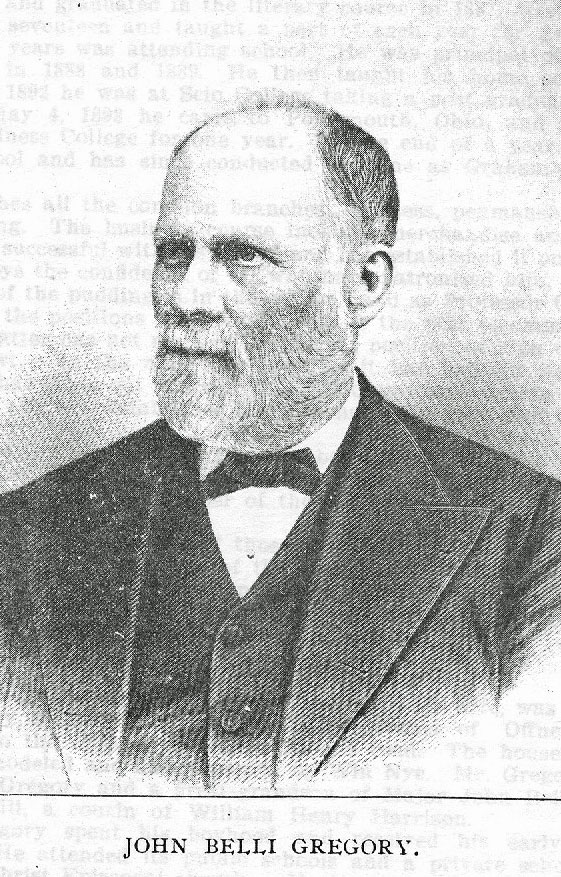
BIOGRAPHICAL SKETCHES - 997
In January, 1886, he located in Carter county, Kentucky, and assisted his father with his property. Here he began the study of law. He was examined at Frankfort, Kentucky, by Judges Pryor and Holt, and admitted to the Kentucky bar in January, 1889, and opened an office at Grayson, Kentucky.
In October. 1893, he was married to Miss Louise Bailey, a daughter of Judge James P. Bailey, county Judge of Lincoln county, at Stanford, Kentucky.
In 1895, after having been engaged in the practice of law for six years, he went to Cornell University Law School, and took a course of lectures, but did not graduate. He was elected Police Judge of Grayson, Ky., in 1893, and served one term. In January, 1895, he was appointed United States Commissioner at Grayson, Ky., and tried some of the most noted "moonshiners" of the Kentucky mountains. In December, 1897, he moved to Covington, Ky., where he opened a law offrce and is now residing there and engaged in the practice of law. Mr. Gregory has two daughters, Catharine and Clara, and a son John B. Mr. Gregory is regarded as one of the best lawyers of the Kentucky bar. He is a man of great force of character, excellent judgment, a good trial lawyer and advocate.
John Belli Gregory
was born in Scioto county, May 29, 1830. He is a son of Moses and Harriet E. (Belli) Gregory, the former of whom was a native of Ross county, Ohio, and the latter of Scioto county. The maternal grandmother of Mr. Gregory, Cynthia Harrison, was a cousin of the hero of Tippecanoe. Her husband, Major John Belli, has a separate sketch herein. His paternal grandfather, David Gregory, was a mechanic, a machinist, and a man of powerful physical endurance. He built one of the first mills ever constructed on the Scioto river. His residence was near Jameson’s Tavern not far from the historical spot called the "Hermit's Cave." He died about the year 1801. His widow removed to Chillicothe, where she was married to Henry Sheely, who in 1805, removed with his family to Portsmouth, where the father of the subject of this sketch, Moses Gregory, was brought up. He has a separate sketch herein.
John B. Gregory was brought up in Portsmouth, where he received his academic training, graduating from the High School of that place at the age of twenty. In 1850, he was employed as division engineer on the Scioto & Hocking Valley railroad, and in 1853, was promoted to assistant civil engineer, superintending the completion of the road from Portsmouth to Hamden. He remained in this position until 1856. In the following year, he was employed as engineer and surveyor in the construction of a blast furnace in Carter county, Kentucky, of which he was one of the projectors and part owner. In 1857, he was appointed by the Board of Public Works, resident engineer for the southern division of the Ohio canal. In 1858, and 1859, he was engaged in railroad engineering and in the running of railroads. From 1859 to 1860, he was Surveyor of Scioto county.
In 1859, Mr. Gregory was elected a member of the Board of Public works, a position he held for three years. He was re-nominated in 1862, but was defeated with the rest of the Republican State ticket. From 1862 to 1864, he was deputy Surveyor of Scioto county. In 1859, he was made financial agent of the Boone Furnace Company, filling the position until 1864, and at the same time rendering valuable service to the cause of the Union, as military agent of the government, keeping" watch of rebel movements and reporting whatever was discovered to the Federal officers in te field and to Governor Dennison. In 1864, he was appointed by the Treasury Department at Washington, to make a survey and execute a plat of the country along the Mississippi river, with a view to confiscation. In 1865, he removed his family to the furnace site in Kentucky, where he remained as manager of the business until 1867.
In this year, he sold his interests in the furnace and returned. to Portsmouth. In 1868 and 1869, he was engaged in engineering and constructing a turnpike road two miles out of Portsmouth, now forming a part of the Portsmouth and Buena Vista road. This was a work of considerable labor, and one of the most difficult of the kind in Ohio, and was made under the greatest possible disadvantages.
In 1869, the Atlantic and Lake Erie Railroad Company (now the Ohio Central) was formed, Mr. Gregory being selected as its chief engineer. In the
998 - HISTORY OF SCIOTO COUNTY.
autumn and winter of that year, he made the survey from Pomeroy to Toledo, and completed them the following year, when the work was begun, and continued under his supervision until the fall of 1871, when he resigned.
In 1872, he was appointed on a committee for the inspection of the public works of the state, and was directed to report on their condition to the legislature. He was subsequently employed in laying out the Columbus and Ferrara Railroad, now a branch of the Ohio Central Railroad. He continued engineering and surveying during 1873 and 1874. From 1876 to 1880, inclusive, he was city civil engineer of Portsmouth, and was deputy Surveyor of Scioto county in 1871, 1874, 1876 and 1879 and in the meantime contracted and built twenty miles of the grading of the Scioto Valley railroad, between Portsmouth and Big Run. May 20, 1880, he was appointed by Governor Foster and confirmed by the Senate, as chief engineer of the public works of the state, which office he held until May, 1884.
On December 2, 1854, he was married to Miss Kate Smith, daughter of Thomas Smith, of Wheeling, West Virginia. They had three children, two of whom are now living. Harry Gregory, the older son, died at the age of sixteen. The other two are Hiram D. and Mrs. Harriet E. Barney. The son has a separate sketch herein. The daughter, Harriet, married Ariel D. Barney, of New York, and is now a widow.
After retiring from public office, Mr. Gregory resided in Columbus until the spring of 1887. He then moved to Carter county, Kentucky, to look after some large property interests he had there. He opened a marble quarry, but abandoned it. He then undertook to ship timber from his lands, which was sent to Liverpool, England. He spent the remainder of his life in his Kentucky home, where he did much good both in church and state affairs. He gave the land and built the Methodist church in the vicinity of his home. He took great interest in politics, being always a strong republican. He was a delegate to the State Republican Convention in Louisville, Kentucky, which met in June. 1895, and nominated William 0. Bradley, for governor. At that convention Mr. Gregory was prominently mentioned for one of the State Railroad Commissioners. He was chairman of the Election Commission for Carter county, appointed under the Goebel law. He was a very useful citizen in his community. Mr. Gregory died on the 17th of January, 1902.
During his residence in Kentucky he was noted for his hospitality. He was always careful to entertain travelers and especially the ministers of any and all denominations in the vicinity. Mr. Gregory had a great many friends in Kentucky, and was beloved by all sorts and conditions of men, his neighbors and acquaintances. While he took an interest in all churches, he remained a faithful communicant of the Protestant Episcopal church. When he made a friend, that friend remained his friend always, and no one ever lived who possessed a greater list of excellent qualities of mind, heart and character.
Harry Shackelford Grimes
was born September 5, 1851, in Portsmouth, Ohio, on Jefferson street between Second and Third streets, in a frame house on the west side of the street. His father was James Grimes, and his mother's Maiden name was Mary A. Tobin. His father was a native of Birmingham, England, born in 1805. His mother was a native of Pittsburg, Pennsylvania. His father came to the United States in 1832 and located in Philadelphia. Afterwards he went to New Orleans, Louisiana, and subsequently returned to Pittsburg, Pa., where he commenced business and was married. He was a man of great inventive genius, and for many years he was engaged in the iron foundry business. He came to Portsmouth in 1837, and was very active and enterprising in his business. He bought and sold real estate, and built many fine residences. He built the house lately occupied by the late J. D. Clare. He died September 27, 1877. His wife died November 15, 1896.
Mr. Harry S. Grimes is his youngest son. He attended the schools of Portsmouth as a boy and youth until the year 1868, when he was in the High School. In that year he left school and began traveling. At the age of twenty he engaged in the commission and grain business in Portsmouth, Ohio, under the firm name of Gibbs & Grimes, and he has been in that business ever since, together with agricultural implements. He was a member of the
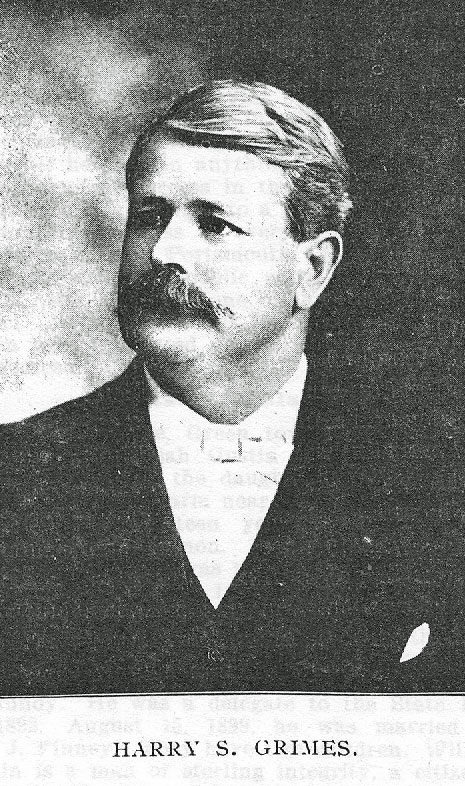
BIOGRAPHICAL SKETCHES - 999
City Council of Portsmouth from 1883 to 1885 and from 1895 to 1897. He was elected a cemetery trustee of Portsmouth in 1889, and has been re-elected tor the same office tri-ennially ever since, his last election being in 1901. He has been a director of the State Board of Agriculture for eleven years. He was president one year of that time, and treasurer one year. He has been president of the Board of Trade of Portsmouth for six years, and is now occupying that position. He has been the president of the Portsmouth Savings and Loan Association ever since its organization. He is now president of the Ohio Grain Dealers Association, and vice president of the National Grain Dealers' Association, and the Portsmouth Hotel Company, of which project he was the originator.
He is president of the Ohio Grain Dealers Insurance Company, and president of the Commercial Club of the City of Portsmouth. He has been a vestryman of the Christ Episcopal church.
Mr. Grimes was married December 9, 1873 to Miss Mary C. Vaughters, daughter of John A. Vaughters, of Friendship, Ohio. They have three children: two sons, Shirley V., and John Alexander; and one daughter, Leah Pauline, who married Harry E. Taylor of the Portsmouth Times.
Mr. Grimes is a republican in his political views. He is noted for his wonderful industry and energy in any business matter or any matter of public interest. If he fails in anything he has the happy faculty of making his failure the ground of success in the next venture. His failures he never tells. He possesses vim and vigor to a remarkable degree, and so plans all. his operations as to bring success in every outcome. He is one of the leading citizens and business men of Portsmouth. He is always in favor of any measure for the public benefit or public good, and if anybody has a scheme to benefit the town. Mr. Grimes is one of the first men who should be consulted upon the subject. It is not difficult to interest him in anything of that character, and when once interested he will do everything in his power to make :he project a success.
Dustin Willard Gustin
was born at Junior Furnace, Green township, Scioto county, Ohio, April 1, 1857. His father was Benajah Gustin and his mother's maiden name was Ann B. Isaminger. She was the daughter of Philip Isaminger. His boyhood and youth were passed on a farm near Powellsville, and at Empire and Junior furnaces until he was eighteen years of age. He attended the district schools and one term at Lebanon. He read medicine two years with Doctor Slagel from 1884 to 1886. He was appointed Deputy Sheriff in 1886 and served one year under A. J. Finney. In 1887, he was re-appointed and served four years under Yeager. In 1890, he was elected Sheriff and served for four years. From 1895 until 1901 he was engaged in the real estate and lumber business. He was elected City Marshal of Portsmouth in April, 1901. He is a republican. He was a delegate to the Congressional Convention that nominated H. S. Bundy. He was a delegate to the State Republican conventions of 1891 and 1892. August 15, 1899, he was married to Mary W. Finney, daughter of A. J. Finney. They have two children: Willard and Edith.
Mr. Gustin is a man of sterling integrity, a citizen much respected and highly honored by his fellow citizens. He makes an efficient officer and is of a most determined and resolute disposition.
Felix Haas,
son of Michael and Clara (Eisman) Haas, was born in Waldorf, Saxe-Meiningen, Germany, August 21, 1867. He was educated in the public schools of Waldorf and attended a short period in the gymnasium at Meiningen. He left school at the age of fourteen, and went to Eisenach and became a clerk in a dry goods store serving an apprenticeship of three years. After serving his apprenticeship, he came to America and directly to Portsmouth, where he received employment with his uncle, Leopold Eisman, in his clothing store. For nine years he worked for his uncles and then formed a partnership with Will H. Schwartz and Abraham Smith under the firm name of Haas, Schwartz & Smith. The business flourished under efficient management and in 1900 a department was added for the manufacture of men's clothing.