800 - HISTORY OF SCIOTO COUNTY
His interest in Wayne Township is easily accounted for. He owned considerable real estate in the eastern part of the Township and was desirous of good roads and improvements Doctor Offnere bought real estate to a considerable extent, but the author cannot find that he ever sold any. He held what he purchased and it descended to his heirs. He was a prominent Mason and contributed liberally to build the present Masonic Temple. He was a useful and valuable citizen and contributed much to the material progress of the town of his adoption. He died December 12, 1859. aged eighty-three years, seven months and twenty-three days.
John Orme
was born March 28, 1774. near Hagerstown. in Maryland. His parents were from England, and the name was originally thought to have been Arms. He was married to Elizabeth Graham. about the year 1798. at Hagerstown. Maryland. They had eight children. the first seven of whom were born in Maryland. John Orme. his wife and seven children came from Hagerstown. Maryland, to the Ohio river at Wheeling. in wagons. They traveled muddy roads and country with no roads at all, climbed over hills, and forded rivers and creeks till they reached the Ohio river. Then he purchased a family boat and went in it to Portsmouth, where he rented what was then called the Offnere farm near Gallia and Offnere streets. His family lived there in a log-house for several years and then they purchased land about four miles north of Portsmouth on the Chillicothe pike. and moved there. John Orme was a tall man, fully six feet high. wore side whiskers. and had a slight stoop in the shoulders.
His eldest son was Thomas Orme. born in 1799. and died February 18. 1872. His second son. Nathan. married Margaret Noel. (laughter of Philip Noel: his son, John Orme. married Philura Hayward. daughter of Moses Hayward. He was a farmer in the Scioto Bottoms. His children were: Martha E.. wife of A. B. Cole: Sarah. married to Charles 0. Cole: George W.. married Effie Fenton, and died at the age of twenty-six. leaving two children. both now deceased : Mary Jane. married to Tames Richardson : Lloyd. married to Elizabeth Hayward. another (laughter of Moses Hayward : Mary, married to Isaac Noel and Eliza married Aaron Clark. who was born September 12, 1817. in Portsmouth. on Offnere street, in a log house near the mound. 0n the Heinisch lot.
John Orme cleared up his land and resided on it till his death on the 25th of March. 1844, at the age of seventy-six years. 0ne month and twenty-seven days. He and his children went through the hardships of the early settlement of the country. He paid for his land by hard work, and at his death he owned the largest portion of Big Island In order to do this. each of the boys and girls had their share of work to do. Eliza. being the youngest, had to do the mar-
PIONEER SKETCHES - 801
keting. She walked four miles or more to Portsmouth and carried a big basket of eggs and a half dozen chickens to market. She says she sometimes rode horseback, if one of the horses happened to be idle. Eggs were three cents per dozen and other things were in proportion. When there was no marketing to carry to Portsmouth, she worked at the spinning wheel, or worked on the farm. She says she was never idle, as there was always plenty to do. She remembers when the 0ld Methodist church stood on Fourth and Market streets. It was a 0ne story brick church with two fire places for burning wood. She remembers two of the ministers : Mr. Brown, of Kentucky and Mr. John R. Turner. The school house where she attended was on the Alpheus farm about five miles from Portsmouth. It was a small log house with benches made out of slabs with wooden pins for legs. One log was taken out for a window and the vacant space was covered with greased paper. Some years they had school for three months. The teacher boarded week about among the families. She says he never forgot to have a switch, which he kept in the corner of the school house and used it as though he thought he had to. Mrs. Clark is living at this date, August 31, 1902.
John Orme was a Democrat, but was not a member of any church. He was an upright, honorable citizen and well respected by all who knew him. He tried to do his best for his large family 0f children. He made them all rich, and his grandchildren are enjoying the fruits of his labors at this day.
Conrad Overturf
was born in Fayette County, Pennsylvania, February 9, 1801. When about seventeen years of age, he came to Portsmouth, Ohio, and on July 20, 1826, married Rhoda Kendall, daughter of General William Kendall. She was born December 9, 1808, and died April 19, 1837. Their children were Elizabeth (Mrs. Hughes) born May 6, 1827, died May 8, 1901, aged 74; Eleanor (Mrs. A. Marsh) born April 16, 1829, and died May 25, 1901, aged 72; William born September 16, 1831. died September 9, 1834. On August 23, 1838, he married Rachel Kendall, the youngest sister of his first wife. She died October 30, 1874. To them were born John W. who after a residence of sixty years in Portsmouth removed with his family to Columbus, Ohio, where he now resides; Rhoda, who died in infancy; Ewing K., who resides in Rush Township, Scioto County; Thomas J., who resides in Buffalo, New York; Emma, who married Peter Brown and resides in Rush Township, and George who resides in Waterville, Douglas County, Washington. From 1830 to 1834, he was Sheriff of Scioto County. From 1838 to 1839, he was Treasurer 0f Scioto County. In 1832, he was elected County Assessor. At that time there was an unwritten law that the Sheriff should also be County Assessor. In 1833, his bill as assessor was $57.75. His assessment
802 - HISTORY OF SCIOTO COUNTY.
roll as returned was $10,974.06 3/4 cents and the commissioners cut his bill to $51.04. In 1834, he again assessed the County and his fees for the same was $61.40, for 41 days labor. In 1835, he was elected councilman of the town of Portsmouth and re-elected in 1836. He was on the committee on claims, in 1835 and in 1836. In 1839, he was Captain of the steamboat "Post Boy." From 1849 to 1852, he was assessor of Wayne Township. He resided in Portsmouth until 1864, when he removed to a farm in Rush Township and spent the latter part of his life there. He was employed for a number of years with the grocery firm of M. B. Ross & Company. He was a member 0f the dry goods firm of Kendall, Kepner & Company, and for a number of years was connected with the flour mill (which property is now occupied by the Times Publishing Company) run by C. S. Smith & Company. He was a Whig and afterwards a Republican. He was a member of the Methodist church and when he removed to Rush Township was instrumental in building a church there. He died October 31, 1872, and was buried on his farm. Afterwards his remains were removed to Greenlawn Cemetery. He was respected by all who knew him.
John Peebles
was born near Shippensburg, Pa., November 21, 1769. His father, William Peebles. was a Captain in the Second Battalion 0f Miles Pennsylvania Rifle Regiment, March 9, 1776. He was taken prisoner at Long Island, August 27, 1776, and died while a prisoner October, 1776.
He spent four hundred pounds sterling to raise and equip his Company and was repaid in continental money only.
John Peebles was married November 17, 1795, to Margaret Rodgers, a native 0f Shippensburg, Cumberland County, Pennsylvania, born May 17, 1777. They came down the Ohio river 0n a flat-boat in 1807. They stopped at Portsmouth, Ohio, near the mouth of the Scioto, and went on to Chillicothe, where they remained until April 2, 1819, when they .came to Portsmouth in a keel boat in the Scioto river.
Mr. Peebles stopped with his family at the Hotel on Front street, and the same day purchased it. The next day was Sunday, and he and his wife attended the Presbyterian church. They put their letters in that Sunday and remained members all their lives. He believed in the doctrine of the final perseverance 0f the Saints and practiced it.
They had a family of nine children, William, the oldest, died July 24, 1829, aged 33 years, and was the first person buried in Greenlawn Cemetery. Rachel Rodgers, the wife of Robert Hamilton, died August 27, 1883, at the age of 83 years. Elizabeth, the wife of Dr. G. S. B. Hempstead, died April 11, 1875, aged 75

803- PIONEER SKETCHES.
years. Fanny Denny died at 16 months at Shippensburg, Cumberland County, in Pennsylvania, November 11, 1804. Jane Finley, wife of Robert Wood, died November 1, 1875, aged 69 years. Richard Rodgers, died August 8, 1893, aged 83 years. Margaret Rodgers died at Portsmouth, Ohio, September 17, 1822 aged 11 years. Joseph Scott, died at Portsmouth, Ohio, July 8, 1893, aged 73 years. John Geddes died October 30, 1901.
John Peebles was a cabinet maker by trade. He followed that and a commission business and conducted a hotel.
In 1819 and 1820, he was engaged in making iron nails. They were made by hand, and sold from forty to sixty cents per pound.
In 1822, he was Overseer of the Poor of Wayne Township.
In 1824. he was Supervisor of the East Ward in Portsmouth, and a health officer of the town the same year.
The first Board of Health in the town of Portsmouth was composed of John Peebles, Jacob Offnere and Ebenezer Corwin. In 1824, he was appointed by the County Commissioners as Custodian of the Standard Measures of the County. He was appointed by the County Commissioners House Appraiser of Wayne Township, and was allowed $3.75 for his service.
In 1825, he was Assessor of Wayne Township, and was allowed $4.00 for his services. The taxes collected in that year were $205.48.
In 1826, he was Overseer of the Poor and a Trustee of Wayne Township.
In 1828 and 1833, he was also a trustee 0f the Township.
On July 17, 1828, he was one of the jury in the celebrated case of Jackson vs Clark, reported in 1st Peters, 666. This case was heard in Columbus before Judges Robert Todd and Charles Willing Byrd. Mr. Peebles' business often took him to Columbus during the sessions of the Unites States Court there, and he was frequently called as a juror. The verdict in the case was sustained by Chief Justice Marshall.
In 1828, he was Secretary of the County Agricultural Society.
In 1830, he was conducting a hotel in Portsmouth, which he called the Portsmouth hotel, at Glover's old stand, corner of West and Waller streets.
In 1832, he was a director 0f the Columbus and Portsmouth Turnpike Company.
In 1836, he was a Commission Merchant in Portsmouth and agent of the Protection Insurance Company of Columbus. He kept his office in with his son-in-law, Dr. Hempstead.
He died at Hanging Rock, Ohio, October 22, 1846. His wife died at the same place, August 28, 1847.
804 - HISTORY OF SCIOTO COUNTY.
William Peebles,
the eldest son of John Peebles and Margaret Rogers, his wife, was born November 16, 1796, in Pennsylvania and came with his father and mother to Ohio in 1807. When they located in Portsmouth in 1819, he was twenty-three years old. and the hotel business was carried on by him in his name in Portsmouth for some time.
In 1826, he was fence viewer of Wayne Township with John R. Turner as his colleague.
In the same year he received one vote for Justice of the Peace and John Noel had 32. He died unmarried July 24, 1829, and was the first person interred in Greenlawn cemetery. His remains were taken up when Mr. John G. Peebles purchased his family lot in Evergreen cemetery and now repose in the family lot with an appropriate headstone.
John Geddes Peebles
was born on a small farm on Lick Run, five or six miles from Chillicothe, Ohio, November 30, 1813. His father, John Peebles, one of the pioneers of Portsmouth, has a sketch herein. His mother was Margaret Rogers, fully mentioned in the sketch of her husband. His parents located in Portsmouth, Ohio, April 3, 1819.
Our subject, John G. Peebles, attended the primitive schools of the village of Portsmouth until he was fourteen years old. He then entered the dry goods store of his uncle, John McCoy, at Chillicothe, Ohio, in 1828, and continued there in a clerical capacity for eighteen months, when he returned to Portsmouth to assist his father in his hotel and commission business. In the summer of 1831, his father was appointed Deputy Marshal and sold his hotel. Then young Peebles clerked on the steamboat "Hermit" and was afterward in the employ of A. B. Ellison and Charles Scarborough. In 1836, he took two flat boats loaded with stone to New Orleans for Lemuel Moss, whose employ he had entered in 1833 as clerk and manager at the quarry mills. Moss was engaged in the manufacture 0f sawed stone. In 1836 he left this position and started a store on the West Side with Captain Francis Cleveland. He closed his store when the panic 0f 1837 came and moved his stock to a flat boat and traded along the river for about a year and then sold out what goods he had left and returned to Portsmouth, where he worked for Colonel John Row until 1842.
This year he removed to Pine Grove Furnace where he worked at the carpenter's trade. While thus engaged he studied the iron business and so well did he learn it that he was made General Manager of the furnace in 1844. Mr. Peebles continued in this position for about ten years, during which time he accumulated a small capital. In 1854, he and his br0ther, Joseph Scott Peebles, and Samuel Coles, bought a half interest in Pine Grove Furnace and the Hanging Rock Coal Company. In 1864, this interest was sold to Thomas W.

PIONEER SKETCHES - 805
Means and others. In 1860, our subject became the successor of James Rogers, as president of the Iron Bank of Ironton, Ohio, which position he filled until the bank merged into the First National bank of Ironton, when he became its president, and so continued until his removal to Portsmouth.
During his residence in Lawrence County, he was interested in other enterprises than those mentioned, the most important of which were the Belfont Iron Works Company at Ironton, Ohio, the Ashland Coal Company, the Ashland Coal and Iron Ry. Company and the Lexington & Big Sandy R. R. Company. Mr. Peebles changed his residence from Ironton to Portsmouth, August 28, 1865. Two years later, in partnership with Sherman G. Johnson and Benjamin B. Gaylord, he built the hub and spoke factory of Portsmouth, the firm being Johnson, Peebles & Company, and later sold his interests to Josiah H. Roads and Sherman G. Johnson. Mr. Peebles was a stockholder in the Portsmouth National Bank from its formation, later he became a director and on the death of George Johnson, in 1875, waS elected President. He held that poSition until his death.
After coming to Portsmouth to reside. Mr. Peebles retired from the more active sphere of business life, in the sense that he did not engage in new enterprises. He continued, however, to look after the interests that he already had, with the shrewdness and ability which always marked his business dealings. A large part of his time was devoted to work along charitable lines. As an instance of this, he bore a prominent and influential part in securing the establishment of the Children's Home, and served continuously as president of the Board of Trustees of that institution for twenty-five years. He avoided all political positions, and, although solicited often, never accepted any position in the gift of the people. He has, however, held appointive positions.
In his political affiliations, Mr. Peebles was a Republican from the time the party was organized, and previous to that time was an old line Whig. He was a faithful and consistent member of the First Presbyterian church of Portsmouth, and contributed liberally toward its support.
Mr. Peebles was married June 10, 1835, to Miss Martha Rose Steele, of Philadelphia, Pennsylvania. Nine children were born, five 0f whom reached maturity : Robert, Secretary and Treasurer of the Ashland Coal and Iron Railway Company at Ashland, Kentucky; John, formerly of the firm of Reed, Peebles & Company, Portsmouth, Ohio; Margaret J. and Mary E. who reside at the Peebles home on West Second street, Portsmouth, with their mother; Richard R. who recently died at Wooster, Ohio.
Mr. Peebles was killed instantly on the afternoon of October 30, 1901, by being run over by a trolley car going west on Second street, at the corner of Second and Washington streets.
806 - HISTORY OF SCIOTO COUNTY.
Notwithstanding he was in his eighty-eighth year, his faculties were well preserved and he filled all the positions he occupied with credit and ability to the last. At the time of his death, he was president of the Portsmouth National Bank, President of the Belfont Iron Works of Ironton, Ohio, and Vice President of the Ashland Coal and Iron Company of Ashland, Kentucky. He took an active interest in many matters of public interest. He was deeply interested in the Presbyterian church and in the enterprise of the preparation of this book. Mr. Peebles had not lost his interest in anything going on around him on account 0f his age or his infirmities. He was not willing to admit that he had any infirmities, at his advanced age, and his unwillingness to depend 0n others in going about cost him his life.
He was a man of the most positive convictions. When he would investigate a matter and make up his mind on the subject, that ended it, but he was always open to conviction and if any one approached him on a matter and it was meritorious, he could interest him in it. He had a wonderfully keen insight in business affairs. His integrity was most strict. He had remarkable executive ability, was a shrewd observer and his acquisitions and knowledge were extensive. In every matter of business or social duty, he was prompt, and never forgot anything incumbent on him to do. As a business man he had phenomenal success, and accumulated a fortune. He made the very best use of it; his charities and beneficences were innumerable. They were carefully and meritoriously bestowed and were given or made without any ostentation. When Portsmouth lost this prominent and distinguished citizen, it lost one of its most useful and valuable business men. This fact was shown in the attendance at his funeral. No larger or more numerously attended funeral was ever held in the city of Portsmouth. Distinguished people from neighboring towns and cities attended to show their respect for his memory. All who knew him well felt as if they had lost a friend and more than a friend.
Joseph Scott Peebles
was born at Chillicothe, Ross County, Ohio, June 19, 1817. His father, John Peebles, has a sketch herein. Our subject was two years of age when his parents removed to Portsmouth. He attended sch00l till fifteen years of age, finishing at the old seminary that stood on the corner of Market and Fourth streets, Davis and Archibald being the teachers. After leaving school, he spent a few months with his brother, John, who was bookkeeper and financial manager of Lemuel Moss's flour and stone mill at the Three Locks, and a few months with G. J. Leet, agent for the Troy & Erie Canal boats. He was then a year 0r two with William Hall, of Portsmouth, where he
learned the dry goods business. He next went with his brother-in-law, Robert Wood, who was in the supply business, on the corner of
PIONEER SKETCHES - 807
Front and Madison streets (the Lodwick corner) ; and afterwards on the corner of Jefferson and Front streets.
In 1836, Mr. Peebles went to Hanging Rock to take charge of the store owned by his brother-in-law, Robert Hamilton, which was connected with Pine Grove Furnace.
During the years 1842, 1843, 1844, after Mr. Hamilton had become exclusive owner of Pine Grove Furnace, he associated with him John Ellison, the manager of the furnace, James A. Richey, his bookkeeper, and Joseph Scott Peebles, under the firm name of Hamilton & Company. In 1844, Messrs. Ellison, M. R. Tewksbury and Richey purchased Jackson Furnace, Ohio, and Mr. Peebles, in company with Robert Wood and Thomas Martin, built the Hanging Rock Foundry, and carried on business under the firm name of Peebles, W00d & Company. This business proved very successful.
In October, 1850, John F. Steele, the junior partner and bookkeeper of Hamilton, Peebles & Company, died, and Joseph was solicited to take the position thus made vacant, with the promise of an interest at some future day. In 1854 the new firm was formed, consisting of Robert Hamilton, John G. Peebles, Samuel Coles and Joseph Scott Peebles, the firm name being Hamilton, Peebles & Coles. September 11, 1856, Mr. Hamilton died, and the business was carried on eight years longer under the same name, and in 1864 was sold to Messrs. Kyle & Company.
April 30, 1864, Mr. Peebles removed to Portsmouth, and with his brother John G. and others bought the Ashland coal and railroad property including a large number of iron and coal mines. They opened the coal banks at Coalton, and built a coal furnace at Ashland. A year later, Joseph Peebles' health becoming impaired, he sold his property to his brother, John G., and traveled a year through the Eastern and Southern states. In June, 1866, he returned to Ohio, and went to Lebanon where he purchased the Corwin property, and remained there till June, 1869, when he purchased a residence at 49 Wesley avenue, Cincinnati, Ohio.
He was married April 8, 1851, to Nancy Finley Lodwick, daughter of Colonel John Lodwick and Hannah Finley, his wife. They had but one child : William, now deceased. September 28, 1874, he went with his son William, who had been appointed vice consul by Hon. James S. Scott. United States Consul to the Hawaiian Islands. On December 1, 1875, he returned to San Francisco and took a steamer for Japan, traveling through the countries 0f the Eastern continent, and returned to America October 28, 1876.
After his return, he visited all parts of his own country, and has been in thirty-six of the states, of the United States. In 1884, he was a stockholder in the Portsmouth Steel and Iron Works. Portsmouth, and the Peebles, Foulds & Company flour mills, Cincinnati, Ohio. March 18, 1860, Mr. Peebles united with the First Presbyter-
808 - HISTORY OF SCIOTO COUNTY.
ian church at Hanging Rock. His first vote was for Wilson Shannon, Democratic Governor in 1838. He voted for Van Buren, Polk, Cass, Pierce and Buchanan for presidents. In 1860, he changed his politics and the rest of his life voted for the Republican candidates. He died July 8, 1890, aged seventy-three. His wife died October 23, 1881, aged sixty-one years.
Nathaniel W. Preston
was born near Danvers, Massachusetts, April 7, 1817. His father died when he was a babe and his mother in company with eighteen others, emigrated to Ohio, in 1820. They landed at Hayport, near Wheelersburg, Green Township, December 20, 1820. There were nine adults and eleven children in the party, among them were Rev. Daniel Young, his brother, John Young, Joseph and Asa Merrill. Mr. Preston's mother, Mrs. Jane Preston, reared two sons, Nathaniel and Ira. She lived a long life of great usefulness and died June 22, 1879, aged 83 years. From December 20, 1820, at the' age of three years, he lived on the banks of the Ohio river at Hayport, in Porter Township and led the life of a plain and simple farmer.
He was married February 19, 1850, to Mary Ann Holmes, who survived him. He never tried to make money and never did so, but always had enough of this world's goods to be, comfortable. He was always cheerful and always cordial. No man was more attached to his friends than he. He never had a dishonest thought. In fact, he was too honest with his neighbors and gave them the benefit of the doubt all the time, instead of reserving it for himself. He believed in simplicity in living and lived in that manner all his life. He was not a member of any church. He often compared himself with his brother Ira and thought himself very wicked. He would sometimes say "damn it" but he possessed all the Christian virtues in an eminent degree. No kinder hearted nor more sympathetic man ever lived. He was always in earliest in all he did. He loved his country and would have given his life for it on a second's notice. In his political views, he was a Republican and strong anti-slavery. He died May 23, 1901, at his home near Wheelersburg, Ohio.
Rev. Ira Mills Preston
was born in Dedham, Massachusetts, in 1818. His father died a few months before his birth and when he was two years old his mother took him and another son, Nathaniel, thirteen months older, the long and then very difficult journey to Wheelersburg, Ohio, to join her father, who had gone there some time before to secure land for a home. Ira grew up there helping in the farm work, but considering himself not strong enough to be a farmer, he went to Marietta to fit himself for a position as clerk in a store in Portsmouth, Ohio. He very soon became a Christian and his conversion changed all his plans

PIONEER SKETCHES - 809
for life. He decided that he must preach the Gospel and that he must have a thorough education. He entered Marietta College in 1841, graduating in 1845. He went to Lane Theological Seminary, graduating there in 1848. He had some time before this decided to go as a missionary to the heathen, ch00sing as his field, West Africa. On the 29th of May, 1848, he married Jane Sophia Woodruff of Marietta, and soon after sailed for the Gaboon Mission in Equatorial Africa. After nineteen years of service under the A. B. C. F. M., he returned to this country, broken in health. His health improving, he taught school for several years. He was tutor in Marietta College for three years. He was a man of great fortitude, bearing hardships and trials without a murmur, always a singularly upright, conscientious man. After years of great feebleness, he died in Marietta, February 7, 1901.
Seymour Pixley
was born July 14, 1801, in New York state. In October, 1830, he was County Assessor 0f Scioto County and John Peebles, G. S. B. Hempstead and Tames Lodwick were 0n his bond. On June 7, 1831, he was allowed $56.81 for his services as Assessor. September 16, 1831, he was a candidate for Sheriff in Scioto County, Ohio. In 1832, he was County Assessor. The total expense was $68.37 1/2 of which his bill was $49.00. 62 1/2 cents was for two quires of ruled paper and $18.75 for Ira Preston for 12 days as deputy. April 3, 1841, he was appointed Assessor of damages on the Portsmouth and Columbus turnpike, by the County Commissioners.
September 30, 1827, he was married to Eliza Ann Smith, daughter of Major John Smith. She was born February 15, 1807. Her mother was a sister of Doctor Lincoln Gooddale of Columbus, Ohio, and daughter of Major Nathan Gooddale, who was abducted by the Indians. Their children were: Hezekiah Squire Pixley, born July 8, 1828; Edwin Pixley, born June 10, 1830; Mary Ann Pixley, born November 17, 1832; Susan Gooddale Pixley, born February 20, 1835 Eliza Ann Pixley, born January 7, 1838; Eliza Ann Smith Pixley died January 14, 1838.
June 20, 1838, Seymour Pixley married Elizabeth Orme, widow of Lloyd Orme. Her maiden name was Hayward and she was a daughter of Moses Hayward. Their children were: Charles Lloyd, born May 6, 1839; William Henry Harrison, born August 20, 1840 ; Milton Smith, born June 2, 1842 ; Martha Hannah, born February 5, 1850, married Joseph Merrill, January 20, 1874, and died September 13, 1901. Elizabeth Orme died August 3 1857, and Seymour Pixley died October 16, 1860, on his farm on the Ohio river near Wheelersburg on which he had lived for many years.
Ezekiel Powers, Sr.,
was born October 11, 1793, in Harrison County, Virginia. His
810 - HISTORY OF SCIOTO COUNTY
father was John Powers, a Revolutionary soldier, who married a daughter 0f William White, a native of Ireland. About 1802, he went with his father to Butler County, Ohio, where they lived for several years. The family returned to Virginia about 1810, 0n account of ill health. When the war of 1812 with England commenced, Ezekiel, with his father, joined the First Virginia Militia, in Harrison County, Virginia and went to the war. He was afterwards granted a pension for his military services.
The records 0f the War Department at Washington show that John Powers, Sr., grandfather of our subject and father of John, Jr., served as a private in Capt. Thomas Meriwether' s Company of Light Infantry, First Virginia regiment, Revolutionary war, from September 14, 1777, to March 4, 778, when he died.
His son John, Jr., also served in the Revolutionary war in Capt. William Hoffler's Company, First Virginia state regiment, from March 1, 1777 to April, 180. He and his son, Ezekiel, Sr., our subject, afterward served in the war of 1812. The former was a member of Capt. John E. Brown's company, 1st (Clark's) regiment of Virginia militia, from February 11, 1813, to June 25, 1813, when he was killed in action at Hampton, Va. The latter served in Capt. John McWhorter's company 0f infantry, 1st Virginia militia from September 16, 1842 to March 29, 1813.
Ezekiel and his father escaped from the British at the time of Hull's surrender, and traveled across the state of Ohio, most of the time in the night, to avoid hostile Indians. They sustained many hardships, living upon the inner bark of trees and ground nuts and found their way to the Ohio river at the mouth of Guyan river, West Virginia, where a camp of hunters in Virginia heard them and constructed a raft on which they were taken across the river. When the raft was near the Virginia side, a band of Indians, who had been in pursuit, came yelling through the willows on the Ohio side and fired at them, but without effect. Their clothing was almost worn from their bodies from struggling through the dense brush at night, their moccasins entirely worn out, their feet bleeding, and they were almost starved. They were well cared for by the hunters who proved to be from near Clarksburg, their home, and with whom they returned. Young Powers had hunted about Guyan river before and had met the famous Davy Crockett and heard from him many incidents of his career as an Indian fighter. On his second removal to Ohio, he settled in Portsmouth, where he resided but a short time. He then removed to the mouth 0f the Little Scioto rivers where he lived for several years.
In 1815, Ezekiel, Sr., was married to Jane Simpson, daughter 0f James Simpson and Jane Van Sickle, of Harrison County, Virginia, who were themselves married on the day of the first battle of the Revolution, in Sussex, County, New Jersey.
PIONEER SKETCHES - 811
His first child, Sarah, was drowned at the age of two years, in 1818, by falling down the steep bank into the deep water. His son, James was born October 7, 1818. He married and lived at Lexington, Indiana, many years, but now resides at Dehesa, California. His second son, John Simpson was born October 13, 1820, and went to California in 1848, and has lead the life of a miner and prospector ever since. He now resides in Dehesa, California. He joined the First California Regiment, United States Volunteers, war of 1861 and served until its close. A second daughter, Harriet; born March 13, 1823, was married to William Campbell, at Lexington, Indiana, and resided there. She died February 14, 1900. The third son, William Powers was born October 6, 1826, was Captain in the Mexican war of a company of Louisiana Rangers, and in the war of 1861 to 1865 was Captain in the Twenty-second Indiana Volunteers. He died May 30, 1901. Ezekiel Powers, the fourth son, was born October 9, 1828, on Bonser's Run. He died at Sciotoville, October 14, 1894. George Read Powers, the fifth son, was born July 27, 1832, near Sciotoville. He went to Indiana when a young man. He joined an Indiana Regiment in 1861, and served until 1865. He resided at Madison, Indiana. Jane Simpson Powers, the wife of our subject, died at Wheelersburg, June 28, 1838.
Ezekiel Powers, Sr., was a stone mason and worked upon the first bridge across Little Scioto river at Sciotoville. He also worked on the Ohio canal, near Chillicothe. He was a Democrat until the war of 1861, when he became a Republican. He was a devout member of the Methodist church and took great interest in the welfare of the church. He was postmaster in Wheelersburg from 1839 to 1843. He 0wned 160 acres of land near Sciotoville upon which he discovered fire day, which in 1861, he brought to the notice of Mr. Thomas, a fire brick manufacturer of near Wheeling, West Virginia, who soon organized a company, procured the 0ld Wilcox saw mill at the narrows at Sciotoville and converted it into the first fire brick works in Scioto County.
He married again in later life. He died in Wheelersburg, January 15, 1876. He was a citizen respected and honored by all who knew him.
John Walter Purdum
was born April 15, 1815, in Cumberland County, Maryland. His parents were Zadock and Matilda (White) Purdum, both 0f whom were born in Cumberland County, Maryland. His ancestors emigrated from Wales to America in the time of Cromwell; his mother was of English ancestry. In 187, his parents, in company with a colony of relatives and neighbors, came to Ohi0 and located in Ross County, near Chillicothe. His father located and cleared a farm in the Paint Creek Valley, where he spent his boyhood; but upon the
812 - HISTORY OF SCIOTO COUNTY.
death of his parents, while he was yet a lad he went to Chillicothe where he learned the trade of carpenter and joiner, In 1832, on the opening of the Ohio canal, he came to Portsmouth.
October 9, 1838, he was married to Eliza, daughter of John Ratcliff who was a prominent citizen of English nativity. She died in 1854. Of this marriage, were born eight children, all of whom died in childhood, except Harriet who died in 1863; John W. Jr., who died in 1870, and Annie E., who died in 1899. April 10, 1855, he was married to Sarah Pursell, who was born in Burslem, Staffordshire, England February 3, 1824, and was a sister of James Pursell, one of the pioneer merchants of Portsmouth. She survived him and died August 10, 1894. Of this marriage, four children were born, two dying in childhood, Martha A., dying in 1880, at the age of 22 years, and James P. Purdum, who is a practicing attorney 0f Portsmouth, Ohio.
From 1832 until 1880, Mr. Purdum engaged in contracting and building in Portsmouth, during which period he constructed many of the largest and finest public and private buildings in the city.
In 1885, he built, and for some years afterwards 0perated, what was then one of the largest planing mills in the Ohio Valley. This mill was located on the north side of Fourth street between Chillicothe and Gay streets. The panic of 1857 and the war of the Rebellion made its operation unprofitable and he sold it to James Bryson who converted it int0 a flour mill, which he operated for several years.
Mr. Purdum was a Whig and Republican and prominent in the councils of those parties, but never sought public office. On several 'occasions, however, he served as a member of the city council. He was an early, earnest and consistent member 0f the First Presbyterian church, in which he served as an elder. On the organization of the Second Presbyterian church, he and his family became members of that congregation. He died at Portsmouth, Ohio, September 7, 1891.
James Pursell
was the son of Charles and Ann Pursell, born at Burslem, Staffordshire, England. March 11, 1817. At the age of fifteen, he left his native place and went to Liverpool where he embarked for the United States 0n the 19th of January, 1831. He arrived in this country on the 8th of March, 1831, and went to the home of his uncle. Thomas Pursell, a queensware merchant in Washington, D. C. There he remained until 1835, and obtained an excellent business training in his experience with his uncle.
While in the city of Washington, he made the acquaintance of Mr. Mathias B. Ross, of Portsmouth. Ohio, who was much impressed by his observation 0f Mr. Pursell. Mr. Ross offered him a position
PIONEER SKETCHES - 813
in his dry goods house in Portsmouth, which he accepted and he remained with M. B. Ross & Co. in the dry goods business until 1839, when he engaged in business for himself. In 1842, he opened a branch store with Karns Laughlin in charge, and another in 1847 with Lon Heaton in charge. In 1850, he built and moved into his own building in Enterprise block. In 1852, he divided his business of queensware and dry goods and took James F. Towell in the dry goods business with him and James Y. Gordon and Thomas J. Pursell in the queensware business.
On March 16, 1843, he married Miss Amanda Thompson, of Wheeling, West Virginia, daughter of Sarah Cowles and Moses Swan Thompson. In October of 1856, while in the east purchasing goods he contracted a cold which resulted in consumption and he died on the 22nd day of March, 1856. His wife survived him with six children, who are noted under her sketch.
Mr. Pursell was always noted for his integrity, in all his dealings. He had great business talent and was very successful. He was one of the most active and energetic citizens who ever lived in the city of Portsmouth. His death was a calamity, not only to his family, his church and social circle, but to the community at large.
Mrs. Amanda Pursell
was born at Wheeling, West Virginia, April 30, 1821. She was a daughter of Moses and Sarah (Cowles) Thompson. She was one of a family of seven children, six sisters and a brother, Dr. John Thompson. She came to Portsmouth with her parents, and on March 16, 1843, was married to James Pursell. He died March 22, 1856, in his thirty-ninth year.
A few clays after the departure of Company G, the first Ohio troops to answer the call of President Lincoln for volunteers, she organized the first Aid Society in the state and began making comforts; clothing, lint. etc., for those whom she felt would need such assistance. Soon after the first engagement. the remains of the boys were sent home for burial. and she and her co-workers were instrumental in having public funerals, such as had never been witnessed in southern Ohio. Soon thereafter, she and some thirty 0ther mothers adjourned to Greenlawn cemetery and held a memorial service, decorating the graves of the fallen heroes. This occurred as early as 1862.
This womanly organization has honored the dead and themselves, by each year strewing flowers upon the three hundred graves at Greenlawn cemetery, until now there are only five or of them left to impress upon the youth of the land the lesson of patriotism and of commemorating the memories 0f the heroic dead. She may justly he regarded as the originator of our beautiful memorial day exercises.
814 - HISTORY OF SCIOTO COUNTY.
Later on she organized the Monumental Society, and was largely instrumental in the erection of the Soldiers' Monument in Tracy Park. Still later, realizing that the country's need was men,5 and, being a widow with no sons of suitable age, she had her agent hire a substitute, paying $800 therefor, and sent him in answer to one of the calls for volunteers.
She was the mother of six children, two of whom are deceased: Charles T. and Henry P. Those surviving are Mrs. Julia P. Rupel and Mrs. Edward Ricketts 0f Cincinnati, and William McLain, of Portsmouth, and Morris H. She was a prominent worker in Bigelow M. E. church. She died March 10, 1895.
William Raynor
was born in Leeds, England, October a, 1810. He married a sister of Joseph Micklethwait, in England and came to the United States in 1831. His wife died soon after he reached this country, and he married Miss Mary Kinney Barber, in 1833. She died in 1864. Their children were: General William Raynor, now of Toledo: Uri Raynor, of Cincinnati, Ohio, and Maria, widow of the late John B. Maddock. For a third wife he married a Mrs. Munn, a widow, daughter of Major Isaac Bonser by whom he had one child, a son Charles, of Sciotoville. He was a shoemaker by trade, but in his latter years he was a gardener. Mr. Raynor was, during his life in Portsmouth, a well knOWn and highly respected citizen. He was a man of energy and great industry. He was thoroughly domestic in his habits and very hospitable., Nothing delighted him more than to entertain his friends in his own home. His greatest pleasure was in making his family and those around him comfortable and happy. He died March 4, 1878.
Major Charles Frederick Reiniger
was born in Wurtemburg, in Germany, November 11 , 1805. His father educated him, expecting him to become a Lutheran minister. However, the son's tastes were all military, and at 18 years of age. he went into the military service and served until he was promoted Major, In 1830, he went to Montreal, Canada. Here he engaged in the butchering business for 0ne year and then went to Cleveland, Ohio, pennyless and a stranger. In 1831, he came to Portsmouth, Ohio.
In 1833, he married Barbara Suiter, daughter of Valentine and Frances Suiter. He had thirteen children, eight of whom survived him, four sons and four daughters. The sons were: Charles Frederick, Jr., Joseph, Louis and George. Joseph and Louis are now deceased. Charles F. lives in Portsmouth and George lives at Washington Furnace. His daughters are Mrs. Jacob Bender, Mrs. Samuel Culbertson of Portsmouth and Mrs. Frank Seth of Parkersville, Kansas.
PIONEER SKETCHES - 815
When he first came to Portsmouth, he worked in the Gaylord mill at 75 cents per day. He conducted the butchering business for a while, and for a time he ran a canal boat to Cleveland. In 1837, he began to build the National hotel at the Point, but did not finish it till 1844. It was the finest hotel in the city, and cost $30,000. He ran it with his brother-in-law, William Briggs until 1852. It was a mistake t0 build it and a greater mistake t0 have built it at the point. It never paid and never could be made to pay. In 1840, he 0rganized the. Washington Guards and was Captain of the Company from 1840 to 1860. He was a city street commissioner in 1849; and the same year was supervisor of Wayne Township. In 1852 he was a Justice of the Peace 0f Wayne Township.
In 1860, he organized the Steuben Guards, twenty-four of whom afterwards went with him into Company B of the 56th O. V. I. Major Reiniger was born with military tastes. He was every inch a soldier. When the Civil War broke out, he was fifty-five years 0f age, yet he organized Company B, of the 56th O. V. I. as its Captain. He entered the regiment August 7, 1861, and served as Captain of Company B, till May 2, 1863, when he was promoted Major. He was discharged October 27, 1864, by reason of his age and physical disability.
In 1865, he was a candidate on the Democratic ticket for County Treasurer against John L. Ward. He received 1902 votes and Ward received 2,130, making a majority of 228. He was always a Democrat in faith and practice. Personally Major Reiniger was a fine looking man. He had the most determined expression on his face. His features were large, regular and handsome. When in the height of his physical powers and dressed in his uniform, he looked every inch a soldier. He loved the profession of arms, and had he followed it he would have acquired great distinction. He was a good and loyal citizen. but had no Qualifications as a man of business. He died in November, 1880. His wife survived until August 17, 1888.
Joseph Riggs
was born near Amity, Washington County. Pennsylvania, July 2, 1796, the eldest son of Stephen and Anne Baird Riggs. He had four brothers and six sisters. His father removed to near Steubenville, Ohio, when he was a child: and later to Sardinia, Ohio, where both he and his wife are buried. In August, 1817, our subject left his home near Steubenville. Ohio, to visit his uncles James and Moses Baird in the Irish Bottoms in Green Township, Adams County. While there he was offered the nosition of clerk in the West Union bank, kept by George Luckey. This position he accepted on December 31, 187; and in coming from Steubenville to Manchester traveled on a flat boat.
816 - HISTORY OF SCIOTO COUNTY.
While living at West Union he was a great friend of lawyer Geo. Fitzgerald, and frequently borrowed his fine horse to ride to North Liberty to court Miss Rebecca G. Baldridge, daughter of Rev. Wm. Baldridge. On January 1, 1819, he was elected cashier of the West Union bank ; and on December 8 1819, he married Miss Rebecca Baldridge, before named. Soon after they joined the Associate Reform church, at Cherry Fork. He served as cashier of the West Union bank until 1823. On March 1, 1824, he was appointed Auditor of Adams County, Ohio, to serve an unexpired term. He was elected, and re-elected; and served from 'March 1, 1824, until the fall 0f 1831. In 1831, he was appointed a deputy suveyor of the Virginia Military District of Ohio, from Adams County. While holding that office he made a connected survey of all the lands in Adams County, and made a map 0f that county which remained in the Auditor's office till it fell to pieces from age. Mr. Riggs was an accomplished surveyor, but when or where he learned the science we are not advised. He resigned the office of Auditor on October 3, 1831, to accept the office of State Senator from Adams and Brown Counties, to which he was elected as a Democrat in 1831, and served until 1833. In the fall of that year he moved to Hanging Rock, Ohio. He remained there until 1837, when he removed to Portsmouth, Ohio, where he resided the remainder of his life.
On reaching Portsmouth in 1837, he and his wife connected with the First Presbyterian church, and he was ordained an elder in 1838. He served until February 9, 1875, when he connected with the Second Presbyterian church. He was at once made an elder in that church, and continued as such during his life.
In 1837, he opened a general store in the city of Portsmouth, and continued in that business, either alone or with partners, for many years. He was a man 0f substance and 0f excellent business qualifications. In March, 1838, he was elected to a township office in Wayne Township, in which was located the town of Portsmouth. He was elected a member of the city council of Portsmouth, March 3, 1838, and continued in it, with intervals, until 1868. He was elected Recorder of Portsmouth April 10, 1838, and served until March 15, 1844, and again from March 7, 1848 to March 16, 1849. He was county surveyor of Scioto County from 1839 to 1841. On May 21, 1838, he was appointed on a committee to secure an armory at Portsmouth. He was surveyor of the town of Portsmouth from November 7. 1845 to March 7, 1849, and again from 1852 to 1854. On December 4, 1846, he was appointed one of the first infirmary board of Scioto County, Ohio, and served by subsequent elections till 1852, and during that time he was clerk 0f the Board. In 1860, he engineered the construction of the tow path from the city of Portsmouth t0 Union Mills, and charged $70.00 for his entire services. In 1867, he was president 0f the city council of Portsmouth. He was usually
PIONEER SKETCHES - 817
on the committee of ordinances, and was one of the most useful members of the council. He was responsible for most 0f the city ordinances and general legislation during his membership of council.
Rebecca G. Riggs, wife of Joseph Riggs, died April 3, 1862. Twelve children were born of this marriage. The oldest, Mrs Rebecca A. Kendall, resides in Oakland, Cal.; Eliza, deceased, was the wife of L. Newton Robinson, who commanded Battery L of the First Ohio Light Artillery during the Civil War ; Mary died in infancy; Harriet,. wife of Robert Dunlap, Jr., died in Pittsburg, Pa.; James W., was killed in a railroad accident on the Scioto & Hocking Valley R. R., in 1857; Martha, widow of J. V. Robinson, Jr., who was Major of the 33rd Ohio Infantry during the Civil War, resides in Florida ; Stephen B., is engaged in the real estate business in Emporia, Kansas ; Samuel A. and Joseph E. are lawyers at Lawrence, Kansas ; Charles H. is connected with the Union Freight Line at Pittsburg, Pa.: Alexander Brown is a professor in Lane Theological Seminary at Cincinnati, Ohio ; Emma, the youngest child, died in 1848, at the age of three years.
He was a public spirited citizen, and was so recognized. When any delegation was to be sent on a public mission by the city authorities he was usually 0ne of it. In 1869, he retired from all business, and lived quietly until his death on July 28, 1877, at the, age of 81 years, 26 days. He was a just man, a consistent Christian, and a most valuable citizen.
Ephraim Wanzer Rickey
was born in Porter Township, Scioto County, Ohio, October 4, 1820. His parents were Jacob and Tryphena (Strong) Rickey, who came from New York to Scioto County, in 1817. They landed at Sciotoville. There they remained four years, and then removed to the flats of Madison Township. Jacob Rickey was a Baptist Minister and for forty-five years preached in, this county. He died at the age of 72. His wife was a teacher, and after her marriage taught subscription school in Madison Township.
Ephraim, through his mother's efforts, received some advantages of education which most 0thers, of his cotemporaries did not have. He was married July 19, 1841 t0 Annie, daughter of Jonathan and Rebecca (Mead) Rockwell, of Madison Township. She was born October 21, 1821, in Madison Township. Mr. Rickey engaged in farming until 1873, when he removed t0 California, Pike County, and commenced dealing in merchandise and live stock, which he continued for several years. He returned to his farm about 1881 and in 1894 removed to Harrisonville, where his wife died April 17, 1896. The following were their children: Rose, Etta, wife of Nathan M. Kent of Harrisonville: James Silas, who has a sketch herein ; Telina, wife of Thomas M. Kent, living in Madison Township; Jacob Frank, liv-
818 - HISTORY OF SCIOTO COUNTY.
ing on Duck Run, and Nathan Thomas, who has a sketch herein, and is a real estate agent in Portsmouth. Mr. and Mrs. Rickey lost four boys and one girl in childhood. After the death of his first wife he lived with his son, James S. Rickey until his marriage to the widow of Thomas Campbell, of Morgan Township, April, 1900. His second wife died November, 1901, and since that time be has lived on his farm in Morgan Township. He is now 82 years old, and enjoys good health. He was a Whig and t00k an active part in the elections of that party. He was one of the very first Republicans in Madison Township when there were only eight votes all told out of four hundred, and has been a Republican ever since. He is a believer in Christianity, and the Seventh Day Adventists express his belief nearer than any thing else. He has a clear conscience, and is ready for the world to come.
Captain William P. Ripley
was born near Madison, Indiana, February 26, 1824, a son of William P. Ripley, who located in Portsmouth, Ohio, in 1833, where he died in 1845. Captain Ripley commenced life by selling fruit, etc. at the wharfs, when boats landed. He then worked on the canal about four years, and when thirteen years of age, was engaged as cabin-boy on the river. He worked in that capacity for two years, and then was in a grocery and saloon, with his brother-in-law, William Sickles, about nine years. He was subsequently employed on the river boats as chief engineer, cook, bottle washer, and mud clerk. He attended t0 business and was promoted till he became a master. In 1857, he was Captain of the "Reliance," and in 1858, of the "Swallow." In 1860, he bought an interest in a steamboat. In 1861. he was Captain of the "Moses McClellan." In 1865, he went int0 the wholesale liquor business, but in 1870, sold out and returned to the river. He built the "Jim Fisk," Jr., in 1870, and sold her the next year. He afterwards bought an interest in the "Kanawha Belle," and in 1873, was Captain of the "Fannie Dugan." He then had an interest in the "Mountain Belle" and was Captain six months. He owned a tug-boat that was commanded by his brother. He sold this boat but afterwards bought it again at a United States Marshal's sale, and of it made the "Iron Duke," which he soon sold. Captain Ripley has been an energetic business man, and made a success of his undertakings. For a number of years he has been retired from all business, and made his home with his son-in-law, Thomas B. Nichols.
He died October 19, 1902.
Joshua Vansant Robinson, Sr.,
was one of the most successful merchants and business men who ever resided in Portsmouth. He first came to Portsmouth about March 29, 1829, and opened a general store which he conducted for years, either alone or with his sons. He was for a long time an insurance agent
PIONEER SKETCHES - 819
conducting that business in connection with merchandising. He was largely intersested in the Scioto furnace at the time it was most flourishing. He never interested himself in politics, though he was a Whig and afterwards a Republican, He bought and sold real estate, but like Jacob Offnere, he was mostly a buyer and he died possessed of a large quantity 0f valuable real estate.
He took a great interest in the public schools, and was a school trustee from 1838 to 1845. While a member of the board, he gave the minutest attention to his duties, and the reports made, while he was one of the board, were models of accuracy. They gave all the information any one could ask. In 1830, he built a brick residence on the northeast corner of Second and Court streets. There was a great yard connected with it' and weeping willows stood in the yard. A portion 0f the brick house is yet standing in the rear of the premises east of Otto Zoellner's jewelry store.
In 1838, he built and occupied the residence now occupied by the Peebles-Hamilton Reading Rooms. This he occupied for his family home until his death. He was greatly instrumental in building the Scioto and Hocking Valley Railroad, in 1857. In 1842, he was a director of the Portsmouth Insurance Company. He was director in every business enterprise in Portsmouth while he was in active life. In the Scioto and Hocking Valley Railroad, the Commercial Bank, and in the Portsmouth branch of the State Bank of Ohio, he was a director. He was President of the latter from its organization, March 1, 1847 until January 7, 1850.
He was born October 18, 1790, and died on Sunday evening January 8, 1865, at the residence of his son-in-law, Col. J. R. Turley, aged .74 years, 2 months, 20 days. He was in apparent good health and attending to business on the day previous to his death. The funeral services took place 0n Wednesday afternoon at the Bigelow chapel. His wife, Hannah Cooper, preceded him about one year. She was from Coopersville, N. Y., born and reared a Quaker. The following were their children : Lucien Newton, Joshua V., Jr., Lewis Cooper, Cornelia M., wife of Hon. Wells A. Hutchins, Charlotte, wife of Col. John A. Turley, Mary Ellen, wife of Daniel A. Glidden, Camilla, who died young, and Charles Henry.
Captain Lucien Newton Robinson
was born in Cincinnati, Ohio, March 19, 1817. Soon after, his parents removed to Evansville, Indiana. In 1829, his father's family came to Portsmouth and he helped in his father's business. At the age of twenty-two, in May, 1830, he was married to Eliza Jane Riggs, daughter of the Hon. Joseph Riggs. From that date to 1841, he carried on a foundry, at Springville, Kentucky. He removed to Portsmouth in 1841, and engaged in steamboating and buying and selling corn. After his father purchased the Union Mills, he removed
820 - HISTORY OF SCIOTO COUNTY.
there and lived a number of years. The Distillery was built under his supervision, as was the Suspension Bridge. The date of his removal to Washington Township was 1848. In 1850, he was candidate for Commissioner and was elected by a vote of 1,190 to 514 for Fullerton, his opponent, and served one full term of three years. On the 8th day of October, 1861, he enlisted in Battery L First Ohio Light Artillery, at the age of forty-four. His health was never good, but he managed to stay in the military service until November 12, 1862, when he resigned on account of physical disability. In the fall of 1862, he went off at a tangent and supported. his brother-in-law, the Honorable Wells A. Hutchins for Congress, on an independent platform, "A more vigorous prosecution of the war. He, more than any one, was responsible for Mr. Hutchins election. He canvassed the entire district with him.
After his retirement from the army, he formed a company to distill oil from shale. He would have made a fortune out of it, but for the discovery of petroleum, just at the time he had the 0il ready to put on the market, after the company had put fifty thousand dollars in it. In 1868, he was appointed Indian agent and went west. He soon had to give this up and ran a hotel at Emporia, Kansas. He was a member of the Kansas Legislature for a term.
He returned to Portsmouth in 1873 and was made mail agent. He ran for State Senator as a Republican in 1875 and was defeated by I. B. Monahan by ten votes. From this date, until his death, he was in poor health. He was a gentleman of very swarthy complexion, prominent features and he had a saturnine expression of countenance. His face in repose was as solemn as that of ten ministers on funeral occasions, but when he relaxed all that changed. He was an excellent political speaker. He could please the people and reach them and he was in demand in every political canvas when he would go. In 1859, he addressed Republican meetings all 0ver the country. He was a very nervous man and full of energy.
He died on Fourth street, Portsmouth, Ohio, in the residence now occupied by Perkins Pratt, November 26, 1877. at the age of sixty years. eight months and seven days. His daughter, Kate married Mr. Harry Willard, of Wellston, Ohio. His daughter Camilla married first Eugene Bigler and after his death Joseph A. Modica. His son, Harry G. Robinson died June 2, 1876, aged 28 years. 8 months and 12 days, and is buried in Greenlawn. His daughter, Lucy A., is now Mrs. S. G. Clark His son Frank H. Robinson is still living. His wife died August 11, 1886.
Mathias Baldwin Ross
was born in Lebanon, Warren County, Ohio. August 4, 1808. He received his education in the Lebanon school, and was a contempo-
PIONEER SKETCHES - 821
rary with Thomas Corwin. At the age of fifteen, he located in Cincinnati, and for some tw0 years was a clerk in the store of George Graham. For the next two years, he was a clerk for his father, under John McLean, Postmaster General, in Washington City.
In 1829, he came to Portsmouth, and embarked in the dry goods trade. On September 5, 1834, Havillah Gunn resigned as Town Recorder and Mr. Ross took his place. April 3, 1835, he was re-elected and he served until April 10, 1838. December 4, 1835, he was one of a committee of three in regard to the Ohio canal. The others were C. A. M. Damarin and Isaac Noel. On April 1, 1836, and March 27, 1837, he was re-elected Recorder. From his location in Portsmouth, he was engaged in a wholesale grocery and general commission business and continued until 1845, when he removed to Cincinnati, and engaged in the same business in Portsmouth. In 1869, he located in New Orleans and became general agent for the Erie and Atlantic and Great Western railroads, but fell a victim to yellow fever, and died September 20, 1878.
He was a remarkably well-preserved, fine looking man for his age. and a kind, noble-hearted husband and father. Both as a business man and as a citizen, he was greatly respected for his scrupulous honesty and purity of life. On June 29, 1843, he married Elizabeth D., daughter of Samuel M. Tracy, of Portsmouth. His widow and a daughter, Miss Alice Tracy Ross survived him, and resided in Portsmouth during the remainder of their lives.
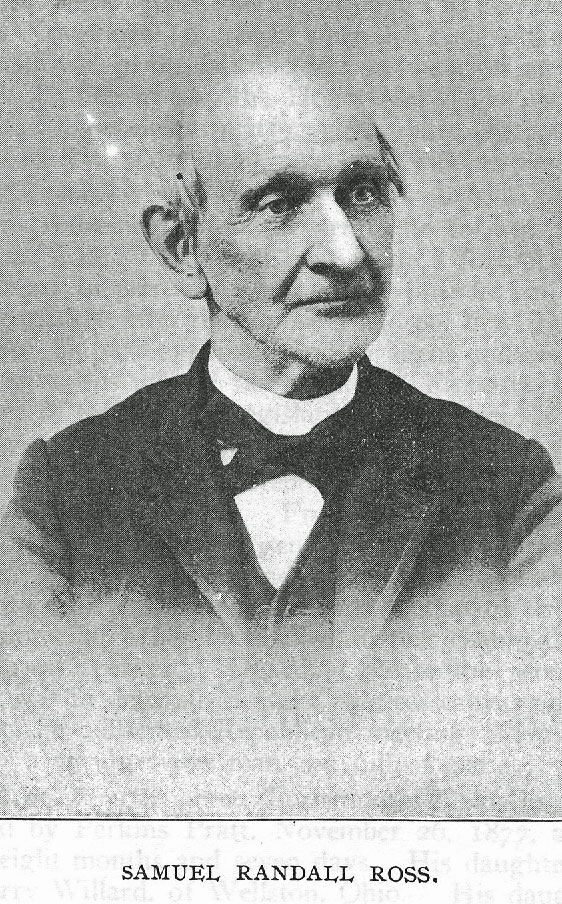
Samuel Randall Ross
was born April 8. 1819, at Oxford, Chenango County, New York, His father was Samuel Ross, a graduate of Princeton College, New Jersey, and a contemporary 0f Theodore Frelinghuysen and N. S. Prime, the father of Ireneus Prime of the New York Observer. His grandfather, Andrew Ross, was a descendant of John Ross of Scotland, who was one of the first settlers of New Jersey. His mother's maiden name was Maria Randall. He was educated at the famous Oxford Academy, at Oxford, New York, and left his father's home at the age of twenty-four and located in Portsmouth, in the fall of 1844, where he has since resided. He first advertised as a grocer in Portsmouth, November 7, 1844. He bought the wholesale grocery business of his cousins, M. B. and J. W. Ross, and conducted it until 1857, when he retired from business until 1861. At that time he engaged in the wholesale tobacco business in Cincinnati with J. G. Kercheval, under the name of Kercheval & Ross, and conducted that for twelve years, when he retired.
He was married, September 7, 1847, to Miss Elizabeth Kinney, the eldest daughter of Washington Kinney and Mary Waller, his wife. Mrs. Ross died October 28, 1897. The following are the sur-
822 - HISTORY OF SCIOTO COUNTY.
viving children : Miss Anna Ross, who resides with her father in the old home in Portsmouth, O.; George Kinney, who has a separate sketch herein, and Thomas Waller, of Cleveland, O.
Mr. and Mrs. Ross moved into the home in which Mr. Ross now resides at No. 310 Court street, in December, 1847, two weeks before the great flood of 1847. Mr. Ross has resided in the same house ever since, and he went through the floods of 1847, 1883 and 1884 the same residence. The flood of 1847 was three feet deep in his residence. Mr. Ross in his well appointed home has been a greater dispenser 0f hospitality to distinguished visitors in Portsmouth than any other person in the city. He has entertained Bishop's Mcllvaine, Bedell, Jagger and Vincent. His house has always been open to the Episcopal clergy and other clergy visiting the city.
Mr. Ross in his political views was first a Whig and afterwards a Republican; but never a seeker of any political preferment. He is a strong churchman, and has been connected with the Episcopal church ever since he has been in Portsmouth. He was connected with the All Saints until the 0rganization of the Christ church, and during the activity 0f that church he was a member 0f the vestry and a senior warden much of the time.
Mr. Ross has passed his 83rd mile stone, as he states it, but he has the most excellent health and a wonderful flow of spirits. He is the best of company, and delights in being in the society of his friends. Mr. Ross is one of those few men who make old age a delight. He has no infirmities. He is in the possession of all his faculties, and all the excellent qualities of mind and heart which he possesses have been enriched and developed by age and experience. His society and companionship is much sought after and highly appreciated among those wilo know him. He is the last survivor of the old time merchants of Portsmouth, Ohio. As an entertainer and a host, and a member of a reception 'Committee, Mr. Ross never had any equal in Portsmouth ; and it is the cordial wish of every one of his friends that he may live to see his 100th anniversary, in the same health and spirits which he enjoys at the present time.
Colonial John Row
was born in Northumberland County, Pa., in 1796. In 1808 his father removed to Circleville. There, at sixteen, he was apprenticed to Charles Cavalier to learn the saddlery and harness trade. In 1812 he was out in the war and was in Hull's surrender. In 1817, when he came of age, he married Susan Baltimore, at Circleville, and moved to Adelphi, where he set up a harness shop. In 1820 he removed to Richmonddale and began merchandising. He carried that on until 1832 when he moved to Waverly, Qhio, where he had a flour mill and carried 0n merchandising. In 1832 he was a director 0f the Columbus and Portsmouth Turnpike.

PIONEER SKETCHES - 823
In 1838, he went to Portsmouth, Ohio, where he resided during the remainder of his life. He first carried on a commission business with James Emrnitt as John Row & Co., but that was dissolved in 1839 and Col. Row conducted it alone. In 1842 he was chairman of the Whig Central Committee and was secretary of the Portsmouth Insurance Co. In 1844, he dissolved partnership with Ralph St. John and thereafter the business was conducted under the name of John Row & Son. In 1845, he was connected with the Sons of Temperance. In 1846, he was school trustee for the third ward. From 1849 to 1853 he conducted a store at Wheelersburg and one in Portsmouth. In 1853 he took charge of the Biggs House and conducted it about eighteen months. In 1861, on April 19, he presided at the great Union meeting at Portsmouth. January 14, 1863, he was appointed Postmaster at Portsmouth, Ohio, and served until November 13, 1866. He was a Mason. In 1866, he became a member of the Bigelow Methodist Church. He was a prominent merchant in Portsmouth for years.
He died May 5, 1871. His wife survived him until 1877.
He had four children : Amaryllis, wife of Rev. S. P. Cummins; Charles Cavalier, Mary Cook, wife of Charles Landon; and John Row.
He was a man of high integrity and much esteemed. He was a public spirited citizen with no ambitions except in a business way.
George Salladay
was born in Maryland in 185, the son of Philip Salladay and his wife, emigrants from Switzerland. While he was a child, his parents. moved to Western Pennsylvania and from there they removed to Scioto County when he was fifteen years of age. He married Phoebe Chaffin, daughter of Reuben Chaffin, May 7, 1812. She was born in Connecticut, September 31, 1794. They had a family 0f ten children, among them were Obediah ; Eunice, the wife of James Collins ; Lemuel and John M. His wife died July 27, 1855, and he survived until October 5, 1860. He was a resident of Portsmouth at its very first settlement. He was cotemporary with Captain Josiah Shackford and Major Henry Massie. At the age of eighteen he was present when the first tree was cut on the site of Portsmouth and help to burn the first brush piles made in clearing the timber to build the town. His picture taken in extreme old age will be found herein. His son, John M., died August 20, 1902. His son Lemuel died September 22, 1902.
John Miller Salladay,
son of George and Phoebe (Chaffin) Salladay, was born January 10, 1814, in Scioto County. He resided on his father's farm until he was twenty years of age, when he started 0ut in the world on his 0wn account, but without any capital. He worked at whatever he could
824 - HISTORY OF SCIOTO COUNTY.
find to do until he was twenty-six years of age, when 0n the 27th day of May, 1840, he married Martha, daughter of Moses Hayward, a pioneer of Scioto County. They had three children : Harriet Jane, who died at the age of seventeen; Lora A., wife of Sam Bierley, 0f Portsmouth, Ohio; and George M. Salladay, who has a separate sketch herein.
Mr. Salladay by economy and careful dealing accumulated a fortune, chiefly in the rich bottom land 0f the Scioto valley. In 1884, he owned 767 acres and has accumulated much more since then. He was first a Whig, but since the 0rganization of the Repubhcan party has been a member of that. He and his wife have been members of the M. E. church since 1864. He has served as trustee 0f Clay Township. His wire died May 29, 1892. Since then he has been making his home part of the time with his daughter, Mrs. Sam Bierly and part of the time with his son, George M. Salladay. He died August 20, 1902.
Mr. Salladay made his fortune by strict attention to his own business. He was always just and honest in his dealings with others and expected the same treatment in return. He was always noted for his obedience to and respect for law and for the rights of others. His character has always been above reproach and criticism. He is one of the last survivors of the men who made the Scioto Valley what the present generation find it.
John A. Schafer
left Wurtemburg, Germany, September 19, 1819, for the New World. He was accompanied by his family, consisting of his wife, Sabina, his three sons and five daughters. They took a sailing vessel at Amsterdam, Holland, for the United States. After being out at sea for about a week the vessel sprung a leak and had to put into the port of Lisbon, Portugal, where they remained until December 24, 1819, when they again put to sea, bound for Baltimore, Maryland. They arrived there without further mishap on the 25th day of February, 1820.
Mr. Schafer had spent all of his means on the voyage and three of his oldest daughters were bound out at Baltimore from three to five years to pay for their passage, eighty dollars each. The others 0f the family proceeded by wagon to Brownsville, on the Monongahela river in Pennsylvania, and thence t0 Portsmouth, Ohio, by means of a flat boat. Mrs. Sabina Schafer died in 1821 soon after their arrival in Portsmouth.
In August, 1824, George Schafer, one of the sons, walked to Baltimore to bring out his sisters. He made the trip, one way, in fourteen days. This brother brought his two elder sisters out in a wagon. The younger sister remained in Baltimore eight years longer. and then came alone. In 1832, Mr. Schafer went to Indiana,
PIONEER SKETCHES - 825
settling in Hamilton County, where he remained until his death on the 8th day of July, 1870, aged ninety-five years, five months, and thirty-two days.
Captain Josiah Shackford
was born in Portsmouth, N. H., in 1736. He came to the location of Portsmouth, Ohio, in 1802, and intended to purchase the town site, but Henry Massie got ahead of him. The idea of founding the town of Portsmouth, undoubtedly originated with Captain Shackford. When he examined the location he saw it was a better 0ne for a city than Alexandria. Henry Massie appreciated this fact, though he made no special examination till after his 'purchase. When Massie came to examine his purchase, he found Captain Shackford on the ground and the two became good friends. Captain Shackford suggested the town to Massie and its name, and Massie named his town Portsmouth, for Portsmouth, N. H., at Captain Shackford's request.
Captain Shackford was sixty-eight years of age when he landed at Alexandria in 1802, and he was the most self contained man, who ever lived on the town site of Portsmouth. He brought no relation, 0r friend, when he came, but came alone in a boat. He never asked any favor of any one. He never borrowed any money, but always had it when he wanted to buy anything. He was a large man, had a large head, a prominent Roman nose, keen and piercing eyes. He had a wart on the bridge of his nose. In his youth, he had been a sailor, and was very fond 0f spinning yarns as to his voyages. While he talked freely of his sea-faring life, he kept still about his domestic and social affairs. Till he died it was not known whether he was a widower or a bachelor. There was much speculation as t0 his family history, and the women folks told a story of his disappointment in a love affair, but he kept a quiet tongue and enlightened no one. He had studied attending to his own business, till he had it reduced to a fine art.
After his death in 1829, one of his nephews came in to settle his estate and then something was learned as to his story. His father, Josiah Shackford, was married twice. The first wife was a widOW named Eleanor Marshall. She has a grown daughter, Deborah, who came to live with her step-father. Deborah was attractive and comely and the usual result followed. Young Shackford fell in love with her, and married her. Shackford, however, was her second choice as she lost a lover, John Hart, by his premature death. Captain Shackford lived with Deborah, a number of years, and after a few years of sea-faring life, wanted to come west. She refused to leave her mother and he would not stay. He left and came to Portsmouth, Ohio. After his wife's mother died, Deborah wrote and offered to come to him, but he would not answer her letters and she was too proud to come uninvited.
826 - HISTORY OF SCIOTO COUNTY.
Captain Shackford cut the first tree which was ever cut by a white man within the limits of the city of Portsmouth. He bought inlot 17 for $30.00, and an outlot from Henry Massie. There was a log rolling in 1802, on the site 0f Portsmouth and Captain Shackford had charge of it. George Salladay, the father of John Miller Salladay, and Caleb Hitchcock were two of these present on that occasion.
The inlot No. 17 purchased by Captain Shackford of Henry Massie was built on, and Captain Shackford resided on it till his death: The building stood where now the Portsmouth shoe factory stands on the northeast corner of Front street, and the first alley east, of Market street. It was a frame. The lower part was finished for a shop and store room. There was no stairway, but a hatch with a ladder. In the evening Captain Shackford put up his ladder, ascended, pulled the ladder after him and closed the hatch. In the morning, he opened the hatch, put down the ladder and descended. The up-stairs was finished off like a cabin in a ship, with bulk heads, etc. After he furnished his building, he went east and purchased a stock of goods. He did all his own cooking and house keeping. When he was obliged to have his cooking done outside, he got Mrs. John H. Thornton to cook his meals and hand them in through the window, as he permitted no women to enter his place.
He was one of the nine conscript fathers who formed the first town council and when lots were cast, he drew the one year term. In 1809, he was a trustee of Wayne Township and in 1813, 1814 and 1818, he was Township Treasurer. In 1815, he was 0n a committee of the Council to bring in a bill taxing shows. In 1816. he was on a committee to bring in a bill to regulate the use of the public well. He owned a fine farm where Aaron Noel formerly lived and rode out to it almost every day in pleasant weather. He had a horse, named "Emperor," which he rode on these occasions. Once the horse threw him and broke his arm.
He built a stone barn on his farm and twice it was leveled by cyclones. He was always planning and recommending public improvements. He was very fond of making models for machinery and believed he could invent perpetual motion. He had no intimate or particular friends and never unbosomed to anyone. He paid all his debts, but had no apparent income. In religious matters, he was his own priest.
He and John Thornton built the carding machine, which stood on the site of the present Biggs House. He also built a mill on Market street between Second and Third streets and was a part owner in it. The house built by Captain Shackford was removed to Front and Bond streets where it was standing till recently. He lived for twenty-five years 0n the town site of Portsmouth and died July 26, 1829, after a short illness, in his ninety-third year. He was the second
PIONEER SKETCHES - 827
person buried in Greenlawn cemetery. William Peebles was the first ; and Mark Huston was the third. His grave is appropriately marked with a tombstone.
Before the world, he always stood at attention and was always on tress parade. If he had private grids or sorrows he kept them to himself. How many men can begin life over again at the age of sixty-eight years in a malarial climate and spend twenty-five more years in active and useful labor. We do not believe there was ever such another case on record. Captain Shackford was always employed and was always pleased to be helping others. He never wrote any letters and never received any, at least to all appearances.
Captain Shackford was an archaeologist among other fads. He spent a great deal of time and labor in digging into and exploring the ancient mounds. He explored the one which stood 0n the G. H. Heinish lot. He surveyed the mounds about Portsmouth and gave his field notes to Captain Cleveland, who in turn gave them to Doctor Hempstead; and from them were made the map f the ancient earth works in this work. An account of Captain Shakford's life is published in a pamphlet which is sold to visitors at Portsmouth, N. H. This gives an account of his voyage to Surinam, with a dog only for company.
George Stevenson
was born in Pennsylvania, April 17, 1803. His wife, Hester Montgomery, the daughter of Samuel Montgomery, was born m Massachusetts, December 28, 1809. He died September 9, 1886, and had most excellent health until the date of his death. His wife died ten years before, on the 6th of March, 1876, and they are both buried in Portsmouth. Their children are as follows : Sarah McClure, born March 31, 1836, at Portsmouth, Ohio, is the widow of Emmett McClure, and resides at No. 420 Fairmont Ave., Pittsburg, Pennsylvania; Rebecca J., born April 7, 1839, died unmarried October 2, 1872 ; son Samuel, born April 7, 1884, in Portsmouth, married Mary Martin of Jackson, Ohio ; a son Frank, born in Portsmouth, February 27, 1848, died December 28, 1839, in Pittsburg, Penn.
Our subject came to Portsmouth on a flat boat, and landed at Alexandria. He had learned the wagon maker's trade in Pittsburg, and he built the first coach which ran between Piketon and Portsmouth. James Emmitt was said to have driven the coach. Our subject was married in Portsmouth in 1835. When he located in Portsmouth, he went in partnership with William Maddock in the foundry business, where the Opera House now stands. He afterward went into the firm of Ward & Stevenson. Ward was a blacksmith and he was a wagon maker. Afterwards the firm became Ward, Murray & Stevenson. At one time he and Thomas Currie had a candle factory at Brunner's corner.
828 - HISTORY OF SCIOTO COUNTY.
In 1840, he participated in the great Masonic celebration of St. John the Baptist's Day. In 1845, he was Assessor of Wayne Township. On September 19, 1845, he was elected one of the school directors for the Second ward. His associates were J. L. McVey and Moses Gregory. On May 1, 1857, he was elected chief engineer of the fire department. April 11, 1859, he was elected president of the council, and re-elected April 9, 1860. March 18, 1862, he presided at the meeting at the Court House in Portsmouth with a view to secure a National Armory at this place. Senator Sherman introduced a bill to appropriate one-half million dollars for that purpose, butsi the measure failed.
Mr. Stevenson was a communicant of the All Saints church and a vestryman. He was a Democrat in his political views. His family home stood on Market street just one door above the present residence of John Lynn.
William Stewart
was born at Ayr in Scotland, in 1816, the son of Hugh Stewart, a miller, and Jeannette Forsythe, his wife. He was one of a family of five sons and three daughters. He was brought up in the strict Presbyterian faith, a son of the covenant. He was taught the trade of a stone mason and followed it in Scotland. In 1840, he came to the United States and worked at his trade in New York city. In 1842 he carte to Portsmouth and engaged in the stone business on the West Side.
He built a stone saw-mill near the site of Alexandria, and carried on the business of quarrying and sawing stone till 1855. His health began to break down. and he felt he must go into other employment. In 1856, he purchased forty acres of the old Martin Funk land of his son, Jacob Funk, for $4,000 and moved on it. He occupied himself as a market gardener until his death.
He was married in 1844 to Miss Jeannette Bryden, also a native of Scotland. They had seven children. The eldest was Walter P., who has a separate sketch herein. His second child was Miss Jeannette. who with his son, Gilbert, his fifth child, have a pleasant home on the Stewart place. His daughter, Margaret, married W. C. Silcox and has one daughter, Jeannette. His daughter, Ella, married Le- grand B. Smith. She died in 1896, leaving two sons, Walter. now aged twenty-two and Stewart, aged fifteen. They make their home with their Aunt Jeannette and Uncle Gilbert. A son, William, is married and resides at Pomona, California, where he conducts a ranch. He has four sons and one daughter. His sons are: Jay, Wallace, Walter and Donald, and his daughter is Amy.
Mr. Stewart was an upright and just man. He was as fond of the bawbees as any Scotchman, but they had to be earned honestly and fairly. He was a typical Scotchman and his appearance and speech
PIONEER SKETCHES - 829
announced that fact wherever he went. He was a devout Presbyterian and fully believed in all and singular, the Westminster Confession. He not only believed it, but he lived it in his every day life. He was esteemed by all for his uprightness and sense of justice. He died July 26, 1870. His wife survived until July 14, 1901.
Levi Sikes
was born at Wilbraham, Massachusetts, on October 29, 1794. His father was John Jones Sikes, the Revolutionary soldier who is mentioned on page 212 of this work. His mother's maiden name was Sarah Sowles. The family left Massachusetts in 1801 and located in New York on the Genesee river. In the spring of 1804, the family came to Scioto County and settled at the mouth of Munn's run. He learned the brick-maker's trade and worked at that business from 1815 to 1822 in Portsmouth. In February, 1819, he married Mary Keyes, the daughter of Salma Keyes, who was born July 17, 1799. He had the following children : Malvina, married John Wait; Harriet;, Eliza, married David Ball ; James Sikes, born May 20, 1826, resides in Porter Township; Ruhama, died in infancy ; Sarah, married Addison Batterson and died soon after her marriage; Melvin, the father of Frank L. Sikes ; Thomas, Colonel in the 33rd 0. , V. I.; Elsie, married Edward Neary ; and Hiram Sikes, who resides in Portsmouth, Ohio.
In 1822, Levi Sikes moved to Porter Township and became a farmer. In 1836 he moved to Harrison Township where he died on March 30, 1870. His wife survived him about four years. She was a woman of remarkable force of character and James Keyes gives a full account of her in his book.
James Simpson
was the son of John Simpson, one of the first settlers of Portsmouth and Mary Noel, his wife, a daughter of Philip Noel. He was born November 9, 1819, on a farm where the Children's Home now stands, which was then owned by his father. He was brought up at his father's trade, that of a carpenter, and followed it most of his life. He had charge of the Cuppett & Webb lumber yards for years. He had twelve brothers and sisters, ten of whom lived to maturity. He received his education in Portsmouth.
He was married April 4, 1839 to Elizabeth Jane Lewis, daughter of Wm. Lewis and Rachel Feurt, his wife. Her father was Frederick Feurt. The marriage ceremony was performed by the Rev. Wm. Simmons. Mrs. Simpson was born in 1822. They have had four children: Wm. Henry, who lost his life in the fire of 1877; Elenora, married first Thos. J. Fritts, and second Thos. T. Yeager ; Thomas Jefferson, and Margaret, the wife of Wm. Worth Donaldson. Their son Thomas J. enlisted September 1, 1861, at the age of seven-
830 - HISTORY OF SCIOTO COUNTY.
teen in Company E, 81st Ohio Volunteer Infantry. He was transferred to Company H, November 15, 1862, and served until July 13, 1865, and veteranized. He died Pipe 10, 1892.
Mr. Simpson was a Whig and Republican in his political views. He joined the Scioto Lodge of Odd Fellows, Oct. 8, 1843, aid was a member of it till his death. He spent most of his life in Portsmouth, but lived in Stephenson County, Ill., from 1854 to 1856. During the war he was a resident of Clermont County, Ohio. He was first a member of the Bigelow church, but since 1867 had been a member of the Sixth Street Methodist Episcopal church. He was a member of the first choir organized in the Bigelow church. He never sought or held any public office except he was Assessor of 'Wayne Township in 1854.
He was an industrious, energetic citizen, and lived up to his profession was a Christian. He was highly esteemed by all who knew him. He was very tall, of dark complexion, thin and spare, and of fine carriage. He had a remarkably firm expression of countenance, which was repellant to strangers, but at the same time to his friends, he was most companionable. He was earnest in all things: He died June 2, 1899.
Elias Simpson
was born in Hampshire County, Virginia, December 15, 1818. His parents were John and Rebecca Simpson. His father died in Virginia and his mother was married there to Hiram Alloway. He came to Pike County, Ohio, in 1827, with his step-father and remained there ten years, when he removed to Scioto County and began working for George Herod in 1837. He went to Mr. Herod's an orphan, ragged and torn, cold, tired and hungry. He was taken in and fed and told his story. He staved through the winter for his clothes. He stayed several years and grew to manhood. He received no education but was active and industrious and made money. He bought a team and that helped him. April I, 1842, he was married to Mary Howard.
He leased land of his employer where he lived until January 17, 1848. when he moved to his farm on Survey 464, in Morgan Township and resided there the remainder of his life. When he first went there he leased land with John Rankins. When he married he bought a small farm and s00n paid for it. In 1854, he began buying land and continued it until at his death, when he owned 3,500 acres in Rush, Morgan and Valley Townships. He was said to have owned more land in acres than any man in Scioto County and to have paid more taxes. He returned more personal property for taxation than any one in the county. His tax return in 1896, is said to have been $30,800. When the war broke out, he thought corn would go up and he rented all the land he could and put it in corn. His expectations
PIONEER SKETCHES - 831
were realized, and as he said, he made a bed tick full of money. He held on to his crop until 1862 and made $50,000. The rest was easy, At the time of his death his wealth was estimated at $150,000.
His wife died August 8, 1881. Of this marriage there were thirteen children : Mary Ann, deceased, wife of James Allison; Rhoda, deceased wife of Joseph Morgan; Rebecca, wife of Jesse Johnson; Franklin, deceased; Henry ; Jane, deceased; John, enlisted October 4, 1864 in Company B, 22nd 0. V. I., and served one year. He died November 2, 1865. Elias, deceased; George, deceased; Amos, deceased; Andrew T., deceased; Cynthia, deceased; Alice, deceased; and A. Lincoln, deceased. He was married July 12, 1883, to Mary Dunlap. She died July 16, 1894, leaving two daughters, Louise and Scioto Valley.
He was a member of Lucasville Lodge, F. and A. M. No. 465. He was first a Whig and afterwards a Republican. He died June 3, 1897, in his seventy-ninth year. He had been a resident of Scioto County for over forty years.
Elias Simpson was an honest man. He never permitted an obligation to lapse. His fortune was made by industry, economy and a close application to business. He had a great deal of faith in his fellowmen and never lost much by it. Honest himself, he took it for granted every one else was honest. He demonstrated what obstacles can be overcome by patient and unremitting labor, guided by a full knowledge of the busines he was engaged in. He was one of the few men who could make money in agriculture, and who did it.
Luke Philpot Newson Smith
was born October 10, 1818, on the lot where J. C. Hibbs formerly had his hardware store on Front street. His father was John Smith, a native of Massachusetts and his mother's maiden name was Mary Stretton. As a child he was precocious and could read in the New Testament when he was only three years old. He had a very meager education in the common schools, but he was a diligent student all his life and educated himself by learning from his well educated friends. As a child he was of a pious disposition; as a young man, he was the life and soul of his circle and was always fond of the society of young people.
At the age of eighteen he began life for himself as delivery clerk for McDowell & Davis, who were then doing a commission business in the McDowell corner. He had literary tastes and on Febraury 11, 1842, he was made Vice President of Franklin Institute. In October, 1844, after he had served as a clerk for the firm for eight years. he was taken into the firm on his birthday and the firm became Davis, Smith & Company. He and his brother Joseph W., were the Smiths of the firm.
832 - HISTORY OF SCIOTO COUNTY.
He was a man of great public spirit and when Mr. Robert Bell started in the manufacturing of shoes in Portsmouth, to encourage it, Mr. Smith took an interest. In 1856, he was a member of the Portsmouth Council and one of the Committee on Claims. In 1854, the firm of Davis & Smith exchanged their interest in the Buckhorn tannery with M. R. Tewksbury for his interest in Jackson furnace, and Mr. Smith removed there and afterwards became sole owner of the furnace.
On October 10, 1839, he was married to Rebecca Peebles. She was born at Wilkinsville, Pennsylvania, May 18, 1821. She and her husband joined the Presbyterian church January 19, 1851, under the pastorate of Rev. Marcus Hicks. In 1852, he was made a ruling elder of the church aid continued until his death. He maintained his residence, until 1872, at Jackson furnace, when he built a large and commodious home at Sciotoville, to which he removed and in which he died October 21, 1873, leaving a widow and seven children to survive him. They were: Anna Thane, Mary Davis, Gertrude, Hugh Cook, Joseph Stretton, who died in October, 1875, Bertha and Lilias. Hugh Cook, married Miss Ella Finton of Portsmouth in November, 1895. Lilias married John Henry Holman at Sciotoville, June 2, 1886, and has one daughter. Luke P. N. married Miss Lydia McLaughlin, in March, 1885, at Sciotoville and has four children. Gertrude was married in March, 1877, to Charles N. Sellers, in Colorado, and has a family of four children. Mr. Smith lost six children in infancy or childhood.
Our subject was a fine looking man of dignified carriage. He always wore a full beard. He was courteous to all he met and made a good impression on friends and strangers alike. He was most highly esteemed by all who knew him. He died from an attack of flux and his death was a calamity not only to his family and friends but to the whole community. As a religious man, he lived up to his professions.
Charles Stratten Smith
was born November 1, 1816, on the McColm farm below Carey's Run. His father was a native of Boston and his mother was a Miss Stratten, of Virginia. He attended the Portsmouth schools, and was a clerk in the store of Hall & Gales. He afterwards traded on the river. From May; 1838 to May, 1839, he was a wharf- master at Portsmouth, Ohio.
November. 1843, he was married to Miss Mary G. Locke. of Oxford, New York. Directly after he went into the grocery business, and remained until 1850 when he went to California to find gold. His wife died December 20, leaving two children, Floyd L. and Addie M., now Mrs. Walter M. Tibbetts, of Indianapolis, In-

PIONEER SKETCHES - 833
liana, and he left them with her parents in New York and sailed from New York City, May 12, 1850.
He made twenty thousand dollars in three years and came home. In 1854, he was the proprietor of a wharfboat at Portsmouth, Ohio. He went into milling, where the Times office stands and made money. He built several steamboats, one the "D. M. Sechler" and ran her on the Muskingum river. He built the John Dice home on Second street.
On January 5th, 1854, Mr. Smith was married to Miss Kate Ackerman. The children of that marriage were Isabel Ellis, wife of Howard H. ;trench, of Indianapolis, Indiana, and Mary Allen died in infancy. Mr. Smith was a half brother to Alpheus, Thaddeus and Robert Cook and Mrs. William Salter, his mother having, after the death of his father, married Hugh Cook. He conducted a paper mill on Mill street. He was a man of fine personal, appearance, a handsome man. His son, Colonel Floyd L. Smith, owes his good, looks to him. He was genial and agreeable, very much appreciated among his friends. He died August 28, 1900.
Joseph Mills Glidden. Smith
was born December 28, 1807, near Tilton, New Hampshire. He was the son of Jeremiah and Betsey (Glidden) Smith. His mother was the daughter of Charles Glidden, a Revolutionary soldier, (see his record under Revolutionary Soldiers) and. Alice (Mills) Glidden. He came to Ohio in 1827 and located near Wheelersburg. He first commenced his life's work at Franklin Furnace. He aided in the construction of Junior Furnace. He built Vesuvius Furnace in Lawrence County, and then went to Jackson Furnace, Ohio. He moved to Scioto Furnace in 1841 and was its principal owner and manager until 1853, when he sold his interest to T. V. Robinson, Senior. He continued to manage the furnace until 1855, when he moved to Portsmouth. , He had been identified with the iron business since 1832 and when he came to Portsmouth, he had $90.000 on deposit in the banks. He concluded to build a distillery at Springville and in so doing, lost all his fortune. He was afterwards interested in Diamond Furnace, at Jackson, in 1864 and 1865 and in 1867 and 1868 he managed Kenton Furnace. His last active employment waS at Talladega, Alabama, where he remained until 1881. At that time he returned to Portsmouth and made his home with his daughters, Mrs. J. W. Bannon and Mrs. James Orin Murfin. On November 3. 1832, at Franklin Furnace, he was married to Miss Charlotte Marie Hurd, daughter of John and Mary (Young) Hurd. Her mother, Mary (Young) Hurd was the daughter of Jesse Young, whose record will be found under Revolutionary Soldiers. They had five children: Warren Smith, now in California; Brigadier General Jacob Hurd Smith of the regular army; a daughter Alice who died in in-
834 - HISTORY OF SCIOTO COUNTY.
fancy; Mary, the wife of James W. Bannon and Josephine, the widow of James Orin Murfin; of Ann Arbor, Michigan. Joseph M. G. Smith died April 4, 1889, at the residence of his daughter, Mrs. Murfin, of softening of the brain. His father lived to be 100 and his mother 98. He was a man of great force and determination, and honest in all his dealings. His generous hospitality was well known. He was a unique character and many are the tales told by the old inhabitants of his adventures.
Mrs. Joseph M. G. Smith
was born September 9, 1814, in Orange County, Vermont, in the town of Burlington. Her father was John Hurd and her mother's maiden name was Mary Young. John Hurd was born in Bath, New Hampshire and her grandfather, Jacob Hurd, was born in England. Jesse Young was her grandfather and he was a soldier in the Revolutionary war. His record will be found under Revolutionary Soldiers. Jacob Hurd's wife was Hannah Barron. Her father Timothy Barron was in the Revolutionary war. Our subject came to Ohio in 1821 with her father, and his family, Orin Gould's mother and her children and the Whitcomb family. Samuel Gould was already here. Benjamin Whitcomb was her uncle and had married Sallie Young, an aunt of our subject. Samuel Gould married Hannah Young. The following are the family of John Hurd, her father, first, .Charlotte Marie, our subject, who married J. M. G. Smith. Second, Jacob Hurd married Elizabeth Clough of Ohio. Third Jesse Young Hurd married Catherine Rogers, at Bloom Furnace. Fourth, Mary Hurd married Leander Comstock in Scioto County. Fifth, Josephine married first, Lewis Tomlinson, second, Dan Glidden, and third Cyrus Ellison. Our subject married Joseph Mills Glidden Smith, November 3, 1831, at Franklin Furnace land- ing. The wedding party of forty rode horseback from Franklin to Junior Furnace, where the bride and groom went to housekeeping in their own house. Elizabeth Kendall, nee Finton, cooked the wedding supper. They lived there two years and then went to Vesuvius Furnace which Mr. Smith built. Their son, Warren, was born there and they lived there for three years. They then went to Jackson and there General Jacob Smith was born. They lived at Jackson for two and a half years and then went back to Junior Furnace and lived there for two and a half years. They resided at Scioto Furnace for eight years. They came to Portsmouth in 1854 and Mr. Smith then built the Springville Distillery. They lived in Kentucky from 1855 to 1861 and then came to Portsmouth which became their permanent home. Their children are given under the sketch of her husband. Mrs. Smith has been a devout member of the Methodist church since childhood. She is certainly living a happy old age at the home of Judge Bannon. She is a woman of remarkable memory and vitality and of a self-sacrificing, lovable disposition.
PIONEER SKETCHES - 835
William Russell Smith
was born in Scioto County on September 20, 1824. His father was John Funston Smith and his mother's maiden name was Russell. His brothers and sisters were: Stephen Smith, Mrs. Elizabeth Moore, wife of Captain William Moore, Thomas and Reuben. William R. was reared in the County.
Some years before the war he bought a steamboat and went on the river as its master. Charles C. Row was with him. He owned and ran the T. T. Patton, the "Nymph," "Clyde" and "Bierce" successively. He had altogether nine steamboats. During his career as a steamboatman he was engaged in navigation on the Big Sandy, the Ohio. the Mississippi and the Yaz00 rivers. He was engaged in the business of navigating steamboats prior to and during the war. His boat, the "Patton." was impressed by the government, and he went with it. The "Bierce" was a tug and was also impressed. The "Patton" carried soldiers and freight, and was used part of the time by General Grant personally. After our subject left the government service, as a master of steamboats, he became a contractor with the Government for the purpose of raising sunken steamboats. He was hurt at one time on the "Bierce" while operating it on the Yazoo river, by a piece of machinery falling on one of his limbs and this laid him up for a year.
He was married in 1863 to Margaret Wishon, sister of Henry and Leonard Wishon. The children of this marriage were William R., Jr., John S., now a resident of McDermott, Ohio, Frank C., Oliver F., Louis D., Everett N., and a daughter, Magnolia Russell.
Captain Smith was originally a Whig, but at the outset of the war he became a Republican. November 13, 1866, he was appointed postmaster at Portsmouth, Ohio; but was not confirmed and served until March 6, 1867, when Oliver Wood succeeded him. After that time he became a Democrat and remained such during his life. He was not a member of any church but believed in the creed of the Universalists. After he left the government service, he engaged in the stone business in Scioto County and was in that for many years. He died in June, 1898, at McDermott, Ohio, of asthma. His wife survives him, and she and her daughter, and sons, John S., Louis D. and Frank C., reside at McDermott, Ohio.
John Webb Spry
was born at Whitestone parish, County of Cornwall, England, December 26, 1822. His father and mother, Richard and Frances Spry with their family of seven children, of whom he was the youngest, left their home in England, leaving Plymouth Harbor March 14, 1834, on the sailing vessel, the "Minerva."
After a voyage of six weeks, considered at that time as being unusually prosperous and speedy, they made ready to land upon the
836 - HISTORY OF SCIOTO COUNTY.
shore of this new and unknown country, when the vessel was wrecked upon Rockaway Beach, Long Island Sound. They were rescued by American seamen who came to their assistance. A rope was stretched from the shore to the ship and the passengers were removed part of the way in small boats and then to the land in the arms of these strong men. No lives were lost, but the possessions of the emigrants went down with the ship which soon sank in twelve feet of water.
After many trials and hardships, this unfortunate and distressed family found their way to Honesdale, Pennsylvania, where English kindred and friends were settled. They next went to Norwich, New York and about 1848, John Spry came to Portsmouth, Ohio, where his brother Richard had lived some time and there he made his home. For several years, he successfully practiced his profession of dentistry and afterwards went into the drug business with Enos Reed.
He was married to Louisa Davey of Alexandria, Virginia by Rev. Spahr, May 2, 1855, and four children were born to them: John Henry, who died. in infancy; Allan Webb; Jennie Waller, who died heart. An intimate friend,, Mr. Stephen Riggs, also a member of silvery strains of whose flute could be readily distinguished above voices and instruments for their exquisite softness and sweetness; he possessed a soul for music, and I often think that he must occupy a First Presbyterian church and devoted his unusually fine musical talents to the services of the sanctuary, adding by his voice and skill that notable choir thus writes of him, "About that time (1850) also appeared in our midst, the mild genial whole souled Doctor Spry, the ful flute playing, much to the interest of the services so dear to his
He was for many years a loyal and consistent member of the November 7, 1888; and Fannie Grace, who died November 14, 1897, prominent place now in the celestial choir, contributing no small amount to the diapason of melody that continually reverberates among the Heavenly hills, as they sing the song of Moses and the Lamb." Mr. Spry possessed a gentle nature and a tranquil spirit with a frail constitution and in early manhood he was called to a better world. the community, he died February 21, 1868.
Richard Spry
Beloved and lamented by his friends and respected and regretted by was born in Cornwall, Whitestone parish, England, March 5, 1809. On April 14, 1831, he was married to Elizabeth Hicks. On March 15, 1834, he set sail to the United States. On reaching land their ship was wrecked on the shores of Long Island. They reached the shore in safety but lost all their goods. They settled first in Norwich, N. Y., and afterwards in Honesdale, Pennsylvania. In 1844, they came to Portsmouth, Ohio, but resided a year or two at Springville. He was a blacksmith and gunsmith by trade, and followed that bus-
PIONEER SKETCHES - 837
iness at Portsmouth, He was president of the Gas Company and the Home Building Association. He was prominent in Odd Fellowship. He was highly trained in music and had served as a chorister. He had been a communicant of All Saints church in Portsmouth, for twenty-one years prior to his death. He died February 12, 1882. His children were, Mrs. T. J. Pursell, Daniel R. Spry, Mrs. Francis Helfenstein, Miss Thyrza G. Spry, and Miss Emma, who died in 1873 and Robert N., who died in 1877.
Mr. Spry was a model citizen and a good Christian. He was highly esteemed by all who knew him. His widow survived until November 11, 1896. She was born June 20, 1811, in Cornwall, England. She was a woman of great kindness of heart and loved by all who knew her.
John Squires
was the town and city Marshal of Portsmouth, Ohio, continually from March 10, 1845, until September 19, 1853, when he became disabled. From 1847 to 1851, he was clerk of the market. In 1848, he was paid for his services as Marshal by the dog tax, and the rent of the market stalls. In 1847, he was allowed $100 as Marshal and $50.00 as clerk of the market.
He was born at Chemung, N. Y., 1798, came to Scioto County in 1818, and located on the French Grant. He was first married to Lucinda Lamb. She died within two years. He was next married to Antoinette Vincent and had three children; Lucina, wife of C. C. Row ; Susan, killed accidentally at the age of 18; and Sophia, wife of John Rockhold. He was at one time part owner of Franklin Furnace, and was manager at Junior Furnace 1825 to 1831. He suffered a sunstroke in 1853 from riding in an open car after a prisoner, and had for that reason to give up the Marshal's office. He died within a week after his injury. His widow survived until 188o, and died in her 79th year. He made a very efficient officer, was a powerful man and had no fear. He never failed to make an arrest or to hold his prisoners.
Colonel Aaron Stockham
was born August 3, 1787, in Pennsylvania. His father was William Stockham, who was a Revolutionary' soldier from New Jersey, born in 1752, and died in Scioto County, Ohio, December 17, 1815. His mother was Susannah Paine, a sister of the famous Thomas Paine. Colonel Aaron was a famous militia Colonel in the early days of the state, and was one of the chief mustering officers of the war of 1812. He was a salt maker at the Scioto salt works, made a great deal of money there, and bought two sections of land on Little Scioto.
He married Ruhama Sikes, a daughter of John Jones Sikes, who has a sketch herein. He died July 16, 1849, and his wife died March
838 - HISTORY OF SCIOTO COUNTY.
10, 1873, aged eighty-three years, seven months and twenty-two days, He had the following children: Rachel,, born, February 19, 1812, married Job Kittles ; William, born March 31, 1813 ; David Jackson, born March 4, 1815; Cynthia Ann, born April 14, 1816, married Claudius Cadot; John, born September 15, 1817 ; Polly, born April 27, 1819, married Franklin Batterson; George W., born February 4, 1821; Susan, born October 4, 1822, married Solomon Riker; Pardon P., born February 22, 1824; McKenzie, born March 8, 1826; James Harvey, born November 7, 1827; Aaron, born June 13, 1832; Henry C., born March 13, 1834.
His son William is living near Stockdale, Pike County, Ohio, He was married to Abigail Adams, January 23, 1839, the daughter of George Adams and Margaret (Schoonover) Adams. His wife was born October 27, 1820, and is still living in excellent health. Their eldest son, George A. Stockham enlisted in Company G, 91st 0. V. I., August 11, 1862, at the age of twenty-two years, and died March 6, 1863, at Fayetteville, W. Va., their daughter, Ruhama is the wife of Levi Brown; Margaret, married Warren Dever ; Nancy, married Solomon Dever. They had five children who died in infancy. Mr. Stockham lived the first eighteen years after his marriage in Madison township, and in 1854, he moved to Marion township, Pike county, Ohio, and has lived there ever since. During the time of the Whig party, he was a Whig, and since, he has been a Republican. He is a member of the Methodist Protestant church. In his ninetieth year, his faculties are well preserved, and he is able to give the Revolutionary reminiscences of his grandfather Stockham with great detail and accuracy.
Rev. Landon Taylor.
The Taylors in New York were a Methodist family. Rev. James, a Methodist minister for thirty-seven years, with his wife Julia A. Hathaway, came to Scioto County and settled near Little Scioto about 1835. There were seven sons and one daughter, four of the sons also becoming Methodist ministers, among whom was Landon, who was born in 1812.
Soon after coming to Ohio, Landon engaged in school teaching near Haverhill, at $25.00 a month, making his home with J. S. Folsom. Later, having married Jane Vincent, daughter of one of the French emigrants in 1837, he secured employment as clerk at Franklin Furnace. The Furnace Company soon after failed, carrying with it all his earnings amounting to $1,200. Stranded financially, and his family broken up by the confirmed invalidism of his wife, he preached for a few years among the furnaces, at Burlington and Wheelersburg where he labored with Murphy in the great revival of 1843. In 1845 he went to the territory of Iowa, and becoming identified with the Upper Iowa Conference, passed the most of his life
PIONEER SKETCHES - 839
there, filling appointments at Burlington, Davenport, Dubuque, 'Iowa City and many other important charges. For a time he was Presiding Elder of the Sioux City district, was Conference Evangelist for some years, then Bible Agent until on account of failing health, he superannuated. In 1883 he published his autobiography under the title of "The Battlefield Reviewed" of which he disposed of two editions. A portion of his last years he spent with his son, Doctor J. L, Taylor of Wheelersburg, where he died in 1885.
His religious faith was intense, and of the now disappearing type of Wesleyan Methodism. He had a grand voice for public speaking, an earnest manner, a fine physique, and withal, was a most genial and interesting companion. His life work was largely one of self sacrifice, since no motives of remuneration, or the lack of it, had the slightest influence in his acceptance of ecclesiastical positions. The joy of his life was that he had contributed to start a number of young people into a religious life who afterwards came into positions of great influence and usefulness in the Christian church.
Doctor Jonathan Tracy
one of the pioneer settlers of the western part of the County, was born in Steuben County, New York, February 2, 1797. His was the hardy frontier life of early days. As a member of the state militia, he participated in. the battle of Plattsmouth during the war of 1812. Securing a meager education, he taught school a few years in western New York, and in 1823, emigrated to Stout's Run, Adams County, Ohio, where he resided until 1834. Having made a study of medicine, he located near Otway, Scioto County, Ohio, where he engaged in the successful practice of his profession for over forty years. He was first married to Sabina White in Steuben County, New York, who died in 1824, leaving one child. In 1825, he was married to Elizabeth Westbrook, of Stout's Run, Adams County, Ohio, with whom he lived for sixty-three years. He was a member of the Methodist church for sixty-four years and was ordained a local preacher. He died October 14, 1888, in full communion with the Methodist church.
Elizabeth Westbrook Tracy was born December 25, 1804, at Stout's Run in Adams County, the daughter of John Westbrook. She saw the first steamboat, the "New Orleans" go down the Ohio river in September, 1811. She joined the Methodist Episcopal church when she was eight years of age. She was the mother of ten children, and at death had ninety-three descendants. Six of her children survived her. She had 56 grandchildren and 35 survived her. She had 26 great-grandchildren and one great-great-grandchild, son of Mr. and Mrs. W. R. Smith, of Otway. She and her husband lived together for 63 years. She died January 7, 1893, aged 90 yearS.
840 - HISTORY OF SCIOTO COUNTY.
John Pease Terry
was born in Coos County, New Hampshire, February 16, 1807. His parents, Charles Terry and Huldah Pease, were from New Haven, Connecticut, subsequently removing to New. Hampshire, where our subject was born. When he was three years of age, the family removed to Oneida County, New York, and one year later, to Ontario, now Wayne County, where his father purchased a farm in the wilderness, and began clearing it, assisted by his eldest sons. His father was a soldier in the war of 1812, and died in 1814 from the effects of a gunshot wound received in the defense of Sodus Point, on Lake Ontario, against the attacks of the British.
Shortly after this event, young Terry was bound out to a farmer, where he remained until he was about 19 years of age. Not liking his master, he left, and, after visiting his sister some thirty miles distant; started on foot for the west, with but one dollar in his pocket, which he had borrowed from his mother. He had at this time no definite destination, but made his way to the mouth of the Genesee river, .walking a distance of some forty miles. Then, by boat, , he reached the mouth of the Niagara river, .where, having spent his dollar, he stopped a short time, and cut wood to earn some money to enable him to pursue his journey by water. Reaching Buffalo, he again stopped, and worked a month carrying brick and mortar, for which he received ten dollars, half in cash and half in dry goods. He then boarded a sailing vessel bound for Cleveland, and was some seven days on the way, the vessel being stormbound. From Cleveland, he walked to Akron, Ohio, where he found employment for six months as a clerk in the store of the contractors on the Ohio canal. This was in 1825. For something over a year subsequent he worked for his brother-in-law, William Lake, at Newburg, near Cleveland, in the manufacture of fanning mills. From 1828 to 1832, he was connected with the engineering corps on the Ohio canal, being for a part of the time assistant engineer. He was also subsequently engaged in contracting on the Cincinnati and Harrison Turnpike. On November 14, 1832, he married Susan Waller, daughter of Doctor Thomas Waller. He then purchased an interest in Clinton Furnace, Scioto County, and had the management of it until the spring of 1834, when he was compelled to sell out and pay a large sum of money on an endorsement for Jacob Clingman, cashier of the old Commercial bank of Scioto. This misfortune left him worse off than nothing.
For several years following he was employed on the public works of Ohio and Indiana. In the fall of 1837, he embarked in the wholesale boot and shoe business in Portsmouth, and so continued for some four years. For the two subsequent years, he was engaged in freighting products to New Orleans, and for two years later in farming in the vicinity of Portsmouth, and still later in the
PIONEER SKETCHES - 841
milling business. In 1853, in connection with others, he built the Madison furnace, in Jackson County, Ohio, and had the general management and supervision of it until 1864. In 1866, he purchased Buckeye furnace, in the same county, conducted it two years and then sold it. He was subsequently interested in a farm in Pettis County, Missouri, and also superintended the building of a furnace in Washington County, in the same state. After 1847, he was variously engaged in business in Portsmouth; was for a while president of the First National bank.
He was town surveyor of Portsmouth from 1838 to 1844. In 1839, he received $50 per year for his services. In 1842, he and C. McCoy were fence viewers of Wayne Township. In the same year, he was a director in the Portsmouth Insurance Company. He was a school trustee in 1857. In 1864 to 1867, 1875, and 188o, he was a member of the City Board of Equalization. He was a member of the council in 1877. In 188o, he was a candidate for the State Board of Equalization for the Seventh Senatorial District, but was defeated by W. T. Washam. He was a director in the Portsmouth Iron and Steel Works until June I, 1881, when he became president and general superintendent ; and was also interested in a large tract of wood land near Portsmouth, working up the timber into lumber.
He always manifested a large degree of public spirit ; and has been prominently active in advancing the efforts of his adopted city. He was a member of the county military committee, during the Civil War, appointed by Governor Dennison. In the discharge of the duties of this office, he was independent, conscientious, and true to the interests of his country. Politically, Mr. Terry was a staunch, uncompromising Republican. He was very successful in his business, and always maintained first class credit. He was a fine specimen of a self-made man, and, as his record shows, worked his way from a poor, fatherless boy to a leading position among the business characters of his community. Retiring in manners, strictly honorable and Conscientious in all his dealings, he was greatly respected in the community for his sterling qualities, both as a man and a citizen.
Mr. Terry had four sons and two daughters : Charles Terry, Louis Terry, deceased, who has a sketch herein, George Terry, Thomas Waller Terry, who died in the Civil War and has a portrait and sketch herein, Mary I. Terry and Alice B. Terry, who died November 25, 189o. Mr. Terry gave three sons to the cause of the Union, all three of them entering the army while yet under age. Mr. Terry died May 17, 1886.
Moor Russell Tewksbury
was born in Bath, New Hampshire, April 27, 1808. His father, was Ezekiel Tewksbury, a native of Amhurst, Mass. His mother, Sallie Barron, was a native of North Haverhill, New Hampshire.
842 - HISTORY OF SCIOTO COUNTY.
Our subject remained on his father's farm until his majority and had only a common school education. At 22 he went to Michigan, but not liking it there went to Portsmouth, Scioto County, Ohio, in 1830. Directly after that, he went to Franklin Furnace and chopped wood and employed himself about the furnace until 1833. In that year, he went to Hanging Rock and engaged as a river agent for Robert Hamilton, who at that time was proprietor of Pine Grove Furnace. Here Mr. Tewksbury remained until 1841 when he became book-keeper for D. Agnew & Co., proprietors of Hanging Rock Forge. This concern failed a year later and the assets were sold out to Mr. Henry Hanna. Mr. Tewksbury remained as their b00kkeeper until 1844. He had saved some money and bought an interest in Jackson Furnace, filling the position of river agent for this Company until January, 1853.
In September, 1845, he was married to Miss Sarah W. Lynn, daughter of Andrew and Jane Lynn, of Brown County, Ohio. Three children were born to them: one child died in infancy; Ella S. married Joseph N. Murray, January 29, 1867, who is deceased, leaving two children; Albert L. and Isabella, the wife of George T. Sellew of Galesburg, Illinois; Sarah L., married John Peebles, November 8, 1870. She died July 7, 1881, leaving one daughter, Martha S. now the wife of Elmer Dover, of Washington, D. C., secretary to Senator M. A. Hanna. In the spring of 1851, our subject removed to Jackson Furnace, and in the following year, his wife died.
In January, 1853, Mr. Tewksbury sold his interests in Jackson Furnace and became a resident of Portsmouth. He first went into the employ of Robert Bell & Co. manufacturers of shoes, and remain- ed with them until 1856. A part of this time he was agent for Madison furnace. In 1854, he was one of the company who built Madison furnace and held and interest in that until April, 1868. Mr. Tewksbury was interested in the bank of Means, Hall & Co. in 1855.
On May 27, 1856, he was united in marriage to Sarah A. Baird, daughter of Captain William Baird of Pittsburg, Pennsylvania. They had four children, one son and three daughters: Jane T., deceased wife of Frank E. Todd; Russell B., business man of Cleveland, Ohio; Julia, married to Theodore N. Johnson, Jr., and Mar- garet, the wife of Albert T. Johnson, President of the Portsmouth & Kentucky Fire Brick Company.
In 1860, the banking house of. Means, Hall & Co. suspended and he wound up its affairs. In 1862, our subject was Deputy Collector of Internal Revenues under John Campbell of Ironton, and remained as such until 1865. He was one of the charter members of the Portsmouth National bank in 1865 and was a director for many years. In 1872, he served on the City Board of Equalization. In 1875, he became president of the Norton Iron Works of Ashland, Kentucky, and held it a year. In politics, Mr. Tewksbury was an
PIONEER SKETCHES - 843
old line Whig. He was a trustee of the Young Ladies' Seminary for a number of years, and a member of the Presbyterian church. He died August 4, 1892.,
John Theron Tillow
was born in Duchess County, state of New York, July 12, 1820. Until he was seventeen years old, the family lived on a farm. His father came to this county from Loraine, France, in 1790. At the age of seventeen, the family moved to Rochester, New York. After his father’s death, in 1831, the family came to Portsmouth, Ohio.. A short time afterwards, Mr. Thomas Lawson, a well and favorably known citizen married his sister, Jane. Mr. Lawson was then in the grocery business and Mr. Tillow became associated with him in business for a number of years. He was married to Julia Elizabeth Williamson, sister of Capt. A. W. Williamson, of Portsmouth, in 1847. He died in February, 1862. Four children and his wife still survive him, Mrs. Louis W. Terry, of Portsmouth; Mrs. T. N. Cheek, of Seattle, Washington; William H., and Frank N., of Lexington, Kentucky. He was a Democrat in his political views.
As a business man, and a man of honesty, and integrity no man ever stood higher. He held the office of treasurer of Odd Fellows in Scioto County.. He was beloved by the poor, and honored by all. At his funeral every business house in the city was closed, and the streets crowded with people to do him honor. He was a self-made man, and at his death had accumulated quite a competency.
Martin Funk Timmonds
was born December 14, 1818, in the town of Portsmouth, then but three years old. His father, John Timmonds, came from Cumberland, Md., and was reared in the Roman Catholic -church. His mother was Catherine Funk, daughter of Martin Funk; they were married October 16, 1817 by John Brown, Esquire. His father died in August, 1831, in his fortieth year, when Martin was but twelve years of age, and upon Martin fell the burden of supporting the family. His mother survived until June, 1877, when she died in her seventy-ninth year. His father had made a good living, but signed t00 many notes as security for others and left his family nothing.
Martin began to work at once, and within a year became the baker for M. B. Gilbert & Company, remaining in their employment as such for fifteen years. In 1847, he went into business for himself in a one story frame building on the lot next west of the Biggs House. In 1852, he took his brother Samuel Dole Timmonds into partnership with him under the firm name of M. & S, Timmonds, a firm which was well known to every steamboat man between Pittsburg and Cincinnati. It kept a small cannon called the "bull dog" which barked every time a new boat came on the river, or an old boat reappeared after an absence. In 1857, they first built the store room
844 - HISTORY OF SCIOTO COUNTY.
next the Biggs House, and during the war made a great deal of money, supplying steamboats and the military camps at Portsmouth with bread, ice and groceries. Samuel Timmonds died in i866, but the firm name remained unchanged. In 1871 the store was burned out in the Biggs House fire but immediately rebuilt. Mr. Timmonds was a stockholder and director of the Portsmouth National bank.
Mr. Timmonds was married in 1852 to Mary Jane Lawson, daughter of Thomas Lawson. She died January 3, 1871. They had the following children: Mary Virginia, wife of Frank Waterman Hills, Comptroller American Smelting & Refining Company, New York ; Samuel Bradstreet, who was one of the organizers and the first manager of the Portsmouth Electric Railway and Light Co.; Katherine Maria, wife of William H. Ware, Jr., of Portsmouth, Ohio; and Jeannette Timmonds Ford.
Mr. Timmonds never remarried, his children made their home with his mother and sister, Maria, on the old Timmonds homestead near the Children's Home.
Mart Timmonds, as he was best known among his business associates; was the soul of honor. His word was alway implicitly taken; he was liked by all who knew him, and had a pleasant greeting for all. Although not a member, he attended the Methodist church regularly and was a liberal contributor to it and to every public enterprise. He was a Whig and a Republican in politics, but never held any political office. No one ever applied to him for charity and was refused. He had as warm a heart as ever beat in human breast. He died November 18, 1882, of blood poisoning, leaving a handsome estate, honorably acquired by his own business ability.
Moses Thompson
was born in Pennsylvania, August 18, 1784. He married Sarah Cole. She was born February 18, 1786 and died June 17, 1854. Moses Thompson was elected Justice of the Peace in Wayne Township in 1848 and was again elected to the same office in 1855: His children were: Margaret, wife of William P. Gray; Jane, wife of Joseph Lodwick; Caroline, wife of Samuel Clark ; Sarah A., wife of William McClain; Amanda, wife of James Pursell; John C. married Abigail Sophia Botsford in Wheeling. She was a native of Bridgeport, Connecticut. Mrs. Henry Hall was his daughter. Eliza married Murtaugh Kehoe; Julia T. married William Salisbury. He was a Whig and a member of the Methodist church. He died October 7, 1861, and is buried in Greenlawn.
John. H. Thornton
was one of the prominent citizens of the town of Portsmouth. He was a native of Flushing, N. Y., and his family name was Merriam. His family was of some importance and he was appointed a naval
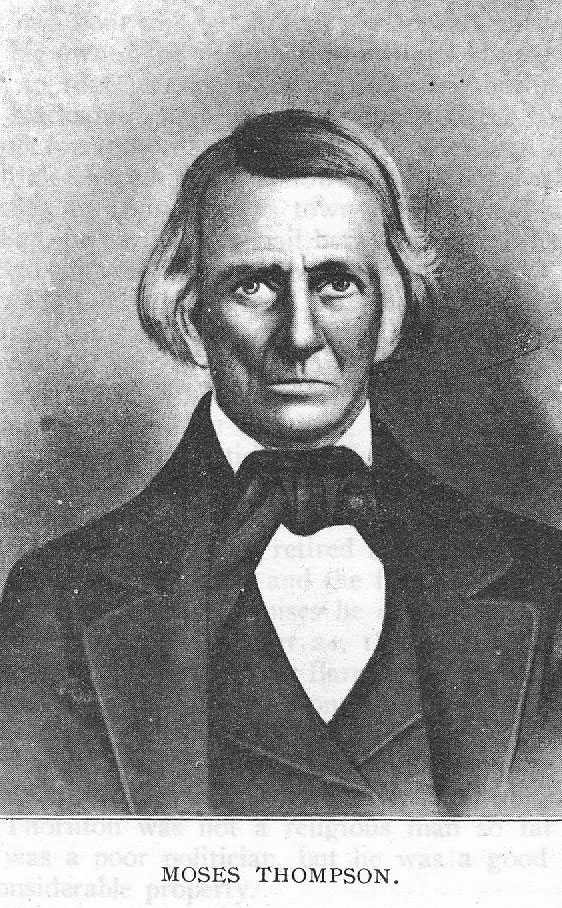
PIONEER SKETCHES - 845
cadet and sent to Annapolis. He was guilty of some infraction of discipline there, and to escape arrest and punishment ran away into Virginia, and was concealed by a gentleman named Thornton, whose name he assumed. He resided with him for some time and there concluded to seek his fortune in the west. He came to Portsmouth, about 1812.
In 1814, he appears as one of the overseers of the poor in Wayne Township. In 1816, he was the Town Supervisor. In 1818, he had an interest in a flour mill but it does not appear that he conducted the business. He owned the site where the Biggs House now stands. and from 1820 to 1826. carried on a wool carding business there together with a blacksmith shop. In 1822, he sold the town its celebrated town bull for $68.00 and kept him for the town for one year for $50.00, and also kept him the following year, after which he was sold. From 1823 to 1825, he was town Marshal and Clerk, of the market. In 1827, he carried the mail between Chillicothe and Portsmouth. In 1830, he was again an overseer of the poor for Wayne Township. In 1838, he was elected Coroner and in December, 1839, the Sheriff, Oliver Lindsey, died and he succeeded to the office. In 1840, he was elected Sheriff on the Whig ticket against one Clark. He received 1,356 votes to 781 for his opponent. In 1842, he was again a candidate for Sheriff on the Whig ticket and was defeated by. John Cook, on the Democratic ticket: The poll stood 920 for Cook and 880 for Thornton. That was the first time the Democrats had ever broken the Whig phalanx in Scioto County.
After that time Mr. Thornton retired from public life. He died owning the Biggs House property and the former home of the Hon. Wells A. Hutchins on which premises he died. He was born November 23, 1784. and died September 24, 1847. He was married to Sarah Glover. a sister of Hon. Elijah Barnes Glover, and left a family, among whom were George Thornton, the blind musician, and the wife of Peter Yeager. His father-in-law, Elijah Glover, Sr., was Sheriff from 1810 to 1814: he was Sheriff from 1839 to 1842: and his grandson, Thomas T. Yeager, was Sheriff from 1887 to 1891.
John H. Thornton was not a religious man so far as we can learn, and he was a poor politician, but he was a g00d citizen and accumulated considerable property.
John R. Turner
was born June 25, 1787, in Northampton County, Va. His father was a poor slave-holder, and was ashamed of the fact. He determined that his children should be free from the curse, and independent of it, and so educated his son for a school teacher.
In 1808, the Turner family came to Scioto County, and John R., began his career as a school teacher. There comes a crisis in the life of every man, when fortune must be taken at its tide. On April
846 - HISTORY OF SCIOTO COUNTY.
16, 1810, Alexander Curran resigned as Clerk of the Court of Common Pleas to avoid issuing a warrant for the arrest of General Robert Lucas.
Havillah Gunn was appointed Clerk pro tem, but would not qualify for a full term. The court adjourned to May 25, 181o, to select a Clerk and to hold an election for Sheriff in place of John Clarke, resigned. James Munn, the Coroner, had also resigned. The Court tried to find a person with grit enough to issue a paternity warrant for General Robert Lucas, Turner volunteered to take the place, and he was appointed pro tem until he could obtain the necessary certificate from the Supreme Judges. Curran had also held the office of Recorder and resigned that, and Turner was at the same time appointed Recorder of the county.
Turner gave up his school at Alexandria to take the place. He held it by successive appointments until the fall of 1851, when the office became elective. He was a candidate for the office at the October" election that year, and received 1,034 votes. His opponent, George W. Flanders received 1,033 votes, and so Turner was elected by a majority of one. Mr. Turner understood the art of standing in with "the powers that be." He was a first-class diplomat, and, while he was a Whig, it mattered not, if a majority of the Court were Democrats, John R. Turner was re-appointed Clerk every seven years. "The powers that be," With him, were the Presiding Judge of the Common Pleas court and his three associates. In 1829, there was an attempt to remove Mr. Turner from office by impeachment. Several charges as to malfeasance and misfeasance in office were presented against him, and he had a trial, but the court unanimously acquitted him. Prior to 1823, he kept the office in a rented room near the court house. From 1823 to 1827, he kept it in Dr. Waller's former office on Front street. From 1827 to 1837, he kept it in rented property, and in October, 1837, moved it into the present court house. He was a most efficient clerk, and was noted for accuracy and neatness.
On July 14, 1811, he purchased of Henry Massie, the founder of Portsmouth, lot No. 113 on Front street, for $30.00. This lot was 82/ feet front by 132 feet deep, and lies directly south of the present residence of George 0. Newman. He built a house on it and resided there until his death. The house is still standing, but has been removed about fifty feet farther east. Mrs. Dorothy Zwick resided in the house until her recent death.
In 1812, he was appointed Clerk to the County Commissioners, and.continued to hold this by appointment from year to year till 1821, when the office of Auditor was created. He was Recorder of the county from May 25, 1810, until August, 1841.
On August 12, 1823, he was appointed Postmaster of Portsmouth to succeed Dr. Thomas Waller, who had died holding the of-

PIONEER SKETCHES - 847
fice. Mr. Turner held the office until June 23, 1829, when he became a victim of Jackson reform and was turned out to give the place to Mr. James Lodwick. His dismissal was considered unjustifiable, and a great outrage. There was much newspaper comment and controversy about it. However, Mr. Turner was a Whig, and Mr. Lodwick a Democrat, and Jackson having just come into office, the victors had to have the spoils. Mr. Turner's compensation was about $150.00 per annum, while he held the place.
In 1826, he kept the office in the court house, but the Commissioners thought they were not bound to keep up the United States, and required its removal.
On March 15, 1816, he was elected a Councilman of Portsmouth for three years, and re-elected in 1819 and 1822. He was President of the Council in 1822, in 1825 and in 1838. He was Mayor of the town in 1822, 1836 and 1855 to 1857. January 1, 1841, he was fined or being thirty minutes late at the council.
In 1826, he was elected a fence-viewer of Wayne Township, with William Peebles as his associate. For many years he was an examiner and visitor of the public schools.
In the great Fourth of July celebration in 1831, he responded to one of the toasts. In 1829, he was one of the committee which settled with Henry Massie for the front of the town.
Mr. Turner was married twice. His first wife was a Scarboro. He had two sons, William and George. William died in boyhood; George grew to manh00d, became a lawyer and was a Territorial Judge in the State of Nevada. He afterwards practiced law in San Francisco, and committed suicide there in 1881, leaving a wife and daughter. A daughter of John R. Turner, Caroline, died in young womanhood. His daughter, Sarah, married Jacob Clingman and went West. His daughter Martha married an Aldrich; Mary Ann married an Allen; Hester married Daniel 'Presler, and Nancy married Eliza Jeffords who became a Congressman in' Mississippi.
John R. Turner every season had a fine garden on his lot. He gave it his personal attention. He grew, cultivated and preserved many fine fruit trees.
He was a zealous Methodist, and the pioneer of Methodism in Portsmouth. In 1810 he organized a class of four and became its leader.
In 1814 he took part in the organization of the first Methodist Society in Portsmouth, and vas one of the first seven members. He became a local preacher in the church in 1816, and thereafter held that position the remainder of his life. He was, however, Chaplain of a Militia Regiment in the county in 1813. As a local minister he is reported to have married more persons than any minister or magistrate in the county.
848 - HISTORY OF SCIOTO COUNTY.
As a Clerk of the Court he issued all marriage licenses, and as a local minister he performed the marriage. He was as keen after a job of this kind as 'Squire Hall or Deacon Tracy.
While Clerk of the Court he was also Master in Chancery, and a Master Commissioner, and, as such, made many sales. His second wife was Miss Susan Chenoweth, an aunt of Samuel Reed, Esq., Vice-President of the Portsmouth National Bank.
He retired from public office in 1857. He was taken sick October 2, 1858, and .the same day made his will and deeded all his real estate to his wife. He died, Friday, October 15, 1858, and was interred the following Sunday. He had the largest funeral ever held in Portsmouth.
The lot which he purchased of Henry Massie in 1813 for $30.00, was sold by his widow in 1889 for $2,500. He and his descendants had held the title for fifty-six years. He was a ready and fluent speaker, and ready to speak at any time. He could always improve every opportunity in the speaking line, and it could be a speech or a sermon, as he desired.
He was very fond of children, and delighted to show them attention. He knew how to keep in office, and how to please those having the appointing power.
He was always a Whig, but never disdained favors coming from his political opponents. Judge Joseph Moore, a strong Democrat, and, Associate Judge from 1834 to 1841, was his friend, and concurred in his appointment while he held the office. His widow, Susan Turner, died January 10, 1878, at the residence of Judge Moore.
Mr. Turner's character was one to be studied by the politicians. He knew how to keep in office, and how to please the public. He discharged the duties of all his offices well, and was an honorable and upright citizen. While he had his enemies they never worried him much, and he pursued his own course without reference to them. His memory will be sweet and fragrant so long as his adopted city endures.
Jerome Bonaparte Valodin
was born June 6, 1817. His father was Francis Valodin and his mother's maiden name was Nancy Slater, the second wife of his father. He was born in the French Grant, on the lot granted to his father. At the age of fourteen, he was bound out to learn the saddler's trade with a Mr. Burke at McArthur, Ohio. His master neglected to teach him and he could not read. He concluded to run away and did so. He went to Greenup and finished learning his trade and there attended school. He developed quite an aptitude for learning and began his career as a school teacher in Greenup County, Kentucky. The second and third schools he taught were in Nile Township, in Judge Moore's District. He taught a school in the
PIONEER SKETCHES - 849
first school house erected where the Elm Tree school house now stands, and was thus engaged up to December 24, 1844, when he married Mary Jane Moore, a daughter of Judge Joseph Moore and of Mary Lawson, his wife.
He and his wife went to housekeeping in Rome, Adams County, Ohio, and lived there for three years. While there, he worked at his saddler's trade. In 1847, he went to Harrisonville, Scioto County, Ohio, and sold goods until 1850. In that year, he went to Turkey Creek and kept a store for a short time. In 1851, he moved on the Judge Moore farm and farmed for eight years. In 1859, he became a teacher in the public schools of Portsmouth, and taught until 1863. At that time, he was compelled, on account of the condition of his health to give up teaching, in which he had been eminently successful. He became a book-keeper and kept books for several firms until 1866, when he bought a grocery on, the corner of Sixth and Chillicothe streets and conducted it until 1870. From that year until 1883, he was a book-keeper and collector for different business houses. In the latter year, he removed to the Judge Moore farm and remained there until his death on January 28, 1886.
Mr. and Mrs. Valodin had nine children : Susan Alice, now the wife of John Cooper. resides near Vanceburg; Mary Agnes died at eight years; Sarah Ellen, deceased. Laura Esther died at six years; Minerva Moore died at eighteen months, and Joseph Moore died at three years; John Moore born April 15, 1859, is still living unmarried, with his mother on the home, farm, the old Judge Moore farm; William Francis died in his sixteenth year.
Mr. Valodin was a member of the Methodist church. From 1850, he was a Whig so long as that party was in existence, and after the dissolution of the Whig party, he became a Democrat and remained such during his life. Mr. Valodin was a master of arithmetic. He was very fond of mathematics. He was a man very strong in his likes and dislikes. There was no limit to either ;
he was a very good citizen. Had he had a complete college education and followed teaching, he would have gained distinction in that profession, as his natural bent was in that direction.
Francis Valodin
was not one of the regular listed French emigrants. He was born in France in 1765, but was without property or education. He seemed to have been left upon his own resources. When he was 26 years of age, he wanted to go to the Northwest Territory: and having no means of going or enlisting himself regularly among the emigrants, he slipped on board one of the ships and secreted himself. He was not found until the vessel was out on the ocean some days. When the ship in which he sailed reached Alexandria, he was sold out for a year to pay his passage, and he worked out his time very cheerfully.
850 - HISTORY OF SCIOTO COUNTY.
After this, he walked to the colony at Gallipolis and cast his fortunes with them. He managed to be counted in as one of the French emigrants when the land deal came up, and he received a patent for lot No. 5 of the French Grant. After obtaining his lot in the Grant, which was one of the very best and part of which is now the homestead of Peter F. Boynton, he cleared up the land and planted fine orchards of peaches and apples. He even went so far as to plant a peach orchard on the slope of the river from the top hank to the water. He was about the first of the French settlers to distill peaches and apples, and he sold great quantities of peach and apple brandy. Ha was also an excellent gardner and reared vegetables for the boating trade.
In addition to his lot of 217 acres, he made the following purchases in the Grant. In 1807, he bought of Anthony L. Carpenter, 75 acres of French Grant lot No. 14 for $255. It was from the original French Grant lot granted Louis Cei. About the same time. he bought lot No. 4, of 15 acres of the little Grench Grant of Mons. G. C. Laforge, who at that time resided in New Madrid, Mo. He paid $400 for this. On December 11, 1816, he bought lot No. 21, in the French Grant of Joseph W. Devacht, for $605. September 8, 1817, he bought lot No. 12, of the French Grant of Louis Berthe. Jr.; The reader will understand that a lot in the French Grant proper was always 217 acres, and a lot in little French Grant 15o acres. His last purchase was 10 acres lying on the river front for $200 of John Fitzer and wife.
in 1800, he married a French woman, his first wife, Madame Gabrielle, from New Madrid. She was 20 years of age and he was 35. She lived but four years, and died on the loth of September, 1804. There were two children of that marriage, Francis and Agate. For his second wife, he married an American woman, Nancy Slater. and she died Dec. 31, 1825, at the age of 41, Her children were: Adell, Ducuttee, Alexandre, Oriet, Hester, Dennis and Henry.
He took pride in educating his children and sent them away from home for that purpose. He never learned to read and write, but he wished his children to have all the advantages which he had been denied. He was a man of great prejudices, of strong loves and strong hates, a trait which he transmitted to his descendants. He kept quantities of fine liquors in the cellar and dispensed them to his friends. He was very fond of card playing and drinking. He was in the habit of going to the town Of Greenup and engaging in card playing and drinking with his friends. August 26, 1826, he spent the evening in Greenup playing cards with a party of friends, and at the conclusion of the games he determined he would cross the river in a canoe. In leaving the house where he had met his friends, he fell over the river bank in the darkness, and so injured himself that he died within a
PIONEER SKETCHES - 851
few hours, in his 61 st year. He had an iron will, indomitable perseverance, and left quite an estate to his children: He had the vivacity of the French, and the energy and industry of his Yankee neighbors, and so prospered more than the majority of the original French emigrants.
Col. Sampson Eagon Varner,
son of Christian M. and Elizabeth Eagon Varner, of Scotch-Irish descent, was born in Staunton, Augusta County, Virginia, August 17, 1824. He came to Portsmouth, Ohio, with his parents in the spring of 1838. The journey over the mountains was made in company with two other families in wagons.
September 28, 1861, Colonel Varner enlisted in the 56th Regiment, Ohio Volunteer Infantry, for three years. He was made Major of the regiment and was promoted to Lieutenant Colonel, April 6, 1863. In 1864, he was assigned to command the post at Algiers, Louisiana, opposite New Orleans, and on the eve of his departure, after four months service there, the citizens of the southern city presented him publicly with a sword and sash as a testimonal of their regard. This is said to be the only instance during the great Civil' War when a conquered people united to do honor and compliment to their conqueror. Colonel Varner left Algiers in July and was discharged from the service November 14, 1864.
In private life he was a brick mason. He had become a large manufacturer of brick and a flourishing contractor when the war broke out. He was one of the organizers and for a time superintendent and director of the Portsmouth Horse Car Company. He served sixteen years as a member of the City Council of Portsmouth, In 1874, he was an Independent Candidate for County Commissioner, but was defeated.
He was married November 26, 1848, to Maria Louise Huston, a daughter of Samuel and Elizabeth Huston, two of Scioto County's pioneers. They had six children, William Eagon, now deceased; Mrs. Ella L. Brown, of Youngstown, Ohio; Mrs. Anna M. Sanford, of Cincinnati; Frank Floyd and James Huston of Cincinnati, the latter connected with his brother-in-law in the firm of Sanford, Storrs & Varner. The youngest daughter, Mrs. Bessie C. Adams, resides in Portsmouth.
Colonel Varner passed away suddenly on the morning of June 5, 1877, of heart disease. A whole city mourned the loss of one who was a public as well as a private benefactor. He was a natural leader. With limited school opportunities, his habit of reading useful hooks enriched his mind and his store of information, his genial disposition, kindly nature and rare conversational ability rendered him attractive to old and young.
852 - HISTORY OF SCIOTO COUNTY.
John Alexander Vaughters
was born August 9, 1814, in Caroline County, Va., a son of John and Catharine (Mason) Vaughters. The family was English. The form of the name as used in Virginia was Vawter. Among the Revolutionary Continental Land Warrants issued from the Land Office at Richmond, Va., was one to William Vawter for 2,666 2-3 acres of land, another to Benjamin Vawter for 200 acres. These are believed to be members of the same family. Our subject's father died in Virginia, and his mother moved with her family to Ohio, and located in Ross County in 183o; but in 1831, removed to Coalton, Jackson County. His mother died in 1833.
Our subject had no means, but he had a good constitution and a wonderful quantity of energy. He and his brother came to Scioto County in 1844, and for a number of years he way a tenant farmer. In 1849, he began to purchase land. By industry, thrift and economy, he prospered and at his death his farm was one of the largest and best kept in the Ohio Valley. At that time he was the owner of 5o3 acres of valuable Ohio river bottom land in the upper part of Nile Township, about Seven miles from Portsmouth.
In 1847, he married Mary Dortch of Kentucky. They have five children, two of whom lived to maturity : Mrs. Harry S. Grimes, of Portsmouth, Ohio, and George A. Vaughters of Chillicothe. Mrs. Vaughters died in April, 186o, and in December, 1861, he married Mrs. Ada J. Brouse, who had two children : Mrs. Chancey M. Holcomb of Gallipolis, and Mrs. W. C. Brouse of the West Side. Mr. Vaughters was always a Republican. He was a man of the most remarkable energy and strict integrity. He was more successful than either of his brothers in accumulating property. He died April 14, 1891, honored by all who knew him.
William Vaughters
was born in Caroline County, Virginia, in 1817, the third of a family of four sons: John, Thomas G., and Richard M. and one daughter, Mary L. In 1831, his father settled in Ross County, and in the same year in Jackson County. In 18,38, he moved to Scioto County. In 1842, he married Miss Sophia Graham, by whom he had two sons and one daughter : John of the West Side, Thomas of Wetmore and Mary Margaret in Illinois, all married. In 185o, he married Mary Bryson by whom he had five children, four sons and a daughter : Richard. William, Carey, Sherman and Ella. He died July 26, 1880. His wife survived him. He was a Republican and served two terms as Infirmary Director from 1871 to 1874 and from 1875 to 1878. In 1871, the vote stood : Vaughters, 2,546; Luther Jones, 2,387; majority, 159. In 1875 he received 3,293 votes' to 2,989 for his opponent, C. F. Bradford, majority 304. He was a
PIONEER SKETCHES - 853
prosperous and successful farmer and left a good estate. He' held the confidence of his neighbors and associates as a just man.
William Veach
was born April 8, 1794, in Surrey County, North Carolina. His father was Thomas Veach and his mother's maiden name was Mary Truitt, Thomas Veach was of Scotch ancestry and the Truitt's were an English family.
In about the year 1800, the family emigrated from North Carolina to Fleming County, Kentucky, using three horses, the mother rode one carrying one child, two children rode another, and the third Was used as a pack horse. The father walked.
The boyhood, youth and young manhood days of our subject were spent on the farm in Fleming County, Kentucky, where the father also conducted a still. William Veach had a fair education, derived principally from his father, and he as well as his brothers, five in all, did land surveying in their neighborhood. In 1822, he was married to Miss Ruth Burris, and came immediately with his bride to Scioto County and settled in Nile Township. After the marriage of his son, Thomas Veach moved to Lewis County, Kentucky, where he died in 1848. William Veach was Justice of the Peace for Nile Township July 20, 1863 for three years. From 1855 to 1861, he was a County Commissioner for Scioto County.
On May 2, 1864, when he was seventy years of age, but giving his age as sixty-eight, he enlisted in Company I, 140th 0. V. I., for one hundred days, and served until September 3, 1864. In addition to having served in the Civil War himself, he had five sons and one grandson who served in the same war.
In politics he was a Whig, but sympathized with the Know Nothing party while it lasted and became a Republican at the founding of that party. He was a live politician and with great energy worked for his party's interest. He sought to see justice done every man. He was a member of the Methodist Church, at Friendship, al' though he believed in the creed of the Christian church, of which there was no organization in his locality. He had thirteen children, seven sons and six daughters, of whom but seven, Nathan Thomas, Horatio C., Harriet, Charles Wesley, George W., Mary and Robert P. grew to womanh00d and manhood. Of these, Charles Wesley and Mary are now living. Harriet married William Canada Worley and resided and died in Scioto County, Ohio. Mary married Murtaugh Lodwick and reSides in Portsmouth, Ohio. Charley Wesley resides at Kingston, Ross County, Ohio. William Veach died of cholera, August 4, 1866, and iS buried at Friendship, Scioto County, Ohio.
Jordan Vigus
was a type of the true American, a unit of that great body which makes our country of the highest citizenship of any on the globe.
854 - HISTORY OF SCIOTO COUNTY.
He was noted for his upright character in youth and in manhood. He was born September 6, 1814, in Adams County. His father was Paul Vigus and his mother's maiden name waS Mary Ann Seaman, daughter of John Seaman, one of the pioneers of Adams County. He received his education in the Adams County schools. When of a suitable age, he learned the trade of the stone and brick mason. In 1834, he came to Portsmouth, saw the future possibilities of the town and decided to make this his home.
In 1836, he married Miss Hannah Caroline Ripley, daughter of William Plum Ripley and Cynthia Spencer Ripley. Seven children were born, four cf whom, died while quite young; Sylvester Warren, Lewis Taylor, Amanda Emmeline and George Oscar. The surviving children are: Mrs. Hannah C. Edgington, Ada C. and Kate L., a teacher in the public schools in Portsmouth.
Our subject was always anti-slavery in his views and acted with the Republican party. When the war broke out, he desired to enlist in the military service and would have done so, except that he was a sufferer from asthma, which rendered it impossible for him to pass the physical examination necessary for him to become a soldier. His heart was for the Union and there was no more loyal citizen in the country. When the news. came, that the rebel, General Morgan, had entered Ohio, it was supposed for a time that he would come through Portsmouth. Mr. Vigus had a flag floating from a staff on the top of his house. Some of his neighbors suggested that he should take it down because if Morgan passed through he would burn his house. ' Mr. Vigus replied, "That flag shall not come down, I will show my colors, and if Mr. Morgan comes this way, he can do his worst."
About 1877, he removed to a small farm on Dry Run, Washington Township, Scioto County, to improve his health, but the disease from which he had suffered all his life, obtained the mastery, and he died March 2 1, 1881.
In early life, he united with the Methodist church, and was ever faithful to the doctrines of that denomination. He believed in the gospel of honesty and integrity and lived up to it all his life. As a citizen, a husband, a father, he was a model. To support him all his life, he had the sympathy and co-operation of a model Christian wife. She was born in Cattarangus County, New York, on April 3, 1812. She came to Portsmouth, with her parents, in 1833. 'She was a woman most highly esteemed by all who knew her, and was a living example of all the Christian virtues.
Antoine Claude Vincent
was born in Gentilly, France, one league south of Paris, October 13, 1772. His parents were Bourgeois and in easy circumstances. They were devout Catholics and set apart their son for the priesthood,
PIONEER SKETCHES - 855
He was educated for this purpose. He studied Latin and Greek. In his boyhood, he was a chorister in one of the churches near his home. When the time came for him to take orders, he had become somewhat tinctured with the freethinking ideas of that period, and did not feel that he could take the vows. This was a great disappointment to his parents, but he took it philosophically, and for immediate employment went to work in a calico factory. Soon after this he went into the service of a wealthy jeweler, Antionme.
The latter saw and appreciated the signs of the coming Revolution, and determined to leave France. He solicited Vincent to accompany him. The latter, being of an adventurous disposition, consented, and they sailed from Havre de Gras to the United States in the vessel bringing the Gallipolis colony. During the long voyage young Vincent studied English and learned to read and write it.
On his arrival at Alexandria he tried to speak it, but found he could not make himself understood, and that he had to learn to speak the language as well as to read and write it. After arriving at Alexandria, they concluded to cast in their fortunes with the French colonists with whom they came, and so went to Gallipolis. They reached Gallipolis but found it was no place for Mons. Antionme's business. The latter then determined to go to New Orleans with his stock of goods and after trading them to return to France. Vincent was to have a part and share in the venture but Was to remain behind his partner to attend to some business and to follow him to New Orleans when he had cleared up the business matters.
Antionme built a fine pirogue, loaded on his stock of jewelry and watches, and put a regular arsenal of fire arms on board to protect his goods. He hired two men, of whom he knew nothing, to row the boat and made his start. It was in the fall of 1791, at the outset of the Indian war. At the mouth of the Big Sandy they encountered a party of Indians in canoes. One canoe, with some of the Indians approached Antionme's pirogue and he prepared to shoot. The two men forbade Antionme to school, as it was not certain the Indians were hostile. Antionme studied a moment, and then shot himself through the heart. The Indians hearing the discharge started to row away and Antionme's companions called them back. The Indians then took such of the cargo as they saw fit, threw the remainder in the river with Antionme's body, and let the cowardly white men go, giving them a blanket and loaf of bread each. It is a great pity the Indians did not kill them instanter, as could Antionme have appreciated the situation, he would have done that meritorious act himself, and could have proceeded safely to Limestone or Ft. Washington, and there could have secured proper escort and proceeded on his voyage. The moral of Antionme's story is always to kill the other fellow first, and take your chances of his kill-
856 - HISTORY OF SCIOTO COUNTY.
ing you. However, a Frenchman is nothing if not tragic, but Antionme's rash act caused this story to be written.
Mons. Vincent had all of his capital in Antionme's goods, and Antionme's suicide caused him to remain in the New World instead of returning to France. He had nothing left but himself and he went to work. He raised chickens, he taught the American children French, etc., but he felt that it was best for him to be among Americans, and he went to Marietta and obtained such employment as he could. Here on the 23rd of January, 1799, he married Mademoiselle Flore Emilie Berthelot. He was then twenty-seven years of age and she was sixteen. She was born November 14, 1783, at Sevres near Paris.
One month after his marriage he made a trip from Marietta to Belpre in a canoe alone. He fell into the river and came near drowning. He managed to get to shore almost exhausted and before he could obtain assistance he came near dying of cold and exposure. This incident caused the first joints of his fingers to stiffen permanently, so that he could never follow his trade, or play the flute afterwards. He regretted the loss of ability to play the flute more than the loss of ability to follow his trade.
While Vincent had not originally been one of the Gallipolis colonists, and had not intended to remain with them, in order to make as good a showing as possible, John Gabriel Gervais put him down as one, and in the allotment pf lots he drew one in the hills, number 54, and sold it to Jean Baptist Gobeau for $200. It lies near the Giant Oak Mills. On March 6, 1801, he bought of Stephen Monot four acres, part of the Little French Grant, lot number 6, on the bank of the. river. The deed was acknowledged April 21, 1801, before John Belli, a Justice of the Common Pleas Court, and was recorded in Adams County. He located on this land in the fall of 1801. On October 6, 1805, he bought twenty-five acres of lot number five for $200 of Anthony Magnet, and on November 1, 1822, he bought the remaining 125 acres of lot five for $900 of the same party. The same land is now owned by his grandson's wife and has increased in value about eight times over what he paid for it. Madame Vincent received an inheritance from her mother's estate in France of about $3,300, and this was invested in land in the French Grant. The correspondence in obtaining this inheritance from France is yet preserved, and in the hands of Dr. J. Taylor of
Wheelersburg, a grandson of Mons. Vincent. Albert Gallatin our minister to France, attended to it, and the money was transmitted through John Jacob Astor. Mons. Vincent was naturalized August 31, 1803. He kept a fine garden on his first purchase, but did not hasten to clear up his latter purchases.
His children were : Louise, born June 28, 1800, married John Swain; Antoinette, first married John Squires, then Silas W. Cole
PIONEER SKETCHES - 857
Lucie, married Horatio Caswell; Susan, married Dan Young Whitcomb, and afterwards John R. Powers ; Theresa, married Volney Reeves, and afterwards John Hurd; Claudius, died July 2, 1836; Fiore Emilie, married John S. Baccus; Marie Jeamie Francoise, married Rev. Landon Taylor.
Mons. Vincent was a fine musician. He was a good player on the flute and violin. He was also a pianist, and could tune pianos.
In 1821, he walked to Gallipolis and back in forty-eight hours to consult a French doctor about his family, four of whom were sick. He disliked horse-back riding, and traveled afoot. He walked to Gallipolis and back in 1837, when he was in his sixty-fifth year. He was an excellent gardener, and kept a vineyard and made wine. He raised tobacco and made cigars. He was a great reader, and C. A. M. Damarin was accustomed to furnish him with books. He took life easy and never hurried himself about anything.
He died August 22, 1846, of a fever, aged seventy-three years, ten months and nine days. In appearance he was a small spare man.
He had all the passion of the traditional Frenchman, and could get towering angry and hiss sacre through his teeth whenever occasion required. If a neighbor wished to borrow anything that Vincent had, he would lend it cheerfully, but with the stipulated proviso that it be forthwith returned in good condition—failing in which, that neighbor was never accommodated the second time. The salient feature of Vincent's character was reliability. His word once being given, there was no evasion or quibbling. It was a prime article of his faith that a promise must be kept sacred at all hazards, and his word had for him as binding an obligation as a bond.,
Heaton Wait
was born March 22, 1811, at West Chazy, New York, on the shore of Lake Champlain. His family record will be found under the title of the Wait family. Benjamin Wait, his father, and family came to Ohio in 1814, from Vermont. The emigrants came by wagons to Pittsburg and on to Portsmouth by river and settled at what is now Wait’s Station. His wife's maiden name was Lavina Heaton. She was born June 26, 1775. John H. married Malvina Sikes, September 12, 1839.
When our subject was a youth, he decided to learn the trade of cabinet making and went to Pittsburg for that purpose. He remained there about two years, then went to Cincinnati and completed his course, after which he went back to visit his folks and decided to work at his trade at that place. He was a very skillful workman and his cleverness in designing and constructing furniture was a great source of pleasure to his friends, and some of them lamented the fact that soon everybody would be supplied and he would have nothing to do.
858 - HISTORY OF SCIOTO COUNTY.
In the year 1838, he moved to Portsmouth and opened a small shop on Market street. The next year, he bought a lot on Jefferson street and built a combined shop and dwelling. Here he made furniture, chairs and coffins for many years, doing all the work by hand. Some of the finest mahogany goods in the way of sideboards, tables and parlor chairs were made here and they were so well made by his superior skill that some of them are in use to this day. Later on he used horse power, the best of that day, and about the year 1850, built a steam factory, one of the first along the river, between Pittsburg and Cincinnati. In 1866, he was joined in business by his son, Gilbert D., and it was conducted under the style of J. H. Wait & Son up to 1884, when he retired from business. His name in business stood for honesty and integrity and the goods he constructed proved the sincerity of his purposes.
His children, were : Isabella, Gilbert, Emma, Fannie, Sarah and John, all living except Isabella. In politics, he was first a Whig, afterwards a Republican. He was a member of the Bigelow Methodist church for many years. He died in Portsmouth, October 10, 1897, aged over eighty-six years. His wife died March 5, 1898.
William Waller, Sr.,
brother of George A. Waller, was born Feb. 7, 1805, the son of Dr. Thomas Waller. He grew up in Portsmouth, and became a dry goods merchant, and was in partnership with Jacob McCabe, as Waller & McCabe.
For a considerable time he' and Samuel Coles conducted a mill at Unionville in Washington Township. From 1830 td 1834, he was Treasurer of the county. In 1847, he was one of the County Commissioners, and served one term. He was a good citizen and a good business man. He was never married.
He was found dead in his bed November 25, 1854.
George Allen Waller
is descended from Charles Waller who came to Virginia in 1820, in the ship Adelaide, a single man. He married a Miss Allen in Virginia, a native of Liverpool. His son William Waller married a daughter of George Allen whose mother's maiden name was Withers. William Waller's son John was the father of Dr. Thomas Waller, father of our subject. George Allen Waller was born August 24, 1817, on Front street in the city of Portsmouth, in a house which stood just below where Dr. Titus now resides, which was moved to Fifth street below Court where it now stands. His father, Dr. Thomas Waller died July 23, 1823, and his mother, Elizabeth Macfarlane, two years later.
He was reared by his eldest sister and brother William. He went to school in Portsmouth until his seventeenth year, when he went with his brother-in-law Captain Cleveland, to locate a canal from
PICTURE OF GEORGE ALLEN WALLER.
PIONEER SKETCHES - 859.
Indianapolis to Evansville, Ind. In 1836, he returned to Portsmouth and clerked for his brother William in his office of Canal Collector at Portsmouth. In the spring of 1837, he went to Indiana to superintend the building of a canal and was gone fill the close of the year. In 1838, he engaged in store boating on the Ohio river. A boat was built and a store placed on it and floated from town to town along the river. The store boat would, be kept at each point as long as it was deemed profitable. In 1839, he carried on wagon-making at Portsmouth with Samuel Peebles. In 1840, he went on the river and spent most of the time as a flat boat pilot until the spring of 1849. In this time he was clerk and captain of a steamboat, though most of the time a pilot. At that time pilots were not licensed.
October 6, 1847, he married to Miss Jane Davey, of Alexandria, Va., in the house where he died.
In the fall of 1848, he was elected Auditor of Scioto County on the Whig ticket, defeating Thomas Kendall on the Democratic ticket. He was re-elected in 1850, defeating James Thoroman. In 1852, he was elected to a third term as Auditor, defeating Thomas Kendall. In 1856, he engaged in the hardware business in Portsmouth and continued in it for a period of over thirty years. In 1857, he was the financial agent of the Buckeye furnace. In 1859, he was Republican candidate for State Senator in the Seventh District, and was defeated by William Newman. In 1861, he was again the Republican candidate for State Senator in the Seventh District, and was defeated by Gen. B. F. Coates by 126 votes. He was a Whig so long as the Whig party lasted. In 1852, he was a delegate to the Whig National Convention at Baltimore, Md. When the Whig party went out he became a Republican and in 1854, he voted for Lincoln for President three times, first as a delegate to the National Convention which nominated him, second at the Presidential election as a voter, and third as a Presidential elector for his District. He became a Democrat in 1866, and remained with that party.
He was eleven years on the Board of Education of Portsmouth, six years from 1857 to 1863, when the Board was composed of three, and afterwards served five years when the members were elected by wards. During his membership the Fourth street, the High school, the Colored school and the Union street building were erected, and he was on the building committee, and was its chairman. He was for twelve years a member of the town and city council. In 1872 and until 1876, he was President of the Iron National bank. He was candidate for Treasurer of Scioto County against Mark B. Wells and was defeated. In 1889, he was elected Mayor of the city, and served one term. In 1893, he was appointed a member of the County Board of Elections and served four years. In 1897, he was appointed a member, of the City Board of Elections for four years. He died November 27, 1900.
860 - HISTORY OF SCIOTO COUNTY.
In all public positions, Mr. Waller has been known for his excellent judgment, and for his integrity. While on the Sch00l Board, his fellow members nearly always followed the course advised by him. In school matters, he studied what' was best, advocated that, and his fellow members necessarily followed him. But he was wrong in retiring Prof. E. E. White, as circumstances afterwards demonstrated.
John L. Ward
was born in Georgetown, D. C., Feburary 14, 1813. In 1818, his parents moved to Pickaway County, Ohio. At the age of 18, he went to Perryville, Ind., and began blacksmithing. He may be said to have hammered out his fortune on an anvil and it was a good one. In 1832, he went to New Orleans as most young men of his time did and was there during the prevalence of the cholera. He returned to Lancaster, Ohio, and went to blacksmithing.
In 1835, he came to Portsmouth, which then had a population of 400 to 500. In 1836, he and Thomas Wilbahn went into partnership in blacksmithing at the south-east corner of Second and Jefferson streets. They continued in business until 1846, when Wilbahn withdrew and the next year Andrew Applegate carne in. In 1843, Ward bought out Applegate and continued in business alone. At the same time he enlarged his business and made plows and wagons. At the same time he conducted a livery stable on Second street in the rear of the Hotel Portsmouth.
His career in public office began in 1843, when he was elected a Councilman from the first ward. In the same year he was a school Trustee. From 1844 to 1849, he was a Trustee of Wayne Township. From 1849 to 1852, he was a member of the town and city Council and one of the Committee on Claims. Hence, he was one of the aristocrats of the town and in that period he governed it and did it well. He always had the affection and good will of the fire laddies and was always trying to do something for them. So much did they think of him in 1859, he was made Fire Chief. From 1859 to 1863, he was Sheriff of Scioto County, and F. C. Searl, then a verdant and unsophisticated country school teacher was his deputy. Searl was an apt pupil in the school of experience and soon learned to be as good, a politician as Ward. The latter may truly be said to have been the founder of Judge Searl's fortunes. The Judge admits it himself and hence, no proof is necessary. While Ward was Sheriff there was a remarkable friendship between Ward and Searl, which only terminated with Ward's death. It was a stronger case than that of Damon and Pythias. Ward was much the older man, but the confidence he placed in Searl proved to be well bestowed and it lead to making the political and private fortune of Searl. From the Sheriff's office, John L. Ward went into the Treasurer's office and served there two terms, 1864 to
PICTURE OF JOHN L. WARD
PIONEER SKETCHES - 861
1868., In 1852, with D. N. Murray and George Stevenson he undertook to manufacture engines and machinery. The firm was Ward, Murray & Stevenson. and it made the machinery for the Burgess mill.
In 1855, he sold out of the machine shop and went into the Burgess mill as a part .owner, but did not give the business his personal attention and this venture of his very nearly proved his undoing. In 1862, he was a government tobacco inspector and U. S. Provost Marshal. In May, 1863, he performed the pleasantest duty of his life. The city of Portsmouth prepared a carload of provisions, clothing and hospital supplies for the 56th 0. V. I., and he and Daniel McIntire went down into the swamps of Louisiana with the goods and delivered them to the soldiers. The trip took them several weeks. The soldiers were much rejoiced to be remembered and unanimously sent back a vote of thanks to the city Council in which Messrs. Ward and McIntire were most highly spoken of. The Council also passed resolutions thanking them for their services in making the trip.
In 1855, he engaged in the hardware business with Joseph Cone as Ward & Cone. After some time George A. Waller was admitted as a partner and the firm was Ward, Waller & Cone. In 1875, Mr. Ward sold out the entire interest to George A. Waller, Cone having previously retired. When the lower mill failed, Mr. Ward apparently to himself was financially ruined, but he made no sign. He sacrificed his property and went on. He retrieved his fortunes and died leaving a fine estate and owing no man a dollar. After he retired from the Treasurer's office he purchased two good farms in Green Township and became a farmer.
In 1871, he was tempted to go into politics, and became a candidate for County Commissioner. That year the candidates submitted their claims to a vote at the primaries and the poll stood William Kinney 665, John L. Ward, 663; so Mr. Ward continued his farming.
In 1836. Mr. Ward married Miss Mary E. Smith of Lancaster, Ohio. They had one child, Mrs. Ellen Miller, wife of Captain Isaac Miller.
Mr. Ward was not a religious man. An occasional oath to him acted as a safety valve to express his feelings or opinions which were always strong, but if probity and integrity are religion, then Mr. Ward was remarkably religious. The following occurrence will show Mr. Ward's characteristics. .A few years prior to his death he determined to put up a monument in the cemetery, and made a contract for the design in granite. having an anvil at the top, which now stands guard over his grave in the cemetery. He was notified that the monument was ready for inspection and acceptance. His neighbor, John F. Gerding was coming to town in an express behind a pair of mules and invited Ward to go with him. Ward accepted, and to reciprocate
862 - HISTORY OF SCIOTO COUNTY.
the favor, told Gerding to put the mules up in -his stable on Sixth street. Capt. Isaac Miller warned Ward not to go near the mules in the stable, but Ward, did not think he needed any advice from his son-in-law about mules, and went into the stable. One of them kicked him in the face and knocked out two teeth, disfigured Ward's face very much and he lay unconscious for a half hour before he was discovered. When Ward was brought back to this world he said he thought eternity had come and the mule was the messenger to notify him. When shown the teeth the mule had displaced, he said they would do for corner stones to the proposed monument. Further commenting on the affair he said, "I have lived 72 years, and the idea of being kicked by a d-d old mule at my age is more than any constitution can bear." He, however, admitted that Captain Miller knew more about mules than he did, and that he ought to have listened to his advice.
We do not write this merely for the sake of giving a biography of John L. Ward. What is the lesson of his life? How many blacksmiths die leaving $80,000? How many of that trade rise above the anvil ? How many men who are financially ruined at the age of 47 ever regain their fortunes? John L. Ward was a man of iron nerve and remarkable will power. When he determined on anything it was as good as accomplished. He would not undertake anything but what he believed he could do, and when he undertook it, it was done. The life of John L. Ward is a noble lesson and example to all young Americans, if they can walk in the path he followed. :If a motto was made to illustrate his life, it would be "Nil desperandum."
William Wertz
was born February 2, 1808, in Philadelphia, Pennsylvania. His parents were Germans. There he learned the tailoring trade, which he followed during his life. When a young man, just of age, he left Philadelphia and went to Washington city and engaged in business for himself for a year. He enjoyed a very fashionable trade in his business. In 1828, he came to Wheeling, and then to St. Clairsville, Ohio, and from there to Portsmouth. where he located in 1829. His grandson was a member of Congress from the Bedford, Pennsylvania, District, in the early history of the Republic. When he first came to Portsmouth to reside, he lived in a small house on Front street. between Washington and Chillicothe. From there he moved to Court street in the Scott property, between Fourth and Fifth streets, and then to the old homestead opposite Lynn's livery stable, where he died.
He was married to Eliza Gibson, daughter of William Gibson, in the year 1834. Mr. Gibson had been a blacksmith in Washington's Army, and kept a tavern at Bedford, Pennsylvania. William Wertz and wife had six children : Hattie, married to George Dennison, of
PIONEER SKETCHES - 863
Milford, Ohio; Ambrose, who died in young manhood; Orliff, who resides in Portsmouth, and is better known as "Buddy ;" Mary, married to William Love, of Philadelphia; Wilbur, who is a brick contractor, and Ida, who died in childh00d. Mr. Wertz worked a great deal of his time in the latter years of his life for Stephen D. Bishop. He was well up in his trade and could have made a fortune at it, had he tried. He was highly respected wherever he was known.
Mrs. Judith Watkins
was born January 25, 1797, in Hampshire County, Va., the daughter of John and Elizabeth Timbrook near Romney. Her mother was a daughter of Lieutenant Lane, a soldier of the Revolution. Mrs. Lane was one of the ladies who strewed flowers in the pathway of Gen. Washington. The Timbrooks family resided in the Little Cabin valley. When a child she was chased by wolves, and rescued by her parents. In 1857, her mother died in her ninety-first year. Her brothers and sisters were as follows : William, died at Fort Wayne. Ind., aged 86; John, died near Portsmouth in 1840; James, died in the suburbs of Portsmouth in 1865; Rebecca, who married Samuel C. Briggs, died in 184o.
In the fall of 1815, Judith Timbrook married Thomas Bates Watkins. In March, 1821, she and her husband, her mother, sister Rebecca and brother James, with a wagon started west. At Brownsville, Pa., they purchased a flat boat. They laid by, nights and Sundays. They reached Portsmouth in April, 1821. They were laid up at Portsmouth with high winds. The people of Portsmouth tried to induce them to stay, and they sold their boat, bought horses and started for Chillicothe. The roads were so bad, that they gave up and located on the John Orme place. north of Portsmouth, where they raised a garden and Watkins teamed. Their flour was $5.00 per barrel, ham 5 cents per pound, eggs 5 cents per dozen, and all other articles in proportion.
When the Scioto. was high, flat boats came down manned by as many as twenty-four hands. Thos. B. Watkins farmed the bottoms for years and then removed to the brick house which formerly stood on Lincoln street north of Robinson avenue.. In 1825, just after he went into partnership with Samuel C. Briggs, he was in the bottoms cutting Wood when a large 'dead limb fell on him and paralyzed him. He lay helpless for six weeks. After recovering, he started a grocery where the Second street school house now stands. He remained there till just before the flood of 1852, when he went to Lucasville and kept a tavern. Charles Mastin kept a store there, and the residents there were David Jones, father of Luke; Henry Roush, who also kept a tavern and Dr. Watkins. A great many teamsters from Lancaster made Watkins' hotel their stopping place, and sometimes there were as many as 20 wagons in front of the hotel at night.
864 - HISTORY OF SCIOTO COUNTY.
In 1829, they removed to Waverly and kept a tavern there. They entertained Duncan McArthur, Robert Lucas and other distinguished men. In 1851, they returned to Portsmouth, and kept a tavern on Front and Massie streets where Reitz's office now is. Mr. Watkins afterwards kept a tavern known as the "Travelers' Home" which Stood east of Chillicothe in the middle of Sixth street in front of the church. Mr. Watkins had always been a Democrat, but he voted for Mr. Lincoln in 1864. He had served in Captain Sealy's Company in the war of 1812. He died November 16, 1884. Mr. Watkins wore the first blue jeans made in Scioto County, and of it mitts. were made for Dr. Waller, John Orme, Daniel Noel and other residents. His children were Mrs. S. H. Holmes, Thomas B. Watkins, James, Captain of the Anchor line steamer of St. Louis, Jefferson L., John Watkins, and Mrs. H. Densmore. Her son, William, died in 1865 and her daughter, Mrs. Thomas Beatty, in 1865. Mrs. Watkins drew a pension on account of her husband's service in the war of 1812. It was granted under the law of March, 1878. She died April 15, 1885.
Peter and Charlotte Weaver.
Peter Weaver was a colored man born in 1748, an attache of the Court House and a well known character in the town. He was the first boot black in the town. ,He went to the taverns, shops and stores on Saturday afternoons and blacked shoes and boots. He had customers by the month and by the quarter. He lived on the site of the National Hotel. On April 23, 1825, he was allowed $3.00 for waiting and attending on the Court. On August 6, 1825, for attending on the court for six days, he was allowed $4.50: November term, 1827, he was allowed for waiting, on the court, $3.75. For waiting on the court at the march term of 1829, he was allowed $3.75. Samuel M. Tracy had $33.33 1-3 for his services at the same term. On December 30, 1830, he was allowed by the county $4.00 for digging the grave of Mahala Murphy, an insane woman, who died in jail.
Peter Weaver was a member of the First Presbyterian church and prided himself on the fact. The colored churches did not suit him. He always wore a silk hat, usually furnished second hand from some friend in the church, In his latter days, Mr. Robert Bell furnished him in silk hats. In the latter part of his life, Peter lived on the present site of the Sixth Street Methodist church. His wife, Charlotte Weaver was a character. She was a midwife and a factotum about the town. No child could be born, no woman buried and no social function be given, without her assistance. She was born in 1778, on the south branch of the Potomac river, a slave, and at ten years was sold to a master named Walker; who took her to Kentucky. There she married Peter Weaver, who had had two wives
PIONEER SKETCHES - 865
before, and was 3 years older than she. Weaver worked and bought his own freedom. Then he borrowed $1,000 and bought his wife’s freedom, but was unable, to buy that of his child by. her. They came to Portsmouth before the town was located and built a cabin. They continued to live in Portsmouth till he died in 1865, at the age of 117 years. She survived until September 12, 1883, when she died in Columbus, Ohio, at the age of 105 years. She had never been sick and was found dead in her bed.,
Nathan Wheeler, Jr.,
located in Portsmouth, in 1819. He had a good education and was very expert in figures. From 1815 to 1819 he was clerk of Wayne Township. From 1817 to 1821 he was Sheriff of Scioto County; at the same time he was collector of taxes. In 1820 he took part in the famous Fourth of July celebration. He was one of the marshals of the procession and Gen. William Kendall was the other. There as a public dinner and he responded to two toasts. On July 17, 1820, he issued an address to the electors of Pike, Scioto and Lawrence Counties as a candidate for Legislature, and while he led the poll in Scioto County, he was not elected. David Mitchell and William Miller were elected. The vote stood as follows: Nathan Wheeler, 465; Caleb Hitchcock, 431; David Mitchell. 200; Miller, 151. This was before the time of political conventions and when each man determined his own candidacy. He had a brick yard in the east end of Portsmouth and made brick there. In December, 1820, he went into partnership with Arnold G. Sergeant, as a watch repairer, sil¬ver and gun-smithing. He was the first person who ever made building bricks in Portsmouth.
On May 4, 1817, John Brown resigned as councilman and Nathan Wheeler was appointed in his place. In 1819, he was Road Supervisor of Portsmouth. He died about the year 1826, but the exact . date is not known, neither is his place of burial.
He was married March, 1811 or 1812 to Nancy Chamberlin. They had three children. She was born in 1792, in Vermont and emigrated to Blennerhasset Island in 1801. She died at Ceredo, West Virginia, in June, 1869, in her 77th year.
Nathan Wheeler was a public spirited citizen. He was ever ready to take part in any public function, whether as a marshal, speaker, or otherwise. He was well liked by his contemporaries. He was industrious and active and a suitable man to aid in building up a city or county. His residence while in Portsmouth was on the north side of Second street, near the Scioto river bridge, and it is said that he kept a ferry there part of the time.
Major Amos Wheeler
was born in Massachusetts, September 5, 1761. He was the son of Nathan Wheeler, a merchant who served for more than five years in
866 - HISTORY OF SCIOTO COUNTY.
the Revolutionary army, being an officer of the Sixth Massachusetts Regiment, commanded by Col. Thomas Nixon.
Amos Wheeler served in the Revolution (see Revolutionary soldiers) and was an eye witness of the execution of Major Andre, the famous British spy, at Tappan, N. Y., October 2, 1780, being one of the horse guard at the time.
After the Revolution, he moved to Bethlehem township, Grafton, County, New Hampshire, and married Elizabeth Snow at Bath, N. Y., October 11, 1788. His wife was the daughter of a sea captain, who spent a great many years on the ocean, and who wrote a book on the Millennium. Amos Wheeler believed with the Declaration of Independence, that all men should be treated alike, and tried to be sociable and friendly with the poorest and most ignorant as well as with the wealthy and educated. He was major in the militia, and a Presbyterian. His wife was a Free Will Baptist, aristocratic, choosing her associates among the wealthy and refined, but always treating the "back woods" people kindly. Although they differed in religion and politics, there never was any quarreling between them.
The family relations were unusually congenial because the children were carefully taught to respect each other's rights and feelings. So peace and kindness reigned in spite of all irreconcilable opinions.
In 1808, Amos Wheeler together with his family, which then consisted of his wife, two sons, and three daughters, moved from New Hampshire, and. settled in the town of Wheelersburg, Scioto County, Ohio. Amos was accompanied to Ohio by his father Nathan Wheeler, an old man who loved to tell war stories, and to sing war songs to die boys. He died in 1812 lacking but two weeks of being 90 years old. During the war of 1812, Amos Wheeler offered his services to his country, and it is believed took part in the expedition against the British and Indians at Vincennes, Ind.
July 17, 1818. while yet a resident of Scioto County he applied for a pension, which was granted and continued until his death. About 1822, he sold his place at Wheelersburg to the Rev. Dan Young who also was from New Hampshire. and moved to Marion County. Ohio. Amos was tall and fair with curling hair, and grew bald as he grew older. He died March 27, 1827, aged 66 years and 6 months, and was buried at Marion, Ohio.
His wife, Elizabeth, who was born on December 16, 1771, was small and her eyes and hair were very black. She was a very handsome woman and used to in the earliest clays, wear high-heeled shoes, and hoops so large that she had to tilt them to pass through a d00r. To the very last she used her face powder, and was fond of fine caps, and was dainty and precise in her dress and manners. She had something of a military spirit, for she walked with much spirit and precision in all her movements, something like a trained soldier, even to the last years of her life. She was so well acquainted with the
PIONEER SKETCHES - 867
Scriptures,—book, chapter and verse,—that her son-in-law, a minister, when .hurried, consulted her rather than turn to the concordance. She was very helpful to him in his ministry, which was a widely successful one. She was in her 73rd year when she died. Elizabeth Wheeler, drew a pension as widow of a Revolutionary soldier, until the time of her death which occurred in June, 1843 at East Liberty, Ohio, where she made her home during the latter part of her life with her eldest daughter, Elizabeth, then the wife of Rev. David Dudley.
Amos and Elizabeth Wheeler were the parents of six children, three sons and three daughters. The five eldest children were born in New Hampshire, and the youngest Horatio Nelson was born at Wheelershurg, Ohio, August 4, 1811.
It might perhaps be interesting to note in this connection that a number of the grandsons of Major Wheeler took part in the Civil War, among them being Lieut. -Edward D. Wheeler who graduated from West Point on June 13, 1864, served during the siege of Petersburg, Va., and was at the action of Laurel Hill and was Asst. Adj. General of the 25th Army Corps when Grant entered Richmond, and who served for many years in the regular army. Lieut. Amos Wheeler, a man in every way worthy of his namesake, took part in many hard fought battles, and accompanied Sherman to the sea. David Thompson, son of Mahala (Wheeler) Thompson, second daughter of Major Amos Wheeler, entered the army as a Second Lieutenant, in the 82nd Ohio, and was rapidly promoted to Colonel. He was wounded at the battle of Dallas, Ga., and again at Averysboro, N. C., for his services in which he was brevetted, Brigadier General, to date, from March 13, 1865. For his bravery at the battle of Gettysburg he was presented with a magnificent sword by the privates, and non-commissioned officers of the 82nd Ohio regiment.
Ruluff Whitney
was born in Salisbury, Conn., June 25, 1777. His father was Christopher Whitney and his mother, Mary Ticknor of Sharon. Conn. His great-great-grandfather, John Whitney, of Watertown. Mass., located there from London, England, in June, 1835, coming on the ship "Elizabeth and Anne." He was soon admitted as a freeman and for twenty years was selectman, constable and town clerk. The founder of the family in England was Turstin the Fleming, or Turstin De Wigmore, or Sea Rover, whose distinction between ',ileum and tuum were of the vaguest character and who with other gentlemen ( ?) of his kind followed in the wake of William, the Conqueror, from Normandy and England, for anything which might turn up.
Christopher Whitney was it Revolutionary soldier. In 1790, he went to the western part of New York, to take up land as a reward for his military services in the Revolution.
868 - HISTORY OF SCIOTO COUNTY.
1,800, Ruluff Whitney married Susan Glenny of Virgil, New York. In 18o6, he was a Justice of the Peace of his township. He lived at Dryden Corners, Cayuga County, New York, until 1816. There was a frost every month that year and he determined to go further south. He started with his family for New Orleans. They went in wagons to Pittsburg, Pa. The party was composed of himself, wife and eight children. At Pittsburg he invested most of his money in goods for trading down the river. These goods were lost in a storm in the river. The family stopped at Pomeroy, Ohio, and Mr. Whitney bought coal land. After remaining here a year or so, he loaded a boat with coal and started with his family to New Orleans, but went to St. Louis. He left his family at St. Louis and took up a claim and built a cabin in Illinois. Coming back to St. Louis to renew his journey to New Orleans, some of his children had been attacked with yellow fever but recovered.
This induced him to give up the voyage to New Orleans and as soon as his children recovered, he took his family on a steamboat to go up the Ohio and return to his old home in New York.
On the boat going up the Ohio, he fell in with a citizen of Portsmouth, who persuaded him that one of the poles of the earth came out there. He was so charmed with what he had heard of Portsmouth that he determined to stop there and did so in January, 1821. He never left the town and is buried in its cemetery. In 1825, he was Coroner of the County. In 1829. he bought the lot known as the Whitney corner where the Washington hotel now stands. He built a part of the building first placed on the lot and moved another part. from Jefferson street. He gave $111.82 for the north one-half of inlot No. 2, 66x82 1/2 feet on the northwest corner of Second and Market streets and bought of Hugh Cook. He gave Mercy Cook, the wife, $5.00 extra to release her dower.
He got coal. off his lands in Meigs County, Ohio, and sold it in Portsmouth. The coal first burned in the court house at Portsmouth, was sold to the County, December 6, 1831at 16 1/2 bushels for fifty cents. Our pioneers were desperately reckless about spelling and in entering the transactions on the Commissioners' Journal, they spelled coal, "cote." Moses Gregory, then Auditor, will have to stand responsible for this error as he -was Auditor at that time. Mr. Whitney had a coal yard on Jefferson street north of Second and later on his lots opposite the court house on Sixth street.
In 1837, he burned and furnished the brick for the present court house. He first used the entire Whitney corner building for a residence. Then he kept a grocery there. In 1837, he went into the pork packing business and built the brick house on Market street so long used by Maxwell as •a feed-store.
In 1833, he was a Health Officer. of Portsmouth was re-elected in 1834, hut declined to serve. In 1836, he was appointed and serv-
PIONEER SKETCHES - 869
ed as Health Officer. In 1836, he was elected clerk of the market at $15.00 per year. He declined to accept the office, at that compensation, and Thomas Ferrin was elected at $30.00 per year and accepted.
Ruluff Whitney was a large, portly man, lacking one-fourth of an inch of six feet, with florid complexion, light hair and blue eyes. His wife was under size, plump and with very black eyes and hair. After he had bought the Whitney lots on Sixth street near the court house, he tried to have the street laid out east, in a straight line until it struck Lawson's Run, but the men in Portsmouth who made it their business to block streets, and in each generation got in their work, said he was entirely selfish in the matter and his plan was defeated.
His wife was a Presbyterian all her life. He attended that church with her, but later he attended All Saints church. He died at his residence on the Whitney corner August 8, 1846. His wife died a year previous. A few years before their death they together made a long visit to their friends and old home in New York. They are buried in the old Funk graveyard in Kinney's Lane. Their children were eight in number. John resided on the corner of Sixth and Court streets. He was married twice and had two sons, John Nesbit and James Glenny; Mary Ticknor, a daughter, married Hannibal H. Hamlin and resided in Cincinnati. She had five children who attained maturity : Ruluff Whitney, Jr., a son, died in Portsmouth in 1824; Susan Whitney, a daughter married Elisha G. Stone and lived in Cincinnati; she had five children to attain maturity. Sarah Whitney, a daughter married Andrew Rowan Harden and resided in Cincinnati ; she had five children to attain maturity. William Glenny Whitney, a son, resided in Portsmouth all his life, and has a sketch below. Minerva Whitney married Abjah Curtis of Connecticut and was childless. Olive Whitney married Col. Allen Campbell McArthur of Chillicothe. Ohio. They had five children.
Ruluff Whitney, our subject, has sixty-eight grand-children and eighty-seven great-grandchildren, all of whose names and addresses are known to Miss Belle Whitney of Portsmouth, Ohio.
William Glenny Whitney
was born April 11, 1811, at Dryden's Four Corners, Cayuga County, New York. It is now in Tompkins County. He was the third and youngest son of Ruluff Whitney and Susannah Glenny. His mother was the daughter of John and Nancy Nesbit Glenny of Virgil, New York. The Glennys emigrated from Newry, County Down, Ireland, in 1795. Ruluff Whitney was a descendant of John and Eleanor Whitney, who emigrated from England, and settled at Watertown, Mass., in 1635.
Mr. Whitney resided with his parents as long as they lived. Until he was about six years of age, they lived in Dryden and vicinity. In the year 1817, they went to Pomeroy, Ohio, where they resided
870 - HISTORY OF SCIOTO COUNTY.
until 1820. In 1821 they settled in the town of Portsmouth. Our subject attended school three months in the winter in town. The teacher was paid by the parents of the pupils. One of his teachers was in the habit of taking a long nap in the afternoons and it was a favorite amusement for the boys to try which could approach close enough to shake a fist under his nose and regain his seat without arousing him. We are not informed who that teacher was, but it may have been William Jones. However, William G. Whitney was disposed to learn and kept his books and slate for study and studied at every opportunity. He was quite a reader of the English classics.
In 183o, he and his brother, John, bought out the father's business and conducted it under the name of J. & W. G. Whitney. They engaged in forwarding freight on the canal and were part owners of the steamboat "Olive," plying between Cincinnati and Portsmouth. William G. was the Captain.
On January 22, 1831, our subject was commissioned Ensign of the First Regiment, Second Division, Second Brigade. State Militia. He was qualified July 11, before Silas Cole, Adjutant. He was called Captain because he became Captain of a militia company in Portsmouth.
Mr. Whitney was twice married. His first wife was Miss Melvina Fleming, whose parents came from Pennsylvania. There were four children of this marriage: Ruluff, who lives at 419 Arch street, Cincinnati, Ohio; Susan, wife of John S. Womble, of Oviedo, Orange County, Florida ; William Fleming and James, an infant who was killed by a fall when he was two days old, the mother following four days after, April 29, 1847.
In 1837, 1838 and 1840, Wm. G. Whitney was overseer of the poor of Wayne Township. From 1840 to 1844, he was town street commissioner of Portsmouth. In 1842, he succeeded Jacob Offnere as town Treasurer and was elected annually until 1845 when he was succeeded by John Waller. He was a communicant of All Saints church and from 1847 to 1851, he was a vestryman. In 1850, he was on the building committee.
In 1850, Mr. Whitney was married to Miss Elcy F. M. Voorhees, daughter of Isaac V00rhees and his wife, Isabella McCormack. Mr. Voorhees came to Ohio from Brownsville, New Jersey, a son of Jacob Van Voorhees and his wife, Hannah Sickles. Jacob Voorhees, his father, was a Revolutionary soldier, and descended from a Stephen Coerte Van Voor Hees, who emigrated from the province of Drenthe, Holland, April 1660, on the ship "Bontekoe," meaning "spotted cow," and settled at Flatland, Long Island. The children of our subjectsis marriage were: Isabella Olive, Mary Jane, married Charles Edwin Jewell, died at Toronto, Canada, June 14, 1889, leaving three children Elsie G. Martha W., who died in infancy, and Teresa, who married Allen Campbell McArthur, of Circleville, Ohio,
PICTURES: WILLIAM VEACH (PAGE 853); SIMEON WOOD (PAGE 875); LORENZO DOW MCKINNEY (PAGE 787); AARON NOEL (PAGE 794).
PIONEER SKETCHES - 871
In 1851, the partnership with his brother John was dissolved John W. took the .Sixth street property, and William G. took the Second and Market street corner. Later, he took into partnership his wife's brother-in-law, James D. McLean. In 1859, the firm abandoned the grocery business and confined themselves to commission and to transporting freight on the canal. The business of freighting on the canal was very lucrative during the Civil War. Mr. Whitney’s business required him to spend much of his time traveling the country between Portsmouth and Columbus, which he did in a buggy built by John L. Ward. It is said he brought the first locomotive for the Hamden Branch of the Baltimore & Ohio Railroad by canal.
In 1870, James D. McLean, Mr. Whitney's partner, retired from the business and it was conducted by him alone. He was a town guard in Portsmouth in 1875.
Mr. Whitney was a Whig and later a Republican in his political views. However, he had a strong dislike to party slavery. While at least after middle age, not an active politician, he always informed himself of the party candidates and never hesitated to scratch from his ticket, the man whom he knew to be unfit for office. Mr. Whitney was essentially a refined man, disliking roughness and coarseness in reading or companionship. While alive to business opportunities, he had no taste for going beyond in a bargain or shoving another man aside. He never used tobacco in any form. He died February 9, 1889, and is interred in Greenlawn cemetery.
Joseph Williamson
came to Ohio from New Jersey and located on government land, on the site of the town of Alexandria. He had a family of nine children : Frank, William; Joseph, Peter, James, Thomas, Margaret, Anna and Sarah. He died in 1812. His wife, Martha (Fort) Williamson died in 1834. Both are buried in Washington township. His son, Joseph was the father of George Williamson of Dry Run, who has a sketch and picture herein.
Alden Washington Williamson
was born February 7, 1819 in Flat Woods, West Virginia, near Louisa, Kentucky. He was the son of Hiram and Mary (Swearingen) Williamson. His father died when he was only fifteen and left several children, of whom he was the eldest. His first employment away from home was on the steamboat "Transit" as a deck hand at $15.00 per month. She was a side-wheeler built by Samuel J. Huston and owned by Captain James W. Davis and Luke P. N. Smith. She ran from Portsmouth to Cincinnati and made two trips a week. She was 100 tons burden. He worked on her until he was made mate at eighteen and then went on the "Ashland," a stern-wheel
872 - HISTORY OF SCIOTO COUNTY.
steamboat owned by the same parties. She ran from Portsmouth to Cincinnati. Captain Tinker was the master. Our subject was mate for ten years on these two boats or until 1847. After the "Ashland" was built, the pilot, steward, engineer and mate all got $1.00 per day. They served some time at this rate and then all who had, been receiving $1.00 per day were raised to $40.00 a month, except our subject. He determined not to stand it and left the boat at Cincinnati. All of the crew wanted him to remain but he refused and returned to Portsmouth on a Pittsburg boat. In the six weeks following his leaving the "Ashland" it had five mates successively. They lost money, and Captain Davis offered Williamson $75.00 per month to go back on the boat, but he declined. They had paid $60.00 for a mate after he left.
December 22, 1841, he was married to Sarah Ann Gharky, daughter of David Gharky. After he left the "Ashland," he engaged in building flat boats for David Gharky and saved $300 from his labors. He bought a canal boat and four horses for $600 paying $300 down and the remainder at $50 per month. He ran the canal boat for ten years and regards this as the pleasantest part of his life. He carried passengers and furnished meals and carried all freight which offered. The rates of fare were $3.00 to Columbus, $1.00 to Waverly and $1.50 to Chillicothe, including meals and lodging and the boats crew and passengers lived on the fat of the land. He ran to Columbus and return and made one trip a week. The boat carried a double crew and ran the whole 24 hours. He cleared $7,500 in four and one-half years. For eight years he used horses, but the last two years he was on the canal, he ran a propeller. He bought it for $2;500 and sold it to a southern man for $5,000.
He went to St. Joseph Missouri, for eighteen months, and there ran a ferry boat which he had purchased at Portsmouth and taken out with him. The boat was a steamboat named "General Gaines." He and his partner, a Mr. Knight, cleared $600 in 46 days by ferrying emigrants on their way to California. He traded the boat for 16o -acres of land two miles back of St. Joseph. He gave $10 per acre for this land, held it three years and sold it for $25 per acre. The Captain thinks it was the mistake of his life in not holding on to this land, as it is now in the center of the city of St. Joseph, a city in 1870, of over 52,000 people. The Captain was like everyone else who has ever lived in Portsmouth, he had a longing to come back, and he did come back. He built two steamboats : the "Cotton Valley" and the "Bedford." He sold the "Cotton Valley" and sunk the "Bedford" at Tower Island, ninety miles below St. Louis. He got $670 out of the wreck of the "Bedford" and bought the "Fashion" and paid $1,200 for her. He ran her from Portsmouth to Rome. The "Fashion" was sadly out of repair and after repairing her a, number of times, he rebuilt her and changed her name to the
PIONEER SKETCHES - 873
"Reliance." He sold her for $2,250, paid his debts and had $200 left.
He and Captain Pres Lodwick bought the propeller, "W. F. Gaylord," and on Nov. 16, 1881, she was run down by the towboat "D. T. Lane," and sunk at Ashland, Ky. All the crew were saved except the cook, Elizabeth Meade. The "Gaylord" was going to land and the "Lane" had a fleet of empties. Captain John N. Lodwick was aboard the "Gaylord" as a guest and was in bed when the crash came. He secured two wooden life preservers and the boat sank under him. He floated down the river, and was rescued by the "Nellie Brown" after he had been in the water about thirty minutes. Captain John N. Lodwick had been blown up four times, sunk three times and run over by a railroad train once.
Captain Williamson is one of the best illustrations of "pluck" who Aver lived in Portsmouth or 'anywhere else. He has made and lost fortunes. He has all the bad luck any one possibly could have. He is badly crippled up and has to go abroad with a crutch under each arm, but nevertheless, he goes about and attends to any business he can do just as though he were young. He goes to church every Sunday and attends to every duty and obligation just as though he had a grant of life for 100 years to come. Whenever Captain has been called on to go through a season of adversity, like Mark Tapley, he always "comes out strong." He is never dismayed, never overcome. if the British gave him the task of subduing the Boers in South Africa, he would undertake it and do it, too, if he lived long enough, even if he had to go about on trestle work like he does now. He has clung to the Ohio river and is known by everyone on its banks from Portsmouth to Cincinnati, and they are all his friends. If he were in that trade again, he could carry every pound of freight which could be loaded on his boat.
John Williams.
better known as "Rocky" Williams was born in Scioto County near Rarden, September 25, 1830. His father was Matthew Williams, an early settler, and his mother's maiden name was Elizabeth Jones. The only education he had was that of the common schools of the vicinity. He was a tall, slender built man, with very black hair, and was the most popular man who ever lived in Brush Creek Township. For sixteen consecutive years, he was Assessor of his township, and was also township Treasurer for two or three terms. In his political views, he was a Democrat. His occupation was a farmer, but at the same time his energy was such that he engaged in buying and selling lumber.
He married Saloma Ann Hibbs, daughter of Samuel Hibbs, in 1862. Mr. Hibbs' mother's maiden name was Sarah Catherine Tener, Three children were born to them : Eliza, the oldest, was mar-
874 - HISTORY OF SCIOTO COUNTY.
ried to John Newman, of Rarden, September 29, 1888, and is the mother of four sons: Charles was born September 8, 1875. He is the agent of the N. & \V. Railroad at Mineral Springs, and Della Pearl, who died July 29, 1891. He was one of the best business men in his township. There was no new enterprise project, in his community in his period of business activity which covered all his life from the age of twenty, in which he did not have a part. He promoted all public enterprises. He was a man of very firm purposes and good judgment. He had most excellent qualities of mind and heart, and when he died he was more generally missed by the community than any man who ever lived in it before, or in his time.
John Asher Winkler
was born November 5, 1820, at Harrisonville, Scioto County, Ohio, and is of German. French and English descent. He is the son of Asher Winkler and Rebecca Rockwell, his wife. His great-grandfather Winkler, whose father went to England from Germany emigrated thence to .Maryland. His father with his parents moved to New York and settled near Elmira. Here his father married Rebecca Rockwell, who was of French and English descent. She was a daughter of Job Rockwell, a Revolutionary soldier. Mr. Winkler's uncles, James and John W., fought in the war of 1812. Only 5, 1816, his parents landed in Ohio, having floated from the source of the Allegheny to just below Wheelersburg.
The country at that time was practically a wilderness. They purchased the land on which Harrisonville was afterwards built. Here they lived for several years, but the land not being very productive, they sold it and bought another farm near Lucasville which proved to be as p00r as the other. They lived here two years and then sold again this land, purchasing land back of Wheelersburg. But on account of the unhealthfulness of the country, they were not satisfied and determined to try it further west. Haying some friends near Piqua, Ohio, they sold out and gathered together their household effects and set out thither.
Our subject was then a sturdy lad of twelve. and was the proud possessor of a yoke of calves which his father had given him. His father wished to sell the calves before setting out, but the boy would not have it. So he rode in his cart and drove his calves all the way to Piqua. His father having refused to feed the calves the following winter, he was compelled to seek work to get feed for them. He secured work in Piqua for himself and his calves. and thus at the age of thirteen, was begun a career which ended in a modest fortune.
His parents returned to Wheelersburg in 1834, and this year marks the close of his schooling. At the age of seventeen, he began work for himself at La Grange furnace. When he commenced working, he vowed he would not touch strong drink, nor gamble, nor as-
PIONEER SKETCHES - 875
sociate with those who did and that he would save enough by the time he was twenty-one to keep him from working for a daily pittance. He quit La Grange furnace when he was twenty. He had saved $600 and had also gained a reputation for honesty and uprightnes of character.
Buying some oxen, he commenced dragging rock for the locks which were being built at the falls of the Licking river. Here he labored until he was twenty-one. Faithful to his vow, he had saved $1,630, and had four valuable yoke of oxen. Turning his paper scrip into gold in Cincinnati, he walked and drove his ,oxen home.
He then began taking contracts for digging and delivering coal and ore at the furnaces in Scioto and Lawrence Counties. He was thus employed at Franklin Furnace for eleven years, at Junior Furnace, one year, at Ohio Furnace one year, and at Union Furnace two years. He also worked at Harrison Furnace and was manager there for some time. From there he went to Boone Furnace in Greenup County, Kentucky, where he was manager for a time.
With this, he ended his furnace career, and was worth $20,000. He met with some severe losses during his time, by fire and water, but not by his own mismanagement. He then bought the farm at Haverhill where Samuel Krickenberger now lives and has farmed ever since. His success at farming has been no less phenomenal than his furnace career, having more than doubled the fortune he had at that time. He has made most of his money at farming, by taking advantage of a low price and selling at an advance, also in raising stock. Recently he has made a division of his property among his children, saving enough for his own comfort while he lives.
He was a Whig, until the breaking up of the party, and then he became a Republican, and is still with that party. He has been a member of the Methodist church at Haverhill for thirty-six years, a greater part of which time he has held office in the church. On March 10, 1842, he married Cynthia Chandler, whose grandfather was English and moved to Ohio in 1802. Their family .consisted of five sons and six daughters, of whom three sons and four daughters are now living. They are as follows : Mary, the wife of Claudius Cadot, died July 12, 1901; Ruby, the wife of John Oakes; Emma, the wife of Samuel Krickenberger ; Silenda, the wife of Frank Seamen ; Stephen, residing new Hanging Rock, 0.; John, and George are engaged in the lead business in Missouri.
Simeon Wood
was born September 7, 1804, in Cayuga County, New York. His father was Abner Wood, and his mother's maiden name was Rebecca Campbell. His father was born in 1766. His father and mother had sixteen children and reared twelve of them. Abner Wood emigrated to Ohio when our subject was four years of age. His father died in
876 HISTORY OF SCIOTO COUNTY.
1882, and his mother died April 18, 1853, in the eightieth year of her age. Both are buried in the cemetery in the rear of the Scioto church, a mile below Harrisonville on the road to Sciotoville. Abner \Vood when he first landed in Scioto County settled in Alexandria in the year 1808. He then settled in the Scioto valley on the east side; but the family suffered so with fever and ague that he moved to the Little Scioto in 1812.
He was reared a Presbyterian. His son Simeon, at the age of twenty-eight, connected himself with the United Brethren church on Little Scioto, because there was no Presbyterian church near. He married Emeline White, daughter of Daniel White. She was born Nov. 9, 1815, in Greenup County, Kentucky. They were married Oct. 31, 1852. They went to housekeeping on a farm at Little Scioto where they spent their lives. They had the following children ; Martha, born November 3o, 1833, died January 1, 1834; Elizabeth, born July 31, 1835, married James Sampson, and died July 19, 1897. He resides in Harrisonville; Sarah, born December 14, 1837, married Milton W. Brown ; Ruth, born March 17, 1841, died February 18, 1858. The mother died December 1, 1875.
While the Whig party lasted, Simeon Wood was nominally a Whig; but in reality he was the strongest kind of abolitionist. He had learned the carpenter’s trade. He worked for Dan Young, and helped build Franklin and Junior furnaces. He also helped build Scioto furnace. There was a life-long friendship between him and Dan Young. He was a great admirer of Dan Young's prominent traits.
Simeon Wood was a man of strong convictions on every subject. He made it a rule to always be in the creditor class. He abhorred debt and always liked to have a surplus on hands. He followed the carpenter's trade as it suited his convenience. He had advanced ideas on the subject of temperance. In the year 1843, he built a barn. At that time it was customary to furnish liquors to be drank at all raisings. He said he would break the custom; he would raise his barn and there should be no liquors used on the occasion. He kept his word and managed to have his barn raised, but his neighbors did not believe he could do it. He died in December, 1896, at the advanced age of ninety-two, in the enjoyment of all his faculties, respected and honored by all who knew him.
John Yoakley, Sr.,
son of William and Letitia (Hammond) Yoakley, was born in Dublin. Ireland, in 1817. He emigrated to this country in 1838, first locating at Zanesville, Ohio, where he remained but a short time. He then removed to Portsmouth, and accepted a position in a banking house of which Peter Kinney Was President. After serving in this position for several years, he resigned, and embarked in the business
PIONEER SKETCHES - 877
of wholesale and retail dealer in music and musical instruments, in which business he continued the remainder of his life.
Mr. Yoakley was a musician of fine attainments, both as a composer and teacher, and for thirty-three years was organist of All Saints church, of which he was a consistent member. He resigned as organist May 30, 1877. He came from a family of musicians, his father and two brothers being quite noted composers.
Mr. Yoakley was married in 1847, to Susan St. John, daughter of Ralph and Lillian St. John, of Grayson, Kentucky. The children born 'of this union were: Lucy Howe, now Mrs. R. L. Cannon of Cincinnati, Ohio; Letitia Hammond, wife of Charles Kinney, of Columbus, Ohio; Lillian St. John, now Mrs. Lillian S. .Gunn, and John Yoakley of Cincinnati, Ohio, the latter of whom inherits his father's great musical talent. Mrs. Yoakley died August 14, 1862, her husband surviving until 1877. He was a prominent Mason. Mr. Yoakley was a man of high character and gentle disposition, beloved by all who knew him. He was one of the few, of whom it may be truthfully said, that the world is better because of his having lived in it.
Aurora Lodge No. 48. Free and Accepted Masons.
This lodge was instituted September 21, 1818. The charter members were Ezra Osborn, Samuel Gunn, Nathan K. Clough, William Bailey, George Clark, Robert Scott, Silas Cole and William Oldfield. Grand Master Henry Brush instituted the lodge. It met in the McDowell building on Front and Market streets. Ezra Osborn was Worshipful Master ; Nathan K. Clough, Senior Warden; George Clark, Junior Warden; William Dailey, Treasurer ; Jacob Evans, Secretary ; Silas Cole, Senior Deacon; Floyd Talbot, Junior Deacon ; Robert Scott, Tyler. On September 24, 1818, these officers were publicly installed at the court house, then on Market street.
It worked under a dispensation till 1820, and was granted a charter, December 26, of that year. The following officers were elected : S. S. Wilkinson, Worshipful Master ; G. S. B. Hempstead, Senior Warden; William Oldfield, Junior Wardell; Jacob Offnere, Treasurer; Marcus Bosworth, Secretary:. James Abbott, Senior Deacon ; Wilson Gates, Junior Deacon; James Hummell, Tyler.
The lodge occupied the McDowell building till 1831. From 1831 to 1843, it met in James Lodwick's house on Front street, between Madison and Massie on the corner of Pine alley. In 1843, it removed to the Whitney building where James A. Maxwell had a feed store. The Lodge then took quarters in the Cook building on the west side of Market street between Second and Third, in 1854.
On May 18, 1855, a move was made toward the erection of the present Masonic building. Thomas G. Lloyd, George Stevenson, J. J. Appler and S. S. Fuller were' appointed a committee to carry on
878 - HISTORY OF SCIOTO COUNTY.
the work. James Lodwick subscribed $250 and Jacob Offnere, $300. $4,885 was raised for building purposes. On August 6, 1855, plans were ordered and on November 24, 1855, contracts were ordered. Appler and Varner did the brick work; Fuller and Carre, the w00dwork, and James Grimes, the iron-work. The work was commenced in May, 1856. June 18, 1856, the corner stone was laid. Grand Master, William B. Dodds, of Cincinnati officiated. Rev. Nicholls, Grand Orator, delivered the address. In 1857, work was suspended at the second story and in the summer of 1857, the building was closed. In the fall of 1858, a five year lease was made of the second floor part to the Hebrew Congregation and it paid two years in advance. In. December, 1858, the Lodge took the south room on the second floor. In 1859, the Lodge borrowed $4,000 to complete the building and owed Thomas Dugan $2,700 besides. He sold the north half of the lot, first and second floor, to the Hebrew congregation and satisfied his claim. The south one-half of lot and first floor he sold to a Building Association, but it was re-purchased by the Lodge in 1885. On November 19, 1866, a move was made to finish the third floor and $3,438.37 was raised which finished it.
The principal early workers in the Lodge were: Samuel Gunn, William Dailey, Dr. Thomas Waller, Nathan K. Clough, Dr. G. S. B. Hempstead, Hiram Wilson, Silas Cole, Wilson Gates, Marcus Bosworth, Ezra Osborn, Robert Scott, Moses Gregory, Dr. Jacob Offnere, Rev. Stephen Lindsley, David K. Cady, James Lodwick, C. A. M. Damarin, Murtaugh Kehoe, William Hall, William Salter, Jacob P. Noel, Robert Lucas, Arthur C. McArthur, Joseph Waddle, Jonathan Cutler, Josiah Shackford, Dr. Erastus Burr, William Oldfield and Washington Kinney. Jacob Offnere gave the Lodge $500 by will and William Salter gave it $1,000. The Past Mas-
ters are as follows:
1820, Samuel Wilkinson; 1821 and 1855, William Oldfield; 1825-39, Ezra Osborne; 1822 and 1826-40, Dr. G. S. B. Hempstead; 1840-1, 1843-4, 1848 and 1858-62, George Stevenson; 1842, 1847 and ' 1853-4, Arthur C. Davis; 1845-6, Moses Gregory; 1849-50, R. C. Jordan; 1851-2, L. G. Terry ; 1857, Rev. Jacob Nichols; 1863, T. J. Pursell; 1866, Elijah Nichols; 1867, B. F. Coates; 1868-73, J. H. Johnson; 1874-6, R. W. Farden; 1877-9, W. A. Connolley; 188o-2, Thomas L. Jones; 1883-5, C. S Cadot; 1886, F. B. Kehoe; 1887-8, George Padan; 1889, D. B. Thurlow, , 1890-I, A. J. Fuller ; 1892, E. F. Draper ; 1893, J. A. Ives; 1894-5, B. F. Vincent; 1896, J. S. Dodge; 1897, W. B. Altsman; 1898, Dr. J. S. Rardin; 1899, Robt. G. Bryan; 1900, J. C. Adams; 1901, C. F. Calvin.
James Lodwick was Treasurer from 1852 to 1879, twenty-seven years. Francis Cleveland was Secretary from 1852 to 1872, when he was paralyzed.
PIONEER SKETCHES - 879
The present officers are: Geo. F. Roberts, W. M.; Dr. G. A. Sulzer, S. W.; L. W. Baker, J. W.; W. C. Silcox, Treasurer; Geo. Padan, Secretary; H. C. Mitchell, S. D.; S. P. Shaw, J. D.; A. J. Reinhard, Tyler.