HISTORY OF SANDUSKY COUNTY - 513
BIOGRAPHICAL SKETCHES.
RUTHERFORD BIRCHARD HAYES.
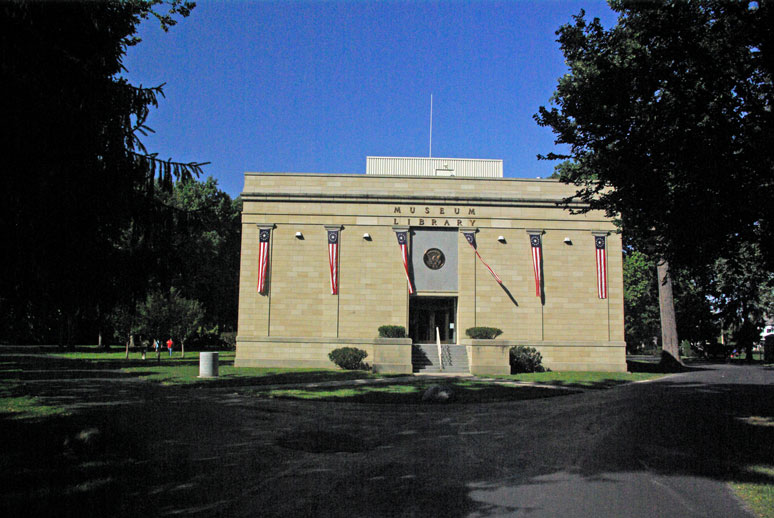
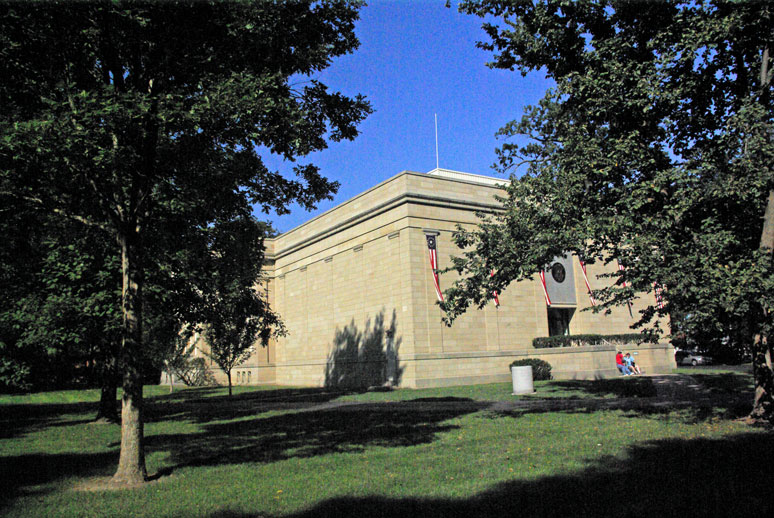
Hayes Presidential Library |
Hayes Presidential Library |
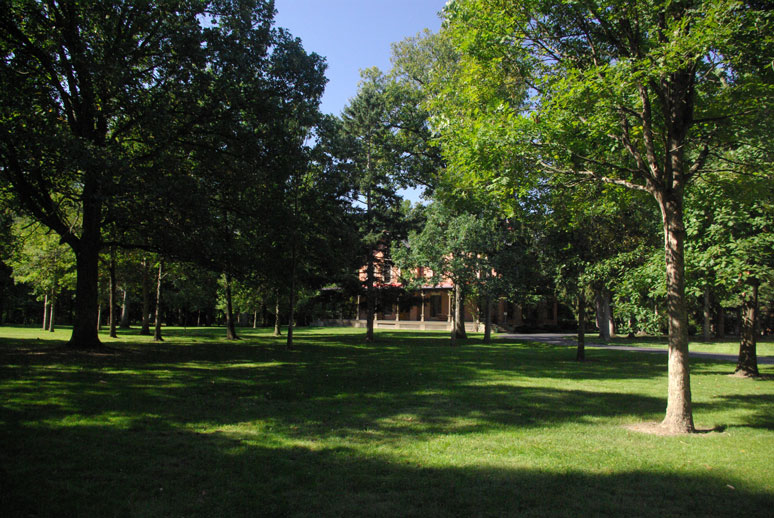
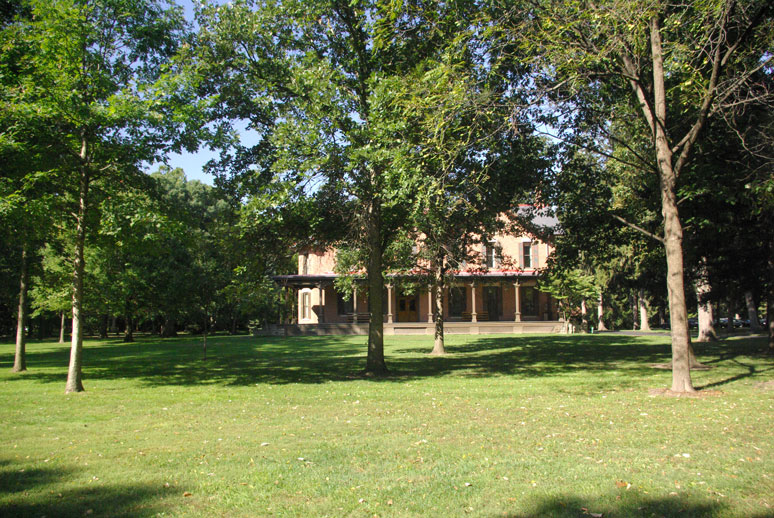
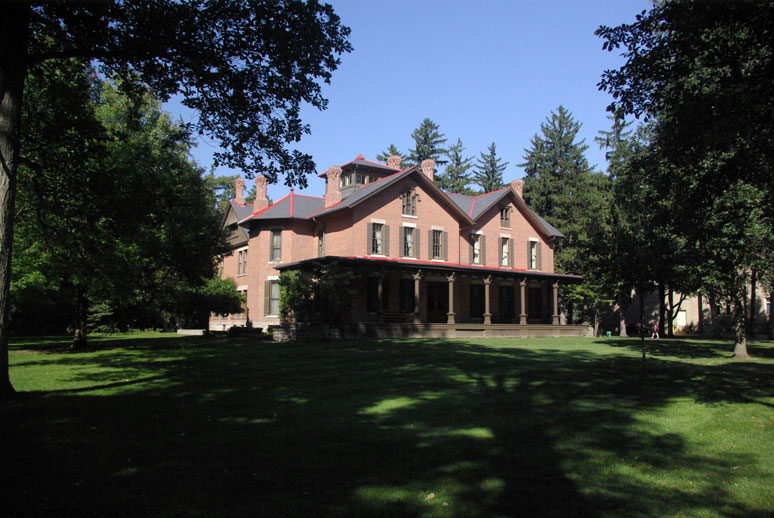
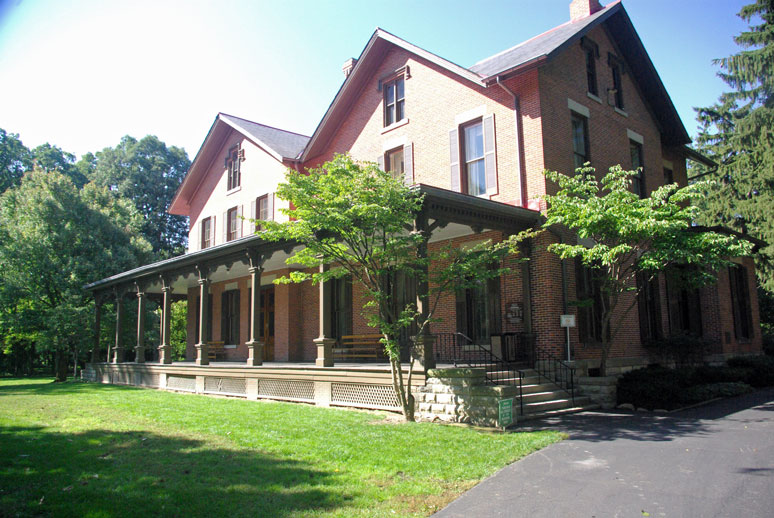
Hayes Home |
Hayes Home |
Hayes Home |
Hayes Homes |
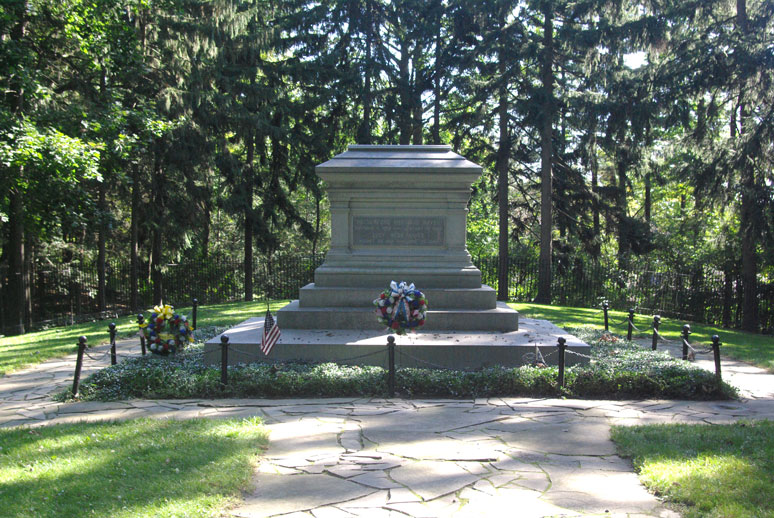
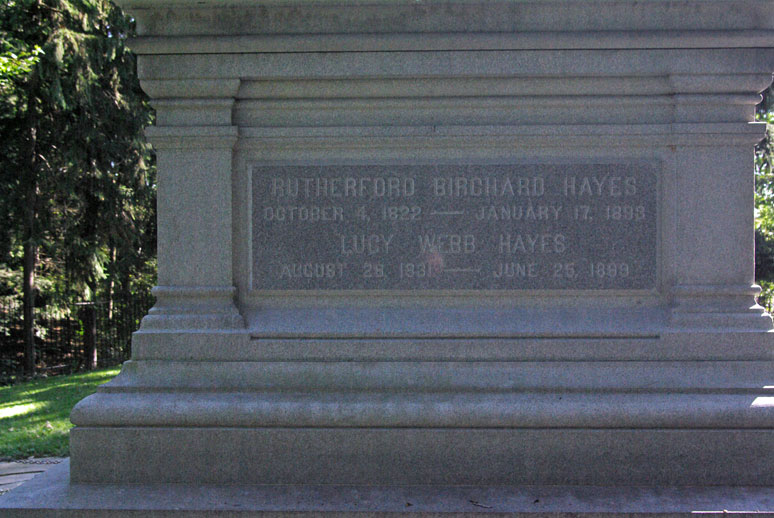
Hayes Grave |
Hayes Graves |
An able historian has observed that native talent is about equally distributed in all nations, but it goes to waste wherever the surroundings are not propitious. Intellectual strength, to be useful must have cultivation, and be associated with good moral qualities; great occasions are necessary to make it prominent in an individual. This is a somewhat abstract theory, but it is a legitimate deduction from the career of that one citizen of Sandusky county who has filled the highest office provided for by the Constitution of the Nation
It is our purpose to give only a bare outline of the life of the ex-Presidents, whose home is within the limits of this city. His biography is beyond our scope, it is a part of the history of the country. But so much of his time, when not engaged in the performance of public trusts, has been spent here that a sketch of his career falls within the legitimate sphere of local history.
Rutherford B. Hayes is a descendant of George Hayes, a native of Scotland, who, after living for a time in Derbyshire, England, came to America in the latter part of the seventeenth century and located at Windsor, Connecticut. Rutherford Hayes, of the fifth generation from George Hayes, was born in West Brattleboro, Vermont, in 1787. He is spoken of as a man of florid countenance and sandy hair, as having a great fondness for athletic sports and of popular manners. He married, in 1813, Sophia Birchard, of Wilmington, Vermont, a lady of fine intellect and lovely character. In 1817 Mr. Hayes, with his family, came to Ohio, the trip being made in a covered wagon and consuming forty-seven days. They settled at Delaware, where, in July, 1822, Mr. Hayes died, leaving a wife and one daughter. Rutherford Birchard Hayes was born on the 4th of October following. The estate and management of family affairs was entrusted to Sardis Birchard, Mrs. Hayes's brother, who was then a young man; and took a loving interest in his sister's welfare. Mr. Birchard became very fond of his nephew, and at the age of twelve years took him under his immediate charge, sending him to school and afterwards to Kenyon college. During this school-period Mr. Hayes spent a large part of his vacation time at the residence of his uncle in Fremont. His sister had toarried William A. Platt, of Columbus, and his mother made her home in that city. Mr. Hayes graduated from Kenyon with the first honors of his class. During the course he kept a diary in which is recorded not only casual events of college life, but his estimates of persons with whom he come in contact, and occasionally lets drop a remark about himself and his aspirations. Mr. William D. Howells, in his biography, observes concerning this journal :
There are few instances and none of importance set down in these early journals. What distinguishes them from other collegian diaries and gives them peculiar value in any study of the man, is the evidence they unfold of his lifelong habit of rigid self-accountability and of close, shrewd study of character in others. At the end of the third year he puts in writing his estimate of the traits, talents and prospects of his fellow-students; and in a diary opened at the same time he begins those searching examinations of his awn motives, purposes, ideas, and aspirations, without which no man can know other men. These inquiries are not made by the young fellow of nineteen any spirit of dreamy or fond introspection. Himself interests himself, of course, but he is not going to give himself any quarter on that account. He has
514 - HISTORY OF SANDUSKY COUNTY.
got to stand up before his own conscience, and he judged for his suspected self-conceit, for his procrastinations, for his neglect of several respectable but disagreeable branches of learning; for his tendency to make game of a certain young college poet, who supposes himself to look like Byron, for his fondness, in fine, of trying the edge of his wit on all the people about him. Upon consideration he concludes that he is not a person of genius, and if he is to succeed, he must work hard and make the very most of the fair abilities with which he accredits himself. He has already chosen his profession and is troubled about his slipshod style and his unreadiness of speech, which will never do for an orator. He is going to look carefully to his literature, and takes an active interest in the college literary societies. . . . He has to accuse himself, at the age of nineteen, of being a boy in many things. Even after he is legally a man, he shrewdly suspects that the law will have deceived itself with regard to him. He also finds that he is painfully bashful in society, but that great relief may be found by making fun of his own embarrassments. It is a frank, simple, generous record, unconscious even in its consciousness, and full of the most charming qualities both of heart and mind.
While at college, Mr. Hayes, with all his introspection, did not foresee the course of his life. He resolved to devote to law his exclusive attention. "But a little later," runs the biography from which we have already quoted, "we find that he has aspirations which he would not conceal from himself, and of which one may readily infer the political nature from what follows. But what follows is more important for the relation it bears to his whole career than the light it throws on any part of it. `The reputation I desire is not that momentary eminence which is gained without merit and lost without regret,' he says, with a collegian's swelling antithesis; and then solidly places himself in the attitude from which he has never since faltered: `Give me the popularity which runs after, not that which is sought for.' So early was the principle of his political life fixed and formulated. Every office he has had has sought him; at every step of his advancement, popularity, the only sort he has cared to have, has followed him. He is and has always been a leader of the people's unprompted choice."
Mr. Hayes graduated in the class of 1842, and began reading law the same year in the office of Thomas Sparrow, of Columbus, a contemporary of Thomas Ewing, Thomas Corwin, and William Allen. He afterwards attended the law school of Harvard college, from which he graduated in 1845, and was admitted to the bar at Marietta. Returning to the home of his uncle in Fremont, he formed a partnership with R. P. Buckland for the practice of law. This partnership continued two years. Mr. Hayes then accompanied his uncle Birchard to the South, the trip having for its object the recovery of the latter's health. In 1849 the young lawyer opened an office in Cincinnati, and for some time had the experience of most young professional men in a city. He was all the while, however, by diligent reading, preparing for future emergencies. He had, in fact, always been a close student, going through book after book, seeking to know the facts and ideas contained in them rather than paying attention to the author's art and style of composition. He read pretty much everything of importance in current general literature. He has carried this habit of reading through life, except during those periods too fully occupied by public duties.
It was through a circumstance of exceptional good fortune that Mr. Hayes was given an opportunity to show his powers as a lawyer, and to earn standing as a practitioner. His first case in Cincinnati was his defence of an idiot girl, who had been arraigned for murder. The half-daft creature was brought into court to answer to the charge, and, being without money or friends, had made no provision for an attorney to defend her. Judge Warden was then common pleas judge, and was on the bench when the case was called. The case was such an undesirable one, and the
HISTORY OF SANDUSKY COUNTY - 515
accused such an unprepossessing client that none of the attorneys present wen anxious to undertake the defence. The judge, finding the poor girl had no counsel, asked the bar who should be appointed to defend her. Mr. Hayes, then almost a stranger in the court room, was singled out as a proper person to undertake the undesirable case. After making some inquiry concerning the character and fitness of the young barrister, the appointment was made, and after a short preparation on the part of the defence, the trial proceeded. The case was tried with vigor on both sides. Mr. Hayes' argument was particularly strong, and at once gave him a reputation as a lawyer. From that time he enjoyed a remunerative practice. In 1856 he declined a nomination for judge of the Hamilton county Court of Common Pleas. Two years later he became a candidate, and was elected to the office of city solicitor of Cincinnati, to which, on the expiration of his term, he was re-elected.
In 1861, when the first call for troops was made, Mr. Hayes offered his services, which were at once accepted by the Governor, and when the Twenty-third Ohio Volunteer Infantry was organized, in June, he was commissioned major. He served under Rosecrans in West Virginia, during the summer and fall, part of the time being judge advocate on the General's staff. He was appointed lieutenant-colonel November 4, L861, and took formal command of the regiment at the opening of the campaign of 1862. The first great battle in which the Twenty-third participated was South Mountain, culminating in the battle of Antietam, September 17, 1862. The summer had been occupied in skirmishes and forced marches until August, when the regiment was transferred to McClellan's command. The enemy was driven from Frederick City, Maryland, and on September 13 Middletown was reached. Here began the battle of South Mountain, in which Lieutenant-Colonel Hayes, in command of the Twenty-third, led the advance. It was ordered at an early hour to advance by an unfrequented road, leading up the mountain, and to attack the enemy. The enemy, posted behind stone walls, poured a destructive fire of musketry and grape into the advancing column. Lieutenant-Colonel Hayes, Captain Skiles, and Lieutenants Hood, Ritter, and Smith were each badly wounded. Colonel Hayes' arm was broken. Out of the three hundred and fifty who engaged in the action, more than one hundred lay dead and wounded upon the field. The command now devolved upon Major Comly, and remained with him from that time forward. The enemy charged from the left and the regiment changed front on the first company. Colonel Hayes, with his wound half dressed and against the remonstrances of his whole command, again came on to the field and fought until carried off. Soon after the remainder of the brigade came up, a gallant charge was made up the hill, and the enemy was dislodged and driven into the woods beyond. Three bayonet charges were made during the day, in each of which the enemy were driven with heavy loss. The Twenty-third participated actively in the battle of Antietam, which followed, being under command of Major Comly. In October the Twenty-third was ordered back to West Virginia, and on the 15th of that month Lieutenant Colonel Hayes was appointed colonel, in place of Scammon, promoted to a brigadier generalship. In December of that year Colonel Hayes was placed in command of the First brigade of the Kanawha division. During all that toilsome West Virginia service of more than a year, Colonel Hayes won,
516 - HISTORY OF SANDUSKY COUNTY.
not only the respect, but hearty friendship of his command. He exerted himself to make camp life agreeable and to relieve laborious marches, so far as possible, of hardships. The affection of members of the Twenty-third for their colonel is manifested yet at regimental reunions. In the battle of Winchester Colonel Hayes, commanding a brigade, took a conspicuous and important part. In this battle he exhibited rare personal bravery, which is a characteristic of the man and an important element of his success. He never hesitated, either on the field or in politics, to do what occasion seemed to require. At North Mountain, Colonel Hayes took command of the whole Kanawha division, and at Cedar Creek, where a horse was shot under him, his conduct was highly meritorious. Immediately after this battle Colonel Hayes, "for gallant and meritorious services in the battles of Winchester, Fisher's Hill, and Cedar Creek," was appointed brigadier-general, to take rank from October 19, the date of the last named battle. General Hayes was given command, in the spring of 1865, of an expedition against Lynchburg, and was making active preparations when the war closed. He was breveted major-general at the close of the war to date from March 13, 1865, for gallantry and distinguished services in West Virginia in 1864, and at the battles of Fisher's Hill and Cedar Creek. He was engaged in much severe service and participated in many battles. He had three horses shot under him, and was four times wounded.
In the spring of 1865 there was a lull in the campaign in West Virginia, and many of the leading officers sought retirement from the service, which to them was becoming wearisome. Several of the military friends of General Hayes desired that he should have a furlough or be advanced to a civil position of honor. A meeting wascalled at Winchester in May, 1865, over which Colonel Devol, of the Thirty-sixth Ohio Volunteer Infantry, presided. A resolution was unanimously and enthusiastically passed, declaring that: "Gen Hayes, in addition to possessing the ability and statesmanship necessary to qualify him in an eminent degree for chief magistrate of the State of Ohio, is a soldier unsurpassed in patriotism and bravery, he having served four years in the army, earning his promotion from major in one of the Ohio regiments to his present position."
This was the first suggestion of his name for Governor, and while the proposition was received with enthusiasm by the army, it met with earnest protest from him. General Hayes had previously, in October, 1864, been elected to Congress from the Cincinnati district. He had also protested against this nomination, and when informed of the unsolicited honor, he replied in a letter, since several times reproduced in political campaigns, in which he said: "I have other business just now. Any man who would leave the army at this time to electioneer for Congress ought to be scalped." Despite this protest, however, General Hayes was triumphantly elected by twenty-five hundred majority over Joseph C. Butler, a popular business man of the city. In 1866 he was re-elected by about the same majority over Theodore Cook. General Hayes was prominent in Congress, rather for his usefulness then for the display of brilliancy. He was unobtrusive, and seldom took up the time of the House, even with a short speech. He was not ambitious to display oratorical ability, but his congressional career is worthy of great respect for the interest he took in the questions which at that time agitated Congress.
The Republican State Convention of 1867 short in Columbus in June. The
HISTORY OF SANDUSKY COUNTY - 517
importance of having a strong candidate was deeply felt throughout the State, and the country looked upon the Approaching contest with interest. The Republican party proposed a suffrage measure, which, owing to race prejudice, accrued wholly to the benefit of the Democrats. Further than this, Mr. Pendleton had announced plausible and popular currency theories, then new to the people and well calculated to attract votes. The Republican convention made General Hayes its spontaneous choice for the head of the ticket, wholly without his solicitation. The Democrats further increased their strength which the popular side of two great issues gave them, by selecting for their candidate Allen G. Thurman. The canvass was vigorous on both sides. The Democrats were on the offensive and pushed prominently the proposition to pay the bonded debt in non-interest bearing greenbacks. Mr. Hayes resigned his seat in Congress, and early in August entered zealously into the canvass. He spoke in nearly every one of the eighty-eight counties of the State, opposing with all his force the position of his opponents with regard to the currency, and supporting with the same fervor the stand taken by his own party for equal suffrage. General Hayes is a campaign speaker of peculiar force and influence. He is not what is generally known as an eloquent speaker, yet he has canvassed this State several times, and drawn large audiences in the same towns at each campaign. His power lies in clear, bold, pungent statement, and he inspires an audience with confidence in the sincerity of his convictions. As a campaigner he belonged to that class who appeal to the reason of the wavering and doubtful. He fought a political battle on the issues rather than by working upon prejudice or inspiring faithful partisans with confidence of victory. In a campaign without an issue General Hayes would have been out of place. The contest in Ohio in 1867 was a pivotal one with reference to the disposition of the National debt and the question of negro suffrage. The Republicans lost the Legislature, but General Hayes and the rest of his ticket were elected. The suffrage amendment was defeated, owing to its unnecessary disfranchising clause, but the principle had developed popular strength and subsequent triumph was assured.
Governor Hayes' administration commanded the respect of the people of the State, and a second nomination was conceded long before the convention met in 1869. The Democrats adopted an ultra platform and nominated General Rosecrans for Governor. General Rosecrans, who was in California at the time, declined the position, and Hon. George H. Pendleton was selected as the opposing standard-bearer. The campaign was fought on issues growing out of the reconstruction measures of the Republican Congress, and attracted National attention. Governor Hayes was re-elected by a largely increased majority. His second administration was liberal and popular, as the first had been. As Governor he was eulogized by the leaders of both political parties.
General Hayes met his first political defeat in 1872, but it was a party and not a personal defeat. On the 31st of July a large number of Cincinnati Republicans united in the following letter:
Hon. R. B. Hayes.
Believing that it is the desire of the Republicans generally of the Second Congressional District, that you be a candidate for the nomination, and feeling that you would receive a larger vote from the district than any other person that could be agreed upon, we unite in respectfully asking that you accept a nomination for Congress.
General Hayes positively and unequivocally declined allowing his name to be
518 - HISTORY OF SANDUSKY COUNTY
used in connection with the candidacy, but in the face of protestation he was nominated, and to prevent dissension in the party accepted. He foresaw defeat from the start, but made a good canvass, and carried a much larger vote in his district than General Grant's vote for President a month later. Hamilton county was carried for the Democrats that year by five thousand majority.
In 1873 General Hayes was unexpectedly nominated by the President for Assistant Treasurer at Cincinnati, but declined the office, being desirous to return to his home at Fremont. He resumed his residence here in the summer of that year, and naturally enjoyed relief from more than twelve years of official care. The two sebsequent years of his life were passed quietly and contentedly. But his party in Ohio was approaching an important political crisis. The October campaign in Ohio in 1875 was looked upon as the preliminary battle of the National contest of 1876. Far more important interests than mere partisan advantage were at stake. Upon the issue of the contest depended, in an important measure, the character of legislation on the currency question. The question was similar to the one which General Hayes, eight years before, had been called. from his seat in Congress to champion. Republicans of the State felt the weight of great responsibility, and discussed, with solicitude, the choice of a standard-bearer. The Democrats, two years before, had elected their candidate for Governor, and the year before carried the State by seventeen thousand majority. Business failures and general industrial depression made the theory of expanding the paper currency of the country extremely popular. In addition to this, discontent with the National Administration made Republicans indifferent. Seventeen thousand majority, the unpopular side of an all-absorbing issue, and an Administration at Washington generally unpopular,. all these obstacles in the way of victory had to be overcome, and who should be chosen to lead in the unequal contest? General Hayes, as in 1864 he had been sought out of the army to be chosen to Congress; as in 1867 he had been recalled from Congress to lead in a doubtful State campaign, against his will and solemn protest, was in 1875 forced from his pleasant and quiet home to lead in a campaign which was to decide, not only the immediate destiny of parties, but to formulate important National legislation. General Hayes was the spontaneous choice of the rank and file of the Republican party in that great political emergency. There were grave doubts, however, as to whether he would accept the nomination, and they were not without reason. To all who had approached him on the subject he had expressed extreme disinclination, and he discouraged, at every opportunity, the use of his name. Nevertheless Republican sentiment asserted itself, and grew in volume until, by the time the State Convention met, It was simply overwhelming. The only other name proposed was that of Judge Taft, of Cincinnati, whose high standing and ability were beyond question. When the convention assembled Judge Taft was presented as a candidate. There was also placed before the convention a dispatch from General Hayes positively declining to be a candidate. He sincerely desired relief from public life, and on convention day confidently supposed that he had set at rest the movement toward his own nomination. While the convention was assembling at Columbus, General Hayes, at Fremont, was quietly directing some farm work. The feeling of the convention was unmistakable, and its demands irresistible. Mr. Hayes did not realize
HISTORY OF SANDUSKY COUNTY - 519
the situation on that day until a bundle of sixteen dispatches was delivered to him imploring a withdrawal of his positive declination, and another dispatch, received soon after, notified him of his nomination by a vote of more than three-fourths of the delegates. Judge Taft, by his representative, moved to make the nomination unanimous, and General Hayes, after consultation with his friends here, telegraphed : "In obedience to the wishes of the convention I yield my preferences and accept the nomination."
General Hayes entered that campaign with all his force, fighting not Allen and Cary but the theory of finance which their party advanced, and which he believed to be pernicious. Few Ohio campaigns have been so free from personality. The candidates of both parties were men of the highest integrity, and with honorable records. The contest was not for the Governorship but for the triumph of a principle which had an intimate relation to the Nation's most vital interests. General Hayes was master of the campaign which he led, having at the outset, in a speech before the central committee, conspicuous for clearness, defined the issues which he desired to have placed before the people. That speech, occupying less than five minutes in its delivery, was the Republican keynote, on which the campaign was fought, the result of which brought its author prominently into the circle of Presidential candidates. The Ohio election of r875 was the turning point in the course of party destiny. The political revolution of the previous two years was brought to a stand-still, and restored to Republicans all over the country confidence in their ability to maintain ascendency in the affairs of the Nation. Pennsylvania, largely influenced by Ohio, was a month later carried by the Republicans. The results in these two powerful andpivotal States gave assurance of success in the approaching Presidential contest, and it was about this time that Governor Hayes' nomination for the Presidency became a subject of serious discussion. The Governor himself, though plainly seeing the possibility of his nomination, was free from that intense ambition which led some other candidates to push themselves to the front. Therein was a secret of his success. If he was to be the standard-bearer of his party, the nomination had to be offered to him. He did not seek the high honor, and by not seeking, antagonized the ardent partisans of none of those who were candidates in the full sense of the term.
When the National Republican convention assembled in Cincinnati, Governor Hayes' eligibility as a candidate was universally recognized, although his delegate support outside of his own State was small. But six ineffectual ballots exhausted personal enthusiasm, and on the seventh the man whose fitness was universally recognized, was nominated.
The result of the convention was most gratifying to the people of this county, irrespective of party differences. This was shown by the brilliant reception tendered Governor Hayes on the occasion of his visit home, June .24. For three days the city was alive with the excitement of preparation. Dwellings, business houses, and public buildings were tastefully decorated and brilliantly illuminated. The reception was held in the evening, and participated in by fifteen thousand people. The event was a most fitting tribute of respect to a fellow-citizen who had been designated by the dominant party for the first place in the Government.
General Hayes' letter accepting the nomination for the Presidency, was characteristically strong and clear. If there had been any doubt in the public mind as to his
520 - HISTORY OF SANDUSKY COUNTY
courage, it was dispelled by the bold and advanced ground upon which the candidate placed himself at the opening of the campaign. His position on the then great questions then occupying the attention of the whole country—reform in the civil service, resumption of specie payments and restoration of fraternity throughout the Union—was especially pronounced and emphatic. With respect to the system of making official appointments, he announced that the "reform should be thorough, radical, and complete." On the currency question then uppermost among business men, he said:
I regard all the laws of the United States relating to the payment of the public indebtedness, the legal tender notes included, as constituting a pledge and moral obligation of the Government, which must in good faith be kept.
His attitude toward the South was equally assuring: "What the South needs is peace, and peace depends upon the supremacy of law." In the last paragraph of the letter is summed up the Republican candidate's pledge to the country.
Let me assure 'my countrymen. of the Southern States that if I shall be charged with the duty of organizing an administration, it will be one which will regard and cherish their truest interests—the interests of the white and the colored people both and equally, which will put forth its best efforts in behalf of a civil policy which will wipe out forever the distinction between North and South in our common country. With a civil service organized upon a system which will secure purity, experience, efficiency, and economy, a strict regard for the public welfare solely in appointments, and the speedy, thorough, and unsparing prosecution and punishment of all public officers who betray official trusts; with a sound currency; with education unsectarian and free to all; with simplicity and frugality in public and private affairs, and with a fraternal spirit of harmony pervading the people of all sections and classes, we may reasonably hope that the second century of our existence as a Nation will, by the blessing of God, be pre-eminent as an era of good feeling and a period of progress, prosperity, and happiness.
We have been endeavoring, so far as a brief sketch will permit, to point out the successive steps by which General Hayesrose in popular favor and official station. The letter of acceptance was undoubtedly the most influential document in the campaign which terminated in his election to the Presidency. It was the expression of a man of decided convictions and with courage to maintain them. Further than this, it was a clear, concise definition of Republican doctrines, which Republican papers and orators amplified, but to which little was added. Like the brief speech to the State central committee one year before, this letter determined the issues of the campaign.
The election was closely contested on both sides. The doubtful result in three Southern States threw the whole country into a state of anxiety which continued until inauguration day. The events of that memorable winter are beyond our present scope. General Hayes was declared elected by the highest authority in the Government, and his title has never since been vitiated by the strongest tests which partizan enthusiasm could institute.
It is too soon to write the history of the administration from 1877 to 1881. That it gave satisfaction to the people is shown by the renewed growth of the Republican party from inauguration day, and the decisive result of the National election of 1880. Its crowning accomplishment was the resumption of specie payment, and the consequent re-establishment of financial security and promotion of business prosperity. The attitude of the administration toward the South went far toward allaying public prejudices. The immediate result of this measure has been renewed life and activity in that long neglected section of the country. We can only enumerate a few other important measures of administration. An Indian policy was permanently established, securing the red man undisturbed possession of the soil he occupies, and encouraging him

HISTORY OF SANDUSKY COUNTY - 521
in civilized pursuits. The Mexican border difficulties were settled by radical measures affording greater security to our border citizens than have they enjoyed since the annexation of Texas. Foreign commerce has been aided by requiring from consular posts detailed monthly reports. The most difficult question with which the Hayes administration had to deal was reform in the civil service. A system of political patronage, quietly acquiesced in for forty years could not be displaced in four years. Bold measures were adopted and the results have already received the indorsement of the country.
President Hayes was fortunate in surrounding himself with a Cabinet of able and distinguished men, and holding them, with two exceptions, till the close of his term. The administration devoted itself assiduously to work, and grew more popular as the results of its labors became known. General Hayes retired from the Presidency with the full confidence of the people of all parties. He had traveled in all sections of the country, and was everywhere received with the respect due the Chief Magistrate of the Republic. When he again became a private citizen, and returned to his home in this city, he was tendered a hearty reception as a mark of personal friendship and local pride.
In this sketch of his public services we have deferred mentioning the social and private life of General Hayes and of Mrs. Hayes, who has occupied a conspicuous place in the State and Nation.
LUCY WEBB HAYES.
The personal appearance of Mrs. Hayes and her qualities as a woman are too well known to justify any comment here. She has been before the public many years, and has always been the recipient of the highest favor and praise.
Lucy Webb was the daughter of Dr. James Webb and Maria Cook Webb, and was born at Chillicothe, Ohio. Her ancestors on both sides were Revolutionary soldiers, on her father's side being Virginians, who came from Kentucky to Ohio, and on her mother's side being from Connecticut and Pennsylvania. Dr. James Webb was a soldier in the war of 1812, and was one of Ball's squadron, which engaged with a party of Indians just south of this city a few days before the battle of Fort Stephenson. He died of cholera in Lexington, Kentucky, in 1833. Maria Cook Webb, the mother of Mrs. Hayes, was a lady of unusual strength of character and deep religious convictions. After the death of Dr. Webb she removed to Delaware, where her sons were being educated at the Ohio Wesleyan University. Miss Webb was instructed at Delaware by the University professors, preparatory to entering the Wesleyan Female College at Cincinnati. It was while attending college at Cincinnati that Mr. Hayes made her acquaintance. Both were spending a short time at Delaware—Miss Webb visiting her mother, Mr. Hayes his old home and birthplace. It is said that the first meeting was at the sulphur spring on the college grounds. Her natural gaiety and attractiveness made a strong impression on Mr. Hayes, who was thenceforth a frequent visitor.
While at school Miss Webb became a member of the Methodist Episcopal church. She has ever since been ardently attached to the duties and requirements of a Christian life. At college she bore the reputation of being a diligent student, and graduated with good standing.
Her marriage to Mr. Hayes took place December 30, 1852. The ceremony was performed by Dr. L. D. McCabe, of the Wesleyan University, who was also present at the twenty-fifth wedding anniversary, celebrated at the White House.
Mrs. Hayes first became known to the
522 - HISTORY OF SANDUSKY COUNTY.
outside world during the war: A distinguishing characteristic is the great pleasure she takes in making people happy. In the army, among volunteer soldiers, she found ample opportunity for the exercise of her rare faculties in that direction. Upon learning of the severe wound received by her husband in the battle of South Mountain, she hastened East and joined him at Middletown, Maryland. As soon as he was able to walk, she spent a portion of each day in the hospitals, cheering the wounded of both armies with delicate attentions and tokens of sympathy. The members of the Twenty-third Ohio Volunteer Infantry remember Mrs. Hayes with the kindest affection.
Mrs. Hayes is eminently social and domestic. Her residence has seldom been without visitors, and she has always been, in every station, mistress of her own household. One feature of White House life, during the Hayes administration, has been a subject of much newspaper comment. The use of wines was wholly abandoned. Wine had never been brought upon the table in their own private residence, and it was the desire of both the President and Mrs. Hayes that their private custom should be maintained, and respected while at the head of the Government.
Spiegel Grove is the name given the home of the ex-President in Fremont. The grounds are located on Buckland avenue, and consist of thirty acres, a large part of which is shaded by forest trees. The house, a substantial two-story brick, stands near the centre. It was built in 1860 by Sardis Birchard, and was his residence until his death in 1874. General Hayes has since made additions to the house. The well-filled library on the first floor indicates the character of the student whose collection it is. Few private libraries in the State will furnish more information 0n topics relating to our own countrythan that of General Hayes. His knowledge of Ohio and Ohio history is especially accurate and extended.
General and Mrs. Hayes have again settled down to the rest and quiet of private life, which, for people of their age, they have indeed had little opportunity to enjoy. Fremont has been for years their home, though for the most of the time not their residence. It is expected that they are now here to remain.
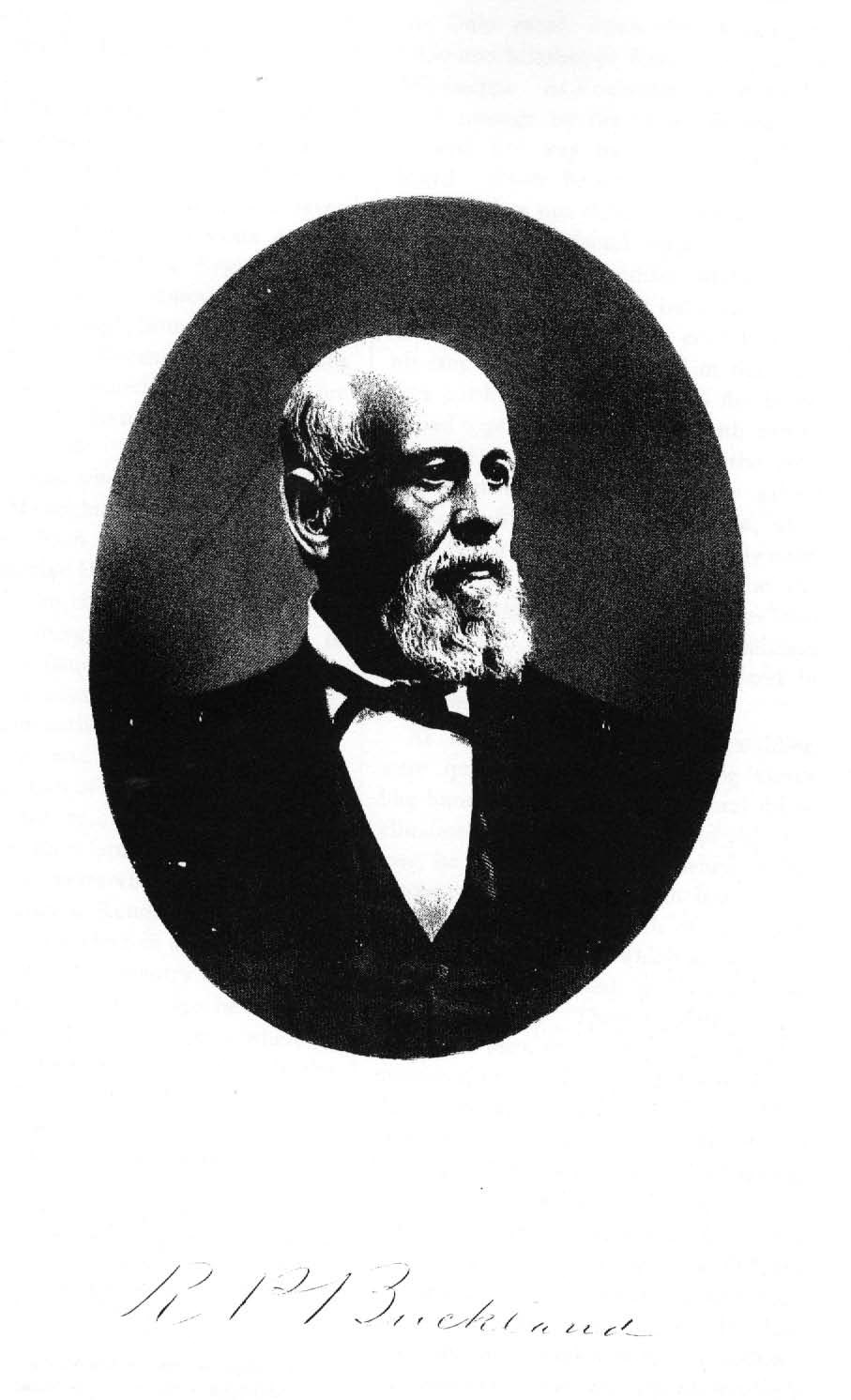
GENERAL R. P. BUCKLAND.
Ralph Pomeroy Buckland was born at Leyden, Massachusetts, on the 20th day of January, 1812. His grandfather and father died from the immediate effects of military service in the cause of our country; the former, Stephen Buckland, who was a captain of artillery in the Revolutionary war, from East Hartford, Connecticut, dying in the Jersey prisonship near New York ; the latter, Ralph Buckland, a volunteer in Hull's army during the War of r812, dying at Ravenna, Ohio, from disease contracted while a prisoner of war.* The subject of
*The following is a copy of a letter written by General Buckland's father about one year before his death:
RAVENNA, September 12, 1812.
DEAR SISTER: These lines will inform you that I am well. I have just arrived from Fort Maiden in Upper Canada, a prisoner on parole. I belonged to General Hull's army, and was sold with the rest of my brother volunteers to the British and Indians by that traitor and coward, Hull. The distress the inhabitants have undergone by letting the Indians in upon the frontiers is beyond description. Plundered of every article of property and clothing; and hundred of families massacred adds to the scene of distress. But they will have to share the same fate or worse if possible. We have a fine army of ten thousand men within a two days march of here, which will show them that a Hull does not command at this time, Governor Harrison has the command of this army, and will do honor to his country and himself. He commanded at the Wabash last fall at the
HISTORY OF SANDUSKY COUNTY - 523
this biography completes the family's military record by his service in the Great Rebellion.
His father, acting in the capacity of land-agent and surveyor, came to Portage county, Ohio, in 1811. About the close of the following year, during the severe winter, while an unbroken waste of snow stretched from the New England States westward, the father removed his family in a one-horse sleigh, from their Massachusetts home to Ravenna in this State, where, as above stated, he died only a few months after. His mother's maiden name was Anna Kent. Her father died at Mantua, Ohio, where he had moved from Leyden, Massachusetts. Some few years after the death of Ralph's father, his mother married Dr. Luther Hanchett, who then had four children by a former marriage. Six more children were born to them. The family were always in moderate circumstances.
During his earlier years Ralph lived with his stepfather and family on a farm, but the greater part of the time, until he attained the age of eighteen, he lived with and labored for a farmer uncle in Mantua, excepting two years when he worked in a woollen factory at Kendall, Ohio, and one year spent as a clerk in a store. In the winters he attended country schools, and the last summer, that of 183o, he attended an academy at Tallmadge, Ohio, where he made a commencement in Latin. In the following fall he embarked at Akron, Ohio, on board a flat boat loaded with a cargo of cheese to be transported through
battle of Tippecanoe, and the Indians have not forgotten it. I have enjoyed very good health since I saw you last. Give my love to my mother and all our friends. I am in great haste, and can write no more at present.
Yours,
RALPH BUCKLAND.
P. S. You will write me an answer soon. I expect to go to Cincinnati in a few days, on public business.
the Ohio canal, down the Muskingum, Ohio and Mississippi Rivers to Natchez, Mississippi. At Louisville he secured a deck passage on the Daniel Boone, and worked his way by carrying wood on board. When he arrived at Natchez he had less than one dollar in his pocket, but he immediately found employment in a warehouse on the landing, where he remained for a few months, but long enough to so thoroughly secure the confidence of his employers that at the end of that time they put him in charge of two fiat boats, lashed together, and loaded with twelve hundred barrels of flour for the New Orleans market. On this trip he served his turn with the rest of his crew, as a cook. The voyage was successfully completed, and soon after landing, at the earnest solicitation of his Natchez employers, who had opened a commission house in New Orleans, he remained in their employ in the latter city.
At that time drinking and gambling were quite common with young clerks like himself ; but, besides a natural disinclination to indulge in things of this nature, he was further strengthened in his resolution to wholly abstain from these evils, by the untimely death of the bookkeeper of the house in which he was employed, who was killed in a duel arising from dissipation. These resolutions have ever since been strictly kept. In his spare moments, of which he had many during the summer months, while at New Orleans, he pursued the study of the Latin and French languages, and several of the common school branches.
In June, 1834, he started for Ohio on a visit to his mother, leaving New Orleans with the fixed idea of returning and making that city his future home. He had been offered several first-rate situations, but on arriving home, through his mother's solicitations, he was induced to remain in
524 - HISTORY OF SANDUSKY COUNTY.
the North. After spending one year at Kenyon College he began the study of law in the office of Gregory Powers, at Middlebury, and completed it with Whittlesey & Newton, at Canfield, being admitted to practice in the spring of 1837.
During the winter of the previous year he spent several months pursuing his studies in the office of George B. Way, who was then editor of the Toledo Blade. While the editor-in-chief was temporarily absent at this time, he acted, for a few weeks, as editor pro tem.
Immediately after admission to the Bar, with about fifty dollars in his pocket, loaned him by his uncle, Alson Kent, he started in quest of a favorable location for an attorney. The failure of the wildcat banks was what settled Ralph P. Buckland in Fremont. On arriving here, at what was then known as Lower Sandusky, he found that he had not enough good money wherewith to pay a week's board. The surroundings could not have appeared very favorable to the young lawyer, but under the circumstances he was compelled to stop. He was trusted, by Thomas L. Hawkins, for a sign, opened a law office, and soon secured enough business to pay his expenses, which were kept down to the lowest possible point. At this date he was not only without means, but, even worse, he owed three hundred dollars for his expenses while a student, and for a few necessary law books. This, it would seem, to him was but a trifle. He was confident of ultimate success, for, eight months after opening up his law office in Lower Sandusky, while still worth nothing in a pecuniary point of view, he went to Canfield, Ohio, and there married Charlotte Boughton. With his wife he returned here in the following spring. Although, as just spoken of; he was without means, his credit was good. He was strictly economical, temperate in all things, and diligent in business. His expenses during the first year of married life did not exceed three hundred dollars, and his business steadily increased, so that at the end of three or four years he had all he could attend to. In these early days of his life he was very slender in build, and troubled, to some extent, with dyspepsia, but outdoor exercise, gained in travelling on horseback to the courts of adjoining counties during term time, cured him of that complaint, and gradually increased his weight and physical strength.
Mr. Buckland first entered into politics prominently as a delegate to the Philadelphia convention in 1843, which placed General Taylor in nomination for the Presidency. In the fall of 1855 he was elected to the State Senate as a representative of the Republican party, in that, the first Legislature after its organization. He was re-elected in 1857, serving four years. He was the author of the law for the adoption of children, which was passed during his, service in the Senate.
In October, 1861, he began to organize the Seventy-second regiment, Ohio Volunteer Infantry, he having, on the 2d of that month, been. appointed lieutenant-colonel by William Dennison, Governor of Ohio, and given the authority to raise a regiment for three years service in conformity to general orders from. the War Department at Washington. The particulars of the organization of this, the Seventy-second regiment, are given in full in the history of that body. In three months it was fully equipped and ready for the field.
On the 10th of January, 1862, he was mustered and sworn into the United States service as colonel of the Seventy-second regiment, and two weeks later with the regiment, in accordance with orders, he arrived, by rail, at Columbus,

HISTORY OF SANDUSKY COUNTY - 525
Ohio, and marched at once for Camp Chase, near the city. At Camp Chase he assumed command, and remained in that position until on the 19th of February he was ordered, with the regiment, to report to General W. T. Sherman at Paducah, Kentucky.
General Sherman placed him in command of the Fourth brigade, First division of the Army of the Tennessee. On March 7, 1862, General Buckland embarked his brigade on steamers on the Tennessee River, under orders to report to Major General C. F. Smith at Fort Henry. This order complied with, he proceeded, with the rest of Sherman's division, up the Tennessee to Savannah and Pittsburg Landing, and from there he went some fifteen or twenty miles further above, for the purpose of cutting the Memphis & Charleston Railroad, but in consequence of the extreme high water, the latter expedition was a failure, and he returned to the Landing. The battle of Shiloh, which took place in the first week in the following April, and in which General Buckland, with the Fourth brigade, took a prominent part, is given, in all the details, in General Buckland's history of the fight, to be found in another part of this volume.
The general opinion entertained by those opposing enlistments was that the subject of this sketch was a man of no courage, and that he would never venture into the field of battle. This opinion had been diffused to a considerable extent among the soldiers and officers under his command;. but after the first fight on that terrible Friday before Shiloh, all doubts as to his courage or disposition to go into danger were scattered. He there had the opportunity of showing, under fire, that valor and determination were some of the strong points of his character. On one occasion, during the battle of Shiloh, being ordered to advance hisbrigade under a very severe fire from the artillery and musketry of the enemy, there seemed, at the moment, to be some hesitation in the lines. General Buckland immediately rode up to one of the color-bearers, took hold of the staff, and conducted the bearer and colors to the desired point, followed by the cheers of the soldiers as they swept forward.
General Sherman, in his report of that battle, written on the loth of April, 1862, uses the following language: "Colonel Buckland managed his brigade well. I commend him to your notice as a cool, intelligent, and judicious gentleman, needing only confidence and experience to make him a good commander."
This opinion of General Sherman's never changed during the time of the war, but, on the contrary, was strengthened by a more intimate and longer acquaintance, which has continued up to the time of this writing.
In the advance on Corinth, begun on the 29th of April, sickness to a great extent prevailed in the ranks, and it required the utmost courage and attention to prevent the men from becoming demoralized. Being in close proximity to the enemy, it was necessary to form line of battle before daylight every morning. The men had become so weak and dispirited that few turned out. This condition was alarming, and foreboded fatal results in case of attack. To remedy this increasing evil, General Buckland took upon himself to arise before daylight, and, with Surgeon J. B. Rice and a lantern, went from tent to tent of the officers and soldiers, causing all complaints to be examined by the surgeon, and compelling all those whom the surgeon advised it would not injure to turn out. This proceeding made him very unpopular, and many bitter letters were written home concerning him. But the soldiers soon discovered that it was done for
526 - HISTORY OF SANDUSKY COUNTY.
their good; their feelings changed, and by open thanks they showed him their appreciation. From thenceforward he became universally beloved by his soldiers.
General Buckland remained in command of the Fourth brigade until the army reached camp No. 6, on the 13th of May, where he was assigned command of the Third brigade; but on the following day General J. W. Denver, having reported to Sherman, by order of General Halleck, was put in charge of the Third brigade, and General Buckland returned to the command of his regiment. In the fight before Corinth, his regiment was constantly under the fire of the heavy guns on the rebel battlements, and, on the 30th of May, entered the city, finding it deserted.
On the 12th of November, 1862, while at Memphis, he assumed command of the Fifth brigade of troops in General Lauman's division, and formed part of the Tallahatchee expedition. Under orders from General Grant, who had learned of the capture of Holly Springs by General Van Dorn, he marched to retake the place, which was successfully accomplished. Soon after, the brigade was assigned to the division commanded by Brigadier General Ross, who, three days later, was placed under arrest, and General Buckland, as the ranking colonel, assumed command of the division until December 26. On the following day he began a march towards Dresden, Tennessee, for the purpose of attacking and driving Forrest from that place; but, on arriving there on the morning of the 29th of December, he found that the enemy had evacuated it the same day.
On the 20th of March he joined General Sherman's corps in front of Vicksburg, and participated in a series of battles and skirmishes which occurred in the movements to the rear of that city. During the siege he was always active and vigilant,and at times much exposed. On the 19th of May, on foot, at the head of his brigade, he marched down the graveyard road, under a terrific fire of musketry and artillery from the enemy's works, and, taking a position along the first parallel ridge, to support an assault on the rebel works, he maintained his place until after the assault on the 22d of the month. Although he was constantly exposed, and his men were shot down around him in great numbers, he escaped uninjured.
While on duty, on the 24th of September, by the fall of his horse his right wrist was broken. By this injury he was incapacitated for active service, but continued to command his brigade, except for a short time, until on the 26th of January, 1864, General Sherman placed him in command of the district of Memphis, where his administrative abilities were exemplified and his integrity of character was clearly manifested.
The incidents connected with General Forrest's night raid on Memphis shed the strongest light on General Buckland's sterling traits of character. But for his courage, decision and promptness of action, the rebel forces would have taken possession of the city, and have captured large stores of Government property. General C. C. Washburne was at that time in command of the department, and had his headquarters in the city. General Buckland commanded the district. Most of the troops, under command of General A. J. Smith, had been sent in pursuit of Forrest, but, by a piece of strategy, the latter had eluded his pursuers near Oxford, Mississippi, and made a rapid march to Memphis. He captured the cavalry patrol, rushed over the infantry pickets, and, under cover of the darkness preceding the dawn of Sunday, the 21st of August, entered the slumbering city. General Washburne was surprised at his
HISTORY OF SANDUSKY COUNTY - 527
headquarters, his staff and orderlies captured, and he narrowly escaped the enemy's clutches. He was in a building near that occupied by his officers, and, being opportunely awakened, with only his pants on, he made good his escape to the fort below the city. General Buckland was aroused by the pounding on his door by the sentinel. The rebels were then in possession of a considerable portion of the city. At once realizing the full extent of the danger, and determined not to be captured without a struggle, but still without the least idea of the number of the enemy surrounding him, General Buckland rallied about one hundred and fifty men; at the same time ordering the rapid firing of an alarm gun, which served to awaken his own troops and alarm the enemy; and, in the gray mist of the early dawn, placing himself at their head, he instantly attacked the body of rebels collected near General Washburne's headquarters. He was out-numbered by four to one. He swept the enemy before him down the darkling streets; his numbers increased, and in such spirit was the attack conducted, and so rapidly was it carried on, that in less than an hour every rebel was driven from the city. A sharp battle immediately ensued in the morning, on the Hernando road, in the outskirts of the city, between the Union troops under General Buckland and General Forrest's entire forces, in which the latter were defeated and turned in full retreat.
A few weeks after these last occurrences, in answer to a letter of General Buckland's concerning events at Memphis, the present situation and his prospect of being elected to Congress, General Sherman wrote him a private letter, from which we make the following extract:
I know on all occasions you will do your best. I attach little importance to Forrest's dash at Memphis. He is a devil of a fellow, and I wish I hada few such, but they don't make permanent results like such men as you do. I entertain for you not only a measure of respect but also of affection. I think you are right now in going to Congress. That is National. I did not want to see you return to private life on account of the labor of war. We must have the assistance of the best men in the Nation to reinvigorate it. In Congress you take a National position, strengthened by a practical knowledge of the labor, responsibility, sleepless anxiety and personal danger of war. Your mind can skip the personal and selfish for the patriotic and real. You know also that words now must be mistrusted and men judged by acts. Opinions may be soft, pleasant and flowing, but the real man must act and not talk. Indeed I do value your friendship. Poor McPherson was dear to us both; and well do I remember in our first Shiloh days how he always hunted out your camp. Whatever may befall us, believe me that I feel for you more than usual esteem and personal friendship, and feel gratified in knowing it is reciprocated.
General Buckland remained in command of the district of Memphis until the 22d of December, 1864, and on January 6, following, he tendered his resignation at Washington, to the Secretary of War, and was duly mustered out of the service. August 3, 1866, he was commissioned brevet major-general United States Volunteers, to rank from March 13, 1865, for meritorious service in the army.
Without having sought or expected political favor, and while still serving in the army, he had been nominated for Representative in the Thirty-ninth Congress. Without having gone home to further his interests, he had been elected by the people of the Ninth district of Ohio. In obedience to their wishes, he left the military for the civil service of his country. In 1866 he was re-elected to Congress. During the whole of the four years in Congress he served on the committee on banking and currency, and on the military.
At the close of his Congressional career General Buckland resumed his law practice, a field of labor in which, before the war, he had attained distinction, and at this date he is still actively engaged in the labors of his profession,
528 - HISTORY OF SANDUSKY COUNTY.
To his example and influence the city of Fremont is indebted to a great extent for its many public improvements, and not the least among them are the beautiful shade trees, which adorn almost every part of the city. He erected the first substantial brick block in Fremont, a three-story building of four storerooms, with a public hall in the third story, considered at the time a great and hazardous enterprise. In 1853 he erected the finest dwelling then in Northern Ohio, and subsequently the three-story brick block at the corner of Front and State streets. In every public enterprise for the interest of the town, he was one of the first to propose and one of the foremost to act, relaxing no effort, and withholding no help until the thing had been pushed to a complete success.
In 1870 he was elected president of the board of managers of the Ohio Soldiers' and Sailors' Orphans Home, located at Xenia, which position he filled for four years.
On the 30th of January, 1875, General Buckland, Hon. R. P. Ranney, Dr. W. S. Streeter, as the guests of Henry A Kent, of New York, sailed from that city in the sailing yacht Tarolinta, for the West Indies. They visited Martinique, Barbadoes, Trinidad, Grenada, Santa Cruz, St. Thomas, Porto Rico, San Domingo, Jamaica, and Cuba, returning to New York April 19, after having sailed about seven thousand miles.
General Buckland was a delegate to the Cincinnati convention that nominated General Hayes. It is well known that his labors and influence contributed largely to the success of the nomination.
For three years, from 1878 he held the position of Government director of the Union Pacific Railroad.
General Buckland's career has been measured by a success that adds one moreexample of what may be attained by a boy. born outside of the pale which is presumed to enclose the advantages and the means necessary to success, viz :—influential friends and parental wealth. Left an infant at the death of his father, whose letter, embodied in this sketch, shows him to have been a man, the impress of whose character was worth more than an estate to his son, he made his own way in the world, and will leave as an inheritance to his children the record of a successful life, judged by what it has accomplished, and of a character for integrity, honor, and noble impulses, worthy of all imitation.
In his family General Buckland has always been kind and considerate of the best interests of each. With the wife of his youth, who still lives, he came to his Lower Sandusky home, and together, with marked mutual esteem, they, each in their sphere, worked to prosper, sharing alike with cheerfulness and hope the privations of the beginning. Suited to each other, as no man and wife could be better, they have lived happily in each other's confidence and love, to enjoy together in an unusual degree the comfortable surroundings their industry has enabled them to secure; and have always shared the pleasures of travel and social enjoyment, for which the later public and official life of General Buckland afforded unusual opportunity.
SARDIS BIRCHARD.*
A detailed biography of Sardis Birchard would be an important contribution to the history of Sandusky county. Although not one of the first settlers, he, at an early day, became a man of influence and prominence. He was born at Wilmington, Windham county, Vermont, January 15,
*Information derived mainly from Knapp's History of the Maumee Valley.

HISTORY OF SANDUSKY COUNTY - 529
1801. Both his parents died while he was yet a child. Both of his grandfathers were Revolutionary soldiers. His grandfather, Elias Birchard, died of disease contracted near the close of the war. His grandfather, Captain Daniel, served as an officer under Washington during the war, and survived many years. The Birchards were among the first settlers of Norwich, Connecticut. Sardis was the youngest of five children. He was placed in charge of his sister Sophia, who married Rutherford Hayes; became one of the family, and lived with them at Dammerston, Vermont, until 1817, when he accompanied them in their emigration to Ohio.
In Vermont young Birchard acquired the rudiments of an English education, by irregular attendance at such schools as were in existence at that day in the country districts of Vermont. He became, for a boy of his age, an expert hunter and horseman, and gained some knowledge of business in the store of his brother-in-law, Mr. Hayes.
In Ohio he worked with his brother-in-law in building, farming, driving and taking care of stock, and employing all his spare hours in hunting. He was able with his rifle to supply his and other families with turkeys and venison.
In 1822 his brother-in-law, Mr. Hayes, died, leaving a widow and two young children and a large, unsettled business. Mr. Birchard, who was then only twenty-one years old, at once assumed the duties of head of the family, and applied himself diligently to the management of the unsettled affairs of his brother-in-law's estate, and to the care of the household.
Inheriting from his father what was considered a handsome start for a young man, with a jovial and friendly disposition, fond of wild sports and wild company, with no one to look to as entitled to control or advise him, his future might well be regardedwith apprehension. He was then a slender, delicate, handsome youth, with engaging and popular manners, and a favorite among the young people of the new country. Warmly attached to his sister and her children, he devoted himself to them and their interests, and was the mainstay of the family.
While yet a boy he was hired to help drive hogs to supply the first settlers of Fort Ball, now Tiffin, in 1817. The men in charge were hard drinkers, and soon after leaving Delaware the whole management depended upon Mr. Birchard. It was in the bitterly cold weather of early winter. The streams were bridgeless, and the roads all but impassable, but with praiseworthy energy and zeal he pushed forward to the Tyamochtee, where he delivered the drove to a party of Fort Ball settlers. This was Mr. Birchard's first visit to the Sandusky. He saw Lower Sandusky for the first time in September, 1824. His companion was Benjamin Powers, afterwards for many years a successful merchant and banker at Delaware. The outfit of the young men was a little extra clothing and a jug of fine brandy. They travelled in a one-horse spring wagon. The custom which universally prevailed, of acquaintances drinking to each other's health whenever they met, made the brandy an important part of the outfit. At Fort Ball they met Erastus Rowe, and had a jolly time, to which the brandy contributed freely. At Fremont they stopped at Leason's tavern, a log house which stood where Shomo's block now stands. The village population at that time numbered about two hundred. While stopping here they made the acquaintance of George Olmstead and Judge Howland. Mr. Birchard and his travelling companion went to Portland the following day, and on their return Mr. Birchard bought a drove of fat hogs, which, as soon as the weather was cold enough, he drove
530 - HISTORY OF SANDUSKY COUNTY.
to Baltimore. Mr. Birchard has narrated two incidents of the trip: At Wheeling it was necessary to swim the hogs across, and they came near losing them all by the swift current of the river. By great exertions, and at considerable risk, they got all but half a dozen safely over. They were overtaken by a tall, fine-looking gentleman on horseback, who had also a carriage drawn by four horses, and two attendants on saddle-horses. The gentleman helped Mr. Birchard get his hogs out of the way, chatted with him about the state of the market, and advised him as to the best way to dispose of his drove when he got them to Baltimore. He learned that the gentleman was General Jackson, on his way to Washington after the Presidential election of r824, in which he received the highest vote, but was not finally the successful candidate.
In the summer of 1825, while mowing in the hayfield, he was seriously injured in health by over-exertion. He never entirely recovered, but remained in poor health during the remainder of his life. In the winter, of 1825—26 he had an attack pronounced consumption, and it was supposed he would not live till spring. He however thought hopefully of his condition, and spoke of a horseback trip to Vermont. One day he heard two. men at work in the room below him, discussing his case. One of them said: "It is strange how Birchard is deceived; he thinks he will make a long journey soon; but the only journey he will make is when he leaves his house, feet foremost, for the graveyard." But the cheerful disposition of Mr. Birchard, assisted by the elasticity of his constitution, carried him through. In May he made a horseback trip to Vermont, where he remained till the approach of cold weather, and then travelled South to Georgia, where he remained till the spring of 1827. Having recovered his health hewent to New York for the purpose of laying in his first stock of dry goods. He was without money, and had no acquaintances. Passing about the streets he fell into conversation with a young merchant named William P. Dixon, a stranger to him, connected with the firm of Amos Palmer & Co., to whom he developed his plans and explained his condition. Dixon told him he would sell him all the goods he wanted in his line and would recommend him to others. His stock was made up and shipped to Cleveland, he accompanying the goods. Mr. Birchard's plan was to sell to laborers on the Ohio Canal, then being built from Cleveland southward. He followed the canal into the Tuscarawas Valley, but became dissatisfied and sold part of his goods to another trader, and with the remainder opened a store at Fort Ball (now Tiffin). Here he remained, trading successfully till December, when he decided to remove to Lower Sandusky. He purchased the stock of Richard Sears, who had made his fortune trading with the Indians.
Merchants, at that time, paid very little cash for produce, and consequently received very little cash for goods, except from the Indians. For clothing, broadcloth, Kentucky jeans, and linsey cloth was generally in use. The Indians bought fine blue cloth, Mackinaw blankets, beads, powder and lead. A great deal of corn was received to payment for goods. This was traded to the distilleries for whiskey, and the whiskey was shipped to Buffalo and sold.
Mr. Birchard received the Indian trade to a large extent by refusing to sell them whiskey. At the end of about four years he had accumulated about ten thousand dollars, which at that time was considered a large amount of money. He was making arrangements to retire, but in 1831 was induced into a larger business than
HISTORY OF SANDUSKY COUNTY - 531
ever. In partnership with Esbon Husted and Rodolphus Dickinson, under the firm name of R. Dickinson & Co., the largest store in Ohio, west of Cleveland and north of Columbus, was opened. The yearly sales amounted to fifty thousand dollars.
Senecas, Ottawas, Wyandots, and a few Delawares, traded in Lower Sandusky at this time, and the store was often full of customers from the reservations. Mr. Birchard found the Indians in his business transactions generally very honest. They would not steal as much as the same number of whites with the same opportunities. He often had his storeroom full of Indians sleeping at night, with no watch or guard.
In 1835 Esbon Husted died, and his place in Mr. Birchard's firm was taken by George Grant, who had been a clerk in the establishment since the organization of the firm. In r841 Mr. Grant died and the firm was dissolved, the business being settled by Mr. Birchard.
Mr. Grant was one of the most promising business men in the place. He was tall, slender, of fine address, and full of life and ambition. He died young, aged only thirty-two years.
Mr. Birchard's connection with banking is mentioned under the proper head. He made large investments in wild land which, as the county improved, rapidly multiplied his wealth.
Mr Birchard was one of the few men who, with increasing wealth, became more generous and public spirited. His good works are conspicuous. He advanced by means of his wealth and influence every public enterprise, and so many were his munificent gifts that he fully deserves the title often given him—"the city's benefactor." His business operations stimulated commerce between this point and Buffalo. He worked unceasingly to secure the necessary legislation for the macadamizing of the Western Reserve and Maumee road. The Toledo, Norwalk and Cleveland railroad enterprise received his strongest efforts.
In politics Mr. Birchard was an enthusiastic Whig, and after the formation of the Republican party became an earnest supporter of its principles. During the war he used his influence to encourage enlistments, and when money was wanted he was never appealed to in vain. He was the first Ohio purchaser of Government bonds, in 1862.
Mr. Birchard's private charities were large, and his public gifts are a monument to his memory. He had a deep sympathy for the poor, and could not bear to know suffering without offering relief. During the last years of his life, when poor health required confinement at home, he left with Mr. Miller, cashier of the bank, standing instructions to contribute liberally to. worthy charities. His tenderness and solicitude for the unfortunate is illustrated by a letter which Mr. Miller still preserves. It was written on a cold, stormy day in early winter, and reads as follows:
MR MILLER:
What a storm! I fear many poor people are suffering. If you hear of any such, give liberally for me.
S. BIRCHARD.
The Fremont Messenger, in an obituary sketch, sums up Mr. Birchard's benefactions, as follows:
About three years since Mr. Birchard presented to the city of Fremont the large park lying between Birchard avenue and Croghan street, and the small triangular park at the junction of Birchard and Buckland avenues.
In 1873 he set apart property amounting to fifty thousand dollars, for the purpose of establishing a public library in Fremont. He contributed from this fund, for the purchase of a library, about one.. third of the amount required to obtain for the public the square on which old Fort Stephenson formerly stood, and was thus mainly instrumental in securing that famous historical locality to the people of Fre-
532 - HISTORY OF SANDUSKY COUNTY
mont forever. His gifts to the city are estimated at seventy thousand dollars, or about one-fifth of his estate.
In addition to the above gifts made during his lifetime, we understand he made in his will the following bequests : Five thousand dollars to Oberlin college, five thousand dollars to Home Missions, one thousand dollars to the Fremont Ladies' Relief Society, and one thousand dollars to the Conger Fund. Mr. Birchard was benevolent to a degree and in a manner known only to his most intimate friends. Aid in necessity was extended to many when none knew it except the recipients, and perhaps a friend whom he consulted. Mr. Birchard was especially devoted to the fine arts, and during his eventful life made a fine collection of oil paintings, which will eventually form one of the attractions of the " Birchard Library."
In May, 1857, Mr. Birchard became a member of the Presbyterian church of Fremont, and remained in its communion all his life. He contributed constantly to its incidental and benevolent funds. He also contributed seven thousand dollars to the erection of the new edifice occupied by the congregation. In this he took especial satisfaction. Though a member of this church, he frequently aided other congregations without distinction of denomination. He gave most satisfactory evidence of sincerity in his religious experience, and died in perfect composure of mind. He had talked much with his friends concerning death, and seemed to be altogether ready.
Mr. Birchard was characteristically hospitable, warm-hearted, and friendly. He was one of the marked characters in the history of the county. His life was fortunately spared to ripe old age. He died at 12 o'clock m., January 21, 1874, aged seventy-three years and six days.
GENERAL JOHN BELL.
General John Bell was a native of Pennsborough, Lycoming county, Pennsylvania, and was born on the 19th of June, 1796. When he was but fourteen years old his father emigrated to Ohio, and located, in 1810, in Greene county, near Xenia. While here he laid out a village, which, in honor of him as a proprietor, was called Bellbrook.
On the 28th of March, 1816, the subject of this sketch was married to Miss Margaret Masten, of Greene county.
In 1823 he visited Lower Sandusky, and after having made arrangements for a residence, moved his family here in the year following. He was a millwright by trade, and upon his arrival he immediately engaged in the milling business, which he followed for some seven years. The first wool-carding machine in this vicinity was brought here and put into operation by Mr. Bell, in the year 1827. Referring to this fact, the Hon. Homer Everett, in a historical lecture delivered at Birchard's Hall, in February, 186o, facetiously remarks :
The judge (at that time probate judge) used to pull wool over the cards, and learned the science so well that he has since somehow succeeded in pulling wool over the eyes of the people, till they sent him to Congress and to many other good places; and he still seems to hold on. He sticks the wool on by an adhesive plaster, called doing about right, in a very kind manner.
Leaving the mill, he entered into extensive speculations in wheat and flour, shipping large quantities to Venice and Buffalo. After a number of years spent in this business, he turned his attention to merchandising, which he followed for some eight years. He had quite extensive dealings with the Indians, with whom he was a special favorite. Time and again his house was literally filled and surrounded by the red men, in each of whom he and his family recognized a friendly guard,—not an enemy. These and similar scenes are, today, yet vivid in the memory of his descendants.
By a course of fair and honorable dealing from the time he first visited the place until he ceased to move among us, he acquired a high degree of regard and consideration on the part of all the citizens. This feeling of respect and esteem went on increasing in volume and intensity while he lived, and only culminated when the portals of the tomb shut him out forever from mortal sight.
For a considerable length of time he
HISTORY OF SANDUSKY COUNTY - 533
was the Government land agent at Lower Sandusky, and also superintendent of the Western Reserve and Maumee road, between Lower Sandusky and Perrysburg; and it was through him, as agent, that the Government lands along this road were disposed of to settlers for the construction of the same.
Mr. Bell was deeply interested in developing the resources of the country, and on all occasions manifested a strong desire to build up the town and to advance its material prosperity; and, disregardful of his own interests, this cardinal purpose was kept steadily in view during his whole life. In the meetings of the people for the advancement of public improvements and the promotion of the public welfare, he was always a conspicuous and leading actor.
He was the first mayor of Lower Sandusky, and also the first in the same office of the city of Fremont, to which position he was repeatedly reelected. For three or four terms he served the people as probate judge; also for a number of years he was a justice of the peace. In 1838 he was appointed postmaster, which position he held till 1844. Subsequently he was a member of the House of Representatives in the Ohio Legislature, to which he was several times re-elected; and afterwards, in 1851, elected to Congress. During the Toledo war of 1835, Mr. Bell was the commander of the Ohio forces, being at that time a major-general of the State militia, having received his commission March 1, 1834.
He was one of the most popular men in the county, as evinced by the fact that, whenever a candidate for an office, he ran ahead of his ticket in almost every instance.
There was one striking trait in his character that deserves special mention in this connection. in all of his public service, as well as in his private life, he was preeminently a peacemaker. He was always in for a compromise if it could possibly be effected, rather than to press a matter to litigation. His great aim seemed to be to aid people to keep out of the clutches of the law, and his advice in legal matters was always given to promote this end. So implicit was the confidence of the people in his judgment and honesty, that his counsel was almost invariably followed, and many a wrangling lawsuit was lost to unprincipled pettifoggers through the sensible, manly advice, " Settle your difficulty between yourselves by yielding each a little, and be brethren."
General Bell was among the earliest settlers in Fremont, and, along with others, could tell of those deprivations, hardships, and dangers which constitute the life of the pioneer. The actual history of any of these worthy veterans would far surpass in interest and grandeur even the recitals of a modern romance.
And has the West no story
Of deathless deeds sublime?
Go ask yon shining river!
Up to the day of his fatal illness the General was remarkably healthy, and, although he had outlived the number of years allotted to the human race, he had the appearance of being much younger. He passed away from the scenes of earth on the 4th day of May, 1869, at the advanced age of seventy-four years. He was a Mason and an Odd Fellow.
The companion of his life had preceded him by about ten years. She died on the 29th of May, 1859.
The family comprised four children,—three sons and one daughter. The daughter is; now Mr. John M. Smith, of Fremont. The only surviving son is Charles H. Bell, also of Fremont.
Both Mr. Bell and his wife united with the Protestant Methodist church at an early
534 - HISTORY OF SANDUSKY COUNTY
age, and both were members of the same at the time of their death.
Mrs. Bell possessed an affable, noble nature; and he, a man of generous, genial heart, was a universal favorite with the people, and at the time of his decease probably had not a real enemy living. He was always the same unassuming, cheerful, obliging neighbor and gentleman, and in his death the city of Fremont and county of Sandusky lost a valuable and much-esteemed citizen.
EBENEZER BUSHNELL, D. D.
Rev. E. Bushnell has been pastor of the Presbyterian church of Fremont since 1857. He was born near Granville, Ohio, November 18, 1822. His parents, Thomas H. and Charlotte Bailey Bushnell, came from Norwich, Connecticut, in 1816, and settled on a farm in Licking county. His father was a surveyor and civil engineer. Mathematical ability is a characteristic of the family. When our subject was eleven years old his parents removed to Newark. There the son was placed under the instruction of tutors preparatory to attending college, but the death of his father necessitated a change in the plans made for him, and he learned the trade of carpenter and joiner as an expedient for earning money to pursue his course in college. Not only the desired end was attained, but a business and mechanical experience was acquired, which has been valuable to him since entering professional life.
Mr. Bushnell became a student at Western Reserve College, in 1842. He graduated in 1846, with the third honors of his class, although weak eyes had seriously interfered with his study. After graduating he entered the theological seminary then connected with the college. Duringthe first two years of the course in theology he acted as instructor in the preparatory school, and the third year was principal of the preparatory department. After graduating in theology, Mr. Bushnell, on account of an affection of the throat, was unable to enter the ministry. He accepted the tutorship of mathematics for a period of one year, and then entered upon his first charge, at Burton, Geauga county. He was pastor of the Burton Presbyterian church seven years. Ex-Governor Sebra Ford was a member of his church, as was also Chief Justice Hitchcock and Peter Hichcock, since well known as a member of the Ohio Legislature.
Mr. Bushnell became pastor of the Presbyterian congregation of this city in 1857, since which time his clerical work is set forth in the history of the church elsewhere in this volume.
Mr. Bushnell married, in 185o, Julia E. Baldwin, daughter of Sylvester Baldwin, of Hudson. She died in 1856, leaving four children, all of whom are living, viz. : Mrs. Dr. Byal, of Beardtown, Wood county; George W., Cleveland; Albert B., Washington; and Thomas H.
Mr. Bushnell married for his second wife, in 1858, Cornelia K. Woodruff, daughter of Rev. Simeon Woodruff, a pioneer preacher of the Reserve. She is a graduate of Mount Holyoke seminary, and at the time of her marriage was engaged in educational work. Three children are the fruit of this marriage—Annie, Charlotte, and Edward.
Mr. Bushnell, in addition to his pastoral work, superintended the city public schools from 186o to 1863. He has been active in the ecclesiastical affairs of his denomination. He has been secretary of the Synod of Toledo for more than a decade, and a member of the board of trustees of Western Reserve College for more than twice that length of time.
HISTORY OF SANDUSKY COUNTY - 535
During the war Dr. Bushnell was active in encouraging enlistments and otherwise laboring in the cause of the Union. He was a member of the Christian Commission and was during the year 1865 stationed at Petersburg.
Mr. Bushnell is the most scholarly clergyman in the city. In addition to general and professional studies, he has been constantly adding to his early attainments in mathematics, for which he has a special aptitude, and the languages, particularly Latin, Greek, and German. In 1871 Marietta College conferred upon him the degree of Doctor of Divinity. He has not entirely laid aside his mechanical training. Several buildings in Fremont have been erected under his supervision.
FAULKNER I. NORTON.
The subject of this sketch was prominently identified with the business interests of Fremont. He
was born in Cambridge, Washington county, New York, March 2, 1811. He left home at the age
of thirteen years and began clerking in Keysville, New York, and afterwards learned the saddle
and harness making trade in Saratoga county. He came to Ohio and settled in Lower Sandusky in
1833. Here he worked at his trade until 1835, and then returned to Claremont, New Hampshire,
where he married Harrietta M. Willard. After returning to Lower Sandusky Mr. Norton engaged
in mercantile business. His next enterprise was to build a foundry, which after operating a few
years he sold to Mr. June. He next engaged in the manufacture of spokes and hubs. The large
brick building on Arch street was erected by him for that purpose. Mr. Norton died November 4,
1878. Mrs. Norton is still living in this city. Mr. Norton pushed his enterprises with
commendable zeal and enthusiasm, and contributed largely to the growth of the town.
JOHN S. TYLER,
the subject of this sketch, was a native of the State of New York, born in Cayuga county, on the 25th day of December, 1806. In 1816 he came to Lower Sandusky with his father's family, from Detroit, Michigan. His advantages for education were limited by the meagre facilities of the day. He was, therefore, a self-made man. For a number of years he was clerk in the store of George G. Olmsted, from whom he gathered much valuable information in business matters, and whom he made his model for deportment and social habits, which were those of the true gentleman. He became a man of remarkably quick discernment, and was acknowledged one of the best business managers in the community. He was probably one of the best judges of investments that the city of Fremont ever had.
From his arrival here till his retirement from active life he was intimately connected with the business interests of this place. He contributed to the growth of the city in the erection of a substantial brick block on the corner of Front and Croghan streets, and subsequently a two-story brick on Croghan street. The mercantile business was his chief employment. His first trade was largely with the Indians, with whom he was a special favorite.
About the year 1832 he married Miss Phebe Ann VanDoren, of Lower Sandusky. By this marriage he had three sons and three daughters. Charleston, his eldest son, served in the Twenty-first Ohio Volunteer Infantry, was wounded at Chickamauga, and died September 28, 1863. Mrs. Tyler having deceased, Mr. Tyler married Eliza Kridler in 185o. Death again removed his companion in r861.
536 - HISTORY OF SANDUSKY COUNTY.
He married for his third wife Helen S Norton, of Wood county. Mr. Tyler died after a brief, illness, January 12, 1873, at the age of sixty-seven years.
ISAAC MARVIN KEELER.
The man whose name is most intimately connected with the history of the Fremont Journal is the subject of this sketch. He is of Puritan parentage, on both sides, both his father and mother having been born in Fairfield county, Connecticut, in 1799. His grandfather, Luke Keeler, and his grandmother, and Isaac Marvin, with their families, emigrated to Ohio in wagons in the year 1817. The former settled in Huron county, and, in partnership with Platt Benedict, built the first house in Norwalk. The latter settled in Richmond county. Isaac M. Keeler was born in Sharon township, Richland county, September 8, 1823. He lived at Norwalk until September, 1840, when he came to Lower Sandusky and entered the office of the Lower Sandusky Whig, as an apprentice. Between 1843 and 1849 Mr. Keeler was temporarily located in Milan, Norwalk, Sharon, and New York. He was commissioned postmaster at Fremont in October, 185o, and served in that capacity two years. In 1854 he purchased the Fremont Journal, which he edited and published until 1865, when he sold the office on account of poor health, and entered the insurance and real estate business, in which he continued until 1877. In December of that year he repurchased the Journal, and, in association with his son, continues to edit the paper.
Mr. Keeler was married to Anna F. Hulburd, of Lower Sandusky, June 23, 1847. She died October 26, 185o, leaving one child. He married for his second wife, May 12, 1859, Jeannette Elliott, by whom he has two children, a son, S. M., and a daughter. Mrs. Keeler is a highly educated and literary woman.
REV. SERAPHINE BAUER.
Rev. Seraphine Bauer was born in France on the 17th day of October, 1835. His father came from Baden, Germany, but he lived in France for a period of twenty-three years. His mother came from Southern France. In the year 1848, after the death of the mother, which occurred in 1846, the father went back to Germany with his son (the only child), whose life up to that time had been quite an agitated, one. Within the earliest period of his life this son began to show remarkable talent, and his father was bound to use all his available means to give his son a thorough education. He soon became familiar with the German language and literature. Like most of the students he took an active part in the revolutionary period at that time. From youth up he began to show a great desire to become a priest, and in order to reach this aim he subjected himself to many a sacrifice. The first disharmonious conflict, which took place in 1851, between the Government and the Archbishop of Freiburg, suddenly put an obstacle in the way of this young man's most ardent wish. After several attempts, first to study medicine, then to enter the army, then to become a merchant, he finally came back to the profession of his first desire, and, after first consulting with Bishop Rappe, of Cleveland, Ohio, he came to America in the year 1854, having lived six years in Germany.
In Cleveland he finished his studies, and on the 13th day of June, 1858, he was ordained a priest. Soon after he took charge of the church in Maumee City,
HISTORY OF SANDUSKY COUNTY - 537
the present South Toledo, where he found a large field for his priestly work. Aside from his own church he had offered and given his services to eight different mission places. At that time a Catholic priest had to battle with the difficulties of pioneer life, especially so in the entire district from Toledo to Fort Wayne, hence in all Northwestern Ohio only two priests were to be found. In this place Rev. Seraphine Bauer remained for four years and three months. The old pioneers of Perrysburg today will tell you of their everlasting love for the Rev. Seraphine Bauer, remembering the time when this young priest frequently rode his twenty and thirty miles to come up to their place in cases of sickness or death among their own members. Finally the bishop was pleased to give this meritorious priest a position less burdensome, and put him in charge of the St. Joseph's congregation, of Fremont, on the 21st day of September, 1862, which position he has since held, now nineteen years.
In order to regain his strength and general health he went back to the Old World to February, 1872. His longing to see the Holy Land was gratified. He spent Palm Sunday, Good Friday, and Easter in Jerusalem, at the grave of our Savior. On Easter Monday he was favored with a rather unexpected honor. For centuries past there has existed in the Catholic church different orders of knights, especially instituted for benevolent purposes. Among these the most principal ones are the order of the Knights of the Holy Sepulchre, and Knight Templar. The first-named still exists in the church, but the Knights Templar was dissolved and cancelled at the Concilium of Vienna in 1311, by Pope Clement V. The Knights of the Holy Sepulchre, who, with few exceptions, are only of nobility and rank, are designated to be the custodiansof the Holy Sepulchre. But since it is impossible for the members to be constantly in attendance, the church has created the order of the Franciscaner to represent the same. On Easter Monday, 1872, as before stated, three new members of the order were created by the Patriarch Valerga from Jerusalem, and these three were Rev. Father Bauer, of Fremont; General Vicar, from the Island Burboun, and a gentleman from Lima, Peru.
In two years Father Bauer will celebrate his twenty-fifth anniversary, and one year later he expects to see the new church completed.
Father Bauer is a man of extraordinary talent. He is gifted with a wonderful memory, and with a sharp and penetrating mind. His character and his sociability in general has made him friends, not only among his own church members, but also all other denominations.
WILLIAM CALDWELL
was born near Chillicothe, Ross county, Ohio, December 23, 1808. His parents were William and Mary Park Caldwell, with whom he came to Port Clinton, Ottawa county, in 1828, and four years later, came to Fremont. Mr. Caldwell married in Fremont in 1836, Jane A., daughter of Thomas and Eliza Davis. She was a native of New York city, and was born December 17, 1808.
William Caldwell, sr., was a native of Pennsylvania, and was one of a family of six sons and one daughter, who emigrated to Kentucky in 1787. He removed to Ross county in 18o6, and in 1812 enlisted in the army, being in the Northwestern division under Hull at Detroit. Through that commander's cowardice the whole army became British captives. After
538 - HISTORY OF SANDUSKY COUNTY
peace Mr. Caldwell located at Columbus, then just made the State capital. He did the blacksmith work on the Ohio penitentiary. He came to Lower Sandusky in 1832, and subsequently removed to Elmore, where he died in 1861.
William Caldwell, jr., has been justice of the peace at Elmore for eighteen consecutive years. He was in earlier years deputy sheriff of this county, and well known among the early men of this city.
Dr. William Caldwell, son of William Caldwell, jr., is a practicing physician at Fremont.
William and Jane Caldwell have had four children: William, born May 27, 1837; Charles, born February 5, 1839, died in 1852; Robert H., born June 14, 1841, died February 8, 1863, and Juliet, born January 8, 1844.
William Caldwell, jr., was elected probate judge of Ottawa county at the October election of 1881.
JOHN FABING.
John Fabing was born in Loraine, France (now Germany), in 1797. In 1824 he married Miss Mary Greiner, who still survives. They emigrated to this country in 1834, and located near Syracuse, New . York, where they lived ten years. December 24, 1844, they came to Sandusky county from . Buffalo, New York. Mr. Fabing died July 25, 1845. He was. the father of six children, four of whom are living, viz: Catharine, John, Frederick, and Barbara. John and Frederick both reside in this county, Catharine and Barbara in California.
Frederick Fabing, the son of John Fabing, was born June 14, 1832, in France, and came with his parents to this country. In 1858 he married Miss Mary J. Webber, of Fremont. She was born in France. January 3, 1833. They have no children.
Mr. Fabing has been a member of the city council two terms. He is at present superintendent of the Fremont gas works.
JOHN NEWMAN.
John Newman, son of John and Eve Newman, was born in York county, Pennsylvania, in 1869, and came by wagon to Ohio in company with his brother, Michael B., in the fall of 1835. He located at Tiffin, and with his brother engaged in the grocery business for a short time. In the spring of 1836 they came to Fremont and engaged in the same business and continued together until the death of Michael B., in the spring of 1839. John then sold out and returned to Pennsylvania. In 1841 he came back to Fremont, and in the spring of the same year was married to Miss Margaretta Livingston, who was born in Canton, Stark county, in 1821. They have had five children, three of whom are now living, viz: Charles, Catharine, wife of Charles Boyer, of Lindsay, and Mary S., wife of William E. Forsythe, of Fremont.
Mr. Newman made his first purchase of land in 1853, buying a farm of eighty acres of General Buckland.
ISAAC B. SHARP
Isaac B. Sharp, an old resident. was born in Delaware in 1809. In 1834 he came to Ohio and settled in Fremont. He is the son of Abraham and Catharine (Gray) Sharp. They were the parents of five children, two of whom are living, Isaac B. and Abraham Sharp, both residents of Fremont.
In 1835 Mr. Sharp was married to Elizabeth L. Davis. She was born in Utica, New York, in 1812. Her father, Thomas Davis, came to that place from Ireland in
HISTORY OF SANDUSKY COUNTY - 539
1805. Her mother was Mary Avery, of English descent, born in Tarrytown, Weschester county, New York, in 1776. Thomas Davis was born in 1771, died in 1861. They were the parents of eight children, four of whom survive, Jane Ann, Elizabeth L., Mary G., and Thomas Robert.
To Isaac and Elizabeth Sharp have been born five children: Isaac B., born January 3, 1836, resides in Wyandotte, Kansas: Angelica, born September 29, 1837, lives in Bellevue, Kansas; Athenia, born October 28, 1841, resides in Seneca county, Ohio: Emma, born August 21, 1845, lives at Mount Pleasant, Pennsylvania; Estella, the youngest, and the only unmarried daughter, resides at home.
The first work Mr. Sharp engaged in, after coming to Fremont, was to assist in building the second bridge across the Sandusky river, where the iron bridge now stands. In 1834 he built the first Methodist church in Fremont. He also built the first Catholic church in the city. Mr. Sharp worked at carpentry eighteen years, and then took a trip to California. On his return he engaged in the lumber business for fourteen years, retiring from active business at the expiration of that time.
Mr. Sharp has not seen a sick day for more than forty years, nor has his family required the attendance of a physician during all that time.
Mrs. Sharp is a descendant from a worthy family, and bears an excellent reputation as a wife and mother.
FRANK CREAGER.
Frank Creager was born in Bellevue, Ohio, July 25, 1849, and is of German descent. He studied dentistry with Dr. B. S. Boswell, of Rochester, New York, and S. M. Cummings, of Elkhart, Indiana, and has practiced that profession twelve years, four years in Indiana and the remainder of the time in Fremont..
In 1875 Mr. Creager married Miss Clara Moore, oldest daughter of John and Eliz Moore, of Ballville, this county. Mrs. Creager was born November 9, t85 I. They have had three children, only one of whom is living. Edna died February 19, 1880, aged three years, six months, and twenty-seven days. Volta died February 29, 11880 aged one year, nine months, and six days. Both of these deaths resulted from membranous croup. Grace was born December 7, 1879.
W. B. KRIDLER.
William B. Kridler was born in Fremont July 12, 1848. He was educated in the public schools of this city, and at Cornell University, New York, graduating from the scientific department of that institution in 1872 with the first class that graduated after the university was founded.
Mr. Kridler was engaged in the banking business in Fremont from 1872 until 1878. In the spring of that year he was elected city clerk, which office he holds at present. In politics he is a Republican.
Mr. Kridler was married in 1878 to Miss Mattie L. Smith, of Hadley, Massachusetts. They have two children, Helen Lyman and James Huntington.
AUSTIN B. TAYLOR
was born at New Fayne, Vermont, November 14, 1813. His father was Simon Taylor, M. D. His mother's maiden name was Cynthia Birchard a sister of Sardis Birchard. Left an orphan he was bound out as a saddler's apprentice; learned the trade, but did not work at it after attaining his majority. On that day
540 - HISTORY OF SANDUSKY COUNTY.
he started for Lower Sandusky to enter the store of his uncle, Sardis Birchard, arriving in Fremont in the fall of 1834. His whole capital at that time consisted of six dollars and an old jackknife. But he had pluck and business energy, and in course of time became the successor of the firm of Birchard, Dickinson & Grant in the dry goods business, which he carried on until 185o, when he sold out to Eisenhour & Coles. In 1851 he was elected justice of the peace and served one term. April 4, 1853 he was elected mayor, defeating Brice J. Bartlett by four votes. The vote stood : A. B. Taylor, 137; B. J. Bartlett, 134 ; total vote, 271. He was married to Delia Pettibone, daughter of Hon. Hiram Pettibone, a former lawyer of this city, April 27, 1840. He died October 28, 1859, and was buried by the Masonic fraternity, of which he was a prominent member, holding the office of treasurer for many years. He left a family of seven children—Mary, died the following spring ; Sardis B., the doctor; Charles, George, Oscar, Austin B., and Delia. He left a large estate, and his whole life was a marvel of business energy.
JEREMIAH EVERETT AND FAMILY.
Jeremiah Everett was a son of John Everett, and was born in the State of Massachusetts in the year 1783. His father moved from Massachusetts to the State of New York, and settled at Schenectady, where he raised his family and died. Jeremiah married Elizabeth Emery, and eft home soon after attaining his majority, and worked at an early day at the Onandaga salt works. When the war of 1812 broke out he volunteered, and served at Fort Erie for a time. The musket hecarried in that service was preserved in the family, and kept after his death by his oldest son, Lorenzo, and all traces of it are now lost, Lorenzo's family being long since dispersed in various parts of the country, but the writer remembers well using the old musket in boyhood to shoot blackbirds away from the oat and corn fields in and about Lower Sandusky.
In the fall of the year 1812, intending to settle on the Connecticut Western Reserve, which was then attracting pioneers in search of land, he settled on the Huron River, in Huron county, at the old county seat, sometimes called the Abbott Place, where Mr. Abbott, afterwards known as Judge Abbott, then resided. There was a settlement of several families in the vicinity, and the fear of Indian attacks caused them to construct a block-house of heavy logs, with port-holes, in which the families lodged at night, or fled to in case of alarm in the day time. The settlement planted corn and potatoes, and such vegetables as they could, along the river. But the frequent alarms of Indians, arising from the capture of Mrs. Snow and the Putnam family, on Pipe Creek, not far away, put them in great fear, and during the summer the settlers tended their crops with loaded guns standing near, to fire in defence of an attack, and give warning of the approach of danger. Here, after the arrival of Jeremiah Everett, and on the 30th of January, 1813, his son Homer was born.
Through the summer of 1813 the inhabitants tended their crops and managed to live without any serious demonstration from the lurking savages. On the 2d of August, 1813, Croghan's victory at Fort Stephenson rather diminished the danger from the savages, and yet the settlers at the old county seat did not slack their vigilance.
On the l0th of September, 1813, when
HISTORY OF SANDUSKY COUNTY - 541
the writer of this sketch was probably on a blanket, laid upon an earthen floor in a log cabin by the banks of the Huron River, and perhaps trying to put his big toe in his mouth, his anxious parents were listening to the distant roar of the battle on Lake Erie in which the gallant Perry gained such a signal victory over the British fleet. Jeremiah afterwards visited the fleet and saw the evidences of the fight in the shattered hulls, broken spars and rigging, and bloody decks of the vessels which had been engaged. This signal victory lifted a load from the hearts of those pioneers. If .the British conquered they must flee, or be scalped; if the Americans should win the battle they could stay. There is no doubt some very earnest praying was done by that handful of settlers while the fight was progressing. But the news of the victory soon brought joy of deliverance from peril, and from that time the little band of pioneers felt safer.
In the spring of the year 1815 Jeremiah Everett, with the help of one Aden Breed, started for the new El Dorado, Lower Sandusky. They moved family and goods by team from the old county seat to Ogontz place, afterwards called Portland and now Sandusky City, on the shore of the Sandusky Bay. The household goods and provisions and the family were there transferred to a pirogue or very large canoe, worked by hand with paddles after the aboriginal fashion. When the wind was fair, they hoisted a common blanket on a pole for a sail and thus made the voyage up the Sandusky Bay and the river to Lower Sandusky, arriving about the middle of April in the year 1815. He found shelter with some hospitable pioneers until he, with the help of generous neighbors and settlers, erected a log house on the ground where the present residence of Isaac E. Amsden stands, then in Lower Sandusky, now in the city of Fremont. While living in this house, he farmed from the land near the residence to the mill-race, and there raised fine crops of corn. A little north of and near this house stood a mortar for pounding corn into Indian meal, which was used by him and his neighbors, before any grist-mill had been built in the vicinity. While living in this house Jeremiah was, in the year 1818, engaged by the Government to carry the mail from Lower Sandusky to Fort Meigs. This mail was carried both ways once a week, when it was possible to get through, but was often omitted on account of the high streams and impassable swamps. In performing this duty Jeremiah Everett often encountered difficulties and dangers. There were streams to cross and swamps to go through, which were enough to discourage any traveller. Often it was impossible for a horse to go through on account of ice, which, while it would bear a man, would break under the weight of the horse, rider and mail, and the only way to perform the service in such case was to put the mail in saddle-bags and strap that on the back of the man and go on foot. Mr. Everett was often compelled to take this course, especially in the spring and fall of the year. Sometimes he would reach Portage River at night, when he would lodge at the house of Mr. Harris. At other times on his return trip he would be unable to reach their hospitable cabin, and would be compelled to stay in the woods between the Maumee and Portage Rivers. On the narrow blazed way through the woods between these two rivers, he found a large, fallen, hollow, sycamore tree, which had been blown down by the winds which swept over the lonely forest. When he, on the trip, admonished by the approach of darkness, found he could not reach the cabin of Harris on the Portage River, he would make his home in the
542 - HISTORY OF SANDUSKY COUNTY
hollow of this upturned monarch of the forest for the night. Besides the mail he carried a large knife, a tomahawk, his provisions for the day and a steel, flint and punk with which to strike and kindle fire and a blanket. Reaching his tree he would strike a fire and gather logs and sticks until a good strong fire was blazing in front of his hollow log. Then, after taking a lunch of cornbread and dried venison or fried pork, he would crawl into the log, wrap himself in his blanket for a rest and sleep until the morning would break and reveal his way through the woods. Several times, while lodging in his lonely retreat, he heard the tramp of some wild beasts making a circuit about his resting place. In such case he kept his fire burning brightly to frighten them away, and it did keep them off. One night while thus camping out, the wolves beat a path on the ground around him, but fled at the approach of day and on seeing the fire blaze up. At another time he heard a soft, steady tread of some animal around his lodging place, when there was a light fall of snow, and on looking around, found what was evidently the track of a panther, which had been reconnoitering around his premises during the night, but was kept at a respectful distance by the fire.
About the year 1825 Jeremiah Everett removed from the log cabin, and settled on the farm now owned by Timothy H. Bush, within the corporate limits of the present city of Fremont. This tract was then owned by David Harrold, of Philadelphia, a wealthy Quaker. Harrold attended the land sale at Wooster, Ohio, and bought this tract. He was wealthy and invested his money with a view of settling on this land for a home.
EVERETT AND HARROLD,
After Harrold purchased the tract of land mentioned, which is now known as out-lot number thirty-one, in Fremont, he ordered pine lumber from Buffalo for a house, which he built entirely of that wood, excepting the frame, which was mostly of native oak. While Everett was living in the log house mentioned, Harrold was out in the woods, on the premises now owned by ex-President R. B. Hayes, looking for suitable timber for his building. While waiting for his workmen, and having an axe with him, he chopped and felled a choice tree while alone. When the tree fell in a direction contrary to his expectations, he endeavored to escape being injured, and started away but was. tripped' down in some way and fell, and the tree fell on one of his legs crushing into the ground and holding him fast, without any means of extrication. It so happened that on the same morning Judge Everett was hunting his oxen which had strayed into the woods. The judge was on horseback and stopped to look around and listen for the cattle, when he heard a faint groan at some distance off, and presently a loud call for help. He hastened to the spot, chopped off the tree with Harrold's axe and released him, when he found that the stranger's leg was broken. He put the man on his horse and took him home, sent for I)r. Brainard, who set his leg, and Harrold was nursed at Everett's house until he recovered and was able to walk. The men of course became acquainted, and were ever after warm friends. Harrold was quite wealthy and his wife refused to emigrate from Philadelphia to the wilderness in the West. Harrold, after finishing his house, offered the use of the house and farm for a nominal rent, and the judge occupied it for about eight years, and until he moved his family down the river on tract number two of the original survey of the reservation. Here, on tract two, Judge Everett, having purchased it, made a home and kept his family until his
HISTORY OF SANDUSKY COUNTY - 543
wife died in December, 1832. About two years after, judge Everett, to help his sons Joel and Lorenzo, sold this tract and married Mrs. Eunice \Volley, widow of Daniel \Volley, who owned a farm on the Sandusky River about six miles north of Fremont. He settled there and both husband and wife having minor children, devoted their time and care w the farm and the welfare of the children. He lived on this farm until his death, on the 29th day of. December, 1842.
The children of Judge Jeremiah Everett were Lorenzo, Joel, Homer, Adelaide, Lodoiska, Zachariah and Charles by the first wife ; by the second, Elizabeth, Helen, Cyrus, and two others, who died young and were buried on the Wolley farm.
Lorenzo Everett, the oldest son, married Catharine Kline, the daughter of a neighboring farmer, and died in the year 1847, leaving one daughter, Harriet, who married a Mr. Fulkinson, and removed to near White Pigeon, Michigan, and died. He also left three sons, Charles Henry Everett, now of Wood county, Ohio: Thomas Hubert Everett, now married and living in Green Creek township, in Sandusky county, a farmer: and Jeremiah Everett, who married a Miss Hutchins, and had one son, who died in infancy. Jeremiah volunteered in the cavalry service in the war for the suppression of the Southern Rebellion, and was shot from his horse and killed in battle. The second . son, Joel Everett, married Mariah Grimes, an adopted daughter of I)r. Daniel Brainard, and died of cholera in September, 1834, leaving one child, a daughter, who married Arthur Ellsworth, of York township, and has since died, leaving one child, a son, named Everett Ellsworth, who is still living. Judge Everett's third son, Homer Everett, was married, in 1837, to Hannah Bates, in Sandusky county. His wife died in June, 1840, leaving an infant daughter, named Hannah Bates Everett. This daughter was married to Henry Hatfield, in the year 1856, and is still living, having two sons, one now in Osborne, Kansas, and one in Denver, Colorado.
Homer Everett married again, Susan Albina Brush, widow of John T. Brush, in December, 1842. By this wife he had two sons and two daughters. George Homer, his first child, born at Fremont, November 4 1844, was an expert as a telegrapher, and in the war of the Rebellion was employed by General Thomas as telegraph operator about Nashville, while that city was threatened by the rebels, and there in his labors and ex exposures as field operator contracted the disease of consumption. After working successfully after the war, at Cincinnati, he came home to his father's house, and as he entered the door said, "I .have come home to die, father." This was in September, 1873. After living through autumn and winter, he died on the 26th day of March, 1874, at his father's house, the home of his childhood, and peacefully passed out of this mortal life without a murmur. The second child of this marriage was Charles Egbert, born on the 17th day of June, 1846, on his father's farm, about six miles below Fremont. Charles served in the naval service during the Rebellion. On his return from the service he married Miss Hattie Tindall daughter of Edward Tindall, of Baliville township. He learned the trade of cabinet-making, is a natural mechanic and expert in his business, and is now engaged as foreman in the manufacturing establishment of H. Bowlus & Co. He has two children, Eddie and Nellie, all living together in Fremont, at the homestead of Homer Everett's family.
Homer Everetts next and third child
544 - HISTORY OF SANDUSKY COUNTY.
of this second marriage was Albina Elizabeth, born at Fremont April 27, 1850, who went to Kansas as a schoolteacher and afterwards married at Osborne City, in that State, Frederick Yoxall, a native of England, with whom she is now happily living there, the mother of two beautiful daughters. The fourth child by Homer's second marriage was Lillie Everett, born at Fremont January 10, 1853, who followed her sister to Osborne, Kansas, about a year after her sister's departure, and after carrying on the millinery business for a time was married to James A. Wilson, then doing a large business as a drug and hardware merchant in Osborne, where she is now living and has one child, a daughter. Susan Albina, wife of Homer Everett, died at Fremont, December 21, 1855, at the age of thirty-four years. In November, 1873, Mr. Homer Everett, having educated and settled his children, was again married and took for his third wife Minerva E. Justice, daughter of James Justice, whose biography will be found in this history. With his third wife he is now comfortably living in the old homestead of the Justice family, at the foot of the hill on the north side of State street in the pleasant city of Fremont.
Few men were ever endowed with better intellectual and conversational powers than those possessed by Judge Jeremiah Everett. Few men possessed the faculty of keeping the respect and confidence and even the love of all his acquaintances in so high a degree. He was too unselfish to get rich, and too industrious to come to want. He was fond of social converse and philosophic thought. Sardis Birchard used to say that he never met a man whom he took as much pleasure in conversing with and listening to as he did with Judge Everett. Jeremiah Everett was appreciated by the early citizens of the county. He early held theoffice of justice of the peace, and kept the office as long as he could afford to do so, and until he positively declined to serve longer at the dictates of his own necessities. The first suits about the riparian ownership 10 the Sandusky River between David Moore and David Chambers, the results of which were given by the lately affirmed decision of the Supreme Court of Ohio and may be found in the Twelfth Ohio Reports, were tried before him; and Judge Lane in deciding the case of Chambers vs. Gavit announced the same principles as the law which Judge Everett as justice of the peace had declared in his decisions. He was elected Representative to the General Assembly in 1825 and was the first resident of Sandusky county chosen for that place. He was again elected in 1835 and served to the satisfaction of the people, but declined to accept the position again. During his first term of service in the Assembly he was largely influential in passing measures favorable to the construction of the Maumee and Western Reserve turnpike. His remains are buried in the old cemetery in a lot surrounded by a hedge of arbor-vita:, and a plain marble slab marks the resting place of an honest and honorable man who died a Christian.
HOMER EVERETT,
a son of Jeremiah Everett and Elizabeth (Emery) Everett, was born at the old county seat of Huron county, on the Huron River, below where the village of Milan now stands, now, however, within the bounds of Erie county, on the 30th of January, 1813. The education of Homer Everett was such as he could acquire by attending the schools in Lower Sandusky two summer and four winter terms, and what he afterwards acquired by

HISTORY OF SANDUSKY COUNTY - 545
his own study out of school. His teachers were Justus and Ezia Williams, Edson Goit, and Samuel Crowell at different periods, who are gratefully remembered by their pupil for their efforts to stimulate a desire for study. In December, 1830, his father gave him liberty to leave home if he thought best, and he accordingly procured from Rodolphus Dickinson, then examiner of teachers, a certificate of qualification to teach, and he immediately started on foot for York township, where he had heard a teacher was wanted. The day brought on a terrible snow storm, but he plodded on. When about half way to Hamar's Corners, on the Western Reserve and Maumee road, he met a man with a yoke of oxen and a sled going to mill, of whom he enquired the road to the district where a teacher was wanted. This man turned out to be Oliver Comstock, one of the directors of the very district young Everett was seeking. Mr. Comstock was well acquainted with judge Everett, the young man's father, and on learning that the applicant was his son, and on seeing Mr. Dickinson's certificate, told young Everett that he could have the school, and might come and begin the following Monday. He then gave him leave to ride back to Lower Sandusky and make ready. Meantime Judge Everett had seen Jesse S. Olmsted and made arrangements for Homer to enter his employ as clerk in his store. On returning home the young man chose to do what his father and mother thought best. Mr. Cornstock was seen and the engagement to teach school cancelled. The following Monday young Everett went into the store as clerk. When he left home he took with him two plain cotton shirts, made by his mother, two pairs of woollen socks, knit by her kind hands, one suit, coat, vest, and pants, of linsey cloth, made by her, one pair of shoes, and one wool hatwhich cost fifty cents, and nothing more of worldly goods or apparel, but took what was better than gold, a father's and mother's blessing, with an exhortation to be honest and true under all circumstances.
He was boarded in Judge Olmsted's family, and his wages for the first year was, cost price for cloth to make a more stylish suit of clothes, and thirty dollars. His wages was, however, increased the next year to a salary of fifty dollars and a suit of clothes, and afterwards still further increased, until on the close of his engagement, after six year' service, he was boarded and drew a salary of one hundred and fifty dollars. Judge Olmsted held the office of postmaster for several of the latter years of young Everett's service, and Everett, as deputy postmaster, performed the duties of that office in addition to those of salesman and bookkeeper in the store. In 1837 Judge Olmsted resigned the office, and kindly recommended his boy Homer, as he called him, to be appointed in his stead, an appointment which seemed to please the people. He was accordingly appointed and commissioned by President Van Buren in that year. While engaged in this office he was elected sheriff of the county, and then resigned the office of postmaster. He was re-elected sheriff. He commenced reading law in 1834, improving his leisure time in so doing until 1841, when, on the solicitation of Nathaniel B. Eddy, he was admitted to the Bar at Columbus, Ohio, and resigned the sheriff's office to form a law partnership with him. He practiced several years successfully with Mr. Eddy, when the latter abandoned practice and engaged in mercantile business. Mr. Everett soon after formed a partnership in the practice of his profession with Hon. Lucius B. Otis, now of Chicago. After several years' practice in association with Judge Otis, Mr. Everett
546 - HISTORY OF SANDUSKY COUNTY
retired from practice and removed to his farm on the river, about six miles below Fremont, intending to lead a quiet farmer's life from that time. In 1847, however, he accepted the office of county auditor, to which he was elected by the people of the county. This position he held for nearly four years, when, in 1852, he resigned the remainder of the last term of that office to return to the practice of the law with Ralph P. Buckland. This partnership continued until 1866, when General Buckland retired from practice, and Everett continued the business about one year alone, when he formed a partnership with James H. Fowler, who had studied law under his instruction. This still continues, and Mr. Everett is still in the active practice of his profession.
During his life Mr. Homer Everett has held, at various times, the following official positions: Deputy postmaster under Jesse S. Olmsted; postmaster under the appointment of Martin Van Buren; township clerk; member of the board of education many years, in which position he was active in bringing about the adoption of the Akron school law; deputy county clerk under James A. Scranton; mayor of the city of Fremont. Two scenes while mayor, Mr. Everett says he can never forget. The first was the death of Michael Wegstein at the battle of Shiloh, April 6, 1862. Wegstein had been a member of the band of music then organized in Fremont. On receipt of the news of his death while bravely fighting for his country, the whole community of Fremont was deeply affected. The band of which he had been a member was perhaps affected most of all. When the news of his death was made certain, his brother musicians, numbering among them some of our best citizens, met, draped their instruments in mourning crape, and went along the sidewalks of the principal streets, playing asolemn dirge for their lost friend. The band and a large procession of sympathizers stopped under the window of the mayor, and after closing the solemn dirge were silent, as if expecting some remarks.
Mayor Everett advanced to an open window and delivered them a short address, alluding in touching terms to the bravery of their lost friend, and urging all to support the cause in which he had so gloriously died. All present were affected and departed in a significant and touching silence. The members of the band were too deeply affected to even play another dirge then for Michael Wegstein.
The other incident Mr. Everett says was that which occurred at the news of the death of Abraham Lincoln, in 1865. On coming to his office about 7 o'clock in the morning, he found the telegraphic dispatches announced the assassination of the President by Booth, and that he was dead. Mayor Everett threw the black signal of public mourning from his office window and repaired to the printing office with a notice of the great National bereavement.
Mr. Everett was sheriff of the county two terms, county auditor two terms, and, to finish up his public services, was elected to represent the Thirtieth Ohio Senatorial District, composed of Huron, Erie, Sandusky, and Ottawa counties, at the fall election of 1867, and re-elected in 1869, being nominated by acclamation. During his service in the Ohio Senate he was a member of the judiciary committee, committee on finance, and other committees. But his chief labor was on a select committee with Charles Scribner and D. B. Lynn, to certify the laws relating to municipal corporations, which was the first municipal code enacted in the State of Ohio.
Of Hon. Homer Everett's family nothing need be said, as they are set forth in
HISTORY OF SANDUSKY COUNTY - 547
the history of Jeremiah Everett and family, to which reference is made for the particulars.
JOHN P. MOORE AND FAMILY.
This enterprising and esteemed citizen of Fremont was born on the 1st day of December, 1829, at Hampton, Adams county, State of Pennsylvania. His father was John Moore, who was born July 10, 1795. His mother, Mary Picking, was born February 19, 1794. Their family consisted of twelve children, of whom John P. was the ninth. Ten of the children are now living, the oldest sixty-six and the youngest fifty years of age.
In May, 1834, Mr. Moore moved his family from Hampton, Pennsylvania, to Woodville township, in Sandusky county, about eleven and a half miles west of Lower Sandusky, on the Maumee and Western Reserve road. Here young John P. spent his boyhood in hard work, with little schooling and little amusement, excepting hunting raccoon at night. He helped to clear and improve his father's farm, burn lime and haul stone for the improvement and macadamizing of the road. The great subject of anxious calculation during the summer was to raise provisions to keep the family supplied through the winter and until another crop could be produced, and hurry the fall work and be ready for two or three months attendance at school during the winter.
On the 3d of April, 1848, John P. Moore came to Fremont and apprenticed himself to the black smithing trade, in a shop established by Ira Camfield, who had died and left the shop to be managed by his widow. That good and capable lady is now living and keeping a boarding-house in Fremont. In the fall of 1850 young Moore, having learned his trade, returned to his former home in Woodville, and built a small shop on the corner of his father's farm, adjoining the Maumee and Western Reserve road, and engaged in general blacksmithing. But in that day there were stage coaches, and the young smith made a specialty of shoeing horses there for the Ohio Stage Company, for whom Mr. John T. Simpkins, now an aged and esteemed citizen of Fremont; was agent at the time.
Mr. Moore worked in this shop about a year, and then bought a lot on the corner of Water and Garrison streets, in Fremont, where he built a shop, and where he has since added a large carriage factory, which he is still carrying on with marked success.
DAVID GALLAGHER.
This very worthy man and early settler in Lower Sandusky was born at Pittsburgh, Pennsylvania, November 12, 1790. He came from Chillicothe to Lower Sandusky in the year 1810. He performed picket duty in the army at Fort Meigs at the time of the fight there. He was also commissary at Fort Stephenson in the year 1814. In 1818 he was in business with George G. Olmsted in the dry goods trade, most of which was with the Indians. Their store was located a little below the present gas works in Fremont, and was subsequently moved to the corner now on the east end of Front street, and opposite to Buckland's old block. This store is said to be the second frame structure in the town. In 1830 he was a very large property owner, chiefly in real estate. For some years he carried on a woollen-mill.
In 1823, March 10, he married Miss M. Claghorn, by whom he had four children.
Mr. David Gallagher died on the 21st day of February, 1860, and as a mark of
548 - HISTORY OF SANDUSKY COUNTY.
respect, the Court of Common Pleas, then holding a session in Fremont, adjourned upon the day of his funeral. The Methodist Episcopal church, of which he was a member, the order to which he had been attached for nearly half a century, and the citizens, almost unanimously attended and participated in the impressive burial services, thus testifying how much he was respected and beloved as a citizen, a man, a Mason, and a Christian. He was one of the fathers and faithful members of the Masonic order in Lower Sandusky, and few there were who better practiced the precepts of the order in daily life than did David Gallagher.
His aged widow and four sons are still living, and are residing in Fremont, where the husband passed so large a portion of his life.
In the historical lecture referred to Hon. Homer Everett thus alludes to the subject of this sketch:
He came here a young man, and, as my information goes, his first employment here was as assistant commissary at Fort Stephenson in the year 1814, and ever since that time he has been a resident of our town. It need scarcely be said that one who settled here at that early day, married, and reared a worthy family, had many trials and experienced various turns of fortune. He had seen this country a wilderness, inhabited by wild beasts, and still wilder men, transformed into what it now is, and could look upon its progress for more than fifty years, as we can upon a passing panorama. He has left this earthly stage ! How busy is death ! Let us be admonished. With Holy Bible, square and compass near his heart, David Gallagher has gone up to the mercy-seat of Christ. Let us rejoice in the belief that it is well with him.
FRANCIS JOSEPH GIEBEL, JR.
was born in Fremont, Ohio, March 14, 1851. His parents were Francis J. Giebel, and Maria S. (Duerr) Giebel. The father was a native of Hesse Cassel, and the mother of Bavaria, Germany. Mr. Giebel sr., emigrated in 1847; Mrs. Giebel, in 1839.
The subject of this sketch was educated in Fremont, having attended both the parochial and common schools of the city. He married Miss Clara Ochs, at Fremont, on the 27th of January, 1874. He learned the shoemaker's trade with his father. In December, 1868, at the age of seventeen years and a half, he, with several other citizens of Fremont, caught the gold fever, and started from home to seek gold in Montana. In the month of October, 1869 he left Montana on his return, and reached home in the month of November following. He immediately went into the treasurer's office as clerk, under J. P. Elderkin, then county treasurer. Here he continued working through the collection of the December instalment of taxes for 1869. He was then employed as clerk in the county auditor's office, under George W. Gurst. In this employment Mr. Giebel continued until his election to that office in the fall of 1874 At this time Mr. Giebel was found to be the youngest county auditor in the State of Ohio, being then only twenty-three years old. He was re-elected in 1876, and served until 1878, when Adam Hodes, present incumbent, was elected to succeed him. But for the custom of his party to let no county officer remain more than two terms, Mr. Giebel would no doubt have been retained in that office. Upon the election of Mr. Hodes, he retained Mr. Giebel as his clerk and deputy, on account of his thorough knowledge of the office and its duties, which position he still holds, and is by all acknowledged to be a man fit for the place. Meantime, Mr. Giebel has been clerk of the city of Fremont, a member of the city council, in which he is now sitting a second term, and was for one year president of that body. He is also a member and stockholder in the Fremont Brick and Tile Company. As a business man in general, and as a county auditor,
HISTORY OF SANDUSKY COUNTY - 549
he stands high in the estimation of the people of the county. As a citizen of correct walk and deportment, he is highly esteemed. His career thus far promises well for the future, and demonstrates what German emigrants may gain for their children by emigrating to free America.
JESSE S. OLMSTED.
In writing the biographies of pioneers and prominent men of Sandusky county, a link would be missing and the chain incomplete should we omit a sketch of the life and services of the gentleman whose family and personal history we give in the following narrative: Jesse S. Olmsted was born in Ridgefield, Connecticut, December 24, 1792. When he was quite young his father removed to Albany, New York, where young Olmsted was placed for awhile under the instruction of Dr. Knott. When quite a young man he was employed as bookkeeper in a large mercantile establishment. Here he became a thorough accountant, and took his first lessons in mercantile transactions. In the fall of 1817 Mr. Olmsted, in company with his brother George G., brought from Albany, New York, to Lower Sandusky, the first stock of goods that rose to the dignity of a mercantile transaction. It consisted of a general assortment of dry goods, groceries, hardware, crockery, liquors, and wines, and amounted, upon the invoices at Albany, to the handsome sum of twenty-seven thousand dollars. This firm of brothers also brought with them carpenters to build a store, and coopers to make barrels to be used at the fisheries here, which trade was then, and has since been, very considerable. The workmen, eleven in all, together with the nails, glass, and the hardware necessary for their intended building, were transported from Albany to Buffalo by land, thence by water to this place. The pine lumber was brought from Buffalo by water. The amount paid for transportation on this stock of merchandise was four thousand four hundred dollars. Immediately upon their arrival they commenced the erection of their store. It was the second frame structure built here. It was located near Doncyson's brewery. Its dimensions were sixty by thirty feet, two stories high, with dormer-windows and projecting beams, with pulley blocks attached in front for raising goods. It presented a front of sixty feet towards the river, and the lower story was divided into two apartments—one a salesroom or store, and the other a warehouse.
This was considered a mammoth building, and for many years it was a kind of commercial emporium, the stock of good in it being greater than in any other between Detroit and Cleveland, and Urbana and the lake. Mr. Olmsted's first trade was chiefly with the Indians of the Wyandot Seneca, and Ottawa tribes. Soon after Mr. Olmsted and his brother opened business, they received in trade and shipped in one season twenty thousand muskrat skins, worth twenty-five cents each; eight thousand coon skins, worth fifty cents each two thousand deer skins, at fifty cents; one hundred and fifty otter skins, at five dollars each; and two hundred bear skins, at five dollars each. In 1820 the Olmsted Brothers sent the first pork from this place eastward. It consisted of one hundred and fifty barrels, and was marketed at Montreal. The cost here was two thousand dollars for the lot, but it was sold for considerable less.
About the year 1825 the firm dissolved, and Mr. Jesse S. Olmsted went into business at Tymochtee; but in two or three years he returned to Lower Sandusky, where he remained the rest of his life.
550 - HISTORY OF SANDUSKY COUNTY.
The first wheat shipped East from this point—a lot of six hundred bushels—was sent by Mr. Olmsted in the year 1830. It cost him forty cents per bushel in Lower Sandusky, and sold in Buffalo for sixty cents. Transportation was then so high that this advance of twenty cents per bushel was consumed in expenses. He made nothing, therefore, by the operation. On the 1st of January, 1821, he was married to Miss Azuba Forgerson, of Lower Sandusky, though a native of Orange county, New York. The marriage license on this occasion was the second issued after the organization of the county. The family comprised three children—Dorcas Ann, the first daughter, born September 12, 1824, died August 25, 1826; Ann M., now Mrs. Charles Foster, of Fostoria, Ohio, and Charles, now partner in the large mercantile firm of Foster, Olmsted & Co., of the same place. Mr. Olmsted died in Fremont on the 9th of November, 1860, at the age of sixty-eight. He was always held in high esteem for his integrity and discernment, and he held for a time the position of county treasurer; also that of associate judge of the court of common pleas; all the duties of which offices, as well as those of other official stations, he performed to the entire satisfaction of the people. Humbug found no victim, hollow, heartless formality no advocate in him. For the unfortunate he always had an open and helping hand, and in early times here many in distress were relieved by his generous donations. As an officer, he was prompt and reliable; as a business man, he was ever strictly honest. His goods had only one price, and his book entries told the truth. Fair profits and unflinching frankness' and honesty in all transactions were the cardinal principles of his life, and when newly-arrived merchants came into the place and adopted the usual tactics of cheapening some leading articles of merchandise, with the price of which the people were familiar, to attract custom, and then make up the loss on articles of which the customer was ignorant of the value, Judge Olmsted's indignation knew no bounds. He denounced such a system of merchandising as knavery and robbery.
The fact that Judge Olmsted was the pioneer merchant of the place, that he came to Lower Sandusky when the whole country was a sickly wilderness, that he was an eyewitness to the birth of the town and of every step of progress in its early history—that he had seen the country a wilderness inhabited by wild beasts and still wilder men transformed into a peaceful garden of civilization and beauty, —all conspire to rank him as the leading pioneer man and merchant of Lower Sandusky, alias Fremont.
In a lecture at Birchard Hall delivered in February, 1860, Homer Everett, esq., who had been many years a clerk for Judge Olmsted, and a member of his family, the judge being then alive and present at the meeting, thus alluded to his marriage:
Forty years a faithful, loving, married pair! For forty years the same familiar step upon the threshold of a happy home to meet warm comforts and a loving welcome; forty years' hand in hand along life's road, eye to eye reading the inmost thoughts. and loving more and more; faithful, true, confiding, with heart to heart through all the trials and changes of mortal life from youth to age. I have been an inmate of that home, and claim the right to say there is not in our town a more interesting and beautiful social spectacle than the every day life of this aged pair! Surely such are blest.
Judge Olmsted departed this life on the 9th of November, 1860. Mrs. Olmsted still survives, and is now in her eighty-seventh year, is still vigorous, and retains her mental faculties in a remarkable degree.
Azuba Olmsted was born in Orange county, State of New York, March, 1795 Her parents were Richard Forgerson and Julia (Davis) Forgerson. They came to
HISTORY OF SANDUSKY COUNTY - 551
Lower Sandusky with Aaron Forgerson in the year 1817
ELISHA W. HOWLAND.
Elisha W. Howland has been dead many years. He was never married and left no relative in this State, and it is now impracticable to obtain facts concerning his early life. It is known that he came to Lower Sandusky as early as 1821. He resided there continually from that date until the time of his death, about the year 1854. He worked at the carpenter business and framed and finished most of the frame houses in the place built previous to that time. At the time of his death he owned considerable property, including the hotel on the northeast corner of Front and State streets. He was for a term one of the associate judges of the county, and was afterwards called Judge Howland. In the early days of Lower Sandusky he opened a cabinet-making shop, and for many years his shop furnished all the coffins used in Lower Sandusky and vicinity. He also made bureaus, bedsteads, chests, and tables for the settlers, and his work was both tasteful and substantial.
In a lecture delivered by Homer Everett at Birchard Hall in 1860, in tracing characteristics of the early settlers at Lower Sandusky, he gave the following sketch of Judge Howland:
He was a man of good sense, sound judgment, independent, skeptical, of strong intellect and pithy expression. Many of his center-shot witticisms and eccentric speeches are well remembered, one or two of which will give an idea of the man.
About the year 1838 our town contained two young and aspiring politicians by the names of Bishop Eddy and Homer Everett. They were Democrats, and for some time had been very active in every canvass, organizing the party, controlling the nominations, and advocating the necessity of voting the regular unscratched ticket. Their efforts were attended with some success, and they became quite conspicuous, and got some offices filled by men who were not fit for the place. "Judge" Howland, as he was called, hated the Democratic party and all belonging to it. About this time a young man named Harmon, also a Democrat, purchased and brought to our town one of those long-eared animals known as cousin of the horse and father of the mules—such an animal as Frank Leslie would have us believe is the high priest of the Sons of Malta. Harmon considered this animal a speculation, and being the first in our town, it attracted considerable attention. One morning he went to the stable. The halter was in the stall, but the jack had stepped out. The door was open, and Harmon supposed his favorite was stolen. The news of the loss soon spread over the town; scouts were sent out in every direction, and everybody was inquiring and narrating these events, and speculation was rife as to where the chattel had gone.
About 11 o'clock A. M. a loud braying in the loft of the stable announced that the missing property had been raised to an elevation above that commonly assigned to it. Harmon heard the musical note and hastened with eagerness to assure himself that the sound had not deceived him. Upon approaching the stable the head and ears projecting from an upper opening of the stable assured him that all was safe. But how did he get there? That was the question. There was no stairs nor ladder, and how could such a creature climb on pegs driven into the wall? He must have been elevated to the haymow by human aid, and who had done it became the great question. Whoever had perpetrated this sell on Harmon might expect to suffer. just then Howland and some others had been discussing politics in a bar-room, and Eddy and Everett had undergone some of the Judge's handling, especially in regard to the bad officers they had been instrumental in hoisting into place, when in came Harmon saying, excitedly, that he would give twenty dollars to know who put his jack up into the loft and left his stable door open. Howland quietly replied, "I can tell who it was."
" Well, who was it ?"
"Homer Everett and Bish. Eddy."
“Why, Judge, what makes you think so?"
" Because it's their trade, and has been since they took hold of the Democratic party. They have been engaged in elevating jackasses for the past three years!"
During his sickness and while confined to his room he sent his landlord, Ira Smith, esq., one evening about 7 o'clock, for a bottle of medicine, with directions to hurry. Smith was detained until about ro o'clock, when he arrived at the door of the Judge's room and found it fastened. He had been a little alarmed for fear the Judge might die suddenly and alone. He rapped and no reply came; rapped again, louder and longer; waited a moment or so, and no sound. He was troubled, and he began to think the Judge had locked himself in and become speechless, perhaps dead. He took hold of the
552 - HISTORY OF SANDUSKY COUNTY.
door handle and rapped and shook it as if he would tear it down. As quick as the rattle of the door subsided, a well-known powerful voice, hot with anger, roared-out: " I've been dead these two hours; go way and don't bother me ! "
There was some contention about the location of the Cleveland and Toledo Railroad through our town. Judge Howland's opinion was that it should cross the river north of town; others contended that it should go through on the south side, and the latter was finally chosen as the route. This line through Bellevue ran near a distillery, and at this place, excepting the curve at the west side of the river, ran pretty direct towards the old cemetery. After the location and line had been fixed the Judge was asked if he did not think it was the best, after all. His reply was: " Well, may be 'tis; they have made two points in the road which will ensure a lasting business. It runs from . . distillery to our graveyard. I suppose the road can carry off the dead as fast as he can kill."
One Anderson, by cunning management, was appointed collector of customs in our town, by the proper authorities at Washington city, and the appointment was not satisfactory to the faithful. Howland disliked Anderson. In course of time, at the solicitation of the people, John R. Pease obtained the removal of Anderson, and secured the office in his stead. On hearing of this change, Howland would say to his friends: "It is a fine sight to see a wicked man repent and do penance for his sins. Anderson is' going about with a face as long as your arm, and has peas (Pease) in his shoes."
JACOB MILLIOUS.
This pioneer of the county was born in Rensselaer county, New York, in 1794. At an early age he learned the trade of painting, and in 1818 started westward. After living in various places in Ohio, painting and doing odd jobs, in 1821, with a load of whiskey and flour, drawn by two yoke of oxen, he started from Cincinnati for Lower Sandusky, where he opened a grocery store and bakery. He suffered for several months after arriving from malarial fever, which greatly discouraged hint. As soon as he had sufficiently recovered strength he packed his gripsack and started for Lancaster, Pennsylvania, and did not return until 1822. He was for many years employed in trade, and belonged to that coterie of friends who did so much to enliven village life.
Jacob Millious, a small, wiry man in stature, was three times married, and left a number of children to perpetuate his honorable name, several of whom, and his worthy widow, reside at Fremont, Ohio.
Mr. Millious died at Fremont in 1880, at the age of nearly eighty-seven years. As a citizen he was enterprising, and in business no man questioned the integrity of Jacob Millious.
JAMES JUSTICE AND FAMILY.
Among the pioneers of Fremont who deserve a notice in this history, few are more deserving a place than the subject of this sketch and his family. James Justice was born in Bedford county, Pennsylvania, on the 18th day of August, 1794. His father was William Justice and his mother was Eleanor Umsted. The father of Mr. Justice was of English and his mother of German ancestry. At about the age of nine years he removed with his parents from Bedford county to Ross county, Ohio, about six miles from the old State capital, Chillicothe. There he received a rudimentary education, such as that early date in the history of Ohio afforded, which was indeed limited compared with the grand system of education now to be found in every part of the State. In early life he manifested an uncommon inclination to activity, a good share of which was wasted in the prosecution of innocent mischief and resistance to authority. However, as he grew to manhood, business activity took the place of mischief, and he en-gaged at about the date of 1817 or 1818 in the flatboat trade with New Orleans. The early settlers along the Ohio river and navigable tributaries all looked to this trade as a market for the bacon, flour and
553a - HISTORY OF SANDUSKY COUNTY

JESSE S. VAN NESS
This popular citizen of Fremont was a descendant of the Van Ness family once so noted for wealth and influence in the State of New York. He was a son of Simon and Julia Van Ness, and was born in Orange county, State of New York, on the 25th day of October, 1819. There he learned with his father the trade of tanning and currying. He was married to Miss Jane A. Blakeslee, in Orange county, on the 29th day of August, 1850, and emigrated from there to Fremont, Ohio, in the month of April, 1852. After locating in Fremont Mr. Van Ness worked about two years in what was known as the old Van Doren tannery. He then bought a lot not far away and built a new tannery for himself, not far from the Van Doren tannery, on the side hill, on the east side of the river.
In the year 1862 or thereabouts, finding the business not remunerative, he sold out, and spent several years in putting up and supplying the city with ice. His ice house was on the premises of Isaac Sharp, next above the river bridge of the Lake Shore Railroad.
While thus engaged he was elected Mayor of the city of Fremont, and although a Republican, the people liked him so well, and had so much confidence in his integrity, ability and good judgment that although the city was really a Democratic city, Mr. Van Ness drew largely from the Democratic party, and was elected by a handsome majority at the spring election of 1873, and again elected in the spring of 1877, and again for a third term in the spring of 1881, and engaged in discharging the duties of the office in a very satisfactory manner, and to the great approval of the people of the city until a short time before his death, when his last sickness disabled him, and his death occurred on the 14th day of June, 1881. Mr. Van Ness was a warm and faithful friend of the public schools of Fremont, and was a valued member of the Board of Education for fifteen years, and held that office also at the time of his death. He was also for a number of years one of the township trustees of Sandusky county.
He was a member of long and good standing of the order of Free and Accepted Masons, having been a member of Brainard Lodge of Fremont, Ohio, many years.
He was also a member of the Independent Order of Odd Fellows, perhaps older in Odd Fellowship than any person in Fremont, he having joined Goshen Lodge in Orange county, New York, before he came to Fremont.
Though not a member of any church, his wife had
552b - HISTORY OF SANDUSKY COUNTY
joined the Methodist Episcopal church when twelve years old, and has all her life been a consistent member and regular attendant on divine service according to the fornis of that church, and Mr. Van Ness, out of regard for religion generally, and especially out of regard for his wife's deep and settled piety, did much for the cause of religion according to the forms of the church which she adopted and revered.
Although Mr. and Mrs. Van Ness were not blest with children of their own, they adopted and educated two daughters, whose education and culture became their chief desire. The first adopted child was Elsie Jane Karshner. a relative by blood, whom they reared with the most affectionate and tender regard, and who was ready to graduate in the Fremont high school in the class of 1866, when she died shortly before the commencement-day, to which she and her parents by adoption looked forward with such pleasing anticipations, at the age of sixteen.
On the death of Elsie there was dark loneliness in the home of Mr. Van Ness, and they soon brought a light to supply the place of the beautiful and loved one which death had extinguished. This light for their home Mr. and Mrs. Van Ness found in the Soldiers' and Sailors' Orphans' Home at Xenia, Ohio. Her name is May Bell. The parentage of this child her foster mother, Mrs. Van Ness, is not now ready to disclose, and the secret remains with her for disclosure when circumstances may require. She is a bright young woman now, engaged in teaching one of the primary schools of Fremont, and is at once the companion and comfort of Mrs. Van Ness in her widowhood.
At the funeral of Mr. Van Ness an impressive sermon was delivered by the Rev. T. H. Wilson, of the Methodist Episcopal church. The Odd Fellows then took charge of the remains, and the closing of business houses, the large attendance of citizens, the attendance in a body of all the remaining city officials, the long line of carriages which followed the remains to the cemetery, and the impressive burial services by the large attendance of Odd Fellows. all testified that Mr. Van Ness was held in high esteem as a citizen, an officer, and a man. He rests now in Oakwood cemetery among the honored ones who sleep there.
HISTORY OF SANDUSKY COUNTY - 553
whiskey, so easily and abundantly produced in Southern Ohio at that time, and from thence drew supplies by exchange, of sugars and all those goods which we now term groceries. Often, however, the flat-boatman would sell his cargo and boat at New Orleans for cash and work his way up the river to his home the best way he could. In this trade young Justice displayed first-class financial talents and accumulated considerable cash. He maintained regular correspondence with the merchants of New Orleans, and was at all times well informed of the prices of goods there as well as the price of the products which were designed for sale or exchange in the South.
Before engaging in the New Orleans trade he had taken some interest in and understanding of the business of tanning at Chillicothe, but discontinued this to volunteer under General William H. Harrison in the War of 1812. He was with Harrison at Fort Seneca at the time of the battle of Fort Stephenson, August 2, 1813. After the war he resided at Chillicothe, and for a time gave attention to the tanning business. On the 12th of October, 1820, he married Miss Eliza Moore, daughter of David Moore and sister to John and James, deceased, two well-known citizens of Ballville, and both millers and manufacturers, and both wealthy and enterprising men.
In the month of September, 1822, Mr. Justice removed from Ross to Sandusky county, and first located in Ballville township, and in what is now known as Ballville village. The manner of his moving from Ross county is quite in contrast with the mode of travel at the present day. He placed his wife and child on horseback, while he started with them on foot. For a time after his arrival at Ballville, Mr. Justice assisted his father-in-law, David Moore, in running his grist- and saw-mill
at that place. After spending probably two years in this manner, he removed to Lower Sandusky and erected a tannery on the north side of State street, at the foot of the hill, on the west side of the river. With the tannery he connected the business of harness and shoemaking. Here, again, his financial talent was displayed, and he accumulated money in his business quite rapidly, and made large savings after supporting a family. In this business Mr. Justice simply managed the financial department, leaving the manual labor to expert workmen, whom he employed in the different shops. About 1847 he turned the business over to his son, Milton J. Justice, and gave his attention to investing and managing his capital. He made large gains by buying and selling lands, sometimes on his own account, and sometimes in partnership with Rodolphus Dickinson and Sardis Birchard. Mr. Justice was prominent in the part he took in constructing the Tiffin and Fostoria plank roads, which for a time contributed so much to the trade and prosperity of Fremont. When the Wyandot Reservation at Upper Sandusky was sold, and the Indians removed to the Far West, Mr. Justice was selected by the Government as appraiser of the land on account of his soundness of judgment in matters of value.
Shortly after coming to Lower Sandusky Mr. Justice was chosen by the Legislature of Ohio one of the associate judges of the court of common pleas of Sandusky county, which office he filled with singular promptness and fidelity for a numbet of years, under the first Constitution of the State.
For a period of perhaps ten years Judge Justice discharged gratuitously and efficiently the duties of a member of the board of education of the city of Fremont, acting most of the time as treasurer of the board, a position for which he was
554 - HISTORY OF SANDUSKY COUNTY.
peculiarly and well qualified. He was also mayor of the village for a term.
When the First National Bank of Fremont was organized, Judge Justice placed some capital in the stock of that institution, and on account of his well-known financial ability and integrity, was one of ' the first board of directors, and he held this position by successive re-elections until the time of his death, which occurred on the 28th day of May, 1873, at the ripe age of seventy-eight years, leaving a large estate for the support of his wife and to descend to his four adult children.
In person Judge Justice was a man of impressive presence and strong magnetic power, of large size, weighing over two hundred pounds, light hair and complexion, blue eyes, and full round head and face. In business promptness and integrity no citizen surpassed him. His punctuality in the performance of all contracts and promises was a marked feature in his character, and his wonderful industry and activity in all business affairs continued until the disability caused by his last sickness compelled him to reluctantly cease his labors. Those who enter the First National Bank of Fremont may see an admirable portrait of Judge Justice on the south wall of the office, which was presented by his children. The picture is the work of his only living son, Milton J. Justice, who is a natural artist and has set forth his father's features with wonderful accuracy.
The wife of the subject of the foregoing sketch was not only one of the pioneers of this county but possessed virtues in a remarkable degree. She was born in Huntingdon county, State of Pennsylvania, on the 13th day of October, 1800, the daughter of David Moore and sister of Mrs. William Fields, now a widow residing in this county, and also sister of the lateworthy citizens James and John Moore, of Ballville township, so well remembered and esteemed by the people of the county as men of high merit and success in business and in usefulness to the community.
At the age of fourteen years Miss Eliza Moore emigrated with her parents from Huntingdon county, Pennsylvania, to Ross county, Ohio. Her father, David Moore, was of full Scotch blood, and her mother was born in Pennsylvania. In 1820 she was married to James Justice, near Chillicothe, and in 1822 emigrated thence to Sandusky county, with her husband and only child and settled in Ballville township. Her father had preceded her in coming into the county and was then engaged in the erection of a grist-and sawmill on the Sandusky River, in what is now known as Ballville village. But Mr. Moore had not then brought his family into the county. The journey from Chillicothe to Baliville was made by Mrs. Justice on horseback. The child, Nancy, she brought with her, is now the wife of I)r. James W. Wilson. president of the First National Bank of Fremont. The way was through an almost unbroken wilderness.
The inhabitants of this northwestern portion of the State were very few and very poor in the goods or this world, but they were rich in that trust in God, irrepressible cheerfulness, and indomitable courage which distinguished the hardy pioneers of that period in this portion of the State. After arriving at Baliville, Mrs. Justice passed a short time in a fisherman's shanty, until a log cabin was finished, in the performance of her domestic duties, with scanty means, and for nine months she never saw the face of a white woman. In this shanty the only fireplace was a heap of stones in one corner to prevent the fire from burning the wall. Above the fireplace was an opening in the roof for the
HISTORY OF SANDUSKY COUNTY - 555
escape of the smoke. If the rain put out the fire, Mrs. Justice would be compelled to go a mile and a quarter to the nearest neighbor's to obtain coals to rekindle her fire. Among her cooking utensils she had what was called a Dutch oven, an iron shallow kettle, with an iron lid or cover, in which all her baking was done, by setting the kettle over coals and piling coals on the cover. She often preserved fire in a stormy time by placing brands and coals in this oven, and placing it out of the reach of the rain in the back part of the shanty, and thus saved the time and trouble of going to the neighbor's for fire. Mrs. Justice survived her husband until the 17th day of October, 1876, when she died at the advanced age of seventy-six years and four days. Her remains now rest by the side of those of her husband, marked by a beautiful granite monument, in that beautiful resting place, Oakland cemetery.
This venerable and respected pair reared a family whose standing in society testify to the merits of their parents. The family consisted of three daughters and one son, all surviving them. Another son was born to them, named Granville Moore, who died at Lower Sandusky at the age of sixteen years. The names of the surviving children are: Mrs. Nancy E. Wilson, wife of Dr. James W. Wilson (this daughter was born in Chillicothe, and was the child Mrs. Justice brought on horseback from that place); Minerva E., wife of Hon. Homer Everett; Mrs. S. Eliza Failing, wife of Dr. John W. Failing, all now residing in Fremont, and Milton J. Justice, now a resident of Lucas county, Ohio.
On the 12th of October, 1870, this then venerable husband and wife celebrated their golden wedding. The occasion was of peculiar interest to a large assemblage of friends there present to witness the ceremonies and festivities. Among the other pleasant events of that evening was one of peculiar interest and pleasure to all present, but especially to Mrs. Justice. This was the presentation from the children by Rev. R. L. Chittenden of a beautiful gold ring, on the inside of which neatly engraved was the sacred word, "Mother." This was surely a most fitting and significant expression of enduring love and filial affection of the children. Surely this pair of pioneers were honorable, and honored by society for their virtues while living, and honored in and by their posterity, who live to revere their memories and imitate their virtues.
It is worthy of note, that Mrs. Justice had received from her father as part of her outfit, a set of Windsor chairs, painted yellow, a bureau, a table, stand, and bedstead, all of solid black walnut and ornamented with brass knobs or handles, which she preserved to the close of her life and which are still kept by her daughter, in the family, at her old homestead, now occupied by Mrs. Homer Everett. The chairs were used by the aged couple at their golden wedding above spoken of, and illustrates that care and economy of Mrs. Justice which contributed so much to the accumulation of wealth and the comfort of her descendants.
JACOB BURGNER
was born in Thompson township, Seneca county, Ohio, November 5, 1833. His parents were of Swiss descent. His father, Peter Burgner, came from Lancaster county, Pennsylvania, in 1812, at the age of nine years, to Stark county, Ohio. Here he twice helped clear up a home and worked several years in the construction of the Ohio and Erie canal. In 1830 he married Miss Catharine Hollinger, and moved to Seneca county, where he en-
556 - HISTORY OF SANDUSKY COUNTY.
tered a quarter-section of heavily timbered land two miles west of Flat Rock. This he cleared up and improved with unremitting toil, making it a comfortable home for himself and family for thirty-three years.
Jacob was the eldest of seven children, five sons and two daughters. His first teacher was John Grimes. Being assisted at home, and stimulated by rewards from teachers and parents, he made rapid progress in his studies, and committed to memory many pages of his textbooks, but his mind was often over tasked and his health injured by close confinement in the crowded, unventilated log schoolhouse where he spent the first twelve years of his school life. He attended several Sunday-schools, read and re-read every library book and newspaper that came in his way, and recited from memory about one-half of the New Testament. When he was eleven years old his mother died, and this event led him to look too much on the dark side of life. At the age of sixteen he became a member of the United Brethren church, under the ministry of Rev. J. C. Bright, and he was soon after elected class-leader and Sunday-school superintendent, offices which he held at intervals for many years afterwards. At the age of seventeen he taught a common school in his father's district, and during the next five winters he taught in the neighboring schools of Thompson township. His wages meanwhile rose from ten to thirty-two dollars per month. He was a careful reader of the Ohio Journal of Education. The summer seasons were spent at hard work on his father's farm. From 1852 till 1856 he attended school at Otterbein University, and at the Seneca County Academy, Republic, Ohio.
In the fall of 1856 he returned to Otterbein University, where he remained three full years and completed his course of study. On the 8th of September, 1859, he was married to Miss Rebecca M. Miller, and soon after came to Fremont and taught the East grammar school under Don A. Pease superintendent. The next year he taught the Maumee grammar school. In the fall of 1861 he returned to Fremont and taught the high school in a small brick building in the rear of the old Presbyterian church, Rev. E. Bushnell being superintendent. In the fall of 1862 he was elected superintendent of the Port Clinton schools, and in 1864 of the Green Spring union schools. Finding that his health was injured by confinement to the school-room, he began farming in the spring of 1863. Here he has followed farming during the summer season and teaching country schools during the winter for the past eighteen years. In the summer of 1864 Mr. Burgner served as clerk of company H, One Hundred and Sixty-ninth regiment, Ohio National Guards, about four months at Fort Ethan Allen, Virginia. In April, 1865, he was elected justice of the peace of Ballville township, which office he held six years. Of Mr. Burgner's brothers, one died in infancy, David and Joseph in early manhood, and Dr. Samuel H. Burgner, of Bellevue, at the age of twenty-eight, leaving an only daughter, Orie, an orphan. His sister Mary married Henry Biechler, and lives at York Center; his sister Lizzie married Joseph B. Maurer and lives near Monticello, Indiana. His father, Peter Burgner, was three times married, and died at the age of seventy-four.
Jacob Burgner's family consists of his wife and three children-Kittie Linneus and Louis. His first daughter, Alice, died in infancy. He took in her place his brother's child, Orie, at the same early age, maintained and educated her, and she is now about completing a course of study at Oberlin college.
HISTORY OF SANDUSKY COUNTY - 557
In the fall of 1853 Jacob Burgner took his first lessons in phonography, of Charles S. Royce, at a teacher's institute, held at Republic, Ohio. The novelty, simplicity, and brevity of phonetic shorthand completely captivated him, and he at once became wedded to it for life. He bought The American Manual of Phonography, by Elias Longley, (Ben Pitman's system, Cincinnati, Ohio), and mastered its contents. He then wrote a shorthand letter to Mr. Royce, and received a similar one in return. While a student at Republic, Ohio, he taught several classes in phonography, and began the study of Ben Pitman's Reporter's Companion. This he mastered, column after column, until he could read at a glance, or write instantly, the briefest outline for more than four thousand of the most frequently recurring words and phrases in the English language. But it was not until after he had taught several classes in phonography at Otterbein University, and had made many repeated efforts and failures at reporting sermons and lectures, that, in 1857, he acquired the ability to write legibly with the rapidity of speech. Mr. Burgner's first verbatim report was one of Bishop Davis' sermons, and it was soon after honored with the dignity of print by the Rev. Alexander Campbell, who solicited and published it in the Millenial Harbinger, Volume I., No. 12.
On coming to Fremont, in 1859, Mr. Burgner gave a short course of lessons in phonography to the teachers of the Union Schools, and in the spring of 1861 furnished the Fremont papers with a verbatim report of the speeches of Hon. Homer Everett, Colonel R. P. Buckland, and Rev. H. Lang, at a flag presentation to the Seventy-second Regiment, Ohio Volunteer Infantry. This was the first stenographic reporting done in Sandusky county.
At the May term, 1871, of the court of common pleas for Sandusky county, Mr. Burgner made the first stenographic report of a law suit, in the case of Mrs. Harriet Seager vs. J. S. Lutz, at request of the plaintiff.
In June, 1876 he reported verbatim for the Cincinnati Enquirer and the Fremont papers the first speech of General R. B. Hayes, after his nomination for the Presidency, and, in 1877, the speeches of many distinguished generals of the army, at the grand reunion of Hayes' regiment, the Twenty-third, at Fremont, Ohio.
At the March term, 1880, Jacob Burgner and L E. Stetler were appointed official stenographers for Sandusky county court of common pleas, for three years, by Judge J. H. Doyle, of Toledo, and they then jointly reported the proceedings in the Pelter Welch murder trial.
STEPHEN BUCKLAND AND FAMILY.
This highly esteemed citizen of Fremont was born at Hudson, Portage county (since included in Summit county) on the 16th day of January, 18'4. He is the son of Ralph Buckland and Ann (Kent) Buckland, of Connecticut, and of English ancestry. His father died before he was born, and was buried at Ravenna, Portage county, Ohio. Stephen left home at about six years of age and became a member of the family of Charles King, whose wife was sister to Mr. Buckland's mother. Mr. King moved to Brooklyn while Stephen was still quite young, and engaged in the manufacture of castor oil, and there manufactured the first castor oil made in the West. In this business young Buckland assisted as he could, and became quite an efficient help for Mr. King. At the age of about fifteen years young Buckland
558 - HISTORY OF SANDUSKY COUNTY
went home to live with his mother, who, meantime, had married Dr. Luther Hanchet, at Middlebury, Portage county, Ohio. While at Mr. King's young Buckland often visited his mother at Middlebury, and in doing so passed over the site of the present flourishing city of Akron. The country where Akron now stands was then a wilderness without inhabitants or improvement, unless a hunter's cabin situated there can be called an improvement. This was about the year 1821 or 1822, and before the Ohio canal was located. Stephen was in the vicinity, and afterwards witnessed the construction of the canal and subsequent growth of the city. He determined, as all young men should, to learn a trade, and according to this determination he learned the cabinet and chair-making business in the establishment of Mr. Harry Purdy, in Middlebury. From there he went to Akron, and after working at his trade for a time rented the factory at lock number four, on the canal, which furnished water-power for the establishment. After remaining in this business a few years he went to Canfield and engaged as clerk in the mercantile house of Kent & Lockwood. While so engaged he made the acquaintance of Miss Lucy Whittlesey, daughter of the late Hon. Elisha Whittlesey, so well known and esteemed in the State of Ohio. He was married to this lady on the 11th day of October, A. D. 1838. Soon after the marriage the husband and wife removed to Edinburg, in Portage county, where Mr. Buckland engaged in merchandising, in which pursuit he continued until 185o.
Mrs. Lucy (Whittlesey) Buckland, the wife of Stephen Buckland, was born at Canfield on the 22d day of December, A. D. 1817. The children of this worthy husband and wife were all born while they were residing at Edinburg, In the year 1850 the family came to Fremont and settled here. Soon after his arrival Mr. Buckland formed a partnership in the drug and book business with C. R. McCulloch, and for some time the firm did a prosperous business. In 1855 this partnership was amicably dissolved and Mr. Buckland opened a drug and book store on his own account, in which business he has continued to the present time, either alone or in company with his sons. To those who know Stephen Buckland no praise is necessary. His name with them is a synonym of all that is sincere, truthful, honest, and patriotic. Mr. Buckland now conducts the business he has so long been engaged in at Fremont, in company with his worthy son, Ralph Pomeroy Buckland, named after General R. P. Buckland.
DAVID DEAL.
The only survivor of the War of 1812, who continues to reside in Fremont is David Deal. He was born near Harrisburg, Pennsylvania, in October, 1793. In his younger years he took considerable interest in hunting and sporting. In 1813 he was drafted and placed in Colonel Stephenson's regiment, under General Harrison's command. He was with the army at Fort Meigs and Upper Sandusky, and was at the former place during the siege. He was discharged at Fort Seneca shortly after the unsuccessful attack on Fort Meigs. He married, in 1814, Magdaline Overmyer, daughter of Peter Overmyer. In 1829 they came to this county and settled in Jackson township. Mr. Deal is now feeble, but retains correct impressions of military operations in the Northwest during the period of the second war with England.