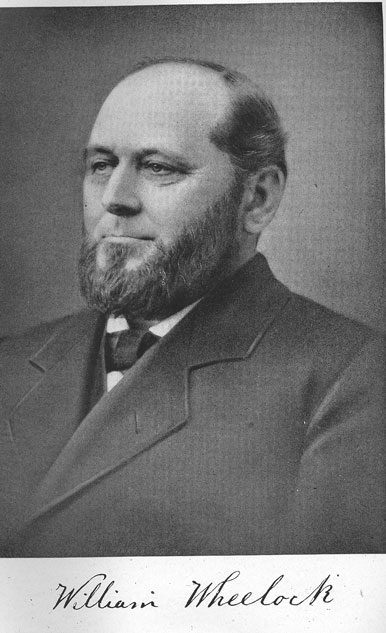
PICTURE OF WILLIAM WHEELOCK
HISTORY OF ERIE COUNTY - 1025
Township, where they were confronted by a pioneer Undertaking in the clearing and developing of their land. There the wife and mother passed away in April, 1896, aged fifty-six years. Werner Kishman died at the home of his daughter in Sandusky May 20, 1911, when in his seventy- third year. He was a democrat in politics, and served in local offices in his home township. He and his wife were confirmed members of the German Reformed Church, 'and he was a charter member of the Mittewanga German Reformed Church.
Henry J. Kishman was the oldest in a family of six, four sons and two daughters, all of whom are married and still live in Erie County. Mr. Kishman himself was married in Vermilion Township to Miss Bertha Reiber. She was born, reared and educated in the same township, and is the daughter of John Reiber, long one of the prominent citizens here of German birth and ancestry. The children of Mr. and Mrs. Kishman are three in number. Catherine like her brothers acquired a good education in the public schools and is still at home. Werner is unmarried and is an active farmer on his father's place. John is still a student in the public schools, being in the eighth grade. Mr. and Mrs. Kishman and children are all members of the German Reformed Church, in which he is an elder. Politically he is a democrat. He end his wife have taken a specially active part hi church affairs and they are people who maintain the highest standards of morality and do all they can to make their community a better place to live in.
WILLIAM WHEELOCK. While the late William Wheelock spent only' a few years at Milan, where he died November 27, 1897, he is recalled by a great many people here as a pleasant and genial gentleman, a successful business man, and Mrs. Wheelock is still identified with this interesting Erie County town and has increased the quality of respect and esteem which are associated with the name. In many ways Mrs. Wheelock is a remarkable Woman, and like her brothers and sisters, possesses a thorough business ability, and is still active in mind and body and is well informed on all current topics.
The late William Wheelock was born in the State of Rhode island in 1830 and was sixty-seven years of age when he passed away. His parents were Manning and Mabora (Southwick) Wheelock. His father was a native of Rhode Island, while his mother was born in Mendon, Massachusetts, and of the fine old Massachusetts stock that became prominent as bread manufacturers. Manning Wheelock some years after his marriage moved to Connecticut, and was overseer of a large farm belonging to a milling company. He died on the farm and he and his wife were both buried there but were subsequently removed to the Enfield Cemetery, where they now lie side by side. They were the parents of six children as follows : Harriet, Daniel, Manning, William, John and Cynthia ; all now deceased. All are buried in the cemetery at Enfield, Connecticut, except William, who is interred at the Ames Circle, Saratoga, New York. Daniel Wheelock has one son living and he resides at Thompsonville, Connecticut, where he lives retired.
On the old Connecticut farm William Wheelock grew to. manhood. Subsequently going to Rockville, Connecticut, he became associated with William Skinner, and they built up an extensive business as retail meat dealers. He was very skillful as a cutter of meat, but impaired health finally obliged him to retire from the business, and for a time he lived at 'Saratoga, New York. From there he moved to Minonk, in Woodford County, Illinois, and took the management of a large store owned by his brother-in-law. Miner T. Ames, one of the extensive coal operators in that section of Illinois. He was very successful in manag-
1026 - HISTORY OF ERIE COUNTY
ing this company store, and his personal popularity added not a little to the prestige of Mr. Ames. From Illinois Mr. Wheelock finally removed to Milan, Ohio, and spent the rest of his days there somewhat retired. He was an active republican in politics, his parents were orthodox Quakers, while he was himself a Presbyterian.
Wheelock married for his first wife Henrietta Bush, daughter of Capt. John Bush, of Enfield, Connecticut. She died when her only son, Frank Howard, was two years of age, and was laid to rest in the Enfield Cemetery. Her son, Frank H., was reared in his father's home, was given a good education, and had a thorough training in merchandising in the store of his uncle, Mr Ames, in Illinois. Subsequently he took the 'office management of the firm of Meeker & Hedstrum, coal dealers, at Chicago. While there he died about twenty years ago, after having opened for himself a most promising career. He was laid to rest beside his father in the Ames Circle at the Saratoga Cemetery in New York. At the time of his death Frank H. Wheelock was engaged to be married to Anna E. Meacham.
Mr. Wheelock was married in Chester, Massachusetts, to Mrs. Lucy (Ames) Gibbs. Her former husband was Nelson D. Gibbs, and was born in Blanford, Massachusetts, was enjoying, a promising career as a farmer at Chester, Massachusetts; at the time of his death in 1862 when in the prime of life. He was an active member of the Congregational Church and in politics a republican. He left a daughter, Mary Ella. Gibbs, who died of measles at the age of thirteen.
Mrs. Wheelock was born at Becket, Massachusetts, October 6, 1834, and during her girlhood she walked a mile to attend the village schools. Her parents were Justin M. and Anna H. (Chaffee) Ames. Her mother was the daughter of Thomas and Abigail (Knowlton) Chaffee, while Abigail Knowlton was the daughter of Colonel Knowlton, one of the heroes in the Battle of Bunker Hill. Justin M. Ames and wife spent all their lives in the farming community around North Becket. His wife died there at the age of fifty-six, leaving ten children. Mr. Ames subsequently married Calista Harriet Bracket, and they moved to Saratoga, New York, where she died in middle life without children. Mr. Ames for his third wife married Harriet, the only sister of the late William Wheelock. They lived at Thompsonville, Connecticut, where Mrs. Ames died when past seventy-five years of age, and was laid to rest at Enfield, Connecticut. Mr. Ames had died several years previously at the same place at the age of eighty-seven, and was laid beside his first wife at Becket. All his marriages were happy and most congenial.
Mention of the Ames children, of which Mrs. Wheelock was one, is briefly recorded as follows : Samantha married Joshua Barnavd, and in territorial times went to the Northwest frontier and improved a farm in the wilderness of Minnesota, where Mrs. Barnard died and where he afterwards married, and subsequently lived at Port Huron, Michigan; there are no children now living by his first, marriage. Zeruah became the wife of Joseph Osborn of Becket, Massachusetts, who was a tanner by trade and subsequently established a tannery at Girard, Pennsylvania, and died there, leaving a son, Bert, who is now married and lives in California. Chaffee S. Ames spent his life as a farmer in Saratoga County, New York, and died leaving a daughter, Ellen, who is now married and occupies the old homestead. George Ames also lived in Saratoga County, New York, died there at the age of sixty-one, and his widow is still living. The next in order of age is Mrs. Wheelock. Lucinda became the wife of James Meacham, of bMiddlefield, Massachusetts, where he died, and she subsequently removed to Milan and is now living with her children in that village, the children being Anna E.,
HISTORY OF ERIE COUNTY - 1027
James Alfred and Wilson A. Minor T. Ames has already been men. timed as a coal operator-in Woodford County, Illinois, though he made his home in Chicago, where he died. He was twice married, having children by both wives, and Knowlton Chaffee Ames, of the first marriage, is living in Chicago, while Adelaide, of the second marriage, is the wife of Mr. Ross, a prominent attorney of Chicago, and another daughter, Hattie, married Mr. McCormick, who was for a number of years identified with the management, of the Waldorf Astoria Hotel at New York City. Wilson Ames became a distiller of cologne spirits in Chicago, and later a coal operator at Seymour, Illinois, and at his death was buried in the Ames Circle at Saratoga, New York ; his widow and son, Hamilton, now live in Brooklyn, New York, where the son is engaged in manufacturing. Juda was for many years in charge of a department in the great store of Marshall Field & Company, in Chicago, also bought goods for the firm for several years in Europe, and finally retired to Norwalk, Ohio, and ,died there at the age of fifty-six. Franklin Ames was for thirty years buyer and head of the wholesale carpet department of Marshall Field & Company, and subsequently acquired an interest as a stockholder in that business, but retired a few years ago, and has a son and daughter.
PATRICK J. MILAN. There are few citizens of Erie County more widely known over the country at large than Patrick J. Milan. While he is classed as a farmer and at that one of the largest and most successful in Oxford Township, his earlier experiences were all with railroad affairs, and in that profession he gained only less distinction than his noted brother, Capt. Thomas Milan, for twenty years motive power chief of the National Railways of Mexico and subsequently president of the Vera Cruz and Pacific Railway—a position he held for a long time. Many years ago he went into Texas during the early railroad period of that state and served as captain in the Texas State Militia, from whence he gets his title, was never married and now retired, resides in California.
This branch of the Milan family originated in Ireland, where Patrick J. Milan was born in County Galway, December 26, 1843. His parents were Thomas and Cecelia (Rowan) Milan, also natives of County Galway. Thomas Milan with his wife in 1848 emigrated to America, and in May, 1849, established his home in Sandusky, where he found employment with the Mad River & Lake Erie Railroad Company, while he served in various capacities for thirty-five years, and died at Sandusky, widely known and respected in 1897. Circumstances and conditions were such that when Thomas. Milan and wife emigrated from Ireland they were obliged to leave their three children, among them Patrick J., then five years of age, in charge of his wife's sister, Miss Nora Rowan. In 1851 Miss Rowan brought the three children to America, and they were reunited with their parents at Sandusky.
Patrick J. held positions of great responsibility with railway companies, as general manager of the Rio Grande & Eagle Pass Railway of Texas, general master mechanic of the Cotton Belt Route, master mechanic of the main shops of Central Railway of Georgia at Savannah, at that time the largest in the old South ; left there to take charge of the Pan-American Railway as its general superintendent, the world's great scenic line,,the objective being to connect the Americas, to make the New Yorker and Patagonian next door neighbors. From the latter position Mr. Milan resigned to live on and develop his Erie County farm.
AMEOL BOOS. In the field of agriculture it has frequently happened that the fathers have secured the broad and fertile tracts of land which
1028 - HISTORY OF ERIE COUNTY
the sons have brought to their full capacity of productiveness. The rough, preliminary labors of the pioneers have been as necessary as the developing work of the later generation; all combine',- for the general advancement of them wonderful agricultural interests of Ohio. Of the men of Erie County who are engaged in farming operations on land secured originally by their fathers, Ameol Boos, of Huron Township, is a sterling representative of -that class of reliable, industrious men who are acknowledged to be broad and scientific in their methods. He was born at Sandusky, Ohio, September 11, 1855, and is a son of George and Catherine (Miller) Boos.
The parents of Mr. Boos were born in Germany and there reared and educated and married in their native land, probably in the Province of Baden. The father was reared to the trade of locksmith, which he followed for some years in Germany, and following his marriage he and his wife went to South America, where they resided about one year, their oldest child, Sophia, being born in that country. In the early '50s the family came to North America and after landing at New York City- made their way to Sandusky, Ohio, from whence, in 1852 or 1853, they came to Huron 'Township. The father purchased twenty-five acres of almost wild land, on which he built a little home, and began to clear and cultivate this primitive farm, under the direction of Mrs. Boos, who had been brought up on a farm in Germany. As the children grew up they assisted their parents in the work of development, and later fifteen acres were added to the original purchase, this subsequently being added to from time to time until the homestead consisted of 105 acres. Here the father erected a good home of seven rooms to replace the first little dwelling, as well as a substantial barn, 30 by-83 feet. He was an industrious and energetic worker and learned to be a good farmer, putting in a great deal of open ditches, which have since been covered by his son. It may be said that this farm is nearly perfect as regards drainage, for there, are more than 50,000 tile here. The land grows fine crops of all kinds of grain, the wheat fields yielding an average of thirty bushels per acre, while potatoes are also grown in great quantities. Throughout his life George Boos continued to intelligently till his fields, and through a career of honest and straightforward dealing won the respect and esteem of the people of his community. His death occurred July 14, 1909, when he was eighty-seven years of age, while Mrs. Boos passed away April 13, 1893, aged nearly sevcnty-six years. She was a Catholic, while Mr. Boos was a member of the Lutheran Church. Five children were born to Mr. and Mrs. Boos : Sophia, who died after marriage ; Ameol, of this notice ; Amelia, who.was married and met her death in a railroad accident on the Lake Shore Railroad at Sandusky, Ohio, in 1897; Mrs. Lena Post, of Huron ; and Mrs. Mary Heminger, of Perkins Township, Erie County.
Ameol Boos was born in Sandusky, but when he was a few weeks old his mother returned to the farm and here he has passed his entire life. He was given the educational advantages to be secured in the. public schools, and was carefully reared to agricultural pursuits, which he has made his life work. At the time of his father's death he succeeded to the ownership of the home farm, and has since added twenty-five acres to it, now having a finely-cultivated tract of 130 acres. He does general farming, and his life has been one of quiet and uninterrupted devotion to his home and surroundings, and out of his labor and experience has come the regard of all who knew him and a reputation as a good and public-spirited citizen.
Mr. Boos was married in Huron Township to Miss Mary Steiner, who was born on the old Steiner farm in Erie County, in 1860, and died April 10, 1894. Three children were born to this union : George M.,
HISTORY OF ERIE COUNTY - 1029
who is a farmer of Huron Township and has one daughter, Mary, now four years of age; Charles, who is married and lives with his father, whom he assists in the operation ot the farm ;. and Ameol, Jr., also Married and a farmer in Huron Township. Mr. Boos married for his. second wife Lula Curtis, who was born in HurOn Township in 1874.
Mr. Boos and his sons are consistent members of the Roman Catholic Church. They have always supported the principles and candidates of the democratic party.
HARDEN A. TUCKER. Among the notable pioneer residents of Erie County still surviving, the lives of few have been so lengthened by a gracious Providence as to afford them a retrospective view of eighty years of their own participation in the development of the county. Such, however, is a distinguishing feature of the career of Harden A. Tucker, "The Grand Old Man of Milan,'"whose life in Milan Township, where he still makes his home, spans a period of four score years. A companion of the wilderness, when wild animals still roamed the untamed forests, a pioneer teacher when schools were 'few and far between, a witness of primitive conditions and a participant in the wonderful devqlopment of this region, he still stands among the younger generation, like a forest monarch among the yiiunger growths. His life has been full and eminently useful ; his record is one on which no blemish appears.
Harden A. Tucker was born near Scituate, Rhode Island, April 21, 1833, a son of Harden and Sabra (Clark) Tucker, natives of that state and of fine old New England ancestry. In 1836, after the birth of three sons and one daughter, the parents set out for what was then the Far West, making their way down the Hudson River and Erie Canal to Buffalo, and then to Huron, Ohio, by way of the Great Lakes. There they settled on a wild farm near the present home of Harden A. Tucker, first erecting a primitive home, later replacing it with a more substantial and commodious one, and finally building a good brick dwelling, in which the parents resided until their retirement, when they sold out .a and moved to Milan. There the father died in June, 1872, when sixty-eight years of age,.the mother passing away at the home of her sons, in January, 1879, when seventy-nine years old. They were Spiritualists in religious belief, and in political matters the father was first a whig and later a republican. Harden and Sabra Tucker were true pioneers of Erie County. In spite of leaving the refining influences of New England, with no experience in the rough life of the frontier, they accepted conditions as they found them, worked out their own material success, and reared their children to lives of usefulness and honesty.
Harden A. Tucker was but three years of age when brought-to Erie County, is one of the oldest living settlers of Milan Township, and is the oldest man of Milan on the North Road. His boyhood and youth were passed in the midst of pioneer conditions and his education was secured in the primitive log schools, but he made the most of his opportunities, and when a young man divided his time between cultivating a farm and teaching in the local school. The wildest of game were still to be found here, and Mr. Tucker relates many interesting experiences in regard to incidents of his early years. On one occasion, while he and several other persons were passing under a large chestnut tree near his home, a panther leaped from a tree sixty feet across the road, and, to use Mr. Tucker's words, "let out a yell that could have been heard three miles away." A few more leaps and it had disappeared into the dense forest. At another time, when Mr. Tucker was returning to his home at night, a huge panther followed him for more than a mile along the wild highway. the beast not turning away until he had reached the very door of his house.
1030 - HISTORY OF ERIE COUNTY
Mr. Tucker settled on his present farm in 1866, and has owned it since 1868. This tract consists of 96.81 acres, the greater part of which he has himself improved, in addition to which he has cultivated other land, and has turned more furrows of land than any other man who lived in Milan Township. Here he has erected modern and commodious buildings, including a brick house, and the land has been thoroughly tiled by him, making it one of the most productive in this part of the county. The land lies almost level, drifting north toward the Huron River, and on it the best of all kinds of crops may be raised.
In 1915 Mr. Tucker celebrated his golden wedding anniversary. He was married August 10, 1865, at Speares Corners, Milan Township, to Miss Elizabeth Rockwell, who was born in New York, January 19, 1838, and was six years old when brought to Ohio by her parents, and eleven years old when she came to Milan Township, where she became a schoolmate and neighbor of Mr. Tucker. She has been a devoted wife and much of Mr. Tucker"s success he attributes to her assistance, advice and good management. Mrs. Tucker is a daughter of John and Sarah (Wilcox) Rockwell, natives of Connecticut, of an honored New England family. As young people they moved to New York, and then to Erie County, Ohio, where Mrs. Rockwell died in Oxford Township, aged seventy-two years, while Mr—. Rockwell died at Milan when past his eighty-fifth, birthday.
To Mr. and Mrs. Tucker there have been born the following children : Henry, who is a prosperous farmer of Milan Township, is married and has six living daughters, of whom four are married, while one son and one daughter died young; Charley, a widower without children, who resides with his parents ; Glenn, who is operating the homestead property, married Lula Snyder, of Milan Township ; B. Frank, who is a bachelor and lives on his farm at Hartland, Huron County, Ohio.
Mr. Tucker has been a lifelong republican, his first presidential vote having been cast for John C. Fremont. He has been content to be a voter rather than an office seeker, but has taken a keen interest in the success of his party's candidates and policies and has always given the Grand Old Party his warmest support. Mr. Tucker has been a diligent, energetic and industrious farmer, and in all the privations, hardships and difficulties incident to the life of the early settlers manifested • that resolution, patience and perseverance that enabled him to contribute his full share toward the development of Erie County, of which, for eighty years, he has been a representative and highly esteemed citizen.
THEODORE HAHN. It has been the mission of Theodore Hahn to have been identified in his fortunes with Milan Township since 1891, and through his energy and good judgment to have promoted agricultural interests here during that period. When he entered upon his independent career, he had little to aid him save native thrift, industry and ambition, but these he has turned to such good advantage that he is now the possessor of a handsome property in the northeast corner of the township and of a reputation for honorable and straightforward dealing that gives him the esteem and regard of his fellow citizens.
Mr. Hahn was born August 7, 1866, in Hesse Nassau, Germany, and is a son of. Conrad and Elizabeth (Orth) Hahn. The parents were small farmers in the fatherland, and resided there until 1871, when, after the birth of all their children they decided that better opportunities could be found in America and accordingly came to this country, boarding ship at Bremen and making port at New York, in June of that year. From the metropolis the little party made their way to Erie County. Ohio, and settled in Huron Township, on the Bogart Road, where Conrad Hahn continued to be engaged in agricultural pursuits during the
HISTORY OF ERIE COUNTY - 1031
remainder of his life, and where his death occurred April 14, '1915, at the age of eighty-seven years. He was a thrifty, energetic farmer, a homemaker and a good citizen, and throughout his long career so conducted himself and his transactions as to win and maintain his fellow- citizens respect and confidence. As a builder and developer of the county, he contributed a handsome farm, well improved in every way, with large, modern and attractive buildings. His family was reared in the faith of the German Reformed Church, and his children have proved valuable additions to whatever community they have been called. Mrs. Hahn, who still survives at the age of eighty-one years, lives at the home of her son, Adam Hahn, a review of whose career, elsewhere in this work, contains a more comprehensive sketch of the family's history.
Theodore Hahn was reared and educated in Huron Township, and there made his home with his parents until 1891. In that year he entered upon his independent career When he purchased his present farm, located on the Wikel Road, in the northeast corner of Milan Township. He has fifty acres, forty of which are under cultivation, and these are operated for farming, fruit growing and stock raising, in all of which branches Mr. Hahn has met with well merited and satisfying success. He rotates his crops, running from corn to oats, wheat and clover, and then back, a system which he finds brings him excellent results. Mr. Hahn has an attractive dwelling, pure white in color, with eight rooms and all modern conveniences and comforts. His barn is 36 by 62 feet, gray colored, with a slate roof, and a lean-to for tools, etc., attached, 12 by 36 feet. Every department of this modern farm evidences the presence of good management, and the atmosphere of the place is that of prosperity and comfort.
Mr. Hahn was married first to Miss Mary Blatt, who died leaving one daughter : Minnie M. C., born September 7, 1894, educated in the Berlin Township public schools and the Sandusky Business College, and now residing at home with her father. Mr. Hahn was again married, September 13, 1899, in Huron Township, to Mrs. Anna (Dippel) James, who was born September 1, 1871, in the City of Cleveland, Ohio, daughter of Henry and Elizabeth (Weiss) Dippel, natives respectively of Hesse Nassau and Hesse Darmstadt, Germany. They came to the United States as young people and met and were married at Cleveland, where for many years Mr. Dippel was foreman for the Doane Oil Refining Company, and later was made its superintendent. In the meantime he had established himself in the coal business, and finally resigned to give his entire attention to that line, in which he was successfully engaged for over thirty years. He and his wife were leading and influential members of the German Evangelical Church, in which he was president of the board of trustees for many years. Mr. Dippel died in December, 1912, aged sixty-eight years, eleven months, while Mrs. Dippel passed away in April, 1913, aged seventy years. By her former marriage, to the late George R. James, Mrs. Hahn has one daughter: Florence, born December 5, 1892, who was educated in the Erie County public schools.
Mr. Hahn is an independent voter and not a politician.
FRED W. HECKELMANN. Some of that quality of enterprise which has the power to mold the world and its circumstances to the desires and ambitions of the individual have been exemplified by Fred W. Heckelmann, who came as a poor German youth to this country about twenty years ago and has succeeded in establishing himself securely and prosperously in the fine agricultural district of Milan Township, where he owns an excellent farm and manages it with the same successful ability that merchants would direct a store or a manufacturer run his factory.
Born in Hesse Nassau, January 10, 1873, Fred W. Heckelmann
1032 - HISTORY OF ERIE COUNTY
belongs to an old line Of ancestry in Nassau. His parents were William and Christina Heckelmann, both natives of Hesse .Nassau. They grew up and married there and all their children were born in that locality. William Heckelmann was a wagon maker, a trade which his father had followed before him, and two of his brothers :also took up. William was nineteen years old when his father died, and subsequently pursued his trade in the old country until his death in November, 1894, when sixty-three years of age. His son Herman, a4 twin brother of Fred, succeeded to the father's business, while two other sons, Adolph and August, are also still living in Germany. Those who came to America were : William, Carl, Fred and Louis. William has been a resident or this country thirty-one years, Carl came over twenty-eight years ago, Fred twenty-five years ago, while Louis has been in America only eleven years.
He had reached the age of seventeen when Fred W. Heckelmann ventured across the Atlantic and aspired to a fortune in the New World. Up to that time he had attended school regularly, and had gained some knowledge of practical accomplishment. He sailed on a vessel at I3remen and from New York came on to Erie County. In 'the main he has been identified with agricultural activities ever since and from a position as a worker for others has succeeded in getting property and has for a number of years been his own master. In the fall of 1906 he bought the ninety-seven acres comprised in the Sayles farm, situated on the old Plank Road near Gaytown in Milan Township. Nine years have effected some remarkable changes in that farm, particularly in its efficiency of cultivation and in numerous improvements. He has raised large crops of corn, wheat and oats, potatoes, and has a group of substantial farm buildings, including an eight-room two-story house, with a slate roof, and barns and other outbuildings.
After coming to Erie County Mr. Heckelmann married Miss Minnie Copenhafer. She was born in Wuertemberg, Germany, May 3, 1871. Her mother died in the old country and her father is still living there at the age, of seventy-six. Mrs. Heckelmann came to the United States and to Erie County when twenty years of age. Both the Heckelmanns and the Copenhafers have been identified with the German Evangelical Church for generations. Mr. and Mrs. Heckelmann have four children : Edna, aged sixteen, has graduated from the eighth grade of public schools ; Hilda, aged fourteen has also completed the common school course and is now in the high school; Maria, aged thirteen, is now in the sixth grade of the public school; while the youngest, Edward, is also at school. Mr. and Mrs. Heckelmann are members of the Oxford Evangelical Church, and for twelve years he has been secretary of the church board. Politically he is a democrat, though of independent proclivities.
ALBERT M. FISH has lived actively and usefully in Milan Township fully fifty years. This is a family with many exceptional characteristics and distinctions, and has been identified with the American colonies in the northeastern part of the United States for four or five generations at least. While in Erie County the family has been chiefly identified with manufacturing as well as agricultural activity, their homes have been centers of culture and influence, and several of the name have attained high rank in the professions.
Of old English ancestry, the earliest ancestors of Albert M. Fish of whom there is record lived in Connecticut. His great-g.randparents were Joseph and Abigail Fish, who were born in Connecticut, and it is believed that they lived and died there. Joseph Fish was born in 1756 and died in 1805, survived several years by his wife. They possessed
HISTORY OF ERIE COUNTY - 1033
many of the hardy characteristics of New England people, were upright, stanch and progressive, and made their influence ;count for the betterment of the community in which they lived, Uriah Fish, grandfather of Albert M. Fish, was born in Connecticut, and personally exemplified the elements of a strong New England character, possessed a rugged physique and was positive and determined in his actions and in his mental processes. His descendants may take pride in the fact that he served as soldier throughout the War of 1812. He had probably moved to New York State before the war, and it is certain that more than a century 'ago this branch of the family was located at Otisco, Onondaga County; New York. Uriah Fish spent many years on his farm there, and eventually established around him his five sons, on separate farms. He died ab6ut 1856. He had been born during the Revolutionary war, and reached good old age. He possessed model habits, was a man of affairs, and had a business judgment which enabled him to provide for himself and for his descendants. Uriah Fish married Lovina Carpenter. She was probably born in Connecticut, and belonged to the old Carpenter family of the New England states. They were probably married before they left Connecticut for New York State, and she outlived her husband some eight or ten years and was past fourscore when she died. Both she and her husband were members of the Universalist Church, and many years ago had been closely identified with the abolition movement. A brief record of their children is given as follows : Eliza married John Bishop and died in New York State leaving descendants. Lovisa married Lewis Wells, and they lived and died in New York State and were survived by two sons and one daughter. David spent all.his life near the old homestead in New York, and after his death left three daughters. John was also a farmer near the old home in Onondaga County, and one son survived him. The next in age was Samuel, to be- mentioned in following paragraph. Mindert came to Ohio and died at Berlin Heights, being survived by several children. Willis C. was the favorite son, was made heir to the old homestead, but his fine sense of justice prompted him to break the will and by his own election the estate was divided in equal shares among all the children ; he married, but had no descendants.
In the next generation is Samuel Fish, father of Albert M. He was born on the old homestead in Onondaga County in 1819. His son Albert has at his home in Milan among other heirlooms and possessions a fine etching of his father, and the portrait exhibits many of the lines and lineaments which denote force of character and energy, and 'those qualities were positively displayed by Samuel Fish in all his activities. Another engraving in Mr. Fish's home shows the large and beautiful homestead where the family lived for many years at Otisco, New York. It was on that homestead that Samuel Fish grew to manhood. After getting his education and starting out for himself he married a poor but noble girl from a neighboring family, and for several years they lived at the old Fish home. Albert M. Fish was born there in the same house and in the same room where his father had first seen the light of day. Albert M. Fish came into the world November 5, 1846, and has himself almost completed the span of three score and ten. The first eighteen years of his life were spent among the scenes and environments of Onondaga County, and he gained an education in the public schools.
In 1864, when Albert was eighteen years of age, and a few days after the Presidential election at which Abraham Lincoln was retained for a second term in the White House, Samuel Fish, who had delayed long enough to cast his vote for the great emancipator, started with his family for the West, and arriving in Milan located and bought a farm in what is called East Milan, just outsides the corporate limits of the
Vol. II--36
1034 - HISTORY OF ERIE- COUNTY
village of that name. The purchase was a large ten-room brick house, surrounded by twelve acres of ground. While the Nate was small, Samuel and his son built up there a considerable industry as a tile and flower pot factory, and they conducted this from 1865 until the death of Samuel Fish on September 15, 1900. At that time he was eighty-one years of age. This factory. at Milan was one of the landmarks in the industrial history of the township. Many years ago the proprietors. introduced the manufacture of flower pots, and that was perhaps the largest feature of the business, and the wares tad an extensive sale. After the death of his father Albert M. Fish continued the operation of the plant for five years; and then abandoned this branch of manufacture and bought some agricultural lands in that locality. He now owns ninety acres of well improved and high class farming land, and devotes his time to general agriculture. However, since the death of his wife he has made his home at the old brick house which was formerly owned by his father, and which is now the property of his sister Miss Celinda Fish, one of the best known women in Milan Township.
Albert M. Fish was married in Milan to Miss Emily Graves. She was born in Lorain County, Ohio, in October, 1846, but gained her early education in Berlin Heights. She died at the Fish home August 8, 1911. She is remembered by her family and friends as a devoted wife and mother, and a woman of many excellent qualities. Her parents were Murray and Cynthia (Gibbs) Graves. Her father was born in Hatfield, Massachusetts, in 1818, and died in Milan in 1895. Her mother was born in Cameron,. New York, October 28, 1824, and died in Milan Township, February 15, 1894. Murray Graves lived in Lorain County for a number of years but finally came to Milan Township in Erie County. He was a good citizen, very industrious, and his business was chiefly in butchering and dealing in meats.
The oldest of the children of Albert M. Fish is Fred A. Fish. He was born at the old home in East Milan in 1875, graduated from the Milan High School in 1892, subsequently took up electrical engineering, in which he gained his first knowledge at local plants, later pursued a technical course in Buchtel College at Akron and was graduated in the electrical engineering department at the Ohio State University, and for his standing was granted a scholarship in the University of Wisconsin. After completing his education in 1898 he subsequently filled a chair in the Ohio State University, and from, that went to the Iowa State Agricultural College at Ames as associate and later as professor in electrical engineering, and has occupied the position for a number of years. He is now living at Ames, and is recognized as one of the best qualified educators in the state. He married Anna Calkins, of Troy, New York, who is a graduate of the University of Wisconsin. Their two daughters are named Frances and Elizabeth.
Carl W., the second son of Mr. Fish, has also been well educated and is now a foreman with a telephone company. He married Miss Olivia Brandrup, who was a well educated Iowa woman and had taught in San Francisco, California.
Roy M., the youngest of Mr. Fish's sons, was born. at the old homestead at East Milan, December 11, 1881. He pursued the study of electrical engineering for a short period, but his health failing about that time he went West with his wife to California, and spent the greater part of 1908-09 in traveling along the west coast. After his return to Ohio he bought sixteen acres in West Milan, and is now engaged in the liaising of small and tree fruits and general farming. He married Miss Ada M. Hart, the daughter of Philip and Lucy (Fisher) Hart. She was born in Norwalk, Iltiron County, was graduated from the Norwalk High School in the class of 1902 and from the Woman's College at Cleveland, and at
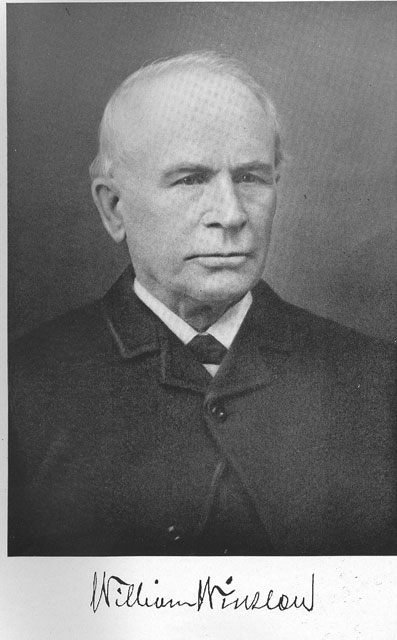
PICTURE OF WILLIAM WINSLOW
HISTORY OF ERIE COUNTY - 1035
the age of twenty was principal of the Milan High School, a position she held for three years until her marriage: MA and Mrs. Roy Fish have two children, Jean Allison and Robert M. This little family are members of the Presbyterian Church, while Roy Fish is affiliated with Milan Lodge No. 329, F. & A. M.
Mr. Albert Fish and his sons are rather independent in political matters. The father at different times served altogether for three terms as township trustee. He is treasurer of Milan Lodge No. 239, F. & A. M., and is also a member of Milan Grange of the Patrons of Husbandry.
WILLIAM WINSLOW. It was by many active relations that the late William Winslow was identified with Erie County, and particularly with the charming little City of Milan. The handsome brick home on Front Street in which he died October 15, 1893, is still occupied by Mrs. Winslow, who lives there with her niece, Miss Hardy. This home, a large and attractive thirteen-room house and, bought by Mr. and Mrs. Winslow when they came to Milan, is in many ways reminiscent of the fine old Virginia home in which Mrs. Winslow Was born and spent some of her early years, near Winchester, Virginia.
While Mrs. Winslow comes of old Virginia stock, and of the real F. F. V.'s, the late William Winslow was of New England and of some of the oldest ancestry found in Massachusetts. He was born at Pittston, Vermont, in September, 1811. He was directly descended from the colonial governor, Everett Winslow, who was the first governor of the Massachusetts Bay Colony. The mother of William Winslow was a Miss Spencer. As William Winslow was a boy of only twelve or thirteen years when both his parents died, there is very. little knowledge concerning his immediate ancestry. The parents died on their little farm near Old Pittson, Vermont. They were survived by seven children, all sons, and it is noteworthy that all of these attained great length of years, except one, who was accidentally killed by the kick of a horse when .a young man. Of these sons, Alnathan died when past seventy-two; Loyal was the youth who was accidentally killed at the age of seventeen ; Horace died when eighty-four ; William was eighty-two when he passed away at Milan ; Franklin attained the venerable age of ninety-one ; Corydon died when past the age of three score and ten ; and Charles at the age of ninety-one. Charles, the youngest, was only an infant when his parents died, and the oldest was-nineteen years old. They clung together until they were old enough to go-Out in the world and earn their own living, and all the sons who reached maturity subsequently became heads of families and enjoyed worthy positions in the world.
When twenty-six years of age William Winslow and his— brother, Horace, moved to Hartford, Licking County, Ohio. William engaged in the general merchandise business, after the manner of the early merchants in the Middle West, having a stock of goods comprising practically everything needed in the home and on the farm, though it not infrequently happened that he was out of a certain line of goods for days at a time, since it required a week or more to get goods from New York City, which was then the general supply point for all western merchants. While William thus engaged as a merchant, his brother Horace went three miles into the country and bought a new tract of land and cleared it up from the wild woods, and spent his life there as a farmer.
From the start William Winslow prospered as a general merchant in Licking County and from that beginning his operations and investments covered a wider scope. Some years after moving to Licking County he invested $1,000 with his brother-in-law, Zenas King, who
1036 - HISTORY OF ERIE COUNTY
became head of the well known King Bridge Company. In this company Mr. Winslow had many responsibilities as superintendent of bridge construction, and this obliged him eventually to sell out his store in Hartford, and he then identified himself actively with the bridge concern. In order to look after these business interests he moved to Milan, locating in that city a year or so after the close of the Civil war. While this was his home he spent much of the time on the road traveling as superintendent of bridge construction, and after leaving that firm he spent most of his time in retirement, although he had milling interests at Milan which required some supervision.
Throughout his active carer Mr. Winslow was a stanch republican in politics, and for many years was interested in every movement for the advancement of the town and county. Perhaps he rendered his greatest public service as chairman of the old Normal School Institute at Milan, which in its day was one of the best schools of the class in Ohio, and a great many successful men and women received part of their education there. He was also chairman of the old Milan and Huron Canal Committee, which canal in its day was one of the busiest waterways, in the United States, and upon its waters floated vast cargoes of wheat and all kinds of grains between Milan, which was the concentration point, and Huron, where the grain was loaded on to the lake vessels and carried to the larger markets of the world. Many years ago Milan was regarded as the greatest grain port in the United States, if not the greatest in the world, with the possible exception of Riga, Russia. In the early days Milan occupied about the same position in the grain industry as the City of Duluth, Minnesota, now has. While never a seeker for political honors himself, Mr. Winslow was always ready to work and use his influence in behalf of his friends. He was an active member of the Presbyterian Church, and did much for its support and upbuilding at Milan.
The late Mr. Winslow was three times married. The only daughter of his first wife, Josephine, died when a promising young woman at the age of eighteen. He married his second wife at Hartford, Ohio, Miss Fannie B. Wheelock, who died in young womanhood and without children.
In Champaign, Hlinois, in January, 1875, Mr. Winslow married Miss Anna C. Renner. Mrs. Winslow was born in Old Virginia, in the Shenandoah Valley near the City of Winchester, February 29, 1828. She was carefully reared and educated, attended young ladies' schools in Virginia, the Hartford Academy and the Granville Seminary, and after her parents removed to Champaign, Illinois, she followed teaching for some time. Her parents were Henry and Mary (Wiley) Renner, both of whom represented the fine old colonial stock of Virginia. Her maternal grandfather, Rev. Bernhard Wiley, was a prominent preacher in the Reformed Church, and carried the gospel mission all up and down the Shenandoah Valley until his death, at his home in Woodstock, Virginia. In 1852 Mr. Renner left Virginia and moved to Champaign, Illinois. In Virginia he had been a farmer, but lived retired in Champaign and died there in his eighty-sixth year, while his wife was seventy when she passed away. Both were members of the Presbyterian Church. Mrs. Winslow is one of the lovely characters in Milan society, a woman of the highest ideals, and her life has been a benediction to all who came within the radius of her influence. She was one of the prime movers and organizers of the old Public Library Association of Milan, which was turned over to the township and which was the nucleus of the present beautiful library and for which others receive the honor. But it was really she, by her untiring efforts, who did more than any one other to start and continue to build this library. She is one of the
HISTORY OF ERIE COUNTY - 1037
active members and still a regular attendant of the Presbyterian Church at Milan. Her niece, Julia M. Hardy, was educated at Milan and in Oberlin College, and is also a woman of thorough culture and together they maintain the fine Winslow home which has stood for so much in Milan ever since it was occupied by the Winslow family.
ISAAC W. HOOVER. As the originator and developer of what is one of the most important manufacturing industries carried on within the limits of Erie County, a special interest attaches to the name of Isaac W. Hoover, who has done much to increase and build up those outside associations by which people in many diverse quarters of the world know of Erie County as the source of a certain type of agricultural machinery which has served to lighten the burdens of crop harvesting and at the same time has decreased the cost of kroduction of one of the most common articles of food. Originally Mr. Hoover was a farmer who specialized in the potato crop. Out of his experience in harvesting that crop by the old fashioned and tedious and laborious method of the plow or potato fork he conceived the idea which he perfected in the manufacture of his first potato digger. Some thirty years ago he manufactured his first machine. Having tried and tested its availability for his own purposes, he began on a small scale to manufacture for others. Since then he has been in increasing ratio a manufacturer, and his machines have lightened the burdens of men throughout the civilized world. Mr. Hoover was not only a good manufacturer, taking- great pride in his output, but also had ability to sell his products. His success has been the result-primarily of getting out a machine which was of demonstrated practical value, and also has been due to his care in never letting one of his diggers go out of his shop unless it was perfect. He has prospered, and his success and prosperity have produced a permanent and far reaching benefit to mankind.
The Hoover Manufacturing Company, of which Mr. Hoover is president and treasurer, has served to give a name and prestige to the little Village of Avery, in which it is not only the largest institution but also the chief source of livelihood to the inhabitants. This company now makes thousands of potato digging machines every year, and its sales are made in practically every country that grows potatoes. Mr. Hoover patented his machine in April, 1885. After getting his patent, he took none of the means so frequently employed to exploit his invention, but proceeded quietly, and his industry has been a growth more than a sudden creation. At first he intended his machine only for use in his own fields, and the first year manufactured only one. It did the work which he expected, and in the following year he made ten machines, all of which were marketed in Erie County. The third year the output of his shop was fifty machines, and from that time the business has been , increasing almost every year, and is now the largest industry of its kind in the United States and one of the most important considered from any point of view in Northern Ohio. At the present time about 5,000 machines represent the output each year, an average of nearly twenty for every working day. These machines are shipped and sold to every civilized country. The great plant covers fully four acres of ground at Avery. Avery is a small station located in Milan Township on the Nickel Plate Railroad, and the machinery goes out frequently in carload lots from that station. From 75 to 100 employes find their chief source of livelihood in these shops.
Erie County may take pride in the Act that Mr. Hoover is a native son. He was born near Sand Hill in Groton Township, January 3. 1845, and grew up in that locality and gained a practical education in the local schools. About forty years ago he moved into Milan Township,
1038 - HISTORY OF ERIE COUNTY
and there became a practical farmer, but was soon developing the potato crop as his specialty. He inherited some considerable degree of mechanical ability from his father, and he exercised this faculty in producing his first potato digger, and from that has built up the. great business already described.
His parents were Rain and Elizabeth (Woolverton) Hoover, both of whom were born in Northumberland County, Pennsylvania. The Hoovers were of Holland ancestry, while the Woolvertons were New England Yankees. Both John Hoover and wife came to Erie County when young people, and were married in Groton Township. John Hoover was a stone mason by trade, having learned that vocation in Pennsylvania, and in Erie County was employed in the construction of a large number of houses in his time. In 1849, with perhaps half a dozen other friends and neighbors, he made the trip across the plains to California. His purpose in going West was inspired by a love of adventure and a desire to see the country rather than primarily as a gold seeker. He spent a year on the golden shores of California, and altogether was absent from Erie County eighteen months. After many interesting experiences in the West he returned by way of the Isthmus of Panama, and then settled on his farm in Oxford Township of Erie County. Living there until 1875 he removed to Bushnell, Hlinois, where his brother Joseph Hoover was living at that time. Mrs. John Hoover died at Bushnell in 1891, when about seventy-five years of age.. Soon afterward the father returned to live with his son Isaac in Milan Township and also spent part of his time with his daughter, Mrs. A. H. Prout, then a resident of Oxford Township, but now of Cleveland. John Hoover passed away in this county in 1905 at the age of ninety-two. He was a democrat in politics, and while not interested in offices was always progressive and public spirited, and enjoyed the reputation among his fellow townsmen for industry and most scrupulous integrity. Besides the two children already mentioned there were two other sons. Louis V. now lives in the vicinity of San Diego, California, where he is a fruit grower and also has interests in the city, and has a family about him. George, who lives in Alberta, Canada, owns more than two sections of land there, devoted to stock ranching, and is married and has sons and daughters.
After leaving the old home Isaac W. Hoover took up farming in Oxford Township, also lived in Huron County for a time, and in 1875 established his permanent home in Milan Township. There he bought seventy-four acres of land, and was soon numbered among the extensive potato raisers, an industry which has long flourished in that section of the county. Mr. Hoover is now one of the largest land holders in Milan Township. His lands are divided into four large farms, each one supplied with a complete set of farm buildings. His total acreage in Milan Township is nearly 700, and all of it is highly improved land, and producing besides potatoes all the staple cereals.
Mr. Hoover is also a director in the Farmers & Citizens Bank of Milan, of which his son Arthur L. is president and director. This bank has a capital of $25,000 and is a well managed and solid institution. Mr. Hoover is also a director in the Huron County Bank of Norwalk. In politics both he and his son are democrats.
In Oxford Township Mr. Hoover married Miss H. Jane Bear. She was born in that township in 1846, a daughter of Hiram and Abigail (Kelly) Bear, both of whom were born in Pennsylvania and came to Erie County about the same tinge as the Woolverton family. Mr. Bear died in 1860 in middle life, having been born December 24, 1819. His widow survived him many years and passed away at the home of her daughter Mrs. Hoover April 18, 1900. She was born. April 20, 1817, and
HISTORY OF ERIE COUNTY - 1039
at the time of her death was eighty-three years of age. Mrs. Hoover's parents were members of the Baptist Church, and in politics her father was a democrat. Mrs. Hoover was one of a family of six daughters and two sons, seven of whom married, and all are now deceased except Mrs. Hoover and Susan I., wife of George Laws of Oxford Township.
There are three children in the family of Mr. and Mrs. Hoover. Marian, born June 21, 1868, is the wife of Harry Mason, a farmer and sand dealer at Avery, and their children are Leonis, deceased, and Lloyd J., Grace D., Harry N., Donald M., and Merle M., whose twin brother Max L. died when nine months of age.
Arthur L. Hoover, the only son of Isaac W., was born November 23, 1871. He was well educated, attending besides the local schools the Milan Normal and the Sandusky Business College. He is now secretary of the Hoover Manufacturing Company. One other officer of this com-: pany is William F. Olemacher, vice president. Arthur L. Hoover was married October 11, 1898, to Harriet Woolverton. Their children are named Margaret, Fay and Mary Jane.
Helen Grace, the third child of Isaac W. and Mrs. Hoover, was born March 13, 1876. She attended schools at Milan, but graduated from the Art School at Cleveland and is now the wife of Dr. Ralph Garnhart, who is a graduate of medicine and is in active practice at Milan ; they have a daughter named Eleanor Louise. Mr. and Mrs. Hoover are Baptists, though they attend the Methodist Episcopal Church at Milan. He is affiliated with the Lodge and Chapter of Masonry at Milan, with the Council and Knight Templar Commandery at Norwalk, and the son Arthur is affiliated with the same branches of the order, has gone through the chairs of the lodge at Milan and is past high priest of the Royal Arch Chapter. Both Mr. Hoover and his son have employed their ample means for the development of the community in which they live. They have constructed two magnificent homes at Avery, and these homes represent not only the most modern type of architecture but also combine the beauties of effective landscape gardening, and each one is numbered among the choicest country estates in Erie County. Their homes are surrounded by large grounds, with beautiful lawns and drives and foliage of all kinds, and their garages are well supplied with some of the finest cars manufactured.
FREDERICK J. OLEMACHER Nearly thirty years ago Frederick J. Olemacher came to the United States a young man without experience in American ways, with no capital, and with willing hands and a steadfast ambition and purpose started to build his own fortune. His success has been such that he is now accounted one of the largest land owners and farmers in Milan Township, and has surrounded himself with those things which constitute real and substantial success in the world.
He is a native of Germany, born in Hessen, October 18, 1841, a son of Daniel and Dorothy (Sauer) Olemacher. They were "born at Bursch Walbaugh, in Hessen. His father was of old German ancestry, and through all the generations they had been largely shepherds. The Olemacher family was of hardy and long lived stock, and Mr. Olemacher's grandparents were respectively seventy-five and seventy-three years of age when they died. Daniel Olemacher himself became an expert shepherd and for many years tended his flock among the hills of his native locality in Germany. His first wife, Miss Sauer, died when her son Frederick was twelve years of age, being survived by seven children, two sons and five daughters. Daniel later married aHenrietta Mitz, of the same locality. The children of Daniel who first came to the United States, preceding the rest of the family, were Phillippa, Carolina and Philip, all of whom located in Erie County, married there, and are now
1040 - HISTORY OF ERIE COUNTY
deceased, though their descendants are still found in this and other parts of the country. In 1886 Daniel Olemacher and his second wife with their four children and with the children. of his first marriage who had not already immigrated, set out for the United States on a sailing vessel from Hamburg, and after thirty-two days of a rough passage landed in New York City. The family came on to Monroeville in Huron County, and they soon found employment in different occupations. The first work performed by Frederick J. Olemacher and his father was in shearing sheep at 10 cents per head. At that time they considered it marvelous if they could earn as much money in a single day as they had been accustomed to get after a week of labor in Germany. Daniel Olemacher spent the rest of his days at Monroeville, where he died April 15, 1893, at the age of eighty-three. His widow passed away September 12, 1912, aged eighty-seven. They were both of the German Reformed Church, and he was a democrat. Frederick J. Olemacher has one sister still living, Nettie, the wife of Philip Detrich of Bryan, Ohio. He also has three half-sisters living in Erie County.
His early training was that of a shepherd boy on the hills of his native country, supplemented with the usual education given to German youth, and he was also obliged to serve the regular three years in the Germany army. He had just about finished his term as a soldier when he made it convenient to come to this country with his parents. After arriving in America Mr. Olemacher depended upon hard work and keeping everlastingly at it in order to make progress. He rapidly adapted himself to the new conditions imposed by a strange land, strange language and strange customs, and out of his earnings accumulated enough in a few years to enable him to make his first purchase of land. This was 100 acres in Milan Township, on one of the prominent highways, and when he took possession much of the land was still unbroken and unimproved. To the management of this property he gave the same energetic handling which has been characteristic of him in all his undertakings, and soon had a fine and valuable farm. Upon it he has erected two fine barns, one 35x66 and the other 25x50 feet. His home is a model place for a country residence, and the large white house contains twelve rooms. He has made himself an expert in the growing of the staple crops of corn, wheat and oats, and there has been no lapse or diminution in his steady advance to greater prosperity. In the years since his first purchase Mr„ Olemacher bought 175 acres in Huron Township, which he gave to his son Adolph. He also owns 133 acres at Spears Corners, and this is now owned and occupied by his son, Henry H. Another sixty acres which he formerly owned belong now to his son William, near Avery in Milan Township. Another son, Fred, has received through the assistance of his father seventy acres in Milan Township, and this place is also near Avery. His son Elmer is still at home, an active assistant to his father, and is the prospective heir to the homestead. All the other four sons are married and have children of their own. Mr. Olemacher also has four daughters : Minnie, wife of Jacob Crecelius, a Sketch of whom will be found on other pages ; Mary, wife of Herman Crecelius, another successful farmer of Oxford Township ; Louise, wife of Henry Schaffer, who is foreman with the Hoover Manufacturing Company at Avery ; and Lillian, who, like the other daughters. is very well educated, is still unmarried and living at home.
Mr. Olemacher's first wife was Minnie Lewis, a native of Germany, by whom the first children were born, and there are two children by the present wife. The mother of the younger children of Mr. Olemacher bore the maiden name of Catherine P. Schnee. She was born in Oxford Township, March 16, 1864, and was reared at Bloomingville, Ohio. Her parents were William and Christina (Schaffer) Schnee,
HISTORY OF ERIE COUNTY - 1041
both of whom were born in the Province of Hessen, Germany, coming to the United States when young people, locating in Oxford Township, where they met and married. They started out as farmers, and in 1870 the mother of Mrs. Olemacher died at the age of thirty-four. Mr. Schnee married for his second wife 'Mrs. Elizabeth (Tessue) Schaffer. They reared a family of five children, while Mr. Schnee by his first marriage had seven children, and his wife by her first union was the mother of eight children. Mr. (Schnee died February 25, 1905, at the age of sixty-five, and his second wife passed away March 17, 1915. All these families are German Reformed Church people. That is the church which Mr. and Mrs. Olemacher attend, and in politics he is a democrat.
EDWARD S. STEPHENS. On the basis of a very creditable record and service Edward S. Stephens has for a number of years been recognized as one of the leaders of the Erie County bar. His success came from his own efforts, and he has always measured results by the highest ideals of professional and personal integrity.
Born at Bogart, Erie County, February 2, 1869, he is the son of Isaiah S. and Mary Ann (Desoe) Stephens. He was reared in the country on a farm, attended the district schools, the private school at Milan, and the Ohio Northern University at Ada. Part of his education was won through opportunities gained by his own earnings and hard work, either as farm hand or teacher. For seven years he taught in public schools and at the same time carried on his studies for the law. He was admitted to the bar in 1897, and has since had his home and office in Sandusky. Mr. Stephens made a specially creditable record as referee in bankruptcy, an office he filled from 1900 to 1906. He left that office to become prosecuting attorney, and his term of service was from 1907 to 1911. Since then he has enjoyed a. large private practice as a member of the Sandusky bar.
On March 6, 1910, Mr. Stephens married Emeline Blaneke. Fraternally he is affiliated with the Benevolent and Protective Order of Elks and the Knights of Pythias.
JAMES S. SANDS. Here is a name that recalls many interesting associations with early history in Erie and Huron counties. Mr. Sands has spent nearly all his life in Milan Township and is the proprietor of a fine farm in that locality. Mrs. Sands as well as himself is closely connected with the pioneer stock in this section of Ohio and their own industrious lives have been in keeping with the many respectable traditions connected with their names.
It was in the immediate vicinity of his present home that James S. Sands was born, December 24, 1857. His birthplace was originally known as part of the old Abbott tract, and later as the Sands homestead. His father's farm was the site which still has great historic interest to . both Huron and Erie counties, where the first courthouse and the first jail were located as the county seat of the original Huron County. That was before the setting off of Erie County as a separate jurisdiction in 1833. At the present time there is not a vestige remaining of the old county seat. The lands have been cleared off and used for agricultural purposes, and there can hardly be found a stick or stone to indicate the public buildings which once stood there. Even the old well which supplied water has long since been filled up. The associations of this old locality are of particular interest to the Sands family, and Mr. Sands' grandmother, Nancy •Laughlin, was as a girl employed in the old Huron County jail, and while living there she married Grandfather William Sands, becoming the mother of William Sands, Jr., father of James S. The many details concerning the membership of the Sands family and
1042 - HISTORY OF ERIE COUNTY
its early associations with Erie County can be found on other pages in the sketch of George M. Sands.
James S. Sands was reared and educated in Milan Township, attended the district schools near his home, and was also at one time a student under Mrs. Palmer at Milan, one of the noted early teachers of the county. Adopting the vocation which has been that usually followed by other members of the family, Mr. Sands after reaching manhood became the owner of eighty acres of his father's large farm, and still has that property. Thirty-two years ago, in 1883, he bought the farm on which he now has his home, comprising sixty-five acres, on the Milan Road two miles from the old homestead. This was formerly the old Captain Minuse Farm. His enterprise and his diligence have resulted in many striking improvements at his farm, including the erection of a comfortable eleven-room white house, modern in all its equipment and arrangement. There are also a number of barns and sheds for the care of his stock, implements and farm products, the principal barn standing on a foundation 30 by 60 feet. Mr. Sands is a first class business farmer, and makes most of his money as a stock raiser.
He is also regarded as one of the leading men of affairs in his section of the county. He has long been one of the leaders in the local republican party and for several years held the office of township trustee. Few residents of the county have gone further in the work and rites of the Ancient Order of Masonry than Mr. Sands. He belongs to both the York and Scottish Rite, having taken thirty-two degrees in the latter. He is a member of Zenobia Temple of the Mystic Shrine at Toledo, is affiliated with Norwalk Council and Commandery, and with the Blue Lodge and Royal Arch Chapter at Milan. He is past master of his lodge and at present is high priest in the chapter.
In 1881 Mr. Sands was married in Berlin Township to Miss Lavina Jenkins. She was born in Berlin Heights, March 13, 1863, was carefully reared and educated and for thirty-four years since her marriage has proved a devoted wife and a kind and loving mother in her family. She comes of a sound old English ancestry, originating in Lincolnshire. Toward the close of the eighteenth century her great-grandfather immigrated to America. His name was Henry Jenkins, and he died at the age of 103 years. It is not known definitely that he was married when he came across the ocean, but his wife's Christian name was Rachel, her surname being unknown. Among the relatives of the family in England there is still a dispute carried on by litigation in chancery courts over the large estate. It is perhaps to be regretted that a more careful record of the 6family on -the American side was not kept, since such a record might prove the means of sharing in the ultimate disposal of this English property. Henry Jenkins settled in New Jersey, where his son William was born, who, in turn, had a son James, the father of Mrs. Sands. James Jenkins settled among the Lower Catskill Mountains in Dutchess County, New York. That was then a wilderness, and around his early home the woods were made frightful by the howling of wild beasts. Mrs. Sands' father, James, often related to her incidents of his early boyhood, and particularly of being chased home by the screaming of wild cats when he was rounding up the cows from the commons where they grazed. The grandfather, William Jenkins and wife, Saloma Goetchens, who was an English girl born in the vicinity of Lincolnshire, reared their family in Dutchess County. He died in April in the year 1853, aged seventy-two, his wife having passed away 'in March, 1844, aged sixty years. He was a farmer and miller, and was a man of no little distinction among the early settlers.
Their son James, father of Mrs. Sands, was born in 1803 and grew up amid the rugged scenery of Dutchess County. Before he- was twenty
HISTORY OF ERIE COUNTY - 1043
years of age he married in 1824 a neighbor girl, Dorcas Ayers, who died in 1844. Through one branch of her ancestry she was descended from Holland Dutch people. Not long after the solemn compact which made them man and wife, James Jenkins ,and bride, With the ambition for gaining a home which inspired the migration of so many people at that time, set out for the new and growing west. They established themselves on a large tract of land along the east line of what is now Milan Township, and not very far from where the first log jail and courthouse had been located as the seat of justice for the original Huron County, that being about ten years before Erie, County was established. Here Mr. and Mrs. Jenkins as young people of hope and energy started life on a pioneer farm. Mrs. Jenkins was a well educated woman, and for a number of years was the principal teacher of the young children at the Laughlin Corners. She died there in 1844, and her only child, Emma, l ad died in infancy. This sudden breaking up of his home almost discouraged Mr. Jenkins, laid that event and also the unhealthy conditions which prevailed at that time in the swampy district of his home caused him to sell out his property in Erie County and return to New York State. There he was married in 1848 at Poughkeepsie to An Eliza (Barnhart) Bennett, widow of Charles Bennett. She was born in the Catskill region of New York, October 26, 1823, and was of German and French parentage. She grew up and learned the trade of dressmaker, which she followed in Poughkeepsie until her marriage. Not long afterwards James Jenkins and wife came West and located in Berlin Township, where he became one of the prosperous farmers and lived there until his death on December 19, 1881. His widow survived until April 1, 1914, and she died at the home of her daughter, Mrs. Sands. She was a lifelong consistent member of the Methodist Church, while her husband was a Presbyterian. In the Jenkins family were the following children : Anna E., who died unmarried at the age of twenty-three; Dorcas, who died after her marriage to Clarence Saunders, leaving several children; Charles, who is married, has four children and lives at Cleveland ; Leman, who is a hardware merchant at Berlin Heights and has five sons and one daughter; Sarah Jane married L. B. Austin and lives at Elyria and has a family ; Lambert lives at Los Angeles and is married ; Lavina (Mrs. Sands) and Moses James of Berlin Heights, Ohio.
Mr. and Mrs. Sands have a son and a daughter. Roy M., born June 23, 1884, was graduated from college with the degree of civil engineer in the class of 1906, and has been very successful as a bridge builder and superintendent of cement construction for a firm of Toledo contractors. The daughter, Forrest E., born October 13, 1885, was a graduated. bach- elor of science in 1910 from the State University of Columbus, has since specialized in a domestic science course, and is now a teacher of that department, much of her work having been done in Erie County.
SAMUEL M. WINTON. The Winton family of Berlin Heights, probably have as many interesting associations with the early settlement and the early families of Erie County as any of the representatives of pioneer stock that can still be found in this region. The Wintons have lived in this part of Northern Ohio upwards of ninety years, while Mrs. Winton's family was settled here more than a century ago.
Samuel M. Winton is of Scotch ancestry, though the name has been identified with this country for several generations. His parents were Montville and Charlotta (Barnes) Winton, both of whom were natives of Lorain County, Ohio, and both of Connecticut families. Both Winfon and Barnes families came to Northern Ohio during the early '20s, when all the country was little more than a wilderness. The Wintons settled in Vermilion Township of Erie County, while the Barnes family
1044 - HISTORY OF ERIE COUNTY
found a location at Amherst in Lorain County. From both of these households the mills and stores and other markets were miles distant. Wild game was in abundance in the woods and the Indians were still common visitors at their log cabin homes. Both families improved good farms and did their share of the early pioneer work. The grandparents of Mr. Winton in both the Winton and Barnes lines lived to ripe old age in spite of the hardships of their early experience, and innst of them were past fourscore when called upon to settle their last accounts. After Montville Winton and wife were married they began housekeeping at Amherst in Lorain County, and he developed one of the first regular businesses of buying and shipping cattle, horses, sheep and hogs. He was a drover to Cleveland and other eastern markets, though most of his stock went to Cleveland. For many years he was almost constantly traveling about over Lorain, Huron and Erie counties, and acquired a large acquaintance with the people of this section of the state through his business relations. It was his custom in the early days to take his cattle to market one kind at a time, driving the cattle, horses, sheep and hogs all in separate droves. Later in life Montville Winton and wife moved to Wood County, Ohio, and spent their last years in retirement at Portage. Montville Winton died there a little more than twenty years ago, having survived his wife several years. Montville Winton was born about 1805 and his wife about 1808. They were members of the Methodist Church and he was a republican. To their marriage were born eight children, four sons and four daughters. Three of these died when quite young. Morton, one of those that grew up, was in the United States Navy throughout the period of the Civil war and died a bachelor at Portage when about sixty years of age. Another child, George, who is still living and makes his home at Portage, in Wood County, was also a soldier and, went through the war unscathed with an Ohio regiment and is now sixty-eight Years of age and is married but has no children. A daughter, Artemisia, the widow of John Stapleton, lives at Fort Wayne, Indiana, and has a son and three daughters. Another daughter was Melissa, who died a few years ago at Portage, as the widow of Franklin Fendell, who was one of the most popular railway engineers on the Lake Shore road.
Samuel M. Winton was the oldest son and the second child of his parents. He was born at Brownhelm in Lorain County, Ohio, May 8, 1838. He grew up at his father's home, and early became identified with the business of stock drover followed by his father. Beginning as early as twelve years he rode a horse and helped drive cattle to Cleveland, and he proved himself so trustworthy that he was often allowed to take a herd by himself. That business gave him his chief activities until he reached his majority. After his marriage he settled on a farm at Ogontz in Berlin Township, and there he had forty-five acres of well improved land and in addition to its own productions he carried on an extensive business in the buying and selling of horses, cattle and other stock, mainly for the benefit of local markets. Another feature of his farming was fruit growing. In these activities he was engaged with satisfying success until the spring of 1903, when he removed to Berlin Heights and bought a comfortable residence on South Street.
Mr. Winton was married in the Peak neighborhood of Berlin Township, January 1, 1863, to Miss Dorleca Peak. Mrs. Winton was born near Ceylon Junction, December 4, 1843, and in that community grew up and received her education, and in a marriage relationship of more than half a century has shared the responsibilities of life with her husband and been his constant help and encouragement. Her parents. Daniel and Mary (Phillips) Peak, both natives of Erie County, repre-
HISTORY OF ERIE COUNTY - 1045
sented a notable family of this section of Ohio. Both hcr parents were born in Erie County prior to 1820 and were married in Berlin Township, and afterwards lived on their farm in that township until they retired to Berlin Heights; Daniel Peak died there August 23, 1865, when nearly forty-seven years of age, and his wife passed away June 25, 1898. at the age of seventy-two. She died at the home of her daughter, Mrs. Winton, at Ogontz. She Was a member of the Congregational Church, though her family were Methodists, and in politics her husband was a republican. Mrs. Winton's .paternal grandfather was Oliver Peak, who was born in Vermont of old New England stock, moved to New York State, and there married Polly .Van Banscoten, who was of an old Dutch family long established in the Mohawk Valley. Polly's father had the care of General Washington's horses while that great man was in New York State during the Revolutionary war. Oliver Peak and wife came to Erie County in 1812 or 1813, and settled in Berlin Township, after breaking a way through the woods from Cleveland. They arrived with an ox team, and their first settlement was a mile south of the lake at what is now Ceylon Station or in that immediate vicinity. Here they went through all the usual experiences of the pioneer. Their first home, a log cabin, was replaced by a frame house, and that in turn by a substantial brick house, which is still standing, though built eighty years ago, and is an interesting landmark of that community. Oliver Peak gave the land now included in the Peak Cemetery. He and his wife lived quiet but industrious and wholesome lives and died on their farm. when about fourscore years of age. Oliver Peak was at one time reputed to be the richest man in Berlin Township. For years he served as justice of the peace, and was held in high esteem for his integrity of character and his good common sense, apart from his material wealth. He was first a whig and later a republican in politics, and his wife was a Baptist in religion. The last thirteen years of her life she was an invalid, and in spite of that affliction was a woman of rare charm and a delightful companion to old and young. Oliver Peak's father was an English sea captain. but died in New England, probably in Vermont.
Mr. and Mrs. Winton have one daughter, Mary L., who is living at home. She was well educated in the Norwalk High School, and is a skilled milliner. She is a member of the Tuesday Tourist Club and one of the active workers in that literary organization at Berlin Heights. The family attend the Congregational Church, and Mr. Winton is a republican in politics.
JAMES CALDWELL MCKESSON. In the construction of the Mad River Railroad, the first railroad in Ohio, to which considerable attention is paid in the chapter on railroads elsewhere in this work, one of the local men prominently engaged was James Caldwell McKesson, then quite a young man. He had come to Ohio with his parents, Isaac and Elizabeth (Caldwell) McKesson, in 1827 from Lycoming County, Pennsylvania, locating at Venice in what is now Erie County.
Later on Mr. McKesson engaged in farming quite extensively and took a special interest in the Agricultural Society of Erie County and in the good of the community in general. Owing to his generosity and philanthropic principles no one was ever turned from his door hungry or in need. He took a great interest in public affairs at the time of the Civil war, giving his eldest son to the service. Although not a regular attendant at religious services he was a very liberal donor to all church interests, especially at Sand Hill, where he spent the greater part of his life, and where he aided very materially in the building of the Methodist Episcopal Church at that place. His brother, Mr. Isaac McKesson, donated the land for the church.
1046 - HISTORY OF ERIE COUNTY
On the paternal side he came of Scotch lineage, his grandfather, John McKesson, being a Presbyterian minister who finished , the course in literature and theology at the University of Edinburgh and came to America in 1761, locating in Pennsylvania. He was a typical Scotch Presbyterian and proved a power foj good in the community in which he resided during the early colonial period.
His son, Isaac McKesson, Sr., father of James C. was also educated for the ministry, but his natural tastes for mechanics C., him to abandon that calling and he later learned the trade of millwright and civil engineering, and was naturally attracted to the favorable location for mills at Venice, Ohio. He moved to that place in 1827.
James C. McKesson was married December 3, 1840, in Bloomingville;. Ohio, to Maryetta Prout. She came to that place with her parents, Daniel and Sarah (Holt) Prout from Oneida County, New York, when but a small child. Four children were born to this union : Andrew D., Sarah Elizabeth, Celina Ramsdell and Elmer Ellsworth. Mrs. McKesson's grandfathers were officers in the American Revolution, and she always prized very highly several articles that had been bought with Revolutionary money.
PROF. ELIAS R. FELTON. In the death of Prof. Elias R. Felton at his home in Milan, March 1, 1906, there passed away one of the ablest educators in Northern Ohio, a man who had impressed his influence upon hundreds of young people preparing for lives of practical usefulness in business careers. Professor Felton during his active career was mainly identified with one of the large business colleges at Cleveland, but was well known in Erie County and his widow, Mrs. Felton, now occupies the old Comstock homestead in Milan Village, the home of her parents.
Born at Nunday Valley in New York State, December 3, 1828, he was nearly seventy-eight years of age when he passed away. His parents were James and Mary (Rawson) Felton, both natives of New York State. Soon after the birth of Professor Felton they came West to Milan, but later returned to New York where the mother died in the prime of life. Some years later James Felton married a Miss Bowers of Huron County, where he lived for many years. He combined the operation of a farm with an industry for the manufacture of high grade axes of all kinds, and the axe factory was one of the prosperous industries of Huron County. His second wife died near Norwalk, leaving several children. James Felton again married late in life, and his own career came to a close, when past eighty. He was a republican, and as a Mason was a charte26 member of both the Blue Lodge and the Royal Arch Chapter at Milan.
Elias R. Felton spent most of his early career in Milan and in Huron County. He attended the old Huron Institute at Milan, and as a youth learned the trade of axe maker with his father.. The first axe he ever made is still in possession of his family. For his first wife Professor Felton married Lucy Perrin, a daughter of Raymond Perrin and a cousin of Judson Perrin, to whom reference is made on other pages. He then moved to Cleveland, took a thorough course in the old Bryant & Stratton Business College, and a few years later became an instructor in the Spencerian Business College at Cleveland, and later acquired an interest in the college and helped to make it a highly successful institution. He retained his business relations until 1895, and then for five or six years was retained as a member of tne faculty of instruction. He finally retired, and spent his last years in Milan.
While a resident of Cleveland Professor Felton was one of the best known citizens and active in municipal politics on the West Side. He
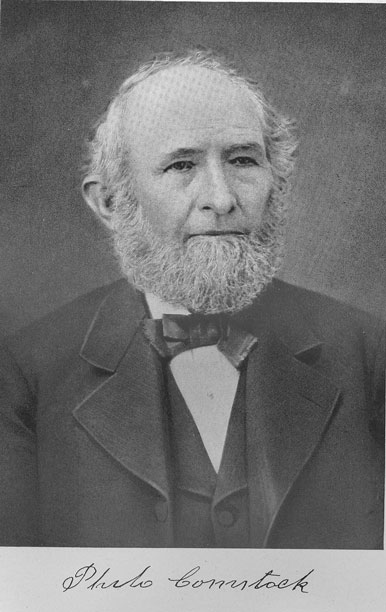
PICTURE OF PHILO COMSTOCK
HISTORY OF ERIE COUNTY - 1047
served as a member of the school board and in other public offices, and at one time was a nominee for mayor. He was also prominent in Masonry, and was affiliated with the Lodge, Chapter, Council, Commandery, the thirty-second degree Scottish Rite Consistory and the Mystic Shrine. In politics he was a republican and in matters of religion supported the Presbyterian Church.
By his marriage to Miss Lucy Perrin, Professor Felton had two , children, William and Ida, and by his second marriage, to Mrs. Matilda (Judson) Perrin, two children were born, Mary M. and Grace B . Grace married E. G. Tillotson, of Cleveland, and at her death left one daughter. Mary married Mr. Harry Allen and had two sons, Donald and Robert.
At Milan on March 20, 1895, Professor Felton married Julia B. Comstock. She was born at the old Comstock homestead in Milan Township east of Milan Village, December 11, 1843. As a young girl she attended the Milan Normal School. She still occupies the pleasant residence on Seminary Street in Milan, formerly the home of her parents, where she and her husband spent his last years. Mrs. Felton is a daughter of Philo and Julia Ann (Austin) Comstock. Her grandfather Nathan Sillick Comstock, married Betsey Seymour, and they were all natives of Connecticut. Nathan S. Comstock was one of the fire sufferers at Norwalk, Connecticut, during the Revolutionary war, and was given a large grant of land in the vicinity of Milan, Ohio. Philo Comstock, who was born February 5, 1809, in 1827, came with his sister Betsey, two years his junior, by way of the Hudson River and the Erie Canal and by boat to Huron and Milan, and took up his home on the portion of fire lands granted to his father. He began the improvement of his place, and in 1829 married Mary Newcomb. She died about eighteen months later. December 25, 1832, he married Julia A. Austin, She was born in Stamford, Connecticut, May 8, 1811, and also belonged to old Connecticut and New England stock. After their marriage they spent several years on the 300-acre farm, where they built a large brick house with a dozen rooms and of old colonial style of architecture. About 1875 Mr. Comstock retired to Milan and died in that village November 7, 1892.. His wife passed away March 14, 1895. The Comstocks were among the most prominent people of this section of Ohio, and lived lives of eminent usefulness and honor in the community. Philo Comstock and wife were charter members of the Milan Presbyterian Church and helped to build the first church edifice and supported its activities, and he was an elder for many years. In politics he was a republican. The Comstock children were : George S., who died young ; Edward A., who was in service as a Union soldier during thd Civil war, was twice married, had three daughters and a son, and is now living at the Soldiers' Home in Sandusky ; Francis D,., also died young ; Gertrude married John F. Randolph of Norwalk, ai1d they have a son and two daughters ; the next in age is Mrs. Felton ; Emma F. was married to Charles V. LaVayea of Cleveland, and she now makes her home with Mrs. Felton at Milan. Mrs. Felton is an active member of the Presbyterian church, belongs to the Research Club in Milan, and is past matron of Edison Chapter No. 112 of the Order of Eastern Star.
JUDE C. CANFIELD. The fine farm home in Florence Township now owned and occupied by Jude C. Canfield is the place where he was born, and which has been in the family for three successive generations. The Canfields have lived in this part of Northern Ohio for more than seventy years, and have been useful factors in converting the wilderness into a prosperous and highly developed country. The genealogical records of the Canfield family show its origin in France as early as 1350 A. D.,
1048 - HISTORY OF ERIE COUNTY
and from that country members of the name came to America during the colonial epoch.
Mr. Canfield's home is in Florence Township near the Huron County line, where he was born October 9, 1874. His parents were Darwin R. and Eunice (Corbin) Canfield, both of whom were natives of Huron County. His father was born May 24, 1846, and died January 20, 1892, and the mother was born September 12, 1848, and died April 26, 1895. The paternal grandparents were Calvert C. and Mary (Hanford) Canfield, who came from the East and found settlement in the wilderness, of Huron County in the very early days. Calvert Canfield, while living most of his life in Huron County, also acquired the land in Florence Township now occupied by his grandson. Darwin R.. Canfield and wife were married in Wakeman Township of Huron County, May 31, 1869, and began housekeeping on the place now owned by his son in Florence Township, and on this tract of seventy acres they erected a fine house, large barns, and spent their lives and later years in comfort and plenty. Darwin R. Canfield inherited this farm in Florence Township formerly owned by his father. They were members of the Congregational Church, and in politics he was a republican.
The only child of his parents, Jude C. Canfield grew up as a farmer boy and obtained a substantial education in local schools. After the death of his father he became owner of the seventy acres which had first been owned by his grandfather and later by his father, and has since made it into a fine farm, with substantial buildings, including an eight room white house and a barn 30x40 feet, and also a drying house 24x40 feet for his sweet corn crop, which is one of the important items in his agricultural business. He also grows abundant crops of corn, wheat, oats, has considerable meadow, and is in every way a progressive agriculturist.
He was married in Wakeman Township to Miss Ina Owen. Mrs. Canfield was born in Townsend Township of Huron County, June 27, 1879, and was educated in the Wakeman High School. Her parents are Romando and Georgia (Sherman) Owen, the former of Townsend Township, where he was born in 1860, and the mother, born in 1861, was a native of Wakeman Township, Huron County. They have been active farmers in Huron County during the greater part of their lives and now live in Wakeman Village, being members of the Congregational Church there, while her father is a republican. Mr. and Mrs. Canfield are the parents of three children: Geneva, who was born October 13, 1900. and is now a student in the Wakeman High School ; Pauline, born March 17, 1901, and also in the same high school; and Owen C., born January 15, 1904, and now attending the grade schools. Mr. Canfield and family support the Congregational Church and all the movements for the benefit of their locality and in politics he is a republican.
LIFE AND WORK OF HUDSON TUTTLE AND HIS WIFE EMMA ROOD TUTTLE. The life work of Hudson Tuttle is not confined to Erie County but is world wide. To a world view Erie County is but a small dot on the surface of the globe. Yet from that point, through the genius of such men as Hudson Tuttle, has radiated an influence that has touched the minds and hearts of people living in the remotest bounds. It was because he passed his entire home life in Erie County and departed from it to the immortal life on December 14, 1910, that a history of Erie County would be incomplete without an outline of his career.
His parents came to the town now known as Berlin in the early '30s, about 1831 or 1832, and bought the land, entirely uncleared, which is now known as Walnut Grove Farm, the old Tuttle homestead, where Hudson was born in 1836. His father was a native of Long Island and
HISTORY OF ERIE COUNTY - 1049
his mother of New Hampshire. Both were excellent people and noted for their integrity, intelligence and all around good citizenship. His father, Nathan Tuttle, lived to be eighty-nine years of age, and his mother, Maria Monroe Tuttle, reached the age of ninety-two. Hudson's prospects for length of years was apparently wood, but his ambition always overdrew on his strength, and his intense mental activity would not stop for a tired body. So his body slept "the sleep which knows no waking" at the age of seventy-four.
His work is still carried on at the old place, the Hudson Tuttle Publishing Company, Berlin Heights, Ohio, from which go out books to all parts of the world.
Mr. Tuttle was married in 1857 to Miss Emma D. Rood of Braceville, Ohio, also a writer with whom he became acquainted by her contributions to a Cleveland periodical. After their marriage they wrote, published and blended their literary labors, as well as home building and rearing of children, and in those beneficent activities their ideal marriage partnership endured for fifty-two years. They celebrated their golden wedding by the publication of "A Golden Sheaf" Which is still sold and from it is extracted the portion of what Mr. Tuttle says in "Ourselves" his introduction to the readers of the book.
"A journey of fifty years! How interminable it seems looking ahead, how short looking pastward! It would have been wearisome, objectless, selfish and disappointing, had it been taken alone. With companionship, support, sympathy and mutual trust, its cares are lightened, the weary days shortened, the flinty paths softened with the flowers of loving kindness. Now we have reached the western slope of the Great Divide, and in quiet I ask my companion: Had you known, that lovely morning we first met, all that fate had stored for our united lives, all the dark hours of pain, choking grief, disappointment, exacting tasks, would you have answered yes?
"I know you would affirm as unreservedly as would I, for, after all, the days of sunshine have been many and the dark days exceptional. They have come into our lives, not by our own seeking, but by the force of circumstances, and we have mastered them, not have they made the waters of life bitter, or broken its current. In the main they have been such as come to the lot of all, and we, standing together, have been stronger to meet and dare, than we could have been, alone.
"We thought our home, with the precious three children, ideal, and their going out into the world was hard to bear. Yet we could not always have them in the nest. The fledgling bird must fly, for the air is its element and it can be happy only when exercising its freedom. Nor could we hold our eldest with earthly ties, and must solace our aching hearts with the reflection that she gained a purer sphere by her emancipation from mortal life.
"They are all ours still, two on earth, one in heaven, and the heavenly one is nearer and visits us oftener ; is the most intimately ours, though oar mortal senses fail to reveal her shadowy form.
"The kindest manifestation of overbrooding love is the thick and impenetrable veil that shuts the future from us. Our strength is not wasted in vain fear of the inevitable, and when we meet tomorrow's message, we can bravely respond. Day by day it comes, and for the requirements made on us we have strength.
"All our children were born in the old farm homestead. Here they were reared. They have left souvenirs in the trees and shrubbery planted; the arbors they built, and pictures they sketched on the walls. The great elm was planted by our boy, Carl, when five years old. It was a tiny seedling with only three leaves when he brought it from the woodland. The tree with crimson foliage, our eldest daughter planted and
Vol. II-37
1050 - HISTORY OF ERIE COUNTY
like everything she touched, responded with vigorous growth. The wauhoo which all winter enlivens with its red fruitage, Claire, our youngest, brought from the woods when in leaf and made it live and grow by constant attention. The tall, ambitious lombardy which flaunts its aspiring coronal, like a gigantic plume, was set by Madge, our granddaughter, as she said, 'to keep my memory green,:
"And well do I remember, it is more than sixty years ago, my mother planted a walnut by the gate, saying that she wanted a shade tree there. Father gloomily said no one would live to see her tree cast a shadow. Now it spreads out its great limbs and the first frost covers the ground with its fruitage. The long row of beautiful maples, which flame in the autumn days, well do I remember when my father transplanted them, and I with childish strength held them up while he sighted them into line.
"Under the cedars is the grave of Trouper, our beloved St. Bernard, most human of all animals, most devoted and sympathetic.
"The rooms of the house which for half a century have been gathering bric-a-brac, books, pictures, and nameless gifts of friends, vibrate with influences which awaken a thousand memories—pleasing memories —with shadows here and there.
"Of the earliest-guest that my memory recalls (of my parents) was Prof. 0. S. Fowler, then in the floodtide of his efforts to bring phrenology before the world, and make it a factor of education. He had utilized the theoretical teachings of Dr. Gall, and his lectures captivated a public which was just awakening from the lethargy of religious domination and craving to be led to new fields. Phrenology did not prove itself a `science' nor establish the great claims he made for it, but he carried with it a tide of common sense in hygiene, self-culture, social relations, and liberal thought, and represented the most advanced ideas of the time-and far ahead of the time. Phrenology has passed, but the liberal ideas, religious, social and domestic, have displaced the old, and few there are who give this earthly pioneer the credit he deserves."
The broad scope to which Hudson Tuttle aspired even in childhood shows why his books are now in greater demand than ever before by educators, psychic students and even theologians. When he was a little lad a traveling preacher went through the woods on horseback and stopped with his parents over night, when the conversation was mostly on religion and beliefs, to which Hudson listened eagerly, noticing his 'alertness, said : "I guess you'll make a preacher, my boy, when you are a man." "If I do," said the lad, "I shall preach what you dont !" and he did. He wrote over a wide range of subjects, the best idea of which can be obtained by a brief quotation of the titles and some of the comments made on the standard works on Spiritualism published by the Tuttles. This list is as follows :
The Arcana of Nature, by Hudson Tuttle, with an introduction by Emmett Densmore, M. D. This book, first published nearly fifty years ago, and a long time out of print, has been republished in London. That it has been translated into several languages, and a new edition demanded, indicates its value.
A Golden Sheaf, by Hudson and Emma Rood Tuttle. Made of what the writers regard as among the most valuable of their inspirations in prose and poetry. A souvenir of their golden wedding.
Mediumship and Its Laws. Answering the question : How can I become a Medium? By Hudson Tuttle.
Religion of Man and Ethics of Science. By Hudson Tuttle.
The Arcana of Spiritualism ; a Manual of Spiritual Science and Philosophy. By Hudson Tuttle.
Origin and Antiquity of Man.
HISTORY OF ERIE COUNTY - 1051
Evolution of the God and Christ Ideas. By Hudson Tuttle.
From Soul to Soul. By Emma Rood Tuttle. This volume contains the best poems of the author and her most popular songs, with the music by eminent composers.
Asphodel Blooms and Other Offerings. By Emma Rood Tuttle. This volume is dedicated "To those whose thoughts and longings reach into the Unseen Land of Souls this handful of Asphodels, mixed with common flowers, is offered, hoping to give rest and pleasure while waiting at the way station on the journey thither."
Angell-Prize Contest Recitations. By Emma Rood Tuttle.
The Lyceum Guide. By Emma Rood Tuttle.
Stories from Beyond the Borderland. By Hudson and Emma Rood Tuttle.
Mr. Tuttle has left for -publication much valuable matter the world may yet see. His "Log Book of the Lucy Ann," a marine novel, is complete, and will some time appear.
He longed to stay and complete his work, and to establish mental freedom. He said : "When the Sun of knowledge shines from the zenith of the cloudless heavens, and there remains no dark shadow of ignorance behind which superstition may linger, then man will find restful peace in the certainty of law and order. Then will have perished the Religion of Pain, which has through past .ages held mankind on its rack of torture, and will have dawned in the millennial day, which is not divine, but essentially human, the Religion of Joy."
CHARLES O. MERRY. Here and there in Erie County can be found a family whose permanent residence can be traced back continuously for more than a century to the earliest pioneer times in this section of Northern Ohio. Such is true of the Merry family, represented by Charles O. Merry, one of the prominent farmer citizens of Milan Township. Milan Township was the original seat of the Merrys in this county, and where the name was established prior to the War of 1812.
Mr. Merry is a son of the late Ebenezer Merry and his grandfather was also named Ebenezer, and the same name was given to his great- grandfather. This family was founded in America early in the eighteenth century by Cornelius Merry, who with his wife left England and founded a home in Connecticut. A son of this emigrant was also named Cornelius, and spent his life in Connecticut. Ebenezer, the first of the name, was born about 1750 and in 1772 married Sarah Whiting. Tilley both died in the New England states.
Ebenezer Merry, the grandfather of Charles 0., was born at West Hartford, Connecticut, July 21, 1773, and after growing up moved to Avon, New York. He was married there May 5, 1800, to Charlotte Adams. The marriage certificate is written plainly in pen and ink by the justice of the peace Isaiah Fish. Charlotte Adams was born in Vermont; August 17, 1789, and was a daughter of Avon Adams, who belonged to the same Adams family which produced those eminent patriots and statesmen, John Adams and others of that name, who gained familiar places in American history during the Revolution.
Soon after their marriage Ebenezer and Charlotte Merry set out for the new country of Northern Ohio, journeying the entire distance on horseback and much of the way through dense woods inhabited by Indians, whose trails they followed, and they passed by cabins of early settlers and Indian wigwams in almost equal number. They arrived in the wilds of what is now Erie County and made their location near Milan Village. They were among the first occupants of the "fire lands" in Erie County, and in that publication known as "The Fire Lands
1052 - HISTORY OF ERIE COUNTY
Pioneers" published in June, 1882, in Volume 1 on page 135, extensive mention is made of the life and character of Ebenezer Merry and his wife. Ebenezer Merry built the first grist and sawmill at Milan This was an institution possibly surpassing that of any other in its value to the early development of the community. Largely as a result of his enterprise Milan became one of the most thriving of the new towns in the northern part of the state. All the early settlers living in a radius of many miles came to Milan in those days to get their grist ground and also to obtain their supplies of building material. Outside of his prominence as an industrial leader and business man Ebenezer and his good wife were chiefly noted for the hospitality which characterized their home. It is said that no traveler ever passed their way who was not invited within their doors and given the privilege freely of eating and remaining as long as he desired. In consequence of this open handed liberality their home came to be known as — The Free Inn." Ebenezer Merry helped to lay out the young Town of Milan, and he also owned a farm on the Huron River north of that village. During the War of 1812 the early settlers put up a blockhouse, to which all resorted in time of threatened danger. The repeated election of Ebenezer Merry to the early State Legislature and his service for two terms as associate judge plainly indicate his prominence in public affairs. About 1816 he built a large and substantial house, the wooden frame and siding being reenforced and plastered on the outside thus making it one of the most comfortable and elaborate of the early homes in Milan Township. On the site of this old home stood the large house subsequently owned by his son Ebenezer and still later by his grandson, Charles 0. Merry. Grandfather Ebenezer died at Milan, January 6, 1846. His widow passed away at the old homestead, where Charles 0. Merry now lives, and which stands on the bluff overlooking the Huron River and also commands a view of the birthplace of Thomas Edison. She died there February 8, 1879. Both were active members of the Presbyterian Church and in politics he was a whig.
Among the children of Ebenezer and Charlotte Merry was Ebenezer, Jr., who was born in or near Milan, January 15, 1820. He spent much of his life at the old home built on the brow of the hill north of Milan in 1837. He gained a very substantial education according to the standards of that time, and was engaged as a teacher at the old Merry schoolhouse which stood on the prairie three miles out from Milan. When only eleven years of age he lost a leg, but in spite of that handicap led a very active career. He was one of the first republicans to join the new party and filled a number of offices with signal ability. From 1844 to 1850 he was a county recorder, from 1850 to 1867 was engaged in business, part of the time as miller and part of the time as a ship builder. In 1867 he was elected county auditor, and held that office continuously by popular election for fourteen, years. While a county official his home was in Sandusky, but on retiring from office he returned to Milan and resumed his occupation as a miller. He died at the old home built by his father in 1837 and was about sixty-eight years 'of age when called away on April 11, 1888. He was a man of sterling worth, of trusted and tried character, and fitly merits a place in any history of Erie County. He was married in Milan in t848 to Attie C. Moore. She was born in Avon, New York, August 15, 1824, and was only a girl when she came to Erie County with her parents, Milton and Ruth (Merry) Moore, who settled on a farm near Hawleys Corners. Her father was born at Farmington, Connecticut, in 1779, and died in Milan in 1847, while her mother was born at Avon, New York, in 1792, and died January 31, 1850. The children of Ebenezer and Attie Merry were five sons and three daughters. Ruth died December 21, 1871, unmarried.
HISTORY OF ERIE COUNTY - 1053
Ebenezer who continued that name into this generation, died at Atchison, Kansas, at the age of twenty-eight, unmarried. Ella C., born in 1852, died in 1864. Charles O. is next in age. Allen H., born in April, 1858, died in the following September. Willis P., born in 1859, is a house painter and decorater at Milan, and by his marriage to Catherine Halpin has children named Catherine, Mary A., James H., Clara B. and John P. ; George S. is a farmer in, Milan Township and married Caroline Beeckley, who died in 1897, leaving children named Maud A., Earl G. and Helen L. Fannie L., born in 1866, died in 1871.
Charles O. Merry, who was born in Erie County, June 4, 1855, grew up in Milan Township, gained his education from the schools of his day and generation, and is now the owner of that splendid old homestead near Milan which has so many interesting associations for the Merry family. He has it improved with a set of substantial farm buildings, and the large house of eighteen rooms is the one built by his grandfather nearly eighty years ago. Mr. Merry was married at Sandusky, April 3, 1879, to Miss Elsie Capitola Rockwell. She was born in Lucas County, Ohio, January 6, 1859, but spent most of her early life in Oxford Township of this county. Her parents were John and Sarah (Wilcox) Rockwell. Her father was born at Catawba Hill in New York in 1816 and was married January 3, 1837, in Northeastern New York to Miss Wilcox who was born in Connecticut about 1820. In 1843 they moved from New York to Ohio, living for two years at Elyria, then coming to Milan Township, following which they were residents of Lucas County and spent the rest of their lives on a large farm in Oxford Township. Mrs. Merry's mother died there in 1892, while her father passed away at the Merry home in 1903. Her mother was a member of the Baptist Church and her father a Methodist and in politics he was a republican.
The children of Mr. and Mrs. Merry are the followinn.: Sarah A., born June 26, 1881, after graduating from the Milan High School was for five years a teacher, and is now the wife of Prescott Milliman, a farmer in Milan Township, and their children are Doris E., John L., Jr., and Marjorie L. Ebenezer J., born August 13, 1882, is a young bachelor still at home. Fronia Esther, born May 22, 1884, graduated from high school in 1902, and as a trained nurse from the Berea Hospital in Kentucky in 1911, and was for eighteen months in service in the Manila Hospital in the. Philippines but now makes her headquarters at Berea, Kentucky. Charles H. born April 13, 1886, lives in Seattle, Washington, mid by his marriage to Alice Sherwood of Ohio. has a son Ralph E. Ruth R., born September 25, 1887, graduated from the high school at Milan in 1905, and is now a successful teacher in the local schools. All the children received good advantages in the way of schools as well as home training in industry and the virtues of honorable living, and their careers so far have well justified the promise of earlier youth. Mr. Merry is affiliated with Milan Tent No. 46, of the Maccabees, and in politics is a republican. Mr. Merry and family belong to the Presbyterian Church.
CHARLES LOSEY. The business of general farming and fruit growing, under the favorable conditions offered in Florence Township, has an enthusiastic and altogether successful follower in the person of Charles Losey, the owner of an excellent estate of 100 acres on Rural Route No. 1 out of Birmingham. Mr. Losey is a native of Erie County, though for a number of years he lived in the State of Michigan, and only quite recently returned to the county and rejoined the agricultural community of Florence Township.
His family is one that was identified for several generations or more with the State of New Jersey. His grandfather, Ichabod Losey, was
1054 - HISTORY OF ERIE COUNTY
born in that state about 1790, was a solid and substantial farmer there, and died near Newark when past eighty-five. He married a Miss Con- dent, who was a native of the same state, and she also lived to advanced years. They were consistent members of the Baptist Church, and in politics he was a whig, and later joined the republican party and lived to see the triumph of its principles in the results of the Civil war, which had closed several years before his death.
In the next generation is John Losey, father of Charles. He was born near Newark, New Jersey, in 1818, grew up as a farmer boy, and when about thirty years of age came out to Ohio and while living in Huron County met Miss Sallie Ann Cole at Monroeville. They were married soon afterward in New York State. She was born at Buffalo about 1820, a daughter of John and Catherine (Francisco) Cole. Her mother was a daughter of Henry Francisco, who was born in France and came to America, probably as one of the followers of Lafayette, and served not only in the War of the Revolution but also the War of 1812. This soldier and American patriot died at Whitehall, New York, at the most remarkable age of more than a century. Mrs. John Losey had come with her mother from New York State to Ohio, her father having died and her mother having married a Mr. Hill. The latter and his wife both died in Huron County. John Losey after his marriage bought a farm near Monroeville, and he lived there until his death in 1900. His widow passed away in 1905, at the age of seventy-eight. Both were members of the Methodist Church and in politics he was a republican, and as a family they enjoyed the full respect of the community in which they lived for so many years. They were the parents of five sons and four daughters, and all of these are living except the eldest child, Ichabod, who died unmarried when about forty years of age. Kate is the widow of Gardner and lives in Norwalk, Ohio. Thomas is a farmer near Monroeville and by his .marriage to Mary Parsons has five daughters. Augustus is a farmer near Monroeville, living with his brother Thomas, and has a son by his deceased wife. Mary is the wife of Patrick McDonald, and they live at Louisville, Kentucky, and. have a large family of thirteen children. The next in point of age is Charles Losey. Emma. is the wife of Charles Cook, a farmer at Cheboygan, Michigan, and they have two sons and four daughters. Oscar lives in Townsend Township of Huron County, and has one daughter. Eugenia is the wife of Louis Bailey, a stationary engineer living at Norwalk, and they have two sons and one daughter.
It was at. Monroeville in Erie County that Charles Losey was born April 26, 1858. He grew up in that community, received his education there, and lived on his father's farm until the age of twenty-four, when he was married in Wood County, Ohio, to Miss Rose. Bratton. She was born in Huron County, January 8, 1862, and died in Michigan January 8, 1900. She was reared in Wood County by her foster parents, Mr. and 'Mrs. Joseph McConnell, having been orphaned when'a child by the death of her own parents, Mr. and Mrs. Samuel Bratton. Samuel Bratton was a soldier in the Civil war, was captured during one of the battles, and while kept in the notorious stockade prison at Andersonville, Georgia, died of exposure and starvation. A few years later his' widow died leaving three children : Mrs. Losey; Almond, of Norwalk; and Della, wife of Seth Fickenger, of Conneaut, Ohio.
After his Marriage Mr. Losey took his wife to Cheboygan County, Michigan, and there bought and improved a farm. This section of Michigan was at that time largely undeveloped and he was one of the helpful factors in the agricultural and civic community. After his wife died there he married Mrs. Fannie (Beasley) Douglass. By her former marriage she has three children: Floyd Douglass, who died at the age
HISTORY OF ERIE COUNTY - 1055
of eighteen ; and Abner and Herbert, both of whom are married and live in Michigan.
In the fall of 1907 Mr. Losey returned to Ohio, and at that time bought 100 acres of well improved land, with excellent farm buildings, near the Village of Florence in Florence Township. This has been the scene of his productive endeavors as a farmer for the past eight years. His early experience in Michigan and elsewhere has been valuable in the management of a farm in such an old, settled country as Erie County. Besides general farming he does considerable fruit growing, and has an excellent apple orchard and nine acres of young peach trees, about 1,000 in number.
Mr. Losey by his first wife haci nine children : Condent is a bachelor living at Des Moines, Iowa; Fred lives at Missoula, Montana, and is married and has one daughter ; Frank is a farmer with his father and still unmarried ; Lena is the wife of Duwayne Burrows, a farmer in Florence Township and they have a son named Charles ; Flossie lives at home ; Lillie is the wife of Lloyd Davidson of Elyria, Ohio, and their children are Rosa, Belda and Wade ; Margaret is the wife of Frank Parker, living east of Wellington, Ohio, and they have a son Charles J.; Belle lives at home ; and Ada, the youngest, is now the adopted daughter of her aunt, Mrs. Cook of Cheboygan County, Michigan. Mr. and Mrs. Losey and family are members of the Methodist Episcopal Church. In politics he is a republican and while living in Michigan served as clerk of his township.
GEORGE P. BENTLEY. After years of successful endeavor as one of the representative agriculturists of Erie County, Mr. Bentley removed from the old homestead farm which had been his place of abode from the time of his birth and established his residence in the Village of Birmingham, in 1912, and here he has since lived in the well earned retirement that consistently rewards him for the former years of earnest and productive application. He is a scion of the third generation of the. Bentley family in Erie County and the name which he bears has been prominently and worthily identified with the industrial and civic develop. ment and uphuilding of this now opulent section of the Buckeye State, where his paternal grandfather established a home in the midst of the forest wilds nearly a century ago.
On the homestead farm of which he himself became the owner and which is now owned and occupied by his only daughter and her husband, in Florence Township, George P. Bentley was born on the 4th of August, 1850, and he is a son of Parker and Amanda (Crawford) Bentley, both of whom were natives of the State of New York and representatives of sterling families that were founded in New England in the colonial era of our national history.
Parker Bentley was born about the year 1820, and was a son of John and Anna (Parker) Bentley, both natives of the State of New York, where the former was born April 20, 1782, and the latter on the 1st of September, 1792, their marriage having there been solemnized in December, 1818. In the old Empire State they continued their residence until after the birth of three of their children, and in the early '30s they came with their family to Ohio, the journey having been made with wagons and ox teams. ' John Bentley acquired a tract of timbered land in the wilds of Florence Township, Erie County, where Indians and wild game ' were still much in evidence, and his primitive log house was one of the early pioneer dwellings established in the township mentioned. This sturdy pioneer, with the assistance of his sons, reclaimed his land to cultivation, and the old homestead, which comprises 150 acres and which is situated to the east of the Vermilion River, on what is known as the,
1056 - HISTORY OF ERIE COUNTY
East Vermilion Road, is now owned by his grandson, Ira Bentley, of whom individual mention is made on other pages of this work. The members of the family did not escape the ravages of the all prevailing ague, or "chills and fever," and to avoid the same John Bentley and other members of the family went back to the State of New York seven different times, in as many seasons, before improvements and individual immunity made it possible for them to remain consecutively on the pioneer homestead. On this pioneer farmstead John continued to reside until his death, which occurred March 29, 1859, and there his widow was summoned to eternal rest on the 28th of April, 1862. Concerning their children the fdllowing brief record is entered : Sheba Ann became the wife of James Wood and died without issue ; Andomeda married Silas Dunham And she was a resident of Michigan at the time of her death, one of her children still surviving her ; Parker is the father of him whose name introduces this article ; the next child, a son, died in infancy ; Margaret became the wife of Dr. Moses Trumbull and both were residents of Ohio at the time of their death, all of their children being now deceased ; Anna, the wife of Ebenezer Hopkins, died in Florence Township, and two of her children are yet living ; John, Jr., was the father of Ira Bentley and further reference to him is made elsewhere in this volume, in the sketch of the career of the son.
Parker Bentley was a lad of about ten years at the time of the family immigration to Erie County, where he was reared to manhood on the pioneer farm, to the reclamation and development of which he contributed his aid. After his marriage he established his home on a tract of land that was mostly covered with timber and without any definite improvement. This place is situated on the Butler Road, about half a mile distant from the old homestead of his father. There he reclaimed a productive farm of 140 acres, and there he continued to reside until his death, which occurred about a quarter of a century ago. As a young man he wedded Miss Amanda Crawford, who was born in the same neighborhood as was he, in the State of New York, and who was a daughter of Alexander and Martha (Wood) Crawford, likewise pioneer settlers in Erie County. Mrs., Bentley survived her husband by nine years and both were consistent members of the Christian Church, earnest and upright folk who ever commanded unqualified popular esteem. Mr. Bentley was a staunch supporter of the cause of the democratic party and was influential in public affairs of a local order, as shown by his having served as a member of the board of trustees of Florence Township. Of the two surviving children George P. of this review is the elder. a- d his sister: Sarah, now a resident of the Village of Birmingham, this county, is, the widow of John Brogran, whose death occurred at Medina, this. state. Mrs. Brogran's first husband was Sidney A. Smith, and their daughter Clara is the only child of Mrs. Brogran, Mr. Smith having been a resident of Erie County at the time of his death. Clara, the only child, first wedded Jay Heath, and they became the parents of one daughter, Dorothy, who remains with her mother. After the death of her first husband Mrs. Heath became the wife of Herman Behrens and they reside in the City of Elyria, Lorain County.
Reared to manhood on the old home farm which was the place of his nativity, George P. Bentley made good use of the advantages afforded in the common schools of the locality, and thereafter was for six terms a student of higher branches, under the preceptorship of Job Fish, an able and popular instructor. He continued to be associated in the work and management of the home farm until the death of his father, shortly after which he became the owner of the property. There he continued his active and successful operations as an agriculturist and stock-grower until his retirement and removal to Birmingham, in 1912. The farm is
HISTORY OF ERIE COUNTY - 1057
specially well improved, having a substantial house of twelve rooms and two large barns, besides which its equipment includes the best type of silo and a modern windmill. The farm is now owned by Mr. Bentley's son-in-law, Clinton E. Ennis, who is one of the progressive and representative young farmers of Erie County. Upon his removal to Birmingham Mr. Bentley purchased his present attractive residence of eight rooms, and the supreme loss and bereavement in his life came with the death of his noble and devoted wife, who here passed to the life eternal on the 24th of March, 1914, at the age of fifty-nine years.
In Wakeman Township, Huron County, was solemnized the marriage of Mr. Bentley to Miss Julia. E. Deman, who was there born and reared. The only child, Elsie; acquired her education in the public schools of Birmingham and is now the wife of Clinton E. Ennis, owning and occupying the old home farm of her father. They have two children, Glenn, born in 1905, and Julia, born in 1908. Mr. and Mrs. Ennis are both members of the Methodist Episcopal Church, as was also Mrs. Bentley, whose gentle and gracious personality gained to her the affectionate regard of all who came within the sphere of her influence. Mr. Bentley is a democrat in national politics but in local affairs is not constrained by strict partisan lines, as he gives his support to men and measures meeting the approval of his judgment. He served four terms as assessor of Florence Township but official preferment has not been a magnet of any special attraction for him. He was formerly affiliated with the Birmingham camp of the Knights of the Maccabees and served nine years as its commander.
NICHOLAS NIEDING. The really free man is one who has some share in controlling and making his own destiny. It is the satisfaction which comes from in some measure creating one's own career that gives value to such substantial citizens as Nicholas Nieding„ who is one of the thrifty and progressive farmers of Florence Township, owning an attractive homestead along Rural Route No. 2 out of Wakeman. He is a farmer and stock raiser, and his home is situated on the west bank of the Vermilion River along the West Vermilion River Road. With fifty-one acres under his control and management, he has more than a local reputation as a grower of fine crops. Most of his farm land is situated in the river bottom, and possesses a fertility which wisely managed has proved the basis of Mr. Nieding's prosperity. Mr. Nieding bought this farm in 1909, hating previously for two years operated the Funk farm near Birmingham.
Nearly all his active career of more than twenty years has been spent as a farmer in Erie County. However, he was born in Brownhelm Township of Lorain County, September 25, 1872, and Was reared and educated there. He has lived in Erie County for the past twenty-five years. Mr. Nieding's parents and ancestors were substantial German people through all the generations. He is a son of Henry and Christina (Fraley) Nieding, who were born in Germany, and were married soon after they came to America. They became man and wife in Milan Township of Erie County and the father started his career as a renter on a farm. Subsequently they removed to Brownhelm Township in Lorain County, where he bought seventy acres of wild wood land. It was necessary to cut down a number of trees to clear a space before he could erect his first frame house. It was a substantial home, comprising eight rooms, and he also added other farm buildings, and made it a most valuable and attractive place. Prosperity rewarded his efforts, and he spent his last years in comfort. His death occurred in July, 1895, at the age of sixty-four, while the mother passed away February 21, 1909, being then seventy-one years of age. Both were members of the German Reformed
1058 - HISTORY OF ERIE COUNTY
Church, having been reared in that faith, while in politics he was a democrat. While they were people of most substantial character and achievements themselves, they deserve further honor because of their fine family of ten children, six sons and four daughters, all of whom are married and have families of their own,, and all live in this part of the state.
After growing up in Lorain County and getting his education in the local schools, Nicholas Nieding married at Sandusky Miss Emma C. Horchler. Shp was born in Licherode, Germany, December 26, 1868. She was only thirteen years of age when she set out alone for the United States, leaving her parents behind in Germany where they died about two years later. She made the journey from Bremen to New York, and thence came on to Erie County, where she joined some of her sisters. She lived for a time with her sister Mrs. Margaret Stump. Her other sisters were Mrs. Martha Asmus, now deceased, Mrs. Elizabeth Goodside, of Milan, and Catherine, who died after her marriage to Peter Leimbach.
To Mr. and Mrs. Nieding have been born three children. Christina H., born June 12, 1895, is now the wife of Lloyd Moats and lives in Berlin Heights ; Carl E., born May 5, 1899, is still attending school and lives at home with his parents; Caroline M., born April 24, 1902, is also in school. Mr. and Mrs. Nieding are both well known people in their community, are attendants of the Reformed Church and in politics he is a republican.
WILLIAM D. DAUGHERTY. More than any other one factor the railroad has developed the great resources of America. Thousands of individual communities derive their importance from their close relations with some great railroad system on which they are stationed. Very frequently the people of a community know a railroad in the personal sense only through its local representative, and whether a railroad means much or little to a town and the degree of esteem in which the transportation corporation stands in such locality very often depends upon the personality of its representative.
The thriving little Village of Avery in Erie County has been particularly fortunate not only as a result of the several splendid factories which have increased the life of the place but also on account of its location along the line of the Nickel Plate Railway., Fir many years the Nickel Plate has been personified in the minds of local citizens through the passenger and freight agent, the genial William D. Daugherty, who for nearly a quarter of a century has been the efficient medium for the transaction of business between the railroad and the community. Mr. Daugherty is the type of railroad man who renders a real service. He began serving this railway corporation in March, 1890, as a telegraph operator at Kimball in Oxford Township, but after eighteen months was transferred to Avery, and has since administered his duties on the chief transportation line through this locality with signal ability and efficiency, and has also identified himself with community life and affairs. He stands high as a citizen, as a churchman and as a member of the Masonic Order, and owns one of the most attractive and beautiful homes of the village. While this is a small community it, is a name which is gaining increasing prominence through associations with important industries that have their seat there. The three principal industries are, first of all, the great Hoover Manufacturing Company, and also a tile and brick company and sand company awl elevator, all of which furnish an immense traffic to the railroad at this point. Mr. Daugherty has a valuable faculty of being able to represent faithfully and efficiently an outside corporation and also to look carefully after the interests of his own community. Besides his position as passenger
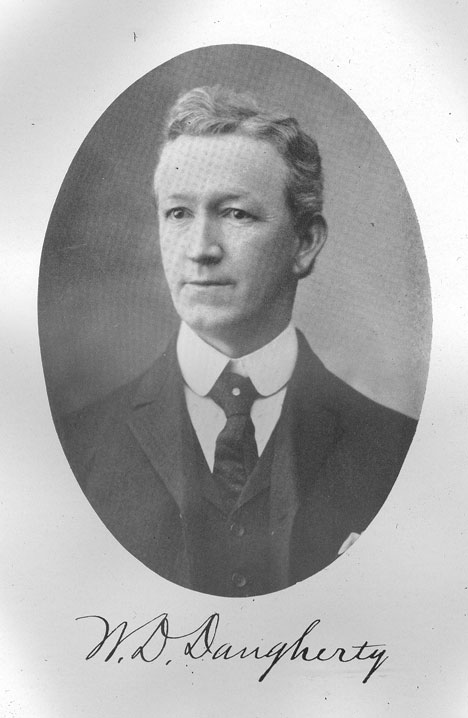
PICTURE OF W. D. DAUGHERTY
HISTORY OF ERIE COUNTY - 1059
and freight agent he has also served as the local postmaster since McKinley 's administration.•
Though most of his life a resident of Ohio, William D. Daugherty was born in the Far West, at Nevada City, California, January 29, 1866. He was six years of age when brought to Ohio by his mother, who located in Danville, Knox County, Ohio, and he was reared and educated in that town. His education was completed in a business college at the Danville Normal. When quite a young man he 'entered the railroad service, and for more than a quarter of a century has been closely identified with the Nickel Plate.
His parents were Dennis and Margaret (Kirby) Daugherty. His mother was born in Ireland, while his father was a native of Halifax, Nova Scotia, having been born there not long after his people came to America. Dennis Daugherty when quite a young man went with his parents to Iowa, and they were there among the pioneer settlers. Miss Kirby also went to Iowa as a young woman. In 1850, during the gold excitement, Dennis Daugherty went across the plains to California, riding one mule and leading another which carried his pack of supplies and equipment. On reaching the coast he procured a mining claim and continued its working for several, years. Returning to "the States" in the same way as he had gone out, a journey that required several months at that time, he was married in Iowa and soon afterwards started again for the West. He and his young wife made the journey this time in a wagon, and spent day after day pushing steadily westward from the Missouri Valley to the Pacific Coast. For protection against Indians and other dangers they kept in close company with other travelers, and a number of wagons were usually drawn up for the camp at night. At Nevada City Dennis Daugherty secured a mine and conducted it successfully until his death in the latter part of 1865. He was then about forty years of age and in the prime of life. William D. Daugherty was born after the death of his father. A few months a fter his birth his mother returned to the East, making the journey by vessel around Cape Horn to New York and thence west to Iowa, and spent some time in straightening up the business affairs of her husband in Iowa. She then returned to California and married there Richard Banbury. After a few years they returned East and by this time the transcontinental railway line, the Union Pacific, had been completed and they made the journey over steel rails instead of by the tedious transportation methods previously employed. They located at Danville, Ohio, where they spent the rest of their lives. Mrs. Danbury died there at the age of forty-five, survived several years by her husband. Mr. Daugherty has a half brother, Charles Danbury, who was at one time deputy court clerk, served as a soldier in the Spanish-American war, and finally moved to Illinois, where he died, leaving a widow and two children. Mr. Daugherty also had a sister, Mary, who died after her marriage to Albert Emrick, leaving three children. Another brother, Edward Daugherty, is now cashier of the Danville Bank, having formerly been a teacher, and by his marriage to Clara Workman has a daughter, Elizabeth, now the wife of Wade Watson, a jeweler at Danville, Ohio.
In Berlin Township of Erie County William D. Daugherty married Miss Myra Dotson. She was born February 14, 1875, grew up and was educated in her native township and at Collins, Ohio, and is a daughter of William Dotson, a family to whom reference is made on other pages.
Mr. Daugherty is an active member of the Lodge and Royal Arch chapters of Masons at Milan, and of the Council at Norwalk. He and his wife do much work in the Methodist Episcopal Church at Milan. He is a member of the official board and his church is one of his chief
1060 - HISTORY OF ERIE COUNTY
interests. His father lived and died a Catholic, but his mother after her second marriage became a Methodist and her children grew up in that faith. Politically Mr. Daugherty is a republican.
HUGH SUTTON. While reared a farmer and identified with that industry in Florence Township for several years, Hugh Sutton is now giving all his time and energy to supplying the needs of the little community of Florence Village, a place of about 100 population, and the surrounding district, with first class merchandise, operating the principal store at Florence, and having a large stock of staple goods with a store building 24 by 77 feet. Mr. Sutton is one of the younger generation of business men in Erie County, has shown himself honest and_ upright in all his dealings and what he has accomplished so far in life is an attractive promise of future usefulness. He has been engaged in merchandising at Florence for the past five years, at which time he came from his farm.
By the accident of birth Mr. Sutton is a native of Lorain County, having been born in Brownhelm Township, January 11, 1881. He grew up and received his education there and for eight years before engaging in merchandising was a farmer in Florence Township. His parents, Nelson and Arcelia (Reed) Sutton, were both born in Erie County, where both the Sutton and Reed families had settled in the early days. Grandfather Sutton was an early miller on Chappell Creek, Florence Township, and his mill turned out great quantities of the early lumber used in the building of homes and other improvements in that community. Nelson Sutton and wife after their marriage moved to a farm in Brownhelm Township, Lorain County, rented land there until 1902, and then moved back into Erie County, where the father bought 108 acres in Florence Township., The land was only partly improved, and after living there a few years he sold and purchased fifty-two acres near Birmingham. Nelson Sutton died there in the summer of 1912. at the age of sixty-six, but his widow.is still living in the county and is now sixty-four years of age. Both parents were originally members of the Methodist Episcopal Church, but in later years dropped their church relations. Mr. Sutton was a republican from the time of casting his first vote until his death. Their children were five in number.. Gertrude died at the age of twenty-one ; Emma is the wife of William Newberry, of Brownhelm Township, a farmer, and they have a son mined Nelson ; Cora is the wife of Fred C. Wykoff. a meat dealer at Toledo; William lives in Elyria and is connected with a hardware house in that city and is married and has two children, Earl and Dessie.
The youngest of the children, Hugh Sutton, managed to obtain a substantial education as a boy, but since early manhood has been self- supporting and is now not only the proprietor of a good business at Florence but also has a happy home. He was married in Vermilion Township to Miss Adaline Tisdall, who was born in that township in 1880 and received her education there. Her father, Hiram, died some years ago when in middle life, but her mother is now living with her daughter in Vermilion Township. The Tisdall family were Scotch Canadians. Mr. and Mrs. Sutton have one child, Elinor G., who was born June 2, 1906, and is now a student in the public schools. In politics so far as national affairs are concerned Mr. Sutton is a republican, but exercises his discretion in casting his ballot for local candidates.
JACOB STIEGER. Such capable citizens as Jacob Stieger are the men who are now bearing the brunt of the agricultural activity of Erie County. He is a general farmer and fruit grower in Florence Township and there owns one of the well improved farms near Masons Cor-
HISTORY OF ERIE COUNTY - 1061
ners, comprising sixty-five acres of land. He has spent many years in this county and the history of his childhood and family is one of more than ordinary interest.
He was born July 4, 1862, in the Province of Odessa, in the southern part of Russia, but is of Gel-man ancestry. Several generations previously one of his ancestors had been induced to emigrate from Germany to Russia, being offered freedom from military service and all the land he could cultivate. After he had got settled these promises were disregarded, and he as well as his descendants were- soon reduced to the intolerable conditions of the Russian peasants, a practical serfdom, a condition from which they were freed only by the general enactment of later years that relieved the greater part of the population of Russia from the old feudal burdens. Jacob Stieger's parents were Jacob and Caroline (Betty) Stieger. His father was a small Russian farmer, was married in that country, and all their children were born there, noted briefly as follows: Mary is the wife of Michael Schatz, a farmer in Huron Township ; Gottlieb lives on a farm near Menno, South Dakota, and is married and has a family; Christina is the widow of Andrew Elmer, and lives in South Dakota and is the mother of ten children; the next is Jacob ; Stephen lives in the same locality of South Dakota as his brother and sister and has a son and daughters.
When Jacob Stieger was about eleven years of age the family emigrated from Russia, passing through Germany and taking a boat from one of the-German ports to England and thence by an ocean liner to America. It required nearly a month for the family to journey from their old Russian home place to New YOrk City. From there they came on to Ohio and located on Kelly's Island, near Sandusky, and later removed into Huron Township, and for five years all the family lived in South Dakota. The parents then returned to Erie County, and the father bought forty-eight acres of land in Vermilion Township. He died there in 1899 at the age of seventy-six, while his widow passed away at the home of her son, Jacob, January 18, 1914, when within three months of her ninetieth birthday. The parents were faithful members of the German Lutheran Church, and after gaining the rights of American citizenship the father voted the republican ticket.
Such education as he had received in the schools of the old country Jacob Stieger supplemented to some extent by attending the local institutions in Erie County. He succeeded his father as owner of the 48-acre farm in Vermilion Tlownship, but in 1905 sold that place and bought sixty-seven acres at Masons Corners, in Florence Township. This land was already in a fair state of improvement, and in the past ten years he has carried forward his work in such a way as to not only yield him annual returns and profits, but also to bring the farm to a still higher state of cultivation and improvement. When he came to the place it had a barn 30 by 40 feet, which is still standing, and he also has a new barn 30 by 30 feet, with shed, a corncrib of 600 bushels capacity, and all the farm buildings are painted red. He and his family have the comforts of a good 8-room white house. Near the group of farm buildings is a 2-acre fruit orchard. He has derived his revenue from general crops and keeps good grades of stock.
In Lorain County Mr. Stieger married Miss Catherine Gall. She was also born near Odessa, Russia, in 1865, and was still a young girl when she came with her parents to the United States. Her uncle, Jacob Gall, had first come to the United States, but four years later returned to Russia to bring his sister and her husband, the parents of Mrs. Stieger, to the land of freedom. Louis Beatty, an uncle of Mrs. Stieger, returned to Russia, but was not welcome to his native land when he returned after a brief residence in the United States, and in
1062 - HISTORY OF ERIE COUNTY
fact incurred a great deal of danger and risk before getting out of the country again, having to resort to travel by night and dressed like a tramp in order to escape detection. The Gall family lived a few years in Dakota Territory, and then Mrs. Stieger's father, John Gall, who had lost his first wife and had married again, came to Erie County, Ohio, and subsequently removed to Clinton County, Michigan, where he died in 1911 at the age of seventy. His widow is still living there and is now past sixty-five.
Mr. and Mrs. Stieger 'nave a 'nappy family of children : V,arrie, The oldest, is the wife of Jay , Otto, a fanner in Berlin Township, and their children are named Mary, Edward and Charles. Anna, the second daughter, is the wife of Earl Hendrickson, of Berlin Township, and they have a daughter named Lena. William J., the oldest son, is now nineteen years of age, has completed his education and lives at home. Clara B. is a student in the Berlin Heights High School, while the two younger children are Jacob J. and Catherine, both attending the common schools. Mr. Stieger in politics is a republican and takes much interest in the local affairs of his home township.
ALBERT C. HOFRICHTER. As a dealer in groceries, produce, meats, etc., Mr. Hofrichter controls a substantial and representative business and is one of the enterprising merchants of the fine little City of Vermilion, his civic loyalty as well as his personal popularity in the community being indicated by his effective service as a member of the board of education of the district. He has maintained his home at Vermilion since 1906, has won distinctive success in his business activities and has a secure place in the confidence and good will of his fellow citizens.
Mr. Hofrichter has the distinction of claiming the Ohio metropolis as the place of his nativity, for he was born in the City of Cleveland, on the 24th of May, 1887. He is a son of Joseph A. and Julia J. (Rolshouse) Hofrichter, the former of whom was born in Louisville, Kentucky, and the latter of whom was born in the State of Pennsylvania. The Hofrichter family was early founded in Cleveland and has been one of prominence and influence among other leading German families of that city. The father of the subject of this -review was for many years engaged in the sheet-metal, roofing and cornice business in Cleveland and at one time was proprietor of the Cuyahoga Cornice Works. He was one of the substantial and highly esteemed business men of the beautiful Forest City, and there he continued his residence until his death, his wife having preceded him to the life eternal.
In the public schools of his native city Albert C. Hofrichter received excellent educational advantages in his boyhood and youth, though the death of his parents early rendered it necessary for him to become largely dependent upon his own resources, his mother having died when he was but six years of age and his father having passed away about two years later. When he attained to the age of fourteen years Mr. Hofrichter found employment in the wholesale grocery- house of the Ross & Sprague Company, and after remaining one year with this representative Cleveland firm he had gained such experience as to make him eligible for advancement. He passed a year in the employ of Grace & Housen, jobbers and wholesale dealers in groceries, and later he amplified his experience through his association with the representative Cleveland firm of Strong, Carlisle & Hammond, engaged in the machinery and general supply business. For some time Mr. Hofrichter held tR position of assistant secretary of the boys' department in the Cleveland Young Men's Christian Association, and subsequently he was employed by a Cleveland company engaged in the brass and gas-fixture business.
In 1906, as a young man of nineteen years, Mr. Hofrichter came to
HISTORY OF ERIE COUNTY - 1063
Erie County and established his residence at Vermilion, where he entered the employ of the F. W. Wakefield Brass Company, of which he eventually became an interested principal and of which he was made secretary and treasurer in 1910. Of this dual executive office he continued the incumbent until January, 1915, when he established his present independent business enterprise, which has proved most successful under his energetic and well ordered management. He continued his identification with the F. W. Wakefield Brass Company, of which he is a director, and he is recognized as one of the alert, and successful young business men and loyal and public-spirited citizens of the city and, county of his adoption. He is a republican in his political proclivities, is a valued member of the board of edueation•of Vermilion and both he and his wife hold membership in the Church of Christ.
On the 4th of June, 1908, was solemnized the marriage of Mr. Hofrichter to Miss Clara M. Wakefield, daughter of Frederick W. Wakefield, of Vermilion, and the three children of this union are Albert C., Jr., Hazel W., and Margaret J.
ISAAC SPORE. The late Isaac Spore, long a resident of Erie County, Ohio, came of a family that had its origin in Holland, and representatives of the name were long established in the farming country of the Hudson River Valley in the State of New York. As a rule, few of the name penetrated beyond the confines of the valley. They were well content to spend their days in the peace and quiet of their wholesome and industrious lives, and they did much from generation to generation to upbuilding communities wherein they spent their days. One of the name, however, who was not content to live and die in the valley was David Spore, the father of the subject of this review.
David Spore was born on June 27, 1809, and died at his home in Berlin Township, Erie County, Ohio, August 6, 1866. He was reared in the trade of a stone mason in Albany County, New York,, and there he married Lucy Pratt, born in New York State in 1813, and the daughter of a country lawyer and a prominent local musician in his time. In about 1852 David Spore, with his wife and children, came, via the Ilrie Canal and Lake Erie, to Sandusky, Ohio. Later they came to the home of a kinsman, Abram Spore, who had settled previously in Huron County, and after they had a chance to look about them the newcomers bought a home in Berlin and there spent the remainder of their lives. David Spore died there in 1866. He spent the years of his life in the work of his trade. He was a whig and a republican. His widow survived him for some years, and passed away at the home of their daughter, Mrs. William H. Jefferson. Mrs. Spore was familiarly. known in the community as Aunt Lucy, and she was deeply loved and genuinely mourned when she departed this life. She was prominent in the Adventist Church, and was a devoted Sunday-school worker all her life. She was also devoted to the cause of temperance, and did much good in the community to promote a higher standard of living.
Isaac Spore was one of nine children of his parents. He was born in Albany County, New York, on the highest point of Helderburg Mountain, on August 20, 1833, and he was nineteen years old when he came with his parents to Ohio. He had a fairly good education for that time, obtained in the schools of Albany County, and after coming to Ohio he entered Oberlin Academy, after which he taught school for some time. After his marriage, however, he turned his attention to farm life and settled on the farm which was his wife's property. It was situated on the State Road in Florence Township, and on the opposite side of the road was a 68-acre tract which he owned himself. Mr. Spore died on May 7, 1900, at the home place. He was one of the dependable men of
1064 - HISTORY OF ERIE COUNTY
the town, straightforward and just, manifesting in his every-day life those sterling traits that ever mark the man of Holland ancestry.
Mr. Spore was married in this township and, county to Elizabeth Judson. She was born in the house in which she took uprher married life, and she has spent her days there down to this time She is the daughter of James and Betsy (Burr) Judson, and she was born June 16, 1837. Her parents were natives of Connecticut.
It is more than ninety years since James Clarke Judson settled in Erie County. He was for a great many years one of the leading men of Florence Township and his work as a surveyor in particular .has left its permanent impress on the lines and subdivisions of a considerable portion of this county. He is honored by a number of descendants in this and other states.
Born in Ballston Springs, New York, April 10, 1795, James Clarke Judson was a son of Andrew and Charlotte (Clarke) Judson, both of Monroe, Connecticut. They moved back to Monroe from, Ballston Springs soon after the birth of their son. Andrew Judson was a son of Ephraim, and the line is traced back through successive generations with Deacon John, Deacon Ephraim, John, Joseph, and William. William was the founder of the family in America in the year 1634. Charlotte Clarke was a daughter of Capt. James Clarke. Her ancestors preceding Captain Clarke were Zechariah, James, James, James, and the last named James signed the fundamental articles of agreement at New Haven, Connecticut, in 1639.
James C. Judson married Betsy Burr, a daughter of John and Jerusha (Beardsley) Burr. She was born December 16, 1798. After their marriage they lived at Brookfield, Connecticut, where he was occupied with his trade as blacksmith, until the spring of 1825. He then emigrated to Florence, Huron County, now Erie County, Ohio, bringing his wife and baby and the family of his wife's parents. Mi. Judson settled on a farm a mile west of Florence Corners. Two years later he went back to Connecticut on horseback and returned by horse and wagon as far as Buffalo and by boat from there to Huron, bringing with him his eldest daughter, who had been left behind on account of illness.
In 1835 Mr. Judson sold the west part of his farm, on which he had built a frame house, now occupied by Prof. Job Fish. The following year he built another house farther east, where he and his wife spent the lest of their days.
Mr. Judson's services as a surveyor, an art in which he had become skilled, were in much demand in the new country of Erie County. His name appeared frequently on the county records as engineer of many of the roads in Erie and Huron counties. He was a charter member of the Episcopal Church at Wakeman, and was a faithful attendant until the decline of that church, when he and his family worshiped with the Methodist Church at Florence.
He was much respected in the community and his counsel was frequently sought by those in trouble. He settled many estates and was guardian of several children and their estates. He was of a genial disposition and a good playmate for all children who visited at his home.
Mrs. Judson died February 23, 1885, and he followed her on April 1, 1885. Their children were : Nancy J., born in 1822; Burr, born in 1824; Antoinette, born in 1829; Albert W., born in 1831; Elizabeth, born in 1837; and Charlotte, born in 1839. Of this family the only survivor is Mrs. Elizabeth Spore, who lives on the old home. Nancy married Russell W. Butler and died in Norwalk, September 26, 1909. Burr married for his first wife Sarah Bissell, and for his second wife Melissa Jones, and he died in Crown Point, Indiana, in' 1899. Antoi-
HISTORY OF ERIE COUNTY - 1065
nette married William W. Bissell, of Clarksfield, and died March 10, 1914. Albert W. married for his first wife Cynthia Scott and for his second wife Mary Ann Fish, and he died in Sandusky, April 22, 1904. Elizabeth married Isaac Spore. Charlotte died young.
To Isaac Spore and his wife five children were born, of whom lnief mention is made as follows:
Arthur M. Spore is secretary of the American Crayon Company of Sandusky. He married Minnie Porter, daughter of Joseph Porter, who was for years master mechanic for the Big Four Railroad. They have children as follows: Charlotte R., Howard J., Leland P., Esther L , and Judson P.
Clarence J. Spore was educated in Oberlin Academy. He is a prosperous farmer of Florence Township, occupying a part of the old Spore place. He married Carrie M. Church, and they have a son, Harold C., a graduate of Oberlin College, class of 1914, and now an instructor of the physical training department in that institution.
Herbert C. Spore lives in Oberlin. He is a graduate of the Berlin High School, and also attended the Indiana State Normal at Valparaiso, Indiana, and the Ohio State Normal at Athens, Ohio. For many years afterward he was engaged in teaching, but is now succe§sfully identified with agricultural pursuits. He married Amy Walker Barlin, and they have three children. Arthur W. Spore, a graduate of Oberlin Business College, is now with the Goodyear Rubber Company, in their office at Akron, Ohio. Jessie is a graduate of Oberlin College, and is now a director of physical training at the Central High SPchool of Minneapolis, Minnesota. Mabel is now a student in the Oberlin High School.
Charlotte C. is the wife of Frank E. Peck, who is connected with the state hospital at Massillon, Ohio. They have no children.
Nellie A. is a graduate of Oberlin. She finished the grade schools at the age of fifteen, taught school for awhile, then entered Oberlin College, and later taught in that institution. She has since perfected herself in the department of physical training, and was employed as a director in physical culture at Mount Holyoke College in Massachusetts. She was there employed from September, 1894, until June, 1908, with the exception of one year when she had leave of absence. In 1909, owing to ill health, she gave up her much loved work and is now living at home.
JOHN D. MICHEL, of the younger generation of farmers, is a native of Erie County and so much impressed with its agricultural and residence advantages that, like hundreds of others, he has never been able to see that he could better himself by making a change of location. His entire career has been devoted to the pursuits of the soil,' and through intelligent and well-directed labor he has worked his way to a position of prestige, being at this time the owner of 130 acres of good land, and the object of the regard and esteem of a wide circle of friends.
Mr. Michel was born in the City of Sandusky, Ohio, December 11, 1886, and is a son of Daniel and Mary (Link) Michel. His father was born in Germany, where he was well educated and brought up in the wine industry, a business of which he mastered every detail. However, he was not satisfied with the opportunities for advancement to be found in his native land, and accordingly resolved to try his fortune in the land across the ocean, with the result that in his eighteenth year he emigrated to the United States. From his landing port of New York, he made his way to Sandusky, Ohio, where he soon secured employment in the business with which he was familiar, and being industrious, willing and trustworthy, made rapid advancement until he became the
Vol. II-38
1066 - HISTORY OF ERIE COUNTY
proprietor of a business of his own. Mr. Michel was connected with the wine industry at Sandusky for more than twenty years and established a reputation as a substantial and reliable business man, but in 1892 turned his attention to farming and took up his residence in Perkins Township. As a farmer he proved successful for the same reasons that he had gained prosperity in his other business—he was industrious, thrifty and true to engagements, he carried on his business operations, under modern methods, and he inspired confidence in others by integrity. After a long and useful career he passed away in '1908. Mr. Michel was a democrat, but not a politician. He married Miss Nary Link, who was born at Sandilsky, Ohio, daughter of Morris and Mary Link, late residents of that city. Mr. and Mrs. Michel became the parents of eight children, namely : Theresa ; Emma, who is the -wife of George Schwanger ; Joseph ; John D., of this notice ; Edith, who is the wife of Earl Hart ; Mary ; William; and Leona.
John D. Michel was six years of age when brought to Perkins Township by his parents, and here he was reared on the homestead place. He was given good educational advantages, attending the public schools and then taking a course at the Sandusky Business College, following which . he returned to the home place and took over its management. He has made a success of his ventures and his 130-acre tract of land is under a high state of cultivation, producing large crops annually and giving generous returns for the labor expended upon it. While he has followed general farming principally, Mr. Michel has not overlooked any opportunities for enlarging the scope of his work, and the various departments of farming have always received attention from him. His methods are progressive, his labor is energetic, and this combination has brought about very compensatory results. Mr. Michel is a democrat, but his activities in public affairs have been confined to casting his vote and to supporthig movements for educational and civic advancement.
Mr. Michel was married in Perkins Township to Miss Florence Odell, of West Huron, Ohio.
WALTER H. TAYLOR. In Berlin Township, along Rural Route No. 2 out of Berlin Heights, is situated the large and well kept farm and beautiful country residence of Walter H. Taylor and wife. The Taylor family with its various connections may properly be classed among Erie County's pioneers, since they have been identified with this locality more than eighty years. A great deal of the progress in material improvements and the upbuilding and maintenance of institutions in Berlin Township since that time can be credited to a comparatively few families like the Taylors.
The first settler of the name in Northern Ohio was Alfred Taylor, grandfather of Walter H. He was born in Westport, Connecticut, in 1794, and was of New England ancestry. Back in Connecticut he was a member of the state militia and a leader in the loaal military band, and among the old settlers was particularly known for his activities as a musician and band leader in both Erie and Huron counties. In January, 1823, Alfred Taylor married Sallie R. Bennett, of Westport, Connecticut. She was born August 10, 1800, and died in Berlin Township in 1857. In 1858 Alfred Taylor returned to Connecticut where he married Lovina Crossmond, who died in Berlin Township about four years after her husband, After his first marriage Alfred Taylor became a contractor for the construction of pike roads and docks. While he lived in Connecticut four children were born to him: Theodore, James, Benjamin S., and one that died when two years of age while the family were on their way to the West, in October, 1832. In starting for Ohio they
HISTORY OF ERIE COUNTY - 1067
went through the Connecticut country by wagons and teams, traveled up .the Hudson River on a boat, and were on a canal boat on the. Erie Canal when this infant child died, and its body was laid to rest along the banks of that canal. From Buffalo the family proceeded up the lake to Sandusky, and thus came on to what is now Berlin Township, where Alfred Taylor bought 100 acres of wild land on the Townsend Road, not far from the villages of Berlin and Berlin Heights. For a number of years they lived the simple existence of pioneers, their home was a log cabin, and hard work and considerable privations were endured. Alfred Taylor improved his land ,and later replaced the log cabin with a substantial frame house, which had the somewhat unusual feature of two open fireplaces. This house is still standing, and one of the fireplaces can still be used. A number of years later Alfred Taylor bought the old Minard farm across the road, and that is the farm home first mentioned as the residence of Mr. and Mrs. Walter H. Taylor. Alfred Taylor had many years of usefulness and honorable esteem in Erie County. He died at his farm home in 1879. His first wife had passed away about middle age. Alfred Taylor was eighty-four years of age when he died, and his second wife was past eighty. They were members of the Congregational Church, and in politics he supported the Whig party as long as it was in existence and afterwards the republicans. In many ways he exerted an influence as a citizen. He was regarded as the most expert snare drum player in Erie County, and under his leadership the local band gained a reputation which some of the older settlers will still recall with pleasure. Alfred Taylor also built and owned the band wagon which carried the company of musicians around all over Huron and Erie counties. This band was regarded as invaluable for political campaign purposes and every big rally and other political assemblages of fifty or sixty years ago was not complete without Mr. Taylor's musicians.
Benjamin S. Taylor, a son of Alfred and father of Walter, was born in Connecticut, November 7, 1823; and died an his farm in Berlin Township, January 25, 1912. He was twelve years of age when he came with his family to Erie County. his brother Theodore died when a young man and still unmarried, and his brother James married but died without children. Benjamin Taylor should be remembered as a successful farmer and stock raiser, one who made a success by hard work. and whose activities and character were such as to command esteem and respect. For a number of years he owned and occupied a farm west of Berlin Village, but died at the house of his son Walter. The distinction belongs to him of having installed the first steam sawmill in Berlin Township, and he conducted it for many years, and from it furnished the lumber which entered into the construction of many boats at Milan an.d Huron. Like his father before him, he possessed a character of positive quality, tried to observe the strict ideals of honesty and justice, but, was always generous and helpful to those who showed any tendency to work and help themselves. In politics he was a democrat. On May 9, 1849, Benjamin S. Taylor was married in Huron County to Miss Harriet Phillips. She was born in Fairfield, Connecticut, November 29, 1823, when five years of age went to New York State, and in 1834 came with her parents to Huron County, Ohio. Before her marriage she was a popular teacher, and her death occurred April 22, 1899. Her parents were Benjamin and Hannah Phillips, both natives of Connecticut. On coming to Ohio they bought a farm in Huron County, and lived there the rest of their days. Benjamin Phillips was for many years an invalid before his death, but both he and his wife attained advanced years. Mrs. Taylor was a member of the Congregational Church, and that faith
1068 - HISTORY OF ERIE COUNTY
was the preference of her husband. It should be noted that Benjamin Taylor grew up as a republican and held to that political doctrine for many years, but finally left the party and became a democrat.
Walter H. Taylor was one of five children. The daughter Mary died after her marriage to E. K. Fisher, and was survived by her husband and three children, all of the latter being now married. Ellen 1s the wife of J. D. Fisher, of Berlin Township, and their children are : Carrie, who was born December 25, 1878, was educated in the Milan High School, at the state university and the training school in Cleveland, and is.now a missionary in Liberia ; and Lloyd, who is an engineer on the Lake Shore Railway and is married and has two children, Mary C. and James W. The daughter Cora is still unmarried. Eva is the widow of E. E. Waldron and lives at Norwalk, Ohio, and has one daughter.
Walter H. Taylor was born on his father's old farm west of the Village of Berlin, June, 1854. His education came from the old Normal School at Milan, and when ready to take up the serious responsibilities of life he received by the will of his grandfather 100 acres, a tract of land which has already been referred to. Since then Mr. Taylor has followed an active and progressive career as an agriculturist, and there are few better bodies of farm lands in Berlin Township. All the land is in cultivation except six acres of native timber. His group of farm buildings is a feature that at once attracts the attention of all passers by. The residence is a large building containing fourteen rooms, and there are also two large and substantial barns, one of them a bank barn 40 by 50, and a horse barn stands on a foundation 30 by 40 feet.
In Henrietta Township of Lorain County, September 10, 1879, Mr. Taylor married Miss Nettie Jane Courrier. She was born in Berlin Township of Erie County not far from the home in which she now lives on January 28, 1857, a daughter of Joseph and Jane (Vanderpoole) Courrier. Both her parents were born in New York State, but were married in Erie County. Her father died in Henrietta Township of Lorain County in 1876 at the age of forty-two, and her mother in liuron
County in 1904 at the age of sixty-seven. They were members of the Christian Church, but later joined the Methodists, and her father was a republican. Mrs. Taylor. grew up in Lorain County, and has proved herself an unusually capable mistress of the fine home over which she presides. She and her huband attend the Congregational Church. In national politics Mr. Taylor is a republican, and has rendered some good service to the community through nine years as township trustee. He is a past commanding officer in the Knights of the Maccabees, belonging to the order at Norwalk.
LEVI ARNOLD. The following sketch contains the important facts in the life and family record of a former Erie County citizen whose name always stood for all that is honest and of good report in this community, for successful thrift and business integrity, and for a position which all must respect. The Arnold family has been identified with Erie County since pioneer days, the early generation havIng made homes out of the wilderness and the late Levi Arnold himself was a product of a log cabin home and a log schoolhouse, but like many others of that generation apparently suffered little handicap in a life of abundant prosperity and civic usefulness.
At the old Arnold home in Milan Township Levi Arnold passed away December 19, 1900, in his sixty-eighth year. He was born in Ashtabula, Ohio, March 6, 1833, a son of Ira and Eliza (Harrison) Arnold. His father was born near Lake Champlain, New York, and was reared in
the home of a well-to-do uncle in Northeastern New York. In that same
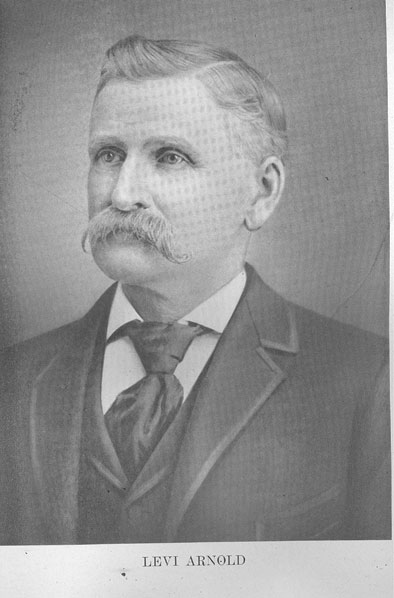
PICTURE OF LEVI ARNOLD
HISTORY OF ERIE COUNTY - 1069
locality his wife was born and reared, and after their marriage there they moved west to Ohio about 1830. They located on a tract of new land in Ashtabula County, spent several years in a log cabin home, but after effecting some improvements on their first farm they sold out and located in hnox County, Ohio, and still later came to Erie County, this being in about 1840. Their first location was near Union Corners in Milan Township, and there the children received most of their school advantages. Later the family moved to Spears Corners in the same township, and a year later the parents moved to Oxford Township, where the father purchased his last farm and home. He died there when seventy years of age, and the mother attained the venerable age of ninety-three. Both stood high in their community, were loved and respected, and came to a serene old age. In spite of her advanced years the mother continued smart and active all her days, was a great talker, and members of the younger generation delighted to hear her stories of early times in Ohio. She was very domestic, and for many years rarely left her own home and fireside. She and her husband were both members of the Spiritualist faith. Their children were : Mary, who died unmarried at the age of twenty-four ; Levi ; Spencer, now deceased, who served as a soldier in the Union army and for a time was on guard duty at Johnson's Island, and is survived by one daughter ; Phoebe Ann, who died when a child; Norman, who is now living in Eastern Ohio and has a family of sons and daughters.
The late Levi Arnold grew up and received his education in Milan Township. He was a small boy when the family came to this county, and on reaching his majority he made choice of farming as his regular vocation. He bought over 100 acres of land in Oxford Township prior to his marriage and during the Civil war time. Subsequently he sold this and for a few years was a renter. He then bought his permanent home on the Milan Road near the Village of Av., containing eighty- two acres of well situated and fertile land. Here he and his wife not long afterward took up a special industry of growing strawberries. At one time he had about twenty-five acres in this crop, and many carloads of splendid fruit shipped over Ohio and other states came from the Arnold farm. During the season there were frequently between 150 and 200 people engaged in picking the berries, and a day's yield was not infrequently as high as 300 bushels. Mr. Arnold laid the basis of a substantial fortune as a pioneer strawberry grower. He also conducted general farming operations, getting large crops of grain, and in later years planted a considerable acreage in potatoes. The material improvements which he effected on the place are still in evidence.' They comprise large barns, other buildings for the shelter of tools and implements and the storage of crops, and a commodious two- story twelve-room house, with basement under all and, with every modern convenience. For many years Mr. Arnold served as a director in the County Fair Association, and the pick of his fields was frequently exhibited at local fairs. In politics he was a strong republican.
In 1858, at Spears Corners, he married Rachel Everitt. Mrs. Arnold was born at Spears Corners June 12, 1839, grew up and received her education there and her entire life has been spent in Erie County. When only fifteen years of age she was given charge of a school and continued teaching four years. She proved a most capable helpmate to her husband, and deserves a large share of the credit for the upbuilding of the farm and the abundance which rewarded the efforts of herself and husband. She has proved her ability as an independent manager of this fine farm since the death of her husband. Mrs. Arnold is a daughter of David and Abigail (Sweasey) Everitt, both of whom were
1070 - HISTORY OF ERIE COUNTY
born in New Jersey, and after their marriage and in the early '30s came to Erie County, Ohio. Her father was a blacksmith by trade and had one of the early shops at Spears Corners. Some years later, about 1855, he bought a good farm in Huron Township, and that was the scene of his later years. He was eighty-six w hen he died and had been hale and hearty up to the last. In politics he was a republican. His wife lived to be seventy-six. While they belonged to no church they were people of the finest quality of morality and most helpful members of the community. in their family of thirteen children one son and six daughters reached maturity, married and had children of their own. Mrs. Arnold has one living sister, Mrs. Abbie A. Rowley, who lives at Lorain, Ohio, and who has a son, Allison Rowley, superintendent of the steel works.
To the marriage of Levi Arnold and wife were born five children. Clinton, who is a well educated man, has lived in Chicago for a number of years and is one of the well known educators of that city ; his daughter, Bessie, is the wife of Dr. James Hanson, a physician at Sandusky, and they in turn have a son named James F. Wilbert, the second child, is now the practical manager of his mother's fine farm in Milan Township, and by his marriage to Louise Lookwood has two children named Harold and Dorothy. Charles Arnold, who has also attained prominence in educational circles, is a graduate of the State University at Columbus, has taken post-graduate work in Harvard University, and is now professor of mathematics at the University of Ohio; he married Leora Burrington, and their daughter, Helen, is now eleven years of age. The two other children, Iva and Frank, both died young. Mrs. Arnold and family attend the Presbyterian Church and her husband was also regular in his worship in the same denomination. For a number of years both Mr. and Mrs. Arnold were active members of the Milan Grange of the Patrons of Husbandry.
CAPT. CHARLES WEITZMAN. From an early period in its history Erie County, by very virtue of its situation, has contributed a generous quota of strong, vital and sterling citizens to "go doWn to the sea in ships" and to become influential_ factors in connection with navigation
interests and service on the Great Lakes, the most wonderful of inland it seas. As sailor and master of vessels Captain Weitzman has long held high prestige and by reason of his worthy service in connection with commerce and traffic on the lakes as well as in recognition of his status as one of the liberal, loyal and honored citizens of Erie County is he entitled to definite representation in this publication.
A scion of an ancient and sterling family of the. Kingdom of Wurtemberg, Germany, where one generation after another of the line was to be found established in the-picturesque Rhine district, near Oberheim and Nussheim, and where the family long stood expotient of the great and fundamental industry of agriculture, were born the paternal grandparents of Captain Weitzman, and there they passed their entire lives, the grandfather having been a substantial farmer and the family faith having been for many generations that of the Catholic Church in the German Fatherland. Carl Weitzman, father of him whose name introduces this article, was born and reared in the Rhine district- of Wurtemberg, where the family home was in the same neighborhood as that of Jacob Gunzenhauser, who came to the United States and became the founder of the well known family of that name in Erie County, Ohio, his first settlement having been at Sandusky, the present metropoplis and judicial center of the county. Reports carried back to Germany by letters from this former neighbor and valued friend so impressed young Weitzman with the advantages and opportunities offered in
HISTORY OF ERIE COUNTY - 1071
America that he decided to join Mr. Gunzenhauser in Ohio, a record concerning the latter being found on other pages of this work, in the sketch of the career of his son, John G. Gunzenhauser.
As a lad of fourteen years Carl Weitzman severed .the home ties and bravely set forth for the New World. At Hamburg he embarked on a sailing vessel of the type common to that period, and by this medium he found transportation to New York City, the voyage having covered a period of several weeks. From New York he made his way to Sandusky where he received a warm welcome by the Gunzenhauser family, and as a sturdy and ambitious youth he soon found employment on sailing vessels plying the Great Lakes, his first experience being that of assistant cook in the galley. He continued to be connected with this department of service on the lakes for many years, and in the connection was pleasantly associated with a number of the old- time lake captains of broad experience and high reputation in their chosen vocation, the while his ability and uprightness combined with his genial nature to gain to him the high regard of those with whom he came in contact and made him well known and distinctively popular in lake-marine circles. From the year of his arrival in America until after he.'had passed the sixtieth milestone on the journey, of life he found employment as a cook on vessels plying the lakes, and in his department he gained specially high reputation, it being well known and axiomatic that it is often easiest to appeal to a man's heart through the medium of his stomach. After severing his association with navigation interests Mr. Weitzman finally, assumed an executive position with the Wickham Company, of Huron, engaged in the fish and lumber business, and he continued to be thus engaged until within a few years of his death, the closing period of his long and useful life having been passed in well earned retirement from business activities and his death having occurred at Huron, in December, 1909, at which time he was seventy-one years of age. Though he was reared and confirmed in the Catholic Church, he became a Protestant after his marriage, his wife having been a member of the German Reformed Church, with. which he affiliated, though not as a constituent member.
As a young man Mr. Weitzman married Miss Agnes Wunderley, who was born at Huron, this county, in 1847, and who was here summoned to eternal rest in January, 1911, her entire life having been passed in her native place and her circle of friends having been limited only by that of her acquaintances. She was a daughter of Elias and Elizabeth "(Rice) Wunderley. The great-grandfather of Mrs. Weitzman Was Alexander Wunderley, who was born in Switzerland, a scion of a strong, thrifty and aggressive old family of that fine little republic. He was reared and educated in his native land and shortly after his marriage he immigrated with his wife to the United States, in the early period of the nineteenth century. After a weary and tempestuous passage the vessel on which they sailed dropped anchor in the port, of New York City, whence the journey was continued by the primitive means then available, river, canal and Lake Erie to the Ohio shores. Mr. Wunderley became one of the pioneer settlers of Seneca County, this state, where he obtained a tract of wild land from the Government and instituted the reclamation of a farm, this old homestead having been situated near the present City of Tiffin. There he and his wife passed the residue of their lives, success having attended their earnest labors as members of the early farming community, and both attained to advanced age, their religious faith having been that of the Catholic Church. They reared a large family of children, all of whom are now deceased. Of the children Alexander, Jr., was born on the old homestead in Seneca County, about the year 1813. He was there reared to
1072 - HISTORY OF ERIE COUNTY
adult age and in his youth learned the trade of shoemaker. At some time between the years 1830 and 1832 he came to Erie County and established his home in the little hamlet of Huron, with whose civic and material development he became closely concerned, and for many years he continued one of the honored and influential citizens and business men of this place, whose river and line harbor on Lake Erie early made it a point of more than little commercial and industrial importance. In the thriving little village he engaged in the work of his trade, and eventually he built up a large business in which he employed several assistants in manufacturing the old-time boots and shoes. Later he became identified with other lines of mercantile enterprise and he continued his residence at Huron until his death, in 1868. Both he and his brother Elias, who likewise was a resident of Huron County, were deprived each of a patrimony of about $2,500-a very appreciable sum at that period—both having been disinherited by their father because of their apostasy from the Catholic Church, though they never afterward became regular members Of any other religious organization. Alexander Weitzman, Jr., wedded at Huron Miss Elizabeth Rice, who was born in Germany, in 1816, and who came alone from her native land and became a resident of Huron, Erie County, when she was a girl of but fifteen years.
Captain Weitzman of this review was the second child and eldest son in a family of five sons and two daughters: Clara, eldest of the number, i§ the wife of Lucius LaVoo, who is a tug engineer by vocation, and they reside at Huron, their four children being Edith, Ruth, William and Yale. Louisa, who became the wife of Charles McLaughlin, is deceased and is survived by two children, Clifford and Mildred, both of whom are now married. Frank is a resident of Sandusky where he is engaged in the mercantile business and has served as a member of the city council; he has no children. Otis was drowned while on a pleasure trip on Lake Erie and was nineteen years of age at 41ic time, in 1896. Howard is engaged in the insurance business at YounsL-town, this state, and has two sons, Lene and Vance. _
Captain Weitzman grew to maturity in Huron, received the advantages of the public schools and at the age of eighteen years initiated his career as a sailor sion the Great Lakes, his first position having been on the schooner David Provost, on which he finished the navigation season of 1885 as a sailor before the mast. In the following season he was on the Comrade, as was he also the next season, and the following year he served as watchman on the steamer Columbus. His next work was as wheelman of the Wetmore, and later in the season of 1890 he assumed a similar position on a superior vessel commanded by Capt. John E. Peterson, of Huron, a veteran and honored vessel master from this port and part owner of the Comrade. Captain Weitzman served on the steamers Columbia and J. C. Iiockwood under Captain Peterson, with whom he continued to be thus associated several years, in the capacity of wheelsman and second mate, to which latter position he was promoted in 1892. In 1894 he was advanced to the office of first mate and he remained with Captain Peterson in this capacity until 1896. In the following year he was with Captain Dick Jolly of the C. B. Lockwood, and the following year found him retained as first mate of the Appomattox. In 1898 he was first mate of the steel vessel Meseba, and thereafter he was first mate of a similar vessel named the Maritanna, on which he served a portion of the season of 1902. He then received his first distinct command, as master of the steel barge Maderia. on which he finished the season. Thereafter he commanded in turn the Joliet, the German, the Meseba, of which he had formerly been. mate ; and from 1907 to 1910, inclusive,
HISTORY OF ERIE COUNTY - 1073
he was in command of the Maricopa. From 1911 to 1914 he served each successive season as master of the steamer Harvard, a vessel of 7,000 tons burden; and the season of 1915 found him in charge of another vessel. He has made an admirable record in his chosen vocation and is known in maritime circles throughout the entire Great Lakes system, with a popularity based on steadfast integrity and genial personality.
Captain Weitzman gives his political allegiance to the republican party; he and his wife and their son are members of the Presbyterian Church at Huron, and in his home city he is affiliated with Lodge No. 369, Free & Accepted Masons, and with Huron Lodge No. 756, Independent Order of Odd Fellows, in which he has passed the various official chairs.
At Huron was solemnized the marriage of Captain Weitzman to Miss Mollie Stickrath, who- was born and reared at Vermilion, Erie County, and who is a ,daughter of John and Joan (List) Stickrath, both natives of Hesse-Cassel, Germany, though their marriage was contracted at Vermilion, Erie County, where he and his wife passed the remainder of their lives, he having been a shoemaker by trade and vocation. Mr. Stickrath died in middle life and his widow attained to the age of seventy-two years, both having become members of the Lutheran Church after they came to America. Henry Stickrath, the one surviving brother of Mrs. Weitzman, is a resident of Marion, this state, and the maiden name of his wife was Ella Thompson; they have no children. Captain and Mrs. Weitzman have one son, Hiram C., who was born in the year 1895, and who was for two years a student in Oberlin College; in 1915 he completed a course in a business college in the City of Sandusky.
CARL KNITTLE. Along the lake shore in Vermilion Township is situated the attractive home of Carl Knittle. He owns sixty-five acres of highly improved land situated on Main Market Road No. 13, with an outlook over the waters of Lake Erie. Carl Knittle has spent all his life in this one locality, and his place has the advantage of being located near Mittewanga Grove and near Ruggles Grove, two well known parks and summer resorts.
On this farm Carl Knittle first saw the light of day May 25, 1877. He acquired the land from his father, and has for fifteen years been one of the progressive men in the agricultural line in this section of Erie County. He raises fine grain crops, fruits, particularly apples, and everything he undertakes he carries forward with characteristic energy and progressiveness. His home is a substantial seven-room white house with green trimmings, and besides various other farm buildings he has a substantial barn 36 by 64 feet.
It was in 1900 that Mr. Knittle acquired this farm from his father, Jacob Knittle. Jacob Knittle was for many years a leading farmer in Erie County. He was born in Hesse, Germany, in 1830, and his parents lived and died in the old country. He had six brothers and three of them came to the United States together, but they separated at New York City, and they were never afterwards in touch with each other. Jacob Knittle was twenty-two years of age when he came to America. He made the voyage by sailing vessel from Bremen to New York, and was on the ocean seven weeks. This was an unusually long trip even for the slow-going sailing vessel. The passengers were subjected to many discomforts and privations, they had little food and water, and they were afflicted with all the ills to which passengers on ocean-going vessels forty or fifty years ago were exposed. Some weeks after arriving in New York City he found a home in Vermilion Township and worked as a farm hand for Simeon Phels. Some years later he invested his
1074 - HISTORY OF ERIE COUNTY
meager earnings and savings in twenty-six acres of land on the lake shore. To this he added thirty-five acres, and the entire place is now owned by his son Carl. On this old homestead Jacob Knittle and wife spent many years. He passed away May 3, 1894. He was a member and official of the. Mittewanga German Reformed Church and in politics a strong democrat. He was married after coming to Vermilion Township to Susanna Altmiller. She was born in the same locality of Germany as her husband, being a few years younger, and was still a girl when her parents died. She came as a young woman to America on the same vessel that brought Jacob Knittle, and they married after reaching Erie County. She died at the old home on the lake shore November 14, 1911, at the age of seventy-nine. There were six children in the family : Henry, who is a farmer in Berlin Township and has five children; Valentine, a farmer in Townsend Township of Huron County, who is married and has a son and six daughters, including three pair of twins; Anna, wife of John Croll, a well known resident of Erie County; Mary, who died at the age of fifteen ; and George, a farmer and truck gardener in Lorain County, who married Miss Mary Ruth.
Carl Knittle was reared and educated in Vermilion Township. He has shown himself to be a live business man, and though not yet in the prime of his years has possessed himself of those things for which ambitious men put forth their most strenuous endeavors.
In his home township he married Miss Catherine Knoch. She was born in Vermilion Township June 29, 1886, was reared and educated here, and has spent practically all her days within sight of Lake Erie. Her parents were George and Catherine (Hildebrandt) Knoch, both natives of Germany. Her father came when a young man to the United States and to Erie County, and was married in Vermilion Township. Mrs. Knoch died when her daughter, Mrs Knittle, was four months old. Mr. Knoch subsequently married a second time, but both he and his second wife are now deceased. Mr. and Mrs Knittle are the parents of the following children: Jacob, born January 11, 1906, and now in school; Earl, born October 13, 1907; Almon, born January 28, 1909. Mr Knittle and wife are members of the German Reformed Church, and for a number of years he served it-as a deacon. In politics he is a democrat.
JOHN H. REIBER. No class of people in Erie County enjoy greater comforts and advantages than those who live on the farms. John H. Reiber has spent all his life in Vermilion Township, and now owns one of the fine places near the lake shore, and his material prosperity is reflected in his prominence as a citizen, and at the present time he is serving as township trustee.
Born in the same township and near the farm where he now resides July 26, 1873, he was reared and educated here, and the, farm on which he was born he still owns. This comprises 571/9 acres of land, all under thorough cultivation with the exception of eight acres in timber, and very productive both in general crops and in fruit. Mr. Reiber has six acres in peaches and two acres in apples ; but the chief feature of his farming enterprise is the growing of sweet corn. He usually plants about twenty acres in this crop and has sold his crop for More than a thousand dollars a year. His specialty in sweet corn is Stowell Evergreen. He also grows other crops and keeps five horses, three cows and a number of hogs. He has a good barn 36 by 60 feet, but the house on the old farm is one that was built a number of years ago. As a temporary place of residence Mr. Reiber lives on the Lake Road and Drive near the street car line, having rented a place there.