HISTORY OF CLARK COUNTY - 425
CITY OF SPRINGFIELD.
BY OSCAR T. MARTIN.
TO dignify with the sonorous name of history the unpretentious narrative of events which here follows may be an unwarranted assurance. It is simply an attempt to. gather in a connected chain links which have been loosely scattered around us. They have been found in disconnected sketches, historical collections, jottings in the press, and in the memories of the elder citizens. It has been well said that an outline scrawled with a pen which seizes the marked features of a countenance will give a much stronger idea of it than a bad painting in oils. If these pages will, therefore, by a strict adherence to facts, and a partiality to dates and prominent circumstances connected with the origin and growth of the city, outline its progress and present to the reader a comprehensive glance of the subject, more will be accomplished, in the opinion of the writer, than if an attempt had been made at literary display, or accuracy sacrificed for the graces of rhetoric. Much has been written here which, perhaps, had better been omitted, and it is equally true that much has been omitted which should have been written; and, while the censor may be just in his most caustic criticisms, yet the great historian whose words we have placed upon the lintel has given us the consolation that this will not be the first failure in historical ventures.
When James Demint, from his lonely cabin on the hillside north of Buck. Creek, looked out of his rude doorway, he saw before him a gentle slope, falling gradually toward the south, with a natural drainage in all directions; in the center of a rich, undeveloped country, directly within the path of travel between the settlements of the East and the West, and with a healthy, vigorous stream running busily along the foot of the declivity. He saw also, here and there,, clumps of trees, royal in foliage, shadowing generous spring, which gushed unbidden from a thousand nooks and corners in the hillsides, enticing the rich herbage into rank extravagance, and suggesting one of nature's hostelries,. where peace and plenty were spread with no niggard's hand. Demint saw that here was a favorable location for a settlement, which would in the future become a city of wealth; that nature had laid the ground-work of the plan which the energy and enterprise of man would develop; and it needed but the suggestion of a lady, Mrs. Gen. Simon Kenton, who was attracted by the superabundance of local springs, to dub the future town Springfield. Thus the cabin of the hardy pioneer, who, with prophetic vision, seemed to have cast the horoscope of the then embryotic city, became the nucleus of the frontier settlement, which soon grew into the thrifty hamlet, then the ambitious town, the restless, enterprising, manufacturing city, where the throbbing engines of industry beat ceaselessly, and the hum of busy wheels grows stronger year by year.
426 - HISTORY OF CLARK COUNTY.
The spot so selected and christened in chivalric style was in the midst of a fertile country, surrounded by deep forests, with a soil of unsurpassed richness, and a water-power which was of inestimable value in early times. It was located on the banks of Buck Creek, or Lagonda, near the confluence of the latter with Mad River. The old Surveyor, William Brown, at one time fixed the exact latitude and longitude of Springfield. Its latitude, according to Brown, is 39 degrees 54 minutes 22 seconds north; longitude, 5 hours 35 minutes and 34 seconds west of Greenwich in time, or 3 degrees 53 minutes and 30 seconds in parts of the circle. Tradition says that the Indians were wont to tarry here temporarily on their hunting expeditions, but had not made it a habitation, and hence there was no name for it in the Indian tongue.
"LA OHONDA."
The stream popularly known as Buck Creek was by the Indians called Lagonda. Those who were best acquainted with the Indian dialect did not hesitate to say that it is a derivative from " Ough Ohonda" (Buck's Horn, Little Deer's Horn, or Little Horn), from the Wyandots, and afterward abbreviated by the French traders to "La Ohonda," which early dropped by usage to Lagonda. This term was no doubt applied to the stream by the Indians because of its forked and crooked course, which the reader who will trace its sinuosities upon the map will see has not a very distant resemblance to a pair of buck's horns.
THE FIRST SETTLEMENT.
As the history of the city is but an aggregation of the acts of the individuals who from time to time were its inhabitants, the first settler occupies a prominent position in the foreground. Adventurous frontiersmen had, during the closing years of the last century, been exploring the virgin forests which bordered the banks of the two Miamis. It was evident that all that fertile country was soon to be redeemed from the savage hordes who were steadily retreating from advancing civilization.
Although not directly connected with' the first settlement of Springfield, yet, as indicative of the growth of the vicinity, it is worthy of note that, in the summer of 1795, David Lowry, a native of Pennsylvania, with Jonathan Don nels, members of a surveying party, whose object was to obtain an accurate Survey of the public lands in this portion of the Miami purchaso, in the prosecution of their work came to what is now Clark County, and encamped one Saturday evening near what is now the village of Enon, and nearly opposite the mouth of Donnels Creek, where Lowry afterward built his residence. The fertile Mad River bottoms were so rich with promise of future harvests that Lowry determined to return and locate permanently in that vicinity. In the fall of the same year, having purchased a tract of land from Patten Shorts, then a large land owner in this section, he removed to the place where he afterward made his home. Following Lowry the next year came two men named Kreb and Brown, who, encamping near Lowry on Mad River, broke up the ground and engaged in tilling the soil. The first attempt at establishing a village in this neighborhood was made in August, 1799, when John Humphreys and Gen. Simon Kenton, with six families from the adjoining State of Kentucky, settled near the bridge on Mad River, west of Springfield, and erected -a fort and fourteen cabins as a blockhouse station for protection against the Indians.
JAMES DEMINT, THE FOUNDER OF SPRINGFIELD.
James Demint, with his family, came from Kentucky the same year. The bluff overlooking the beautiful Lagonda appeared to him a more favorable lo-
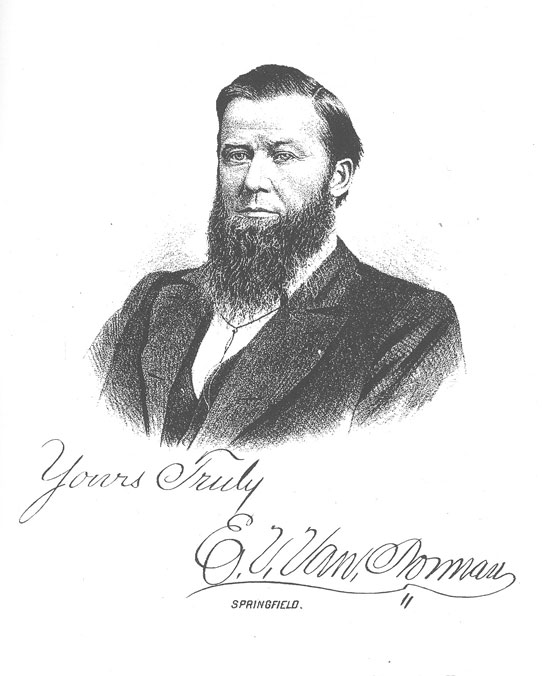
PAGE 427 - PICTURE OF E. V. VAN NORMAN
PAGE 428 - BLANK
CITY OF SPRINGFIELD - 429
cation than the Mad River bottoms, where the Humphreys settlement had been formed. He built the first log house within the present limits of the city. It was a large, double log cabin, and stood for many years on the brow of the hill on the north bank of the Lagonda, on the west site, and near the State road, now Limestone street, leading to Urbana. The present Northern School building, formerly the Seminary, is near the site of this cabin. Mr. Demint entered and held by certificate from the Government a large tract of land south and west of his new home. This he afterward laid out into town lots, which are embraced in the first plat of Springfield, and is here given:
ORIGINAL PLAT OF THE TOWN OF SPRINGFIELD
(NOT SHOWN)
430 - HISTORY OF CLARK COUNTY.
The surveyor who laid out this plat was a young man named John Daugherty, who was then temporarily stopping at Demint's cabin. He commenced the work March 14. 1801. The intention had been formed by Demint to lay out a town on the slope facing the bluff, on which the proprietor had located his cabin. The plat as shown here indicates his purpose to have the center of his town midway of the slope, which he has designated on the plat as the public square. The principal streets ran parallel with the Lagonda Creek. Columbia street was at that time the principal thoroughfare, or Main street, and what is now Main street was then known as South street. Subsequent developments, however, pushed the center of trade south, and the adoption of South street as the line of the road from Springfield to Dayton established that street as the Main or business street of the place.
When Daugherty began this survey, there was some trouble about finding a starting-point. as the Government survey had not yet been completed. He finally determined to go down to the range line running between Ranges 8 and 9 and measure due north a distance of four miles, which would fix the position of the Government section line when it should be run by the Government- sur vey. This brought him to about where the line of High street now is, and from there the new plat was laid off, and is dated March 14, 1801.
Sometime after this. probably in the fall of the same year, Israel Ludlow, as Government Surveyor, established the present section line between Sections 34 and 35. This line passes through the open alley which runs between the First National Bank and the new commercial building on Limestone street, and is two hundred feet. more or less, farther north than the south line of the town plat as located by James Demint. In short, two surveyors, each measuring four miles in the same direction, made a difference of about two hundred feet in the result of their work. It is needless to add that the last line was the true one, because it was one of the great system of lines by which this county was divided. though the experience of every surveyor from then until now is that the first measurement was very nearly correct, while the Ludlow surveys generally overrun, both in distance and quantity. There has been, therefore, a dispute as to the exact locality of these lines, but the statement here given may be regarded as authentic.
The public square as designated in the plat, and now occupied by the court house, county buildings and Soldiers' Monument, was intended as an open space, the center of the future city, but the wishes of the founder in this respect have not been observed, and the lots have always been occupied to the street. The recorded plat is dated and signed by James Demint September 5, 1803, and was recorded in Greene County September 13, 1804, it being then included in the limits of that county:
BEAUTY OF LOCATION.
A more favorable location for a prosperous city could not have been selected. The extensive area of table-land that lay thirty feet or more above the level of Buck Creek, with an undulating surface, or rising into abrupt bluffs,. opened from this chosen site not only a varietv of scenery, but a broad range for an extended growth. We take the following description of the landscape from a faithful narrator-Dr. John Ludlow:
"The scenery had all the irregularity and variety of a New England landscape. without its hardness and abruptness. For several miles east and south of the new village of Springfield, the country was an undulating plain, which in the summer was covered with tall grass, mixed with a great variety of flowers. among which a species of wild pea, very fragrant but now extinct, was abundant. The country north for miles was an unbroken forest of large trees in
CITY OF SPRINGFIELD. - 431
great variety. The beautiful and never-failing stream called Buck Creek, or Lagonda, fringed its northern border with clear, running water. Mad River, with its rapid current. was within a couple of miles of its northwestern boundary. The `Rocks.' or perpendicular bluffs, filled with deep strata of solid limestone on either side of Buck Creek as it advanced toward its junction with Mad River, were covered with cedars, hanging vines, ferns, mosses and flowers; the wild grape-vine hung from the statelytrees and dipped its tendrils into the placid stream below: the sycamore bent its projecting boughs over its banks, while the sugar maple and mulberry. towering above, with the dogwood, redbud, spicewood, butternut, buckeye and other trees, with their variegated leaves, formed a beautiful and attractive picture. Near the mouth of Mill Run, a little rivulet which flowed near the south and west lines of the village, the scenery was unusually attractive and romantic. The little stream went tumbling over the rocks in order to reach the brief valley below and empty its waters into Buck Creek. On each side of this cascade, there were high, projecting rocks, covered with honeysuckles and wild vines and beautiful ferns, which hung down in festoons as a curtain to the chasm below., which was taller than a man's head. On the east side of this chasm, there was a large spring of water flowing from a round hole in the rock. with a strong current. remarkably cold, and depositing a yellow sediment. On the west side, there was another spring of delicious water, which, in after years, slaked the thirst of little fishing and picnic parties, who found delight on the banks of Buck Creek in the wild and picturesque. valley."
FIRST COMMERCIAL ENTERPRISE.
The first commercial enterprise was inaugurated by Demint, who some time after his location erected a small still at the foot of the hill below his cabin, and near the present spring-house on the Northern School grounds. and began making "fire-water" for the Indians end settlers. Demint was a rough, reckless man. a type of the class who are always found upon the frontier. In his wife he had a suitable companion, a hard working affectionate woman, who was a help-meet for her husband in the hardships of a pioneer life. Among the denizens of the rocks along Buck Creek, were multitudes of rattlesnakes which were driven from their dens by Demint. his good wife assisting in smoking them out and killing them as they attempted to escape. It is said in one spring they killed ninety of these reptiles in this manner. Jesse Demint, son of James, shot and killed near the rocks an immense panther, which measured nine feet in length. and was supposed to be the last of its race in this vicinity.
CHARACTER OF DEMINT.
James Demint. although recognized for his many good qualities, had a passionate fondness for whisky and gambling. He frequently would mount his fine bay horse. for a visit to the neighboring towns where he usually indulged in a prolonged spree. On these visits he would supply himself with a new deck of cards, and eagerly engage with any one for small wagers. At one time, he was playing with a man who owned a very fine deck of cards. He took such a fancy to it that he determined to purchase it, but the owner refused to sell, and it was only when Mr. Demint offered him a deed in fee for any lot on the plat of Springfield which he might select, for the cards, that he was induced to part with the treasure. The exchange was made and the consideration for one of the finest and most valuable blocks in the city. was at one time a gambler's deck of cards. The founder of Springfield died about the year 1817, at the tavern of the Widow Fitch in Urbana. His widow, who was his second wife,
432 - HISTORY OF CLARK COUNTY.
afterward married a man named John Rust. He followed teaming between Springfield and Cincinnati, and lived for several years about four miles from Springfield, on the old Dayton road. The venerable William Patrick, of Urbana, in a letter read at the Clark-Shawnee Centennial, says (Patrick) was an employe about the house of the Widow Fitch at that time, and remember on a summer evening that Mr. Demint rode up and ordered his horse put up, and took a room and would receive such persons as would minister to his chosen pastime, and other amusements. I have said already that he was addicted to drink; I do not mean, however, that he would stagger or wallow in the gutter he was of the kind that could drink deeply and not show intoxication. His great mania being for the enjoyment of his cherished game for small stakes, he followed his accustomed amusements at any points in the village that would screen him from the lynx-eyed officers of the law. He would frequently, during his stay, take a nap on a Iong bench that stood against a partition in the bar room, where, one evening, a little before sun down, the old landlady came to me and told me to wake up Mr. Demint and prepare for supper; and obeying the request, I went to him on the bench and shook him, and called him by name; but he stirred not, and to my horror I found him dead. He had gone to sleep to wake no more. And after the bustle and excitement of preparing the body for the cooling board was over, it being nearly 9 or 10 o'clock. John Fitch, the son of the old landlady, approached and asked me who would go to Boston (Springfield) and inform his wife. I immediately answered "I will go," so he immediately ordered the hostler to saddle and bridle the dead man's valuable gelding, and when all was ready he said to me "give me your foot," and immediately vaulted me into the saddle, slapping the horse or. the buttock, and addressing me waggishly, said: "Bill be careful that old Demint does not get on behind you." And although I was never subject to superstition, yet for the life of me I could not avoid looking askance occasionally during my lonely and melancholy ride that night, reaching my destination about daybreak, and breaking the sad news as well as I could to his wife. After taking some refreshment she immediately had a horse saddled and returned with me to Urbana, receiving the coffined remains of her husband and returning to Springfield for sepulture immediately."
GRIFFITH FOOS' ARRIVAL.
In 1801, Griffith Foos brought several families to Ohio from Kentucky. The Scioto Valley- at first attracted them, but, finding it malarious, they determined to seek a more congenial locality. In March, 1801. they came to Springfield on horseback from Franklinton, near Columbus, following Indian trails as their guides.
They had heard from hunters that the Mad River Valley was a healthy and beautiful region. and, when near what is now the county seat, they entered upon an Indian trail which they followed until they reached Mad River. They passed up the valley without observing the Humphrey's settlement, going in the direction of Urbana, until they reached "Pretty Prairie," then changing their course southwestward they followed Buck Creel: until they came to James Demint's cabin. The party enjoyed his hospitality For several days, and, after an inspection of the country, expressed themselves well pleased, and as Mr. Demint offered them valuable land at very low prices and stated his intention to lay out a town as soon as competent surveyors could be procured, Mr. Foos and party concluded to return to Franklinton, where they had left their families and household goods and bring them to Springfield. Four days and a half were required to move from Franklinton. a distance of forty miles. They made the first wagon track into Springfield from that direction. They were com-
CITY OF SPRINGFIELD. - 433
pelled to cut down trees to make a roadway and ford streams. They trans ported their goods over the Big Darby upon horses, and then drew their wagons over with ropes while some of the party waded and swam by the sides to prevent them from upsetting.
THE FIRST TAVERN.
We now enter more directly into the history of the development of Springfield, as a distinct feature of the county. Prior to June, 1801, the town plat as laid out by Demint was without an occupant. The log cabin on the bluff north of the creek was the only tenement visible. but as Mr. Foos had expressed a desire to locate here for the purpose of going into business soon after his return from the Scioto Valley, he began the erection of a house to be used as a tavern. It was a double log house, and was located on the south side of what is now Main street, a little west of Spring street. In June, 1801, he opened it to the public, and continued it until the 10th of May, 1814. These were the days of magnificent distances, and the patrons of Mr. Foos lived within a radius of forty miles. On the day announced for the raising of Mr. Foos' cabin, the set tlers came from all directions to participate in the festivities of the occasion. A "log cabin raising" was an event of the season. Plenty to eat and to drink, especially the latter, was furnished by the proprietor to all who chose to attend, with or without an invitation, the climax being attained by a dance in the evening which continued until the dawn began to glimmer through the trees. Mr. Foos died in 1858, having lived in Springfield over half a century. He saw it develop from a single house to a rapidly growing and flourishing inland town, and peopled by a class of men who were remarkable for their industry, enterprise and culture.
PICNIC TO YELLOW SPRINGS.
Mr. Demint did not receive much encouragement immediately after the laving-out of his village plat. His lots were not considered valuable investments, and but few improvements were made thereon for several years. The attractions in the vicinity were appreciated by the residents, but the fame thereof had not as yet spread abroad. The natural scenery at Yellow Springs had been highly extolled by passing hunters. Griffith Foos and Archibald Lowry determined to visit that locality. In the "leafy month of June" with their wives and on horseback they went, " picnicking" to the now popular resort. They were prepared to camp out. and, directing their course toward Dayton until they reached Knob Prairie near Enon and turning southeast following an Indian trail which ran in the direction of Mud Run. they came to the Springs, where they remained two days. unmolested by beast or savage, enjoying the beautiful scenery which was then worthy of tedious journey. Its wild luxuriance, unmarred by the encroachments of civilization, made it a subject for the cunning hand of the limner, and to this day. such has been the marvelous beauty Of some of its scenery, that it has been transferred to canvas by skillful artists. The excursionists discovered near the river. while rambling through the beautiful evergreens and shrubbery, the deep ravines and rumbling cascades what appeared to be two artificial wells cut in the solid rock about three feet in diameter, and several feet in depth. They were until recently visible a short distance from the Springs.
IMPROVEMENTS. MILLS, ETC.
Following the erection of the double lo cabin of Mr. Foos, a number of other buildings rose on different parts of the town plat. All were roughly built and did not add to the attractions of the place. The first "mansion" of any pre-
434 - HISTORY OF CLARK COUNTY.
tensions after that of Mr. Foos was built in 18113 by Archibald Lowry, a brother of David Lowry. He owned a tract of land which was afterward laid out in town lots by his son, James Lowry. James was at one time a prominent business man of the city, but his latter days were spent with dissolute companions, and he was murdered some years ago in a wretched hole called "Rat Row," on Market street, in a midnight brawl. The new house built by Archibald Lowry was a large two-story hewed-log house on the alley first west of Limestone street, about half way to High street. It was the second public house in the place.
Necessity at the time suggested that the rapid waters of the stream which flowed along the southern limits of the village (night be utilized by furnishing power for grinding the corn and wheat raised in the fertile valleys. There were no mills nearer than Lebanon, Ohio, to which the settlers were obliged to convey their grain and purchase their flour. To make a market hearer home, Demint built a small grist-mill near the mouth of the stream on the spot afterward occupied by Fisher's old mill. The stream became known it, Mill Run, which name it holds to this day. This mill was the first in the vicinity. It had the capacity to grind about twenty-five bushels of corn every twenty-four hours.
DAYTON AND SPRINGFIELD ROAD.
In 1803, Congress passed a law donating 3 per cent of all money- received from sale of lands, for use on roads. In order to obtain the benefits of this law, a movement was inaugurated among those interested to establish communication between Dayton, Springfield and Columbus. A wagon road was surveyed in 1803, between Dayton and Springfield, which was afterward extended east toward Columbus. This road did not follow the principal or Main street of the then village, on account of the low swampy land which was on the east end of that street, but was located on South street. It soon became a thoroughfare, and had much to do in establishing the business center south of the original Main street. In after years, business houses were built along the principal lines of ingress and egress. Two years after the road had been located between Springfield and Dayton, one Capt. Moore and his brother Thomas, took the contract to open the road from Franklinton to Springfield. The advent of the. construction corps employed on this road was hailed with as much enthusiasm by the citizens of Springfield as in after years they welcomed the railroad and the locomotive. When within a few miles, the contractors made a frolic of the job and invited all the people to come and help them, so that they might go into Springfield in one day. Never was invitation responded to with greater alacrity. The road was finished in a day an event which was celebrated in the evening by an immense supper and a ball at Foos' Tavern.
THE CITY IN 1804.
The boast of the embryonic city in 1804 was about one dozen houses, all built of logs. Some of the most pretentious. such as Col. Daugherty's, Lowry's tavern and Charles Stowe's business building, had large stone chimneys, which were esteemed quite aristocratic. The houses of which the village was then composed were situated as follows: Near the southeast corner of Main and Market streets, a man named Fields kept a small repair shop: west and almost opposite, was a cooper-shop owned by John Reed; on the northeast corner of the same streets stood a log house, while a short distance west on the south side of what is now Main street, near Primrose alley, was a larger log structure occupied by Charles Stowe, of Cincinnati, as a general store. He was the first merchant in this place, and had a profitable trade with the Indians and hunt-
CITY OF SPRINGFIELD. - 435
ers. Another log house was on the southeast corner of Limestone and Main streets, and Col. Daugherty's large log house with its imposing stone chimneys was nearly opposite. A large two-story log house, which, in time of the Indian incursions incident to border life, was used as a block-house, stood near the southeast corner of High and Limestone streets. Not far from what was long known as "the old Buckeye corner," nearer the public square, was another cabin, in which two Frenchmen named Duboy and Lucroy sold goods suitable mostly to the Indian trade. The two taverns conducted by Foos and Lowry, with two or three cabins on Columbia street, composed the village of Springfield.
The health of the neighborhood is indicated in the fact that there were at that time only four graves in what is now known as the old graveyard. One of these was the grave of Mrs. Demint, who cued in the fall of 1803.
THE EARLY SETTLERS OF SPRINGFIELD.
Those who have been identified with the early settlement of a community leave their impress upon it. An insight into their habits, characters and modes of thought is essential to a thorough understanding of the growth and develop ment which was made possible by their early struggles. A study of New England without a knowledge of the Puritan character of the Plymouth fathers would be as valueless as a history of Old England without a thorough description of the Saxons and the Normans. Let us, therefore. take a glimpse at some of those hardy men whose names are linked with early life in Springfield.
John Daugherty first comes under our notice as engaged in laying out the town plat of the village, having been called to this work by Mr. Demint. He was a native of Virginia, who had come to Demint's from Kentucky. He was a man of considerable natural ability, uncouth in person, but endowed with the faculty of making friends among all classes. His persuasive manners made him popular among the pioneers. He held various offices of trust; was elected. Auditor of the county of Clark in 1818, Representative in the State Legislature daring the winters of 1820, 1821, 1822. and again in 1824. As he had proven an efficient Representative, he had little difficulty in being chosen to the State Senate from the district then composed of Clark. Champaign and Logan Counties. in 1825. The primitive method of electioneering, as used by this pioneer politician, was to make a personal canvass of the district on horseback, having a jug of whisky in each end of his saddle-bags. An intuitive insight into character suggested to him when to use a direct appeal for support, and when the more indirect, but equally as potent, influence of the jug should prevail. A ready wit, fluent speech and courteous bearing gained him a large following. At the close of his political life, he moved to a farm in Springfield Township, about two miles south of Springfield, where he died in 1832.
ROBERT RENNICK.
That portion of the city now known as the West End was originally owned by Robert Rennick, jointly with James Demint. Mr. Rennick at first settled in Springfield Township, but, soon after Demint's location of the town, he became a resident there. His land. which was in Section 5, Township 4, Range 9, was set apart to him upon a mutual division of the tract, which, as stated before, he owned in common with Demint. The east half, by this partition, came into the possession of the latter, while the former held the west half, the eastern boundary of which ran along the line called Yellow Springs street. He was a man of indomitable will and enterprise. The small mill at the mouth of Mill Run could not meet the demand made upon it from the surrounding country,
436 - HISTORY OF CLARK COUNTY.
which fact induced Mr. Rennick, during the years 1806 and 1807, to build a larger mill on Buck Creek, on the opposite bank, and a little below what is now Fern Cliff Cemetery. It became a valuable acquisition to the new settlement, and long continued in successful operation. About fifteen or twenty years later, this mill, together with the farm on the north side of the creek, came into the possession of a Mr. Henry Bechtle, who continued the business successfully as late as 1835. After the death of Mr. Bechtle, the mill was abandoned, and finally torn down.
Mr. Rennick, in 1820, held the office of Justice of the Peace. His rulings were marked by a profound contempt for the decisions of the higher courts, but were tempered by a sturdy common sense, which guided him aright. He was frequently a law unto himself, and served his own writs if a Constable was not convenient or suitable to his mind. At one time, a man charged with horse stealing was arrested and brought before him. As the modern features of jail or station-house had not been provided, and it became necessary to retain the prisoner overnight to secure the attendance of an important witness, Squire Rennick proceeded to improvise a pair of stocks. He split a log in halves, and hewed them so that, when joined again, two holes sufficiently large to insert the prisoner's legs were made. In these holes his legs were placed, the log pinioned first, and the offender secured. He then laid the man thus fastened in a convenient place on the ground, confident that he would not forfeit his recognizance for his appearance, the next day.
JONAH BALDWIN.
One of the Commissioners in the council with Tecumseh held in the village in 1801 was Jonah Baldwin, who was selected because of his sound judgment and excellent character. He came to Springfield in 1804, a young and then unmarried man. He built a large two-story frame house some years after his arrival, on a lot a little east of Limestone street, on Main street. Here he opened a tavern, which also served him as an office as a Justice of the Peace. He had a remarkable memory for dates and circumstances connected with the history of the nation. Mr. Baldwin died near Springfield in 1865, having attained the age of eighty-eight years.
WALTER SMALLWOOD.
In the spring of 1804. Walter Smallwood, with his young wife, came from Virginia, purchased a lot on the south side of Main street and erected a residence near where the Western House now stands. He was a valuable acquisition, as he was the. first, and, for a number of years, the only, blacksmith in the place. Mrs. Smallwood was a woman of superior intellect, cultivated manners, and very active in all matters pertaining to the social improvement of the community. She became one of the original members of the first Methodist societies organized here. She was remarkably gifted in prayer. Her choice words and sweet voice, melting in its tenderness, were frequently heard in supplication in the religious worship of that church. Mrs. Smallwood became the mother of six children-three boys and three girls-all of whom reached mature years, and, under the early teachings of a pious mother, identified themselves with religious organizations. The oldest son, Louis, went farther west in 1832, and settled in Lexington, Mo., where he engaged in the practice of his profession, the law. He served several terms as Clerk of the Court at Lexington, with credit. In 1852. Mr. and Mrs. Smallwood followed their children to Missouri. Their youngest son. Walter, who had learned the trade of a painter, and also studied law while in Springfield. became a Judge in one of the inferior courts
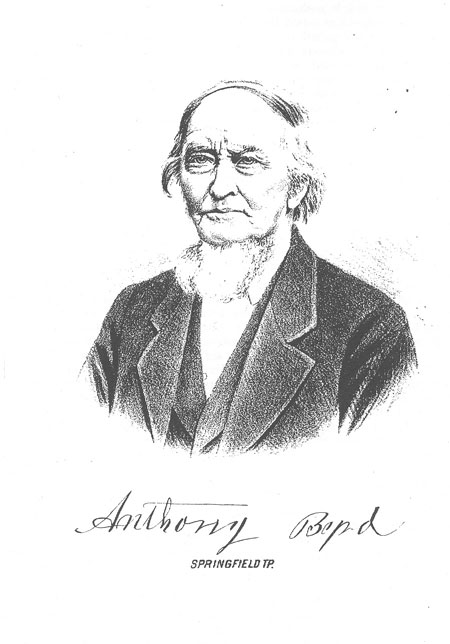
PAGE 437 - PICTURE OF ANTHONY BYRD - SPRINGFIELD TP
PAGE 438 - BLANK
CITY OF SPRINGFIELD. - 439
in Missouri. He entered the Union army during the rebellion, serving a portion of the time as staff , officer. At the close of the war, he went to Mississippi, where he assisted in framing the new constitution of that State, and wrote a very able address to the Senate of the United States in advocacy of its approval by that body. The Smallwoods were all loyal during the rebellion, and none more so than their aged father. The following anecdote of Mr. Smallwood is related by a writer in Harper's Magazine, and is characteristic of his intrepid character: "When the rebel Gen. Price, with his army, was making a raid in the vicinity of Lexington, Mo., Mr. Smallwood was standing one morning at the gate in front of his house in that city, when a rebel officer rode rapidly up to him and inquired if he could inform him where Gen. Price and his army was. The old gentleman gazed indignantly at the officer, a moment, and then replied, `I don't know, sir, where they are, but can tell you where they ought to be at this moment.' The officer innocently asked, 'Where?' Mr. Smallwood, raising his cane and shaking it with great violence at the rebel officer, exclaimed, in a loud voice, `In hell, sir, in hell?' The officer pursued his inquiry no farther, but rode rapidly away."
Mr. Smallwood buried his wife in Missouri before the war, following in "1869, at the age of eighty-seven years.
REV. SAUL HENKLE.
The first settled minister of the Methodist Church in Springfield was Rev. Saul Henkle, who came from Hardy County, Virginia in the spring of 1809, on horseback, with his young wife and child, two months old. He moved in the log house built by Archibald Cowry, then occupied as a tavern, and continued to live there until he built his one-story brick house on High street in 1825. where he lived the remainder of his life.
Mr. Henkle was a regularly ordained preacher of the Methodist Episcopal Church, but joined the Protestant Methodists soon after their organization. He was a devout Christian and an exemplary citizen, living to promote the moral and religious welfare of the people in the village and neighboring country. His ministerial life covered a period of twenty-eight years. At every marriage feast and every funeral ceremony, he officiated, and neither would have been complete without him. A funeral in those days was attended with a solemnity unobserved at the present time. The coffin rested upon a simple bier, and was carried on the shoulders of four or six men, walking to the grave. The officiating minister preceded the coffin, and the pall-bearers, the mourners and friends, with,"solemn step and slow, " walked behind in twos. When the procession began to move, the minister would commence the singing of a familiar hymn, in which the rest ,would join, and which they continued until they reached the grave. The usual hymn sung on these occasions was the one beginning
"Hark! from the tombs a doleful sound."
In the year 1827, Mr. Henkle edited and published a religious paper called The Gospel Trumpet. He performed all the labor at his residence on High street. He also wrote some editorials for the Western Pioneer. In 1830, he was elected to the office of Clerk of the Court, in which position he proved an efficient and popular officer.
He was a man a little below the ordinary height, of rather slender form, inclined to stoop in the shoulders, with a remarkably pleasant face, and manner indicating his ministerial office. In the pulpit, his speaking was extemporaneous. He was slow in delivery, but his words were appropriately chosen, and his thoughts were entertaining and instructive. His first wife died in Septem-
440 - HISTORY OF CLARK COUNTY.
ber, 1825, and he married again in 1829. He died in Springfield in 1837 in the fifty-fifth year of his age. His second wife, a most excellent woman, Survived him about thirty-seven years. She was a very active and consistent member of the High Street Methodist Episcopal Church. Saul Henkle, Esq., now of Washington City, and Mrs. J. S. Halsey, were their children.
JOHN AMBLER.
John Ambler came from New Jersey to Springfield in 1808. remaining but a short time, when he purchased and removed to a farm on Mud Run. The occupation of farming not being congenial to his tastes, he soon sold his farm, and removed, with his wife and children, to Springfield. Among the residents when he first came to the village were Griffith Foos and Archibald Lowry, tavern-keepers; Mr. Hodge and Samuel Simonton, merchants; Walter Smallwood, blacksmith; James Shipman, tailor; Mr. Doyle, saddler; Mr. Fields, who kept a repair-shop for articles in wood and iron; Dr. Richard Hunt, the first physician; and Col. Daugherty, the surveyor. In 1812, Mr. Ambler was both merchant and tavern-keeper, occupying a small log house nearly opposite the Mad River National Bank. He was a very public-spirited, worthy gentleman, and among the foremost to advocate the prosperity of the place. When Springfield became the county seat,'he was elected Treasurer, and used his private residence as the office. This building was a two-story brick house, on Main street. on the northwest corner of the alley west of Factory street. Mr. Ambler and Maddox Fisher were the contractors for building the first court house; also, to inclose the old graveyard on Columbia street with a stone wall. He also donated one-half of the lot now used by the First Presbyterian Church, of which he was one of the original members, and contributed largely to the first church building thereon, paying for and doing a portion of its painting.
Mr. Ambler died shortly after, turning over the books and papers of the Treasurer's office to James S. Halsey, who had been elected his successor. Mrs. Ruth Shipman, mother of John Shipman, present Postmaster, was the daughter of Mr. Ambler.
COOPER LUDLOW.
Cooper Ludlow, who came to Clark County in 1805 and settled in Springfield Township, near the first Mad River bridge west of the city, was a tanner by trade, and worked a tannery in connection with his farm. In 1812, he moved into Springfield, and kept a public inn on the corner of Main and Factory streets. He was an industrious citizen. and invaluable in laying the foundations of Springfield's prosperity. Mr. Ludlow was twice married. Dr. John Ludlow, President of the First National Bank, was his son by his first wife. His second wife was the mother of Abraham Ludlow, member of the City Council, and of the extensive manufacturing firm of Thomas, Ludlow & Rodgers, George Ludlow, ex-member of the police force, and three other sons. and one daughter, Mrs. Ferrill. His descendants have been valuable citizens, and have aided much in promoting the prosperity of the place of which their ancestor had been one of the founders. The house of Mr. Ludlow for many years was on the southwest corner of High and Factory streets. and but recently gave place to the new High-School building.
PEARSON SPINNING.
Among the first merchants. who contributed largely by his wealth and enemy toward the prosperity of the village, was Pearson Spinning, who came to Springfield from Dayton in the fall of 1812. He at once entered upon the
CITY OF SPRINGFIELD. - 441
sale of dry goods. and continued in that business until 1834, when, having accumulated a large property, he was considered the wealthiest man in the place. For many years, it was Mr. Spinning's custom to make a trip to New York City and Philadelphia once a year. on horseback, to purchase goods, and, owing to a lameness with which he was afflicted, always rode on a side-saddle. It required about six weeks, then. to make the trip. The goods he bought-were brought over the Allegheny Mountains in wagons to Pittsburgh, and in keel-boats floated clown the Ohio River to Cincinnati, and from there to Springfield in wagons. Freight then averaged about $6 per hundred weight, while wheat only brought 37 cents per bushel. In 1827, he built his fine residence on the east side of Limestone street. which now forms a part of the King building, and. in 1830, lie commenced the block of buildings on the northwest corner of Main and Limestone streets, known as the "Buckeye" building, and at one time occupied as a hotel. In 1837, Mr. Spinning took large contracts in the public works of the State then in progress, in which he lost a large portion of his property. After this, lie continued the business of his hotel, called the "Buckeye House," for several years, and later in life he acted in the capacity of Justice of the Peace. Mr. Spinning was born in Elizabethtown, N. J., in and died in Springfield in 1857, in the seventy-first year of his age.
GRANNY ICENBARGER.
We are indebted to Dr. John Ludlow for the following description of two original characters. for many years familiar to the residents of Springfield: 'Granny' Icenbarger. as every one called her, was no ordinary person in the early history of the town. She came here with her family during the war of l 1812. They were Germans. and the family consisted of four children, the aforesaid Granny. and a wild and drunken husband. The family were supported by the old lady in the manufacture and sale of cakes and beer, in which capacity she gained a wide popularity among the people of both town and country. She was a woman of unblemished character, and diligent in her calling. She was admitted within the bounds of all camp-meetings, and was a regular attendant of all military musters and other public gatherings, where her cakes and beer were made part of the programme, and many a hungry and thirsty soul was replenished at her board. Her kindness of disposition to all, especially to the children. gained for her the respect of every individual. Slip ever had a cake as a reward for kind acts from boys, and all stood ready to befriend her. She was a portly, good-natured and motherly looking person, and lived in town for more than a quarter of a century of its early history.
"For several years after she came, she lived and conducted her business in a log house on the west side of Market street, not far from the southwest corner of Main street. It was while she lived in this cabin that her husband died. He was a small. thin man, with very slender and crooked legs, which seemed to stand very far apart when he walked, and when lie was under the influence of liquor, which was nearly always the case, he was extremely noisy, and danced and hopped about in the wildest manner, and was a source of much trouble to his wife. At the time of his death. I remember going to their house, in company with some other boys, to show our sympathy and gratify our curiosity on the occasion.
"It was in the evening, and the old lady met us at the door and said to us: Law me! pot's, to olt man is tet: what a pity!' After telling her son to hold the candle that we might see the remains, she told us, in her simplicity, how much it would cost her to bury him. Nevertheless, we thought she was deeply afflicted at her loss, though we boys expected to see her rejoice at his departure. Granny Icenbarger died in Springfield in 1839."
442 - HISTORY OF CLARK COUNTY.
JOEL WALKER.
In the two-story log house in which the first court was held (near the present location of the First Baptist Church), there lived for many years a very eccentric and notable pioneer named Joel Walker. He came to Springfield among its first settlers, and one of his brothers lived among the Wyandot Indians. Mr. Walker, unlike his brother, was a man of plausible manners and smooth words, whose chief occupation consisted in a careful attention to everybody's business but his own. He was "headquarters" for all the gossip and news of the village, and a standing witness in court. While regularly imbibing his "morning dram." he carefully kept himself from drunkenness and profanity. His greatest vice was the excessive laziness, loafing much of the time, leaving the support of his family to the labors of his wife and daughters. He made a seeming care of the morals and welfare of the community. He wore a stout leather belt, fastened ;around his body by a large buckle, as a substitute for suspenders, with which he often strapped his boys for being trifling and lazy. By shrewdness or politeness to a stranger, or the proffer of a bunch of tanzy. he procured his "morning dram" at the bar of some tavern, or perhaps by the recital of some funny anecdote, cracking a joke, or giving one of his long and peculiarly load laughs, he satisfied his love of the ardent for the day. If he had nothing to eat at home, he managed to drop into the house of a neighbor at meal time and accept the invitation to "set up" at the table. He was a very singular mail. and, by, his eccentricities, he afforded much amusement and flan in the town. So noted were his lazy habits that it became a common expression by any citizen then out of employment, if asked what he was doing, to reply, "Helping Joe Walker."
Another peculiar character was a son of Granny Icenbarger, who was familiarly and widely known as "Gabe." Gabe had inherited some of his father's weak elements, and had several times been arrested for violation of the law. Upon one occasion, he was brought before His Honor, Judge Swan, then Presiding Judge of the Court of Common Pleas, on an indictment for unlawfully selling liquor. Upon his plea of guilty, the Judge announced a fine of $25. Gabe very impudently responded by telling the Judge to charge it, as he had an open account with the county. The indignant Judge added thirty days' imprisonment to the fine. Gabe was hustled off to the jail, but insisted that his kit of tools----being a shoemaker--should be sent him. Having procured some leather, he worked assiduously at his trade, and when his time expired he refused to leave. when ordered out. He said that he had an understanding with the Judge by which he was to occupy the jail permanently. It was finally necessary to eject him by legal process.
LITTLE DADDY VICORY.
Merryfield Vicory an odd but genial character, located in Springfield in the year 1814. and soon afterward received and held the sobriquet of "Little Daddy Vicory." He was a short, round man, with a jolly face. He had been a drummer in the Revolutionarv war. and had his drum shot from his side by a cannon ball at the siege of Yorktown. Mr. Vicory in one instance displayed skill and bravery in catching a thief while stealing some bacon, from his smoke house. He seized the thief and tied him fast with a rope, and it being Sunday morning. kept him in confinement until the horn for church. when he drove the thief down Main street under threatenings of a large club, with two sides of bacon swinging over his shoulders. He went so far in his efforts to humiliate that thief as to take him to the door of the Presbyterian Church and ask the people there assembled if they claimed him as one of their members. The
CITY OF SPRINGFIELD. - 443
thief was never after seen in the town. Mr. Vicory received a pension from the Government, and, soon after his settlement here., he bought ten acres of land on the old Columbus road, on what afterward became the east end of High street. He was father of Mr. Freeman Vicory, another esteemed citizen, who inherited the property, and spent his days also in Springfield. Mr. Merryfield Vicory was buried with military honors, in March, 1840, aged seventy-seven years.
JAMES WALLACE.
James Wallace was a native of Kentucky, and came to Ohio when he was a boy of fourteen years old. During the war of 1812, he brought the mail once a week to Springfield on horseback, returning with the same to Cincinnati. He settled in Springfield about the year 1814; apprenticed himself to William Moody, a harness and saddle manufacturer, but, before finishing his trade, he bought the remainder of his time, and, by the assistance of Pearson Spinning, he opened a store in the village of Lisbon. He soon returned, however, and entered Mr. Spinning's store as partner,* where lie, and Mr. Fisher, on opposite corners, kept up a lively competition. In 1823, Mr. Wallace had a store in his own name, in the brick building immediately east of the present Mad River National Bank building, where for several years he continued as a leading merchant. Mr. Wallace was a very affable man, a good talker, somewhat excitable, and an excellent salesman. He was opposed to any one leaving his store without purchasing goods, and often he was seen enticing customers in from the streets or pavement as they were passing along. He kept a great variety of goods, so it became proverbial, if an article could not be found elsewhere, it could be had at "Jimmy Wallace's." Becoming unfortunately embarrassed in his business in later years, he sold put and left Springfield. He maintained, however, during these and subsequent days, his standing in the Presbyterian Church, and reached a good age ere the day of his death.
DR. NEEDHAM.
One of the pioneers in the profession of medicine in Springfield, Dr. William A. Needham, came from Vermont in 1814. He first .lived in a small log house in the vicinity of Lagonda, but, in 1817, moved into his new frame house on the southwest corner of Main street and the alley east of Limestone street, opposite the building now owned by William Burns. The Doctor became a popular physician and leading citizen. He was a jovial man, full of quips and pert sayings, and his social qualities and kindness of heart gained for him a large circle of friends. He was the father of the wives of Samson Mason and Jonah Baldwin. and died in Springfield in 1832. aged sixty-five years.
ELIJAH BEARDSLEY.
Elijah Beardsley, originally from Connecticut, came to Springfield in 1815. bringing with him a wife, two sons and six daughters. He first occupied a log house that stood near the southeast corner of Plum and Main streets, and, with all its inconveniences, he made it pleasant to many a weary traveler who wished to tarry for the night. One of Mr. Beardslev's daughters in later years married Ira Paige, and another, Laura, married James S. Christie, who, with her husband, is still living, and among the oldest of the present inhabitants of this city. Except a temporary residence of nearly three years in Cincinnati, Mr. Beardsley lived in Springfield until his death, October 2, 1826, aged sixty-six years.
* Mr. Wallace returned from Lisbon and was partner with Mr. Spinning on the northwest corner of Limestone and Main streets. In 1823, Mr. Wallace had a store of his own on the northeast corner of Limestone and Main street.. Subsequently Mr. Wallace's store was moved to the brick house named, where the Republic Printing Company is now located.
444 - HISTORY OF CLARK COUNTY.
MADDOX FISHER.
Maddox Fisher, who came from Kentucky with his family in 1831, became one of the most enterprising and public-spirited of the early settlers of Springfield. He possessed considerable wealth, and, soon after his arrival, purchased twenty-five lots, at $25 per lot, of Mr. Demint. most of them being located in the vicinity of the public square. He opened a dry-goods store on Main street. a little west of Limestone street. While prosecuting with energy his own trade, he was ever ready, by his influence and wealth to aid in the improvement of the place he had chosen as his home, and which he believed would eventually become a large city. In 1814. lie built a cotton-factory on the Rocks, near where Mill Run empties into Buck Creek. taking the place of Dernint's old mill. It continued operations a few years, when it was changed into a flouring-mill. In this mill he did a profitable business until November. 1834. where the mill was destroyed by• fire, at a loss of $6,000. The building of this factory. and afterward mill, seemed to have marked a turning-point in the history of Springfield. Prior to this, little business was doing; the inhabitants appeared discouraged. real estate had depreciated. and hard tinges were depressing. But this improvement of Mr. Fisher's gave a new impulse to trade and further growth. In 1815, he built a two-story brick house on the east side of Limestone street. just north of the public square. designing the same for a store and dwelling. In 1825, he built a handsome residence on the corner of North and Limestone streets, which afterward was partially incorporated in the fine dwelling of the late Dr. Robert Rodgers. In 1824. he served. with general acceptance as Postmaster, and, in 1830, lie erected the store and residence (since enlarged and built into a handsome block of four stories) now owned by his son. M. W. Fisher, on the southwest corner of Main and Limestone streets.
Mr. Fisher was a native of Delaware. where lie was married at the age of twenty, after which he moved to Kentucky, and thence to Springfield. He was a man of medium height, somewhat fleshy, a true gentleman of the old school, a leading member of the Methodist Episcopal Church. quite entertaining in conversation, and very hospitable and kind to strangers, as well as to his numerous friends. He generally wore a straight-breasted, dark broadcloth coat. and his polished. silver-headed cane. and his well-filled silver snuff-box in one of his spacious vest pockets, were his constant companions. He died in this city October 22, 1830, in the sixty-fifth year of his age.
IRA PAIGE.
Ira Paige was another prominent person who settled in Springfield in 1814. He was a native of Massachusetts, and, soon after his arrival, he established a woolen-factory, with Mr. James Taylor as partner. near by or in the basement of Fisher's flouring-mill, where jeans and flannels and woolen rolls were manufactured for customers. This business -was continued by Mr. Paige for more than fifteen years, and was considered then an extensive factory. In 1832 and 1833. he represented the county in the lower branch of the State Legislature, and subsequently he became an Associate Judge of the Common Pleas Court, and sat upon the bench with Judges Service and McKinnon. During the latter part of his life. Judge Paige was engaged in farming. He was a man of excellent judgment and good, sound sense, coupled with intelligence, strict integrity and fine social qualities. By his influence and force of character, he added much to the moral and social condition of the village and town. He died in Springfield in July. 1847. in the fifty-eighth year of his age.
CITY OF SPRINGFIELD. - 445
JAMES JOHNSON.
James Johnson, a native of England, came to Springfield at an early date, and, in 1816, he built a large two story stone house on the south side of Main street, between Factory street and the alley east. He built also a small, one story addition on the east end of this house, where, in 1817. he manufactured cut nails by hand. The nails used in building Dr. Needham's house were made here, and for several months the citizens were supplied with the article from Mr. Johnson's factory. He afterward removed to Pike Township, on Donnel's Creek, where he had purchased a farm, and erected a small mill. He here spent the remainder of his days. The two-story stone house was taken down in 1871. by Edwin L. Houck, who erected in its stead a fine three-story block, with a spacious hall in the third story.
MAJOR CHRISTIE.
The last of the early settlers to whom we shall here call attention is Robert Christie, or Maj. Christie, as he was more familiarly known. He came from Washington County, Vermont, in the fall of 1817. with his second wife and eight children. and his aged father. Deacon Jesse Christie, then in his eighty-first year. A small frame house on Main street. below Yellow Springs street, was his first residence, but the year following his arrival he located on what is known as the Bechtle farm. a part of which now constitutes the largest portion of Fern Cliff Cemetery. There was an unbroken forest from his residence east as far as Demint's cabin, extending north several miles. The land occupied by Wittenberg College and Fern Cilff was heavily timbered. the maple predominating over other trees. The wild grape festooned the trees in wild luxuriance. The species known as the fox grape was a very desirable fruit, and gathered in large quantities. Small game, with occasionally specimens of larger and more dangerous animals, furnished sport for the expert hunter. A species of panther and several deer were shot while the Major resided on this farm. The Major was a wide-awake man, nervous, and quick in all his movements. and had a very intelligent and social family. His humble but hospitable dwelling was often the scene of merriment and good cheer, and the frequent resort of the neighbors and friends. On the 8th of April, 1819, his daughter Mary was married to Louis Bancroft. Their wedding tour was simply a horseback ride, both riding the same horse, from the farm to their new abode in the village. On the 8th day of April, 1869, Mr. and Mrs. Bancroft celebrated their golden wedding-in all probability the first event of the kind that occurred in the annals of this city.
A singular circumstance occurred in Maj. Christie's family while residing on the Bechtle farm. Their youngest daughter, Sarah, who was then in her teens. was very ill with the tphoid fever. and preparations were made for her shroud and funeral. But a' young physician who called to express his sympathy for the afflicted family, on seeing the supposed corpse, thought he discovered that the vital spark was still lingering. After labored efforts, her resusci tation was effected. She fully recovered from the illness, and lived to be twice married and rear a family of four sons and two daughters.
Of Maj. Christie's sons, two of them, James S. and Jesse Christie, Jr., became residents of Springfield, where they were influential men, taking an active part in the promotion of all that pertained to the welfare of the people. They were both for many years Elders m the First Presbyterian Church. The elder, James S. Christie, was particularly active in all the religious movements of the churches. He had the entire confidence of the people, and was several times recipient of the unsolicited office of Justice of the Peace.
446 - HISTORY OF CLARK COUNTY.
The youngest son of Maj. Christie, Robert, was an early settler of Scott County, Iowa, and at one time an influential citizen of Davenport, Iowa. In August, 1822, Maj. Christie died, in the forty-seventh year of his age. He was buried with Masonic honors, in which fraternity he held an exalted rank. In January of the succeeding year, his father, Jesse, followed him, in his eighty-seventh year.
STEADY GROWTH OF THE VILLAGE.
Having briefly sketched the lives of some of the principal characters who were identified with the foundation of the future city, whose names are inseparably connected with its infant growth and development, and whose patient endurance, enterprise and sagacity gave it an impulse which has been repeated by their descendants in later years, we may return to a more detailed narration of the progress which was steadily made. All the difficulties which were com mon to the settlements on the frontier were the lot of the young village. The facilities for intercourse with the world beyond were limited, markets were few and inaccessible, material for the erection of buildings and machinery for the manufacture of articles of necessity were not to be had. The danger of incursion from the savage tribes kept the whites in a constant state of alarm, and prevented the immigration which would have been gladly welcomed. But, notwithstanding these difficulties, the little cluster of log cabins on the east fork of Mad River began to stretch along the slopes.
A post office, with its weekly mail carried on horseback from Cincinnati, was, according to the official records at Washington, established in 1804, with Richard McBride as the first Postmaster. There seems to be a discrepancy between this statement and the recollections of some of those whose memories run far back into the early years, who assert that no postoffice was established until 1814, and that Robert Rennick was the first Postmaster. He kept the office in his mill on Buck Creek, and subsequently in a little cabin that stood a short distance west of the Republic Printing Company's building, on Main street.
The architectural demand for improvement upon the unsightly log cabins was first met by Samuel Simonton who began in May, 1804, to erect a two-story frame house on the northeast corner of Main and Factory streets. When this building was in the progress of erection, a tornado, but thirty yards wide, came sweeping over the place from the southwest, taking a northeasterly direction until it struck this house, when it changed to an easterly course. So violent was the storm that the upper story was badly injured, which induced the owner to reduce its height to one story, and postpone its completion until the following spring. Several log cabins in the course of the storm were thrown down, others unroofed, and considerable damage done to fences. Mr. Simonton kept tavern in this building, and, in later years, had a store on the corner of Main and Limestone streets, long known as the "Buckeye Corner." He finally sold this establishment to Pearson Spinning and removed to New Carlisle, in this county, where he built a mill on Honey Creek.
Demint found that the demand for lots was growing. and that a preference existed for those which abutted on South, now Drain, street, because that was now the thoroughfare, the road running between Dayton and Springfield as before stated having followed this street. Demint, therefore, in the early part of the year 1804, laid out a second addition to the village. This was an extension of the first plat west as far as Race street. In this plat the name of South street was changed to Main street, and the original street by the latter name was obliged to be content with a more modest title.
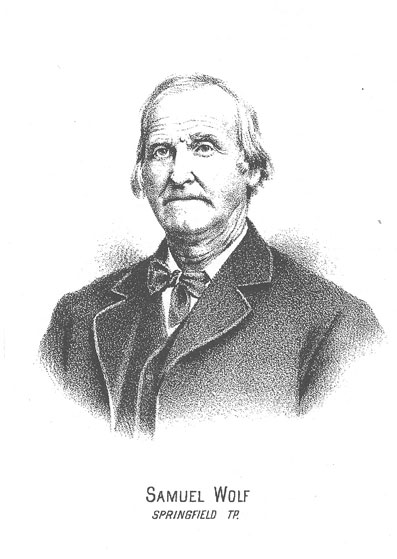
PAGE 447 - PICTURE OF SAMUEL WOLF - SPRINGFIELD TP.
PAGE 448 - BLANK
CITY OF SPRINGFIELD. - 449
THE FIRST SCHOOL.
Prior to the year 1806, no attention had been paid to the education of the children of the settlement. The rugged life of the pioneer found no great advantage to be derived from learning. They had "books in the running brooks and sermons in stones." A knowledge of woodcraft and unerring skill with the rifle were deemed sufficient for the time. The loose, unrestrained habits which always vanish as civilization advances, bringing with it culture and respect for order and sobriety, still lingered here. Drunkenness and lawlessness prevailed. The voice of the minister in rebuke was not heard, nor had the influence of religious associations been suggested. But, in 1806, the necessity of establishing a school became apparent, and Nathaniel Pinkered became the founder of the educational system in Springfield. He opened a school in a log house on the northeast corner of Main and Market streets. All the branches embraced in the common school system of that day were taught.
The same year which began the educational history of Springfield found also an awakening interest in religious matters. The Miami Methodist Episcopal Circuit, which was established in 1800, extended northward from Cincin nati and included Clark County within its bounds. There had been but little organization among the church people. Mrs. Smallwood had called several of the sisters in the Methodist Church together and formed a temporary society, but even the itinerant minister had not penetrated before this time into the forests along Mad River. This year, 1806, however, the Miami Circuit was in charge of Rev. John Thompson who extended his labors to Springfield, visiting it at stated periods. Two Methodist preachers named Saile and Goble also preached alternately here every three or four weeks. They held services in the log house on the northeast corner of Main and Market streets, where Pinkered kept his school. Rev. Mr. McGuire rode the circuit in 1807, and Rev. Milligan in 1808. The pulpit was supplied irregularly by ministers of the Miami Circuit until Rev. Saul Henkle, who moved into the place in 1809, began to hold stated religious services. There was also preaching occasionally by ministers of other denominations, who held their services in Foos' tavern or out-doors if the weather permitted. But to the Methodist Church belongs the credit of first establishing public worship.
FIRST CHURCH BUILDING.
The interest which had been created in religious worship by the Methodist Church led members of other sects to similar efforts. During the winter of 1810-11, the "New Lights" as they were then called) or Christian denomination, were successful in a revival of religion. This led to an organization of a New Lights or Christian Society. The members felt strong enough to begin the erection of a church. A general call was made upon the citizens of the place, which met with a hearty response. Mr. Griffith Foos gave toward this building a fine young horse valued at $10, which seems to have been a fair price for a horse at that time. As all the citizens, irrespective of their tendency or affiliation with other sects, contributed to a common fund for the erection of a church edifice, it was determined to make it a free church for all denominations. This catholic spirit was in accord with the general character of the pioneers, who opposed exclusivenes or caste in religion as in society. The site selected was on the south side of the lot west of Mill Run, and south of Main street, just in the rear of Funk's building. It was built of hewed logs about twenty by thirty feet in size. The pulpit opposite the door was made of rough, unpainted boards, and stood high up from the floor. The ground around the building for several yards south was dry and slightly elevated and neatly sodded. In the midst of this lawn stood three or four large spreading burr oaks,
450 - HISTORY OF CLARK COUNTY.
which gave. the tempting shade in summer. Near the church door lay a large gray bowlder upon which many a saint and sinner sat. In 1818, this church was used as a schoolhouse. but, in 1825, it had been converted into a mere shelter for hogs and cattle.
The same sect, the New Lights, also had a camp meeting here about this time which attracted to it. with those who attended for devout purposes, a large number of depraved men, who were riotous in their conduct and disgraceful in their behavior. One person in particular attracted attention. His name was Jack Eels, said to have been the wickedest man in the neighborhood. He visited the camp meeting one day somewhat intoxicated. and began to make fun of the worshipers. especially of the peculiar "jerks" which characterized many who were converted. Jack said it was all a sham. But the jerks (whether from the influence of liquor or not, the veracious historian does not state), prostrated him so completely that his friends were obliged to carry him home in an exhausted condition.
A SEAT OF JUSTICE.
Before the Legislature organized the county of Clark. the temporary seat of justice for the county of which it was then a part was Springfield, and the place for holding court was the house of George Fithian. The Presiding Judge of the first Court of Common Pleas was Francis Dunlevy. John Reynolds, Samuel McCullough and John Runyan were the first Associate Judges. Arthur St. Clair was Prosecuting Attorney, John Daugherty, Sheriff, and Joseph C. Vance, Clerk. The first grand jury was composed of the following citizens of the county: Joseph Layton. Adam McPherson. Jonathan Daniels. John Humphreys, John Reed, Daniel McKinnon, Thomas Davis, William Powell, Justis Jones, Christopher Wood. Caleb Carter, William Chapman, John Clark, John Lafferty. Robert Rennick. Among the first Petit Jurors were Paul Huston. Charles Rector, Jacob Minturn, James Reed, James Bishop and Abel Crainford.
In September, 1805, the court was organized for the transaction of business. The first case tried was "The State of Ohio vs. Taylor," who had been indicted for threatening to burn the barn of Griffith Foos. At the first session of the Supreme Court held in 1805, the Judges were Samuel Huntington, Chief Justice, with William Sprigg and Daniel Symmes, Associate Justices. This court was held in a two-story log house which then stood in an open common near the southeast corner of High and Limestone streets. The only criminal case tried before this court was "The State against Isaac Bracken, Archibald Dawden and Robert Rennick." upon an indictment for an assault upon an Indian named Kanawa Tuckow. The defendants pleaded not guilty, and taking issue "for plea put themselves upon God and their country." The jury was composed of William McDonald. Sampson Talbott, Justis Jones, George Croft and others. The attorney for the defendants was Joshua Collett, who afterward was one of the Judges of the Supreme Court. The defendants were found not guilty, having proven that the Indian was a very bad and dangerous character and had persisted in occupying Rennick's land in opposition to his wishes. As an illustration of the bitter prejudice which existed at this time among the settlers against the Indians, one of the jurors of the case, before the trial openly declared that he would never bring in a verdict against a white man for assaulting an Indian.
TREATY WITH THE INDIANS.
The bloodthirsty Indian wars which had raged along the borders had scarcely ceased, when the settlement of Springfield was made. Its effect upon both sides was yet plainly visible. It had been a warfare full of malignant
CITY OF SPRINGFIELD. - 451
spirit. So outrageous had been the acts committed by the Indians on helpless women and children. that the settlers were bound in a common cause against them. During the summer of 1807, the inhabitants were frequently alarmed at reported incursions of the Indians against them. When these rumors seemed to have foundation, all the families were collected in a two-story log house which then stood on the southeast corner of High and Limestone streets, and remained there until the alarm subsided. While the community was in this agitated condition in the autumn of 1801, a white man by the name of Myers was killed by a band of strolling Indians a few miles west of Urbana, and a family by the name of Elliott. living on Mad River not far from the present residence of Peter Sintz. had been frightened by a rifle shot piercing the sunbonnet of Mrs. Elliott, while gathering wood in their door-yard, supposed to have been sent by an Indian. who a few days before had been refused the use of a butcher knife.
These outrages taken in connection with the assemblage of the Indians under Tecumseh and the Prophet, created a great alarm among the people of Springfield and surrounding country. Many families moved back to Kentucky, whence they came : others were formed into companies of militia, and Foos' tavern was converted into a garrison. A demand was made by the whites upon the Indians for the persons who had committed these unlawful acts. The Indians denied that these things were done with their knowledge or consent. The alarm. however, continued, and it was finally agreed that a council should be held on the subject in Springfield for the purpose of settlement. Gen. Whiteman, Maj. Moore. Capt. Ward and two others acted as Commissioners on the part of the whites.
The council assembled in Sugar Grove. that then stood on or near Main street, opposite the Foos tavern. Two bands of Indians attended the council, one from the north in charge of McPherson; the other, consisting of sixty or seventy braves, came from the neighborhood of Fort Wayne under the charge of Tecumseh. Roundhead. Blackfish and other chiefs were also present. There was no friendly feeling between these two parties; and each was willing that the blame of the outrages should be fixed upon the other. The party under McPherson, in compliance with the request of the Commissioners, left their weapons a few miles from Springfield. But Tecumseh and his party refused to attend the council unless permitted to retain their arms. The reason Tecumseh gave was that his tomahawk contained his pipe and he might have occasion to smoke. After the conference was opened. the Commissioners, fearing some violence still, made another effort to have Tecumseh lay aside his weapon. This he positively refused to do. At this moment, Dr. Richard Hunt, a tall, slim young man recently from Pennsylvania, and a boarder at Foos' tavern, thinking to reconcile matters with Tecumseh. cautiously approached and handed the chief an old long-stemmed earthen pipe intimating that if he would give up his tomahawk, he might smoke the aforesaid pipe. Tecumseh took the pipe between his thumb and finger, held it up, looked at it for a moment, then at the owner, who was gradually receding from the point of danger, and with an indignant sneer immediately threw it over his head into the bushes. The Commissioners then yielded the point and proceeded to business.
After a full and patient inquiry into the facts of the case, it appeared that the murder of Myers was the act of a single Indian, and not chargeable to either band of the Indians. Several speeches were made by the chiefs, the most prominent of which were those by Tecumseh. He gave a satisfactory explanation of the action of himself and the Prophet in calling around them a band of Indians; disavowed all hostile intentions toward the United States, and denied that either he or those under his control had committed any depre-
452 - HISTORY OF CLARK COUNTY.
dations upon the whites. His manner of speaking was animated, fluent and rapid, and, when understood, very forcible.
The council then terminated. During its session, the two tribes of Indians became reconciled to each other, and peace and quiet was gradually restored to the settlement. The Indians remained in Springfield for three days, amusing themselves in various feats of activity and strength such as jumping, running and wrestling, in which Tecumseh generally excelled. At this time, Tecumseh was in the thirty-eighth year of his age, five feet ten inches high, with erect body, well developed and of remarkable muscular strength. His weight was about one hundred and seventy pounds. There was something noble and commanding in all his actions. Tecumseh was a Shawnese; the native. pronunciation of the name was Tecumtha, signifying "The Shooting Star." He was brave, generous and humane in all his actions.
Among others who were present at this council were Jonah Baldwin, John Humphreys, Simon Kenton, Walter Smallwood, John Daugherty and Griffith Foos.
The council had a salutary effect upon the village. It set at rest the startling rumors which discouraged immigration, impeded progress, and paralyzed the ambitious efforts of the inhabitants. The town began rapidly to improve. The valuable water-power attracted men of enterprise, who began to utilize it in various branches of industry. There were no streams of water of consequence nearer than Chillicothe, sixty miles distant, so that mills of various kinds began to spring up in favorable localities.
In the year 1809, John Lingle erected a powder-mill near the mouth of Mill Run. He also built a log magazine for the storage of the powder, a little west of the present city hall, on the north bank of the stream. The machinery of this mill was primitive, but the untiring energy of the proprietor enabled him to supply the demand for that indispensable article in frontier life for some years. The residence of Mr. Lingle was on top of the rocks near his powder mill, but after the loss of a little child by drowning in the mill dam, he moved to a small frame house on Market street, opposite his magazine, where he died in 1818.
The streams in this vicinity, being fed by thousands of springs which poured into them at frequent intervals, were wont, upon the slightest provocation, to assume dangerous proportions, but no serious difficulties were apprehended from inundation until the spring of 1809. Lagonda Creek had then a current which in depth, width and rapidity was not to be compared to the sluggish waters which now crawl over the bed of that once beautiful stream. In the beginning of the season just mentioned, there had been many heavy and long continued rains, which caused the creek to overflow its banks, inundating all that part of the country northeast of the town, which was then an open prairie, and encroaching dangerously near the settled portion of the town. After giving this evidence of its destructive power, it soon subsided, but many began to fear for the safety of the place from a repetition of the overflow, and some who had settled there with the intention of making it their permanent abode soon took their departure.
The founder of the village was not discouraged at the doubts and fears of the timid, for about this time he made a third addition to the original plat, extending his line of lots to Pleasant street. The precise date of this addition is not known, as it was not recorded during Demint's lifetime and not until 1853, but it is thought to have been about the year 1810.
THE FIRST BRICK HOUSE.
As the rude log cabins gave way to the more substantial frame dwelling, so the latter in time was compelled to give place under the advancing steps
CITY OF SPRINGFIELD. - 453
of improvement to the enduring brick structure. It is a mooted question who is entitled to the credit of building the first brick house in the limits of the town. Respectable authority gives it to John Ambler. and equally authentic sources say that William Ross, who assisted David Lowry in making pork barrels in Dayton, should have the honor. It is stated that Ross erected a two-story brick house on the southeast corner of Main and Market streets, that it was first occupied by him as a dwelling and store, and then as a tavern which was widely known as "Ross' Tavern." This building was standing as late as 1869, when it was removed to give place to the more modern edifice erected in that year by Ridenour & Coblentz. On the other side of this not vitally important question is the statement that John Ambler made and burnt the brick that went into Ross' house as well as his own, which he built on the north side of Main street, about half way between Factory and Mechanic streets, in 1815, about six months, it is asserted, before the Ross house was erected. Mr. Ambler's dwelling is standing at this date and is now occupied by Mr. C. A. Davis. Freeman Vicory hauled the bricks for this house. About this time, Maddox Fisher built the two-story brick house adjoining the public square as marked in Demint's plat, which remained standing until torn down by James D. Stewart, who erected thereon his present residence. Mr. Fisher intended this building for a store as well as a dwelling, but subsequently used it for the latter alone.
ADDITIONAL CHURCH EDIFICES.
As we have seen, the Methodist Episcopal Church organized the first religious society, so that this pioneer denomination was the first to erect, in 1814, a church edifice for their exclusive use. It was a large frame building and stood on the northwest corner of Market and North streets, and was used as a place of worship for twenty years, when it was converted into a dwelling. At the time. this building was erected and for fifteen years thereafter, the lots in that part of the town were not inclosed, but were covered with scrub oak, hazel bushes and plum trees. The foot paths which led to the church followed irregular lines, that were the most convenient for the villagers. The Second Methodist Church was not built until 1834.
Open air meetings were held in a grove near the first Methodist Church, at which some of the noted preachers of the day were present. Lorenzo Dow, an an eccentric itinerant, delivered a sermon here. While he was earnestly pointing out the way of salvation to an interested audience, some graceless boys climbed a tree. overlooking the audience. Dow had his attention attracted by the noise. and, stopping short, he turned to the boys and said:
" Zaccheus he climbed a tree
His end to see.
If those lads would repent and believe
They too should their salvation receive."
VOLUNTEERS FOR HARRISON.
The war spirit strongly animated the loyal people of the country, and when Gov. Meigs issued his call for volunteers to hasten to the relief of Gen. Harrison, who, in the month of December, 1813, with his army, was besieged at Fort Meigs by the British army and a band of Indians under Tecumseh, the response was met by the enlistment of many volunteers. James Shipman undertook to raise a company of citizen soldiers. He obtained a number of names of volunteers who agreed to meet him at Urbana. When the day for marching came, Mr. Shipman's recruits failed to come to time. Nothing daunted. however, he went to Urbane alone. and. with one Thomas McCartney, whom he met on the way, joined Capt. McCord's cavalry company at Urbana.
454 - HISTORY OF CLARK COUNTY.
A number of other volunteers also hastened to the relief of Fort Meigs, going by the way of Troy and Piqua, among whom was Cooper Ludlow, father of John Ludlow.
SMITH'S ACADEMY.
One of the characters of the village, who established at this time a seat of learning which became famous for miles as " Smith's School "was a stout, sturdy Englishman named Samuel Smith. He kept a pay school in a frame building on the north side of Drain street, on the west bank of Mill Run. He was a man of stern discipline, who (lid not "share the rod" to "spoil the child," and neither the age or sex of his pupils was respected in administering punishment. He designated two or three "monitors" over his forty or fifty scholars, to whom he gave the audible instruction, "if they disobey the rules. knock them down, kill 'em or drag 'em to me." To catch a disobedient boy by the hair of the head, and drag him to the middle of the room and lay on the blows thick and fast, was no uncommon node of punishment. His classical learning allowed him to indulge in the humor of diguifying some of his, scholars with such appellations as "Mark Antony," " Pompey, y." "Julius Caesar," etc. His assistant was his wife. a tall, angular, sharp featured Yankee woman. who taught the smaller children at their residence near the school. Smith was wont to amuse his scholars by marvelous tales of Yankee laud, which he narrated with a serenity that led his younger hearers to believe in their absolute verity. He gave instances of the rough land and hard soil of Vermont so hard that a farmer there was obliged to use a team of fifty yoke of oxen in breaking up a new piece of land with a plow, and the land so hilly that one-half of the oxen hung by their necks between the hills while plowing That the climate was so variable that a big ox went into a lake to drink, one mild day in winter, and was frozen fast while drinking by a sudden cold change in the weather, that the ox walked up the mountain carrying with it the whole frozen lake, and the next day, when a thaw came, the ice melted. causing a great flood, with immense destruction of life and property.
The bottle was a favorite companion, and when warmed by a liberal use of it. Smith's stories grew Munchausen like in their exaggerations. It became a habit of the people to call any story of doubtful veracity one of Smith's lies.
It was a custom in those days for the boys to " lock out " the schoolmaster abort the holidays from the schoolhouse, until he paid the usual penalty of a treat with apples, cakes, etc. The larger boys of Smith's school attempted an affair of this kind, but were matched by the master. who mounted the roof, and throwing a handful of brimstone down the chimney into the tinge fire of logs burning there. placed a board over the top, to the great discomfiture of the boys, who soon opened the windows and beat a hasty retreat. In later years. Smith gave up his bottle and died at an advanced age, respected as a useful citizen.
SPRINGFIELD AS A COUNTY SEAT.
The village had now grown of sufficient importance, and its relations to the adjacent territory were such as to justify the State Legislature in constructing from the adjoining counties of Champaign. Madison and Green :a separate county. By an act of that body passed March 1, 1818, the county of Clark was thus formed, and so named in honor of Gen. Rogers Clark, who defeated the Shawanese and Mingo Indians in the battle at their town on Mad River, called Piqua or New Boston. The particulars attending the organization of the county more properly belongs to the history of the county, to which the reader is referred. It will be sufficient to state here that the accomplishment of this advanced movement was due largely to the efforts of Maddox Fisher, who, as a
CITY OF SPRINGFIELD. - 455
successful lobbyist, visited Chillicothe where the Legislature was in session, and by persevering effort finally succeeded in having the bill passed, which also provided that Springfield should be the county seat. An attempt was made to have the county seat located at New Boston, the reputed birthplace of Tecumseh, but the measure failed through the active opposition of Maddox Fisher. When he returned from Chillicothe with the news of the success of his measure, he was received with shouts of gratification. As a reward for the active efforts of Maddox Fisher, he was awarded the position of Postmaster, which at that date was a post of honor more than of profit.
"OLD VIRGINIA" AND "SLEEPS HOLLOW."
The then beautiful rivulet "Mill Run " glided smoothly through the village, following a small valley a few rods west of where the First Presbyterian Church is now located. and dividing the place into two sections. The section west of the Run had two brick houses. one stone house, a few of frame and several cabins. There were two taverns in the west section, one in a small one-story brick house kept by James Norton on the lot now occupied by the Teegarden residence. and the other in a two-story frame house building kept by Cooper Ludlow. This part of the village was called " Old Virginia," by those of the east side, because several families from the Old Dominion had settled there. Those living on the west: end returned the compliment by calling the east end and particularly that portion around the public square " Sleepy Hollow." on account of the lack of enterprise there. It has retained the name until this day. The west bank of the Run was low and muddy. To reach the foot-log which crossed the Run, it was necessary to wade through deep mud and mire. The east bank of the Run was quite steep. The land along the south side of the Run from Center street east to Spring street. and as far south as the railroad passenger depot, was ;, continuous quagmire. in which cattle often swamped. Limestone street was only extended through the quagmire by throwing in brush, and placing logs upon them in the form of a corduroy bridge, which was then covered with dirt and gravel.
Shortly after this, two Irishmen. Andrew and Frederick Johnson, took the contract from the owners of the swampy land along the south bank of Mill Run, to ditch and drain the wine, which soon made this portion of the town passable.
The number of houses in the east end, or "Sleepy Hollow," was greater than in the west end. There was a public house kept by Mr. Ross, another by John Hunt, a boarding house by James McElroy in a weather-boarded log house, on the northeast corner of Main and Market streets. Maddox Fisher kept a store in a frame house on Fisher's corner. Pearson Spinning's store was in another frame building across Main street, opposite Mr. Fisher's store. There were two or three stores of less importance at this end, besides several mechanics' shops and a printing office. The town had no pavement except one in front of Mr. Fisher's store. It was no unusual sight to see citizens cutting firewood with an ax t wood-saws not being then iii. use), in front of their shops or dwellings on Main street. Wagons were driven close up to the front doors of houses, and the streets were remarkable for the depth of the mud.
A RELIC OF THE MOUND-BUILDERS.
A few rods east of the intersection of Spring and Washington streets, there was a mound of earth about fifty yards in size across its base and of conical shape. About this period (1818), several white oak trees and clusters of bushes stood upon its side, and a number of large stumps indicated that other trees had grown nearer its apex. During the work upon the Dayton & Sandusky Rail-
456 - HISTORY OF CLARK COUNTY.
road in 1847, this mound was entirely removed for the earth it contained. As the delvers in it penetrated its interior, they fotmd it had been the burial place for a former generation of people. It was a huge sepulcher full of human bones. As the bones had by this period of time to a great extent become intermingled with the earth, the entire mass was carted to the railroad and formed part of the road bed. While the work was in progress, there was picked up what seemed to have been a section of the lower jaw bone of a wild animal containing a stout, crooked tusk or tooth. The bone had been ground away so as to be firmly grasped by a human hand. It had no doubt been used as an instrument of warfare. A few days after it had been taken from the ground, it crumbled into dust by action of the air upon it.
A TEMPERANCE ORGANIZATION.
The good people interested in the welfare of the community began to be alarmed at the condition of society. There was danger that the new county seat would become the center of vice and wickedness for the surrounding country. Rough, lawless men, desperadoes, who haunt the new settlements where the restraints of society and religion are unknown, continued to hang arotmd the public houses, drinking, swearing and quarreling. Horse-racing was the common amusement, while gambling was open and unrestrained. The influence of this condition of society was found to be degrading. But the customs of those days were such as tended to corrupt instead of improve the morals of the people. The bottle of whisky was a necessary adjunct to the water pitcher upon the counters of the stores for the free use of all the customers. In the family the decanters stood openly upon the sideboard. The professor of religion, as well as the man of the world, indulged with the same freedom. In the field no work could be performed without whisky freely supplied. The farmer who would fail to furnish it would speedily find himself without harvesters.
To stem the tide of evil which seemed to gather such strength in the community, it was determined to organize a temperance society. In the summer of 1818, therefore. that active minister. Rev. Saul Henkle, gathered a few of the good men and women of the place together and formed an association, the declared object of which was to abandon the use of intoxicating liquors themselves, and induce others to do the same. By such influences as these, the rapid progress of iniquity in time was checked, and good order began to reign as the better class of citizens gained the ascendancy.
WERDEN'S TAVERN.
"I will take mine ease in mine inn," consolingly said the traveler, as he approached Springfield, weary with the day's jolting over the primitive roads before McAdam had suggested a way of making the rough ways smooth. He knew that ease and comfort awaited him at "Billy Werden's" tavern. It was a famous hostelry. William Werden located in Springfield in 1819. He came from Delaware to Ohio. The first tavern he opened was at McElroy's old stand, on the northeast corner of Main and Market streets; but soon after, he rented the Ross tavern, on the opposite corner. which he fitted up as a first-class public house. It was in this place that Mr. Werden built up a State reputation as a landlord, which made him famous among travelers everywhere. He did much to quell the rowdyism and bar-room brawling which had become such a nuisance at other resorts. As this tavern was the stopping-place for a line of stages running from Cincinnati to Colmnbus, the sign was that of a stage-coach and horses under full speed, suspended on a tall post at the outer edge of the sidewalk. The room used for his office and bar was not more than twenty feet.
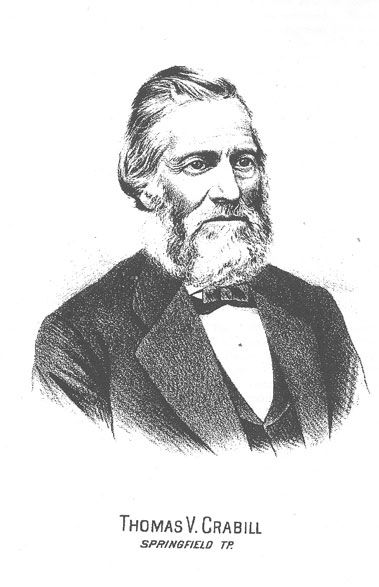
PAGE 457 - PICTURE OF THOMAS V. CRABILL - SPRINGFIELD TP.
PAGE 458 - BLANK
CITY OF SPRINGFIELD. - 459
square, and his whole house, with all its rooms, was not larger than one now required for a large family. The genial host was the first to meet the tired stranger with an outstretched hand and a generous welcome. To conduct him into the house, have a servant remove his muddy leggings and boots, provide him with clean slippers and a warm fire, were the kindly offices which won the heart of the traveler, while the polite attention of the hostess, a bountiful meal, skillfully prepared under her own direction, a clean bed and a good night's rest, sent him on his way refreshed and satisfied in the morning. Mr. Werden bought the property on the northwest corner of Main and Spring streets in 1820, but he did not occupy it until 1829, and then built his large hotel, known as the Werden House. He continued in business here until he had gained a competency, when he retired from active business. During the last term of Jackson's administration. his zealous support of "Old Hickory" gained hint the office of Postmaster, which he held for four years.
THE FIRST CENSUS.
The first enumeration taken here under the laws of the United States was in 1820. It showed that Springfield contained 510 inhabitants, of whom 285 were males and 225 were females. There were eight general stores, a flouring-mill, woolen and carding mill, a cotton mill, several schools, a printing office and a post office at which the mails were received in elegant four-horse coaches; an adequate supply of lawyers and physicians was also to be found. The court house then in process of erection was the only public building worthy of notice.
John Bacon and Charles Anthony, Esq.. two of the prominent citizens of Springfield. who were always thoroughly identified with the business interests of the city and its later growth, with Ira Paige, a prominent merchant, whose name was connected with its mercantile progress, were married about the same time, in the early spring of 1820. They were young men of vigor, ability and industry, and jointly entered into a career of prominence.
The first-named of these young men, John Bacon, came to Springfield in 1818. For many years. he was successfully engaged in the manufacture and sale of harness and saddles, investing his surplus means in real estate and dis counting notes, which paid him a good return. Mr. Bacon accumulated considerable means. which, with the increased value of his real estate, made him quite wealthy. Retiring from his regular trade. he became a prominent Railroad and Bank Director. At one time, he held the office of Member of the State Board of Control, connected with the State Bank system that preceded the establish ment of the National Banks. He was for several years a Director in the Little Miami Railroad Company, and served in 1860 as a member of the State Board of Equalization. At the time of his death, which occurred in 1870, he was the President of the Mad River National Bank.
(A sketch of Gen. Anthony appears in the history of the Clark County bar, where it properly belongs.)
BIBLE SOCIETIES.
The interest taken in the advancement of the morals of the community is shown in the organization of those valuable auxiliaries to church work, such as Bible and missionary societies. The temporary organization of the Clark County Bible Society was effected at the Methodist Church, on the 6th day of August. 1822. by the election of Rev. Archibald Steele as Chairman, Rev. Saul Henkle Secretary. and Isaac T. Zeller as Assistant Secretary. The Board of Managers for the town was composed of the following citizens: Pearson Spin ning. Maddox Fisher, John Ambler. John Bacon and Robert Rennick. Board
460 - HISTORY OF CLARK COUNTY.
of Managers for the county: Rev. Joseph Morris, Griffith Foos, Moses Henkle, Robert Humphrey, John Humphrey, Thomas Patten, Joel Van Meter, John Layton. Rev. Malyne Baker, John Forgy, Joseph Keifer, Thomas Fisher, Jeremiah Sims. Christian Frantz, Jacob Ebersole, John R. Demon, Andrew Hodge and Thomas Curl. The regular organization was affected on Monday, September 2, 1822. George M. J Jewett was chosen Chairman pro tern., with Rev. Saul Henkle as Secretary. The constitution adopted shows the following names among the first signers: Rev. John S. Galloway, Rev. AI. M. Henkle, Rev. Saul Henkle, Archibald McConkev, W. Al. 'Spencer and James S. Christie. An election for officers resulted as follows: President. Rev. Archibald Steele; George W. Jewett and Morris Henkle, Sr.. Vice Presidents; Pearson Spinning. Treasurer; Rev. Saul Henkle. Corresponding Secretary; and Isaac T. Zeller, Recording Secretary. The following gentlemen were elected Directors: John Ambler, Joel Van Meter, Jeremiah Sims, Robert Humphrey, Griffith Foos. Archibald McConkey, Thomas Patten, Joseph Heifer. Maddox Fisher. Daniel McKinnon. Daniel Moore and Andrew Hodge. Under an organization like this. composed of citizens of means and high standing, the society prospered. and was an instrument. of great good. This society was recognized as an auxiliary by the parent society in November, 1842. On September 5, 1872. an entertaining meeting of this society was held, in commemoration of its fiftieth anniversary. On this occasion it was stated in a paper read by Rev. S. Cochran. that $6,796 had been presented as a donation to the parent society in New York, and $6,572 worth of Bibles and Testaments had been received from that society in fifty years.
PUBLIC BUILDINGS.
In the early history of Springfield as in its later years, there was a manifest tardiness in the erection of public buildings. Although the place was designated as the seat of justice in 1818, vet, for four years following, the court held its regular sessions at the tavern of John Hunt. on Main street. The delay in the erection of the court house and the jail vas no doubt. owing in part to the generous rivalry which existed between "Old Virginia " and " Sleepy Hollow," the west and east ends of the town. each of which made strong efforts for the selection of their respective localities. Although the Commissioners of the county met on the 2d day of March. 1819, and commenced the consideration of the erection of a court house on the public square, yet it was not until the summer of 1828 that the building was completed. A brick jail was also built in the public square. and fully completed December 6, 1824 A temporary jail was erected on the east side of Fisher street, about half way between Main and Columbia streets, which was simply a log house. and not very secure. A detailed narration of the building of the court house and jail appears in the bistorv of the county.
After grim-visaged war had smoothed his wrinkled front," the military spirit was kept alive by the organization of companies under efficient commanders. who had obtained their knowledge of the art of war in the struggle of 1812. These companies met at stated periods and drilled in the manual of arms until they became remarkably proficient. In 1825, the first, and perhaps the best drilled and neatest equipped company as compared with others which followed, was organized under Capt. B. W. Peck, Capt. Charles Anthony. First Lieutenant. This company was followed by others, which were the "Clark County Guards." Capt. Shipman; Osceola Plaids," Springfield Cadets," and one or two cavalry companies. "commanded by Capts. John Cook and Putnam.
CITY OF SPRINGFIELD. - 461
LIGHTING THE STREETS.
The question of lighting the streets soon became a topic of interest, and a correspondent in the columns of the Western Pioneer, of date September 25, 1825, suggests a method which indicates the position of the community in this matter and which method was deemed a great improvement over the existing con dition of the streets. The correspondent suggests large glass lamps with double reflectors, at a cost of about $25 each. and to be placed on posts at suitable points; a contingent fund of 121 cents to be raised from each house to pay for the oil and wick; the lamps to be lighted and taken care of free of charge by the persons before whose doors the posts should be placed.
SPRINGFIELD A TOWN.
The Legislature. on the 23d day of January, 1827, passed an act which incorporated Springfield as a town. It became evident that, in the future, the place was destined to occupy a position of prominence. There were elements of prosperity in its material advantages in its favorable site, and in the busy, bustling character of its citizens, which indicated steady growth. Although there was a scarcity of currency. trade was not impeded because of a lack of metal or paper medium. Wheat was received in exchange for many articles, was deposited in the mill, converted.into flour, and sent by the merchant to Cincinnati. where it was taken. re-exchanged for merchandise, which was brought back in the returning wagons. The lack of railroad facilities made the merchant and traveler rely upon horses, which were very cheap, and became a frequent subject of barter. Every other man was a horse-trader. Dr. John Ludlow in his historical reminiscences. states he remembers of going to Cincinnati with a teamster when he was a boy fourteen years old, that the teamster "wapped" horses three times on the way. and the last horse died the same day he obtained it: but. soon he had another from a farmer in exchange for his sil ver watch. The horses used in the large. broad-tread wagons were generally stout animals. They were sometimes gaily caparisoned, and, with broad harness, jingling bells and six or eight to a wagon. were an attractive sight.
THE PAPER-MILL.
In August, 1827, an important branch of industry was established, which furnished employment to a number of people. Dr. Ambrose Blount, James Lowry and Jacob Kills, as partners, built a large paper-mill at the foot of Center street, on Mill Run. not far from North street. The mill did not commence operations until the following June, 1828. The mill was very successful in the manufacture and sale of large quantities of paper. ;mostly printing paper of excellent quality. The same firm also. the same year, opened a store near the northwest corner of Main and Market streets, where rags were received in exchange for goods, and where the employes were paid for their work. Four years later, Jacob Kills & Sons succeeded the original proprietors. They added extensive improvements in its machinery, increased its facilities and extended its trade. They afterward added to the mill a first-class bindery. They worked up a fair custom by sending forth one of the sons, with a fine, two-horse peddlers wagon, which enabled him to exchange paper and stationery for rags. books to be bound, and blank books to be manufactured to order. The business was successfully prosecuted for twenty years, rendering a good profit on the capital invested.
462 - HISTORY OF CLARK COUNTY.
THE FIRST MAYOR.
After the elevation of the village to the dignity of a town, an election was had to fill the offices of Mayor, or President of the Board of Trustees. James L. Torbert was elected to this office. He had come to Springfield in 1824, and was an active young attorney, but as there was not sufficient legal business to occupy all his attention, he also taught school. It was at his schoolhouse, on the northeast, corner of Market and North streets, on the 25th day of June, A. D. 1827, that he, with several other members of the First Presbyterian Church, organized the first Sabbath school. He was afterward elected Prosecuting Attorney, to which office he brought a clear head and an earnest desire to faith fully administer its duties. In 1848, he was editor of the Republic, and wrote many pungent arguments against the "Free-Soilers." whom he charged as recreant to their principles in not indorsing the Whig nominees for President. As an ardent Whig. he entered vigorously into the campaign, during which he gained the reputation of being one of the most effective stump speakers in the Congressional district of which his county was then a part. As Judge of the Common Pleas. successor to Judge Swan. his able and impartial decisions were the subject of favorable comment.
A record of a census taken by a citizen appears appears in the Western Pioneer of September 28. 1828. It gives an accurate statement of the popula tion. the number of stores and manufacturing establishments. It shows that the people were industrious. and that the manufactories were diversified. We find from this enumeration that there were in the limits of the town at that time 935 souls. Of these, there were of male adults 285; of female adults, 225; males under eighteen. 218; females under sixteen. 207. There were fifty-four blacksmith-shops. four coach and wagon shops, two common and fancy chair shops, four boot and shoe maker shops. three tanneries. and a currier-shop, twenty-seven house carpenters and joiners. There were six tailor-shops, three saddle and harness shops three bakeries. three cabinet-shops, one clock and watch maker. two hatters. one coppersmith-shop, one tin-shop, two millwrights, two extensive distilleries. fourteen general mercantile stores, four groceries, a new paper-mill. an extensive flour-mill, three good houses of entertainment, four public schools. two for females and two for males in one of which the higher branches of literature and the Greek and Latin languages were taught; four attorneys at law. five physicians. three slaughter houses. three brick-yards, two house and sign painters. one gun-shop. one portrait, miniature and fancy painter, engraver and gilder. two wheelwrights. one pottery. This enumerator also states that at that time they had a court house. which, in point of neatness and convenience would not suffer in comparison with any court house in Ohio; a brick jail. two churches. and a Third in building. a printing office, a post office, at which twenty-four mails are received weekly, in elegant four-horse coaches." In 1830. the population reached 1,080.
One of the prominent citizens. who, about. this time, became identified with Springfield's fortunes. was Reuben Miller. who was the son of Rev. Robert Miller. a local minister of the Methodist Episcopal Church. He was born on the 19th day of January, 1797. in an old schoolhouse at the mouth of Pike Run, on the Monongahela River. near Brownsville, Penn.. where his father had stopped to spend the winter of 1796-97 while emigrating from Virginia to Kentucky. From this point the family journeyed by flat-boat to Limestone (now Maysville). Ky.. and settled in Mason County. and afterward removed to Fleming County in that State.
In March. 1812. in order to escape the evils of slavery, his father removed his family to Champaign County. Ohio. where he located upon a farm within
CITY OF SPRINGFIELD. - 463
the bounds of the present Moorefield Township, in Clark County. At this time, Reuben was but fifteen years of age. He worked upon the farm until he was twenty-two years of age, when he turned his attention to study, and, by close application, without a teacher, for three or four years (in the meantime occasionally teaching school), he acquired a pretty fair English education; as he, in his own biography, relates, "became a very good arithmetician, learned to write a good hand, became a 'pretty good grammarian, studied geometry, trigonometry, surveying, navigation, and acquired some knowledge of astronomy; also commenced the study of the Latin language, but failed for want of an instructor."
On the 27th of March, 1823, he married Mary Hedges, who was born in Berkeley County, Virginia, and was living at that time with a brother in Champaign County, Ohio, and in the month of December following, removed to a cabin which he had built on a farm given to him by his father, in Moorefield Township. where he resided, farming a little, teaching school, and occasionally making land surveys, until the 10th of April, 1828, when he removed to Springfield; the occasion of the removal was his appointment, by the Court of Common Pleas, in the fall of 1827, as County Surveyor of Clark County. Springfield had then grown from a village of a few houses, as he first saw it in 1812, to be a town of about 800 to 900 inhabitants. At that time, there was little surveying to be done, and his first employment was in the County Clerk's office. Afterward, he taught a school for three or four years in Springfield. He was County Surveyor for nine years, during a part of which time he was also a Justice of the Peace and Mayor, or rather, as it then was named; President of the Town Council of Springfield. During this time, he acquired some means, went into the dry-goods business with a man by the name of Carrick, who in two years succeeded in loading the concern down with debt, and then died, leaving his partner many thousand dollars minus, notwithstanding which his energies were not impaired, but he went diligently to work, and, after fourteen years of hard struggle, paid off all his indebtedness.
In the fall of 1838, he was elected County Auditor of Clark County, and was re-elected to eight successive terms, serving in that position eighteen years, from March, 1839, to March, 1857. In the fall of 1856, during his last term as Auditor, he was elected Justice of the Peace of Springfield Township, and was re-elected five successive terms, serving in that position eighteen years, until the fall of 1874. He became a member of the Methodist Episcopal Church in September, 1812, and, in the year 1835, was ordained a Local Deacon, and afterward a Local Elder in the same church, and held that relation to the church until he died. On the 2d of January, 1875, his wife died, and then, at the earnest solicitation of his only living daughter, he went to reside with her at Keokuk, Iowa, where he died on the 3d day of October, 1880, from a gradual failing of the bodily powers, at the ripe old age of nearly eighty-three years, and was subsequently buried in Fern Cliff Cemetery, in this city. He left five living children-Dr. D. B. Miller, of Covington, Ky. ; John C. Miller, of Springfield, Ohio, present Probate Judge; Commander Joseph N. Miller, United States Navy; and Henry R. Miller and Mrs. R. B. Ogden of Keokuk, Iowa.
He was a man of correct character and habits, peculiar and almost eccentric in some of his ways; he had a keen sense of the humorous, and was almost invariably sunny and jocular in his moods. He had a more than ordinary share of natural ability, but was hampered by his imperfect chances for education and his business misfortunes, so that he himself felt, notwithstanding that he was a prominent and honored citizen, that he never attained to the full measure of his strength. He was much given to humorous versification, and as a specimen of his peculiar modes of thought, we append in conclusion of this sketch his epitaph, written by himself many years before his death:
464 - HISTORY OF CLARK COUNTY.
"Here lies a man - a curious one,
No one can tell what good he's done.
Nor yet how much of evil;
Where now his soul is. who can tell!
In heaven above, or low in hell?
With God or with the devil?
"While living here he oft would say
That he must shortly turn to clay,
And quickly rot-
This thought would sometimes cross his brain.
That he perhaps might live again,
And maybe not.
"As sure as he in dust doth lie,
He died because lie had to die,
But much against his will;
Had he got all that he desired.
This roan would never have expired,
He had been living still."
A DAILY MAIL.
The diffusion of intelligence from the seat of Government and the East had hitherto depended upon a weekly mail, which was carried on horseback. The arrival of this mail was the. day of the week, and was called "mail-day." An innovation was made in 1828 in this arrangement, which was gladly welcomed. It provided for a daily mail, carried by a four-horse coach. The current news was thus brought here from Washington and the Eastern cities within five days after its publication in those places.
SOCIETIES.
The benevolent and literary societies which had been formed from time to time lacked elements of stability. Feeble attempts to resuscitate and reorganize repeated failures were made, but, judging from an article from the caustic pen of Rev. Saul Henkle, then editor of the Western Pioneer, dated February 14, 1829, all these efforts had been unsuccessful. This article, here given, details, in very sarcastic language, the birth and death of the different literary. musical, religious and colonization societies:
"A sort of fatality seems to attend the benevolent and literary societies which have been gotten up in this good town of Springfield. We leave it with our readers to determine the cause of their failure; or, if thought more appro priate, we would refer the subject to a council of physicians, to report the nature and causes of the distemper to which this general mortality is attributed.
"1. A Literary Society, formed in December, 1815, of about thirty-five respectable members, died, say May, 1816, from want of attention on the part of its parents, aged about six months.
"2. A Library Society, formed in 1816, was soon threatened with death by starvation, and, by the overseers of the poor. was sold out, but soon after died, in a state of feeble childhood.
"3. A Library Society, brother and successor to the above, formed. say 1820 or 1821. It has been nearly frozen to death in an empty case, but of late has got into trousers, but is still very delicate.
"4. A Bible Society, formed September, 1822, for awhile promised to be strong and healthy, but, having been dieted for several years chiefly on 'Annual Reports,' grew very sickly; of late, however, it has gained a little strength, and may possibly live to years of maturity, though efforts are now making to effect its death by poison.
CITY OF SPRINGFIELD. - 465
"5. A Missionary Society. formed in November 1826, has disappeared in a mysterious way, and has not since been heard of. Some suppose it has been Morganized.
"6. `A Tyro's Club,' formed in July. 1856, was very sprightly and active for a few months, but, in the absence of its parents, was taken suddenly ill, and died for want of suitable attendance, at the age of about five months.
"7. A Colonization Society, formed November 1, 1826, is still living. but, from neglect and abuse, has been kept so feeble that it has not been seen abroad more than two or three times.
"8. In the same year, a Society for the Encouragement of Instrumental Music was formed, but, from the miserable condition of the instruments, the exertion of blowing brought on a decay of the lungs, by which it was carried off in a few months.
"9. In 1827, a Vocal Music Society was formed, but, soon taking the influenza. lingered awhile and died.
"10. A Literary Society. formed in November, 1828, gave hopeful promise of a better fate, but was found dead a few evenings since, in the Brick Academy. Some attributed its death to strangulation, but the Coroner's inquest seemed to think it occasioned by dropsy on the brain.
"11. A Reading Room Society. formed a few evenings since, is only kept from freezing by having some eight or ten newspapers wrapped about it. If it can be gotten through this winter. we hope to see it in a more growing and prosperous state. .
"12. A Temperance Society. just formed. will hardly live through the winter without the application of active stimulants.
"13. To these may be added a society proposed to be formed for the promotion of Christian charity. This cannot be organized at all, in our opinion, as it requires a commodity (charity) very rarely to be met with in this market, and, besides this, no man here has any idea that he stands in need of the article in question. each supposing himself abundantly supplied."
THE MARKET HOUSE.
A long, wooden structure. with two rows of stalls, side tables, and a pave ment walk between, for the building of which proposals had been received by the Town Council July 1, 1829, was finished in 1830, and dignified with the title of Market House. The Council by ordinance, provided that the Market House, now erected on West street and South street, be and the same is declared a public market. The same ordinance also provided that Wednesday and Saturday of each week should be market days, from the 20th of March to the 20th of September.
A VISIT FROM HENRY CLAY.
The eloquent "Harry " Clay. the pet and pride of the West, honored the town with a visit on the 24th day of July. 1830. He was en route for Columbus, and, due notice of his approach from Yellow Springs having been given, a large concourse of citizens, on horseback and in carriages, met him about six miles from town, and, with enthusiastic hurrahs, escorted him to Col. Hunt's tavern, where he took dinner and made a short speech in reply to a flattering toast.
THE FIRST BOOK STORE-NICHOLS.
The culture of the intellectual faculty was but of little moment among the hardy pioneers, but, as the forests began to dwindle and the comforts of civilized life to appear, men began to read and study. The multiplication of books by the improvements in the printing-press brought them to the fireside of every
466 - HISTORY OF CLARK COUNTY.
family. A taste for intellectual pursuits, began to be developed. A copy of "Bunyan's Pilgrim's Progress," or that cheerful work, "Fox's Book of Martyrs," a volume of sermons, or of the "Spectator," no longer supplied the increasing want. The demand must be supplied. To John D. Nichols, a native of the Bay State, is due the credit of inaugurating the book trade. In the winter of 1830-31, Mr. Nichols brought a stock of books and stationery from Cincinnati, shipping by canal to Dayton, thence by wagon here. His store became the center of news, and a great attraction. It proved a successful venture, and an indication that the people were keeping up to the age. Mr. Nichols had, in the fall of 1825, been a book agent, soliciting subscriptions to the "History of All Religions" and "Butler's Universal History," making a tour on foot from Columbus to Worthington, thence to Urbana, Bellefontaine, Sidney. Dayton, returning by Springfield and London; and, in the spring of 1826, making the same trip in a one-horse wagon, delivering the books and receiving pay for the same. He was thus probably the first book agent in this part of the State. Mr. Nichols, in 1827 and 1828, was engaged in publishing several books at Cincinnati, Ohio, among them a "Life of Gen. Jackson" and the "Western Medical Journal," both of which, in mechanical execution and ability of its contents, would compare favorably with similar publications of a much later date. In 1828 and 1829, Mr. Nichols published the Saturday Evening Chronicle, in Cincinnati, a literary journal, of which E. D. Mansfield, Esq., was editor.
THE CHOLERA.
The vigilance of the early authorities of the town might be a lesson to those iii power at this later day. It was by the adoption of effective sanitary measures Springfield escaped the visitation of that terrible scourge which, during the year 1832, and also the year following, desolated so many homes in the cities and towns of the West. The approach of the dreaded visitor induced the citizens to take prompt action at once. So a meeting of citizens was called for the 13th of July, 1832, for the purpose of adopting measures to cleanse the town of all filth and nuisances. They passed resolutions requesting the Council of the town to enforce all ordinances and regulations which would purify the streets and alleys. They divided the town into four districts, and appointed a committee of three for each district, whose duty it was to aid the municipal authorities in thus enforcing all resolutions and ordinances of the Council. A committee of three persons was also appointed to solicit funds to pay the necessary expenses. The danger was, by these precautionary efforts, happily averted from the town. But the county was not as fortunate, as the village of New Carlisle lost thirty-three of its inhabitants by the scourge.
The organization of a lyceum, or literary society, for the intellectual improvement of its members, was accomplished in November, 1832. On the 22d of that month, at a meeting of citizens called for the purpose, E. H. Cumming presided, with John A. Warder as Secretary. Messrs. Charles Anthony, E. H. Cumming and M. M. Henkle were appointed a committee to prepare and report a constitution and a code of by-laws; on the 29th of the same month, at an adjourned meeting, the report of this committee was presented, and, after full consideration and amendment, it was adopted.
The first regular meeting of the Springfield Lyceum was held on the 11th day of December, in the Presbyterian Church. An introductory lecture was delivered by Samuel Ells, a young man of fine talent, who was a graduate of Hamilton College, New York. He was then teaching what was called the Springfield Classical School, and was much interested in forwarding and sustaining the lyceum. At the same meeting, there was a debate upon the question, "Is the reading of novels beneficial?" John M. Gallagher was Secretary of this
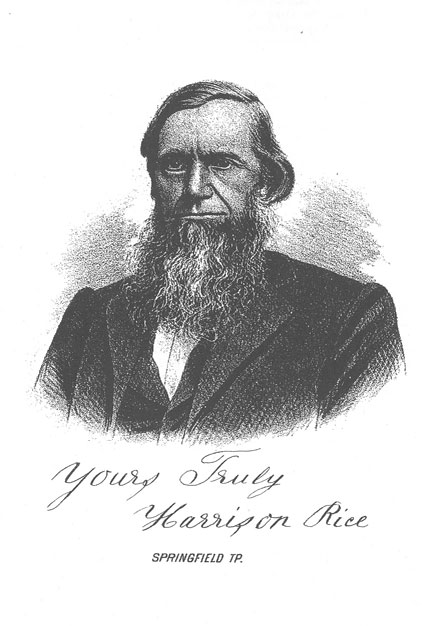
PAGE 467 - PICTURE OF HARRISON RICE - SPRINGFIELD TP
PAGE 468 - BLANK
CITY OF SPRINGFIELD. - 469
meeting. This society was well sustained, its meetings being held principally during the winter season. In 1849, it was re-organized. A large and convenient reading room was added, at which access could be had to the library, and to the current newspapers, received from different parts of the Union. In December of the same year, Horace Greeley delivered the opening lecture of a course which had been previously arranged. These lectures were continued for several years.
The town was continually adding to its dimensions and numbers. It now (1832) contained a population of 1,250. of whom there were sixty-one colored. There were 180 dwelling houses, a court house, Clerk's office and jail, four churches, all of which were well attended, one paper, one grist and one carding and falling mill, one brewery and one distillery, sixteen dry-goods stores and one book store, five groceries and three taverns, one printing office, which issued a weekly paper. There were also six practicing physicians and five lawyers, attending to the physical and legal demands of the people. There had been erected and completed, during the twelve months previous, fifty-one buildings, of which three were of brick, seven one-story, sixteen two-story, one three-story; of frame, eleven one-story and sixteen two-story.
The great national thoroughfare known as the National Road was opened in the year 1832 through Springfield. The excellence of the work on this improvement, and the durability of the structures on it, have made it. a lasting monument to the Government which prosecuted it. It became necessary to place: a culvert over Mill Rum on South street, which aided greatly in improving that locality. This road at once placed Springfield on the great thoroughfare. a principal point of stoppage for all travelers East and West, and brought it into notice among the enterprising and growing places of the State. In the decade of years closing with 1840, there was but little which the historian notes of sufficient moment for record. There was a steady increase of population from 1,080 to 2,094, an extension of the limits of the town, an encroachment of business houses upon the suburbs, a change in the style and character of the new buildings, and an improvement of the old. A corresponding change is also observable in the habits and character of the people. The primitive modes of life, the uncouth,.uncultured manners of the pioneers, disappear with the forests. There is a higher regard for morals and a stricter observance of the Sabbath, while daily brawls have grown less frequent. The dress of the citizen, his intercourse with his fellows, and social relations, are toned with a higher culture, and correspond to the civilization to which they have attained. An appreciation of learning and literature has awakened an interest in the outside world. Men began to read and think more, and the prosperity of the future city began to be assured.
The anniversary of the Declaration of American Independence was celebrated in the vi village of Springfield July 4,18 32. The citizens formed in procession, under the lead of Maj. Charles Anthony, preceded by the Springfield Band, and es corted by Capt. Cook's cavalry. They marched to the Presbyterian Church, where an oration was delivered by Rev. M. M. Henkle. A dinner was prepared by Col. Hunt in the grove south of the village. Among the toasts responded to on this occasion were the following, by Dr. Isaac Hendershott: "Nullification and the non-protective system, the hemlock and night-shade of Southern culture, exoties of baneful tendency, which can never be engrafted on true American stock. "
Benjamin C. Hathaway offered the following: "Our Republic! all men are born free and equal, and are endowed with certain inalienable rights. May she act in accordance with those sublime truths! may she burst asunder the manacle of the slave! may she respect the rights of the poor Indian! Let us restrain,
470 - HISTORY OF CLARK COUNTY.
not the liberty, but the licentiousness, of the press. Then, emphatically, shall she become the type of duration and the emblem of eternity, and millions yet unborn shall rise up and exclaim, Esto perpetua!"
FIRE.
Hitherts the town had been fortunately preserved from fire. The. loss of an occasional building of but little value was the. most serious damage. But, on the evening of February 21, 1840, an extensive conflagration occurred, which at one time threatened to sweep the entire place. It consumed the entire business block from Maddox Fisher's block on Main street to the alley west of Limestone street, and also the building now known as the St. James Hotel. The buildings destroyed had been but recently erected, and were nearly all store-rooms. The enterprising proprietors were not prostrated by their sudden loss, but immediately began to replace the sites with durable structures of modern pattern, which were a credit to the town. Nearly all the printing materials of the Pioneer office were destroyed by this fire, which delayed the publication of the page four weeks.
POLITICAL EXCITEMENT.
The "log cabin" campaign of 1840 is remembered in all its detail by the pioneers of to-day as a season of the most intense political excitement. There has been recently a revival of the scenes of that campaign, but the " old inhabitant" still insists that the crowds, processions, excitement and enthusiasm of that year have not yet been equaled. We have an accurate sketch of the campaign in 18411 in Springfield, written by Robert C. Woodward. one of the chron iclers of local events, which we here append: "The country was wild with unbounded enthusiasm in favor of `Old Tip' for the Presidency. Everybody was on tip-toe of excitement. Speeches were everywhere made, log cabins innumerable built, procession after procession formed, an infinite number of banners and devices painted and printed, and neither money nor effort spared in arousing the people in favor of Gen. William Henry Harrison. Springfield was not an idle spectator of these scenes, but entered with zeal and energy into the spirit of the times. On Thursday, June 18, 1840, the citizens raised a huge log cabin on Main street, a little southwest of the First Presbyterian Church, in which meet ings were held and speeches made for months afterward. When this cabin was built, invitations were sent far and near to all who thought "Matty Van a used up man," to come and join in a grand barbecue, and in response to these calls, between 15,000 and 20,0110 persons were present. The day was a delightful one. Everywhere, and especially on Main street, flags, variously inscribed, floated to the breeze. All was excitement, and the whole scene greatly enlivened by the inrush of carriages, wagons and horsemen, with flying banners, from all points of the compass. A large and very lengthy procession was formed, and every conceivable device and trade represented in the same. After the procession had completed its march through the principal streets, the multitude repaired to the" Market House space, where a table 1,000 feet in length and six feet broad was loaded with provisions; served up for the occasion by the citizens of the town and county. About 1 o'clock, a vast crowd proceeded east on the National Road to meet Gen. Harrison, who had been invited as a guest. At 1:30, the coach containing the General, accompanied by the veteran Gen. S. Van Rennselaer. Cols. Todd and Clarkson, was met about two miles out, and the party being transferred Wed to an open barouche, proceeded to town. Both sides of the road all the way were crowded with people, horsemen and vehicles. When the procession reached Mr. Warder's residence, Gen. Harrison received there a letter informing him of the death of his son and an injury to his grandson, and accordingly
CITY OF SPRINGFIELD. - 471
he hastened to meet his afflicted family. Passing through the crowd in an open barouche, he speedily overtook the stage and resumed his journey toward Cincinnati, home. After his departure, speeches were made by Gen. Joseph Vance, Charles Anthony, and the two soldiers who had fought under Gen. Harrison. The dense crowd that stayed to witness the illumination in the evening were addressed by Ottawa Curry and Mr. Gest, and, after listening to these, and the singing of many log cabin songs by various glee clubs, and the giving of many hearty cheers, the people finally dispersed to their homes." We have presented this instance as a single illustration of the excitement that then prevailed as a flame of fire all over the Union. On the 9th of September following, Gen. Harrison visited Springfield on his way to Dayton from Urbana, and addressed the citizens in a brief but comprehensive speech.
As one of the outgrowths of the political campaign was the organization of the first brass band, under the direction of Prof. L. R. Tuttle, an accomplished musician.
James Leffel, the founder of the extensive firm of James Leffel & Co., built the first foundry, locating it near the first Buck Creek bridge west of Springfield. The building was completed and operations commenced in it in January, 1840. It was in this foundry, while engaged in a general business, that Mr. Leffel began the exercise of his inventive talent in producing some practical and useful articles. Mr. Leffel was a small man, of quick perceptions, ready mechanical skill, and with a genius for invention. He struggled manfully, amid many discouragements, in perfecting his inventions and bringing them into public favor. A pleasing conversationalist, a man of indomitable energy, he was upright in all his transactions. In June, 1845, Mr. Leffel and William Blakeney commenced building an extensive brick foundry on the north side of Buck Creek, a little east of Limestone street. Upon its completion, in the following December, they began the manufacture of Buckeye cooking stoves and lever jacks, both improvements of Mr. Leffel, besides doing a general foundry business. Mr. Leffel died in June, 1866, in the prime of life, just as fortune began to smile upon him. The business which he had founded was developed by his successors, and the manufacture of turbine water-wheels of Mr. Leffel's patent has long been a leading feature of the city.
To James Leffel is due the idea. of utilizing the water of Buck Creek in the city limits, and to Samuel and James Barnett the credit of undertaking the project. It had long been a favorite scheme with Mr. Leffel to bring a portion of Buck Creek in a race down the north side of its banks to the foot of one of the main thoroughfares of the town. After persistent argument she succeeded in convincing the Barnetts of its utility. As a result. the Barnett Water Power and Flouring Mill were built at a cost of $32,O00, and commenced operations in the fall of 1841. The water-power is durable, the stream having an abundant supply from numerous springs. The race is one and a half miles in length, giving a fall of twenty-four feet, and, at the lowest stage of water, power sufficient to propel twenty run of stone. The addition of this improvement was an important feature in Springfield's manufacturing interests. It was an inducement for the erection of other establishments, and brought trade to a larger extent to the doors of our merchants.
Within five or six years after the completion of the flouring-mill, other manufactories were erected in the immediate vicinity Mr. Richards. in connection with Mr. James Leffel, proceeded to erect a cotton-factory and machine shop about the same time Messrs. Leffel and Blakeney built their foundry. A planing-mill and sash-factory, built by James S. Christie and Lucius Muzzy, followed, and then Rabbitt's old woolen-mill joined in the busy hum of industry. The woolen-mill was built on the south bank of this race, four stories in
472 - HISTORY OF CLARK COUNTY.
height and forty by sixty feet in dimensions. For over twenty years, the manufacture of the best woolen goods and stocking yarn was successfully continued here. About three hundred feet east of the planing-mill, Smith Boucher erected on the race a tine oil-mill, four stories in height, fifty by fifty-six feet. which was afterward owned by Steele, Lehman & Co., and still later by Mr. John Foos. A more dotailed account of the establishment of these and other manufacturing establishments will be found in a succeeding chapter.
The industrial interests of the town now began to form a most important element. William Whiteley had, in 1840, commenced the manufacture of plows, and soon after reaping machines, in a small shop on the west side of Limestone street, near the railroad. It was here that William N. Whiteley, the inventor of the Champion reaper and mower, learned the trade of a machinist and laid the foundation of the immense Champion interests, which have given to Springfield a prominence throughout the States and in the lands beyond the seas.
The daily trains on the new railroad, the Little Miami, established easy communication with Cincinnati, so that in the month of April, 1847, James P. Brace was enabled to establish a route of subscribers to Cincinnati dailies, and to supply them regularly upon the arrival of the train, at from 15 to 20 cents per week. In September following, John D. Nichols commenced the circulation of the Cincinnati Daily Gazette, beginning with twenty-six subscribers. In a few weeks later, Mr. Nichols bought of Mr. Brace the list of subscribers he had for the Commercial and Enquirer, and introduced with the dailies several weekly and illustrated newspapers and monthly magazines. In 1854, Mr. Nichols having a list of nearly three hundred dailies and as many weeklies, sold the same to Mr. E. A. Neff, who united therewith small fruits and opened a depot for news in the post office lobby. He was succeeded by Charles H. Pierce, who added stationery to the daily list, and afterward established more permanently the trade, which, through his energy and perseverance, now continues a profitable business.
The building which now stands on the corner of High and Market streets, a disgrace to the city, was once its pride and ornament. The demand of the town, which had, November 1, 1848, a population of 4,268, having more than doubled its number of eight years before, was for a commodious building, where town meetings and public entertainments could be held. To meet this, the Town Council in 1848 built the present city hall. The ground floor was used for butcher and vegetable stalls, and the upper floor as an audience chamber. The cost of the building, including the bell and the grading necessary, was $7,800. This year, also, the Council provided a town clock, which was placed in the spire of the First Presbyterian Church. Both the town hall and the town clock have outlived their usefulness, and should long since have been removed.
The visitation of cholera in May, 1849, was disastrous. The former escape from the scourge had led the people to hope they would be again as fortunate.. But now it seemed to have taken fast hold upon the inhabitants. Its ravages continued nearly ten weeks. The largest number that died in one day of this disease was seven. The total number of victims was seventy-five. Business was paralyzed, and the condition of affairs was exceedingly unpromising. One of the most prominent victims was David King, a public-spirited citizen, who was then actively engaged in important enterprises. His loss was deeply regretted.
A quartette band of vocalists was organized in the summer of this year, called the Buckeyes, and composed of the following persons: Silas Ludlow, Thomas A. Bean, Oliver Kelly and James Wissinger, under the musical director ship of Prof. L. R. Tuttle. They gave their first public concert in the city hall
CITY OF SPRINGFIELD. - 473
on the evening of November 9, 1849. Their excellent singing, by well-trained voices, gained for them an enviable reputation.
SPRINGFIELD A CITY.
The town now having outgrown its hitherto modest limits became entitled to the dignity and privileges of a city, tinder a bill of incorporation which passed the Legislature March 21, 1850. A vote for the adoption or rejection of the city charter was taken in May of the same year, resulting in the adoption by a vote of 386 for to sixty-three against. The charter designated the following boundaries of the city. Beginning at the east side of the Twopole street, northeast corner of the new graveyard; thence south to the old Columbus road ; thence southwesterly to the point of intersection of Pearce's mill road and the Limestone road; thence clue west to the section line of Section 34; thence south with said section line to the corner of the section: thence west with the section line of Sections 34 and 4, to the northwest corner of Section 4; thence north with the line of Sections 4 and 5 to Buck Creek; thence up Buck Creek, and on the north side thereof, to Charles Anthony's west line; thence north with said Charles Anthony's west. line and Maffonts west line, to the north line of Section 5 ; thence east with the north line of Sections 5 and 35, to the Mad River & Lake Erie Railroad;, thence in a southwesterly direction with said railroad, to the point of intersection with Lagonda mill road; thence east to a point due north of the place of beginning; thence south to the place of beginning.
The following officers were elected under this charter: Mayor, James M. Hunt; Councilmen, Alexander Ramsey, John G. Filler, C. D. McMarshal, Martin Carey.
An enumeration was taken this vear (1850), by Benjamin H. Rogers, which gave Springfield a population of 5,1119. an increase over 1848 of 841.
The different secret associations of the city being desirous of more commodious rooms, an association for the erection of a building whose upper rooms could be used by these associations and the lower ones for storerooms, was organ ized and the corner-stone of the building known as "Union Hall Building," on Market street. between Main and High. was laid on June 27, 1850. with appropriate ceremonies by the different orders of Odd Fellows and Masons in the city. In the March following two business rooms of this block were occupied by Foos & Brother. In 1874, this building was greatly improved and modernized.
The modern improvement in lighting the city with gas dates back to April 1850. The Springfield Gas Light & Coal Company under the supervision of Mr. E. C. Gwvn had their works so far completed at that time as to furnish lights for six street lamps and several stores in addition to the city hall, which had then eighteen burners. The price of gas was then 6 per 1,000 cubic feet. The construction of the gas works has been a profitable investment. The Springfield Gas & Coke Company had been chartered March 8, 1849, and organized September 19, 1849, with a capital of about $5,000. The officers were Charles Anthony, President; James S. Goode, Secretary. Board of Directors-Charles Anthony, William Foos, Peter Murray, T. J. Kindlebarger and Joshua Gore.
John Kinsman & Co. subsequently leased the property, and have successfully conducted the business. At this time the city contained twelve churches, one female seminary, one reading-room and three large halls for exhibitions, lectures. etc.. eleven physicians and sixteen lawyers, two banking institutions, seven hotels, seventeen mercantile and three book stores, three drug stores, five iron and hardware stores, forty-three groceries, three bakeries, two dental offices, one daguerrean room, ten boot and shoe stores and shops, nine tailor shops, five saddle and harness shops, four stove and tin shops, three cabinet
474 - HISTORY OF CLARK COUNTY.
warerooms, four hat stores, three jeweler's stores, six wagon and carriage shops, several blacksmith and cooper shops, and several warehouses, four extensive foundries, one oil. one paper, two saw, one planing and three flouring-mills, two book binderies, three printing offices and one publication office for a paper printed in Urbana, Ohio.
MANUFACTURING INTERESTS.
We have now reached a period in our narration where the history of Springfield is identified with that of its manufacturing interests. It is impossible to separate them. To note the advance of the city in its material interests the reader is referred from this time to the chapter on the industrial interests of Springfield, and which forms a hart of this history. The inventions which have gained for it an international reputation, the enterprise and thrift which continually demand extensive additions to large establishments to provide facilities for the annual increase of business, and which yearly extends its conquests until the uttermost parts of the earth are brought within its dominion. there find proper recital.
It simply remains for us to make outside notes for the prominent events which have transpired, or give special features of progress.
The taxable value of real estate within the corporate limits, at this time 1853, as fixed by the Appraisers, and subsequently equalized by the County Board of Equalization was $699,976, while the value of buildings ascertained by the same authority was $527,400. The increase in buildings and consequent increase in value of the real estate had for the most part been confined to the eastern portion of the town. "Old Virginia " lagging behind its more thrifty neighbor. It had a number of neat and tasty private residences erected in pleasant situations and adorned with a variety of trees and shrubberies; until within a year or two of the time of which we write, there had not been a business house west of Mill Run. There were thirty-six groceries and taverns in which 42,284 gallons of intoxicating liquors were sold annually, at a then estimate of $24,800, yet these were all monopolized by the east end. Now, however, a change came over it. The season of 1853 was prolific of new houses, and improvements were visible everywhere. The western locality began to feel the spur of progress. A three-story brick business room on the corner of Main and Factory streets, and an imposing school building which then would have done honor to any city in the State, were among the evidences of advancement.
A writer in the Republic of January 3, 1854, gives the results of the last season's operations. It is inserted here as the observations of an eye witness, who writes, as he says, "for the benefit of those who are interested in the property of our growing city: "
"At the east end of Columbia street may be seen the suburban residence of Mrs. Warder, occupying an elevated position. This is an English cottage after the Gothic style, and is said to be one of the best built houses within the cor porate limits. On Spring Hill, looking down upon the placid waters of Buck Creek and the quiet inhabitants of Sleepy Hollow, is the handsome, convenient residence of L. H. Olds, and a little further north fronting the Urbana Pike the tasteful and pleasant dwelling of A. A. Hayward. On Buck Creek, a large oil mill has been erected by Mr. James Barnett, who is driving business with his usual energy. Passing over to the east end of High street, on a lovely spot of ground, is the large and, the should think, pleasant, residence erected by Rev. Mr. Moore. Also the beautiful. showy, elegant and convenient dwelling completed last spring and now occupied by Mr. Wallace. A little further west is the model cottage of Mr. J. B. Fisk, built in the form of a cross. We like this style very much. Next is a substantial home built by Father Foos, in which
CITY OF SPRINGFIELD. - 475
to spend his remaining days. Still further west is the handsome residence of J. B. Morris, which is a specimen of New England style and is a credit to him as a gentleman of excellent taste. Opposite the female college stands the mansion of William Foos, finished last season, and is about perfect in its internal and external arrangements. This is too good a house to have so little ground around it. On the south side of the city, east of Dr. Gillett's, Mr. G. W. Turner has erected a very fine house, and when entirely completed will be quite conspicuous; and immediately east is another of about equal proportions, and a little similar in external appearance erected and now occupied by Mr. James A Bean. These two houses, occupying as they do a very elevated and conspicuous portion of ground, will give the stranger as he passes through the city an idea of the ele gance of taste being displayed by those of our citizen now erecting their new homes. The probable cost of these buildings is not far from $40,000."
In speaking of the improvements just completed in the business portion of the town the same writer says: "On Main street is a three-story brick with iron front just erected by Messrs. Birdseye & Diehl; on Limestone street, near Main, may be seen looking down upon all its neighbors the first and only four story building ever erected in our city, built by our active and energetic citizen. Peter Murray, who has done more toward the improvement of our city than any man living in it. One of the rooms is being fitted up for the use of the Clark County Bank, soon to be put in operation by Messrs. Hertzler, Harrison and others. The upper part of this building is to be added to the Murray House."
CELEBRATION OF THE LAYING OF THE ATLANTIC CABLE.
The popular enthusiasm excited all over this country by the attempt to join the Old and New Worlds with the electric cable, found expression in general celebrations in all the cities when the marvelous connection was made. On Thursday, the 5th day of August, A. D. 1858, a cable dispatch to the Associated Press. New York, from Cyrus W. Fields, dated from the United States frigate Niagara at Trinity Bay, New Foundland, announcing that the cable had been successfully completed, was posted on the bulletin board at Springfield. This simple announcement produced an intense excitement. All business was suspended. The streets were thronged with people, discussing the news, and exchanging congratulations. There were doubts suggested upon the authenticity of the dispatch. The impossibility of the cable successfully working after being laid found many advocates. On the following Monday night the message of the Queen of England to President Buchanan, in which the royal lady congratulated the President on the successful completion of the international work, was received, and about midnight the reciprocating answer of Buchanan was also read. On Tuesday morning the citizens were awakened by the ringing of bells and the thunder of artillery. In the afternoon the independent military companies with the fire organizations paraded through the streets. In the evening the messages of the Queen and President were read from the balcony of the city hall by Dr. Seys. The reading of the messages was responded to by a salute from the artillery. Hon. S. Shellabarger followed with an able and appro priate address. The principal streets were in a blaze of light from the illuminated houses and bonfires, while the joyous peals of bells mingled with the thunder of cannon on the Market square. A torch-light procession was formed, which, headed by Tuttle's band, marched and countermarched for several hours. Flags waved from the principal buildings and streamers with appropriate sentences were suspended across Main street. The ceremonies of the day and evening were the exultant appreciation of a grand achievement.
476 - HISTORY OF CLARK COUNTY.
SPRINGFIELD IN THE WAR.
The loyal people of Springfield were intensely interested in the events which closed the year 1860. The campaign of that fall had been hotly contested The successful party saw their chosen leaders elected, but observed the ominous mutterings which followed with great anxiety. The threats of disunion and the counter determinations of coercion pressaged a deadly struggle for the mastery. That cruel strife would be averted was the prayerful hope of all good citizens. But when State after State in the South adopted ordinances of secession which were followed by an appeal to arms, the citizens were ready for the conflict. The proclamation of President Lincoln for 75,000 volunteers immediately after the fall of Fort Sumter, met a hearty response here. As soon as the proclamation was received a meeting of citizens was held in the city hall, at which a subcommittee was appointed to issue a call for a general mass meeting of the citizens of the city and county. Judge William White was President of this meeting, and Hon. J. K. Mower was Secretary. On the same day in the afternoon in pursuance of the call of the city hall was filled with an anxious and earnest crowd. There was an unanimous sentiment in favor of a hearty indorsement of the administration in its efforts to suppress the rebellion. Gen. Samson Mason having been called to preside over the meeting, read the proclamation of the President. It was followed by eloquent remarks from prominent gentlemen.
The following resolutions were adopted:
Resolved, That the determination of the Government to suppress insurrection, punish traitors and execute the laws, receives the hearty approval of the people of Clark County irrespective of party, and that they will sustain every effort to maintain the Union with men, money and every means in' their power.
Resolved, That a committee of five from the city and two from each of the townships of the county be appointed to devise and execute such measures as maybe required to carry into effect the foregoing resolution.
The quota of volunteers from the city was rapidly filled. On Wednesday, April 17. the first company to depart for active service was the Springfield Zouaves, commanded by Capt. E. C. Mason. The second company was the Washington Artillery, commanded by Capt. J. C. Vananda, which left on April 22, and the third company was the Jeffersonian Guards, commanded by Capt. Philip Kreshner, which followed four days thereafter. We shall not attempt to give a detailed history of the enlistment of troops in Springfield, to number its volunteers or to follow the various companies and regiments in their marches and battles, as that is given in the comprehensive military history of the county, which includes that of the city, in this volume. It would be superfluous here as the subject has been exhausted in the history to which we refer. We shall but mention several features which have been there omitted.
There was a rapid enlistment from the city. Volunteers were eager to rush to the front. In the four wards, up to August 29, 1862, the number of enlisted men were as follows: First Ward. 90; Second Ward, 105; Third Ward. 141; Fourth Ward. 139, making a total of 475. At this time the whole population of the above wards was as follows:
Population. Enrollment.
First Ward..............................................................1,228 238
Second Ward........................ ................................ 1,403 263
Third Ward........................................................... 2,261 400
Fourth Ward.... ......................................................1,853 342
Totals.... . ............................................ .................6.745 1,243
The care of those whom the defenders of their country's honor left behind, was gladly assumed by the citizens. Organized societies and commissions
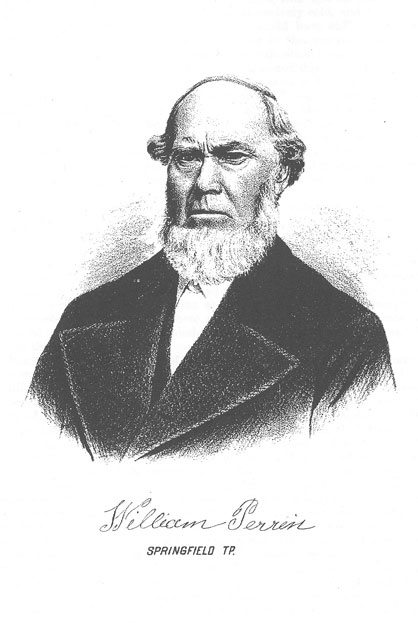
PAGE 477 - PICTURE OF WILLIAM PERRIN - SPRINGFIELD TP
PAGE 478 - BLANK
CITY OF SPRINGFIELD. - 479
ministered to the poor and needy. Their charity was boundless. Committees were appointed to ascertain those who lacked food, fuel and clothing, and to supply their wants. The winter of 1863 was excessively cold, and had it not been for the organized assistance at hand many would have suffered from the rigors of that inclement season. A call was made to the generous farmers of the county to donate wood to the sufferers. So enthusiastic was the reply that it was determined to make a general delivery on a stated day. On the 31st day of December of that year, the farmers sent their teams to the city loaded with wood. A procession was formed which numbered 147 wagons, containing over two hundred cords of wood. Col. Peter Sintz acted as Grand Marshal, while Krapp's Band led the way. The line when closely packed was over ten squares in length. After the wood had been distributed among the families of the soldiers, a sumptuous dinner was given to the donors at Knaub's Hotel.
A "saw-buck-eye" brigade was also organized, which did valiant service in preparing the wood thus generously bestowed, into convenient size for consumption.
The ladies of Springfield were earnest in their ministrations to the soldier. The departure of a favored company or the return of a gallant band was followed and welcomed with good wishes and many greetings. The Soldiers' Aid Society was unceasing in its attention to the soldier boys. One of the most memorable events was the return of the Forty-fourth Ohio Volunteer Infantry, a favorite Clark County Regiment. on veteran furlough. The ladies prepared a royal banquet at the city hall, which had been handsomely decorated for the occasion. The regiment formed in line at the depot and marched through the principal streets to Market space, where a speech of welcome was delivered by Hon. Samuel Shellabarger, and responded to by Col. Gilbert, the much-respected Colonel of the regiment.
When the fall of the capital of the Southern Confederacy was announced, nowhere was the news received with more enthusiasm than in this city. Great preparations were made for a proper celebration of the event. All were eager for an occasion to give vent to their feelings of gratitude, at the prospect of the cessation of hostilities. The cannon at sunrise on Friday, April 14, 1865, spoke as on former occasions its Union sentiments. The church bells clanged merrily. Congratulatory greetings passed among friends and neighbors, business was generally suspended and the city put on its holiday attire. A grand parade was to be a part of the ceremonies of the morning, but, as the Governor of Ohio had issued a proclamation appointing Friday as a day of thanksgiving, and requested religious meetings to be held on the morning of that day, it was decided to postpone the procession until 2 P. M. A union prayer meeting was held in the city hall at 8 o'clock in the evening, under the leadership of Rev. Dr. Joseph Clokey. At 2 o'clock the procession under the Marshalship of Lieut. Col. Welsh was formed. It was composed of the Masonic orders in fine regalia, Knight Templars in gorgeous costume, Odd Fellows and other secret societies, the students of Wittenberg College, fire department, Col. King's and Peter Sintz's cavalry command, a motley crowd in burlesque representing the remains of the Southern Confederacy. This troop was mounted on dilapidated horses, which would have shamed Rosinante, their persons were costumed with disguises which were ludicrous in their representations, and their appearance created much merriment on the route. After the procession had disbanded, a jollification meeting was had at the city hall, which was addressed by Gen. Samson Mason, Hon. Samuel Shellabarger and Judge R. B. Warden.
The general pleasure of the day was somewhat marred in the early morni ag by the premature explosion of a cannon, which shattered an arm of William Boyer, a member of the firing squad.
480 - HISTORY OF CLARK COUNTY.
ASSASSINATION OF LINCOLN.
The day following the grand celebration is memorable in the history of the city. The contrast between the rejoicing, the sunshine, the multiform expression of gladness which prevailed on Friday, and the universal dejection and sor row the symbol of mourning on every house, the cheerless gloom and leaden sky of Saturday was startling. The Chief Magistrate of the nation lead been stricken unto death by the bullet of the assassin in the flush of victor• and bright ahticipation of peace and re-union. Upon the windows and doorways were yet clinging the decorative symbols of joy of yesterday, and now the flags and national emblems were draped in the deepest motirning. Stores and private residences were hung with their tokens of grief, as though the angel of death had touched each household. On Saturday afternoon, April 15, 1865, Krapp's baud marched through the streets playing mournful dirges. Every countenance bore a look of sorrow. Knots of persons world meet on the street corners, and with bated breath discuss the momentous event. A terrible calamity seemed impending over the city. So deep was the prevailing sorrow that it was believed that a public meeting might afford the oppressed people the relief of expression. A call was therefore issued by Mayor J. J. Snyder at the request of many citizens. for a meeting to be held on Saturday- at 4 o'clock P. M. At that hour, the old hall was densely crowded with the loyal men of the city. The meeting was called to order by Mayor Snyder, and an impressive prayer was offered by Rev. S. F. Scovil. After these introductory exercises were concluded, a deep and profound silence prevailed. The sorrow-stricken audience were mute with their unutterable grief. For a space of fifteen minutes there was not a word spoken. Finally Gen. Samson Mason was nominated as Chairman, and Col. H. B. Wilson. Secretary. A committee consisting of the following gentlemen was appointed to prepare resolutions: Judge R. B. Warden, Hon. S. Shellabarger, Hon. R. D. Harrison, Rev. Chandler Robbins, Judge William White and Thomas F. McGrew. Owing to the importance of the duty assigned to this committee, and the near approach of Sunday, it was deemed advisable that they should report at an adjourned meeting to be held on Monday.
On Sunday the churches were. appropriately draped in mourning, and funeral discourses were delivered from every pulpit. At the Second Presbyterian Church, Hon. Samuel Shellabarger delivered an address on the Christian character of Abraham Lincoln, which was listened to with profound attention.
At 8 o'clock on Monday morning, at the adjourned meeting had at the city hall, the Committee on Resolutions reported as follows:
Burdened with a common sorrow at the national bereavement in the startling and untimely death of Abraham Lincoln, the late President, and the dangerous and to be feared fatal wounds of his great co-worker, William H. Seward, Secretary of State, which bereavement Providence in His inscrutable wisdom has permitted to be accomplished by the hand of the assassin, the people here assembled do resolve,
1. That we recognize this event an unparalleled national calamity to the American people, which every patriot mourns ; but which the language of none can adequately express.
2. That in the present condition of our imperiled country, we feel that our supreme reliance must be in the Almighty Disposer of Events.
3. Though sadness reigns, despondency shall find no place in our hearts. But invoking the wisdom the Justice and unselfish patriotism of the late President, and aspiring to his own high rule of action, as announced in his last inaugural, "With firmness in the right, its God gives us to see the riht," we will strive with renewed enery• to finish the work to which our country has been called, and to this end will give to the administration of his successor our unfaltering support.
Previous to the adoption of the resolutions, addresses were made by Judge White, Judge R. B. Warden and Rev. S. F. Scovil. These meetings made a deep impression upon the people. There was a unanimity of regret in the community, and universal condemnation of "the deep damnation of his taking off."
CITY OF SPRINGFIELD. - 481
RECEPTION TO RETURNED SOLDIERS.,
The gratitude of the people of the country at the safe return of her thousands of brave defenders found expression in a grand reception given to them in the fair grounds on September 13, 1865. This day was selected as it was the anniversary of the day (September 13, 1862), when Col. Gilbert, in command of but 4,000 men kept at bay at Charleston, W. Va., the whole rebel force tinder Gen. Loving, estimated from eighteen to twenty-four thousand men. It was a re-union of the returned soldiers with their wives, families, sweethearts and parents, who had sustained them while at the front with their prayers, sympathies, ballots, supplies and sanitary stores. The building on the fair grounds then known as Floral Hall was tastefully decorated. A table 1,000 feet long laid with plates on the sides surrounded the hall. Accommodations were provided for 2,000 soldiers at the first table, and over four thousand people feasted there during the day. Flags and banners ornamented every conspicuous place, while expressive sentiments appeared at every turn. Welcome our Defenders " tastefully- clone in oak leaves was stretched across the end of Floral Hall. Among others were, " The oak of the North or the Southern Palmetto shall shelter none except in the grave." "Departed soldiers, we mourn your loss; your reward is twofold, with God and a nation; they have earned their pathway to glory."
The speakers of the day were Gen. J. D. Cox and Chaplain Collier.
RETURN OF PEACE.
Following the disturbed condition of the country incident to the war, the ominous predictions that the country would be overrun with marauding gangs of lawless men, whose object would be naught but pillage, were unfulfilled. As instantly the silent steeps of Benledi's craggy sides were the shrill whistle of Roderick Dhu peopled with warriors "armed for strife," and again with a wave of the hand hushed into profound peace, so the citizen soldiery of this country sprang to arms, and when peace was declared quietly returned to their occupations. Business was resumed in all localities, as though there had been no interruption. In this place even before the last gun had been fired the Springfield Board of Trade was organized. It was set on foot for mutual improvement, culture of friendly feelings, and interchange of mercantile intelligence among business men, on the 25th day of February, A. D. 1865. A membership of 163 was obtained. The following officers were elected: President, William Warder; Vice President, Thomas F. McGrew; Secretary, Clifton M. Nichols; Treasurer, John C. Child; Executive Committee, Ethan A. Williams, John Foos, Edward B. Cassilly, Charles Morgan.
The board continued in existence for several years, but was finally abandoned.
UNPRECEDENTED COMMERCIAL ACTIVITY.
The flush times which followed the war gave an impetus to trade and business unprecedented in the history of commercial matters. The city was growing rapidly. Scores of new buildings were rising in every locality. The unroofed houses, partially demolished structures and unfinished blocks made the place look as if a tornado had recently swept over it. In the year 1868, new manufacturing establishments were started, additions to others and extensive enlargements were completed, while in the suburbs, the neat, tasty cottages, as well as the substantial and elegant mansions, gave evidence of the culture and wealth of the citizens.
Up to this time, the old, dilapidated City Hall was the only audience-room. The concerts and dramatic representations placed upon the stage in that dingy
482 - HISTORY OF CLARK COUNTY.
hole were not of the highest order, because of the lack of conveniences to properly present them. A commodious hall with the proper facilities was an increasing demand. Andrew C. Black had the spirit and enterprise to undertake to supply this want. In 1868, he began the erection of the Opera House, which has long been appreciated by an amusement-loving public. The building is 99 feet on Main street, and 108 feet on Market street. It has four splendid business rooms on the first floor, with a number of offices on the second and third floors, and a festival hall on the fourth floor. On the west side, extending from the second floor to the dome, is the auditorium, stage, and rooms connected with the "music hall." It has a capacity for seating about one thousand people. The usual arrangement of parquet, dress circle, proscenium boxes and gallery were complete, while the decorations and artistic work were of the highest character. The cost of the building was $100,000. It was formally opened to the public on February 4, 1869, by an address by Thomas F. McGrew, and an entertainment of music, select readings, etc., by home talent, followed by the presenta tion of the "Drummer Boy of Shiloh," which was largely attended, and was continued several days. In the summer of 1880, Mr. Black remodeled the interior of his opera house, conforming it to modern tastes and requirements, at a cost of $18,000. It is now one of the most beautiful and convenient opera houses in the State.
The total number of buildings erected this year (1868) was 250, and the total cost $900,000.
Another improvement added to the city this year was the large hotel building on the northwest corner of High and Limestone streets, called after Springfield's favorite stream-the Lagonda House. The lot on which this block was built was long known as the Mason corner. It was Lot No. 32, on the original town plat, and was bought by Gen. Samson Mason of James Lowry in 1822. A title bond had been given in 1821. The lot was then inclosed, and was covered by hazel and elder bushes and young walnut trees, and intersected by hog-paths in many directions. The ground now occupied by the First Baptist Church, Second Presbyterian Church, and the business block between was at that time in a. similar condition. Gen. Mason, in 1827, commenced the erection of the residence which he completed in 1831, and occupied until his death. It was a splendid mansion for those days, and was a very respectable building when demolished. The enterprise of building the Lagonda House was given a start by the solid donation of $10,000 from the firm of Whiteley, Fassler & Belly. On the 12th day of March, 1868, subscriptions to the amount of $100,000 were ob tained, and the Champion Hotel Company was organized. The Mason corner was purchased for $20,000. The building was then placed under contract, ground broken, and was rapidly pushed forward until completed. It is five stories high, with an extension from High street north on Limestone street of 115 feet, and 1711 feet on High street. It contains 140 rooms, a commodious office, bathrooms, and other arrangements of a -first-class hotel. The cost of the entire building, when furnished, was about $130,000. The Board of Directors of the company, when first organized, was composed of the following persons: William N. Whiteley, John Foos, J. D. Stewart, David Thatcher, James S. Goode, John W. Bookwalter alter and Charles H. Bacon. The hotel was formally opened on September 30, 1869, with L. W. Cook & Son as landlords.
The activity which had prevailed in business circles in 1868 extended over into the following season. The demand for business rooms and private dwellings was increasing. Rents advanced, the value of real estate appreciated, and additions to the city proper were made in all directions. In 1869, there were erected 188 new buildings, at a cost of $582,751.
Now, with its hotel accommodations, its opera house and extensive manu-
CITY OF SPRINGFIELD. - 483
factories, Springfield became an object of importance throughout the State. Invitations were extended to various associations to hold their annual meetings here. The State Fair was held on the Clark County Fair Grounds in 1871 and 1872. The State Editorial Association, upon invitation, had also met here in 1870. Great preparations were made to entertain the editors of the country press throughout the State, which included an inspection of all the manufacturing establishments, a banquet at the Lagonda House, and an excursion to the Yellow Springs.
The census of 1870 gave a population of 12,652, being an increase of over 75 per centum since 1860.
THE HARD TIMES.
The depression of business, which was a natural sequence of the flush times of the war, and which prostrated all branches of industry in other localities, did not seriously affect the manufacturing interests here. While each establishment kept up its full quota of employes, rum full time and paid promptly, the other business interests were enabled to successfully stem the tide of disaster which was sweeping over the country. It was a subject of much comment throughout the State that Springfield suffered little outside of the general depreciation of values, as compared with other localities. Immediately preceding and following the financial crash of 1873, there were a number of assignments, but the total is small for the city of its size and the magnitude of its commercial interests.
The records of the Probate Court from 1872 to 1877, inclusive, show the nature of the assignments made, as appears by the following compilation:
Year. Assets. Liabilities.
1872..................................$5,911 55 $9,159 82
1873..................................88,112 57 120,610 37
1874..................................12,451 11 7,151 68
1875.................................. 21,193 35 25,115 77
1876.................................254,977 23 465,074 60
1877 ..................................45,581 94 64,015 61
Totals ............................$428,227 75 $696,127 85
In the decade closing with the census of 1880, the population of Springfield was found to be 20,730, being an increase over the former census of over 65 per cent. This was an indication that, notwithstanding the stagnation, uncertainty and insecurity of monetary and commercial matters, the city was rapidly increasing in numbers and importance.
THE WOMAN'S, CRUSADE.
On the evening of November 11, 1873, twenty-six ladies of the city of Springfield went before the City Council with a petition signed by over 600 women, praying for the prohibition of ale, beer and porter houses.
The desired relief from the evils of the liquor traffic not being afforded from this quarter, on the 21st of this same month the Women's Benevolent Society passed resolutions to the effect that, as nine-tenths of the cases of poverty and distress which appealed to them for charity, and came within the province of their labor, arose either directly or indirectly from the liquor traffic, and, consequently, while it existed, could be only, in a slight measure, relieved, that they call upon the community in general and ask the co-operation of the churches in inaugurating a series of temperance meetings, to be held consecutively in the different places of worship throughout the city.
Mrs. J. R. Guy, Miss Mary Clokey and Mrs. Joseph Cathcart were appointed a committee to meet with the Pastoral Conference of the city, and present the wishes and views of the Ladies' Benevolent Society. This being carried into
484 - HISTORY OF CLARK COUNTY.
effect, the conference pledged itself to a hearty co-operation with the ladies, cordially approving of their action in petitioning the Council, and their plans regarding the mass meetings, and promising the use of the churches for these meetings, in order that the sanctity of religion might, as far as possible, be thrown around the movement. The temperance meetings were inaugurated December ? in the English Lutheran Church, with Rev. M. W. Hamma presiding, and a large audience present.
An Advisory Committee, formed for the purpose of acting with and advising the ladies, who were the more prominent in the work, was formed of representative men from each church.
On the 6th of January, 1874, during the week of prayer, a Woman's Temperance Association was formed after the morning prayer meeting in the First Presbyterian Church, the volunteer rolls for signatures being circulated by Mrs. E. D. Stewart, afterward known in this country and abroad as "Mother Stewart," who had been added to the original committee.
On the 14th of January, 1874, the morning prayer meeting for the temperance cause was established, and, on the following Sunday, the Sunday afternoon prayer meeting for the same cause. These meetings continued without intermission for twenty-six weeks. So intense was the interest they produced, and so strong the feeling of religious fervor, that it was no unusual thing to see this placard on the doors of business houses: "Closed for one hour, to attend the prayer meeting." On the 16th, the vast audience attending the mass meeting requested that this meeting be held once a week hereafter, and it was so ordered. This meeting was addressed principally by ladies, whose talents as orators were developed by this work to a wonderful extent.
On February 11, an all-day prayer meeting was held in the First Presbyterian Church, Dr. Dio Lewis, of Boston, and the reformed liquor seller, J. C. Van Pelt, of New Vienna, Ohio, being present in the afternoon. Excitement was intense. From this meeting the first "praying band" went out led by "Mother Stewart" and Mrs. Cossler, and visited the Lagonda House saloon. News of their coming had preceded them. The streets were full of followers. They were jostled and crowded, but no insults were offered the women. The saloon was found locked, but the prayer meeting was held outside. From this time throughout the entire winter, these bands, having special leaders, went out daily, holding prayer meetings in, or outside of saloons, as opportunity offered. A committee was appointed for the special supervision of the street work, with Mrs. James Kinney as President, and Mrs. John C. Miller as Vice President of the committee.
These praying bands circulated the pledge, gained many signers, succeeded in reforming many drinkers, and bringing them into the church. Mr. John W. Bookwalter gave the crusaders the use of an empty building owned by him (the old Episcopal Church, which has since been demolished) for their headquarters. So satisfied were the citizens that these ladies were doing good that the different wards furnished lunch, daily, for the praying bands at this place, and here starving inebriates were often fed and warmed.
In March, 1874, began what is known as the "anti-license campaign." The new constitution which had been framed for the State of Ohio was to be voted on in August, and it contained a clause to the effect that license should be optional with the people--might be voted in or out of existence, as the people pleased.
On the 3d of April, a Clark County Temperance League was formed, with a corps of efficient officers-Mrs. J. R. Guy, Secretary, being one of the most active and energetic. The mission of this league was to hold temperance meetings in all the school districts and villages throughout the county. Much good was done by this league, and many drinkers reformed.
CITY OF SPRINGFIELD. - 485
In the summer of this same year, the first Ohio State Temperance Convention of those interested in the crusade work convened at Springfield, and organized the entire crusade element into an association to be known as the Woman's Christian Temperance Union. This union (or the women connected with it) did not prosecute liquor-sellers under the law, but left this feature of the labor to the supervision of the Advisory Committee, depending upon prayer and missionary labor for their success. "Picket duty," or the watching of those who entered saloons, by committees appointed for that purpose, was less extensively practiced in this county than in many other places.
On the 16th of February, 1877, a call was issued by many of the leading ten perance ladies of the city for a series of Sunday afternoon Gospel temperance meetings, to be held in the city hall. This was done at the suggestion of Mrs. Bishop Morris, then President of the Clark County League, and who had witnessed the good effect of such meetings among reformed men in Cincinnati.
These meetings were so well attended, and became so powerful for good, that the workers determined to put forth a still greater effort for the advancement of the cause, and, on the second week of April, 1877, Col. Richard Realf, of Pittsburgh, a convert of Francis Murphy's, came to Springfield upon invitation, and, with the aid of the ladies and the Young Men's Christian Association, inaugurated that phase of the temperance work known as the "Murphy Movement." This phase of temperance reform interested a large number of citizens. A series of Gospel temperance meetings were held nightly in the city hall, at tended bv vast audiences. Col. Realf remained in Springfield one week, during which time large numbers signed the pledge. The object' of this movement was to win both drinker and seller by kindness, love and persuasion to forsake their career. Citizens gave liberally of their means to secure experienced workers from abroad to conduct the public services, and for many weeks, night after night, Black's Opera House was crowded " from pit to dome " with eager listeners, who came forward in vast numbers at every call and signed the pledge, each signer receiving his own pledge and carrying it away with him. During the time when the meetings were conducted by Messrs. Clancy and Smithson, also of Pittsburgh, the people would go hours beforehand, packing the lobby long before the opening of the doors. It was found necessary, also, at this time, to exclude every woman from the lower part of the building and reserve its use for the men, so anxious were they to give a full opportunity to all men who desired to be present and sign. At this time, also, a rigorous attempt was made to -exclude the ladies from all participation, in order to favor the prejudices of any man who might desire to become a " Murphy," but who was opposed to the crusade, and to woman's public work in moral reforms. No entertainment ever " drew " with the magnetic force of the Murphy meetings, at which reformed men told their experiences in their own natural language, and these were often both pathetic and amusing. A choir was formed of fine singers, unequaled by any church choir in the city, and this was by no means a slight source of attraction, as their selection of music was of the most choice and affecting character.
About the middle of May, a " Murphy Club " was formed, of which Mr. A. R. Ludlow, a prominent manufacturer and well-known citizen, was made President, and this club was fully equipped for entering actively upon the work. After the departure of Messrs. Clancy and Smithson for other fields of labor, the meetings were removed once more to the city hall. All persons who would sign the pledge and the constitution of the club could become members, the men paying a small stipend weekly into the treasury, but the women were admitted free. In order to utilize and harmonize all the temperance elements, the ladies were also invited to speak from the platform, and did so with good effect.
486 - HISTORY OF CLARK COUNTY.
Clark County never experienced so forcible an influence as that exerted upon it during the course of this work. From the formation of the club, in April, 1877, to December, 1880, 15,621 persons signed the pledge, only 1,117 of whom resigned. A very large majority of these signers were adult males.
THE CENTENNIAL CELEBRATION.
The 100th anniversary of American independence was appropriately observed in Springfield. The morning of the 4th day of July, A. D. 1876, was ushered in by the firing of cannon and ringing of bells. The business streets of the city were properly decorated with flags, banners and pendants, expressing patriotic sentiments, while many private residences gave evidence of the industry and enthusiasm of their occupants. At 8:30 o'clock in the morning, in accordance with the suggestion of President Grant's proclamation, union prayer meetings were held in the Center Street Methodist and First Presbyterian Churches. One of the largest processions which was ever held in Springfield paraded the streets. It was a complete representation of the triumphs of the century. All the industrial arts were represented, the various departments of the city government, secret societies, choral unions, etc., making several miles in length.
The Declaration was read by Rev. H. H. Morell, and an oration delivered by Thomas F. McGrew.
MILL RUN IMPROVEMENT.
The stream which was once the principal motive power of the village, but which, in later years, had become a mere sewer and a useful receptacle for the city's garbage, had been for years a source of great annoyance to the property owners from High street west, as its waters were confined within narrow limits by the improvements which had been made along its borders. Every spring, freshets would flood the streets and cellars adjoining High, Market and Center streets, causing continual damage. The City Council, in 1877, proposed to remedy this evil by arching over with stone the stream from the shops of Whitely, Fassler & Kelly, on High street, to Center street. This work was completed in the following spring. This arch was eighteen feet in diameter, with a radius of nine feet. It cost $19,669.90, of which amount $582.44 was paid by the city, and the residue by the property holders between Main, Jefferson, Market and Center streets.
The density of population had become, under the old number of city wards, inconvenient and cumbersome in the transaction of the business of the city, as well as in its elections. The subject or the division of the city into a greater num ber of wards had long been discussed. In September, 1879, by the death of Councilman S. C. Warner, from the Fourth Ward, a vacancy was created in the Council, which, by the neglect of the proper authorities, was not filled in the proper time, so that the vacancy continued until April, 1880. Meanwhile, a special act of the General Assembly, passed February 27, 1880, amending Section 1,693 of the Revised Statutes, was passed, which provided that, in cases like this, where there was a vacancy unfilled by the neglect or omission of the proper authorities, a majority of the members qualified to vote should be sufficient to pass any ordinance, etc. Under this amended act, the five remaining members of the City Council (which had been equally divided politically) succeeded, on the 24th day of March, A. D. 1880, in passing an ordinance re-districting the city into nine wards, as it is now constituted. This measure was made a political issue in the City Council, and created a great deal of interest. As the Council, on political questions, was a tie, there were grave doubts whether five Councilmen could pass the ordinance re-districting the city, and the death of one and
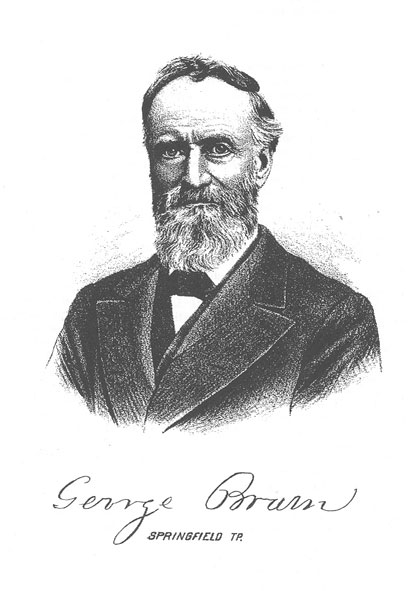
PAGE 487 - PICTURE OF GEORGE BRAIN - SPRINGFIELD TP
PAGE 488 - BLANK
CITY OF SPRINGFIELD. - 489
the absence of the other four, so as to prevent a quoriun, was relied upon in an injunction proceeding to restrain the Mayor from issuing the proclamation; but the proclamation was issued before the notice was served on the Mayor, and the injunction proceedings were dismissed. The measure of establishing the nine wards was therefore successfully carried into effect.
THE FINE ARTS.
This sketch would not be complete without reference to the condition of art among us, as an evidence of culture and progress. Within a decade of years, the city has advanced in the fine arts to a remarkable extent, and several gentle men of refinement and culture have added to the attractions of their homes quite a number of very choice and costly art works, conspicuous among which were many very beautiful and exquisite oil paintings, Messrs. B. H. Warder and J. W. Bookwalter being among the leading and most prominent collectors. Mr. B. H. Warder's collection of paintings were mostly imported direct from Europe by himself. The majority of the pictures in his possession are from the studios of eminent German artists. Conspicuous among them are the following well known names: We have, in a large painting, by Adelsteen Norman, an admirable rendering of a Norwegian scene, a lake of sparkling fresh water among the snow-clad mountains, a large and very vigorously treated picture; a large canvas by Carl Boker, with a deep vein of humor running through it; it tells its own story on sight; another very large picture by Hugo Katzenreuter, peasants bringing tithes to the monastery, is an admirable work of art; a superb cattle piece by A. Braith, of Munich, king of cattle painting; also, a strong and excellent piece of cattle painting by J. H. L. De Haas, one of the most eminent cattle painters of the clay; a beautiful and enchanting spring morning, representing a German home among the peasantry, thatched roof, etc., a lovely picture, by C. Matchin, of Weimar; and others, by such masters as Schlessinger, Carl Hoff, F. Voltz, F. Schauss, Meyer Von Bremen, Meyerheim, Vautier, Otto Gunther, J. Geizer, G. Major, P. Van Chendel, P. G. Compte, Ch. Hoguet, Herman Kalbauch, Hugo Kauffman, P. Robbe, Alfred Bohm, Herman Ten Kale, Louis Lassalle, Louis Ritter Koek-Koek, A. Kowalski, M. F. H. De Haas; an exquisitely beautiful 1 painting by A. Amberg, of Berlin, the " Lovers by the Lake;" a fresh out of-door effect by E. Chialina, and yet a number of other pictures by as many more artists, and bronzes, clocks and bric-a-brac in endless array. Mr. Warder is in possession of three paintings by F. Schauss, and two by Schlessinger. The Kowalski has been thus far Mr. Warder's last purchase, having procured it at Gaupil's, New York. It is a small canvas, and is treated very artistically. The subject is "The Vidette Outpost." Three mounted scouts have proceeded as far as has been considered safe, and, while one of them is left in charge of the half-weary looking chargers, the other two proceed to some distance; clambering up on a rocky eminence, they survey the surrounding landscape by the light of the newly risen full moon, apparently with the design or purpose of locating the enemy's outpost pickets and familiarizing themselves with the lay of the ground. There is a ghostly weirdness suggested by the picture-a vague feeling that danger is lurking about the rock and bushes. The time of year seems to be early November-a windy, cheerless night, comfortless and gloomy; the artist has reproduced the whole incident with admirable skill and faithfulness. Of the collection of paintings in the possession of Mr. John W. Bookwalter, much can be said in praise of the good taste and judgment evinced in their selection. With only a few exceptions, they are excellent works of art, and, as they are grouped together on the walls of the beautiful picture hall, or gallery, which Mr. Bookwalter caused to be constructed for the above purpose at the residence of Mrs. James Leffel, on Maple avenue, North
490 - HISTORY OF CLARK COUNTY.
Side, they are shown to the best advantage that good light, properly introduced, and tasteful and intelligent grouping, will admit.
Among the leading pictures will be found L. Knau's "Old Beau," painted in 1851, at Dusseldorf; a not very large canvas, but certainly a very valuable one, artistically and pecuniarily; the treatment is very masterly; the colors are brilliant as though painted yesterday. The leading personage in the painting is the one that gave the picture its name; the "Old Beau ' stands quite erect, with feet pompously set apart, a quaint-looking skull cap set jauntily upon his head, and an immense button-hole bouquet stuck in the lapel of his coat, with scarlet waistcoat, long stockings and big shoes with buckles: he is airing himself ostentatiously before two young ladies, one of whom is apparently attentive enough, while the other but illy conceals her repugnance at his assumption; the female figures are posed on a garden seat in the shadows. while the light falls full upon the "Old Beau's" very ugly and repulsive countenance, and about his shoulders and bouquet, seeming actually like real instead of painted light. It is a peculiar picture, this, one moment attracting you by its wonderful painting and consummate art, the next moment you are repelled by the hideous "mug" of the conceited egotist.
The picture has quite a history of its own. The last owner but one of the "Old Beau" was Mr. John Taylor Johnston, of New York, who exhibited it, with a number of other paintings, at the loan exhibition at the Metropolitan Museum, on Fourteenth street, in centennial year.
The "Story of the Battle," by Julian De Vriendt, is also a very fine picture, and a very costly one. "The Mountain Brook," by A. Bierstadt, is the largest canvas in the collection, and is considered one of Mr. Bierstadt's very best efforts.
"The Embroidery Lesson," by Hugues Merle, is also a large canvas (for this collection), and is a really very beautiful picture, in Merle's most characteristic style. "Six Weeks till St. John's Day," by Hughes, is a full life-size bust portrait of an old woman in extreme Dutch costume, counting upon her stout fingers the number of weeks as yet until St. John's Day. It is an admirable piece of painting, wonderful, and wonderfully realistic.
"The Beach at Newport," by William T. Richards, of Philadelphia, is an extremely characteristic picture, not only in its resemblance to Richards' best style of sea-coast painting, but also in its likeness to nature.
"The Convalescent," by Felix Schlesinger, is full of emotion and sentiment-a picture that would endear itself to any person in a short time on account of the tender feeling in the subject, and of the charming and vigorous manner in which it is rendered.
There is a fine moonlight scene by L. De Winter. 'The " Iconoclast," by the late and lamented Emanuel Leutze, is said to have been one of the artist's best efforts. It is certainly a most effective and masterly production. A Puri tan father returns to his home to find his daughter upon her knees before a small shrine in ivory, representing the crucified Christ upon the cross. The angry father rushes into the room, and with his left hand he grasps his daughter by the arm, and, with his gauntleted right hand fiercely clenched, he at one blow is about to crush the forbidden emblem.
Cherictrie's picture of children and the doll is an exquisitely lovely work of art. They are endeavoring to teach the doll how to warm its bands at the fire, and the artist has certainly succeeded in presenting the scene in a very wonderful manner. It doesn't seem like paint, but nature. The treatment is very realistic.
The "Duet," by A. Gues, of Paris, a pupil of Gerome, is also a very finished picture, and painted in the artist's most careful manner.
CITY OF SPRINGFIELD. - 491
Among the smaller paintings, yet not an iota less attractive, are such pictures as "The Donkey Boy of Cairo," by F. A. Bridgeman, a young American artist, of whom all Americans should be proud. He has spent the last dozen years of his life in Europe, and has taken a very high position at home and abroad as an artist of very great merit, and still greater promise. The "Donkey Boy of Cairo" is a picture which in every respect is truthful in subject and detail. The boy, while waiting for a passenger, has tucked himself into the corner of a doorway, to avoid, as much as possible, the tropical rays of the sun, while the donkey (the street-car of Cairo) stands reined up, arrayed in the gaudy trappings peculiar to oriental countries. The facade of the old building gives one the idea, to some extent, of the peculiar style of building and ornament of many of the older structures of the ancient capital of Egypt.
John F. Kensett, our great and lamented landscape painter is represented in a broadly treated picture called the "Secluded Brook." The manner in which it is painted suggests the Munich school very much.
C. Brillouin. in the "Bookworm." shows one what can be clone in good drawing and extremely close treatment. It is a very wonderful piece of painting.
Vrolyk's "Cattle" are real, and his sunlight is really warm, and his shadows cool and comfortable. It certainly is a very fine picture. V. Codina Laughlin "Christening," Wordsworth Thompson's "Political Consultation," V. Chavet's "Connoisseurs," Eastman Johnson's "Young Housekeeper," "The Cavalier." by Leon Y. Escosura. "On the Beach,"' by F. H. Kammerer, as well as the "Coquette, or Springtime." by the same, are all very admirable works of art, and reallv deserve a much more extended mention.
There are still other as fine pictures in the same collection, viz., J. C. Thom's "Winter Sunset," "The Sisters," by A. Toulmouche, "Early Devotion," by Meyer V on Bremen, "Sunset on the Rhine" and "View on the Delaware," by A. C. Houland. "Evening in the Campana," by J. F. Cropsy, "Scene on the Nile," by Theodore Frere, "Winter," by A. Schenck, "Wood Scene," by E. D. Nelson (finished by Kensett), "Autumn," by William Hart, "Bashful, yet Fond," by George H. Baughton, "Venice," by C. P. Cranch, "Waiting at the Rendezvous," by Worms, "A Venetian Lady," by Jean Aubert, "Straits of Gibraltar." by Samuel Colman, "The Young Navigator," by J. S. Guy, "Adiroudacks," by A. H. Wyant, and two of a series of four pictures representing the seasons, by J. W. Casilear.
Mr. Bookwalter has also half a dozen very fine water-color drawings, by such artists as Emile Adan, W. H. Powell. T. Moran, etc.; also a beautiful statue, "A Young girl's First Sensation of Cold Water," modeled in the true Italian school of genre re art; the finish is completeness itself; the texture of skin, hair, linen, earth, water, etc., is as perfect as can apparently be done in marble. Mr. Bookwalter has still other paintings. "After the Raffle," a French painting, by Maurice Leloir, a brother of Louis Leloir, both very eminent artists. Another is an old man's head and shoulders, life-size. He wears jeans coat and vest, muskrat fur cap, and a smile--almost a grin. The picture throughout is a perfect wonder of close painting; every detail is put there with the utmost fidelity. Q. Becker is the artist. There are said to be only a very few of this artist's works in America. The companion piece to it, an old peasant woman's bead, same sized picture, is in August Belmont's gallery, Fifth avenue, New York.
An exquisite little picture by A. Savini, among Mr. Bookwalter's last purchases, is a gem, a Meissonier in finish. "The Lovers' Tete-a-tete," a young lady sitting at a spinning-wheel, while her lover bends over her in true cavalier like elegance, and whispers something apparently infinitely interesting to her, as her tell-tale face indicates. They are dressed in seventeenth century costumes.
492 - HISTORY OF CLARK COUNTY.
"The Shepherd," by Tiratella, "The Sunset in the Bahamas," the latter painted to order for Mr. and Mrs. Bookwalter, by Albert Bierstadt, very tropical, and also very typical of the West India Islands at certain seasons of the year.
"Absorbed," by E. Leutze, is a very charming work; a young lady sitting in a library engaged in perusing a book; a canary bird sits on the chair she is sitting in, singing as though its little throat would fail under the ordeal. And a "Moonlight," by A. Bierstadt, about completes this brief and incomplete notice of the Bookwalter collection of paintings.
Mr. John Foos, of East High street, has, on the walls of his palatial residence, several very excellent paintings. One very fine landscape by an Italian artist of eminence, T. Diano, is worthy of a place on the walls of any gallery in the State. The scene depicted so graphically is evidently located in Switzerland. There is quite an expanse of country in the foreground; then comes, in the grand distance, a mass of snow-clad mountains, all aglow with sunlight, such as is seldom as perfectly painted on canvas. The clouds lift themselves joyfully from the dizzy mountain heights, while the foreground is all alive with a turbulent stream of green water, fresh from the newly melted snows and avalanches of the mountain heights. On the left of the picture is a rough, rocky roadway, with a rude shrine in the wayside, and a group of peasants in a devotional attitude before it; and in the distance come into view a peasant with a straw basket held on his head, and a flock of sheep following him in close proximity. It is a very strongly painted and excellent picture.
Mr. J. J. Barber, landscape and cattle painter, of Columbus, Ohio, is also represented here by three very good pictures, in his characteristic and best vein. A marine picture by Nicholson, of Philadelphia, is a foggy morning on the ocean, and a very good picture. Mr. Foos also owns one of our former townsmen's, the late Godfrey N. Frankenstein, best efforts, a scene on Buck Creek (the Lagonda below the city). Also a wooded glen, a quiet retreat, by Uhl; a babbling brook, rippling along through the middle foreground of the picture.
William Warder, Esq., of East High street, has in his possession what evidently has been handed down to us from the old masters. The subject is " St. Peter," with the inevitable bunch of keys clasped in his fingers.
An eccentric picture collector, a Mr. Joseph Phillipson, an early resident of St. Louis, a gentleman of culture and wealth, in about 1814 had represented to him by a German gentleman that he knew of a collection of old masters' works, some four hundred in number, which could be purchased at a very low figure. Mr. Phillipson went to Paris and purchased the entire collection for $14,000. and brought them to St. Louis. Afterward, having failed in business, he was compelled to part with a large part of the collection. This happened about twenty-five years ago. They were scattered broadcast over the land. Mr. Warder's mother purchased the above picture at the time, afterward coming into his possession. The name of the artist has unfortunately been lost, but the picture is very old, as is evident from its having been re-backed, the old canvas becom ing entirely too frail to hold the paint. It is certainly a wonderfully painted and excellent, as well as capitally preserved, picture. certainly is no doubt a work of great value intrinsically.
Capt. A. S. Bushnell is the fortunate owner of the replica of David Neal's famous painting of the finding of Rizzio by Mary Stuart. It is a medium-sized canvas, but it is a gem, a masterpiece of draughtsmanship and color, admirable in design, and full of the literature of the subject.
Two paintings, considerably larger in size, entitled " Going to" and "Coming from the Fair." by Breitback, tell the story they are intended to tell perfectly. They are well painted. It is a very cheerful and exhilarating sight to see the fresh and briglit-looking young people start out in pairs (and paired in
CITY OF SPRINGFIELD. - 493
the good old way) for the fair, with their countenances full of happiness and hope, full of anticipations of the pleasures of the day; everything seems so bright and promising; then comes the second scene-the return from the fair by the pale light of the moon, so tired and weak-entirely discouraged. The young men have imbibed too freely during the day, and now must be assisted home by the young women. The rendering of maudlin drunkenness in the latter canvas is admirable.
A small but exquisitely painted picture, by Lossow, a full length figure of a lady, in a costume of the eighteenth century, in a boudoir, all of which is very charmingly rendered.
A lovely mountain landscape, painted in Hertzog's best style; small, and there certainly is enough material in it to fill a much larger canvas, which suggests its richness and fullness.
Mr. Bushnell owns a wood interior, with a hunter on the trail, accompanied by a dog. It is a very sparkling and attractive painting. The picture is painted by Claugh, an American artist of fine reputation.
There are also several other paintings in the above collection--one by Hugo Kauffman, "The Return of the Veteran," with both head and arm in sling. The picture is small, and painted on a panel.
Also, a good copy of A. Amberg's "Lovers by the Lake," by Uhl; the original is in possession of B. H. Warder, Esq.
Mr. Bushnell anticipates adding to his collection of paintings at intervals, as new pictures come before him and please his fancy.
Localizing art to Southwestern Ohio, and more directly to Clark County, Ohio, and to Springfield as the radiating point, we find that among the earlier exponents of art were the portrait painters Sweet, Brannan, Roberts, Craft, John Frankensteiu, C. T. Webber; and among the painters of landscape, etc., were Godfrey Frankenstein, Miss Mary Spencer, Miss Eliza Frankenstein.
Among the former, Sweet died very young, in 1843, at the Exchange Hotel, leaving a number of unfinished commissions in portraiture, among them the portraits of the then proprietors of the hostelry, Mr. Jason P. Phillips and wife. His very earliest efforts indicated that he was very talented.
Brannan's ability was not to be questioned. In his portraits, he gave evidence of great ability. strong. graceful; realistic, his productions were masterly. A few examples of his skill in portraiture yet remain in the city to attest his merits.
John Frankenstein was a great painter. In portraiture, he was very masterly--a modern Michael Angelo. There are very few, if any, of his works to be seen in the city at this time. He was a very peculiar man, and, during the last nears of life, lived secluded in New York City. On the 18th day of April, 1881, be was found dead in his room in that city, surrounded with many works of his art from his own easel.
FRANKENSTEIN FAMILY.
In 1831. John A. Frankenstein and Anna C. Frankenstein, the parents of John. Godfrey N.., Marie M. C., George L., Gustavus and Eliza, emigrated from Germany to America. They were shipwrecked on the coast of Virginia, but were more fortunate than some others in saving all of their valuables. An exceedingly kind and wealthy family gave the parents and children shelter during their trials, until they were able to resume their journey Westward. Some time during the year, they arrived at Cincinnati; Ohio, their future home. John A. Frankenstein was a teacher and professor of languages, also a thorough musician, and who possessed a voice of exceeding sweetness. In those days, at Cincinnati, teaching was not remunerative, and few cared to learn either Ger
494 - HISTORY OF CLARK COUNTY
man, French or Latin, and so on, so Mr. Frankenstein turned his attention to cabinet-making. He invented many beautiful designs. Anna C. Frankenstein, the mother, was a woman of great personal beauty., superior intellect and most lovely Christian virtues. John, the oldest child, at the age of fifteen, painted portraits, the coloring of which is pronounced by competent judges to be unsurpassed. He also became celebrated as an historical painter and sculptor. The pictures, "Christ Mocked in the Praetorium," "Isaiah and the Infant Savior," and others, are works of great power and beauty. The busts of Judge McLean, Dr. R. D. Mussey. "The Dawn of Life," place him in the front rank of sculptors. Godfiey N. Frankenstein, the second son, was born September 8, 1820. The passion for drawing developed itself in young Godfiey at a very early age. Some of his boyish expedients in reference to artists' materials were amusing. It is related of him that, when quite a little boy. upon an occasion of hog slaughtering, he got a quantity of blood with which to color some of his drawings. The butcher. discovering what he was about. kindly informed him that coffee made very good yellow. The little artist coaxed his mother to make some for him, and in a short time he had painted a whole village. church and all, using coffee for the straw-colored houses, the blood for the red tiles of the roofs of the dwellings, and diluted ink for the slate-colored roof of the church. During the year 1832, at the age of twelve, he worked a few months with a sign painter. At the age of thirteen, he carried on the business of sign-painting on his own account. Persons wishing work done, and asking for the proprietor of the establishment, were, as we may well suppose, considerably astonished when the boyish Frankenstein presented himself in that character. He often related., with great pleasure and amusement, the number of incidents that happened to him in those youthful days. He sometimes found some difficulty in convincing persons who came to the paint-room that he was the proprietor. At one time, a man came and wanted a sign painted. "My lad, where is the boss`? I want a sign painted right away." "He stands before you." "Now, my lad, don't fool me. I'm in a hurry; tell me quickly, where's the boss:"' "He stands before you." "Well, now, you have too "honest a face not to tell the truth." Young Godfrey asked him to be seated and watch him make some letters. Accordingly, while he was getting ready to letter, the man jumped up and said: "Here's your order. I see by your maneuvers that yon can paint a sign, and I'll bet, if you live long enough, you'll do some wonderful things." He won a great reputation for the beauty of his lettering, then a mere boy. He was accustomed, at this time, to go out early in the morning, among the hills near the city, to draw from nature, returning before business hours. He now also practiced painting heads, and met with great success. He soon became so absorbed in painting pictures that he began to neglect. his sign-painting, and it was obvious to him that he must abandon either the one or the other. After much reflection and deliberation, and a consultation with his parents, who left the matter entirely to him, he decided to give up his business. though it bade fair to be very lucrative, and devote himself entirely to art. In June. 1839, he opened his studio in Cincinnati, and made quite a brilliant debut. His health, however, soon became seriously affected by the extreme dampness of his room, and he did not fully recover for several years. During the years of 1839, 1840 and 1841, he made sketches in the vicinity of Cincinnati, chiefly on Mill Creek, then and for several years after a beautiful stream; on Bank Lick. Kentucky; on the Little Miami, near Clifton, Ohio: about Yellow Springs, Ohio; in the vicinity of Madison, Ind. ; and many other places. On the death of his father, which occurred in 1842, his elder brother being absent, he became head of the family," which position he held until death. In June, 1844. he visited Niagara Falls for the first time. He was so charmed with their grandeur and beauty
CITY OF SPRINGFIELD. - 495
that he spent the greater part of the time between 1844, and 1866 depicting them on canvas in all seasons of the year, by day and by night, from every conceivable point. All these scenes he portrayed on canvas with a fidelity and delicacy of touch which have never been equaled or surpassed by any artist, living or dead. He was the first to call attention to the great beauty of Niagara Falls, and the first to make it apparent. He also, between the years 1844 and 1851, painted a large number of pictures, and visited various sections of the country in the pursuit of his art. Among his pictures at this period were portraits of William Cullen Bryant, Hon. Albert Lawrence, and the White Mountain scenes, the Lawrence homestead, Groton, Mass., the Adams residence, Quincy, Mass.. the birth-place of John Adams and John Q. Adams, Braintree, Mass., and many other places of interest. William S. Sampson, Esq., of Cincinnati, purchased the artist's first landscapes-one above Cincinnati, on the Ohio River; the other below Cincinnati, on the Ohio. He manifested great interest in him, and proved a most invaluable friend to him until death. The late Dr. John Lock, a scientist, took a very great interest in Frankenstein's paintings, and, during the artist's youth, did everything in his power to encourage the growth of his genius. John D. Park, of Cincinnati, has a gallery of the Frankenstein paintings. His judgment in nature's beauties is keen and correct. We could enumerate many others, but space forbids; and we ought not to omit mentioning the friendship existing between John L. Whetstone, of Cincinnati, and the artist, from boyhood until death, that was as beautiful as it was rare. In 1849, he removed with his mother and sister to Springfield, Ohio. Between the years of 1851 and 1861, when not at Niagara, he painted some lovely scenes on the Lagonda Creek, Mad River-all in the vicinity of Springfield, Ohio. The quiet beauty of some of these views is matchless. In 1849, he conceived the idea of painting a panorama of Niagara, one of the principal motives being to bring the great wonder of the world before all people, to induce many who might not otherwise do so to make a journey to the great original; to present those who could not do this as faithful a representation as could be given, and to renew the pleasure of those who had made the pilgrimage. How fully he has succeeded is attested by the spontaneous and enthusastic language of the press throughout the country, and of the thousands from all parts of the globe who have seen the work In 1867, he visited Europe, sojourning awhile in England, painting some English scenes, and spent a season, in company with his younger brother, Gustavus Frankenstein, among the Alps. On their return to London, it was acknowledged that Mont Blanc and Chamouni Valley had never before been painted with such power and beauty. After an absence of two years, he returned to America in April, 1869, and in the following autumn he went to one of his cherished streams, Little Miami River, near Foster's Crossings, twenty-two miles above Cincinnati, and painted Gov. Morrow's old mill, two views of it-one looking up the stream, the other down the stream. The loveliness of these two scenes is indescribable. The following season, 1870, finds him again in the same vicinity, fairly throwing the sunshine on the canvas. In the month of January, 1871, the artist met with a severe loss in the death of his mother, from the effects of which he never fully recovered.
In the autumn of the same year, he went to the White Mountains, accompanied by his sister Eliza, where they both painted from nature. In November, 1872, the artist painted his last scene from nature-Mad River, Fern Cliffs, three miles from Springfield, Ohio. He contracted a cold, which culminated in a very brief, severe illness in the following February, lasting ten days, and, on the morning of February 24, 1873, he breathed his last. His industry was wonderful, and he possessed one of the largest collections of landscape paintings in the world, never having parted with any of his original pictures, but one.
496 - HISTORY OF CLARK COUNTY.
He was a great and good man. He had the strictest regard for truth and right, in whatever he said or did. His word and his honor as a man he valued above all price. He died in the prime of life, and, as a Louisville writer well said: "He applied all his energies to the duties of his profession with the devotion of an enthusiast. He had a great range of knowledge, and a wonderful perception of the qualities and relations of things. His learning was both thorough and profound. He was a philosopher, a reasoner and an observer. A laborious student, not wedded to any dogmas; was constant, methodical and unremitting in the performance of his duties. He was none the less distinguished for his exemplary conduct in all the relations of private life. The beautiful and childlike simplicity of his character, the unobtrusive modesty of his manners, and the refinement and purity of his principles, won for him love, honor, obedience, and troops of friends."
Marie M. C. Frankenstein, a sister, equally gifted with pencil and brush, and a rare talent for modeling, has also received the highest testimonials for having been a most successful teacher in the primary department of the public schools in Cincinnati, Ohio.
George L. Frankenstein has command of pencil and brush, and wields the pen with equal force and grace.
Gustavus Frankenstein very early evinced his talent for drawing and painting, and has become a great mathematician, writer and scientist, the author of the Magic Reciprocals, whose exquisite beauty has called forth the highest praise.
Eliza Frankenstein, the youngest of the family, often accompanied her brother Godfrey in his sketching tours. It afforded him exceedingly great pleasure to have her paint, and he often said the most peaceful and happiest moments of his life were those when he and she together went to paint from nature. Still busy with her brush, she continues her favorite studies in botany and music.
S. JEROME UHL.
S. Jerome Uhl is an artist who has made rapid progress toward fame by the force of merit alone. He has been a citizen of Springfield since 1868, during which time he has risen to a high rank in his profession. His portraits have been universally admired for the absolute faithfulness to the originals, the delicacy of torch and realistic appearance of features. Mr. Uhl mixes his paints with the same important ingredient which Sir Joshua Reynolds said was essential to success-to wit, brains. Among the prominent works of this artist, chiefly portraits, we have observed that of Gen. Lytle, Cincinnati; Mrs. John Campbell, Ironton. Mrs. Dr. Vincent, Plainfield, N. J.; Asa Bushnell; Maj. Luther Brown, deceased; Mrs. Whitely, mother of William N. Whitely: Mrs. Amos Whitely, Mrs Mary Cowling, Oliver S. Kelly. Several gems in landscapes have been produced from his studio. They were painted for Ross Mitchell, and are scenes about Lagonda. Mr. Uhl will leave during the present summer for Europe, where he proposes to spend about two years in study. He will take with him commissions from a number of our citizens for paintings from his hand.
PRESENT PROSPECTS.
We have now seen the little hamlet in the woods develop from the lonely cabin on the hillside and the small cluster of log huts on the slope, through all the processes of municipal growth. until it has attained the position of the third manufacturing city in the State. In all its stages, its course has been steadily onward in its symmetrical development. It is now in the, heyday of its strength and enterprise, peopled by a class of citizens who demand obedience to law and order, who have a conscientious respect for religion, and a through appreciation of education and the fine arts. These elements of success in the
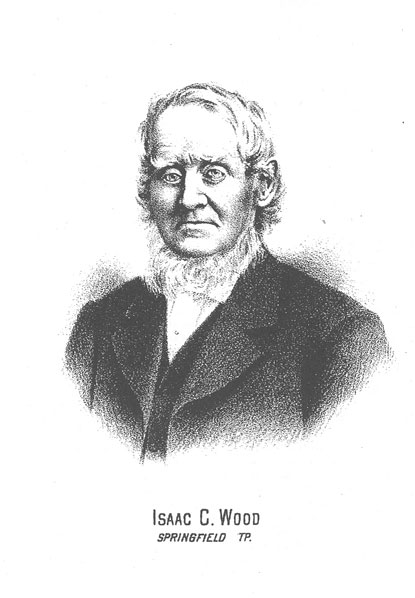
PAGE 497 - PICTURE OF ISAAC C. WOOD - SPRINGFIELD TP
PAGE 498 - BLANK
CITY OF SPRINGFIELD. - 499
past are prophetic of still greater achievements in the future. It has not yet reached its maximum stature. Its possibilities have not yet been measured. Its manufacturing establishments have been crowded out of the center of the city, and are stretching along its suburbs east and west, contiguous to the railroad tracks which intersect the city in many directions. It is on the eve of important enterprises, public and private, which will add to its wealth and importance. The establishment of water-works is in the immediate future. This has been a subject of discussion for the last ten years, but no practical sieps had been taken until the present year. 1881. The necessary legislation has been obtained. Authority to issue the bonds of the city to the amount of $400,000 has been granted. A Board of Water Works Trustees, consisting of George H. Frey, John H. Thomas and Oliver S. Kelly has been elected, contracts for the work have been made, and this much-needed improvement will be added to the city. The water will be obtained above Lagonda, will be filtered in galleries, and brought fresh and pure into the houses of the citizens, in sufficient quantity and at moderate cost.
The Grand Opera House, a beautiful building, will be finished by the 1st day of October, 1881. It is being erected by John W. Bookwalter, a citizen of wealth, on the site of the former shops of James Leffel & Co., which have been removed to the vicinity of Lagonda. It has all the modern improvements, stage accessories, exits, etc., a seating capacity of 1,200, and will be finished in the highest style of the decorative art. It will be the pride of the city.
The railroad enterprise which has engaged the latest attention of our citizens is the proposed extension east of the Indianapolis, Bloomington & Western Railroad from Indianapolis to Springfield, connecting with lines east and north here. This will place the city on the great highway of trade and travel between the East and West. The company has asked a donation from the citizens in the sum of $100,000, and will then extend the road through New Carlisle to Springfield, opening an entirely new territory, which will be greatly to the advantage of the city. There is also in contemplation the construction of a standard gauge road from Springfield north through Piqua and Sidney, which, if completed, would open a way to the Northwest. This road is called the Springfield, St. Paris & Sidnev road.
In concluding this part of this history, the writer desires to return his acknowledgment for the assistance which has been afforded him by the labors of those who have traversed this field before him, and without whose sketches and historical reminiscences this work would have been impossible. Robert C. Woodward, the efficient Librarian of the Public Library, is the local historian who has been assiduous in collecting and preserving many matters connected with the early settlement of Springfield. These were published in a small book in 1852, under the title of "Sketches of the City of Springfield." Great freedom has been taken with these sketches, and they have been embodied herein so far as applicable. Dr. John Ludlow, who is a connecting link between past and present Springfield, some years ago read before the Clark County Historical Society a series of valuable papers on the early settlers of Springfield, which were partly based upon the sketches of Mr. Woodward, and partly upon his own recollections. The valuable historical statements which were made in those papers, subject to such corrections as were necessary, have been incorporated in these pages, and to these gentlemen full credit should be given. The memories of the older citizens, the newspapers of the day, old rusty records and forgotten archives, have been fruitful sources of information. In what has been written there will no doubt appear many errors, but these will be pardonable, as the entire work was performed, of necessity; in a few weeks, and amid the hurried rush and continued interruptions of a professional life.
500 - HISTORY OF CLARK COUNTY.
This closes the history of the city proper. Its educational, religious and industrial interests are histories in themselves, and may be found in the succeeding pages. The various departments of the city, and its more important elements, such as its press, railroads, telegraph, public library, art, etc., etc., are given in detail in the pages which follow. The aim has been to present Springfield as it was, and as it is. If we have but barely outlined it in the foregoing and in the succeeding pages, we shall be satisfied.
CHURCHES
In consequence of the loss of the old records of Mad River and Springfield Circuits, it had been somewhat difficult to find correct data upon which to make a complete record of the Central Methodist Episcopal Church, which is the parent church in the city of Springfield, from the beginning of Methodism in this city to the present time; but with the aid of the conference minutes and by diligent inquiries made of pioneer Methodists and others, we are able to present the following as being substantially a correct account of early and later church matters as pertaining to this charge.
The first account of Methodism in Springfield which we have is the establishment of Miami and Mad River Circuits, in the bounds of which Springfield was included in the year 1805, which was about four years after the village was laid out by James Demint. A large scope of country was included in the limits of that circuit, which had in that year, a membership of 734 communicants. The Mad River Circuit was set off and established as a separate circuit from the Miami Circuit, with the Rev. John Thompson in charge. In 1807, Revs. Adjet McGuire and Isaac Quinn were preachers upon Mad River Circuit; in 1808, Revs. T. Milligan, J. Davison and W. Mitchell; in 1809, Revs. Hezekiah Shaw, William Young and Saul Henkle; in 1810, Revs. Saul Henkle and Hector Sanford; in 1811, Rev. John Clingan; in 1812, with probable additional territory, it was styled Mad River and Xenia Circuit, with the Revs. John Collins and Moses Crume as preachers; in 1813, the name was again changed and finally established as Mad River Circuit, with the Rev. Joseph Tateman as preacher, and a membership of 1,200; in 1814. the preacher in charge was Rev. Joseph Oglesby; in 1815, the Rev. Abbott Goddard; in 1816), Revs. Moses Crume and Henry B. Bascom; in 1817, Revs. Walter Griffith and William Williams-, in 1818, Revs. John Sale and John Strange; in 1819. Rev. John Strange; in 1820, Revs. Russell Biglow and Robert W. Finley; in 1821, Revs. Robert W. Finley and A. McLean; in 1822, Revs. Thomas S. Hitt and George M. Maley; in 1823, Revs. James Collerd and John T. Taylor. The membership reported this year was 1,209. In 1824, Revs. William Lamdin and John P. Taylor; in 1825, Revs. James T. Wells and George Gatch; in 1826 and 1827, Revs. Augustus Eddy and Levi White; in 1828 and 1829. Revs. Burroughs Westlake and Alfred M. Lorain; in 1830, Revs. Levi White and Elias Patler: in 1831. Revs. William H. Raper, James T. Donahoe and Joab W. Reagan; in 1882, Revs. William Raper, Richard Brindriff and Joseph Hill. In 1833, William Raper being the Presiding Elder of Lebanon District. of which Mad River Circuit was a part, a new circuit was formed, of which the charge at Springfield formed a portion, which was styled Springfield Circuit, with the following preachers in charge: Joshua Boucher, J. P. Taylor and A. Sellers as supernumerary. The circuit at the close of this conference year had a membership of 950. It was during this year that the church was built, if not wholly completed, at the southeast corner of Columbia and Market streets. It was a large brick edifice, two stories in height, with a gallery, supported by large circular wooden pillars. running across the end opposite the pulpit. and along the two sides, affording ample accommodations for the largest congregations collected at Springfield at
CITY OF SPRINGFIELD. - 501
that day, and, on account of its size, the church was often used for gatherings not strictly religions in their character. Back of the pulpit was a large circular recess reaching nearly to the ceiling of the main structure, and arched over so as to form a sort of half-dome. This was removed some years afterward on account of the echo which it created. The church had no belfry, and for a number of years the people were accustomed to assemble, as did the other congregations of the town, at the ringing of the court house bell, which was rung at the same hours on the Sabbath for the service of all the churches. A belfry was, however, erected shortly afterward, and a bell'placed therein, which is the same bell now used at the Central Church. In 1834, Revs. J. Boucher, Granville Moody and A. Sellers, as a supernumerary, were in charge of Springfield Circuit. In 1835, Urbana District of the Ohio Conference was organized under William H. Raper, as Presiding Elder, with Springfield Circuit in its bounds, under the charge of Revs. William A. Barrett and John Alexander and A. Sellers, supernumerary. In 1835-36, Revs. Michael Marley and E. B. Chase; in 1836, Revs. Michael Marley and Joseph Gasner, were appointed to Springfield Circuit; in 1837, Revs. Mifflin Harker and James L. Grover; in 1838, Revs. Mifflin Harker and Solomon Howard; during the last three years, Rev. Robert 0. Spencer succeeded W. H. Raper as Presiding Elder of the Urbana District: in 1839, Revs. William Young and Samuel Clarke were preachers, and Rev. Zachariah Connell commenced a four years' term as Presiding Elder; in 1840, only seven years from the organization of Springfield Circuit, the charge at Springfield was constituted a station, with the Rev. William Young as its Pastor. and had at the close of this conference year a membership of 330; in 1841, Rev. Solomon Howard was Pastor; in 1842 and 1.843, Rev. John W. Weakly; at the close of this conference year there was reported a membership of 375; in 1844, Rev. William Herr was Pastor; in 1845, Rev. Uriah Heath; in 1846, Rev. Randolph S. Foster; during the past four years Rev. William Simmons was Presiding Elder; in 1847, Rev. Randolph S. Foster; Rev. James L. Grover, Presiding Elder: in 1848, Rev. Charles Elliott.
During this year a portion of the church colonized into what is now known as High Street Church, the two charges being supplied by the Rev. Charles Elliott and Rev. Solomon Howard, who was then President of the Ohio Confer ence High School, located at Springfield. In 1849, Rev. Maxwell P. Gaddis was Pastor of the old charge, which received the name of Columbia Street Methodist Episcopal Church. At the close of this conference year, notwithstanding the division made the previous year, there was a membership of 446. In 1850, Rev. Maxwell P. Gaddis was continued Pastor. Rev. James L. Grover closed a four years' term as Presiding Elder. In 1851, Rev. Granville Moody was Pastor. Rev. Michael Marley, Presiding Elder. In 1852, Rev. Granville Moody: in 1853, Rev. James F. Chalfant; in 1854, Rev. James F. Chalfant; in 1855, Rev. Joseph Newson; in 1856, Rev. Joseph Newson; in 1857, Rev. W. J. Ellsworth; in 1858, Rev. 1W. J. Ellsworth. This year Rev. James F. Chalfant closed a four years' term as Presiding Elder. In 1859, Rev. M. Dustin was Pastor. In 1860-61, Rev. Charles Ferguson was Pastor. During the conference year, in the summer of 1862, the church having sold the building at the corner of Columbia and Market streets, commenced the erection of another church edifice at the northwest corner of Center and High streets, to which was given the name of Central Methodist Episcopal Church. In 1862, Rev. J. F. Conrey was Pastor. This year closed a four years' term of Rev. John T. Mitchell, as Presiding Elder of what was now called Springfield instead of Urbana District. In 1863-64 and 1865, Rev. S. L. Yourtee was Pastor. In 1866, Rev. J. W. Cassatt became Pastor. Rev. Michael Marley, who had been Presiding Elder of Springfield District for the past three years, died this year of cholera,
502 - HISTORY OF CLARK COUNTY.
during the session of conference at Ripley, and the Rev. William Simmons was appointed as Presiding Elder during this conference year. In 1867, Rev. J. W. Cassatt was appointed again to this charge, and the Rev. Asbury Lowry became Presiding Elder. In 1868, the Rev. J. W. Cassatt was re-appointed to this station. In 1869-70-71, Rev. S. A. Brewster was Pastor; in 1872, Rev. C. W. Ketchum; in 1873, Rev. C. W. Ketchum; in 1874, Rev. C. W. Ketchum. On the 1st of January, this year, the pews were declared free to all. J. W. Cassatt was Presiding Elder. In 1875-76, Rev. E. T. Wells was Pastor. July 3, this year, the old singing books of the Sabbath school were sent to the col ored school of Knoxville, Tenn. In 1877, Rev. E. T. Wells; in 1878, Rev. W. A. Robinson. The church was this year frescoed, painted and otherwise greatly improved. In 1879, W. A. Robinson, Pastor; S. A. Brewster, Presiding Elder. In .1880, Rev.W. A. Robinson, Pastor.
The present building, the one built in 1862, is a large two-story brick of rather imposing appearance, with a tall belfry and large bell. It was valued at $22,000 On the first floor there is a Sunday school and prayer meeting room, and four class rooms. The second story comprises the auditorium, with a seating capacity of about five hundred persons. The room is _nicely frescoed. the seats comfortably cushioned, and the church on the whole wears a very comfort able, if not an elegant appearance. It is heated by steam and lighted by gas throughout. The parsonage is four doors west on High street. It is a very fine two-story brick house, with pretty grounds and in a very aristocratic neighborhood. It is valued at $9,000. The lot on which it stands was donated by P. P. Mast.
In the fall of 1848, Rev. Charles Elliott, D. D., became Pastor of Columbia Street Methodist Episcopal Church, situated on the southeast corner of Columbia and Market streets, Springfield, Ohio. Seeing the crowded condition of the church, Dr. Elliott proposed the formation of a new charge, and, on the 1st day of April, 1849, he called on his congregation for volunteers, and about eighty members responded and formed a colony to be known as the "High Street Methodist Episcopal Church." The next day the Pastor appointed a Board of Trustees for the new charge as follows: Levi Rinehart, Edmund Ogden, Christopher Thompson, L. H. Olds, Rev. John M. Young, S. G. Moler and S. S. Henkle, and the same was organized by the election of Levi Rinehart, President, and S. S. Henkle, Secretary. The basement of the high school (now the seminary) was occupied for public worship, for the time being, as well as by the Sunday school. The colonists, as heads of families as near as can be ascertained were as follows: The Trustees above named. and David Hayward. M. W. Fisher, Reuben Miller, Mrs. Clarinda Henkle, Sr.. George Clarke. W. N. Schaeffer, William Porter, Charles Hotsenpillar, Henry. Hedrick, Milton Harrison, Mrs. Smallwood and E. G. Dial. On the 1 st of January, 1850. the lot was purchased by the Trustees, which is now occupied by this church. Rev. Isaac Dillon was the first Pastor from September 1, 1849. Rev. John Inskip succeeded Dillon in the fall of 1850. The Pastor, in a few weeks, presented a plan for the new church building which was adopted, and the work was prosecuted vigorously to completion, and the dedication sermon was preached on the ''7th of July, 1851, by Rev. John Miley, now Professor in Drew Theological Seminary, New York. The Pastors of this charge successively up to 1868 were Rev. John W. Weekley; appointed September 1, 1851; Rev. W. H. Sutherland, 1853: Rev. M. Dustin. 1854: Rev. J. N. Marlay, 1856: Rev. W. J. Fee, 1858; Rev. Allen T. Thompson, 18611; Rev. George C. Crum. 1862: Rev. A. B. Wambaugh, 1864: Rev. G. W. Dart, 18015: and Rev. Thomas Collett. 1868. During the pastorate of the last named. the work of remodeling the church building was commenced and completed at an expense, all told, of $18,000. The successive
CITY OF SPRINGFIELD. - 503
Pastors after him, up to this time, were Rev. Lucien Clark, 1871 to 1874; Rev. W. L. Hypes, 1874; Rev. S. B. Smith, 1875; Rev. F. G. Mitchell, 1876; and Rev. Thomas J. Harris, 1879. During the pastorate of Rev. Lucien Clark, the property adjoining the church on the west was purchased by the Trustees for the purpose of a parsonage, at a cost of over $8,000. The membership of this charge is between three hundred and four hundred.
Grace Chapel was built by the Central Methodist Episcopal Church for missionary purposes. The ground on which it stands was donated by P. P. Mast, Esq. It is a one-story frame, with no bell or belfry, and comprises one large Sunday school or church room and two class rooms. It was built in 1872, and cost about $1,800. The dedicatory sermon was preached by Rev. Charles Ferguson, Sunday, August 12, 1873. A successful mission school is being carried on there now.
The Methodist Protestant Church, of Springfield, is located at No. 39 West Washington street. This church was organized in January, 1829, with twenty-six members. The Rev. Saul Henkle, Sr., was a leading member, and took an active part in the organization, as did his brother, Rev. Moses M. Henkle. The first named was a prominent citizen of Springfield, and at that time Clerk of the Courts, which office he filled for twenty-one consecutive years until his death in 1837. The Rev. William Steele, now residing at Bloomington, Ill., is probably the only member of the original society now surviving. For a number of years this church was embraced in a circuit, having ministers appointed by the Ohio Conference, which was organized in November of the same year. The late Rev. Adjet McGuire was the first Pastor, with Rev. Jonathan Flood for the colleague. A house of worship was shortly after erected, being the small, brick church on North street, since sold to the African Methodist Episcopal society. There were but three other churches in Springfield, viz., the Presbyterian on Main street, Methodist Episcopal on Columbia street, and the Seceders, now United Presbyterian, on Limestone street. The Springfield Methodist Primitive
Church was detached from the circuit and made a station in 1837. The first Pastor, under this arrangement, was A. H. Bassett, who subsequently, for many years, conducted the Methodist Recorder now issued at Pittsburgh, Penn. The succeeding Pastors and their dates, as nearly as can be ascertained, were as follows: A. C. Barnes, 1838-39; David Croll, 1840; Robert Dobbins, 1841-42; O. P. Stephens, 1843: James Pelan, 1844-45; O. P. Stephens, 1846; Reuben Rose, 1847-48; W. G. Fowler, 1849; R. M. Dalbey, 1850; C. H. Williams, 1851-52; N. S. Smith, 1853; and, subsequently, dates not definitely ascertained, by T. B. Graham, T. Heard, S. S. Bartlet, J. E. Snowden, J. B. Walker, J. McFarland, J. W. Ellis, J. W. Spring, W. E. Marsh, J. M. Flood, W. R. Parsons and others.
The present house of worship was built in 1851-52, under the pastorate of Rev. C. H. Williams, but only the basement completed until 1858, while Rev. J. B. Waller was Pastor, the subscription was raised, the church finished, and duly dedicated on the 29th of July of that year. Rev. James Baker is the present Pastor, and, with a membership of about one hundred; the society is on a good basis and in prosperous condition. Rev. C. H. Williams, still a resident of Springfield, is Corresponding Secretary of the Board of Missions of the Methodist Episcopal Church, and editor and publisher of the Methodist Protestant Missionary.
The St. Paul Methodist Episcopal Church was made up by a colony from the First or Central Methodist Episcopal Church, which separated itself from the parent church February 10, 1880. There were over one hundred and fifty members. A lot was procured on South Yellow Springs street, at a cost of $7,000, and the erection of a church building began in June, 1880. The build-
504 - HISTORY OF CLARK COUNTY.
ing is to be of brick, one story high, of rather peculiar design and so con structed that it can be used as church room, prayer meeting room and class rooms, or thrown into one vast audience room capable of seating not less than one thousand five hundred people-with the galleries. When completed it will have a cost from $20,000 to $23,000. The corner stone was laid with impressive services on the 31st of July, 1880, in the presence of a large concourse of people.
On the 5th of May, 1867, at the house of Frank Galespy's, nine members of the African Methodist Episcopal Church resolved to withdraw from the church and form a separate organization. They were organized by Rev. P. Fulman, May. 28 in the same year. A lot was purchased on South Center street, between Clark and Fair streets, on the 6th of June, 1867, for $300, and a one story frame church built thereon called Asbery Chapel. The Rev. Scott Ward served as minister from October 30, 1867, to March, 1868. Rev. S. Dodridge. from March 20, 1868, to March, 187(1; Rev. H. Butler, March. 1870. to September, 1870; Rev. G. Dowener, October, 1870, to March, 1872: Rev. William Eckels, March 20, 1872, to February, 1873; Rev. H. W. Johnson, February 18. 1873, to July, 1873. Rev. A. H. Price, from July 14, 1873, to 1874: Rev. A. W. Hargrave, from February 14, 1874, to March, 1874: Rev. Scott Ward, from 1874 to 1878; Rev. M. McCoomer, from 1878 to 1870: Rev. Thomas Tompkins. from 1879 to 1880.
Rev. C. Jones, the present minister, was called in April, 1880. On the 24th of July, 188(), the church closed a very successful camp-meeting held at the fair ground, having realized some $600 or $700, which is to be devoted to the building of a nice brick church.
The early history of the North Street African Methodist Episcopal Church society cannot be accurately ascertained, as it dates from a period as far back as 1824-25, and no reliable data can be secured beyond the more recollections of a few aged members. About that time, however, a nucleus consisting of a few earnest Christian negroes, many or all of whom were once slaves, were accustomed to gather in their primitive cabins or even in barns, and hold religious services. Their first church was probably in a small frame house, on High street, a schoolhouse, which stood on the hill on the spot now occupied by the residence of Mrs. Bacon. Later they purchased a little stone church on Limestone street near the creek. As the society gradully increased in numbers and strength, they purchased a small brick edifice known as the St. John Lutheran Church, which was located on North street, where the present church of the society now stands, paying for the same about $800. In 1874, the society having prospered, was, on September 28 of that year, duly incorporated, and preparations made for the building of the present large brick church, which was completed about 1876, at a cost near $12,000. Among the earliest preachers of this society, and perhaps the first, was Thomas Lawrence. Rev. Fayette Davis and Rev. Klingman were also early preachers. The church has prospered greatly, and stands now one of the representative societies of this popular denomination.
The First Presbyetrian Church was organized July 17, 1819, with a membership of twenty-seven. For three or four years previous to its organization, the Rev. Archibald Steele acted as stated supply, preaching once in four weeks in schoolhouses, the court house or the old stone Associate Reform Church, that stood on Limestone street and was afterward used as an African church. The first Ruling Elders were John Humphreys and Melyn Baker. The Rev. Steele continued his services as stated supply till June, 1823. He was succeeded by Rev. Andrew W. Pouge, who gave his services once a month until in 1825. On the 30th of June, 1825, Rev. Franklin Putnam became the first regular Pastor
CITY OF SPRINGFIELD. - 505
of the church. During his pastorate, which ceased. March 21, 1828, sixteen were added to the membership. Rev. William J. Frazer then succeeded as supply, in which capacity he served from December 21, 1828, to February 21, 1830. During his term of service, in 1828, the first church was built at cost of $6,000, on ground that had been sold under execution and bought by John Ambler for $800. He had purchasd it for church purposes and sold it to the church for what he had given for it. The building was a small and very plain one-story brick house, without any cupola or other embellishment. It was built by piece-meal as the congregation could afford. The act incorporating the first Presbyterian society was also passed during Rev. Frazier's term of service., by the General Assembly of the State February 11, 1829. The Rev. William Gray supplied the pulpit from 1830 to February 24, 1832. During all this time there was a steady advance in the church's numerical strength. In 1832, the church became self-sustaining, and Rev. John S. Galloway was invited to become the stated supply for three or four months, at the end of which time, October 4, 1832, he was installed and ordained Pastor. In this relationship he continued to serve the church with marked success until April 16, 1850, when he resigned and entered the service of the American Bible Society. Two years before his departure, in 1848, the old church was torn down and a new one built at a cost of $12,000 on the same ground. It was also a brick, but with two stories and a cheap wooden cupola. The dedicatory sermon was preached by Rev. Phineas Girley. Rev. N. C. Burt was called as Pastor September 2, 18511; he served until June 19, 1855, when be resigned to take a church in Baltimore. He was succeeded by Rev. William F. Findley in 1855; he left in 1858. The church was then without a regular Pastor until Sylvester F. Scovil was called in 1860, and served until 1866. Rev. T. A. Fullerton filled the pulpit from 1867 to 1871, during which time $3,200 was used on the church in building an addition, cupola, etc. Rev. Fullerton was followed by Rev. George F. Cain, from 1871 to 1872. He was succeeded by Rev. W. J. McKnight, who served from 1872 to 1.879, since which time the church has been without a regular Pastor, but the pulpit has been supplied by Rev. Dr. Helwig, of Wittenberg College, this city. Dr. Falconer, of St. Louis, is the present Pastor. The church building, as it now stands, is an imposing structure indeed, with its towering cupola 175 feet high., its stained glass windows and stone borders. It is as handsome within as without, being beautifully frescoed and well furnished. It is lighted by gas and heated by hot-air furnaces. On the first floor are the church parlor, lecture room, Sunday school room and infant school room. The up-stairs comprises the vestibules and the main auditorium, which has a capacity of seating comfortably 800 people. The church is valued at $50,000.
The Sunday school of this church was first held in different places wherever and whenever there was preaching. It was first held in the court house with Judge Torbett as Superintendent three years before the church was organized. They began holding it in the church about 1830, with about fifty scholars, and superintended by W. M. Spencer; he was immediately followed by James S. Christie, who served for nine years. After him various men had charge of the school until now W. M. Weir is the Superintendent. It is in a flourishing condition, having at present 300 scholars; and is furnished with a very large library, which is well kept up.
The North Side Mission Chapel was built by the First and Second Presbyterian. Churches, in the fall of 1878, for mission Sabbath school purposes. The ground on which it stands .was donated by Dr. Robert Rodgers for Presbyterian Church purposes. It is on Mason street near Sherman avenue. The chapel is a one-story frame building, containing an infant school room and the main Sun-
506 - HISTORY OF CLARK COUNTY.
day school room. There is a flourishing school carried on there now, and fiom time to time preaching is held.
The Second Presbyterian Church was a colony from the First Presbyterian Church. It was formed in 1860, with a membership of 106. In 1862, $4,000 was paid for a lot on South Limestone street, and a church built thereon, costing $18,000. The dedication services were held September 3, 1863. The following is a list of the Pastors with the dates of service: Rev. E. R. Bower, from May, 1861, to July, 1867; Rev. P. H. Mowery, from November, 1868, to September, 1873; Rev. W. H. Webb, the present Pastor, came in June, 1874. There are at present 312 members. The church is a two-story brick, with the usual Sunday school and prayer meeting rooms on the first floor, in rear, and the auditorium in front.
With their usual modesty, and desire to avoid anything which seemed to call for the praise of men, the fathers of the United Presbyterian Congregation were not careful to preserve a record of their doings, but suffered them to go in the past as though there was little in them of interest to generations following, so that he who would study their plans and labors is often wholly in the dark as to when and how they did many things. This is a sufficient cause for regret, but, to add to our misfortune, the only account which was left of their transactions, was destroyed by fire forty years ago, and the "traditions of the elders" do not cover a period much anterior to that time.
No definite date of the organization of the society, presently known as the United Presbyterian Congregation of Springfield, can be obtained. The persons who formed the nucleus of the congregation emigrated from Bourbon County, Ky., in the early part of this century, and brought their religion with them.
Before the erection of a church building, they met for worship in the second story of William McIntire's distillery-rather a strange place in which to worship-but they could do no better. The first church building was erected on Lot No. 1, Demint's Plat, on the east side of Limestone street, near Buck Creek. No date can be found of the erection of the house. The deed of the lot is dated March 27, 1819. The main part of the building now occupied was built in 1839. The society was first organized as a congregation of the Associate Reformed Church, and, with a sister congregation of Xenia, Ohio, extended a call to Rev. John Steele, of Bourbon County, Ky., who accepted the united charge, and was brought, with all his earthly possessions, from his former home to Xenia by members of his new charge in their wagons.
They were resolved that they would have a Pastor at any cost. This was in the year 1817.
Mr. Steele resigned his pastorate in the latter part of the year 1836, having served here for nineteen years.
A call was made by the Springfield congregation in 1837, for the services of Rev. James F. Sawyer, for the whole of his time, and he was installed as Pastor in 1838. Mr. Sawyer resigned his charge in May, 1848, after a service of ten years.
Rev. Robert Henry was the next Pastor, taking charge of the congregation December 17, 1850, and continuing his labors as Pastor until the middle of the year 1853.
Rev. Joseph Clokey, D. D., began his ministry in the congregation March 1, 1855, and retired March 1, 1875, having been Pastor twenty years. During his pastorate in the year 1858, the two ecclesiastical bodies known as the Asso ciate and the Associate Reformed Churches, united and formed the United Presbyterian Church, and soon after the congregation took the name by which it is at the present time known. The present Pastor is Rev. Joseph Kyle, who
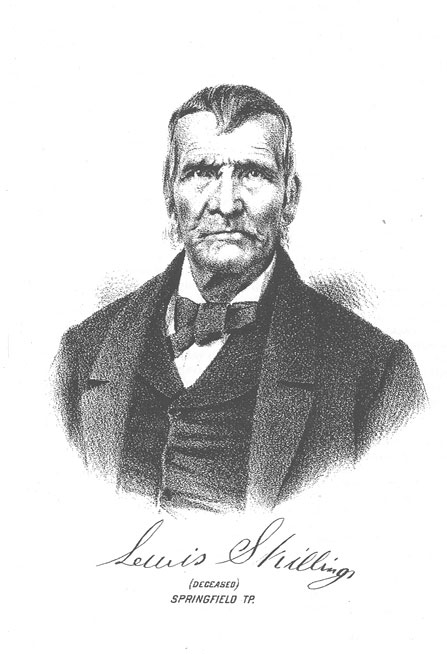
PAGE 507 - PICTURE OF LEWIS SHILLINGS - DECEASED - SPRINGFIELD TP
PAGE 508 - BLANK
CITY OF SPRINGFIELD. - 509
began his labors in this field January, 1877. The congregation reported to the last general assembly of the church 174 members.
The First Baptist Church of Springfield was constituted on the 29th day of January, 1836, with the following-named persons as members: Edward J. Nugent, William T. Young, John Young, William J. Card, Thomas H. Howard, Mary Hill, Jane Mareness, Mary Steinbach, Sarah Ann Downing, Lydia Card, Rachel Young, Mary Ann Nugent and Sarah Howard. The Gospel union of the Mad River Association met with the church, and the ministers and brethren in attendance assisted in the organization. On the 7th day of May, in the same year, steps were taken for the establishment of a Sabbath school in connection with the church. On the 23d day of May, a call was extended to Rev. D. A. Nichols, which was not accepted. Rev. E. D. Owen accepted a call to the pastorate July 12, 1836, and, on the 11th of August following, the church was admitted to membership of the Mad River Baptist Association. The following year arrangements were made looking toward the purchase of a lot for church erection purposes. On January 17, 1838, Rev. James Elliott, of New York, was called to labor one-half his time as Pastor. May 26,1840, Rev. H. D. Masonbecame Pastor, during whose term of seven months' service a branch consisting of seven members in Clifton was added to the church. March 29, Rev. Enos French was called to the pastorate, at a salary of $400. On the 26th day of June, A. D. 1841, Messrs. Gallagher, Young, Halsey Cotes and Mareness were appointed a committee to secure a site for a church building. The first election of Deacons was held October 25, 1841, and J. M. Gallagher, E. J. Nugent and J. S. Halsey were elected. The church was organized under an act of incorporation June 15, 1843, and Messrs. Nugent, Cotes and Halsey were elected Trustees. On the 8th day of September, 1843, Rev. Mr. French resigned the pastoral office to take effect at the close of that year. The lot on the northeast corner of High and Limestone streets was purchased on the 4th day of March, 1844, for church purposes. Rev. Mr. Syms was chosen Pastor April 8, 1854, and continued as such for three years and three months. The church building was commenced during his pastorate, but no part of it was ready for occupation until September of 1847, when services were held in the lecture room. The entire building was ready for use and was formally dedicated February 12, 1852.
The following Pastors have had charge of this church: Rev. John S. Moore, from October 9, 1.848, until April, 1850; Rev. Joseph Brown, from November 5, 1850, to June 5, 1860; Rev. William Allington, until March 15, 1862; Rev. Samuel Williams, from June 2, 1862, to July 1, 1864; Rev. J. R. Baumes, from November 24, 1864, to March 10, 1868; Rev. R. S. Colwell, from August 11, 1868, to July 1, 1873; Rev. A. L. Wilkinson, from December 8, 18'73, until August 1, 1877: Rev. J. B. Tuttle, until August 1, 1880.
On the 6th day of April, 1868, fifty-two members withdrew from this church by letter, in order to form a new society, which they accordingly did under the name of the Trinity Baptist Church of Springfield.
This society in April, 1881, sold the church building and lot for $25,000 to Ross Mitchell. They propose to build a handsome edifice elsewhere.
In the vestry of the First Baptist Church of Springfield, on the night of March 28, 1868, a small number of Baptists met to organize a new church. They realized that with the rapid growth of population and wealth came a necessity for a division of labor.
Much of the outlying territory of the city was far removed from places of worship, and it was to meet this want by organizing another Baptist congregation and erecting a suitable place of worship was the object of this conference. At a subsequent meeting held at the same place on the night of April 9, the organization was perfected, under the title of Trinity Baptist Church of Spring-
510 - HISTORY OF CLARK COUNTY.
field, Ohio, with the following official board: Pastor, Rev. J. R. Baumes; Clerk, J. J. Tuttle; Treasurer, McClung Huffman; Deacons, A. O. Hayward and J. J. Tuttle; Trustees, Lewis C. Huffman, Jacob Gram and J. J. Tuttle.
For a brief time the young church occupied the city hall, the use of which had been granted by the City Council, the first service being held on Sunday, April 12. Subsequently, a lease was secured of Central Hall, on Market street, which was occupied until January 22, 1871. On August 14, 1868, the Council of Recognition, composed of delegates from the various ions .churches comprising the Miami Baptist Union Association, met in Central Hall for the purpose of recognizing and receiving the church as a component part of the association; the Rev. S. Williams, of Springfield, Ohio, preaching the sermon, and Rev. J. N. Weatherly, of Casstown, Ohio, extending the right hand of fellowship. Closely following this, a Building Committee was appointed, who purchased the present church lot, on the southwest corner of Limestone and Mulberry streets, and, on the 7th day of August, 1870, broke ground for the present chapel. The building was completed, and, on Sunday, January 22, 1871, was dedicated. The dedicatory sermon was delivered by Rev. H. S. Colby, of Dayton. The chapel is of the Gothic style of architecture, with a front of forty-two feet between the towers; and a depth of sixty feet. The audience room had a seating capacity for 300 persons, and also contains the library. The upper story has a large room suitable for social gatherings, with the Pastor's study annexed.
The following is a list of the Pastors, and the length of time they served the church:
Rev. J. R. Baumes, D. D., from May 2, 1868, to November 19, 1872; Rev. C. W. Rupe, from November 19, 1872, to December 1, 1873; Rev. A. B. White, from May 4, 1874, to December 1, 1876; Rev. A. L. Jordan, from July 1, 1877, to July 1, 1879.
The present Pastor is Rev. T. B. DePoy, who was called by the church March 22, 1880, and entered upon his pastoral duties April 11.
The Free-Will Baptist Church is located on Clifton avenue, Springfield, Ohio. The church building is of brick, a large and handsome structure, with an imposing and picturesque steeple, and of excellent architectural design. It was constructed by the Pleasant Grove Free-Will Baptist Church Society, of Green Township, Clark County, and was completed in 1876, at a cost of about $7,500. The church was dedicated with the usual ceremonies by the society in February, 1877, and, in March following, the religious society that now occupies the church was organized, and placed in the charge of Rev. R. J. Poston, who served the congregation acceptably for two years. He was succeeded by the Rev. C. A. Gleason, but the society has for some time past been without a Pastor.
They have a flourishing Sabbath school of about one hundred attendants. Prof. Coates was the first Superintendent, and William Pearson is the present Superintendent. A large baptismal font has been constructed beneath the pulpit of the church, and the usual appliances for the comfort and convenience of a thriving congregation are to be found within this admirable building.
The Second Baptist (colored) Church is on Market street, between Pleasant and Kiser streets. The date of the organization of this church society, from the best information attainable, was about 1858, when the services were held in Black's Hall, on Main street, and sometimes in the court house or at private residences. The congregation was then very small, probably not more than seven or eight being active members. Elder George Dowdus was the first regular Pastor, and had charge during the period when meetings were held in Black's Hall. Services had been conducted by Elder Bryant, who came from Xenia for
CITY OF SPRINGFIELD. - 511
that purpose about once a month; also by Rev. Shelton, an itinerant, and Elder Moss. In 1865, the society purchased the lot now occupied by their church, on Market street, and constructed a comfortable brick building at a cost of about $3,000. Elder Williams was the second regular Pastor, who served about a year, and during his pastorate was mainly instrumental in clearing the church of a debt of $1,000. Elder John Allen served about one year (1870), Elder Powell one year, Elder Meredith one year, Elder Carey about two years. Elder J. Meeks about two years, and Elder J. Reckman about a year. The present Pastor is Elder Bonner, who took charge in September, 1 879. This church received con siderable aid from white citizens and the other churches. It now numbers over two hundred members, and is in a prosperous condition.
In December, 1834, the following named persons united themselves for the purpose of establishing a Protestant Episcopal Church in Springfield, Ohio, under the name of "All Souls' Parish." The original members were William Coles, Caroline Coles, Louisa E. Couch, Elizabeth Williams, Eliza Sherman, Augusta Sherman, Joseph Sprague, Betsey Sprague, William Parker, Charles Harrold, Joseph T. Thorpe, Harvey Vinal, Elizabeth Vinal, Martha Vinal, John Newlove; Melinda E. Dewal, Henry D. Williamson, Greenfield Dooley, Samuel Clark, Jane Cook, Thriza Cook, Nathaniel Cook, Elizabeth Parker, Laura Varian, Mrs. A. E. Varian, Peter A. Sprigman, John M. I. Keeys, Henry Diffendaffer, John R. Tonge, Elizabeth Thorpe, James Wallace, Jr., William McClure, William N. Wilson, Nelson Weston, Peter Murray, Joseph Perrin, Nancy N. Perrin, Lydia Vance, David Gwynne, Jr., Sarah T. Gwynne, George Mortimer, Jane Mortimer, Richard H. Hubble, Emery C. Ross, Cyrus T. Wade, Alice Wade, Edward H. Cumming, William Werden, Sarah Mason, Minerva Mason, James Bonner, Benjamin Brubaker, Samson Mason, Harvey Humphreys, Sarah A. Diffendaffer, Mary Jane Werden, Mrs. Werden, Elizabeth Dory, John Ludlow, Sarah Voorhees, William Foster, Jonathan Jackson, Isaac Hendershott, Mrs. E. G. Hendershott, John Luty, Thomas Hall, James Sykes.
On the 12th of December, 1834, a meeting of the parish was held, with the Rev. Alexander Varian, who had been most influential in establishing the church, in the chair; and at this meeting the election of Vestrymen was as follows: Joseph T. Thorpe and Joseph Sprague, Wardens; H. Vinal, George Mortimer, Peter A. Sprigman, H. Diffendaffer, Joseph Perrin, C. T. Ward, Samson Mason, D. Gwynne, E. C. Ross and John Cook, Vestrymen. The Rev. Alexander Varian was invited to take charge of the parish as Rector.
In February, 1835, a lot on the southwest corner of High and Limestone streets was purchased for the church, and a building on the south part of the lot was fitted up and used temporarily as a church. Soon after, a new building was erected on the north part of the lot, and consecrated by the Bishop November 28, 1844. This building was used for worship until the erection of the new church, on the corner of High and Linden avenue, which was consecrated May 5, 1874. The total cost of the new church was $38,000, and was all paid for before its dedication. The parish continued under the original name "All Souls"' until 1842, when by act of the Legislature it was changed to "Christ's Church."
In August 11, 1835, the Rev. A. Varian resigned, and was followed by the Rev. Henry Payne, who continued until December, 1839. The next Rector was Rev. Willard Presbury. Mr. Presbury resigned in 1843, and was succeeded by Rev. A. T. McMurphy, who resigned his pastorate November 10, 1846. By request of the Vestry. Rev. Edward H. Cumming and afterward Rev. James Stephenson filled the pulpit temporarily until the 1st of November, 184'7, when Rev. Richard Killers accepted the charge. Mr. Killen remained in charge but a few months, when Chandler Robbins was selected to assume the position as Deacon
512 - HISTORY OF CLARK COUNTY.
and Lay Reader, and afterward on December 11, 1848, as Rector. Mr. Robbins resigned October 1, 1854. April 2, 1855, Rev. John T. Brooke was elected Rector, and continued to August 19, 1861, when H. W. Woods became Rector, and resigned in 1862. The nest Rector was Rev. Charles McIlvain, called June 8, 1863, and vacated the charge November 12, 1865. May 24, 1866, Rev. John G. Ames was elected Rector, and resigned December I, 1869. He was followed by C. B. Davidson, D. D., November, 18711, who resigned February, 1873. May 3, 1.874, Rev. H. H. Morrell entered upon the charge and continued until May 1, 1879. In November, 1879, the Rev. John T. Rose accepted the call, and still continues lector in charge.
The church is prosperous and has a large and interested congregation.
During the year 1849, a few members of the now First Presbyterian Church met together from time to time at the Recorder's office for prayer, and talking over the best plans for forming a new religious society. After these consultations a public meeting was called at the house of Henry E. Smith, Esq., on Wednesday evening, February 28, 1850. At this meeting, the following resolutions, among others, were adopted: Resolved, That it is expedient to organize a new church in the city of Springfield, and, Resolved, That the new church be called the First Orthodox Congregational Church of Springfield.
During the month of March, this little flock secured the services of Rev. J. C. White, who was their first spiritual guide. He continued with them until October, 1854. On the 27th of April following his call, an Ecclesiastical Council, called by the church, decided unanimously in favor of organizing a Congregational Church, and proceeded the following day (Sabbath) with appropriate services.
In 1851, a lot was dedicated to the church by W. M. Spencer, on which a building was erected for $3,700. The church entered the basement of their new edifice October 31, 1851; previous to that time they had held their meetings in the city hall. The church was dedicated April 28, 1853, by Rev. Boynton, of Cincinnati. A debt of about 83,500 was incurred in remodeling the church. It was canceled in July, 1856, by a noble effort on the part of the church and society, aided by friends from abroad and by Granville Moody, a Methodist minister, who made a humorous appeal to the people, saying he had come to put the "finishing touches" on the new church. This was during the pastorate of Rev. Hugh McLeod, who served from May, 1855, to December, 1857.
His successor, Rev. Edward W. Root, served from October, 1859, to October, 1865. Rev. A. H. Ross served from February, 1866, to January, 18713. During his term, the interior of the church was remodeled and greatly improved at an expense of $3,000. Rev. Joseph L. Bennett was called April, 1873, and served until December, 1874. He was followed by the present Pastor, Rev. William H. Warren, in September, 1875. The church began with thirty-nine members, now has a membership of 350.
The building is a two-story brick with a square belfry about sixty-five feet high. It has on the first floor one Sunday school and two smaller rooms, and up-stairs the auditorium capable of seating 600 people. The church is in a very flourishing condition.
The English Lutheran Church was originally organized May 7, 1841, by Rev. John Leiman, with about forty members. The first officers of the church were Jacob Shuman, Elder; Jacob Cook and Daniel Reifsnider, Deacons. Rev. Leiman resigned his pastorate in 1844, and the church was allowed to perish. It was, however, re-organized in 1845 by Dr. Ezra Keller and three other men, whose names were Kurtz, Filbert and Cook, in the house of Jacob Strager. The first communion service was held January 11. 1846. In 1845, immediately after re-organization, the subject of building began to be agitated. Previous to this,
CITY OF SPRINGFIELD. - 513
the services were held in the court house. Shortly afterward, a lot was purchased, 100 feet deep by 100 feet front, of Peter Murray, for $250, and on the 14th of June, 1845, the corner-stone of the church was laid, the services being held in the Universalist Church by Dr. Keller. It is impossible to ascertain the cost of building this church, as it was built by piecemeal, and it was a long time before it was finished. It was remodeled and partially rebuilt in 1869 and 1870, $20,000 being expended for that purpose. In 1873, the spire, which was 161 feet high, was struck by lightning and destroyed. The value of the church property is estimated at from $40,000 to $45,000. It is located on the corner of High and Factory streets, is a two-story brick, sixty-four by ninety-four feet, and is furnished with an $1,800 pipe organ and a very large bell. The first floor is taken up by one large Sunday-school room, with a seating capacity of 650. The second floor comprises the vestibules and the large auditorium, capable of seating, with the gallery, 750 persons. The following is a list of the ministers of the church from its first to the present, as gleaned from an old and very incomplete record: Dr. Keller, 1845 to 1849; Prof. Diehl, January to June, 1849; Drs. Sprecher and Conrad, June, 1849, to 1854; Rev. A. Esick, 1854 to 1856; Rev. A. J. Waddell, 1856 to 1857; Rev. J. H. Heck, 1858 to 1862; Rev. Officer, 1862 to 1863; Rev. M. Titus, 1863 to 1868; Rev. J. B. Helwig, 1868 to 1869; Rev. M. W. Hamma, 1869 to 1878; Rev. M. J. Firey, the present Pastor, was called January, 1878.
The church owns, or will own, a beautiful two-story brick parsonage on the corner of Center and Clark streets. It is valued at $5,000, and is held by them on the following conditions: The church is to rent it of the present proprietor for three years, at $300 per year, at the expiration of which time they can have it for $2,000. They have commenced the rental, and have the money in bank to complete the purchase, so that now they virtually own it.
Augsburg Chapel was built by the English Lutheran Church in 1879, at a cost of $800, on ground purchased by them for $800. It is situated on West North street, and was built for missionary purposes. It is a one-story frame, comprising one room capable of holding 100 people, in which Sunday school is held every Sabbath.
The Sabbath school of the English Lutheran Church is one of first importance in point of numbers in the city. It was organized November 12, 1845, with the following officers: A. R. Howbert and Mrs. C. Keller, Superintendents; D. Harbaugh, Secretary and Treasurer; and sixty-four members. It continued quite small until 1866, at which time it numbered 300 scholars. Since then, it has continued to increase in numbers and interest until the average enrollment now is 690. They at one time had over 900 enrolled, and tried hard to make it 1,000, but failed. The present board of officers is: P. A. Schindler, Superintendent; B. F. Prince, Assistant Superintendent; R. T. Nelson, Secretary; B. F. Funk, Treasurer; Frank Rightmyer, Biographer; Robert Remsberg and L. H. Pursell, Librarians; A. Studebaker, Usher; Mrs. Breckenridge, Superinteudent of Primary Department; A. L. King, Assistant; W. J. Dixon, Secretary; Finance Committee, Messrs. Rightson, Hosterman and Grove. There is in the school a gentlemen's Bible class of 100 members, and a ladies' Bible class of thirty-five members.
The German Lutherans, for some time previous to 1845, held meetings in the court house, in private houses, or in any room that could be obtained, being addressed by any minister passing through the city or coming on invitation. In 1845, they were organized into a church, with a membership of seventy-five, by Rev. Schladerm, as St. John's Lutheran Church, who served them as Pastor until 1849, when he was succeeded by J. C. Schulze. He in turn was succeeded by Rev. Charles Stroud in 1857. After a pastorate of nineteen years, Mr.
514 - HISTORY OF CLARK COUNTY.
Stroud was, in 1870, succeeded by Rev. C. Betzler. Rev. T. A. Polster was then called in 1873, after which the present Pastor, C. W. Knuth, succeeded, in September, 1875. The church has a membership of 400 now. It is under no synodical body, being what is termed an" independent charge." The church is built on a lot purchased in 1849 for $200. It cost originally $6,000 in construction, but has recently been enlarged at an expense of $8,000. It is now valued at $20,000. It is a two-story brick, with the usual complement of rooms for church and Sunday school services.
Owing to a disagreement among the members of St. John's Lutheran Church, twenty-three families separated themselves from the church in 1851, and formed Zion's Lutheran Church. They were headed and organized by Rev. J. C. Schulze, who was Pastor of St. John's Church at the time of the split, and, espousing the cause of the discontented members, became their first Pastor. The church is under the Joint Synod of Ohio. They held their meetings in the court house for about two years after their organization, when they purchased a small church on North street, between Limestone and Spring streets, of the Methodists, giving therefor $800. They worshiped in this building until 1867, when they sold it to the African Methodist Episcopal Church for $1,200, and built their present house at a cost of $22;000. The ground on which it stands was dedicated to the church by Mrs. Margaret Burger. The church was dedicated in 1867, Rev. Loy preaching the English dedicatory address, and Rev. Layman the German. Rev. Schulze was followed in the pastorate of the church by Rev. Lorenz; he by Rev. H. Hinkle in 1869. The present Pastor, F. W. Althoff, succeeded in November, 1872. The church building is a two-story brick, with belfry not yet completed. It has on the ground floor a Sunday-school room, a day school room and three rooms in which the sexton lives. Upstairs there is the main auditorium, capable of seating 400 people, and the vestibules. The property is now valued at only $20,000, having cost considerably more on account of its being built just after the war. There is now an actual membership of 150, and 375 communicants.
Connected with the church is a Sunday school of 150 scholars, which has been in existence since the church was organized.. It is, and always has been, superintended by the Pastor. There is also a day school of about seventy scholars connected with the church. It is supported by tuition paid by the scholars; is taught by the Pastor, and is under the supervision of the Church Synod.
Previous to the year 1837, the believers of the doctrine of Universalism had no church society formed here, and no stated meetings. They had services once in a great while, by ministers passing through the town, or near it, who would, on invitation, preach for them. These meetings were first held in the schoolhouse, and were largely attended by members of all churches, out of curiosity. They were afterward held in other churches, courteously opened to them. The first minister who ever preached the doctrine here was Rev. Mr. Fisk, of New Jersey, about 1833. Four years after this, John Wynn, known as Father Wynn, conceived the idea of establishing a church here, and to this end he headed a subscription paper with $1.000, and started out personally to raise more. He succeeded in getting enough to build the church, and, in March of the same year, 1837, John Lowry donated the lot on Washington street, between Factory and Center, where the church now stands. The contract for building the church was awarded to Mr. Wynn, at from $4,000 to $5,000. It is a one-story brick building, of very ordinary appearance, but is said to have been, when built, the handsomest church in town. About the time the contract for building was awarded, the church society was organized, and Rev. George Messenger chosen Pastor. He preached the dedication sermon in the summer fol-
CITY OF SPRINGFIELD. - 515
lowing. Among the first to join the church were Mrs. Messenger. the Pastor's wife, John Wynn, Rufus Pearce, Mr. Bancroft and Mrs. Bancroft, the latter coming from the Presbyterians. The ministers who have presided over the church from its beginning are: Rev. George Messenger, Revs. Pingrew, Emmett, Biddlecum, Waite, Lionell, Weaver, Turner, Demorest, Bossaman, Tomlinson, Henley, Carlton, George, Ashenfelter, and the present Pastor, Rev. Guthrie. The order of these Pastors may be broken, as the records are all lost, and the memories of very old people have to be relied upon for the facts. It is the custom of the people of the Seventh-Day Adventist Church to hold tent meetings during the tenting season, and, in August, 1878, such a meeting was in progress in this city under the charge of Elders Wagner and Stone, sent thither by the Ohio Conference. At the close of these meetings, some sixteen people of the city and vicinity commenced a series of meetings, and, on the 11th day of December of that year, effected the organization of the Seventh-Day Adventist Church of Springfield. Its membership then consisted of the following named persons:
Robert J. Hill. Dorcas L. Hill, Sarah E. Hill, Hamilton W. Cottrell, Mary L. Spring, Maggie Cottrell, Phoebe Taylor, Margaret McClellan, Mary A. Manning, Abram McClellan, Anderson Wilcher, Jennie Husted, Joshua A. Cottrell. Alice Sparrow, Mary Hill and Albert Wike.
They first met and held service at Allen's Hall, on West Main street; are now at 25 1/2 East Main street, second floor. The first Pastor was Elder H. W. Cottrell, who was succeeded by William Cottrell, the present Elder. The church has now a membership of thirty.
The Christadelphian society was formed in 1868, with a membership of thirty. There has been a division of their number, and now there are but fif teen. They meet in Central Hall, corner of Main and Center streets. They have no ministers. All are on an equal footing, and any one can expound the Scriptures who desires so to do, but the principal leader of the society is Dr. Reeves, Market street. As the society is somewhat new, we will say they believe, among other things, that " eternal life" is this life prolonged to eternity, and that Christ's coming will be a literal coming, and that He will establish a physical kingdom here, reigning Himself while in the flesh.
The Disciples of Christ was a Campbellite society (now extinct), organized by Edmund Pimlott, in Black's Opera House, in 1869. There were but twelve or fifteen members at first, but had increased to twenty-five at the time of dis banding, which was in September, 1879, and on account of Rev. Pimlott resigning, and of some misunderstanding with the Tenth District Missionary Society, under which they were working.
The K. K. Oher Zecdukah (which, being interpreted, is " The Holy Congregation of Benevolent Men") is a Hebrew congregation, formed in. 1867 with ten members. They formerly met in private houses, but now meet in King's Hall, No. 24 South Limestone street. There is a membership now of over forty. They were first presided over by Rabbi Myers, in 1868. He was followed by Rabbi Strouse in 1.871. He by Rabbi Freedman in 1872, and he by tho present incumbent of the office, Rabbi Greenbaum, in 1874.
The present officers of the society are as follows: President, Samuel Waldman; Vice President and Treasurer, S. Lessner; Secretary, I. Isaaco; Trustees, L. Adler, L. Stern and M. M. Kaufman.
The Catholic Church of Springfield. The history of Catholicism* in Clark County is identical with its record throughout Ohio-a missionary priest visiting a settlement once or twice a month, seeking out the Catholics, ministering
* The history of the Catholic Church in Springfield and Clark County has been prepared exclusively by the authorities of that church.
516 - HISTORY OF CLARK COUNTY.
to their spiritual wants, and finally forming a congregation from the few families scattered over a county, and the synopsis of its history is told.
It is true that, long before the advent of the whites to the great Northwest Territory, the Catholic missionary, braving death in every form, traveled throughout its trackless forests and navigated its then unknown rivers, preaching the word of God to the red man, teaching him the great truths of the Gospel, and often yielding up his life at the hands of those he came to save.
Those intrepid priests thought nothing of the dangers to which they were exposed, being wrapped up in the salvation of souls, and all the great discoveries in the Northwest were the result of the zeal of those missionaries in behalf of Christ and His church.
Sixty years ago, Catholics were scarce in Ohio, and in 1817, at the first mass celebrated in Cincinnati, the Rev. Dominick Young officiating, seventeen Catholics were present, all that could be found in Cincinnati at that date, to attend divine service.
In 1822, the Rt. Rev. Edward Fenwick was appointed Bishop of the Cincinnati Diocese, at which time there were probably not more than 100 Catholics in the whole State.
Bishop Fenwick was one of the early missionaries of Ohio, and was known throughout several States for his ardent zeal in behalf of God's children. He died in 1832, and in 1833 the present Archbishop, the Most Rev. John B. Purcell, was appointed to fill the vacancy.
The diocese then comprised Ohio, Michigan and a portion of Kentucky, but in due time the two latter States were cut off and formed into other sees. Cleveland was made an Episcopal see in 1847, and Columbus in 1868, and both have grown to be flourishing dioceses, but Clark County still remained in the Diocese of Cincinnati.
St. Raphael's Church- It may be asserted with safety that in 1830 there was not a single Catholic family within the borders of Clark County, but, along about 1835, and the following ten years, a number of Catholics located in Springfield and immediate vicinity, among whom were Patrick Rockett, Timothy Reardon, William Gribblenhoff, Nicholas Spangenberger, Wendling Poppert, L. Cuymus, Joseph Bauer, John and Francis Creighton, John Doyle, Mr. Barmot, Michael Kelly, Adam Hyle, Henry Quinn, John A. Shuette, David Clancy, Francis Shrimp, John Connors, Joseph Lebold, Michael O'Brien, Michael Kennedy, Mr. Metsinger, Mrs. Lemon, and perhaps a few others, most of whom had families.
From 1845 to 1850 came John, Patrick and James Hennessy, Peter and Thomas Lynch, Francis McConnell, Simon Quills, Mathew Green, Michael Condron, Mathew Bolan, Sylvester Degan, Anthony Cavanaugh, James Quinn. Pat rick Clark, William Burns, Hugh Farvy, Patrick Casey, Patrick Meehan, Jeremiah Foley, Bartholomew Doyle, James O'Brien, Mrs. Bridget Henry, Patrick and Daniel Doyle, James, Owen and Thomas McBreen, Patrick and Charles Biggins, Henry and Martin Gibbons, John Flannigan, Mathew and Patrick Carlos, Peter, Luke, Patrick and John Case, John Douglas, Andrew Meehan, Patrick Shinners, Thomas McLane, Lawrence Hays, Michael Murphy, John Bellow, Thomas Cal-roll, Michael Dillon, John Sullivan, Hugh Sweeney, John Kinney, Michael Ging, Dennis and John Shea, Dennis Clancy, Patrick Dillon, Eugene McCune, Thomas Conway and Michael Hart.
In the following five years came William Powers, Anthony Hines, Thomas O'Brien, Bernard Enright, Thomas, Andrew and Michael Gallagher, John Madigan, Peter Seward, Mr. Weingartner, James Fitzgerald, Mr. Monaghan, Patrick O'Brien, Michael, Patrick and John Bolan, William Regan, Richard Burns, Dennis Hogan, Owen Galleghar, Michael Condron. Michael Rule, John McGarr.
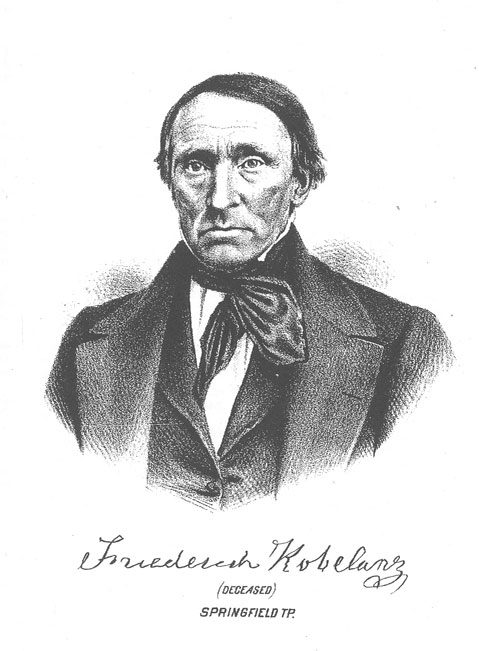
PAGE 517 - PICTURE OF FRIEDERICH KOBELANZ - SPRINGFIELD TP
PAGE 518 - BLANK
CITY OF SPRINGFIELD. - 519
Francis Dougherty, James Bucke, Jeremiah Cronin, Hugh Hart, Peter Madden, Michael Madden, Joseph Gunder, Andrew Haas, John Carr, John Milan, Michael Dargen, Michael and John Hughs, Martin Quaid, Patrick and Daniel Tehan, Thomas Shaw, Mr. Ford, Richard Walsh, Anthony Ray, and perhaps a few others, whose names we have been unable to obtain; but those mentioned were the nucleus around which gathered the present large Catholic population of the county.
The first priest visiting Clark County, as far as known, was the Rev. Henry Damian Juncker, a German priest from Dayton, who celebrated mass in the house of William Gibblenhoff, which was the first divine service of the Catholic Church held in the county.
Father Juncker became Bishop of Alton, Ill., in 1857, and died in 1868.
From this time, the Catholics had servcies at irregular intervals of from once to twice per month at the private houses of members, and sometimes at small public halls, whenever such could be obtained for this purpose.
The next priest coming to Springfield was the Rev. Joseph O'Maley, also of Dayton, who afterward died in this city while here on a visit.
He was followed by his brother, Rev. Patrick O'Maley, and he by Father Cahill, of Piqua, who was an earnest, eloquent divine, and did much good.
Other priests came at different times, whose names were not known, or, if so, forgotten, but all were merely transient, and came as often as they could to hold divine service and preach God's word to the faithful few who gathered to listen to the teachings of the ordained servants of Christ, and worship at the rude and hastily erected altar of the Most High.
It was not, however, until August, 1849, that Springfield had a resident priest; but at that date, the Rev. James F. Kearney was appointed resident Pastor, and remained about one year, when failing health compelled him to resign his charge.
He was born in Frederick County, Maryland, in 1820; at the age of fifteen, entered St. Xavier's College, Cincinnati, afterward studied theology at the Diocesan Theological Seminary, then located in Brown County, Ohio, and was ordained a priest December 20, 1834.
His first mission was Steubenville, his second Springfield, his third Hamilton, and his fourth and last Urbana, Ohio, where he labored until his death, February 10, 1878.
He was noted for his generous hospitality and unaffected piety; was popular among his clerical brethren, and seldom failed to win the esteem and confidence of all with whom he came in contact. He was earnest in God's service, and did good and lasting work for the church throughout the scenes of his labors.
Some time before Father Kearney took charge of the Springfield mission, ground was purchased and a church erected by Michael P. Cassilly, a zealous Catholic of Cincinnati, who presented it to the congregation solely for church purposes, but he was afterward compensated to some extent for his noble and timely generosity.
It was a good while, however, after the erection of the church before it was fully finished, and up to this period service was held in the basement.
The first regular parish register was opened in August, 1849, by Father Kearney, as before that date, there being no resident Pastor, the record of births, marriages, etc., was probably carried to the point from which the visiting priest came.
In 1850, the Rev. Maurice Howard succeeded Father Kearney.
He was born in Ireland January 4, 1813, where he was also educated, and studied for the priesthood at " St. Mary's of the Barrens," Missouri; was or-
520 - HISTORY OF CLARK COUNTY.
dained in Cincinnati, by Bishop Purcell, October 23, 1842, and was appointed to a mission in Wayne County, Ohio; afterward attended the following counties: Ashland, Richland, Crawford, Medina, Summit, Portage, Mahoning, Tuscarawas, and part of Stark and Huron, up to February, 1846, in that year going to Cleveland, and attended Lorain, Lake and Geauga Counties until October, 1847, remaining in Cleveland until January, 1848, at which time he took charge of Tiffin, Seneca County, attending Wyandot, Sandusky and part of Huron, until coming to Springfield in May, 1850.
For thirteen years, Father Howard watched over his flock, laboring hard and earnestly for his people, and during his ministry the church was finished and dedicated, receiving the name of St. Raphael, the ceremonies being per formed by Father Howard and an assistant, the Bishop not being able to be present on that day.
He also attended Greene, Madison, Champaign, Logan, Hardin, Warren, and parts of Delaware and Montgomery Counties, and, in February, 1864, was transferred to Galesburg, Knox Co., Ill., attending several counties in that vicinity, and in 1878 went to Keokuk, Iowa, where he is now in charge of the church of St. Francis De Sales.
In 1863, the Rev. D. J. Cogan became Pastor of St. Raphael's, remaining but a few months, and in January, 1864, the Rev. J. N. Thisse took charge.
He was born in Lorraine, France, April 12, 1832, made his preliminary studies at Tout A'Mousson, in the diocese of Nancy, and, about 1850, came to Cincinnati, finishing his classical course at " St. Mary's of the Barrens," Missouri, and his theological studies at "Mt. St. Mary's Seminary," Cincinnati, where he was ordained in 1855 or 1859; soon after ordination, was appointed to Chillicothe, Ohio, went from there to Piqua, thence to Circleville, and lastly to Springfield.
He was a zealous Pastor, an earnest, eloquent preacher, and as a scholar had few superiors.
His zeal and liberality, however, exceeded his financial judgment, and his over-confidence in humanity made him an easy victim of unscrupulous men; therefore, his management of the financial affairs of St. Raphael's was poor, and bore hard upon the congregation, which, at his death, was deeply in debt. Yet he was well liked by his people and the citizens generally for his whole-souled and generous nature, and his sad death was a calamity for which all sincerely mourned.
On the 29th of May, 1873, while returning from a sick call, his team took fright, ran away and threw him from his buggy, killing him almost instantly, he having lived but an hour after that terrible accident.
Besides those priests mentioned, in the first portion of this history, who ministered to the Catholics of Clark County, the following came transiently and officiated: Father Duffy, in 1848; Rev. Thomas Blake and Rev. Thomas Boulger, in 1850-the latter of whom is now in Urbana; Rev. C. A. Doherty and C. F. Shellhamer, in 1868; Rev. N. B. Young and J. H. Jutting in 1869; Father De Cailie in 1873; and perhaps a few others.
Up to the year 1868, there was but one priest for St. Raphael's, but the growth of Catholicism throughout the county made it necessary to have an assistant who would be able to attend to the missions of South Charleston, Tre mont, Plattsburg and Enon in Clark County, and Yellow Springs in Greene County; so, early in that year, the Rev. J. A. Maroney became Assistant Pastor of St. Raphael's, but in 1872, he was appointed resident Pastor at South Charleston, and his successor in Springfield was the Rev. J. A. Burns, who remained until January, 1876, when he was sent as Pastor of Yellow Springs Church, and the Rev. C. M. Berding became Assistant, remaining until the fall
CITY OF SPRINGFIELD. - 521
of 1877, at which time Rev. T. A. Conway was appointed as his successor, and he, in May, 1878, was succeeded by the Rev. Francis Mallon, who was followed, in September of the same year, by the Rev. J. D. Dickhous, and he, in January, 1879, by the Rev. Michael Ahern, who remained until March, 1881, when the Rev. William B. Miggeel became Assistant, and he is the present one.
The priest's residence was in the rear of the church, in a few rooms fittea up for that purpose, until 1865, when Father Thisse purchased a residence across the street from the present school building, but, the title being made in his own name, the property was sold by his administrator after his death.
The church was remodeled in 1865 and 1866 by Father Thisse; is located on East High street, and is a large brick and stone structure, 40x125, with a seating capacity of about 700. The main tower is surmounted by a handsome gilt cross, the emblem of Christ crucified, and is furnished with a bell weighing 1,600 pounds. The building and ground are valued at $30,000.
The interior of St. Raphael's will compare favorably with most Catholic Churches in towns the size of Springfield.
Its main altar is a handsome piece of carved and gilt wood-work, containing a number of spires, the central one of which reaches to the top of the nave in which the altar stands, and over the sanctuary is placed the crucifix, emblematical of Catholic Christianity.
Near the summit of the nave is a round window of stained glass, that casts its shaded light over all, in the center of which is a large eye, symbolical of the all-seeing eye of God.
On either side of the main altar stands the lesser ones of St. Mary and St. Joseph, of the same design and finish as the central ones, only smaller.
The church windows are all of stained glass, the whole interior presenting a finished appearance, and is heated throughout by hot-air furnace.
The first Catholic school was taught in the basement of the church during the pastorate of Father Howard; afterward, a frame building was purchased by Father Thisse, which stood on the site of the present school building, and which served for school purposes for several years.
The present Pastor of St. Raphael's, the Rev. W. H. Sidley, is a native of Geauga County, Ohio; began his studies at Notre Dame, Ind., where he spent two years; went thence to St. Mary's Seminary, Cleveland, Ohio, remaining there seven years, afterward spending one year at Mt. St. Mary's, Cincinnati, where he was ordained in June, 1870, and immediately sent to Sidney, remaining there until June, 1873, at which time he became Pastor of St. Raphael's.
On taking charge, he found a debt of $7,000, a small frame school building, and no residence for the priest; but., with a brave heart, he almost immediately began the erection of a priest's house, which was completed June 1, 1874, at a cost of $7,000.
It is a handsome building, containing, twelve rooms, with bay window and every modern convenience, and is a credit to the congregation.
Not contented with the school, and ambitious to have a building that would favorably compare with other public educational institutions of Springfield, Father Sidley, in 1876, began to build the present imposing structure, and so perseveringly did he prosecute the work that it was opened for scholars in September, 1877. It is 45x82, three stories high, containing eight schoolrooms, besides a hall in the third story the full size of the building, which is used for exercises, lectures, fairs, and for the general use of the congregation.
The school is heated by hot-air furnace, and the building, furnished complete, cost $12,000, and the lot $7,000.
Dennis C. Lehan, assisted by nine Sisters, has charge of this institution, with an enrolled scholarship of over 600; all the common branches are taught,
522 - HISTORY OF CLARK COUNTY.
besides singing, rhetoric, plain and fancy sewing, and one of the Sisters has eighteen pupils taking lessons on the piano.
This school is supported by St. Raphael's congregation, at a cost of $3,000 per year, besides paying their share of the taxes toward the support of the public schools of the county.
There is not, perhaps, in Ohio, a Catholic congregation of its size whose financial condition can compare with St. Raphael's, owning as they do nearly $60,000 worth of property, free from debt, and $3,000 to their credit in the bank, which facts and figures speak louder than would mere praise of the Pastor or congregation-which to-day numbers about 3,500 souls.
St. Bernard's Church.- In September, 1801, the German Catholics of Springfield, desiring to have a church where the German language would be preached at all times, organized a congregation, which met at 166 and 168 East Main street, in a building which was bought for that purpose by Nicholas Spangenberger, Joseph Bauer and John A. Shuette, the building being fitted up and used for church, school and residence.
Father Volmer ministered to the Germans for awhile, but the first mass was celebrated in this building November 1, .1861, by the Rev. Father Manclerke, who came from Dayton for that purpose, coming afterward once or twice per month.
In 1863, Rev. William Deiters, a native of Germany, where he was also educated and ordained, was appointed Pastor, he being the first regular Pastor of this church.
He remained until 1866, and, in February of that year, was succeeded by the Rev. J. Weissenberger, who began the present church building, laying the foundation in the fall of 1867, when the work was abandoned.
In 1868, the Rev. J. H. Jutting became Pastor, and was succeeded, in June, 1869, by the Rev. B. H. Engbers, who remained but a few months, though in the meantime he began to go forward with the building, letting the contracts for the work.
He was succeeded, July 9, 1869, by the Rev. John M. Schuchardt, who immediately took in hand the erection and completion of the present handsome and commodious church, which was finished early in 1870, and dedicated July 3 of that year by the Rt. Rev. Sylvester H. Rosecrans, of Columbus, the Archbishop being at that time in Rome, Italy, attending the Ecumenical Council.
The church is 60x130, is located on the corner of Columbia and Lagonda avenues, will seat about 900, and cost $24,000. The interior is very beautiful, being handsomely frescoed throughout, and in the nave over the altar is a soul inspiring painting of the crucifixion. In fact, St. Bernard's will favorably compare with most city churches in design and finish.
At the same time as the. church, a two-story brick was erected in the rear of the church for the Pastors residence, and in 1874, Father Schuchardt built a school which cost $3,000. and is taught by three Sisters, with an enrolled scholarship of 115.
This congregation numbers about 800; is growing rapidly, and is in a good financial condition.
Father Schuchardt. was born in Dusseldorf, Germany, there educated, and, in 1862, ordained in Baltimore. Md., where he remained a short time, then came to Covington, Ky., and from there to- Springfield.
In reviewing the history of Catholicism in this county and State, we are forcibly struck by its rapid and steady growth, and where fifty years ago not a single Catholic family existed in Clark County, to-day their numbers reach nearly 5,000. In 1817. at the first mass celebrated in Cincinnati; seventeen Catholics were all that could be found to attend divine service; to-day, the dio-
CITY OF SPRINGFIELD. - 523
cese contains eighty schools, 18,000 scholars, 213 priests, and 150,000 Catholics; and the whole State, 219 schools, 44,128 scholars, 453 priests, and 350,000 Catholics, besides societies innumerable for the propagation of faith and the encouragement of social intercourse, temperance and reform, nearly every church having a number of such societies that work in harmony with the Pastor and assist him in his labor of duty and love.
(RETURN TO THE TITLE PAGE)