|
THE CLARK COUNTY MEDICAL SOCIETY.
BY DR. ISAAC KAY.
The Clark County Branch of the Ohio Medical Society was organized in Springfield May 30,150. The records for one year
from the date of its origin are not in existence.
On the 21st day of May, 1851, a meeting of the physicians of Springfield was held at the office of Dr. Robert Rodgers-Dr. J.
Hendershott, Chairman, and Dr. E. M. Buckingham, Secretary. A committee was appointed to draft constitution and by-laws; also a committee to invite the profession throughout the county to join in the association, and one to make
arrangements for a room in which to meet.
At the next meeting, May 30, the constitution and by-laws were adopted.
The following were the original members:
(2) Jesse W. Cook,* Berkley Gillett,* Robert Rodgers,* G. W. Runyan,* M. L. Houston, A. C. McLaughlin, James
Sprague, Elijah Collins, E. M. Buckingham, Isaac Hendeshott,* Cornelius Smith.* R. Houston,* V. Smith, J. N. Stockstill,
D. C. Poage,* George Keifer (removed), R. J. Shackelford (removed),
*No record for the ten years from 1843 to 1853.
t Resigned. L. H. Olds appointed to fill vacancy.
(2) Those marked with an Asterisk (*) are deceased.
HISTORY OF CLARK COUNTY. - 349
E. W. Steele (removed), John A. Skinner,* J. C. Stoddard, Tobias Barr (removed), James H. Gillet, Isaac Meranda, David
Serviss,* James R. Bayley, W. W. Dawson, Andrew Bruce.* E. Thorn,* H. H. Young, J. B. Lingle, H. C. Foster.* B.
Winwood,* G. F. Kennedy, G. C. Paoli (removed), T. P. McCullough (removed), John H. Laurence (removed), Thomas C.
Eakin (removed), George P. Hackenbery (removed), C. S. Smith (removed), M. Buffenbarger (removed). H. H. Seys, Isaac
Kay, E. Owen, Ed D. Roe,* Daniel Neff (removed), William Marquart.
At the above meeting, by request, Dr. Gillett submitted an article to the society upon the position which its members should
take concerning quackery and quack medicines. A resolution was passed inviting members of the profession in adjoining
counties to co-operate in this enterprise. A Committee on Medical Ethics was appointed, and empiricism definitely
discountenanced. Dr. Robert Rodgers was chosen President for the ensuing year-1850-51.
At the November meeting, 1850, Dr. Skinner read an essay upon "Medical Science," which was followed by one from Dr.
Stockstill upon "Malaria." A committee was appointed 'to memorialize the Legislature to tag quack medi cines and
nostrums, and one to draft and report a bill of minimum prices. The report of this committee was adopted at the next
meeting. February 4, 1851, four members were admitted. Dr. Cook made a verbal report of the "Phenomena connected with
the prevalence of cholera in Newark, Ohio," etc., and a resolution was passed that, "when called for," essays should be made
the property of the society. Dr. Runyan also read an essay upon " New Medicine and New Instruments." (1) Dr. R. Houston
was chosen President for the ensuing year, 1851-52. (2)
The object of this meeting being rather to give an historical remme of the more salient and important features of this
organization than to present the proceedings of each meeting in detail, through a period of more than half a century, the
method pursued in treating of the first two years will not be adhered to closely in the remainder of this chapter; nevertheless,
we hope to let no essential point of historic interest go unrecorded.
November 4, 1851, "after some discussion," a resolution not to patronize, except in cases of necessity, drugstores that sold
patent medicine, was withdrawn. The first "request of dismissal" on the records occurred at the same meeting. Dr.
Buckingham read an essay upon the "Advancement of the Regular Profession of Medicine." February 3, 1852, the first "case
of discipline" was presented, verbally, which led to a resolution requiring that, when charges were made against members,
they shall be in writing, and the accused shall be duly notified thereof by the Secretary. This was also the first meeting on
record wherein an autopsy took place. Dr. Runyan exhibited to the society a heart obtained by post mortem examination,
possessing great interest. At this session, a gentleman who preferred justice to generosity-and who probably expected to
"pay for his funeral " suggested that ministers of the Gospel should be charged the same as other patients. May 4, 1852, Dr.
Shackleford read an essay upon the " The Properties of Quinine." An effort was also made, but failed, to obtain permission
of the society to reduce the established fees in Carlisle, Charleston, Vienna, Enon, Fremont, and their respective vicinities.
State delegates were appointed, and Dr. B. Gillett was chosen President for the ensuing year. The President-elect read an
essay upon " The Influence of the Passions and Emotions of the Mind upon the Body." November 16, Dr. Paoli read an
essay on the " State of Medical Science in France." At this meeting
*Those marked with an asterisk (*) are deceased.
(1) A copy of the retiring President's address was requested by resolution for publication.
(2) Dr. B. Gillett and J. Hendershott, vice Presidents; Dr. 1°.. 1H. Buckingham. Secretary, and Dr. G. H. Runyan,
Treasurer. Drs. Gillett, Cook, Stockstill, Runyan and Rogers composed the first board of censors.
350 - HISTORY OF CLARK COUNTY.
A committee was appointed to report upon the "Nature and Treatment of the first expulsion occurred -cause, the advocacy
and practice of homoeopathy. Typhoid Fever," and the "Medicinal Virtues of Cod Liver Oil." At the next meeting, February
1, 1853, Dr. Paoli reported on the latter, after which the subject was generally discussed. At the morning session of the May
meeting this year, Dr. Hackenberg read an essay on "The Influence of the Atmosphere upon the Human System," and Dr.
Paoli read an interesting report of a case of "Erysipelas Phlegmanodes." Dr. Hendershott was chosen President for the
ensuing year, 1853-54. November 1, 1853, the society met at Carlisle. At the next meeting in Springfield, essays on special
subjects, and the report of the Committee of Ethics occupied the attention of the society. May 7, 1854, it was resolved that
any member removing and remaining out of the county one year would forfeit his membership. Also, that absence for three
successive meetings would have the same effect. Dr. McLaughlin read a description of a case of malignant epidemic. Dr.
Sprague, of Vienna, described an instance of obstetrical malpractice. Committees were appointed on the practice of physic,
on surgery, and on obstetrics, whose duty it shall be to embody the experiences and observations of the society thereon in
separate reports, to be submitted at the next annual meeting. Dr. R. J. Shackleford was elected President for the ensuing
year.
The meetings thus far summarized correspond in character to those which followed until November 6, 1855, inclusive. From
various causes, the sessions of the society were discontinued until April 12, 1864, when a convention was held to effect a re-organization, fifteen physicians of Clark County and vicinity responding to the call previously made. The meeting was held
at the office of Dr. Rodgers. Present: Drs. Rodgers, Owen, Bruce, Thorn, Lefevre., Dunlap, Hazzard, Stockstill, Rector,
Reeves, Pratt, Clark, Janney and Kay. Dr. Rodgers was appointed President, and Dr. Kay Secretary. The fee bill was
readjusted in committee of the whole. The name of the society was changed to "The Clark County Medical Society." May 5,
the constitution and by-laws of the old medical society were adopted, and the society virtually resuscitated. November 1,
1864, the fee bill was further discussed, amended, and ordered printed Dr. Hazzard read an essay on "Pneumonia; its
Pathology and Treatment," etc. This and other medical topics were discussed. At the February meeting, 1865, Dr. E. Owen
read an essay on " The Treatment of Neuralgia by Strychnine." May 2, 1865, the Treasurer's report for the year just closed
showed: Receipts, $16; expenses, $5.50. A. C. McLaughlin was chosen President. Dr. Kay read an essay on "The Medical
Properties and Uses of OxGall;" Dr. Cravath on "The Claims of Medicine as a Science;" Dr. Hazzard on "The Change of
Type in Disease;" and the retiring President delivered an appropriate valedictory address. A strong resolution was passed in
regard to practitioners in the county who would not affiliate with the society, and thus help to promote the best interests of
the profession. Dr. Rodgers read a paper on "Anesthesia." November 7, Dr. Dunlap verbally reported a case of craniotomy,
and Dr. Buckingham a special operation in surgery.
The Medical Society was now again under full headway, and the meetings have been held with great regularity ever since.
Subjects of vital interest to the profession have constantly engaged the attention of the members, and great benefit has been
derived from the essays and discussions, not only to the fraternity, but to the community also. An elevated standard of
medical ethics has been secured, and incompetence and charlatanism uniformly rebuked. Looking over the records for the
past fifteen years, we find that more than one hundred meetings have been held during that. time. As a matter of course, it
would require almost a separate volume to given even a synopsis of each. Not less
HISTORY OF CLARK COUNTY. - 351
than one thousand medical topics have been discussed, about two hundred essays have been read, and more than that
number of verbal reports made of important cases under treatment. All the leading questions connected with the progress of
medical science for the last half-century have been canvassed, prevailing diseases and local epidemics considered, and a vast
amount of co-operative work done in the society's sessions, the valuable results of which the community are now receiving,
almost wholly unconscious of the source whence, to so great an extent, they have come. This has not been a " Mutual
Admiration Society" in any sense. While nearly a hundred practitioners have been admitted, the rules of discipline have been
frequently enforced, and the records show instances of criticism, censure and expulsion.* The Presidents, from our last
mention, have been Drs. E. Owen, J. S. R. Hazzard, Isaac Kay, E. M. Buckingham, H. Senseman, A. Bruce, J. H. Rodgers,
W. G. Bryant, Calvin Pollock, W. H. Reeves, W. H. Banwell, H. H. Seys and J. M. Harris. The principal Secretaries have
been Drs. E. M. Buckingham, from 1850 to 1853; Isaac Kay, from May, 1854, to May, 1865; and from November 10, 1870,
except two years, by Dr. Totten to date. Very full and systematic minutes have been made throughout, and, generally
speaking, copious publications received through the local press. The early records are in a good state of preservation, and
the later are seldom equaled in neatness and convenience of arrangement. The present membership is twenty-eight. Monthly
meetings are bold, with occasional exceptions, and the old-time enthusiasm still characterizes the sessions. Of the original
members of the first society, only thirteen now remain, viz.: Drs. Buckingham, McLaughlin, J. H. Gillett, Kennedy, Seys,
Kay, Hazzard, Senseman, Herble, Owen, J. H. Rodgers, Reeves and Stonebarger. The officers of the society for 1880-81
are: President, J. M. Harris; First Vice President, W. L. Stonebarger; Second Vice President, T. M. Carroll; Secretary, Isaac
Kay; Treasurer, John Reddish; Board of Censors, W. G. Bryant, J. H. Rodgers, D. C. Huffman, H. H. Seys and McK.
Driscoll.
CLARK COUNTY BIBLE SOCIETY.
To show the manner in which the Bible Society of this county was organized, we quote from the record of the first meeting
held, as follows:
"Formation of the Auxiliary Bible Society of Springfield, Clark County, Ohio.-Agreeably to a request made by the Rev. Mr.
Hall, a number of the citizens of this county convened in the Methodist meeting-house on the 6th of August, 1822, for the.
purpose of taking into consideration the expediency of forming a Bible society. The meeting was opened with prayer by the
Rev. Archibald Steel, after which the Rev. Archibald Steel was appointed Chairman; Rev. Samuel Henkle, Secretary; and
Isaac T. Teller, Assistant Secretary, for the present meeting. Letters from the American Bible Society showing Rev. Mr. Hall
to be an agent of that society were then read, after which the meeting adopted the following resolution, viz.: Resolved,
Unanimously, that this meeting, impressed with the importance of a general circulation of the Holy Scriptures, and of
furnishing the destitute therewith, form a Bible society for this county, auxiliary to the American Bible Society of New
York." At this meeting a constitution was adopted, which, being somewhat lengthy, and being later superseded by the
present constitution of the society, we omit. However, the following names were signed thereto as the first members: John
S. Galloway, M. M. Henkle, Saul Henkle, Archibald McDonald McConkey, W. M. Spencer and James S. Christie.
* From the first organization of the society to February 17, 1873, seventy-two physicians had been connected with it as
members.
352 - HISTORY OF CLARK COUNTY.
A committee was then appointed to solicit signers to the constitution, to report at the first annual meeting, and, after
ordering a copy of Dudley's Analysis of the Bible Society System, and the publication of the constitution and minutes in the
Farmers' Advocate, the meeting adjourned. to meet September 2, 1822. At that date, the society completed its organization
by electing Rev. Archibald Steel, President; George N. Jewett and Moses Henkle, Sr., Vice Presidents; Pierson Spinning,
Treasuuer; Samuel Henkle, Corresponding Secretary; Isaac T. Teller, Corresponding Secretary; and for Directors, John
Ambler, Joel Van Metter, Jeremiah Sims, Robert Humphreys, Griffith Foos, Archibald McConkey, Thomas Patton, Joseph
Keifer, Maddox Fisher, Daniel McKinnon, Jr., Daniel Moore and Andrew Hodge.
The old record book of the society seems at some later day, to have been taken apart and incorporated with a better quality
of paper into the present bound record, and in this process the minutes of the first anniversary have been partially omitted,
and a general disarrangement of the records made. Yet the good work seems to have gone along prosperously until about
1840, from which time up to 1842 no certain record appears.
On the 7th of March, 1842, the friends of the Bible Society met at the Methodist Episcopal Church and "organized as a
Bible Society," with the following officers: President, Solomon Howard; Vice Presidents, Charles Anthony and E. H.
Cumming; Secretary, Henry Hedrich. Treasurer. James T. Murray. At this meeting, the following constitution was adopted:
CONSTITUTION OF THE BIBLE SOCIETY.
ARTICLE I. This society shall be called the Bible Society of Clark County, Ohio, auxiliary to the American Bible Society.
ART. II. The object of the society shall be to promote the circulation of the Holy Scriptures "without note or comment,"
and in English those of the commonly received version.
ART. III. All persons contributing to its funds shall be members for one year. and shall be entitled to purchase Bibles and
Testaments at the Depository at cost prices. Those contributing $1 or more, shall receive (if called for within twelve months)
a common Bible in return. Those contributing $10 at one time shall be members for life.
ART. IV. All funds not wanted for circulating the Scriptures within the society's own limits shall be paid over annually to the
parent society to aid distribution among the destitute in other parts of the country, and in foreign lands.
ART. V. The officers of the society shall consist of a President, two Vice Presidents. Secretary and Treasurer, whose duties
shall be such as their respective titles import.
ART. VI. The management of the society shall be intrusted to an Executive Committee of seven (including the Secretary and
Treasurer), which shall appoint its own Chairman, and make its own by-laws, and fill vacancies that may occur in its own
body. October 20, 1870, Art. VI was so amended as to read: The Executive Committee shall consist of one member from
each Evangelical Church, and also include the Pastors of said churches, five of whom shall constitute a quorum.
ART. VII. It shall be the duty of the committee to meet frequently on adjournment, or on call of the Chairman, to keep a
good supply of books on hand, to appoint local distributors, to see that collections are made in some way. annually, in every
congregation, and that all funds are forwarded early to the parent .society. with a stateinent as to the portion designed for
the payment of books, and that as a free donation.
ART. VIII. There shall be a general meeting of the society at such time and place, each year, as the Executive Committee
shall designate. when a full report of their doings shall be presented by the committee (a copy of which shall be furnished the
parent society), and when a new election of officers and committee shall take place. Should the society fail of an annual
meeting, the same officers and committee shall continue until an election does occur.
ART. IX. Any branch society or Bible committee formed within the bounds of this auxiliary, by paying over its funds
annually shall receive Bibles and Testaments at cost prices.
ART. X. No alterations shall be made in this constitution except at an annual meeting, and by consent of two-thirds of the
members present.
To this constitution 100 names are subscribed:
That this was an entirely new organization seems apparent from the minutes of the Executive Committee of a meeting held
March 14, 1842, wherein
HISTORY OF CLARK COUNTY. - 353
the following record appears: "On motion of Hedrick, the Treasurer was required to secure the Bibles belonging to the old
Bible society and distribute for sale.
The first annual meeting of this society was held in the Methodist Episcopal Church, Springfield, March 20, 1843, with Gen.
E. H. Cumming, Vice Pres ident in the chair, and H. Hedrick, Secretary. The annual report of the Exec utive Committee, the
Treasurer's report and the report of the Female Bible Society were presented and read, and a resolution was passed making
the life members of the Springfield Bible Society life members of this, the Clark County Bible Society. Officers were chosen
as follows: John W. Weakley, President; James F. Sawyer and Willard Pinbury, Vice Presidents; Henry Hedrick, Secretary;
and W. M. Spencer, Treasurer. A resolution was passed favoring the introduction of the Bible into the common schools.
The minutes of the various meetings of the Executive Committee show that though search was made in every township of
Clark County by earnest laborers, who reported the number destitute of Bibles, the number by them sold and donated, and
the fact that many families who were without the Word of God expressed their shame and humbly begged not to be
reported, as they would supply the deficiency themselves.
The second annual meeting was held at the Presbyterian Church on Thursday evening, March 28, 1844, and the usual
reports submitted but not recorded. An address was read by Gen. Cumming, which was ordered published in the Republic.
The subject of the Bible in the schools was ably discussed by Rev. Sawyer and others, and a resolution passed urging the
same. James F. Sawyer was chosen President for the year, and Mr. Hedrick continued as Secretary.
In the second annual report of the Executive Committee they say that fifty Bibles were presented to the Wyandot tribe of
Indians, as they passed through Springfield on the way to their Western home.
April 23, 1845, the third annual meeting was held in the Methodist Episcopal Church, and was opened by prayer by Rev.
William Simmons. The proceedings were of the usual interesting character, and Rev. John S. Galloway was chosen
President, Mr. Hedrick being continued as Secretary. An adjourned meeting was held Thursday evening, April 24, 1845, in
the Presbyterian Church, a full report of which was not given.
The Executive Committee at their meeting June 16, 1842, took measures to establish a depository at New Carlisle.
The fourth annual meeting was held at the Presbyterian Church Thursday evening March 26, 1846, with Vice President Rev.
A. T. McMurphy presiding. Prayer by Rev. Ezra Keller As heretofore, the ladies seem to have been but silent spectators in
these meetings, the annual reports of the Springfield Female Bible Society being duly read by the gentleman. Era Keller was
made President, and Mr. Hedrick continued as Secretary.
The fifth annual meeting, April 28, 1841, was held at the Methodist Episcopal Church, and was opened by the President, Dr.
Keller, in the usual manner. Prayer by Rev. Gray. Rev. William Sym was elected President, Mr. Hedrick, Secretary. An
address was delivered by Rev. R. S. Foster, and the agent of the American Bible Society. The annual report of the Executive
Committee shows $260.71 paid for books and sales to amount of $63.97, with thirty-seven volumes donated. "Among the
Bibles donated" says the report, "were twenty-two to those persons who had volunteered to be soldiers in Mexico."
At the sixth annual meeting held in the Episcopal Church, April 26, 1848, but little business was transacted beyond the
election of officers. Rev. Foster preached an able sermon on the authenticity of the Scriptures. On May 10,
354 - HISTORY OF CLARK COUNTY.
following, the Executive Committee appropriated $150 to create Samuel Barnett a Life Director in the American Bible
Society.
The seventh annual meeting occurred at the Presbyterian Church April 4, 1849, at which time James L. Grover was chosen
President, and Rev. Mr. Edwards delivered an address, followed by appropriate remarks by C. Elliott, D. D. The Executive
Committee at its meeting June 14, 1849, records "The committee to visit the hotels reported through Mr. Anderson. The
report states that the Buckeye had thirty rooms, the National sixty-two, the United States eighteen, American twelve. Four
hotels, 122 rooms. On motion, it was determined to put Bibles into the above hotels, and the Treasurer was directed to
order the books, and to report whole cost, and the cost of each hotel."
The eighth anniversary was held in the Episcopal Church May 8, 1850. Rev. C. Robbins was chosen President, and an
address delivered by Rev. Grover. The annual report showed a healthy and progressive state of the society.
The ninth annual meeting was held May 28, 1851, at 2 P. M., in the Associate Reformed Church, and Dr. R. Rogers was
called to preside. Rev. R. W. Henry was elected President, and Rev. J. S. Galloway delivered an address. An adjourned
meeting was held in the evening in the Presbyterian Church, addressed by Rev. William P. Strickland, of Dayton. The annual
report gave the result of the third exploration of Clark County. Number of families visited, 2,898; found destitute, 232;
being an average of about one in twelve.
The tenth annual meeting occurred at the High Street Methodist Episcopal Church, at 2 P. M., May 26, 1852, and was
opened with prayer by Rev. Weakley. Rev. N. C. Burt was chosen President. Life memberships were conferred on Henry
Hedrick, John Ludlow, Revs. Chandler Robbins. J. C. White, Solomon Howard, J. C. Schulze and Mrs. Spencer and Jonah
F., Spencer; and, in the evening at the same church, the society was addressed by Rev. White on "The Bible."
The next annual meeting, the eleventh, was held at June 8, 1823, in the Episcopal Church. In the absence of the President
and Vice President, Rev. C. H. Williams was called to preside, and prayer offered by Rev. Dr. Peasley. The reports were of
great interest, showing the society free from debt, having $58.82 in books, and $404.03 cash on hand. Revs. Enoch West,
John McLain and Samuel Ham, made life member of parent society. In the evening an address was delivered, at the
Associate Reformed Church, by Rev. James Presley, of Cincinnati.
The twelfth annual meeting occurred at the Episcopal Church May 14, 1854. Rev. J. F. Chalfant presided in the absence of
the regular officers, and opened the meeting with devotional exercises. The usual programme was enacted, and an evening
meeting was held at the Presbyterian Church; address by Rev. Sloane.
At the thirteenth anniversary held at the Presbyterian Church May 30, 1855, the Revs. William L. Hypes, Wesley Webster
and John Braden were made life members by contribution, and William Barnett and William Runyan, Esqs., by contribution
of $30. Samuel Barnett was chosen President. The meeting was concluded in the evening at the same place.
At a meeting of the Executive Committee March 21, 1856, Mr. Henry Hedrich, who had served so faithfully as Secretary of
this society since its organization in 1842, resigned, by reason of removal from Springfield, and William Runyan was chosen
to fill the vacancy.
May 26, 1856, the fourteenth annual meeting convened at the Methodist Episcopal Church. Mx. Runyan was elected
Secretary, and the usual routine of business was conducted, and completed at an evening meeting. Rev. Dr.
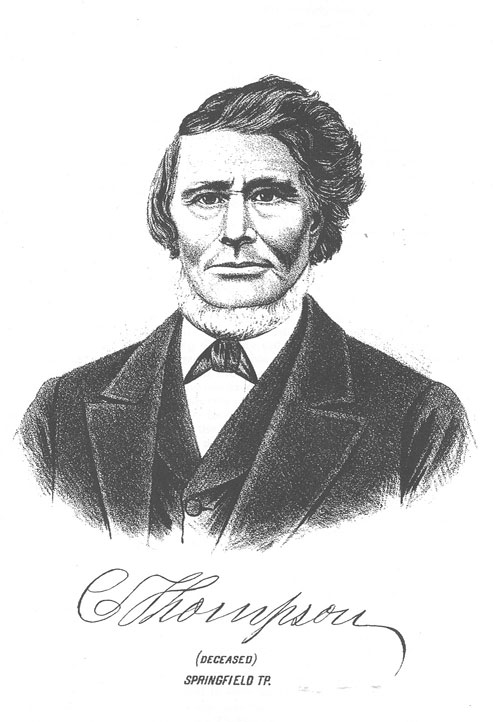
PAGE 355 - PICTURE OF C. THOMPSON - SPRINGFIELD TWP.
PAGE 356 - BLANK
HISTORY OF CLARK COUNTY. - 357
Brooks addressed the meeting. At this meeting was read the thirty-fifth annual report since the first organization, and the
thirteenth under the present organization. The report says: "The Female Bible Society has control of Springfield. They have
proven themselves very efficient, having visited over four hundred families and found some forty or fifty families destitute of
a Bible."
The fifteenth annual meeting, at the Presbyterian Church, May 27, 1857, was presided over by Hon. S. Mason, and reading
of Scriptures and prayer was offered by Rev. J. F. Marley. Rev. T. M. McWhinney, Pastor of the Christian Church in Enon,
was made a life member by his congregation contributing for that purpose.
The sixteenth annual meeting, at the Associate Reformed Church, was held May 26, 1858. John Ludlow was made
President, and David Cooper, Secretary. The annual report shows that the whole amount donated to the parent society since
the organization of this auxiliary, in 1822, was $2,262.28, and the gross amount remitted for Bibles and Testaments, in the
same period, was $3,670.06. The Female Bible Society, of Springfield, since its organization in 1842, had donated to the
American Bible Society $354.
The seventeenth annual meeting occurred May 25, 1859, at the Congregational Church, John Ludlow, President, William
Spencer, Secretary, in place of David Cooper, resigned. Quoting from the record of the Secretary, "The meeting was an
interesting one, but it was to be regretted that but few of the friends of the Bible cause were present."
The eighteenth anniversary was held at the Presbyterian Church March 28, 1860. Rev. Joseph Clokey was made President,
and T. A. Wick, Secretary. The reports were as usual, and showed a favorable condition of the society.
On the 25th of March, 1861, the nineteenth anniversary service was held at the Presbyterian Church, being the thirty-ninth
since its organization. Rev. J. S. Galloway, agent of the American Bible Society, addressed the meeting. Rev. Allen T.
Thompson was chosen President for the year.
The twentieth annual meeting occurred at Union Hall, on Monday evening, June 7, 1862. A full report of a canvass of the
county by Rev. S. Scott was made, and published in the city papers. Rev. J. Clokey, D. D., chosen President, and Charles L.
Petts, Secretary. In the Treasurer's report it is shown that the society supplied Testaments to the members of the Forty-fourth Regiment, Ohio Volunteer Infantry, on their leaving Springfield for the field of battle.
At a meeting of the Executive Committee held April 11, 1863, the following resolution was adopted on the death of an old
member:
"WHEREAS, It has pleased Almighty God to remove by death, since the last annual meeting of the Clark County Bible
Society, viz., August 24, 1862, Rev. John S. Galloway, who has been identified with the County Bible Society for nearly
thirty years, and served devotedly for eleven years as an agent for the Bible cause in Western Ohio, therefore,
Resolved, that this committee deems it befitting in them, and due to the memory of our departed brother, to record our just
appreciation of his excellences of character, and his devotion and untiring energy in behalf of the Bible cause, and our
sincere sense of the loss sustained in the decease of so ardent a fellow-laborer, and our earnest prayer that God may raise up
other holy and zealous men to fill the places of those who are called from labor to reward." The twenty-first annual meeting,
and the forty-first since organization, was held in the First Presbyterian Church July 9, 1863. The same President and
Secretary were re-elected to serve another year.
The twenty-second anniversary was held July 18, 1864, at the Central Methodist Episcopal Church. Rev. Clokey was
continued as President, and J.
358 - HISTORY OF CLARK COUNTY.
W. Gunn chosen Secretary. The attendance was poor, and there seemed to be a lack of the former interest manifested in the
welfare of the society.
The twenty-third anniversary was held at the Second Presbyterian Church June 29, 1865. Rev. E. M. Bower elected
President, T. J. Finch, Secretary. The following resolution on the death of Abraham Lincoln, President of the United States,
was offered and adopted:
"Resolved, That the members of the American Bible Society regard with deepest sorrow the assassination of Abraham
Lincoln, the late President of the United States; and that they hereby record their sense of the loss which the nation and the
world have sustained in the decease of this illustrious servant of the people, whose interest in the work of this society, of
which he was a member and Director for life, and whose devout reverence for the Word of God characterized his
Presidential career as a merciful, just and great ruler, the breaker of the bonds of 4,000,000 of people, and the worthy
successor of Washington."
The twenty-fourth annual meeting was held at the First Presbyterian Church in the afternoon of June 19, 1 866. Rev. T. T.
Titus was elected Pres ident, and Rev. J. W. Gunn, Secretary. At night an interesting public meeting was addressed by Revs.
Titus, Wombaugh and Ames.
The twenty-fifth anniversary, at Christ Church, July 22, 1867, selected Rev. A. T. Fullerton for President, Rev. J. W. Gunn,
Secretary. The sum of $800 was donated to the parent society.
The twenty-sixth annual meeting was held in the English Lutheran Church July 6, 1868, and the usual business transacted.
Rev. J. B. Helwig was elected President, and J. W. Coles, Secretary; $400 was appropriated to the parent society.
The twenty-seventh meeting was held Monday and Tuesday evenings July 26 and 27, 1869, and were of great interest. The
various reports showed the society in a flourishing condition. Rev. Charles Stroud chosen President, and J. W. Coles,
Secretary.
The twenty-eighth anniversary was held July 27, 1870, at the Second Pres byterian Church. Rev. P. H. Mowry was chosen
President, J. W. Cole, Secretary. The meeting was without special interest, excepting the annual reports which showed a
steady growth and prosperity.
The twenty-ninth anniversary was held September, 1871, at the Second Presbyterian Church. Rev. George F. Cain chosen
President, and J. W. Coles, Secretary. A lengthy and interesting report of the canvassers which was submitted by S.
Cochran, agent, together with the usual reports.
The thirtieth annual meeting was held September 16, 1872, at the Second Presbyterian Church, and Rev. Lucien Clark
elected President, J. W. Coles continued as Secretary. Rev. S. Cochran reported that this was the fiftieth, or Jubilee Year, of
the Clark County Bible Society from its first organization. The Executive Committee was instructed to arrange for a jubilee
meeting in November, but no record of such meeting appears in the books of the society.
The thirty-first meeting, and fifty-first annual meeting since organization, was held September 29, 1873, at the first
Presbyterian Church. The following were chosen as officers for the ensuing year: President, Rev. Joseph L. Bennett; Vice
President, James L. Christie: Secretary, J. W. Gunn; Treasurer, George Horner.
The thirty-second annual meeting was held October 20, 1874. Very few were present, and Rev. W. H. Webb was elected
President, Rev. R. P. Thomas elected Secretary. At the anniversary meeting, on Sunday evening, held jointly at the English
Lutheran and Second Presbyterian Churches, both were filled to their utmost capacity.
HISTORY OF CLARK COUNTY. - 359
The thirty-third meeting, October 20, 1875, was held at the English Lutheran Church. Rev. W. H. Webb was elected
President, and J. W. Gunn, Secretary.
On Sunday, October 25, 1876, Rev. E. T. Wells, of Central Methodist Episcopal Church, preached an able discourse to the
united congregations of the city, in the First Presbyterian Church, on the subject "Send out thy Light and thy Truth."
On the following Monday evening the thirty-fourth annual meeting was called for the same place, but, as only a few were
present, adjourned.
In 1877, it appears from the minutes of the Executive Committee, no annual meeting was held, owing to delays in the
reports of collections, etc. However, the committee called a meeting for February 26, 1878, which was held at the Second
Presbyterian Church at that place, and the usual yearly exercises took place.
The thirty-sixth annual meeting was held at the Central Methodist Episcopal Church November 11, 1878, and Rev. Joseph
Kyle was elected President, and C. C. Taylor, Secretary. The usual reports were read and published in the city papers.
The regular annual meeting for 1880 was held in the First Presbyterian Church April 2. After the usual religious services in
the opening, the society proceeded to the election of officers for the ensuing year, the following being the result: President,
S. A. Brewster; Secretary, C. C. Taylor. The usual reports were then submitted, after which the society adjourned.
CLARK COUNTY SABBATH SCHOOL UNION.
This organization seems to have had its origin with a convention of Sunday school teachers held at South Charleston
November 2, 1865, at which time a constitution was adopted, the first section of which explains the object of the body.
SECTION 1. This association shall be known as the Clark County Sabbath School Union. Its object shall be to unite all
Evangelical Christians in the townships in efforts to promote the cause of Sunday schools in co-operation with the County
Sunday School Union, aiding in establishing new schools where they are needed, and awakening increased interest and
efficiency in such as are already in operation.
It was also provided by this instrument that the usual officers should be chosen at certain periods, and that there should be
one Vice President in each township, whose duty it should be to look after the welfare of Sunday school interests in his
township.
The first officers chosen were: President, E. M. Doty; Secretary, James Evans: Treasurer, J. M. Sheeder.
And the following Vice Presidents from the various townships: Rev. N. C. Smith, Madison Township; Rev. E. Hills,
Harmony Township; A. B. Runyon, Pleasant Township; Robert Black, Pike Township; John Swearinger, German Township;
John Johnson, Bethel Township; G. L. Massey, Mad River Township; Rev. D. R. Culmerry, Green Township; Rev. M.
Thomas, Moorefield Township; William Berger, Springfield Township.
This organization has accomplished a great labor in connection with the branch of Christian work for which it was formed.
Yearly meetings have been held in various parts of the county, and a free interchange of ideas by more frequent meetings of
such as were disposed to grow in the service. Some idea of the method of work may be formed from the subjoined scheme
which governed the last session of the Union, held in the English Lutheran Church, Springfield, Ohio, Thursday, May 27,
1880.
360 - HISTORY OF CLARK COUNTY.
The order of exercises was as follows: 9 o'clock, sharp, Devotional Exercises; 9:30, President's Address; Secretary's Report;
Treasurer's Report and appointment of committees; 10, reports of Vice Presidents, Secretaries and others; 11, question box.
Afternoon session-2, devotional exercises; 2:15, reports of committees; 2:45, question box; 4, Interchange of thoughts of
what we have heard and what we will take home with us.
Evening-8, Sabbath school mass meeting; to which all are invited. Come all, and join us.
Members of the convention were urged to come prepared with practical questions upon the Sabbath school work in our
county.
The officers were, President, J. M Jones; Vice President, W. M Berger; Secretary, A. L. King; Treasurer, G. W. Winger;
Executive Committee, C. M. Nichols, C. A. Phelps. P. A. Schindler, A Barr, W. H. Weir and Ross Mitchell.
THE GRANGE IN CLARK COUNTY.
The Grange movement reached Clark County early-the first grange organized in the county being No. 50, and the work
progressed rapidly until twelve had been organized. Of these, five have gone entirely out of existence, and only two can be
called really strong and successful organizations.
The Grange is an organization first formed in 1867, and full completed and perfected in 1873, designed to unite the farmers
of the country in one great brotherhood, in which by mutual existence, mutual prctection, mutual instruc tion, and mutual
encouragement., they can advance in financial prospects in intellectual progress, and in social life and enjoyment.
In 1873 and 1874, the movement advanced with unparalleled rapidity, and Granges were organized at a rate utterly unheard
of in the annals of any similar organization.
It could be compared to nothing, but a great wave sweeping across the country. In the nature of things such advance could
not be healthy, and, after it had passed, many were the wrecks of imperfect organizations left behind. A period of depression
followed, and the impression was spread that the Grange was dead. At the present time the organization is coming out of
this depressed stage, and a healthy activity is manifested in almost all quarters. In Clark County the order is less prosperous
than in many others. It is, however, well grounded here, and is likely to gradually gain strength as its purposes become
better, and more widely understood.
THE MAD RIVER VALLEY PIONEER AND HISTORICAL ASSOCIATION
was the name of an organization which was formed in May, 1870. Its existence as an active society was of short duration,
but it developed a great deal of valuable historical matter while it did exist. " The Early Settlement of Springfield" was the
title of a paper prepared by Dr. John Ludlow, and read before this body in January, 1871. Dr. Ludlow's article has been used
here and there throughout this work, and was invaluable as a source of information.
The Battle of Piqua, by Thomas F. McGrew, Esq., was one of this class of papers, though not prepared until within the
present year; yet, as will be seen, Mr. McGrew was one of the prime movers in this association.
As the proceedings of the society were of a decidedly historical nature, the details of the first meeting are given entire, at the
risk of being tedious. Many of the incidents mentioned in the opening address have been alluded to in other parts of this
volume, yet the same facts related by different persons will never
HISTORY OF CLARK COUNTY. - 361
be treated quite alike, and one author thereby becomes "confirmation strong" for another.
This association has held no meetings for several years, though its books and papers are yet in the hands of some of its
former officers who now reside here.
A permanent organization of the Mad River Valley Pioneer and Historical Association was effected at its first regular
meeting, held in the rooms of the Young Men's Christian Association on May 3, 1870. The name "Mad River Valley " was
inserted in lieu of " Clark County," which had been determined upon at the first meeting. The chair was occupied by Thomas
F. McGrew, Esq. The Rev. A. H. Bassett delivered the inaugural address:
MR. PRESIDENT: To rescue from oblivion interesting facts and important information would seem a duty which we owe
to those who come after us. The present is indebted to the past; so the present should provide for the future. To-day has the
benefit of yesterday's observations and experiences; so should to-day preserve and carry forward its accumulated
information for the benefit of to-morrow.
Our American continent, which we are wont to term our Western World, is eminently a land of rapid development and
marvelous progress. Our forefathers and foremothers were men and women of great toil, and patience, and endurance, and
perseverance. They began at the sterile Plymouth Rock, making it a fruitful field. Then, they erected there a State,
diminutive in size, but of mammoth enterprise, and a very empire in resources and population. Then they proceeded to found
and build and people State after State in their westward progress, not stopping for mountain barriers or for savage
opposition. As they advanced, they had to penetrate vast forests and traverse great mountain ranges, with or without roads,
and with or without teams, carrying fire-arms to secure game for their sustenance and to protect themselves from savage
assaults. They constructed boats for crossing our great rivers, and even for navigating them for many hundreds of miles
(downward). Selecting the sites for their dwellings and for their prospective towns, they wielded the echoing ax to fell the
timbers of the dense woodlands, and constructed substantial but rude dwellings of primitive materials. The labor and
hardship and exposure they went through would to us seem incalculable, as unendurable; but they heeded it not. Their
methods, their experiences, their sufferings, their exploits, we have loved to hear them relate. But alas! many of them have
passed away. And again, alas! many of them have left no record of their thrilling story, of their eventful and adventurous life.
Of our own city, within a very few months or years, the following-named venerable citizens have taken their departure: Col.
Werden, Col. Baker, Gen. Anthony, Gen. Mason, Judge Torbett, Dr. Hendershott, Squire Spining, Father Kills, Father
Barnett, Father Schindler, Father Watkins, and a score-it may be scores-of others.
But it is yet fortunate that some of the fathers are still with us. We have amongst us honored citizens, whose memories are
not in pioneer associations, who have lively-remembrances of the primitive and backwoods experiences. If we have not
living old physicians, who used to click the spring lance, and bleed the patient in every fever, we have some old ministers, as
Bishop Morris and Dr. Brown, who used to be pioneer itinerants, at half paid allowance (not to say salary), which would not
to-day keep your clergyman in books and periodicals. If we have not Judges who used to preside in log court houses, or
lawyers who used to collect their fees in coon-skins and maple sugar, we have those of different professions who used to
attend school (if at all) in houses of unhewn logs, with puncheon floors, mud chimneys, and window-lights of greased paper.
We have among us men who were soldiers in the. war of 1812, who used gun-
362 - HISTORY OF CLARK COUNTY.
flints, and carried punk and a tinder-box for striking fire, for percussion caps and friction matches were unknown. We have
still among us many who used to be happy in log-cabin houses; who used to hunt deer and wild turkeys for provisions; who
used to thrash their grain and shell their corn by hand, beat it to a degree of fineness in a log mortar, with a stone pestle. The
generation has not passed away of men who knew no reaper but the sickle, no mower but the scythe, no threshing-machine
but the flail, no cider-mill but the home-made press. The men are here who saw nearly, if not quite, the first steamboat on
the Ohio, who witnessed the beginning of your canals, your macadamized roads, your railways and your telegraphs. Yes,
you have yet pioneers in your midst whose memories, as we have said, are rich in story of the past, filled to the brim with
incidents and experiences of thrilling interest. Then, whilst we yet have them amongst us, let us, as opportunity may serve,
gather around them and listen to their simple and unvarnished narrative, for it will have the eloquence of personal
realization.
Here, now, is one of the objects of this association: We would supply a sensible lack, i. e., one means of public
entertainment which has not yet been brought before our community. We have no lack of concerts, festivals, fairs or picnics.
We are amply favored with the visits of the menagerie, the circus troupe, the dramatic corps, the minstrel band. And our
graver and more sensible courses of popular lectures furnish literary entertainment, and sometimes amusing pastime. But, to
make up the variety, you need a pioneer association, to furnish you the entertainment of an occasional evening in the
personal recitals of such as can tell you about the past of our now well-fixed and prosperous country, and State, and city.
The pioneers are passing away. Let us ask them to relate to us their story before they go hence. And let us make reasonable
haste to do this, as their time may be short.
Another object of this association is to answer the purpose of an historical society, to gather facts, documents and relics for
preservation, that we may leave intelligible and useful records for the inspection and benefit of coming generations.
We have evidence that the ancients, from remotest ages. used to erect monuments to perpetuate the knowledge of events.
And, as they knew not the art of printing, they were accustomed to engrave their historic facts upon the enduring marble. A
great many ancient records in this form are extant, some in a wonderful state of preservation. And modern oriental
researches are continually bringing to light additional marble chapters of this ancient history. All this evidences the wisest
forethought in the men of the primal ages. It seems that they even thought of us, though then unborn, and did us the great
favor to send down to us these simple, primitive records. The value now placed upon them is inestimable.
Grateful, then, to the ancients for their forethought toward us, should we not learn from them with our ten-fold increased
advantages to convey records forward to posterity? The very winds are daily sweeping away many leaves of important
information, which should be snatched, as it were, from destruction, and laid away for future inspection and use. And for
what you may do in this regard, the men and women of hereafter, whom you and I may not live to see, will rise up and call
you blessed.
Then, let us make a beginning of an historical collection-books, papers, manuscripts, fragments, relics, antiquities,
curiosities, or what not, pertaining to the history of our country; and its accumulations will soon produce archives which will
do credit to our city and county, and be of unending benefit to coming generations.
In the principal counties throughout the State, pioneer associations have
HISTORY OF CLARK COUNTY. - 363 .
been formed and are in active operation-wide awake in the matter. Let us not be behind the times. Do we not consider Clark
County one of the best? Are we not wont to regard Springfield the very garden spot of Ohio? Would we not scorn to fall
behind in intelligence, or in enterprise in any respect? We think we have cause to feel proud of our improvements and of our
achieve ments in mechanical and manufacturing enterprises. It is indeed said that we boast much of our progress, and of the
extensive amount of our industrial products sent abroad to all quarters under heaven. This is well. Let no man stop us of this
boasting. But we have been lacking of one cause of boasting. Up to this time, it has been said that Clark County has no
pioneer association, no antiquarian society, no historical club. Please, sir, let us have an end to this. Never again, after to-day, let such a thing be said of Clark County. I trust you will so decide, and that this community will sustain you with its
hearty amen and its prompt co-operation.
I need not ask, are our people generally aware that Clark County, of which we are citizens, contains some historical
localities of rare interest? We have just at hand the famed Mad River. I have been curious to learn, and have made
considerable search to ascertain, the origin of this unique name. You may smile at my simplicity, as I confess that for many
years I had an idea that this river derived its name from the appellation given to Gen. Anthony Wayne, as Mad River Valley
was partly the theater of his important operations. On account of his characteristics of uncommon daring and bravery, he
received the epithet, "Mad Anthony." But I have had to relinquish this supposition, so long entertained, for my researches
have brought to light but one explanation -that given by Timothy Flint, in one of his volumes of Western History. He
represents Mad River as thus named because of the furious character of its current! Now, it so happens that I have not
traveled extensively enough up and down the stream to discover its furious portions. It has usually appeared quite calm and
unassuming when I have met with it.
Long before the settlement by whites, one hundred years ago, and how much longer I presume no living man knoweth, there
was an Indian town called Piqua, situated on the opposite side of Mad River, five or more miles below this point. I think this
was the original Piqua, as may appear presently. The name (Piqua), in the Shawnee, is said to signify a man that sprang up
out of the ashes. Now, some of us white men may have had such antecedents as this, and we might not relish being reminded
of it. This Piqua, on Mad River, was a place of much consequence for the time, extending for more than three miles up and
down the margin of the river. Its reputation as a headquarters of the Shawnee tribe was known far abroad. And even before
the settlement of Ohio, as long ago as 1780, an army of a thousand men was raised in Kentucky, and, under command of
Gen. George Rogers Clark, came out through the wilderness (for there was no white settlement even at Cincinnati), all the
way to the Piqua town, on Mad River, to subdue and destroy it. On their way, they came to old Chillicothe town, on the
Little Miami, which was at the spot you now call Oldtown, a little this side of Xenia. (But then there was no Xenia, mind
you.) Apprised of their approach, the Indians had not only abandoned the place, but had set fire to their houses, and nearly
all were consumed. The army pursued the Indian road from Chillicothe across to Piqua, probably passing near where Enon
now stands. You know there is an ancient mound in that vicinity. To be brief, Piqua and its forts were destroyed. And the
army, having fulfilled its mission, retraced its steps to Kentucky, and was forthwith disbanded. Just here, observe, we are
honoring the memory of Gen. G. R. Clark, who led this army, by calling after him the name of our county.
Meanwhile, it seems the Indians were dispersed from old Piqua, and went
364 - HISTORY OF CLARK COUNTY.
over to the Great Miami and built another Piqua, which still survives, and the white man's edition of it they now call "City."
About the year 1768 or 1769, little more than a hundred years ago, at Piqua, on Mad River, Tecumseh was born. He must
have been a half-grown lad at the time his native town was destroyed; old enough, however, to be an observer of the sad
scene, and to receive his impressions of the affair. It was natural, if not meritorious, in him, that he should be loyal to his
nation and strive to repel the encroachments of the whites. He grew to be a leading and influential chief and warrior. It is
said that he traveled so extensively as to visit all the tribes east of the Mississippi.. from Mackinaw to Georgia, to endeavor
to unite all in a planned combination against the American Government. It seems that, in the Indian style, he was a natural
orator, and sometimes wielded a marked power with his eloquence. But his plans were foiled, and had to be given up. In the
year 1812, he was induced to become an ally of the British army. They made him a Brigadier General, and it is said he was in
every battle in the Northwest, except that of Tippecanoe, until he fell in the battle of the Thames, 1813, as was believed,
from a pistol shot from the hand of Richard M. Johnson. Gen. Tecumseh, though an Indian, and though he did not please
Gen. Harrison, had his noble traits of character. It is particularly represented that he behaved with great humanity toward
our men at the siege of Fort Meigs.
When Gen. Proctor had abandoned the American prisoners to the ferocity and tomahawks of the savages, one great Indian
chief, Tecumseh, came rushing in, and exerted his authority to arrest the massacre; and, meeting a Chippewa chief who
would not desist for persuasion or threats, he buried his tomahawk in his head. Tecumseh fell in his prime-in his forty-fourth
year. Now, be it remembered that this Tecumseh, celebrated throughout two great nations, beside his own people, had his
birthplace here on Mad River, in our very vicinity. If we are not proud of this association of ideas, I apprehend we have no
cause to be ashamed of it. I know not why we have not given his name to something, if it were only a way station or a back
street. We have certainly immortalized the names of some meaner white men. I have passed through important towns named
Tecumseh in other States, hundreds of miles from the birthplace of the warrior. He was certainly a shrewd and brave man;
and, viewed from his standpoint, was a man of principle. Could he rise from the dead and appear among us, I apprehend we
would have to give him amnesty, though a red man, and I think he would be a pretty popular fellow. Had I assurance of a
second, I would move that we yet set up the name of Tecumseh somewhere in Clark County.
But, pardon me; I have gone beyond my intention when I set out. I had no purpose to give a sketch of Tecumseh, or of our
local history. There is a rich theme for some gentleman more competent than your present speaker. I desired it should be
suggested to this community, as many may not be aware of it, that Clark County, Ohio, is rich in historical associations.
And, this being the case, it is a lack which is not creditable to us that we have in existence no organization of the character
of a pioneer, or antiquarian; or historical, society. I am gratified to know that we have among us intelligent and honored
citizens, who have lived nearly or quite all their lives in this section, some who were living in this valley whilst Tecumseh
was yet living, and whilst his tribe was yet residing, or at least wandering, in Ohio, and not far distant. And I do not despair
of finding out some one of our old settlers who has actually seen Tecumseh. The inquiry would not be an unworthy one. My
old friend, John R. Crain, of Bethel Township (I wish it were called Tecumseh), who was Postmaster in Springfield thirty
years ago, informs me that he was born on the very
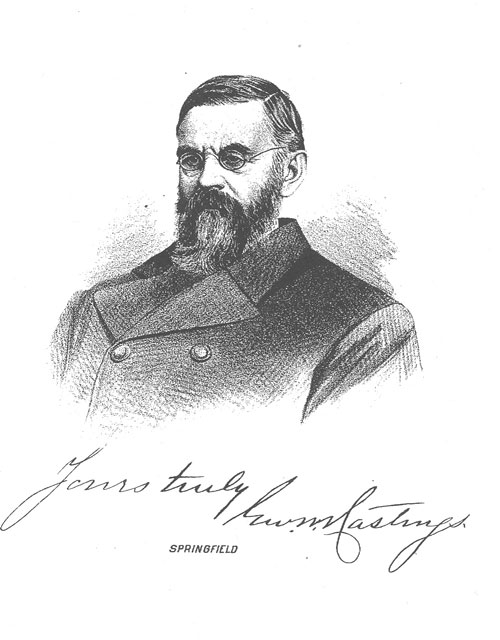
PAGE 365 - PICTURE OF GEORGE W. HASTINGS - SPRINGFIELD
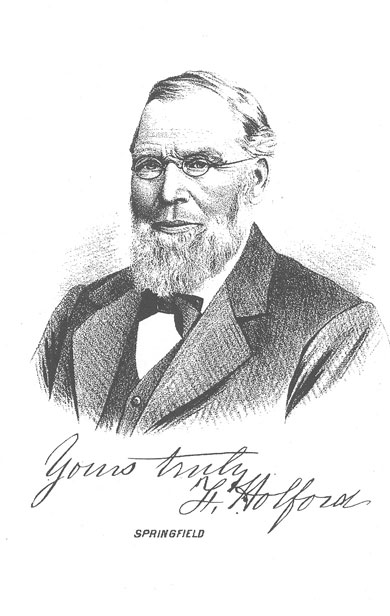
PAGE 366 - PICTURE OF F. HOLFORD - SPRINGFIELD
HISTORY OF CLARK COUNTY. - 367
farm where he now has his home, more than half a century ago, and this is at the very locality of old Piqua town. Had I not,
in time past, repeatedly visited the place, I should certainly now desire to make an excursion to look upon the famed spot.
Through the kindness of a member of the family of Mr. Crain, I am furnished with some ancient relics from the battle-ground of old Piqua. He informs me also, as I trust I may use the freedom to mention, that Gen. J. W. Keifer was also born
in the same vicinity; and Mr. Shellabarger, too, had his birthplace but a short distance from there, on the opposite side of the
river. These gentlemen, I doubt not, would be able to communicate many circumstances of interest, historical, or, at least,
national, connected with the old Piqua locality. Many other citizens, doubtless, are also possessed of facts and incidents,
historical or antiquarian, pertaining to the Mad River Valley or some other portion of the State. I trust these will become
enlisted in behalf of this association, and will be induced to give us hereafter their views and their narrations for the
entertainment of the public.
I pray you that you go not back from this movement. Let it be a success and a perpetuity. And let us not forget that all
should be done in God's fear, and to the glory of His name.
After the conclusion of the address, W. W. Beach, from the committee appointed for that purpose, reported the constitution,
which was unanimously adopted, and signed by a majority of those present. The by-laws were also unanimously adopted.
CLARK-SHAWNEE CENTENNIAL.
Monday, August 9, broke upon this community with a cloudless sky, favoring the ceremonies for which such extensive and
laborious preparations had been made during the past few weeks, and the centennial of Gen. George Rogers Clark's victory
over the Shawnee and Mingo Indians, at Old Piqua, four miles west of this city, was given an encouraging send-off.
Everything was in complete readiness Saturday evening, the grounds being properly laid out and signals set. The Memorial
Guards and Cummins Cadets pitched their tents in a shady spot Saturday, and remained on guard in anticipation of a crowd
of curious and impatient people Sunday. The crowd was there sure enough, 200 carriages and buggies coming in from all
directions, loaded with people, who inspected favorably the preparations made. In the city, the flags of all nations appeared
at the early hour from windows and roofs, not only of business houses, but of dwellings, giving the streets the holiday aspect
desired. The celebration had been the talk of the people in this part of the State since it was first suggested, and at the last
interest became intense. This was shown by the crowds of people which began pouring into the city soon after sunrise,
increasing every hour until one could scarcely move along the streets. First on the day's order of exercises was the reception
of distinguished guests, the Governor and staff, Mayors and Councils of sister cities. Interest therefore centered in and about
the railroad depot. At the appointed hour, the various bodies and organizations to take part in the procession and
proceedings at the grounds met at headquarters, and at 9 A. M., massed on Market square.
368 - HISTORY OF CLARK COUNTY.
HOW THE CELEBRATION ORIGINATED.
In the issue of the Daily Republic for June 14, 1880, appeared an able article from the pen of Mr. Thomas F. McGrew, of
this city, the historian of the celebration, entitled " The Siege of the Old Indian Town of Piqua," giving a detailed account of
the battle of the 8th of August, 1880, with the circumstances leading to the encounter and showing the objects accomplished
in the opening of this rich and fertile valley to settlement and civilization. That paper attracted wide attention and was
reproduced by the press of other cities. The propriety of a fitting celebration of the anniversary, as one of paramount
importance in the history of Clark County, which took its name from the hero of the enterprise, immediately suggested itself,
and at the regular July meeting of the Clark County Veteran Memorial Association, Capt. Alden P. Steele moved the
appointment of a committee to consult with citizens and consider the propriety and feasibility of so celebrating. The motion
prevailed and the Captain of the association appointed as such committee Capt. Steele, Col. Howard D. John, Andrew Watt,
Capt. D. C. Balentine and William H. Grant. At a subsequent meeting, this committee reported favorably upon the
proposition and it was resolved by the association to celebrate accordingly, on Monday, August 9, the 8th, the day of battle,
falling on Sunday. The original committee was continued in charge of necessary arrangements, with power to call to their
assistance any member of the society or community able and willing to work. From the first announcement of this decision, a
deep interest was taken in the matter, especially by residents of that part of the country in which is located the scene of the
battle, and, although the time was comparatively short, preparations were made so skillfully and promptly with the hearty
co-operation of many leading citizens, that everything was in readiness by the evening of Saturday, August 7, and the
liveliest anticipations existed among the people of half a dozen counties in Southeastern Ohio. The Veteran Memorial
Association is an organization composed of ex-soldiers, officers and privates in the Union army and navy in the war of 1861-65, formed for the purpose of keeping alive the fellowship formed on the battle-field, for showing proper respect to the
memory of ex-soldiers passing away in our midst, and for decorating soldiers' graves on the day annually observed in nearly
all the States for observance of the beautiful ceremony. It was deemed entirely in keeping, in the lack of a Historical or
Central Pioneer Association, that this organization should initiate and conduct the celebration in progress to-day on the site
of the old Indian town of Piqua, and Clark-Shawnee battle-ground. A proper share of credit is therefore due the Memorial
Association for anything of success achieved. Gov. Foster and several members of his staff, who had spent Sunday, in the
camp of the Sixteenth Regiment, O. N. G., at Tiffin, arrived in the city, rather unexpectedly, by the early train and proceeded
at once to the Lagonda House, where shortly after they were found by the Reception Committee. The 9:20 excursion train
from Columbus brought other members of the Governor's staff, which is represented here to-day by Adjt. Gen. W. H.
Gibson, Col. T. E. McNamara, Col. J. H.Sprague and Col. J. C. Wehrle. The procession formed on Limestone street, front
of the Lagonda House, at 9:30 A. M., with Col. R. L. Kilpatrick, U. S. A., Chief Marshal, with Capt. Charles Hotsenpiller,
U. S. A.. Col. A. Dotze, Capt. Amaziah Winger, Capt. J. R. Ambrose and Dr. W. G. Bryant. medical officer, as aides. The
procession moved in the following order:
Grand Marshal and Aides.
Seventh Regiment Band.
Veteran Memorial Association, 100 men, commanded by Maj. W. J. White.
Squirrel Hunters, Capt. Frederick A. Lewis commanding.
HISTORY OF CLARK COUNTY. - 369
Carriages with officials and invited guests.
Company A, Seventh Regiment, O. N. G., Capt. Charles Anthony, fifty men.
Duquesne Blues, O. N. G., Capt. Harper, fifty men.
In the first carriage rode Gov. Charles Foster, Adjt. Gen. Gibson, Judge William White and Gen. J. W. Keifer.
Second carriage, Col. Anderson, U. S. A., Commandant Columbus Barracks and grand-nephew of Gen. George Rogers
Clark, Hon. J. F. Oglevee, Auditor of State, Rev. T. J. Harris, Chaplain of the day, and Mayor E. S. Wallace.
Third carriage-Dr. Keifer, of Troy, and Governor's staff.
Fourth carriage-Capt. Runyan, of Logan County, in uniform of the old time militia; Col. Johnson, Piqua; and Commissioners
of Clark County.
The route of the procession was east on High street to Sycamore, north to Main street, west to Market, south to Market
space, where footmen boarded the train for the grounds, carriages and horsemen proceeding by pike.
On arrival, the exercises at the speakers' stand began with music by the band and prayer by Rev. T. J. Harris, Pastor High
Street Methodist Episcopal Church, and Chaplain of the day.
Gen. Keifer then delivered the following welcoming address:
FELLOW-CITIZENS: The. duty assigned me is a pleasing one. I am warned to be brief and not to trench on the work
alloted here to others. The welcome extended to our distinguished guests must be found more in the hearty spirit in which all
give out signs of pleasure over their presence, than in words which I may titter.
Speaking for those through whose persevering efforts we are permitted to meet on this occasion; also for all who have
interested themselves in this centennial day, I extend a hearty welcome to all persons assembled here.
A perfect realization of the importance and interesting character of this meeting can be had only by bringing into vivid
recollection the incidents and' events which have occurred on these grounds a hundred years ago.
Here, then, savage and civilized man joined in mortal combat. The battle fought and won on that day had most important
results. The border pioneer settlers, especially from Kentucky, fought to free their homes from depredations by the merciless
red men. But the greatest results are to be read in the fact that here, on that day, the most warlike Indian tribe on the
continent was defeated and forced back, and the pioneer white man was allowed to advance to new possessions. On this
field as upon every other where an untutored and barbaric race of men have measured prowess with an educated and
civilized race, the latter has proved the most valiant. No race of men ever were great and successful warriors whose training
did not comprise something more than is obtained in the chase or alone in the use of arms. The Hebrew people, just out of
centuries of Oriental bondage in which they were strangers to war, and who in all their history had been trained to peaceful
pursuits, proved more than a match for the numerous large warlike bands with whom they came in contact in their forty
years' journey through the wilderness to the Promised Land.
On these grounds, 100 years ago, were the then principal villages of the Shawnee Indian tribe. . This tribe had occupied
different portions of the now territory of the United States during nearly three hundred years of preceding history, and it was
the most warlike of all the Indian tribes. It had rarely been at peace with the other tribes until it went to war with the whites.
Their chiefs possessed more sagacity and more of the true spirit of warriors than the chiefs of other tribes. Their traditions
were of war, extending back to a time when they, in search of conquest, "crossed a sea" to this continent. In this tribe alone
did the latter tradition prevail. Here the head chiefs made their
370 - HISTORY OF CLARK COUNTY.
home. On account of the abundance of game, the richness of soil, the pure water from the numberless perennial springs, the
large quantities of fish which then abounded in the limpid waters of Mad River and its tributary streams, the facilities for
engaging in favorite sports upon the river and the then open prairies, these aboriginal people had become more than
ordinarily attached to this place as a home. The acquisition of these lands may have been at the cost of many of their chiefs
and braves. Here were the graves of their ancestors and those dear to them. They followed the natural instincts of mankind
in defending this country against the aggressions of the white race. I am not charged with the duty of picturing the scenes of
the battle fought here. That duty will be performed to-day by others; and by simulation we are soon to witness all the scenes
of that eventful day. Already we witness the contending forces gathering for the fray.
Who were here on that memorable day? There were here (at their birthplace) the three ten-year-old brothers-triplets-with
their Creek mother, two of whom became famed in the bloody history of the West. The names of those boys were Tecumseh
(a cougar crouching for his prey), Ellskwatawa (an open door), afterward named and recognized as the Prophet, and
Rumskaka. The principal chiefs and braves of the Shawnees, supported by about three hundred Mingo warriors under the
notorious renegade white man, Simon Girty, fought upon this field. George Rogers Clark, then but twenty-eight years of
age, and who stood deservedly high in public esteem as an Indian fighter, commanded the "long knives"-the white soldiers.
Among those with the expedition, perhaps more in the character of a scout and a spy than a soldier, was the famous Western
adventurer, Daniel Boone.* Though the army of Col. afterward Gen. Clark was small-only about one thousand in numbers-it
contained many who are known in the annals of history.
The day we celebrate was an anxious one. Success that day was to the pioneer settlements a guarantee of freedom from the
scalping knife of the savage; and success to the Indians was the preservation of their rude homes, their, small crops and
natural hunting grounds. From the women and children, witnesses of the battle gathered on these heights, there doubtless
went up prayers for the success to the Great Spirit above; for they worshiped a "Great Unknown." These "children of the
forest," as said by another, had seen the Great Father
"In clouds and heard Him in the winds."
Here then was witnessed the exaltations of victory, and the crushed hopes and sorrows and sufferings and defeat. The cycle
of an hundred years has beheld the vain struggle of a once proud and valiant race of God's people for their homes and for an
existence. The Shawnee tribe is now almost extinct; a mere remnant of it, without tribal identification, can only now be
found in the far-off Indian Territory, merged with a similarly fated tribe-Pottawatomies. Though these "children of nature"
flourished and were long known to history (under varied names), before their defeat on these historic plains their star of
destiny was set. They are doomed to extinction. Their fate has been or will be the fate. of all other savages on this continent.
While we deplore the poor Indian's fate, and hesitate to pronounce his treatment by our kindred and race just and human
when tested by divine precepts, we can still hope that He who rules all things for the best will not, as a retributive justice,
visit a like or kindred fate on our own race.
* According to other accounts Boone must have been in the" Carolinas " searching for his wife and family at the time of this
expedition.
HISTORY OF CLARK COUNTY. - 371
Reaching back a century, where certain records of history "fade away in the twilight and charm of tradition," we gather up
the marvelous growth of civilization in the New World.
The past century is rich in the romance of American history. Progress has reigned with imperial power. The savage war-whoop has been superseded by the neighing of the "iron horse." The event we celebrate sharply marks the point where
barbarism ended and civilization set in. Here barbarism was driven back still farther in its native forests, where through all
the ages it has had its securest home, and the inseparable twins, Christianity and civilization, bearing the ax of Time, have
cloven along their retiring footsteps room for a better, purer and holier life, in all of which we may be able to read the decree
of Almighty God.
To bring us closer, if possible, to the condition of things as they once existed here, and to aid in paying just tribute to our
fathers who fought here, or who but little later were the avant couriers of our present peaceful and happy State, let us speak
in the words of one of Ohio's poet sons:
" The mighty oak, proud monarch of the wood,
Upon these hills in stately grandeur stood.
Along these vales did ferocious panthers prowl,
And oft was heard the fierce wolf's frightful howl;
But all these savage beasts have passed away,
And the wild Indians too-where are they ?
They have disappeared-most of these tribes are gone,
Like the night's dark shades before the rising dawn.
Can we forget that brave and hardy band
Who made their homes first in this Western land'?
Their names should be enrolled on history's page,
To be preserved by each succeeding age
They were the fathers of the mighty West;
Their arduous labors Heaven above has blessed,
Before them fell the forest of the plain,
And peace and plenty followed in the train."
Gen. J. Warren Keifer was then responded to by Gov. Charles Foster, who spoke as follows:
LADIES AND GENTLEMEN OF CLARK COUNTY:
I am very grateful indeed, for myself and for my associates here from the State Government, for the welcome that has been
given us in words, and not only in words, but for the welcome expressed by this magnificent presence before us. It has been
my good fortune (I suppose I may call it good fortune) to visit almost every county in this State within the past year. Ohio is
a great State, with populous cities and influential towns and counties-at least we of Ohio think it is a great State-and I
noticed in all the counties I visited that every one thought their town the best town in their county and the best county in the
State. I conclude that the remark is equally current here. Unfortunately for me, I failed to visit Clark County last year, but I
am happy to be present with you to-day. Among the first things I heard when I arrived this morning was that " same old
story," that the county of Clark is the finest in Ohio, and that the city of Springfield is the finest city in the State or in any
other State, for that matter. Even my old friend, your honored citizen, one of the Judges of the Supreme Court, dignified and
thoughtful as he is, said that this county and this city of Springfield were the best county and the best city in the State
(Laughter.)
I am glad to be here to-day on this centennial occasion-this centennial of an occasion that marked the downfall of barbarism
and the beginning of the rise of the splendid Christian civilization we now see in Clark County, and not only in Clark
County, but throughout the great Northwest.
I congratulate yon, the people of Clark, on your splendid civilization, on
372 - HISTORY OF CLARK COUNTY.
your agricultural industries, on your great manufacturing interests, and your institutions. Again, in behalf of myself and my
associates, I thank you for the kind invitation and for this most generous welcome. (Applause).
LETTERS AND COMMUNICATIONS.
Capt. D. C. Balentine, editor of the Springfield Transcript, selected to read letters and communications from invited guests
unavoidably detained and others, remarked that he felt himself unable, even did time permit, to read the entire mass of
manuscript placed in his hands, and, as they say in Congress, would "ask leave to print" for the benefit not only of this but
for future generations. He then read, either in whole, or in part, the following papers:
FROM JUDGE FORCE, CINCINNATI.
FROM LEAVENWORTH, KAN., July 21, 1880.
MAJ. W. J. WHITE:
Dear Sir: I have just received your letter, inviting me to serve as orator at the centennial of Gen. Rogers Clark's victory at
Old Piqua.
The letter followed me to this post, where I am resting a few days before setting out with Gen. Pope for the southwest
corner of Colorado.
I thank you heartily for thinking of me on so interesting an occasion, and would gladly serve if it were practicable. But while
you will be celebrating your centennial, I shall be camping in the wilderness.
The proceedings will of course be printed: and will contain much of historical interest. I desire to bespeak a copy.
Very truly yours,
M. F. FORCE.
FROM PRESIDENT EDWARD ORTON, COLUMBUS, OHIO.
OHIO STATE UNIVERSITY, PRESIDENT'S ROOM, COLUMBUS, OHIO,
July 28, 1880.
PROF. W. J. WHITE
My Dear Sir: I crave your pardon for my delay in answering your letter, I have been absent from home about a week, but
your letter came into my hands a day or two since in time, certainly, for an answer before this date. I am collecting the coal
and ore statistics of the State and have a number of men in the field. When I returned, I was snowed under with urgent
requests of various sorts that demanded instant attention, and, yielding to the immediate pressure, your letter escaped notice
until an hour or two before your telegram was received. I cannot render the service you ask. I wish I could. Nothing would
please me better than to make a study of this early chapter. of our history, but I am so burdened with my present duties that
I cannot think of assuming any service outside of them. Very truly yours,
EDWARD ORTON.
FROM HON. STEPHEN JOHNSTON, PIQUA.
PIQUA, Ohio, August 2, 1880.
P. O. CUMMINGS, Secretary Clark-Shawnee Centennial, Springfield, Ohio:
Dear Sir: Your invitation extended to me to be present, at the anniversary of the battle between Gen. Clark and the Shawnee
Indians a century ago is before me. In reply, will say I shall be happy to accept the invitation and be with you at the time
fixed. My mother was personally acquainted with Tecumseh and Daniel Boone, being born in Fort Bryan, Kentucky, or
called usually "Bryan's Station," and being also acquainted with Abraham Thomas, who was
HISTORY OF CLARK COUNTY. - 373
in the battle and has given an account of it published in Howe's History of Ohio. Mr. Thomas came from Kentucky to Ohio
at the same time with my mother's family and settled in this county (Miami), only a few miles apart. It will afford me great
pleasure indeed to look over the ground on the anniversary of the battle. Very truly, your obedient servant,
STEPHEN JOHNSTON.
FROM M. M. MUNSON, GREENVILLE.
GREENVILLE, July 28, 1880.
F. M. HOWE, ESQ.:
My Dear Sir: Yours of the 27th is at hand, and I have given the subject matter some consideration. At the present writing I
am not able to give you any further historical account of the battle fought at "Old Piqua" between the Kentuckians under
Gen. George Rogers Clark and the Shawnee Indians, which occurred August 8 and 9, 1780.
I am aware that there are conflicting accounts of that battle and the circumstances that attend it. You refer to those given in
Howe's His. Col. Ohio. One is from "Bradford's Notes on Kentucky." This work is generally admitted as good authority in
pioneer history. This book is out of print and quite rare. The other is Reminiscences of Abraham Thomas, published in the
Troy Tunes, in 1839.
The reminiscences were written by a Mr. Bosson and were received as reliable, as Mr. Thomas was a man of truth. I
furnished them to Mr. Howe for his book in 1846-47. Several things combine to make your celebration on this spot of
interest and importance. First-Tecumseh was born here in 1865 or 1866. May we not trust that a more complete life and
juster conception of the character of Tecumseh will be brought out by your people on that occasion? One of the Drakes has
given us an extended life of the chief, but from its reading a wrong impression of his character is made upon the reader. A
good deal of poetry and romance has been from time to time interwoven with his life. Sayings and doings and many
incidents are largely colored by McDonald and subsequent writers. I knew an old gentleman who spent much of his time in
Troy. He was Gen. Harrison's Secretary, and was at the treaty of Vincennes in 1870. His impression of Tecumseh was not
favorable. His description of his personal appearance, his action, voice or speech, and a general analysis of his character, I
recollect, were quite elaborate and thorough. Some allowance should be made for my old friend, for he lived in those
"perilous times," "a part of which he was," and was an old man. Second-The battle which your coming celebration is to
commemorate. This is an important historic event, and a complete and reliable historical account should be secured before it
is too late. I trust every effort will be made by your people to this end. Third -This spot once aspired to be the county seat of
Clark County; once was the rival of your now beautiful and thriving city.
Mr. Smucker, the pioneer historian, lives in Newark, and is the Secretary of our Pioneer Society. I will try and see him in a
day or two and have a personal interview with him upon the subject to which you refer in yours of the 27th. Books and
documents treating upon early history or pioneer matters are rare, and most that were attainable in your county have been
deposited in our society rooms in Newark. If I cannot go to Newark in time, I will inclose yours with a note to Mr.
Smucker, who will write you or your committee. Mr. S. is the best posted historian in certain lines of pioneer history in
Ohio, and then he has access to all published matter in this field at Newark, where we have them deposited. From what I
have said of Tecumseh, I don't wish you to think he is by any means an unimportant personage-far from it. On the
374 - HISTORY OF CLARK COUNTY.
other hand, I look upon him as being the greatest Indian characters that has been known upon the American continent. I only
want a just portraiture of him. What do you say to a parallel in part between he and Jeff. Davis? I am your obedient servant,
M. M. MUNSON.
TECUMSEH.
The noted Indian Chief and Shawnee warrior, Tecumseh, was born on this spot and was twelve years old at the time of Gen.
Clark's attack. The following biography of this remarkable man is given in the American Encyclopedia:
Tecumseh, or Tecumtha, a chief of the Shawnee Indians, was born near the present city of Springfield, Ohio, about 1768,
and was killed at the battle of the Thames (Canada), October 5, 1813, being then forty-five years of age. His first prominent
appearance was in the attack on Fort Recovery in 1794. About 1805, his brother, Elskwatawa, set up as a prophet,
denouncing the use of liquors, and of all food and manners introduced by the whites. Tecumseh and the Prophet then
attempted to unite all the Western tribes into one nation to resist the whites. They visited the Indians from the Lakes to the
Gulf of Mexico, and soon had a village of 400 Indians gathered at Greenville. Gen. Harrison required them to remove, as it
was beyond the Indian limit fixed by treaty. Tecumseh went to Vincennes with 400 warriors to over-awe Harrison, and the
conference was broken up by his violence. Finding that he had gone too far, he attempted to explain. In 1811, while he was
in the South exciting the Creeks and Seminoles to rise by promise of English aid, Harrison marched on the Prophet's town to
demand that the Indians should return to their various tribes, murderers of whites to be surrendered, and plunder given up.
The Prophet attacked him and was defeated at Tippecanoe, on the Wabash, November 7. This disconcerted Tecumseh's
plans and broke the spell of the Prophet's power. When war was declared with England, Tecumseh appeared in Canada with
a number of warriors and refused to meet the American commanders in council. He was in the action against Van Horne on
the Raisin, and after being wounded at Maguaga was made a Brigadier General in the British forces. He was in command
with Proctor at the siege of Fort Meigs, and saved American prisoners from massacre. After the battle of Lake Erie, he
urged Proctor to engage Harrison when he landed, but accompanied him in his retreat. In the first engagement, he was
wounded while holding the passage of the stream. With Proctor he selected the battle-ground at the Thames, in the
southwest corner of Canada, and commanded the right wing. Laying his sword and uniform in the conviction that he must
fall, he put on his hunting dress and fought desperately until he was killed. Col. R. M. Johnson was said to have shot him;
but in reality his death was not for some days known to the Americans.
FROM DR. J. J. MUSSON, ST. PARIS.
ST. PARIS, August 6, 1880.
CAPT. STEELE, Springfield, Ohio:
Dear Sir: Your postal was received on time. If professional engagements do not prevent, I will be present at the celebration.
A few facts relative to Black Hoof may not be inappropriate. About thirty years since I obtained his skull at Wapakoneta.
That his age was very great at the time of his death is attested by the closure of the alveoli (the sockets in which the teeth are
inserted). Whether, as reported, he was 110 years of age when he died I do not know; but that his age was very great there
is no doubt. His skull indicates a remarkable brain for an Indian. If he was as well balanced in mind as from the
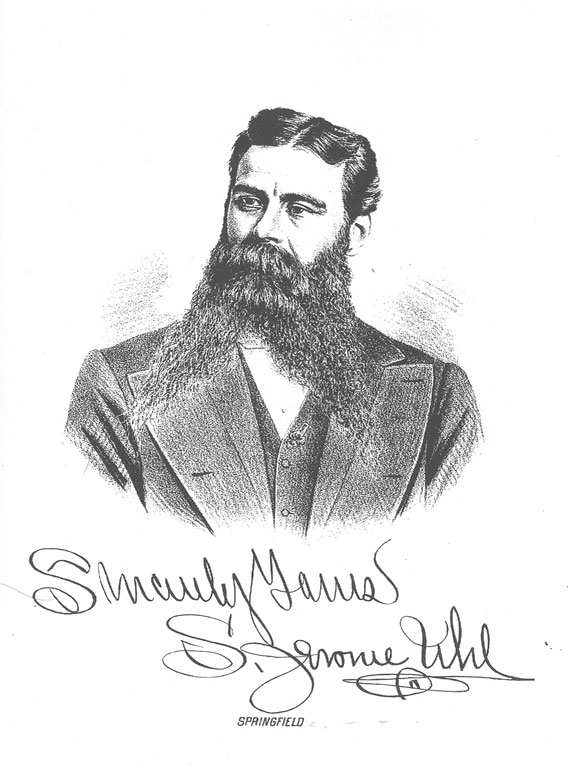
PAGE 375 - PICTURE OF A. JEROME UHL
PAGE 376 - BLANK
HISTORY OF CLARK COUNTY. - 377
form of his skull his brain must have been, he could not have been otherwise than a great leader. Just. above the temple, on
the left side of the skull, there is an indentation. It was caused by a blow from a musket in the hands of an infuriated soldier
shortly after his capture in the war of 1812-15. He was knocked senseless, and, although at the time it was supposed it had
made a Good Indian of him, he lived many years, dying at Wapakoneta in the fall of 1831. A report of this incident in his life
will be found in Howe's History of Ohio. He was the adviser and confidential friend of the great Tecumseh, and, at the
instance of the latter, attempted to unite several Indian tribes into a grand and confederation, so as the more effectually to
resist the continually increasing encroachments of the whites. After the war of 1812, he settled down to a peaceful life, the
monotony of which was only varied by an occasional drunk. In getting his skull I was assisted by an old pioneer who
attended his funeral. Respectfully,
JOHN MUSSON.
Should I not get down, see that the skull is returned in due time.*
FROM ISAAC SMUCKER, NEWARK.
NEWARK, Ohio, July 21, 1880.
CAPT. M. M. MUNSON:
My Dear Sir: Yours, with the letter from Mr. Howe, was received yesterday. I have no fuller, better or more reliable account
of Gen. Clark's expedition to the Mad River Indian towns, in August, 1780, than appears in Howe's Collections. Thomas
calls it a "bloodless victory to the expedition," but in a preceding paragraph admits that a party of the Clark army, acting as
spies on the Indiana side of the Ohio River, were surprised and several killed and wounded.
The history of the Clark expedition was briefly this: In July, 1780, Gen. Clark organized about one thousand Kentuckians to
march against the Indian towns on Mad River, a few miles west of Springfield, for the purpose of chas tising them for their
marauding excursions into Kentucky. The army left the mouth of Licking August 2, 1780, reached the Piqua Indian town on
the 8th, and had a battle, with the loss of about twenty men on each side, the Indians being compelled to retreat. Gen.
Clark's army then returned to Kentucky, arriving at the mouth of Licking, opposite Cincinnati, August 14.
Drake's Memoir of Tecumseh is probably the fullest and most reliable, and contains about all that is known of him. I see
Howe draws largely upon Drake in making up his biographical sketch of him. His character, when divested of the drapery of
romance thrown around it, was simply that of a brave, influential, energetic, talented, vindictive savage-that and nothing
more-certainly nothing better. Fraternally,
ISAAC SMUCKER.
FROM C. W. BUTTERFIELD.
MADISON, Wis., August 4, 1880.
WILLIAM J. WHITE, Springfield, Ohio:
Dear Major: It would afford me great pleasure to be with you on the 9th inst., at the meeting of the Memorial Association,
of Springfield, with the pioneers of Clark County, to celebrate the one hundredth anniversary of the battle of Col. George
Rogers Clark with the Shawnees and Mingoes, at the Indian town of Piqua, within the present limits of your county; but I
am so far away and so pressed with business engagements that I must forego the happiness of being present upon that
occasion.
* The skull was on exhibition during the day of the celebration.
378 - HISTORY OF CLARK COUNTY.
The historical sketch of "The Siege of the old Indian town of Piqua," published in the Springfield Republic of June 14, 1880,
written by Thomas F. McGrew, which you were so kind as to send me, I have read with much interest and profit. The writer
has evidently caught the spirit of "The Siege," and has left little to be added to the history of the expedition. "One hundred
years ago," says the circular which you have favored me with, "the now fertile farms, productive valleys, lofty ledges and
sparkling springs of Clark County were the homes, the haunts and hunting-grounds of the Shawnees." This is true; and may
I be allowed to add, that what is now the great State of Ohio was then, "to all intents and purposes," a howling wilderness.
One hundred years ago, there was not in the vast extent of territory bounded on the north by the Great Lakes, on the east
and south by the Ohio, and on the west by the Mississippi, a single permanent American settlement. Beyond the Ohio,
looking north and west, was everywhere an Indian country; and, at that time, all the tribes but one throughout the whole
region were openly at war with the United States. That one was the Delawares; and these Indians the very next spring took
up the hatchet in favor of the British. So, the settlements that had taken root west of the Alleghanies-reaching from
Pittsburgh down the east side of the Ohio to some distance below Wheeling-and the few . that were dotting the wilds of
Kentucky, were all suffering the horrors of the Western Border war of the Revolution-a war characterized by rapacity and
bloodthirstiness. Previous to this, two expeditions had crossed the Ohio, directed exclusively against the savages: One from
Fort Pitt (Pittsburgh), in February, 1778, to attack Cuyahoga, under Brig. Gen. Edward Hand, resulting so ingloriously that
it is known in history as the "squaw campaign;" the other from Kentucky, in May, 1779, led by Col. John Bowman, against
Chillicothe, a Shawnee town, about three miles north of the present site of Xenia. His success was not what had been
expected; but the expedition was by no means a failure. Then came the campaign of Clark, "one hundred years ago," against
Piqua, the particulars of which your historian has given with so much clearness and accuracy; and to 'celebrate the one
hundredth anniversary of which your association and the pioneers of Clark County are so soon to assemble on the "Old
Piqua Battle Ground."
But what of Indian marauds, meanwhile, across the Ohio into Pennsylvania and Virginia, and into the infant settlements of
Kentucky? The actors were fitly described as "horrible hellhounds of savage war! " for they murdered, indiscriminately, the
young and the old-helpless women and children-every age and either sex. To prevent almost continual depredations of this
character, carried on by the Shawnees and Mingoes, upon the inhabitants of Kentucky, the expedition against the Indian
towns on Mad River was organized by Clark. The enterprise, as you know, was a success: though the Shawnees were but
little humbled, and the Mingoes still less. The immunity from savage aggressions, which the campaign brought to Kentucky,
was of short duration. But of the expeditions which followed I will not speak. Suffice it to say, that what is now Clark
County never again was the scene of conflict between the Americans and Indians in force.
And now, before I close, a few words about Simon Girty, who is said to have been in command of the Mingoes at Piqua.
Possibly you may be interested in a brief sketch of the "noted desperado" something concerning him outside of the general
drift of what is to be found in the current histories of the day. He was born about the year 1741. on an island in the
Susquehanna River. His father's name was also Simon. His mother's maiden name was Crosby. Simon, the younger, had
three brothers-Thomas, James and George. The father was killed in a drunken frolic. The widow afterward married a man
HISTORY OF CLARK COUNTY. - 379
named John Turner. They had one son, also named John. During the old French war, all were. captured by the Indians. The
elder, John Turner, was tortured at the stake; the residue of the family was taken into captivity, but Thomas Girty escaped.
Simon Girty was adopted by the Senecas; James, by the Shawnees; George, by the Delawares. To what tribe the mother and
child (young John Turner) were assigned is unknown. After peace was declared, they all returned to Pittsburgh and vicinity-to civilized life. But during the Revolution the Girty boys joined the British and their savage allies. They all became noted for
their cruelty to prisoners. Simon was a conspicuous character in the Indian war which followed the Revolution. Soon after
the close of the last-mentioned conflict, he married Catharine Malott. They had a family of five children-John (who died in
infancy), Ann, Thomas, Sarah and Predaux. Their descendants are numerous and respectable. Simon Girty died February 18,
1818, near what is now Amherstburg, Canada.
Yours truly,
C. W. BUTTERFIELD.
FROM PRESIDENT HAYES.
EXECUTIVE MANSION, WASHINGTON, August 5, 1880.
GENTLEMEN
I am directed by the President to say that arrangements already made for the disposition of his time next week render it
impracticable to reach Springfield on the 9th inst., and he is obliged with regret to decline your very kind invitation to be
present on the occasion of the celebration of the one hundredth anniversary of the victory of Gen. Clark.
Very truly yours, W. B. ROGERS, Private Secretary.
Messrs. George H. Frey, P. P. Mast, John H. Thomas, City Council Committee, Springfield, Ohio.
FROM SENATOR THURMAN.
COLUMBUS, August 3, 1880.
Dear Sir: I have delayed answering your polite invitation to attend the centennial celebration of Gen. Clark's victory, in the
hope that I might be able to accept it. But I now find, to my regret, that I cannot do so, as I am com pelled to be absent from
Ohio for the next ten days, if not longer. Thanking the Committee for the favor of the invitation, I am
Yours truly,
A. G. THURMAN.
G. H. FREY, Esq., Springfield, Ohio.
FROM SENATOR PENDLETON.
CINCINNATI, July 24, 1880.
GEORGE H. FREY, Esq., Chairman Committee on behalf of City Council:
My Dear Sir: I have the honor to acknowledge your invitation on behalf of the City Council of Springfield to attend the
centennial celebration of the victory of Gen. Clark over ;he Indians, to be held at the battle-ground, Monday, August 9,
1880, and to be the guest of the city. I expect, in pursuance of a previous engagement, to be absent from the State at that
time. If anything should transpire to relieve me from this engagement, it will be a pleasure as well as an honor to accept your
invitation. Convey to the Committee and the gentlemen of the Council my high appreciation of the honor they have
conferred on me, and believe me
Very respectfully yours,
GEORGE H. PENDLETON.
380 - HISTORY OF CLARK COUNTY.
FROM MAYOR NOBLE, OF TIFFIN.
TIFFIN, OhIo, July 27, 1880.
GEORGE H. FREY, Esq., Springfield, Onio:
Dear Sir: Your kind favor and invitation received. In reply, allow me to say, my official duties are such that I will be unable
to attend your "Centennial." Permit me, hovever, in the name of the city of Tiffin, to extend unto you our hearty and sincere
congratulations, and may the coming years bring to you even more prosperity than the past.
Respectfully, HARRISON NOBLE,
Mayor of Tiffin.
FROM WILLIAM PATRICK, URBANA.
URBANA, Ohio, August 2, 1880.
F. O. CUMMINGS, Secretary Clark--Shawnee Centennial, Springfield, Ohio:
Dear Sir: Permit me to return my thanks for the kind invitation extended to me to attend the centennial and pioneer re-union,
on the 9th of August, four miles west of Springfield, on the Old Piqua battle-ground 100 years ago, for the purpose of
celebrating that great historic event. Memory brings up recollections in connection with the subject of my very early pioneer
life that seem to urge me to make this effort to accept the very kind invitation to attend; but surrounding circumstances will
more than likely intervene to prevent it, and, if so, please be assured that my heart is with you in that great and laudable
enterprise.
The battle of Piqua, preceded by many raids at different points, was only the commencement of a long line of conflicts with
the savages in the various parts of the then great Northwestern Territory. Gen. Clark, six years later, raised a large force and
marched it against the Indian villages upon the Wabash, and, while at the Falls of Ohio, detailed Col. Logan, afterward
breveted Gen. Logan, to raise a considerable force and march it upon the Macacheek towns, now within the limits of Logan
County, Ohio, which resulted in the burning of Macacheek, Pigeon Town, Wappatomica and other towns in the vicinity,
names not now recollected: and this predatory mode of warfare culminated in the decisive battle gained by Gen. Wayne in
1795. Connected with the scenes enacted in these various conflicts, the names of Boone, Kenton, Whiteley, Patterson,
Kenedy, Trotter and others were embossed in shining filigree during the fifteen years which followed the one you celebrate
on the 9th of August. 1880.
My father, Anthony Patrick, migrated from New Jersey, in the year 1800, to Trrunbull County, Ohio, when I was about ten
years old, and purchased land, settled on it and improved it, within two miles of the line dividing Pennsylvania and Ohio, and
about two and one-half miles west of the present celebrated manufacutring town of Sharon, Penn. But, as was very common
at that early day among the first settlers in Ohio, he and several of his neighbors, hearing glowing rumors of the richness and
fertility of the Mad River country, became restless and dissatisfied with their location, and, hoping to better their condition,
sold their lands preparatory- to seeking the El Dorado in the valley of Mad River; and, in the spring of 1811, my father with
some five or six of his neighbors decided upon a novel mode of transit, which was to build a boat with sufficient capacity to
contain them and their families, with their few household goods and supplies, and launch it in the Shenango River. about two
miles above the site of the present town of Sharon as above alluded to, and which in due time was fully accomplished and
floated down the river over three new mill-dales to the mouth of what was called the Big Yankee Creek, and safely
HISTORY OF CLARK COUNTY. - 381
moored and made ready with steering oar and paddles for the first spring .. freshet, which soon occurred, when all the
immigrants boarded and cut loose and floated down the Shenango into the Big Beaver, and over the Beaver Falls down to
its confluence with the beautiful Ohio River, and down it to Cincinnati with its log cabins under the hill and here they sold
their boat for about $20, made their dividends and all the boat's crew distributed themselves in what was, at that day,
Champaign County. I very much doubt whether any nautical enterprise has more than equaled it since that clay.
This brings me to the point to tell when and how I became acquainted with Springfield. My father moved from Cincinnati up
to Lebanon about the 1st of June, and, in the following August, hired a team to bring his family and goods to Urbana, and,
on the 9th of August, 1811, being coincident with the anniversary you intend to celebrate at Piqua, we passed through your
little hamlet of a few cabins, arriving at Urbana on the same day, when I was nearly fifteen years old. This circumstance,
connected with the fact that at the close of my services in the war of 1812-15, having two uncles and several of our old
neighbors from Trumbull County living in Harmony Township, on the waters of Beaver Creek, I was induced to take charge
of a small school and "teach the young idea how to shoot" (but not with toy pistols). This situation brought Springfield and
what is now the eastern part of Clark County into a more general acquaintanceship with very first settlers. And among those
in town I will mention Ambler, Demint, Daugherty, Foos, Hunt, McElroy, McCartney, Platt, Walker, Pendleton and
Rennick. And now, passing by Springfield for the present, will in rural districts, dating back from 1811 to 1816, name the
heads of families in and adjoining the neighborhood in which I was employed as above indicated, and with whom I have
formed more intimate relationships growing out of my position as school-teacher for two or three quarters on Beaver Creek,
as follows: Samuel McMullin, Thomas Rathburn, John and Clark Rathburn, John Woods, Charles Bradford, William
Trustrum, and Elijah Hull and their old fathers, Jacob Judy and sons, Jacob Harris, Henry and Isaac Hylse, and their old
father, Samuel and John Patrick, Robert Turner and brother James; and will now add some whose Christian names I cannot
remember: Storms, Goodfellow, Norton, Hampton, Loomas, Simpson, Snodgrass, Broadwell, Clark, Wallingsford and
Gandy. Many of these persons, soon after the date indicated, changed their residence from Harmony Township, and the
probability is that none of the persons named are left, except, perhaps, in a very few descendants.
Piqua, the point of your intended celebration, traditionally claims the paternity of the celebrated warrior, Tecumseh, who, it
is also claimed, was one of a triplet at his birth, but this allegation I will leave to the better antiqua rians than myself to
decide as to its truth, merely inserting this short note by way of reminder. All the foregoing fragmentary and desultory
reminiscent sketches have been grouped together from memory, and antedate the organization of Clark County, and are
entirely applicable to old Campaign as organized in 1805. Springfield, of course, has been only partially portrayed under the
cloud that shadowed her up to the organization of Clark County in 1818, and her becoming its county seat, which fact, in
connection with the natural advantages developed of water-power, affording facilities for milling and manufacturing
purposes, coupled with the hidden wealth of her inexhaustible stone quarries, together with the fact that some fifty years ago
she was made a point on the great national thoroughfare, the Cumberland road; all these things, with others combined, at an
early day began• to attract public attention abroad, and population, with its wealth and capital, rushed speedily into the lap
of Springfield; and, although some reverses occurred in the beginning, yet through the
382 - HISTORY OF CLARK COUNTY.
indomitable energy and perseverance of her first class population, with its native genius, she has been placed on a high plain
of progress, that, with the present network of railroad facilities added to her other already enumerated advantages, will carry
her to the goal of prosperity at least equal to any other inland business center of the same numerical class of the city of
Springfield. I would like to say in conclusion, if I had not already said so much, that during my younger manhood, I formed
some very agreeable relationships with many of the citizens of Springfield, and will say that I never knew a better class of
citizens than I found there; indeed they were my beau ideal in business and professional circles. But as is the case of my own
town, these things with me now are in the past, for I feel myself as among strangers both here and there, at the ripe old age
of eighty-four.
Most respectfully,
WILLIAM PATRICK.
FROM T. M'KINNON, LONDON.
LONDON, Ohio, August G, 1880.
TO THE MEMBERS OF THE PIONEER ASSOCIATION:
When I learned of the proposed meeting of pioneers to be held near Springfield this month, my great wish was that I might
be one of the number there assembled; but circumstances are such as will prevent my attendance. I have some recollections
of the early days and doings in this region, which I will give to the meeting on paper, if I cannot give them in person. I was
born in Harrison County, Ky., in November, 1795. My father, with part of his family, came to Ohio in the fall of 1802, and
settled on Buck Creek north of Springfield At that time I was sick and unable to come, so father left me with my mother and
younger children in Kentucky until the neat spring, when he returned and brought us to Ohio. Thus, it will be seen, my
residence in Ohio is as old as the State itself. On our way up to where father had selected a home, we passed through
Dayton, then a small town; through what was called Tapman's Prairie, and crossed Mad River at old Indian town. This river,
my mother said, was certainly rightly named, for it was such a rapid stream. Three men-David Lowry, Jonathan Donnell and
John Denny--lived 'near there. We stopped overnight with Mr. Denny. Donnell afterward hung himself. We again crossed
Mad River, and continued on our way up to Back Creek. The first man we met was Robert Renick, and soon afterward we
met Col. William Ward, a leading man of that day, and afterward Clerk of the Court at Urbana. One day, soon after we
settled on Buck Creek, and father and the older boys were away from home, four Indians-two young men and two older
ones-came to our house and called for their dinners. Mother provided a dinner for them, and while they were eating she
asked one of the young men if they were at the burning of Col. Crawford. He said that the two of the older ones were. She
then told him that Col. Crawford was her grandfather. When he notified the other ones of that fact they all immediately
stopped eating and appeared somewhat alarmed; but she told them to go on with their eating and not be uneasy. She then
asked them if they could tell her about the death of Maj. Harrison. They told her that he had been squibbed to death with
powder at Wapatomica, near Zanesfield, Logan County. She then told them that Harrison was her father. This report fully
corroborated one given by a man named Trover, I think, who was a prisoner at the same time with Maj. Harrison. He said
he had seen Harrison's body black and powder-burned.
Another Indian trouble was in the time of Gov. Tiffin. He was advised of coming trouble and he sent word to Tecumseh at
Wapakoneta to meet him in council at Springfield, with eighty warriors, the picked men of the Shawnee tribe. I remember
one of them in particular, a man by name of Goodhunter.
HISTORY OF CLARK COUNTY. - 383
who had formerly camped near our house, when on a hunting expedition. He was as fine a specimen of perfect physical man
as I ever saw. The council was held and the pipe of peace was smoked. The following incident occurred in connection with
the smoking: A Dr. Hunt* had a clay pipe and Gov. Tiffin used it for the occasion. When he had filled the pipe and started it,
he passed it to Tecumseh who looked at it a moment, and then throwing it away he brought forth his tomakawk-pipe, and
after starting it handed it to Gov. Tiffin. I heard Tecumseh's speech as he made it through an interpreter, and I never heard a
finer orator than he appeared to be. The first merchants in Springfield were two Frenchmen named Dubaugh and Lucroy.
They had their goods in a log cabin between what is now Limestone and Market streets, on Main street. Their goods were
better suited to the Indian trade than to any other. When they left, a man by the name of Samuel Simington came on with a
stock, and he built the first frame house in Springfield, on the southwest corner of Limestone and Main streets, where
Baldwin's building now stands. Simington afterward sold out to Pierson Spiniug and went to New Carlisle, and built mills on
Honey Creek. The first tavern-keeper was Griffith Foos, who kept on the corner of Main and Spring streets. He had one
boarder for several years that I remember very well. He owned a great deal of land around there. He was a fine looking man,
wearing very heavy black side whiskers, but having a head of hair as white as snow. He always took special pains to keep his
hair and whiskers in order. The first camp-meeting held in that region, and the first one I ever attended. was held about
where the County Infirmary now stands. It was conducted by two brothers named Thomas and Richard Clark. They were
nicknamed "Newlights." Their hearers got the jerks, both men and women, and kept on jerking until they became exhausted.
One Jack Eeles, said to have been the wickedest man in that county, went to one of their meetings drunk, making fun of
them and claiming that their jerking was all a sham. But the jerks got hold on Jack and got him down and would not let go
of him. He became so exhausted that his friends had to carry him home. Jack afterward went into the army, was in the war
of 1812, and was killed at the battle of Lundy's Lane, in July, 1814. My father was the first settler on Buck Creek, above
Lagonda. He planted the first apple orchard in that part of the country, and some of the trees were still standing a year or
two ago.
James Shipman was the first tailor in Springfield. Walter Smallwood was the first blacksmith. Cooper Ludlow was the first
shoemaker. James Demint, the proprietor of Springfield, lived in a double log cabin which stood on the hill opposite
Barnett's mill, near where the public school building now stands.
I never saw but two deformed Indians. One of these had no under jaw. The other one, called Bateast, had a monster of a
nose. If you wish to see how his nose appeared, just take a common-sized turnip, cut it in two, and place a half on each side
of a large raddish, and then you can see Bateast's nose.
He and his brother-in-law, Roundhead, and Goodhunter all went off and joined the British army and never came back.
Roundhead lived at a little town now called Roundhead, in the southwest corner of Hardin County. Bateast's home was at a
place a few miles west of Roundhead, then called Bateastown. In 1803 or 1804, Congress passed a law donating 3 per cent
of all money received from sale of lands for use on roads. This donation was called the 3 per cent fund. One Capt. Moore,
and his brother Thomas, in 1805 took a contract to open a road from Franklinton to Springfield. When they got. within a
few miles of Springfield with the road, they made a frolic of the job, and invited all the people around to come and help
them, so they might go into This was Dr. Richard Hunt.
384 - HISTORY OF CLARK COUNTY.
Springfield in one day. The people turned out and put the road through in one day and that night they had a big supper and
ball at Foos', which was a grand affair. There was great rejoicing that the road was done.
Thomas Moore drove the first hogs East from this region. He bought his drove from the people on credit. He bought some
from one lady named Nancy Reed, promising to bring her a silk dress pattern from Baltimore as payment for her hogs. He
drove his hogs to Baltimore, but as his expenses on the trip were more than the original cost of the hogs, he lost money, and
could not pay in full for the hogs when he got home. But he brought Nancy her silk dress, and she had the honor of wearing
the first silk in this part of the country, and at the same time, the satisfaction of getting payment in full for her hogs-a thing
which nobody else could say. But. Moore paid all a proportional part, and promised the remainder as soon as he could get it.
It was several years before he made payment of these debts, but he did it after he got back from serving with Hull in his
campaigns. He had saved enough out of his wages to cancel his hog debts. Moore lived and died on the farm where he first
settled.
During the first years of our life there, there was only one company of militia in all that region now comprising Clark,
Champaign and Logan Counties, so thinly was it populated. My father's place was the usual drill ground, and I knew every
man in all that territory. By 1812, the country was so well settled that there were nine companies, commanded by the
following Captains: Black, McCord, Vance, Barrett, Lemon, Cox, Kiser, Stewart and one other, whose name I have
forgotten. Nearly sixty years ago, I helped to survey all the islands in the Mississippi River from the mouth of the Des
Moines River to the mouth of the Illinois. In my early days, I crossed the Alleghany Mountains twelve times on horseback.
As may be known from a statement of my birth, I am nearly eighty-five years of age, and was four years old at the death of
George Washington. My health is tolerably good. At times I feel very well, and at other times somewhat feeble. Some years
ago, my eyesight began to fail, and for the last ten years I have been entirely blind. I claim to be the first man who named
"Honest Old Abe " for President. I lacked but a few days of being old enough to vote at James Monroe's first election in
1816. My first vote was for Monroe in 1820, at his second election, when he received the entire vote of the Electoral
College, less one.
My votes for Presidents have been as follows: 1824, Adams; 1828, Clay; 1832, Clay; 1836, Harrison; 1840, Harrison; 1844,
Clay; 1848, Taylor; 1852, Scott; 1856, Fremont; 1860, Lincoln; 1864, Lincoln; 1868, Grant; 1872, Grant; 1876, Hayes; and
in 1880 I hope to vote for Garfield, which will make me sixteen Presidential votes. Respectfully,
THEOPHILUS MCKINNON.
London, Ohio.
It had been arranged to suspend exercises at the stand at this point until after dinner, but, having made so good a start, and
the assemblage remaining intact and manifesting much interest, the order was gone through with to the end, omitting the
musical interludes. Mr. Thomas F. McGrew, of Mad River National Bank, this city, the historian of the day, upon being
introduced by the Chairman, read the following admirable and accurate paper, which is entitled to careful perusal and
preservation. It received the undivided attention of the audience:
MR. PRESIDENT, LADIES AND GENTLEMEN: On the 14th day of June, 1880, an illustrated article was published in the
Springfield Republic, entitled: "The Siege of the Old Indian Town of Piqua, in the month of August, A. D. 1780." Shortly
after the publication of said article, the Soldiers' Memorial Association made arrangements for the celebration of the 100th
anniversary of that military
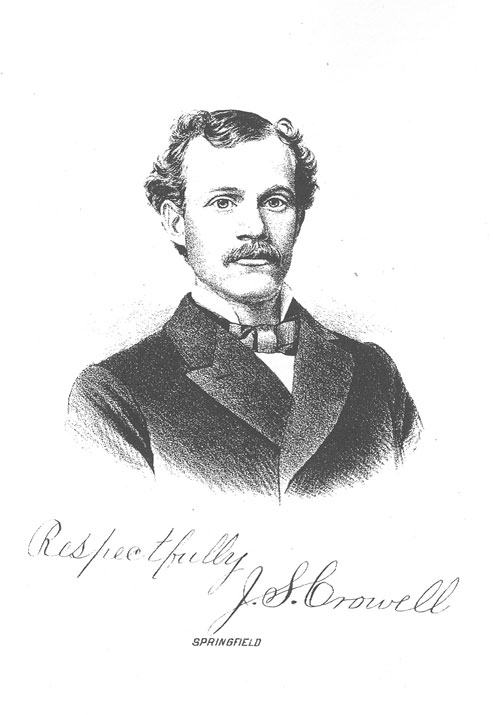
PAGE 385 - PICTURE OF J. S. CROWELL - SPRINGFIELD
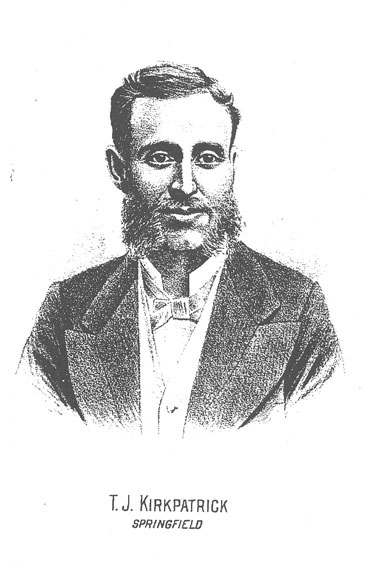
PAGE 386 - PICTURE OF T. J. KIRKPATRICK - SPRINGFIELD
HISTORY OF CLARK COUNTY. - 387
event, on the site of the old Indian town. It is for that purpose that we have met here to-day. It was supposed that this
celebration would serve another important purpose: that the investigations which would be made, would determine all
disputed points, as to the exact location of the forces engaged in the battle, the site and form of the stockade fort, the old
Indian road from Old Chillicothe to Piqua, and the burial-place of the soldiers killed in the fight. The information thus
collected, when carefully compiled, would form an interesting chapter in the history of the settlement of Ohio. In reference
to this event, we have not the usual record authority to aid our investigations. I wrote to the War Department for copies of
papers on file that might in any manner be connected with the siege, and received the following letter from the Hon. Alex
Ramsey, Secretary of War:
"SIR: Replying to your letter of the 5th inst., expressing a desire to procure, if on file, a copy of a report by Gen. George R.
Clark of his capture of the old Indian town of Piqua, August 8, 1780, I beg to inform you that the Adjutant General reports
that the desired report is not on file, and that the records of his office do not cover so early a date as the one named."
An official report of this battle may be found in Virginia, but investigation there could not be made in time for this
celebration. I hope the subject will be pursued until an official report has been found, or the fact ascertained that none was
ever made. The materials furnished here to-day affecting the Shawnee tribe of Indians, the local history of the construction
of the town of old Piqua, the early settlers of Clark County and the town of Boston, are as follows:
1. An accurate and exhaustive history of the Shawnee tribe of Indians, by C. C. Royce, of the Smithsonian Institution,
Washington City.
2. A letter from Hon. C. W. Butterfield, on the same subject, with some personal incidents in the life of Simon Girty.
3. A letter from William Patrick upon the pioneer settlers of Clark County and the city of Springfield.
4. A letter from Dr. John Ludlow on the town of Boston, which has disappeared, not one house being left.
5. A letter from Dr. John J. Musson, in reference to Cata-he-cas-sa, or Black Hoof. In this intersecting letter, he states that
Black Hoof was the confidential friend of the great Tecumseh, and, at the instance of the latter, attempted to unite the
several Indian tribes into a general confederacy, so as the more effectually to resist the constantly increasing encroachments
of the whites." On this point in the history of these two Indians, I most respectfully suggest that Benjamin Drake, who had
gone over the whole subject in his "Life of Tecumseh," says that" when'. Tecumseh and the Prophet embarked in their
scheme for the recovery of the lands as far south as the Ohio River, it became their interest as well as policy to enlist Black
Hoof in the enterprise, and every effort which the genius of one and the cunning of the other could devise was brought to
bear upon him. But Black Hoof continued faithful to the treaty which he had signed at Greenville in 1795, and by prudence
and influence kept the greater part of his tribe from joining the standard of Tecumseh or engaging on the side of the British
in the late war with England.
6. A letter from Isaac Smucker, of Newark, Ohio.
7. A letter from Theophilus McKinnon, of London.
These historical papers will be published and made part of the proceedings of the day's celebration. The parties brought
together in the battle fought over this field one hundred years ago represented four forces in human affairs, of great and far-reaching consequences. Gen. George R. Clark represented the white race. He had been educated according to the highest
standard of colo-
388 - HISTORY OF CLARK COUNTY.
nial times, and was a military officer of considerable experience in war, and of great reputation as an Indian fighter. His army
was composed of a class of men who have all passed away, called "backwoodsmen." We all remember their bravery,
qualities of great personal endurance and high patriotism. The Shawnees represented one of the most warlike tribes that
have been found on the continent, under command of Indians of the highest type, of large experience and undoubted
courage. The Mingo Indians were commanded by Simon Girty, one of the most degraded specimens of the white race; but,
combining the training he had received in the settlement with Indian cruelty and treachery, made him a formidable opponent.
The result of the fight determined the superiority of the whites, who realized the encouraging influences of the victory, and
the Indians became satisfied that separate and independent tribes could not stand up against the advancing settlements, and
Clark's victory demonstrated that two tribes combined-the Shawnees and Mingoes-could not do so; and the determination of
this point, in my judgment, makes Clark's battle the decisive one of our Indian wars. St. Clair's defeat was the result of
negligence, and the victory at " the battle of the. Fallen Timbers " was obtained by the great care bostowed by the
Government on the material prepared for that campaign; but the victory of Gen. Clark over the Shawnees at this place was
an inspiration-quick, complete and decisive. From this time forward, the Indians sought for a confederation and foreign aid.
The desire of confederation was at no time, and with no chief, an inspiration, but a conviction of weakness most
emphatically declared by Clark's victory.
Gen. Jackson, in his message of December 7, 1830, says:
"Humanity has often wept over the fate of the aborigines of this country, and philanthropy has been long busily employed in
devising means to avert it.. But its progress has never for a moment been arrested; and one by one have many powerful
tribes disappeared from the earth."
Such has been the fate of the Shawnees, who once occupied this valley. When first known to the whites, they were a
numerous and warlike people of Georgia and South Carolina. (Mr. Royce's letter,* read here to-day, traces them to a higher
antiquity.) They abandoned or were driven from that locality, and located in Pennsylvania and took part in the tragic scenes
of the Wyoming .Valley. They fought on Braddock's field, at Point Pleasant, and along the whole line of the Western
frontier, and lastly, we find them on the Wabash at Tippecanoe. Their traditions, if carefully preserved, would have
embraced a hundred battle-fields in as many separate districts, which now embrace eight or nine sovereign States, with a
population of from eight to ten millions of people. From this place where we are now assembled, one hundred years ago
they were driven by Gen. George Rogers Clark. The manner or plan of the battle I do not propose to explain, for it will be
demonstrated to you by what is called a sham battle; but I will trace the life, character and influence of one of their most
distinguished chiefs, because of the power he exerted to prevent the settlement of the State of Ohio, and of course the
county of Clark.
The celebrated Tecumseh was born in Old Piqua in 1768, and was twelve years old when Gen. Clark captured the town, and
as a boy, must have witnessed the battle and defeat of his countrymen. It could not fail to have influenced his after life.
Perhaps the event decided his whole career. Let that be as it may, I wish to speak of him as I understand his history life
becomes quite interesting to us because of the fact that he was born within the limits of Clark County; but the whole life of
Tecumseh cannot be perfectly comprehended until one has studied the life of his brother, the Indian Prophet, Law le-wa-se-kaw. I cannot trace the history of both the brothers, for want of
* This letter is printed with the article entitled " Indian Occupancy."
HISTORY OF CLARK COUNTY. - 389
time, and will only refer to the most distinguished one of the two, unconnected and apart from the traditions of his tribe, and
the magic practiced by the Prophet.
I will limit myself to four points in his history, and their treatment by me will in no sense be the popular view of the subject.
And first, his bravery; second, treacherous disposition; third, misapprehension of the legitimate rights of his tribe, in relation
to other tribes and the Government of the United States; fourth, the failure of his contemplated union, or confederation of
the Indian tribes, even as an ally of the British Government, and himself fighting as a Brigadier General in its army. It has
been said, by a distinguished gentleman from Ohio, that Tecumseh was the "Napoleon of the West." It will not be regarded
as out of the record for me to say, in this connection, that I do not concur in the justice of this title.
The same writer continues to say
"So far as that title was deserved by splendid genius, unwavering courage, untiring perseverance, boldness of conception and
promptness of execution, it was fairly bestowed on this savage.''
It is in such extravagant language as that just quoted that writers love to indulge in when they refer to the Indian chief. I
think that be was no better than his vagabond brother, the Prophet.
To read the life of Tecumseh as written by some of his admirers. and to accept their estimate of his character, is calculated
to make one regret the fall of a chief who, they hold, contemplated the union of his race., and to believe that he was justly
and rightfully entitled, in his lifetime, to have checked the advance of civilization, and to hold the vast West an unbroken
empire of the confederate Indian tribes. In these views I do not concur. I regard him as having been but a little in advance of
his race. He was only a cunning savage nothing more than that James, a British historian, in his account of the battle of the
Thames, describes him as follows:
"A Shawnee, five feet ten inches high, and with more that the usual stoutness. He possessed all the agility and perseverance
of the Indian character. His carriage was dignified: his eye penetrating; his countenance, even in death, betrayed indications
of a lofty spirit, rather of the sterner cast." This writer was describing an officer of the English army. His national pride
would incline him to a favorable estimate of an Indian chief who served in the English army, and in that light we must regard
his portraiture of Tecumseh. I have met and conversed with an early settler in Clark County who remembered his personal
appearance, and described him as nothing above that of an ordinary Indian.
As an illustration of his morals and honor, in his early life, I give the following incident: It was communicated to me by a
friend, who obtained the same information from an early settler in Clark County, that Tecumseh traded with a white man a
much-worn saddle for one that appeared better. The white man repaired the saddle which he obtained in the trade, and, by
the use of his own skill and materials, made it look the -better one of the two. When Tecumseh nest met this white man with
the repaired saddle, he treacherously claimed it as his own. The white man invited him to settle the right of ownership by a
personal conflict, which the Indian very cowardly declined. The want of honor in a savage might be excused, but the want of
courage would be condemned by the whole of his race. The truth of his personal timidity is easily believed, when all his
biographers admit, on the authority of some Indian chiefs, that in his first battle, fought near the present site of Dayton, he
became frightened and fled from the field. This last-stated fact was told by those personally present and acquainted with it,
to show a want of courage in Tecumseh. This personal
390 - HISTORY OF CLARK COUNTY.
trait in his character has been part of the history of several great men, who in after life became brave, but, as it is the
grandest virtue in a savage to be brave, I reproduce the circumstance as an answer to those who desire to celebrate
Tecumseh as a hero from infancy. The chief indicated great treachery of dis position by his conduct on several different
occasions. A council was held at Springfield, Ohio, in the ,year A. D. 1807, in a sugar grove situated a little east of the court
house as now located. McPherson's command, in compliance with the request of the Commissioners, left their arms a few
miles from the place of the conference, but Tecumseh and his party refused to attend without bringing their arms with them.
The reason that he desired to be armed in a conference with parties who were not armed can be accounted for upon no other
ground than that of contemplated treachery. He had no reason to fear danger from unarmed men, neither did he need arms
for the protection of his party at a conference to be held for no purpose but the desirable one of peace. His conduct was not
amiable, but sullen and rude. This treacherous disposition of the savage was confirmed by his conduct at the council of
Vincennes, held with Gen. Harrison in the month of August, A. D. 1810. He attended with 400 warriors in full war paint,
bringing by their sides tomahawks and war clubs. They reached the town in eighty canoes. The warriors were painted in the
most terrific style of savage life. The canoes were examined and found well prepared for war. Forty of his principal warriors
attended Tecumseh at the conference, the exact location of which had been selected by himself. Here lie acted with great
violence, evidently intending mischief to the Governor, who wisely called up his guard in time to prevent a bloody
termination of the coup cil called to secure a continuance of peace. Great care has been bestowed upon this part of his
history, with the intention of proving that he did not intend treachery, but this does not seem to be maintainable when we
recall the significant fact of the presence of 400 warriors, armed and in war paint. His conduct here makes the impression on
my mind that he intended, if an opportunity afforded, to murder Gen. Harrison.
Gen. Proctor, of the British army, hoped to reduce Fort Meigs, and, upon doubtful authority, it has been said that he
promised to surrender all the prisoners who had fought at Tippecanoe to the Indians, to be disposed of as they might in
council decide. Among these of course would be Gen. Harrison, who was to have been delivered to Tecumseh, and to be
disposed of at the pleasure of that chief. Davidson's Historical Narrative asserts: "There is no doubt that when Proctor made
arrangements for the attack on Fort Meigs with Tecumseh, the latter insisted and the former agreed (perhaps submitted to
what he could not help) that the white prisoners should be handed over to the Indians."
Drake unwillingly admits that "Tecumseh may possibly have made such an arrangement with Proctor, and announced it to
the Indians, for the purpose of exciting them to activity and perseverance in carrying on the siege."
The command of Col. Dudley, after the death of its commander, surrendered to the British, and, while huddled together in
an old garrison, the Indians commenced to put them to death. Please remember that no white soldier participated in the
massacre, which it is claimed that Tecumseh tried to prepent and denounced Gen. Proctor for permitting. The General said:
"Your Indians cannot be commanded." In reply to this, it has been reported that Tecumseh said: "Begone! you are unfit to
command. Go and put on petticoats!" It does not seem at all probable that an Indian would address a British commander in
this style. It is possible, as he could not speak English. that some one has invented this answer for him. There is much
testimony to show that Gen. Harrison and all who fought at Tippecanoe were to have been
HISTORY OF CLARK COUNTY. - 391
given up to the Indians. I incline to the opinion that Gen. Proctor did not make the offer, but that Tecumseh demanded the
prisoners as a reward for military service, and that if he had obtained the person of Gen. Harrison, he would have burned
him at the stake. Tecumseh's own language proves him to have been capable of such conduct. He once declared that he
"could not look upon the face of a white man without feeling the flesh crawl upon his bones." When Detroit was captured,
on August 16, 1812, Tecumseh commanded the Indians. After the surrender, Gen. Brock requested him not to allow his
Indians to ill-treat prisoners, to which he replied: "No! I despise them too much to meddle with them."
The saddle trade. flight from the battle-field near Dayton, the council at Springfield and at Vincennes. prove Tecumseh to
have been cowardly in the early part of his life, and in the latter part, treacherous. He was a savage nothing more. He
possessed no qualities of grandness. He believed in the witchcraft of his prophet brother. and was no better than he was-only
braver. His plan for the union and confederation of the Indian tribes was impossible- a misapprehension of the right. It was
in violation of Indian tradition, and of the rules of international law, which all writers regard as conducive to the rights of
nations, to common justice, and the happiness of the people whose government adheres to its principles. His union was to be
supported upon the new doctrine that "no particular portion of the country belonged to the tribe then within its limits.
though in reference to other tribes its title was perfect; that is, possession excluded them forever. but did not confer on the
tribe having it the right to sell us (the United States) the soil, for that was the common property of all the tribes who were
near enough to occupy or hunt upon it, and it could only be vacated by the consent of all the tribes."
Under this new doctrine, he proposed to hold land which had been ceded to the United States by treaty. and threatened to
kill all the chiefs concerned in making the treaty in reference to the lands disposed of. The doctrine was a new departure
from the Indian practice from the first discovery of the continent, and, if insisted upon, would involve all the tribes in a war
with the United States. He carried with him a red. stick, the acceptance of which was regarded as equivalent to joining his
party: hence, Indians hostile to the United States were called Red Sticks. He failed to engage any number of the tribes in his
plan, all hope of which was defeated by Gen. Harrison at Tippecanoe. The new doctrine (lid not originate with Tecumseh.
but it failed under his leadership; but if his union had succeeded, the settlers in the West would have been murdered, and its
present prosperous condition delayed many years. Gen. Harrison, who was in a position to be well informed, wrote to the
Government: " That the complaint of injury, with regard to the lands, is a mere pretense suggested to the Prophet by British
emissaries and partisans."
Tecumseh fell fighting for the British and against the United States, at the battle of the Thames, in the month of October. A.
D. 1813. He is buried not far from the battle-field. His death seems to have been considered of small account at the time., as
Gen. Harrison did not mention it in the report of the battle-but the English bore testimony to his good conduct. Think as we
may of this savage. his memory will ever live in the annals of the early settlement of Ohio. He lies buried on the banks of the
River Thames, rendered ever illustrious by the bones of an Indian who was born within the present limits of Clark County.
Ohio. and who has been pronounced a statesman, warrior and patriot. In reference to the place of his grave. Charles A.
Jones, of Cincinnati, wrote a poem entitled:
"Tecumseh, the last King of the Ohio."
I reproduce the first verse:
392 - HISTORY OF CLARK COUNTY.
"Where rolls the dark and turbid Thames.
His consecrated wave along,
Sleeps one, than whose few are the names
More worthy of the lyre and song;
Yet o'er whose spot of lone repose
No pilgrim eyes are seen to weep;
And no memorial marble throws
Its shadow where his ashes sleep."
Since the writing of these verses, a monument has been erected at his grave.
We do not wish to recall the history of the aborigines who occupied this locality, or any other, to extol their supposed
greatness, or to lament their disappearance, but to compare them with the white race of people who have fol lowed them,
and learn from the past useful lessons for the present, and from the wonderful events and improvements made in the last one
hundred years, present the power, talent, genius and unequaled greatness of the people who occupy this land. In the place of
the Indian trail, they have laid down railroads; where stood a wigwam, they have built cities; they have Jigged down the
mountains, bridged rivers, defied deserts-some they have made productive extorted from the rocks of the land gold, silver,
iron, copper and tin. The hunting-grounds of the passed-away race are annually covered with crops of wheat, rye, corn and
grass. The site of Old Piqua is about the center of a food-producing district, with a surplus produce great enough to feed the
world. It was part of the inevitable that the red man should depart and the white man take his place. No thoughtful person
would prefer a country covered with forests and ranged by a few savages, to our extensive State, covered with cities, towns
and well cultivated farms, embellished with all the improvements that art can devise. or industry execute, occupied by more
than three millions of people, enjoying all the blessings of liberty, civilization and religion.
GEN. W. H. GIBSON.
Gen. W. H. Gibson, Adjutant General of Ohio, addressed the audience substantially as follows: What means this vast
assemblage? Why do men of all classes forsake their employments and gather here on this day? Men from all branches of
trade and industry are of one spirit today, and are here to commemorate the fact that 100 years ago to-day, this territory,
then the resort only of wild Indians and beasts of the forest, was taken possession of by the representatives of the Christian
religion, and who were the pioneers of Christian civilization. Under Gen. George Rogers Clark, the hunters of Kentucky met
the savages of the Shawnee tribe. I see them now as they advanced upon the foe. Onward dash the brave Kentuckians. The
battle rages, and finally victory is plucked from the bosom of apparent defeat. Under the "Stars and Stripes"-the flan of the
free-the battle was gained over the Indians who represented the flag of Great Britain. This was a battle of the great
Revolution. The leader of our forces here was George Rogers Clark, a young man of twenty-six years of age, and he had
gained fame already in other fields. On this day, 100 years ago, the hardy, patriotic pioneers rushed on the Indian village and
destroyed its cabins, then destroyed the acres of growing corn, and then returned to their homes in Kentucky.
Where are these men to-day? In unserried ranks, they are marching among the armies of heaven. Their bodies sleep in the
soil here, but they are looking down upon us to-day from the battlements above. They look down to-day upon an age of new
and advanced ideas and achievements. One hundred years
HISTORY OF CLARK COUNTY. - 393
have wrought new and wondrous things. A hundred years ago, Ohio was a wilderness. To-day, it has 3,200,000 people-more than all the country possessed in 1780. To-day, we have in the United States fifty millions of people wiser and more
enterprising and happier than any other fifty millions of people in the world. To-day, the broad fields and the busy factories
of our country send their products across the seas to all portions of the civilized globe. And now may the flag that has
floated over America for a hundred years still float as the emblem of the principles of civil and religious freedom! The fact
that there are Americans everywhere, in all the lands to-day, and the fact that her products are in every clime, are due to the,
fact that there were George Rogers Clarks one hundred years ago! To-day, the American pioneers are building their fires in
every canon in Colorado, and in California and Oregon, and they are even going beyond the Pacific to China and Japan!
From thirteen colonies, we have grown to a union of thirty-eight States, and a number of Territories are now standing in
bridal garments waiting for Congress to perform the nuptials. The orator alluded in eloquent terms to the treasures of iron,
coal and precious metals in American hillsides, the products from which burden fleets of ships on the great seas. At the close
of the Revolutionary war, it was discovered at Philadelphia and at Paris, during negotiations for peace, that old George
Rogers Clark had conquered the territory now covered by the State of Ohio, for the American Union.
Let us now ask ourselves: Are we worthy sons of George Rogers Clark? Shall we preserve the privileges won for us by him,
and perpetuate them? What shall we make of this grand country a century hence? Who doubts that every star will continue
to revolve in its orbit, or that other stars will be added? Shall we not have, instead of 50,000,000 people, four times that
number added? When 1980 shall come, and men gather on this spot to celebrate the second centennial of George Rogers
Clark's victory, what a magnificent country shall be spread before them! Allusion was made to the methods by which
civilization always advances. First, the cannon cleared the way. Then come the Bible and the public school. We owe much of
our modern civilization to the cannon of George Rogers Clark, and its work here one hundred years ago. What would the
country be without Ohio? And what would Ohio be without Clark County? Ohio gives to the country its Presidents, its
Supreme Judges, its great Generals and its great statesmen. Let us cherish the memory of our heroes; let us imitate their
deeds of patriotism. And now, thanking you for your kind attention, I want to ask you all to be here a hundred years hence,
and I hope to be here to address you; and I want, in closing, to ask you to give three cheers for the State of Ohio.
Three cheers were given with hearty good will.
Col. T. M. Anderson, U. S. A. (of the Columbus Barracks), was introduced, and responded briefly. Soldiers were better at a
fight or a feast than at making speeches. He had been alluded to in the newspapers as a grandson of Gen. Clark. The General
had no sons or daughters, and therefore could have had no grandsons. The speaker was only a distant relative of the
distinguished General.
Hon. Stephen Johnson was next introduced, and addressed the audience. He came not to speak, but to see and to hear. He
first paid a tribute to the eloquence of Gen. Gibson. Mr. Johnson's mother was a native of Kentucky. and was a friend of
Daniel Boone. She was also acquainted with Tecumseh saw him frequently at Fort Wayne, Ind. She disputed the story that
the Kentuckians had skinned Tecumseh on the Thames battle-field and made razor strops of his hide. It cannot be
questioned that he was a man of a high order of ability. The speaker's father was a Government store-keeper at Fort Wayne,
394 - HISTORY OF CLARK COUNTY.
and it was his duty to sell blankets and supplies to the Indians, and to secure their friendship for the whites. Tecumseh
declined to eat with Mr. Johnson, saying: "I am the enemy of the white man, and I cannot eat bread with him." The conduct
of England during our struggle with her was hypocritical and treacherous, and she used her influence to our disadvantage
during our civil war. Mr. Johnson knew Black Hoof well. He was an intellectual man-a man of extraordinary mental power.
Maj. White, in behalf of the Memorial Association, thanked all persons who had in any way contributed to promote the
purposes and success of this centennial celebration, after which the Rev. W. B. De Poy, of Springfield, offered a fervent,
patriotic prayer and pronounced an appropriate benediction.
At one side of the stand erected was displayed a life-sized portrait in crayon, by the artist S. Jerome Uhl, of Springfield, of
Gen. George Rogers Clark, hero of the 8th of August, 1780. On the other side was an equally fine portrait of the Shawnee
Chief, Black Hoof, whose skull was on exhibition among the collection of relics on the grounds, furnished by Dr. Musson,
of St. Paris. The exercises at the stand reached a conclusion about 2 o'clock, when an adjournment was had for dinner. This
was one of the features of the day deserving commendation. Under the plan pursued by Chief Commissary Holloway, the
tables bore an abundance in great variety and really excellent. A special table was set for the Governor and staff. The center-piece was a juicy pig, roasted whole and contributed by Mrs. A. Holcomb. Gov. Foster himself had accepted an invitation
from Mr. and Mrs. T. F. McGrew, and dined at their residence in the city, disappointing the committee of ladies greatly. A
large number of lady volunteers rendered valuable service in supplying the wants of all comers, and are deserving of the
thanks of the Memorial Association and committee.
Col. F. S. Case, of Bellefontaine, an Aide on the Governor's staff, arrived during the forenoon and joined the other members
of the staff. There were also present the following-named members of the Dayton City Council: George Butterworth, Wash
Silzel, W. C. Crum, John Feicht, Harman Soehner, H. S. Gordon, J. R. Rea, John Myers, John Breen, J. W. Knaub, and City
Clerk George Lane.
Dinner over, the vast concourse amused themselves in various ways until about 3:30 P. M., when the troops and Indians
formed for the sham battle. It took an hour to get the crowd in place, the people persisting in going to the wrong places. It
was even necessary to change the plans somewhat and contract the "field of battle." The Indians, over one hundred strong,
all in war paint, feathers and full Indian rig, under command of Dr. Kline, of Miami County, and Maj. Hardman, of Enon,
this county, first appeared over the brow of the hill to the west, making quite a picturesque and natural appearance against
the sky. They advanced sounding the "war whoop," until about half way to the place where Clark's, Lynn's and Logan's
troops were concealed, they encountered the skirmish line formed by Capt. Lewis' "squirrel hunters." The firing then began
rapidly, the skirmishers falling back to within the white troops' lines, when an advance was made from that quarter and the
"big Injuns" in turn forced to fly. A stand was made at their village (represented by a row of improvised huts of fence-rails
stuffed with straw), and here the musketry was deafening until, the Indians driven further back, they fired the huts and fled
precipitately. The Indian business was "simply immense," and Lo was cheered to his heart's content. There was complaint of
scarcity of ammunition among both Indians and soldiers, from what cause is not known. Capt. Ad Knecht and John
Hegerman, Theo. Knecht, G. Haines and Frank Scheible, of Dayton, were present with two cannon, but, from some
oversight or misunderstanding, the powder supplied was not of the kind required, and no more could be
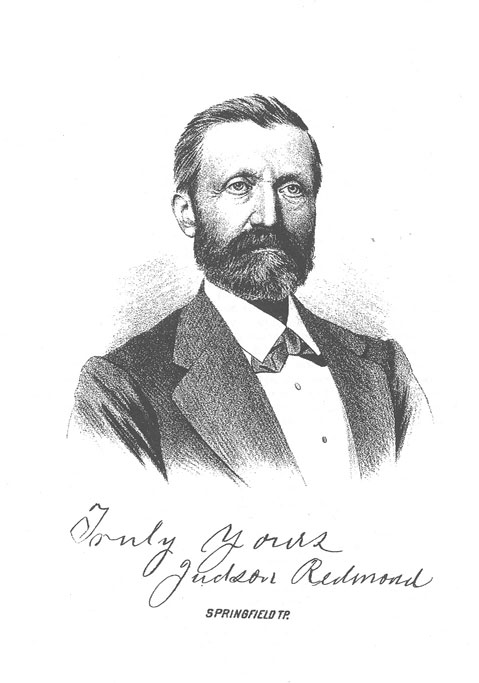
PAGE 395 - PICTURE OF JUDSON REDMOND - SPRINGFIELD TP.
PAGE 396 - BLANK
HISTORY OF CLARK COUNTY. - 397
obtained in time-consequently the artillery could take no part in the contest. This closed the celebration, and the grand rush
for home began, in the eagerness to get out of the heat and dust and confusion which reigned.
It is remarkable that the day passed without accident (beyond the smashing of three or four buggy wheels) or disorder of any
kind. But one or two drunken men were seen on the grounds, and they filled up before going there. One of these tried to get
up a fight, and drew a knife on somebody, but he was hustled out of the crowd instantly. This is matter for congratulation,
certainly, and is due entirely to the forethought of the managers in forbidding the sale of liquor or beer anywhere on the
grounds. The Memorial Guard, Capt. Russell, are entitled to great praise for the work clone by them as special police, in
standing guard and preserving order. They bore themselves like the tried veterans they are. At night, as there was great delay
at the railroad station, owing to the tremendous rush in embarking people for the city, the Guard marched into town., to give
the ladies the room on the trains they would have occupied. The crowd at the celebration is thought to be the largest that
ever gathered in the county, not counting that at the State Fair ten years ago. Several good judges placed it at 20,000, while
others will take their affidavits it was one-third larger. Adjt. Gen. Gibson, who is good authority on such subjects, placed it
at 25,000. Certainly the turnout from all points was beyond all expectation. Mr. Knight, ticket agent at Union Depot, reports
the sale of 4,600 tickets to Pontoon Bridge, and 1,600 fares were taken up on the trains, which ran as fast as possible
backward and forward. It is estimated that 8,000 to 10,000 people left this city by trains, and the quiet on the street from 10
A. M. to 5 P. M. was equal to Sunday. Nearly everything was closed up in the way of business, and men, women and
children braved heat, dust and crowds to take in the celebration. The last of the crowds did not get away before 9 o'clock P.
M., covered with dust and tired, but in the main satisfied and disposed to be jolly over what they saw. Taken as a whole, the
success achieved made the effort worth while. It is proper to give full credit to Capt. Steele, Chairman of the Committee, O.
N. Bartholomew, in charge of the grounds, W. H. Grant and A. Holcomb, of the Committee, for the great amount of work
clone by them.
COMMITTEES.
Capt. Alden P. Steele, Chairman Committee of Arrangements. Maj. W. J. White, Captain of the Memorial Association,
Chairman of the Day. Capt. F. O. Cummings, Secretary. Capt. D. C. Balentine and Owen R. Perkins, Assist ant Secretaries.
John W. Parsons, Treasurer. Lieut. J. C. Holloway, Commissary. O. N. Bartholomew, Quartermaster. S. G. Brown,
Ordnance. Charles E. Folger, Press Agent. W. H. Grant, Leander Baker and A. Holcomb, on Police and Grounds. Capt.
Charles Anthony, Seventh Infantry O. N. G., Organized Militia. William Whiteley, Relics and Antiquarian Materials. John H.
Johnson, Flags and Decorations. Col. Howard D. John, Andrew Watt. T. Kizer, Topography. Capt. John Russell,
Commanding Memorial Guard, Officer of the Day. Springfield-Quincy A. Petts, Judge E. C. Dial, George H. Frey, John H.
Thomas and P. P. Mast, Auxiliary Committee of City Council. Enon-Serg . Maj. Peter Hardman, Representative Indians;
Nelson Hardman, Pioneers; Capt. J. M. Haines. Bethel-R. M. Lowry. South Charleston-Joseph Shickedantz, Webster
Barrett. Selma-Dr. Farr, Capt. Miller. Vienna-F. V. Hartman. Catawba-Joseph Pierson, Dr. W. E. Bloyer. Pitchin-Capt.
Perry Stewart, James M. Littler. Tremont-John H. Blose. Lawrenceville-M. V. Ballentine. Medway-David M. Burns, Finley
Shartle. New Carlisle-Dr. H. H. Young, Horace Taylor. Donnelsville-
398 - HISTORY OF CLARK COUNTY.
Capt. J. L. McKinney, C. S. Forgy. Clifton-W. B. Todd. Plattsburg Jerry Yeazell. Harmony-Milt. Goodfellow. North
Hampton-P. M. Hawke. Noblesville-George F. Johnson.
PROGRAMME.
Monday morning, August 9, 1880.-Assembly of all organizations at their respective quarters at 8 o'clock A. M. Formation
under direction of Chief Marshal, on High street, with right resting on Limestone, at 8:45. Reception of Gov. Foster and
party and invited guests by the Council Committee and Veteran Memorial Association. Parade-East on High street to Linden
avenue, countermarch west to Spring, north to Main, west to Market, where the column will divide, and the portion which is
mounted and in carriages will continue the march to the battle grounds; those on foot will move to the depot and take the
cars for Pontoon Bridge. Upon arrival at the grounds, the following programme will be observed at the stand: Music
Invocation, Rev. T. J. Harris. Music. Address of welcome, Gen. J. Warren Keifer. Response. Music. Reading
communications, Capt. D. C. Ballentine. Dinner. Music. An historical sketch, Thomas F. McGrew. Music. Oration, Gen. W.
H. Gibson. Music. Miscellaneous speaking. Benediction, Rev. Du Poy. Col. Robert L. Kilpatrick, with efficient staff, Chief
Marshal of the Day. Signal Code - Red and white pennant and national flag at half mast, where Clark's men were buried and
site of the old stockade; solid red guidons, outlines of old stockade fort; diagonal red and black guidons, Indian line of
defense, right wing; orange-colored guidons, triangular, Lynn's command, Gen. Clark's right wing (between these opposing
lines the conflict was the hottest); blue guidons, triangular, center of Clark's command; white guidons, triangular, Logan's
command; large blue and orange square, old for where Clark crossed the river; large scarlet flag with white crossed cannon,
supposed position of Clark's gun; broad swallow-tailed pennant, red, on top of hill, Indian signal station; large red flag with
white ball on top of cliffs, opening to canyon in rocks where Indians supposed to have escaped; national colors, Mingo Park,
speakers' stand. Sham Battle-The exercises of the day will conclude with a mimic battle, to terminate in the destruction of
the Indian quarters. Persons represented: Gen. George Rogers Clark-Col. Harvey Vinal; Col. Lynn -Col. Peter Sintz; Col.
Logan-Capt. Perry Stewart; Col. Floyd-Capt. Lewis; Maj. Slaughter-Capt. Ad. Knecht.
THE HISTORY OF SHORT-HORN AND OTHER CATTLE.
BY J. S. R. HAZZARD, M. D.
Those most intimately connected with the introduction and breeding of fine cattle in Clark County, like the great mass of
cattle breeders, have given but little attention to the recording of facts relating to their respective herds; hence, the material
of which this chapter is composed has been gathered with much difficulty and labor, from scraps and desultory notes made
by different breeders, some of whom have long since passed away. It is from this mass of disconnected fragments that I have
endeavored to winnow all that is unnecessary to their proper arrangement into an historic sketch, and to eliminate whatever
of uncertainty that may invalidate its statements.
HISTORY OF CLARK COUNTY. - 399
Casting about in quest of reliable data for a correct starting-point, I am constrained to believe I discovered it in the following
narrative, presented by my old friend, John Price, now living within a mile of the spot around which so many reminiscences
of his early life cluster. In 1822, he was living with his father, James Price, on the Duval estate, now owned by the heirs of
the late John Mattison, the Kirkhams.
His father, owning a large dairy, produced a great amount of cheese, which necessitated frequent trips to Cincinnati by
wagon to find a market for the almost exclusive product of their farm. It was while on one of these tours Mr. James Price
observed a beautiful roan yearling heifer in a meadow belonging to a Mr. Frederick Nutts, of Montgomery County, Ohio.
The striking resemblance this heifer bore to the fine cattle he had been used to seeing in England impressed him so strongly
that he determined to buy her if it were possible; therefore, on returning from Cincinnati, he stopped at Mr. Nutts' overnight
(Mr. Nutts being a tavern-keeper as well as a farmer). Mr. Nutts informed him that he had purchased the dams of his young
stock in Kentucky; that they were purely bred Durhams, from imported English stock. This statement Mr. Price readily
believed from the appearance of the cattle, and it intensified his desire to own some of them, they being the first of the kind
he had seen since leaving old England.
After much dickering, he bought the roan heifer for $40, which was considered an enormous price to pay for a yearling,
when the best of milch cows could be bought for $6. He brought her home, congratulating himself upon being the owner of
so beautiful an animal, but his wife did not see it in that light. "The beast is pretty, to be sure, but there is no sense in giving
half a ton of cheese for it," was her forcibly expressed opinion. Not many months subsequent to the purchase of the heifer,
Mr. Price bought of Mr. Nutts a roan bull calf of the same breed, paying $45, which still more astonished his wife and
provoked adverse criticisms from his neighbors.
These two animals were undoubtedly the first short-horns to grace a pasture in Clark County, and perhaps the grade steers
sired by this bull were the first three-year-old steers ever sold for the then unheard of price of $12 per head. Mr. Price was
unfortunate with his heifer; she, by some means, fell into a spring, and died without issue, but the improvement made by the
use of his bull upon his herd abundantly paid him for what, in that day, was deemed a wild speculation. To which family of
short-horns these cattle belonged, or from which importation they descended, it is impossible to determine at this date, but
they were undoubtedly short-horns, and were probably of the Sanders 1817 importation.
It seems proper, just here, to throw in a few sentences of explanation, to enable those unacquainted with the short-horn
literature to understand some phrases and expressions peculiar to it. In 1822, the first volume of the English Herd Book was
published; consequently, all cattle imported prior to this important event came without registered pedigrees. Antedating the
Herd Book prominently stand what are known as the Miller, Gough and Patton stock; but more conspicuously, because
nearer the sunrise of this important epoch in shorthorn history, stands Col. Sanders' importation of 1817, and known in
short-horn parlance as Seventeens. In 1846, L. F. Allen, Esq., published the first volume of the American Herd Book. The
American Herd Book holds about the same relation to the English Herd Book that the earth does to the sun. They constitute
the short-horn solar system, dividing the day from the night, or the authentic from traditional history. Many individual
animals of those importations antedating the Herd Book era have since been recorded in both English and American Herd
Books, and there are few herds in this country that do not
400 - HISTORY OF CLARK COUNTY.
number among their very best specimens of short-horns individuals tracing through the Herd Books to those importations.
And yet, by some hyperpurists, they are tabooed, because the spots on the moon were not discovered prior to the creation
of the sun. Early in short-horn history, a disposition existed to divide these noble animals into tribes and families. The
practical breeding of the Colling Brothers foreshadowed the idea, but it remained for Thomas Bates, Esq., of England, to
fully inaugurate and insist upon its utility, as well as its convenience. Hence, we now have the Duchess, Princess,
Kirkleavington, Oxford, Rose of Sharon, Young Mary, etc., etc., tribes, all springing from a common root, but supposed to
possess inherent qualities peculiar to the tribe or family, on account of a certain line of breeding, but more frequently
because bred by a certain distinguished breeder; therefore, we have Bates, Booth, Mason. Torr, Paley, etc., etc., cattle. In
this country, families take their names from the imported cow to which they trace their pedigree; for instance, a certain cow
or bull is called a Donna Maria, because it runs back in pedigree to imported Donna Maria, by Gledhow. or an Arabella to
imported Arabella by Victor, or a Scottish Bluebell to Scottish Bluebell by Molecatcher; the sire of the imported cow being
added in order to distinguish imported cows of the same name, as, Red Rose by Earnesty from Red Rose by Skipton.
Again breeders in this country have created sub-tribes. as the Louans. an offshoot of the Rosemary by Flash tribe; the
Nannie Williams of the Helen tribe, and the Pixies of the Red Rose by Earnesty tribe. Hoping enough has been said to
illustrate the subject, we come back to the development of shorthorn interest in Clark County.
The germ planted in 1822 by Mr. James Price seems to have gained but little strength outside of his own pastures for a long
time. Doubtless, however, his yearly demonstrations of improved blood over the scrub stock around him were silently and
slowly gathering force, and only held in abeyance by embarrassing circumstances, peculiar to that time, until, in 1835, Hon.
Alex Waddle determined to try the rearing of cattle that would make greater and quicker returns for the food consumed.
Consequently, in the fall of 1885, he bought of Mr. Walter Dun, Sr., of Kentucky, ten grade short-horn heifers. all in calf to
Mr. Dun's imported bull, Accommodation. Here he rested. and watched the results, and here we will leave him for the
present.
In 1836, a very strong feeling pervaded the whole eastern and southeastern portions of the county in regard to this subject.
Farmers appeared to awake from a Rip Van Winkle sleep that had so long closed their eyes and paralyzed their energies;
consequently, the foundations for several herds were laid in this year. The first in order of time is William D. Peirce's. of
Madison Township. He. in company with Mr. David Harrold, of Madison County, bought. of Col. Sanders, of Kentucky,
several head of shorthorns, but, from circumstances unnecessary to relate here, Mr. Peirce retained only the three-near-old
roan cow, Miss Trimble, of the Rosemary tribe. for which he paid $450. Rosemary was imported in 1820, by Dr. Law, of
Baltimore, Md. Miss Trimble was in calf to Pontiac when purchased, and in clue time dropped Fair Rachel. Miss Trimble
proved to be very prolific, dropping in all nine calves-five heifers and four bulls. Mr. Peirce embarked in his short-horn
enterprise after the true English style, naming his farm Darlington, and henceforth his herd was known in short-horn circles
by that euphonious sobriquet. At that time, it appears he did riot own a bull. but bred Miss Trimble to Mr. Seymour's bull.
imported Comet Halley, the issue being a red and white Heifer calf. which he named Victoria. We will now leave Darlington,
but will refer to it whenever time and events incorporate it in the woof of this narrative. We have incidentally
HISTORY OF CLARK COUNTY. - 401
referred to Mr. D. Harrold as purchasing cattle in company with Mr. Peirce in Kentucky. Although not a resident of this
county, his farm is just across the line in Madison County, and his herd did as much toward grading up the common cattle of
this county as any one within its borders, and it seems necessary therefore to speak of it somewhat in detail. The purchase
made in Kentucky at. the time already mentioned consisted of four heifers and one bull, all the heifers being descendants of
the 1817 importation. Nicanor, the bull, was of the Rosemary tribe, roan in color, and is represented as being a superb
specimen of his race in every respect. In addition to the cattle purchased, Mr. Harrold brought three bulls belonging to Col.
Sanders, to be hired out, after the English fashion, to enterprising farmers to use on their common cows. It appears that Mr.
Rowland Brown, residing near South Charleston, and in this county, rented two of them, Zadoc and Miami, both red and
white in color, and of great substance and fine quality, and withal very prepotent. Mr. Harrold kept the other, Montezuma,
to use on his own herd. These bulls soon wrought a marked improvement in the cattle of that portion of the county; indeed,
so manifest was the change that Mr. George Chamberlain, an extensive cattle dealer of that time, claimed that steers sired by
Miami were worth 25 per cent more than anv others in the country. About this time, Mr. Pugh, of Cincinnati, leased the
Duval farm, and placed on it a large herd of the very best short-horns, purchased of Mr. Samuel Cloone, of Clinton County,
Ohio. Of these cattle, Mr. George Watson, who remembers them well, says: " They could not be bettered."
Contemporary with Messrs. Peirce and Pugh, and near neighbor to the latter, Mr. Thomas Wright, also from Cincinnati,
established a herd of shorthorns. Mr. Wright purchased his cows of Gen. James, Garrard, Ky., two of which were noted
animals of their day; the red cow on account of her massive carcass and enormous milking capacity; the roan cow because of
her beautiful symmetry, rich color and queenly hauteur. The descendants of the latter are still to be found in the county,
attesting by their many excellences the royalty and prepotency of their distinguished ancestress. At first, Mr. Wright bred his
cows to Mr. Pugh's bulls, but soon bought a roan bull calf, sired by Nicanor, of Mr. D. Harrold. This calf quickly developed
into a splendid animal, but, becoming vicious, was slaughtered. As showing a peculiarity of Mr. Wright, the following
incident is related by those cognizant of the facts: After recovering , from injuries inflicted by this bull, he pierced the bull's
eye-balls with an awl, totally blinding him; but, finding him still untrustworthy, he sold him to Mr. Benjamin Browning, to be
slaughtered, and then, fearing he might be used for breeding purposes, persistently held to his halter until quite satisfied that
his vicious pet was dead. At the time short-horn herds were springing into existence so rapidly in the southeastern portions
of the county, Mr. Benjamin Moore was quietly gathering one in Pleasant Township, on the farm known as the Dawson
farm. Not much can be learned about this herd, except that it was headed by a splendid red and white bull, bought of Col.
Evans, Pennsylvania, named Powelton, doubtless a descendant of John Hare Powell's stock, near Philadelphia, and that, in
1837, Mr. Moore in connection with ith D. Harrold, rented of the Ohio Importing Company the bull Nimrod. To this bull
Mr. W. D. Peirce bred Miss Trimble, and, on the 28th of April, 1838, she dropped a white bull calf, which was named
Snowball, and in the following April she dropped a roan heifer by the same sire.
Mr. Waddle was so well pleased with the calves from his Kentucky grades that he bred them to Zadoc, the bull before
mentioned. Mr. John Stickney, Sr., with others, caught the spirit of improvement, and bred their common cows to Nicanor,
Montezuma, Miami, Mr. Pugh's Magnus, and Mr. Moore's Powelton; with splendid results.
402 - HISTORY OF CLARK COUNTY.
There were at that time four herds established in the county, which, as leaven, set influences in motion that acted and re-acted upon the cold-blooded, slow going, slab-sided, ill-shaped and unprofitable bovine race around them.
The work was a great and noble one, requiring much labor, firmness of purpose and enduring patience, joined with large
outlays of capital, against adverse criticism.
These pioneer short-homers had to deal with mind, as well as matter. Like missionaries in heathendom, they had to break the
fetters of habit, and prejudice, and doubt, by ocular demonstrations, before they could convince their chary neighbors that
theirs was the better way. To do this, they felt that much depended upon their skill in breeding and rearing their own stock,
not only thoroughbreds, but more especially grades, which was really the great objective point of their venture. They
believed the blood of this matchless race was capable of metamorphosing the veriest scalawag that cumbered their pastures
into a thrifty and gainly beast; but, to succeed, they must follow closely and adopt the methods and appliances of the great
masters of the art. In due time, therefore, these herds were seen at the county fairs, and those who remember the fairs when
held at South Charleston, in those earlv days when fairs subserved the. purpose for which they were created-to wit,
educators-can recall the interested crowds lingering about those beautiful animals, listening with rapt attention to the
exposition of their points of excellence, and striking contrast to the common scrubs, so earnestly pointed out by their
owners. Old short-horners of those clays who are still living, evoking the esprit de corps that held the multitudes around the
show-ring, will glow with ardent admiration as those short-legged, straight-backed, massive-cropped, broad-hipped, level-rumped and fleshy -quartered animals pass in retrospect. Such men aver that short-horns of the present clay do not compare
favorably with those of the past; that line breeding-breeding to a gilt-edged pedigree and red color-have wrought a material
change in their type; where style has been gained, constitution and size have been lost; where smoothness of contour and
depth of flank have been obtained, the width of hip and milking quality have been compromised; and as the head and horn
have been shortened and refined, the leg has been elongated and fertility impaired. Evidently, those pioneers made the best
of the facilities at their command. Their young stock, thoroughbreds and grades, demonstrated the extreme possibilities
which they promised could be realized. A demand for young bulls was gradually created, and the grading up process slowly
inaugurated, the good effects of which are seen at the present day.
In 1841, Mr. Henry Stickney makes his debut, and, recognizing the improvement made in the stock by his father and
brothers, John and George, he seeks to continue building upon the foundation so happily laid, by purchasing the bull Daniel
Webster of Mr. Pugh. About that time, Mr. Pugh's lease expired, and he offered his fine stock at public auction; but money
was scarce and bidding slow; he therefore closed the sale, and removed his whole herd to the neighborhood of Cincinnati.
Not long subsequent to Mr. Pugh's departure, Mr. T. Wright determined to make a closing-out sale. At this sale, Mr.
Benjamin Browning bought some of Mr. Wright's fine cows, laying the foundation of his future herd, of which more will be
said hereafter. In the spring of 1842, Mr. Benjamin Moore offered his entire herd at public sale. None of his stock, however,
fell into the hands of Clark County men at this sale, except a few cows bought by Mr. Andrew Goudy, who, so far as can be
ascertained, merged them in his herd of common cattle, thereby attenuating their richer blood by promiscuous and indifferent
breeding. The cows belonging to Mr. Moore's herd had the reputation of being splendid milkers, but they were not
HISTORY OF CLARK COUNTY. - 403
considered by stock men first-rate handlers. They were muscular enough, but not mellow and fine-.grained; in the language
of the butchers, "they did not die well." For several years, a calm seems to pervade short-horn circles broken only by the
occasional sale of a young bull. It was during this interim of repose that Mr. Browning put Burleigh, a fine three-year-old
bull, owned by Mr. W. D. Peirce, and a grandson of Miss Trimble, and sired by Nimrod. at the head of his herd, followed in
due time by Bucyrus, of the same tribe. But, in 1847, Mr. Jacob Peirce attains his majority, and, thoroughly fascinated with
what he considered the romance and poetry of agricultural life, short-horn breeding, and earnestly desiring to emulate
Bakewell, Collings, Booth and Bates in attaining fame by pursuing one of the most intricate and treacherous paths that leads
to that historic pinnacle, he starts with his father, Jonathan Peirce, for the Scioto Valley to buy a herd of short-horns. To
show the enthusiasm and zeal that possessed his mind at this time, I quote his own words, found in his catalogue, July, 1859.
He says: "I resolved to have the best short-horns in the country, regardless of price. I determined not to be outdone by any
person in the State of Ohio as a breeder of fine cattle."
In accord with this sentiment, Mr. Peirce not only paid the highest prices for cattle, but made the most elaborate.
arrangements for their care, providing a herdsman at $300 per annum, with a corps of attendants to feed and groom them
after the most approved manner. Well, Mr. Peirce and father bought, at the time alluded to, six or eight cows and heifers of
Messrs. George and Harness Renick. These animals were the very best, and belonged to such distinguished tribes as the
Rose of Sharon, Donna Maria, Poppy, etc., and were only one remove from the imported cows. It does not appear that they
bought a bull at this time, but bred their cows to William D. Peirce's young bulls, Snowball, Burleigh and Premier, also to
imported Nimrod, imported Norfolk, etc. Indeed, the catalogue of Mr. Jonathan Peirce conclusively shows that he did not
believe that the inimitable symmetry and exquisite beauty possessed by the renowned Cleopatra were the results of the
unification of physiological units so wantonly attempted by the incestuous house of the Ptolemies, nor that the
acknowledged prepotency, and up-headed and stylish appearance which characterizes the Bates cattle, should be attributed
to in-breeding, but, taking the practice of the elder Booth as his guide, he bred most promiscuously, for he bred to no less
than thirteen bulls in five years. Still, anxious to excel their confreres beyond the shadow of a doubt, they bought of Mr.
Sherwood, of New York, in 1848, the splendid white cow Diana.
In striking contrast to Mr. Jonathan Peirce's course of breeding, Mr. William D. Peirce adopts the plan of in-breeding, using
his young bulls, the descendants of Miss Trimble, upon their sisters and half-sisters, a la Colling.
In 1848, Mr. B. B. Browning purchased a bluish roan bull calf, quite young, of Mr. Knowles, near Sheffield, England, which
he named Prince Albert. This calf was imported by Mr. Browning, and reared on his farm, and was not imported by the
Madison County Importing Company in 1853, as stated in L. F. Allen's history of short-horns. He is _duly recorded in the
American Herd Book, and numbered 3284.
Another lull seems to have settled over short-horn activities, broken by Mr. George Watson purchasing of Mr. Shropshire,
Kentucky, several short-horn cows and heifers, and the establishment of another herd on the Dawson farm by Mr. Collier, in
1850. But, in 1852, a re-action takes place, first indicated by Mr. Waddle buying the young bull, Arthur, of Mr. William D.
Peirce; but the most important event was Mr. Jonathan Peirce's sale, which occurred on the 11th of March, 1852. At this
sale, twenty-three cows and heifers and six bulls were sold, all of which have been lost sight of except the three cows bought
by Mr
404 - HISTORY OF CLARK COUNTY.
Alex Waddle. Hitherto, Mr. Waddle had bred only grades, but at this sale he lays the foundation of a herd that has won a
commanding position among the short-horn herds of the county. In this year, Mr. W. N. Chamberlain embarked upon the
inviting but rock-lined sea of scientific breeding by buying a beautiful heifer, of the Red Rose by Earnestly sort, of Mr.
Matthew Bonner; and Mr. Henry Stickney enlarged his herd from Dr. Warfield's, Kentucky. Mr. Alex Waddle bought a
young bull of Mr. Collier, which he named Collier, but, not desiring to use= him upon his best cows, he, in connection with
Messrs. William and Jacob Peirce, bought, at the sale of the Scioto County Importation Company, Alderman, a roan bull, at
$1,150; Moss Rose, by Stapleton, at $1,200; and Mary, by Lord of the Manor, at $1,650. Mr. Waddle took Mary, Mr. J.
Peirce Alderman, and Mr. W. Peirce Moss Rose. These prices were unprecedented, and marked an epoch in the history of
short-horns in the county. Mr. Collier's herd was soon scattered, on account of his death, and no trace of it can now be
found, other than the bull bought by Mr. Waddle.
In 1853, Mr. B. Browning was sent as one of the agents of the Madison County Importation Company to England, and
assisted in buying the splendid cattle of that importation, which were sold in London, Ohio, in 1853, at public auction. At
this sale, Mr. William Watson bought Princess, by Belted Will, at $690, who proved to be very prolific, and many of her
descendants are still in the county. But short-born interests appear to have culminated in this county in 1854. An association
was formed in that ,year, of which C. M. Clark was the prime mover and leading spirit, and an importation made under the
agency of Dr. Watts, of Chillicothe, and Hon. Alex Waddle, of this county, who proceeded to England and bought nine bulls
and twenty cows and heifers, which were sold near Springfield, on the 6th of September, 1854, at public auction. The agents
had been exceedingly fortunate in their selections; their return with their cattle widely heralded by the leading newspapers of
the country; the day was fine, the crowd large, expectation on tiptoe, and the cattle pleased the most fastidious connoisseur.
Under this combination of favorable auspices, bidding was animated, and Buckingham was soon knocked off to William D.
Peirce at $1,000. The beautiful roan yearling, New Year's Day, was taken by C. M. Clark at $3,500; Messrs. A. I Paige, H.
Stickney, R. Oxtoby and William Watson were the fortunate purchasers of Czar, at $1,900; Hon. Alex Waddle took Lord
Stanwick at $500, and Lord of the Isles at $575; Mr. A. I. Paige paid $1,425 for Aylesby Lady, and $1,100 fcr Dahlia;
Roman 13th and her bull calf sold to Jacob Peirce for $1,300; Mr. Waddle paid $1,000 for Zealous, Zenobia $625, and $425
for Blushing Beauty; William D. Peirce paid for Lancaster 17th $900, $1,000 for Roan Lady, and $1,075 for Venus; George
Watson and L. B. Sprague bought Zephyr at $400, and Lancaster 19th at $350; H. Stickney paid $290 for Butterfly,, and C.
M. Clark $1,125 for Easter Day. This is the largest acquisition of short-horn blood ever made before or since in this county,
aggregating $17,690, and much valuable stock now in the county trace in their pedigrees to this importation.
Following close upon this great sale was another memorable event, to wit, the great National Cattle Show, which was held
in Springfield, beginning October 28, 1854. This was an episode, and intensified the interest. already at the boiling point, in
short-horn circles. To Mr. C. M. Clark is due the honor of bringing this great show to Springfield at this time. It doubtless
did much toward educating our people to a proper conception of the possibilities to which this unrivaled breed of cattle
could attain. All sections of our wide domain were represented, affording ocular demonstrations of the flexibility of nature,
and the innate capacity they possessed of adapting themselves to their surroundings and maintaining their excellence,
whether reared upon the stunted
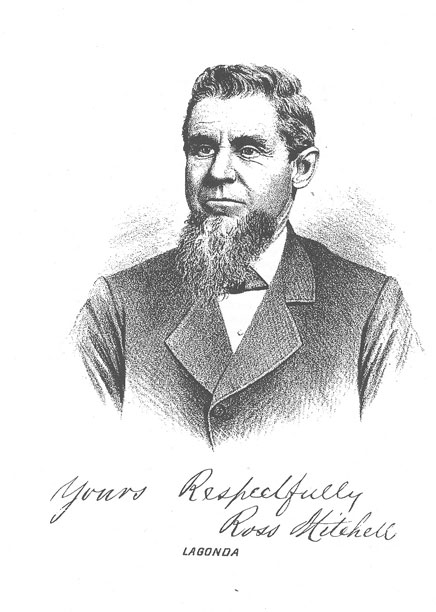
PAGE 405 - PICTURE OF ROSS MITCHELL - LAGONDA
PAGE 406 - BLANK
HISTORY OF CLARK COUNTY. - 407
grasses of New England pastures, or luxuriating in the blue-grass lawns of the West; whether exposed to the rigor of
Northern winters, or subjected to the torrid heat of the semi-tropics. Not only did the old breeders of the county avail
themselves of the opportunity afforded by the great sale just mentioned to make important accessions to their respective
herds, but several "parvenues" stepped into the arena and laid the foundations of future herds. with blood fresh from the
fountain head. C. M. Clark started in the race under the most favorable circumstances. New Year's Day and Easter Day,
beaux ideal shorthorns, could not disappoint the most sanguine expectations. A. I. Paige, the happy possesor of the exquisite
Aylesby Lady, and the symmetrical Dahlia, and joint owner of the royally bred Czar, might reasonably expect to realize re
sults but little short of his most extravagantly tinted day dreams. Lancaster the 19th, whose veins were as full of blue blood
as any Lancaster's that ever wore a rose; and Beautiful Zephyr, with hair as silky as thistle-down, and eyes as clear and
placid as a mountain lake, doubtless filled Mr. Sprague's future with brightest visions of success. With the foundations laid,
they began building upon them and making additions, as circumstances indicated. In the fall of 1855, Mr. W. N. Chamberlain
bought of Mr. J. G. Dun, Knickerbocker, a roan bull calf of the tribe of Red Rose by Earnesty, which did more, perhaps, to
bring his herd into notoriety than any other animal he ever possessed.
On the 17th of October, 1856, Mr. Jacob Peirce offered at public sale a draft from his herd of fourteen bulls and twenty-five
cows and heifers. This was the first sale of the kind ever made in the county. His stock were in good condition, all
catalogued, and their pedigrees complete-a great improvement upon his father's in 1852. Notwithstanding the preparations
thus made, the cattle sold extremely low. The highest figure paid for a bull was $111; the lowest (bull calf), $30; $201 was
the maximum paid for a cow, and $30 the minimum (calf). Several of these cattle belonged to what is now the fashionable
Rose of Sharon tribe. None of these animals were incorporated into the then existing herds, nor formed a nucleus of a new
one. In 1858, C. M. Clark made a large addition to his herd. He paid R. G. Corwin $500 for a little calf named Flora Bell, of
the Scottish Bluebell tribe; Kitty Clyde and Kitty Clover came from Kentucky, and cost respectively $900 and $800; Snow
Drop and Beauty, costing about the same, were also from the same State. About this time, Mr. B. Browning made another
trip to England, and brought back with him a young white bull named Nelson Gwynn. This bull was not considered, by some
good judges, as par excellence; he nevertheless left a good impress upon the stock of his neighborhood. He was sold and
taken East. In 1859, August 10, Mr. Jacob Peirce brought his whole herd, fifty head, to the auction block. He stated in his
catalogue that he had "gratified his ambition by carrying off the red ribbons in many hotly contested show-rings, both at
home and abroad, and at county, State and national fairs," but adds, with a kind of melancholy pathos, "at an enormous
cost." This sale was largely attended, but the tidal wave did not come, judging from the prices realized. Alderman, purchased
in 1852, had been bred extensively on this herd, notwithstanding he gave a black nose to many of his calves-and, even at the
present day, his descendants often show this disagreeable atavism. He had died, however, some time before the sale, from an
attack of mad itch. Darling and Delightful, bred by Mr. A. I. Paige, from Dahlia and Aylesby Lady, and of the herd which
took the first premium at the Ohio State Fair, brought $350 and $375 respectively. This was a terrible letting-down for
descendants of such blue-blooded ancestry. Truly, bovine as well as human life is checkered. After a send-off of this kind,
re-action in prices was almost impossible; some animals were knocked off for the mere nominal sum of $25. But a sharper
competition seems to have existed for
408 - HISTORY OF CLARK COUNTY.
bulls. Starlight 2d, bred by D. Watson, of Union County, and sired by imported Starlight, brought $650; Crusade, $370; Don
Quixote and Blucher, $250 each; Oscar, $50; and Nicholas, $45. Forty-eight head brought $6,422.50, averaging $133.80.
Females averaged $122.54; bulls averaged $167.58. The price paid for one cow and one bull was not reported. Nearly all of
these cattle were descendants of the Scioto County and Clark County importations, a few pedigrees being topped by
Knickerbocker. Mr. Jacob Peirce did not breed so promiscuously as his father, nor approach in-breeding so nearly as did his
brother William. This large herd was widely dispersed through the West and Northwest, only a very few remaining in the
county, and they, like snow falling upon the bosom of the ocean, were soon lost in the general mass of common stock.
Another turn of the wheel of time brings William D. Peirce's pioneer herd under the auctioneer's hammer, on the 20th and
21st days of June, 1860.
Mr. S. Howell, the administrator on Mr. Peirce's estate, offered the largest herd that had hitherto been thrown upon the
market, comprising sixty-eight cows and twelve bulls. Of these eighty head of cattle, thirty-eight cows and one bull were
descendants of Miss Trimble, the first short-horn ever bought by Mr. Peirce, and it is worthy of remark that every one
approached their progenitrix in color. These cattle were low in flesh, and looked badly, and sold much below their intrinsic
value, but there are no means by which their average price can be ascertained. Buckingham 2d and Roan Lady had died
some time previously. Lancaster 17th, costing Mr. Peirce $900, sold for $59, but Mr. A. I. Paige, coming to the rescue, paid
$400 for Venus-$675 less than she cost in 1854. Of course, such fearful depreciation of values for imported cows depressed
prices for home-bred animals beyond recovery. Why the names of these imported cows appear so seldom in the pedigrees of
Mr. Peirce's herd must be left to conjecture. Mr. L. B. Sprague took this opportunity of introducing into his herd some
descendants of Miss Trimble; Mr. W. N. Chamberlain bought Violet for $59, and a three-year-old bull, Ignis Fatuus, for
$54, and Will-of-the-Wisp was knocked off to Mr. J. V. Cartmell for $20. Many of these cattle were bought by farmers of
the county at merely nominal prices, and thrown into the general herd and lost sight of as thoroughbreds, but produced a
wonderful leavening effect upon the thrift and quality of the cattle in our county. Forebodings, consequent upon our political
situation at this time, paralyzed enterprise in every department of business, and were doubtless largely responsible for
forcing down prices below zero at his sale. During this year, Mr. W. N. Chamberlain purchased Dundenna, a very fine heifer,
of Mr. James Rankin, Madison County, Ohio, and Mr. L. B. Sprague bought sev eral cows of the T. Wright sort, of Mr. B.
B. Browning. The original cow bought by Mr. Wright of Gen. Garrard, Kentucky, and referred to before, was slaughtered
by Mr. Browning after she had attained the age of nineteen years. She was a remarkably rapid breeder, but in her old age
became unusually fat. Mr. Sprague also bought Mr. Watson's interest in their stock jointly owned. Zephyr, which they had
purchased at the Clark County Importation Company's sale, proved to be a slow breeder, and soon became excessively fat,
ceased to breed, and was slaughtered. About 1862. Mr. Stickney sold Butterfly and twenty head, mostly of his Kentucky
purchase, to Mr. Sprague; and Mr. Paige sold his imported cows, Aylesby Lady and Dahlia, to the same gentleman. Aylesby
Lady had become a slow, if not a doubtful, breeder, and dropped Mr. Sprague but one living calf, a bull, which, owing to the
diseased condition of her udder, was raised by another cow. Not long subsequent to the birth of this calf, she died from
cancer of the head.
Czar had been sold to a gentleman in Clinton County some time before Mr. Paige disposed of his cows.
HISTORY OF CLARK COUNTY. - 409
The country at this time was overcast with the blackest of war-clouds; upon it all eyes were fixed, the hearts of strong men
quaked, and the moanings of many Rachels were heard. To be or not to be as a nation, was the supreme question that filled
men's minds by day, and haunted their dreams by night, leaving no place to thoughts pertaining to a pursuit so incongruous
to their surroundings as systematic and scientific breeding. Under these circumstances, it was not surprising that some
relaxed their watchful care over their herds, and others abandoned theirs altogether, sending them to the shambles, while
only the more hopeful preserved theirs from degeneracy by careful breeding.
It was under this state of depression that Mr. Chamberlain ventured to buy Victoria 3, an Imported Princess by Belted Will.
But in 1865, the war-cloud rifted, and, by 1868, the benign influences of peace had restored confidence to the public mind,
and recuperation was everywhere manifest; consequently Mr. C. M. Clark offered his fine herd for sale in the fall of 1868,
under much more favorable auspices. To be sure, his herd had been more fashionably bred, and had cost more than any in
the county, which accounted for some of the strength given to prices, but doubtless, the facts mentioned above were large
factors. Mr. Clark had bred and reared sixty calves during his short-horn career, and had been most scrupulous in the care of
his stock; had won the red ribbon in almost every show-ring in the country, and, with all the prestige thus obtained, he
offered them at public sale. Ten of his best cows averaged $1,000, and all the rest of his stock brought satisfactory prices.
New Year's Day had long since become unprofitable, and Easter Day in the decrepitude of age sold for a mere pittance.
Several young bulls were bought by farmers of the county, but Dexter was the only one that found a place in the herds of
professional breeders. Mr. Clark did not use many bulls on his herd; perhaps the great majority of his stock were sired by Sir
Robert Alexander. Duke of Clark and Dundee. It was about this time Mr. Sprague brought Gen. Burnside, a fine show bull,
from Kentucky, and moved by a laudable ambition to attain pre-eminence as a breeder, he introduced into his herd, during
the next six years, bulls possessing great individual excellence, and celebrated as sires, such as Dundee, Xenophon, Dexter,
Imported Colonel and Col. Foote. In the fall of 1871, Mr. W. N. Chamberlain made a closing out sale. His stock had been
carefully bred, and Knickerbocker more particularly, had brought his herd into considerable hotoriety; besides, they were in
good condition, but Mr. Chamberlain thought they sold too low. Except through the four cows bought by Mr. Sprague, no
trace of this herd can now be found within our borders. Mr. Chamberlain acted upon the theory that the road to success led
through a continuous breeding to prizewinning bulls, hence but few of his cattle were bred alike, or were uniform in
characteristics, nevertheless they took prizes at county, State and national fairs. About this date Mr. Sprague added several
cows to his herd, belonging to the Red Rose by Earnesty tribe, and made some important private sales. But, in less than a
year, he announced that, on the 17th of October, 1872, he would offer Oak Grove herd at public sale. Dahlia, Butterfly and
Lancaster 19th, the last of the Clark County importation, had previously been sent to the shambles.
The appointed day came, a lovely autumn day; the sun was bright, the air balmy; the crowd large and the stock in good
condition. The bidding ran low at first, but gradually strengthened until fair prices were reached and maintained. At this sale
Mr. George Watson & Son bought Clifton Duke 4th and four cows, and Mr. D. Heiskel, N. B. Sprague, Col. Cheney, J. S.
R. Hazzard & Son, and several other Clark County citizens, were purchasers. About forty
410 - HISTORY OF CLARK COUNTY.
head were sold, leaving a remnant of ten head as a nucleus for a future herd. Mr. Sprague's herd contained some very fine
animals, but there was a lack of uniformity, which could have been attained, if a different method in breeding had been
pursued.
Early in 1873, Dr. Hazzard & Son bought Sir Walter Scott, a Rose of Sharon, and, on the 15th of May, Hon. Alexander
Waddle offered his splendidly bred herd at public sale. This herd consisted of thirty-one head, mostly descendants of
imported cows and bulls which he had bought twenty years before, and not a single vitiating cross could be found in any
pedigree, but yet high prices were not realized. Hon. John Howell paid $370 for Zara, belonging to the Zealous tribe, but he
got Zelia of the same tribe, for $55. John Waddle and Dr. Hazzard bought several cows. Mr. L. B. Sprague led off Blushing
Maid, but Mr. John Heiskell preferred a Blushing Queen, and Mr. E. Merritt chose Beulah, while Mr. R. Hunt thought
Zenith superior. Lord Stanwich did not live long enough to make much impression, Lord of the Isles was slaughtered,
Zenobia failed to breed, but Mary, Zealous and Blushing Beauty became full of years, and did not go to the shambles until
after a life of service. This was the last of the pioneer herds, all of which have subserved their mission, and their owners are
worthy of commendation, and should be remembered as public benefactors. These veteran short-horners have realized that,
however infallible the truism, like begets like, when applied to natural types, it is exceedingly fickle, when human hands
essay to wield its prowess; that if animal form in the hands of Bakewell was as plastic as softened wag, not many Bakewells
are produced in a century; that eminent breeders, like distinguished poets, are born, not made; that short-horn breeding
inures to philanthropy, rather than to personal aggrandizement; that while its incertitude infatuates its votaries, it draws
heavily upon their material resources.
Notwithstanding, as the old breeders retire, fortunately, the ranks are speedily filled by new adventurers, each hoping, that if
a Bakewell or Colling should be needed, he will be the coming man.
Following closely Mr. Waddle's retirement, I. H. Hollingsworth, Esq., established a new herd in the same neighborhood, by
the purchase of several fine animals of Messrs. Hadley & King, Clinton County, Ohio. Mr. Hollings worth wisely laid a good
base, as time and good management will demonstrate. About this time, Mr. L. B. Sprague purchased Horace Mann, a bull of
the Red Rose by Skipton tribe, bred by Mr. D. Selsor, Madison County, Ohio. On July 15, 1874, at the Ackley House
stables, Mr. John Waddle offered twelve cows and one bull at public auction, but prices ruled so low that they were soon
withdrawn from market. At this sale, Dr. Hazard & Son purchased Mistletoe 4th, a Donna Maria. But, on January 6, 1875,
Mr. Waddle again brought his herd before the public, and closed it out at low figures. Mr. Levi Jones was, however,
unfortunate in the purchase of Harmony Belle, a descendant of Dahlia, she failing to breed, but Dr. Hazzard & Son took
Royal Lad 2d, a two-year-old bull of the Donna Maria tribe, at $160. Mr. William Wildman organized his herd by a draft of
good animals from the herd of Mr. S. H. Hadley, Clinton County, Ohio. In the fall of this year, Mr. J. M. Hodge concluded
to engage in short-horn breeding, and purchased some very nice and fashionably bred animals of prominent breeders in
Kentucky. June 22, 1876, Mr. L. B. Sprague made his final sale. Another fine day, a large crowd greeted Mr. Sprague.
At this sale, twenty five cows averaged $136; Horace Mann had become unsound and brought only $80, but Mr. N. B.
Sprague paid $245 for Oak Grove Duke, a young bull of the Caroline by Dashwood sort. At this sale, Mr. C. F. Roher
purchased a number of fine cows and heifers; also Mr. George Watson
HISTORY OF CLARK COUNTY. - 411
& Son, N. B. Sprague, D. Heiskell and several citizens of the county were purchasers. Mr. Roher headed his herd with
Linwood Chief, a very fine young bull, bred by Mr. Bryan, near Urbana. Ohio, but, in November, Mr. Roher sold all the
stock he had so recently collected, at public sale. At this sale, Mr. W. S. Thompson bought the bull just referred to, and four
cows. During this year, Dr. Hazzard purchased Scottish Bluebell of C. M. Clark, Esq., and Victoria 10th and 11th of Mr.
John Wilson. In 1877, Mr. George Watson & Son bought Equinox, a young bull of the Red Rose by Earnesty tribe, with
several cows, of Mr. J. G. Dun, and made several important private sales. Clifton Duke 4th died about this time. October 3,
1878, Mr. W. Stickney bought at William D. Baird's sale a very nice cow of the Imported Princess by Belted Will tribe, and
Dr. Hazzard & Son, a heifer calf of the same sort. Eakly in 1870, Mr. N. B. Sprague offered at public sale a draft from his
herd; his cattle were in good condition, and brought fair prices. At this sale, Mr. Moore Goodfellow secured several fine
animals, and Mr. Jacob Yeazel, Jr., bought Mr. Sprague's best breeding cow. Several other farmers of this county bought
young bulls, but the females were generally taken by strangers.
This year was characterized by great activity among the short-horners in sales and purchases. Watson & Son sold ten head
at good prices, and Hazzard & Son disposed of thirteen head, including Royal Lad 2d. W. S. Thompson sold Linwood
Chief, and bought Loudon Duke from H. H. Hankin's herd, also four cows, all in calf, of J. D. Dun. Mr. D. Calvin procured
three splendidly bred heifers from the herd of H. C. Merridith, Indiana. Messrs. M. J. Hodge and William Stickney brought
from Kentucky some nicely bred young bulls, and Watson & Son bought three cows of Messrs. Black & Hays, Pickaway
and Ross Counties, Ohio, and Hazzard & Son purchased Col. Foote of Mr. C. Dye, Miami County, Ohio. The quietude of
1880 was broken by Mr. N. B. Sprague buying a young bull of Mr. R. G. Dun; Mr. W. S. Thompson a Rose of Sharon cow
at Hills & Co.'s sale, Delaware, Ohio, and Mr. A. Mouke a cow and bull calf of the same parties. There were at the present
time ten established shorthorn herds in the county (one bull and four cows constitute a herd), besides a number of bulls and
cows owned by farmers not professional breeders. These ten herds aggregate 170 head of as pure bred short-horns as the
country can produce, and contain representatives of all the leading tribes and families. Short-horn blood introduced into our
county sixty years ago has produced a wonderful effect upon our common stock, adding 50 per cent to their value. An
animal is rarely seen in the eastern portion of the county that does not show more or less of the short-horn characteristics.
It is worthy of record, that there is not a white bull, and but very few white cows, in any short-horn herd in Clark County.
Red, red and white, and roan are the colors most desirable, and if the fashion continues to drift in the same direction, solid
red will eventually be the prevailing color. Another notable fact is, that Mr. C. F. Rohrer was the first and the only man to
own a herd of short-horns west of Mad River, up to this date- December 11, 1880. Owing to the fact that a few of the
central Western States are required to supply the export trade, which is but in its incipiency, young thoroughbred short-horn
bulls are more eagerly sought after by farmers than at any previous time. Good, straight-pedigreed, blocky, and red colored
yearling bulls will readily bring from $50 to $150, which will pay the breeder and the purchaser. Heifers generally bring a
little higher figure, their value being largely determined by the fancy the owner and buyer may have for the particular tribe to
which the individual belongs. The average weight of a yearling bull is about nine hundred pounds; a yearling heifer will fall
below this 200 pounds.
412 - HISTORY OF CLARK COUNTY.
DEVON CATTLE.
J. J. Scarff, Esq., is the oldest and most extensive breeder of Devons in the county. His fine herd adds a very pleasing feature
to our annual fair, whence he enters upon an extended tour; exhibiting at many of the district and State fairs, both East and
West, returning late in the fall with a huge bundle of red and blue ribbons, trophies of victory in the show-ring.
His only competitor i a this county is Mr. Jesse Mead, who purchased his first Devons from him in 1868-69.
He also bought two females of Mr. James Buckingham, Ohio, in 1871-72, and one of Mr. G. Frantz, Ohio, the same year; he
further added to his herd, by buying two cows of Mr. R. G. Hart, Michigan, in 1875, and a cow and calf of J. Showard,
Esq., Ohio, in 1878. His herd at this time numbers thirty-one head. Mr. Mead is a regular exhibitor at our county fair, and,
between these two rival herds, the badge of honor oscillates. Mr. Mead's herd frequently accompanies Mr. Scarff's through
the whole fall campaign, winning many red ribbons over all competitors.
If short-horns have found a habitat east of Mad River, the Devons have been domiciled on its western banks.
Mr. John Gowar is the only person that ever gathered a herd of Devons east of Mad River, and his enterprise was
unsatisfactory and short lived, therefore grade Devons are rarely seen in the eastern portions of our county.
Messrs. Scarff & Mead find ready sale for their surplus stock at paying figures; the latter gas but recently received an order
from a gentleman in New Mexico, for a draft from his herd.
HOLSTEIN CATTLE
have but recently been introduced into our county. Mr. W. Smith, of Bethel Township, about two years ago brought some
very fine specimens of this breed from Pennsylvania, and, at the fair of 1879, they made their formal debut in the show-ring,
thus seeking a public recognition of their avowed excellence, and challenged criticism by comparison with rival breeds. They
promise to meet that long-felt want of farmers, to wit, extra dairy and butcher qualities combined, and will doubtless prove
formidable rivals of the
ALDERNEYS,
which have already strongly intrenched themselves in public favor in certain localities, especially in and about Springfield,
although but a few herds kept for breeding purposes have ever existed in the county. Mr. H. G. Hamlin began collecting his
herd in 1875, from noted breeders of this sort of cattle, and claims the honor of having introduced the first registered
Alderney bull (Marston) into the county. Since the establishment of his herd, he has sold about seventy head at private sale.
One heifer sold when two years old, and with her first calf, gave seventeen and one-half quarts of milk per day, and when at
three years old, made seventeen and one-half pounds of butter per week. Mr. Hamlin has introduced into the county some
eight or ten head of registered Alderneys, and has on hand now seven. He reports that the demand for young stock is good
at an advanced price.
Mr. Edward Harrison, of Springfield, has cultivated this breed of cattle perhaps as assiduously and as successfully as any of
his contemporaries. His herd is certainly the peer of any, in purity of blood, and in all the useful qualities for which this breed
of cattle is distinguished, which gives to his surplus
HISTORY OF CLARK COUNTY. - 413
stock a commanding place in the market. Mr. Harrison has introduced twelve gilt-edged pedigreed Alderneys into the
county, and has now on hand a very superior herd.
Several years ago, Mr. W. B. Saylor, near New Carlisle, gathered a herd of choice Alderneys, and since his decease his
widow has carefully preserved them in all their useful excellence, and has now in her possession several fine specimens of
her own breeding. Where Mr. Saylor made his original purchases I have no means of knowing at hand.
Mr. J. J. Scarff, New Carlisle, a few years since purchased a registered Alderney, from which he has reared three calves, and,
judging from his recognized ability and experience as a breeder of Devons, it will not be long before this nucleus will be
developed into a herd of the first magnitude. Mr. Charles Anthony's La Belle Desreaux 2d, *No. 5096, is one of the most
beautiful specimens of her race, possessing strongly marked characteristics of the breed, yet as symmetrical in form, and as
mellow to the touch, as a first-class short-horn; she also gives abundant evidence of her high-born royalty by the highest test
known, viz., the ability to uniformly reproduce herself. Mr. Anthony purchased this beautiful cow in Champaign County,
Ohio, paying $200 for her.
Mr. William Garrison, of Mad River Township, is the fortunate owner of two heifers from this noble cow. William N.
Whiteley, Esq., brought into this county a very finely bred cow (Della T.), but sold her to Mr. C. O. Gardner, of Springfield.
Miss Susan Sintz and Mrs. Julia A. Burnett also own one or more registered Alderneys.
Besides those above referred to as registered, there are many others scattered through the county of the so-called Alderneys,
but we have classed all those that cannot be registered as grades, however superior they may be in all the useful points of
excellence.
For much of my information in regard to this breed of cattle, in our county, I am tinder obligations to my friend Mr. Edward
Harrison, who remarks that the first introduction among us is involved in great obscurity and like the most of innovations;
they had to win their way into popular favor. But a few years ago, a car load of these cattle were brought here from the
East, but they brought such low figures that the experiment has never been repeated; nevertheless, fifty head of registered
Alderneys have been owned in this county.
Since the foregoing was prepared for the press, it has been ascertained that Mr. Joseph Garst, of Pike Township, is the
owner of a trio of fine Jerseys, one of them registered in the American Jersey herd-book-the other two eligible to record in
said book, applications for registry having already been forwarded. The animals referred to are as follows:
Nannie, No. 2,008; calved, March 29,1875; sire, Kentucky, No. 628; Dam, Frances, No. 1,808.
Fonna, No. - ; calved February 19, 1878; sire, Crown Prince, No. 330; Dam, Nannie, No. 2,008.
James, No. --; calved February 5, 1881; sire, Crown Prince 2d, No. 920; Dam, Nannie, No. 2,008.
* American Jersey Cattle Herd Book.
414 - HISTORY OF CLARK COUNTY.
POPULATION IN DETAIL OF SUBDIVISIONS.
This is from the census bulletins, No. 113 to 117, of corrected returns of the enumeration of 1880, and is therefore the
official figures of Clark County population:
Bethel Township, including the following villages, 3,133: Donnelsville Village, 195; *Medway Village, 199; New Carlisle
Village, 818.
German Township, including the following villages, 2,100; *Tremont Village, 279; *Lawrenceville Village, 82.
Greene Township, including the following villages, 1,522: *Clifton Village (part of), 22 (see Miami Township, Greene
County). *Concord Village, 118; Cortsville Village, 57.
Harmony Township, including the following villages, 1,846; *Brighton Village, 93; Harmony Village, 81; *Plattsburg
Village, 53; Vienna Village, 170.
Madison Township, including the following villages, 2,396; *Selma Village, 214; South Charleston Village, 932.
Mad River Township, including village of Enon, 1,812; Enon Village, 362.
Moorefield Township, including the village of Bowlusville, 1,345; *Bowlusville Village, 53.
Pike Township, including the following villages, 1,758; *Dialton Village, 95; *North Hampton Village, 173.
Pleasant Township, including village of Catawba, 1,581; Catawba Village, 250.
Springfield Township, including the following places, 24,455; *Edwardsville, 129; *East Springfield Village, 148;
*Florenceville Village, 1.2; *Lagonda Village, 474; *Sugar Grove Village, 146.
First Ward, 2,211; Second Ward, 2,100; Third Ward, 2,905; Fourth Ward, 1,396; Fifth Ward, 2,967; Sixth Ward, 3,368;
Seventh Ward, 2,666; Eighth Ward, 1,351; Ninth Ward, 1,766; Springfield City, 20,730; West Springfield Village, 245.
NOTE-Village of Clifton, in Greene Township, and Miami Township, Greene County, 267.
It will be borne in mind that only a portion of the village of Clifton is in this county.
* The asterisk denotes that the limits of the town or village are not clearly defined, and the population is therefore, to some
extent, estimated.
PAGE 415 - BLANK
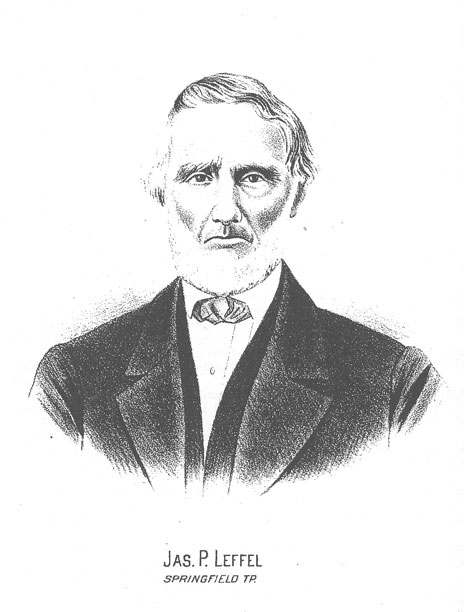
PAGE 416 - PICTURE OF JAS. P. LEFFEL - SPRINGFIELD TP.
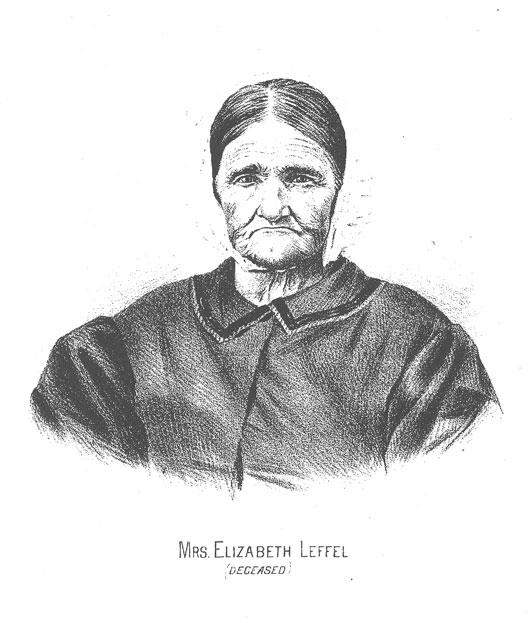
PAGE 417 - PICTURE MRS. ELIZABETH LEFFEL - DECEASED
PAGE 418 - BLANK
PAGE 419 - TABLE OF DISTANCES BETWEEN THE SEVERAL TOWNS AND VILLAGES OF CLARK
COUNTY.
PAGE 420 - DECENNIAL APPRAISEMENT OF REAL PROPERTY.
PAGE 421 - VALUATION OF REAL PROPERTY IN TOWNS AND VILLAGES.
PAGE 422 - BLANK
PAGE 423 - BLANK
PAGE 424 - BLANK
(RETURN TO THE TITLE PAGE)
|