HAMILTON - 323
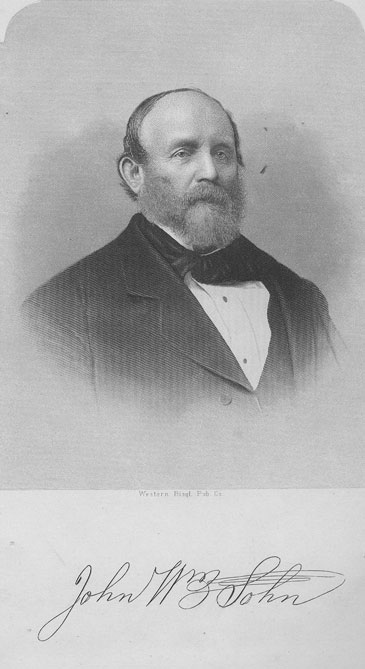
studied. The events of this period made a strong impression upon Mr. Sohn, and much was then to be heard of America. Many of the German soldiers who fought under the British ensign in the Revolutionary War had settled not far from where he was born, and many old men still lingered who recounted their exploits in America, and told how fertile its land was, and more recent travelers had made known the ease with which a livelihood could here be obtained. From Alsace and Lorraine an emigrations had sprung up immediately after the pacification of Europe, in 1815, and those who came over sent letters back to their friends more than confirming the stories they had previously heard. Mr. Sohn determined to cast in his lot with us, and embarked for our shores, at Bremen, in 1834, landing at Baltimore. He came west on foot, with an occasional ride on a canalboat. In Hamilton, which he reached in November, 1834, he finally found employment at chopping wood at twenty-five cents a cord. After a little he went to work in a brewery, and then in a pork-house, and after nearly a year went to Cincinnati, working as a brewer, remaining there three years. Returning to Hamilton in June, 1839, he bought a small brewery with the savings of his previous labor. The business gradually extended, and his sales became larger, until in 1846 he embarked also in tanning. This enterprise assumed extensive proportions, and he now has two large tanneries, one in Hamilton and one in Pike County. As a convenience to those who dealt with him, he also opened a leather findings store. His brewery does a large business, and he is also extensively engaged in the manufacture of malt for other brewers. He has the largest vineyard in Butler County, and has had great success in the growing of native wines. To these he adds the packing of pork, in which he does the largest business in the county, and is interested with two of his sons-in-law in the manufacture of the Universal Wood-working Machine, which is the invention of the young men, and is of very decided utility in the manufacture of scroll and other kinds of wood-sawing and dressing. He is also a farmer, having a great deal of land that he owns, and has cultivated under his own instruction. He is a director of the First National Bank, and for fifteen years was president of the Hamilton Insurance Company.
In 1840 he was married to Miss Catherine Rosenfeld, a native of Saxony, and daughter of the Rev. Charles Ernst Rosenfeld, pastor of the German Lutheran and Reformed Church of Hamilton. Mr. Rosenfeld was born in 1779, at Koenigsberg, and came to this country in 1836, first settling in Chillicothe. In 1838 he came to Hamilton. His wife, Anna Barbara Schmidt, was born in 1801, at Koenigsberg, and died in Eichelsdorf, in Saxony., in 1834, before he came here. He possessed an excellent education, and loved to impart knowledge. Shortly after arriving in this county he opened up a school for Germans, which was the first ever held here in their native language. An excellent musician, he taught both the piano and organ, and gave instruction to the members of a brass band organized soon after his arrival. It was difficult at that time to get music especially arranged for brass instruments. Mr. Rosenfeld took the piano score, arranged the various parts for each performer, wrote them out with his own hand, and taught each man how to use his own instrument. He understood the method of performing on every instrument of modern date, and on some reached a high degree of excellence. Among his treasures was a violin presented to him by Carl Maria von Weber, the author of " Der Freyschutz," when they were both young and were intimate companions. This instrument is now preserved with religious care by his (laughter, Mrs. Sohn. Mr. Rosenfeld was also a musical author. He furnished the melodies to many popular airs, and in some cases wrote both the words and the music. He had a prodigious bass voice, and none who ever heard him sing
"A mighty fortress is our God"
will ever forget it. His acquirements were not limited to books and music. He was the first gardener of his day in this neighborhood. All plants and vegetables were understood by him, and he knew the art of coaxing the reluctant earth to yield up its fruits. His example was highly beneficial to his countrymen, and, indeed, to all the dwellers in this neighborhood who kept a garden. His kindness to those weaker and less informed than himself was great. He wrote letters to Germany for his flock, carried on legal correspondence, acted as trustee and guardian, and decided disputes, all without fee or reward. He received no compensation for teaching the brass band, nor would he accept any thing for the favors lie bestowed upon those around him. He died in 1855. He had six children, Ernst Ludwig, Philipp Albrecht, Katharina Barbara, Johann Christian, Carolina Barbara, and Catharina, all of whom have died, excepting the two last named.
Mr. and Mrs. Sohn have had nine children, three sons and six daughters, all of whom, save two named hereafter, are living. Caroline, the eldest, is married to Captain William C. Margedant, of the firm of Bentel, Margedant & Co., manufacturers of the Universal Wood-worker mentioned above. The house does a large business. Wilhelmina, the second child, is the wife of Frederick Bentel, of the same firm. Augusta, the third, was the wife of William F. Doepke, a prominent dry goods merchant of Cincinnati, but died in February, 1881. William G. P. Sohn, the fourth child, is the husband of Charlotte Slarb, and is now living in Hamilton. He is a successful tanner. Charles E. is the fifth, and Christian Sohn is the sixth. He has received a collegiate education in Germany, and is now living in California. Adelheid died in 1879. Leonora and Alma are living with their parents in Hamilton.
324 - HISTORY OF BUTLER COUNTY.
Mr. Sohn is a Republican, and has been a leader of the party for many years. During the war he vigorously advocated its prosecution. His first vote was cast for Martin Van Buren, and he adhered to the Democratic party till the war. Since then he has been a staunch supporter of 'the unity of the nation. His first political office was that of member of the city council. He was a member of the school board that introduced the union school system in Hamilton, and supported the measure with all his ability. In the two bodies last mentioned he has frequently been a member. In 1849 he was elected county commissioner, and held the office for three years. In 1872, in common with many other Republicans, he became dissatisfied with the conduct of affairs by General Grant and his friends, and he saw the imperative need there was for a change. The supporters of Horace Greeley nominated Mr. Sohn for the position of member of Congress, and that nomination was indorsed by the Democracy, although he had for many years been opposed to them. Unfortunately, he was defeated.
Since his arrival here he has been the leading German citizen of the town. Few public enterprises have been begun in which he has not taken part, and of nearly all those in which the Germans are concerned he has been the originator. He was instrumental in organizing the first benevolent society of his countrymen in Cincinnati, in 1836, which is still in existence. The first German singing society which was organized in Cincinnati was begun by him. It served for many years as the choir of St. John's Church, and helped much to promote the acquaintance of members with each other. He was its first president. For many years he has been president of the United German Society, which has done much to aid and improve those who come here from the Rhine and the Danube..
Mr. Sohn is still busily experimenting in matters tending to promote the prosperity of the human race. For the last five years he has been testing the effects of sowing grain in heaped up ridges, answering the same purpose that hilling corn does. It increases the production, renders cultivation more easy, and checks the injuries both of drought and flood. In addition to the thing itself, he has discovered the way to do it. A machine invented by him drops the grain and makes the furrow and ridge at the same operation. He truly deserves the credit to be given to him "who makes two spears of grain to grow where one grew before." The principle is that the seed is planted in raised up ridges of mellow earth. Under the ordinary plan the seed is planted near the hard pan, and low down. In wet weather the water accumulates and soaks upon it, and in dry weather it is the place soonest dry and most liable to be affected in drought. Under the new and improved system invented by Mr. Sohn the plant germinates in soft and kindly soil. The roots reach out in every direction, unaffected by hard clods of earth or by hard pan. The earth is por ous and allows the greater portion of the rain to be drained immediately off, while its cellular condition, like that of a sponge, retains a very considerable portion of moisture, even in the dryest season. The sun and air strike the soil, and as the greatest portion of plant food is derived from the atmosphere, progress can not fail to be rapid. Experiments tried on farms in this neighborhood prove that increased crops are gained, varying in corn from five to twenty-five bushels per acre, and in proportion in wheat, barley, and other grains.
THE LIBERTY PARTY.
At a meeting of the Liberty men of Butler County, on the 20th of September, 1847, Doctor W. H. Scobey was placed in the chair and John Thomas appointed secretary. It was resolved that they regarded the Missouri Compromise as a wicked sacrifice of principle, and that they looked on the proposition of Secretary Buchanan to extend that compromise as a base treachery of the principles of liberty, and the man as a fit tool for the aristocracy of the South.
Subserviency to the slave-holding aristocracy of the South ruled, they declared, even in the legislative bodies of the free States, and they desired to vote for men who would stand firm to truth in a time of need.
The number of buildings erected in Hamilton for the four years ending in 1849 was as follows: 1846, 45; 1847, 43; 1848, 85; and 1849, 130.
Ludwick Betz, auditor of Butler County, died in September, 1847. Mr. Betz was an honest, upright citizen and a faithful public officer.
Pursuant to previous notice, a large meeting of the Germans of the towns of Hamilton and Rossville, together with many English-speaking citizens, was held at the court-house on Friday evening, April 14, 1848, for the purpose of expressing their sympathy for the gallant French who had just cast off the yoke of despotism and proclaimed republicanism in France. The meeting was organized by electing John W. Sohn president; William Beckett, vice-president; John Baughman and Franklin Stokes, secretaries.
A committee of six was appointed to draft resolutions expressive of the sense of the meeting in regard to the movements then making throughout Europe to establish free governments, consisting of the following gentlemen: W. C. Howells, T. E. Lemond, Thomas Reed, C. Hipp, P. Rife, R. Fisher.
Doctor Fisher addressed the meeting in the German language, and his remarks were received with applause by the German portion of the audience.
Mr. Hipp, from the German portion of the committee, reported a series of resolutions, which were adopted with enthusiasm, and Mr. Howells reported a set of resolutions which were unanimously adopted.
They hailed with the most unfeigned delight the great movements in human progress made by France in her
HAMILTON - 325
late revolution and change of government, and had abiding confidence in the success of her effort to free herself.
A committee of four was appointed to communicate these proceedings to our minister in France, Mr. Rush. The following gentlemen were appointed the committee: Doctor A. Fisher, John W. Sohn, John B. Weller, and W. C. Howells.
The president of the meeting was authorized to appoint a committee to raise funds to aid the movements in progress in Germany towards the establishment of a republican government.
The Germans of Hamilton and Rossville also held a meeting at the court-house on the 30th of April, 1847, at early candle-light, to adopt measures for the relief of the suffering and destitute Germans and the families of the political prisoners of that country. Dr. Ciolina, a gentleman who had, according to his own account, been for many years a physician to crowned heads in Europe, addressed the meeting.
The proprietors of the omnibus which had in 1848 lately been established between Hamilton and Cincinnati had extended the line on to Eaton. They had put a large and commodious vehicle on the road between this place and Eaton, and took passengers through from that point to Cincinnati without any night travel. No railroads were yet in existence. Terms of fare from Eaton south per omnibus to Camden, 25 cents ; Somerville, 371, cents ; Hamilton, 75 cents; from Hamilton to Cincinnati, 50 cents, making the fare through to Cincinnati $1.25.
The Junto of Enquiry, at its regular meeting in the school-house in Rossville, on Thursday evening, January 3, 1850, discussed the propriety of abolishing the credit system in all business transactions. Henry Traber was the secretary.
It was some years after the beginning of telegraphing before any attempt was made to connect Hamilton with the outside world. Henry O'Reilly, still living in great old age in the city of New York, was the principal man in the combination that first reached this place. Work was begun in 1849, and the line from this place to Cincinnati was to be completed by the 20th, or at farthest the 25th of December. Messrs. Kent & Co. informed the editors of the Telegraph that the posts would all be laid down in three or four days after November 29th, by which time they would have an effective force at work setting them. The route was by Springfield, Carthage, and Mount Auburn. Operations had begun also on the Cincinnati and St. Louis line, west of Hamilton, in the neighborhood of Darrtown. The line went by Oxford, Connersville, Indianapolis, Terre Haute, etc. The business would pass over the Hamilton line to Cincinnati, thus greatly enhancing the value of the stock. Two thousand miles of telegraph lines were now in actual operation in Ohio. Of these 1,400 belonged to what was called the Morse, and 600 to the O'Reilly lines.
The agent of the O'Reilly telegraph line published a card in the papers, in which he said their company had already in operation from the lakes to Dayton (connecting with the National Road and Wabash and Miami Valley towns) a line now extended through Germantown, Middletown, and Hamilton; to Cincinnati, which would be completed in a few weeks. " An office has been secured at Middletown by the requisite subscription of stock, and undoubtedly will be at Germantown. At Hamilton an office will also be opened, giving direct communication with every point upon this extensive line, and connecting at all its terminations with O'Reilly lines to any part of the Union. The line now constructing by Messrs. Kent & Co., from Hamilton to Cincinnati, is in violation of Morse's contract with O'Reilly, and will be regarded and treated as such by Mr. O'Reilly. It will be opposed in every legitimate way. The citizens of Hamilton are respectfully invited to consider the matter, and to subscribe to the stock of the O'Reilly ' Ohio, Indiana, and Illinois' line, which will furnish them superior telegraphic advantages, and be a safe investment.
" A subscription paper is in the hands of Mr. James Blair, at the Hamilton Hotel, to whom those favorably disposed are referred."
In an issue soon after, the Telegraph said the office of Kent & Co.'s telegraph was to be in the Odd Fellows' building of Rossville. The office of O'Reilly's line would be in Campbell's Row, Hamilton, James Blair had received the appointment of agent, and would have the management of the office of O'Reilly's line.
On the 31st of January, 1850, the Morse telegraph line was in full operation, the laying on of the wire having been completed, a couple of days before. The office was in Campbell's building, and Mr. J. L. Wilkins was ready to send and receive messages.
The first advertisement of Dr. Howells that we have noticed was in the Telegraph of January 9, 1845. It is as follows :
H. C. Howells, Surgeon Dentist, Hamilton, Ohio. Room over Joseph Howell's Drug Store, formerly occupied as Corwin & Smith's Law Office.
R. E. Duffield informed his friends and the public generally, says a paper of 1845, that he had removed to his new shop and wareroom on Pearl Street, adjoining the office of the Hamilton Intelligencer, where he intended to carry on the cabinet-making business in all its different branches. A variety of finished work was constantly on hand and for sale at the most reasonable prices, and work would be made to order at the shortest possible notice. He was prepared to serve on funeral occasions with hearse, etc., at his former prices.
Henry Traber had just opened an entire new stock of dry-goods, hardware, queen's-ware, etc., fresh from the Eastern cities, which he offered very low for cash, on the 29th of April, 1847. All kinds of produce would be taken in exchange for goods. Store one door below Smith's drug store, north side of' Main Street, Rossville.
326 - HISTORY OF BUTLER COUNTY.
A mass meeting of the friends of free soil and free men, of free labor, and the free principles of the Jeffersonian ordinance of 1787, in opposition to southern politicians and northern doughfaces, would be held at the court-house, in Hamilton, Ohio, Saturday, July 29, 1848, to appoint delegates to the Buffalo convention, which would meet in Buffalo, New York, on the 9th of August, following, to nominate candidates for President and Vice-president of the United States, who would pledge themselves to carry out the principles of the Wilmot Proviso as applied to the free Territories lately acquired from Mexico. The friends of these measures were respectfully asked to participate in the proceedings. Some of the best public speakers in Ohio had been invited to attend.
Valentine Chase, who little foresaw the bloody end of his own life, when a member of the Ohio Legislature introduced a bill on the subject of the immigration of colored persons, which we reproduce as showing that the prejudices of a century ago were still in existence thirty years since. The editor of the Telegraph approved the proposed enactment, and thought that there were enough negroes in Ohio. " If the black race continues to increase among us as it has done for the past few years, there will hardly be room for us."
A BILL to prevent the further Immigration of Black and Mulatto Persons into the State.
SECTION I. Be it enacted by the General Assembly of the State of Ohio, that from and after the passage of this act, it shall not be lawful for any black or mulatto person to come into this State for the purpose of residing or remaining therein, and if any such black or mulatto shall hereafter, in violation of the provisions of this act, come into this State and remain or reside therein, he or she shall, so long as he or she shall so remain in the State, be incapable of acquiring or holding any property, real or personal, therein ; and shall, moreover, upon satisfactory proof thereof being made before any justice of the peace of the proper county, as hereinafter provided, be removed and taken out of this State upon the warrant of the said justice of the peace, which warrant it is hereby made the duty of said justice to issue ; and it is hereby further made the duty of any constable to whom such warrant may be directed to serve and return the same according to the command thereof.
SEC. 2. It shall be the duty of every constable within this State, as soon as it shall come to his knowledge that any black or mulatto person has, contrary to the provisions of the first section of this act, come into this State, and is residing therein, forthwith to give notice thereof to some justice of the peace of his county, and the said justice of the peace shall cause notice of such information or complaint to be given to such black or mulatto person, and if said black or mulatto shall not, within ten days from the service of the said notice, either remove out of this State, or appear before the said justice of the peace, and by his own oath or otherwise satisfy the said justice that he or she is not remaining in this State in violation of the provisions of the first sec- lion of this act, the said justice shall cause the said black or mulatto person to be proceeded against according to the provisions of the first section of this act. Provided, that nothing in this act shall be so construed as to prevent any black or mulatto person from coming into this State for temporary purposes merely, and not with the intention of remaining therein.
SEC. 3. The said justice shall subpoena such witnesses as the party may require, and if upon hearing the testimony the said justice shall be of opinion that the said black or mulatto person is remaining within this State contrary to the intent and meaning. of this act, he shall so adjudge, and shall issue his warrant as directed by the first section of this act.
SEC. 4. The justices and constable shall receive the same fees that they would receive for like services in criminal cases.
SEC. 5. If any justice of the peace or constable shall willfully neglect or refuse to perform any duty required by this act, he shall, on conviction thereof by indictment, be fined in any sum not less than twenty nor more than one hundred dollars, and shall, moreover, forfeit his office.
In a notice of the Miami Paper Mill, in 1849, it was said that this establishment was built upon the Hamilton and Rossville Hydraulic, in the northern part of the town, and spoke volumes in favor of the industry and enterprise of its proprietors, Messrs. Beckett, Martins & Rigdon. The main building was seventy feet by forty, and two and a half stories high, above the basement— in which were four rag engines, and rag cutting and dressing machinery, driven by a water-wheel thirteen feet in diameter, with twenty feet buckets. The paper machine and finishing rooms were in a wing ninety-four by thirty- eight feet, and one story high. The paper machine was of Fourdrinier's pattern, built by Messrs. Goddard & Rice, of Worcester, Massachusetts. It combined all the modern improvements in paper-making, and was a fine piece of mechanism. The mill was capable of turning out from one thousand seven hundred to two thousand pounds per day. The buildings were sufficient for another machine and four additional engines.
JOHN L. MARTIN.
John L. Martin, a native of Chittenden County, Vermont, emigrated to Ohio in 1837, and located at Hamilton, Butler County, in the Spring of 1846. He descends, on his father's side, from a Scotch family, who emigrated to Vermont—then disputed territory as between New York and New Hampshire—about the year 1770. His father, James Martin, born in 1772, was a captain in the Vermont volunteers at the battle of Plattsburg, September 11, 1814. The Vermonters, on that occasion, were, strictly speaking, volunteers, for the then governor of the State, Martin Chittenden, was such a determined Federalist that he refused to issue his executive proclamation ordering out the State militia. But the hardy sons of Vermont, despite the governor's opposition, shouldered their muskets, crossed the lake in sloops and batteaux to the scene of conflict, and were largely instrumental in achieving the victory which practically settled the controversy as to the supremacy of Lake Champlain. His
HAMILTON - 327
mother was from a Connecticut family of the name of Campbell, somewhat conspicuous in Revolutionary annals. The head of the family was one of the three hundred defenders of " Fort Forty," at Wyoming, Pennsylvania, nearly all of whom were massacred by Tories and Indians, under the Tory leader, Colonel John Butler, in 1778.
The subject of this sketch was born at Burlington Falls, now Winooski City, January 4, 1814. He enjoyed the usual educational advantages furnished by the district schools of that day, until after having served an apprenticeship at millwrighting he entered a school of mathematics and civil engineering at Burlington, under the tuition of John Johnson, Esq., then the surveyor- general of the State of Vermont. Here he remained one year. At the expiration of that time—the Spring of 1837—Edwin F. Johnson, son of the above, who then held the office of chief engineer of the State of New York, organized a corps of engineers for the survey of the New York and Erie Railroad, which, even at that early day, had been projected and State aid voted by the Legislature. Young Martin was to have had a subordinate place in that corps, but before the surveys were actually commenced the financial embarrassments of that memorable period came suddenly upon the country, resulting in universal bank suspensions, and paralyzing every public enterprise. But the growing West was an inviting field of adventure, and thither he went.
After a stay of a few months at Cleveland, he engaged in the service of the State on the Ohio Canal south of Columbus. From 1839 until he came to Hamilton, in 1846, he was engaged in building flouring-mills through the central portion of the State, from Toledo to Portsmouth. His first engagement here was the rebuilding of the Erwin, Hunter & Erwin Mill, after its partial destruction by fire, in the Spring of that year. In the Fall following he went to Wisconsin to locate a hydraulic improvement on the Milwaukee River, north of that city. Returning from Wisconsin, he engineered the repairs to the old toll-bridge, which was well-nigh swept away by the great flood in the Miami, January 1, 1847. " The old bridge" was one of the earliest public improvements in Butler County, and was finally washed away by the great flood of 1866. In the Fall of 1847 he contracted for the building and equipment of a steam flouring-mill in the city of New Orleans, of the capacity of one hundred and fifty barrels per day. The engines and cast-iron machinery for the mill were built in Cincinnati; the wood and timber, ready-worked and in readiness to be set up in the large warehOuse for which they were designed, were prepared at Hamilton, the whole outfit loaded on barges at Cincinnati and towed to New Orleans. Within ten weeks from the time of reaching its destination the mill was in complete and successful operation, and the skilled workmen employed in its construction were homeward bound. In the Winter of 1848-9 Mr. Martin con- tracted with Calvin Riley to build and equip—furnishing all machinery and materials—the paper-mill now owned and operated by Messrs. Beckett & Laurie. Mr. Riley had previously had some experience in the manufacture of paper at Cuyahoga Falls. While the mill was being built, under that contract, Riley engaged in produce speculations, in the northern part of the State, which were attended with heavy losses, consequent on the declining markets in the Spring of 1859, and he was thereby compelled to abandon the enterprise. Meantime the contractor had gone forward with the work, incurring an expenditure of over six thousand dollars, no part of it having been advanced by Riley. All he could do was to transfer his interest in the property. Thereupon the firm of Beckett, Martin & Rigdon was instituted, and the mill carried forward to an early completion. Shortly after the mill went into operation a disastrous flood swept away the hydraulic head-gates and long lines of embankment. More than two months' time was expended in repairing the works, during which time all the mills were idle. The following Summer Mr. Martin sold his interest in the mill to his partner, William Beckett. In January, 1849, he was married to Sarah Ann Potter, youngest daughter, and only child of a second marriage, of Samuel M. Potter, a well-known and highly respected citizen, who resided in the vicinity of Trenton, Butler County, from about the year 1805 until the time of his death, in 1842.
In the Spring of 1852 the Middletown Hydraulic was projected. The State had just then contracted for the building of a new feeder dam at the old site, two miles north of the village. This, together with the rights reserved to Abner Enoch, the original proprietor, as far back as 1826, when the canal was located—which rights the Hydraulic Company secured by purchase—rendered the creation of valuable water power at that point at once practicable. Mr. Martin became at once identified with the development of the works. In the Spring of 1853 he formed a partnership with Joseph Sutphin. Thereupon they secured a lease of power from the Hydraulic Company with the exclusive privilege, for a term of years, of erecting a flouring-mill at that point. The firm continued in the joint ownership of the mill till 1873. They were also engaged in the manufacture of paper with the Messrs. Wrenns, now Sutphin & Wrenn. The flouring-mill firm is now Joseph Sutphin & Son.
In 1858 Mr. Martin received the Republican nomination for the State Board of Public Works. He was elected to that office in October of that year, and his term of office expired in February, 1862. The division of the public works assigned specially to his charge was the Miami and Erie Canal, and, for a part of his term, the National Road, or that portion of it in Ohio which many years before had been ceded by the general government to the State. In June, 1861, the entire public works of the State were leased to a private company by authority
328 - HISTORY OF BUTLER COUNTY.
of an act of the Legislature passed at the last previous session, for the term of ten years. But before the expiration of the term the lease was, by joint resolution of the Legislature, extended for an additional term of ten years. The lease was, however, surrendered in June, 1878, three years before the expiration of the term, on the ground, as was alleged by the lessees, of its forfeiture on the part of the State by reason of its having authorized the cutting off and abandonment of the Hamilton Basin. The act of the Legislature authorizing the abandonment provided that the consent of the lessees should first be obtained. This, however, was not done, but the city took forcible possession by filling up the channel at its entrance to the main line of canal in the night time, so as to prevent injunction proceedings. Thereupon the lessees, after notice, abandoned the entire works to the State. The advantages that were to result to the city-as predicted by the advocates of the measure-from the filling up of the basin, even after an expenditure of near seven thousand dollars, seem not to have been realized. It was, to say the least, a measure of doubtful expediency.
In August, 1862, Mr. Martin was appointed by President Lincoln collector of internal revenue for the third district of Ohio, comprising the counties of Montgomery, Preble, Butler, and Warren. He served in that capacity until September, 1866, when General Van Derveer succeeded him, under appointment of Andrew Johnson. During his incumbency of the office of collector he resided in Dayton, where the principal office of the district was located. He also held a commission from Edwin M. Stanton, Secretary of War, issued under an act of Congress, passed March 3, 1863, as receiver of commutation money on account of exemption from the draft, as authorized by that act. During the pendency of the draft over 2,600 persons commuted, paying to the treasury of the nation $80,000 in the third district alone. After his retirement from the office of collector he, in the Spring of 1867, returned to Hamilton, taking the presidency of the Second National Bank. He remained in that position until January, 1870. At this time, through the agency of Cincinnati parties, stimulated by the speculative activities in the distilling and wholesale liquor interests, a majority of the stock of the bank changed ownership, Mr. Martin retiring, and A. C. Sands becoming president. One year thereafter, financial embarrassments having depressed those interests, and the large defalcation having just then occurred in the office of county treasurer, a reorganization of the bank was deemed necessary. Mr. Martin was urged to again take the presidency of the bank, which he declined. The stock that one year before had commanded a premium of fifteen per cent was now offered at par. The bank was, however, reorganized under the skillful and highly successful management which still continues.
In March, 1871, Mr. Martin moved to his farm, one and a half miles east of the city. Here he continued to reside until the death of his wife, which happened after a short illness, in April, 1873. Being left quite alone, he returned to the city, where he lived in the family of his brother-in-law, Ezra Potter. In September, 1874, he married his second wife, Mrs. Mary C. Roosa, who for many years had been a resident of Lebanon, Warren County, Ohio. He once again took up his residence in Hamilton in August, 1875, where he now lives. His family consists of himself, wife, and son, Edwin C. Martin, who was born in Hamilton in February, 1850, and he now lives in Richmond, Indiana, engaged in the business of journalism. A%second son, who died in infancy, February, 1859, was born at Middletown in September, 1858.
John Longfellow, at the time of his death, was the oldest man in Hamilton, and its oldest resident. He was born in the State of Delaware, in the county of Kent, September 12, 1794, and began living here in 1804. He was consequently eighty-seven years old when he died. His father's name was Elijah, and his mother's Elizabeth. Mr. Longfellow was three times married. By his first wife, Nancy, he had two children. Jonathan was born March 16, 1815, and Elijah August 29, 1817. His second wife, Elizabeth, had eight children. Delia was born October 11, 1820 ; Rebecca, October 3, 1822; Daniel, November 20, 1824 ; Levi, March 14, 1826 ; John J., May 15, 1828 ; James, April 3, 1834, and Jane in 1832. Rebecca, Daniel, and Levi are now dead. His third wife was Elizabeth, daughter of William L. and Rachel Rowland. Her father was in the war of 1812, and Mr. Longfellow had a nephew in the last war, who died from a gun-shot wound in the neck.
Robert Harper was born in County Down, Ireland, July 6, 1808. He was educated in select schools in Ireland, emigrating to America in 1826 or 1827. He landed in Baltimore, and then engaged with Galloway & Brown for three years. He came to Ohio in 1831, and located in Hamilton, engaging in the grocery and produce business, in the firm of Johnson & Harper. It was thus known for three years, when it became Harper, Hues- ton & Co., for three or four years. They also carried on distilling and ran a line of freight boats to Cincinnati. This lasted till 1840, since which he has led a retired life. Mr. Harper married Mary, daughter of Colonel Matthew Hueston, of whom a full account is given elsewhere. Mrs. Harper was born in Butler County, in 1811. They are the parents of six children, three of whom are living. Hannah is now the wife of Major R. E. Lawder, of Missouri ; Eliza J., the wife of William P. Washburn, of Tennessee, and Kate is now Mrs. William P. Chamberlain, of Knoxville, Tennessee. Mrs. Harper died December 15, 1879. Mr. Harper was canal collector for three years, in 1833, 1834, and 1835. He is a member of the Presbyterian Church, and has been a Whig and Republican. He has been a successful and respected citizen.
In 1788, at the suggestion of John C. Symmes, Enos
HAMILTON - 329
Potter purchased a section of land in the Symmes purchase, and with his wife, Rhoda Miller, left his pleasant home in New Jersey to make a new one in the wilderness. But, upon his arrival at Columbia, learning that the Indians were very hostile, they concluded to remain there till these dangers were over. But, after having spent ten years in their temporary home, they removed, in 4798, to their farm, near Middletown, where they were the remainder of their lives. These early pioneers had ten children, the youngest son of whom was Aaron, who was born in 1809. In this home he grew up under the fostering care of a more than ordinary mother, his father dying when he was only five years old. But in 1827, when he attained his eighteenth year, he left the maternal fireside, and removed to Cincinnati, where, under the tuition of E. B. Potter, he learned his trade. On September 20, 1830, he married Miss Emeline Ransdale, and in 1837 he removed his business to this city, where he remained to the day of his death, with the exception of a few months, which were spent in Indiana. He was the first ornamental marble-cutter ever in this place.
He was baptized by Elder Gard at the age of seventeen, and had a decided evidence that he had become a child of God. Nor was his espousal of the faith once delivered to the saints a mere form. As soon as he was settled in business here he was found in the prayer-meetings and Sabbath-school, anxious to do good somewhere, even if the Church of his choice did not exist in the place. For five years he prayed and wept over the fact that there was no Baptist Church here with whose members he could work for the honor of God. But when upon the 31st of December, 1841, Rev. A. Drury came here and preached in the Presbyterian Church in Rossville, he felt that the favored time had come, and with one congenial spirit, he resolved that separate meetings should be regularly maintained till God in his providence should warrant the organization of a Baptist Church, and just here the real character of Mr. Potter appears in its true light, for he, with Dr. Rigdon, solemnly pledged himself before God, to maintain the worship of God and pay the amount which might be needed to carry this determination into execution, and, with the aid of a few who loved the truth, and under the guidance of such men as Drury, Bryant, Moore, and others of a kindred spirit, the little band so prospered that on the 20th of April, 1844, it was recognized as a branch of the Lockland Church. During that whole period of toil and anxiety, from the preaching of Drury's first sermon in 1841 till the organization of the first Baptist Church in 1844, we find that Messrs. Potter and Rigdon were responsible for all the expenses needed, and so deeply was Mr. Potter interested in that growing work that during most of the time he acted not only as treasurer but as sexton also, and after the organization of an independent Church of his own fizith we find that its highest interests lay near his heart. It was the child of his own labor and toil, and to the day of his death its welfare found a place in all his prayers. In health his seat in the sanctuary was never empty.
On the first day of July, 1871, he died, in the sixty- second year of his age. He was married in 1830 to Miss Emeline Ransdale, daughter of J. Ransdale, a former well-known citizen of Cincinnati. Mrs. Potter was born in Boston, Massachusetts, July 19th, 1813. They were the parents of six children, of whom but one, Charlotte A. Shuey, now the widow of Adam C. Shuey, now survives. She was born January 9th, 1833.
LEWIS D. CAMPBELL.
Lewis D. Campbell, once minister to Mexico, and for many years a representative in Congress, where he was chairman of the Committee on Ways and Means, was born in Franklin, Warren County, Ohio, on the 9th of August, 1811. He attended school in Franklin until he was fourteen years old, when he was transferred to the farm, on which he labored until he was seventeen. From 1828 until 1831 lie served an apprenticeship in the office of the Cincinnati Gazette. He began here at the lowest round of the ladder, carrying newspapers and sweeping out the office in the morning. He soon acquired much proficiency in the printer's art, and in 1831 came to Hamilton, where he published a weekly newspaper advocating the election of Henry Clay to the presidency. This was the Intelligencer. In its columns he soon began to display that keenness of retort, that power of argument, and that knowledge of statistics which afterwards made him so strong in public life.
While editing and printing his journal he studied law, and in 1835 was admitted to the bar. He soon acquired a large and valuable practice, which would have been still more profitable to him, had he abstained from political action. But this his natural temper forbade. In 1840 he was elected, as he thought, over John B. Weller, the most formidable Democrat in his district, to Congress, but did not receive the certificate, which was awarded to Mr. Weller. Mr. Campbell, however, refused to go to Washington to contest the seat, and expressed his determination never to enter that city until he did so as a member of Congress. That opportunity came to him in 1848, when he was chosen by a majority over General Baldwin. He at once took a leading position. In 1850 he was elected over Judge Elijah Vance ; in 1852, 1854, and 1856, over C. L. Vallandigham, afterwards the leader of the Peace Democracy in Ohio during the war, and in 1870 over Robert C. Schenck, one of the strongest men in Congress.
Mr. Campbell found the great question in Congress, during the ten years he first spent there, was slavery. In 1850 Henry Clay introduced his celebrated compromise measures, designed to pacify and conciliate the South, and to cement the Union. It was then in no
330 - HISTORY OF BUTLER COUNTY.
serious danger, but Mr. Clay believed that it was, and enough others joined him to pass the measures through. One of these bills was vigorously opposed by the young representative from this district. It was the iniquitous fugitive slave bill. That denied to a man accused of being a slave the right to a jury trial, which was granted to every one accused of having stolen a dollar; it raised a court to decide upon a black man's freedom, from whose decision there was practically no appeal; for if the unhappy wretch were declared a slave, he was immediately taken to a Southern State, where he had no standing in a court of law, and it allowed the commissioner sitting as judge ten dollars if he decreed slavery, five dollars if he decreed freedom. Mr. Campbell participated prominently in the debates on this and the other bills, uniformly maintaining the position that, while the Southern States should enjoy all their rights guaranteed by the Constitution, slavery should be excluded from the Territories by Congressional enactment. In the Thirty-third Congress, when the great question of repealing the Missouri Compromise came before the House of Representatives, he was selected in a conference of the opposition members as their leader on the floor. That struggle will long be remembered. Those opposed to the repeal, under the lead of Thomas H. Benton and Lewis D. Campbell, used every effort and exhausted every parliamentary device to defeat it. But it was not to be. Those in favor of the measure were stronger than those opposed, and after an all-night's session the bill was finally passed. Being a good parliamentarian and a ready debater, with a good voice, he discharged the duties thus assigned him, during that long and ever- memorable struggle, with eminent satisfaction to the friends of freedom, meeting in discussion the ablest men of the South. The discussion between him and Hon. Alexander H. Stephens, of Georgia, on the relative advantages of free and slave labor, gave him rank with the ablest debaters of Congress.
At the opening of the Thirty-fourth. Congress, Mr. Campbell received the votes of a large majority of his party for the speakership, and would probably have been elected had he continued to be a candidate. But in consequence of pledges exacted of him, which he thought would dishonor him if made, he peremptorily withdrew his name. After a struggle, prolonged many weeks, N. P. Banks was elected. During this Congress Mr. Campbell served as chairman of the Ways and Means Committee. The arduous duties thus devolving upon him were discharged with great ability. Among the measures reported by him, which became laws, was the Tariff Act of 1857, which levied the lowest average duties on imports of any act passed within the last half century.
It was during this Congress that Preston S. Brooks made the assault on Charles Sumner in the old Senate chamber. Mr. Campbell was one of the first to reach the senator after he was stricken down. On the following day he introduced the resolution for an investigation, was chairman of the committee appointed for that purpose, and made a report for the expulsion of Brooks. The challenge which the latter subsequently sent Mr. Burlingame was one of the fruits of the assault on Mr. Sumner. Upon the pressing request of Mr. Burlingame Mr. Campbell took charge of the affair as his friend (General Joseph Lane, of Oregon, being the friend of Mr. Brooks). The correspondence on the part of Mr. Burlingame was wholly written by Mr. Campbell, who still retains all the original papers. It was through his skillful management that Mr. Burlingame was carried safely through without a stain upon his honor.
When the Southern rebellion commenced Mr. Campbell at once ardently espoused the cause of the Union. In the Spring and Summer of 1861 he assisted in raising several regiments. In the Autumn following he organized the Sixty-ninth Ohio Regiment, and was commissioned as its colonel. In the Winter of 1861-2 he was in command of Camp Chase, where he received and kept as prisoners of war the officers taken at Fort Donelson and in other battles. In April following he went under orders with his regiment to Tennessee, where he served in the Army of the Cumberland until the failure of his health, when he reluctantly retired.
This position Colonel Campbell had taken, not because he thought he was the one best fitted fbr it, in a military sense, but because he could thus be a better support to the government of Tennessee. After the outbreak of the War of Secession Andrew Johnson was the only one of the senators from the seceded States who remained. His electrical appeals for the preservation of the Union gave him great popularity in the North, but of course he could not return home, as Tennessee was then under rebel rule. As soon, therefore, as our troops had opened the way, Mr. Johnson was requested to act as governor, and Colonel Campbell to act as the military commander. Mr. Johnson required some one to help him who was thoroughly familiar with public affairs, to counsel with as occasion required, and these requisites were to be found in his associate. Before Mr. Johnson went to Tennessee he made Colonel Campbell's house his home, and from this place both went out to make stirring appeals for the Union.
During the war, and after it, Colonel Campbell was frequently called upon to go to Washington. Lincoln, Seward, and Johnson all possessed great confidence in his patriotism, his practical experience, and his insight into men. Seward had been in the Senate while he was in the House, and they had frequently met at each other's rooms, and the New Yorker had learned to repose implicit confidence in his friend from Ohio. Lincoln held him in high favor, and Johnson desired him to take a seat in the Cabinet. This he refused, as his pecuniary condition at the time would not permit of the sacrifice.
HAMILTON - 331
But in 1866 Colonel Campbell was appointed minister tk Mexico, to succeed Thomas Corwin, who had just died, He hesitated, but finally accepted. In November of that year, accompanied by General Sherman, he proceeded on his mission. The French army of occupation and other forces of Maximilian were then in Mexico, holding the capital and other principal cities. President Juarez and his cabinet officers had been driven to a point near the north-western border. Failing to reach the government of that republic in its migratory condition, Mr. Campbell was directed by Mr. Seward, Secretary of State, to make his official residence, temporarily, in New Orleans. He remained there until 'June following, when, tired of that kind of service abroad, he resigned.
Taking his seat as a member of the Forty-second Congress in March, 1871, he was at once recognized as possessing that commanding influence which is attained only by long and honorable public service. Acting with the minority, he was not placed in such position as to take the leading part which had fallen to his lot in previous congressional service, yet his influence was very perceptible in the promotion of salutary legislation.
In April, 1873, immediately after the close of the Forty-second Congress, Mr. Campbell was elected a delegate to the convention to revise and amend the constitution of the State of Ohio. After the convention assembled at Columbus he was elected, on the 22d of May, its vice-president by a unanimous vote.
In politics Mr. Campbell commenced his career in the school of Clay, Webster, and others, and was always an active member of the Whig party until its dissolution. Subsequently he was identified with the Republican party, but in 1860, believing that the leaders of that party were going too far, he voted for Bell and Everett. After the war of the Rebellion closed he left that party, believing that by its reconstruction and other acts it had abandoned the principles upon which the war had been prosecuted, and that its measures of centralization were anti-republican and of imperial tendency. He has since co-operated with the Democratic party, and supported Mr. Seymour for the presidency in 1868, Mr. Greeley in 1872, and Mr. Tilden in 1876.
During the last twenty years Mr. Campbell has been engaged in agricultural pursuits on his large and fertile farm on the Great Miami River, near the city of Hamilton. It has fallen to the lot of few men now living to take a more prominent and influential part in the history of the country than Mr. Campbell.
Mr. Campbell's ancestors, paternal and maternal, emigrated from the highlands of Scotland and settled in Virginia and Pennsylvania. His maternal grandfather, Andrew Small, at the age of eighteen years enlisted in the army of the American Revolution, in Cumberland County, Pennsylvania, on the first day of July, 1775, in the rifle regiment of Colonel Harris, and served in the severe northern campaign of that year under General Montgomery. He served in the war most of the time until 1781.
Mr. Campbell's father, Samuel Campbell, was born in Virginia. He emigrated to the Northwest Territory in the year 1796, and settled in the Miami Valley. He was out in the War of 1812, under General Harrison. Mr. Campbell's mother was born in Pennsylvania, March 20, 1785, and now, aged ninety-seven years, lives near Franklin, Ohio, enjoying good health, on the same tract of land on which her father settled in 1796, when the Miami Valley was an unbroken wilderness. Her father served in the war of the American Revolution ; her husband served in the War of 1812, and two of her sons and two of her grandsons served in the Union army in the late War of the Rebellion.
Mr. Campbell married the only daughter of John Reily, of whom a full sketch appears elsewhere.
When the war of the late Rebellion commenced, Mrs. Lewis D. Campbell had two brothers living: James Reily, the oldest, residing in Texas, and Robert, the youngest, in Ohio. Both went into the war, and were killed in battle (colonels at the head of their regiments), the former in the Confederate army, at Bayou Teche, Louisiana, the latter in the Union army, in the battle of Chancellorsville, Virginia.
GREENWOOD CEMETERY.
For some years previous to 1847, the citizens of the villages of Hamilton and of Rossville became impressed with the necessity of abandoning the use of the burial grounds provided for each town, and the urgent duty of obtaining new places for the purpose of sepulture. No steps had been taken to effect the desired object until the Fall of that year, when John W. Erwin, in connection with other gentlemen, determined to ascertain the views of the citizens, and to raise, if possible, a sufficient amount of money for the purchase of suitable grounds for cemetery purposes. Thereupon, in the Fall of 1847, the following paper was prepared and presented to the citizens of Hamilton and vicinity for their subscriptions :
"The undersigned citizens of Hamilton and vicinity, believing it to be of the utmost importance that a rural cemetery should be established in the neighborhood of said town, do hereby associate ourselves as a joint stock company for that purpose, each share of stock to be twenty-five dollars, and when a sufficient amount shall have been subscribed, the same to be applied for the purchase and improvement of grounds suitable for that purpose, to be laid off in walks, carriage-ways, alleys and subdivisions, and sold in lots under the direction of the association. Stock subscribed to go in payment of lots purchased, and the balance of the proceeds, if any, to be expended from time to time in defraying expenses and improvements on the grounds," etc.
Mr. Erwin, and others, diligently sought to obtain
332 - HISTORY OF BUTLER COUNTY.
subscribers to the paper. They encountered many difficulties in their efforts. Some thought there was no pressing necessity for new cemetery grounds. Some thought the enterprise chimerical, and that a sufficient amount of money could not be raised to accomplish the object. Others, who sometimes and to some extent found themselves in antagonism with movements made by Hamilton, were impressed with the idea that Hamilton was too unhealthy for a burying-ground. Notwithstanding the many objections urged to the undertaking and the difficulties encountered, persistent efforts were made to secure subscriptions. Finally, an amount deemed sufficient to justify a more complete organization and the purchase of grounds was subscribed.
Very opportunely, just when most needed, the Legislature of Ohio, on the twenty-fourth day of February, 1848, passed a general law for the organization of cemetery associations. By the passage of this act the friends of the enterprise were greatly assisted in their undertaking. At a meeting held at the court-house in Hamilton on the 25th of February, 1848, John M. Millikin, John W. Erwin, and William Bebb were appointed a committee to personally examine several sites suggested, and on the subsequent third day of March, 1848, the committee submitted a report, in which they discussed the character of the subsoil best suited for a cemetery and other essential qualities, such as an undulating surface, the amount and quality of the natural growth of timber, location, etc. The committee reported fully on the merits and demerits of the several tracts offered, and concluded by recommending the purchase of the grounds offered for sale by the executors of Daniel Bigham, deceased, supposed to contain twenty-four acres, at one hundred and twenty-five dollars per acre. The subject was fully considered by the stockholders present, who voted by a large majority for its purchase. William Bebb, John M. Millikin, and L. D. Campbell were appointed a committee to conclude a contract with the executors for its purchase.
On the sixteenth day of March following Governor William Bebb presented to the meeting then held a certified copy of the act passed upon the subject of organizing cemetery associations, and the following resolutions were adopted :
"Resolved, That we accept the act passed February 24, 1848, entitled, An Act Making Provisions for the Incorporation of Cemetery Associations,' and hereby organize ourselves into a cemetery association.
“Resolved, That we will meet on the fifteenth day of April next, at two o'clock P. M., at the court-house in Hamilton, for the purpose of electing seven trustees and one clerk for the association."
In obedience to the second resolution, due notice of an election was given. The result was the choice of the following persons as trustees : William Hunter, Henry S. Earhart, William Wilson, William Bebb, Lewis D. Campbell, John W. Erwin, and John M. Millikin. At the same time John H. Shuey was elected clerk. The committee appointed for that purpose reported that they had concluded a contract with the executors of David Bigham for the purchase of the tract of land offered, which was found to contain 21T% acres. At a meeting held by the stock-holders on the 18th of May, for the purpose of choosing a name, several were suggested. Twenty- four votes were cast for the adoption of " Greenwood " as the name of the cemetery association, and seventeen votes for " Hamilton." The result was the choice of the former name. On the 20th of May, 1848, the trustees. held their first meeting, John H. Shuey, the elected clerk, being present. John M. Millikin was chosen president, and William Wilson, treasurer. Upon due consideration it was speedily determined that the purchase heretofore made of 21 29/100 acres was altogether insufficient, and an additional strip of ground adjoining the former purchase, containing 5 57/100TVu acres, was purchased. This strip of ground, lying on the east, was very desirable,—indeed, it was deemed indispensable, and the board of trustees did not hesitate in making the purchase from Mr. James Bigham, at one hundred and twenty-five dollars per acre. The addition enlarged the cemetery to 26 76/100 acres.
The trustees found that they had onerous duties to perform, which demanded immediate attention. The purchased grounds had to be paid for; prompt collection of stock subscribed was required ; the grounds were to be cleaned up, laid out in walks, avenues, drives, and subdivided into lots, and then properly inclosed. The trustees, in their early work, were without experience or information in the performance of their duties. There were no landscape engineers or gardeners to employ or consult; and no cemeteries in South-western Ohio that had been laid out and improved in accordance with cultivated taste and artistic skill. The magic hand, guided by the experience and intuitive good taste of Mr. Strauch, the superintendent of Spring Grove Cemetery, had not then metamorphosed that unsurpassed rural cemetery.
Notwithstanding the difficulties in their way the trustees did not hesitate. They proceeded to clear off the grounds by the removal of such timber as was deemed unsuited to the place, and to cause the ground to be inclosed. Preliminary to the subdivision of the ground into lots, was the duty of locating and marking out the drives and avenues. How many should be made and where located, were the perplexing questions. As the services of experienced, competent men, familiar with such work, could not be obtained, Henry S. Earhart and John M. Millikin determined to see what progress they could make in such an undertaking. They fixed upon the present entrance gate as the commencing point of the main avenue. That point being determined upon, they indicated by throwing aside the leaves the center of the several drives and avenues, and Mr. Ear-
HAMILTON - 333
hart carefully measured and staked off the several drives and avenues, and also proceeded to subdivide the grounds into lots eighteen by thirty-six feet. There were many fractional lots, and some fractions which were included in adjoining lots. These drives and avenues as thus laid out were approved by the board, and have remained without any material modification to the present day. The survey having been completed, the stockholders met in the cemetery on the 19th of March, 1849, for the purpose of selecting their lots. The names of stockholders were placed in a box, and were drawn out by tellers, and each stockholder selected his lot in the order the names were drawn. This mode of selection gave entire satisfaction to all interested.
The citizens of Hamilton and vicinity soon began to take an unusually lively interest in the cemetery. Those who had not favored the enterprise soon became satisfied that it deserved their support and approval. The success of the undertaking and the interest manifested by the public will be seen in the following statement: Between March, 1849, and January 1, 1851, there had been sold two hundred and fifty lots, for the sum of $6,068.36. During the same time one hundred and eighteen original interments had been made, and the remains of one hundred and ninety-nine persons had been removed from other places of sepulture. Thoroughly assured of the complete success of the undertaking, and of the necessity of enlarging the cemetery grounds, the board of trustees, on the 24th of March, 1856, purchased of William Beckett sixteen acres of ground adjoining, on the east side of the cemetery, for the sum of three thousand dollars. This purchase was not only very important but opportune. It was important, because the more desirable locations in the original laid-out grounds would in a few decades be taken up. The purchase was opportune, because other parties would soon have purchased the tract for like sepulture purposes, and the Hamilton Cemetery board would have been prevented from extending their possessions. This same sixteen acres of ground had previously been proffered to the city of Hamilton as a donation for a public park, by the Hon. John Woods. The offer was coupled with a requirement that the city should appropriate annually a small sum of money for its improvement. Fortunately for the Cemetery Association, the exceedingly liberal offer of Mr. Woods was rejected.
This sixteen acres of ground made a most desirable addition to the cemetery, and enabled the board of trustees to secure another piece of ground adjoining on the east. This last purchase was made, not in view of the present wants of the association, but because of what the board anticipated would be the requirements of the city and neighborhood in generations to come.
Therefore, on the 4th of April, 1872, the board of trustees contracted with William H. H. Campbell to pay him $9,100 for 22 75/100 acres of land. This last purchase of land makes a total of 6515016 acres of good ground now belonging to Greenwood Association, for which the association has paid, exclusive of interest, the gross sum of $15,443.75. The cemetery association now owns a body of ground in every way well suited for cemetery purposes, amply sufficient for the wants of Hamilton and vicinity for the next century, possibly for two centuries.
The association has been managed with singular success. Vigilant care and strict economy in the transactions of its business have been rigidly observed. There has been no peculations, no embezzlements, no defalcations. Every dollar received for lots sold, for interment fees and for property sold, has been faithfully accounted for. The association has commenced the foundation of a sinking fund, to which annual sums will be added. The object of the board is to secure a permanent fund, amply sufficient to meet the wants of the association in the remote future. The number of lots sold up to the 1st of January, 1882, were 1,013; number of lot holders, or grantees to the 1st of January, 1882, were 1,318.
The number of interments from the organization of the cemetery to the 1st of January, 1882, is as follows: Original interments, 5,028; removals from other burial grounds, 1,039; total, 6,059.
The officers of the association for 1882 are as follows: President—John M. Millikin. Trustees—John M. Millikin, C. Falconer, James Giffen, Isaac Robertson, John W. Erwin, Joseph Curtis, James E. Campbell. Treasurer—Joseph Curtis. Clerk—N. G. Curtis. Superintendent—A. J. Goshorn.
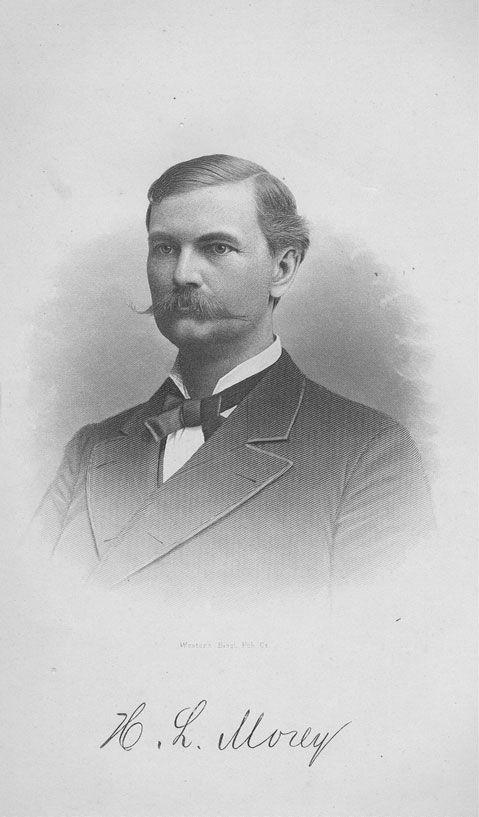
HENRY L. MOREY.
Henry Lee Morey, representative in Congress from this district, was born in Milford Township, in this county, on the 8th of April, 1841. He is the son of William and Derexa Morey, neither of whom are now living. The ancestors of William Morey came to America, from England, in the early part of the seventeenth century, and are supposed to have settled in the colony of Massachusetts. From thence, in time, their descendants scattered to various parts of the country, the branch to which William Morey traces his origin settling in Connecticut. His grandfather served in the Revolutionary War as a commissioned officer. After the close of that struggle, and when the lands of Western New York were offered for sale, he removed to that State and settled in Steuben County.
His father, William Morey, in turn, emigrated in 1814 to the new State of Ohio, bringing with him his young family, among them William, a lad of thirteen, and locating in the Seven-Mile Valley, near the site of the present village of Collinsville, where he died on the 16th of August, 1815, in the forty-second year of his age, leaving Anda Morey, his widow, and seven children, four sons and three daughters. He was buried in the old cemetery near that town, but sixty-two years afterward his remains were removed by his grandchildren to Green-
334 - HISTORY OF BUTLER COUNTY.
wood Cemetery, where they now rest beside those of his wife, who survived him thirty years. William Morey, his son, and the father of Henry Lee Morey, was the third child of the family. He was united in marriage with Derexa Whitcomb on the 6th of May, 1824, in Yankeetown, now Somerville, in this county.
Derexa Morey, whose maiden name was Whitcomb, was descended from Puritan stock. Her ancestors came to this country from England about 1630, and are supposed to have come from Dorsetshire, in the ship Mary and John, which sailed from Plymouth, in England, and landed in what is now Boston Harbor, on the 30th of May of 1630, after a voyage of seventy days. One of their descendants, Colonel Asa Whitcomb, was a revenue officer in colonial times, and others of the family have won distinction in the various walks of life. One branch of this stock removed from Massachusetts to Vermont, from which is descended Anthony Whitcomb, the father of Derexa Whitcomb. A brother of Anthony was the father of James Whitcomb, at one time commissioner of the land office, twice elected governor of the State of Indiana, and later a United States senator from that State.
Anthony Whitcomb came to Ohio from the State of Vermont about the year 1815, and settled in Hamilton County, near Cincinnati, then a small town, where he soon .-after died, leaving Lucy Whitcomb, his widow, and six children, two sons and four daughters. Lucy Whitcomb afterwards married again, and moved to Preble County, in this State, taking her family with her, where she died on the 5th of October, 1821, in the forty-eighth year of her age. Derexa here met William Morey, with whom she was united in marriage on the 6th of May, 1824. They were the parents of fourteen children, ten of whom survive, seven sons and three daughters. During the war of the Rebellion four of their sons served in the Union army.
William Morey died on the 8th of June, 1872, in the seventy-first year of his age. In early life he learned and carried on the business of a hatter, but afterwards embraced mercantile pursuits, and later turned his attention to agriculture, which he followed for the remainder of his life. While engaged in the hatting business he visited the city of New Orleans to purchase a stock of furs, and there first became acquainted with the institution of slavery, and saw its practical workings. His strong sense of right revolted at its enormities, and made him look with abhorrence upon the system. He returned to his home a radical abolitionist, which he continued openly to be until the day of his death. During the period of fierce agitation of the slavery question he lived upon one of the lines of the underground railroad, and was known as a friend of the black man.
In early life he united with the Universalist Church, of which he continued a faithful member until his death. He was the strong friend of temperance, his voice being always against the liquor traffic, as also against the use of tobacco. His wife survived him five years, dying on the third day of July, 1877, in the seventy-sixth year of her age. She was buried in Greenwood Cemetery by the side of her husband and children. In her early womanhood she united with the Universalist Church, in which faith she continued th:oughout life. She was a woman of bright intellect, thoughtful, patient, and self-denying, always ready to relieve the wants of the needy. On the 12th of July, 1879, Matella Morey Druley, the youngest child of William and Derexa Morey, died in the thirty- first year of her age, being the first death among their children for more than thirty years.
Henry Lee Morey attended the common schools of Butler and Preble Counties until 1856, when he was sent to the Morning Sun Academy to prepare for college. Two years later he entered Miami University. The war breaking out, he enlisted in the University Rifles, at Oxford, on the day after the fall of Fort Sumpter. This company was united with the Twentieth Ohio Volunteers, and was active in the campaign of Western Virginia. At the expiration of this service, he enlisted in the Seventy-fifth Regiment Ohio Volunteers, and helped to recruit and organize that regiment at Camp McLean, near Lockland, Hamilton County. On the completion of the organization, he was elected a second lieutenant, and served with his regiment to the close of the war, being successively promoted to the positions of first lieutenant and captain, being senior captain of his regiment at the close of its term. His regiment went from Camp McLean, in January, 1862, into Western Virginia, and in its campaigns marched over all the ranges of mountains into Eastern Virginia. He took part in the battles of Monterey, Franklin, Shaw's Ridge, McDowell, Strausburgh, Cross Keys, Cedar Mountain, Freeman's Ford, Sulphur Springs, Waterloo Bridge, second Bull Run, Aldie, and Chancellorsville in Virginia ; Fort Wagner, Morris Island, Fort Gregg, and in the siege of Fort Sumpter (under General Quincy A. Gilmore), in South Carolina; and Camp Baldwin and Gainesville, Florida. He commanded his company in every action after Monterey. He was taken prisoner at the battle of Chancellorsville, and confined in Libby Prison, in Richmond, and was exchanged with the last lot of officers previous to the suspension of the cartel.
After the war he studied law, graduating at the Indianapolis Law College, and settling in Hamilton in the Spring of 1867, where he has ever since remained. He is a Mason, having become a Past Master, and has advanced through the council and chapter degrees. He has lately become a Knight Templar. He is also an Odd Fellow, a Knight of Pythias, and member of the Royal Arcanum. He has always affiliated with the Universalist Church, and for ten years has been superintendent of its Sunday-school in Hamilton.
On the 25th of April, 1865, he was married to Mary
HAMILTON - 335
M. Campbell, who died July 1, 1867. February 26, 1873, he married Ella R. Campbell, sister of his first wife, and daughter of William H. Campbell, late State senator, and granddaughter of Mrs. Mary Campbell, who is still living in Franklin, Warren County, in her ninety-seventh year.
He was admitted to the bar in 1867, and has remained in the active practice of his profession in the city of Hamilton ever since, until the last session of Congress, during which time he grew in popular favor, until he attained a leading place at the bar, and rapidly developed those elements so essential to a good lawyer. Of sterling integrity, fearless in his professional duties, of correct judgment, quick and decisive, keen and discriminating, energetic and persistent, clear and comprehensive, he is true and fair to his client, honest with the court, and candid with the jury. As a counselor, he is frank and safe; as a pleader, terse and concise ; as a jurist, logical and forcible, and as an advocate, eloquent and persuasive.
In his political career Mr. Morey has been remarkably successful. He is a Republican, devoted to his party, proud of its history, and thoroughly believing in its principles, but always courteous to his political opponents. In 1871 he was elected solicitor of the city of Hamilton, to fill a vacancy caused by the death of Judge Vance, and was shortly afterwards re-elected for a full term. In the same year he was elected prosecuting attorney of Butler County largely by his personal popularity, defeating his Democratic competitor, whose party was over two thousand in the majority.
In 1875 he was a candidate for State senator in the district composed of Butler and Warren Counties, and _although running largely ahead of his ticket, was defeated. In 1880 he was nominated for Congress in this district by the Republicans. He received the nomination on July 28th, at the convention in Morrow, upon the three hundred and sixty-seventh ballot, after a protracted and close contest. He was triumphantly elected, receiving one thousand and twenty-eight majority over General Durbin Ward, the Democratic nominee. His career during the first session of that Congress was so highly satisfactory to his constituents, that on July 13, 1882, by his party at its convention in Lebanon, Ohio, he was renominated by acclamation.
In his official acts he keeps in line with the Republicans on party questions, but in his relation with his constituents and in his zealous and devoted care of their interests he makes no distinction, treating all alike. He is affable and genial, courteous and kind, attentive and industrious, with wonderful capacity for details, efficient, of broad views, and patriotic. In his capacity as a private citizen, he is generous, sympathetic, neighborly and obliging, active and enterprising, successful and influential; and has done much for the growth and development of the city of Hamilton and Butler County, and has always been the friend and advocate of all valuable public improvements looking to the prosperity of the people.
J. E. MOREY.
James Ellwood Morey was born in Milford Township, Butler County, Ohio, on the third day of April, 1845. He is the son of William and Derexa Morey, and is the thirteenth child in a family of fourteen children, of whom nine were sons and five daughters. His childhood and youth were spent in the ordinary duties and pursuits of a farmer's son, and in attendance upon the public school of his district, and as he grew older the Morning Sun Academy, until he reached his seventeenth year, when, on the 7th of August, 1862, he enlisted in the Ninety-third Regiment Ohio Volunteers in response to President Lincoln's second call for 300,000 men. In the Fall of the same year he was taken prisoner, but was soon exchanged and again took his place in the ranks. He continued in the service until the 14th of June, 1865, when he was mustered out and honorably discharged, the rebellion being subdued and peace declared. His regiment formed part of the Army of the Cumberland. He took part in the battles of Chickamauga, Mission Ridge and Lookout Mountain, Rocky Face, Resaca, Dallas, Kenesaw Mountain, Lovejoy Station, Columbia, Nashville, and numerous skirmishes and minor engagements.
Returning home at the close of the war, he entered Miami University in 1865, from which he was graduated in 1867, and in the same year began the study of law in the Indianapolis Law College. He received his diploma in March, 1868; was admitted to the bar the following August, and at once commenced the practice of law at Hamilton, in which place he has since resided.
On the thirty-first day of January, 1870, he was elected secretary of the Hamilton Insurance Company, and from that time gave his attention to the insurance business, until August, 1878, when he returned to the active practice of law, to which he has since exclusively given his time. On the 18th of October, 1880, he entered into partnership with his brother, Henry Lee Morey, and Allen Andrews, under the firm name of Morey, Andrews Si Morey. He was brought up in the Universalist faith, and is a member of that Church. He is a charter-member of Lone Star Lodge, No. 39, Knights of Pythias, Hamilton, Ohio. On the 16th of April, 1873, he was married to Winona Chadwick, daughter of Clinton and Ellen Chadwick, of Camden, Preble County, Ohio.
Mr. Morey is a man of excellent health, strong mind, and good morals. He is kind, sympathetic, obliging, and greatly attached to his home, family, and friends. In business he is careful, industrious, and enterprising, and has been very successful. As a citizen he is public- spirited, influential, and deeply interested in the improvement of his city and county. As a lawyer he is zealous in his profession, cautious in counsel, and careful of his
336 - HISTORY OF BUTLER COUNTY.
clients' interest; and, in the trial of any cause, strong and tenacious. To the court he states his propositions with force and clearness, and before a jury he is candid, earnest, and effective. In politics he is a firm Republican.
MICAJAH HUGHES.
Micajah Hughes, of Liberty Township, president of the First National Bank of Hamilton, was born in Baltimore county, Maryland, on the 25th of January, 1807. He is the son of Elijah and Sarah (Muchner) Hughes, who were both natives of the same county, and removed to Ohio, settling in Liberty Township, in 1815. Mr. Hughes followed the occupation of a blacksmith in Maryland, but after coming to Ohio, also embarked in farming. He was born November 4, 1777, and died August 8, 1849, and his wife died September 10, 1845, being born May 5, 1780. Micajah Hughes was educated in an old log school-house, in Liberty Township, located in Huntsville. He soon was initiated into farming, and in 1832, in company with Daniel, his oldest brother, bought a farm of one hundred and sixty acres, in Lemon Township, which they owned together until 1837. In the meantime they had bought another farm in the county, then dividing it. Micajah took the farm on which he now lives, of one hundred and twenty acres, and forty acres of woodland, two miles distant. Their partnership was dissolved in 1837, when Mr. Hughes married. His business from that time on has been to farm, trade in stock, and loan money.
He was one of the organizers of the First National Bank in Hamilton, in August, 1863, and has ever since been its president. The first meeting to form this bank was held on the day on which the battle of Gettysburg was fought, but the meeting at which the permanent organization took place was on the 6th of August. The capital was originally $50,000, of which Mr. Hughes owned one-tenth, but a few months after it was increased to $60,000, and in Janute•y was made $100,000, its present capital. Mr. James Beatty was the first vice- president. The average dividend of the bank since its beginning has been sixteen and two-thirds per cent; the highest dividend, twenty-four per cent, and the lowest, ten. The deposits now are over $700,000, mostly received from farmers.
The bank has been uniformly successful in its history, never having been obliged to close its doors or ask the least indulgence. Its stockholders are conservative moneylenders, who never receive favors from the bank or use its funds for their own purposes. In proportion to its capital it has the largest deposits of any bank in the State, except one in Cleveland and one in Cincinnati. Mr. Hughes now owns but one thousand dollars' worth of stock, just enough to qualify him to be president, by request of stockholders, though he formerly owned twelve thousand five hundred dollars of stock. He pays the largest personal tax in Butler County, being on upwards of eighty-seven thousand dollars, all his property being in this county, except ten lots in Louisville, Kentucky.
He was married on the 3d of March, 1837, to Miss Phebe F. Cassidy, born September 19;1814, of Lemon Township, who was the daughter of John and Sarah Cassidy, farmers. Mrs. Hughes is still living, at the age of sixty-six. Nine children were born to Mr. and Mrs. Hughes, though but five are now living. The oldest, Mrs. Helen Taylor, was born May 23, 1839 ; Albert, born April 23, 1843; George W., born June 29, 1844; Joseph B., born November 21, 1848; Alexander C., born January 16, 1851, and died August 14, 1867, at Minneapolis, where he had gone for his health. He was a lawyer of Hamilton. Sarah L., born February 4, 1841, died November 9, 1871, was an accomplished scholar and writer. She possessed a high degree of literary skill, and her letters from Europe excited much attention. Alice M., born July 2, 1845, died July 1, 1861; Evelyn, born October 22, 1853, died November 1, 1853; Clarence E., born March 3, 1855, died September 11, 1864.
He has always been a Democrat, casting his first vote for Jackson, in 1828, and voting for the candidates of that party ever since. He has frequently been a delegate to the State Democratic Convention. He was a director of the Butler County Insurance Company for ten years, and was one of its organizers.
UNIVERSALIST CHURCH.
As nearly as we can ascertain, the history of Universalism in Butler County dates back to 1838, when occasional preaching services were held in the city of Hamilton, and at various other places in this county.
James McBride estimated the attendance upon the various Churches in Hamilton, in 1842, as follows : " Methodist, 300 ; Presbyterians, 200; Associate Reformed, 200 ; Episcopal, 50 ; Reformed Presbyterians, 100 ; Baptists (Old School), 30 ; Universalists, 100. Total population of Hamilton and Rossville, 2,552 ; of age to attend Church, 2,089. Total attendance, including 200 Catholics, 1,030; non-attendants, 1,059."
In one of our old county papers we find the following announcement : " Rev. D. R. Biddlecome, Universalist, will preach at Jacksonburg, at 3 P. M., and in Hamilton in the evening. ' About this time there was an occasional sermon by some Cincinnati missionary Universalist minister, who preached at Oxford, Bunker Hill, and other places. Rev. Henry Gifford, Rev. Abel C. Thomas, Rev. John Gurley, Rev. George Rogers, Rev. E. M. Pingrey, Rev. W. W. Curry, Rev. Ben. F. Foster, Rev. J. C. Petrat, Rev. N. M. Gaylord (brother- in-law of General Van Derveer), Rev. Mr. Davis, and Rev. Mr. W. S. Bacon were the early occasional expounders of this faith " once delivered to the saints."
Among the old-time attendants upon the Universalist Church services we find the following names: Jacob Matthias, Isaac Matthias, John W. Erwin, John K. Wil-
HAMILTON - 337
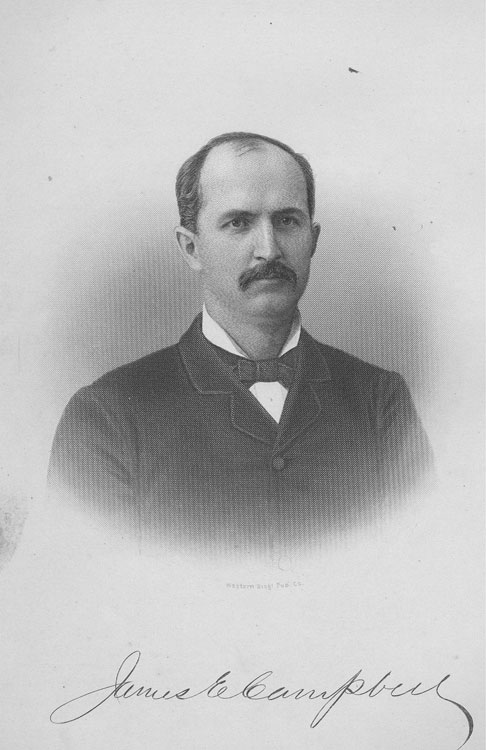
son, Perry G. Smith, John 0. Brown, Peter Jacobs, Thomas Reed, Richard Easton, and Isaac Warwick. At this time these friends of liberal thought met in the lower rooms of the court-house, which were ordinarily well filled, and the religious services were always characterized by most excellent music. Their present church was erected in 1851 and cost about $9,000. Besides other generous contributions, John W. Erwin donated the church bell, which was a premium bell, and cost five hundred dollars cash. Christopher Hughes, Ludwick and Jane Betz, and Jasper Johnson were now attendants upon public worship with this congregation.
The Rev. Jonathan Kidwell, a most able controversialist, and other prominent Universalist divines, occasionally held public debates with the ministers of opposing faiths at various places in Butler County. Churches have been built at Oxford and Bunker Hill, which have for many years had preaching about every alternate Sunday. Rev. C. H. Dutton, Rev. William Tucker, Rev. J. P. MacLean, and Rev. C. L. Haskell, in the order named, have been the more recent pastors of the Hamilton society. It lias an interesting Sunday-school, with about eighty names enrolled, and an average attendance of probably fifty-five.
Unfortunately the church property of this society has become involved in litigation, which for final adjudication has been appealed to the Supreme Court. H. L. Morey, J. E. Morey, B. F. Thomas, John W. Erwin, R. N. Andrews, Dr. S. H. Potter, S. 0. Peacock, and various influential citizens of Butler County attend this church. Should the Supreme Court finally decide adversely to this society, it proposes at once to build a new and beautiful modern church edifice; otherwise, to entirely renovate its present house of worship.
JAMES E. CAMPBELL.
James Edwin Campbell, lawyer, of this city, is a native of Middletown, where he was born on the 7th of July, 1843. He is the son of Dr. Andrew Campbell, of whom a full account will be found elsewhere in this work, and Laura P. Reynolds, daughter of John P. Reynolds, once a publisher in New York State, and afterwards a leading and influential citizen of Middletown. Mr. Campbell's father was of Scotch extraction, and his mother of English. The family of Mr. Reynolds was originally settled in Devonshire, Jonathan Reynolds emigrating from Plympton Earl, in that county, in 1645, and on his arrival in America, taking up his dwelling near Plympton, in the Plymouth colony, now a part of Massachusetts. Mr. Campbell is sixth in descent from Jonathan Reynolds. The family, after settling in Massachusetts, extended to Rhode Island and New York, and are now numerous in these two latter States, having many members who have filled important positions in the State and national councils. By another branch of his maternal family, he is descended from John Parker, who commanded the American troops at the heroic struggle at Lexington, which began the Revolutionary War. His paternal great-grandfather, Andrew Small, at the age of eighteen, went with Montgomery on the fatal expedition to Quebec, suffering untold miseries on his return through Canada. Both of his grandfathers were soldiers in the 'War of 1812.
James E. Campbell was educated in the free schools of his native town, and in later years received instruction from the Rev. John B. Morton, an early and successful teacher of that place, and for many years the pastor of the Presbyterian Church. When approaching maturity he began the reading of law, and taught school for a short time.
In the Summer of 1863, after the navy had become thoroughly organized in all its departments, and had won some of its most glorious victories, he became a master's mate on the gunboats Elk and Naiad, serving on the Mississippi and Red River flotillas, and taking part in several engagements. But the unhealthiness of the climate soon affected him, and after a year, being surveyed by a board of surgeons, he was discharged, returning home a mere skeleton. As soon as he had sufficiently recovered his health he resumed the study of law, and during the Winter of 1864 and 1865 he became a student in the office of Doty & Gunckel, Middletown, being admitted to the bar in .1865.
In the Spring of 1867 he began the practice of his profession in this city. During the interval he was bookkeeper of the First National Bank at Middletown, and was also a deputy collector in the Internal Revenue service of the Third District for about eight months in Hamilton, under General Ferdinand Van Derveer, Collector. He was elected prosecuting attorney of the county in 1875 and 1877, holding that position for four years and filling the duties of his office most acceptably. From 1867 to 1869 he was United States commissioner. In 1879 he made a very close race for the Ohio State Senate, being defeated by only twelve votes. During the war he was a Republican, and remained so until the Greeley campaign, when, in common with thousands of others, he cast off the party yoke, and voted for Greeley and Brown. Since that time he has acted with the Democrats.
In addition to his business as a lawyer, he has paid much attention to insurance, and has gradually gained a large and valuable business in this line, and has been charged with many important receiverships and other trusts. Mr. Campbell is a Knight Templar, a member of the Knights of Pythias, and the Grand Army of the Republic. He was married to Miss Libbie Owens, daughter of Job E. Owens and Mary A. Price, on the 4th of January, 1870. Her father was a native of Wales, and her mother of Welsh descent. They have three children. Mr. Campbell is a hard worker, and can accomplish more in one day in his business than the
338 - HISTORY OF BUTLER COUNTY.
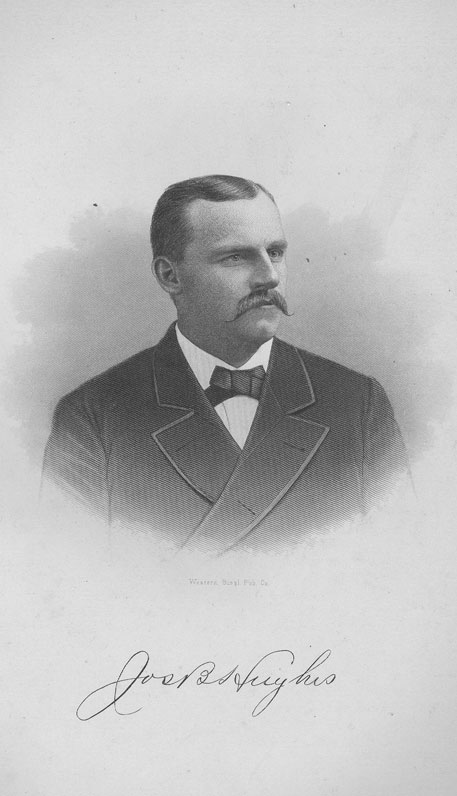
most of men. He attends the Presbyterian Church, and contributes liberally to the support of all benevolent and, charitable enterprises.
He is systematic in all his efforts, and his offices are models of neatness. Socially no man stands higher. He is courteous in manner, thorough in his acquisition of detail, and of the highest integrity of character. As a lawyer he has few superiors at his age, possessing great skill in ascertaining the true points of a case. He is a good, clear, logical speaker, and well informed on all questions of law. No young man in Hamilton has a better or more honorable record, and no one is deserving of greater credit than he.
At the Democratic Convention held at Lebanon, August 16, 1882, he was nominated unanimously for the position of Congressman, and is now making a most gallant campaign in behalf of his party.
CAPTAIN ISRAEL GREGG.
Captain Israel Gregg, for many years a prominent steamboat man, was for a long time a resident of Hamilton. He was born on the 20th of February, 1775, in Virginia, but his parents, who were adventurous pioneers, removed to Brownsville, Pennsylvania, shortly after, where, on attaining a sufficient age, he was taught the art of a silversmith, and on reaching his majority set up for himself. Two years after, or on the 12th of July, 1798, he married Elizabeth Hough, one of the younger children of a Quaker family, and sister of Joseph Hough, for twenty years the leading merchant of Hamilton. Another brother, Benjamin, was auditor of the State of Ohio from 1808 to 1815.
Mr. Gregg afterwards became interested in steamboating, and in 1814 was in command of the steamboat Enterprise, built at Brownsville by Daniel French, on his patent, and owned by a company at that place. It was a boat of forty-five tons. It made two voyages to Louisville in the Summer of 1814. In December she took in a cargo of ordnance stores at Pittsburgh, and sailed for New Orleans, arriving at that port on the 14th of the same month. She was then dispatched up the river in search of two keel-boats, laden with small arms, which had been delayed on the river. She had reached twelve miles above Natchez when she met the boats, took their masters acid cargoes on board, and returned to New Orleans, having been out six and a half days, in which time she ran two hundred and sixty-four miles. She was then for some time actively employed in transporting troops, etc. She made one voyage to the Gulf of Mexico, as a cartel, and one voyage to the rapids of Red River with troops, and nine voyages to Natchez. She set out for Pittsburg on the 6th of May, and arrived at Shippingport on the 30th, twenty-four days out, being the first steamboat that ever arrived at that port from New Orleans. She then proceeded to Pittsburg, where her arrival was warmly greeted, as the passage from the sea by the means of steam had been successfully accomplished for the first time. Captain Gregg afterwards commanded the Dispatch, a small boat of twenty-five tons, built at Brownsville, which was wrecked near New Orleans in 1819, and he continued as a commander in the river service for several years after.
He then became an inhabitant of Hamilton, where he dwelt the remainder of his days. He was elected sheriff of Butler County in 1835, and served four years, also holding other offices of trust and responsibility. By his first wife he had eleven children, who are now all dead. Upon her decease he married Mrs. Phebe Kelley, of Rossville, an aunt of William D. Kelley, of Pennsylvania, on Thursday, the 5th of December, 1822, the ceremony being performed by the Rev. H. Baker. By this marriage he had two children : Jane H., now the wife of J. C. Skinner, and Sarah, widow of Samuel Cary. He died on the 20th of June, 1847, aged seventy- three years. He was a man of great uprightness and benevolence, and his memory is still cherished by those who knew him.
JOSEPH B. HUGHES.
Joseph Barcalow Hughes, auditor of Butler County, was born November 12, 1848, on his father's farm in Liberty Township, in this county. He is the son of Micajah Hughes, president of the First National Bank, and grandson of Elijah Hughes, a native of Baltimore County, Maryland. The family emigrated to this county from. Maryland about the close of the War of 1812, and settled in their present neighborhood, in which they have ever since resided. They are noted for their good, practical common sense, industry, sobriety and sterling honesty, and, as a consequence, have accumulated large estates, and are considered among the first families of Butler County.
Micajah Hughes was married more than fifty years ago to Phebe Freeman Cassidy, a native of the county, a lady whose good sense and good judgment have contributed in no small degree to her husband's prosperity. This long and happy union has been blessed by ten children, of whom Joseph is the sixth.
Reared upon a farm, he grew up with all the advantages of out-door life and physical exercise; attending district school until he had attained such proficiency that an advanced school became necessary to develop the intellect which nature bestowed so profusely upon him. For this purpose he attended the Ohio Wesleyan University at Delaware, Ohio, and afterwards, to acquire a business education, he went to a commercial college at Dayton, Ohio, at both which seats of learning he showed himself a young man of excellent memory, quick perception, good judgment, and sound understanding.
He was married November 12, 1868, to Miss Mary Davis, daughter of Almon Davis, a wealthy farmer of Liberty Township. Mrs. Hughes was born in April, 1848. She is a lady of culture and refinement, and is one
HAMILTON - 339
in every way fitted to make home attractive and happy. One child, Gordon Taylor, a bright, intelligent boy now twelve years old, has been given them to bless their union. Mr. Hughes engaged in farming with fair success until 1875, when desiring to furnish his boy with better facilities for education, and being himself of an enterprising commercial and manufacturing disposition which farming did not gratify, he moved to Hamilton and engaged in mercantile pursuits until 1881, when he sold out to his brothers. While engaged in business his attention was directed to the subject of manufacturing the beautiful ware known as Wedgewood, large quantities of which are imported from England and sold in this country, and he became impressed with the belief, after investigation, that it could successfully be manufactured in America.
Acting upon this belief, he with others organized the Royal Pottery Company, of which he was elected president, about three years ago, for the manufacture of this ware. The necessary buildings and machinery were constructed, skilled workmen were brought direct from England to start the enterprise, and the problem was successfully solved by turning out goods equal to the best imported from Europe, thus demonstrating what American enterprise and skill can accomplish when led by intelligence and good judgment. Since Mr. Hughes's election to his present position, he has disposed of all his interest in the company, as well as other outside business, that he may devote his whole time and attention to the duties of the office to which the people have elected him; but as a manufacturer and a merchant, his good judgment, thorough methods, and fair dealings procured him a fair share of success, and the respect of all with whom he dealt.
From his earliest youth he has taken an earnest interest in politics, allying himself with the Democratic party, being a true disciple of the teachings of Jefferson, Jackson, Madison, and the other great founders of that party. He is thoroughly democratic in his principles, is opposed to all monopolies and to all legislation, for the benefit of the few at the expense of the many, or to any thing tending towards monarchy, absolutism, or aristocracy.
For years he has been a hard worker in the ranks of his party, acting as committeeman in his township, attending conventions, and helping worthy friends to public positions, but not until the Hancock campaign in 1880 was he put forward as a leader by his admirers, who began about that time to estimate the man at his true value.
At the Morrow convention in 1880, which nominated General Ward for Congress, he was selected by the delegation from his county to second the nomination, which he did in a neat and appropriate speech, being the first time he had attempted the difficult task of speaking in public. During the political campaign of that year he spoke at various points in the county, discussing the political questions of the day in a manner that showed a thorough knowledge of the subject, to the gratification and, we may add, surprise of his friends, and with credit to himself.
In the campaign of 1881 he contributed greatly to the success of his party by his writings to the Daily Democrat, in a manner that shows him to be a good writer as well as a good speaker, and his abilities as a political strategist are recognized by his being made chairman of the county executive committee of this county. As a speaker he is thoroughly honest and sincere in his utterances, and therefore impresses himself upon his hearers; his sentences go direct to the point, and convince by their directness rather than by their eloquence. As a writer he is forcible, fair, and direct; but if occasion require, he can be pungent and sarcastic, covering the object of his attack with ridicule, in which respect he is much more effective as a writer than speaker.
It is reasonable to suppose that the public would look to such a man as one well calculated to fill a public office with credit to himself and with honor to them, and therefore when he was nominated by his party by an overwhelming majority, and triumphantly elected to the office of auditor of this county, in the Fall of 1881, it was no more than was to be expected in recognition of his abilities and reward for political services.
He entered upon the discharge of the duties of his responsible position in November, 1881, to serve for three years. In the discharge of those duties it is safe to predict, from the integrity displayed by him in the past, that the interests of the public will be properly guarded, and that the laws governing his official acts will be honestly and faithfully executed. He is a man of incorruptible honesty and unflinching honor, possessing that conscientious regard for the sanctity of an oath that insures its faithful observance. He is a Knight Templar, is a past Chancellor Commander in the Knights of Pythias, and a valued member of other orders with which he is associated. With his natural shrewdness, industry, and ambition, we predict for him a future that will place him in the front ranks as a citizen, a politician, an officer, and a thoroughly cultured, upright gentleman.
THOMAS V. HOWELL.
Thomas V. Howell, the leading dry-goods merchant of Hamilton, was born in this city, in what is now the First Ward, September 28, 1826. He is the son of Hezekiah and Sarah A. (Virgin) Howell. Mrs. Howell was the daughter of Thomas Virgin, an early settler in Liberty Township, and afterward in the War of 1812. He was killed by Indians, on the Rocky Mountains. ,Mr. Howell received a limited education in the common schools, and when from ten to twelve years of age entered the employment of George P. Bell, a prominent merchant, and continued with him some ten years, when he
340 - HISTORY OF BUTLER COUNTY.
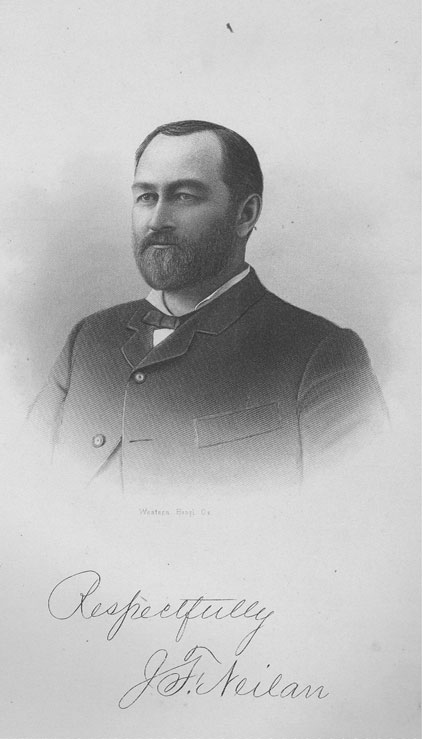
went to Cincinnati, with the firm of Reilly & Woods. He returned to Hamilton, and entered the employment of Brown & Leigh, remaining there until March, 1849, when, in company with D. G. Leigh, they purchased the business of William B. Van Hook, and began the firm of Leigh & Howell, under which title they traded for two and a half years. Mr. Leigh then sold out to John Dye, and the new firm of Howell & Dye was formed.
About 1854 Mr. Howell purchased the interest of his partner and carried on business by himself for twelve years. On beginning in 1849, his trade was not limited exclusively to dry goods, but embraced all that is commonly sold in country stores, including at one time a large stock of boots and shoes, and afterwards of millinery. In 1870 he admitted his son, David Leigh Howell, as a partner, under the firm name of T. V. Howell & Son. In 1875 they built the store since occupied by the firm, a handsome three story building, and admirably adapted to its present use. Their former store had been on the corner of Third and High, in the place now occupied by Hughes Brothers. The firm also carries on an extensive concern in Middletown, and are large dealers in all lines. Much of their goods is imported directly by themselves.
Mr. Howell was married October 20, 1849, to Miss Sarah A. Conner, daughter of David Conner, a former well-known resident of this place. They are the parents of one daughter and one son, the former being Kate C. Howell, and the latter David L. Howell. Mrs. Howell and daughter are members of the United Presbyterian Church. He is a self-made man, and had' no early advantages. He is a member of the Masonic order, and contributed liberally of his means and influence in sustaining the government during the last war.
WILLIAM B. VAN HOOK.
William B. Van Hook was born at Cincinnati, Ohio, on the twenty-sixth day of October, 1795. His parents were Dr. Benjamin F. Van Hook and Catherine Van Hook, who were Hollanders, and who had emigrated from New Jersey to the North-west Territory at a very early period. Mr. Van Hook remained in Cincinnati until the last war with Great Britain, when he enlisted as a private in Captain David Oliver's company, and served as a soldier until peace was declared. He moved from Cincinnati to Hamilton in the year 1818, where he continued to reside until his death, which took place in 1871.
He was by trade a carpenter, which he followed for many years. He had more than ordinary skill as a mechanic and builder. About 1818 he and the late James B. Thomas went from Hamilton to New Orleans on a flat-boat, where they remained for several months, working together at the carpenter business. Mr. Van Hook and the late Colonel Ball, of Trenton, walked all the way back to Hamilton through the then Indian coun try. He was shortly afterwards married to Julia Ann Stephens, who survived him, and who died in June, 1882.
In early life Mr. Van Hook exhibited quite a taste for the theater, and, as an amateur, played with and assisted the since eminent tragedian, Edwin Forrest. The circumstances are related elsewhere. Mr. Forrest never forgot his old friend, and never visited Cincinnati afterwards without sending for him.
Mr. Van Hook was a man of more than ordinary merit, and filled with ability offices of public trust. For several years he was a member of the Ohio Legislature ; was speaker of the House of Representatives, and was warden of the Ohio penitentiary. He was at various times a member and president of the city council of Hamilton. During the late rebellion he was deputy provost marshal of the Third Congressional District. In politics he was always an unwavering and ardent Democrat, but during the war of the Rebellion acted with the Union party. For more than half a century he was a prominent member of the Masonic fraternity. He died at his home in Hamilton, Ohio. At the time of his death he was probably the oldest citizen of this place. He was a highly respected, useful, and honored citizen.
JOHN F. NEILAN.
John F. Neilan, the prosecuting attorney of this county, is a native of Ireland. He was born in Roscommon County November 18, 1845. His parents, Thomas Neilan and Sarah Dwyer, emigrated to this country in 1848, being forced to that step by the misgovernment of the English. Mr. Neilan's family is one of the oldest and wealthiest in the west of Ireland, whose patrimony was confiscated by the British Government. John F. Neilan was but three years old when his parents came to the United States, locating in New Haven, Connecticut, and as soon as he grew old enough was sent to school, where he received the rudiments of education.
In 1857 his parents came to the West, that boundless field for industry and thrift, and settled in Fayette County, in this State. There, with indomitable industry, they proceeded to clear off the virgin forests, and get the ground ready for cultivation. From 1857 to 1866 he led the usual life of a farmer's boy, but with few of the advantages commonly to be found in that position. His parents were very poor, and he received no school education after he was twelve years of age, with the exception of six or eight months in all, obtained a couple of months each Winter, when the weather was so bad that no work could be done on the farm.
He was, however, an incessant reader. He read every thing he could lay his hands on—books, magazines, and newspapers. History, biography, and travels were his favorites, and so industriously did he pursue his reading that he was known by all to be a well-informed young man at the age of twenty. His love for his adopted country and his hatred of British rule led him to pay
HAMILTON - 341
particular attention to the history of the United States and the Revolutionary struggle. He sat up night after night, reading the story of the blockade at Boston, the conflict at Lexington, the disastrous defeat at Brooklyn, the retreat across the Jerseys, the Winter at Valley Forge, the great victories at Saratoga and Yorktown, the brilliant campaign of Greene in the South, and the thousand and one other facts that make up the history of our war for self-government, with no light but that of a log-fire, and alone.
In 1868 he began teaching school, for which he had qualified himself by study. This position enabled him to keep up his reading, and to find new books in each neighborhood. In this county, to which he came on the 16th of March, 1866, from Clark County, he taught for six years. While teaching he studied law, a part of the time in the office of Judge Crane, and was admitted to practice in all courts of record on the 13th of April, 1874. In that year he became the editor of the Hamilton Examiner, a Democratic newspaper. He was married on the 2d of June, 1874, to Miss Jane W. Kincaid, daughter of Jackson Kincaid, who was born in Virginia, and Isabella Hill, a native of Butler County. Her birth was in December, 1849. Mrs. Neilan has proved an estimable, loving wife, and their home has been a happy one. They have had three children, Thomas K., Mary E., and John F., Jr. Thomas, who was born December 4, 1875, was killed by the kick of a horse, on the 19th of July, 1881. This was their first sorrow. Mary E. was born September 28, 1878. John F. Neilan, Jr., was born December 28, 1881.
Mr. Neilan was elected city solicitor of Hamilton in April, 1877, retaining the position till April, 1881. In 1879, while holding that place, he was nominated for prosecuting attorney by the Democratic convention. Always an ardent, fearless, and successful political strategist, he was made the especial target of the opposition party. All the corrupting influences possible in political warfare were brought to bear against him, but he was triumphantly elected and served the people for two years, and for his honorable course and ability as a shrewd, quick- witted criminal lawyer, he was given the nomination for a second term without opposition, and his election followed.
Mr. Neilan ranks to-day with the first lawyers in our courts. His ability as an attorney and counselor, and reputation as a speaker, gained in many a hard fought political battle, have made him a reputation extending far beyond the confines of his county. He is a man of great will-power and determination, and always ready to give his opinion on all questions, and to conceal nothing. He is faithful and impartial in the discharge of public duties, and serves the people with honesty and ability. His intention is to resume the practice of law at the expiration of his term of office, and devote his whole attention to his chosen profession.
HAMILTON AND ROSSVILLE HYDRAULIC COMPANY.
For several years an idea had been entertained by some of the citizens of Hamilton of the practicability of taking the water out of the Miami River, at a bend about four miles above, conveying it by a race to the town, and thereby creating a water-power which would be advantageous to the place. In the Summer of 1840 John W. Erwin, an experienced and skillful engineer, surveyed and leveled the route, and made a map and estimate of the expense of the work. This estimate and map were forwarded to the succeeding Legislature, with a petition praying the incorporation of a company to effect the object contemplated. On the presentation of this the Legislature, on the twenty-fifth day of March, 1841, passed an act incorporating a company by the name of " The Hamilton and Rossville Hydraulic Company," and gave them power to erect a dam across the Miami'River at any point between the head of New River and Allen's mill, and to construct a canal or race thence to the town of Hamilton, for the purpose of creating a water-power for propelling mills and other machinery.
The assent of the owners was required to be obtained over whose lands the water should be conducted or works erected. The capital stock of the company was limited to one hundred thousand dollars, divided into shares of fifty dollars each. On twenty thousand dollars being subscribed they were authorized to elect a board of directors and proceed with the object of the undertaking.
At the next session of the Legislature a law was passed modifying the provisions of the original act so that the business of the company should be conducted by nine directors, instead of seven as provided by the first act, and prohibiting the directors from involving the company in debt to a greater amount than the stock subscribed, unless authorized by two-thirds of the stockholders. The assent of owners of land to the right of way being required by the act of incorporation, in the Spring of the year 1841 John W. Erwin obtained a release of the right of way from John Mitchel, George R. Bigham, William Bigham, James Bigham, and David Bigham, on the condition that the Hydraulic Company should build each of these persons a good bridge on their land, for the passing of wagons and cattle over the company's canal.
A difference of opinion existed between the citizens of Hamilton and Rossville as to the point where the waterpower should be erected, and on which side of the river the water should be brought. The act of incorporation appointed Samuel Forrer, of Dayton, a civil engineer, to survey and estimate the route on each side of the river, and to establish it on the best and most practicable route. On being notified by the company, Mr. Forrer attended at Hamilton, in October, examined the different routes, and after making an estimate of the expense, on the 26th of October, 1841, made a report deciding in favor of the one on the Hamilton side. Books for the subscription of stock were opened on Wednesday the first day
342 - HISTORY OF BUTLER COUNTY.
of December, and twenty-two thousand dollars immediately taken.
An election was held at the office of Lewis D. Campbell, secretary, on the first day of January, 1842, at which John Woods, William Bebb, Loammi Rigdon, Jacob Hittel, Andrew McCleary, Lewis D. Campbell, and Jacob Matthias were elected directors. William Bebb was chosen president, and Lewis D. Campbell, secretary. Henry S. Earhart was afterwards appointed treasurer. The board then employed John W. Erwin and John C. Skinner, engineers, to re-survey the route, and prepare the work for being let. After the work had been prepared for letting, John W. Erwin declining to serve further as engineer, John C. Skinner was appointed, at a salary of four hundred dollars per year. A number of proposals were received, and the whole work put under contract at prices from five to thirteen cents per cubic yard for excavation and embankment. The contractors immediately commenced work, and prosecuted their jobs with vigor, so that, notwithstanding the great embarrassment of the times, and the difficulty of raising funds, the whole was finally completed, and the water let in at an early date.
The commissioners appointed by the general government to examine and make a report of the most suitable place for the establishment of a United States armory, on some of the Western waters, being in the county at the time, a committee of citizens drew up a statement of the advantages of Hamilton, and the eligibility of the place for such an establishment. The Hydraulic Company proposed to furnish them three thousand cubic feet of water per minute, over a fall of twenty feet, for the use of their works, free of charge, provided they would erect a tight dam over the river at the head of the race, and invited the commissioners to visit the place. On the 13th of September, 1842, they arrived at Hamilton, and spent three or four days in examining the town and vicinity.
The Hydraulic Canal, from the north line of Hamilton, passes down near the bank of the river, through a space of ground lying between the town lots and the river, previously held as public common. A conversion from public to private use it was alleged might interfere with the title, as it had originally been granted by Israel Ludlow, who laid out the town, for the purpose of a public common. An arrangement was accordingly entered into between the Hydraulic Company, the heirs of Israel Ludlow, deceased, and the town of Hamilton, by which the company was permitted to construct their canal over this ground. The space between the hydraulic canal and the river was laid off into lots. Those soutli, of Buckeye Street were divided equally between the Hydraulic Company and the heirs of Ludlow. The portion lying north of Buckeye Street was divided equally between the town of Hamilton, Ludlow's heirs, and the Hydraulic Company.
The canal for hydraulic purposes is taken out of the Miami River about four 'miles above Hamilton, at a place where formerly stood Moody Davis's mill. A tight dam is here constructed across the river. The water is taken from the pool formed by the dam, and conducted down a bayou which had supplied the mill with water, about one hundred and twenty-four poles to a point below where the mill stood, where another dam is made across the bayou, and an embankment continued up on the west side to the east end of the dam across the river. This serves to raise the water to the same height as the water in the pools.
To regulate the quantity of water and guard against freshets in the river, substantial head-gates of wood are placed, mostly submerged in water. The superficial area of a cross-section of the water at the gates is two hundred square feet. From the head-gates the canal was excavated through the lands of Alexander P. Miller, about one mile. It is thirty feet wide at the bottom, and forty-five feet at the top water-line, and five feet deep, having a descent of one foot in the mile, which will give the water a velocity of one hundred and thirty-seven feet per minute, being capable of discharging twenty-six thousand cubic feet of water per minute. From the point where the excavation terminates to the grand reservoir, a distance of two-fifths of a mile, the canal is formed by a single embankment, located near the base of a high ridge, the depth of the canal averaging eight feet, by seventy feet wide. Here it enters the grand reservoir.
The reservoir is formed in the bed of what is commonly called Old River, by an embankment across the old channel, some distance above where the canal enters it, and another embankment below, where it is taken out. The reservoir is one mile long, fifteen feet deep at the upper end, and twenty-four feet deep at the lower. The area of the surface of the water is about seventy acres. From the lower part of the reservoir to the north line of the lots of Hamilton, a distance of one mile and nearly a quarter, the canal was constructed over the lands then owned by the Messrs. Bighams, by a heavy artificial bank on one side, and a natural bank on the other. It is about seventy feet wide, and from ten to twenty feet deep. At the line of the corporation is a reservoir covering six or seven acres, having a depth of eighteen or twenty feet. This reservoir is of great importance in retaining a supply of water to feed the canals below. From here the main branch continues west on the north line of the lots to the bank of the river, at such a distance from the river as to leave lots of convenient size between the canal and the river on which to erect mills and factories, so that the water-power can be applied.
In September, 1841, the Miami River was gauged by Messrs. John W. Erwin and Henry S. Earhart, above the head of New River, near where the hydraulic canal is taken out, and the quantity of water passing in the river was found to be 26,132 feet per minute. The river
HAMILTON - 343
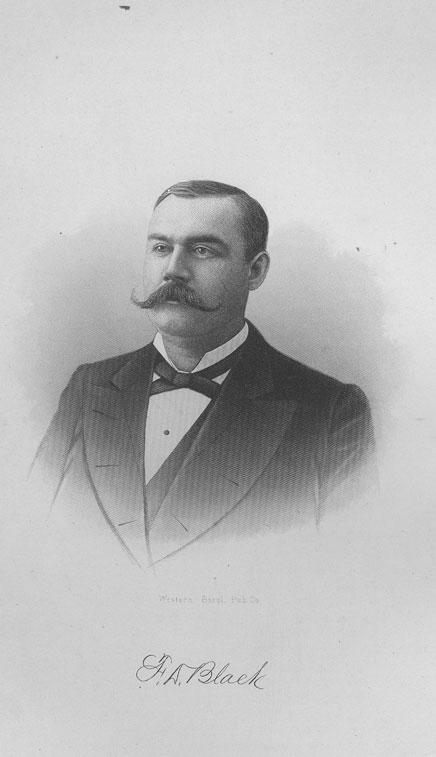
was extremely low at the time, and the Miami Canal passing its usual quantity of water. The entire fall at the town of Hamilton, from top-water line in the hydraulic canal, to low-water mark in the Miami River, is twenty-nine feet. But deduct six feet of the fall, on account of ordinary freshets in the Miami River, and allow two feet for the depth of water over wheels, and there remains twenty-one feet of fall. A column of water of 25,000 cubic feet per minute, over a fall of twenty-one feet, is sufficient to propel one hundred and sixty-six pairs of mill-stones four and a half feet in diameter, with the requisite machinery necessary for the manufacturing of flour. The length of line along which the water-power may be used is about two miles.
It is the opinion of men of experience, well-skilled in such matters, that this water-power is the best west of the Alleghany Mountains, and east of the Upper Mississippi and its branches. The whole work is constructed in the most substantial manner, with a view to its stability and durability.
The first water-power leased was to Erwin, Hunter & Erwin, who erected a flour-mill at the east end of Hamilton bridge. Along its banks are now many valuable manufacturing establishments, and it has also been very useful in putting out fires. Another race was constructed on the west side of the river, which was not as largely used as on the east side, but which has been of great value.
The Hydraulic Company passed the first water through their lower level from Fourth Street down Stable Street to the Miami River, on Monday, the twenty-seventh day of January, 1845. This lower level of the canal was three feet in depth, turning the water-wheels of Messrs. Erwin & Hunter's flour mill, and the Tobias Brothers' machine shop, near the east end of the Miami bridge.. The first work done by water power was done by the Tobias Brothers, January 31, 1845. Their shop was thronged with curious visitors for many days. The occasion was a jubilee .for the citizens, huzzaing, firing of cannons, and shaking of hands being among the demonstrations.
The Rossville Hydraulic Company was incorporated February 27, 1846. The corporators were Robert B. Millikin, James Rossman, John K. Wilson, Robert Beckett, Samuel Snively, Henry Traber, Charles K. Smith, William Daniels, Alfred Thomas, Wilkison Beatty, and Joshua Delaplane. It was organized in March, 1848. Henry Clayton was the first engineer employed. He was engaged about a year, and was succeeded by Henry S. Earhart, who made the location. The water is taken out one and a half miles above town, just below the mouth of Four-Mile Creek. Passing through the low grounds below, and under Two-Mile Creek by a tunnel, the water is spilled on a line between North Street and Rhea's line. The work was begun in May, 1849, the excavation being let to Connor McGreevy and John Connaughton. The company built the dam. In the flood of January, 1852, the abutment on the east side of the dam was destroyed. It was repaired in a permanent manner, and the dam lengthened two hundred feet.
F. D. BLACK.
F. D. Black, sheriff of Butler County, was born September 12, 1849, at Hamilton, Ohio, being the third son of Peter P. and Mary (Kirbel) Black, who were both immigrants from Europe. The former was born in France and the latter in Prussia. They came to America in 1839, the mother in company with her parents, but kr. Black being alone. He was then twenty-one years of age. His father had served under Napoleon in all his wars, and was one of the survivors of the terrible experiences at Moscow and the subsequent retreat. A brother of Mr. Black, who accompanied him to this country, while on a visit to France in 1860, was also a soldier under Napoleon III, and in 1861 went out as captain of a company under General Siegel, and was wounded at Pea Ridge. Peter Kirbel, the materhal grandfather of Sheriff Black, lived to the advanced age of ninety-six, having been a resident of Butler County ever since 1839, and for the thirty years prior to his death, in 1873, dwelt with his daughter, Mrs. Black, in Hamilton. Peter Black has been a resident of Hamilton for some forty- three years, and for the greater portion of that time has been known as one of the largest manufacturers of the county. He has been one of the active founders of several of the largest establishments in Hamilton, among which is the large institution now carried on by Messrs. Long & Alstatter, of which he was the original projector and in which he was interested for many years. He is at present senior member of the large establishment of Black & Clawson, engaged in the manufacture of machinery for paper manufacturers.
F. D. Black, after attending the schools of Hamilton, entered at the age of thirteen St. Mary's College, at Dayton, where he remained till eighteen years of age. Having acquired a liberal education, he now turned his attention to business affairs. In the Fall of 1868 he went to St. Louis, Missouri, in charge of a branch house of Long, Black & Alstatter, engaged in the manufacture of agricultural implements, of which his father was a partner. In 1870 Mr. Black withdrew from business affairs, in consequence of his father's disposing of his interest in the above firm.
He immediately turned his attention to politics and public affairs, and was appointed by Sheriff R. N. Andrews as his deputy, which position he filled with credit, so that upon Mr. William H. Allen succeeding Mr. Andrews he retained Mr. Black in the position he had so well filled. He was also appointed by Mr. Marcellus Thomas, who retained him during his term. Upon looking for a candidate for sheriff in 1879 the Democrats wisely chose Mr. Black. Ten years' experience as dep-
344 - HISTORY OF BUTLER COUNTY.
uty recommended him as highly qualified to fill the office, and consequently he was elected by a decided majority over his opponent. Mr. Black had during his first term so well performed the duties of his office, and secured the approbation of the public, that he was nominated in 1881 for a second term, and elected by a large majority. Since he assumed the duties of his position he has acquitted himself with great credit, and deserves special commendation for his vigilance and success in the capture of the notorious Jones and Vanderpool, indicted and held for trial on a charge of forgery. Three months were spent by Sheriff Black in tracing them through Ohio, Michigan, and Canada. They were finally arrested about forty miles from Toronto, and extradited. Mr. Black has the honor of having in his possession the only extradition warrant in existence signed by President Garfield. By the arrest of these chiefs of forgery and swindling he effectively broke up that system of robbery in this part of Ohio.
Mr. Black was married to Miss Mary Riffle, of Liberty Township, Butler County, who bore him three children, two girls and one boy. The son, Paul, is now being educated at St. Mary's College, at Dayton, where his father formerly attended, and the two daughters are about to enter Cedar Grove Seminary, in Hamilton County. Mr. Black is a young man of superior native powers, and a mind with proper training capable of filling high positions.
WILLIAM BECKETT.
William Beckett, son of Robert Beckett and Mary Crawford Beckett, was born in Hanover Township, in this county, on the 17th of March, 1821. He graduated at Miami University in 1844. In 1845 he came to reside in Hamilton, and began the study of the law in the office of Hon. John Woods, whose second daughter he married in September, 1846. On his admission to the bar he commenced practice with Mr. Woods. It is a fact pretty well known in the Miami Valley that Mr. Beckett is possessed of a tongue which, when engaged in conversation, works very smoothly and quite effectively ; but he soon ascertained that when he arose to address a jury or a public audience, that member utterly refused to perform its proper function, but rather "clove to the roof of his, mouth." Thereupon be promptly abandoned the idea of practicing law, and took the position of a general business operator—buying and selling real estate, manufacturing, assisting in the management of the hydraulic works, etc.
After the death of Mr. Woods, in 1855, Mr. Beckett, his executor, took his place as director in the Cincinnati, Hamilton, and Dayton Railroad, and also in the Cincinnati and Indianapolis road, known as the Junction. From that day to the present time he has been an active and liberal supporter of every movement to advance the interests and promote the prosperity of the city and county. He is largely interested in the manufacturing industry, and any event which would deprive the city of his efficient capacity and energy would be severely felt by the whole community.
There are few men in Butler County more widely known personally than Mr. Beckett. During a considerable portion of his life he was a man of large means, and his hospitality was fully commensurate therewith. Public men when in this vicinity commonly gravitated to his home, and some of his well-known political influence may have been promoted in this way.
POLITICAL HANDBILL.
It is interesting to see that the great political crisis which threatens the country this year, and threatened it last year and the year before, has always been existing. It can not be said that the campaign of 1852 was conducted on any other than party issues, or that there was any thing remarkable in the situation of the country. Yet see the appeals in the Intelligencer :
BASE FRAUD !
OUTRAGEOUS ATTEMPT TO DEFEAT
L. D. CAMPBELL
We have it upon reliable information, that on Monday last, JOHN CARR, formerly representative from this county, and one of the trustees of Fairfield Township, was in Mason, Warren County, wanting to hire TWO HUNDRED HANDS to work in this county. He there represented that Campbell would be elected by a small majority, doubtless as a blind to cover his real intentions.
FREEMEN OF THE THIRD CONGRESSIONAL DISTRICT! What say you to such infamous conduct on the part of the Locofocos of Butler County ? Desperation is seen in every movement. Campbell must be defeated, say they, at all hazards; and, to our certain knowledge, one of the State officers has boasted that he could beat the world at pipe- laying.
Whigs of the townships, be on your guard. Some of these hirelings will be quartered in every township in the county. GUARD WELL THE PoLLs! See that none but LEGAL VOTES are deposited and a triumphant victory is sure!
JOHN M. MILLIKIN.
Major John M. Millikin, the oldest professional man in Hamilton, and once treasurer of the State of Ohio, was born in Greensboro, Greene County, Pennsylvania, on the 14th of October, 1804. He is the son of Dr. Daniel Millikin and Joan Minor. When he was three years of age his father removed to the West and settled in Hamilton, being the first physician who permanently took up his abode here. John M. Millikin received instruction from Dr. Alexander Proudfit, who taught a school here about the time of the second war with Great Britain, and from others, and in 1824 went to Washington College, in Washington, Pennsylvania, spending a year there, and returning home the last of May, 1825. In that year he began the study of law with Jesse Corwin, in this city, and on the 5th of September, 1827, at
HAMILTON - 345
Columbus, he was admitted to practice by the Supreme Court of Ohio, and immediately opened an office. Colonel Campbell, who is next junior to him at the bar, did not enter practice till 1835, nor Thomas Millikin, the next in age, till 1840.
In 1834 the law firm of Millikin & Bebb was begun by the formation of a partnership between himself and William Bebb, afterwards governor, and this connection lasted till 1840, when Millikin retired from practice. In 1829 he was appointed brigade major and inspector of militia, an office he retained till 1833. January 1, 1841, he was appointed an aid-de-camp by Governor Thomas Corwin, and in 1846 he was a member of the State Board of Equalization. In 1856 he was elected a member of the State Board of Agriculture, and was twice re-elected. He served as president of the board one year. In 1860 he was appointed a trustee of Miami University. In this capacity he has served two terms of nine years each, and has been reappointed for the third term. In 1873 he was named by the Secretary of the Interior as one of a commission to proceed to the Indian Territory for the purpose of making a treaty with the Creek Nation for the relinquishment of a part of their territory to the Seminoles. In October, 1875, he was elected treasurer of the State of Ohio, and on the 10th of January, 1876, entered upon the discharge of the duties of his office. The Republicans renominated him for the same position in 1877, but at the October election the Democrats were in the ascendency, and he was, therefore, defeated. He retired from office on the 14th of January, 1878. He has always been a Whig and a Republican in politics. He cast his first ballot in 1826, and has voted at all State elections since. His first vote for President was cast in 1828 for John Quincy Adams.
Major Millikin has always been an important man in local affairs. He has been president of the County Agricultural Society, president of Greenwood Cemetery Association, president of the Farmer's Club, and other societies. He has an excellent knowledge of local history, and skill in narrating it. He is highly esteemed by his fellow-citizens, and has frequently been named by them as a suitable man for governor. He resides a little east of Hamilton on a farm which is cultivated according to the true principles of agriculture.
He was married on the 6th of September, 1831, to Mary Greenlee Hough, daughter of an esteemed early citizen of Hamilton, and has had by her four children, who attained full age : Minor, Joseph, Dan, and Mary. Mention is made of them in a sketch of the Millikin family, on page 185.
FIRST BAPTIST CHURCH.
On the 31st of December, 1841, Dr. Loammi Rigdon, Rebecca Rigdon, Aaron Potter, and Emeline Potter, being desirous to have Baptist preaching, resolved to make an effort to maintain a minister one-half of his time, and engaged the Rev. A. Drury, of Cincinnati, for that purpose, at the rate of four dollars for each visit. In 1842 he closed, and Elder Quant succeeded, staying, however, but a short time. In April, 1843, the Rev. Mr. Osborn began preaching, receiving two hundred dollars per year. Of this Dr. Rigdon and Mr. Potter each paid seventy- five dollars, and the Ohio Baptist Association, fifty dollars. There being no organization of the Church at this time, an arrangement was made with the Muddy Creek Church to receive into their membership any who might wish to join at Hamilton. It should be remembered that all this time there was a Baptist Church here, which adhered to the anti-mission side. The split had occurred in 1836.
In 1844 the Lockland Church received the members of the Hamilton congregation into membership, and constituted it a branch Church. The members were L. Rig- don, Rebecca Rigdon, Aaron Potter, Emeline Potter, Eve Davis, Elizabeth Walton, Sarah Steele, Sarah Garrison, Mary Garrison, Mary Kelley, S. Jane Walton, Louisa Pharis, and Louisa Boatman. When Mr. Osborn's term expired no other preacher was called, but services were held occasionally, at which neighboring ministers officiated. Meetings were held in the court-house and at the Female Academy. October 20, 1844, the Rev. D. Bryant was called as pastor, and a couple of months after it was resolved to erect a meeting-house. This house was in due time erected, at a cost, with the lot, of $3,311, and, with an addition afterward made, was occupied till 1858, when it passed into the hands of William Miller, the German Lutheran Church, and the Episcopal Church, successively. It is now changed into stores.
Mr. Bryant accepted another call in 1845, and William Roney was installed as pastor soon after. April 15, 1846, the Church was received into membership with the other Baptist Churches of the State, under the title of the First Baptist Church of Hamilton. The first trustees were L. Rigdon, A. Potter, J. L. Batcheldor, Joseph Shotwell, and J. S. Beatty ; treasurer, L. Rig- don; clerk, W. S. Going; deacons, L. Rigdon and Joseph Shotwell. Mr. Roney left on the 4th of June, 1848, and was succeeded by William Ashmore. In 1850 he went to China as a foreign missionary, and for a year the Church was without a pastor. The Rev. H. M. Richardson became pastor in 1852. The membership at this time was seventy-two. He stayed with the Church ten years, and did much good service. During his ministrations it was that the new church was built, at a cost of ten thousand five hundred dollars. He was succeeded by C. B. Keys, J. M. Pendleton, V. W. Snow, R. Telford, N. A. Reed, Thomas Hanford, J. R. Ware, W. E. Lyon, W. A. Smith, P. M. Weddell, and Homer Eddy. The last is the present pastor.
On Sunday, January 17, 1875, the church building was partly destroyed by fire. The other Churches, the Young Men's Christian Association, and the Masons
346 - HISTORY OF BUTLER COUNTY.
promptly tendered their aid. The loss was fully covered by insurance. About this time, too, the Church became straitened for means, could not pay the pastor's salary, and was for several short spaces of time without preaching. It is now, however, on the upward wave. The membership is increasing, and there is much interest felt. The Sunday-school has had as superintendents Aaron Potter, E. G. Dyer, W. Richardson, W. E. Scobey, George P. Brown, Walter Webster, Joseph R. Gibbons, and F. P. Stewart. Much of the success of this Church was owing to the indefatigable zeal of Mr. Aaron Potter and Dr. Loammi Rigdon, who put their shoulders to the wheel and made the Church an accomplished fact.
WILLIAM MURPHY.
William Murphy, flour manufacturer of Hamilton, Ohio, was born September 30, 1838, in Franklin County, Indiana. His parents are James and Susan Caroline (Erwin) Murphy, the former a native of New Jersey, and the latter of Indiana. His paternal grandfather removed from New Jersey about 1816. From Pittsburg he took passage on a flat-boat to Cincinnati, and thence he went to Indiana, settling near Brookville. He engaged in farming and distilling, and conducted a country store in addition. Mr. James Murphy was brought up on the farm, a vocation he has ever since followed, though he has for years been largely interested in other enterprises. He has for a long time been a large stock-raiser and pork dealer at Oxford, Butler County, Ohio. He also conducted for many years a large saw-mill. He is a man of considerable wealth, and is widely and favorably known among the business men in his section of country. He is now a man of about seventy-five years of age, while his life-partner is but little his junior.
At the age of thirteen William Murphy entered the Miami University at Oxford, where he diligently devoted himself to his studies for the four succeeding years, which put him in possession of a thorough English education. His tastes, however, were for a business career. After spending some time with his father, who was then largely engaged in the stock business, he settled at Oxford (to which place his father soon removed), and established himself in the grain traded which he continued with success till 1865. -
He now sought a larger field for his operations. He settled in Hamilton, and in company with Jacob Shaffer, bought the Hamilton City Mills, in West Hamilton, formerly owned by N. G. Curtis. An extensive business was soon built up, and continued till 1869, when the mills were burned. With but little delay Mr. Murphy and his partner bought the West Hamilton Mills, where they continued the manufacture, very extensively, of the finest grades of flour, till 1876. Mr. Murphy then dissolved partnership with Mr. Shaffer, disposing of his interest to him. He then formed a partnership with Mr. John Sortman. The Hamilton City Mills were re built by them, and under the firm name of Murphy & Sortman, the mills were kept in operation till 1880. Mr. Murphy then withdrew from the firm, and leased the Hydraulic Mills, which are still operated by him. The business done here is exclusively flouring, and is very extensive. Mr. Murphy manufactures a very superior quality of flour, for which he finds a ready market throughout the New England States, where the greater portion of his shipments are made.
In the Spring of 1882, Mr. Murphy, in company with Messrs. F. B. Thompson, S. D. Cone, and H. A. Dilg, organized the Dr. Temple Medicine Company at Hamilton and Cincinnati, with a capital of $150,000. Mr. Thompson was made president and Mr. Murphy treasurer of the concern. The medicines manufactured are the well-known Asthma specific and " Hops and Boneset" discovered by Dr. C. W. Temple nearly forty years ago. The former remedy had been improved in its medicinal powers by the Temple Company, who have also prepared specifics for hay fever, dyspepsia, and other diseases. From the • inception of the company, which is but a few months since, it has met with great success. They are pushing the enterprise vigorously, and their popular remedies now are found in all parts of the United States and other countries. Although these medicines have had great local popularity for many years, certainly as far back as 1849, their manufacture and sale have never been properly managed, until the present company took the enterprise in charge, and it is now fast becoming one of the important institutions of the city. Mr. Murphy owned and controlled the West Hamilton Hydraulic Water-power for ten years.
In 1876 Mr. Murphy was elected a member of the city council of Hamilton, and served in that capacity for three successive terms, or till 1882. During these six years he was always found among the first to take steps towards public improvements, and to institute measures for the city's good.
Mr. Murphy has been married twice. He married his first wife, Miss Lorinda Bake, of Contreras, Ohio, daughter of Peter and Tabitha Bake, December 22, 1864. She died the following year from the effects of a burn by coal oil, two days following the accident. She left one child, a daughter, Dora, now seventeen years of age. He married his present wife, Mrs. Eliza Smalley, widow of Isaac Smalley, daughter of Henry H. and Lydia Myers Seal, February 9, 1868. Mrs. Murphy's father was a native of Pennsylvania, and her mother of Butler County, Ohio. The former removed with his father, at an early day, near Brookville, Indiana, where he afterwards engaged in farming, a calling he still follows. He carries on a very extensive farm, though at the advanced _ age of seventy-three, while his wife is sixty-eight. Mrs. Murphy has one son by her first husband, Henry Burton Smalley, now eighteen years of age, and engaged in the milling business. Seven children have been born to Mr.
HAMILTON - 347
and Mrs. Murphy, though but four are now living. William J. H. was born June 7, 1871; Eva Pearl, June 28, 1873; Minnie Myrtle, December 31, 1877; and Marie, September 23, 1880.
Mr. Murphy has always been a Democrat in politics. He is a member of the Knights of Honor and Knights and Ladies of Honor, and has also been an Odd Fellow for the past three years. As a business man Mr. Murphy is cautious, considerate, and uniformly successful, and he has the reputation of being the best-natured man of Hamilton.
COLONEL A. DUNN.
Colonel A. Dunn died very suddenly in November, 1854, while out valuing the property of Asa Emmons. He was taken with a fainting fit, dropping down in the field, from the effects of which he died in a few hours. He was one of our most respectable and highly esteemed citizens. He had done much for the advancement of our agricultural interests as well as the general prosperity of the county, and was, at the time of his death, the president of the Butler County Agricultural Society. The esteem which the community entertained for him was appropriately attested in the very large procession which followed his remains to their last resting-place.
JAMES BEATTY.
James Beatty, a wealthy banker and well-known land owner of Butler County, died in March, 1880, at his residence, near Jones Station, of paralysis. Mr. Beatty was a native of Ireland, and about sixty-five years of age. He accumulated considerable wealth, most of which was made in the pork business. He owned one thousand nine hundred and forty-eight acres of land, and was estimated to be worth about $800,000. He was for a number of years vice-president of the First National Bank of Hamilton, and one of the principal stockholders.
THE NATIONAL ARMORY.
Among the projects agitated in Hamilton forty years ago was one for the establishment of a national armory. Congress had ordered the construction of several new ones, and this place had several itdvantages which it was thought ought to secure the erection of such an establishment here. It was to be located in one of the Western States. Ohio had peculiar claims, owing to its superior representative numbers, and in consideration of its long line of exposed frontier. This place was better than any point further east or further north, because the navigation of the river and the canals is less interrupted by ice and extreme low water. From here arms could be transported with ease to the North on the lakes, or to the South or South-west. A meeting was held in Hamilton in 1841, at which an elaborate report was made. It pointed out that the prices of property were low and rents always obtainable ; provisions were cheap. There was an abundance of timber, stone, and other materials. No carting would be required, as in Cincinnati, and coal could be cheaply delivered. The prospective hydraulic works would furnish all of the water power, and an excellent location was shown at the north end of town, just below Millikin's Island.
Brigadier-general Armistead and Colonel Long, of the United States topographical engineers, in their report to the Secretary of War, say:
" Of the Miami country generally beauty rather than grandeur is strikingly characteristic of its main features. The immediate valley of the Miami River, in particular, presents a beautiful expanse of intervale land, bounded on both sides by gently sloping hills, and like that of the Muskingum, embosoming two or more benches, or plains, rising by gentle gradations one above another, but far more spacious on the former than on the latter. These valley lands are remarkably rich and productive, and are for the most part cleared, ancl in a high state of cultivation. A view of some portions of this interesting valley, early in September, when contiguous fields, as far as the eye can reach, are clad in the luxuriant verdure of growing corn, is one of the most delightful prospects that can be witnessed. On returning from the valley and reaching the uplands, a view not less interesting, though less captivating, is presented ; a broad surface, generally of a rolling, but occasionally of a gently waving aspect, and stretching to the farthest limits of the horizon, here meets the eye. In richness of soil, variety of products, and healthfulness of appearance, all combined, it is not surpassed, probably, by any upland region to be met with in any other part of the United States.
" The country around Hamilton and Rossville, for many miles in every direction; presents the more comely and interesting features generally exhibited by the Miami country. The woodlands, which formerly presented a dense and heavy growth of timber, shrubbery, vines, grasses, etc., have given way to cultivated fields, yielding all the necessaries of life in the greatest profusion. Corn, wheat, rye, barley, oats, potatoes, tobacco, hay, fruits of all kinds common or peculiar to the climate, peas, beans, hemp, flax, etc., are among the products of the soil, and these, together with horses, cattle, sheep, hogs, poultry, beef, butter, lard, tallow, etc., constitute the leading articles produced for market, all of which can be supplied in abundance, and on the most moderate terms.
" The facilities afforded to this neighborhood by the hydraulic canal for trade and intercourse by water with remote parts of the country are invaluable. A broad basin, nearly a mile long, and fifteen to twenty feet deep, connecting the town of Hamilton with the canal, affords a spacious and commodious port for the commercial business of the neighborhood.
" The valley of the river and the adjacent country on both sides, in this neighborhood, are similar to what they are represented to be in the neighborhood of Dayton,
348 - HISTORY OF BUTLER COUNTY.
except that the uplands present an aspect considerably more rolling and diversified in the vicinity of the site now under consideration. The river, in its passage through this neighborhood, is more serpentine, Shoally, and rapid than in other places, and embosoms an island containing three hundred and ten acres, called Millikin's Island, which is situated a little above the town site of Hamilton."
D. W. McCLUNG.
David Waddle McClung, surveyor of customs for the port of Cincinnati, is of West Scotland or Highland stock. In 1730 his great-grandfather came to this country and settled in Washington County, New York. His descendants mostly resided in that State; but his son Charles McClung, grandfather of David W. McClung, removed to Mifflin County, Pennsylvania, where David's father and mother were both born, but were both brought to Ohio by their parents in early childhood, the families settling in Fairfield County. The father's name was also David. He was married in 1824 to Miss Elizabeth Brown, daughter of David and Elizabeth (McTeer) Brown. Their fifth child and fourth son was David Waddle, born December 18, 1831, in Eaton Township, Seneca County, Ohio, to which his parents had removed two years after marriage. But five of this large family, including David, are now living. The father died in October, 1867, and the mother in August, 1877. David was brought up on a farm, attended the country schools in his childhood, which were very good for the time, the residence of the family being on the border of the famous Western Reserve, and was a member of the Seneca County Academy at Republic, then taught by Thomas W. Harvey, since State commissioner of schools. Here he prepared for college, and entered as a freshman at Muskingum College, New Concord, in October, 1850 ; remained one term, and then transferred his allegiance to Miami University at Oxford, from which he was graduated A. B. in 1854.
During much of his preparatory course he maintained himself by teaching school, beginning at the early age of fifteen, and for a large share of the expenses of his college course he served the univirsity in various capacities, but had to create a debt, which was faithfully re• paid upon his entrance into business life. After graduation he again undertook the pe.dagogue vocation, but in a higher field, becoming at first principal of the high schools, then superintendent of the public schools in Hamilton, in which two positions he remained three years.
At the expiration of his year as superintendent, he accepted the charge of the Republican organ here, the Hamilton Intelligencer, which he conducted, or assisted in editing, for about two years, in association with his old friend and classmate, Colonel Minor Millikin. It was the early day of the Republican party ; Butler County was largely Democratic. It was an important transition period, and the Intelligencer bore its full share in fixing the current of public opinion. The fight with the opponents was at times close and sharp, and Mr. McClung was himself personally attacked by an infuriated Democrat, and bore from the conflict an honorable scar which he wears to this day. He was, during this time of editorial work, engaged at intervals in the study of the law, and in the Winter of 1859 and 1860 he was appointed by the governor to the position of probate judge of the county in the place of William R. Kinder, who died in office.
Upon the outbreak of the war, the call for volunteers being issued Monday morning, April 16, 1861, he enlisted in a Hamilton company as a private soldier, and went with it to Camp Jefferson, Columbus, where it was sworn into service April 24th, and assigned as Company F, Third Ohio Infantry. On the 27th of the same month the regiment was sent, with five companies of the Eleventh, to establish Camp Dennison, on the Little Miami Railroad. Mr. McClung was taken from the ranks, where he was still serving as a private, and made quartermaster of the camp, in which place of responsibility and honor he was detained, contrary to all precedents of the service, until the following March, hundreds of thousands of dollars in money and property passing through his hands meanwhile. He then received a commission, to date from February 19, 1862, as captain and assistant quartermaster. He remained at the camp until June 15, 1862, having meanwhile rebuilt it, in order to fit it for Winter quarters, and was then ordered to Camp Chase to build the barracks for rebel prisoners there.
When the call for five hundred thousand more was made by President Lincoln, Camp Dennison acquired more importance than ever, and Captain McClung was ordered back to equip the regiments forming therein. From first to last it is believed that he prepared not far from one hundred regiments for the field. When the second levy of troops had been equipped he supervised the conversion of the barracks at the camp during November and December, of 1862, into a convalescent hospital. Thence he departed for Madison, Indiana, where hospitals more convenient to the river were to be built, and then to Cincinnati, to take charge of the purchase of supplies, in which capacity he served until the close of the war. His money accounts with the government, during his entire term of service, aggregated about twenty-five million dollars ; his property accounts, more than twice as much.
His services were not finally dispensed with until November 8, 1865, when he was honorably mustered out, at his own reiterated request. Shortly before this, October 30, he was breveted major of volunteers, for faithful and meritorious services, on the recommendation of General Ekin and other high officers of the quarter- master's department.
HAMILTON - 349
He returned to Hamilton, and was elected president of the Second National Bank, although not then a stockholder. In about a year and a half he resigned that place, and began the manufacture of machinery, in Hamilton, remaining in this business for two years, when he exchanged his stock in the machine-shop for an interest in the Woodsdale Paper Company, of which he took charge, and remained its business manager until February 1, 1879, when he removed to Cincinnati and became assistant postmaster. In January, 1881, he was nominated by President Hayes surveyor of the port of Cincinnati, and again by President Garfield, upon his accession, when he was promptly confirmed by the Senate, and received his commission. of date March 10, 1881.
Colonel McClung was married on the 19th of March, 1861, to Miss Anna Carter Harrison, only daughter of Carter B. Harrison, youngest son of General Harrison. Her mother was Mary, of the family of John Sutherland, one of the pioneers of Butler County. She is a worthy helpmate of her distinguished spouse. They have had no children.
FIRE COMPANY.
Hamilton had a fire company as far back as 1839, and it is possible it had one at a much earlier date, although we have no record of it. It was entitled the Hamilton Fire Company, No. 1, and was to consist of not more than fifty members., The officers of the company were' Thomas H. Wilkins, foreman ; James Reynolds, assistant foreman ; George Seward, treasurer ; and Elisha Dalton, secretary.
The members were as follows : C. K. Smith, A. D. Kyle, James B. Cameron, Ira M. Collyer, Sineas Pierson, Richard Cornell, H. S. Earhart, G. W. McAdams, J. H. Smith, John Davis, James C. DeCamp, Aaron Potter, John Herron, Philip Berry, John Rinehart, James Albert, J. B. McFarland, James Watson, William Cornell, Benjamin Davis, Stephen West, John S. Wiles, N. W. Clyne, George Krug, Isaac M. Walters, William Conley, Robert Whitehead, Aaron Woodruff, W. B. Saunders, John Eichleberger, Joseph Durbin, D. G. Rose, John Jewell, F. T. Walton, J. Bayles, Jacob Wayne, Joseph Wallace, A. Rollins, Thomas Fawcett, Otis Brown, Jonathan Conover, Samuel Johnson, Andrew Stewart, James O'Connor, Peter Myers, M. L. Serrel, and Nelson Ralph.
MASONIC LODGE.
In the year 1811 the Grand Lodge of the State of Ohio, at Chillicothe, granted a dispensation or charter, authorizing the establishment of a lodge of Freemasons at Hamilton. The dispensation was signed by Lewis Cass, grand master, and Henry Brush, grand secretary, and dated the 7th of September, 1811. On the 10th of October, 1811, a number of Freemasons met at the tavern then kept by William Murray, on the south-west corner of Dayton and Water Streets, in Hamilton, and organized themselves into a lodge, by the name of " Washington Lodge, No. 17," the first officers of which were Joseph Hough, worshipful master ; Thomas Blair, senior warden ; Matthew Hueston, junior warden ; Robert Taylor, senior deacon ; Joseph Potter, junior deacon ; William Wallace, tyler ; John Taylor, treasurer ; and Alexander Sackett, secretary.
At that time not more than nine Freemasons were known to reside in Hamilton or the vicinity ; but soon after the establishment of the lodge a number of persons joined, and were initiated into the mysteries of the craft, so that they shortly became respectable as to numbers and standing in society. They continued to hold their meetings at the house of William Murray for several years. The lodge was then removed to the house on the south-west corner of Second and Basin Streets, where a tavern was then kept by Thomas Blair, and afterward by James Wilson.
Afterwards they leased from the Hamilton Literary Society the second story of a building erecting for an academy on lot No. 140, at the intersection of Dayton and Third Streets, then belonging to the literary society, on condition that they would erect and finish the second story, and maintain it in good repair at their own expense. This they fitted up in a neat and tasteful manner, and the lodge was removed to that room, where it was continued until 1831. A school was kept in the lower apartment. The building standing in an isolated place, some evil-disposed persons broke open the room, carried away their jewels, and injured the furniture. This induced them to remove to a more secure place. Accordingly, on the 1st of April, 1831, they leased the fourth story of the Hamilton Hotel for a term of twenty years, at a rent of eighteen dollars per year, which they forthwith fitted up in a neat and appropriate manner for the accommodation of the lodge.
The number in 1843 attending the lodge, as actual members, was forty. In addition to these, there were about fifty more who belonged to the order, but were not in the habit of attending regularly, making in all about ninety Freemasons within the jurisdiction of the lodge.
The excitement as to Masonry and anti-Masonry which prevailed in several parts of the United States from 1827 to 1836, did not agitate (at least to any considerable extent) the neighborhood of Hamilton. The fraternity was not interfered with by the community.
The worthy masters have been Thomas Blair, Samuel Bayless, Joseph Hough, Joseph Benham, Alexander Proudfit, Lewis West, Daniel Millikin, Charles K. Smith, William B. Van Hook, Jesse Corwin, John H. Dubbs, T. M. Thomas, Elijah Vance, Thomas Reed, Benjamin F. Raleigh, William Sheeley, Isaac Robertson, George W. Louthan, William C. Hunter, John M. Parks, H. H. Wallace, George W. Dye, John B. Lawder, John
350 - HISTORY OF BUTLER COUNTY.
Crane, William Fenn, J. Conover, and Allen Andrews. There are other Masonic institutions here, but we have been unable to get information about them.
THE BAPTIST CHURCH.
A society of Baptists was formed in Hamilton and organized in 1829, at which time they numbered twenty- seven members. Leonard Garver, of Rossville, made them a donation of lot No. 151, in the south part of the town of Rossville, on which, in 1833, they erected a brick building as a place of public worship, at a cost of about one thousand dollars. In February, 1833, the Legislature passed an act incorporating the Hamilton and Rossville Baptist Church, under the name of " The Hamilton and Rossville Regular Baptist Church," by which act Samuel Fields, Leonard Garver, Isaac T. Saunders, Isaac Paxton, and William Morris were elected trustees to manage the property of the association.
The first stationed preacher in the congregation was the Rev. Daniel Bryant, who settled in Hamilton in 1829, and continued to officiate for two years and four months. He was succeeded by the Rev. Stephen Gard, of Trenton, who preached to the congregation three years. The Rev. Thomas Childers then officiated four years, and was succeeded by the Rev. Joseph H. Flint, who remained two years, and then the Rev. Wilson Thompson officiated two years, up to May, 1844, at which time the number of members belonging to the society was about thirty-five. Number of members at the time the society was organized, twenty-seven ; there had been added by baptism, thirty-four; by letter, forty; total, one hundred and one. There had been dismissed by letter, forty; excluded, eight ; deceased, eighteen ; total, sixty-six. Number of members in April, 1844, thirty-five. Owing to the smallness of the congregation, it has been impossible to obtain any definite particulars of the later years of this society. In the division between the Old School and New School, in 1836, they adhered to the Old School, and their numbers gradually diminished. For some time past they have had preaching once a month by Mr. Danks, of Cincinnati.
CHARLES L. WELLER.
Charles L. Weller was born in the town of Montgomery, Hamilton County, September 4, 1821, from whence his parents moved to Oxford, Butler County, Ohio, about the year 1826. Both parents died there. Charles was appointed a cadet at West Point in 1841, but his health failing under the rigorous discipline of that institution, he resigned after about nine months' service. He was schooled at Miami University, though not to graduation. In 1844, after the decease of his father, he took up his residence at Hamilton, where he served about a year as deputy sheriff under William J. Elliott. Then he went to Washington City as a clerk in the general post-office under Cave Johnson. In 1849 he resigned to take the position of disbursing officer in the boundary commission under his brother John B., who had been appointed to run the boundary line between the United States and Mexico. On the way to the field of survey he was sent back from Panama with dispatches to the government at Washington. He had there a long controversy with the Secretary of the Interior, over an attempt to remove him from the commission, in consequence of which he was detained there some six months, during which time he was employed by the secretary of the United States Senate in compiling a book of claims.
At the session of Congress in 1849 and 1850 he was the Democratic candidate for sergeant-at-arms, and was within one vote of an election. In 1850 he returned to his former home, Hamilton, bought out the newspaper organ of the Democratic party, the Telegraph, which he edited for two years or more, during which time he was sent by his party as representative to the Ohio Legislature. After serving one session he resigned, and in December, 1852, he started with his wife (Miranda Martindell), whom he married in 1846, for California, where he arrived January 6, 1853, and located at San Francisco, where he still resides. He was appointed under President Pierce assistant United States appraiser of merchandise; also pension agent, both of which positions he resigned, upon his being appointed postmaster of San Francisco in August, 1854. This latter office he held until April, 1861, since which time he has been engaged in the real estate and stock-broker's business, and in mining operations, being president of the Ophir, the Mexican, the Crown Point, and the Exchequer mining companies, and also president of the Pacific Stock Exchange Board, of San Francisco.
GERMAN METHODIST CHURCH.
The German Methodist Episcopal Church was organized as a branch of the Methodist Episcopal Society of Hamilton in 1843. The first members were Conrad Stonebreaker, Mrs. Ruoff, and Mr. Griesel. A few others came to Hamilton with their families, when a Sunday- school was begun, and a church bought in 1860, formerly the property of the Lutheran Society. They paid for it two thousand two hundred dollars. The trustees were Philip Berry, S. W. Mower, Joseph Lashhorn, and Conrad Stonebreaker. They were much persecuted by the members of the other German Churches, who tried to keep their members away.
They have grown considerably in the last three years, now having sixty-two members. A year ago they bought a lot, and intend shortly to begin the erection of an edifice on the east side of the river. The Church is still a mission, and receives support from the general Church fund. The first pastor was the Rev. Martin Hartman, and since that time they have had as preachers Messrs. Kessinger, Voltz, Rinehart, Jacob Gabler (under whom the church was bought), Breuning, Charles Helwig, John Felsing, and John Bier. The Sabbath-school has eighty
HAMILTON - 351
scholars, and fifteen officers and teachers. Frank Keller is superintendent. There is also a Christian Church, on the west side, of which Elder Gaff is the pastor, of whose history we are not informed.
THOMAS MOORE.
Colonel Thomas Moore, one of the oldest members of the bar in this county, was born in Quebec, Canada, July 28, 1822. He is the son of Thomas and Elizabeth Moore, who were of Scotch-Irish descent. He was brought to Pennsylvania in 1828, where, after the sojourn of a year, his father died, in 1829 or 1830. With his mother and two brothers, he came to Ohio the year after, and settled in Oxford, in this county, where he went to school until removing to Preble County, in 1833. When be was fifteen he began working at the tailor's trade, and after completing his time, labored for eight weeks as a journeyman, acquiring enough money in this time to carry him through one term at the Miami University, in the Fall of 1839. He was a student in that institution for some four years, working at his trade during vacations, and whenever the opportunity offered, and also teaching school, using the money thus acquired to gain an education.
Completing his course, he entered the office of L. D. Campbell, in Hamilton, about 1845, and read law with him. From this he went to Jackson & Hawkins, at Eaton, and was admitted to the bar of the Supreme Court of Ohio, at Columbus, in the Winter of 1845 and 1846. A year after he entered into a partnership with Judge William J. Gilmore, which lasted a year, and was dissolved by Judge Gilmore going to Eaton, where he married. Mr. Moore remained in 'Hamilton, and has been here ever since. He was elected State senator from Butler and Warren Counties in 1860, being the first Republican to fill that position. He was mayor of Rossville in 1850 or 1851, a position he soon after resigned. He was originally a member of the Associate Reformed Church, but for the past eight or ten years has been a member of the Presbyterian Church. In 1864 he was elected colonel of the One Hundred and Sixty-seventh Ohio National Guard, and commanded it during its service of four months in West Virginia. A full account of this regiment is given under the head of the Rebellion. They were mustered out at Hamilton, in September of that year.
The colonel was married in 1845, to Miss Mary C. Caldwell, who was born in Preble County in 1823. Mr. and Mrs. Moore are the parents of seven children, of whom five are living. Wilberforce is a member of the bar, in partnership with his father; E. Everett is a member of the legal profession, now a teacher and farmer of Missouri; Walter P. is a farmer of Missouri; Thomas Moore, Jr., is one of the local editors of the Hamilton Daily News; and Mamie is still at home. Colonel Moore has long been an active and laborious worker in the Republican cause, and before that in the Whig. He is a frequent speaker at temperance and Sunday-school meetings, and is interested in every thing that concerns this city or locality.
Joseph Garrison, who was sheriff of this county from 1856 to 1860, comes of an old family. His parents were early settlers. He was born in Madison Township on the 29th of November, 1825, and was married August 8, 1854, to Mary Ann Houser, daughter of John and Rachel Houser. She was born in Fairfield Township, January 8, 1834. They had two children. William J., the eldest child, died at the age of nine months. He was born March 24, 1856, and Mary Ann, October 10, 1858. Mr. Garrison was in the Mexican War, where he served as quartermaster's sergeant. His wife's brother, Samuel Houser, was in the late war for over three years. After ceasing to be sheriff, Mr. Garrison engaged in the manufacture of brick. He died December 9, 1865.
ALEXANDER DELORAC.
Captain Alexander Delorac was for many years one of the best known men in town. He settled in Franklin in the year 1805, where he was engaged as a trader for many years, making regular trips to New Orleans every Spring with whisky, pork, and flour. Captain Delorac was an officer in the army in 1812, and he was in several brushes with the Indians. In his earlier life he was somewhat celebrated in sporting circles, and was proclaimed fistic champion on general muster days, and at race courses. He was also noted as a pedestrian. In 1832 he ran a race of six hundred yards at a company muster near Palmyra, Warren County, with a boy about six years old astride his back, against a taller man than himself, and he won the race. -
He resided for many years in a comfortable dwelling on Prospect Hill, in West Hamilton, a point where the Indians in olden time laid in wait to shoot and scalp persons who straggled from the fort. Captain Delorac also once resided in Cincinnati, where he was engaged in trade. In his youth he was a clerk for John Sutherland, and then and afterwards acquired a knowledge of boating on the Miami unsurpassed by any other man. At the time of his death, some ten years ago, he was one of the oldest citizens.
AFRICAN METHODIST EPISCOPAL CHURCH.
In the early part of 1842 a few colored families felt the need of a Church. They had been worshiping in the white congregation, but on account of prejudice were compelled to sit in pews near the door or in the gallery. A meeting was called at one of the houses, and an organization effected with the following families as members : Andrew Sampson and wife, Stephen Hall and wife, Samuel Jones and wife, Robert G. H. Anderson and wife, Julia Samson, Silas Dixon, and Walter C. Young. This little company of believers grew rapidly, and a house
352 - HISTORY OF BUTLER COUNTY.
of worship became necessary. A small building was erected, and in August, 1842, it was dedicated, and the Rev. Owen T. B. Vickers, of Cincinnati, preached the dedicatory sermon.
Too feeble to support a regular pastor, the conference made it a circuit station, and sent them a preacher every two weeks. The Rev. Henry Atkinson and the Rev. M. M. Clark were its first preachers. The latter gentleman was one of the best educated colored ministers of his day. He was pious and eloquent, and his influence is still felt among this people. There is but one person living who was among the founders in 1842, Mrs. Harriet Sampson.
A new chapel was erected in 1877. It is a capacious edifice, situated in a desirable part of the city, of brick structure, sixty-two by forty. It will seat three hundred persons, and cost about six thousand dollars. At the entrance of the auditorium, against the east wall, there is a marble slab with the following inscription on it :
MEMORIAL
PAYNE A. M. E. CHAPEL
Orrganized August, 1842.
Building begun In 1868, by the Rev. A. H. A. Jackson.
Finished 1877, by the Rev. P. Tolliver, Jr.
TRUSTEES—J. S. Lewis, F. Beard, A. J. Evens, B. M. Carson, H. Rimmonds.
BUILDING COMMITTEE—Alfred J. Anderson, Ira A. Collins, Clerk.
WORKERS—Mrs. L. A. Anderson, at large; M. J. Evens, M. itimmonds, J. Sharp, Andrew Sampson.
P. Tolliver, Pastor.
WILLIAM ANDERSON.
William Anderson, miller, and vice-president of the Second National Bank of Hamilton, was born in Winchester, Frederick County, Virginia, January 6, 1812. He is the son of Jacob and Jane (Summerville) Anderson, both of whom were natives of that State. William Anderson was sent to the schools of his native county, receiving only a meager education. At the age of twenty-four he came to what was then the far West, and settled in Hamilton. He was first occupied in the saddlery business, but in 1844 engaged in the dry goods and grocery trade with his brother-in-law, George Lou- than, which continued till 1847, when he bought out his partner. In 1850, in company with Mr. Snively, he erected and put into operation a tannery, at a cost of $20,000. In connection with the tannery business they also established a boot and shoe factory, employing about thirty hands, which at that time was one of the largest enterprises of the kind in this section of the country. They also opened a retail store, for the sale of their productions.
In 1853 Mr. Anderson, with B. W. Tanquary, engaged in the milling business, in what was known as the old Hamilton River Mill, but their facilities not being large enough for their rapidly increasing business, they erected a new mill soon afterward, at a cost of from eighteen to twenty thousand dollars. After ten years of very successful business, a disastrous fire in the month of April, 1864, swept it all away, involving a loss of thirty- one thousand dollars, on which there was an insurance of eleven thousand. Nothing daunted, Mr. Anderson purchased another mill, then owned by Lewis D. Campbell, having made arrangements for the Campbell Mill the very morning the other was destroyed. In June, 1866, Mr. Tanquary withdrew from the business, and since that time the firm has been known as Anderson & Co.
Mr. Anderson is one of the largest stockholders in the Second National Bank of Hamilton, and occupies the position of vice-president. He became a member of the Presbyterian Church, in the year 1862, and has been a ruling elder in that organization for eight years. He was married, on the 29th of March, 1836, in Millwood, Virginia, to Rachel C., daughter of James Carter, who was proprietor of the Red Bird Paper Mills, of Frederick County, Virginia. Mr. Carter was a prominent and influential man of that county, and belonged to one of the oldest families in Virginia. As a result of his marriage with this lady, Mr. Anderson has had two daughters, only one of whom survives. Alberta J., who became the wife of the Rev. H. M. Richardson, a Baptist clergyman, of Rochester, New York, died in 1864. Virginia C., the daughter now surviving, is the wife of George K. Shaffer, of Hamilton.
John W. Benninghofen, one of the most highly respected citizens of Hamilton, and a prominent woolen manufacturer, was born on the 12th of March, 1812, in Wuelfrath, in Prussia. His parents had six children, of whom he was the eldest. Their names were John P. Benninghofen and Wilhelmina Riffeltrath, and the occupation they followed was that of weavers of silk. When he had reached fifteen years of age his school education ceased, and he was apprenticed to the dry-goods trade. He remained in this till he was twenty-nine years of age, or the year 1841, and came to the United States in 1848, landing in New Orleans. No sooner had he arrived there than he took passage for Cincinnati, coming immediately to Hamilton. Here he peddled for three years, and then acted as clerk for John W. Sohn in his leather and brewery business, staying in this occupation for about seven years. At the expiration of this time he entered into partnership with Asa Shuler as a woolen manufacturer, and remained in that occupation, under the firm name of Shuler & Benninghofen, until his death, which occurred on the 19th of April, 1881. He was then aged sixty-nine years, one month and seven days.
Mr. Benninghofen was twice married. The first marriage was to Gertrude Hiss in Germany, in 1832, who bore him two children : Robert, who died in 1872, and William, who died in 1867. His second marriage was to Miss Wilhelmina E. Klein, on the first of October,
HAMILTON - 353
1854, at Cincinnati. She was born in Wirtemberg, Germany, December 14, 1832, but came to America when a child with her parents, John U. and Wilhelmina Klein. The father died in Stark County, in November, 1859, aged seventy-three years, and the mother, whose maiden name was Niss, died in March, 1876, aged eighty-two years. Mr. and Mrs. Benninghofen had five children. Christiana was born September 25, 1855 ; Wilhelmina, March 29, 1858 ; Peter, September 29, 1860; Pauline, March 11, 1863, and Caroline, April 8, 1866. In the late war Robert, his son by the first marriage, served three years, and Mrs. Benninghofen had a brother Christian in the hundred-days' service.
Mr. Benninghofen was very highly esteemed. He was a Democrat in politics, and voted first for Franklin Pierce. In appearance he was above the medium size, and somewhat inclined to obesity. He had a large head and a very prominent forehead.
JOHN CRANE.
Major John Crane was born in the State of New Jersey in 1796, and died on the 16th of March, 1864. He came with his family to this county in the first quarter of the century, and first settled in Jacksonburg, where in 1818 a post-office was established, he becoming the first postmaster. In 1825 he was elected a county commissioner, serving in this capacity for three years. In 1828 he was a member of the Ohio Legislature, having as a fellow-member Fergus Anderson, of this county. From 1841 to 1845 he was coroner. Major Crane removed to Hamilton in 1825, keeping for several years a hotel in the frame building on the corner fronting the public square. During his residence in this town he was engaged for several years in the grocery and liquor business, in company with William B. Van Hook, and was at the same time city inspector. About 1855 hb prepared with great labor and expense a useful map of this county, being a loser by it to the amount of five hundred dollars. He was for several years the commandant of a splendid battalion of uniformed light infantry. One of the companies, known as the Miami Guards, was composed of the finest young men in Hamilton. Major Crane had taken' the lodge, chapter, and encampment degrees of Masonry. He was a Knight Templar, becoming such in the year 1827, in Lebanon. For a few years before his death he resided in Covington, Kentucky, but his remains were brought here, and he was buried in Greenwood Cemetery.
GEORGE W. TAPSCOTT.
George W. Tapscott was born in the State of New Jersey, in 1810, and was at his death fifty-one years old. In 1826 he came to Hamilton with his brother-in-law, Henry S. Earhart, and in the capacity of a clerk he commenced to serve him in the sale of merchandise. A few years after, when he attained his majority, he became a member of the firm of Earhart & Tapscott. His urbanity, strict attention to business, and exemplary character as a clerk secured for him a high and responsible position. As a member of the firm he continued in business until about the year 1843, when he turned his attention to other pursuits. For more than twenty years he had been prominently, actively, and successfully engaged in the milling business, and in the buying and packing of pork. In the conduct of all his business affairs Mr. Tapscott scrupulously aimed to be correct.
Colonel William Sheely, one of the oldest residents of Butler County, died in September, 1859, at his residence near this city. Colonel Sheely came to this county at an early day, and filled several prominent positions, having been an influential citizen. He had for some time been afflicted with disease of the heart, and it is supposed that this was the cause of his death, as he died suddenly.
ODD FELLOWS.
In 1842 the Odd Fellows of this town met to establish an organization, and the following persons applied for a charter to the Grand Lodge, which was granted, April 16, 1842: Thomas Robinson, Samuel Shaffer, Alf. Breitenbach, J. M. Spiller, William Anderson, and S. W. Morris. Harmony Lodge, No. 14, I. 0. 0. F., was instituted by Charles Thomas, grand master, May 20, 1842. The first officers of the lodge were Samuel Shaffer, N. G. ; S. W. Morris, V. G. ; Alf. Breitenbach, secretary ; J. M. Spiller, treasurer. The following persons were initiated at the first meeting of the I. 0. 0. F., in Butler County : Ferdinand Creighton, Samuel Millikin, Augustus Breitenbach, George Myers, Charles Snider, Michael L. Delorac, Michael Hoffman, Jacob Ebert, Aaron Reiser, David Taylor, Charles K. Smith, Josiah Breitenbach, and Ephraim Ayres, seven of whom are still living. William Anderson and Samuel Shaffer are the only living members who applied for charter No. 14, I. 0. 0. F. Mr. Shaffer had served in Lodge No. 4, in Cincinnati, and was initiated in 1837.
Hamilton Lodge, No. 17, Independent Order of Odd Fellows, was instituted in the third story of the Lohman building, then owned by Norris Crane, January 21, 1843, by Charles Thomas, M. W. G. M.; Thomas Sherlock, M. W. D. G. M. ; David T. Snelbaker, G. W. ; Samuel W. Corwin, G. S. ; Isaac Hefley, G. T. ; Henry M. Bates, G. G. ; William Aconn, G. C.
The chartered members were as follows: John W. Erwin, I. M. Spiller, Wilson Cummins, Charles K. Smith, 0. S. Witherby, William Wilson, James B. Cameron, John S. Brown, James Reynolds, Jacob Ebert, Charles Snyder, Samuel Johnson, Henry Richmond, R. H. Lewis, and Thomas Davis.
The first meeting of the organizers was held on Main Street, Rossville, near Perry G. Smith's drug-store. They held their meetings for some time there, until the Odd Fellows' Hall was built by a stock company. It
354 - HISTORY OF BUTLER COUNTY.
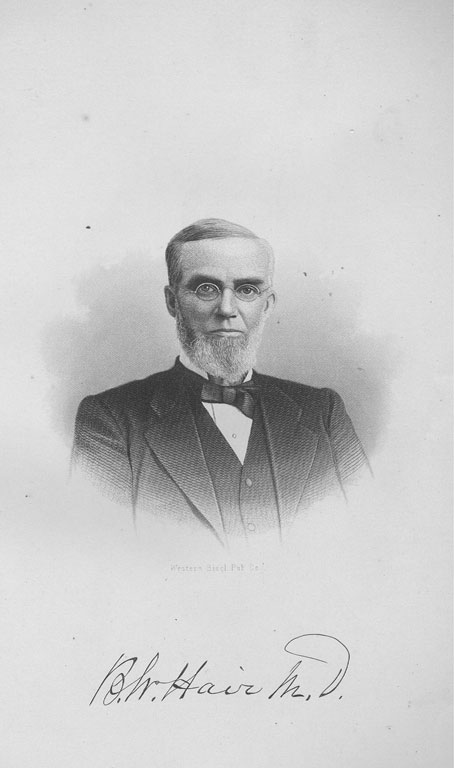
cost ten thousand dollars, and is a large and handsome building. It was afterward sold by the sheriff, and was bought by Daniel Sortman. It is now owned partly by the Odd Fellows. The only surviving members are John W. Erwin, of this city ; 0. S. Witherby, of California ; Samuel Johnson, of Cincinnati ; and Thomas Davis, of Illinois.
The lodge is now located in their own building, on the south-west corner of High and Third Streets, with a membership of one hundred, and from its organization to this date has been able to furnish relief according to the requirements of the laws of Odd Fellows. There is also a German lodge in this city.
B. W. HAIR.
Benjamin W. Hair, M. D., discoverer and manufacturer of " Dr. Hair's Asthma Cure," was born July 26, 1819, in Washington County, Pennsylvania, being the youngest of thirteen children. His parents, James and Rebecca (McCowen) Hair, were both born in Berkeley County, Virginia. A few years after their marriage (about 1806) they removed to Pennsylvania, where they lived the remainder of their days. Farming was their life vocation, being pursued both in Virginia and Pennsylvania. Mr. James Hair was also justice of the peace for thirty-four years of his life. At his hands justice was indeed found, for during this long period as a magistrate, both in Virginia and Pennsylvania, there were, out of hundreds of cases, but six that he did not succeed in compromising, and which finally came to trial. He always used every possible influence to secure an amicable settlement between the contestants, in which he was almost invariably successful. He was a true peace-maker, and for this, and many other excellent traits of his character, he was greatly esteemed and respected by all who knew him. He died while yet holding his office. .His wife had preceded him, having died in 1840.
Two brothers of Dr Hair made themselves widely known in the ministry. They were both Presbyterians. One of them died a few years ago in Chicago, while still laboring in his profession. A circumstance worthy of note, as not hang a parallel, perhaps, in the United States, is connected with the family of Dr. Hair's oldest brother. The widow, with four generations, all females, constituting the entire posterity of Mr. John Hair, are still living in Sigourney, Iowa, making in all five generations.
Dr. Hair attended the common schools until he was nineteen years of age, when he entered Washington College, in Washington County, Pennsylvania, then in charge of the Rev. Dr. McConaha, where he was a schoolmate of Hon. James G. Blaine, and joined him in debate at college societies, where he graduated in 1842, in high standing. He then began the study of medicine in the office of the noted Dr. Biddle, of Monongahela City, Pennsylvania, and in the meantime entered the Ohio Medical College, at Cincinnati, where he graduated as a doctor of medicine in 1845. A location for practice was the next question to determine, and finally Fairview, Hancock County, Virginia, was selected, where he remained actively engaged till 1849. He next removed to Hamilton County, Ohio, remaining in Sharonsville and vicinity till 1853. From that place he moved into Butler County, where, with the exception of four years spent in Princeton, Illinois, and an equal time in Franklin County, Indiana, he has since remained. In 1864, while in Indiana, he went out as assistant surgeon of the One Hundredth United States Infantry, serving in that capacity until the close of the war. He was with the army of the Tennessee, under General Thomas.
Returning to Butler County, he resumed practice, which was continued till 1879, when a new departure in his professional career took place. While in the army he contracted spasmodic asthma, which developed in a few years into an exceedingly severe case. For eleven years there was not a day or night that he did not experience asthmatic paroxysms, and was finally reduced to a mere skeleton. He had, during all these years, been studying the disease carefully, and had made many experiments to ascertain its true nature, the method to alleviate it, and a rational philosophy of cure. But finally, on the 8th of January, 1876, he began treating his case with a remedy which he compounded upon scientific principles, based upon his own observations, study, and experiments. It relieved him immediately, and since the first forty-eight hours succeeding its first application he has not, in a single instance, experienced a recurrence of his malady.
He then began treating other asthmatics, and found that in a very large majority of cases a perfect cure was effected. To test the medicinal powers of his discovery thoroughly, he treated many cases gratuitously all over the country, and the result was that in a short time his medicine met with a general demand, so that in the Spring of 1879, he began the manufacturing of " Dr. Hair's Asthma Cure" in Hamilton, which was carried on with great success till August, 1881, when the enterprise was removed to Cincinnati under the firm name of Hair & Son. Until recently Dr. Hair has supplied his patrons directly, but the demand became so universal that he decided to furnish all druggists instead, by which means a more general distribution of the cure could be effected. It is now known and used all over America, and has been the means of curing thousands of suffering humanity, its discoverer included. Though established but three years, the enterprise is reputed worth upwards of $300,000, of which Dr. Hair & Son are sole proprietors.
Dr. Hair was married September 24, 1844, to Miss Margaretta L. Hamilton, of Florence, Washington County, Pennsylvania, daughter of John and Margaretta Hamilton of that place, farmers by occupation. Mrs. Hair
HAMILTON - 355
died March 4, 1882, leaving three daughters and one son. The oldest is the wife of Virgil Gilchrist, of Cincinnati, her second husband, and was born August 8, 1844. West Anna, wife of the Rev. T. J. McClelland, of Piqua, Ohio, was born January 25, 1847. James W. was born the 10th of May, 1851, and Margaretta R., wife of Robert Cochran, of Millville, Butler County, was born March 4, 1856.
Dr. Hair is a man of great earnestness and enthusiasm in whatever interests him. In temperance work he has been very active and influential. He has devoted much time and spent much money in organizing and sustaining temperance organizations. His work in this direction has been followed by great good, and reflects great credit on him. In Church work he is no less prominent, being one of the largest supporters of the Presbyterian Church in Hamilton. His benevolence in these particilars are but symbols of his relation towards all worthy enterprises. As an illustration of his zeal and liberality, his action in the recent efforts to enforce the Sunday laws will show. He, upon the first resistance being offered to the law, came forward and sustained Mayor Puthoff, and offered to give five hundred dollars, or even one thousand dollars if needed, to enforce the law.
In politics he is an enthusiastic Republican, and never fails to vindicate the principles he espouses. Socially he is genial and hospitable, and with friends self-sacrificing.
ST. JOHN.
St. John's Church was founded about the year 1830, and has had the following ministers : Messrs. Rosenfeld, Hardorf, Clements, Gebel, Fischer, Thomen, Richter, Anker, Grenim, Wetterstroem, Gerwig, Poster, Pfaefflen, Heimech, Gahring, Herrmann, and Stempel. On the 10th of July, 1867, the corner-stone for a new church was laid, and on the 27th of May, 1868, it was consecrated. According to the record, the cost of the church amounted to $28,568. The Rev. Philip Stempel, its pastor, has been here since 1875. The services are in German.
ZION CHURCH.
In 1844 some members seceded from St. John's Church and organiled a new society. Their first meetings were held in a frame building in Rossville, and they also worshiped in the Rossville Presbyterian Church. After several years they began building in Hamilton, diagonally apposite where the church now stands. Some of the walls are still in use. The pastors have been the Rev. Messrs. Hardof, Conradi, G. Grau, F. Groth, from November 14, 1852, to 1861 ; R. Herbst, until 1873 ; and G. H. Trebel. Under Mr. Herbst's pastorate the new church was erected, at a cost of from twenty-eight to thirty thousand dollars. The denomination is Evangelical Lutheran. At its organization the society had eighteen members ; it now has eight hundred and fifty communicants and a voting membership of one hundred and fifteen.
REFORMED CHURCH.
The Reformed Church in this city dates back as far as the 15th of April, 1866, when steps were taken towards its organization. Meetings were held at the German Methodist Episcopal Church every other Sunday until September 30, 1866, and then for two weeks in Rumple's Hall. Services were discontinued till Spring, when they were held for a short time in the Universalist Church. During the latter part of the season they held meetings in the Christian Church, in West Hamilton. An organization was begun at this period, at which F. B. Tomson, Belle Tomson, Ada Tomson, Louisa Bower, Mary M. Wehr, Jesse Jacoby, and John Breitenstein met at the house of Augustus Breidenbach, and constituted the First Reformed Church. F. B. Tomson and John Breitenstein were elected elders; Jesse Jacoby and George Huber, deacons; and F. B. Tomson, Daniel Brosier, and Jesse Jacoby, trustees. The names of those who were not present, but signified their assent, and became members, were Mrs. F. B. Tomson, Mattie Tomson, Maggie Bowerman, Mrs. Sophia Breitenstein, Elizabeth A. Eckert, Mrs. Elizabeth Rothenbush, and George Huber.
On the 11th of September, 1867, the lot on which their house stands was purchased of Thomas Millikin by the pastor, the Rev. G. Z. Mechling, and Jesse Jacoby, on their individual responsibility. It was afterwards deeded to the congregation, and paid for by them. The lot is on the corner of Ross and Third Streets. It is eighty-six and a half feet by one hundred and sixty feet, fronting on Ross, and cost nine hundred dollars. Mr. Mechling at once began canvassing the neighboring Churches for means to erect a building, and met with gratifying success. Fourteen hundred dollars were obtained from Seven-Mile, St. Paul, and Millville. Jesse Jacoby obtained some five hundred dollars in Pennsylvania. The Xenia charge gave one hundred, West Alexandria one hundred and thirty-five, and other Churches contributed liberally. On the 11th of June, 1868, ground was staked off and workmen began at the foundation. The cornerstone was laid on the 30th of August. The building was not completed sufficient to occupy until the 19th of September, 1869. The dedicatory sermon was preached by the Rev. T. P. Bucher. The church is sixty feet long, thirty-eight feet wide, side walls- eighteen feet high, and center of the ceiling twenty-eight feet. It is a very pretty Gothic edifice, the handsomest in town, and cost about eight thousand dollars.
No effort had been made to gather a congregation of size until the church was ready. Yet the body grew slowly. The first year nineteen members were received, the second, four; the third, eight ; the fourth, two; the fifth, eleven ; the sixth, none; the seventh, eighteen. The whole number of members up to 1876 were seventy- seven, and then appearing on the Church rolls forty-six. Number of members dismissed, seven ; deaths, six; removed from the bonds of the congregation, nineteen; dis-
356 - HISTORY OF BUTLER COUNTY.
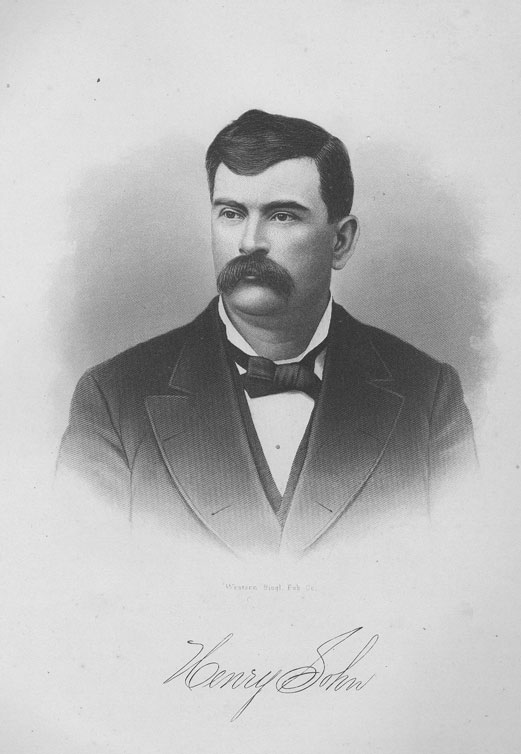
affected, seven. Up to the present time there have been one hundred and five persons on the list. The Church belongs to the Reformed Church in the United States of America, and is commonly known as the German Reformed. Its standard of faith is in the Heidelberg Catechism, and its government is Presbyterian. In connection with the Church is a flourishing Sunday-school. The Rev. G. Z. Mechling has been the pastor since the beginning.
CHRISTIAN HENRY SOHN.
Christian Henry Sohn, of the firm of Sohn & Rentschler, was born in the city of Bissingen, in Wirtemberg, Germany, May 15, 1846. His father, Charles Frederick Sohn, came to America about 1849, and after a brief interval settled in Cincinnati, where he followed the calling of a brewer. About that time the mother cf Christian Henry died, leaving a family of two sons and two daughters, and a year after her death the father sent for his family of little children from Germany, and they were brought over by a cousin. Upon his arrival, J. G. Sohn, the uncle of the boy, took charge of him, keeping him at school until his fourteenth year, when he went to work.
In 1860 he came to Hamilton, being apprenticed to Jacob Rupp, a butcher, and remained with him until the breaking out of the war. Filled with patriotic ardor for his adopted country, he enlisted, but was soon brought back on a writ of habeas corpus, as he had enlisted without the consent of his father, and was only fifteen years of age. In 1863 he went to Cincinnati and engaged as clerk in a grocery store, remaining there until his eighteenth year, when he again enlisted, in Company B, One Hundred and Eighty-first Ohio Regiment. With this regiment he stayed until the 23d of November, 1864. On that day he was wounded in the head by a shell, during the progress of the battle of Murfreesboro. He remained in the hospital at Murfreesboro for about seventy days, when he received a furlough, and returned home, reporting at Columbus. His company was mustered out at Salisbury, North Carolina, and his discharge, which was dated July 14, 1865, was sent to him.
The effects of the wound which he had received were such as to disable him for more than a year, and for that period he was unable to work. That year he remained in Cincinnati, and at its expiration came to Hamilton, where he engaged to work in a brick-yard. He stayed here with Jacob Rupp until 1869, in that year becoming bookkeeper for Henry Eger, in a brewery. In 1875 the firm of Sohn, Rentschler & Balle, founders and manufacturers of shelf hardware, was formed, with a very small capital. Their business rapidly increased., and on July 25, 1876, the first two partners bought out Mr. Balle, and formed a firm under the name of Sohn & Rentschler. Mr. Sohn's partner is G. A. Rentschler, an active and able business man, who is interested in several other enterprises. They make shelf hardware, all kinds of gray iron castings, and machinery to order, having a large and rapidly increasing business. Mr. Sohn has also one-sixth interest in the stock company of Hooven, Owens, Rentschler & Co., manufacturers of portable and stationary engines and threshers; one-fourth of the Phoenix Castor Company, and one-third interest in an ice-house in Fairfield Township, with a capacity of four thousand tons. He is interested in what is known as the Cincinnati Brewing Company. He is a member of Hamilton Lodge, No. 409, of Free and Accepted Masons, and is a prominent man in all social organizations.
He was married the twentieth day of December, 1876, to Anna Sophia Morgenthaler, daughter of Christian Morgenthaler, who was born July 25, 1813. His wife is now thirty-four years of age, having been born in April, 1848. The different concerns in which he is a partner employ about three hundred men. The Ohio Iron Works, as the firm of Sohn & Rentschler is known, started with three thousand dollars, each one contributing a thousand, but the partners have persevered, and by industry and forethought have made the business valuable. They erected their own buildings, the partners themselves working. Mr. Sohn is a shrewd, practical man, and in all his dealings is upright and just, and is considered one of Hamilton's most prominent and enterprising young business men. In society and among his friends he is genial and affable, while in business he is careful, prudent, and foreseeing. From small beginnings their trade has gradually increased, until it has reached large dimensions. Mr. Sohn is an excellent example of a self-made man, and his career shows plainly what can be accomplished by industry and strict attention to business.
JEWISH SYNAGOGUE.
The first organization of the Israelites in this town was in August, 1866, at the residence of Mr. Moses Klein, Mr. Klein being elected president, pro tem., and F. Sternfield, secretary. Mr. Rosenthal, of Dayton, was the first one to officiate at services. Those belonging to this organization were as follows : Jacob Maas, Jacob Grabenhewer, David Koppel, Mayer Roth, Moritz Sauer, Hermann Gugenheimer, Louis Davis, Jonas Hirsch, F. Sternfield, Samuel Ganz. The first place used for public worship was at Morner's building, on High Street. On April 6, 1878, they bought a building lot on Fourth Street, upon which there was erected a synagogue, which was built by the members and the public. Its cost was $2,450. It was dedicated by the Rev. Dr. Wise, of Cincinnati, September 21, 1878.
ST. STEPHEN'S CHURCH.
The first Roman Catholic that ever preached at Hamilton was the Rev. Mr. Hill, who delivered two or three discourses in the court-house in the year 1825. In the early part of the year 1829 the Rev. James Mullin, then of Cincinnati, but who now has charge of St. Peter's
HAMILTON - 357
Church in the city of New Orleans, visited Hamilton, and preached a sermon in the court-house to a large and respectable assembly of people, many of whom had never heard a Roman Catholic preach before. He occasionally visited Hamilton several times afterwards, during that and the succeeding year, and delivered discourses in the court-house to large and attentive audiences. His manner and eloquence, which was of the first order, attracted considerable attention, and tended much to dissipate and do away with the prejudices existing against that denomination of Christians.
The Right Reverend Edward Fenwick, bishop of the diocese of Cincinnati, also delivered two or three discourses, and the Rev. Mr. Montgomery preached several times about the same period. A proposal was made by some of the citizens, that if the Catholics would build a church in Hamilton a lot of ground should be furnished them free of expense. The proposal was acceded to by Bishop Fenwick. A subscription was accordingly put in circulation, and lots numbered 151 and 152 in the town of Hamilton were purchased for the sum of four hundred dollars, which were conveyed to Bishop Fenwick in 1830, in trust for the purpose of erecting a Roman Catholic Church thereon.
At this time there were no persons belonging to the Roman Catholic Church residing in Hamilton, and not more than a dozen known to live within the limits of Butler County. The subscription to purchase the lots was obtained wholly from persons belonging to other denominations, and those who were not attached to any particular church. An additional subscription of three hundred dollars was afterwards obtained to aid in the erection of the building. The lots are beautifully situated, on the corner of Dayton and Second Streets, forming, together, a plat of ground two hundred feet square, the most eligible location for a church in the town. In the year 1832, a brick building in the Gothic style was erected, and inclosed on the ground under the superintendence of Mr. A. White, of Cincinnati. The wood-work for finishing the interior of the building, was got out and prepared in Cincinnati, but when nearly ready to be brought out and put up in the Fall of the year 1833, the carpenter shop of Mr. White was consumed by fire with all the work which had been prepared ready for finishing the interior of the church. Consequently the finishing of the building was delayed for some time. Mr. James Murray was afterwards employed to finish the interior of the building, which was completed in the year 1836.
The church was of brick with a stone foundation, built in the Gothic style, sixty feet long by forty feet wide, and twenty-two feet high to the eaves. The entrance was from Dayton Street by a door on the south. The altar was at the north end. The interior was finished in a plain but neat manner, having pews capable of seating at least five hundred persons. Over the altar was a splendid painting, and on the east a figure of our Savior on the cross as large as life. An excellent organ was obtained and placed in the church. On the south end of the building was a very neat steeple covered with tin and surmounted by a small gilt cross. The whole presented a handsome appearance, the principal defect being that the foundation of the building was not raised high enough from the ground.
A neat brick building, two stories high, with an attic story, was afterwards erected near the south-west corner of the lot, on which a select school was taught. The rest of the building was designed for the accommodation of the officiating priest and others having the immediate charge of the Church.
The number of members belonging to the Roman Catholic Church of Hamilton, in 1844, was about six hundred. In June, 1840, the Rev. Thomas R. Butler arrived at Hamilton and took charge of the Church and congregation, and continued as the officiating priest from that time until about the first of January, 1845, when he removed from Hamilton to St. Louis. During Mr. Butler's residence his urbanity and gentlemanly deportment acquired him the esteem of all those with whom he had intercourse. As a speaker he was eloquent, and as a polemic debater he acquired considerable celebrity.
Up to 1848 the German and English speaking Catholics were united in their services, but there were serious difficulties connected with this mode of worship. Many of the Germans understood no English, and none of the Irish people understood any German. So it was thought advisable to separate, each nationality to have its own church. A plan was laid before the members of the congregation by which it was stipulated that, as the church property then was appraised at six thousand dollars, one of the two parties was to raise three thousand and pay it to the other portion of the congregation, which would go out and erect a new church. The Germans being successful in obtaining subscriptions to that amount, became, by decision of Archbishop Purcell, the owners of the existing church building and the property thereto attached. The Rev. Nicholas Wachter, of the Franciscans, became their first pastor. The congregation increased in numbers steadily until it was found necessary to replace the old church by a new house of worship. In the year 1852 the corner-stone of the present edifice was laid, the church being completed in 1853, at a cost of about twenty thousand dollars, under the supervision and pastorate of the Rev. Pirmin Eberhard. The congregation increased and flourished, it having its own school as early as 1849. In the course of time other buildings, such as a new school, vestry-room, and parsonage, were built, each attended with considerable expense. At present, St. Stephen's is one of the most complete churches of the arch-diocese of Cincinnati, a monument to the zeal and liberality of the German Catholics of Hamilton. The congregation numbers at present three hundred and
358 - HISTORY OF BUTLER COUNTY.
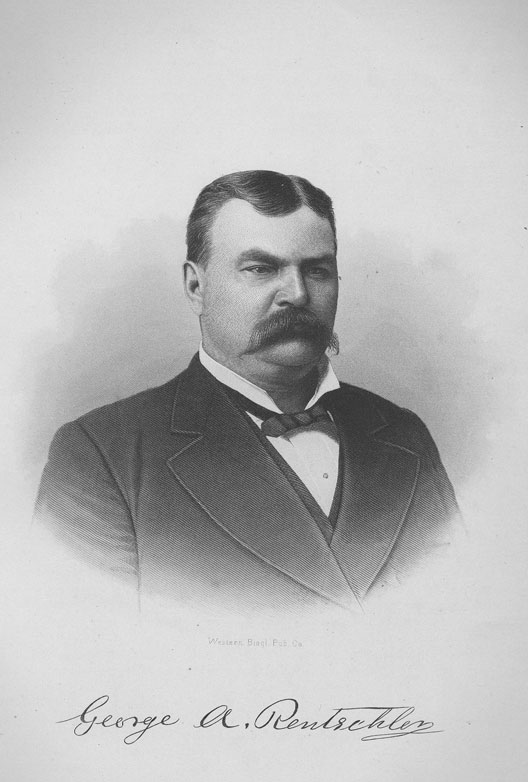
seventy-five families, or very nearly sixteeen hundred souls. Ever since the congregation became entirely German, the Franciscan order has had charge of it. The present pastor is the Rev. Nicholas Holtel.
The school, which is under the supervision of the pastor, is divided into classes for the boys and girls. The male pupils are taught by brothers of the Holy Cross, from Notre Dame, Indiana, while the female pupils are taught by the sisters of Notre Dame. Three hundred and eighty children attend the school, and are taught all the elementary branches. A branch from this Church is known as St. Joseph's, and is situated in the lower part of the town. Its pastor is the Rev. A. Biene. It was organized in 1866. There is a cemetery belonging to St. Stephen's, in which are many handsome monuments.
GEORGE ADAM RENTSCHLER.
George Adana Rentschler was born in Schmee, Wirtemberg, County Calw, Germany, on the 8th of July, 1846, and is the son of Jacob and Catherine Rentschler. His mother died in his infancy, and in 1852 his father, with a family of seven children, came to America, George being the youngest. They first settled in Newark, New Jersey. There he attended school up to the time of his father's death, in 1858. He then commenced to learn the trade of molding and pattern-making, with Oscar Barnett & Co., with whom he remained for seven years, learning the business thoroughly. While serving his time he attended night-school, and supported himself by his earnings.
In 1864 he went to Peru, Indiana, where he was employed at molding for one year. He then removed to Indianapolis, where he had charge of the Novelty Iron Works until 1870. From 1870 to 1871 he was in Cincinnati with Adams & Brith, in charge of their stove foundry. In 1872 he returned to Indianapolis, acting as superinten-dent of the Variety Iron Works, where he remained until their removal to Hamilton in March, 1873. Mr. Rentschler accompanied them and remained in the same position until June, 1875, when the firm of Sohn, Rentschler & Balle was formed. By this time Mr. Rentschler had acquired a vast stock of experience, and he thought he could utilize it more thoroughly for himself than by working for another man. Although the capital of the concern was small, the industry and pains of the partners supplied all defects. Their chief line was shelf hardware. July 25. 1876, Mr. Belle withdrew, and the new firm was known as Sohn & Rentschler, and their establishment as the Ohio Iron Works. In the firm of Hoover, Owens, Rentschler & Co., which manufactures portable and stationary engines and threshers, Mr. Rentschler owns a large interest.
In conjunction with Joseph B. Hughes, now the county auditor, he founded the Royal Pottery Works, which make a class of goods never before attempted in the United States, and of rare beauty and utility. He has also an interest in the Phoenix Caster Company, in an ice-house in Fairfield Township, which will hold four thousand tons, and is interested in what is known as the Cincinnati Brewing Company of Hamilton. The greatest portion of his time, however, is taken up in his iron works. Here they manufacture gray iron castings, make machinery to order, and supply a large line of shelf hardware. It was some time before they were able to obviate the difficulties occasioned by a lack of money, but since that trouble disappeared, they have rapidly increased, year by year, until their business now is of large size.
Mr. Rentschler was married in 1864, at Newark, New Jersey, to Miss Kate Graf, by whom he had two sons. She died December 29, 1869. He is a member of the Blue Lodge of Free and Accepted Masons, of Hamilton, No. 409, and is also a member of Germania Lodge, No. 129, of Odd Fellows, at Indianapolis. It will be seen, therefore, that the enviable position which Mr. Rentschler now occupies is not owing to any advantages given him by his parents or his friends, but is the result of his own hard labor and great capacity for taking trouble. He was only able to invest one thousand dollars in the establishment when it began, but the value of the knowledge he had attained can not be estimated. He is thoroughly informed as to every detail of the business, and has worked at every part of it, so that, if necessity required, he could do the work with his own hands. His judgment is excellent, and he looks after every portion. In manner he is social and genial, and a visitor at once feels at home in his society. Mr. Rentschler is a model of physical strength and manhood, and his standing in business and social circles in the city of Hamilton is of the highest order. Without having any particular early educational advantages, he has qualified himself, by observation and reading, until he has stored his mind with good and useful knowledge; and with his practical experience has no superior in his several lines of business.
WILLIAM HUBER.
Dr. William Huber was born in Lebanon, Pennsylvania, on the 5th of July, 1813. He was educated in the schools in that vicinity, and when fifteen years of age attended an -academy at Lebanon. He began reading medicine when sixteen years old, and attended a course of lectures at the University of New York, in Fairfield, in 1831 and 1832, and a second course at the College of Physicians and Surgeons in New York City, in 1833 and 1834. He was graduated from that institution in 1834, and began the practice of his profession at Lebanon, April 1, 1834. He continued there until ill health compelled him to seek a more congenial climate, and he then came to Columbus, Ohio, where he improved so rapidly that he concluded to remain in this State. He went to West Alexandria, Preble County, where he remained one year, then going to Eaton. There, in company with Dr.
HAMILTON - 359
A. H. Baker, he stayed two years, then coming to Hamilton. He located here in 1841, and has ever since been in the practice of his profession in this town.
Dr. Huber is one of the oldest members of the Butler County Medical Society, and is a member also of the Union District Medical Society. He is a very prominent physician. Dr. Huber was married in 1846 to Miss Mary D. Budd, who was born in New Jersey. They are the parents of eleven children, of whom six survive. He is a member of the Episcopal Church and of the Masonic order.
F. B. PUTHOFF.
Frederick B. Puthoff, mayor of the city of Hamilton, was born at Cincinnati, April 20, 1843. His parents, John Henry and Mary Elizabeth (Borger) Puthoff, were natives of Osnabritck, in Hanover. Mr. and Mrs. Puthoff came to this country about 1834, settling in Cincinnati, where the father soon built up a prosperous business, and where he still lives, at the age of seventy-five. Mrs. Puthoff died in 1879. Frederick B. Puthoff attended the schools of Cincinnati, and at the age of eleven was sent to boarding school at Dayton, where he remained for two years, and exhibited marked proficiency in his studies. He then returned to Cincinnati, where he entered St. Xavier College, being there for two years more. He then was employed as a clerk in different stores, being in this occupation until he had reached his eighteenth year.
He tried to enlist at the beginning of the war, but on account of his age, and from the fact that he had two older brothers already in the service, they refused to take him. Mr. Puthoff did not take the refusal of the recruiting officers to accept him with resignation. He ran away from home and boarded the boat that took the regiment to Ripley, Ohio, where he found his two older brothers, who informed the officers of the circumstances, and requestM them to return him to Cincinnati, which was done. Four months after, he ran away again, joining the commissary department, and acting as one of the clerks. With this department he remained for a year.
He then returned home and began learning the cabinet-maker's trade, at which he continued until of age in 1864. One day shortly after, he left the shop with his working cap and apron on, and walked up to the recruiting office, where he enlisted in the Second Ohio Cavalry, returning to his employer's place in uniform. With other recruits he was sent to Harper's Ferry, after being drilled for some time at Columbus, and was placed in the brigade under command of General Custer. They remained in Virginia until the close of the war, and after the grand review Nat Washington were sent to Arkansas.
Upon his return home to Cincinnati he engaged as a salesman in the furniture business with Duncan & Williams, wholesale dealers, remaining there until 1867. He was married in 1867, and every thing went on well. He was then living in St. Louis, his employers in that place being Comstock & Haywood. After being 'there some mouths be was sent by them to Peoria, Illinois, to act as salesman and assistant manager of a branch house. His wife died the year following, on the 14th of May, 1868, one week after giving birth to twins.
Mr. Puthoff remained in Peoria until 1870, when he came to Hamilton, where a brother was engaged in the drug business. Here also was his daughter. With what means he had saved from his salary as salesman he bought a stock of goods and opened a hat store, continuing in that business until May, 1881. A short time after his coming to the town his fellow-citizens perceived that he had a natural adaptability to the public service. He was always ready for committee work or for labor at the polls, and spoke readily and effectively. He was elected a member of the city council from the First Ward in 1878, and signalized his term of two years in that capacity by vigorous and successful efforts for sewerage, parks, improvements of streets, and other municipal improvements.He refused a re-election, which was proffered him, but his popularity brought him out as a candidate, against his own wishes, for the State Legislature, but he failed to secure the nomination in convention.
In 1881 he was named for the office of mayor, and was triumphantly elected, receiving the largest majority ever given in the city—six hundred. The candidate on the other side was the popular M. N. Maginnis. During his administration of affairs the city has been distinguished by its quiet and the respect paid to law. The death of Garfield happened since he was in office. Every preparation had been made here for celebrating the anniversary of the nation's birth with unusual distinction. Mayor Puthoff issued a manifesto requesting the citizens to desist from the public demonstrations intended. A citizens' meeting was called by him to express sorrow and detestation of the crime, and at this meeting the mayor spoke weightily and with feeling. The proposed celebration was abandoned. He exerted himself at the time of the proposed execution of the new liquor law by his efforts to secure a hearty and free submission to it, and to allay any animosities that might have sprung from this cause.
Mayor Puthoff is a member of the Knights of Honor and the Knights and Ladies of Honor, and is a member of the Soldiers and Sailors' Association. He was married to his second and present wife, Helen McCafferty, of Macomb, Illinois, but a native of Nauvoo, in the same State, on the 18th of July, 1870. Three children by this wife are living. The oldest, Fred. L., is nine years of age; the second. Mary E., died at the age of three; Eva H. is two years of age; and the youngest, a little girl a year old. Anna M., the daughter of the first wife, is fourteen years of age, and attends a boarding school in Cincinnati. Mr. Puthoff has well discharged the duties of the offices confided to him, and has shown by his ability his capacity to take other and larger trusts.
360 - HISTORY OF BUTLER COUNTY.
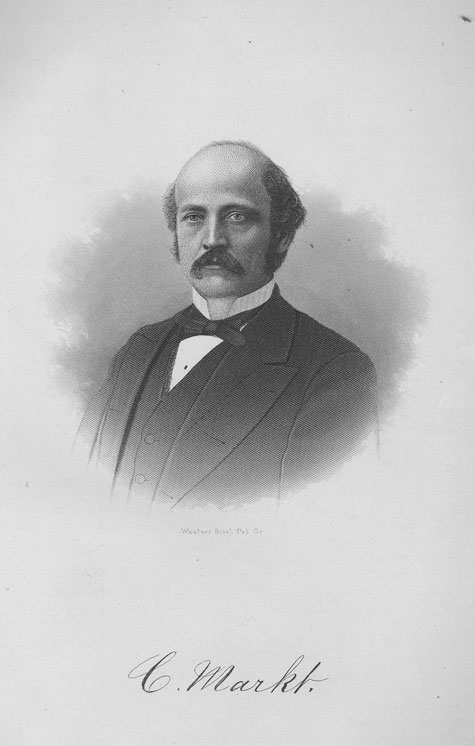
CONSTANTINE MARKT.
Constantine Markt, M. D., president of the Eclectic Medical Society of the- State of Ohio, is a native of Spaichingen, in the kingdom of Wirtemberg, Germany, where he was born on the 25th of February, 1832. His father, Karl Markt, was a dealer in clothing, and for sixteen years was one of the twelve associate judges of the district, to whom was confided the duty of sitting in judgment at the trial of offenders, two with the supreme judge constituting a quorum. His mother was named Mary. One of Dr Markt's brothers had been forced to leave Germany on account of political troubles in 1848, and had settled in Thompson, Lake County, Ohio. He wrote repeatedly to his father to come over with his family, and settle here also. Constantine was opposed to this, but after the death of his mother, which happened in 1852, he abandoned opposition to the plan, and, with his father, one brother, and three sisters, embarked for America in 1854. What they should do in the New World lie did not know. He had received his early education in the schools of his native town, and at the age of fourteen began attending a seminary, where he prepared himself for the university, and where he graduated three years later, having taken the classical course. He was then made a teacher under the government, remaining attentive to his duties until his departure for America.
Upon their arrival, Mr. Markt found that the brother who had preceded him was not in a situation to render them much aid, and the young man determined that to his toil they should owe their subsistence. As yet he could not see his way clearly. The most imperative requisite for a livelihood is a knowledge of the language of the people among whom it is the lot of a stranger to be cast, and of English lie as yet knew nothing. He soon, however, was in a way to remedy this defect, as a short time after he arrived he made the acquaintance of Postmaster Mead, an old and esteemed citizen of that town, with whom he exchanged lessons in music to his little girl for English. It was not long after he reached Thompson that his new friend perceived that he possessed musical attainments far beyond the common, and that as a performer upon the piano he much surpassed any one in the neighborhood. In truth, Mr. Markt had been thoroughly groundei in the principles of music in Germany, and had been well known in the places in which he had lived as an amateur of promise. He had, however, never intended to become a professional musician, but the quick eye of Mr. Mead soon saw that here.was the path that would lead him to a livelihood and competence. He took Mr. Markt to Painesville, sixteen miles distant, where he performed before the musical young ladies of the town, met for that purpose. From that time he had no fears of his future. He then removed to Painesville with the rest of the family, and there established himself. He taught assiduously during the day, and in the evening studied medicine, for which he had had an inclination from boyhood, with Dr. Carpender. He cared for his family as long as they needed it—his father until his death in 1865, and his sisters until their marriage.
In 1856, having attained sufficient means and a competent knowledge of the English tongue, he began attending lectures at the Eclectic Medical College, in Cincinnati, under charge of Dr. Cleveland, who died in Nashville, Tennessee, during the war, and was graduated in 1858. He at once came to Hamilton, and entered upon practice, being married the same year. Here he was at once successful. His easy and agreeable manners, his imperturbable coolness, his command of all the resources of the physician's art, at once made him a favorite. A year after coming here he was made brigade- surgeon of this district for the militia. During the war he was influential and active. He attended assiduously to his calling for many years, but finally, after a long attack of illness, became convinced that he had given too intense a devotion to his profession. He resolved to abandon the duties of a visiting physician, and bought the drug-store formerly owned by J. W. Baldridge, No. 13 Third Street, which had been established years before by John 0. Brown. To propose, however, is one thing, and to do is another. Many of his old patients refused to leave him, and he found that he had, in addition to his medical practice, a drug-store on his hands. He had also, during his many years of residence here, acquired great skill as an operator in difficult cases of surgery, and in this respect his reputation has increased with time.
He was married in 1858 to Miss Josephine C. Carpender, daughter of his old preceptor, Dr. Joseph Brown Carpender (who was a man of much prominence in the medical profession as well as in other ways). He was a native of Milton, Vermont, and the son of a physician. Mrs. Caroline Jackson Carpender was the mother. Dr. Carpender graduated at the Burlington Medical College about 1826. He came West in 1835, and settled in Wellsville, Erie County, Pennsylvania, but in 1843 went to Painesville, Ohio, where he practiced until his death, in 1861, at the age of fifty-five. He had been mayor of Painesville, and for several years president of the school board. He was a man of great probity of character, and for years exerted a marked influence in the affairs of the town. Mrs. Carpender died in 1865. She was also a native of Milton, Vermont. Dr. and Mrs. Markt have had three children, two of whom are now living. Adelaide C. Markt was born July 25, 1869, and Karl Constantine, August 16, 1873. Mrs. Markt is a Presbyterian in religion, and a lady who enjoys the highest esteem of all who have the pleasure of her acquaintance, and is considered one of the most popular in the social circles of Hamilton. She is secretary of the Butler County Children's Home, and one of the managers. She is one of its founders, and a
HAMILTON - 361
charter member. She is active in Church and missionary work. Besides what we have mentioned above, Dr. Markt has taken an active interest in every thing that benefits society.
He is a member of the Miami Medical Society, the State Medical Association (of which he is president), the National Medical Society, president of the Physicians' Protective Association of Hamilton, and county examining physician of the Royal Arcanum and the Knights of Honor, and a contributor to various medical periodicals. He is a member of the Ancient Order of United Workmen, the Knights of Honor, and the Royal Arcanum. He was the leader of the Mcennerchor in this city for several years, and brought it to a high stage of excellence. Since entering upon medicine he has found but little leisure for this favorite pursuit. He is the secretary of the board of health, and has been so for eighteen years ; has been a member of the school board, and has filled other offices of prominence and responsibility. In person Dr. Markt is tall and commanding, in manners courteous and obliging, and in business thorough and exact. No man is better esteemed in Hamilton, and when a friend has once been made by him he is always kept.
EPISCOPAL CHURCH.
In the year 1834 a few persons, numbering about twenty-four, belonging to the Episcopal Church, living in Hamilton and the vicinity, united and formed themselves into a congregation, and on the 13th of August, 1834, an election was held, which resulted in the choice of William A. Krugg and Isaac Howe wardens; James Reily, George Keck, and Frederick P. Narden, vestrymen ; and William G. Fields register. At the same meeting James Reily was appointed a committee to solicit the'Legislature to grant a charter incorporating' the society ; and in March, 1835, the Legislature passed a law, by which William A. Krugg, Isaac Howe, Frederick P. Narden, George and James Reily were incorporated under the name of " The Wardens and Vestrymen of the parish of St. Matthew's Church, in the town of Hamilton and Rossville."
The society purchased the north part of lot No. 82, at the intersection of Front and Basin Streets, in the town of Hamilton, and made arrangements for the erection of a house of public worship. Lewis D. Campbell, William A. Krugg, George Keck, Frederick P. Nardeu, and Isaac Howe were appointed a committee to superintend the building. ,The building of the church was commenced in 1835. George Brown was the carpenter, and Isaac Howe the bricklayer.
The church was situated on the angling corner from the south-west corner of the public square, and was a brick building, sixty feet long on Basin Street, by forty feet wide on Front Street. There was a basement story under the whole building, divided into different apartments for vestry rooms and Sunday-schools. The entrance to the church was from Front Street, by two doors on the east, entering into a vestibule. The pulpit was on the west end of the church. Two aisles ran the whole length of the church from east to west, and the remainder of the floor was divided into fifty-four pews, capable of seating five hundred persons. There was also a gallery and seats for the choir on the east, and a cupola on the east end of the church. It was a handsome and neat building. The cost of erecting the church was $2,350, the amount being raised by subscription. The members belonging to the society being few in number, they were aided by those of other denominations, and the citizens generally.
The first rector of the Church was the Rev. Seth Davis, who settled in Hamilton and commenced his duties in 1837. The church was consecrated to the service of Almighty God by the Right Reverend Charles P. Mcllvaine, bishop of the diocese of Ohio, on the 5th of October, 1837.
The Rev. Mr. Davis remained rector of the Church until some time in the year 1839, when he was succeeded by the Rev. Henry Paine, who remained until May, 1843, when he relinquished his charge and removed from Hamilton. The number of members belonging to the Church at that time was about twenty-four.
The Church, however, was heavily in debt, and finally the building was sold to the Catholics, who tore it down and erected a new church in its stead, some of the walls of the old building, however, being still preserved. The number of members was at all times small, and periods of several months often passed without preaching. Latterly they bought the Baptist Church on Third Street, near Dayton ; but that, too, was encumbered with a mortgage and was sold. The edifice has now been altered for commercial uses. No meetings have lately been held.
DR. S. H. POTTER.
Dr. Stephen H. Potter is one of the senior physicians and surgeons of Hamilton and vicinity. He was born in Cortland County, New York, November 12, 1812. His parents were Stephen and Lydia Potter, who were noted among the early pioneers of Central New York for their enterprise, industry, and integrity. Until his seventeenth year he was occupied on his father's farm, attending the common schools about one-third of the year, his parents then giving him his time, which he employed in improving his education, working in Summers and teaching school during the Winters.
At the age of twenty-one, in March, 1833, he was employed as principal of a high school at Canandaigua, New York, with three assistants, remaining there successfully two years and four months. The next September, after engaging in this school, he also commenced the study of medicine with Dr. E. B. Carr, reciting to him an hour daily, Sundays excepted, until July, 1837, when, in order to pursue his studies more favorably, he went
362 - HISTORY OF BUTLER COUNTY.
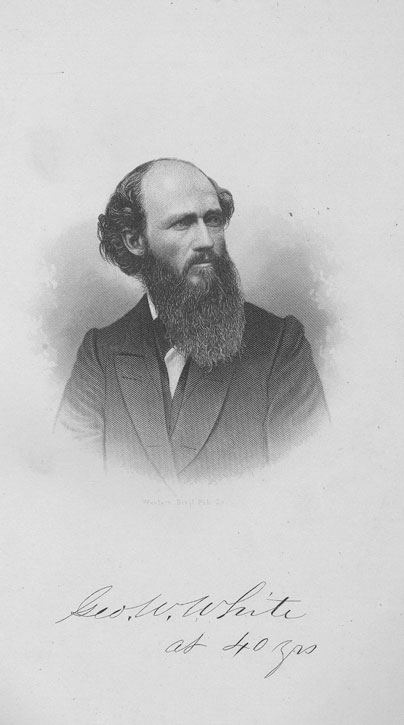
to Olean, New York with his brother-in-law, Dr. E. W. Finn, who owned a large drug store and had an extensive practice. Here he devoted his time industriously to these pursuits until September, 1837, when with two other medical students he came to Ohio and attended a medical college six months, graduating honorably, March 15, 1838. He immediately settled at Canal Winchester, in the Scioto valley, where he enjoyed a large practice until December, 1844,when his father was entirely disabled by palsy, which necessitated his return to Cortland, his native place. Here he soon received a large patronage among his early school companions and friends, until May, 1849, when his father having died and other relatives being provided for, he settled in the city of Syracuse, New York. Here with others he organized and had incorporated the Syracuse Medical College, and established, edited, and published the Syracuse Medical and Surgical Journal, a monthly. The first term of the institution opened the next November 5th, with eighty-seven actual matriculants, and continued two terms each year, of four months each, or thirteen terms, until June, 1855. In February, 1852, to improve his knowledge of surgery, Dr. Potter went to Philadelphia, and attended the clinics in the Pennsylvania hospital, and surgical lectures in the medical department of the University of Pennsylvania, until the latter part of May.
He continued dean of the Syracuse Medical College and in charge of the Journal until September, 1855, when his wife suffered incipient consumption, rendering it necessary to return to this valley, her native place, hoping that the change might restore her health. He arranged with his partner, Dr. F. W. Walton, now of Piqua, Ohio, to settle their business. Dr. Potter then went to Cincinnati, where he accepted the position of lecturer on principles and practice, in the American Medical College, where he continued publishing his journal, and attending the clinics twice weekly in the Commercial Hospital of that city until June, 1856, when he resigned, sold his journal, and settled with his family permanently in this city, where he has ever since been in active practice, with the exception of two brief intervals. At the urgent solicitation of friends, in May, 1873, he went to St. Louis, Missouri, and assisted in organizing the American Medical College and the American Medical Journal, which have both enjoyed surprising patronage. The former is now holding its eighteenth term, and has become a leading institution in the West, and the Journal has attained a large circulation.
The doctor was for four consecutive years president of the Ohio State Eclectic Medical Society, and the past two its recording secretary ; he was one of the incorporators and first vice-president of the National Eclectic Medical Association at Chicago in 1870, which organization has since grown to thirty State auxiliary societies, with prosperous working members ; and has been the president the most of the time for about twenty-two years of the Miami Medical Society. He has also been for four years a member of the city council, and is at present a member of the board of health.
The doctor has been married four times, each time happily; has reared seven children to adult age, and, unfortunately, lost as many in infancy and childhood. He is the well-known author of a " Compendium of the Principles and Practice of Medicine," a book of five hundred pages, a work full of research and a marvel of condensation, for ready reference, and invaluable to busy practitioners and medical students. It has a large demand, having passed two editions, and has been adopted as a text-book in our medical colleges.
Perhaps the most notable incident in the extended and eventful life of Dr. Potter was the rescue of a fugitive slave named Jerry in Syracuse, New York, about 1852. It occurred soon after the fugitive slave law was passed, and on the occasion of holding a national antislavery convention at that place. Daniel Webster hall recently delivered a speech to an immense concourse there, threatening that " when this convention thronged the city, a noted fugitive would be arrested and taken back to slavery. The United States Government would teach the people that there was potency in law." Four United States marshals had been detailed from as many adjacent cities, and the whole police force of Syracuse were ready. Jerry was arrested and placed in chains. About thirty thousand people were waiting to witness the scene. The man, with blue eyes, red cheeks, and brown curly hair, with no other semblance of a negro, was taken away from the officers by the mob, and finally placed by Dr. Potter in the grounds of a residence inhabited by a stiff pro-slavery man, where the most active search failed to find him. After the lapse of a week, and search having been made from house to house, when detection was imminent, the doctor arranged with Jerry's host to drive in with a meat wagon, got Jerry in, and, covered with blankets, he drove before the door of the Syracuse House, hitched, went in with the doctor, took cigars, and drove out through the city about 4 P. M. in beautiful sunshine, no one suspecting the presence of Jerry. After reaching Brewerton, seventeen miles, Dr. Potter took Jerry in his carriage, sending the team back, and conveyed the fugitive to Mexicoville and by the underground railroad to a small harbor on Lake Ontario, whence he obtained a passage on a small sailing vessel to Canada. No more noted fugitive slave case ever occur red in the United States, and in it the doctor was the principal agent of success.
JOHN C. McKEMY.
John C. McKemy, late judge of the common pleas court in Darke County, but now a resident of Hamilton, was born May 5, 1835, in Lexington, Virginia. His father and mother, William and Elizabeth (Kirkpatrick) McKemy, were both natives of Virginia, and de-
HAMILTON - 363
scendants of the earliest settlers of that State. Both are now dead, the former having died April 8, 1882, aged seventy-nine, and the latter in December, 1878, at the age of sixty-nine. Farming was their life vocation, and they resided in their native State until death. W. D. McKemy, a brother of
John C., who was educated by the latter, after serving in the rebel army throughout the Rebellion, and for a long time a prisoner, being captured at the battle of the Wilderness, is now judge of probate at Dayton, and a lawyer of excellent ability.
John C. McKemy remained at home upon his father's farm until 1855, when he came to Ohio and located in Darke County, where he labored on a farm during the Summer and attended school in the Winter. His circumstances were such as to deny him the privilege of a collegiate education, but he made the best of what opportunities he had, and gained a good, practical knowledge of books. In 1858 he entered the law office of Evan Baker, of Greenville, as a student, and after two years of arduous study, was admitted to the bar of Darke County in 1860. He immediately established himself in practice in Greenville, making his mark at once, and in 1865 formed a partnership with Mr. D. L. Meeker, of that place. This connection was continued up to 1866, when Mr. McKemy was elected probate judge of his county. His ability as a lawyer, and the judicial quality of his mind were soon, however, to elevate him to a higher position in his profession than he had previously held. In 1868 he was elected judge of the common pleas court, to accept which he resigned his position as probate judge.
Judge McKemy remained on the bench till the Fall of 1872, when he resigned, with the determination to resume practice. He established himself at Dayton, where the firm of McKemy & Nauerth existed till 1876. He then removed to Hamilton, where he has since remained in successful professional pursuits. During the four years in which Judge McKemy presided as common pleas judge there were perpetrated within his circuit the greatest number of terrible murders and crimes ever known in the history of the county. The state of affairs was dreadful. Six months of the year were of necessity devoted to the trial of criminal cases. Judge McKemy did not shrink from the responsibility. Among those which came before him were the famous McGehean and Licklider murder cases, and many others of aggravated character. Substantial justice was attained, and the purification of the community was largely owing to his strenuous efforts. There were also several very important civil actions tried before Judge McKemy, in which he did himself great honor. One particularly worthy of mention, was tried in Dayton, involving the rights of the veterans in the Soldiers' Home of that city to vote. Judge McKemy decided that they had no right to exercise the elective franchise in that place, and his decision was sustained by the Supreme Court of Ohio. However, Congress subsequently passed a law granting to them that privilege, which they now enjoy.
Probably no other judge in the State within a period of equal length has been obliged to sit in judgment in so many cases of equal weight and importance as did Judge McKemy from 1868 to 1872, in the first subdivision of the Second Judicial District of Ohio, trials in which public feeling ran high, and in which personal sympathies and prejudices placed the lives of men involved in them in actual jeopardy. Since his retirement from the bench Judge McKemy has been an attorney in nearly every important case tried in Hamilton and the neighboring cities. He was in the noted Dickey—Tytus breach-ofpromise and seduction case, and also assisted in the trial of the State vs. John Francis, for murder, which was transferred from Montgomery County to Hamilton on a change of venue. He was also one of the attorneys in the settlement of the Beatty estate, the largest ever brought into the courts of Butler County.
For years Judge McKemy has been a very active and influential Democrat, and up to within a few years was one of the leaders of his party in his own and surrounding counties. He served as chairman of several Democratic conventions, and in several presidential campaigns canvassed both Ohio and Indiana as a speaker. His life has been one of activity and industry, which, coupled with his native ability, has made him not only an excellent lawyer and able judge, but successful in pecuniary affairs. He is the possessor of considerable real estate in Hamilton and other places, besides having an interest in four silver mines in Colorado, two of which are in successful operation, and the others are under process of tunneling. He is a member of the Knights of Honor and the Ancient Order of United Workmen.
Judge McKemy was married December 6, 1861, to Miss Mary A. Wiley, of Darke County, daughter of Caleb and Elizabeth Wiley-. Mr. and Mrs. Wiley were both natives of Virginia, though they removed to Ohio when young. They have lived on one farm for about sixty years. The former is eighty-three years Of age, and the latter sixty-three. Of this union there are seven children now living. The oldest, Fannie Belle, born in 1865 ; Ella J., born 1866 ; Pearl C., born in 1868 ; William C., in 1875; Florence May, in 1876; Blanche, in 1880, and the youngest in 1882.
SAMUEL DAVIDSON.
Samuel Davidson was born in Portage County, Ohio, June 10, 1825, and was the second son of Patrick and Jane (Custard) Davidson. He is of Scotch and German descent. With his parents, he moved to Mercer County, Pennsylvania, about 1832 or 1833, and was educated in the common schools. In the Spring of 1840 he began an apprenticeship of four years at the cabinet and furniture trade, which he acquired, working as a journeyman some three years. He then learned the business of
364 - HISTORY OF BUTLER COUNTY.
a mill-wright, an occupation which he followed till 1856. In the Spring of that year he came to Hamilton, taking charge of a portable saw-mill and machine shop. At this he continued till 1862, then organizing the firm of Davidson & Co., founders of Cincinnati, continuing there till 1865. He entered into partnership with Bernhard Stemps, in 1865, in the stove, tin, and hardware business, which lasted till 1870. In the Spring of 1872 he began business in his present location. Although small at first, it has grown to large proportions. It embraces hardware, grates, and mantels, and agricultural implements.
Mr. Davidson was married, in 1849, to Miss Amanda Smith, and they were the parents of two children, both deceased. He and his wife are members of the Methodist Episcopal Church. Mr. Davidson is a member of the Masonic order. He has always declined office, but in 1861 was a member of the city council, and in 1865 was again a member, being elected president of the board. He had no start in life, but is entirely self-made.
GEORGE W. WHITE.
George W. White, the well-known artist of this city, was born on the 8th of November, 1826, at Oxford. His father, George G. White, was a native of Virginia, and emigrated at an early age to Ohio, settling in Fairfield Township, near Black Bottom, in the year 1800. In 1824 he became postmaster of the village of Oxford, continuing in office some twenty-five years. Here George W. White began his first attempts at painting, which it is believed, are mostly destroyed. Ir. Higgins, who resides in the village, was the first to encourage him in the idea of becoming a painter, and gave him a lump of crude umber, gamboge, and Prussian blue, with some white lead. With these crude appliances he began a picture on a piece of unprepared bed-ticking, and placing it on the house-top to dry. His first essay at painting heads was made in Hamilton, iu the year 1840, with S. S. Walker, under whose direction he was placed a short time, when he became ill from close confinement, on recovery being sent to the Miami University as a student. Prof. Moffatt, seeing his predilection, advised him to continue the study of art. Although his father was unfavorable to this course of life, he supplied his son with means to go to Cincinnati, where he entered upon an artist's career in 1843. He met with but little encouragement. The painters all assured him that the life of an artist was "a starving one," and he was obliged to catch up what instruction he could from the others, not being able to afford regular lessons.
His scanty means were soon exhausted, and he began traveling as a negro minstrel. This was then new, and he went through the country with Webb's Serenaders and Sable Sisters, following this with a trip on the Ohio and Mississippi with a show company, comprising minstrels, tumblers, and athletes. At New Orleans the company disbanded in trouble, and White returned to
Cincinnati and engaged with Rockwell's Amphitheater, on the site where the Gazette office now is. Here he sang and played nightly in the saw-dust of the arena, under the cover of burnt cork. This was his last appearance in public in this capacity. He resumed the pencil, and returned for a season to his native village; where he painted cabinet heads of all who would sit, at five and ten dollars a head. He returned to Cincinnati in 1847, and took rooms in the Apollo Building, at the corner of Fifth and Walnut, which was at that time the retreat of several meritorious artists, amongst whom we might name Beard, Brannon, Miller, Eaton, Duncanson, Whittridge, Johnson, Tom Jones, the sculptor, and others. Mr. White had as his room-mate W. L. Sonntag, the landscape painter, who is now living in New York City. The first picture which Mr. White ventured to place before the public was a half-length portrait of Julia Dean, the celebrated actress, afterward known as Julia Dean Hayne. She was then the city's favorite, and her picture attracted wide attention. She was represented as Virginia in the play of the Roman Father. From that time on he continued to paint portraits, landscapes, and so on ; in fact, any kind of work was gladly received. Some of these canvases were the joint productions of White and Sonntag, who, when not engaged in painting, were skirmishing about for something to eat. They suffered keenly from the distresses and difficulties which usually attend this class of young and undistinguished painters, and were forced to do whatever offered. Occasionally they decorated omnibuses and railroad cars, and at other times painted scenes in the Museum Theater.
Mr. White became a member of the Artists' Union on its formation, which afforded him a sale for a number of his pictures. In the Summer of 1848 he painted the " Greek Slave," two pictures, embodying the front and rear views, with the matchless profile seen to equal advantage in both. This effort placed him favorably before the public as an artist. The pictures, after being shown in the East and West, were finally taken to New York and sold for a thousand dollars apiece. He continued painting, turning out some fine work occasionally, among which were his pictures of " Musidora," "Helen McGregor," "Beauty's Reverie," " Galbina," "Undine," and " Ophelia." Among his portraits at that time were those of the Rev. Thomas H. Stockton and Edwin Forrest, the actor. At the burning of Wood's Museum, in 1857, these and many other works of the artist were destroyed. They represented the labor of years. He had resided for some time in Covington, when he was induced by his friends to go to New York City. After an experience of a year he returned, setting up his easel in Cincinnati, and shortly after painting "Louis Kossuth" and "Lola Montez." In 1857 Mr. White came to Hamilton, where he has since remained, excepting during the Rebellion, when he was in Cincinnati. He met with
HAMILTON - 365
almost con employment, and received high and flattering encouragement from patrons at home and abroad. Among the most notable of his pictures at that time were those of General Grant and General Sherman.
He was married in 1866 to Miss Mary, daughter of the late Major John Crane, an old resident of Hamilton. Mrs. White died in 1872, leaving one son. Mr. White, like most painters of the day, depends for a living on painting portraits and teaching the art, in which he has been generously supported by patrons and friends.
JAMES T. GRAY.
James Thompson Gray, of Reily Township, was born in Franklin County, Indiana, December 27, 1819, removing to this county in 1833. His parents were Samuel Gray and Margaret Hiles. He was married on the second day of March, 1843, to Martha Ann Hidlay, daughter of Henry and Sarah Hidlay, who was born in Butler County in 1824. They have had five children. Sarah Eliza was born January 14, 1844 ; Phebe Harriet, November 4, 1846; Samuel Lerton, November 16, 1848; John Dinborn, April 19, 1854; and James Elmore, April 11, 1858.. Mr. Gray was elected township trustee in 1852, and held the office for eight consecutive years. In October, 1881, he was elected county treasurer, and was to have taken his seat on the first Monday in September, 1882, but died very suddenly some three weeks before. Mr. Gray followed the business of buggy and carriage blacksmith.
ARTHUR W. ELLIOTT.
The Rev. Arthur W. Elliott was the most famous of the early Methodist preachers in this county. Although others preceded him, he was the contemporary of those who made the beginnings and first uttered the Word of God to the hardy pioneers of this county. He was born in the county of Baltimore, in the State of Maryland, on the 22d of February, 1784. At the age of eighteen, moved by the spirit of adventure, he fell in with the tide of emigration, just then beginning to set powerfully toward the great Northwest Territory. On horseback he crossed the Alleghenies, and continued his course westward until he reached the Miami Valley, where he determined to make his future home. He went back to Maryland soon after, where he was married in "1804, and in the year 1805 returned, settling in Liberty Township. Here he remained for many years.
In 1806 an event took place which gave a new current to his thoughts, and changed his whole character and life. He was converted, and after a brief time became a local preacher in the Methodist Episcopal Church. He was admitted in the traveling connection in 1818. From the beginning, however, he devoted himself almost entirely to the work of the ministry, and his labors for the Church of his love were more strenuous and more enduring than any other form of labor. He had pur chased a farm on his first arrival, which was swept away by the duplicity of one of his supposed friends. With an effort, he made another start, in which he was successful, and he was a farmer as well as preacher for many years.
He was the founder of the Spring Church, the earliest Methodist organization in Eastern Butler. He was a man of powerful frame, and with great energy and force. As a preacher he was a man of great fervor and power ; he moved his audiences at his will, and many were converted under his ministrations. He was a man of wit and humor, and many of his sayings are still preserved by those who were fortunate enough to hear him. He took a decided part in politics, at a time when that was regarded as far more unseemly than now. He was a Whig, and as a Whig speaker he accompanied General Harrison on his famous electioneering campaign of 1840. He was an arden.., Mason, and was a member of that organization for more than forty years, in which society he was the grand chaplain of the Grand Lodge of Ohio. In 1854 he removed to Paris, Illinois, where he died January 18, 1858. He had seen his work prosper ; his Church, at the time of his birth, had only ninety-three preachers in the United States, but at the time of his death it had 10,794. Few had done more for it than he had.
EVAN EVANS.
Evan Evans, of Morgan Township, was there born May 2, 1816, being the youngest son of William and Jane Evans. William Evans was a native of Wales, settling in Butler County about 1802. He reared a family of six children, of whom four are living, and died in 1821. His son received a limited education in the common schools, and was brought up to farming. At thirteen years of 'age he began looking out for himself, going to work for others. He was married May 28, 1842, to Miss Anna Mering, daughter of John Mering, a former well-known resident of Morgan Township. Mrs. Evans was born in Morgan Township in 1824. They were the parents of eight children, of whom seven are living. William E. is a resident of Jasper County, Missouri ; John M. is a farmer of Morgan Township; Elizabeth J. is now the wife of A. L. Scott ; Emma M. was the wife of Erastus Robinson, and died in February, 1877, in her nineteenth year ; Albert E. is at home, fitting himself for the medical profession; Cora Belle, Spencer E., and Chester C. are still under the paternal roof.
After marriage Mr. Evans located on a partially improved place in Morgan Township, and bought and sold five different farms in Morgan Township, settling on the John Mering homestead in 1849, where he has since resided. There are one hundred and sixty acres in this place, and in Missouri five hundred. He has held all the township offices, and lately has acted much as administrator and assignee. He is a member of the Butler County Agricultural Society, and for the past ten years
HAMILTON - 365
almost constant employment, and received high and flattering encouragement from patrons at home and abroad. Among the most notable of his pictures at that time were those of General Grant and General Sherman.
He was married in 1866 to Miss Mary, daughter of the late Major John Crane, an old resident of Hamilton. Mrs. White died in 1872, leaving one son. Mr. White, like most painters of the day, depends for a living on painting portraits and teaching the art, in which he has been generously supported by patrons and friends.
JAMES T. GRAY.
James Thompson Gray, of Reily Township, was born in Franklin County, Indiana, December 27, 1819, removing to this county in 1833. His parents were Samuel Gray and Margaret Hiles. He was married on the second day of March, 1843, to Martha Ann Hidlay, daughter of Henry and Sarah Hidlay, who was born in Butler County in 1824. They have had five children. Sarah Eliza was born January 14, 1844 ; Phebe Harriet, November 4, 1846 ; Samuel Lerton, November 16, 1848; John Dinborn, April 19, 1854; and James Elmore, April 11, 1858. Mr. Gray was elected township trustee in 1852, and held the office for eight consecutive years. In October, 1881, he was elected county treasurer, and was to have taken his seat on the first Monday in September, 1882, but died very suddenly some three weeks before. Mr. Gray followed the business of buggy and carriage blacksmith.
ARTHUR W. ELLIOTT.
The Rev. Arthur W. Elliott was the most famous of the early Methodist preachers in this county. Although others preceded him, he was the contemporary of those who made the beginnings and first uttered the Word of God to the hardy pioneers of this county. He was born in the county of Baltimore, in the State of Maryland, on the 22d of February, 1784. At the age of eighteen, moved by the spirit of adventure, he fell in with the tide of emigration, just then beginning to set powerfully toward the great Northwest Territory. On horseback he crossed the Alleghanies, and continued his course westward until he reached the Miami Valley, where he determined to make his future home. He went back to Maryland soon after, where he was married in 11804, and in the year 1805 returned, settling in Liberty Township. Here he remained for many years.
In 1806 an event took place which gave a new current to his thoughts, and changed his whole character and life. He was converted, and after a brief time became a local preacher in the Methodist Episcopal Church. He was admitted in the traveling connection in 1818. From the beginning, however, he devoted himself almost entirely to the work of the ministry, and his labors for the Church of his love were more strenuous and more enduring than any other form of labor. He had pur chased a farm on his first arrival, which was swept away by the duplicity of one of his supposed friends. With an effort, he made another start, in which he was successful, and he was a farmer as well as preacher for many years.
He was the founder of the Spring Church, the earliest Methodist organization in Eastern Butler. He was a man of powerful frame, and with great energy and force. As a preacher he was a man of great fervor and power ; he moved his audiences at his will, and many were converted under his ministrations. He was a man of wit and humor, and many of his sayings are still preserved by those who were fortunate enough to hear him. He took a decided part in politics, at a time when that was regarded as far more unseemly than now. He was a Whig, and as a Whig speaker he accompanied General Harrison on his famous electioneering campaign of 1840. He was an ardent Mason, and was a member of that organization for more than forty years, in which society he was the grand chaplain of the Grand Lodge of Ohio. In 1854 he removed to Paris, Illinois, where he died January 18, 1858. He had seen his work prosper ; his Church, at the time of his birth, had only ninety-three preachers in the United States, but at the time of his death it had 10,794. Few had done more for it than he had.
EVAN EVANS.
Evan Evans, of Morgan Township, was there born May 2, 1816, being the youngest son of William and Jane Evans. William Evans was a native of Wales, settling in Butler County about 1802. He reared a family of six children, of whom four are living, and died in 1821. His son received a limited education in the common schools, and was brought up to farming. At thirteen years of age he began looking out for himself, going to work for others. He was married May 28, 1842, to Miss Anna Mering, daughter of John Mering, a former well-known resident of Morgan Township. Mrs. Evans was born in Morgan Township in 1824. They were the parents of eight children, of whom seven are living. William E. is a resident of Jasper County, Missouri ; John M. is a farmer of Morgan Township; Elizabeth J. is now the wife of A. L. Scott ; Emma M. was the wife of Erastus Robinson, and died in February, 1877, in her nineteenth year ; Albert E. is at home, fitting himself for the medical profession; Cora Belle, Spencer E., and Chester C. are still under the paternal roof.
After marriage Mr. Evans located on a partially improved place in Morgan Township, and bought and sold five different farms in Morgan Township, settling on the John Mering homestead in 1849, where he has since resided. There are one hundred and sixty acres in this place, and in Missouri five hundred. He has held all the township offices, and lately has acted much as administrator and assignee. He is a member of the Butler County Agricultural Society, and for the past ten years
366 - HISTORY OF BUTLER COUNTY.
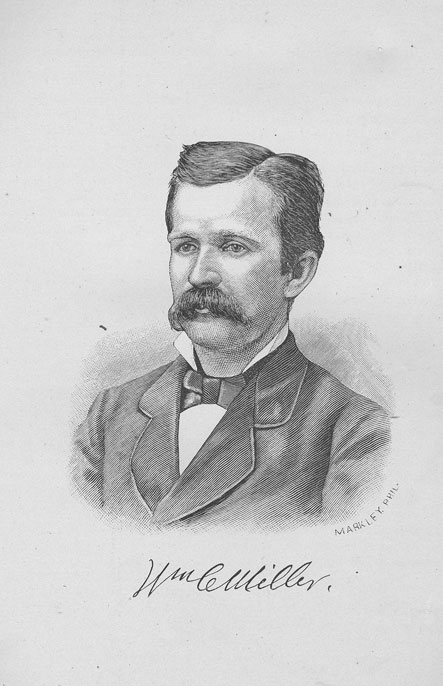
has been one of its officials. He is a member of the Congregational Church at Paddy's Run. Mr. Evans's oldest son, William E., was a member of the Fifth Cavalry, participating in all of the battles of the regiment. He served three years and three months before reaching the age of twenty.
WILLIAM C. MILLER.
William C. Miller, M. D., was born in the Kingdom of Wurtemberg, Germany, July 31, 1847. In October, 1854, in company with his parents, he emigrated to America, and settled in Hamilton, Butler County, Ohio. He received his education in the public schools, and in 1863 entered a drug-store. He advanced from one position to another until 1871, when he went into partnership with W. B. Falconer in the drug business. This was continued successfully until October, 1874, when he retired from the firm to attend lectures at the Miami Medical College at Cincinnati. At the close of his first course he entered the drug-store of A. D. Wittich, at Dayton, Ohio, continuing the study of medicine under the preceptorship of Dr. .Phil. Halanan, and remaining until October, 1876, when he took his second course at Miami College, graduating in March, 1877. Returning to Dayton he entered into the practice of his chosen profession.
In April, 1879—his mother and sisters still living at Hamilton—he came back to this city and purchased the drug-store of the late B. S. James, on the corner of Main and Front Streets, where he is now doing a good business. He has fought his way up to his present standpoint in life, and with excellent prospects in the future. Dr. Miller was married in September, 1880, to a very estimable young lady, daughter of the late Hon. Jesse Corwin, and niece- to Governor Tom Corwin of Ohio. One child, William Corwin Miller, has thus far blessed their home. Dr. Miller is now in his thirty-fifth year, in comfortable circumstances, and with the best of life before him. Strictly temperate in habits and enjoying health, he intends to make the most of it.
THOMAS MILLIKIN.
Thomas Millikin, an old and highly respected lawyer of Hamilton, was born in Rossville, now West Hamilton, on the 28th of September, 1819. He was the son of Robert B. Millikin, a well-known physician, and Sarah Millikin. The latter was from Virginia, and the former from Pennsylvania. Thomas Millikin began his classical studies with the Rev. Joseph G. Monfort, in Rossville, in 1832, and entered the Freshman class at Miami University in September, 1834, graduating from that institution in July, 1838. He began the study of law with Elijah Vance, in the Fall of 1838, and was admitted to the bar December 20, 1840. He has ever since been actively engaged in the labors of the law, and is the oldest practicing lawyer in the county. He never held a public office except for one year in 1843, when he was prose cuting attorney. He has been a Democrat all his life, but acted with the Union party during the war. He was married at Columbus, Ohio, November, 4, 1841, to Mary, daughter of the late William B. Van Hook. Mr. Millikin has for many years been one of the most prominent citizens of the county, and has been retained on one side or the other of almost all the prominent cases in the courts for the past twenty years.
ALEXANDER F. HUME.
Alexander F. Hume, judge of the Court of Common Pleas, was born in Delaware County, New York, April 20, 1829. With his parents he came to Clarke County, Ohio, in 1838, and received his education in the common schools and high schools in Springfield, graduating there and entering Miami University in 1846, where he remained a year and a half. He then entered the Central College, at Danville, Kentucky, where he graduated in March, 1848. He entered the office of Judges Rogers and White, remaining with them until he was admitted to the bar in August, 1850. He came to Hamilton in the Fall of 1850, and was in practice here until elected judge of the court of Common Pleas, in 1859, which he filled for five years, when he resumed practice. He was re-elected to the same position in 1875, and has held the place continuously since. In 1878, he was a candidate for judge of the Supreme Court of the State on the Democratic ticket, and came within three thousand votes of an election. He carried his own county by a majority of three thousand. He was married in 1854 to Miss Sarah J. Traber, daughter of John Traber, an early settler. They are the parents of six children, four sons and two daughters. He was one of the organizers and the first president of the Second National Bank, of Hamilton, resigning the position afterwards. He has recently purchased the Peter Schwab mansion on Second Street, and is renovating and redecorating it.
CITY GOVERNMENT.
For a long time the citizens of both Hamilton and Rossville had perceived the vital necessity which existed for a union, and the project was taken up seriously and moved to a successful completion in 1854. Ordinances of annexation were passed by the common councils of both villages, and at an election held on the first Monday of April, in the year just mentioned, the question, having been submitted to the legal voters, was adopted, and the consolidation soon after became a fixed fact.
The mayors of Hamilton before that event had been, about 1834, Ezekiel Walker, Richard Easton, and Jonathan Pierson ; about 1842 to 1846, M. P. Alston ; about 1851, David G. Leigh, James Daugherty, John S. Wiles, and Robert Hargitt. Since the union they have been Robert Hargitt, John S. Wiles, Ransford Smith, Daniel Longfellow, who served three terms and died in office ; A. C. Stephenson, who served out two terms and the
HAMILTON - a366
remainder of Mr. Longfellow's; M. N. Maginnis, John B. Lawder, M. N. Maginnis, Edward Hughes, Frederick Egry, and F. B. Puthoff.
The city is now under the government of a mayor and common council. It is divided into five wards, the last having been erected within the year, and has ten councilmen. They elect a clerk and sergeant-at-arms. All city officers hold their positions for two years. The mayor has jurisdiction as a justice of the peace, and has, in addition, power to enforce the city ordinances. He takes part in the deliberations of the common council, but has fio vote. He is the chairman of the newly elected body until its organization. The police are appointed by the mayor, with the confirmation of council. The latter appoint a market master, city solicitor, city clerk, street commissioner, marshal, who, by virtue of his office, is chief of police, and chief of the fire department. The department is paid. There are three engine houses, three steamers, and a hook-and-ladder company. Of the police there are a captain and fourteen men.
The valuation of the city is $5,500,000, and the rate of taxation is twelve mills on the dollar. The city debt is $25,000, which is lessening at the rate of $5,000 a year. There is a board of health. There are two parks, each formerly a burying-ground. The streets are wide and clean, and the town presents a handsome appearance.
JOHN W. ERWIN.
No history of Hamilton would be complete that did not include the name of John W. Erwin. He was born in the State of Maryland, and came out here more than fifty years ago. When he arrived there was no railroad, no canal, and no well-constructed highway in Ohio. To these public labors he has devoted his life. He has been a civil engineer for sixty years. To him and James McBride must be attributed the first intelligent examination of the prehistoric relics of the State.
LANE FREE LIBRARY.
The Lane Library is the result of a gift by Clark Lane. He had long noticed the destitution of the place of his residence in some intellectual respects, and had resolved to do something to remedy the defect. But his efforts to enlist his fellow-citizens in such an enterprise proved unavailing, and he then determined to found a library himself. On some lots opposite his residence he began the erection of a handsome brick building, and when complete furnished it with books and magazines, lighted and warmed it, placed his niece in as librarian, and paid all expenses himself. The gift was received with enthusiasm by the citizens, and the whole was finally transferred to the city, being now supported by taxation. Miss Florence Schenck is the present librarian, with Miss Laura Rodefer as assistant. The former public school library. has been added to this collection, the whole now embracing about four thousand volumes.
BIOGRAPHICAL NOTES.
Robert Newell. Andrews, the son of William Andrews and Harriet Newell, was born September 16, 1839, in Ross Township, in this county, and was brought up on a farm. He received a common school education. His mother died when he was but nine years of age. In the Spring of 1861, he came to Hamilton, and worked at milling for Tanquary & Anderson, until the Spring of 1862. He spent the year of 1862 and part of 1863 in Preble County, at work in the mill for Barnett & Whiteside. He came back to Hamilton in the Summer of 1863, and worked for John Lamb in the West Hamilton Mills. He went into the sheriff's office as deputy sheriff under A. J. Rees, in May, 1864, and remained with him until his term of office was closed. He was elected sheriff of Butler County in October, 1867, and was reelected in 1869, making a total service of four years. During his administration occurred the only execution for murder or other crime that has ever happened in this county. John Griffin was tried for the murder of Usile Prickett, and convicted at the January term of court in 1869, and was executed July 29, 1869.
Alfred Anderson was born in Wheeling, Virginia, February, 24, 1824. His mother, Mary Clark, was a free woman, reared from early childhood by Mrs. Ralston, the widow of an officer in the American Revolution. His father's name was Shannon, the brother of Governor Shannon, of Ohio and Kansas. When the boy was three or four years old, his mother married Robert G. H. Anderson, who not long after removed to Cincinnati. They remained there until 1832, when the Asiatic cholera compelled a hasty retreat to the small towns in the neighborhood, and the Anderson family were first in Hamilton and afterwards in Richmond. They settled permanently in this place in 1837, where Alfred has ever since lived, with the exception of twelve years spent in the South.
At the period when he first came to this city the State made no provision for the education of colored children, and he consequently never had but three months' schooling in his life. His constant study at home, with much reading, has, however, made him well acquainted with English literature, and given him a good knowledge of French and Spanish. He married the daughter of a clergyman when still a young man, who bore him nine children, and died in 1863. In 1865 he again married. Both of his unions were fortunate ones. He was enabled to send some of his children to college, and he gave them all as good a training as he could.
He was early identified with the anti-slavery cause. In 1843 he aided in editing the Palladium of Liberty, published in Columbus, the first newspaper attempted by the colored men in Ohio. A few years later he became interested in the Colored Citizen, of Cincinnati, and he was a regular contributor to the North Star, published by Frederick Douglass, and the Liberator, edited by William Lloyd Garrison. He prosecuted, at his own expense, a
366b - HISTORY OF BUTLER COUNTY.
case through the courts of Ohio, by which a large portion of the colored citizens were enabled to vote, who previously had not been allowed to exercise that privilege. He has also done much to aid those to reach a placeThf safety who were escaping from slavery. His name has of late been prominently spoken of for minister to Hayti, a post for which he would be well fitted. He is an agreeable and pleasant companion, an excellent raconteur, a man of keen intellect and biting wit, and impressive and dignified carriage. His memory- is excellent, his knowledge of history and pOlitics has been sedulously cultivated, and his reasoning powers are good. He has a fine command of the mother-tongue,. both in writing and speaking, and is a man of excellent private character.
Robert Jackson Bell, of Morgan Township, was born in Butler County, Ohio, May 15, 1815. His father was David and his mother Margaret Bell, who came to this county in 1809. On the 23d of November, 1843, he married Ann W. Lyle, daughter of Benjamin Lyle. She was born in Montgomery County, Pennsylvania, June 5, 1816, and married in this county. This union resulted in David, born June 30, 1844; William H., born June - 12, 1847; Francis W., born December 28, 1848; Margaret Jane Woodruff, born November 13, 1850; John Wesley, born March 18, 1853 ; Robert Fulton, born May 23,1854; Washington, born December 30, 1858.
Robert J. Bell is one of the most prominent citizens of Morgan Township, as is shown by his having held the office of justice of the peace for twenty-one years.- He is now a notary public. David Bell was in the War of 1812: During the year 1834 Mr. Bell's father, mother, and one sister died, in less than twenty days of cholera. Robert Bell is an active member of the Washington Methodist Episcopal Church.
ALLEN ANDREWS.
Allen Andrews was born at Muncie, Indiana, on August 11, 1849. He is a son of George L. and Margaret Andrews, and is the fifth child in a family of five sons and two daughters. His father, George L. Andrews, was a native of Connecticut. He was a graduate of Yale College, and after leaving that institution, came West, and was one of the pioneer educators in this State and Indiana. He married Miss Margaret Rodebauch,. of- Dayton, Ohio, while teaching" in that city. Some time afterward he removed with his family to Muncie, Indiana, and was in charge-of the public schools there for some time, when his health becoming impaired, he removed to his farm in Jay County, Indiana, where he died, May 28, 1854, from the effect of an injury received some months before in a mill.
Margaret Rodebauch, who became the wife of George L. Andrews, was the daughter of Adam Rodebauch. Her great-grandfather, Adam Rodebauch, came from Germany about the middle of the eighteenth century, and settled in Pennsylvania. She is still living, seventy years old, and resides at Lancaster, Indiana. When the civil war commenced, her two elder sons, John and William, enlisted under President Lincoln's first call for troops, and served the Union cause till the close of the war.
In the early part of 1863, her next two sons, Furman and Allen, tendered their services in answer to the call for volunteers. The former was accepted, went with Sherman's army. on its march to the sea, and was discharged after peace was restored ; the latter was rejected on account of his youth, and remained at home to care for his widowed mother and the other members of the broken family. After the close of the war, Allen Andrews applied himself to study, having already enjoyed the advantages of the very excellent common school system of the State of Indiana. He engaged in teaching in 1867, previously having been a student at the National Normal, at Lebanon, Ohio. He is a graduate of Liber College, Indiana, and wris selected by the faculty to deliver the valedictory address to the graduating class. He was superintendent of the public schools of New Madison, Ohio, during the years of 1871 and.1872.
He read law with the Hon. William Allen, late of Greenville, Ohio, and was admitted to the bar by the Supreme Court of Ohio, March 16, 1874, and on May 23, 1874, associated himself with J. K. Riffel in the practice of his profession, in Greenville. He removed from that place to Hamilton on February 29, 1876, and engaged in practice in this county. He was in partnership with J. C. McKemy from January, 1877, to October, 1880, when the firm was dissolved. On October 18, 1880, he associated hiMself with H. L. Morey and J. E. Morey, under the firm name of Morey, Andrews & Morey.
On January 29, 1879, he was united in marriage with Miss Belle 'Davis, second daughter of John P. Davis, of Hamilton, Ohio, by his first wife, whose maiden name was Blair. He is a member of the Independent Order of Odd Fellows, and also a member of the Masonic order. He is the W. M. of Washington Lodge, No. 17, Free and Accepted Masons, in which position he has acted for the last three years.
BIOGRAPHICAL NOTES.
Frank X. Black, manufacturer of paper-mill machinery, was born in Hamilton, in 1848. He is the son of Peter P. and Mary A. Black. He was married, April 14, 1874, to Henrietta C. Hurm, daughter of Philip J. and Anna Stacia Hurm. She was born in Hamilton in 1848. They have three children. Louisa E. was born May 19, 1875; George F., March 9, 1879; and Frank J., December 9, 1879.
In 1872 he was urged by the paper-makers of this valley to start in the roll-grinding business, and enable them to get their calender rolls reground without ship-. ping them East, which caused extended delays and great outlays for freight. He visited the shops of J. Morton Poole, Wilmington, Delaware, where he found it neces-
HAMILTON - c366
sary to learn the grinding business before they would furnish him with the machine. He accordingly began with them, and worked for one dollar per day until he was told he was competent enough to take charge of the grinder, when he was furnished with one. The firm continued to grind rolls until 1876, when the firm was changed to Black & Clawson, and to the grinding business they added other branches, until they began the manufacture of complete machines for making all kinds of paper. They now are making a specialty of this class of work.
Joseph Burkart, who is a carriage-blacksmith, was born in Cincinnati, June 10, 1850. He is the son of John and Pauline Burkart, natives of Germany.
Henry Beardsley was born in Fairfield County, Connecticut, April 17, 1812. His parents were Abram and Hannah (Raymond) Beardsley, who died in Connecticut. Mr. Beardsley learned the trade of a hatter, and came out to Ohio, settling here in 1836, on the 20th of June. He has followed manufacturing and dealing in hats. He has been married three times. First, in 1840 to Isabella Gibson ; second, in 1847 to Laura O'Connor, and the last time in Batavia, Ohio, to Sarah E. Moore. The last is a daughter of John B. Moore, of Clermont County. He has had five children. Emma (Mrs. F. Martindell), was born in 1847 ; William Henry, in 1850 ; Abbey Jane, in 1852; Edward Moore, in 1858, and George in 1863. Edward is a physician, and lives in San Francisco, and George resides in the same place. Mr. Beardsley was a member of the school board for about five years, from 1856 to 1861, the First Ward building being erected about that time. He was also a member of the common council for about four years, from 1846 to 1850. The right of way was given to the railroad during that time. During the late war Mr. Beardsley was a member of the military committee of this county. He went i4eto business upon his arrival here, and has been in it ever since. He is now the oldest merchant in trade in the town.
Dr. John R. Brown is the grandson of Joseph Brown and his wife Margaret, who came here from Virginia about 1797, and about the beginning of the century locating in Rossville. In August, 1800, their son, Israel Brown, was born in that town, and in the Winter of 1801 Mr. Brown died. Eighteen months afterwards his widow married again. Her new husband was John Thompson. In 1804 their son, Joseph Magie Thompson, was born the year of the great freshet which made the New River. Israel Brown left Butler County at an early age, going to Hamilton County, where he learned the trade of a carpenter. He was three times elected to the Legislature, and was a member of the State Board of Equalization from the day it was formed till the date of his death, which occurred December 16, 1860. He married, in Hamilton, Jane Robinson, who still survives at the age of eighty-two, and resides a quarter of a mile from her old home. They had several children, the only one of whom now living in Hamilton is John It Brown. At the time Mr. Brown moved to Hamilton County his mother and step-father, John Thompson, remained here, where their two children were born. Joseph Magie Thompson, as is said above, was born March 10, 1804. No record exists of Daniel. Mr. Thompson enlisted in the War of 1812 three times, serving throughout the entire struggle. He was captured seven times by the British, and on one occasion was taken with six others. They were given several .days in which to swear allegiance to the king of Great Britain, four of the party finally consenting. Mr. Thompson, however, was made of sterner stuff, and, with two others, refused to do this,. and resolved to escape, which they did. They were three days without any thing to eat, but finally managed to reach the American lines. He was Scotch by birth, as was also his wife, and was a man of wealth for those times, and a prominent pioneer. He died in Hamilton about 1816, his widow surviving him many years. She died in 1862, aged eighty-seven years.
Of his children, Daniel is now residing in Richmond, Indiana, and Joseph Magie married, March 8, 1826, Mary Ann Messick, who was born February 10, 1807, in Delaware. They had six children. Theodore was born September 10, 1827, and died in Memphis in 1879. He was a captain of the One Hundred and Seventy-second Regiment, O. V. I., in the late war, under Colonel Luzbeek. Alonzo H. was born May 10, 1829, and resides in Hamilton. He was a soldier of the late war, in Company H, Eleventh Missouri V. I., and served through most of the struggle. He was wounded several times, and at the battle of Atlanta was so badly injured that he was discharged, crippled for life. Freeman B. was born July 29, 1831, and is now a resident of Hamilton. Miles L. was born October 26, 1833, and lives at Columbus, Indiana. He is married. Martha J. was born May 27, 1836, and is the wife of A. J. Gaither, and lives in Jersey County, Illinois. Joseph W. was born September 7, 1838, living at East Memphis, Tennessee, and is married.
Joseph M. Thompson was for many years a prominent citizen of Port Union, Union Township, holding several township offices, and died in Columbus, Indiana, on the 7th of March, 1878, his wife dying March 31, 1874. His son, Colonel Freeman B. Thompson, was married on the 1st of July, 1856, to Mary Ann Beatty, daughter of James Beatty. She was born in Butler County, September 24, 1839, and died April 14, 1879. They have had. eight children. William B. was born June 5, 1857, and is married, living in Fairfield Township. Ida May was born April 5, 1859, and is the wife of James M. Earp, a resident of Hamilton. Mary Ella was born March 17, 1863, and is the wife of Elva Thompson. She lives in Hamilton. Frankie Luella was born July 2, 1865 ; Lillie Leona, June 1, 1868 ;
366d - HISTORY OF BUTLER COUNTY.
Harry, June 16, 1870 ; George, March 16, 1872, and Jimmy, January 29, 1877. Mr. Thompson, in 1859, moved to Shelby County, Illinois, where he was for many years a prominent farmer, holding many offices of honor. Among others he was sheriff for six years, and was elected colonel of the One Hundred and Fourteenth Illinois Volunteer Infantry. He returned to Hamilton, Butler County, on the 10th of November, 1880, and still resides here.
James M. Earp was born in Wilkes County, North Carolina, December 23, 1850, and was married May 31, 1877, in Shelby County, Illinois, to Miss Ida May, daughter of Colonel Freeman B. Thompson. They have two children. Mary Ellen was born April 6, 1878, in Shelby County, Illinois, and Lillie Mary was born March 18, 1880, in Butler County. Mr. Earp came here from Illinois in 1879, and settled in Union Township, where he resided on Mr. James Beatty's farm, removing in 1880 to Hamilton. In May, 1881, he began business in West Hamilton as a hatter and dealer in gentlemen's furnishing goods.
William Bruck was born in Hamilton, November 14, 1848, and is the son of J. P. and Mona (Kline) Bruck. He received a fair education in private schools in Hamilton, and when thirteen began learning the trade of printer, in an office conducted by his father. He worked as a journeyman in Cincinnati and Indianapolis until 1876. He was chosen as policeman that year, and served for four years. In the Spring of 1881 he was elected city marshal, a position that he still occupies. Mr. Bruck was married in July, 1869, to Miss Barbara K., daughter of John Musch. They are parents of two sons, William L. and Edward. They are members of St. John's Lutheran Church. He is a member of the Knights of Honor.
Owen C. Brewer was born in Liberty Township, Butler County, February 4, 1851, being the younger son of Peter K. and Mary (Flenner) Brewer, the former a native of Maryland, where he was born in 1809. He came to Ohio in 1831, settling on the place in Liberty Township, where he spent the remainder of his days. He was married in 1837 to a daughter of David Flenner, and reared a family of five children, all living and residents of this county. He was a successful farmer, dying September 1, 1871. His wife, who was born in 1807, is still living, at the age of seventy-four.
Owen C. Brewer was educated in the public schools until he was eighteen years of age, being brought up to farming, and then engaged in teaching for some four years. In 1872 he was appointed to a position in the auditor's office, and in 1873 was made a deputy auditor, holding that position until June, 1874, when he received the appointment of secretary of the Soldiers' and Sailors' Orphan Home, at Xenia, with W. D. Kerr as superintendent. While there Messrs. Kerr and Brewer introduced the industrial branches, which made the institution self-sustaining. He was there until the end of Governor Allen's term, when he returned to Hamilton, there acting as a clothing salesman until March, 1882, when he began the clothing trade in his present location.
Mr. Brewer was married, in 1875, to Miss Diana Stark, of Xenia. They have two children, Paul K. and Earl C. Mrs. Brewer is a member of the Presbyterian Church. Mr. Brewer is a member of the Knights or Pythias, and also of the Knights of Honor. He was elected a member of the board of education from the Fourth Ward, in 1879, and re-elected in 1881, both times without opposition. He was clerk of the board for two years and a half, and became its president in April, 1882.
Charles Beck, Jr., was born in Venice, in this county. June 8, 1845. He is the son of Charles and Theresa Beck, natives of Wellenberg, Germany. He attended the common schools in the country, and afterwards in Hamilton. He began at fourteen to learn the shoemaker's trade with his father, and was at this for eight years. He then began clerking in his father's store, and afterwards attended the Business College in this place. In 1859, he began business in the boot and shoe trade, which he continued till 1879. He has been trustee of his ward, and overseer of the poor. In 1878, he was elected infirmary director for the county, and again in 1879, acting as clerk of the board. He is a Democrat in belief, and a member of the Catholic Church. He was married on the 14th of September, 1869, to Catherine Tabler, daughter of Henry and Catherine Tabler, of Hamilton, both now being dead. He has four living children and three dead. Charles Henry, Clara C., William A., and Frank C. are the names of those living.
John Frederick Bender was born in Germany, September 28, 1830. He is the oldest son of F. W. and Catherine Bender, and was instructed in the government schools. He learned the trade of a carpentpar from his father, and remained employed at that till he was twenty-one. He was conscripted in the Prussian army in 1851, and served three years, and on the expiration of his term, followed Ills parents and family to America, in the Spring of 1855, coming direct to Hamilton. He assisted his father in laying the foundation of the present business, of which he-is the head. Mr. Bender married in March, 1857, Miss Mary Elizabeth Hardegen, born in Germany. They have a family of two daughters and one son. They are members of the Lutheran Church. Mr. Bender enlisted in the One Hundred and Sixty-seventh Ohio National Guard, of which regiment he was major under Colonel Moore. He served out his term, and was mustered out at Hamilton in 1864.
Jacob Bender was born in Prussia, August 18, 1837. He is the son of F. W. and Catherine (Diehl) Bender. He was educated in the public schools in Germany, and brought up to farming until coming to America with his parents in 1853. His first location was in Cin-
HAMILTON - e366
cinnati, where he was one year, coming up to Hamilton in 1854. He received something of an English education after arriving in this country, and worked at the carpenter's business for some time. He began to learn the trade of hatter in 1856, serving an apprenticeship of four years with Henry Beardsley, with whom he afterwards worked as a journeyman. He was in his employment until enlisting in 1864, in the hundred-day troops. He served out his full term of enlistment, in West Virginia, and returned home and was mustered out at its close. He resumed his former situation on his return, and remained with Mr. Beardsley until July, 1870, when he began business for himself. He is doing an extensive trade in hats, caps, furs, gloves, umbrellas, etc. He is a member of the Zion Lutheran Church.
Jacob Boli was born in Germany, December 30, 1819, and was educated in Germany. When young, he learned his father's trade, that of a baker, and worked at it as journeyman for some time, coming to America in 1838. He just escaped conscription. He first located at Massillon, Ohio, where he was employed as a baker and confectioner for two years, and then going to Cincinnati. He was married there about 1842, and is the father of ten children, only two of whom are living. L. A. Boli, who was born January 16, 1846, is a well-known merchant of Hamilton, and Caroline, born April 10, 1849, is the wife of Alexander Dilg, a resident of this place. After marriage he went to Indiana, and engaged in farming, then going to Louisville, Kentucky, where he remained ten years in the grocery trade. In May, 1855, he came to Hamilton, beginning the grocery trade on the west side, and coming to his present location on Front Street about 1860. He is now doing a prosperous business in general family groceries, and is a large owner of real estate. He is a member of St. John's Lutheran Church.
William E. Brown was born in Xenia, Ohio, on the 13th of November, 1825. His father was a mechanic of moderate means, and his son was obliged to obtain an education by his own exertions. He was early taught to labor, and at the age of seventeen was in Northern Mississippi as a tramping journeyman shoemaker He subsequently passed eighteen months in New York City. At the age of twenty-one he commenced the study of law in Xenia. He completed his preparatory legal studies in Dayton, and was admitted to the bar on the 29th of March, 1849. The following Spring he settled in Hamilton, with very little money. Up to this time he had worked at his trade to pay expenses. Before the expiration of his first year's practice in Hamilton, he had business enough to support himself. He married the daughter of Robert Beckett in 1852. In 1855 he was elected an elder in the United Presbyterian Church of Hamilton. He gave up the practice of law for a while on account of impaired health, but afterwards resumed it. He was elected president of the Second National Bank of Hamilton in 1870. Under his able management this institution has nearly trebled its business. It was, in a great measure, through his advice and direction that the handsome building of this bank was built. The Second National Bank of Hamilton is one of the safest and most conservative banks in the country.
John C. Barcalow, the landlord of the Central House, was born in this county April 11, 1830. His parents were John and Nancy Barcalow, both now dead. He was married in Warren County-on the 29th of October, 1851, to Elizabeth A. Emley, daughter of David and Sarah Emley. She is a native of Warren County. Mr. and Mrs. Barcalow have had twelve children. Anna E. Schaffer was born April 24, 1855 ; Ada E. Spitler, August 15, 1856 ; Georgetta, July 11, 1858 ; David E., May 15, 1860; Kate E., May 12, 1862 ; John B., March 4, 1864 ; C. M., November 17, 1866 ; Sallie E., January 3, 1869 ; Harry and Carrie, March 31, 1871; Louraine R., July 31, 1873, and Richard E., September 10, 1875. Mr. Barcalow was a member of Company E, One Hundred and Fifty-ninth Ohio Volunteer Infantry, and served in the hundred days' call in West Virginia without hearing a gun fired.
John Bender was born in Prussia, December 13, 1848. He is the son of F. W. and Catherine (Diehl) Bender, who came to this country in 1853, bringing their son with them. He was a carpenter by trade, arriving in Hamilton in 1854, and worked at this till about 1865, when he organized the firm of F. W. Bender & Sons, purchasing the property where his sons are, and also the planing mill of Miller & Campbell. For a short time the firm was Bender & Brown. He reared a family of twelve children, eight sons and four daughters, all residents of Hamilton. He was a successful man, and by the aid of his sons laid the foundation of a large and successful business. He was a member of the Evangelical Protestant Church. His death occurred on the 20th of October, 1867. The business was continued under the firm name of J. F. Bender & Brothers, the members being J. F., E., F. W., H., and John. The latter was educated in the common schools in Hamilton. In 1864 he attended one term A the commercial college in Cincinnati. He was in the employment of John Stilwaugh for some two years, and then entered the business of his father and brother in 1865. He takes charge of the office and financial matters, the rest of the firm being all practical mechanics. He also does the estimating and contracting. Mr. Bender was married in 1873 to Miss Lena Morton, and is the father of three children-J. F., Matilda P., and Elsie. They are attendants of the Zion Lutheran Church.
Mrs. Jane Betz was born in Morgan Township, March 27, 1812, being the daughter of David and Margaret (Rainey) Bell. David Bell settled in Morgan Township at an early day. He was a native of Pennsylvania, and Mrs. Bell of Ireland. They reared five children, two of
366f - HISTORY OF BUTLER COUNTY.
whom are living, Robert J. and Mrs. Betz. Mr. and Mrs. Bell died in 1834, from cholera. Their daughter was educated in the common schools, and was at home till the death of her parents. She was married to Ludwick Betz about this time. Mr. Betz was then deputy auditor, under James B. Cameron, and afterwards was elected to the same position for two terms. He was also county surveyor from 1836 to 1842. He died September 2, 1847. He was a successful business man and an esteemed citizen. Mrs. Betz is a member of the Universalist Church, and has resided in Hamilton since 1835.
Stephen D. Bowers was born in Fairfield Township, in this county, August 16, 1845, being the youngest son of Daniel and Elizabeth (Thorp) Bowers. The father was long a resident of that township, but died in September, 1845, a month after his son was born. Mrs. Bowers, who was the daughter of C. C. Thorp, reared her family of three little children successfully, only one of them now, however, surviving. She died October 18, 1878. Stephen D. Bowers was educated at home, in the common schools. When sixteen he began learning the trade of machinist, and worked as a journeyman for two years. He was connected with a life insurance company for a year, in Cincinnati, and then traveled for a manufacturing shoe house some three or four years. April 28, 1868, he began in the boot and shoe business for himself, in a modest way, and has built up a large and valuable trade.
Mr. Bowers was married May 19, 1870, to Miss Susan Elizabeth Walton. They are the parents of two sons and two daughters—Gertrude, Cornelia, George W., and Walton S. He is a member of the Methodist Episcopal Church and of the Odd Fellows. His brother, G. W. Bowers, enlisted in the Thirty-fifth Ohio Volunteers in 1861, and was wounded at the siege of Atlanta. He died in hospital at Nashville, Tennessee, July 1, 1864. His sister Cornelia was married to Cyrus Pottenger, of Camden, Ohio, and died July 11, 1880.
L. A. Boli, jeweler, was born in Washington, Indiana, January 16, 184k, and is the only son of Jacob and Caroline Boli. He was educated in Hamilton, where he came with his parents in 1856, graduating at the high school. He was in delicate health in his youth, and began his present business in 1869 in a modest way. He has since learned the trade, and is now a practical jeweler, having the largest business in that line in Hamilton. He is a dealer in watches, jewelry, silverware, clocks, and optical goods. He was married on the 10th of May, 1869, to Miss Carrie Buckle, daughter of Jacob Buckle. They are the parents of five children, of whom three are living—Lewis J., Edward 0., and Carrie. Mr. Boli was elected a member of the school board for the Third Ward in the Spring of 1882, and has done good work there. He is a supporter of all Christian and worthy objects, and is a member of the Masonic order, the Odd Fellows,
Knights of Honor, and the American Order of United Workmen. He succeeded to the business of William E. Drayer, one of the oldest jewelers in Butler County, from whom he bought the property where his business is located. He is also one of the firm of L. A. Boli & Co., of the Miami Valley Soap Works, a new concern, doing a promising business in laundry and toilet soaps.
Peter P. Black was born in France, on the 29th of June, 1817, and was there educated. When he was thirteen he commenced an apprenticeship of three years at the blacksmith's trade, and worked as a journeyman for two years in Metz. On coming to America he located in Saugerties, New York, for some time, working in the stone-quarries for nine months, and then coming to Cincinnati, where he commenced blacksmithing on his own account, at Newtown, Hamilton County. On the 17th of August, 1841, he was married to Mary Carbel, born in Germany, October 13, 1817. Mr. and Mrs. Black are the parents of five children, of whom three are living. Frank X. is a well known manufacturer of Hamilton ; F. D. is the present sheriff of the county ; and Mary is the wife of George Schroder. Mr. Black lived in Newtown some time after his marriage, being engaged as a blacksmith, but in 1844 came to Butler County, locating in Jacksonburg, and carrying on his occupation there for nine months. In the Fall of that year he came to Hamilton, where he has since been. He worked at twenty dollars per month for Isaac Tobias, for three years, and then began as a manufacturer of plows. In 1856 and 1857 he organized the firm of Long, Black & Alstatter, manufacturers of reapers, mowers, etc. This firm existed until 1872, since which time he has led a retired life.
Edgar A. Belden, attorney and counselor-at-law, was born in Hamilton, November 28, 1855. He is the son of Samuel C. and Mary (Fitton) Belden, and was educated in the schools of Hamilton, graduating at the high school in 1872. He then engaged in the insurance business in Cincinnati for five years, but in 1879 began reading law in the office of Thomas Millikin. He was admitted to the bar in February, 1881, and immediately began practice in Hamilton. He is connected with the Methodists, and is the president of the Irving Literary Club, a pleasant and agreeable society.
Charles Beck, senior, was born in Germany on the 15th of February, 1812. He was educated in Germany, and became an apprentice to the shoemaker's art in Vienna in 1825, serving three years. He worked as a journeyman in Prague for some time, and was in the army for six years, from 1832 to 1838. When discharged he left Germany, and arrived in America January 4, 1839, where he was married on the 3d of February, 1839, to Theresa Stark, who was born in Germany, December 25, 1808. They were the parents of eight children, of whom four are living. Henry E. is a resident of Hamilton ; Harriet is the wife of A. Winter, of this place ; Charles,
HAMILTON - g366
Jr., is also a well-known resident, and Katy is the wife of Alexander Getz. Mr. Beck arrived in Ohio in the Spring of 1839, coming direct to Hamilton, still employed at shoemaking, and residing in Venice for some eight years. He then engaged in farming, purchasing a place in Ross Township, and staying there for eight years. In Hanoier Township he was one year, returning to Hamilton in 1857, and beginning mercantile business in 1859. In 1860 he entered the firm of Beck & Winter, keeping a general store. Of late he has been out of business. He is a member of the Roman Catholic Church.
Christian Brady was born in Northumberland County, Pennsylvania, October 13, 1812, coming to Ohio with his parents in the same year. They settled in Reily Township. He is the oldest son of Joseph and Mary (Shipman) Brady. The father was a pioneer, and raised a large family of twelve children, six of whom are living. Christian was educated in the common schools in Reily Township, and was brought up to farming until he was twenty-one years of age, when he began learning the carpenter's trade. At this he worked for eleven years, then purchasing a farm of one hundred and sixty acres in that township. He was married in 1844 to Maria, daughter of Benjamin Sortman. They are the parents of two children, one now living, Ada, the wife of Dr. J. B. Scott. Mr. Brady came to Hamilton in February, 1865, and engaged in the grocery business for two years, afterwards leading a retirord life until December, 1881. In company with his brother-in-law, D. Sortman, he began the manufacture of grain cradles. He is a member of the Christian Church.
William Barton Carr was born in Hanover Township in 1848, being the son of John W. and Elizabeth J. Carr. He attended the common schools, afterwards going to Otterbein University and the Miami University, and also received a commercial education at the college in Hamilton. He was married in 1872 to Clara Brown, daughter of William E. Brown and Mary Beckett. They have had four children. Bessie was born in 1873, Maynard in 1876, Mary in 1880, and William Everett in 1881. He is a member of the United Presbyterian Church. His occupation is that of the proprietor of a flouring-mill. His great-grandfather was in the Revolutionary War, and his grandfather in the War of 1812.
Mrs. Jane Hudson Corwin was born in Mourne, County Down, Ireland, October 6, 1809, and came to this country with her father, the Rev. James McMechan, in the Autumn of 1817, taking up her residence in this town in the Spring of 1818. She was thoroughly instructed by her mother and older sister, and was possessed of great beauty and attractive manners. April 15, 1829, she was married by the Rev. Dr. MacDill to Jesse Corwin, one of the leading members of the Hamilton bar. This pair of generous and genial people kept a hospitable home for many years in this city, which was a pleasant resort for their many friends, and those of them who still survive will recall with grateful memories the cordial civilities of their departed hosts. Eight children were born to them, only three of whom are living. Thomas Corwin, one of her sons, rushed to the defense of the country when attacked by rebels, and in April, 1861, joined the Third Ohio Volunteer Infantry. Mrs. Corwin united with the Associate Reformed Church in 1840, and sat under the preaching of the Rev. Messrs. MacDill and Davidson for many years. She was naturally a believer in the truths of religion, and gave them her unquestioning assent. In both prose and poetry she wielded a facile pen, and her productions were warmly received by her friends. She was a welcome contributor to the newspapers, and five or six years ago gathered her verses from their files, added a few new ones, and published them in book form, entitling them " The Harp of Home." Her death occurred March 6, 1881. Few have left behind them more friends to lament their loss.
Leroy D. Brown, superintendent of the schools of Hamilton, was born November 3, 1848, in what is now Noble County, Ohio. He is the son of Jeremiah B. and Isabella (Harris) Brown. He attended district school until the age of fifteen, from three to six months each year. Each school was provided, by legislative enactment, with a library, and during his boyish days Brown read every volume in the list. His choice was for biography, history, and travels. He was obliged to labor the rest c the year. When fifteen, having been unable to obtain the consent of his father to enlist, he ran away, and entered Company H, One Hundred and Sixteenth Ohio. This was in January, 1864. He remained in the service until the close of the war. He was in the Shenandoah Valley, and saw service under Siegel, Hunter, Crook, and Sheridan in this department, and afterward was in the Army of the James, near Richmond. When discharged he was the general's orderly.
After returning home he was in the district school, and afterward in a high school at Seneca, Ohio. He began his career as a teacher on Member 3, 1866, in a district adjoining the one in which he had lived in boyhood. In April, 1867, he entered Mount Auburn Academy, where he in part fitted for college, and in 1869 joined the preparatory department of the Ohio Wesleyan University, from which he was afterward graduated. He taught in Noble County during the greater part of 1872 and 1873, and was also county examiner. In 1873 he took charge of a graded school at Newport, and was afterward made superintendent. In 1874 he was in charge of the public schools at Belpre, and in 1875 he was made superintendent of the schools of Eaton, Preble County. This position he filled until 1879, when he was elected superintendent of the schools of Hamilton and has since been re-elected. He is the secretary of the State Association, and a writer in edu-
366h - HISTORY OF BUTLER COUNTY.
cational periodicals. He served a term as trustee of the Lane Free Library, and is a post-graduate student of the Cincinnati University. He was admitted to the bar in 1878. He married November 28, 1878, Esther Emma Gabel, daughter of Lucian and Mary A. Gabel. The father is an architect and builder, and now resides in Hamilton. Mr. and Mrs. Brown have one boy, Thomas Pollok Brown, who is about three years of age. Mr. Brown is a Mason, and a member of the Grand Army of the Republic.
Torrence Edgar Crider was born in Madison Township, May 26, 1856, being the son of Abraham and Dorcas Smith Crider. His father was of Pennsylvania, and his mother of Scotch-Irish descent. He went to school until 1869, then beginning to work at telegraphing, which he had learned in leisure hours. He obtained a situation in Middletown, and was afterwards at various places in the employment of the Cincinnati, Hamilton, and Dayton Road. He then received an appointment in the auditor's office, under S. B. Berry, in April, 1878, and has remained there ever since, being reappointed by J. B. HuAes. Siece being in that office he has learned surveying), and has made several elaborate maps. One series, covering the whole of the county, was executed for the county commissioners, and was a beautiful piece of work. He is an ardent Democrat, and takes great interest in political affairs. He was nominated for county surveyor in August, 1882. He was married December 24, 1879, to Mattie H. Overpeck, daughter of David and Rachel Overpeck, and has two children.
Augustus H. Cisle was born in Mount Pleasant, Hamilton County, August 18, 1847. He is the oldest son of Thomas J. and Mercy (Seward) Cisle. With his parents he removed to Preble County in 1856. He attended school in these two counties, and afterwards in Morning Sun Academy, until 1863, when he enlisted in Merrill's Horse Regiment, and was with that command in the Missouri campaign, also being in Arkansas, and at the battle of Nashville. He served until after the close of the war, being mustered out at Nashville, Tennessee, September 1, 1865. Returning to civil life, Mr. Cisle located in Hamilton in November of the same year, beginning an apprenticeship at the trade of blacksmithing at the establishment where he now is junior partner, then M. Shipley & Co. After acquiring the trade he was placed in charge of the shop as foreman, and continuing in that capacity till becoming a partner, in 1879. The firm name is now Millikin & Cisle, and the members are R. B. Millikin and A. H. Cisle. They are the successors to the Hamilton Plow Company, and employ on the average thirty-five men. Mr. Cisle was married on the 3d of July, 1872, to Miss Amanda Walton. They are the parents of one daughter, Susie Mercy, born October 30, 1876. Mr. Cisle is a member of the Knights of Pythias.
John B. Cornell, cashier of the First National Bank, is the fourth of ten children of Joseph Cornell and Elizabeth Beeler. He was born in Hamilton County, Ohio, February 1, 1833. The father was a native of Pennington,. New Jersey, and the mother was born in Hamilton County. The father came to Ohio in 1816, with his father, when seventeen years old. He was a schoolteaclitr, John B. Weller being one of his students. John B. Cornell was educated in a log school-house, and at college in Cincinnati, but on account of his health, withdrew at the age of twenty-one. He taught school a year and a half. He then went into Dr. Peck's private hank as book-keeper till 1861, when the bank suspended. In February, 1862, he engaged as book-keeper with Gwyn & Campbell, in a gun manufactory which made government carbines. In August, 1863, the First National Bank was organized, and he was made assistant cashier. In April, 1864, he became cashier, a position he has ever since held. In 1878, he engaged in the ice business and has been president of the Lake Erie Ice Company since that date, in company with S. D. Fitton, its founder. He cast his first vote for Chase, as governor, and has been a Republican and Abolitionist all his life. He has been active in politics. He has been a Mason for many years, and was for some time secretary of his lodge in Sharonville.
Mr. Cornell was married April 9, 1857, to Miss Phebe F. Hageman, of Sharonville, Hamilton County, the daughter of Adrian and Mary Hageman. She died May 24, 1864, leaving two children, Carrie, born October 18, 1859, and Charles, born September 7, 1861. Carrie has spent the year in Berlin, studying the languages and music. The son is a book-keeper in the bank. Mr. Cornell was again married on the 18th of April, 1866. One child, John, was born October 18, 1869. With his two oldest children, Mr. Cornell went to Europe in 1881, taking a tour through the principal cities, and going as far south as Rome and Venice.
J. H. Carle, who was born in Butler County, June 6, 1841, is the only son of Pierson and Hannah (Scudder) Carle. Pierson Carle was born in this county in 1802, and was the son of Thomas Carle, a pioneer of this neighborhood, who settled, in 1802, in Madison Township, close to what was afterward known as Ball's Ferry. Pierson Carle was a carpenter by trade, and lived in Trenton. He was a grain buyer, and came to Hamilton in 1865. He continued the grain business here until about 1870, when he organized the firm of P. Carle & Co., purchasing the Miami Canal Flouring mills, and carrying them on for the remainder of his life, enlarged and improved. He was a successful business man, and raised a family of one daughter and one son, the former being the wife of J. H. Williamson, of Milford Township. He died October 7, 1878.
J. H. Carle was educated in the common schools in Madison Township and assisted his father in purchasing grain. After the mill was bought he became a partner,
HAMILTON - 367
and after the death of his father was the head of the firm, which consists of himself and William Anderson. The mill is an extensive one, and with a much increased capacity within the past two years, making a superior brand of flour, and supplying a demand that exists in Richmond, Virginia, 'and New England. It is the most extensive flouring-mill in Ham ilttn.
Mr. Carle was married April 13, 1865, to Miss Dorcas, daughter of Samuel Young, a former well known resident of Milford Township. They are the parents of one son, Charles C., born May 10, 1869. Mrs. Carle is a member of te Presbyterian Church. In August, 1861, he enlisted in Company C, Thirty-fifth Ohio, and was in the battles of Mill Springs, Pittsburg Landing, and Stone River. Through an accident he lost his left eye, and was discharged from the service. He re-enlisted in the One Hundred and Sixty-seventh, and served in West Virginia for four months, his full term, and was mustered out in the Fall. After this he was a resident of Anderson, Indiana, for some seven years, buying grain for P. Carle & Son.
Dr. John Cass was born in Westfield, Chautauqua County, New York, June 16, 1832. He is the son of Joseph and Jane (Dickson) Cass. When nineteen, he graduated from the Westville Academy, and afterwards, as well as before, taught school. He had also read medicine, beginning his books in the office of Dr. Levi A. Cass, in Westfield, and continued in that for one year. He then entered the Long Island Medical College, where he remained till he graduated from it in June, 1857. He commenced to practice in Thirteenth Street, New York, staying there some four years, coming to Ohio in 1861, where he purchased a drug store in the northern part of the State. Before arriving in Ohio he had taken two courses of lectures at Bellevue Medical College, graduating at that institute in 1863. He did a successful business in the drug line for some time, also practicing his profession. He then sold his drug store, locating afterwards iu Massillon, Ohio, for four years, coming to Hamilton in September, 1877, and at once beginning practice, which is now extensive.
The doctor was married December 22, 1858, to Miss Marianne Parker, of New Hampshire, and has had two sons, Daniel and Harry G., who are living with their father. Mrs. Cass died December 10, 1872. He was again married on the 27th of September, 1876, at St. Timothy's Episcopal Church, Massillon, Ohio, to Miss Florence A. Bucher. They were the parents of one daughter, Florence B., who was born April 19, 1878. Mrs. Cass died April 24, 1878. He adheres to the Episcopal Church, and has been active in its behalf. He has belonged to the Masonic order for some twenty-three years, and is a member of the city board of health.
James E. Neal, ex-speaker of the Ohio House of Representatives, was born in Hamilton, November 21, 1846. He is the son of James A. Neal and M. Giffen. He attended the common schools of Hamilton, and afterward enjoyed a collegiate education. He read law with Robert Christy, in this city, and was admitted to the bar in 1868, immediately beginning practice. As a lawyer, his success has been great. He is now one of the attorneys for the New York, Chicago, and St. Louis Railroad. Soon after being admitted to the bar, he was chosen by the Democracy of this district as their candidate for the Legislature, and was triumphantly elected, serving two years as a member on the floor and two years as speaker, ending his term in 4870. He was the youngest speaker the House ever had, and proved an adept in parliamentary rules and usages. He has been lieutenant- colonel of the Fourth Regiment, Ohio National Guard. He has achieved an enviable reputation as a lawyer, legislator, and public man. He was married on the 5th of June, 1882, to Miss May B. McKinney, of Hamilton.
Michael C. Ryan was born in Lancaster, Pennsylvania, of which place his mother and father were natives, in 1820, and removed to this State in 1832. He soon began his preparatory studies for Miami University, and was admitted to that school in 1835, graduating with the highest honors in 1839. During the last year of his stay in College, he, with seven others, founded the Beta Theta Pi, a Greek letter society of national reputation. He was admitted to the bar soon after leaving the academic shades of Oxford, and became the partner of his brother-in-law, John B. Weller, who then was one of the most important men in the county. From 1848 to 1852 he was prosecuting attorney, and from 1852 to 1858 was clerk of the courts. In 1856 he was a delegate from the State of Ohio to the Democratic National Convention which met in Cincinnati that year, and which nominated James Buchanan. He was clerk of the fund commissioners of this county to distribute the surplus revenue of the United States among the ,various States. In November, 1847, in conjunction with O. S. Witherby, he purchased the Hamilton Telegraph, and in October, 1849, became its editor. Mr. Ryan was a Mason, having take the degrees of knighthood, and for one term presided in the chapter. At the outbreak of the civil war he took a. strong stand for the government, and was made colonel of the Fiftieth Ohio, but his death, which followed soon after, prevented him from taking any active part in the field. 'That occurred on the 23d of October, 1861. He was a great lover of books, and , gathered a large and valuable library. He was married in 1845 to Emily Lefflar, and had three children. Sophia is now dead, Emma is Mrs. Samuel L'Hommedieu, and William is the only son. He was married in December, 1860, to a daughter of Dr. Hale, of St. Louis. The father of Colonel Ryan, Isaac Ryan, was born in Pennsylvania, and was a merchant; he married Sophia Davis, the granddaughter of a Swiss noble. Mrs. Emily Ryan was the only child of William and Margart Lefflar, also dr of Pennsylvania. 404
368 - HISTORY OF BUTLER COUNTY.
John E. Slayback was born in Butler County February 16, 1848, and is the son of William and Sarah A. Slayback. He attended the public schools, afterwards taking both the scientific and classical courses at the National Normal University, at Lebanon, Ohio. He spent one year in the Michigan, University Law School, and one in the Cincinnati Law School. He taught school for six years, and located in Hamilton July 1, 1879, beginning the practice of the law. He is a Republican politically. He was married February 16, 1881, to Miss Irene A. Dodds, at Mason, Warren County. She is the daughter of John A. Dodds, a member of the Ohio Legislature in 1849, 1850, and 1851.
Among those whose deaths were most deeply regretted in Hamilton was Mrs. Eleanor A. Smith, the widow of Charles K. Smith. She was a daughter of the Rev. James McMechan, of Newry, County Down, Ireland, who had been regularly educated for the Presbyterian ministry at Glasgow, Scotland. Although possessed of ability as a preacher, he did not follow that calling alone, but was for many years a teacher. In April, 1800, he married Miss Margky Hudson, of Dublin, the daughter of a Quaker family, of whom a full account is given elsewhere. They lived happily together for nearly twenty years, and had six children, of whom Mrs. Smith was the eldest. They are now all dead.
Before Mr. McMechan came to this country, three brothers had settled in the Seven-Mile Valley in this county, where they left numerous and respectable descendants. He was solicited by them to come here, and sailed from Ireland in the Summer of 1817. The voyage was tedious, and lasted more than three months, but their journey was not yet ended. The Alleghanies were to be crossed, and a boat was to be taken down the Ohio River. This required six weeks longer. In the Spring of 1818 the family settled in Hamilton. The father, one of his sons, and Eleanor, at once began teaching, the latter on the north-east corner of Third and Buckeye Streets. The building was on the lot adjoining that now occupied by Lane Library, and the well from which her pupils drank is still standing on the library lot. But Mr. McMechan soon sickened and died, and was followed by his son William, a youth of great promise.
" Miss Ellen," as she was then known, assumed the responsibilities of the school, although she was but seventeen years of age, having been born on the 24th of June, 1801. She was the first female who ever taught in Hamilton. She proved herself equal to the situation, and the best families of the town sent their children to her to receive instruction. Among them were the names of Reily, Sutherland, Blair (two families), Millikin (three families), Wilson (three families), Hough, Greer, Davis, Kennedy, Caldwell, Murray, Monfort, Boal, Woods, Falconer, Dickey, and Cummins. After a year's residence at the location named, she removed to Ludlow Street, where her school was continued for seven years.
She was married on the 21st of November, 1827, to Charles K. Smith, then a young and rising man in the town, and destined ultimately to become a man of great distinction. The officiating clergyman was the Rev. Francis Monfort. There were nine children born of this union, of whom six survive, and except one son, are residents of this city. Her children were all carefully instructed by her, as she never considered that the knowledge derived at the schools could supersede the necessity of training on her part. Her own education had been far beyond the common, and she was well fitted for the task. She had been thoroughly grounded in the Scriptures in her youth, and always retained the sound and broad basis of religion then acquired. Not long after her marriage she united with the Associate Reformed Church, of which Dr. MacDill was pastor. To that organization she adhered until 1873, when she withdrew and became a member of the Episcopal Church. Her death occurred March 6, 1879, of chronic bronchitis. Mrs. Smith was a woman of great originality and decision of character, with manners refined and dignified, and was justly regarded as one of the most accomplished women of her day.
Ezra Potter, real estate agent, was born near Trenton, Butler County, December 10, 1810. He is the son of Samuel Maxwell and Elizabeth Coddington Potter. Samuel Maxwell Potter was born in New Jersey, in 1779, where his family had been for a long time settled. His great grandfather, Daniel Potter, purchased a tract of land one mile square, and moved up from Connecticut Farms and built a residence upon it. The town of Summit is now built on this land, in what was then Essex, but now Union County, a county since formed by detached portions of Essex and Somerset, with Elizabeth for its county-seat. Summit is a beautiful suburban town, twenty-two miles from New York, on the Delaware, Lackawanna, and Western Railroad. When he was about eight years of age, his father, Russel Potter, and family, left New Jersey and settled near Morgantown, Virginia. Maxwell remained with his father until he was about twenty-two years of age, when he married Elizabeth Coddington, of Alleghany County, Maryland. He then left for the West, coming to Ohio in 1803, and purchased a tract of land now known as the Henry Sellers farm in Madison Township. There was .a log-cabin upon this land, and two or three acres partially cleared when he purchased it.
He was followed by his father and mother, Russel and Rhoda Potter (his mother was before marriage Rhoda Maxwell, of New Jersey), and their other son, Levi, in 1805. They purchased a tract of land adjoining the one above described (now known as the Edward Cornthwait farm), which became the farm of Levi, and on which they all lived together and where five of the two families died. Russel and Rhoda Potter, the parents, both died in February, 1814, with cold plague, and Levi and his wife Chloe, and their eldest daughter, Rachel,
HAMILTON - 369
all died during the 'Winter of 1830, with typhoid fever. Russel Potter, of Hamilton, and Mrs. Charlotte Baird, of Trenton, are the only surviving members of the children of Levi and Chloe Potter, five of whom are dead.
Maxwell was twice married. He reared a family of eight children, seven of whom were by the first marriage and one by the second. His first wife, Elizabeth Coddington, died in 1819. His second wife was a widow, Sally G. Squier, her maiden name being Sally Gard. She was a native of New Jersey, and a highly esteemed woman. She died in 1852. Of the eight children three only survive : William, a resident of Wayne County, Indiana; Mrs. E. Hartley, of Franklin, Warren County, Ohio, and Ezra, of Hamilton. Benjamin Potter, deceased, late of Middletown, Ohio, was the eldest of his children. The other daughters, after marriage, were Mrs. Hannah Emans, Mrs. Rhoda Morehouse, Mrs. Mary Lucas, and Mrs. Sarah A. Martin, who was the first wife of John L. Martin, now of Hamilton. Samuel Maxwell Potter died in March, 1842, at the age of sixty- three years. He was an earnest Christian, and an active member of the Baptist Church at Trenton, from the time he came to Ohio until the close of his life. His bearing was such that his influence for many years was felt in sustaining a good moral standing in the neighborhood where he lived.
Ezra Potter was born on the farm which his father purchased when he first came to Ohio. At that time there was so little land cleared and in a condition to cultivate, that it required the constant labor of father and sons to provide a living for the family. His opportunities of acquiring an education were, therefore, very limited. He remained on the farm with his father until he was twenty-three years of age, except that in the year 1830, he and two other young men formed a partnership and purchased a canal-boat which they run from Amanda to Cincinnati. It was generally freighted with whisky and flour on the down trip. The tow-path of the canal at that time would compare favorably with the swamps of Darke County. In 1834 he entered into the employment of a store-keeper in Trenton; receiving six dollars a month. At the end of ten or twelve months he purchased the stock of goods from his employer on a long credit, not having at the time fifty dollars in cash, but by good fortune and close attention to business, succeeded in paying for it, and at the end of four years sold out completely and found he had gained a handsome little sum to commence business with again.
He was twice married, first in 1835, to Mary L. Gard, daughter of the Rev. Stephen Gard, of Trenton. In February, 1841, he moved to Hamilton with his family, then a wife and two children and a nephew, E. P. Emans, whom he reared from a small boy until he was twenty-three years of age, and commenced a grocery business in a one-story frame building on the north-west corner of High and Third Streets, where J. W. Fye's grocery now is,''and occupied as a dwelling the adjoining building, where Albert Kennedy lives. His term of business there was short. In a few weeks his family were all sick, and continued so with but little abatement for several months. In August, 1841, his wife died, after which he had a long continued illness at his father's house in Trenton, during which time he sold his Hamilton grocery and remained with his father's family. In 1844, he was married to Catherine Miller, daughter of Ellis Miller, who was also dne of the pioneers of Butler County. He then returned to Hamilton and resumed mercantile business in the room now occupied by the Hughes Brothers.
In 1845, he induced his father-in-law, Ellis Miller, to move to Hamilton, and during that year they built a saw-mill on the hydraulic, near the north-east corner of Dayton and Lowell Streets, where the Bender Brothers' planing and flooring mill has since been erected. He then sold his interest in the saw-mill, and in 1846, built what is now known as Carr's flouring-mill, which fronts on Dayton Street and the hydraulic. This building he leased to Denman Ross and Martin Lemon, to be used by them for the purpose of spinning cotton. They did not, however, continue the business long. Mr. Ross went East to get information concerning the improvements made in manufacturing in his line of business, and while in Lowell was offered a large salary to engage in business there, which he accepted. This building was sold by Mr. Potter and afterwards converted into a flouring-mill. It was the first factory building erected on the east branch of the Hamilton Hydraulic.
He also sold his stock of dry goods, and in 1850 removed to Camden, in Preble County, Ohio, where he again engaged in the mercantile business for several years, returning to Hamilton in 1856, and opening a real estate office (the first of its kind in Hamilton). This has been his principal business from that time to the present. During this period he was engaged in the lumber and coal trade three years, and was also United States deputy collector of internal revenue in Butler County for three years, commencing in October, 1862. His business and fortune have been somewhat varied. They were generally prosperous, but the change in times caused a large shrinkage in the value of real estate for a number of years, commencing soon after the year 1870, and continuing up to near 1880, and this very materially changed his financial condition.
He has had five children, two by the first marriage and three by the second. Only one of each survives. As to the children of the first, Anna E., the eldest, remains at home with him; Laura died at the age of twenty-three years. As to the children of the present Mrs. Potter, Frank, her first child, died at the age of three years ; her next, Mary P., died in May, 1881, at the age of thirty-two years; and Ellis M., the youngest, is engaged in mercantile business in Cincinnati Mary P. was the
370 - HISTORY OF BUTLER COUNTY.
wife of John N. Wyman. He died in Topeka, Kansas, in June, 1879, where they had been living, and she died at the home of her parents, in Hamilton. They were both highly respected and their death greatly lamented by a large circle of relatives and friends.
Joshua B. Emerson was born March 23, 1782, in Vermont, and died September 30, 1863. He married Mary Burnham (widow of Samuel Phillips) born August 14, 1798, in Hartford, Connecticut. She died January 5, 1879. They had five children, of whom two are living. Anna Eliza was born September 4, 1829, in Fairfield Township, and is the wife of Andrew McCormick ; Harriet was born November 6, 1839, and is single. The two who died were Mary, who was born November 14, 1832, and died September 28, 1844, and Frances A., born June 22, 1835, who died February 5, 1867. Mr. Emerson came to Fairfield Township in 1830 with his father.
John J. Longfellow was born in Butler County in 1827, and was married in 1850, to Harriet Moudy, born in 1828, in Hamilton County. They have had one child, Othias M. Longfellow.
Stephen H. Elkins was born in Frederick County, Virginia, about 1781, and died about 1846, in Montgomery County, Indiana. He married Abigail Catterlin, born in' New Jersey, about 1763, who died about 1850, and had nine children, seven of whom grew to maturity, and two of whom are living. Reuben was born April 28, 1808, and is married, and living at Symmes's Corners; Joseph was born October 7, 1814, and is married, living in Fairfield Township. Mr. Elkins came to Ohio in 1805, and settled in Fairfield Township. He had no capital when he came, and worked on a farm. He was drafted for the War of 1812, but was only out a few days, under Colonel Sigleson. He was discharged at Middletown. He was a member of the Baptist Church. His grandfather on his mother's side, Joseph Catterlin, was a captain in the Revolutionary War.
Moore P. Vinnedge, an old and respected resident of Fairfield Township, was born there in 1807. His parents were John Vinnedge and Rosanna Moore. The former was engaged in the Indian wars of the Northwest, and was married in this neighborhood, which was then a portion of Hamilton County. He settled on the Van Cleaf place, where he lived for over fifty years. His son, Moore P. Vinnedge, was married in June, 1833, to Nancy Kirk, and had by her ten children, eight of whom are still living, five daughters and three sons. He resided upon one farm for forty-seven years, dying September 22, 1882. He was at the time of his death the oldest native resident of the township.
S. B. Deam, of Collinsville, was born in Jackson Township, Montgomery County, Ohio, September 7, 1845. He is the son of Charles Deam, a native of Philadelphia, and Nancy Bachman, of Berks County, Pennsylvania, and both of German descent. He attended the district schools of Jackson Township and the Lebanon Normal School, in Warren County. He was a teacher in the public schools of Mud Lick, Butlerville, Socialville, Westchester, and Wakefield, in the period between 1865 and 1874. In the Winters of 1874 and 1875 he traveled through the States of Indiana, Illinois, Missouri, Arkansas, Mississippi, Tennessee, and Kentucky. From 1876 to 1882 he taught school in Milford Township, with great success. He has been a justice of the peace from April, 1880, to April, 1882. He is now the freight and ticket agent of the Cincinnati, Richmond, and Chicago Railroad at Collinsville. He was married on the 12th of November, 1874, to Edna J. Patchell, daughter of James Patchell, of-Union Township. They have three children-Ona, Howard, and Warren.
Louis B. Delacourt, editor and proprietor of the National Zeitung, and son of Charles A. W. and Seraphine (Haacke) Delacourt, was born at Colmar, France, January 25, 1830. He is' of mixed German and French descent. The family of Delacourt, or, to follow the original orthography, de la Cour, is one of ancient French pedigree, and being royalists in politics, its members fled across the Rhine on the breaking out of the French revolution, and found safety in one of the German states till that terrible epoch was concluded by the triumphs of Napoleon the First. The parents of Mr. Delacourt removed to Magdeburg, Saxony, the year following his birth, and he received his education at the renowned polytechnic school of that city, graduating from the department of engineering in 1846.
At the age of seventeen Mr. Delacourt came to New York and devoted one year to acquiring a perfect knowledge of the English language, after which he engaged in the tobacco trade, dealing principally in imported cigars. In 1850 he removed to Charleston, South Carolina, where he remained five years in the same line of trade as in New York, and during the last year of his residence occupied the editorial chair of the Charleston Zeitung, the first German paper established in the State.
Leaving Charleston in 1855 he engaged in the dry goods trade at New Orleans till the breaking out of the Rebellion in 1861, when he went to Havana, and remained a year, coming in the Fall of 1862 to Hamilton, where he soon afterwards established the National Zeitung. A man of nervous temperament and quick perceptions, with varied experience and an education that gave him perfect command of three languages, Mr. Delacourt was not long in making his paper a power in the community, Being also a good public speaker, he came frequently before the people in the political campaigns, and soon had acquired an acquaintance and an influence second to no country editor in the State. His paper, reaching a large class of native Germans in Butler County and the valley of the Miami who can not read English, has the advantage of appealing to them in their native tongue, and as an organ of the Democratic party has an influ-
HAMILTON - 371
ence that is very pronounced. Mr. Delacourt has been a member of the school board for the city of Hamilton for nearly ten consecutive years, and has been instrumental in elevating the tone of the public instruction, and ingrafting some of the most useful features of the German system.
In 1852 Mr. Delacourt was married to Emily Heintz, then of Charleston, South Carolina, but a native of Zweibrucken, Bavaria, in which state her brother, Philip Heintz, a criminal lawyer of great renown, was a member of the landtag. Mr. Delacourt has had five children, only three of whom survive, two sons and a daughter: William C. A., Louise Henrietta (now wife of Louis Sohngen, Jr.), and Edward H. Delacourt.
Mrs. Hannah Davies was born in Virginia, March 31, 1806 or 1807, and was the daughter of Joseph and Rachel (Dunham) Kyle. With her parents she came to Ohio in 1809, settling in Eaton, where her father taught school, arriving at Hamilton in 1810. Mrs. Davies was educated at home, in Hamilton, and there remained until her marriage in 1830 to David Ott. He died in 1831. He was a successful business man, and was engaged in milling.
Mrs. Ott remained a widow for twelve years, but in 1842 was married to Evan Davies, a native of Wales, and a school-teacher by calling. He also conducted a fitrm. He taught in the city schools, was county examiner of schools, and principal of schools in the First Ward. He was a successful educator, and was justice of the peace for some time, but resigned the position. He was an active member of the Presbyterian Church, and also of the Masonic order. Mr. Davies was the father of one son, David W., now a resident of the State of Texas. He died in 1869, in the sixty-ninth year of his age. Mrs. Davies has continued to live in Hamilton. She has been a member of the Presbyterian Church since 1836, and is a genial and pleasant lady.
Daniel Dunwoody was born in Hanover Township, May 20, 1836, and is the son of Joseph Dunwoody and Sarah Johnson. The father was from Pennsylvania. Daniel attended school and worked on the farm until he attained the age of twenty, when he began learning the carpenter's trade. This has since been his occupation, with the exception of a year in the drug business, and one year in the hardware trade. For the last six years he has been on the police force in the city of Hamilton. He was married at Hamilton, on the 18th of November, 1869, to Clara Ann Lovell, daughter of the Rev. Charles R. Lovell, and Mrs. Harriet V. Lovell, whose maiden name was Pilcher. She was born at Somerset, Hamilton County, November 10, 1840. They have four children. Charles L. was born August 8, 1870, and died March 9, 1851. Elmer R. was born May 17, 1873; Bessie E., .December 28,. 1875, and Carl L., January 31, 1878.
Mr. Dunwoody's grandfather, Eli Johnson, was in the War of 1812. Two brothers, L. R. and Samuel Dunwoody, were in the Fifth Ohio Cavalry, and one brother-in-law, Isaac L. Fisher, was a member of the Thirty-fifth Regiment. The following is a record of the family: Joseph Dunwoody was born November 1, 1791; Mrs. Dunwoody, October 26, 1800, dying in 1875; Eliza, a half-sister, was born March 1, 1816; Joseph, a half- brother, May 22, 1817; Nancy, September 23, 1819; Lavinia, September 7, 1821; David, December 23, 1823; Eli, April 2, 1826; Loammi R., July 8, 1829; Robert, October 2, 1833; Daniel, May 20, 1836; and Samuel, August 11, 1839. Those that are living are David, Nancy, Loammi, and Daniel.
John Dillon was born in Trenton, Madison Township, February 14, 1833. He is the son of Samuel Dillon and Eliza Schavier, both now being dead. His parents came to this county at an early day. His grandfather, Samuel Dillon, was the first coroner ever appointed in Butler County. John Dillon was married August 7, 1856, to Martha Jane Hull, daughter of Samuel and Susanna Hull, who are both dead. They came to this county in 1819. Mrs. Dillon was born May 14, 1834. They have had five children. Eliza E. Millspaugh was born June 28, 1857; Mary E., May 27, 1859; Lewis A., April 4, 1866; Martha Jane, December 12, 1864; and Flora May, May 2, 1869. Martha Jane died January 27, 1868.
One of Mr. Dillon's brothers, Samuel P., was in the late war. He was a member of Company D, Thirty-fifth Ohio Volunteer Infantry, and was wounded at Chickasaw Bluff, in the right hand. He now draws a pension. He is a resident of Hot Springs, Arkansas, and is a minister of the Gospel of the Presbyterian denomination. Mr. Charles Dillon was originally a farmer, but has been a tile manufacturer for the last fourteen years, in which he has excellent facilities. He usually manufactures about one hundred and twenty-five thousand per year, finding ready sale for all he can make.
Mrs. Eve Davis was born in Washington County, Pennsylvatia, February 5, 1804, and is the daughter of Adam and Mary Miller. She had limited opportunities for education, and came to Ohio with her parents in September, 1816, settling on a place some three miles from Hamilton, on the Springdale Pike. Adam Miller was an early settler. He reared a family of eleven children, of whom but three survive, Mrs. Davis, Mrs. Thompson, and Mrs. Catherine Duke. He died August 27, 1819. Mrs. Miller lived until 1862, and was then in her eighty-seventh year. Eve Miller was married February 11, 1844, to James Davis, who was born in Pennsylvania in 1798, and came to Ohio at an early day. He was a farmer by occupation, and owned a farm on the Middletown Pike, living there the remainder of his life. He was an active member of the Methodist Church. He died July 19, 1850. Mrs. Davis continued to live on the farm for six years, when she sold the place, and purchased another near Somerville. She was there four years, and then bought a farm near her old home on the
372 - HISTORY OF BUTLER COUNTY.
Springdale Pike. She was engaged in farming all these years, and in 1866 came to Hamilton, where she has since lived. She has built and sold four houses since coming to this place, and is now erecting a handsome residence on Second Street, which she intends to occupy. She has been a member of the Baptist Church since 1832.
Godfrey Doeller, druggist, was born in Cincinnati in 1851. He is the son of August and Mary V. Doeller, natives of Germany. The father was out with the three months' men.
Vincent D. Cohee, son of Vincent D. Cohee and Rebecca Moore, was born near Hamilton, February 15, 1825. Mr. Cohee, Sen., was born January 8, 1781, in the State of Delaware, and removed here in 1811. Mrs. Cohee was born May 14, 1786. He died in 1868, and she about 1854. They reared a family of ten children, six of whom are still living. Mr. Cohee was in the War of 1812, and the muster roll of his company is still preserved in the family, as also a government note calling for four hundred dollars. It is now (1881) just one hundred years old, having been issued in 1781. The present Mr. Cohee has been a resident of Butler County for over fifty-five years, following farming until eighteen years of age, and since then being a carpenter and cabinet-maker. The remainder of his family now reside in the State of Indiana, excepting one sister, the widow of the late Charles Sprague, who lives with him in Hamilton.
James Daugherty was born in Berkeley County, Virginia, near Martinsburg, on September 14, 1814. He came with his parents to Ohio in 1817, and settled in Deerfield Township, Warren County, in 1817. He received his education in the common schools, and was brought up to farming until he learned the cooper's trade. In 1839 he was married to Elizabeth, daughter of Zina Doty, a former well-known resident of Butler County. She was born in this county in 1817. Mr. and Mrs. Daugherty are the parents of eight children, of whom six are living. Aquila J. was formerly a well-known newspaper man. He was connected with the Cincinnati Enquirer and Gazette, and was with the Louisville Courier- Journal four years. He is now general western agent of the Erie and North Shore Railroad, at Keokuk, Iowa. He is a graduate of Miami University. Lissa is now assistant teacher in the high school in Hamilton, and has been engaged in that calling since 1861. In that time she has never lost but one week, which was when her mother died. Sallie V. and Jennie E. are at home. James N. is a resident of the State of Illinois. Annie B. is a music teacher by profession. Mrs. Daugherty died December 10, 1871.
Mr. Daugherty came to Hamilton in 1847, conducting the coopering business for some years, and employing fifteen or sixteen hands. He was elected a justice of the peace in 1851, holding that position for seven years. He was mayor in 1852, being re-elected for three terms. In 1857 he was elected auditor of Butler County. He represented his ward in the school board in 1858, and was active in educational matters. The family are members of the Methodist Episcopal Church.
John Decher was born in Hesse-Darmstadt, in Germany, May 20, 1835, and is a younger sou of Yost and Elizabeth Decher. He was instructed in the public schools in Germany, and when fifteen began an apprenticeship at the trade of shoemaking, but while doing so, on the 4th of July, 1852, he came to America. He worked in Buffalo, and also in Canada, as a journeyman. In 185C Mr. Decher came to Hamilton, where he located, and was employed here by Isaac Whistler, till September 13, 1861, when he enlisted in the Seventeenth Missouri Volunteer Infantry, being in the battles of Pea Ridge, Vioksburg, Arkansas Post, Yazoo Pass, and at the siege of Vicksburg. After the surrender of Vicksburg, he was attacked with typhoid fever, and was an inmate of the hospital for eight months. Upon recovering he was transferred to the Veteran Reserve Corps, and was on duty in Virginia for a short time, being then transferred to Elmira, New York, acting as a guard until the conclusion of his term of service, December 18, 1864.
He resumed his former situation with Mr. Whistler, and upon the death of the latter, in 1867 or 1868, he began business for himself, at which he has since continued. He is now at 112 Third Street, where he does a good business in custom work, besides having a well assorted stock on hand of ready-made goods. He was married in 1859, to Miss Kate Vinson, and is the father of seven children. " Frederick R. is a shoemaker by trade, and a resident of Kansas. Carrie is the wife of Sidney Snider. George A. is a machinist, and the others are Lizzie, John, Lulu, and Sophia. He is a member of the Grand Army of the Republic, and also of the Temple of Honor, and in politics is a Republican.
The Rev. Truman S. Cowden was born in Gustavus, Trumbull County, May 11, 1827. He is the son of James D. and Diantha C. (Ostrander) Cowden. He attended the common schools of the neighborhood till 1839, when the family removed to Gallipolis. He went to school there for some four years, graduating in 1845 or 1846. His youth was passed in acquiring an education, and he had decided to adopt the medical profession, but, while reading medicine, he received a license as an exhorter in the Methodist Episcopal Church. This had been entirely unknown and unexpected to him. Three months later he received a license to preach, and a recommendation to conference as a suitable person to preach the Gospel. The presiding elder of the district, Mr. Free, with much persuasion finally prevailed on Mr. Cowden to do so. His first work was as an assistant preacher on Jackson Circuit, upon which he had twenty-four appointments. The emoluments of his first year were sixty- one dollars.