HAMILTON - 283
HAMILTON.
TOPOGRAPHY,
HAMILTON, the seat of justice for the county of Butler, is situated on both banks of the Great Miami River, about thirty miles, by land, from its junction with the Ohio River, and about fifty miles pursuing the meanders of the river.
The original Indian name of the Miami River was Te-wighte-wa. It is so named on an old map of the country engraved in the year 1762, dedicated to General Amherst, then commander-in-chief of the British forces in North America. Te-wighte-wa was also the original name of the Miami tribe of Indians. On the first intercourse of the whites with them the old Indians of the Miami tribe called themselves by that name. According to some old books we find that the Miami River was sometimes known as Rocky River, or Stony River.
Hamilton is situated in 39̊ 26' north latitude, and 84̊ 31' west longitude from London, or 7̊ 29' west from the City of Washington. The upper plain, where the court house and principal improvements of the town are located, is about thirty-four feet above the surface of the water in the Miami River at its common stage. The soil is alluvial, resting on a strata of gravel at least forty feet thick, that being ..the greatest depth to which the earth has been penetrated. Pure water is everywhere to be obtained in abundance by digging to a level with the water in the river. The water in the wells rises and falls with the Miami, hence it is presumed that they are supplied by water filtering through the gravel from the river. The water obtained is clear and cool, but strongly impregnated with lime, so much so that tea-kettles and other culinary vessels in which it is boiled soon acquire a coating of lime on the inside, which requires to be frequently removed. It is not known to contain any other foreign substance in any considerable quantity.
The alluvial plain on which the city of Hamilton is situated extends back about a mile and a half from the river to the base of the hills, which ultimately rise to about the height of two hundred and fifty to three hundred and fifty feet above the plain. The hills run in a southwardly direction, then gradually incline to the south_ east, presenting a level plain or valley between them and the river at and below Hamilton.
The site where Hamilton now stands, previous to being occupied by General St. Clair's army, was mostly covered with a dense forest of timber, with thick underbrush. About a mile to the south was a pond coveming about one hundred acres of land, evidently the bed of the Miami River at no very remote period.
The tract of land lying between this pond and the river comprehended about six hundred acres, and was at thief time a beautiful meadow covered with high grass. Above the fort, in what is now the upper part of the town, was also a beautiful prairie of forty or fifty acres.
In digging cellars in the northern part of the town of Hamilton, in the year 1855, 'two teeth of the mastodon were found near each other embedded in the gravel, about five feet below the surface of the ground, bearing testimony that this huge animal at some former time dwelt in the forests in the vicinity. At the time of the first settlement of the country vast herds of deer and elk roamed through the woods, and numbers of other kinds of game were very abundant, and remained so for some time afterwards.
In the south part of the town, near the old burying ground on the corner of lot number forty-four, or on the west side of Third Street, and just north of the Junction Railway, was a mound of earth four feet high and thirty feet diameter. On removing it for the erection of a building, the bones of two human skeletons were found, with some flint arrow points and other stone implements. The hills in the neighborhood of Hamilton are composed of first a rich fertile mould, then loam, intermixed with loose stones, and underneath interstratifications of blue limestone and marl in places.
THE LAST COMMANDER OF THE FORT.
The latest commander of the fort was Major Jonathan Cass, who was born in the year 1753, about fifteen miles from Newburyport, New Hampshire. His ancestors were from Devonshire, England. His remote ancestors were of Norman birth. He was living in Exeter, New Hampshire, when the news reached there of the battle of Lexington. With some half dozen comrades he set off at once, musket in hand, to join the army, marching from his home to Cambridge. He was where the balls flew thickest at the battle of Bunker Hill, and participated in the great battles of Trenton, Princeton, Germantown, Monmouth, and Saratoga, remaining in the army until the close of our great Revolutionary struggle. His accounts as brigade quartermaster were closed June 26, 1783, and a certificate was issued to him for the balance due of £65. 10s. 4d. Whether the government ever paid this certificate or not, is not now known. It is stated in Appleton's Cyclopedia, under article " Lewis Cass," that Major Cass retired to a four thousand acre tract of land in Muskingum County, Ohio, given to him by the government for services in the Revolutionary army. This is a mistake. He never received an acre
284 - HISTORY OF BUTLER COUNTY.
of land for his services nor a dollar of pension money, although he died from injuries received while in the discharge of his duties in the public service. After the close of the war he resigned his commission and engaged successfdlly in the West India trade, living with his family at Exeter, New Hampshire. About the close of the year 1781 he married Miss Mary Gilman, daughter of Nicholas Gilman. Of this ninon, three sons and two daughters were born, all at Exeter. The oldest son was General Lewis Cass, and the youngest, Captain Charles Lee Cass, a brave officer of the " War of 1812," distinguishing himself at the battle (sortie) of Fort Erie. All of the children became citizens of Ohio, the last survivor (George W.) reaching the green old age of eighty-seven, in 1873.
When the regular army was increased, after the defeat of General St. Clair, General Knox, then Secretary of War, sent to Mr. Jonathan Cass, then a private citizen, a commission as major in the army. This commission was wholly unexpected and unsolicited, but was given by General Knox in recognition of long and faithful military service and soldierly character and bearing of one whom he knew personally. The personal presence of Major Cass was most striking and commanding ; he had the look of one born to command. In height he was nearly or quite six feet, of perfect form, without superfluous flesh, black hair and piercing black eyes, and commanding brow. He joined his command at Winchester, Virginia, taking his family with him, excepting his oldest son, Lewis, who was left at Exeter, that he might continue his studies at " Phillips Academy." From Winchester he was ordered to take command at Fort Franklin, on the Alleghany River, in Pennsylvania, north of Pittsburg. His route to his new command was via Fort Cumberland, and across the Alleghany Mountains, and along " Braddock's road" to Pittsburg, and thence up the Alleghany River in barges. From Fort Franklin he was ordered to Fort Washington (Cincinnati), to which point he went about the Fall of 1793, taking his family with him, excepting his son Lewis, who still remained at " Phillips Exeter Academy." He remained in command at Fort Washington nearly all the time that he was with the army of General Wayne. In 1794 and 1795 he was at Fort Hamilton. While in charge of a reconnoitering party, his horse, in jumping over the trunk of a prostrate tree, fell, and in coming down fell upon and broke one of Major Cass's legs below the knee. In consequence of bad surgery, the wounded leg never healed, and required daily dressing for about thirty-five years, and was painful all that period. It finally caused premature death, at the age of seventy-seven. His widow followed about five years later. In consequence of this injury, he was for a time so disabled from military duty that he was granted a leave of absence, and went with his family to Exeter, New Hampshire, traveling by a northern route. He went from Cincinnati to Detroit via Fort Wayne, Indiana (then " Block House No. 10"), descending the river from Fort Wayne to Lake Erie, and coasting thence to Detroit. From Detroit he went by boat to Oswego, and thence to Albany ; from Albany to Boston. This was in the year 1795 or 1796. In the year 1799 he was so far relieved from suffering that he applied for "orders," and was sent to Wilmington, Delaware, but was soon after ordered to the command at Winchester, Virginia, at that time a principal recruiting station.
In the year 1800 he tendered his resignation as an officer of the army. The Secretary of War accepted it, to take effect at the end of one year. In the meantime he was granted a " leave of absence" to the date his resignation was accepted.
The choice of the four thousand acre tracts of land in the United States military district in Ohio (west of the Ohio River, east of the Scioto, north of latitude 40̊, and south of the Greenville treaty line), was decided by a lottery, drawn in Philadelphia in 1799 while Major Cass was stationed at Wilmington, Delaware. He drew No. 1. He commissioned Bazaleel Wells, surveyor, of Steubenville, Ohio, to make a selection for him, and the latter chose the section at the mouth of Walkatomaka Creek, on the Muskingum River, fifteen miles due north of Zanesville, Ohio, and for his services received four hundred acres off of the north-west corner of the section selected. No. 2 was drawn by Thomas Baokus, who "located" the section at the mouth of Whetstone Creek, above Columbus, on the Scioto.
As soon as Major Cass received his "leave of absence" he proceeded with his family (excepting his oldest son, Lewis, who was left in Wilmington, Delaware, in charge of a Latin grammar school) to take possession of his purchase of lands in Ohio. The warrants which were given in payment of those lands were purchased in the open market in Philadelphia. He came West by way of Cumberland and Pittsburg, stopping long enough at the last named place to make purchases of furniture, farm implements, supplies, etc., for his new home. He descended the Ohio River to Marietta in a " broad-horn" boat. At Marietta he transferred his family and effects into large, canoes, called pirogues, and thus ascended the Muskingum River about one hundred miles, disembarking on his own lands. On arriving there he found several families from Maryland and Western Virginia living on the ground, each having a few acres in cultivation. On this farm Major Cass lived the remainder of his days, which terminated in September, 1830, in the 76th year of his age. As before stated, his death was premature, having been caused by thirty-five years of suffering, occasioned by an injury in the military service of his country.'
LAYING OUT OF THE TOWN.
In the month of June, 1795, a number of the officers and soldiers of the army were disbanded at Greenville,
HAMILTON - 285
and returned to Hamilton. There were then no persons living in the country anywhere near Hamilton, except Charles Bruce, who had settled in the year 1793 on the Miami River, a mile and a half below the fort, at the outlet of the pond, and David Beaty, who, some time afterwards, built a cabin and settled on the bank of the pond, one mile south of the fort, near the junction of the two turnpike roads now leading to Cincinnati.
Fort Hamilton remained occupied as a garrison until some time in the Summer of the year 1796, when the public stores, and property belonging to the garrison, were sold at public" auction, and the fort abandoned. The line, however, where the pickets stood could be distinctly traced, and some of the buildings of the garrison remained standing as late as the year 1812. They have been seen by persons still living.
On the 27th of July, 1795, Jonathan Dayton conveyed to Israel Ludlow the fractional section, number two, in township one, range three, and on the 17th of December, 1794, Israel Ludlow laid out a town on this ground, in the immediate vicinity of Fort Hamilton, and gave it the name of Fairfield. The name was, however, shortly afterwards changed to that of Hamilton, in remembrance of the fort, which name it bears at present. The whole number of lots in the present plan of the town were not laid out at that time,, but additional ones were laid off afterwards, from time to time, as persons proposed to purchase, or circumstances seemed to require.
Darius C. Orcutt, who then resided at Hamilton, was agent for Mr. Ludlow, to lay out lots and contract with persons wishing to purchase. He was one of the early pioneers of the country. He was a pack-horse master with St. Clair's army, and was on the ground on the day of the disastrous defeat. He was one of the second couple married in the Miami country. He was united at Cincinnati to Miss Sally McHenry, in 1790. (The first couple married were Daniel Shoemaker to Miss Elsie Ross, a few days before.) Mr. Orcutt owned lot No. 145 in Hamilton, on which he built a hewed log house, which was afterward weatherboarded. It is the same house where Major William Murray lived, but was removed fifty years after, in consequence of the works of the Hydraulic Canal Company encroaching on the site. Mr. Orcutt afterwards lived a long time in Rossville, was constable of St. Clair Township many years, and finally died in the vicinity of Hamilton in indigent circumstances.
Shortly after the town was laid out, a few persons purchased lots and settled in the place. The first settlers were Darius C. Orcutt, John Greer, William McClellan, John Sutherland, John Torrence, Benjamin F. Randolph, Benjamin Davis, Isaac Wiles, Andrew Christy, and William Hubbert. The first part of the town of Hamilton being originally laid out under the territorial government, there was then no law requiring town plats to be placed on record, consequently it was not recorded at the time. Afterwards, on the twenty-eighth day of April, 1802, Israel Ludlow placed the plat of the town on the records of Hamilton County at Cincinnati, where it may be found, in book E, No. 2, page 57. This recorded plat only comprehended entire inlots from No. 1 to No. 221, 12 fractional lots, and outlots from No. 1 to No. 30. The most northerly blocks of lots in the town numbered from No. 222 to No. 242, inclusive, and outlots Nos. 31, 32, and 33 are not laid down on that plat, nor are they recorded ; hence the presumption is, that they were laid out after the first town plat was placed on record. According to the original plan of the town of Hamilton, placed on record by Israel Ludlow, " the streets are sixty-six feet wide, except High Street, which is ninety-nine feet wide; alleys sixteen feet wide. The entire town lots are six poles by twelve, containing seventy-two square poles each. Entire outlots contain each four acres." However, the original survey, by which the town was laid out, was made with a two-pole chain, three inches and a half or more too king. Hence, it has ever since been the practice of surveyors, in measuring lots in Hamilton, to add three and a half inches to each two poles of measure, in order to correspond with the lots as originally laid out, and leave the improvements of individuals upon the ground which they believed they had originally purchased.
This circumstance was early known to the proprietor, but, having sold a number of lots in different parts of the town, to individuals who had made improvements upon them, he instructed his agents to survey and lay out the lots in such a manner that each person should have the ground on which he had made his improvements.
ADDITIONS TO THE TOWN OF HAMILTON.
Israel Ludlow, in consideration of the sum of five shillings, on the twelfth day of July, 1798, conveyed to Brigadier-general James Wilkinson, who had then succeeded General Wayne in the command of the northwestern army, the equal undivided half of the ground occupied by Fort Hamilton, comprehending all the land within the exterior line of pickets, and extending to low water mark of the Miami River, estimated to contain three acres and a half.
Some time afterwards, when General Wilkinson had gone to the south with the army, Peyton Short sued out from the Court of Common Pleas of Butler County a writ of attachment against Wilkinson for debt, and at- \ tached his interest in this ground, which was afterwards sold on the attachment on the 16th of April, 1806, and William Corry and John Reily became the purchasers 'for one hundred and twenty-five 'dollars. The deed made to them by the auditors appointed by the court bears date the fourth day of May, 1806.
William Corry and John Reily afterwards, on the fourth day of October, 1811, sold and conveyed their interest,
286 - HISTORY OF BUTLER COUNTY.
being the one equal undivided half of the garrison tract, to Lawrence Cavenaugh for five hundred dollars, and Lawrence Cavenaugh afterwards conveyed the interest which he had thus acquired to this ground to the guardians of the minor heirs of Israel Ludlow, deceased, for the use and benefit of the heirs.
On the fifteenth day of September, 1817, Samuel W. Davies, Griffin Yeatman, and Stephen McFarland, guardians of the heirs of Israel Ludlow, laid out this ground, together with all that comprehended between High Street and Basin Street, and between Front Street and the Miami River, into town lots as an addition to the town of Hamilton. They are numbered from 243 to 262, inclusive, with four fractional lots on the river. They were offered at public sale on the ground in 1817, and brought high prices. Lot No. 251, on the corker of High and Front Streets, sold for $1,700.
On the 13th of November, 1826, William Murray laid out an addition to the town of Hamilton, on the Miami Canal, then in the course of construction, on a part of his farm situated in the southwest part of section No. 32, in township No. 2, of range 3, M. R. These lots were laid out on both sides of the canal, and extending westwardly along High Street, from where the Basin was, to near the outlots on the original plan of Hamilton. They were numbered from No. 1 to No. 62, inclusive, and called East Hamilton. The place soon afterwards acquired the sobriquet of Dehbysville, after Mrs. Murray, by which name it was occasionally called for many years. Mr. Murray at first held his lots at so high a price that but few would purchase.
Notwithstanding, he sold a few, and when the canal was completed to Middletown, and navigation commenced, business appeared to increase for a time. Some houses were bdilt. The office of the collector of tolls on the canal was established at that place. Pierson Sayre, the first collector, built a house and lived there, and after him William Blair. Two taverns were begun, one by Benjamin Enyeart. William Blair opened a commission warehouse, and Alexander Delorac kept a coffee-house and nine-pin alley; a blacksmith shop was soon added, and then, in the estimate of its projectors, it was a full-fledged town. The distance from Hamilton proper was a pleasant walk on the basin bank when it was constructed; the coffee-house and nine-pin alley of Mr. Delorac were frequently visited by citizens of the place, but, unfortunately, they were consumed by fire, with all the refreshments and attractions which they contained, which put an end to that species of amusement. The basin was constructed in 1830. The collector's office removed to the west end of the basin in 1830, and the business of the place declined and dwindled away so as to be of little or no consequence. At the September term of the Court of Common Pleas for Butler County, in 1837, on the application of William Murray, Jr. (the late William Murray), who had then inherited the property, a decree was made by the court, vacating that portion of the town plat which had not previously been sold out to individuals.
In March, 1838, James C. Ludlow subdivided four acres on outlot No. 12, and that portion of outlot 15 lying south of the basin, including a portion of ground lying on the east, into building lots, as a further addition to the town. They are numbered from No. 1 to No. 37, inclusive, and three lots of a larger size, called outlots. But few of them were sold by the original proprietor.
The Hamilton and Rossville Hydraulic Company, having it in contemplation to construct their canal, to bring the water to their manufactories, through that ground on the river in front of the town, which had been designated on the original plan of the town as commons, doubts were entertained that, should that measure be carried into effect, whether it would not vitiate the original grant, by appropriating the premises to other purposes than that 'Intended by the grant, and consequently that the surviving heirs of the original proprietor would claim and appropriate the property to their individual use. Under these considerations, by mutuall agreement between the heirs of Israel. Ludlow, the Hamilton and Rossville Hydraulic Company, and the corporation of Hamilton, the premises were laid out into town lots on the second day of March, 1843, and by an order made by the Court of Common Pleas at their March term, 1843, it was decreed that the heirs of Israel Ludlow should have one half of the lots lying south'of the north side of Buckeye Street, and one-third part of that portion of the lots lying north of Buckeye Street. To the Hamilton and Rossville Hydraulic Company was decreed the one-half of the lots lying south of the north side of Buckeye Street, and the one-third part of the lots lying north of Buckeye Street. The town of Hamilton was to have the remaining onementhird of the lots lying north of Buckeye Street, and acccordingly partition was made of the property amongst the parties in this manner.
The lots laid out are on the river bank in front of the inlots, heretofore laid out, extending from the north to the south line of the town, and are numbered from No. 263 to No. 311 Many of these lots in the lower part lie wholly on the river beach, and those in the upper part are so narrow, extending into the river, as to be of little or no value.
The lots lying between the bridge and Buckeye Street are the only ones of suffrcient dimensions to be occupied advantageously for manufacturing purposes.
On the fifteenth day of August, 1843, Doctor Jacob\ Hittell laid out a few lots in original outlots, No. 1, on the west side of Front Street, and adjoining on the south of the inlots heretofore laid out. They are numbered from No. 1 to No. 11, inclusive.
On the third day of November, 1843, the original outlots numbered 22, 25, and 28, through which the eastern branch of the hydraulic canal passes, were sub-
HAMILTON - 287
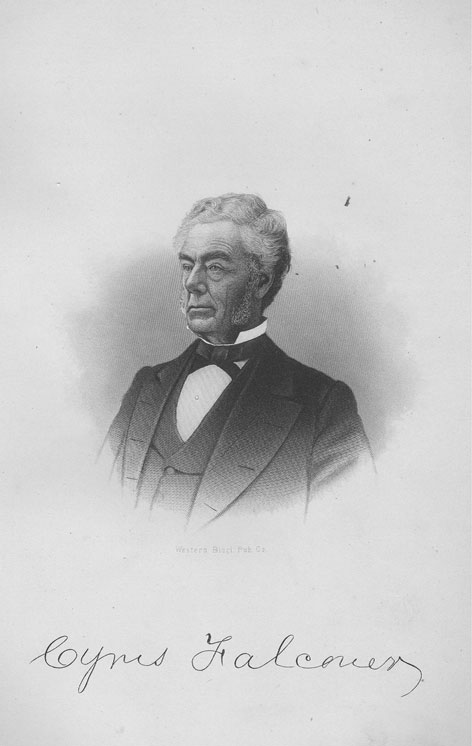
divided into building lots by William H. Bartlett, John Woods, John W. Erwin, Cyrus Falconer, William Bebb, and Evan R. Bebb. The lots are numbered from No. 1 to No. 79, inclusive, and denominated " The hydraulic addition to the town of Hamilton."
ROSSVILLE LAID OUT.
Previous to the year 1801, all the land on the west side of the Great Miami River was owned by the United States, consequently no improvements were made on that side of the river, except by a few squatters who had settled on the public lands. There was one log house built, at an early period, on the west side of the river opposite to the fort, near where the west end of the bridge now is. It is on the corner, and is the same house which. has since been weatherboarded. A tavern was first kept in it by Archibald Talbert.
On the first Monday of April, 1801, the first sales of the public lands, lying west of the Great Miami River, were held at Cincinnati, under the authority of the United ,States, at which sale a company, composed of Jacob Burnet, James Smith, William Ruffin, John Sutherland, and Henry Brown, purchased section No. 36, town 4, range 2, and fractional sections Nos. 31 and 32, town 2, range 3, lying on the west side of the Miami River, opposite to the town of Hamilton, on part of which tract they afterwards laid out the town of Rossville, the plat of which bears date on the fourteenth day of March, 1804. It was named after James Ross, of Pittsburg. The town then laid out consisted of one hundred inlots, five poles wide by ten poles deep ; twelve fractional rots, next the river, five poles square, and twenty outlots, most of them containing four acres each. The inlots 53 and 58 were given by the proprietors to the county of Butler for public uses, and the ground lying between Water Street and the river was given for a public common, to be kept open for ever. The fractional outlot No. 20 was given for a burying-ground.
On the fourteenth day of March, 1804, the proprietor had a public sale on the ground, at which the lots were offered at auction, and a considerable number of them sold at fair prices.
Encouraged by the success of the first sale of lots, the proprietors proceeded to lay out an additional number of outlots, adjoining on the south-west of the former ones, beginning at outlot No. 21 and extending to outlot No. 38, inclusive. The plans of these additional outlots were not placed on record at the time, nor have they since been recorded ,anywhere, but appear on an old map of the town which has the plan of those additional outlots, laid out at that time, upon it, made by John Reily, of Hamilton, and formerly in his possession. Mr. Reily was the general agent for the proprietors, who laid out the town and superintended the sale of lots for them.
On the sixteenth day of May, 1804, a second sale of lots in the town of Rossville, including the additional outlots laid out since the first sale, was held, at which a considerable number were sold. The additional outlots. were all sold at prices from twenty-five to twenty-eight dollars each. Several buildings were soon afterwards erected, and the town began to grow.
On the eleventh day of November, 1818, John Sutherland and Samuel Dick, who had then become the proprietors of the unappropriated ground adjoining Rossville on the north, laid out an additional number of inlots in the upper part of the town, which are numbered from No. 101 to No. 112, inclusive, and also three outlots on the north of the burying-ground (now the park), Nos. 39, 40, 41, and 42.
The original outlots numbered 9 and 10, in the northwest part of the town, were subdivided and laid out into building lots by Robert B. Millikin and William Taylor, on the twenty-eighth day of April, 1831. They are numbered from No. 113 to No. 140, inclusive.
JOHN SUTHERLAND.
John Sutherland, the earliest merchant of Hamilton, was a native of Caithnesshire, Scotland, where he was born in 1771. His father was a farmer, and Mr. Sutherland was brought up to the same calling. In 1788 he determined to come to the United States, and, on his arrival here, settled in the western part of Virginia. In 1793 he came to Ohio, and acted as a captain of packhorse, engaged in transmitting stores from Cincinnati to the military posts in the interior. Robert Benham was in charge of the pack-horses, and was assisted by several others, among them Mr. Sutherland. Each had the care of about forty horses. Afterwards he held a position in the commissariat department. When peace was concluded, he settled in Hamilton, opening a store on Front Street. Here he did a large business with the Indians, who came in from the surrounding country to exchange furs for the articles of the white men. The business was very profitable, and he soon became easy in his circumstances. As they moved away from this neighborhood, he employed persons whom he supplied with goods to go to their towns and trade with them. Some years afterwards Mr. Sutherland also dealt largely in beef cattle, which he purchased in the lower end of this valley, and drove north to Detroit. Soon after coming here he formed a partnership with Henry Brown, under the firm name of Sutherland & Brown ; after a time also establishing a store in Dayton, which was continued until they dissolved partnership in 1810. About 1813, Mr. Sutherland entered into partnership with James P. Ramsey, and did business under the firm name of Sutherland & Ramsey until 1820. His store was at first in a double log building across the alley which runs east and west behind the United Presbyterian Church, and then it was removed to Front Street, between Stable and Dayton, where he built a house on Lot 120 ; and he subsequently built
288 - HISTORY OF BUTLER COUNTY.
the house at the northeast corner of Front and High Streets, now owned by the family.
The result of his economy, care, and sedulous attention to his good name soon gave Mr. Sutherland unlimited credit, and his profits accumulated until he became the wealthiest man in the county, and one of the wealthiest in the State. He was liberal in his dealings and trusted much, but in course of time lost a great deal of money by bad debts. In 1818, and in some succeeding years, he was largely in the pork and flour trade, and made heavy shipments to New Orleans. The times were unpropitious, and he lost heavily. He had also become an indorser to large amounts for his friends, and, these coming back to him, embarrassed him. He finally suspended business, and in the end he found it required the greater portion of his acquired wealth to pay off the indebtedness thus forced upon him. However, a sufficient amount to make his family comfortable was saved from the wreck.
He was a man of unbounded charity and benevolence. He gave away much, and he assisted those who were weaker than himself to help themselves. He was a friend to every one who deserved it. He was a regular attendant of the Associate Reformed Church, although not a member, and gave of his means liberally to it, being a trustee at one time. He was a very hospitable man, and was never more pleased than when entertaining company. At his house ministers, and especially those of the Scotch Churches, were always sure of a hearty welcome.
He died on the 9th of September, 1834. He had been three times married. His first wife was Miss Mary Scott, of Fayette County, Kentucky, and his second Miss Mary Steele, of Kentucky. To the latter was born Alexander, who died soon after reaching maturity. In May, 1810, he married Nancy Ramsey, daughter of James Ramsey, of Ligonier, Pennsylvania, who was born on the 6th of November, 1787. She was one of the original members of the Associate Reformed congregation on its being formed in 1817, and remained a worthy and respected member of it all her life. Her temper was most cheerful ' and even, and she appeared to advantage everywhere. No gossip or scandal was encouraged by her, and she loved the company of pious people. She died March 21, 1855. She had borne eight children, two sons and six daughters. Elizabeth St. Clair Sutherland died unmarried. James R. died in June, 1834, at the age of twenty- two. Mary A. married Carter B. Harrison, a son of President William Henry Harrison. Carter B. Harrison died in Hamilton, the 12th of August, 1839, leaving his wife a widow with one daughter, Anna C., who married David W. McClung, now surveyor of the port of Cincinnati. Sarah married Nathaniel Reeder, dying in 1863. Three of her children, Nathaniel, John, and James, are now living, and two died in infancy John Sutherland, another brother, is still living. Jane, Isabella, and Nancy, the three youngest children, reside in the old homestead. Isabella is married to Dr. J. S. McNeeley, and has one son, Joseph Sutherland McNeeley.
SALES OF LAND.
The original lots laid off in Hamilton measured 6 by 12 poles, 100 by 200 feet ; eight such lots generally forming a block 400 feet square. A comparison between the prices paid Mr. Ludlow or his immediate purchasers for these lots and their present value may not prove uninteresting reading.
Take the square embracing Lots 99, 100, 101, and 102, bounded by High, Third, Basin, and Second Streets, now one of the most valuable blocks in town. The records show the following first sales :
Israel Ludlow's administrators sold to John Reily, on July 18, 1806, Lot 99, for $50 ; Lot 100, for $25.50 ; and Lot 101, for $20.
Samuel Dick sold to John Reily, July 18, 1806, Lot 102, for $28. The total for the block was $123.50.
Colonel Campbell still resides on part of Lot 99. The half block, bounded by Reily, Basin, Second and High Streets, is held by Mrs. Campbell, who inherited it from her father, John Reily, and her title deeds are probably the oldest of any resident of the city.
In the square bounded by Dayton, Second, Heaton, and Third, the only lots in this block that have not been subdivided are those now owned by St. Stephen's Church, Ezra Potter, and Calvin Skinner. Mr. Potter's lots (153 and 154), fronting 200 feet on Dayton and Third, were bought by John S. Gordon from David Gano, July 28, 1835, for $225.
Lot 151, corner of High and Second, was sold by Ludlow to Michael McNamee, together with Lot 18, June 22, 1795, for $28. On September 14, 1805, Michael Lafferty became the purchaser of Lots 151 and 152 (fronting 200 feet on Dayton by 200 on Second) from Samuel Enyart for $55. On February 22, 1830, James McBride sold these two lots to the St. Stephen's society for $400. These four lots make the south half of the block.
Lot 165, extending from James Neal's corner south on Second 200 feet to St. Stephen's property, and east on Heaton 100 feet, was sold by Ludlow to Rebecca F. Randolph, October 2, 1795, for $2.
Lot 166, east of Neal's, fronting 100 on Heaton by 200 deep, was sold by Ludlow at the same time and same price to Sarah F. Randolph.
Lots 167 and 168, fronting 200 feet on. Heaton and 200 on Third to Potter's Alley, were sold with fifteen other lots to Daniel Gano by Ludlow, July 13, 1827, for $700, and Gano sold the lots, 167 and 168, July 25, 1855, to John M. Millikin and William Bebb for $550.
Fenton Lawson and others sold Lots 167 and 168 to W. H. Bartlett, December 11, 1841, for $700, and on February 18, 1844, Calvin Skinner bought the south halves of the lots, 200 feet front on Third by 200 deep, his present residence, from J. B. McFarland for $400.
HAMILTON - 289
Lot 103 comprises the entire strip of ground on the east side of Third Street from High to Basin, extending back to Smith Street,-72 square poles. This property was sold by John Brown to John Sutherland, June 18, 1800, for $30.
Lots 111 and 112, with Beckett's block and Dr. Falconer's residence on their front, extend back to the Hydraulic, and together have a front of 200 feet on High Street. Ludlow sold both these lots to Eleanor Moore, May, 1804, for $62 -$42 for 111, and $20 for Lot 112. Ludlow obtained possession of the lots again, and his heirs sold to John Woods, March, 1832, all of Lot 112, Falconer's and Beckett's Hall in part, and 34 feet of the south, High Street end, of Lot 111 for $500. April 17, 1835, Woods bought of James S. Green 66 feet more of the south half of Lot 111 for $675 ; he thus had the entire, front from the corner of Second to Falconer's Alley for $1,175.
Starting from the Hamilton House corner, Lot 110, and going west, we find that Ludlow sold 50 feet of the east end of the lot (Hamilton House) to James McBride July 24, 1812, for $157, and at the same time the west 50 feet to Thomas C. Kelsey for $126. The next lot on High (109), was sold by Ludlow's administrators; the east half to Kelsey, March 1, 1813, for $150, and the west half to Samuel Morrison for $159.50. Subsequently, April 1, 1835, Dr. Hittel bought the west half of James Young for $2,000.
The Sutherland Corner, Lot 107, fronting 200 on High, extending from the west line of Lot 109 to Front Street, and 100 on Front Street, was sold by Ludlow to John Sutherland in 1803, deed made March 1, 1813, for $30. The lot next north on Front Street (108) fronting 100 on Front, and running 200 deep on Stable, was also bought by Sutherland March 1, 1813, for $154. C. Morganthaler bought 50 by 100 feet of this lot October 19, 1849, paying $700.
These figures make the value of the entire block between High Street and the Hydraulic, Second and Front, $770.50.
Lot 173, the residence of Dr. Howells, stands on the south-west corner of Front and Buckeye-200 feet on Buckeye by 100 on Front. Lots 174 and 173, extending the entire front on Front Street between Heaton and Buckeye, were sold by Ludlow to Benjamin F. Randolph October 2, 1795, for $40. March 10, 1845, Samuel Snively sold Lot 173 to Joseph Howells for $600. On March 14, 1845, Dr. H. C. Howells bought 50 by 100 feet off of the east end (on Buckeye Street) of the lot, paying $100. August 15, 1848, the doctor bought an additional 50 feet next west of his first purchase, paying $350. He now owned half the lot. On September 14, 1849, he bought the remaining 100 feet front on Buckeye, on which his residence stands, paying $2,000. So the lot that cost Joseph Howells $600 in 1845 had cost Dr. Howells, including buildings, $2,450.
The lots originally laid out in the First Ward were 5x10 poles-822x166 feet ; fractional lots, 82 ½ x82 ½ feet.
The Straub House lot, No. 1493, 87 ½ x 87 1/2; feet, was sold by Sutherland & Brown to James Mills, June 19, 1809, for $16. The stable lot, same size, in the rear, was sold at the same time by Sutherland & Brown to Thomas McCullough, for $10.50,
Lot 1540 extends from the west line of the Straub lot to the corner of Main and Front, and is 82 feet deep. John Sutherland sold this lot to Kelsey & Smith, April 16, 1813, for $49.
The entire block, extending from Odd Fellows Hall to the river, and south on Front and Water to the alley, was sold by John Sutherland to John Hall, June 5, 1813, for $1,200.
The four lots, 1523, 1528, 1533, and 1538, extending on Second Street, east side, from Boudinot to Main, were sold by Sutherland & Brown to Robert and John Taylor, June 19, 1809, for $66.40.
Beeler's drug store stands on the south-east corner of lot 1539, and fronts 185 feet on Main. Lot 1532 lies behind it, is of the same size, and extends on Front to the John Brown Alley.
Sutherland & Brown sold the Beeler lot to Samuel Dick for $28.50, January 15, 1810, and the other lot to Samuel Alston, June 19, 1809, for $23.25.
Doctor Miller's drug store stands on the north-east corner of Lot 1542. This lot fronts 185 feet on Main by 85; on Front. Sutherland & Brown sold this lot to Samuel Scott for $21, June 19, 1809, and on January 17, 1814, Isaac Falconer became the purchaser, for $100.
On June 19, 1809, Sutherland & Brown sold Samuel Dick nine lots for $10. One of these lots was 1543, on the south side of Main, extending from the corner of Second to the alley, going east ; another was Lot 1552, where Doctor Scobey's residence stands ; two others, 1544 and 1547, behind it, make a front of 165 feet on the northeast corner of Main and Second.
Lots 1562 and 1563 extend on Ross Street, south side, between Front and Second. Mrs. Matthias lives on part of 1562, and P. C. Conkling, Mr. Beek, and Daniel Shaffer on Lot 1563. Sutherland & Brown sold Lot 1,562 to Ethan Stone, June 19, 1809, for $55, and William Corry sold lot 1563 to John Reily, July 16, 1813, for $400.
The school-house lot opposite (Lots 1553 and 1558) were sold by the Presbyterian Church to directors of school district No. 2, St. Clair Township, August 9, 1851, for $500.
Lot 1559, north-west corner of Front and Ross, occupied in part by Daniel Galloway, was sold by Sutherland & Brown to John Reily, June 19, 1809, for $50.
JOHN WINGATE.
John Wingate was one of the earliest settlers in Hamilton. He was here almost as soon as the clash of
290 - HISTORY OF BUTLER COUNTY.
arms ended, and remained here through our infancy as a town, although afterwards going away- to other places. He was born in the State of New York in the year 1774, and in his youth learned the trade of stonemason. Soon after the date of St. Clair's defeat, Mr. Wingate came to the Western country with the army commanded by General Wayne. He was a sergeant in Van Rensselaer's cavalry, in the battle of Fallen Timbers, when Wayne gained a complete victory over the savages. He behaved with bravery on this occasion, and his deeds were long remembered by his associates in arms. His brother was slain by his side in that action. After the disbandment of the army, Mr. Wingate came to Fort Hamilton, where he settled, marrying Miss Mary Dillon, who was the daughter of one of the earliest pioneers. She died in a few years, leaving him with two children. Soon after coming here he opened a store on Front Street, in a log building, situated on the west side of the street, on the lot now occupied by St. Mary's Catholic Church. In 1806 he gave up business, and the store was rented to the Hough Brothers, of whom the survivor, Joseph Hough, was long an ornament of Hamilton. In October, 1807, he was elected sheriff of the county, serving for two years, and being preceded and followed by Mr. William McClellan. On the 24th of May, 1809, Mr. Wingate was married to Mrs. Emma Torrence, widow of John Torrence, then lately deceased. She was a lady of great worth, and highly esteemed for her many amiable and excellent traits of character. She was a daughter of Captain Robert Benham, and sister of Joseph S. Benham, the distinguished lawyer. Mr. Wingate was elected about 1810 a brigadier general of the Ohio militia, and in the year 1813 again went out to the war, serving six months in that capacity.
After his marriage with Mrs. Torrence, in 1809, he kept an inn for the accommodation of travelers, on the corner of Dayton and Water Streets, the stand that had been previously occupied by John Torrence. In 1816 he removed to Cincinnati, where for some years he kept the old Cincinnati Hotel, on Front Street, between Sycamore and Broadway, and after a time removed to Big Bone Lick, Kentucky, where he kept a house of entertainment for several years, finally removing further West. He returned during the last weeks of 1851, and took up his abode with John Burke, Jr., near Symmes's Corner, whose father, when an unprotected boy, had found a friend and benefactor in him.
His death occurred only a few weeks later, on the 14th of April, 1851, when he had attained the age of seventy-seven years. His funeral was largely attended. It was held in the Methodist Episcopal Church in Hamilton, the discourse being pronounced by the Rev. Arthur W. Elliott, and the body being interred in Mr. Elliott's own lot, in Greenwood Cemetery. After the service at the church had closed, a funeral procession was formed, under the direction of Lewis D. Campbelk The funeral car was preceded by martial music ; then followed a company of artillery with a brass field-piece, under the command of Captain Nathaniel Reeder ; Major William P. Young, bearing the national flag, appropriately trimmed ; the mayors of Hamilton and Rossville ; the clergy and pall-bearers. The body was followed by the friends of the deceased, the soldiers, and a large train of citizens. As the procession entered the cemetery grounds, the artillery commenced firing minute guns, which, with the tolling of the bells in town, continued until the service at the grave was concluded. The whole formed a combination at once solemn and impressive.
POST-OFFICE AND PUBLIC MAILS.
In 1804 a post-office was established at Hamilton, and on the second day of August in that year John Reily was appointed postmaster, by Gideon Granger, then Postmaster-general. There was at that time only one mail route established through the interior of the Miami country. It was carried on horseback, once a week, leaving Cincinnati, and passing by Hamilton, Franklin, Dayton, and as far north as Stanton ; thence to Urbana, Yellow Springs, and Lebanon, back to Cincinnati. In a year or two afterwards the route was reversed, so as to go out by the way of Lebanon and return by Hamilton. At that time all the people living north and west of Hamilton had to come to this post-office for their letters.
John Reily held the offrce of postmaster from the time of his appointment, in 1804, until July, 1832, when he resigned, and James B. Thomas was appointed in his room.
James Lowes was appointed postmaster and entered on the duties of the office on the first day of April, 1851. He resigned on the thirty-first day of January, 1853, and on the next day James K. Thomas, son of the former, postmaster, who had been appointed, took possession of the office.
On the eighth day of August, 1853, L. M. Furrow, who had been appointed postmaster in the stead of James K. Thomas, removed, took possession of the post-office, and entered upon the discharge of the duties of the offrce.
On the twenty-sixth day of April, 1855, the post-office in Rossville was discontinued, and the business transferred to the post-office in Hamilton.
The following are the dates of the appointment of the postmasters at Hamikon and Rossville:
Hamilton.—John Reily, August 2, 1804; John Reily, June 29, 1818; James B. Thomas, July 9, 1832; James Lowes, March 27, 1851; James K. Thomas, June 19, 1853; Lawrence N. Furrow, July 29, 1853; Jacob Troutman, March 13, 1857; William H. Blair, April 23, 1861; William H. Rossman, March 30, 1871 ; John McKee, September 8, 1873; Charles E. Giffen, January
20, 1882.
Rossville.—Joseph Wilson, November 24, 1819; Robert B. Millikin, September 2, 1824 ; Jacob Matthias, September 21; 1836; Samuel G. Sweeney, March 8,
291 - HAMILTON.
1837; Samuel Millikin, March 29, 1839; Levi Richmond, May 1, 1844; Joseph Curtis, May 29, 1849; George Longfellow, April 14, 1853; Robert Hargitt, December 10, 1853. Discontinued April 19, 1855.
OLD ADVERTISEMENTS.
In the Western Spy and Hamilton Gazette, " published weekly at Cincinnati, Northwestern Territory, by Carpenter & Findlay," are several interesting and curious advertisements. Among the list of letters remaining in the post-offrce at Cincinnati, the only post-office in the Territory, we find the following : " Charles Brown, care of Samuel Dick; James Carter, care of Paul Hueston; James Cole, Big Miami; Patrick Graham, Gregory's Creek ; Abraham Lakes, Deerfield; David Lee, Big Miami; James McClelland, near Hamilton; John Cleves Symmes; Thomas Alston, and Peter Atherton, below the Big Miami; David Hendrix, near Hamilton; Jerome Holt, Dayton; King Dearmond; Daniel Doty, Big Prairie; Zina Doty; James McCloskey, care of Samuel Dick; Reverend Richard McNemair; Joseph McMahan, near Hamilton ; Azarias Thorn, near Hamilton; John Torrence, Hamilton; James White, schoolmaster; James Watson, near Hamilton; Anthony Williams, Deerfield.
Here is a Hamilton advertisement:
LAST NOTICE. - We have every reason to return our warmest acknowledgment to those who have give birth to and support our interest in trade, yet the delinquencies are numerous, which renders it inconvenient to visit their several dwellings. We therefore request those (in friendship) to call at the places of contracting, viz.: here or at Dayton, and settle up their accounts as per contract. Such characters as may fail in so doing before the 10th of August next will be deemed as being pregnant with fraud and deceit, and may not expect further indulgence by
SUTHERLAND & BROWN.
HAMILTON, June 20, 1804.
N. B. We wish to purchase beef cattle delivered by the 10th of August next. S. & B.
THE COUNTY JAIL
As soon as it was known that this would become the capital of the county a paper was circulated for subscriptions to build a county jail. Benjamin F. Randolph and Celadon Symmes were the agents of the county in collecting the money, which was not all got together for ten years. The building, which was of stone, was begun in 1805 and finished in 1806. It cost $1,600, a little more than the subscriptions. The paper circulated reads thus:
SUBSCRIPTION LIST.
Be it known by these presents, that we, the subscribers, do each and severally and separately firmly bind and obligate ourselves or heirs and assigns, to the county of Butler, in the State of Ohio, for the different sums annexed to each and every name in the particular articles herein described; viz., money, stone, brick, lime, lumber, mechanical work, labor, hauling, etc., etc., etc.,—to be appropriated to the only use of said county to erect publick buildings, and such other purposes as the commonwealth of said county Is. deem necessary. The same sums subscribed shall be recoverable at law by the trustees appointed for that and other publick purposes in said county, providing that the seat of justice of said county be appointed and established in the town of Hamilton, in said county of Butler—otherwise to be void and of no effect. In witness whereof we, the subscribers, have severally and separately set our names with the sums annexed thereto, this eighteenth day of July, in the year of our Lord one thousand eight hundred and three.
The sums subscribed are to be considered in dollars.
Jno. Torrence, - 50
Frederick Fisher, - 50
Charles Bruce, - 50
Jonah Enyart, - 10
Thomas McCullough, - 50
Jo. McCullough, - 5
S. Line, - 35
Zopkan Bell, - 5
Paul Bony, - 50
Timothy Woodruff, - 10
James Lyon, - 20
Benj. F. Randolph, - 51
David Line, - 15
Jno, Vinnedge, - 30
Andrew Christy, - 20
Wm, Long, - 5
Brice Virgin, - 5
Samuel Gregory, - 2
John Weyeney, - 1
John Wingate, - 20
Celadon Symmes, - 50
Daniel Conner, - 20
Azarias Thorn, - 25
Joseph Walker, - 20
Henry Watts, - 6
Isaac Stanley, - 25
Abr. Barlow, - 4
Henry Wason, - 20
Isaac Wiles, - 25
John Moffett, - 3
Barney McCarron, - 15
Jacob Lewis, - 10
William Scott, - 10
John Gordon, - 69
Jas. Dunn, - 20
Samuel Brant, - 2
Gilbert McCrea, - 5
William Mahan, - 5
Thomas Alston, - 6
John Dunn, - 4
James Watson, - 10
Samuel Walker, - 10
James McGuire, - 2
Jacob Scott, - 3
Robert Jonston, - 2
Wallis Alston, - 2
John Crum, - 2
John Maxwell, - 2
Jas. Blackburn, - 25
John McDaniel, - 5
Joseph Urmston, - 5
Francis H. Gaines, - 3
Samuel Ewing, - 3
Joseph Holloway, - 5
Abner Willson - 4
Thomas Baxter, - 6
John M. Crane, - 10
Geo. Marlan, - 15
James Clark, - 10
Richard McCain, .- 10
Samuel Alexander, - 10
William McKinstry, - 10
Edward Harlow, - 10
James Cummins, - 10
David Cummings, - 10
Thomas O'Brian, - 5
John Doty, - 10
Philip Round, - 1
Jacob Rowan, - 5
Joseph Botten, - 4
William Legg, - 2
James Murphy, - 1
Joseph Peak, - 2
Henry Thompson, - 5
D. W. Nutt, - 10
John Smith, - 5
William Herbert, - 6
Miles Whitmore, - 5
James Hamilton, - 5
Tobias Talbott, - 3
John Dixon, - 1 ½
William Symmes, - 30
Joseph McMaken, - 7
John McMaken, - 2
ISaac Seward, - 1
Samuel Seward, - 10
George Van Ness, - 5
George 13rownherd, =
Daniel Davis, - 3
William Smith, - 6
John Reed, - 1
James Seward, - 15
Hezekiah Bradbury, - 26
Robert Noble, - 3
Sutherland & Brown, - 50
Jonathan Pittman - 5
Philip Hoyle, - 3
Jeremiah Murfey, - 1
Joseph Hennery, - 10
William Ruffen, - 10
James Patterson, - 20
David E. Wade, - 5
TOTAL.
Cash, - $355 00
Timber, - 124 00
Mechanical work, - 114 00
Labor, - 216 00
Hauling, - $123 00
Whisky, - 69 00
Grain, - 241 50
$1,242 50
HAMILTON IN 1803.
The appearance of Hamilton in 1803, when Mr. Reily moved here, was then far different from what it is at present. The fort had been dismantled and abandoned but a few years previously.
The fort was opposite the place where the bridge over the Miami River has since been built, extending from
292 - HISTORY OF BUTLER COUNTY.
Hydraulic Street to the site of the United Presbyterian Church, and from the river as far east as the ground on which the Universalist Church is built. The ground east of the fort extending as far as Second Street, including the public square and High Street, had been occupied as a burying-ground for the garrison, and numerous rude grave-stones and graves were dotted over the surface. A natural terrace, eight or ten feet high, ran along the west side of Front Street, separating the upper from the lower plane. When this bank was excavated in grading High Street, several skeletons were taken up entire, and many human bones disinterred, which were all removed and buried. Many more, doubtless, lie in this space. As late as 1812 a paling inclosing a single grave stood in the middle of High Street opposite the Hamilton Hotel, but was removed that year.
The inhabitants of Hamilton, when Mr. Reily came here, weme few in nuniber, and composed chiefly of soldiers and other persons who had been attached to Wayne's army, and had remained here when that army was disbanded at the close of the campaign. These persons lacking energy and enterprise, spoiled for pioneer work by military camp life, and in many cases dissipated and immoral, were not the class of citizens best calculated to promote the rapid improvement of the place.
Few houses had been erected. A two-story frame house stood in the center of High Street, not far from the present bridge. It was the old house erected by General Wilkinson for the accommodation of the officers of his army. In this house William McClellan kept a tavern. Above it, extending from near the river to the east line of the pickets, was a row of stables, built of round hickory logs with the bark peeled off, which were originally used for the horses of the officers and the cavalry, and afterward as stables for the tavern. The artificers' shops stood further to the north, near where the hydraulic race now is. The magazine stood in the south angle of the garrison, and some other dilapidated buildings were in and around the locality of the fort. There was a well of excellent water, which is still in use, a few feet west of the dwelling of John W. Sohn, over which there was then a large wheel for drawing water.
John Torrence kept a tavern at the corner of Dayton and Water Streets, in the house now owned and formerly occupied by Henry S. Earhart. Mr. Torrence died in 1807, but his widow continued the business—even for years after she became the wife of John Wingate. She was the daughter of Captain Robert Benham, whose adventures are frequently mentioned in the early history of the county, and a sister of Joseph S. Benham, formerly a prominent lawyer of Hamilton. On the lot opposite, on the north side of the street, was a log-house, which was built by Darius C. Orcutt, and then occupied as a boarding-house by Mrs. Griffin, a sister of Abner Enoch.
Isaac Stanley afterward kept a tavern with the sign of a Black Horse, on Front Street, in an old log-house, in the upper part of the town.
John Sutherland kept a store in a house on the east side of Front Street, between Dayton and Hydraulic Streets, and carried on an extensive trade with the Indians. It is now torn down. In the upper part of the town were several cabins, in which lived James Heaton, Isaac Wiles, George Harlan, William Herbert, and George Snyder.
John Wingate commenced a store in a log-house where St. Mary's Catholic Church now stands, where he failed in 1806. Thomas and Joseph Hough continued the business ; and, after the death of the former, it was successfully occupied by Hough & Blair, and Kelsey & Smith, for the same purpose. Nearly opposite, on the south side of the street, lived Thomas McCullough and Dr. Jacob Lewis. In the south part of the town resided John Greene, Azarias Thorn, Barney McCarron, Benjamin Davis, Ludlow Pierson, and perhaps others not now recollected.
On the west bank of the Miami River was a solitary log-house, occupied by Archibald Talbert, who kept a tavern and the ferry. The town of Rossville was not then in existence. It was surveyed and laid out by Mr. Reily in 1804.
EARLY DAYS OF THE TOWN.
When Mr: McBride first settled himself in Hamilton in the year 1807, the inhabitants were few in number, and the improvements principally confined to the margin of the river. William McClellan, who served eight years as sheriff of Butler County, then kept a tavern in the old garrison house, which had been erected for the accommodation of the officers of the army, which has already been described. It was taken down in 1813. John Torrence kept a tavern on the corner of Dayton and Water Streets. William Murray kept a tavern on the opposite corner in a house on lot No. 145.
Isaac Stanley also kept a tavern in an old log house in the upper part of the town, Which stood on lot No. 162, on Front Street. He was a justice of the peace as well as a tavern keeper, and kept his office in the barroom (the only room in the house, except a little log but standing back, occupied as a kitchen). Here he dispensed justice and whisky for several years.
A store was kept by John Sutherland, on Front Street, between Stable and Dayton Streets.
Messrs. Joseph Hough and Thomas Blair had a store near the south-west corner of the public square. It was kept in an old log house standing 'on the lot now owned by the Catholic Church. John Reily, the clerk of the court, kept his office in a log house in the lower part of the town, as mentioned in a previous chapter. Azarias Thorn lived on lot No. 9, in the lower part of the town. After his death the same house was owned and occupied by Oliver Stevens. Mrs. Greer lived in a log house,
HAMILTON - 293
isolated, in the brushy wood near the north-east corner of Second and High Streets.
Widow Davis lived in a very old log house which stood on the corner of the alley and Front Street. Barney McCarron lived in a cabin in the south part of the town.
Doctor Daniel Millikin, the only physician in the place, lived in a house on the bank of the river, above Major Murray's Tavern. In the same neighborhood also lived James Heaton, Isaac Wiles, George Snyder, William Herbert, and George Harlan, with, perhaps, some others.
William Corry, the only lawyer in the place, kept his office in the same building with the clerk of the court. Several other lawyers, however, regularly attended the courts at Hamilton. At that time, nearly all that past of Hamilton lying east of Front Street was an impenetrable thicket, covered with small, scrubby oaks, blackjacks, vines, and hazel bushes. True, paths and roads were in some places cut through them, to admit a free passage, but, aside from these, underbrush was so thick that it was only in some places a person could make his way through them, or see a rabbit at the distance of a few paces. This was then the case from Sutherland's Corner to the Hamilton Hotel, and eastwardly to where the canal now is, and southwardly as far as the town lots extend.
At that time it was common to meet with Indians in the streets of Hamilton almost every day, who came to trade their furs and peltries with the storekeepers. In 1808 a band of seventy or eighty Indians encamped in the lower part of Rossville, and remained more than a week. When they got liquor they frequently became intoxicated, and were then very troublesome. One night, when a number of them were intoxicated, Mr. McBride took a seat on the bank of the river, concealed from their view, and remained a considerable time, watching the squaws taking the drunken Indians across the river, at the ford opposite the lower part of the town, to their camp, on the other side of the river. Two squaws would take hold of an Indian, one on each side, and conduct him across the stream, singing a slow, monotonous song as they waded through the water.
The improvements in Rossville were then still fewer than in Hamilton. There was a log house near where the west end of the bridge now is, occupied as a tavern and ferry-house. It was kept by Colonel James Mills, afterwards by John Hall, and years afterward by Lewis P. Sayre. Michael Delorac kept a tavern and ferry. The tavern was kept in a house in what was then the upper part of Rossville.
Some years afterward Isaac Falconer built a house on the corner of Main and Front Streets, where he kept a tavern many years. These, with two or three log houses in the lower part, comprehended the extent of improvement. Brushwood, elder bushes, a1. high weeds occupied the remaining part of the town. In those days it was customary at court time, and on election and other public days, for great numbers of the people from the country to come to town, business or no business, and to devote their time to drinking and noisy revelry. There were no temperance societies in those days. Every man who had any pretensions to gentility must be hail-fellow well met with every one—must at least call for his half- pint of whisky, which, in the taverns, was then measured out to customers in small half-pint and gill green bottles, like vinegar cruets.
The upper part of the town of Hamilton, north of Dayton Street, was a beautiful natural prairie, unimproved and uninclosed, except a few straggling cabins near the bank of the river, pastured by the town cows and sheep. The race-course was on this common. Though now fallen into disrepute, horse-racing was, in those times, a favorite amusement, and an affair of all- engrossing interest. Every business or pursuit was neglected during its continuance. On public days—indeed, on almost every Saturday—the streets and commons in the upper part of the town were converted into race- paths. The race-course comprehended the common from Second to Fourth Streets. At Second Street, a short distance north of where the Roman Catholic Church is now built, was erected a scaffold, elevated a little above the heads of the people, where stood the judges of the race.
On grand occasions the plain within the course and near it was occupied with temporary booths, erected with forks and covered with boughs, just cut and brought from the woods.
Here every thing was said, done, sold, eaten, and drank. Here was Black York, with his fiddle and his votaries, making the dust fly with a four-handed, or otherwise four-footed reel, and every fifteen or twenty minutes was a rush to some part or other to witness a fisticuff.
Amongst the bustling crowd of jockeys were assembled all grades and classes of people, from the highest to the lowest. Justices of the peace and other civil officers of the County were there. Even judges of the court mingled with the crowd, and sometimes presided at those contests of speed between the ponies of the neighborhood. tut public opinion has undergone a change. It now attaches odium to what in former times were regarded as only venial, errors.
Balls and dancing parties were frequent. Though the inhabitants of the town were few in number on these occasions, the youth and beauty of the county would assemble, and many a long Winter night did they amuse themselves " on the light, fantastic toe," measuring time to the sweet strains of Vanzant's fiddle, until broad daylight would warn them that it was time to retire. These balls were generally held at Wingate's or Murray's tavern. Sometimes there were social dancing parties at
294 - HISTORY OF BUTLER COUNTY.
the widow Davis's, but in times of sleighing they were always held at Mother Broadbury's, two miles from Hamilton, on the Cincinnati road, where Wilkeson Beaty formerly lived, in. Section 35.
POPULATION.
The residents in Hamilton in 1810, according to the census, were 210, and those in Rossville, 84. The following list, therefore, must embrace all who were here in 1807, when Dr. Daniel Millikin and Samuel Millikin came to Hamilton.
John Kelly was clerk of the courts, and agent for the proprietors of the town of Rossville ; John Sutherland was a storekeeper, as were Joseph Hough and Thomas Blair ; William Murray kept a hotel, and so did John Torrence and John Wingate ; William McClellan kept a public house ; Lawrence Cavanaugh was a man of some means ; William Hubbert was a proprietor of the town of Rossville ; Isaac Stanley kept a hotel ; John Greer was an associate judge, and James Heaton was the county surveyor. The other names from this side of the river were George Snider, Anderson Spencer, Thomas Spencer, Oliver Stephens, Captain Azarias Thorn, Daniel Hill, Paul Bannell, William Riddle, Isaac Wiles, Gardner Vaughn, George Harlan, Mrs. Davis, Barnabas McCarron, Mr. Hagan, and Hugh Wilson.
In Rossville, there were Michael Delorac, father of Alexander Delorac ; John Aston, Robert Taylor, John Taylor, John Hall, Isaac Moss, James Ross, Archibald Talbert, the ferryman ; Moses Connor, Leonard Garver, Samuel Spivey, and Samuel Ayres. This gives twelve names for Rossville, and twenty-eight for Hamilton, which, at the usual rate of computation, would give for the population of Rossville sixty persons, and for Hamilton; one hundred and forty.
The first marriage in Butler County, after its erection, was by Celadon Symmes, and the fortunate parties were Jacob Sample and Jane Hueston. This was on the 8th of September, 1803. Marriages had undoubtedly taken place before this, but they were under the jurisdiction of Hamilton County, and are there recorded, if anywhere.
Mr. Birch came to Hamilton in 1810 or 1811. He first occupied the south room of the house now owned by Mrs. R. Tapscott, and which was built in 1810 by Joseph Hough, deceased. Subsequently, and before the brewery was built, Mr. Birch resided in a small house built by himself on the west side of the road leading to Cincinnati, and some two hundred yards north of the pond. The old brewery was built about 1813 or 1814.
TAXATION.
It appears from the earliest tax duplicate that in 1804 fifty-eight lots were taxed in Hamilton. Benjamin F. Randolph had eighteen ; John Reily, one ; Sutherland & Brown, five ; John Sutherland, six ; John Torrence, twelve ; Azarias Thorn, two ; Isaac Wiles, thirteen ; and
John Wingate, one. The lots of the last named four persons were taxed for two years, the total amount being forty cents and a half. This would be at the rate of three-quarters of a cent a lot per year.
The " duplicate" for 1805 consists of about twelve pages of folio paper without rules, lines, or printed heads. While the paper is yellow from age, the ink is as clear and black as though it was fresh only yesterday from the ink-stand. On the back of the duplicate, in the bold handwriting of John Reily, is this indorsement : A Duplicate of Taxes on Land for the year 1805, amounting to dollars, 871.64.2."
The duplicate was divided into two parts : the first part containing the registry of non-resident land owners, and the second part the registry of those who were in possession. Of land owners the duplicate shows nonresidents 64, owning 27,727 acres. Residents 310, owning 87,398 acres. Total 374, owning 117,125 acres. Among the largest non-resident land owners were Elias Boudinot, after whom Boudinot Street, First Ward, is named, who held 1,994 acres in sections 13, 14, 20, 21, and 25, in Lemon Township ; Elijah Brush, 1,065, in sections 8, 9, 16, and 17, Lemon Township ; John N. Cummins, 1,240 acres in Fairfield ; William H. Harrison, afterward President of the United States, 640 acres, all of section 33, Union Township ; Henry Ray, 1,895 acres in St. Clair Township ; Benjamin Scudder, who held 640 acres in sections 27 and 33 in Liberty Township, which is still owned in great part by his heirs ; John Cleves Symmes, 640 acres in Fairfield Township ; Jonathan Dayton, 2,130 acres in Liberty and Fairfield.
Of resident land owners, David Beatty held 885 acres in Fairfield and Hanover ; Daniel Doty, 295 in Lemon ; Samuel Dickey, of Prairie, 400 acres ; and Samuel Dickey, of Elk Creek, 370 acres ; Ralph W. Hunt, of Lemon, held 2,600 acres in Lemon ; Matthew' Hueston, father-in law of Robert Harper, held 1,543 acres in Fairfield ; Thomas Kyle held section 28, Lemon Township ; Solomon Line held 934 acres in Fairfield ; Enos Potter held 640 acres in sections 23 and 27, Lemon ; Celadon Symmes held 4,631 acres in Fairfield ; and Joel Williams held 2,505 acres in St. Clair and Ross. Land at that time was divided for taxation into three grades. What was called first quality was taxed $1 per 100 acres ; second —quality, 75 cents per 100 acres ; third quality, 50 cents per 100 acres. There was of first quality, 21,914 acres ; second quality, 78,709 acres ; and third quality, 16,502 acres ; total, 117,125 acres ; and the total taxes assessed on this land amounted to the enormous sum of $871.64.2.
The smallest tax on the duplicate was assessed against John Reily, who held a few lots in Hamilton, Williamsburg, Cincinnati, and Deerfield. His lots in Hamilton embraced one acre of ground, and are now occupied in part by Colonel Campbell as a residence, and the entire tax on all of Mr. eily's property for 1805 was two cents
HAMILTON - 295
and seven mills ! The largest resident tax payer was Celadon Spumes, $21.67.9 ; after him, Joel Williams, $18.64; then Samuel Dick, $18.07, on 3,703 acres in what is now Ross ; next, John N. Cummins, $15.81.
CORPORATION AND TOWN COUNCIL.
The town of Hamilton was incorporated by an act of the Legislature, passed in January, 1810, in pursuance of which law a president and three trustees were elected by the citizens, who proceeded to organize themselves and pass ordinances for the government and regulation of the town for four succeeding years. A considerable number of the citizens were opposed to the corporate regulations, and some irregularity occurring in their proceedings, no election was held in the year 1815, in consequence of which the corporation became forfeited and so remained until the year 1827, when the town was again incorporated, together with Rossville, under the name of "The towns of Hamilton and Rossville." The powers and duties of the corporation were vested in six trustees, to be elected by the citizens, who should hold their office two years, and appoint out of their own body a president and recorder. The towns were divided into two districts or wards, Hamilton forming one and Rossville the other, the citizens to meet in their respective wards and each elect their trustees. The corporation were vested with power to levy a tax of not more than one-eighth of one per cent on the amount of the grand levy of the State. In May, 1827, the citizens met at their respective places of holding elections, those of Hamilton electing Doctor Loammi Rigdon and others, and the citizens of Rossville, Israel Gregg and others, as trustees, who afterwards met and appointed Israel Gregg president and Loammi Rigdon recorder. Under this corporation and manner of organization the towns continued to prosper, under a well regulated police, for four years. In January, 1830, the Legislature passed a law authorizing the corporation to grant licenses to grocers and retailers of spirituous liquors. In the course of time, jealousies springing up between the two towns, on the petition of the citizens of Rossville, the connection between them was dissolved by the Legislature, in February, 1831, and each erected into a separate corporation. In accordance with this amendatory law the citizens of Hamilton elected James O'Connor, John Woods, John C. Dunlavy, Jesse Corwin, John M. Millikin, an Henry S. Earhart, trustees, who organized themselves by appointing James O'Connor president and John M. Millikin, recorder, who continued to exercise the duties of their office for the two succeeding years.
In February, 1833, the charter of the town of Ham- ton was modified by an act of the Legislature, by which the government of the town was vested in a mayor and six trustees, to be elected by the citizens for the term of three years.
By this act the corporation were authorized to levy a tax of one-fourth of one per cent for corporation purposes. The citizens met in May, 1833, and elected James McBride mayor and John Woods and others trustees, who organized themselves and appointed John Woods recorder. This board drew up and passed an entire new code of laws for the regulation and government of the town, and commenced' grading and improving the streets. On the 14th of February, 1835, the Legislature authorized the corporation to draw water from the basin, for the purpose of extinguishing fires, on which privilege being granted, the corporation, in 1836, laid pipes from the basin down Basin Street as far as Front Street, with pipes leading from them to fill two cisterns, constructed in the public square.
On the 7th of March, 1835, the Legislature passed a law, further modifying and amending the act of incorporation. By this law the name of the corporation was changed to that of "The town of Hamilton." They were authorized to levy a tax of one-half of one per cent on the grand levy of the State, for supplying the town with water and improving the streets. The act authorized them to borrow money, not exceeding fifteen hundred dollars; to appoint a wharfmaster; gave them the use of the county jail, and provided for filling the office of mayor, in case of vacancy.
The corporate powers of the town of Hamilton were vested in a mayor and six trustees. The mayor presided at the meetings of the board and was the judicial officer to carry into effect the ordinances passed by the board, and had all the powers vested in a justice of the peace, either in civil or criminal matters, throughout the town. In criminal cases the marshal might serve pro&ss in any part of Butler County. The corporation had power to appoint a recorder, a treasurer, marshal, wharfmaster, supervisor of streets and highways, inspector and measurer of wood, tanner's hark, lumber, and other articles of domestic growth, and regulate their duties. The corporation was vested with power to make ordinances and by-laws for establishing and regulating the market, organize fire companies, and provide for the extinguishment of fire; to regulate the streets, alleys, and highways, and generally to make such ordinances and regulations for the safety, health, cleanliness, and convenience of the citizens, as was usual in like corporations.
GROWTH OF THE TOWN.
The population of Hamilton, as shown by census in 1810, was 242, and of Rossville 84. At the next de1cennial census, in 1820, it was all inchided under the name of Hamilton, and the population numbered 660 souls. In 1830, at the next census, the population of Hamilton had increased to 1,072, and Rossville again appeared with 629 inhabitants. There were 9 colored persons in Hamilton in 1810; in 1820, 33, and in 1830, 80. No colored persons-were in Rossville at either date.
The Miami Intelligencer, No. 31, of February 23, 1815,
296 - HISTORY OF BUTLER COUNTY.
advertises a new huckster-shop, in which cider, green and dried apples, whisky, beer, tar, and other accommodations, if called for, could be had. Boots and shoes were made. The advertiser was James T. Morton, corner of Front Street and the Diamond. Elihu Line had lost a large ram, and Paul Sanders had had a boy, named Briton Wright, an apprentice at the pottery business, run away from him. He was aged seventeen years, stout made, dark skin and complexion, about five feet high, " much given to lying, and a little light-fingered." Whoever would take him up and return him would have six cents reward and no thanks. Those indebted to the late firm of Kelsey & Smith were invited to come forward and settle up. Absalom Goodnough, at his new shop, on Front Street, sold boots and shoes. R. Birch, at the Hamilton brewery, refused to pay a due-bill of sixty-one dollars and fifty cents, payable in barley. William Murray needed a hostler. Michael Delorac, "being far advanced in age and unable to traverse the streets and by-roads of Hamilton in search of passengers and freight, but wishing to make an honest and honorable livelihood" by his calling, gave notice that his ferry was in complete repair, the flats new, and that good entertainment for man and horse could there be procured. Preliminary articles of peace had just been brought over from Ghent.
MRS. KENNEDY'S RECOLLECTION.
The oldest resident of Hamilton, at this date, is Mrs. Esther Kennedy. Her husband was a noted builder in his day, and came here to put up a house on the west side of the river, on the Seven-Mile Pike, near the corporation limits, known as the Rhea house. This was in 1812. While doing this, he boarded with William Murray, father of the late William Murray, who kept a tavern. Soon after this they built the house now standing. on High Street, one door west of Fye's grocery. At this time, all business was done near the river, and chiefly on Front Street. The Sutherland corner, now occupied by Rothenbush & Ratliff and Dr. S. H. Millikin, was building, and was plastered by Mr. Kennedy. Going up the street, there were no buildings until the present house of L. D. Campbell was reached. John Reily had put up a part of the house three years before, and it was used as his dwelling and office. From that to Third Street was a pasture field, fenced in, in which Mr. Reily pastured his horses and cattle. The third and last house from the river was that built by Mr. Kennedy for his own use. The woods had been cut down, and a clearing made from this site to the river. On the west side of Third Street was a clearing running down to the burying-gmound of the town, near the Fourth Ward Park, while on the other side the forest commenced and extended eastward.
On Fye's corner stood a large, magnificent elm, beneath whose spreading branches divine service was held on Sunday. Halfway down the river, on the west side, was the old jail. The lower part of this was used as a jail, while justice was dealt out in the room above. Preaching was held in this building on the Lord's-day. ̊Part of the palisades of the fort were still standing, near the river. There was no bridge there then. The stream must be crossed by ferries.
At the time of the war of 1812 Mr. Kennedy was engaged in building the Hamilton House ; that, for many years, was the great resort for travelers. He was drafted into the service for six months, but secured a substitute, and finished the building. For nearly two years after their house had been completed, Mrs. Kennedy carried water from Mr. Reily's welk There was then no resident lawyer except David K. Este, afterwards of Cincinnati. Mr. Kennedy died in 1830.
In 1813 Isaac Paxton, a veteran of Wayne's wars, set up a shop in Hamilton as a silversmith. In 1814 Pierson Sayre settled on Lot 120, on Front Street, between Dayton and Stable Streets.
SUICIDE OF JACOB FOREMAN.
In 1814 there came to Hamilton from Canada a fine, handsome man of about fifty years of age, who was a shoemaker. He engaged board at the house of Major Murray, and soon went to work. His name was Jacob Foreman. He talked little, and no one knew any thing of his past history. He seemed brooding over past troubles. In the month of June, 1815, Mr. Murray having engaged a farmer named Oliver to bring him a load of wood from where the gas works now are, but which was then covered by the original forest, requested Foreman to go out there and help load the wagon, which he willingly did. When it was loaded, Oliver started back, imagining the shoemaker was walking in the rear. When the wood was unloaded, however, he was not on hand to render assistance, nor did he come in soon after. 'Mr. Murray had noticed that he appeared low spirited, and feared that some accident had happened to him. Waiting a reasonable time, they then began a search, and continued it until late that night. The next morning, Sunday, it was again begun, and was joined in by every man and boy in the village. Placing—a man on each rod of ground, they started near where the railroad track now is, and moved forward until they reached the ground just below the infirmary bill. Here Foreman was found, hidden in the top of an old oak, blown down in a recent tempest. He was alive'and uninjured, but said he had tried at various times during the night to hang himself with a grape vine, failing in which he went to sleep.
He went home with Mr. Murray, washed and shaved himself, and dressed himself in his best clothes, and at supper time seemed to be in better spirits than for weeks past. After a night's rest he was up early the next morning, when he ate a hearty breakfast. Shortly after this meal, however, he went up stairs, and, standing on the landing, deliberately cut his throat from ear to ear, almost severing his head from his shoulders. In this con-
HAMILTON - 297
dition he walked down stairs, tried to open the door leading into the dining-room, but failed, and fell in a moment, after trying the latch, dead upon the floor. The noise attracted the attention of the inmates of the house, who opened the door, and were horrified to find the corpse.
There was an immense assembly at the funeral, as the story had been noised abroad through the country. The interment was made in the Sycamore Grove. Shortly after the burial the body was exhumed by the physicians, the flesh removed, the bones boiled, bleached, and articulated, and the skeleton of the first suicide in Hamilton hung for many years in the residence of one of Hamilton's early physicians.
INDEPENDENCE DAY 1N 1814.
The Fourth of July, 1814, was celebrated at Hamilton. About one o'clock the Declaration of Independence was read, and an oration delivered at the court-house, after which a procession was formed and marched to Wayne's Spring, about a third of a mile below town, to partake of a dinner, to be provided for the occasion. James Heaton, William Murray, and David Latham were the committee of arrangements. Friends in the country were cordially invited to attend.
MURRAY'S RECOLLECTIONS.
When William Murray was a boy, or from 1810 to 1820, the business of the town was done along the river bank, between the two ferries, one of which crossed the river at the foot of what is now known as Dayton Street, and the other at that point where the old bridge was situated. This ground is now covered with shops. A large market-house also stood on High Street. Rossville contained but a very few houses.
The first printing-office was opened and the first paper printed in 1814 in the old building then standing on the south-west corner of Dayton and Water Streets. This paper was the Miami Intelligencer.
This house of Mr. Murray stood on the lot opposite Snider's paper-mill, and the lot is now used by that milk It was destroyed by fire in 1839. Colonel Campbell's present residence was built by John Reed in 1808. Mr. Reed was at that time boarding with Mr. Murray's father. The Sutherland corner, now occupied by Rothenbush & Ratliff, was built in 1810-11. The court-house was commenced in the year 1813, and completed in
Schmidtmann's corner, now called the Central House, was built in 1816, a portion of the original structure still standing.
The first brick houses were built in 1817-18 on High Street, near Frechtling's new store, and were known.As the " brick row."
The covered bridge, washed away in 1866, was commenced in 1818, but was not completed until the latter part of the next year.
Masonic Hall, corner of Third and Dayton Streets, was our first school-house. This building was put up in 1817. There was a little log cabin, standing near where the United Presbyterian Church now stands, which was taught by a Presbyterian preacher. The village of Hamilton never attained to the dignity of a town until the Miami Canal was dug. Soon after this was cut through, in 1826, the place began to grow, and became much healthier. Before, it was no uncommon thing for every body to be sick with chills and fever, so that often there were not enough well to take care of the sick.
EDWARD MURPHY.
In the year 1800, when about twenty years old, Edward Murphy came to Hamilton, then a village containing but a few rudely constructed buildings of wood, and commenced work at blacksmithing. At this time there were but two smith shops in the place, the one owned by Samuel Dorcus, the other by Mr. Wiles. After peace was declared in 1815, he engaged in blacksmithing in Hamilton, where for fifty years he followed his vocation. Prominent among those with whom he was early associated in the business relations of early life were Isaac Watson and Jeremiah Mansur. Other names with whom he was• associated were John Reily, John Sutherland, Joseph Hough, Thomas Blair, John Pierson, Ludlow Pierson, Anderson Spencer, Sheriff McClellan, Michael Delorac, and James Mill, who built the first brick house in Hamilton.
THE BIGHAMS.
The Bigham family was an important and influential one in this county at a very early period. The father of the family, William Bigham, was born in Williamsburg, Virginia, November '1, 1752, and was married to Mary Reed in Lancaster County, Pennsylvania, in 1779. He made two trips to the West ; first, in 1795, and again in 1801, purchasing, in the first expedition, land in Cincinnati and near to it, and also in Hamilton. He came West to reside in 1809, when he brought to Cincinnati his wife, four sons—David, George R., James, and William ; and two daughters, Mary and Judith. One daughter was married in Pennsylvania, and two near Cincinnati. In the Spring of 1810 he settled on a large tract of land, on the Miami River above the town, where he died on the 4th of September, 1815. He was a member and an efficient ruling elder of the Presbyterian Church in Hamilton, and was considered the father of that denomination in this place. By his will he gave a considerable sum to the. Presbyterians to aid in erecting a house of worship, which, two years after his death, was done.
David Bigham, his son, was born in Pennsylvania, April 3, 1788, and came out here with his father on his second visit. He intended to study for the ministry, but was prevented by a cancer, which, however, was subsequently cured. He was twice married. His first unio
298 - HISTORY OF BUTLER COUNTY.
was to Miss Beardsley, of Westchester, and his second to Mrs. Susan Cummins, daughter of John Ludlow, by whom he had six children. He was a man of high moral and intellectual character, and was ruling elder of the Presbyterian Church for thirty-one years; having bean elected in 1815, at the time of the death of his father. His home was the resort of the first men of the country. His house was noted for its hospitality, and it was ever open for his friends. He kept up his studies, and his knowledge of Latin and Greek rendered his society useful and much sought after by the clergy and others. He built a residence and a woolen factory, which he conducted till his death, February 17, 1847. The city of Hamilton afterwards bought a large tract of the old homestead, and it is now used as Greenwood Cemetery.
George R. Bigham, his brother, resided with his father, inheriting the homestead and a portion of his father's land, where he remained until the year 1834, then removing to a house previously erected in Hamilton. In June, 1822, he accepted the appointment of county surveyor, to succeed James Heaton, who had been appointed in 1803. These duties he filled until October, 1836, when he was succeeded by Lud wick Best. He. was remarkable for the minute accuracy of his surveys, and spent much time, after his office had expired, in practice. He was one of those employed to make the first survey of the Cincinnati, Hamilton and Dayton Railroad. In 1838 he entered into partnership with William Wilson, but after eight or nine years the firm failed for a large amount. The debts were paid in full, but it took Mr. Bigham's entire fortune to do it. In October, 1852, he was taken ill, and died on the 14th of that month. He had all his life long been a Presbyterian, being one of the members who organized the first Presbyterian Church, and at the time of his death was the last survivor. of those who aided in its formation, and who still lived here. He was twice married ; first, to Margaret Gormley, and second, to Margaret Cook. The daughter of the first marriage, Margaret, married Dr. A. B. Nikon, now of California.
Of George R. Bigham's brothers and sisters, Mary married Robert Taylor, of Rossville, and soon after died; Judith married David Dick ; James was married, first, to Catherine Scobey, and, second, Martha Dick ; and William married Martha C. Ross. He was a ruling elder in the Presbyterian Church, being the third from the same family.
EDUCATION.
No record has been preserved of the earliest teacher in Hamilton, nor of the school over which he presided. The town had lasted fifteen. years before any pedagogue now remembered came upon the scene. Mr. Ritchie, whose first name has not been preserved, came here about the year 1810, and taught upon Front Street, in the Third Ward, upon lot No. 174. He afterwards removed to a log house, upon the site of St. Mary's Church. There he continued teaching for several years, sand being a bachelor, kept his own house. One morning the pupils came at the usual hour, and found him dead. He was a rigid disciplinarian, and did not spare the rod. A school was carried on for some time after his death by another teacher, but the name is forgotten.
In 1812 the Rev. Matthew G. Wallace, who had been preaching occasionally in Hamilton, came to the place to live, and organized a Presbyterian Church. He also opened a school for instruction in the usual English branches and the classics, in the old court-house. A drawing of the building hangs in the present court-house. The next school was on Second Street, on a part of lot No. 188, where the Benninghofen residence now is. Here, about the year 1815, Benjamin B. Pardee gave instruction. Very nearly at the same time there was a school in Rossville, near the river, half-way between the present suspension and railroad bridges. It was conducted by Mr. Elder, and was attended by pupils from both sides of the river.
At about the same time Alexander Proudfit, who had been classically educated, came to study medicine with Doctor Daniel Millikin, and at the same time to teach. Doctor Millikin built him a school-house on the north side of Heaton Street, between Second and Third Streets, on lot No. 203. It was of hewed logs. Doctor Millikin's own children attended, and in course of time many from other families.
In 1818 the Hamilton Literary Society erected, at the south-west corner of Third and Dayton Streets, the first story of a brick building, twenty-two by thirty-six feet, the Masonic fraternity afterwards adding a story for the use of its order. Here taught the Rev. James McMechan and Henry Baker. Joseph Blackleach followed them, remaining for two years, and having seventy or eighty pupils. He died in 1819 or 1820, while on a visit to Oxford. After him came Hugh B. Hawthorne.
In 1819 Ellen A. McMechan, daughter of Rev. James McMechan, who was then dead, opened a school on the north-east corner of Third and Buckeye 'Streets, lot No. 181, teaching there for one year. Removing from this location, she continued her school on Ludlow Street, near the north-west corner of Third, where she taught for seven years. She had about seventy pupils, of whom Mrs. L. D. Campbell and Mrs. John M. Millikin, and perhaps others, are still alive. She had been thoroughly trained, and to have been in her school was regarded as being itself a compliment. She charged three dollars for each term of five months, teaching five and a half days each week. There were other teachers who did not ask as much.
The Rev. Francis Monfort taught between the years 1820 and 1822, in a frame house on the corner of Third and High Streets, lot No. 103, being the one now occupied by Hughes Brothers. He gave instruction in the
HAMILTON - 299
classics and higher mathematics, besides the ordinary English branches.
Benjamin F. Raleigh taught from 1825 to 1830. He was township clerk of Fairfield Township for several, years, and was township superintendent of common schools. This is the first notice we find of the common school system. He was a large, powerful man, and ad- ministered the government of the school with vigor.
Greer, another school teacher, whose place was on lot No. 72, was also a believer in the strong mode of teaching. " From the center of the room where he sat he would reach and remind his scholars with a hickory rod ten feet in length."
The most important school for the instruction of young ladies ever here was originated by John Woods in 1832. He drew up articles of association for the foundation of a seminary, designed to give a more thorough education than was then possible, to be entitled the Hamilton and Rossville Female Academy. Subscriptions to the amount of two thousand five hundred dollars were soon obtained, and the stockholders met and elected John Woods, the Rev. Doctor David MacDill, the Rev. Augustus Pomeroy, James McBride, and Caleb DeCamp, directors of the association. Lot No. 247 was purchased, on Water Street, and a school-house erected, being the one now occupied as a city building, and in which the fire re- cently occurred. This was finished in the year 1834, and on the 7th of March, 1835, a bill was passed by the Legislature incorporating the academy. The bill was drafted by William Bebb, afterwards governor of the State.
Miss Maria Drummond was the first teacher. On the 8th of October, 1835, Miss Georgetta Haven took charge of the school at a salary of four hundred dollars a year, but this was afterwards increased to five hundred dollars. Miss Amelia Looker and Miss Eliza Huffman were employed as assistants at salaries of four hundred and three hundred dollars respectively. The academy soon became very prosperous, and in the Summer of 1836 there were one hundred and twenty-seven pupils upon the daily roll.
At the close of Miss Haven's administration, which lasted several years, the academy was conducted by Doc-, for Giles, Mr. Batchelder, Mr. Marchant, Mr. Furman, and others. But the common schools had now gone into operation, and they interfered with the success of the academy. In 1856 it was closed, and the building and site sold. The directors had an idea that the location of the building interfered with it, and determined to try a new location, but, although twenty-six years have since elapsed, they have not found it. The school had worthily fulfilled its mission, and from its halls many of our best ladies received their instruction.
From an old circular of the academy, in 1841, we take the following names of the young ladies who attended:
Margaret Abbot, Eliza Bebb, Margaret G. Bigham, Rebecca Beaty, Mary D. Budd, Catharine Brietenbach, Sarah E. Crawford, Dorcas Cooch, Mary E. Curtis, Isaphine Crane, Sarah A. Conner, Caroline Cornell, Susan Daniels, Lydia A. Dunn, Julia Durrough, Mary E. Elmer, Keziah Elliott, Elizabeth Fisher, Jane Hunter, Mary Jane Hunter, Eleanor Hueston, Emnia Ingersoll, Sarah Jones, Amanda Kline, Caroline Keyes, Amanda Louthan, Emma Lefler, Marietta McBride, Lydia M, McDill, Mary McCleary, Amanda McDonald, Ellen M. Matthias, Emily E. Matthias, Elizabeth C. Meyers, Caroline Millikin, Elizabeth Meredith, Sarah Morris, Jane Payne, Ann Payne, Emma Payne, Charlotte Potter, Lucy Rigdon, Ellen Rigdon, Laura Rigdon, Isabella Sutherland, Elizabeth Traber, Marcella Smith, Nancy A. Stearns, Sarah Sinnard, Angelina Smith, Dell Scott, Martha Traber, Mary A. Taylor, Catharine Taylor, Sophia Thomas, Martha Woods, Rebecca Woods, Rachel Woods, Caroline M. Williams, Elizabeth Watkins, Mary Van Hook, Susan Van Hook,
Another institution which had considerable celebrity in its day was the Rossville Presbyterian. Academy, then under the direction of the Rev. Thomas E. Thomas. An advertisement of his in 1848 reads :
This Institution, established a year since, under the direction of Oxford Presbytery, may now be regarded as upon a permanent basis. The experiment of the past year has proved entirely successful ; more than fifty pupils having been in attendance during that period. The Institution is founded upon the principle of connecting careful religious training with intellectual education. The Bible is studied systematically, and recited daily, by every scholar. Our design is both to prepare young men for College, and to afford a good academical education for those who desire nothing more.
The course of study will embrace Rhetorical Readings, Geogray Grammar, Rhetoric, Arithmetic, Algebra, Geometry, Ancient and Modern History, particularly that of the United States, the Constitution and Government of the United States ; Natural History, including Anatomy, Physiology, etc.; the Latin and Greek Languages ; Old and New Testament History, the Epistles and Prophecies, Biblical Antiquities, and an abridgment of Home's Introduction to he study of the Scriptures, together with stated exercises in Declamation and Composition.
Terms per Session, five, seven, or ten dollars, in proportion to the advancement of the pupils ; to be paid invariably in advance.
Boarding may be had, in private families, for one dollar and fifty cents per week.
THOMAS E. THOMAS, Principal.
JOHN THOMAS, Assistant.
By order of Presbytery,
THOMAS E. THOMAS, Chairman of Committee. October 2, 1848.
The common school system was inaugurated in 1825, but met with much opposition. From the time it went into effect down to 1851 the schools of what are now the Secold, Third, and Fourth Wards were under the control of the school authorities of Fairfield Township, and those of the First Ward were under the directors of St. Clair Township. The Second and Third Wards were then School District No. 1, and the Third Ward was District No. 10. It, appears from the records that sharp bargains were made Neh the teachers whenever practicable, and they were frequently engaged by the day.
300 - HISTORY OF BUTLER COUNTY.
The first school-building for the use of common schools was erected not far from 1837. In this Mr. Bebb took great interest. He suggested the plan, advanced a large portion of the money needed, and devoted much time to the completion of the work. This is now a part of the Third Ward School, on Dayton Street.
April 19, 1851, an election was held in which the electors voted for or against the adoption of the act. of February 21, 1849, providing that cities and towns may be formed into one district, to be governed by a board of six directors and three examiners. It was adopted, and the officers chosen soon after took their position. Two of the directors, John W. Erwin and John W. Sohn, are still living in Hamilton. The examiners, Isaac Robertson, Doctor Cyrus Falconer, and William Huber, all are alive, and in the active practice of their professions. June 21, 1851, the first tax was levied by the board, being one and one-fourth mills on the dollar. June 30th, the township funds were transferred to John W. Sohn, treasurer. In 1852 the schools were classified. In 1853 Mr. J. W. Legg, of Piqua, was engaged, at a salary of fifty dollars per month. In 1854, after the union of Rossville and Hamilton, .Alexander Bartlett was appointed superintendent of schools, at a salary of eighty dollars per month. The ladies employed as teachers, who this year received twenty-five dollars per month, petitioned for an advance, but it was not granted.
It had been a condition of the union of the two towns that a school-house should be erected in the First Ward, and on the 29th of May, 1856, the board of education adopted a resolution requesting the city council to ad.vance sufficient money to build the house. On the 14th of August the council passed an ordinance appropriating eleven thousand dollars in aid of the work. The building was put up, but its cost far exceeded this amount. In June of this year the pupils were classified. In 1857 the office of superintendent of schools was separated from the duties of principal of the high school, and G. E. Howe was chosen superintendent, at a salary of one thousand a year, and on January 12, 1858, S. A. Norton was placed in charge of the high school, at a salary of eight hundred dollars per year. This was the time at which the First Ward school-house was completed, the force of teachers having in the meantime been increased from eight, employed in 1854, to seventeen.
In 1861 the schools were under the superintendency of John R. Chamberlin, now of Cincinnati. Doctor W. W. Caldwell became a member of the board of education in 1859, and was president in 1861. In 1862 he was elected treasurer of the board, holding that office until 1875, making a total of sixteen years' service. The German-English department was organized in 1851, the first teacher being Matthew Pfaettlin. The superintendent continued to hear lessons a part of his duty, until 1870. Mr. Chamberlin warsliceeeded by Mr. H. T. Wheeler, and he by John A. Shank, John Edwards, and E. Bishop, the latter retiring in 1871. Little is known about their labors.
The colored school was organized in September, 1853, and was taught in a dilapidated old shanty, situated on the site now occupied by the colored church. In 1867 a building was finally erected, at a cost of two thousand dollars.
In 1871 the public schools passed under the management of Mr. Alston Ellis, and he was succeeded by Mr. L. D. Brown, the present superintendent, March 1, 1879.
In 1873 it was resolved to build a school-house in the Fourth Ward. A lot had been purchased three years before, at a cost of four thousand eight hundred and seventy-eight dollars. The plans and specifications of the building were prepared and approved in June, 1873, and the contract was awarded in July. The house was first occupied in September, 1874, and had ten commodious, well ventilated school-rooms, each having a seating capacity for fifty-six pupils, and a large room for general exercises on the third floor. The building is very thoroughly put up, and every thing was done in the best manner. When completed and the bills brought in a very severe criticism was indulged in, on account of the cost, which was much beyond what had been expected. The following are the details:
Main Bulding—Erection of the building, - $66,025 65
Lightning rods, - 270 00
Architect, - 1,866 00
Total cost of main building, - 68,16165
Janitor's Hume—Erection of the building, - 6,732 67
Furniture, Stoves, etc.—School-desks, stoves, and other furniture, - 2,277 45
Fence—Putting up fence and painting the same, - 1,904 00
Grading Lot—Filling up and grading school-lot, - 1,979 38
Miscellaneous—Negotiating bonds issued by the board of education, - 10,300 36
Well and Pump, - 193 00
GRAND TOTAL
Issued in bonds, - 90,372 51
Cash, - 1,176 00
Total - $91,548 00
There are now in Hamilton five school-buildings, one for each of the first four wards, and one for the colored schools, The Fifth Ward, being lately organized, has no school-house. School is taught 200 days in the year, 2,008 children being enrolled, with a supposed number of a thousand children in the private and paro-o chial schools. There were 5,058 children of school age, showing that two thousand do not attend school anywhere. The valuation of school property in the district is $5,600,525, on which the tax levied is five mills on the dollar. The school property is valued at $125,000. Thirty-six teachers are employed, 13 of whom are in the German-English department, and one in music. The average pay of teachers per year was $540. There were 51 teachers in the public schools. On the whole, the schools seem to be conducted in a very satisfactory manner.
HAMILTON - 301
BANK OF HAMILTON.
On the 19th of December, 1817, the Legislature of the State of Ohio passed a law incorporating the Bank of Hamilton, with a capital of three hundred thousand dollars.
In the Spring of 1818 books for the subscription of stock opened, and an amount suffrcient to authorize the bank to go into operation being subscribed, an election for directors was held. On the 11th of July, 1818, the board of directors elected met for the first time, and appointed John Reily president and William Blair cashier of the bank. Bank notes having been engraved and prepared for circulation, the directors met on the 30th of July, made their first discounts, and the bank went into operation. The bank was kept north of the Public Square, immediately opposite the court-house, in the front room of Dr. Jacob Hittel's brick house, then owned by William Blair.
The capital stock paid into the bank was $33,062.68, on which they continued to discount and do a small but respectable business for several years. In the Fall of the year 1818, the Secretary of the Treasury of the United States required all payments due the United States to be made in gold or silver or bills of the Bank of the United States, in consequence of which the banks of the State of Ohio, and the banks in the West generally, suspended specie payments about the 1st of November. The Bank of Hamilton suspended specie payments on the 9th of November, 1818.
In May, 1819, the Farmers' and Mechanics' Bank of Cincinnati, by an agreement with the treasury department, became a depository of the public moneys, on which they resumed specie payments. Under these circumstances application was made to the Bank of Hamilton on the 27th of May, 1819, by their agent, Nicholas Longworth, for a loan of $10,000 in specie, in order to enable them to sustain themselves and carry out their agreement with the treasury department. This, it was represented, they were abundantly able to do, as they were to have a permanent deposit from the government of $100,000 which, it was stated, exceeded the amount of their paper in circulation, consequently they could only be pressed for a short period, the specie to be returned at any time, on a moment's warning, and not to be affected by any amount of the notes of the Bank of Hamilton which they might have in hand at the time. It was also proposed to make the notes of the Bank of Hamilton receivable in the land office, if desired, on terms that would be mutually satisfactory, and on the general resumption of specie payments they proposed to reciprocate the accommodation in any way that might be most advantageous for the Bank of Hamilton. The proposition was acceded to by the directors of the Bank of Hamilton, and the sum of $10,000 in silver paid over to the Farmers' and Mechanics Bank on the 15th of June, 1819. A few weeks afterwards the Farmers' and Mechanics' Bank suspended specie payments and closed their doors. A correspondence was commenced with the Farmers' and Mechanics' Bank on the subject of the loan, which they were unable to return or secure. Finally, in May, 1820, a deed was made by the Farmers' and Mechanics' Bank to the Bank of Hamilton, for their banking house and lot, being the three-fourth parts of lot No. 103, on Main Street, between Front and Columbia Streets, in the city of Cincinnati, which was accepted in full for the loan of $10,000, including interest.
The property was taken possession of by the Bank of Hamilton and rented to John & Gurden B. Gilmore for a broker's office and residence. In December, 1824, a writ of ejectment, issued from the Circuit Court of the United States for the district of Ohio, in favor of the heirs of Israel Ludlow, deceased, was served on the ten ant of the Bank of Hamilton for the recovery of the house conveyed to him by the Farmers' and Mechanics' Bank on the ground that the lot had been illegally sold by the administrators of Israel Ludlow after his death. At the January term of the Circuit Court in 1827 a judgment was rendered in favor of the heirs of Ludlow against the Bank of Hamilton, which the Bank of Hamilton took up on a writ of error to the Supreme Court of the United States at Washington. When the cause came on for hearing at Washington the judgment of the court below was affirmed, which rendered the title of the Bank of Hamilton void.
The property conveyed by the Farmers' and Mechanics' Bank being thus lost to the Bank of Hamilton, and the Farmers' and Mechanics' Bank unable to make good their warranty, the whole appeared in a manner lost. However, on examination, it was found that the property had been conveyed to the Farmers' and Mechanics' Bank by John McIntyre, by deed of general warranty dated the 31st of May, 1815. John McIntyre lived in Madison, Indiana, and was perfectly solvent. The agent of the bank accordingly called on him on the 29th of October, 1829, when John McIntyre agreed to pay to the Bank of Hamilton the sum of $2,000, which was accepted, and Mr. McIntyre released from his warranty on the payment of the money, and the agreement was afterwards complied with.
The bank was crippled severely, and its transactions were virtually wound up. From 1824 till 1835 the stockholders did nothing more than to elect directors to keep the bank alive. In the latter year $50,000 additional shares were sdbscribed, and it again went into operation. After a few years, however, the pressure of the times compelled them to close, and they finally shut their doors on the 9th of February, 1842, when an assignment was made.
STORE DEALINGS.
The following is a bill of goods sold by John Sutherland, probably not far from 1810. The luxuries were appreciated and indulged in even at that early day
302 - HISTORY OF BUTLER COUNTY.
WILLIAM ALYEAR TO JOHN SUTHERLAND.
For 1 quart of whisky, 0 1 10
Half-pound of tobacco, 0 1 6
61 yards of Irish linen, at 6s per yard, . . 1 19 0
Half-yard of cambric, 0 4 2
2 yards of white flannel, 0 9 0
1 pack of playing cards, 0 3 0
3 yards of hair ribbon, 0 4 6
1 pack of playing cards, 0 2 6
Total, 3 5 6
By making a suit of clothes, 1 2 6
Remainder, . 2 3 0
Whisky was worth at the above figures 25 cents per quart in our currency ; tobacco, forty cents per pound playing cards, seventy-five cents per pack ; hair ribbon, sixty cents ; white flannel, $1.20 ; Irish linen, $5.75 ; good prices for a pioneer to pay with corn selling at ten cents the bushel.
JOSHUA DELAPLANE.
Joshua Delaplane is one of the oldest and best known citizens of Butler County. He has been a resident since June, 1819, and his course since that time has commanded the respect and confidence of the community. His parents were Daniel and Catherine Delaplane, natives of Maryland, in which State Joshua was born, in Frederick County, on the 24th of June, 1807. His father served in the war of 1812, and afterwards moved out to this region. The boy followed farming until he was twenty-one years of age, when he learned the cabinet and undertaking trade, and followed that business for forty-five years. Part of the time he was in partnership with other persons, and their furniture was sent down to the Ohio River, and thence by boat to all its various tributaries, taking months to a journey. He has been married three times, all of his wives being dead. His children are Nancy Jane, Catherine D., Frederick, Mary, Georgie, and Rebecca. Of these, Frederick, Mary, and Rebecca are dead. A short time since he celebrated his seventy-fifth birthday.
THE PRESBYTERIAN CHURCH.
About the year 1805 a small society of Presbyterians in Hamilton and the vicinity formed themselves into a congregation, and had preaching occasionally by the Rev. Matthew Green Wallace, who then lived on a farm on the north line of Hamilton County, about eight miles from the town of Hamilton. He had preached occasionally from 1801. For several years afterwards he came to Hamilton, generally every other Sabbath, and preached in an old frame building then occupied as a court room, one of the remnants of the fort. In the year 1810 he removed to the town of Hamilton to reside, and continued to preach to the people half of his time, that is, every Sabbath, until the year 1821, when a misunderstanding occurred between him and some of the influential members of his congregation, and he was superseded by the Rev. Francis Monfort, who then became the pas tor of the congregation. Mr. Wallace had also preached at Seven-Mile and Dick's Creek.
Mr. Wallace was rman who had received a liberal education, but was rather indolent in his studies in after life. His manner of preaching was not of the first order of eloquence,. nor was his discourse always arranged in the most systematic order.
But when he addressed the throne of grace in prayer few men were more able and impressive. He had a natural vein of wit and satire, which at times he was in the habit of indulging too freely in conversation, and which frequently made him enemies, when it might otherwise have been avoided. He died in 1853.
In the year 1817 the Presbyterian congregation belonging to the General Assembly and the Associate Reformed congregation of Hamilton united in the erection of a building for a place of public worship. According to the agreement between them, each of the congregations were to have the privilege of occupying the house half of the time. For the purpose of carrying this agreement into effect, they purchased from David K. Este the south half of inlot No. 103, at the west end of where the Basin afterwards was constructed, and which is now covered with warehouses and stores, for the price of one hundred and fifty dollars. On this, in the year 1818, they erected a brick building for a church, fifty feet long by forty feet wide, which cost three thousand and ninety-eight dollars and eighty-eight and a half cents. The prices of material were at that time very high, and the work was not conducted with the most rigid regard to economy, so that the building cost a much larger sum than it ought to have done. The interior of the building, however, was never entirely completed. On the location and construction of the Hamilton Basin in 1828, the congregations deeming the site of their building not a suitable place of public worship, sold out the lot and building for the sum of six hundred dollars to Silas Smith, who converted the building into a store and commission warehouse. Part of the wall is still standing, and forms a part of Jacob's Hall, on Third Street, between Basin and High.
A deed of conveyance not having been executed by Mr. Este to the congregations, one was made by him directly to Silas Smith. The deed bears date the 22d of May, 1828. The two congregations divided the proceeds off' the sale between them, intending each to purchase a lot and build for themselves.
On the 21st of January, 1829, John Reily made a deed of conveyance. to James Boal, George R. Big- ham, James B. Thomas and Caleb DeCamp, trustees of the First Congregation of Hamilton and Rossville, of inlot No. 22, in the south pamt of Hamilton, for the use of the Church.
On this lot the congregation erected a brick building for a church, fifty feet long by forty-two feet wide, and eighteen feet in height to the eaves of the roof. The
HAMILTON - 303
entrance was on Front Street, by two doors in the west end of the building. The pulpit was on the west, bementween the two doors, and the interior was divided into seventy-two pews and two aisles, capable of seating comfortably five hundred persons. The cost of erecting this church was about one thousand six hundred dollars.
In January, 1837, the Presbyterian congregation sold this lot and building to the German Lutheran congregation for the sum of seven hundred dollars, and purchased from the Bank of the United States inlot No. 253, on the west side of the Public Square, in Hamilton, for the sum of five hundred dollars, as appears by a deed dated the 21st of April, 1835, made to George R. Bigham.
They also purchased twenty feet from the north side of lot No. 254, adjoining from Charles K. Smith, for the sum of three hundred dollars, as appears by a deed made by Charles K. Smith to George R. Bigham on the 23d of March, 1835, for the use of the " First Presbyterian Church, of Hamilton." But when the fifth house of worship was erected in 1854, Mr. Smith conveyed the lot in fee simple.
The Presbyterian Church was afterwards incorporated by an act passed by the Legislature of the State of Ohio. The deed for lot No. 253 having been made to George R. Bigham in his individual capacity, on the first day of July, 1843, he made a deed to James Fisher, William Bigham, William Hunter, L. Cooper, and Lazarus McNeil, trustees of the Church, for the use of the congregation.
In the year 1833 the congregation erected a church on the ground which they had purchased. The building was of brick, sixty-six feet long by forty-two feet wide, with a basement story under the whole, divided into a school-room and apartments for other purposes. The part above occupied as the church had entrances by two doors on the east facing the Public Square on Front Street. The pulpit, was on the west end of the building opposite the doors, and the body of the church was divided into two aisles running east and west from the two doors the whole length of the building. It had sixty pews, capable of seating comfortably four hundred and fifty persons.
There was also a gallery on the east end of the church capable of seating one hundred and fifty persons more. The interior arrangement of the church was neat and convenient. It had a plain roof without cupola or steeple, and standing back from the street, with other buildings crowded around it, was not seen to advantage; none of it being exposed to view but the end next to Front Street. The whole cost of erecting and completing the church was about five thousand dollars.
The Rev. Francis Monfort, who came to Hamilton and became the pastor of the Presbyterian Church in November, 1821, continued to officiate thus until the year 1831, when a schism occurring in the Church, in part originating from the doctrines of the New School and
Old School parties, which then began to agitate the Church, Mr. Monfort adhered to the Old Schook He was ejected from the charge of the congregation. However, a portion of the congregation still adhered to him. They built a new brick church on lot No. 58, in Rossville, where Mr. Monfort continued to officiate as their pastor until the year 1837, when he relinquished his charge and removed to Mount Carmel, in the State of Indiana.
On Thursday, the second day of February, 1832, " The First Presbyterian Church of Hamilton and Rossville " was organized by order of the Cincinnati Presbytery, the Rev. Andrew S. Morrison and Rev. John Thompson acting on the committee of presbytery.. The Church was then composed of thirty-five persons, thirteen males and twenty-two females. Hugh Wilson, David Bigham, and Thomas Mitchell were elected elders.
On the 4th of June, 1832, after a sermon preached by the Rev. Henry Little, the Church unanimously invited the Rev. Augustus Pomeroy, who belonged to the New School party, to preach in the congregation as a stated supply for one year ; the invitation was accepted, and Mr. Pomeroy entered on his duties on the 24th of June, 1832. On the 24th of November following, Cornelius W Hall was chosen an additional elder. On the 1st of March, 1833, James Boal, George R. Bigham, James Bigham, and Hugh B. Wilson were elected deacons. On the 12th of the same month the Rev. Mr. Pomeroy received a call to be pastor of the Church. He accepted the invitation, and was installed on the 21st of the same month.
Mr. Pomeroy continued pastor of the Church until the year 1836, when his pastoral relations were dissolved. He was succeeded in June in the same year by the Rev. Mr. Jones, an Episcopalian, who acted as a supply to the congregation for a few months only. He removed in September, 1836.
The Church remained destitute until some time in the year 1837, when the Rev. Charles Packard, an adherent to the New School, was invited as a stated supply. He discharged the duties of pastor for two years, until the 1st of May, 1839, when he gave in his resignation.
On the 19th of July, 1840, the Rev. Thomas Ebenezer Thomas was called to the pastorship of the Church. He accepted the call and forthwith entered upon the duties of his office. Henry J. Curtis, William Cook, and William Wilson were elected elders to supply the vacancies occasioned by the removal of two of the former session. They were afterwards duly ordained by the pastor. At the time Mr. Thomas took charge of the Church at Hamilton he was reputed to belong to the New School party. He afterwards acted as a mediator bementween the two parties, and latterly attached himself to the Old School Presbytery. He was a violent abolitionist. He continued the pastor of the Church. The congregation paid Mr. Thomas for his labors about $500 per
304 - HISTORY OF BUTLER COUNTY.
annum, which was raised by subscription from the members of the Church. The number of members in connection with the Church in 1842 was 102.
On the 5th of February, 1847, a meeting of the membership of both Presbyterian Churches was held. A plan of union was adopted, and the two Churches hereafter worshiped together. Mr. Thomas continued as stated supply until the last of October, a, period of ten years and a half. He was succeeded by Rev. George Darling for three years, and the harks Sturdevant two years and a half. During his stay it was resolved in April, 1854, to rebuild, and during the progress of the work they held their meetings generally in Beckett's Hall.
The Rev. Levi Christian was called in April, 1855 ; but after arrangements had been made for his installation declined, and went to Philadelphia. Hugh Ustic was called in April, 1857, but died the next Falk
In January, 1858, the Rev. Mr. MacMillan was invited to labor here, and remained until 1864, laboring with much success. After him the pastors have been C. B. Martin, E. J. Hamilton, Nathaniel West, S. McC. Anderson, and E. W. Abbey.
In the beginning the ailkirs of the Church were managed by trustees. In 1822 these were G. R. Bigham, James Wilson, and Jonathan Barret. At the division, James Boal, G. R. Bigham, James Thomas, and Caleb DeCamp were trustees in the new Church; but in March, 1832, James Boal, G. R. Bigham, James Wilson, and Hugh B. Wilson were elected deacons in this branch. The old branch had no deacons until December, 1840, when S. E, Giffen and James Garver were elected.
After the union the Church elected William Hunter, Abraham Huestou, Robert Kennedy, Jacob L. Garver, S. E. Giffen, and James R. Garrison. In 1854 John R. Lewis and John Keen were elected. Afterwards there were chosen Jacob Shaffer, P. C. Conklin, David J. T. Smyers, Samuel Shaffer, Alpheus Stewart, James T. Imlay, Jacob Miller.
The list of elders is as follows:
David Beaty, William Bigham, John L. Wallace, David Bigham, Doctor Benjamin B. Hughes, Hugh Wilson, Jeremiah Porter, Abraham P. Andrews, Isaac Davis, Robert Irwin, Thomas Mitchell, Daniel Delaplane, Benjamin R. Symmes, John McKean, James M. Chapman, Jonas Ball, William N. Hunter, Cornelius W. Hall, Henry J. Curtis, William Wilson, William Bigham, Doctor Cyrus Falconer, S. E. Giffen, Noah C. McFarland, James R. Garrison, Josiah Scott, Isaac Robertson, Doctor J. S. McNeeley, J. W. Harris, R. C. Stewart, William Anderson, J. Calvin Skinner.
The Church has had nineteen pastors, as pastor or stated supply, nineteen deacons, and thirty-two regularly installed elders. In 1876 the rolls contained 1,479 names, but it is probable a number of persons are omitted, and there are some omitted from the official rolk
REGISTER OF THE FIRST ADULT MEMBERS.
William Bigham, Sr.,
David Beaty,
John L. Wallace,
David Bigham,
Benj. B. Hews,
Mary Bigham,
George R. Bigham,
Margaret Bigham,
Margaret Beaty,
Mary McClelland,
Hugh Wilson,
Sarah Wilson,
Phoebe Symmes,
Jackson Ayres,
Elizabeth Ayres,
Mary Wallace,
Rebecca Wallace,
Hannah Ewert,
Abner Torbert,
Jane Torbert,
Thomas Mitchel,
Frances Mitchel,
Esther Thomas,
Elizabeth Rhea,
Elizabeth Shroads,
Isaac Anderson,
Euphemia Anderson,
Harriet Smith,
Nancy Reily,
Mary Haynes,
Eleanor Keyt,
Isabella Benham,
Mary D. Hews,
Zebulon Wallace,
Moses Proudfit,
Jane Wilson,
William Bigham, Jr.,
Hannah McBride,
Betsey V. Hawley,
William Murray,
Debby Murray,
Matilda Pierson,
Charlotte Duffield,
Margery McMechan,
Samuel Barnett,
Mary Barnett,
John Smith,
Catharine Smith,
Richard Malone,
Mary Malone,
Benj. F. Randolph,
Jeremiah Porter,
Nancy Moore,
Susan Snyder,
Maria McClelland,
Jane Delaplane,
Rebecca Wallace, Jr.,
Susan Boal,
James Bigham,
John H. Thomas,
John Jones,
James Boal,
Margaret Wilson,
Margaret Proudfit,
Ezekiel McConnell,
Margaret McConnell,
Joseph Wilson,
Sarah Wilson,
Ann Wilson,
Mary Wilson,
Sophia C. Monfort,
John McKinney,
Nancy Steward,
Joan Millikin,
Kozia Jones (colored),
David Higgins,
Rachel Barrett,
Matthew Snoddy,
Mrs. - Snoddy,
Sarah Hathaway,
Phcebe Barr,
George Snrder,
Sarah Watkins,
Nancy Andrew,
Jonathan Barrett,
Abraham P. Andrew,
Mary Lewis,
Dorothy Wiley,
Ann McClelland,
Lucinda Symmes,
Daniel T. Symmes,
Charles Smith,
Rebecca Ball, Sr.,
Cornelia J. Sempelaar,
Wm. J. Snoddy,
D. Sampson (colored),
D. Morgan (colored),
Martha Bigham,
David Buck,
Mary Giffen,
Jane Giffen,
Margaret Giffen,
Martin Rinehart,
Mary Gault,
Mary DeCamp,
Mary Wilson,
Johnson Snoddy,
Ann Snoddy,
Jane McGilvery,
Elizabeth C. Monfort,
William N. Hunter,
Esther W. Hunter,
Celadon Symmes,
Mary Wilson,
Mary Crane,
Susan Bell,
Deborah Galloway,
Phoebe Long,
Isaac B. Perrine,
John Gault,
Samuel W. Giffen,
Mary B. Snoddy,
Jane Wallace,
Sarah Randolph,
Susannah Schooley,
Dinah Mays (colored),
John Wilson,
Catharine Bigham,
Thomas Burns,
Jeannette Burns,
Cecilia Higgins,
Matilda Smith,
John McKeon,
Margaret McKeen,
Hezekiah T. Crane,
James M. Chapman,
Rebecca Daniels,
Isaac Davis,
Mrs. - Davis,
Hannah Davis.
Jane Bigham,
Clarissa Crane,
Martha Buck,
Jane Buck,
Elizabeth Anderson,
Jemima Rowan,
Jonas Ball,
Margaret Watkins,
Henry Rowan,
Robert Irwin, Jr.,
Mary Ann Irwin,
Madelina Vinnage,
Charles Beeler (colored,)
Samuel Buck,
Sarah Buck,
Frances Boal,
Susan Bigham,
Eliza Ann McCowan,
Mark S. Gaskell,
James S. McClelland,
HAMILTON - 305
Joseph Harper,
Elias Gabriel
Uriah W. Stimson,
Katy Maria Melline,
Susan Jane Melline,
Joseph P. Wilson,
Julia Ann Wilson,
George Atkins,
Polly Gilman,
Martha A. McClelland,
Sarah Wilson,
Mary Widener,
James Anderson,
Julietta Cohy,
Eliza Wilson,
Rosanna Murphy,
Elizabeth Gault,
Frances A. Bardsley,
Elizabeth Green,
Christina Shepherd,
Harriet Pocock,
Susanna Harper,
Deborah Buck,
Esther Chapman,
James Galbraith,
Agnes Galbraith,
Rhoda DeCamp,
John McRae,
Margaret McRae,
William Cook,
Margaret Neal,
Margaret Click,
John Coppage,
Catharine Hueston,
Eliza Jefferson,
Susannah Lewis,
Rebecca Wilson,
Mary Cummins,
Thomas VanHorne,
Joseph Wallace,
Jane Pauley,
Mary Ritchie,
Isaac D. Watson,
Deborah Watson,
John B. Cornell,
Joseph Piner,
Antoinette Piner,
Jane Sampson (colored
Stephen Schooley,
Isaac Watkins,
Lucinda Buckley,
Hugh B. Wilson,
Eliza Gilliland,
John Bridge,
George Vanaustrin,
Isaac Gaskell,
Charity Keiser,
Clarinda Duney,
Stephen Hawn,
Julia Ann Hill
William Wilson,
James Smith,
Jno. W. Hill,
Sarah Pierson,
Sarah Runnels,
Margaret C. Bigham,
Martha F. Cook,
Phoebe Hendrickson,
Mary Baker,
Evelina Baker,
John T. Allison,
Rebecca Allison,
Leonard Garver,
Isaac Ayres,
Nicholas Shepherd,
Catharine Symmes,
Damaris Campbell,
Leon Pierson,
Elizabeth Hinckle,
Mary Ann Morgan,
Benjamin C. Brown,
Mrs. Catharine Garver,
Mary Ann Cornelius,
Elizabeth Murphy,
Dorothy Bardsley,
Mary Cornell,
Margaret McClamers,
Elizabeth Mills,
Joseph G. Monfort,
Samuel S. Gardner,
Pamela Alexander,
Nariah Davis,
Jane Murray,
Daniel Delaplane,
Catharine Delaplane.
METHODIST CHURCH.
The Methodist Episcopal Church in this County did not have as early an origin as some others. Services were held at the Spring Meeting-house in Liberty Township and at Oxford long before they were held here. Hamilton existed for fifteen years before any Church organization at all was attempted., Among these the Methodists were third in order. There were very few ordained ministers to labor in the field.
The minutes of the Ohio Conference give as the bounds of the Miami District in 1813, Cincinnati, Mad River, Xenia, Scioto, and Deer Creek. Solomon Layden was presiding elder. The appointments were Cincinnati, Little Miami, Lawrenceburg, White Water, and Oxford.
In 1817 Miami District extended to Piqua. David Sharp was the presiding elder.
The Rev. Samuel West was appointed to travel on the Miami Circuit in the Fall of the year 1818, continuing for one year. When he came to that circuit there was no Methodist preaching in Hamilton, nor was there any organized society of that denomination in the place. But as he traveled around the circuit he passed through Hamilton occasionally, and having been previously acquainted with Thomas Sinnard, who then lived in Hamilton, Mr. Sinnard invited Mr. West to make an appointment and preach in that town, which he did in the brick house then standing on lot No. 140, at the intersection of Third and Dayton Streets, and continued to preach regularly as he passed around his circuit. Towards the case--,. the year Mr. West formed a society consisting of the following persons : Thomas Sinnard and his wife, Aaron Jewell and his wife, Mrs. John Caldwell, and Miss Lydia Jones—six in number. These were all at the time he formed the society. At the close of Mr. West's year on the circuit, in the Fall of the year 1819, Hamilton and Rossville were made a station, and Mr. West appointed to it. During that year he preached in the brick school-house above mentioned, and in Delorac's warehouse in Rossville, and occasionally at Schooley's.
It was in that same year that the first Methodist meeting-house was built. It was commenced about six months after Mr. West began his stated labors, and was finished under his superintendence before the year closed, and left ready for his successor to enter with a society of over sixty members. Jacob Rickart was the carpenter and Samuel Messick the bricklayer.
This building was erected on the east half of inlot No. 58, on Ludlow Street, between Second and Third Streets. It was of brick, forty-two feet long by thirty-two feet wide, and cost about thirteen hundred dollars. The land was a gift from John Woods, although the deed stands in the name of John McCleary and wife. Its date is February 11, 1820, and it was made to Samuel Messick, John Blackall, John Moorehead, George J. White, Aaron Jewell, Jacob Rickart, and James O'Conner, trustees.
Among the first members of the Church were John Blackall and wife, later Hannah Clark, from Albany, New York ; Eli Green and wife, Thomas Sinnard and wife, Samuel Wing and wife, Aaron Jewell and wife mid mother, Daniel Thompson, Elizabeth Caldwell, John Messick, Julia Van Hook, Susan Stephens, Catherine Mansfield, Joseph Hough and Jane his wife, Fanny Vandegriff, Charles Beeler, formerly of the Presbyterian Church, and Helen his wife, colored ; Mary Leach, William Leach, John Leach, Jacob. Rickart, Samuel Messick, John W. Moorehead, George J. White, James O'Conner and wife, Daniel Thompson and wife, David Clark and wife, Charity Lynch, Rev. Dr. Lynch, Mrs. John Woods, Mr. Lynch and a sister, George P. Bell and wife, Mrs. J. Watkins, Jacob Gangus, Mary Hough, afterwards Mrs. John M. Millikin ; Robert Smith and wife, I. Seebring, and John Thomas and wife. These had been gathered in up to the year 1821 ; in that year the Church had 65 members.
In 1814 the Miami District included Cincinnati, Law-
306 - HISTORY OF BUTLER COUNTY.
renceburg, White Water, Mad River, Xenia, Piqua, and Oxford. The appointments nearest to Hamilton were in
1814—Cincinnati and Miami, Joseph Oglesby and John Waterman ; John Sale, Presiding Elder.
1815—Miami Circuit, Alexander Cummins and Russel Bigelow.
1816—Miami Circuit, Abbott Goddard and William P. Finley ; Moses Crume, Presiding Elder.
1817—Benjamin Lawrence ; Moses Crume, Presiding Elder.
1818—Samuel West, Henry Matthews; John Sale, Presiding Elder.
1819—Hamilton and Rossville, Samuel West ; Walter Griffith, Presiding Elder.
1820—Henry Baker; Walter Griffith, Presiding Elder.
1821—John P. Durbin ; Alexander Cummins, Presiding Elder.
1822—Henry Baker ; Alexander Cummins, Presiding Elder.
1823—Thomas Hitt ; John Strange, Presiding Elder.
1824 - Miami Circuit, John P. Taylor, Augustus Eddy ; John Collins, Presiding Elder.
1825—A. S. McClain, John P. Taylor.
1826—A. M. Loring ; John Collins, Presiding Elder.
1827—William Simmons, D. D. Davisson ; Greenbury R. Jones, Presiding Elder.
1828—Hamilton, John A. Baughman ; Greenbury R. Jones, Presiding Elder.
1829—John A. Baughman ; Greenbury R. Jones, Presiding Elder.
1830—Robert O. Spencer ; Greenbury R. Jones, Presiding Elder.
1831—G. R. Jones ; J. B. Finley, Presiding Elder.
1832—William Simmons ; J. B. Finley, Presiding Elder.
1833—E. Zimmerman ; T. A. Morris, Presiding Elder.
1834—J. J. Hill, Daniel Poe ; William B. Christie, Presiding Elder.
1835 and 1836—S. A. Latta.
1837 and 1838—W. D. Barnet.
1839—David Reed.
1840 and 1841—C. W. Swain.
1842—David Whitcomb.
1843—W. R. Anderson.
1844—A. M. Lorrain.
1845—M. Dustin.
1846 and 1847—Augustus Brown.
1848 and 1849—Augustus Eddy.
1850, 1851, and 1852—W. H. Lawder.
1853—W. R. Davis.
1854—J. J. Hill.
1855—Moses Smith.
1856—E. G. Nicholson.
1857, 1858, and 1859—C. R. Lovell.
1860—A. Lowrey.
1861 and 1862—W. H. Lawder.
1863—Moses Smith.
1864, 1865, and 1866—J. J. Thompson.
1867—Charles Ferguson.
1868, 1869, and 1870—W. I. Fee.
1871, 1872, and 1873—D. J. Starr.
1874, 1875, and 1876—T. J. Harris.
1877 and 1878—G. H, Dart.
1879—Granville Moody.
1880, 1881, and 1882—T. S. Cowden.
Rev. A. W. Elliott and Father Wetherby were also here as superannuated preachers, and Daniel Thompson and Mr: Van Hagen as local preachers.
In the month of March, 1833, a report was made to the society saying that a gentleman had offered to convey them another lot of laud, west of the old one, on condition that a parsonage should be erected, but as the society was about to build a new house of worship, they saw difficulties in the way. The gift, however, was accepted, and efforts were made to erect a suitable church, in order to accommodate the increased number of people. A subscription paper was put into circulation, and funds were raised sufficient to erect the building. The old meeting-house was to be turned into a parsonage. This scheme met with the approbation of the gentleman referred to, John Woods, and was accordingly carried into execution. The deed was made out to Jacob Rickart, Aaron Jewel, Daniel Thompson, Thomas Sinnard, George P. Bell, Jacob Elerick, Joseph F. Randolph, Thomas Berry, and John Rinehart, and was dated February 12, 1833.
The second building, which was begun in the year 1833, a neat, substantial structure, was of brick, sixty feet long by forty-five feet wide, with a gallery, and was capable of seating from seven to eight hundred persons. Its cost was about $4,800.
The old building was occupied as a carpenter shop by Peter Myers until the 5th of March, 1839, when both the new and the old church were burned. The shop was filled with shavings as dry as powder, and when Mr. Myers arrived there in the morning he lighted a match to make a fire in the stove. Some of the fire fell among the shavings, and in less than a minute the whole was in flames. He took up a board and tried to knock out the fire, but without success, as each effort he made only served to scatter the flames, so that he could hardly get out without being himself burned. The alarm was given, but as there was no engine in town no effective resistance could be offered, and the members and citizens stood helplessly by, and saw the edifice which had cost them so much labor and toil burnt to the ground. There were two ministers on the ground, the preacher in charge, the Rev. David Reed, and the Rev. James B. Finley, who was staying at Mr. Reed's house. Mr. Finley was not disposed to see the fire gain so easy a conquest, and accordingly began throwing on water from a bucket, but soon desisted.
This calamity was most sensibly felt. The Methodists had been before the public with subscriptions for building two houses, and besides this had lost some of their best members by removal, others shortly after following. Among these were Aaron Jewell, Thomas Berry, Daniel Thompson, and David Clark, known as Jersey Clark, a great fisherman, who was always on hand, and generally dressed in his fisher's coat.
July 1, 1839, the trustees met, and the Rev. Charles W. Swain, the stationed preacher, was chosen president
HAMILTON - 307
of the board of trustees, Philip Berry being elected a member of the board.
In October, leave was asked and obtained of the commissioners to hold public services in the court-house. Services were also held in the old Presbyterian Church in Rossville, which stood on the lot where the First Ward High School now is.
Subscriptions were taken up by the Rev. A. W. Elliott, George P. Bell, Eli Green, J. P. Moore, George W. McAdams, D. Davison, P. F. Cheesman, Thomas Sinnard, H. Watson, the Rev. William Anderson, J. W. Davis, Philip Berry, John Rinehart, and others, and by a vigorous effort the house was raised and partly finished, so as to occupy the upper room for Church purposes, leaving the basement and gallery unfinished, in the Summer of 1840. The debt of the Church at that time was between six and seven thousand dollars. In addition to what the building would naturally have cost, there was the expense of rebuilding one of the walls, which had been blown down by a gale of wind while the building was in process of erection. After this was paid the Church went on with its repairs, alterations, and improvements, until it was nearly finished. In June, 1868, the trustees resolved to remodel the walls inside, and six thousand dollars were obtained to begin the work. W. I. Fee, W. A. L. Kirk, G. M. Flenner, and S. K. Lighter, were appointed a committee to supervise the work.
At that time the house was lower than at present. The front doors, three in number, were on a level with the water table, which was five feet above ground, with a platform running across the whole front of the building, on a level with the audience-room, which was ascended by board steps from the ground. Under this platform was a door entering the basement, besides doors entering from each side into a hall, dividing the basement into two parts, the south part for the use of the Sunday-school, and the north part intended for class-rooms. These steps and platforms had somewhat decayed, and had to be replaced by others or an entrance obtained some other way.
The plan of the building adopted was designed by Joseph Lashhorn.
The money collected in 1839 and 1840 went to pay the following bills:
Brown J. Myers, carpenter work - $1,499 00
Gladman, stone mason - 587 00
Lashhorn, for lumber - 1,869 54
Brown J. Myers, brick - 1,807 54
Brown J. Myers, rebuilding (blown down) - 16 63
Lashhorn, for glass - 70 75
Jesse Crane, nails - 31 25
Jasper Snyder, painting - 110 00
Bricklaying - 903 00
Lashhorn, for sundries - 364 07
Arthur W. Elliot, traveling expenses - 414 00
And enough other sundries was incorporated to bring the total bill up to $8,426.07.
It is a brick building, forty feet long by fifty-five feet wide, with a basement story of stone. The entrance is by doors on the north side into a vestibule. The pulpit and altar are on the south end. Three aisles run the whole length of the building, and the residue is divided into a number of pews, having a gallery on the north end. The whole is capable of seating comfortably one thousand persons.
The building has a plain roof, without steeple or cupola, but the whole edifice is in good taste and presents a handsome appearance. The whole cost was $7,339.77.
In the early history of church going in this neighborhood, instrumental music was not favored, and the sexes sat apart in church. The Methodists then dressed with exceeding plainness. When Mr. Goddard was in Hamilton he thought that a singing-school would kill any revival. It was said that when a revival of religion commenced, the devil was sure to come along with a singing master under his arm and drop him down where he would do the most harm. When Dr. Latta was in charge he encouraged the formation of a choir, which made considerable progress, but this innovation could not be endured by the Rev. David Reed, his successor. Shortly after his pastorate began, he took his stand in the pulpit and gave out the hymn. The leader soon had a tune selected, and the choir were turning over the leaves in their note-books to find the page. Noticing this, the pastor inquired what those people were turning over the leaves of their books for; it put him in mind of a hen scratching in the leaves to make a nest. This rather stunned the leader, while the ladies began to look for the shortest way down from the gallery. It is needless to say that the pastor had the leading of the singing to do himself for a while, and the congregation had the opportunity of learning the tune called Pisgah, that being a favorite with him.
Several of the older members seeing that opposition was useless, would sit during the singing with their elbows on the seat before them, with their fingers in their ears to stop the sound. On one occasion, at a Sunday-school celebration, the committee had reported among the hymns to be used America, "My Country, 'T is of Thee," but some objected from conscientious scruples, and the whole work of the committee was laid aside.
The days of this feeling, however, have passed away, and as much attention is now paid to music there as in any Church in this city. Among those who were prominent in the singing in years gone by were Samuel Jones, Stephen E. Giffen, and John S. Wiles. The latter taught by the patent notes. The books used included the Old Measure Harmonist, the Sharon, the Harp, Cythera, the Standard, the Musical Leaves, Western Lyre, and others.
The Sunday-school began operations about the time the first church was built, in 1820. The Rev. Dr. Miley, who was learning the saddler's trade with Mr. King, in the year 1828, when he was fourteen years of age,
308 - HISTORY OF BUTLER COUNTY.
attended that school, under the Rev. Dr. Baughman. He did not recollect the name of the superintendent. Among the workers in the school the doctor named Mrs. Green, Jane Blackall, now Mrs. McAdams, John W. Messick, and Thomas Berry. In the Autumn of 1834 Thomas Berry was superintendent. The names of the superintendents can only be given from memory, without regularity : B. F. Raleigh, Daniel Thompson, John S. Wiles, Lawrence Smith, John Osborn, Joseph Curtis, Philip Berry, J. W. Davis, Professor Starr, Thomas Fitton, G. M. Flenner, S. M. Griffis, James Fitton, David Gary, John McLean.
The parsonage was built in 1859, and the roof of the church was put on at the same time. It was erected by a building committee consisting of J. Curtis, Joseph Lashhorn, and J. K. Davis. S. R. Lighter was the architect. The reported cost of the whole work was two thousand four hundred and seventy-nine dollars and eighty cents. The parsonage now stands on the church lot.
THE THEATER.
Theatrical performances began in Hamilton in the year 1821, with the Blanchard family. No particulars have been preserved of their playing. In 1822 a Thespian company was organized here, consisting of home talent, and giving occasional performances. We give a couple of their programmes:
THEATRICAL.
On Tuesday evening, May 6th, will be presented by the Hamilton Thespian Society, the celebrated
Tragedy of George Barnwell,
in five acts, by George Lillo, Esq., after which will be performed a Comic Opera, in two acts, written by Coleman, Jr., author of the "Iron Chest," "Mountaineers," etc., called
"Love Laughs at Locksmiths."
For characters, etc., see bills.
HAMILTON, May 5, 1823.
THEATRICAL.
On Tuesday evening, 8th of April, 1823, will be presented and performed ,by the Hamilton Thespian Society, a celebrated Comedy, in two acts, written by James Kinney, Esq., author of "Matrimony," "Ella. Rosenburgh," etc., called
" Raising the Wind."
After the Comedy will be performed for the second time (by particular request) a celebrated Interlude, called
"The Tailor in High Life."
The evening's entertainment to conclude with the very laughable Farce of
" Miss in Her 'Teens."
For particulars, see bills.
In the year 1822 Edwin Forrest, who had been an amateur performer in theatricals in Philadelphia, and who was very young, accepted an engagement with the manager of a company which was to play in Pittsburg and Cincinnati. It was his first trip as a professional, and he reaped little money from it, for the company broke up at Cincinnati, and the members were left to shift for themselves the best way they could. Mr. Forrest conceived the idea that Hamilton, twenty-three miles distant, would afford him shelter for a few days, and, having hired an old horse and a tumble-down wagon, he set out from that city with Mrs. and Miss Riddle, well-known performers, seated in the rude conveyance, while he walked on foot. When he arrived in this place he found that there was a Thespian Society existing here, and with it he arranged for a first appearance. The theater was a barn situated where the Catholic Church now is, on Dayton Street, the upper part being fitted up for a theater. William Murray, who died lately, was the doorkeeper, and took the money. The members of the company were Charles K. Smith, John M. Millikin, William B. Van Hook, Stephen Millikin, Lorenzo Latham, and others. Before the Riddles came here all the female parts were represented by boys, following the usage of the Shakespearean drama.
The opening night came, and with it the best people of the town, who were found at early candle-light, crowding the little candle-lit barn. At least 300 people were present, and Forrest received a regular ovation. The receipts on the opening night were, perhaps, fifty dollars, his portion of this sum being highly satisfactory to the " star," who little dreamed that in later years one thousand dollars a night would be his terms.
During his stay in Hamilton the theater was crowded nightly, and such plays as " Raising the Wind" and " Miss in her 'Teens" constituted the programmes.
It need not be said that all theater-loving people were pleased. A local critic contributed his views of the performance to the Miami Intelligencer :
" The arrival in town of Mr. Forrest, Mrs. and Miss Riddle, and other performers, is hailed with pleasure by every admirer of the drama.
" On Thursday evening last, the 30th of July, in the character of Richard, Mr. Forrest certainly acquitted himself with the greatest degree of credit, as the applause manifested by a crowded house, from the moment he appeared on the stage until the close of the selected scenes from that tragedy, and the frequent and unanimous bursts of admiration throughout, evinced that his unrivaled performance had made a deep impression on the minds of the auditory. In the preceding afterpiece, as well as the comedy, on Saturday evening, he did well. His imitations of the most celebrated actors of the present century were inimitable. In fine, for the general manner of his performance, he merits the greatest praise, though it is thought he excels in personating the tragedian.
" The celebrated tragedy of Douglass,' in which Mr. Forrest performs the principal and most difficult part, is announced for next Tuesday evening. Those who may
HAMILTON - 309
have had the pleasure of seeing him in the character of 'Richard,' will know how to appreciate the present opportunity of witnessing the display of Mr. Forrest's talents. It being the last night, it is presumed the liberality of the citizens will induce them to bestow an ample share of substantial applause on this deserving actor, to remunerate him and his companions for their trouble and expense.
" The other gentlemen, undoubtedly, deserve much praise. Mrs. and Miss Riddle's performances require no comment—their merits are well known-they appear desirous to please on all occasions."
The last .night of performance the following bill was given :
THEATER.
LAST NIGHT OF PERFORMANCE.
On Tuesday evening, August 5th, will be presented Home's celebrated tragedy of
(With new Scenery, Dress, and Decorations)
" Douglass;" or, the "Noble Shepherd."
Young Norval, - Mr FORREST.
Lady Randolph, - Mrs, RIDDLE.
Goldsmith's " Harlequin Epilogue."
(In character), - MR FORREST.
SONG, "Robin Adair." - Miss RIDDLE.
Fancy Dance, by Miss Riddle.
The evening's entertainment to conclude with the burlesque farce of
"Sylvester Daggerwood;" or, "The Mad Dunstable Actor."
Sylvester Appolonius Dionysius Daggerwood, - Mr. FORREST.
Fustian (an author) - Mr DAVIS.
Prompter, - Mr GEORGE.
Mr. Forrest ever afterwards retained kindly recollections of this place, although he was unable to pay all his indebtedness. He owed Mr. Cooper, with whom he boarded, a small sum, and gave his due bill for the amount. It was afterwards paid, and the paper was found among those preserved by him until his death. In Alger's " Life of Forrest," a fac-simile of this due bill can be seen.
From Hamilton, according to Mr. Murray, the party went to Dayton, Franklin, Lebanon, and one or two other towns near by, but found business so dull that at Lebanon Forrest pawned his stage dresses for money to forward the ladies of the company to Newport, and the rest walked to the Kentucky village. On their way they found a stream to cross, and being penniless, the men swain to the other side. Too proud to beg, they stole corn and roasted it. Forrest afterwards said that the " corn was as hard as Pharaoh's heart." On reaching Newport, the company played " Douglass," and "Miss in her 'Teens," to a seven-dollar house. The little band kept together for several months thereafter, with but poor Nile success, and at last Forrest, who had been refused an engagement by Sol. Smith (whose brothers and sisters lived in Hamilton at the time), then organizing a dramatic company, joined a circus as leaper and vaulter, in which he had always been proficient. In the circus-ring Smith found the boy actor (for when Forrest played in the Thespian- Hall, as related above, he was but eighteen years old), and coaxed him back into his legitimate profession. His onward and upward career since those days is a matter of history, and out of place in these recollections of incidents in the early days of our city.
The same Fall an exhibition of living animals was here. Their programme said :
GRAND EXHIBITION OF LIVING ANIMALS.
The citizens of Hamilton, Rossville, and their vicinities, are respectfully informed that a grand collection of living animals, viz.: A full grown African Lion, African Leopard, Brazilian Cougar, Shetland Pony, with its rider, Ichneumon, and several other animals, will be exhibited at the Hamilton Hotel, on Thursday and Friday, the 10th and 11th inst. Admittance 25 cents; children under 12 years, half price. Good music on the ancient Jewish Cymbal and other instruments.
HAMILTON, September, 8, 1823.
The theatrical company still seemed to exist in 1828. A bill of theirs said that the " Hamilton Thespian Association" would perform in the room above the Hamilton Coffee House, November 15, " Coleman's much admired comedy, 'Love Laughs at Locksmiths,' and the laughable afterpiece of Dick, the Apprentice.'"
The city fathers were disposed the next year to discourage any dramatic performances; they passed an ordinance to prohibit stage playing within the towns of Hamilton and Rossville. It read:
" Be it ordained by the trustees and citizens of Hamilton and Rossville, that if any person who is not a resident of the towns of Hamilton and Rossville, shall publicly act or be concerned in publicly acting or exhibiting any stage, play, or scene, or any play or scene usually acted in theaters, such person shall forfeit and pay therefor a sum not exceeding ten dollars, nor less than five dollars, to be collected in the same manner as fines for offenses against an ordinance to prevent certain misdemeanors within the towns of Hamilton and Rossville.' Provided that the president of the board of trustees of the corporation may grant a license to any person to act, or exhibit any stage, play or plays, upon his paying to the treasurer of the corporation a sum not less than two dollars, nor more than five dollars, for each time of acting or exhibiting the same, to be fixed at the discretion of the president.
JAMES O'CONNER, President.
CALEB DECAMP, Recorder."
UNITED PRESBYTERIAN CHURCH.
Amongst the respectable early settlers in the vicinity of Hamilton were many who belonged to the Associate Reformed Church. For many years after their settlement in the country they had no opportunity of hearing
310 - HISTORY OF BUTLER COUNTY.
preaching, except occasionally, and that but rarely, when a clergyman of their denomination might be traveling through the country. Amongst those who visited the country about that period were the Rev. Adam Rankin, of Kentucky ; the Rev. R. H. Bishop, then of Lexington, Kentucky, afterwards president of the Miami University, who then belonged to that denomination ; the Rev. David Risk, and some others who occasionally visited the country and preached to the members of that Church.
In the year 1814 the Rev. Alexander Porter, with a number of the members of his Church, emigrated from South Carolina, and settled in the south-west corner of Preble County, Ohio, where they formed the congregation and built the church of Hopewell. After this period Mr. Porter occasionally visited and preached at Hamilton, sometimes in the building then occupied as a courthouse, and sometimes, when the weather was pleasant, in a grove of woods near the intersection of Second and Dayton Streets.
In the year 1815, or a short time previous, a Church of the Associate Reformed denomination was regularly organized at Hamilton, and in the year 1817 the Rev. David Macdill was settled over the congregation,, then consisting of about twenty-seven members, and regularly ordained as their pastor, in which capacity he continued to officiate until 1848. Until the year 1839 he preached two-thirds of his time at Hamilton, the other one-third of his time to the congregation of Concord, on Seven- Mile Creek.
The number of members belonging to the Church at Hamilton, in 1844, was about eighty-four. They paid their pastor a salary of from four hundred and fifty dollars, or ranging between that sum and five hundred dollars, per year, not being every year exactly the same, which was raised by subscription from the members.
In the year 1828, when the Associate Reformed congregation, in connection with the Presbyterian congregation, sold their house and lot at the west end of the Hamilton Basin, as previously related, the Associate Reformed congregation purchased inlot No. 81, near the bank of the Miami River, on the corner of Basin and Water Streets, in Hamilton, for the sum of one hundred dollars, on which they erected a brick church in the same year, though the bffilding was not ready for occupancy until the Spring of 1829. The house was erected by Samuel Gray, then of Rossville, and was forty-eight feet long by forty-four feet wide, and sixteen feet high from the foundation to the cornice. On the west end of the church next the river was a cupola, executed in a neat style, corresponding with the dimensions of the building, in which was hung a fine-toned bell.
The interior of the church was finished in a plain but neat manner. The pulpit was on the west end of the building, which had two doors, and one each side of the pulpit, entering from Water Street, on the west.
There were also two doors on the east end of the building, corresponding with the doors on the west, with two aisles, or passages, running the whole length of the building, from the western to the eastern doors. The interior was divided into fifty-six pews, in which five hundred persons may be comfortably seated. The building was erected with strict regard to economy, costing only one thousand and fifty dollars, exclusive of the pews and some further expense in finishing the interior of the building.
The building presented a very good appearance, especially from the west side of the river. The principal objection was that it was not high enough for elegance.
In course of time a new building was required, and another was consequently erected in 1852. It cost six thousand six hundred dollars, and an additional lot cost four hundred dollars. The committee put under contract several other improvements, such as paving the gutters and sidewalks, and a large iron gate, with posts and steps of Dayton stone, at a cost of four hundred and eleven dollars, making the entire cost of the building, lots and improvements, seven thousand four hundred and eleven dollars.
The following have been the elders of the Associate Reformed Church and the United Presbyterian since its beginning, so far as can now be told :
William Caldwell, James Brown, Robert Grey, John Beckett, John McCracken, John Latia, James Scott, Alexander Young, Samuel Grey, Robert Caldwell, William Taylor, John McDonald, David Crawford, James Giffen, William E. Brown, George R. Caldwell, R. C. Stewart, Robert Scott, John Scott, John McKee, D. W. McClung, Robert Beckett, James McKinney.
The members at the organization, or soon after, were William Caldwell, Mary Caldwell, James Brown, Robert Gray and wife, Nathan Caldwell, John Caldwell, Grizelle Caldwell, John Latia and wife, Samuel Gray and wife, William Taylor and wife, Robert Little and wife, Robert Tweedy and wife, John McCracken and wife, John Beckett and wife, Joseph McMaken and wife, James Scott and wife, Robert Scott and wife, Wm. Robertson and wife, John Nelson and wife, James Bell and wife, James Lester and wife, John Smiley and wife, John Hall and wife, Robert Hall, Hannah Hall, Mrs. Millikin, Mrs. Andrew, Mrs. Ewing, Nancy Sutherland, James Ramsey and wife, Robert Lytle and wife, Margaret Blair, Ann Douglass, Sarah Blackburn, Rachel Lintner, John Bain and wife, Hannah McBride, Nancy King, Elizabeth Lane, Matthew Winton, Mary Gray, Alexander Young and wife.
On the retiring of Dr. MacDill, he was succeeded by the Rev. William Davidson, who remained here until February, 1874, when he resigned his charge, dying July 21, 1875. The Church had been most fortunate in these two pastors, who had preached the Word here for fifty-seven years in succession, and it had grown strong and usefuk During his term as a pastor, the Church,
HAMILTON - 311
then the Associate Reformed, became known as the United Presbyterian. The Associate Reformed Church, with half a dozen other smaller sects, was an offshoot of Scotch Presbyterianism, and the United .Presbyterian Church was the union of these various forms of North British Calvinism under one fold. This happened on the 26th of May, 1858.
The Rev. Alexander W. Clokey was the next pastor. He was a son of Doctor Joseph Clokey, moderator of the General Assembly of 1860. He was born in 1842, in Jefferson County, Ohio, and was graduated at Wittenberg College in 1864, studying theology at Xenia. He was stated supply at Indianapolis in 1867 and 1868, and pastor at Aledo, Illinois, from 1869 to 1872. He came here iu 1874 and stayed till 1876.
His successor was the Rev. John W. Bain, an able and eloquent divine. He was born near South Hanover, Indiana, in 1833, and entered Hanover College in 1850. After a time he went South, traveled and taught two years, and spent one year at Davidson College, North Carolina. He returned North, and graduated at Westminster College, Pennsylvania, in 1858. From that place he went to Xenia, Ohio, where he studied theology. His first charge was in Cannonsburg, Pennsylvania. He gave his services for some time to the Christian Commission, then engaged in raising money for the soldiers, and in the Winter of 1863 and 1864 spent a while with the commission in the field on the Rapidan. He was then three yeams at a mission station in Chicago, and came to Hamilton in 1877. In this new field he was well thought of. His discourses were well reasoned and well expressed, and he had the faculty of language. The Church throve under his charge. He left here in March, 1882, to become the pastor of the Alexander Presbyteriian Church, of Philadelphia, Pennsylvania.
He was succeeded by the Rev. Elihu C. Simpson, who was born August 6, 1849, at Morning Sun, Preble County, and lately has been pastor of a Church in Richmond, Indiana.
HENRY S. EARHART.
Henry S. Earhart, " the oldest inhabitant," and a man whose kindly nature will be remembered long after he shall have passed away, is one of the four residents of the county, now living, who were born in the Northwest Territory: This happened three miles east of Franklin, Warren County, on Clear Creek, on the 17th of February, 1800. He was the son of Martin Earhart and Catherine Site, who were among the first settlers that came to Ohio. His grandfather Earhart was all through the Revolutionary War. Henry S. Earhart first came to Hamilton on a visit, about 1815, but did not reside in the county until the year 1822, when, in conjunction with his uncle, John L. C. Schenck, of Franklin, the leading merchant of this section at that time, he established a store at Jacksonburg. After remaining there a few years, he came to this city, and has been here steadily ever since. On his first arrival, he was in partnership with George W. Tapscott for a number of years, finally, however, discontinuing business. Possessed from youth with a love of the mathematics, he next took up civil engineering, and projected the hydraulic works and the Cincinnati, Hamilton, and Dayton Railroad. He was married on the 10th of March, 1823, in Franklin, to Elizabeth Tapscott, daughter of James Tapscott and Mary Hendrickson. They came from New Jersey in 1814 or 1815, and are now both dead, as is Mrs. Earhart. She was born in Allentown, Monmouth County, New Jersey, September 15, 1796. Mr. and Mrs. Earhart had five children, of whom the two oldest are dead. John S. was killed in the army, and Martin W. by accident. James T. lives in Kentucky, George T. in Hamilton, where he is the general ticket agent for the railroad, and Sarah S. is also at home. John was a captain in the army, and George was also a volunteer. He rose from orderly sergeant to lieutenant, and attributes the loss of his health to the exposure he endured. Henry S. Earhart has now been for many years one of the leading men of the town. He was a councilman for six years, at about the beginning of the city organization, and has been civil engineer to the city and identified with all its improvements.
Among the early teachers was Mr. B. F. Raleigh. He was a native of New York State, but came West before 1830, and located in Hamilton. He married Miss Maria Holmes, and resided here until 1853, then removing to Highland County. He died in Wilmington, Ohio, in 1866 Many are still living in Hamilton who remember him as their preceptor. He left a wife and four worthy and intelligent sons to mourn his loss.
Mr. Raleigh was a man of culture and had the control of our best educational interests in Hamilton for a period of years, and was also county surveyor from 1842 to 1849. His remains were brought to the old home, and interred in Greenwood Cemetery, November 6, 1866.
Captain William Robison, once county commissioner, was born in Dauphin County, Pennsylvania, where he was married, and soon after removed to Rockhridge County, Virginia, where James, their oldest child, was born, in 1795. In 1805 Mr. Robison, with his family, came to this county, bought a farm, and settled on it, near Collinsville. At the beginning of the war in 1812 he raised a company of riflemen, who called themselves the Bald Hornets, and went out with Colonel John Mills. At the siege of Fort Meigs Captain Robison, for his heroism and faithful discharge of his duty, was promoted to the office of brigade inspector. He was county commissioner in 1809 and afterwards. He was commonly known in this neighborhood as Major Robison, but it is not now known from what he derived this title. He was a big, jovial man, everywhere well liked. He was the father of ten children, four boys and six girls, nine of whom grew up to be men and women, and three
312 - HISTORY OF BUTLER COUNTY.
of whom are now living. He died when about fifty-five years of age, and was buried at the frame church in Collinsville.
MRS. MARGERY McMECHAN.
Mrs. Margery (Hudson) McMechan, for many years a resident of Hamilton, was born May 22, 1780, near Banbridge, County Down, Ireland. Her parents, John and Ellen (Park) Hudson, were members of the society of Friends, a belief she also imbibed and adhered to until her marriage, in Dublin, April 17, 1800, with a minister of the Presbyterian Church, the Rev. James McMechan, of Newry, a gentleman of culture and standing. Such a step being in direct opposition to Quaker regulations, severed her connection with the sect.
Besides ministerial duties, accident had placed Mr. McMechan for a few weeks at the head of a large educational institution, during the temporary absence of the principak This vocation accorded so well with his taste that he resolved to adopt it, and after his return to Newry he established such a school and conducted it successfully, achieving distinction as an educator. Through the persuasions of a brother, who had come to the new world, Mr. McMechan was induced to emigrate with his family in 1817, landing in Baltimore October 6th of that year. Coming West as soon as practicable in those days of difficult and hazardous traveling, they arrived in Hamilton after a wearisome journey of six weeks, frequently consuming an entire day in gaining three miles. The discomforts of early Western life to one entirely unaccustomed to it, and the marked difference of climate, proved unfavorable to the husband and father, who survived the change but two years. Left a " stranger in a strange land," the sole guide of a young family in the "straight and narrow way," Mrs. McMechan devoted herself to her great charge with a fidelity and energy that were characteristic. The children were Eleanor A., afterwards married to Charles K. Smith; William; Jane, who became the wife of Jesse Corwin, and James, who lived with their mother at Hamilton, and John, a merchant of Eastport, Mississippi. Sara, the youngest, died during the passage to America.
Agreeable in conversation, with a retentive memory, Mrs. McMechan's reminiscences of her early life were many and interesting. When the rebellion of 1798 occurred in Ireland, she was eighteen years of age, and a participant in many of its perils. The relation of one ordeal to which herself and friends were subjected will bear repetition. A young sister being in failing health, a change of air and scene was advised. Mrs. Hudson, taking her daughters, Margery and the invalid, left her home and went to that of a relative, in another part of Ireland, Mr. Ephraim Boake, of Boakefield, near Ballitore, a wealthy Quaker, who lived up to the principles of the sect to which he belonged, and took no part in the tumult that was agitating Ireland. He permitted he king's troops, during marches, to quarter on his es tate of Boakefield, and this, with his difference in religious views, was a ground sufficient to render him most obnoxious to the insurgents. Shortly after the ladies arrived at what they hoped would prove a haven of rest, the house was surrounded by an armed force of masked men, who peremptorily demanded admittance, which was refused as decidedly. They succeeded, however, in effecting an opening and immediately commenced firing into the hall and stairway. Not less than sixty shots went tearing through this beautiful home, the inmates barely escaping with their lives. The subject of this sketch was forced to make her exit down the fated stairway, which she did almost miraculously only a few moments before it was entirely demolished.
On another occasion, when the strife was carried into her own home, the sister already mentioned, a zealous young Protestant, was an object of dislike and vengeance, one of the gang singling her out for a murderous assault. Mrs. McMechan's mother was a woman of great nerve and self-possession, and seeing her daughter's peril, seized the nearest available weapon and dealt the invader a blow which rendered him helpless and gave freedom to his intended victim, a circumstance of which she was not slow to take advantage. She ran up the stairs and into the nearest apartment, followed quickly by another rebel, who, finding the window open and the room apparently unoccupied, abandoned the idea of killing Miss Hudson, thinking she had already lost her life by a suicidal leap. Driven almost to madness, by an extremity so appalling, the young girl had speedily found a hiding-place on the framework at the top of a bed, such as were in use in those days, a feat she could never have accomplished with her mind in its tranquil state, and was resting securely on this novel elevation when her assailant entered. This lady, after her marriage, lived in America, and was the mother of the late Dr. John McMechan, who practiced medicine for many years in Butler County. More than sixty years after these events, Mrs. McMechan was doomed to witness the horrors of another rebellion, being over eighty years old when the civil war in her adopted country took place.
Shortly after the family located in Hamilton Mrs. McMechan became a member of the Associate Reformed Church, of which the Rev. David MacDill was pastor, and was throughout her life a consistent Christian, enduring with fortitude and patience the feebleness incident to age, and waiting uncomplainingly and with entire submission for the divine summons. Her life ended peacefully, in Hamilton, the sixth day of January, 1869, in the eighty-ninth year of her age.
William Cooper, in the public prints, gives notice that, having lately taken the tavern stand on High Street, opposite the court-house, formerly occupied by George F. Glassford, he begged leave to notify his friends that he had opened a house of entertainment, and solicits a share of public patronage. This was in 1822.
HAMILTON - 313
In 1824 Hiram Wright respectfully informed his friends, and the public in general, that he had lately opened a public house on the corner of Dayton and Main Streets, in Hamilton, where he was ready to accommodate those who gave him a call. Liquors would be sold 50 per cent lower than heretofore in this place, if cash were paid down, otherwise the customary price. "Shoemaking carried on as usual. Butchering to commence on the third day of August next, where beef can be had of the best quality and in the neatest manner, on Tuesday and Saturday mornings."
Somewhat later, George Vandegriff took the establishment formerly occupied by William Cooper, " in the brick row opposite the court-house, where he is now keeping a house of entertainment for the accommodation of traveling gentlemen and ladies, and solicits a share of public patronage." The bill of prices is as follows :
Horse fare per night, supper and lodging, - .56 1/4 cts.
Breakfast and horse feed, - .31 1/4 "
Lodging, per night - 6 1/4 "
Board by the week, - 1 50
Victuals—single meal, - 18 3/4 cts.
" N. B. Gentlemen and ladies can be accommodated with private rooms. He has repaired the house in good style, and his accommodations are as good as any in the county."
The advertising art was not unknown in 1823. A professor of the tonsorial art thus makes known his qualifications
BARBARISM.
GREEN BRIGGS,
Having taken a permanent residence in this place, tenders his professional services to the gentlemen of Hamilton, Rossville, and their respective vicinities. He may be found at any time at his office, where all business intrusted to his care will be diligently and faithfully attended to. He does not wish to make any great profession of his knowledge, or to speak in his own praise, neither does he wish to "anticipate the pleasure " which gentlemen must necessarily and inevitably feel while undergoing the operation of his dexterous performance, but will merely state that he has heretofore never failed to give universal and unbounded satisfaction to his friends.
The peculiar situation in which he has fortunately located himself is strikingly. singular. On one side of him is a law offrce, on the other a tavern, the court-house in his front, Stable Street in his rear, and a printing office immediately above him. Possessing so many superior advantages, in point of locality, political principles, and acquirements over his predecessor (Benj. Tolliver), who came before the public under arbitrary colors, Green Briggs flatters himself that his services will be duly appreciated, and that he will meet with the support and approbation of an enlightened community.
Notwithstanding the head prefixed to this notice may appear somewhat shocking, still there is no harm whatever intended. He merely wishes to convey the idea that he will
Shave and Cut Hair
on the most reasonable terms, in the best possible manner, and in the most superior style of Eastern elegance.
HAMILTON, November 24, 1823.
In 1826 a calamity occurred that sent a thrill throughout the community. A house in this town, occupied by Mr. James Boal, was struck by lightning, and the electric fluid caused the death of no less than four persons, thus bereaving Mr. Boal of an affectionate wife and two lovely children, one about five and the other about three years of age, and a widowed mother, Mrs. Perrine, of a daughter in the bloom of life. Four other persons were in the room at the time, three of Mrs. Boal's children, and a daughter of Mrs. McCarron, who providentially escaped with but slight injury.
Fashionable gentlemen now may be interested in knowing what kinds of clothes were worn in those days. Mr. Basey's house had been broken into, and he had been robbed. He was a well-known saloon-keeper of the town. He thus advertises his loss:
" About nine o'clock last evening from the residence of the subscriber in Hamilton, the following articles of clothing : A drab double-milled Newmarket coat lined with silk ; a blue close-bodied coat with a few small slits in the tail of it ; two silk velvet vests, one a black and the other a crimson color. Two pair of blue pantaloons, of the same quality as the close-bodied coat ; one pair ribbed cassimere ; one pair fine blue cazinett ; one pair sky-blue ribbed cazinett."
" The American museum of wax figures," exhibited here in 1825 at Colonel Vandegriff's hotel. The museum consisted of nineteen figures, General Jackson, Commodore Porter, John Q. Adams, General Marat, and Charlotte Corday, Lorenzo Dow, Catharine, the empress of Russia, Harriet Newell and her infant, the American beauty, and two beautiful children, the fair sleeping Desdemona, and an infant child, Paul Cuffee, Turner the Hermit, two Lilliputians, and an African boy.
During the freshet in April, 1825, twenty-five boats descended the Miami River, laden with pork, flour, and whisky destined for New Orleans. One or two accidents occurred. One boat struck the pier of the Hamilton bridge, and sunk a few miles below. Another was wrecked a short distance, above town, and a Mr. Johnson, of Rossville, was drowned in assisting the owner to save the cargo.
The forty-eighth anniversary of our national independence was celebrated in 1824 by the citizens of Hamilton and Rossville. At half past 8 o'clock, A. M., a procession was formed in front of Blair's Hotel and proceeded to the Presbyterian Church, where (after other exercises by some of Mr. Watkins's pupils) Taylor Webster pronounced a highly interesting and appropriate oration. At 11 A. M., the citizens assembled at the court-house. The Declaration of Independence was read by James McBride, and the oration delivered by Mr. John L. Watkins ; after which those citizens who wished to partake of the entertainment prepared by Mr. L. P. Sayre, in Rossville, were directed to form a procession a t the east door of the court-house, which was accordingly
314 - HISTORY OF BUTLER COUNTY
done, and, preceded by a band of musicians, playing suitable martial airs, they moved to the place of destination. Great cordiality prevailed throughout, and nothing occurred to mar the festivity of the day, which was ended in a very happy way.
The anniversary of Washington's birthday was celebrated in a very becoming manner by the citizens of Hamilton and Rossville, on Wednesday, February 22, 1826. At 2 o'clock P. M. the farewell address of Washington was read by Mr. Charles K. Smith before a large and highly respectable audience of both sexes, assembled at the court-house, after which Mr. Jesse Corwin pronounced an oration, the whole being much enlivened by the performance of several appropriate airs by a band of music.
The Hamilton Free and Easy Club met in February, 1825, at early candle-light, to discuss at Mr. Blair's Assembly Room, the following question: "Were the Allied Powers justifiable in confining Napoleon Bonaparte on the Island of St. Helena?"
In 1825 the Cincinnati and Dayton mail stage ran once a week between Cincinnati and Dayton. It left Cincinnati every Monday at 4 A. M., and arrived at Hamilton the same day by 6 P. M. It left Hamilton every Tuesday at 4 A. M., and arrived at Dayton the same day at 6 P. M. From Dayton it left every Friday at 4 A. M., reaching Hamilton the same day by 6 P. M. It departed from Hamilton every Saturday at 4 A. M. and arrived at Cincinnati the same day by 6 P. M.
The stage offices were kept at Cincinnati by Hezekiah Fox ; at Hamilton by Thomas Blair, and at Dayton by Timothy Squires. The owners were Henderson & Squires.
As an instance of rapid traveling, the newspaper says that the President's message, in 1829, was delivered at the city of Washington on the 8th inst., and " we, at this distance, publish it on the 11th--only three days after !! This is truly going the whole ' and stands unparalleled in our backwoods annals of transportation."
In 1827, it was stated on the authority of Platt Evans, of Cincinnati, that goods were transported from New York by the canal at the following prices per hundred weight :
From the city to Portland, Ohio, nine days . . $1 18
From Portland to Cincinnati, fourteen days . . 2 00
Total: - $3 18
From the same city, by way of Philadelphia and Pittsburg, Mr. Bard, also of Cincinnati, said it cost him five dollars per hundred weight, and required several days longer. It was, therefore, much cheaper, and equally safe, .to take goods purchased in Philadelphia, for the western market, by the way of New York.
Advertisements for runaway apprentices were common in early days. We find the following in the Intelligencer:
THREE CENTS REWARD.
Walked away (too lazy to run) from the house of the subscriber, in Butler County, on the 11th inst., an indented apprentice to the coopering business, ycleped William Vaun, 16 years of age, about 5 feet high. He took with him a new drab tight-bodied coat, an old wool chapeau, (Sze. All persons are cautioned against harboring or employing him. The above reward (but no extra charges or thanks) will be given to the person who will " do up " the said walk-a-way in a bandbox, to prevent his taking cold, and deliver him safely to JONAS WEHR.
HAMILTON, January 18, 1828.
Among the deaths recorded at an early date, we have Matthew Winton, in the seventy-eighth year of his age, in 1830 ; Moses Conner, in 1829 ; Sarah Wright; in the eightieth year of her age, in 1828; George Chesterson, an aged citizen, in 1825, and John Blackhall, in 1824.
The mayor's docket of 1834, when James McBride filled that position, has been preserved. It is full of interesting reading. The first case we notice bears date of October 28, 1834, and was the State vs. Ruber Meeker, on the charge of running a horse through the streets of Hamilton. The charge was made by Samuel Bayless, and the witnesses were John S. Gordon, John M. Millikin, George P. Bell, and John Woods. The docket shows a clear case against the defendant, and a fine of five dollars was annexed against him.
On the same day, and on the same charge, and proved by the same witnesses, John Meeker paid a similar flue ; but John Meeker must have been indulging in something stronger than spring water, for the next case on the docket is that in which on a charge of assault and battery on Matthias Dungan he pleaded guilty, and was again fined five dollars and costs.
There are a number of cases against sundry parties for " keeping a grocery and retailing spirits without a license." Henry Amsden, John Jenkins, Benjamin Talbert, James Elliott, James Ward, Charley Snyder, Billy Lohmann, and others, were so arraigned, and when they could not produce, and generally they did not, the permit of the Common Pleas Court to sell liquor, they submitted to a fine of thirty dollars and costs.
The 21st of February, 1836, was a good day for the marshal of Hamilton. The weather had been unusually cold, and on that bright Sunday morning the basin was frozen over as smooth as glass, and as solid as a rock. Mr. Bayless had his hands full of warrants for the arrest of William B. Cameron, Ira M. Collyer, John Blackall, Alex. Richardson, William East, a boy of color ; William Harrison, James Moore, Benjamin Van Hook, and a half dozen others "engaged in the sport or amusement of skating on the Hamilton Basin on the Sabbath day." They were called upon to pay fines and costs ranging from one to two dollars.
Shortly after this Henry Swain, commonly called " Dutch Henry," was fined three dollars and costs for riding his horse at a gallop through the streets. The
HAMILTON - 315
witnesses were Henry S. Earhart, George W. Tapscott, and Robert Harper.
But on Sunday, February 28, 1836, Michael Delorac, instigated, doubtless, by the devil and an inordinate greed of gain, sold a grindstone for the sum of one dollar and fifty cents. He was arrested "for being found on the first day of the week, commonly called Sunday, sporting and at common labor, in violation of the statutes," etc., and fined one dollar and costs.
On the same day John B. Weller, John Woods, and William Bebb were arrested on a similar warrant for Sabbath breaking. The facts in these cases are as follows :
“'The said defendant (Weller), on Sunday, the 28th of February last, in company with others, left Hamilton on horseback for Eaton, in Preble County, with the avowed intention of attending the Court of Common Pleas in that county, which commenced its session on the ensuing Monday.
"The defendant, John B. Weller, moved the court to be discharged, upon the grounds that the facts, as proved, do not bring the case within the section of law under which he is arraigned, to wit, the first section of an act entitled, An act for the prevention of immoral practices,' because the charge, as proved, is no violation of the laws of Ohio, and not recognized as an offense. Which motion was overruled by the mayor, who refused to discharge the defendant on the grounds above stated, whereupon the said defendant tendered his bill of exceptions, which was signed by the mayor, and the mayor assessed a fine of one dollar for the offense and costs of suit."
Daniel Skinner, who had the temerity to engage in the sport or amusement of sleigh-riding on the Sunday of February 28, 1836, was summarily arrested, and, on the testimony of W. H. Bartlett, Jesse Corwin, John Eichelberger, Israel Gregg, and John G. Ritter, vindicated his reputation and succeeded in obtaining a verdict of not guilty.
The anniversary of our national independence was appropriately celebrated by the citizens in 1830. An impressive address to the throne of grace was offered up by the Rev. Mr. J. Bradley, of Middletown. The Declaration of Independence was read by W. Murray, Jr., and an eloquent oration pronounced by James Reily. The procession was again formed and marched to Rossville, where an elegant dinner was prepared by Mr. Ingersoll, for which the company appeared to have excellent appetites.
The political contest between General Jackson, Henry Clay, and John Q. Adams for the Presidency produced great excitement in the county of Butler, dividing the people into parties, which opposed and assailed each other with all the violence of party rancor. On the success of General Jackson, in the Fall of 1828, great rejoicing was made by the successful party. A celebration was had, and barbecue made in Rossville on the 4th of March, 1829, being the day on which General Jackson was inaugurated. A fatted ox was furnished by Jacob Wehr, which was roasted whole, on the common on the river bank, in the lower part of Rossville, which, with bread furnished from the bakery, formed the bill of fare. Two or three hundred persons were present, who, with their knives, each cut off such part of the ox as suited their taste. This, with bread and an abundance of whisky, obtained from the neighboring groceries, constituted the repast. The day wad somewhat rainy and the ground muddy, and the liberal potations of whisky used at the feast rendered the appearance of the assemblage in the evening like any thing else than a temperance meeting.
In July, 1830, Henry Clay, of Kentucky, paid a visit to Hamilton, in accordance with an invitation received from the citizens of the place, communicated through a committee who had been appointed to wait on him for that purpose. He arrived at Hamilton on Thursday, the 29th of July, and on the next day partook of a public dinner provided on the occasion. The dinner was prepared by Thomas Blair and served up in elegant style under the shade of the locust trees in the public square, on the east side of the court-house, about two o'clock, at which two hundred and eleven persons sat down, being all that the table would accommodate. John Bigger, of Warren County, officiated as president of the day. After the dinner was over toasts were given and drank with great glee. After the toast complimentary to Mr. Clay had been given and drank, he addressed the assembled multitude from the east door of the courthouse in a speech of great eloquence and effect, which occupied about two hours in the delivery. There were about one thousand persons present to hear him.
In the evening a brilliant party was given in honor of Mr. Clay, at the house of John Woods, then member of Congress from this district.
The house and yard were brilliantly illuminated and crowded to overflowing, and all the beauty and elegance of the town and neighborhood were present to welcome and take by the hand their celebrated guest. On Saturday Mr. Clay bade farewell to Hamilton, and proceeded to Cincinnati, on his way to Ashland.
HAMILTON BASIN.
In the year 1826 and 1827 that portion of the Miami Canal between Cincinnati and the Miami fields above Middletown was constructed, passing on the east side of the town of Hamilton at the distance of nearly a mile from the Miami River, and about half a mile from inlots of the town. On the first day of July, 1827, the water was let into the Miami Canal by the feeder, two miles above Middletown. The first boat on it was built at Middletown by Robert L. Campbell, and called the Samuel Farrel.. On the fourth day of July, the water
316 - HISTORY OF BUTLER COUNTY.
having reached Middletown, the canal-boat made several trips from Middletown to the canal feeder. The canal filled slowly, so that it took more than a month before the water reached Hamilton. In August the canal-boat Samuel Forrer came down to Hamilton, and remained some time, making trips with ladies and gentlemen for pleasure to Middletown and to the neighborhood of the big pond below Hamilton.
In December, 1827, the citizens. of Hamilton and Rossville had a public meeting at the court-house in Hamilton, at which they passed resolutions setting forth their grievances in consequence of the location and construction of the Miami Canal, and appointed Robert B. Millikin, John Reily, and Thomas Blair their agents to memorialize the board of canal commissioners on the subject of a lateral canal and basin, and perform such other matters as might be deemed necessary. A survey and plan with an estimate of the expense of constructing a side cut or lateral canal from the main canal to the town of Hamilton was made by Jesse L. Williams, an engineer on the Miami Canal, and now living at a good old age in Fort Wayne, which was forwarded to the board of canal commissioners, together with a memorial by the agents on behalf of the citizens, praying that the board would, on behalf of the State of Ohio, make a location of a lateral canal and basin at Hamilton, and grant the citizens the privilege of its construction, and give them such pecuniary aid as they might deem proper. Jesse Corwin was appointed by the citizens to proceed to Columbus and lay the memorial before the board of canal commissioners, and represent the case as well to the board as to the Legislature. Dr. Daniel Millikin was afterwards associated with him to second him in his efforts.
On the presentation of this memorial, the board of canal commissioners, at a meeting held at Columbus, on the fifteenth day of January, 1828, passed the following resolution :
" Resolved, That in the event of the General Assembly granting to the board of canal commissioners the authority to lay out and construct side cuts, or lateral canals, as suggested in the last report of the board, the acting commissioner be authorized to lay out and establish a side cut from the Miami Canal to the town of Hamilton, and upon the construction of it by the inhabitants of said town, in the manner he shall prescribe, to pay towards the cost of the same to the persons properly authorized to receive it, a sum not exceeding two thousand dollars."
In compliance with the request of the citizens of Hamilton, the Legislature of the State of Ohio, on the eleventh day of February, 1828, passed a law authorizing the canal commissioners to construct, or permit to be constructed, a navigable communication between the Miami Canal and the town of Hamilton, in the county of Butler, and if they should deem it inexpedient to construct such communication at the expense of the State, they way permit it to be done at the expense of individuals desiring such communication under such regulations and restrictions as will secure the interest of the State."
On the passage of this law subscription papers were immediately put into circulation, and a sum deemed sufficient to complete the work was soon subscribed. When this was accomplished, on the application of the citizens, Micajah T. Williams, acting canal commissioner on the Miami line, on the thirty-first day of March, 1828, entered into a contract with Andrew McCleary, of Rossville, to construct the basin at seven and three- fourths cents per cubic yard for the embankment.
The length of the Hamilton side cut, or basin, from the main canal was fifty-three chains and sixty-two links. The natural surface of the ground on which the basin was constructed being some four or five feet lower than the bottom of the main canal, it was laid out of such a width as to admit of the earth and gravel being taken from the center to construct the banks. The basin was one hundred and twenty feet wide at the bottom, and one hundred and forty-eight feet wide at the surface of the water, having an average depth of about eighteen feet. On each side was a towing path eight feet wide, which, with the slope of the banks, made the whole width occupied by the basin from the outside base of one bank to the outside base of the other bank about two hundred and six feet. The surface of the water in the basin being about five feet above the general level of the town, it presented a beautiful appearance.
Mr. McCleary, the contractor, commenced the work immediately on his closing the contract, and prosecuted it with vigor, so that the whole was completed by the 13th of December, 1828, and the water let into the basin a few days afterwards. The bottom of the basin being a very loose gravel and the banks also gravel, it required a considerable length of time to fill it and some care to prevent the banks from giving way. The water leaked through the banks and at the bottom, rising up in High Street and the low ground on the north, so as to overflow to the depth of three or four feet in the street in the front of Mrs. Caldwell's residence, doing considerable damage to property in that part of the town, until a drain was dug down Basin Street to convey the water to the river. The leakage continued for several months. Mr. McCleary paid at that time for a man and two horses and a scraper only seventy-five cents per day ; for a stout, able-bodied man, thirty cents per day, and, notwithstanding the cheap labor, he lost over one thousand and five hundred dollars.
The whole cost, of constructing the Hamilton basin amounted to the following sum :
For 80,413 cubic yards of embankment, at 71 cents per yard - $6,232 00
For grubbing, safety-gate, bridges, and other work, - 575 52
For puddling, securing safety-gate, digging ditch to drain water to the river, and other expenses necessarily incident to the construction of the work, - 695 50
Total: $7,503 02
HAMILTON - 317
Two thousand dollars of which was paid by the State of Ohio and the remaining sum by the citizens of Hamilton and Rossville.
An office for the collection of tolls was established at the east end of the Hamilton basin, on the main line of the canal, in March, 1828, and Pierson Sayre appointed `collector, with a salary of two hundred dollars per year. He then lived in East Hamilton, and continued in offrce until the 1st of April, 1830, when he resigned, and William Blair was appointed in his room, with a salary of three hundred dollars per year.
In March, 1832, the office was removed to the west end of the basin. On the first day of March, 1832, William Blair resigned the office and Robert Harper was appointed in his stead, who served until the first day of March, 1836, when he resigned, and John Crane was appointed, who continued in office to 1844. On the 27th of January, 1844, the Legislature passed a law declaring that the collectors of canal tolls should be entitled to receive such compensation as shall be allowed by the board of public works, not exceeding two-thirds of the amount now allowed. The salary of the collector of Hamilton was reduced to two hundred dollars per year.
The following persons succeeded Mr. Crane: 'William C. Howells, Daniel Skinner, James George, and James Dougherty.
The following is the list of original subscribers:
Isaac Anderson, A. P. Andrews, Jonas Ball, John Beach, Thomas Blair, James Boal, William Blair, Geo. P. Bell, Thomas Burns, C. & H. Bowers, Russel Burrows, Jas. Broadberry, Geo. Burnap, Jacob Burnet, Morris Crane, Samuel S. Cole, M. & A. Conner, Est. of Caldwell, David Clark, Jas. B. Cameron, Jesse Corwin, 0. S. Caldwell, David Conner, Samuel Dick, Jr., Caleb DeCamp, John C. Dunlevy, Nicholas Davis William Daniels Samuel Dick Richard Easton H. S. Earhart & Co., Wm. J. Elder & Co., Thos. Enyeart David K. Este Isaac Falconer Daniel Flenner Thomas Fawcett Isaac Fisher Jacob Flickinger John D. Garrison Israel Gregg |
$10 00 10 00 3 00 10 00 100 00 100 00 50 00 25 00 25 00 20 00 10 00 4 00 5 00 51 00 25 00 75 00 25 00 50 00 5 00 15 00 25 00 10 00 5 00 10 00 25 00 25 00 15 00 150 00 30 00 5 00 10 00 10 00 5 00 44 00 10 00 150 00 5 00 5 00 5 00 100 00 5 00 |
Hunter & Nutt, Peter Helwig, John Hunter Robt. J. Howard, Isaac Howe, Robert Hewes, Math. Hueston, Henry Jacoby, William Jones, John Johnston, Aaron Jewell, Robt. Jones and John Eichelberger, Joel Kennedy, Wm. A. Krug, Thos. Kenworthy John Line, Joseph Lashorn, Joseph Landis, Philip Landis, Jas. C. Ludlow, William Moore, Robert B. Millikin, Andrew McCleary Stafford Morgan, David MacDill John McKeen, Benjamin Moses, James McBride, Dav. McMechan, Dan. Millikin, John McClure, Robert Martin, Thos & Wm. McMillen Sam. Millikin, Jos. McMechan, Phil. McGonigal, Sam. Melone, John Moorehead, Azur R. Mills, |
$10 00 1 00 5 00 20 00 10 00 5 00 10 00 5 00 10 00 5 00 50 00 75 00 50 00 10 00 15 00 10 00 20 00 100 00 5 00 40 00 100 00 50 00 25 00 10 00 10 00 15 00 10 00 100 00 5 00 100 00 5 00 10 00 10 00 10 00 10 00 5 00 3 00 10 00 5 00 |
Jas. O'Conner, Isaac Overpeck, Isaac Paxton, Isaac Poiner, Thos. Peterkin, Jonath. Pierson, John Reily, Loammi Rigdon, John Rinehart, John L. Ritter, Jacob Sandoe, Morris Seely, Wm. H. Spalding, Lawrence Smith, Silas Smith, Thos. Sinnard, Chas. K. Smith, Oliver Stevens, John Sutherland, in cloth, |
$25 00 1 50 10 00 10 00 5 00 15 00 500 00 25 00 5 00 1 00 5 00 10 00 5 00 5 00 350 00 25 00 25 00 25 00 100 00 |
Chas. Snider, Jasper Snyder, Samuel Scott, William Taylor, John Traber, Thomas M. Thomas, Benj. Vangorden, Edward Vickroy, Geo. Vandegriff, Wm. B. Van Hook, I. P. Vanhagan, Hiram Wright, Samuel P. Withrow, Hugh Wilson, John Winton, John Woods, Charles Walker, Isaac Wiles, Isaac Watson, Michael Yeakle, |
$5 00 5 00 10 00 25 00 25 00 25 00 5 00 3 00 20 00 100 00 5 00 10 00 5 00 100 00 200 00 100 00 10 00 8 00 5 00 8 00 |
The basin did a very useful work for many years, and it was a mistake to have done away with it so soon. Undoubtedly the canal, of which it was a branch, will some day, not far in the future, also be disused and filled up. But that time has not yet arrived, nor in our judgment had it arrived for the basin in 1877. There were many complaints of disease said to have originated from its exhalations, and it did comparatively little business. The business men, as a rule, opposed its removal, but the question was submitted to the people of the city, and they voted against retaining it.
An act was passed by the General Assembly, April 27, 1872, for cutting it off, which provided that the measure should be approved by two-thirds of the voters of the city; that the city council should procure the written consent of the lessees of the public works to the cutting off, and obtain a release from them of 'all claims for damages from the State; the city of Hamilton to be liable for all damages to property occasioned by the filling up. To ascertain what these damages might be, council was required to give thirty days' notice of its intention to cut off, and within thirty days afterwards persons claiming damages were required to present to council a written application clearly setting forth the ground on which damages were claimed, and the amount.
On the application of council, the judge of the Court of Common Pleas was to appoint three commissioners, who should have authority to examine witnesses under oath, to audit the claims for damages, and within one month after their appointment, make a report to council of the amount of damages, if any, awarded.
Under the requirements of this law, an election was held on Tuesday, May 18, 1875, with the following result :
FOR CUTTING OFF |
YES |
NO |
First Ward |
183 |
218 |
Second Ward |
385 |
84 |
Third Ward |
522 |
84 |
Fourth Ward |
426 |
16 |
Total |
1,516 |
402 |
Total vote - 1,918 |
|
|
Majority for cutting off - 1,114 |
|
|
Or more than two-thirds in favor of cutting off.
318 - HISTORY OF BUTLER COUNTY.
The lessees of the public works withholding their written consent to the proposed cutting off, Mr. Neal, at the next session of the Legislature, introduced a supplemental bill to remedy this defect.
About 9 o'clock Tuesday night, June 19, 1877, a force of a hundred men appeared at the neck of the basin with wheelbarrows, picks, shovels, etc., and proceeded to fill up the basin at that point. The men were divided into squads and thoroughly organized, as if they had prepared themselves for the work some time before. At the meeting of council, the night before, the matter of cutting off the basin was laid over indefinitely. This was done in order to mislead those who were opposed to it. If any time for the filling had been fixed, the opposition would have been ready with injunctions to stop the work, and might probably have delayed it for months. As soon as filling up the neck was commenced, a report that the work was in progress spread like wild-fire throughout the city, and it was not many minutes before a crowd of two thousand people was collected on the basin banks. The men worked well, and a little after 12 o'clock the job was completed.
It is said that some of the men opposed to the cutting off made an effort to procure an injunction, but the judges of both the Common Pleas and Probate Courts were out of town.
The citizens generally were pleased, and in a short time the excavation was filled up. The expectations of those who favored its removal have not been realized ; fevers still exist in Hamilton, and the land is entirely waste.
TAYLOR WEBSTER.
Taylor Webster was born in Pennsylvania, and when a child immigrated, wrth his father and mother, to Butler County, Ohio, in 1806. He received a limited education in the schools of that early day, and for a time pursued his studies at the Miami, University, when that institution was in its infancy.
Mr. Webster was identified with the press of Butler County for a long time. From about the year 1828 until the year 1836, he edited and published the Western Telegraph, which was the organ of the old Jackson Democracy. Subsequently the Telegraph was carried on by John B. Weller. During the first part of this period the Hamilton Intelligencer, the opposition paper, was edited by John Woods, and subsequently it was edited, printed, and published by Lewis D. Campbell. These four Hamilton editors all represented the district in Congress—Mr. Woods fair years, Mr. Webster six years, Mr. Weller six years, and Mr. Campbell, the only survivor, eleven years.
In 1829 Mr. Webster was elected clerk of the House of Representatives of 'the Ohio Legislature. In 1830 he was the representative of Butler in the Ohio Legislature, and was elected speaker. In 1832, 1834, and 1836 he was elected representative to Congress from the district composed of the counties of Butler, Preble and Darke. In 1838 he was succeeded by John B. Weller. Subsequently he was the successor of John Reily, deceased, as clerk of the Court of Common Pleas, and of the Supreme Court of the State of Ohio for Butler County.
During the administration of Jackson and Van Buren, when he was actively in the field of Ohio politics, he was not such a leader as were William Allen, John Brough, or John B. Weller. He was not an orator, but in a less ostentatious way he performed more telling service than either of them. Their great powers were displayed in haranguing the multitude and exciting their friends to action without, perhaps, making very many converts from the opposition. Mr. Webster's great strength lay in his indefatigable industry, and his principal strength was in what was called the button-hole and fence-corner system of electioneering. He had no superior in the Miami Valley in organizing political forces in detail during a campaign, and bringing them into action when a decisive battle was to be fought. He was naturally of a mild and unassuming disposition—calm, discreet, and considerate in action. He was always temperate, industrious, and persevering, and he discharged with honesty and fidelity the functions of the various official positions with which he was intrusted. He died on the 27th !if April, 1876, at the residence of his son, in New Orleans.
CYRUS FALCONER.
Cyrus Falconer, physician and surgeon, was born January 21, 1810, in Washington County, Penn. His parents, Isaac and Nancy (Wilkins) Falconer, were natives of the same place. In 1812 the family removed to Ohio, passing down the Monongahela to Pittsburg, and thence on flat-boats down the Ohio to Cincinnati. Rossville (now West Hamilton) being their point of destination, they started for that place, crossing the Big Miami by ferry-boat where the iron bridge now spans it. The doctor's father rented a hotel opposite to where the Straub House now stands. The building was erected as early as 1806, and still remains a land-mark. Mr. Falconer conducted this hotel and the ferry till 1816, when he erected the frame building now occupied by W. C. Miller as a drug-store. It was known as the " Falconer House," and was conducted by Mr. Falconer until 1838. Besides his hotel business, he for several years carried on the cabinetmaker's trade, which he had learned while young, in company with Mr. Thomas Enyeart. He was among the first to build flat-boats on the Miami, and for many years carried on an extensive trade down the Ohio and Mississippi. He made several trips to New Orleans, the last one being in 1827, with a load of furniture of his own manufacture. Mr. Falconer built one of the first saw-mills in Hamilton (Rossville), which he carried on for a short time. He also was engaged in farming, to some extent. He was drafted, in 1814, for the second war with Great Britain, but before reaching the seat of
HAMILTON - 319
hostilities the conflict was over. He served for several years afterwards as captain of a military company. He died in 1840, aged sixty, while his widow survived him fourteen years, dying at the age of sixty-four. But one brother of Dr. Falconer's, John H. Falconer, ever grew to manhood. He was a tailor and hotel-keeper in Ross- vine for several years, and afterwards a farmer in Illinois, where he died in 1866. His only sister was Mrs. Louise M. Deshler, widow of the late John G. Deshler, of Columbus, who was a very prominent and wealthy banker. Dr. Falconer received his primary education in the schools of Hamilton. At the age of fourteen he began studying Latin and the higher branches in a select school conducted by John L. Watkins. In 1826 he entered Miami University (then in its infancy), and was in the class with General Robert C. Schenck. He remained at this institution until the Fall of 1827. To add a little experience and knowledge of the world to his book learning, he accompanied his father on his last trip to New Orleans on a flat-boat down the Ohio and the Mississippi. It was on this romantic trip that he became instilled with abolition principles. He witnessed slavery in its worst form ; and the cruelties and degradation seen by him made a lasting impression upon his mind. Upon his return in the following Spring he began the study of medicine in the office of Dr. R. B. Millikin, father of Mr. Thomas Millikin, at present the oldest practicing lawyer of Hamilton. During 1830 and 1831, he took a course of lectures at the Ohio Medical College, at Cincinnati. In 1832 he was licensed to practice medicine by the Second Senatorial District Medical Society, and immediately opened an office in Hamilton. In the Fall of 1834 he entered into partnership with Dr. L. Rigdon, brother of Mr. Sidney Rigdon, made famous by his association with Joseph Smith, of Mormon notoriety. The Winter of 1837 was passed by the doctor in traveling through Texas on horseback, shortly after the capture of Santa Anna by Sam Houston, prospecting for a new location. A tour was also made through Illinois and Iowa, when he returned to Hamilton, and in the Autumn of 1838 he entered the Cincinnati Medical College, from which he graduated in 1839. He now resumed his practice in Hamilton, opening an office on the grounds where his residence now stands. In 1846 he took as assistant Dr. L. J. Smith, and in 1850 received him as partner. In 1859 this relation was dissolved, and it was not until 1878 that another and last partnership was formed, when Dr. Lee Corbin became associated with him in practice for one year.
It is just half a century since Dr. Falconer entered upon the duties of his profession, which gives him the distinction of being the oldest practicing physician in the county, while but few in the State can lay claim to a professional career of equal length. No physician in Butler County is more widely or more favorably known than Dr. Falconer, not only by his acknowledged skill as a physician and surgeon, but also as a man of prominence outside of his chosen profession. His early education was liberal, and from studious habits and a naturally inquiring disposition his mind is replete with a store of knowledge that constitutes him one of Hamilton's most cultured citizens. He is a ready writer, which from time to time has enabled him to furnish scientific and medical journals with able articles. His first contribution was a report on cholera in Butler County, published in 1834 in Dr. Drake's Western Medical Journal. Another article which attracted considerable notice was furnished the same journal some years afterwards, describing a Caesarean operation performed by him.
Doctor Falconer has been a prominent member of the Ohio State Medical Association ever since 1845, shortly after its inception, and is one of a few of its oldest members now living. He has been its vice-president repeatedly, and in 1881 was nominated for president, but was defeated by a small vote. He has also been a member of the American Medical Association since 1859, and was a delegate to the first international-medical congress, which was held in Philadelphia in 1876. The medical profession in Butler and surrounding counties owe much to Doctor Falconer for his efforts in their behalf. He was the active founder of the Butler County Medical Society, established in 1837_, and served as its president for many years. He has also been president of the District Medical Society, composed of the physicians of Butler and Preble Counties, Ohio, and Union, Rush, Wayne, and Fayette Counties, Indiana. Doctor Falconer for many years has had a very large practice, and every thing intended for the advancement of medical science in the surrounding country has had his hearty support and the benefits of his long and successful experience. Upon the first draft of soldiers in 1861 he was appointed examining surgeon of this district. For the past three years Doctor Falconer has been carrying on a farm in Hanover Township in connection with his other duties.- During R. B. Hayes's first term as governor of the State, Doctor Falconer was, by his appointment, trustee of the State Agricultural College, and was also appointed by Governor Noyes.
Ever since the inception of the Republican party Doctor Falconer has been an enthusiastic supporter of its principles, although his first vote was cast for a Democratic candidate, General Jackson, in 1832. Between that date, however, and the birth of the Republican party his affiliations-were with the Whigs. He figured conspicuously in politics in those days and was sent as delegate to the Whig National Convention at Harrisburg, in 1839, which nominated General Harrison for President, and took an active part in the campaign following.
The doctor has been one of the leading members of the Presbyterian Church of Hamilton for a great many years, having been associated with that Church since 1845, and for the past thirty-two years one of its elders.
320 - HISTORY OF BUTLER COUNTY.
In 1857 and 1864 he was a delegate to the Presbyterian General Assembly, at Lexington, Kentucky, and Newark, New Jersey, respectively.
He was early identified with the educational interests of Hamilton, and was one of the organizers of the union school system in this place in 1851. He was one of three of the first board of school examiners, in which capacity he served for nine years.
Doctor Falconer married his first wife, Miss Mary, daughter of the Hon. John Woods, October 8, 1839, who died September 18, 1870. Eight children were born of this union. The oldest, John W., born September 30, 1840, was killed at Appomattox Court-house, April 9, 1865, thirty minutes before the flag of truce was raised by General Lee asking a cessation of hostilities from General Grant. He was captain of a company of United States colored troops, and was leading the skirmish line which checked the last effort of the rebels to escape, when he received a mortal wound. The second son, Jerome, born March, 1844, was also shot at Stone River, in August, 1863. He died at his home, in Hamilton, seven months afterwards. William B. was born May 14, 1847. Louise, wife of General Eugene Powell, of Delaware, Ohio, was born February 15, 1852. Helen, wife of Captain O'Brien, of the Seventeenth Regiment in the regular army, serving at Fort Yates, Dakota, was born December 9, 1853. Cyrus, Jr., was born March 5, 1856. Scott, born May 12, 1858, died, aged two years, and Mary was born May 22, 1863.
The date of his second marriage was February 1, 1872, to Miss Margaret McKee, of Columbus, who died September 15, 1878. He married his present wife, Miss Ella Crawford, of Hamilton, May 20, 1880. Of the last union one child, a son, was born, February 16, 1882.
Doctor Falconer, although of advanced age, is firm and elastic in step, vigorous in movement, and displays the same activity and quickness he did thirty years ago. His face is very marked in its outline, and his head is crowned with an abundant growth of white hair.
He has been concerned in nearly every public measure which affects the interests of Hamilton, and has been distinguished in his action by originality of views. He is but little affected by the ideas of others, and pursues his course regardless of popular clamor. Often he has been the most unpopular man in town, but time has generally shown the correctness of his opinions. He never shrinks from maintaining what he believes to be true ; neither does he mince words in branding a falsehood.
For the last fifty years he has taken a decided stand in every thing that can affect mankind in this neighborhood. He was an ardent Whig and is now an ardent Republican ; he is unremitting in his attendance on the ordinances of religion ; he is an active Sunday-school teacher; he has on occasions delivered addresses on patriotic and professional subjects; in committee work he has done a great deal ; he has exposed wrong and fraud wherever he has met them, whether intended to defraud the taxpayers of Hamilton or of the country. He attends every public meeting at which it is desirable that good citizens should turn out, and he has not been backward in putting his hand into his pocket when desired to do so for the good of the community. For many years he has been regarded as among the first three or four citizens of the town.
POLITICAL CAMPAIGN OF 1840.
During the year 1840, the contest between William Henry Harrison and Martin Van Buren, for the presidential chair, agitated the whole community from one end of the country to the other. Political conventions, mass meetings, Democratic Van Buren clubs, and Harrison Tippecanoe clubs occupied great part of the time and attention of numbers of the people.
On Monday, the 24th of August, 1840, a large meeting of the Van Buren Democrats took place at Hamilton, at which Colonel Richard M. Johnson, of Kentucky, Senator Allen, of Chillicothe, and Wilson Shannon, then governor of Ohio, were present. The number of persons assembled was about three thousand.
About 10 o'clock Colonel Johnson addressed the crowd from the front door of the court-house, but the situation proving unfavorable, he was heard but by few. At the close of his speech the company adjourned to the sycamore grove south of the town, where Governor Shannon made a speech, near two hours long; Senator Allen then claimed the attention of the audience for an hour or two longer, which occupied the time until 4 o'clock, when the assembly was dismissed and the auditors went to their respective homes.
On the 5th of October, 1840, a very large mass meeting of both political parties was held at Hamilton, agreeable to arrangements which had previously been made, of which notice had been given by hand-bills, circulated far and wide. The number of persons in attendance were variously estimated by the different parties, some estimating the number of each party as high as fifteen or twenty thousand.
The number of the Harrison Whigs was probably about five thousand ; that of the Van Buren Democrats about three thousand.
Early on the morning of the fifth, flags and banners were seen floating in the breeze, from the top of almost every house in the town, as a signal that the house was open for the free accommodation of all strangers who might call. The day was fair as heart could wish, and early in the morning were seen coming in, by every road and avenue, from every part of the country, as well as from the adjoining counties, and some from the State of Indiana, numerous long processions; their banners waving in the wind, with the emblems of their different trades and professions borne aloft, until every house, street, common, and alley presented one solid mass of human beings.
HAMILTON - 321
By a mutual arrangement previously made between the parties, the Democrats occupied Front Street, and the part of the town lying west of that street. The Whigs occupied Second Street and that portion of the town on the east. At 10 o'clock the different parties formed their processions, and proceeded to march around that part of the town allotted to them.
The Democrats formed on Front Street, extending its whole length. The procession was composed of persons on horseback, in carriages, and every other description of vehicle the country could produce, moving down that street, and passing up Water Street, on the bank of the river, with their bands of music, flags, and banners.
The Whigs formed their procession on Second Street, which consisted of a great number of ladies as well as gentlemen, some on horseback, some in carriages, some in wagons, and in almost every species of vehicle that could be imagined. The procession continued to move down Second Street, passing up Third Street, and so round alternately. When the rear of the procession was at the head of Second Street, the front was half-way up Third Street. Notwithstanding the great numbers in the procession, every street and avenue of the town was filled with persons on foot, who (lid not fall into the procession. Hundreds of flags and banners bearing appropriate and strange devices and mottoes were borne aloft by the different companies forming the procession. Carriages and wagons carrying almost every implement of mechanical trades were in the procession. Here was a blacksmith shop mounted on wheels, with its forge and bellows in full blast, the smith and striker busily engaged in making horseshoes. On another wagon were seated half a dozen shoemakers steadily employed 'at their work. A pair of shoes were actually made and finished during the procession, and in the evening presented to Robert C. Schenck, one of the orators on the occasion, with an intimation that they were designed to be used in his race at the ensuing election.
On another wagon were seated several ladies, each with an old-fashioned wheel, busily engaged in spinning flax, and immediately following on a similar wagon was a weaver with his loom and quill fillers, converting the yarn into cloth.
Anon, comes a great canoe, mounted on wheels, in which were seated about thirty persons. The canoe was tastefully painted, and on each side were inscribed in large letters appropriate mottoes.
Then comes a vehicle, on which are seated twenty-six little girls, from eight to ten years of age, all dressed in white, each bearing a flag representing one of the United States ; their sweet voices ringing out in merry peals, and singing popular songs, appropriate to the occasion.
Half a dozen excellent bands were in the procession, enlivenimg the scene by their melodious strains. Many grotesque and strange scenes intermingled in the procession. Log cabins and canoes, on wheels, were frequently seen passing in the crowd. On one wagon was a buckeye tree erect, with a live raccoon on its branches, and a living deer standing at its root. Some boys bore a living raccoon white as the driven snow.
The processions continued Having in succession along the streets, with their music and banners, until near noon, when they adjourned for dinner. A bountiful repast had been furnished for all. Farmers throughout the country had liberally contributed their best and fattest beasts; sheep, hogs, calves and poultry, hams and bacon, to which was added bread and butter of the best quality, not forgetting a number of barrels of cider furnished by the Whigs. All the warehouses around the basin were . cleared out and thrown open, in which tables were set and abundantly supplied, which were appropriated for the Whigs. The Democratic party had their collation in the sycamore grove, in the south part of the town.
Abundance of provisions and to spare were supplied for the whole mass, which, taking both parties together, must have numbered at least eight or ten thousand.
After taking their repast the procession was again formed, and moved to the speaking ground. 'Ile Whigs had a stand erected east of the town dom which General Metcalf, W. Southgate, and R. Wickliffe, Jr., of Kentucky, Thomas Corwin, of Lebanon, and Bellamy Storer, of Cincinnati, successively addressed the multitudes, and in the evening again there was speaking by Robert C. Schenck, S. F. Cary, and others. The Democrats had their speaking in the sycamore grove in the afternoon, and in the market-house at night. They were addressed by John Brough, auditor of state, afterwards governor. At night the town was beautifully illuminated. Stands were erected at the intersection of streets, from which orators were haranguing the people. Private parlors and rooms were crowded with ladies and gentlemen, singing songs and enjoying themselves until a late hour. Notwithstanding the vast assemblage, and the proximity of the two political parties, every thing passed off most harmoniously, and without any disorder or altercation. It was observed that not a single person was seen intoxicated on the occasion.
LEVI RICHMOND.
General Levi Richmond was born on the twenty-ninth day of January, 1805, in Ross Township in this county, and was, at the time of his death, in the forty-fifth year of his age. He was married on the fourth day of December, 1823, by the Rev. John A. Baughman, to Martha Powers Akers, a most estimable lady,. and had by her six children.
The greatest portion of his life was spent in the immediate vicinity of the spot where the light first fell upon him. From April, 1835, until in October, 1841, he resided in the town of Millville, when he removed to Rossville, where he continued to reside up to the time of his death.
322 - HISTORY OF BUTLER COUNTY.
He received from his parents what, in the days of his youth, was considered a liberal education. Although but limited in comparison with the instruction now to be obtained, it was yet sufficient for one of such close observation and thirst for information to enable him by a very extensive general reading to qualify him for all the useful and practical pursuits of life.
Coming upon the theater of action,when recollection of the glorious achievements of our heroic army of the war of 1812 was fresh in the memories of all true-hearted Americans, and accustomed to hear the war-worn veterans recount their deeds of personal valor, his spirit became fired with enthusiasm, and he longed for the opportunity of offering his services to his country. Devoting a great amount of time to the study of military affairs, and being attached to the eighth company of the second regiment in the third brigade of the first division of the Ohio militia, he was, on the fifteenth day of June, 1830, commissioned a lieutenant in his company. On the tenth day of January, 1832, he was promoted to the rank of captain. Shortly afterwards he was raised to the rank of major of the regiment, and afterwards he was promoted to lieutenant-colonel, and then colonel of the second regiment, and finally was elected and commissioned a brigadier-general of the first division.
A long period of peace having blessed our flag no opportunity was afforded him to display what all military men acquainted with him agreed that he possessed in a most eminent degree—military skill.
When the war with Mexico broke out, being pretty well advanced in years, and having a large family to claim his support and protection, he was induced to abandon his wish to accompany our army in that country, but his voice was heard urging the young men to rally around the flag.
The great aim of his life appeared to be to render himself a useful member of society. Ardent and liberal in all his sentiments, he was a firm and unwavering friend of the people's rights. Having attached himself to the Democratic party early in life, he never lost sight of the party's interest ; and the ardor and enthusiasm which characterized him in political affairs rendered him one of the strongest pillars which supported that political creed.
For seven successive years he served as township clerk of his native township, and was twice elected justice of the peace of St. Clair Township. In the year 1843 he was appointed postmaster of Rossville, which office he held until a Whig administration came into power, when he was removed on political considerations.
THE OLD POST-OFFICE.
The " old post-office," at the corner of Second and High Streets, was pulled down in April, 1853. It was a strongly framed, one-storied frame building, painted a Spanish brown color. From the prominent position it occupied in the town, and the many recollections associated with it in the minds of old residents, it did not disappear without notice.
The building was framed at Black Bottom, four miles below town, by " old Captain Sam Johnson," father of 'Squire Johnson. It was not weatherboarded, however, and after standing a time, it was removed and put up in its location in Hamilton, on ground leased from Mr. Reily, in 1815. It was first occupied by Joseph Hough and Dr. Samuel Millikin as a store. They kept dry- goods, groceries, drugs, iron, queen's-ware, hardware, and all the articles incident to the wants of a new country. Mr. Hough, on the dissolution of his partnership, which subsisted for several years, continued the business till 1825, when Mr. James B. Thomas took the store. Mr. Thomas occupied it till 1849—twenty-four years.
Mr. Thomas kept the post-office there from the date of his appointment, July 23, 1832, till his resignation, in 1849. It was the scene of many a lively discussion and many a jovial bout. Here congregated the wit and wisdom of the village, and here originated many a practical joke, which set the community in a roar.
JOHN W. SOHN.
John William Sohn, long a resident of this city, is a native of Windsheim, formerly a free city of Germany, but now a part of Bavaria, where he was born on the 23d of May, 1815. Windsheim was one of the numerous cities which formerly composed the Hanseatic league, retaining its independence until the conclusion of the wars of Napoleon, when it was- annexed to Bavaria, being confirmed to that state by the treaty of Vienna. It has a beautiful location, being surrounded by vine-clad hills ; the town itself is defended by strong stone walls, and its appearance is at once antique and beautiful. Its attractions are still further enhanced by a promenade on the top of the walls, which gives a fine view of the distant hills. Mr. Sohn's parents were Wilhelm Ludwig Sohn and Catherine Daehner. Without being possessed of wealth, they were able to give their children good educations. There was an excellent Latin school and gymnasium in Windsheim, and until the lad was seventeen years of age he steadily attended them, making good progress. His father, whose trade was that of a brewer, lived in the city, and also carried on a vineyard, and with him the son began learning the mystery of the vine—how to plant, prune, and cultivate it, and finally to express its juice and change it to wine. At seventeen he became an apprentice to his father as a cooper and brewer, and served two years diligently at his trade, but when nineteen concluded to remove to America. At the time Charles X was dethroned in France, and was succeeded by Louis Phillippe, the revolutionary ideas then inculcated had an extensive currency in Germany. Secret societies were formed in the colleges and among friends, and the doctrines of the rights of man were assiduously