THE PRESS - 111
THE PRESS.
NEWSPAPERS soon followed the advent of settlers in this country, and several were soon in operation. But Butler County, from its nearness to Cincinnati, did not have a press as soon as some other counties of less population. In the columns of Liberty Hall, a newspaper of Cincinnati, under date of April 16, 1813, appears the following :
" PROSPECTUS,
"BY E. MORGAN & CO., QF A NEW WEEKLY PAPER, TO BE ENTITLED
" THE MIAMI GAZETTE,
"An age like the present, portentous beyond any parallel to be found in the history of mankind, will offer the best apology for the multiplication of periodical publications—whose object is : 1st. The diffusion of literature and science in the most enlightened and scientific epoch known within the pale of human knowledge, and, 2d. An early communication of the great political events, both foreign and domestic, which are now agitating every quarter of the globe.
" The proposed paper shall be conducted with the most undeviating impartiality, alike avoiding the petulance of party and the designing misrepresentations of disorganizing partisans, of whatever description they may be. It will be our aim to detail things as they are, following up the lights of truth, according to the best of our perception, and discarding every thing which may have a tendency to mislead the judgment or warp the heart from the best interests of its country. Such is the plan we are determined to pursue.
" CONDITIONS.
"1. The Miami Gazette will be published weekly, on a royal sheet, with an elegant new type, in the town of Hamilton, Butler County, and delivered to subscribers within the town. The first number will appear in July.
" 2. Yearly price two dollars, if paid in advance ; two dollars and fifty cents, if paid within six or twelve months, according to the term subscribed for. But if payment be delayed beyond either period, then three dollars will be demanded. Subscribers receiving their papers by a private post will be charged for the packing and postage an additional fifty cents. Country produce will be received in payment.
" 3. Advertisements inserted at the usual rates."
The Gazette does not appear ever to have been issued. But two firms of printers had their eyes fixed on this place, and had sent out notices of their intention to establish a paper. The town was clearly too small for both, and they consolidated. Keen & Stewart constituted one of the firms, and Colby & Bonnell the other. The result of their joint labors was entitled the Miami Intelligencer, and the publishers were Colby, Bonnell & Co.
Mr. James McBride owned the press and type, which he purchased at Deer Creek, then above Cincinnati, from a Frenchman named Menessier. Some use had previously been made of them, but what we are unable to learn. The first number of the journal was dated June 22, 1814. It was printed on a coarse, dingy royal sheet of four columns to the page, or a little larger than a page of Harper's Weekly. A large cut of the.Goddess of Liberty blowing her trumpet was worked in the second number. It had evidently seen hard usage. The newspaper was published in the old Wingate House, corner of Dayton and Water Streets.
In the second number the proprietors have the following card :
" Colby, Bonnell & Co. respectfully submit to their friends, and to the friends of republicanism, the following proposals for publishing in Hamilton, Ohio, a weekly newspaper, to be called Miami Intelligencer.
" ADDRESS.
" From the sheets of the Miami Intelligencer the reader may inform himself of the principles and politics of the editors. However, lest the omission of giving some small outlines of our political opinions might be construed to our prejudice, we have no hesitation in avowing ourselves as American Republicans, not of those pretended Republicans who see but to condemn, who with impunity violate all law and outrage all order, nor of those Republicans
112 - HISTORY OF BUTLER COUNTY.
who, under a pretended attachment to the principles of Washington, daily contradict by their words and actions every moral and political opinion which that great and good man promulgated—but of those genuine, honest Republicans who are independent enough to condemn, and candid enough to praise, where either may have been deserved ; to censure only where censure may be due, and give applause where merit deserves it.
"Although we are the avowed friends of the present administration of our country, yet we never shall become the tool of any man or set of men, be they attached to what party they may, or their station ever so high and their influence ever so extensive.
" The moralist, the poet, and the politician whose productions deserve attention shall find place in our paper for their accommodation ; but scurrility or personal abuse shall never disgrace the pages of the Miami Intelligencer. Such are our political opinions ; such are the plans which we have determined to pursue, and from them we trust no consideration shall ever induce us to swerve."
This was followed by the
"TERMS OF PUBLICATION.
" 1. The first number was published on Wednesday, June 22, on a royal sheet of good paper, in handsome type.
" 2. Price to subscribers : Two dollars, if paid in advance, for one year; two dollars and fifty cents, paid within the year ; three dollars, if paid after the year expires.
" 3. In all cases where the paper is sent by post, there will be an additional charge of fifty cents per year.
" 4. Advertisements will be inserted at the usual rates.
" 5. Produce will be taken at the market price.
" The subscribers, believing that a consolidation of the establishments of the Volunteer and Miami Intelligencer would be most beneficial in themselves and pleasing to the inhabitants of Butler and the adjoining counties, have formed a union. The Intelligencer shall be published every Wednesday morning.
" Gentlemen who have interested themselves in behalf of either establishment will please accept our thanks. They will confer another favor by sending a list of the_ subscribers obtained, to this office immediately, or delivering it to the post rider of their district.
" KEEN & STEWART,
" COLBY & BONNELL."
The motto was " Virtue the soul of Freedom." The matter under the editorial head in the number before us is as follows :
" William H. Harrison, Isaac Shelby, and Lewis Cass have been appointed, by the President, commissioners to treat with the Indians at Greenville.
" The late arrival of the eastern mail last evening prevented our making copious extracts from our papers, letters, etc. The mail should arrive at noon. We have discovered the cause, and represented the same to the proper department. The imposition will, no doubt, soon be remedied."
Under the head of "Married," we find the followi.ng:
" On Thursday last, by William D. Jones, Esq., Mr. Noah Wiley, of Crosby Township, Hamilton County, to Miss Mary Buffington, of Ross Township, Butler County.
"At the same time, by the same, Mr. William Russell to Miss Roxy Hungerford, both of Ross Township."
Under the date of Boston, May 30, it notices the arrival at that port of the British letter of marque schooner Brilliant, captured by the privateer brig Scourge.
Under the date of Paris, April 6, a new French constitution is given. A few of the articles are as follows :
"CONSERVATIVE SENATE.
"Extract from the Register of the Conservative Senate, of Wednesday, 6th April.
"ART. 1. The French Government is monarchical and hereditary, from male to male, in order of primogeniture.
" 2. The French people call freely to the throne of France, Louis Stanislaus Xavier, of Fralee, brother of the late king, and after him the other members of the house of Bourbon, in the ancient order.
" 21. The person of the king is sacred and inviolable. All the acts of the government are signed by a minister. The ministers are responsible for all which these acts contain violatory of the laws, public and private liberty, and the rights of the citizens.
" 23. The liberty of the press is entire, with the exception of the legal repression of offenses which may result from abuses of that liberty. The senatorial commissions of the liberty of the press and individual liberty are preserved."
It also contains the address of the French Provisional Government, from which we extract, where they speak of Napoleon :
" He never knew how to reign, either in the national interest or the interest of his own despotism.
“He has destroyed all that he ought to create ; and recreated all that he ought to destroy. He relied only upon force ; force now overwhelms him—just reward of senseless ambition.
" At length this unexampled tyranny has ceased, as the allied powers have entered the capital of France.
" Napoleon has governed us like a king of barbarians ; Alexander [of Russia] and his magnanimous allies speak only the language of honor, justice, and humanity. They have just reconciled Europe to a brave and happy people.
"People of France ! The senate has declared that Napoleon has forfeited his throne. The country is no longer with him."
David McMechan, of Seven-mile, advertises a dark brown mare, strayed or stolen from his residence in Milford Township, about the beginning of April. He offers five dollars reward, and promises to ask no questions in case she is returned.
THE PRESS. - 113
Michael Hagerman and Abraham Piatt & Co. advertise jointly that about the 4th of July they will haire in operation on the Miami River, a half mile below Hamilton, " three circling machines of superior quality."
James P. morton " gratefully acknowledges the partiality of a discerning public," and advertises that he has " recommenced boot and shoe making at Mr. Pearson's."
Andrew O. Rork says that he has a new cording machine on Four-mile, at Scott's mill.
Samuel Millikin, near the printing office, advertises a large lot of approved family medicines, "prepared only by T. W. Dyott, M. D., grandson of the late celebrated Dr. Robertson, of Edinburgh."
Colby and Bonnell retired from the firm September 12, 1814, at which time Keen & Stewart removed to their new office on High Street. Stewart withdrew November 14, 1814, Zebulon Colby returning, and the publishers became Keen & Colby. This arrangement continued until May 14, 1815, when William Murray, the father of the late William Murray, took an interest in the paper, to secure a debt, and the firm became Keen, Colby & Murray. -
The publication of the Miami Intelligencer was continued by this firm until March 29, 1816, when the business relations were dissolved, and Smith, Colby & Co. took possession, and changed the name of the paper to the Philanthropist.
The Philanthropist had for its motto " Man is man ; who'is more?" It was printed from the same type and press, and preserved the form and announced the same terms of subscription as its predecessor. Except in name, there was nothing in it to indicate a change. In August, Mr. Smith sold out, and the publishing firm was changed to Zebulon Colby & Co., August 23, 1816, and under their direction the paper was issued until April 18, 1817, when they sold out to Wesley Camron and James B. Camron. They issued the Miami Herald.
" Free, but not licentious."-Volume I, number 1, appearing under date of September 12, 1817. The publication office was in a frame building that stood near the north intersection of Reily with High Street. This building has since been removed to Second, below Basin, and is the present residence of Frank Martindell.
After running two years-to October 5, 1819-a new publishing firm, consisting of James B. Camron and John L. Murray (brother of the late William Murray), was organized, and the name of the paper was changed to the Hamilton Gazette and Miami Register, the first number of which appeared October 12, 1819. While the paper professed to be independent in politics, and devoted to literature, it betrayed a decided tendency to Republican or Democratic politics. The enterprise of the new firm led them to enlarge the paper to five col. umns, on January 25, 1820, and its publication was continued by them until January 3, 1821, certainly, and in all likelihood continuously until November 11, 1821, when
James B. Camron became sole publisher, changing the name of the paper to the Hamilton Intelligeneer and Advertiser.
It commenced the publication of a new series at that date, and the office was removed to the building in which, a few years ago, Tom Myers was assassinated. On January 10, 1825, Mr. Camron changed the name of his paper to the Hamilton Advertiser, with " Justice and equality" for a motto ; and again, on November 17, 1826, he changed to the Hamilton Ohio Advertiser, and began a new series, which was closed October 26, 1827.
At this last date Cameron, as he now spelled his name, began the publication of the Western Telegraph, a flaming Jackson paper, with Taylor Webster as editor. The following August (1828) the publication of the Intelligencer was resumed, under the auspices of its early friends, and with the title of the Hamilton Intelligeneer. It supported John Quincy Adams as President,. and from that time on advocated Whig measures. Dr. John C. Dunlevy was supposed to be the editor, but his name was not announced.
Mr. John Woods, then the leading lawyer of the county, and the member of Congress, became a part owner in,,,,the Intelligencer on the 15th of November, 1828, when he bought'half of the establishment from Edward Shaeffer, to begin in March, 1829. The other half was sold to Michael B. Sargeant, the law partner of Mr. Woods, in February, 1829. Mr. Shaeffer's name appeared as publisher as late as December 22 of that year. August 17, 1830, John Woods was editor and publisher. October 13, 1830, Richard H. L. Neale was announced as jointly interested, John Woods continuing editor. June 21, 1831, Mr. Woods became sole publisher. At about this time Lewis D. Campbell, who had just finished his apprenticeship on the Cincinnati Gazette, came to the office of Mr. Woods as a printer.
We have left to us in the journals of that time several articles which show the cost of carrying on newspapers. Before this period, now just half a century ago, the newspapers were carried on by printers ; after this they were conducted by politicians, who felt the vital importance of having their doctrines correctly set forth.
In Mr. Woods's office there was then only a Ramage press, requiring two pulls to complete the impression, and inked by balls. There was no large assortment of type, and but little mercantile printing was done. Much depended upon legal and official advertising.
The Telegraph, in July, 1831, published the following as an attack on the other paper :
" We know a press which is doing business under the following prospects : It has two ostensible partners, and as it is published by A. B. & Co., the company style would seem to indicate that there were more than A. & B. They do not profess to have more than four hundred subscribers, and it is said that not three hundred and fifty papers are received by paying subscribers-this, for
114 - HISTORY OF BUTLER COUNTY.
six months (if cash were paid within that time), would be $350 ; but no subscription of that number ever paid within thati.ime $300. The actual living expenses of each of the partnerscan not be less than $5 per week— they' ought to receive $6, to make journeymen's wages. They employ a hand at not less than $5 per week; their paper for four hundred subscribers is $5; their office rent, ink, contingencies, etc., will be $2. These sums, which are all put at the lowest estimate, amount to $22 per week, which multiplied by twenty-six, the number of weeks in six months, will amount to $575. The advertising and jobs can not amount to $75. Allowing, there.- fore, four hundred subscribers, and each to pay his dollar within the six months, the receipts can not exceed $475, leaving a deficit of $100. Our knowledge of business has taught that an establishment under such regulations can not be continued a year under a certain sacrifice of $200, and a very probable sacrifice of several hundred more."
The younger members of the profession will not be able to see where he has understated the income or overstated the expense. This is, however, the case. If there were two partners, one undoubtedly was a lawyer and politician, and took nothing from the fund. They would also have received a larger sum from advertisements and job printing, certainly $200 in the six months. By taking off, therefore, $130 for one of the partners, and adding $125 to the advertising and job printing, $255 is gained, making a surplus of $155, instead of a deficit of $100.
This idea that there must certainly be a loss is carried out still further in another issue of the same
" PRINTING OFFICE, Dr.
" To cash paid at sundry times:
for paper, since 1st January, - $550 00
paid journeymen, - 1,248 00
for twenty cords wood, - 20 00
for type, - 150 00
expenses of apprentice, - 100 00
incidental expenses, - 100 00
Total, - $2,138 00
"SAME, Cr.
" By cash received in said time. - $500 00
outstanding claims, - 3,500 00
Balance in favor of institution, . . . . $1,362 00
" From the preceding it will be seen that $2,138 have been expended in the process of business during the past year, not including stockholders' time—equal to $1,200— and that the actual receipts into the treasury have not exceeded $500. Thus the stockholders find themselves $1,638, in cash, out of pocket ; and (if all be collectable) only a net gain of $162, a sum not half adequate to the injury of materials."
This was a preposterously large price to pay journeymen. No office outside of Columbus and Cincinnati, in this State, paid such a sum ; and the quantity of paper used would indicate a very large subscription list.
John Woods was announced as the editor of the Intelligencer, March 31, 1829. His opening address breathes a true spirit :
"Having claimed and exercised, during the late political contest, the right of deciding for myself, and of acting upon the convictions of my own judgment, without regard to the poor popularity which is bought by the sacrifice of principle and self-respect, I need now give no other pledge than that I will still pursue a fearless and independent course. I trust, however, that I shall not be unmindful that others may have an equal right to form and act upon their own opinions.
"Whatever may be my success in endeavoring to make the Intelligencer a source of general information, and of agreeable amusement to its readers, I will at least preserve it from low scurrility and degrading personal contests. When it wantonly attacks private character, and becomes the vehicle of low and malignant slander, I will no longer ask those whom I shall assail and abuse, or the public thus insulted, to support me with their patronage and countenance."
Mr. Woods retired at the close of the presidential contest, the day of publication was changed to Saturday, and a new, series was started on Saturday, November 10, 1832, and on the 17th of that month Lewis D. Campbell was announced as editor. Mr. Campbell did all the labor—was publisher, editor, compositor, office boy and all. He employed, for the first two years, no one to help him, except when working press, when he required some one to ink the forms as he pulled off. For this he paid " one bit" per week. We quote a paragraph from his salutatory:
" It is confidently hoped that as the presidential canvass is over party spirit will soon subside, and the public mind, which has so long been kept in an unpleasant agitation, again become settled. Let the result of the contest which is now closing be what it may, our exertions will be actively employed in restoring peace and tranquillity. We are ready and willing to submit to the solemn decision of a free people."
The last sentence alludes to the second election of General Jackson, in 1832. The subsidence of party spirit and the restoration of peace and tranquillity in politics were Utopian schemes of the day. In 1834, L. Gibbon and D. B. Gardner assisted him as publishers. Mr. Gardner retired November 12, 1835, and Mr. Gibbon continued as publisher until May 12, 1836, when Isaac M. Walters succeeded. The name of the paper was changed, January 4, 1838, to the Hamilton Ohio Intelligencer, and in November of that year, Mr. Campbell retired. He had in the mean time studied law, and was admitted to the bar. His farewell article, under the head of " Editor's Adieu," contains the following paragraphs:
" I congratulate myself upon leaving my situation with a whole hide and a clear conscience, and upon placing
THE PRESS - 115
myself in a position which will enable me to be an observer of what is going on in the great editorial arena. It will be fun to see the lunges that will be made ; to see the Register and Statesman wool' each other ; to see the veteran of the Cincinnati Gazette deal out' is well-aimed blows at both friends and foes ; to see Prentice floor his hosts, and to see the small fry' about the country dextrously wielding their weapons.
" I now deliberately walk out of the field, and put up the bars, entertaining a hope that those friends who have stood by and patronized me may live a thousand yéars, happily and prosperously ; that all honest Van Buren men will soon perceive and flee from the error of their way, and that the Intelligencer may be more profitable to its publishers and more efficient to its object than it has been under my control."
Mr. Walters, in addition to his duties as publisher, assumed those of editor, preserving these relations until February 27, 1840, when William C. Howells, now consul-general of the United States in the Dominion of Canada, purchased the paper, and became both editor and publisher. His son, William D. Howells, the graceful essayist and novelist, was employed in the office a portion of the time. The first business Mr. Howells undertook was to restore to the paper its old name of the Hamilton Intelligencer. He conducted the paper with marked ability until November 16, 1848, when he sold it to John P. Charles. A few months after, Mr. Howells purchased the Dayton Transcript.
December 7, 1848, the firm of the Intelligencer became Charles & Boardman, Mr. Charles being the editor.
Mr. Charles disposed of his interest in the paper to Mr. J. W. McBeth, on May 17, 1849, and the style of the firm was McBeth & Boardman-Mr. McBeth doing the editorial work, and Mr. Boardman superintending the publishing department.
Mr. D. W. Halsey succeeded to Boardman's interest April 24, 1851, and the firm of Halsey & McBeth existed until February 15, 1855, when McBeth disposed of his interest to Mr. Halsey
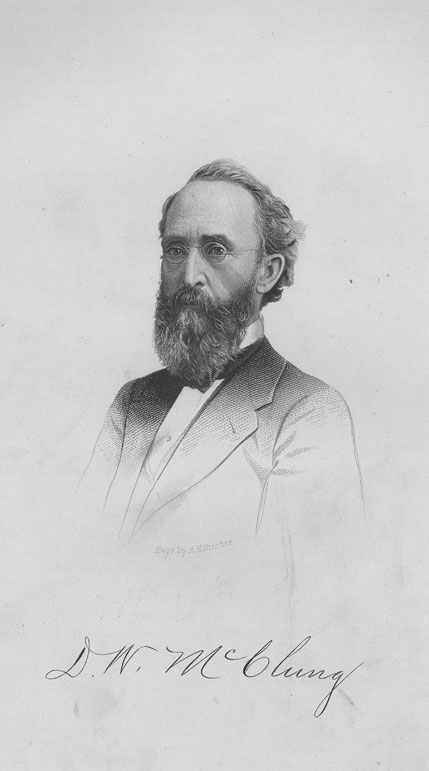
The appearance of the newspaper had greatly changed at this time from that of the first issties of the Intelligencer. It was a large, handsome sheet, filled with good reading matter, and devoting a reasonable proportion of its space to local news. The enlargement took place at the beginning of 1852, and was the first since. 1837. Mr. Halsey owned the paper until 1857, when he died. The date was November 4. It was purchased from his executors by Minor Millikin and David W. McClung. Mr. Millikin afterward went out to the war, and was killed while bravely fighting for his country. Mr. McClung is the present collector of internal revenue in Cincinnati. Among the contributors to the paper at that time was Whitelaw Reid, now editor of the New York Tribune, who furnished the weekly Oxford letter. It was well done. Mr. McClung retired July 29, 1858, and Mr. Millikin owned and edited the paper until June 30, 1859, when he sold it to Jacob Morris. Mr. Morris associated William Bunston with him as joint owner, February 23, 1860, and this business relation existed until May, 1862, when Williams & Egry, proprietors of the Hamilton Telegraph, purchased the paper, and merged it in the Telegraph.
The Western Telegraph and Hamilton Ohio Advertiser, Volume I, Number 1, was published by James B. Camron and Taylor Webster, November 2, 1827, under the firm of Camron & Webster.
October 29, 1829, it was printed and published by Taylor Webster, no account being given of the withdrawal of Mr. Camron at that time. Mr. Camron afterward became county auditor, and died in 1843. He was not a practical printer.
March 11, 1831, the name was changed to Hamilton Telegraph and Butler County Advertiser. The motto then was "Justice and Equity."
March 9, 1832, the name was changed to Western Telegraph and Butler County Advertiser, and the place of publication changed. This paper was dated at Rossville, as were all its successors for nearly eight years.
October 28, 1836, the paper was suspended, Mr. Webster not having leisure to attend to it. He was the member of Congress at that time.
November 18, 1836, the publication was resumed by Franklin Stokes, a practical printer. A vast improvement in the typographical appearance of the paper is perceptible in his first number. John B. Weller appeared as editor.
November 7, 1839, the paper was again suspended for a brief period, for the purpose of settling up, the printing office being offered for sale. "This paper," Mr. Stokes says, "closes the twelfth volume of the Western Telegraph, and we embrace this occasion to return our thanks," etc.
November 30, 1839, the place of publication was again changed to Hamilton.
February 18, 1847, the name of the paper was changed to Butler County Telegraph.
November 18, 1847, Ryan & Witherby are announced as publishers, and O. S. Witherby and N. M. Gaylord are announced as the editors. A. P. Miller was the proprietor.
October 18, 1849, M. C. Ryan, who had long before been employed by Mr. Campbell in his printing office, assumed the sole editorial charge of the paper, having had greatness thrust upon him, as he explains, by mentioning the departure of one of the editors to California and the absence of the other on the business of " Paradise Lost."
November 15, 1849, F. Van Derveer was announced as editor. He disposed of his interest to William Ramsay, of the Dayton Empire, October 1, 1850, and went to California. C. L. Weller was the editor in 1851, Ramsay only holding the paper ten days.
116 - HISTORY OF BUTLER COUNTY.
November 11, 1852, the official records show that William R. Kinder commenced a new series at that date, styling it volume 26, number 1. Mr. Kinder continued as editor and proprietor until June 13, 1854, when his interest was purchased by Charles I. Barker and James McCormick.
On November 8, 1855, Major Alfred A. Phillips purchased Barker's interest in the paper, and the firm name was McCormick & Phillips. Mr. Phillips remained in the business but a short while, and was bought out by Daniel R. Empson, April 17, 1856. Under this arrangement Empson became editor, and McCormick had charge of the publication. About one year later-April 23, 1857-the paper passed into the hands of the Telegraph Company, with William R Kinder as editor. Mr. Empson died June 18 of that year.
September 3, 1857, James K. Webster purchased the paper, and retained Mr. Kinder as his editor. Mr. Kinder finally retired from the editorial chair, May 6, 1858, and Mr. Webster succeeded him, F. Van. Derveer acting as editor, and owned and controlled the paper until June 6, 1861, when John McElwee and John P. P. Peck purchased it. The former remained in the paper but a short time, selling out in a couple of weeks to his partner, who made it an outspoken champion for the cause of the Union in the war of the Rebellion, which was then inaugurated.
The greater portion of the Democracy in this county were opposed to the war. It seemed to them something which could have been avoided by a few timely concessions, and they were not slow in discharging their wrath upon Mr. Peck, as a renegade Democrat. He was at that time a private banker, and a run was begun upon his establishment, resulting in its suspension. He published the Telegraph until October 24, 1861, when the paper, press, and material were purchased by Williams & Egry, proprietors of the Hamilton Intelligencer. The two papers were merged, and were thenceforward, to the present time, published as the Hamilton Telegraph.
The Democracy were not satisfied with the withdrawal of their patronage from Mr. Peck's bank and his paper, but set up a new journal, entitled the True Telegraph. It was printed on type bought in Oxford, and was issued by Dr. John McElwee and Abram C. Marts. Thus there were three papers here in progress at the same time-the Telegraph, the True Telegraph, and the Intelligeneer. The editors of the latter, after the consolidation with the Telegraph, were Valentine Chase and H. P. K. Peck, to November 27, 1862, and W. S. Bush to March 12, 1863. At the last date, Mr. John C. Lewis purchased the interest of Mr. Williams, and became the editor. Mr. Lewis disposed of his interest to Mr. Egry, November 2, 1865, who remained sole owner, with J. T. Langstroth as editor, until October 31, 1867. At that time F. H. Scobey became a part proprietor, which interest he retained for one year. In October, 1868, Mr. Egry again became sole owner of the paper, with F. H. Scobey for editor-relations that continued unbroken until Mr. Egry sold out to C. M. Campbell, on the 17th of December, 1879. The next week appeared the first number of the Daily News, an evening daily, which has been continued up to this time. Mr. Scobey acted as editor until March, 1880, when he withdrew, shortly afterward going to Kansas. Since this time Mr. Campbell has acted as editor. Albert Dix has been the business manager since Mr. Campbell took possession, and Fred L. Rosemond has been the city editor since Mr. Scobey left. The Telegraph is still continued as the weekly.
It is difficult for those not on the ground to conceive the intense excitement that prevailed here at the outbreak of the war. The outbreak of patriotic feeling at the time Sumter was fired on was enough to silence dissent, but in a month or two affairs had changed. We had lost some small engagements ; the war was by no means as successful as had been hoped, and business was stagnant. To those who believed that the struggle should have been averted the course of the Telegraph was extremely offensive. Its proprietors were Democrats, but" the bulk of the party charged them with being traitors. The proposition, therefore, to establish a new paper devoted to sound principles was hailed with alacrity. Once begun, its course was plain. It denounced the administration and the war, it ridiculed the leaders in Congress, declared Democrats who had sprung to the assistance of the country were hypocrites or turncoats, and was never tired of harping the changes on the negro, Old Abe, }east Butler, and the downfitll of the Constitution. The leader of the peace party in this section was Clement L. Valandigham, of Dayton, a man of high standing, and of great personal magnetism. They continued this opposisition during the war, and for years after, although Mr. Vallandigham did not. He saw and accepted the new situation very soon after the close of the contest.
The True Telegraph began in September, 1861, and soon forced the other Democratic paper to sell out to its Republican rival. The paper was edited, at the beginning, by Dr. McElwee. Within a few weeks the paper was sold to Marts & Mayo. Mr. Mayo acted as editor. He had previously been a school-teacher, and had written a life of Vallandigham. October 30, a new series of the True Telegraph was started, and styled volume 36, number 1. The paper was published by the True Telegraph Company, with Owen Morony business manager.
Under this management, Crane and Palmer appear as editors, March 26, 1863, and on April 23d of that year they became proprietors. On July 21, 1864, Crane & Palmer sold the paper to the True Telegraph Company. They secured the services of John McElwee as editor, who served as such until February 23, 1865, when he was succeeded in the editorial chair by John A. Cockerill. Mr. Cockerill, at this time, was a very young man, but a writer of great force. John A. Cockerill & Brother
THE PRESS - 117
became the owners of the paper, October 26, 1865, and on April 25, 1867, Mr. John A. Cockerill became sole owner of it, and so remained until July 2, 1868, when he sold to Jacob H. Long, who installed Colonel H. H. Robinson as editor. Mr. Lon continued in ownership of the paper, and Mr. Robin n was its editor, until January 13, 1870, when it was sold to John R. Nickel, editor-in-chief, and L. B. De la Court, managing editor, and its name changed to the Butler County Democrat, March 10, 1870 ; owing to legal complications, the additional name and True Telegraph was appended to it.
Dr. Nickel retired from the paper, May 11, 1871, and its entire possession passed- into the hands of L. B. De la Court, who retained Dr. Nickel as its editor. Mr. De la Court owned the paper until December 21, 1873, when Thomas H. Hodder purchased it, and held it until April 15, 1875. During this time, Mr. Hodder changed the form of the paper from a folio to a quarto, and made some other mechanical improvements in it.
The firm of R. N. Andrews & Co. succeeded Mr. Hodder in the ownership of the paper, April 15, 1875. Mr. J. W. Shares name appeared in the initial number as its editor, and until June 24, when it was dropped. Later in the year it was edited by J. P. Caldwell for a brief season and by Thomas H. Miller and others.
On May 13, 1875, the paper assumed the name of the Butler County Democrat and Hamilton Guidon, McElwee & McMaken selling the Guidon to the Democrat. On December 2, 1875, the paper was purchased by the Democratic Printing Company, composed of R. N. Andrews, Thomas Miller, and H. C. Hume-Mr. Hume acting as editor. Subsequently Andrews disposed of his interest to George R. Vinnedge, and afterward Mr. D. J. Callen, of Mercer County, purchased the interest, first of Miller, then of Vinnedge, and then came into entire possession of the paper, by purchasing the interest of Mr. Hume. Callen became financially embarrassed, and the Democrat was placed in the hands of a receiver. The receiver, N. E. Warwick, under the order of the Court of Common Pleas of Butler County, edited and continued the publication of the paper until February, 1877, when it was sold by him to H. C. Hume, Mrs. Catharine Miller, and George Vinnedge, who soon afterward sold the establishment to B. K. Brant, its present proprietor, who is assisted by Isaac Coy. It is Democratic in politics. A daily paper was issued from this office in the Fall of 1881.
In April, 1821, a paper was commenced by John L. Murray, called the Volunteer, and afterwards Murray's Weekly Volunteer, which was continued to December, 1825, when it was discontinued.
The next earliest periodical of which we have any account was published at Oxford. It was edited by the professors, and printed by John B. Smith. Its title was the Literary Register, and it had for motto " Prodesse pain conspici." It was in magazine form, two columns to the page, and devoted a trifle of its space to local matters. It appears to have continued only about two years, for we find in the Hamilton papers an advertisement of the material for sale :
" To PRINTERS.
" The Erodelphian and Union Literary Societies of Miami University will dispose of a good printing press, together with
a large quantity of type, to suit the purchaser, if application be made immediately.
" For particulars apply to
" ISAAC SHEPPERD,
SAMUEL W. MCCRACKEN,
WILLIAM M. MCLAIN,
JAMES H. BACON,
" MIAMI UNIVERSITY, OXFORD, December 4, 1830."
The Rev. Dr. MacDill, a name ever to be honored in this county, began the publication of a religious periodical in Hamilton, in the year 1829. It began in January. It was entitled the Christian Intelligencer, and was published in pamphlet form, forty-eight pages to each monthly number. It was devoted to the defense of the doctrines of the Associate Reformed Church and the diffusion of religious intelligence generally. After editing the paper for three years, 1829, 1830, and 1838, it was then suspended, but resumed again in March, 1833. . At this time the fourth volume commenced. At the close of the thirteenth volume the name was changed, and it was then called the Evangelical Guardian,. In 1847 it was called the United Presbyterian. At this time the Rev. James Pressley, then of Cincinnati, was associated with Dr. MacDill as publisher and assistant editor. At the close of the eighteenth volume, Dr. MacDill concluded to remove West, and the Rev. James Claybaugh, D. D., succeeded him, although the former still contributed articles from his home in Illinois. The journal is still carried on in Pittsburg.
In July, 1830, James B. Cameron commenced a weekly paper in Rossville, called the Ohio Independent Press, which was afterward published by Cameron, Hutchins & Co., until February, 1832, at which time the publication was discontinued, the publication not having been regular during the latter part of the time.
The Free Soil Banner was issued in Hamilton, August 21, 1848, giving an active support to Van Buren. It was edited by the following committee : John W. Erwin, John W. Wilson, Henry S. Earhart, Mark C. McMaken, Alfred Thomas, and John R. Lewis. John H. Elliott, Hamilton, and H. C. Bird, Rossville, were publishing agents. John C. Skinner, treasurer. It was issued weekly, for three months.
The Daily Press was issued in Rossville, in May, 1851, by James H. Green and Alfred L. Sewell, two practical printers. Four numbers only were published.
The Miami Democrat was begun iu Rossville, in January, 1850, and was conducted by Wilson H. Laymon. He retired from the paper, Tuesday, September 9, 1851, and the next number was owned by an association of Democrats-Longfellow & Co. ; L. J. Strong, editor.
Committee.
118 - HISTORY OF BUTLER COUNTY.
Of the Hamilton and Rossville News we know nothing but its death. This happened on the 10th of February, 1848.
Democracy Untrammeled and Butler County Investigator was first issued at Rossville, September 20, 1849. It was printed by J. M. Christy.
The Hamilton Daily Chronicle was proposed by S. R. Smith & Co., in 1855. We do not know whether it came to pass.
The Herald of Education was published by J. P. Ellinwood, in 1854. He was then superintendent of schools here.
Steph. R. Smith issued the Butler County Democrat, in August, 1861, which died after one week.
The Tri-weekly Advertiser was published March 14, 1867, by Jacob H. Long, and a weekly newspaper of the same name was begun by Mr. Long, February 24, 1875. The first was afterward merged into the Independent, which began in 1871. Mr. Long afterward disposed of his interests to Dr. J. R. Brown, Samuel L'Hommedieu, and W. H. Beardsley. The paper was edited by Colonel H. H. Robinson, and was printed until 1874, when it was disposed of to the Hamilton Printing Company, and merged into the Examiner.
The Examiner was begun in 1874, by the Hamilton Printing Company, and was conducted thus until in October of that year, when it was sold out to the Guidon, and became merged into that paper. It was edited by Thomas A. Corcoran, of Cincinnati, six or eight weeks, and afterward by John F. Neilan.
The Guidon was started August 26, 1875, by John McElwee. It established a reputation at once for ability to criticize, ridicule, and lecture the community in general. Its proprietor associated with him J. J. McMaken, and they bought out the Examiner, and the paper then became more conservative, and was removed to West Hamilton. In May, 1875, McElwee and McMaken sold out to the Butler County Democrat, and the Guidon and Examiner were merged into that paper.
The Orcus was originated in 1878, by S. D. Cone, who published and edited it for about three months ; then being purchased by Lou J. Beauchamp and Robt. S. Carr, when it was bought by B. R. Finch and N. E. Warwick, and ran about six months—being noted for its sprightliness. Then, on account of change of business affairs, it was discontinued, the proprietors refunding advance subscriptions.
July 17, 1876, S. D. Cone and Colonel P. H. Gallagher, formerly of Charleston, West Virginia, and who was Mr. Callen's business manager of the Democrat, began publishing the Sunday Morning News. Mr. Cone was the originator of the venture, in the belief that a Sunday paper issued at an early hour, before the arrival of the Cincinnati trains, could acquire a large and profitable circulation, and in great measure supplant the Cincinnati Sunday dailies. With that view, special telegraphic dis etches were engaged, by the Atlantic and Pacific line,
in all important points—the first attempt at newspaper special telegraphing ever made in Hamilton. The News ran its career in a little less than four months, and was highly appreciated. It came to an end through the business troubles of the Democrat, and not through lack of support.
The Observer is published by Jacob H. Long, and is a continuation of the Advertiser. It was established February 24, 1876. From the same office there was published, in the Fall of 1881, a Democratic daily of the same name, and later, another daily, entitled the Daily People.
The Hamilton Register was established in 1877, by J. W. Bennett, and was afterward changed to the Hamilton Free Lance. It suspended publication in 1879, and its editor entered the field of journalism in Warren County, where he continued his labors.
The Schildwache was established in May, 1859, by F. E. Humbach and John P. Bruck, being edited by John P. Dietz, of Dayton. After six months' service in this capacity he resigned, and was succeeded by L. F. Schmidicke, of Cincinnati. During 1860, F. E. Humbach sold out to J. P. Bruck. In 1861 J. P. Bruck responded to the call of the President for troops, and raised the first company that left Hamilton for the seat of war, of which he was elected captain. During his absence in the field (three months), Frederick Egry acted as superintendent, and attempted to run it in the interest of the Union cause, although it was originally an outspoken Democratic sheet. In November, 1862, Captain Bruck sold out to Peter Milders, with Professor A. Goering and Louis Hey as editors. In 1863 Milders disposed of the Schildwache to Robert Christy, Esq., now a prominent practicing attorney at Washington, D. C., who immediately sold it to J. H. Long, the latter publishing it as the Butler County Democrat, a short time, in connection with L. B. De la Court. After a brief partnership, De la Court withdrew, and, in 1864, began the publication of the National Zeitung.
After the close of the Fall campaign, in the year 1863, the German Democrats of Butler County manifested a desire to start a new German Democratic newspaper, not having been satisfied with the policy pursued by the Democrat. The project was carried out by a number of German Democrats, who called a meeting for the purpose of organizing a stock company. On the thirteenth day of April, 1864, the following persons met at Rumple's Hall, West Hamilton : Messrs. Christian Morgenthaler, January Getz, Eberhart Botlinger, John Fischer, L. B. De la Court, Adolph Schmidt, Peter Becker, and others. Mr. Morgenthaler was elected president ; Adolph Schmidt, secretary ; and January Getz, treasurer of the company. The meeting resolved to publish a German Democratic newspaper, to solicit subscriptions for stock, and elected L. B. De la Court
THE COUNTY IN 1828 - 119
editor and business manager of the concern.. On the fourth day of July, 1864, the first number of the Hamilton National Zeitung was published. A few years later the paper passed into the sole possession of L. B. De in Court, who bought the entire stock of the company. The National Zeitung has been published since without interruption, and is at present the only German newspaper published in Butler County.
Preceding the Schildwache there had been a German paper called the Wachter, and, during the war, a Republican journal was issued in Hamilton, entitled the Beobachter.
We can not refrain from expressing our indignation at the vandal who destroyed a series of files of these newspapers, running up to the beginning of the county, and of priceless value. He had before refused to allow access to them on the ground that Butler County had not treated him right. He was a disappointed candidate for office, and his fellow-citizens had undoubtedly judged his capacity and public spirit correctly.
There are now published in this city the News and Telegraph, from the same office, by C. M. Campbell, the former being daily ; the Democrat, by B. K. Brant ; the Observer, by Jacob H. Long ; and the National Zeitung, by L. B. De la Court. Two advertising sheets are also issued.
THE COUNTY IN 1828.
BUTLER COUNTY was formed and organized in 1803. The following table will show the march of population since the organization of the State government, according to the quadrennial enumeration of the free males over twenty-one years of age, made for the purpose of apportioning the representatives and senators to the State Legislature :
In 1803 - 836
In 1807, - 1,719
In 1811, - 2.326
In 1815,- 2,877
In 1819, - 3,754
In 1823, - 4,239
In 1827, - 4,546
The whole population was, in 1810, 11,071; in 1820, it had increased to 21,726; and in 1828, amounted to about 26,000. The whole number for each of these dates may be ascertained with sufficient accuracy by multiplying the number over 21 years by 5.6. The whole number of free persons of color, in 1820, was 158.
In 1820, there were in this county, of free white males, under 10 years of age, 459; between 10 and 16, 1,774; between 16 and 26 years, 2,656; between 26 and 45, 1,976 ; and of 45 years and upward, 1,242. And there were also of free white females under 10 years, 3,870 ; between 10 and 16 years, 1,694 ; between 16 and 26 years, 2,022; between 26 and 45 years, 1,835 ; of 45 years and upward, 961. From this data it will appear that in 1820 the number of males exceeded that of the females 928.
This excess was accounted for, in part, by the spirit of adventure and the prospects of success inducing more young men to emigrate to and try their fortunes in the new countries than young women ; but, even of that class under 10 years of age (upon whom these circumstances could have little or no influence), there is an excess of 189 males.
Fairfield Township contains 26,294 acres of land, valued, with the improvements, in 1827, at $192,112. It contained, in 1827, 522 voters, and 2,923 inhabitants. It contained also 594 head of horses, and 863 head of cattle, valued at $30,664. The foregoing items, together with the town property, valued at $160,990, and the capital engaged in merchandise, estimated (before the court) at $6,600, made the aggregate value of the township $300,366. This amount of property paid a tax of $941.14, for State and canal purposes; $640.60 for school and county expenses ; and $330.11 for township expenses; making, in the whole, $1,911.94.
Hanover Township contains 21,890 acres of land, valued, in 1827, at $101,876. There were in this township 391 horses, and 540 cattle, valued together at $19,960. Total value of the township, $128,836. On this amount there was paid $387.50 State and canal tax ; $258.35 county and school tax ; and $64.91 for township uses ; total, $710.32. Number of voters, 285, and of inhabitants, 1,596.
Madison Township contains 24,502 acres, estimated, then valued at $134,972. Horses, 532 ; cattle, 786 ; value, $27,688. Capital engaged in merchandise, $2,976. Town property, $6,074. Aggregate estimate, $171,710. On this amount was paid $534.90 for State and canal purposes; $363.20 for county and school uses; total, $898.11. Number of voters, 418; of inhabitants, 2,340.
Lemon Township contains 22,165 acres of land, then valued at $153,458. Horses, 632; cattle, 886; estimated at $32,376. Capital in merchandise, $16,900. Town property, $33,395—making the aggregate value of the township, $236,129. On this was paid $726.12 State and canal tax ; $495, for county and school purposes ; total, $1,221.19. This township contained 554 voters and 3,100 inhabitants.
Liberty Township, 17,783 acres of land, estimated, in 1827, at $105,439. Number of horses, 377 ; and of cattle, 529; valued at $19,212. Town property, estimated at $700; capital in merchandise, $1,750. Giving an aggregate value for this township of $127,101; paying a tax of $389.54 for State and canal expenses ; $262.74 for county and school uses ; and $128.55 for township purposes ; total, $781.25. Number of voters, 255 ; of inhabitants, 1,428.
Milford Township, 20,965 acres of land, then valued
120 - HISTORY OF BUTLER COUNTY.
at $104,984. There were owned in it 428 horses, and 600 cattle, valued at $21,920 ; town property, $2,400 ; mercantile capital, $4,780. Value of this township, $134,004. Taxes: State and canal, $407.10; county and school, $273.02; total, $680.12. Number of voters, 306 ; and of inhabitants, 1,713.
Oxford Township contains 1,583 acres of taxable land, valued at $7,886. The college lands, amounting to 17,464 acres, valued at $59,257, were not subject to taxation. This township contained 332 horses, and 8,607 cattle ; valued at $18,136. Town property, $10,585; merchants' capital, $6,700; property of the Miami University, buildings, etc., $25,000'. Total value of the township, $127,566. This township paid $104.35 for State and canal purposes ; and $87.50 for county and school purposes ; making only a total of $198.05. The number of voters was 367, and of inhabitants 2,050. The annual rents paid to the university by the lease-holders of this township amounted to upward of $4,000.
Morgan Township contains 23,003 acres of land, then valued at $72,072. It also contained 392 horses, and 654 cattle ; valued at $20,912 ; capital in merchandise, $700; total value, $93684. This township paid $291.37 for State and canal purposes"; and $197.95 for county and school expenses ; total, $489.32. Voters, 333 ; inhabitants, 1,884.
Ross Township-acres of land, 18,395; value, $105,306. Horses, 369; and cattle, 586; value, $19,424; town property, $6,700 ; merchants' capital, $4,400 ; total value, $135,930. This township paid a tax of $416.73 for State and canal purposes ; $280.90 for county and schools ; and $105 for township expenses. It contained 304 voters, and 1,702 inhabitants.
Reily Township-22,125 acres of land, valued at $70,463. Horses, 397, and 624 head of cattle, valued at $20,872 ; merchants' capital, $800. Tax : $278.34, State and canal ; $186.21, county and school ; $186.99, township ; total, $464.56. Number of voters, 268 ; and of inhabitants, 1,500.
St. Clair Township contains 17,761 acres of land, valued, in that year, at $125,638. Number of horses, 356, and of cattle, 509, valued at $18,312; town property, $28,120; merchants' capital, $10,075; making the aggregate value of the township $182,145. This township paid $556.12 State and canal tax ; $373.98 county and school tax ; and $186.99 township tax ; making a total of $1,117.09. Number of voters, 294 ; and of inhabitants, 1,664.
Union Township contains 21,104 acres of land, then valued at $120,220. Horses, 397, and cattle, 574, value $20,472 ; town property, $3,413 ; capital in merchandise, $1,250 ; aggregate value of the township, $145,355. Taxes : $468.51, State and canal ; $323.25, county and school ; $97.17, township. Number of voters, 315 ; and of inhabitants, 1,164.
Wayne Township-This township, the last in their alphabetical order, contains 21,207 acres of land, valued, in 1827, at $122,974. There were in this township 525 horses, and 676.cattle, valued at $26,384; and also town property worth $5,748; with $4,500 of capital engaged in merchandise; making an aggregate value of the township. of $159,606. Tax : $483.24, State and canal ; $223.63, county and school ; and $80.90, township ; total, $887.78. Voters, 294 ; inhabitants, 1;646.
To arrive near the whole value of the county, to the items above enumerated must be added the value of the young horses and cattle under three years old, and the sheep and swine, which would amount to a very considerable sum, and also the amount of household furniture, farming implements and mechanic tools. These items would probably increase the amount nearly one half, the horses and cattle being each valued at a fixed rate-the horses at $40 each, the cattle at $8-probably much below the average value which they would then sell for in the market.
An ingenious writer who collated the above statistics indulges in the following anticipations as to the future of this county. He writes in 1828:
" We will indulge, here, in a few speculations on the energies which heaven has imparted to the soil, and to how great an extent its resources may be developed. Butler County contains about 15,000 acres of first-rate land; 180,000 acres of second-rate land; and 80,000 acres of third-rate. This 15,000 acres of first-rate land will produce annually of corn, at the rate of 45 bushels per acre, 675,000 bushels.
" This amount of corn, at two gallons per bushel, would yield 1,350,000 gallons of spirits, which at 20 cents per gallon, would amount to $270,000 ; and it would produce, allowing 10 bushels to yield 100 pounds, 6,750,000 pounds of pork, which at 2z cents per pound,
would be worth $169,750, and would subsist about 100,000 persons !
“ The 180,000 acres of second-rate land, supposing it to yield 15 bushels of wheat per acre, would produce 2,700,000 bushels, which would make about 500,000 barrels of flour, worth $3.25 per barrel, and would amount to the enormous sum of $1,375,000, exclusive of the price of the barrel and expense of grinding and packing ; and at 40 cents per bushel would amount to $1,080,000. This quantity of wheat would subsist 400,000 persons, allowing each to consume 61- bushels, which is rather more than is actually consumed in bread-stuffs. One-third of the second-rate land, 60,000 acres, in grass, would yield, at 142-- tons of hay per acre, 90,000 tons, which would winter about 90,000 head of horses, or 120,000 head of cattle ; and the remaining two-thirds, 120,000 acres, would yield sufficient grazing to feed them through the Summer. Were they disposed of, either horses or cattle, at three years old-in general, the most judicious age- if horses, 30,000 (one-third) might be disposed of annually, which, at an average of $40 each, would yield
EDUCATION - 121
$1,200,000 ; if cattle, 40,000 would be disposable annually, which at $10 per head, would yield $400,000. This showing proves clearly that horses are much the most profitable species of stock.
" The living animals which are annually sent from the Western States into the Southen markets (principally horses) yield about $3,000,000. It is, perhaps, not rating horses too high in those markets at $80 per head ; and 37,500 horses only would be required to produce that sum. Butler county, alone, appropriating all her lands, could produce this number.
" Eighty thousand acres of third-rate land, very proper for that purpose, would support, at 5 sheep to the acre, 400,000; which, averaging each fleece at 2 pounds, would yield 800,000 pounds, worth, at 30 cents per pound, $240,000.
"These calculations have been made, supposing every acre of land to be under cultivation. At present the quantity in actual agriculture does not greatly exceed one-third, and there is a very small portion of it, indeed, under that high state of cultivation to which it will probably arrive at some future day, when the great increase of population will demand every energy of the soil to produce aliment to sustain animal life. We may gather a knowledge, satisfactorily accurate, of the prospective population which this county may one day contain, or at least support, by ascertaining the greatest quantity of grain which it will produce. It is a principle infallible in the economy of nature to produce life to as great an extent as nature and art furnish means to sustain it.
" The whole quantity of land (rating the first quality at 30 bushels of wheat per acre, the second quality at 15, and the third-rate at 8) would produce 3,790,000 bushels. Estimating the consumption of each individual, young and old, in bread, meat, liquors, clothing, and that consumed by the necessary proportion of domestic animals, to be equal to 25 bushels (and this is apportioning a more liberal allowance than is consumed in some countries of Europe), it would give 156,000 inhabitants—a number greater than was contained in the States of Delaware and Rhode Island in 1820. And yet this would not make a population much more dense than some sections of country in the old world. It gives 326 to the square mile. The Netherlands contains 214 persons to the square mile ; England, 225 ; and Ireland, 228. In countries as extensive as either of the last mentioned, there must be considerable quantities of land which will not produce; in this county there is scarcely a rood which may not by profitably improved.
" There were in 1810, in this county, 10 tanneries, and 74 stills for distilling ardent spirits. We have no data from which we could form any tolerable estimate of their numbers at present, but the numbers of both are considerably increased. There was also, in that year, in it, 514 looms, upon which were woven 156,476 yards of various kinds of fabric, estimated at $130.000. The number of looms, and the quantity of labor performed on them, has not probably increased since then with the amount of population. Our citizens now purchase much of their clothing which they were then compelled to manufacture for themselves.
" In 1820, there were 1,022 persons engaged in manufactures. This number probably includes adult artificers of every kind. There were also 59 persons employed in mercantile business, and 3,961 persons engaged in agricultural pursuits.
"There is at this time (1828) in operation within the county 38 grist-mills, driving from 1 to 3 run of stones ; 45 saw-mills ; and 12 fulling mills. Besides these, there are various other kinds of machinery propelled by waterpower, and a large amount of water-power yet to be improved and brought into profitable operation."
EDUCATION.
EMERSON says : " The world exists for the education of each man." The founders of the American Republic believed that a free government is a government for each man, and that without universal education a permanent republic is impossible. In the famous ordinance of 1787 are these words :
" Religion, morality, and knowledge, being necessary to good government and the happiness of mankind, schools and the means of education shall forever be encouraged."
The men who wrote the great ordinance were no dreamers. They applied their theories of government, and in educational affairs at least they were eminently successful. They provided that no State or territorial legislature should interfere with the disposal of the public lands by the general government, and that a portion of these lands should form the nucleus of a fund for the education of the whole people.
The constitution of Ohio, formed in 1802, as well as the constitution of 1851, copied, in substance, the part of the ordinance which is above quoted, and from this it will be seen that the fostering of schools has been one of the objects which the State of Ohio has constantly sought to attain.
It is not sufficient to show that Butler County has borne a worthy part in the promotion of that intelligence for which the State has become so favorably known, and in which the people of the commonwealth have a laudable pride.
This county was organized in 1803. The first settlers came from nearly all the older States, Pennsylvania, Virginia, and Kentucky being most numerously represented. No sooner did the pioneer finish his cabin than he began to plan for the education of his children. The primitive log school-house, with its "stick and mortar"
122 - HISTORY OF BUTLER. COUNTY.
chimney, paper windows, puncheon floor, slab seats, and itinerant schoolmaster, immediately followed the completion of his dwelling, and although not much was attempted in these schools, what was attempted was thoroughly done.
The children learned to spell, read, write, and cipher (often as far as the " rule of three"). One of the best features in the training of pioneer children was the physical exercise which all received—boys and girls alike. At home the boys cut fire-wood, fed the stock, broke the flax, and went to the mill, ten or even twenty miles away. The girls milked the cows, worked in the fields, spun flax and wool, wove, and did all manner of housework, and thus became accustomed to labor with their hands—a schooling that is not less valuable in business life than that derived from the study of books. Nor was moral training neglected in these days. Habits of industry, thrift, and patience were universally inculcated.
The children crossed the threshold of the school-room prepared to respect and obey the rules of the teacher, and when this respect and obedience were not given, the offender was promptly punished, both by teacher and parent.
The training in these schools and homes did not end with school-books and moral precepts. The first exercise at school was commonly the reading of a chapter of the Bible; and in many a cabin, at night, before the family retired, was enacted the scene of family worship, so beautifully pictured by the poet Burns, in " The Cotter's Saturday Night :"
"The cheerfu’ supper done, wi' serious face,
They round the ingle form a circle wide ;
The sire turns o'er, with patriarchal grace;
The big ha' Bible, ante his father's pride.
He wales a portion with judicious care,
And ' Let us worship God,' he says, with solemn air.
They chant their artless notes in simple guise,
They tune their hearts, by far the noblest aim,
Perhaps Dundee's wild-warbling measures rise,
Or plaintive Martyrs, worthy of the name."
The backwoodsman's children entered the field of active life with strong bodies and good characters, and with a very fair common school education. The physique and the sturdy character of these children were chiefly due to their parents, but the faithful work of the humble and poorly paid schoolmaster had not been in vain.
The primitive teacher in Ohio was either from one of the older States or from across the Atlantic. With rarely an exception, he was earnest, industrious, and conscientious. He was dignified, and could scarcely be called genial by his pupils. He believed in his prerogative, and would sacrifice his position rather than humiliate himself in his own estimation. He was often a classical scholar. He taught for three months at a time, and boarded around among the parents of his pupils. His pay was always meager, being but a few cents per day for each pupil. Once a quarter., generally at Christ- mas time, "the big boys" would meet at the school-house before daylight, fasten the shutters and the door, and thus " bar out" the master, demanding of him "a treat." Sometimes he would give them apples and cider, and sometimes he would not. In case he refused to comply with the demands of the boys, they would either yield gracefully to their master's firmness, or otherwise they would treat him with personal violence, such as immersing him in the nearest mill-pond, or, in very rare cases, inserting his head under the corner of a fence. These were rude times, which, for the good of all, have long since passed away, never to return ; but, for the sake of truth, it should be remembered that what the " big boys" did to the master was prompted more by their love of fun than by their desire to see any one suffer physical pain.
These early schools began 'about eight o'clock in the morning, and continued till four or five in the afternoon, with an hour's intermission at twelve. Nearly all the pupils " brought their dinners," which consisted of apples, bread, meat, and sometimes milk.
After the dinner had been eaten, the boys would play ball, and the girls "black man," and other lighter games, till the time for books. All played hard, and all studied hard.
In the school-room there were nearly as many classes as would. be obtained by multiplying the number of pupils by the number of the R's. Blackboards were not known, and school apparatus had not been thought of west of the eastern cities.
The text-books were not uniform. Each pupil used what he could get. Webster's and Dillworth's Spelling- books, the New Testament, the English Reader and its Introduction, Pike's and Bennett's Arithmetics, and Mur' ray's Grammar were among those most common. Penmanship was taught by copies written by the master, and the goose-quill pen was in general use. Occasionally there was a school in which geometry, surveying, and natural philosophy were taught, but such were exceedingly rare. In these schools the higher branches were recited at the noon hour, or after the lower classes had been dismissed. Nothing but the love of learning could have induced these overworked teachers, in their log school-houses, to have done such work for their older pupils.
In these same log school-houses statesmen, authors, and generals were inspired to study and to acquire the knowledge which afterward made them a power in their day and generation. The primitive schoolmaster, as we now call him, builded wiser than his patrons knew. But we are mistaken if these early and true teachers did not expect to see their ambitious pupils become useful and eminent citizens. Whoever seeks an honest answer to the now general inquiry, What is the cause of such a host of great men in Ohio? will find the true answer in the lives and services of the primitive schoolmasters of our great State. Grant, Sherman, Hayes, Garfield, Halstead (and hundreds
EDUCATION - 123
of really great men in Ohio, whom the world does not know), were not all of these the pupils of the primitive schoolmaster?
A roll of the names of those who were especially useful in developing Butler County into an influential part of a great commonwealth would be incomplete without Ritchie, Pardee, Proudfit, McMechan, Smith, Monfort, Beers, Marston, Gailbreath, Thomas, Bebb, Hughes, Clack, Bishop, and others who taught the children of the pioneers.
There are no records to show when the first school was held within the limits of what is now Butler County. It is said that reading and writing were taught in Fort Hamilton during the Autumn of 1791, by a soldier to some of his comrades. It is not probable that any school existed before 1805. In every new settlement, however, there was one during a part of each year. These were subscription schools, and the names of the teachers have not been preserved.
In Hamilton a Mr. Ritchie, the Rev. M. G. Wallace, Benjamin Pardee, Alexander Proudfit, the Rev. James McMechan, Henry Baker, Hugh Hawthorne, Miss Ellen A. McMechan, the Rev. Francis Monfort, and Benjamin F. Raleigh all taught prior to the year 1830.
In. Middletown, Judge Beers, Marsha Wilson, Ephraim Gray, Joseph Worth, and Jeremiah Marston were among the earliest teachers.
In New London, Adam Mow, a Mr. Jenkins, David Lloyd, and the Rev. Thomas Thomas taught school at an early date.
The Rev. R. H. Bishop, who was the first president of Miami University, is justly entitled to a place on the roll of the great teachers of Butler County. James M. Dorsey was the first teacher in Oxford.
In Butler County the higher education has not been limited to the university at Oxford. In 1810 the Rev. Matthew G. Wallace taught the classics and the higher English branches in Hamilton.
In 1815 Alexander Proudfit, an alumnus of the Ohio University, taught Latin and Greek to the sons of Dr. Daniel Millikin, and to others. In 1818 the Hamilton Literary Society erected a substantial building for academical purposes. In 1821 the Rev. Thomas Thomas established a high-school at New London, and in the same neighborhood, in the same year, a library association was formed.
One of the teachers in the New London. High School was William Bebb, afterward governor of Ohio. Evan Davis taught in New London from 1830 to 1836, inclusive. For nearly forty years this gentleman occupied a prominent place in the educational work of the county.
Of the teachers who won distinction in the New London High School, the Rev. B. W. Chidlaw deserves favorable mention. Murat Halstead, who has won a more than national reputation as a journalist, was one of his pupils.
In 1833 Nathaniel Furman established an academy in Middletown. His school was continued for fifteen years, and became widely known for its excellence.
In 1835 " The Hamilton and Rossville Female Academy" was opened. In 1836 the number of pupils in this school was one hundred and twenty-seven. Miss Maria Drummond, Miss Georgietta Haven, Miss Amelia Looker, Miss Eliza Huffman, Mr. Nathan Furman, and others, were at different times teachers in this academy.
The educational revival, which began in the United States in 1825, bore fruit in Ohio in 1853. The new school-law then enacted put an end to nearly, all private schools, except seminaries, colleges, and universities. With scarcely an exception all the citizens of Butler County united in availing themselves of the privileges of the new law. County examiners were appointed, school directors were elected, school-houses built, apparatus and school libraries purchased, teachers employed, and for once in the history of the State nearly all the children were in school a part of each year.
Under the law of 1853 the most important and influential school officers in a county are the school examiners, whose duty it is to examine teachers and to give certificates to those who are of good character, and who possess an adequate knowledge of the various branches studied in the schools.
The following is a complete list of all who have been school examiners in Butler County since 1853 : Evan Davis, Benjamin F. Raleigh, Andrew G. Chambers, S. V. Chase, J. T. Killen, W. H. Wynn, S. A. Campbell, J. Longnecker, John R. Chamberlin, A. Crider, Benjamin F. Thomas, H. C. Williamson, Gilbert L. Travis, H. D. Henkley, F. Z. Leiter, Wesley Thomas, A. Ellis, D. P. Nelson, S. I. McClelland, J. Q. Baker, and L. D. Brown. The last three named constitute the present board.
A sketch of the educational history of Butler County would be incomplete without at least a brief mention of the Western Female Seminary, at Oxford, and of the Oxford Female College. The seminary was incorporated in 1853. In 1860, and again in 1871, the buildings of the seminary were destroyed by fire. Since the last fire, the building has been rebuilt, and the school has been more prosperous than ever before. The Female College, under the careful supervision of Dr. Robert D. Morris, has done great good to the public. As a whole, the schools of Butler County are in a highly prosperous condition. Hamilton, Middletown, Oxford, Monroe, New London, Amanda, and West Chester have excellent buildings and excellent graded schools. Hamilton and New London have well-equipped public libraries, and Middletown stands first in her supply of school apparatus.
In the towns the majority of the teachers are ladies. In the country this is not the case. Teachers still receive wages that are too low in comparison with what is generally paid for skilled labor. Nevertheless, Butler County
124 - HISTORY OF BUTLER COUNTY.
has for years paid her teachers far better than the average county in the State has done.
The following school statistics for Butler County have been taken from the last annual report of the Hon.. J. J. Burns, state school commissioner of Ohio : Number of youths between 6 and 21 years of age, 14,844; number of school-houses, 123. Value of school property, $421,550; number of teachers necessary to supply the schools, 201; number of different pupils enrolled, 9,067; average daily attendance of pupils, 5,796. Number of certificates issued, 226. Average wages of teachers per month in township districts : Gentlemen, $45 ; ladies, $33. In special districts : Gentlemen, $59 ; ladies, $46. In high schools, gentlemen, $65; ladies, $78. Average number of weeks schools were in session : Township, 35; separate districts, 37.
An interesting chapter on the growth and influence of the Butler County Teachers' Association could be written. The names of Thomas M. Mendenhall, Emanuel Richter, Alston Ellis, James A. Clarke, J. W. Judkins, J. P. Sharkey, John Q. Baker, Professor B. Starr, James M. Slither, Isaac S. Coy, L. E. Grennan, and many others, would deserve more than mere mention in such a chapter.
Were a complete list of the benefactors of the public schools of Butler County to be prepared, many pages would be required. It is certainly in place, however, to state here that Clark Lane, the founder of the Lane Free Library, of Hamilton, is one of the greatest of these benefactors. The library that he established will be an imperishable monument in the lives of those that have been enriched by the healthful literature he made free to the people of his city.
AGRICULTURE."
BUTLER COUNTY contains four hundred and fifty-seven square miles. This area, as returned and assessed for taxation, contains 293,605 acres. The county, therefore, is of medium size ; there being three counties in the State which contain less than 200,000 acres, and four counties which contain over 400,000 acres, all averaging 288,346 acres.
The lands of the county, from the latest data available, and from the known changes which have since taken place, are subdivided about as follows :
In arable lands, - 210,000 acres.
In meadow and pasture lands, - 20,000 "
In wood and uncultivated lands, - 63,000 "
Total, - 293,000
The value of the lands, exclusive of the real estate in towns and cities, exceeds in value per acre the value of
* By John M. Millikin.
the lands in any of the other counties in the State, excepting the counties of Hamilton and Montgomery.
There are no data of recent date which exhibit the present subdivision of lands ; but it is believed that the lands are now divided into about 4,000 farms of the following dimensions :
Farms containing less than 40 acres, about - 1,400
if 46 between 40 and 80 acres, about - 1,190
if 64 " 80 and 160 acres, about - 1,130
if 160 and 320 acres, about . 300
over 320 acres, about - 30
The geological formation of Butler County is identical with that which exists in the Miami Valley, known as the Lower Silurian. Throughout the county blue limestone rocks, of good quality, are found in great abundance.
Geographically considered, its location is not liable to serious or well-grounded objections. It enjoys superior business advantages from its proximity to the city of Cincinnati. There the farmer can, at all times, find a fair and ready market for all his productions. The facilities of access to the city by canal, by railroads, and by turnpikes, relieve the farmers from the unpleasant necessity of submitting to either exorbitant charges for transportation or to the unreasonable and more odious exactions of those who have control of grain elevators. If farmers are not satisfied with the margin of profit claimed by grain-dealers, they can transact their own business in conformity with their own views. They enjoy like opportunities in the purchase of staple goods for their family use. Hence, the position of Butler County in reference to business affairs is unusually favorable.
The soil of this county is properly designated as limestone soil. It is exceedingly variable in character, but highly productive. Much of it is unsurpassed in fertility, while there is only a small portion which is not susceptible of being made of good quality by judicious husbandry. It has neither barren plains, nor sterile hills, nor marshes, nor swamps,, which mar the beauty of the landscape, or generate noxious and unhealthy atmospheres.
As the characteristics and productive qualities of the soil in a county can be more correctly estimated and determined by the number, size, and character of the streams which flow through it, a skeleton map of the county is herewith presented, exhibiting the course of the Miami River, and the many large creeks, small creeks, runs, and streamlets which so abound and which so thoroughly ramify the entire county. This map will not only be valuable as indicating the quality of the soil, but will exhibit the abundance of water which the streams afford, and which is used for propelling machinery, as well as supplying water for farm and other purposes.
The lands known as " bottom lands " on the Miami River are generally composed of a sandy alluvial deposit. The predominant timber upon these lands is hackberry, buckeye, box-alder, sycamore, honey-locust, walnut, and
AGRICULTURE - 125
sometimes sugar-tree and hickory. Nearly all the lands in this county of this quality have been cleared for more than fifty years, and have since been cultivated almost continuously. Portions of these lands have been occasionally subject to inundation from backwater, and have thereby become greatly enriched, while other portions have been injured by the displacement of the soil or the covering of the same with gravel.
The same quality of rich alluvial lands is to be found along the larger creeks, and is liable to like overflows and subject to like casualties. Such lands do not constitute either the most valuable or the most desirable farms. They subject their owners sometimes to great inconvenience and loss, and are not so suitable for the production of the various grains, grasses, and other crops raised as are lands of essentially different quality. Nevertheless, these " bottom lands" are highly prized by many, and greatly preferred by a few of our farmers.
Lands known as " second bottom," whether near the Miami River or in the vicinity of our largest creeks, constitute a larger proportion of our good choice lands. Farms composed of such soil are more highly valued, and are regarded as decidedly superior in quality. Such lands usually abound in about the following varieties of timber : Hackberry, cherry, walnut, buckeye, blue ash, gray ash, pin-oak, white oak, burr-oak, and sugar- tree. Sometimes sycamores grow on such soils, in connection with elms and the several varieties of haw-trees. It is not intended to say that all these several varieties of trees are found in the same locality ; sometimes particular varieties prevail in one neighborhood, while other varieties predominate in another.
The surface of such soils not only furnishes exceedingly eligible sites for the location of farm buildings, but it is very favorable for farming operations. The soil is composed of a dark sandy loam, which originally abounded in vegetable mold. The land is, therefore, almost uniformly friable and easy of cultivation ; sometimes it is based upon a gravelly subsoil, and at other times upon a clay substratum. This quality of soil is not confined to the immediate vicinity of either the Miami River or the largest creeks, but is to be found in great extent throughout many parts of the county. Farms consisting of lands of this quality have maintained their fertility surprisingly, even under improvident cultivation. They are easily recuperated with clover, which takes readily, and grows with vigorous luxuriance.
The " uplands" are very variable in quality. In one portion of the county, where the hills are unusually high for this part of Ohio, the land is of exceeding richness. The soil is adapted to the production of every variety of grain grown in the county. It is based upon a clay subsoil, and was originally covered with a rich, dark-colored vegetable mold. These hills, which have an altitude above the Miami River of about three hundred feet, were originally covered with a very thick growth of timber, indicating the very best quality of soil, entirely dissimilar from that which usually grows upon our uplands. On the very highest points on these hills, sycamore, black walnut, white walnut, black locust (trees between two and three feet in diameter), box-alder, gray ash, blue ash, pawpaw, etc., grew to an unusual size. And, notwithstanding the irregularities in the surface of this region, and the rich and friable character of the soil, yet there is no excessive gullying or washing away of the surface of the fields. Tile rich and favorable character of these lands, and their high elevation, make them especially valuable for the cultivation of fruit of every variety.
The other uplands, although somewhat different, are nevertheless similar in quality to most of the uplands in the Miami Valley. In some places they have incorporated with the surface soil a good proportion of vegetable material, while in other localities the soil is purely argillaceous. The farms on these uplands, usually denomi-
126 - HISTORY OF BUTLER COUNTY.
nated " clay farms," have for the last thirty-five years continuously grown upon public favor. By judicious culture they have regularly improved in' productiveness. Clover usually takes readily, and all the labor and means applied in renovating these soils have been successful in producing good and enduring effects. Farms located upon these uplands are generally favorable for fruit- growing, for the production of small grain and grasses, and for general farming purposes. Indeed, farmers occupying such lands are already competing in large crops of corn with those who reside upon purely bottom lands. The prevailing timber is white oak, pigeon-oak, hickory, ash, red-bud, dogwood, and elm. Intermixed with these we generally find metre or less of walnut and sugar-tree.
The climatology and meteorology of Butler County vary immaterially from that which prevails in southwestern Ohio. The most important characteristic of the climate is its uniformity. By this we do not mean to say that we are exempt from the usual changes- and fluctuations of temperature, of wind and of rain, which are found to exist in other localities. What is claimed is great uniformity, for a series of years, of mean temperature, of mean precipitation of rain, and of mean force and frequency of winds. Consequently, although, in common with others, the county has occasionally suffered from the effects of droughts, from an excess of rain, and slightly from severe winds, yet its farmers have not encountered such privations and sustained such losses from the above causes as are common in other localities in the country. Our mean temperature for many years has been about fifty-three degrees ;, and the mean fall of water varies but little from forty-eight inches.
Although the surface of Butler County, sixty years ago, was thickly covered with a heavy and vigorous growth of timber, eight-tenths of which has been removed, yet there are now no perceptible changes in either the mean temperature, the mean quantity of rain precipitated, the frdquency or duration of showers, or in the character or direction of the prevailing winds. Neither is it believed that our atmosphere is less humid than it was fifty years ago. Some slight modifications of our climate may have taken place. They are, however, not so marked as to be appreciable, even by those who have been careful observers of the weather and its influence upon the vegetation of the county.
The thorough clearing up of farms, however, has produced very decided effects upon our streams. They now rise more rapidly, attain to a great height, and subside, consequently, in much less time than heretofore. Obstructions have been removed from low lands, from runs and streamlets, and from creeks ; and water now flows speedily off, instead of remaining spread over large tracts of laud, to the great detriment and loss of our farmers.
In view, therefore, of the foregoing, we believe that it will not be unsafe to say that if a favorable geographical and commercial position—a climate singularly favorable for the production of the great agricultural staples and for the cultivation of fruits, and a soil variable in character, yet highly rich in all essential elements—are necessary to constitute a good farming region, then the farmers of Butler County are in the possession of that rich boon. In fertility of soil, in her temperate climate, in her favorable geographical position, her numerous streams of water, her timber, her exhaustless quarries of blue limestone, and her abundance of water power, Butler County may be equaled—she can not be excelled.
The cultivation of the lands of this county is by no means what it ought to be. The farmers are not sufficiently alive to the importance of a very complete knowledge of the general principles of such branches of learning as relate to agriculture. They hesitate, in many cases, to adopt, and in other cases they reject, not only the teachings of science, but refuse to profit by the practical demonstrations of our more intelligent and experienced cultivators. Notwithstanding the existence of this state of feeling among some of our farmers, we have the gratification of being able to say with truth that the husbandry of the county has, in many important regards, attained a commendable thoroughness, and is now rapidly improving. Farmers are becoming less and less unwilling to learn from others, and are more ambitious to investigate and consider the reasons assigned for the various systems or modes of culture. In due season, we do not question but what an improved state of husbandry will generally prevail, and that the annual product of this county will be quadrupled.
The productiveness of the lands of the county will best be understood by a full statement of the annual amounts of grains produced and the number of domestic animals Owned in the county since the year 1850. And, first, of the grain produced.
Under this general head it is proposed to give a brief account of the mode of culture, with the results of wheat, barley, corn, rye, oats, and buckwheat, and to present such other facts and statements in reference to the same as may be deemed of general interest.
WHEAT.—This is one of the staple and most profitable crops raised in Butler County. The mode of culture generally adopted gives conclusive indications that the farmers have given great attention to the production of this favorite crop ; and the results prove that they have generally met with fair success.
Wheat ground is generally prepared with more than ordinary care. Everything necessary to be done for the proper preparation of the ground is more faithfully attended to than in preparing the lands for any other crop. The grain is generally put in with a drill. There are some, however, who adhere to the old way of sowing broadcast. Barn-yard manure on hand at the time of plowing for wheat, if unrotted, is carefully plowed under. If thoroughly rotted, it is applied as a top-dressing before
AGRICULTURE - 127
the ground undergoes thorough pulverization with the harrow.
The old mode of plowing up " bare fallows " during the Summer, and then replowing the same before sowing in wheat, has fallen into almost general disuse. If there are any fallow grounds, they are what are termed in England " green fallows." Clover-fields are esteemed the best for the production of a good crop of wheat. There are many who have great faith in the productive capacity of a good timothy meadow field, or timothy and clover field under pasturage for a good crop of wheat. Wheat stubble, barley stubble, and oats stubble grounds continue to be used by many for growing wheat. The practice of sowing wheat upon the same ground for many successive years is not so common as heretofore, although very frequently followed.
The breadth of land sown in wheat in this county is by no means uniform. It is as variable as the product per acre is uncertain. The crop harvested in 1862 was nearly forty-five per cent greater in breadth of land than the crop harvested in 1865; and the aggregate product of wheat in the county in 1862 more than doubled that harvested in 1865. The yield per acre of the crop of 1862 was fifteen and a half bushels, while the .yield of 1865 was less than eleven bushels per acre.
To show the capacity of Butler County as a wheat- producing county, we herewith present a statement showing the number of acres sown and the number of bushels harvested per annum. Our statement refers to the years in which the crops were produced.
STATISTICS OF WHEAT IN BUTLER COUNTY.
YEARS |
No. Acres sown |
No. Bushels gathered |
YEARS |
No. Acres sown |
No. Buskels gathered |
1850 1851 1852 1853 1854 1855 1856 1857 1858 1859 1860 1861 1862 1863 1864 1865 |
31,131 26;242 24,947 24,804 29,278 31,294 40,145 42,396 43,331 42,267 42,723 45,860 51,206 39,766 39,972 35,795 |
529,390 377,738 397,625 367,030 396,266 447,813 636,861 789,569 497,926 589,976 639,578 533,843 783,984 495,953 538,850 387,670 |
1866 1867 1868 1869 1870 1871 1872 1873 1874 1875 1876 1877 1878 1879 1880 1881 |
38,602 32,890 37,733 40,517 35,075 34,318 28,901 33,856 38,443 34,235 25,839 33,900 39,653 38,427 38,669 42,799 |
127,832 425,336 329,144 646,054 442,537 384,427 300,186 487,070 623,329 149,847 263,135 525,889 564,944 678,717 587,764 |
BARLEY has been extensively cultivated in this county for many years. It has in many instances been one of the most remunerative crops grown, particularly when sown upon land specially adapted to its production. At times when barley-commanded a high price, some of the farmers have produced such crops as would enable them to realize from fifty-five to seventy dollars per acre for a single crop.
The soil best adapted for raising barley must be a rich, warm, loamy soil, in good filth and condition. On poor soils it is an unreliable and poorly paying crop. Fall barley is more generally raised than Spring. The first is more certain as a crop, and is more desired by brewers. Neither are regarded as being as exhaustive of the soil as wheat ; and the stubble of barley is generally regarded as favorable for sowing wheat upon. The straw of barley is much used for feeding cattle, and as a substitute for hay for horses that are not performing very severe service. In the table that will be hereafter' given it will be seen that the number of acres sown in barley varies from six to sixteen thousand acres per annum, and that we produce from 165,000 to 340,000 bushels per annum.
Barley being a crop quite extensively grown and relied upon by many farmers of this county, they will be interested in knowing the number of acres annually sown and the product thereof. The following will give the desired information :
YEARS |
No. Acres sown |
Annual product |
YEARS |
No. Acres sown |
Annual product |
1858 1859 1860 1861 1862 1863 1864 1865 1866 1867 1868 1869 |
17,383 15,749 9,171 10,569 6,211 9,501 11,644 14,179 944 12,394 6,692 9,165 |
389,995 339,935 230,560 224,639 163,714 187,393 289,151 280,645 14,160 346,552 83,646 245,747 |
1870 1871 1872 1873 1874 1875 1876 1877 1878 1879 1880 |
1,021 16,887 18,857 14,026 12,443 10,155 10,126 15,852 11,841 15,995 23,693 |
15,732 400,918 398,558 309,110 464,632 71,318 193,542 484,734 435,150 449,786 489,055 |
The crop of barley produced in 1866 was the most deficient of any that has been raised at any time within the last forty years.
RYE receives but little attention from the farmers of this county. Some sow it to provide early green feed for their mulch cows, while others raise very small quantities for the grain and choice straw.
OATS are more extensively cultivated, although our farmers have been greatly discouraged in their production by the injuries which have for many years been done that crop by rust.
BUCKWHEAT is raised to a very limited extent indeed. Why it is so much neglected it is hard to determine. The quantity produced does not equal the demand for home consumption.
The corn-crop of this county is the crop, of all others, upon which farmers must rely. It is the basis of our agricultural prosperity. It is indispensable to the diversified system of husbandry which farmers have so long practiced with such pre-eminent success.
In this chapter it is deemed unnecessary to go into any special examination of the several modes or systems of culture which have been practiced in4 raising this crop. The qualities of land best adapted to the production of this important staple have already been given, when
128 - HISTORY OF BUTLER COUNTY.
speaking of the various kinds of soil which exist in the county.
One very marked as well as important change in the culture of the corn-crop has taken place within the past ten or fifteen years. Farmers no longer restrict themselves, as formerly, to any specific number of what were styled " plowings" before " laying by" their corn-crop. It now receives much more attention than formerly, and many more " workings." The mellowness of the ground and its freedom from Weeds have much to do in determining when it will be either safe or prudent to cease further cultivation of the land. A fixed number of times of "going through" no longer determines or regulates the operations of the intelligent cultivator of corn. •
The following statement will exhibit the number of acres of corn planted in the years stated, and the number of bushels produced in each year :
YEARS |
No. Acres planted |
No. bushels produced |
YEARS |
No. Acres planted |
No. bushels produced |
1850 1851 1852 1853 1854 1855 1856 1857 1858 1859 1860 1861 1862 1863 1864 1865 |
62,031 54,640 57,763 62,470 55,594 61,939 59,513 56,383 49,848 57,237 55,566 58,093 58,353 57,666 46,905 51,273 |
2,646,353 2,696,183 2,446,123 2,406,733 1,815,161 3,245,186 2,288,713 2,696,597 1,448,846 2,089,463 2,581,596 2,425,379 2,215,510 2,275,145 1,252,636 2,181,989 |
1866 1867 1868 1869 1870 1871 1872 1873 1874 1875 1876 1877 1878 1879 1880 |
13,411 51,374 53,039 52,258 42,350 58,723 57,690 54,971 58,110 73,388 72,247 75,744 68,841 65,547 59,031 |
136,000 1,838,375 2,164,062 1,601,229 1,239,132 2,522,690 2,738,309 2,437,997 2,300,388 2,935,430 3,000,546 3,273,070 2,946,815 2,516,016 2,358,833 |
With this exposition of the grain--producing capabilities of this county, we pass to the consideration of other questions connected with our agriculture.
In the further presentation of such facts-and considerations as are pertinent to an exposition of the state of agriculture in this county, we shall give, briefly, some account of the cultivation of other articles which are included in agricultural products.
Among these may appropriately be mentioned the growing of potatoes, of flax, of sorghum, and of tobacco. The quality of our soil is well adapted to the raising of potatoes. Farmers who have given their attention at the right time and in the right way to the proper cultivation of this highly prized and indispensable esculent have always been well rewarded for their labor and painstaking. And yet potatoes are not so generally cultivated as they should be. We do not produce more potatoes than we consume. We should produce largely for exportation. It is a staple vegetable, universally used, and always commanding a fair price, and its production should, therefore, be greatly augmented.
Flax, although grown in this county, is not as extensively raised by our farmers as by those residing in some of the adjoining counties. It is more generally cultivated for the seed, which has become an important article of commerce, and is industriously sought for at high prices. The fiber is now only incidentally valuable. It is not relied upon to any great extent as a source of income, because of the unsalable condition in which the same has to be sold. If a cheap and speedy way can be discovered by which the fiber can be so manipulated as to make it an available and desirable stock for the manufacture of a good quality of paper, then the business of growing flax would rapidly increase, and soon become a prominent and profitable' crop in this county.
Sorghum cane is cultivated with us, and manufactured into syrup, to a moderate extent. It has proved a very valuable substitute for other molasses, and has been used extensively by those who felt themselves unable or unwilling to purchase sugar or other molasses at the exorbitant prices demanded. If science, and the practical skill of those who are now investigating the subject and making experiments, shall successfully ascertain some real, certain, and not extravagantly expensive process, by which farmers and others can manufacture a fair article of sugar, then the introduction of sorghum will have been proved to be of exceeding great value to the country. A s yet no satisfactory testimony of such success has been given. That sugar has been produced from sorghum is unquestioned. That the process of its production is easily to be understood and practiced, so that success in making sugar is certain, no satisfactory proof has yet been adduced. It is earnestly to be hoped that our farmers may soon be able to obtain such information and instruction as will enable them to manufacture their own sugar from sorghum syrup in such quantities as will at least enable them to meet the demands of their own households.
Tobacco is the last of the four articles named in the preceding list. How great a curse it has been to the soil unwisely prostituted to its cultivation we have no time to consider at length. It is enough for the intelligent and conscientious husbandman to know that every district of country devoted to the raising of tobacco for a series of years has been almost irreparably injured in its productive capacity. Small and particular localities which have been cultivated in tobacco may have had their fertility maintained for a while by robbing other portions of the farm of their due proportion of manure ; yet, sooner or later, the exhaustive process will ultimately work the deterioration of any neighborhood or farming district where tobacco-raising is a prominent part of the farming operations.
As the very choicest land of a farm has to be used for growing tobacco-as it is an exacting crop (not only upon the land, but upon those who work it, and who worm the plants)-as the product has to be housed and handled, stemmed, and prepared for market in a most careful manner, by those whu have practical experience in its management-as the crop is precarious and uncer-,
AGRICULTURE - 129
tain, and the price which it commands is exceedingly fluctuating—we are happy to know that many of the farmers of this county, who were beguiled by its tempting but false promise of gain, have entirely abandoned its cultivation. The losses which some of our farmers have sustained by reason of their devotion to the weed have sadly modified their admiration of its money-producing qualities. We have no commiseration for those who have sustained losses. On the contrary, we rather rejoice that something has occurred to induce them to withdraw from the pursuit of a business which at no time and in no manner has promoted the happiness or well-being of a single consumer, but which, on the contrary, has strongly tended to injure, mentally and physically, all who permitted themselves to be brought within its baneful and destructive influence.
In addition to the foregoing statements relating to the past and present condition of many important branches connected with the agriculture of Butler County, it will not be inappropriate briefly to make reference to other products which deserve attention, and which constitute a part of our productive wealth.
With us, as yet, fruit culture has not received merited attention. As a substantial element of food for many— as a valuable agent in preserving and promoting good health—and as a luxury which all classes may enjoy with a zest and a relish unknown to the non-producer, good fruit, upon the farm or in the garden, may be justly re-garded as the best indication that the agriculturist or horticulturist has been mindful of his duty to his family and himself, while he has been considerate in looking to the sure and liberal pecuniary reward which will follow the labors of the careful, industrious, and intelligent cultivator. The growing of fruits is not only an attractive pursuit in which men become intensely enthusiastic, but it is profitable employment. Hence, under favorable circumstances, every desirable point for raising fruit should be speedily and thoroughly improved.
The orchard culture of apples is improving regularly; while the orchard culture of peaches and pears is making rapid progress. Some exceedingly eligible localities in various parts of the county have already been well improved by the establishment of large peach orchards. One of these localities, on the west side of the Miami River, near Middletown, has attained a creditable notoriety as a valuable fruit producing point, from which extensive crops of peaches have been profitably shipped. Its location is exceedingly favorable as a shipping point. Fruit designed for the North may be taken in the morning from the trees, and properly boxed and delivered at the depot in time for the morning express train from Cincinnati. Thus fresh fruit may be landed in Toledo, Detroit, Chicago, Cleveland, or Buffalo, and intermediate points within from six to twelve hours of the time the fruit was taken from the tree.
The cultivation of all the esteemed varieties of small fruits is receiving increased attention. Blackberries, strawberries, raspberries, currants, and gooseberries are being disseminated . more thoroughly throughout the county. Amateurs, gardeners, and farmers are vying with each other for prominence in their cultivation.
Grapes are receiving increased attention. All the more modern and all the esteemed varieties are receiving proper culture in the vineyard as well as in the garden of the amateur.
Vegetable gardening for the supply of the markets has increased with unusual rapidity. The same is true of the country. Farmers everywhere are giving more time and labor to the cultivation of their own fruit and vegetable gardens. They are manifesting a becoming and an increasing regard for the comforts of their family, by supplying them with the fruits and garden products that constitute to so great an extent the substantials and luxuries of life.
Superadded to these productions, our farmers are giving more and more attention to the
cultivation of sweet potatoes, and the field culture of pumpkins, turnips, beans, etc. All these things, concerning which we have no statistics, constitute in the aggregate a valuable item in making up a full statement of the entire agricultural products of this county.
The domestic animals of the county now claim special attention, that their qualities, their numbers, their value, and the state of improvement which they have undergone or are now undergoing, may be fully given and understood. And first of the horses. For their general- good qualities they are not surpassed by those of any other county in the State. In size, symmetry, fine style, etc. ; in adaptation to the wants and tastes of our people, who take a pride in having fine horses—they are deserving of high commendation. Good judgment and fine taste have secured to us our present stock of horses, which is the result of judicious and long-continued crossings with the best thoroughbred horses to be found among Us. Horses, either thoroughbred or of esteemed high blood, have been so long used for improvement as to justify one of the most experienced and best informed breeders of Ohio in saying that " there is a large infusion of thoroughbred blood in our stock of horses." The history of our improvements in horses will verify the truth of his statement.
As early as about 1816, a very superior horse, called " Shakespeare," was brought into the county, from New Jersey. He was a horse of fine size and appearance, and proved to be a horse of high quality as a breeder. He was extensively used as a breeding horse, and the improvement in the size and substantial character of his descendants was very marked. No higher commendation for a horse, thirty years ago, could be given, than to say he was a " Shakespeare."
This horse was sired by " Valerius," a colt of Colonel Smock's " Badger," of Maryland. The dam of " Shake-
130 - HISTORY OF BUTLER COUNTY.
speare" was a descendant of the famous high bred horse of Somerset, New Jersey, called " Don Carlos."
About the same time, a horse which acquired a great notoriety in the county, called " Badger," was introduced to the attention of our farmers. This horse was also a colt of " Valerius," and consequently a half-brother of " Shakespeare." Both had more than one-half thoroughbred blood in their veins, and both were extensively used as breeders, and the result was a marked and decided improvement in the size and general good qualities of our stock of horses. The " Badger" stock stood preeminent, as spirited, active, and fleet travelers, with surprising powers of endurance. The writer recollects most marvelous stories which were told fifty years ago of the facility with which this strain of horses could carry men eight and ten miles per hour, under the saddle, without exhibiting signs of distress. These horses, and the numerous " Young Shakespeares " and " Young Badgers," which did not discredit their illustrious sires, prepared the way for further improvements, which were made through the introduction of other horses of good quality and high blood. Among these we are enabled t) name " Kirkland" and " Miami Chief," both thoroughbred horses, " Flag of. Truce," " Defiance," and other horses of other like good qualities.
About 1831, a fresh impetus was given to the improvement of our horse stock by the introduction into our county of the fine horse "Cadmus." He was a colt_ of " American Eclipse," out of " Di Vernon," by Ball's " Florizel," and consequently a horse of unsurpassed "breeding qualities. He became the sire of a large number of popular stallions, and of many fine breeding mares. Among the number of his colts was a stallion called " Sheppard's Cadmus," the sire of the-unequaled " Pocahontas," who was described by Frank Forester as " one of the most superb, most sumptuous of animals, as well as the fastest of the day."
Subsequently, a horse called "American Boy" was brought from Monmouth County, New Jersey. He had a large infusion of good blood in his veins, from such noted horses as "Seagull," "Imported Expedition," and " Imported Royalist." This horse produced much valuable stock, among which may be mentioned " Belmont," " American Boy, Jr.," and these in turn had their descendants, also much esteemed.
The original stock of our improved horses, which were at an early day brought into this part of the State, came from New Jersey, Long Island, Virginia, and Maryland. Their get constituted the base upon which subsequent improvements have been made. And in addition to the strains of horses, and particular horses above given, it is proper to state that many other horses of good qualities have been used by our breeders. Among these we can give the names of " Orphan Boy," " Comet," " Miami Chief," " Friendly Tiger," " Top Gallant," " Young Cadmus" (by " Cadmus," and dam by "Sumpter "), " Bell Founder," " Archie," " Lightfoot," " Mambrino," " Vic tor," " Highlander," and " Perfection." Others of equal merit, whose names are not readily called to mind, have had their part in the improvement of our stock.
We have not relied alone upon our own stock. That which has been introduced into neighboring counties has been used, and its improving influence is manifest. One thing we have carefully avoided : We have not deteriorated our stock by using what Dr. Clemens styles the " Morgans of to-day," and what he describes as stock "not suited for any thing, badly gotten up, and bogus."
STATEMENT OF THE NUMBER AND VALUE OF HORSES ,FOR THE
YEARS NAMED.
It will be seen, by reference to the foregoing table, that the number of horses in this county for the last thirty-five years has undergone but a very slight change. Their average price, however, has undergone very decided fluctuations. The average value of horses, as returned for taxation in 1847 was $38.04. The average value in 1866 was $83.39, an increase of about 109 per cent, a decided change in twenty years. The decrease in the value of horses as returned in 1862 was violent and excessive, resulting from the apprehensions of all classes that the effects of the rebellion would be to destroy the value of all of our property. The mistaken views of all were soon made apparent, and the result is that in 1866 the value of horses per head had increased in four years from $51.04 to $83.39, being an increase of 63 per cent.
The average value for 1865 and 1866 of the horses of Butler County was $83.50 per head. That is a higher average than was attained in those years by any county in the State, save the county of Hamilton. Notwithstanding the many fine single horses, and fancy matched horses of great value, owned in the cities of Dayton, Columbus, Toledo, and Cleveland, the averages in their respective counties did not equal the average value of the horses in this county. This fact conclusively sustains the
YEARS |
No. Horses |
Value |
YEARS |
No. Horses |
Value |
1836 1843 1844 1845 1846 1847 1848 1849 1850 1851 1852 1853 1854 1855 1856 1857 1858 1859 1860 1861 |
7,846 7,970 8,102 8,618 10,690 10,516 10,507 10,632 10,319 10,175 8,465 10,894 11,262 10,963 11,160 11,307 11,400 11,799 12,551 12,023 |
$313,840 318,800 324,080 344,720 427,600 400,027 388,513 400,009 412,805 430,767 402,081 586,319 694,233 687,471 801,667 894,093 870,583 859,932 830,511 728,550 |
1862 1863 1864 1865 1866 1867 1868 1869 1870 1871 1872 1873 1874 1875 1876 1877 1878 1879 1880 1881 |
11,817 11,512 11,375 11,055 11,219 11,165 11,414 10,471 10,342 10,860 10,899 10,504 10,470 10,638 10,809 11,277 11,442 11,482 11,246 11,300 |
$603,160 666,366 803,422 925,996 935,5t 0 956,658 975,602 863,499 864,415 830,342 819,410 779,487 769,255 951,822 735,417 722,138 680,147 645,492 635,094 650,019 |
AGRICULTURE - 131
assertion that we very confidently made, that in the blood, size, fine style, symmetry of form,
and enduring qualities of the horses of this county, we are not excelled. With this confident expression of our opinion we conclude what we have deemed it proper to say upon this division of our report.
Mules, by consanguinity, and the uses to which they are applied, rather than by numbers or value, next claim our attention. They have never been received with favor by our farmers. Their appearance was not prepossessing, and a strong repugnance to permit any uncomely mongrel to supersede the noble horse has seriously interfered with their introduction into this county. They were, therefore, slow in gaining a foothold among us. Now they have some fast friends who regard them as indispensable helpmates in the work of the farm-as reliable and enduring slaves, and as profitable stock to raise and feed for market. The slow progress of their introduction, and their numbers and value, will be seen by the following table :
YEARS |
No. Mules |
Value |
YEARS |
No. Mules |
value |
1846 1847 1848 1849 1850 1851 1852 1853 1854 1855 1856 1857 1858 1859 1860 1861 1862 1863 |
9 12 13 25 22 47 48 96 154 169 161 249 240 217 226 281 252 |
$530 438 458 938 1,048 2,281 2,882 5,982 9,533 13,500 14,220 21,295 18,800 16,964 14,461 11,455 15,050 |
1864 1865 1866 1867 1868 1869 1870 1871 1872 1873 1874 1875 1876 1877 1878 1879 1880 1881 |
295 262 309 303 540 509 516 489 530 533 574 601 666 725 822 797 790 721 |
$20,585 25,407 32,180 32,724 45,684 44,040 47,265 46,902 49,304 47,070 47,245 50,664 52,500 56,476 53,510 51,714 52,715 51,209 |
CATTLE.-The quality of the cattle of this county does not compare favorably with the quality of the horses, the sheep, or the hogs. The infusion of improved blood, by crosses of our common cattle with other breeds, has not made much progress. More attention to this important branch of good farming has been given within the last ten years than during the twenty preceding years. Although men can be impressed with the fact that the value of our stock would be enhanced in four years fifty per cent by judicious crossing with the finer breeds of cattle, yet there seems to exist an inveterate repugnance on the part of some who are abundantly able to expend money for the accomplishment of so great an improvement. There are some who appreciate good stock, and who feel the importance of setting a good example before those who, from obstinate prejudices and selfish but shortsighted views, are unwilling even to promote their own interests. Progress has been made in the right direction, and sooner or later we shall have good cattle in abundance. The breeds which have received attention from our farmers are Shorthorn Durhams, Devons, and Ayrshires. The former breed has been more extensively used for crossing than both the others. Devons have been purchased by some under the singular delusion that they stand pre-eminent as a breed of cattle for milk. Those who so highly commend the Devon for their milking properties would most likely disparage the Ayrshire cow as a good milker. Crosses, however, with Devons, even if made under mistaken views, will accomplish good results, and may induce our farmers to consider the propriety of making further experiments in crossing and improving their stock, even at the cost of a few dollars, well invested.
As it will be seen, by examination of a table hereafter given, our stock of cattle, has been fearfully reduced in numbers within the last score of years. In 1855 we had 20,914 head of cattle, while now our numbers have been very improvidently reduced to 16,519. This is an actual reduction of twenty per cent in twenty-six years. This great falling off has very unwisely been permitted to take place, notwithstanding the increase of our own immediate population and the exceedingly rapid increase of Cincinnati and of all the principal cities in the country, which are constantly making greater demands upon farmers for beef. The numbers of our cattle should at least grow with the increase of our population. But it has not been so with us.
The above reduction is not only injudicious and improvident, but, if correspondingly continued, will tend to the serious impoverishment of our soil, and must reduce our position from a first-class producing county to one of the second class. The high prices which meats of every kind have commanded has unwittingly induced our farmers to sell not only their aged cattle, but their calves. They have not only parted with the golden egg, but they have foolishly sold the hen that laid it. The places of the aged cattle made into beef have not been filled by younger stock raised upon the farm. On the contrary, a shortsighted and avaricious policy has induced many to destroy their capital by selling off all their calves for veal, instead of bestowing upon them extra care to make them more than fill the places of those previously and properly sold.
As a general rule, every good system of mixed husbandry, in order to be profitable and promotive of the permanent productiveness of the soil, should be based upon the amount of manures that may be relied upon from the domestic animals maintained upon the farm. No arbitrary rule as to the number to be kept can be definitely fixed. All such rules would be liable to frequent modifications, depending upon the character of the soil, the climate, the grains grown, the grasses produced, and numerous other important considerations. Besides, temporary circumstances might, for a brief season, justify a departure from any well-considered rule which may have proved to be generally correct.
132 - HISTORY OF BUTLER COUNTY.
In this climate, with our highly productive soil, alike suitable for grains and grasses, it can not be unsafe to prescribe, as a general rule, that the number of our domestic animals should bear that proportion to our population which is found to be wise and appropriate in foreign countries less productive than ours, which proportion to population may be modified by the extent of area upon which such populations, respectively, may be found to exist.
Let us see, therefore, what proportion the cattle of other countries bear to their population, and what proportion they bear to the aggregate number of acres in such countries, so far as we can find the necessary data for giving the proportion.
In Great Britain to every head of cattle, 3.20 of population.
" Prussia -3.40
" France -2.60
" Holland - 2.70
" Hanover -2.20
" Austria - 2.20
" Sweden - 2.00
" Bavaria - 1.50
" Denmark - 1.40
" Ohio in 1866 - 2.05
" Butler Co. in 1855 - 1.60
“ ” 1866 - 2.66
" “ 1881 " - 2.57
As our population is much less dense in Ohio than in the above-named foreign countries, and our ability to feed stock is far superior to their ability, it is apparent that our cattle in Ohio are not so numerous as they should be. The proportion of cattle to population in Butler ^County, asit existed in 1855, was no better, all things being considered, than that above given for Ohio. The present exhibit, therefore, for Butler County, is reprehensibly low. Our number of cattle ought to be speedily increased, for our credit as well as our profit.
If we rightly estimate our productive ability to sustain a large amount of stock, the great and increasing demand at remunerative prices for cattle in every condition, and their value in providing the most reliable means for maintaining the fertility of our soil, we can not hesitate to come to the conclusion that Ohio, as well as Butler County, has been pursuing an unwise policy in not maintaining and increasing her stock, not only in .number but in quality. The population of Butler County, was, in 1855, 33,301, and is now 42,580 ; and , yet while this increase of population of 9,289 has taken place, our cattle have decreased from 20,914 to 16,519. We should resolve speedily to regain our former position, and then put forth new energies to make our county one of the best counties in the West for the production of beef and milk.
No carefully conducted experiments have been made to determine the most economical mode of raising and fattening stock. The general custom of bestowing as little attention upon the stock of the farm as possible often prevails. We have, however, many exceptions, where intelligent and well-directed efforts are given to increase the number and to improve the quality of our cattle.
The number of marauding cattle found upon the public roads has sensibly decreased. The law upon that subject has had a salutary effect, not only in restraining the wayward footsteps of famished cattle, but in educating their owners to a higher sense of their obligations to their neighbors. Yet there are sore-heads who have not yet become reconciled to the necessity of caring for the property, the rights, or the comfort of others.
The following table will give the number and value of the cattle in this county since 1843:
YEARS |
No. Cattle |
Value |
YEARS |
No. Cattle |
Value |
1836 1843 1844 1845 1846 1847 1848 1849 1850 1851 1852 1853 1854 1855 1856 1857 1858 1859 1860 1861 |
8,151 8,671 8,608 9,077 12,946 11,751 12,838 12,420 12,618 13,044 15,360 20,095 20,913 20,914 19,829 18,252 17,050 17,765 16,558 16,431 |
$65,208 69,369 68,864 72,616 103,568 107,063 103,358 107,329 112,861 122,718 135,226 219,045 257,057 227,198 256,881 248,182 245,999 239,283 230,726 211,774 |
1862 1863 1864 1865 1866 1867 1868 1869 1870 1871 1872 1873 1874 1875 1876 1877 1878 1879 1880 1881 |
15,848 16,236 14,470 12,623 14,781 18,724 17,238 15,732 17,236 17,493 16,800 16,522 17,989 16,054 15,630 15,388 16,404 16,882 16,906 16,519 |
$173,714 200,479 232,438 311,673 395,197 421,308 457,993 429,008 461,324 441,710 346,568 339,552 375,000 313,089 336,183 317,228 357,757 328,025 356,401 331,092 |
The breeding and fattening of hogs is an important branch of the business of farming as conducted in this county. No county in the United States of equal area has produced so many hogs of a superior quality as the county of Butler. The breed which is here so highly esteemed is the result of careful and judicious selection, conducted by the best breeders in this county and the adjoining county of Warren, for the last fifty years.
The precise history of the method adopted to produce this popular breed of hogs can not be given as fully and as reliably as its present value and importance demand. The best information of a reliable character which can be obtained gives us to understand that as early as about 1820 some hogs of an improved breed were obtained and crossed upon the then prevailing stock of the county. Among the supposed improved breeds of hogs there were the Poland and Byefield. They are represented as being exceedingly large hogs, of great length, coarse bone, and deficient in fattening properties. Subsequently more desirable qualities were sought for, and .the stock produced by the crosses with Poland, Byefield, and other breeds underwent very valuable modifications by being bred with an esteemed breed of hogs then becoming known, and which were called the Big China. They possessed important qualities in which the other breeds were sadly deficient. At a later period Mr. William Neff, of Cincin-
AGRICULTURE - 133
nati, an extensive pork-packer, and fond of fine cattle and hogs, made some importations of fine stock from England. Among them were some Irish Graziers. They were white in color, of fair size, fine in the bone, and possessing admirable fattening properties. Berkshires, about the same time, were attracting much attention, and both breeds were freely crossed with the then existing stock of the county. The result of these crosses was highly advantageous in the formation of a hog of the most desirable qualities. The Berkshires had obtained, with many breeders, great favor, while others objected to them because they thought them too short and too thick in the shoulder. Nevertheless the Berkshire blood was liberally infused into this stock of hogs, but in such a judicious manner as to obviate the objections urged against them, and to secure their conceded good qualities.
Since the formation period of this breed of hogs, as above stated, there have been no material or decided innovations upon the breed thus obtained. Breeders have carefully selected and judiciously bred from the best animals thus produced among us. Wherever defective points were apparent, they have been changed by careful breeding. 'There has been for many years no admixture of any other breed of hogs. This breed is now, and has for nearly fifty years been the stock predominant in this county. Breeders believe that they have a well-established breed of hogs, which is unsurpassed in the most desirable qualities of a good hog. This breed of hogs, although of comparatively recent origin, may be regarded as thoroughly and permanently established. They have been bred so long, and with such judgment and uniform success, that they may be confidently relied on as possessing such an identity and fixity of character as a distinct breed as to give assurance that they will certainly and unmistakably propagate and extend their good qualities.
For many years there was some diversity of opinion as to the proper name to be given to the popular and prevailing breed of swine. The subject was thoroughly discussed, and the name definitively and authoritatively determined by the action of the National Swine-breeders' Convention, held at Indianapolis in November, 1872. That convention settled on the name Poland-China. The action of the convention has been almost universally adopted by breeders throughout the country.
While we claim that Butler County has more good hogs than any county in the State, yet we do not desire to do our neighbors any injustice by appropriating all the credit for this breed of hogs to ourselves.
Warren County assisted in the formation and establishment of this breed of hogs. They continue to raise them in their purity and perfection, and take into the market as fine lots of hogs as have ever been raised and sold.
In verification of what we claim we propose to show the averages of hogs sold and delivered to packers—not isolated cases, nor single specimen hogs, but the lots of hogs raised by our farmers and sold in the market. These hogs are usually kept over one Winter, and are sold at ages ranging from eighteen to twenty-one months.
Mr. David M. Magie has made the following sales :
NOT SHOWN
These are individual lots, among many which have been noticed as remarkable for their high average. Although they have never been equaled, so far as the public know, yet some may regard another kind of evidence as more conclusive. To such we submit the following facts, kindly furnished by Mr. Chenoweth, who, for many years, weighed the hogs packed by Jones & Co., at Middletown, in this county. The hogs there packed are mainly furnished by citizens of this county and Warren County. The following table will explain itself:
NOT SHOWN
Such an average, for so many seasons, where so great a number has been packed, we believe to be unequaled.
Below we give a statement of several lots of hogs packed at the above house during the season of 1867:
NOT SHOWN
These figures, which are obtained from unquestionable sources, must decide the superiority of our breed of hogs over all others. To produce such averages, the stock must be of the best quality, and then care and judgment in breeding must be practiced, and good attention given
in raising and fattening.
The course adopted in breeding, rearing, and fattening our hogs, as practiced by our successful breeders, is very uniform indeed. Young sows are usually preferred for breeders. They and the boar are carefully selected, so
134 - HISTORY OF BUTLER COUNTY.
as to perpetuate good points and to avoid any that may be deemed either defective or unsatisfactory in their appearance. Breeders aim to have their pigs come between the 1st of March and the 15th of April. The sows, with their pigs, are carefully attended until weaning time, when they are duly separated, and the pigs are then abundantly supplied with slop and other feed, so as to prevent them from losing growth or flesh in consequence of their weaning. Whenever they attain sufficient age they are turned into clover, where they remain during the continuance of grass. During the ensuing winter, they are kept in a thrifty growing condition. In May of the second year, they are turned into clover pasturage, where they remain until August or September. This Summer pasturing upon clover is deemed essential to the proper development and growth of the hog. They increase rapidly in size, and become i. the best possible condition for receiving fat-producing fo, , which is given to them with care and regularity until tlk, are ready for market.
Some feeders deem it advisable o give the stock they propose to fatten a slop of meal or orts during a part of August and September. Others rely upon nothing but corn, fed to them in the, ear, or by urning in " upon standing corn. This latter mode would seem to be a very slovenly and improvident manner of fee, ing hogs. It is, however, not always so. When the weather is favorable there is economy of labor and no waste of grain in thus fattening hogs. If turned in early they consume a large portion of the stalks and all the corn. There is another reason in favor of feeding off corn by turning hogs early in the season upon the corn : The hogs take off but little from the land, and it is,, therefore, less exhausting to the soil than feeding the grain produced in any other way. To feed hogs thus in a wet season is very objectionable. Grain is lost, hogs do not thrive so well, and the land is very liable to become injured by compacting and baking.
As yet, no carefully conducted experiments have been made in this county to test the advantages of cooking food for fattening hogs. Farmers estimate that it re- quires from eighteen to twenty-five bushels of dry corn to flatten each head of a fair lot of hogs. In two instances the experiment of fattening hogs with corn boiled on the ear has been tried. One gentleman, some years ago, fattened some twenty-five head on boiled corn, and stated that he had done so by using about seven or eight bushels per head. Another gentleman claimed to have produced the same results by using half the usual quantity of corn. There is but little question but what an immense saving would be effected by cooking all our corn used for fattening purposes.
The prevalence of that fearful, and usually fatal disease, the hog cholera, has done its work with us as with others. It does not prevail as extensively now as heretofore, nor is the disease as virulent. Farmers now watch the condition of their stock with more care than hereto tofore. While there is no reliable remedy known for curing the disease, yet careful attention to the health and growth of stock, and the use of some supposed preventives may be efficacious in staying the ravages of the disease, and saving us from great losses.
For the purpose of showing the capacity of Butler County for raising hogs, and making pork for the market, the following statement is submitted, showing the number and value of hogs assessed for taxation purposes :
YEARS |
No. Of hogs |
Their Value |
YEARS |
No. Of hogs |
Their Value |
1846 1847 1848 1849 1850 1851 1852 1853 1854 1855 1856 1857 1858 1859 1860 1861 1862 1863 |
54,077 60,604 64,067 63,425 52,467 41,515 51,362 66,249 66,695 53,137 47,399 49,566 49,655 42,012 40,279 49,992 56,306 42,012 |
$156,190 97,514 116,446 86,688 87,720 165,360 225,901 184,765 118,504 163,845 201,739 182,162 132,524 154,018 208,367 142,127 126,672 |
1864 1865 1866 1867 1868 1869 1870 1871 1872 1873 1874 1875 1876 1877 1878 1879 1880 1881 |
39,629 27,886 29,959 40,527 38,083 39,034 36,490 43,036 44,856 41,352 41,455 39,524 36,704 44,242 52,706 46,0'79 32,367 28,255 |
$153,596 180,932 233,906 239,712 198,702 227,303 264,620 286,751 180,149 272,311 193,101 236,730 276,443 244,095 196,020 157,388 134,709 133,072 |
This table shows the increase and decrease of numbers, as w, 1 as their aggregate values, for the last thirty-six years. t will be seen that the number of hogs reported has underg .ne decided changes The largest number was 66,695 in the year 1854, and the' lowest number was 27,886 in 1865. While our population was increasing at nearly the rate of 550 per annum, amounting in 11 years to about 6,000, the number of hogs decreased in the same time about 55 per cent. The variableness in price has been remarkable. They were worth, in 1848, $1.52 per head ; in 1855, $2.23; in 1863, $3 ; and in 1866, $8.
SHEEP At a very early period in the agricultural history of Butler County, John Reily, Daniel Millikin, and possibly one or two others, strongly imbibed the mania, which prevailed at that time, for raising Merino sheep. This variety of sheep was not generally introduced among our farmers, owing to the high prices they then commanded. They therefore constituted a very small portion of the few sheep then in the county. "Common sheep," as they were called, Were the predominant breed. They possessed no very desirable quality, save that of a high capacity to endure excessive bad treatment. Their wool was coarse and hairy, and only suitable for the manufacture of such goods as were denominated " home-spun."
From the introduction of the Merinos, a few years previous to 1820, some change in some localities was affected in the quality of the wool. A very few appreciated the value of having a better grade of wool than that furnished by the common sheep, and hence the introduction of the Merino blood was very limited indeed.
AGRICULTURE - 135
Subsequently new breeds of sheep were sparingly introduced, and were received with greater favor. Some Southdowns were introduced as early as 1830, and subsequently Leicesters, Cotswolds, and their crosses were occasionally seen. At this time we have creditable flocks of " improved Spanish Merinos," of Southdowns, of Leicesters, and Cotswolds. Considering the little interest which had existed for many years in sheep husbandry, the present prospect for increased attention to that interesting and profitable branch of the farmer's business is very encouraging indeed. Our contiguity to the Cincinnati market, and the rapidly increasing consumption of choice mutton, which exceeds the increase of population, has induced many farmers to give more attention to raising sheep which are esteemed to be best for mutton, quality and quantity considered. Here; as elsewhere, great difference of opinion exists as to the bes breed of sheep for making mutton. Some prefer the Sou downs, while others pre fer the larger breeds.
Those who prefer the Merino rely upon the superior quality and quantity of wool, claiming that for a given quantity of food they realize more money on heir small sheep than can be made with the larger breeds. It is probably best that this diversity of opinion should prevail as to the relative value of the several breeds o sheep. It excites more interest, and a rivalry that is neither unpleasant nor unprofitable, and thereby our manufacturers are furnished with a better variety of wool, and our markets are more abundantly supplied with mutton of an improved quality.
Recently a new breed of sheep has been introduced, which attains a mammoth size, and which promises to be a great addition to the stock of this county. It is known as the Oxfordshire Downs.
The condition of sheep husbandry in this county can be seen by an examination of the following table, giving their number and value in the years named :
YEARS |
Number |
Value |
YEARS |
Number |
Value |
1846 1847 1848 1849 1850 1851 1852 1853 1854 1855 1856 1857 1858 1859 1860 1861 1862 1863 |
23,535 19,923 17,358 16,262 12,447 9,515 8,298 9,095 10,253 10,073 7,958 6,364 5,356 5,320 5,500 5,135 5,568 7,114 |
$11,278 9,683 8,986 7,597 6,043 8,918 12,730 17,145 14,745 13,323 10.287 9,121 8,830 8,523 8,474 10,086 23,025 |
1864 1865 1866 1867 1868 1869 1870 1871 1872 1873 1874 1875 1876 1877 1878 1879 1880 1881 |
10,684 13,628 15,834 13,470 13,630 9,559 7,652 6,005 5,488 5,992 10,043 7,009 6,653 7,712 9,448 10,180 11,328 13,091 |
$40,399 63,658 52,046 47,666 36,557 24,878 21,849 17,224 20,895 21,860 29,571 24,932 23,584 26,975 28,307 34,115 44,775 54,186 |
From this statement it will be seen that the number of sheep decreased from 23,535 in 1846, to 5,135 in 1861, and that their average values have fluctuated between 55 cents and $4.74 per head. These extreme fluctuations, in numbers and in price, are not credible by those who have not bestowed immediate attention upon such questions. Precisely why such remarkable fluctuations have taken place, it would be difficult to determine to the satisfaction of many. Causes have existed which legitimately would tend to affect not only the number but the price of sheep. Yet no adequate reason can be assigned for such extreme changes in numbers or price. The figures show that men have been influenced in their movements as sheep are-the one follows the bell-wether, while the other regulates his business by the movements of his neighbors. There has been nothing whioh should have produced these violent changes. Sheep husbandry, for the last fifteen years, has, upon an average, been as profitable as the ordinary business of the farm for the same period.
Present pecuniary profits should not be regarded as the only motive which should influence the operations of the careful and considerate farmer. The cleanliness of his farm, the preservation, if not the increased productive capacity, of his soil should not be lost sight of in deciding in what manner he should conduct his farming business. If experienced English farmers are content to fatten sheep for the butcher, only asking the manure made as their clear profit, then surely our farmers ought to consider wi ther they will not be able to enrich their farms to so great extent by feeding sheep that they will be content with a small profit for the grain and labor expended.
Our sheep bear no proper proportion to the number of acres of land which we have, nor to our population.
These comparisons show that we in Butler County are greatly behind in the number of sheep. Our population, our acreage, and our ability to raise and keep sheep, all suggest that we should give more attention to sheep husbandry, and should speedily increase our flocks. If other countries, or other parts of our own State, less favohtbly situated, find it profitable to keep so large a number of sheep, surely this county, in such proximity to Cincinnati, where good mutton always finds ready sale at a fair price, can find abundant warrant for increasing their flocks of sheep, and for improving their quality.
Thus far no serious disease has prevailed among our sheep. They have been exempt from ailments of almost every kind. Their only enemy has been found in the four thousand ravenous dogs which infest the county, and which not only annoy and disturb the quietude of whole communities, but which do, annually, injuries exceeding in value all the dogs of the county one hundred fold.
Butter and cheese must not be passed unnoticed. As to the latter article, neither the quantity made nor its quality give it any special claims upon our attention. We do not aim to make enough cheese for domestic use. The amount manufactured is consequently very inconsiderable,
136 - HISTORY OF BUTLER COUNTY.
and its quality is not such as to give it a high marketable value.
Butter making, however, has grown to be an important business. In no branch have we made greater improvements than in this domestic department. Formerly good butter was a rare commodity in our markets. Now they are pretty well supplied with a fair quality, in many cases a superior quality, of butter. Our housewives, in this department, as in most others over which they have special supervision, have made most commendable progress in improving the value of their products.
There are other topics connected with the agricultural interests of this county which most probably should have received attention. In considering the multitude of the more important questions, they have been overlooked.
In conclusion, it affords us great Measure in being able to bear favorable testimony to the general progress which has been made in the intellectual, mora., and social culture of our agricultural population. This in provement has been more general and more marked among females than among males. In substantial educational attainments, in moral culture, and in social accomplishments, our young women of the county are far in advance of our young men. Even in the same families, the daughters have more refinement and more propriety of deportment than the sons. It is greatly to be desired that there will be no abatement of effort on the part of our young women to attain a high position, and that, by increased manly exertions, our young men may make more rapid progress, so that they may soon occupy a like honorable position in the good opinion of worthy men and women everywhere.
THE MIAMI CANAL.
THE navigation of the Miami River did not please our forefathers. They could go down the stream, but not up, except with so much difficulty that it was practically never tried. Enlarging and digging out its bed was discussed for many years, as is related in a preceding chapter ; but nothing ever came of the project. No canal of great size had been made in this country when the idea was first entertained of uniting Lake Erie and the Ohio River by digging a navigable channel from the one to the other. But it was not long after the second war with Great Britain that New York began its surveys from the Hudson River, along the channel of the Mohawk, to the eastern extremity of Lake Erie, under the leadership of DeWitt Clinton. The result of the labors of the surveyors of this route was before the people of the world when, on the 14th of December, 1819, Governor Ethan Allen Brown, the chief magistrate of the State, incited by the example set him by a long list of worthies, from Christopher Colles and Eliakim Watson down to the latest advocates of internal communication, sent a message to the Legislature of Ohio, in which he called their attention to the necessity of improving our highways of travel, and the importance of constructing canals.
His words did not fall on unwilling ears. They were repeated year by year, and inquiries were made of those who had gained experience by the construction of these water-ways in New York, as well as of capitalists and money-lenders in the great commercial centers of the East. It was necessary not only to find out that canals were practicable, but that they would pay; and not only this, but that money enough could be borrowed by the State in its corporate capacity to arrange for their construction. All these questions were in the end answered satisfactorily.
Before making any recommendation on the subject, Mr. Brown had an extended correspondence on the subject with DeWitt Clinton, then the head of the Board of Ca, 1 Commissioners of New York State. This was in 1816. February, 1820, an act was passed by the Ohio Legislature appointing three commissioners to locate a route for a navigz. le canal between Lake Erie and the Ohio River, and proving for its location through the Congress lands, then late of the Indians. This act also proposed to ask of Congress a grant of one or two millions of acres of land. The enactment was not thoroughly carried into effect by reason of some failure to appoint commissioners or to have a suitable survey made.
In a communication sent by Governor Brown to the House of Representatives in the preceding month he treated at some length the idea of a canal through the two Miami valleys. In the valley of the Mad River little more than excavation and a few locks would be required. Following down the route of the Great Miami no obstacle would be met with until the hills at Franklin were- reached. Near Hamilton there was the choice of two routes—one by the valley of the Great Miami down the stream, or the other following the line of Mill-creek, the valleys of both coming together in Fairfield Township.
On the 3d of January, 1822, Micajah T. Williams, of Cincinnati, a representative from Hamilton County, and chairman of a committee to whom the report had been referred, made an elaborate report, discussing the question at length. He said :
" It is a well-established fact that man has not jet devised a mode of conveyance so safe, easy, and cheap as canal navigation ; and although the advantage of cheap and expeditious transportation is not likely to be perceived when prices are high and trade most profitable, yet the truth is familiar to every person of observation that the enormous expense of land carriage has frequently consumed nearly, and sometimes quite, the whole price of
THE MIAMI CANAL - 137
provisions at the place of embarkation for a distant market. This is essentially the case in relation to all commodities of a cheap and bulky nature, most of which will not bear a land transportation many miles, and consequently are rendered of no value to the farmer, and are suffered to waste on his hands. The merchant who engages in the exportation of the produce of the country, finding it a losing commerce, abandons it, or is ruined ; and crops in the finest and most productive parts of the. State are left to waste on the fields that produce them, or be distilled, to poison and brutalize society."
The valuable report of Mr. Williams concluded with the introduction of a bill authorizing an examination into the practicability of connecting Lake Erie with the Ohio River by a canal, which was read the first time, and finally passed January 31, 1822. The second sec ion appointed Benjamin Tappan, Alfred Kelley, Thomas Worthington, Ethan Allen Brown, Jeremiah Morrow, Isaac Miner, and Ebenezer Buckingham, Jr., comissioners, " whose duty it shall be to cause such examinations, surveys, and estimates to be made by the engineer as aforesaid as may be necessary to ascertain the practicability of connecting Lake Erie with the Ohio River, by a canal through the following routes, viz. : from Sandusky Bay to the Ohio River; from the Ohio River to the Maumee River ; from the lake to the river aforesaid by the sources of the Cuyahoga and Black Rivers and the Muskingum River ; and from the lake by the sources of the Grand and Mahoning Rivers to the Ohio River."
In a letter addressed to Micajah T. Williams, one of the Ohio canal commissioners, by DeWitt Clinton, governor of New York, on the 8th of November, 1823, in response to inquiries from Mr. Williams, Governor Clinton thus refers to the project of constructing a canal from the lake to the Ohio River :
" The State of Ohio, from the fertility of its soil, the benignity of its climate, and its geographical position, must always contain a dense population, and the products and consumptions of its inhabitants must forever form a lucrative and extensive inland trade, exciting the powers of productive industry, and communicating aliment and energy to external commerce. But when we consider that this canal will open a way to the great rivers that fall into the Mississippi ; that it will be felt, not only in the immense valley of that river, but as far west as the Rocky Mountains and the borders of Mexico ; and that it will communicate with our great inland seas and their tributary rivers, with the ocean in various routes, and with the most productive regions of America,—there can be no question respecting the blessings that it will produce, the riches it will create, and the energies it will call into activity."
James Geddes, one of the most honored names in the State of New York, was employed as engineer, on the recommendation of the governor and canal commissioners of that State. He retired within the year, and was succeeded in September, 1824, by Mr. David S. Bates, also of New York, who remained here as principal engineer until March, 1829. The engineer in charge of the preliminary work upon the Miami Canal from the first, Samuel Forrer, was superintending engineer of the line from Cincinnati to Dayton. Mr. Forrer is still alive, as are also three of the other engineers, Jesse L. Williams, Francis Cleveland, and Richard Howe.
In'the second annual report of the commissioners they say.:
" The unhealthiness of the season, and other causes which have operated to retard the prosecution of the surveys and examinations, have prevented the location of a line of canal on the Western or Miami route.
" The canal line south from the summit would probably cross a ad River near its mouth, thence pursuing the valley of the Great Miami to a point where it may be thrown into the valley Mill Creek ; thence along that valley to Cincinnati. The waters of Mad River may be thrown into this line near Dayton, and those of the Great Miami below, and, being conductea sufficient quantities to the termination of the canal at Cincinnati, would afford power for extensive and valuable hydraulic works, which are there much needed.
" This line of canal would pass through a section of country inferior to none in America in the fertility of its soil or the quantity of surplus productions it is capable of sending to market. That part of the canal between Dayton and Cincinnati may be with great ease supplied with water, could probably be constructed for a moderate expense, and would become a source of immediate ands; extensive profit."
In their next report the commissioners say :
" From Dayton to Cincinnati this line, sixty-six miles seventy-one chains in length, assumes generally a very favorable aspect. To Middletown, a distance of about twenty-three miles, it is of the most favorable character, with the exception of two points. The first is situated about three miles below Dayton ; the second at and immediately below the mouth of Clear Creek, below Franklin. The first of these difficulties is occasioned by the contact of the river (the Miami) and the highlands for the distance of forty-eight chains. To pass this will require a wall of stone-work at low-water line, or an embankment of earth and loose fragments of stone, protected from the outside from abrasion by the floods, by loose stones. This wall or embankment must be raised of sufficient height to protect the canal from the floods of the river, which rises from twelve to fifteen feet. It is believed that such a work can be built and sustained without difficulty. The bottom of the river is composed of detached masses of rock, and at this point the river is very shoal. The adjoining hills and bank are composed of loose masses of stones, gravel, and other materials necessary for the construction of the embankment or wall.
138 - HISTORY OF BUTLER COUNTY.
The second of these difficulties is of a character very similar to that of the first, though of an aspect somewhat less formidable. The river does not bear so hard upon the hill as at the first point. A wall or embankment will be required to pass this difficulty very similar to that above described. This line, as far as Middletown, can be supplied with water without any cost on account of feeders. The crossing of Mad River above Dayton with the line of canal by means of a dam will afford any supply of water from that stream which may be required for the purposes of navigation, and an ional quantity may be drawn from it for the supply of 1, aulic works along the line below, without injury to the vain, ble works already in operation at Dayton.
"From Middletown to the Ohio River at Cincinnati, a distance of about forty-four miles by the line of location, there are few serious obstructions. With the exception of half a mile of side-hill near Irwin's mill on Mill Creek, which has a tendency to slip, and three or four miles in the same vicinity of side-lying ground, and a few points of inconsiderable difficulty on the Miami between Middletown and Hamilton, this line is of the most favorable character. It presents nothing but proper cutting of the easiest character. The line follows the immediate valley of the Miami River to Hamilton, and then bears off from the river on a level plain, with proper cutting, and passes into the valley of Mill Creek along the margin of some ponds and swamps, which in flood-time flow into that stream. The excavation to get into the valley of Mill Creek from that of the Miami does not exceed five feet depth at any point. There is not in the whole a half- mile of the line which amounts to that depth. Down the valley of Mill Creek there are no obstructions until the line reaches the side-lying grounds near the Ohio. These, though presenting difficulties, are not of the most serious character.
" From a point on Mill Creek near White's mill, about nine miles from the Ohio, two lines were run,—one on the principle of keeping up the level so as to command the upper plain on which Cincinnati stands, entering the Ohio at the mouth of Deer Creek, above the town ; the other by locking down the valley of Mill Creek as it descends, and passing on the west of that plain to the lower plain of the town. The first of these lines, in consequence of keeping so high a level, will cost something more than the second or lower level. The difference, however, will not be great, as the lockage, which on the lower line is distributed along the valley of Mill Creek for a distance of seven miles, is on the plan of the upper line thrown into the valley of Deer Creek near the river, where suitable stone for their construction can be had from the bed of the Ohio, without the cost of hauling them from six to seven miles. But should the difference in the cost of these two lines be considerable, the superior value for hydraulic purposes, which the surplus water which might be thrown to that point would have on the upper plain over its value on the lower plain, will probably more than compensate for the difference in the cost of the two lines. The upper plain is elevated one hundred' and eight feet above high water in the Ohio. The surplus water that might be conveyed into a basin on the upper plain, with so great a power for its use, might be made a very considerable source of revenue to the canal without interfering with its usefulness for navigation, the primary object of its construction. This section, from Middletown to Cincinnati, may be supplied with water from the Miami with but very little expense. By a cut of twenty-four chains the mill-race of Abner Enoch, near Middletown, may be turned into the canal. Building a dam, and enlarging this race, will be all that is necessary to command from the river any quantity of water which be required for the supply of the canal to the Ohio. As mu water may be introduced at this point as can be thrown toward through the canal without injury to the navigation, without sensibly affecting the mills on the river below. This surplus water may be very profitably used at several points in the valley of Mill Creek, by throwing it at the heads of locks, on to wheels, and taking it again into the canal on lower levels, losing nothing except the extra evaporation and absorption occasioned thereby. The surplus water which may be passed through the canal and used for hydraulic purposes, both in the valley of Mill Creek and at Cincinnati, would unquestionably be a source of considerable revenue to the canal and of general benefit to the surrounding country. It may be remarked, also, that at no points within the State would this hydraulic power be of so great a source of revenue as at these. The surrounding country sustains a dense population, and is almost entirely destitute of water-power. The same remarks will apply, in some degree, to the line from Dayton to Middletown. Suitable stone for the construction of locks may be obtained near Dayton and in the bed of the Ohio River near Cincinnati. Through the intermediate parts of this line stone of the proper quality for that use has not been discovered convenient to the line. Stone of a good quality may, however, be transported from Dayton and points above that by water, and deposited near the sites of the locks between Dayton and Hamilton."
In their next report the commissioners enter into a calculation of the revenue to be obtained from the lower section of the Miami Canal. They say :
" The following statement will exhibit the probable revenue which may be derived from the proposed canals during the progress of the work and after their completion. So soon as that part of the line extending from the Miami above Middletown to the Ohio shall have been completed, which will be in three years from the commencement of the work, an extensive and valuable water-power at the southern termination of the canal in Cincinnati, where that power is much needed, and as valuable as at any other place, will be at the disposal of the State.
THE MIAMI CANAL - 139
This power may be estimated as follows : Any quantity. of water which can be permitted to pass in the canal without injury to its banks or to its navigation may be taken into the canal at Middletown. From a close calculation, it is thought safe to introduce 8,000 cubic feet per minute. Admitting 4,400 cubic feet per minute of this quantity to be expended on the forty-four miles of canal between Middletown and Cincinnati, equal to 100 cubic feet per minute for each mile, and 600 cubic feet per minute to be used in locking boats from the Ohio River into the canal and from the canal into the river, which will be sufficient to pass eighty boats per day, there will remain a surplus of 3,000 cubic feet per minute applicable to hydraulic purposes at Cincinnati. The descent from the proposed basin, on the upper plain at Cincinnati, to high-water mark in the Ohio, is fifty feet, and to low-water mark one hundred and eight feet. 'This water may, therefore, be applied on three overshot water-wheels of fifteen feet diameter each, in succession, before it reaches the level of high-water mark. It has been ascertained by actual experiment that 300 cubic feet of water per minute, if applied to the best advantage on an overshot wheel of fifteen feet, will give power sufficient to keep in operation two pairs of four and a half feet mill-stones. Calculating from this datum, twenty pairs of mill-stones could be driven on the first descent of sixteen and a half feet of the surplus water from the basin, the same number on the second descent, and the like number on the third descent of sixteen and a half feet, in all power sufficient to keep in operation sixty pairs of mill-stones in the descent of the surplus water from the basin to the level of high-water mark. Two hundred and fifty dollars would certainly be a moderate rent for water-power sufficient to drive a pair of mill-stones' , or the same power applicable to any other machinery, in such a place as Cincinnati, especially when it is considered that the power would be constant, not subject to interruption from high or low water. At this rate the water-power from the basin to high-water mark in the Ohio would rent for fifteen thousand dollars per annum. And this rate is much lower than that for which power is rented in other places. The power obtained by descent from high-water to low-water mark would not be as valuable as that above estimated, as it would be subject to occasional interruptions from high water. These interruptions on the upper half of the descent from extreme high-water mark would seldom occur ; and it will be safe to estimate the rent of water-power from high to low-water mark at five thousand dollars per annum ; making the total amount of water-rents twenty thousand dollars per annum. Much water-power may also be obtained in the descent between Middletown and Cincinnati, which is one hundred and seven feet. The amount of tolls arising from transportation on the canal extending from Dayton to Cincinnati it is not so easy to estimate. The following, however, is the most correct view we are able to give of the subject. It is ascertained from information on which the utmost reliance can be placed, that thirty thousand barrels of flour have been export, d from the county of Montgomery alone in one year. It w undoubtedly be safe to estimate that the same quantity to be exported when additional facilities are offered by the canal for exportation ; and that at least an equal quantity be exported from the counties of Clarke, Champaign, Miami, Darke, and other adjoining counties. The lowest price for which flour can now be transported from Dayton to Cincinnati is fifty cents per barrel. A toll of twelve and a half cents per barrel from Dayton to Cincinnati will not be unreasonable, and this on sixty thousand barrels will give a revenue of $7,500. On all other articles exported from Dayton to Cincinnati on the canal it will be undoubtedly safe to calculate on receiving a toll of $2,500 per annum, making on the descending navigation from Dayton an aggregate of $10,000. From the business which will naturally fall into the canal from the intermediate counties of Warren, Butler, and those adjoining them, together with the whole ascending navigation, it will be safe to calculate on receiving an equal amount of toll, making a total product from tolls of $20,000 per annum, which, added to the estimated rents for water-power, will produce the annual sum of $40,000."
The preliminary measures having been taken, the acting commissioner issued the following advertisement :
" MIAMI CANAL.
"Proposals in writing will be received by the undersigned at Hamilton, on the 15th of July next, for the construction of about fifteen miles of the Miami Canal, extending from a point on the Great Miami River two miles above Middletown, to a point near Hamilton.
" Persons who are disposed to contract for the construction of any part of this work are invited to examine the ground before the day of sale. Any information as to the character of the line, manner of constructing the work, or terms of contracting, may be had on application to Samuel Forrer, Esq., engineer on the line.
" A profile of the line, with the estimates of the value of the work, will be exhibited on the day of letting, for the information of all who may be disposed to take contracts-.
"M. T. WILLIAMS, Acting Commissioner.
" CINCINNATI, June 27, 1825."
In that year (1825) his excellency DeWitt Clinton, governor of the State of New York, visited Ohio, on the invitation of the citizens of this State, in order to be present at the commencement of the internal improvements of the State by our canals. As soon as it was known that he would be present on that date, an invitation was extended to the most prominent gentlemen of the vicinity to meet him, on the 11th of July, in Hamilton. The invitation read as follows :
" SIR,—You are respectfully invited to attend, at Hamilton, on Tuesday, the 12th July instant, at an early hour, for the purpose of partaking of a dinner to be prepared for their excellencies DEWITT CLINTON and
140 - HISTORY OF BUTLER COUNTY.
JEREMIAH MORROW, governors of the States of New York and Ohio. Invite any of your friends who can make it convenient to attend with you.
" By order of the committee of arrangement.
" LEWIS P. SAYRE, Chairman.
" HAMILTON, July 11, 1825."
The dinner which was provided on the occasion, of which one hundred and fifty persons partook, was elegant and abundant. It was prepared by T. Blair, and served up under the shade of the locust trees in the court-house yard. The day was fine, and the pleasure which was universally felt at welcoming the " father of internal improvement" was heightened by the presence of Jeremiah Morrow, governor of the State of Ohio ; Ex-Governor Ethan Allen Brown, the Honorable Benjamin Tappan, and Micajah T. Williams, Esq., canal commissioners ; Judge David S. Bates ; the chief engineer, Samuel Forrer, Esq., and a number of other distinguished citizens and strangers, who honored the occasion by their presence. John Reily presided at the table, assisted by John Woods,, as vice-president. Governor Clinton was met at Middletown on the previous day by a deputation from Hamilton, with Captain Dunn at the head of his fine company of cavalry, together with a large concourse of citizens, who escorted him to Hamilton, where rooms had been prepared for his reception.
The enthusiasm which was excited by the presence of Governor Clinton was, if possible, heightened by the toasts and sentiments which followed the removal of the cloth. Thirteen regular toasts had been prepared, as follows :
TOASTS.
1. " The President of the United States and heatls of departments.—If talents, virtue, experience, and patriotism at the helm will afford security, the ship of state is in no danger of foundering."
2. " The Heroes of the Revolution.—They are fast dropping into the grave, but the memory of their deeds survives them."
3. " Internal Improvements. — Whether their accomplishment legitimately belong to the States or the nation, a prophetic spirit may look forward to the period when, in times of trouble and difficulty, the works of the present age may become the safeguard of our national independence and the bond of national union."
4. " The State of New York.—She has given a noble specimen of what the genius and enterprise of one man may accomplish. Let Ohio profit by the example."
5. " The States of Ohio and New York.—Connected by mutual interests, and not less united in policy than in their admiration of the illustrious father of internal improvement."
6. " The Miami Canal.—When completed as far as its location has been authorized, may no sectional interests prevent its extension to Lake Erie !"
7. " The Republics of South America.—Let no unholy interference of the allied sovereigns disturb their independence !"
8. " Greece.—The land of ancient renown and modern glory."
9. " The Bunker Hill Monument.—When it shall have moldered into dust, the names and the deeds that it commemorates will not be forgotten."
10. " Lafayette.—His honors and rewards as far exceed those of princes as his merits surpass theirs."
11. " The Friends of the Manumission and Colonization of the Blacks.—They are the friends of man, and their exertions will promote the best interests of their country."
12. " The Press.—It needs no other check to preserve it from licentiousness than uncorrupted public opinion."
13. " The Literary Institutions of Ohio.—May they continue to be encouraged by an enlightened and liberal policy until the Western wilderness shall become an academic shade !"
After the regular toasts, Mr. Reily, from the chair, addressed the assembly as follows
" I rise, gentlemen, to propose a toast in obedience to the instructions of the committee of arrangements ; and, in thus becoming the organ of my fellow-citizens, I have the satisfaction of performing a duty highly gratifying to myself.
" It is only an act of justice to testify respect to men of distinguished worth and talents, whose lives have been devoted to the service of their country. But this is an occasion of more than common interest. Our State has just commenced a stupendous work of internal improvement similar to that which New York has nearly completed, under the auspices of our distinguished guest—a work which is destined to elevate her to a proud rank among the States of the Union. Under such circumstances it is natural for her to look to New York for her model, and to DeWitt Clinton as her presiding spirit. I shall, therefore, meet the cordial response of this assembly when I propose-
" DeWitt Clinton, the friend and promoter of internal improvement."
To which Governor Clinton replied :
" Fellow-citizens,—I receive with grateful sensibility this expression of approbation, and I fully appreciate its importance. Its communication through so respectable an organ in behalf of this respectable company renders it peculiarly interesting, and I offer to you my sincere thanks for your kindness to me on this occasion, and during my visit to this place.
" For fifteen years I have devoted myself to the great cause of internal improvement, and it has been my good fortune, during my administration, to witness the commencement of the canals of New York, and in a very short time I hope to witness their completion. To the moral power and intelligence of the people we must ascribe the success of these stupendous undertakings. Ohio
THE MIAMI CANAL - 141
in her infant state, with inferior revenues and a less numerous population, has followed the example set by her elder sister, and has undertaken an enterprise without a parallel in the .history of mankind, considering all the circumstances under which it has been commenced ; and the whole exhibits wisdom, patriotism, and magnanimity that would reflect honor on any age or country. The success is as certain as the resulting advantages, unless some destroying spirit should be let loose among you and darken the brightest days that ever opened upon the West. I beg leave to present as a toast:
" The public-spirited State of Ohio and her excellent chief magistrates who have pointed out her way to greatness and glory, and supported her in her illustrious career."
By John Woods, Esq. :
" Governor Morrow.— His long-tried public services have tested the purity of his principles.
" Under his administration the State of Ohio has commenced the great work of forming by internal improvement the bonds of union between all the members of our government, and by whose wisdom and prudence were pointed out the only means by which we shall be enabled to march with firmness to the accomplishment of the magnificent work."
Governor Morrow rose, and said :
" Gentlemen, it would manifest insensibility on my part were I not to acknowledge the gratitude I feel for your kind expression of regard. That I have performed public services in which important interests were rendered, early in the settlement of our country, is certain. But it is equally true that these, which are overrated, have been more than compensated by the repeated expressions of your confidence.
" Permit me, then, to say that I express the feelings of my heart when I assure you that I entertain a sincere respect for the people of this town and its vicinity, and tender my best wishes for their welfare. I propose-
" The Citizens of Hamilton and Rossville.—Their interests assured and prosperity promoted by the Miami Canal."
Arrangements having been made at Cincinnati to entertain the distinguished gentlemen as guests in that city on the day succeeding, the company retired at an early hour, and Governor Clinton, accompanied by the gentlemen who had attended him hither, together with an escort of military and citizens, proceeded, that evening, to Martin's tavern, where he was met by a military escort from Cincinnati.
After Governor Clinton had been entertained at Cincinnati, he visited the falls of the Ohio ; then returning to Hamilton, which he reached on the 18th of July. The next day he proceeded to Middletown. One of the local papers thus speaks of the day :
" On Thursday last the people of the Miami country were gratified with one of the most interesting spectacles that ever was, or perhaps ever will be, witnessed by them. It was the ceremony of commencing that great work of internal navigation which is destined to raise their character as an enterprising people, promote their happiness, both in a political and moral point of view, and increase their wealth as individuals and as a community. They saw the first sod raised by the great father and patron of internal improvement; and, notwithstanding it will be a matter of much exultation to see the completion of the work, yet it will not detract from, or even equal, the excitement produced by viewing the first breaking of the ground—the first step to the
daring and stupendous undertaking.
" Although notice had been given but three days previous, thousands of freemen, drawn by the interest and novelty of the scene from different parts of the country, were on the ground ; and never, perhaps, was observed a greater degree of harmony in a like assemblage than what prevailed on this occasion. Unanimity in the object for which they had assembled to view the commencement seemed to be the prevailing sentiment, and was strikingly expressed in almost every countenance ; and all appeared to be animated by the importance of the matter, and to take a deep interest in the ceremonies of the day.
" The appearance of several independent companies, attended by an excellent band of music, from Cincinnati, added greatly to the occasion. A fine troop of cavalry, commanded by Captain Morsell, escorted Governor Clinton from Cincinnati ; the-other companies, three in number, were the Cincinnati Guards, commanded by Captain Emerson, Captain Avery's company of light infantry, and the Lafayette Greys, commanded by Lieutenant Burley. They deserve the unbounded thanks of our citizens, and are most certainly entitled to the highest commendation for the patriotism displayed in marching so great a distance, and for the good discipline and soldier-like conduct evinced during their stay in this place and in Middletown ; and we sincerely hope that their reception and entertainment was fully equal to their expectations of the hospitality and patriotism of our citizens.
" Captain Crane's company of Jacksonburg artillery and a troop of horse belonging to Middletown were likewise observed among the military.
" Among the distinguished guests, in addition to Governor Clinton and Governor Morrow (the latter of whom arrived about 11 o'clock, A. M.), we observed our late governor, E. A. Brown, General Harrison, General Beasly, Judge Bates ; Dr. Drake, of Lexington, Ky. ; Mr. M. T. Williams, acting commissioner, and Mr. Forrer, principal engineer, together.with many others, whom our memory does not sufficiently serve us to particularize at this time.
" The ceremony was commenced' by an appropriate and impressive prayer to the Throne of Grace by the Rev. Mr. Vickars, chaplain of the day ; after which Judge Crane, of
142 - HISTORY OF BUTLER COUNTY.
Dayton, rose, and, in a commanding strain of eloquence, delivered an excellent address. Nothing we could say by way of commendation would add to its excellence ; for it amply speaks its own superior merit, and attaches great credit to its intelligent and classical author. It is sufficient to say that it was received by the audience with loud and repeated acclamations.
" Governor Clinton and Governor Morrow then descended from the rostrum, which had been prepared for the occasion, followed by the commissioners, contractors, and other persons of distinction who felt an interest or were to assist in the enterprise. The governors each raised a sod, as the commencement of the work ; after which the other gentlemen assisted. The latter part of the ceremony was greatly enlivened by the continued volleys of musketry and by the many appropriate airs performed by the band of music.
" After partaking of an excellent dinner, prepared by Mr. J. P. Reynolds, a number of toasts were drunk. The one given by Mr. Clinton was received with loud cheers. He responded with the following toast :
" The Miami Canal, like the Nile, will enrich and aggrandize the region of its transit—not by fertilizing a soil exuberantly rich, but by opening. lucrative markets for its production.'
" The company separated at an early hour. Governors Clinton and Morrow, with their respective suits, departed the same evening for Lebanon."
The place at which these ceremonies took place was in a field about a mile south of town, at the place where the first lock is now constructed. The land was then owned by Daniel Doty, and is in section 28.
As we have elsewhere said, the northern portion of the route, that part going from Dayton to Lake Erie, had been partly located in 1824, and the next year it was regularly surveyed. This section of the work was not done till some time after the other, and, indeed, was for a period in danger of not being done at all. But the general government, in response to a petition from some of the best men in Ohio, made a grant of land equal to one-half of five sections in width on each side of the proposed route, between Dayton and the Maumee, so far as the same should be located through the government lands. In return it was simply provided that all persons or property of the United States should forever pass through or over the canals free of tolls. The amount of this grant, as afterwards ascertained, was three hundred and eighty-four thousand acres. Its market value could not have been very far from a million of dollars. The same act granted the State half a million dollars more, in aid of its canals. This grant was conditioned upon the completion within five years of the canals already begun at the time of the passage of the act, and the grant for the Miami extension upon the commencement of the work within five and its completion within twenty years, on penalty of payment by the State to the federal government of the value of the lands. The Legislature accepted the former, but declined the latter grant, as it was feared that it might be impossible to fulfill the conditions. These were the initial grants by the general government in aid of internal improvements, and were the forerunner of those to the Illinois Central, Northern Pacific, and Union Pacific railroads, as well as to a hundred others of less length. When Judge Jacob Burnet, of Ohio, was sent to the United States Senate in 1830, he succeeded in getting a bill through which repealed the forfeiture clauses and made the grant equivalent to five sections for every mile of canal located on land previously sold, as well as that unsold, by the general government. The land so given was located by the governor, and by it, undoubtedly, the extension was effected.
Work was speedily begun above Middletown, taking the water from Enoch's dam, and running to the head of Mill Creek, a distance of twenty miles. The Advertiser of August 23d says :
" It will be remembered that twenty miles of the Miami Canal was put under contract on the 20th of July last. It was divided into forty-three sections. On the 28th of July the sod was first broken on section No. 8, a part of a contract taken by Seymore Scovel, Esq., of the State of New York. On the 23d the whole of this section was taken by a sub-contractor, who commenced active operations on it on the 24th, and has now, August 23d, completed thirty rods ready for inspection. No less than thirty-nine parties, or near five hundred workmen, under original and sub-contractors, are now engaged on twenty-seven sections. Many of these sections are in a rapid state of forwardness, and present a scene more like the effect of magic than reality, and can only be accounted for by the number of workmen so suddenly thrown upon them, and the determined perseverance of the undertakers. A little more time will be necessary for farmers to remove their corn from the ground occupied by a part of the canal line, when all the sections will speedily be commenced ; and, from the number of persons continually flocking in for employment, and the character of the contractors, there can be no doubt that the whole twenty miles will be completed within the stipulated time. We understand that the resident engineer will set out in a few days to prepare the south end of the line for contract, which has been delayed in consequence of the great press of business occasioned by the immediate commencement of labor by so many of the contractors on the part of the line already let, and that the acting commissioner intends to dispose of fifteen miles more on or about the 15th of September next."
In their next report the canal commissioners give an account of what work had been done, and of the actual beginning of labor. They state :
" Towards the latter part of June, the commissioners were enabled to commence the preparation of a part of
THE MIAMI CANAL - 143
the Miami Canal for contract ; and on the 20th of July, in pursuance of public notice previously given, contracts were made for the construction of twenty miles of that canal, including six locks, extending from a pint of the Miami River near Middletown to the head of Mill Creek. These contracts were, as in the former cases, effected at prices in all cases as low, and in most lower, than the original estimates. On the day following, the work was commenced on this canal in the presence of the distinguished chief magistrates of Ohio and New York and an immense concourse of deeply interested citizens ; since which it has progressed with spirit and effect, and is now in a flattering state of progression.
" As early as the 27th of September twenty-two miles in addition, including six locks, extending to a point near Cincinnati, were prepared and placed under contract upon terms still more favorable to the State ; making, in all, forty-two miles of this canal now under contract. Upon the whole of this line, with only two exceptions, the contractors have already commenced the work on their jobs, and are prosecuting it in a manner highly satisfactory. Thirty miles or more are now grubbed and cleared ; the excavation already performed exceeds two hundred thousand cubic yards ; three large culverts are built, and the other items of the work have progressed in the same proportion. The most serious difficulty which has been experienced or is anticipated in the prosecution of the work on this line arises from the scarcity of stone of a suitable character for the construction of the locks, and from the difficulty of procuring water-lime. It was, in the first instance, thought most advisable to construct the locks of timber, and contracts for the first eight locks were made accordingly. It was, however, soon ascertained that to obtain timber in sufficient quantities would be attended with difficulties, be more costly than was anticipated, and, in most cases, would inflict a serious and measurably irretrievable injury upon the adjacent country. It was determined, therefore, to suspend the construction with timber of most of the locks, and to make further efforts for the discovery of stone, which have so far been successful as to induce a belief that stone will be obtained within a reasonable distance for their construction. The cost of obtaining the stone will, however, be such as to forbid the hope of constructing the locks for a sum below the original estimates of their cost. If the saving in the cost of the locks could have been in the same proportion with that on the other items of the work under contract, this line would be constructed for a sum very considerably less than that at which it was estimated. From the best estimate which can be made from the other items of the work at contract prices, making a liberal allowance for all contingencies which will probably occur, and placing the cost of the locks at $4 per perch, the line under contract will be constructed for the sum of $358,984.14. This is less than the sum at which it was estimated in the last report of the board by $25,000, and makes an average cost per mile, including twelve locks, of $8,547.24.
" Abstract marked F will show the name of each contractor, the extent of contract, the contract price of each item of work, the average price of each kind of work, the total estimated amount of each contract, and of the whole line under contract at contract prices. The value of work performed on this line up to the 21st November is estimated at $31,994. The number of laborers engaged upon this line in the month of November amounted to nearly nine hundred. The contracts for the first thirty miles of this line require its completion by the first day of October next, and for the last ten miles by the 5th of May, 1827.
" In the last report of the board to the Legislature two points of termination at the Ohio River, near Cincinnati, were named. The one, by preserving with the line a high level from a point about ten miles up the valley of Mill Creek, as it descends, and passing the western margin of the city upon a low level, to unite with the river at a point immediately below it. Estimates of the cost of each of these lines were made, which showed a difference in favor of the line upon the low level of about $45,000; and the cost of the Miami Canal, as stated in the report, was estimated upon this line. Upon a full investigation of the question of the proper point to terminate the canal, which was made in August last, it was deemed advisable, with reference to all the interests connected with the canal, notwithstanding the estimated difference of cost, to adopt the line upon the high level, and terminate the canal at the mouth of Deer Creek. The superior value of the hydraulic privileges afforded by the high level, the favorable position which the mouth of Deer Creek affords, when compared with the other point of termination, for a safe harbor for steam and, canal boats, both in low and high water, the great facility it affords over any other for the construction of dry and wet docks, which the increasing commerce of the Ohio River and the interests of the public will soon imperiously require, and the prominent and mutual advantage, both to the surrounding country and the city, which the level, uninterrupted by locks for a distance of ten miles back into the country will afford,— all conspired to produce the conviction upon the minds of the commissioners that the adoption of that line was required by the general interests connected with the work.
" It will be recollected that, in the last report of the board, calculations were made upon the extent and value of the surplus water which it was believed could be drawn from the Miami River to that point. With a view to this object, the capacity of the upper end of this section of the canal is enlarged, for the purpose of receiving and passing forward a greater supply of water. The first ten miles from the river are constructing with an increase of one foot in depth and three and a half in the width of the top water-line ; and the next fifteen
144 - HISTORY OF BUTLER COUNTY.
miles with an increase of half a foot in depth, and one foot and three-fourths in the width of the top water-line. The increase of the capacity of the canal must proportionately enhance its cost, and is another reason for the apparent disparity between the savings on this line at contract prices, compared with original estimates, and the other lines under contract. It is, however, believed that the cost of this increase of the capacity of a part of the line will be more than reimbursed to the State in the value of the surplus water which is anticipated from it. Propositions have already been made by responsible individuals to contract for the use of the whole amount of surplus water which can be delivered at Cincinnati, at the price placed upon it in the last report of .the board.
" It will be recollected, when examining this comparative statement, that on the locks in this line there is no saving from the estimates owing to the scarcity of stone, and that the first ten miles of the canal, below the feeder from the Miami, is constructing with an increased depth of one foot and an increased width of three and a half feet, and the next fifteen miles with an increase in depth of six inches and in width of one foot, nine inches. The estimates of last Year were made for a canal of the usual dimensions."
The contractors on the Miami Canal, with their respective sections in this neighborhood, were : John Hepburn, 1, 2, 25, 34, 43 ; Warren Jarvis, 4, 19, 28, 31, 32 ; A. Amsden, 37, 41 ; Hale & Lyons, 26 ; Sells & Jewett,
" RECAPITULATION,
SHOWING THE SEVERAL KINDS OF WORK UNDER CONTRACT ON THE MIAMI CANAL FROM MIDDLETOWN TO CINCINNATI-FORTY-TWO MILES--AMOUNT OF EACH KIND, AND THE AVERAGE PRICE AS CONTRACTED.
THE KINDS OF WORK. |
AMOUNT OF EACH. |
AVERAGE PRICE AS CONTRACTED. |
TOTAL. |
Grubbing and clearing |
42 miles |
$4.08 2/3 per chain, about $327 per M |
$13,735 38 |
Excavation |
1,519,133 cubic yards |
Average cost per yard, $7.17 |
118,959 32 |
Embankment |
688,628 cubic yards |
Average cost per yard, $10.04 |
69,159 50 |
Culverts (26) |
8,083 perches |
Average cost per perch, $207 |
16,731 42 |
Culverts, pits, foundations,etc. |
|
Estimated to cost, |
10,270 00 |
Locks (2), 100 feet lockage, |
18,910 perches of masonry |
Average cost per perch, $4 |
72,640 00 |
Aqueducts |
9,882 perches of masonry |
Average cost per perch, |
18,559 00 |
Excavations of lock-pits |
17,350 cubic yards |
Average cost per yard, $14.38 |
2,495 00 |
Wooden trunks |
478 feet, |
Average foot-run, 703,04 |
3,36150 |
Excavations of pits and foundations, |
|
Estimated to cost |
4,020 00 |
Waste-weirs |
|
|
1,430 00 |
Road-bridges, wood-work |
Twenty-two |
Average cost, $104 each |
2,295 00 |
Road-bridges, embankment |
Twenty-two |
Average cost, nearly $68 each |
1,497 80 |
Wall of timber in the river |
1,200 feet |
Average cost, .67 per foot |
804 00 |
Pavement or protection wall |
4,300 yards |
Average cost, .36 per yard |
1,554 00 |
Miscellaneous items, such as stone walls, channel of creeks, land-drains, etc., Mucking the whole length of the forty-two miles, 246,000 cubic yards, at 8 cents, Total Cost. Corrected Average cost per mile of 42 miles, including 12 locks |
1,810 22 19,680 00 $358,680 14 358,294 14 $8,547 24 |
||
" The locks in the above abstract are placed at $4 per perch. They were mostly contracted for to be built, of timber, but have since been changed, and are to be built of stone, so far as it can be obtained at reasonable cost.
The line from the Ohio River to the Miami near Middletown, on the low level, was estimated
in the last report to cost, - $381,140 00
To which add the difference in the cost of the high level, as estimated - 45,000 00
$426,140 00
To which add ten per cent to cover contingencies as stated in the report, - 42,614 00
Total cost as estimated - $468,754 00
Amount of contracts as above shown, - $358,984 14
Estimated amount of line not under contract to the Ohio - 75,926 00
Ten per cent, to cover contingencies on the above items - 7,592 00
442,502 14
Balance in favor of contracts, - $26,252 86
5 ; Thomas Freeman, 6 ; G. Perrine & Co., 14, 15, 17, 20, 22, 38, 39 ; Dean and others, 23, 24, 29 ; S. Scoville, 11, 12, 13, 27 ; Scoville & Dean, 8; •Sam'l Ward, 9; William H. Lytle, 3, 7, 35, 36, 40 ; John Babcox, 10 ; Bower, Adams & Co., 16, 18 ; Barney Sweeney, 42 ; Kay & Lyons, 33 ; James Dryer, 30 ; Joseph Evans, 21; Peter Carney, 44 ; James C. Cascadding, 45 ; William Patton, 46 ; Brannon & Boyle, 49; Eyerett & Co., 47, 48, 81, 87, 89 ; Hepburn & Jarvis, 50, 74, 82, 83 ; Otho Craig, 51; McGonigle & .Co., 52, 56 ; John Lytle, 53 ; Israel T. Gibson, 54 ; Thomas Sinnard, 55 ; Lyons & Thompson, 57, 60 ; Richard Fallis, 57 ; Groghan & Lennard, 59 ; Elias Murray, 61; James Glenn, 62 ; D. Perrine & Co., 63, 68, 69, 70, 72, 79, 86, 90 ; John A. Hays, 64, 67; 71; Jacob Reinerson, 65 ; De Kay, 66 ; Shether & Thayer, 80, 84, 85 ; John Waldron, 73 ; Geo. Hepburn, 75 ; Thomas Heckwelder, 76 ; Price & Beard, 77, 78; E. Farrington & Co., 88.
THE MIAMI CANAL - 145
In their next year's report the commissioners say :
" A considerable portion of this line running through a dry and gravelly soil, the operations of the contractors were continued through the Winter and Spring with considerable success, and during the Summer and Autumn the work has progressed in a vigorous and efficient manner. Of the forty-three miles of this canal now under contract, thirty-four are completed, and the remaining twelve miles, consisting mostly of heavy work at the lower end of the line, are in such a state of forwardness as to afford strong assurances that the whole line will be finished by the 1st of July next. No apprehension of a failure of this desirable end is felt, except as to two or three heavy embankments on Mill Creek ; and these, if the Winter should prove favorable for work, it is believed can be completed within that time. The finished work on this line, in addition to the excavations and embankments of the thirty-one miles, consists of nine locks, five aqueducts, twenty stone culverts, varying in size from three to twenty feet chord, numerous paved waste- weirs, road-bridges, etc. The aqueducts and culverts on the whole line are completed, excepting the planking of the aqueduct trunks, which was directed to be omitted until Spring. Of the three locks remaining unfinished, one is very nearly completed, the walls of the second are raised to the upper meter-sill, and of the third to the height of four feet. They will be completed at an early day in the ensuing season.
" On the 2d of June last a contract was made for the construction of a darn across the Great Miami River above Middletown, a guard-lock, and a feeder forty-three chains in length from the darn to the canal. The work under this contract has progressed so far as to afford an assurance that it can be accomplished in the next season as the stage of the river will admit. In the mean time the canal may be supplied with water through the millrace of Abner Enoch in sufficient quantity to answer all the purposes of navigation. It was found, by observation during the last Spring, that the ponds at the head of Mill Creek, in the county of Butler, through which the canal passes in leaving the valley of the Great Miami, would in that season of the year entirely overflow the banks of the canal, and for some months remain in that situation. To prevent this evil—which would not only at times interfere with the use of the canal, but would in a measure destroy it—it was found to be necessary to drain the ponds by making a cut one mile and seventy chains in length. A contract was, therefore, made for cutting this drain, the cost of which is estimated at one thousand dollars. It is probably by this time completed.
" Contracts have also been made since the date of the last report of the board for the extension of the canal into and through the city of Cincinnati, to a point near the head of the proposed locks, by which it is to be connected with the Ohio. These contracts, including those for the dam-feeder and pond-drain, have been made upon terms as favorable to the State as those heretofore made for the construction of other parts of the work. So far the work is nnw completed, and the final accounts of it made out. It is found that in plain line the original estimates of the work in each section correspond very nearly with the true result, and that the actual cost of such line will not exceed the estimated cost as stated in the last report of the board ; in some cases it is found to fall considerably short ; but on rough, uneven, and side- lying ground, where heavy embankments and steep bluffs are encountered, a heavy portion of which is on this line, the engineers' final accounts, so far as they are now perfected, show that the number of yards of excavation and embankment in each section, as then estimated, will fall considerably short of the true result. This deficiency in the estimates on the rough line is to be accounted for in the following manner. In making out an estimate of the amount of excavation and embankment for the accounts of last year, no other data could be had than a single line of levels divided into stations of three chains each, from which the average depth of cutting or height of the embankments was inferred. The result now shows that the number of yards then produced falls short, particularly on inclined grounds and steep bluffs. In addition to this, it has been found advisable on the heaviest parts of this line, with a view to greater security, to increase the base of the banks, and, where heavy bluffs are encountered, to throw the center line of the canal farther into the hill or bluff bank, which has necessarily added much to the number of yards of earth to be removed. It has also been found necessary to relet some of the heaviest of these embankments at higher prices. From the scarcity of stone on the line, it was found necessary, in making the contracts for the locks and other stonework, to stipulate a given distance within which it was then supposed stone could be obtained, and to agree to pay where the acting commissioner or engineer should be convinced of the necessity of going farther for stone for such extra hauling. It has been found impracticable to procure the necessary quantity of stone of a suitable quality within the distance assigned, and an extra allowance for hauling stone has been necessarily made to a considerable amount. Some lock excavation has been also unexpectedly encountered, and several paved waste- weirs, culverts, and some pavement of the banks, have been added to it. These items of increased cost and the unforeseen variations in the amount of work to be performed will add considerably to the final cost of this section of the Miami Canal when compared with the estimates of last year. The exact amount of the increase, which is chargeable principally to the stone-work and the heavy embankments and blufit, can not now be ascertained, as the heavy work on the line is not yet completed ; nor is it in such situation as to permit accurate estimates of the cost to be made. On that part of the
146 - HISTORY OF BUTLER COUNTY.
line between Middletovn and the locks near Reading— thirty-one and a half miles—the excess of the actual cost over the estimates of the last year will be upwards of seventeen thousand dollars.
" There has been paid to contractors on this canal and the works connected with it, during the year ending on the first of the present month, $265,302.78, which, with $31,994, the amount of payments last year, makes the total sum of $297,296.98 which has been paid on this line. The amount of the contracts which have been made on this canal from the final accounts of that part which is finished, and from the best estimate which can now be made of the unfinished parts, is as follows :
The thirty-one and a half miles contracted to be completed by the 1st of October, terminating at tie head of the locks near Reading (twenty- seven and a half miles finished), - $228,867 20
The line from the head of the locks near Reading to the junction of the Hamilton and Indiana roads, contracted to be finished by the 15th of May next, - 164,442 99
The dam, guard-lock, and feeder, from the Miami, - 15,000 00
The pond-drain at the head of Mill Creek - 1,000 00
New line to and through Cincinnati - 19,500 00
Total estimate of contracts on line - $433,809 20
" Deducting the total amount of payment on this line from the estimated amount of contracts, as shown above, will leave the sum of $136,512.22, required to accomplish the works now under contract. The acting commissioner on this line, as provided by law, has appointed Matthias Corwine, of Warren County, James McBride, of Butler County, and Arthur Henry, of Hamilton County, to be a board of appraisers for the assessment of the damages claimed by individuals in consequence of the construction of the canal through their lands, and for the materials used in the construction of the works connected with it. The operation of the law in relation to the use of materials for the construction of the canals has produced considerable dissatisfaction on this line ; but it is confidently believed there will be a disposition among the citizens of that part of the State to acquiesce cheerfully in the awards of a board of appraisers composed of men of unquestionably high standing for uprightness of character and good judgment."
In the mean time canal-boats had been running on the portion which was completed, and many of the citizens of Butler and Hamilton counties had availed themselves of the opportunity of a ride upon the canal. One of the Hamilton newspapers, on November 30, 1827, says :
"The S. Forrer, of Middletown, returned to this place on Wednesday evening last, on her way from Hartwell's basin, near Cincinnati, accompanied by the Washington and Clinton, of the Farmer's and Mechanic's line, with a party from Cincinnati. Yesterday morning they all left here in fine style for Middletown. The Washington and Clinton returned again in the evening of the same day, and left this place again early this morning for Cincinnati."
A little later the same paper says :
" The water was let into the lower section of this canal to the city of Cincinnati several days since (March, 1828). Boats are now running regularly from Middletown to Cincinnati, a distance of forty-four miles."
On the 28th of March it reports the progress already made :
" It will certainly be pleasing to some of our readers to learn the result of the first week's experiment on this canal. The first entries that were made on the collector's books at this place were on the 19th of March. Between that and the 26th there was entered for Cincinnati 991 barrels of flour, 432 barrelPof whisky, 138 barrels pork, 576 kegs lard, and 86 barrels oil, besides a great variety of other produce of the country for the Cincinnati market. The boats on their passage outward were also generally full-freighted with merchandise and passengers. The tolls entered upon the collector's books at this place during the first week, between the 19th and 26th, amounted to $229.36. Thus fair is the beginning."
In its issue of April 25th it has the following notice :
"ARRIVAL EXTRA. - The Miami Rambler, a large pine canoe, arrived at the Hamilton Basin on Friday last, in eight days from Jefferson County, Pennsylvania, a distance of seven hundred miles. Mr. Samuel Scott, a citizen of this county, with his son, were the passengers of the canoe in her novel trip. They embarked on the head waters of the Alleghany River, proceeded down that river to its confluence with the Ohio River at Pittsburg, then down the Ohio River to Cincinnati ; from thence they proceeded on the Miami Canal, about thirty miles up the line ; their canoe was then hauled over the bank of the canal into the Miami River ; then down the Miami to the mouth of Four-mile Creek ; then up Four- mile to Mr. Scott's residence."
In May the newspaper reported that Packet No. 1. Farmers' and Merchants' Line, P. A. Sprigman, master, had arrived at the Hamilton basin, and would ply regularly between Cincinnati and Middletown when the canal was passable.
In November, 1828, the commissioners announce the completion of the lower level from Cincinnati to Middletown, although some unexpected difficulties had been met with. They report :
" The first division of this canal, extending from the head of Main Street in the city of Cincinnati to the mouth of the Miami feeder, a distance of forty-four miles, has been completed during the past season. Its full completion was delayed until the latter part of the season in consequence of the multiplied difficulties which had to be encountered by the contractors in completing their work on the heavy cliffs and embankments in the valley of Mill Creek. The greater part of the line was finished as early as midsummer. The introduction of water into this canal was commenced about the 1st of July, and was attended with serious difficulties. By continued and
THE MIAMI CANAL - 147
persevering efforts thirty-eight miles of it were sufficiently filled by the 1st of November for the running of boats. The extensive beds of very coarse gravel over which the first twenty miles of the canal are constructed, with the dry condition of the earth and pure state of the water at this season of the year, rendered the operation of filling it difficult and tedious. The process was rendered more difficult from the circumstance of there being but one point from which water could be drawn to supply the demand produced by the great absorption throughout the line below. Experience soon established the point that a patient perseverance was the only safe, and in the end the most expeditious, course which could be pursued. To increase the volume of water introduced from the river, with a view to hasten its progress forward in the canal, only added to the liability of the new banks to give away, and thus to produce delays much more serious than would be experienced by the flow of water in smaller quantities, proportioned more nearly to the powers of resistance of the new and porous banks. The first view of the difficulties in filling this section of the canal seemed to wear a discouraging aspect ; but a little observation and reflection only were necessary to satisfy the mind that the evil was merely temporary. The result has proved it to be so. Though by very slow degrees, and for a time scarcely perceivable, the absorption continued to lessen, until, with but little increase of the supply from the river, the canal was filled to a natural basin about six miles by the line of canal north of Cincinnati. It was deemed prudent to arrest the progress of the water at this point, with a view to allow the heavy clay embankment below it, under the seasoning influence of the Winter frosts and rains, time to settle and to acquire that solidity and strength which it is necessary they should have to render them safe,. and which can only be acquired by the aid of time and the seasons. Embankments of the magnitude of these, where clay is the only material of which they are composed, can not be used while in a green and unsettled state without incurring greater risk than the dictates of prudence will sanction. In the present case the obligation to adhere to the counsel of prudence was the more binding, as the season had too far advanced to permit the idea of doing much business on the canal before Spring. Navigation on this division of the canal may commence as early in the Spring as the bank can be raised, and such repairs made as the effects of the Winter upon this part of the line may render necessary ; and a full confidence is felt that the business which will be done upon it, and the benefits resulting to the country, will be equal' to the most sanguine expectations of the commissioners.
" On the 28th of November three fine boats, crowded with citizens delighted with the novelty and interest of the occasion, left the basin six miles north of Cincinnati, and proceeded to Middletown with the most perfect success. The progress of the boats was equal to about three miles an hour through the course of the whole line, including the detention at the locks and all other causes of delay, which are numerous in a first attempt to navigate a new canal, when masters, hands, and horses are inexperienced, and often the canal itself in imperfect order. The boats returned to the basin with equal success, and it is understood have made several trips since, carrying passengers and freight. The success of these experiments in canal navigation and the obvious facility with which heavy burdens were moved by the power of even a Angle horse, must go far to convince the most incredulous of the high interest and importance of such a channel of commercial intercourse passing the heart of a country as populous and productive as that through which this canal passes.
" The levels throughout this line prove to have been taken with the nicest accuracy, and the work generally appears to have been constructed in a substantial manner Some breaches have occurred on the first introduction of the water and in consequence of the late heavy rains, but not to a greater extent than must be expected in all new canals. The liability to evils of this nature will gradually lessen, as time and the effects of the water upon the banks increase their solidity and strength. Two breaches occurred in the course of the season at a point about five miles from Hamilton, where the canal was constructed in the face of a bluff bank with the river, and considerable depth of water immediately at its base. The embankment at its base yielded to the pressure from above, and spread in the deep water of the river. The breaches are repaired, and probably have added to the security of the other parts of the same line of embankment. Another breach occurred in the embankment at Gregory's Creek, produced by the interference of an individual in closing the lock-gates below without the knowledge of the superintendent, before sufficient wasteways had been prepared to pass off the accumulated water. But the most serious injuries were experienced at the aqueduct over Mill Creek. From the peculiar character of the bottom of that stream, the spring-floods undermined the foundation of one of the piers so as to require the rebuilding of about ten feet of the head of the pier : and one of the wing walls of the same Work also gave way a few days after that level was filled with water. The space within the wing-walls not occupied with puddle was filled with a very fine sand (the adjoining material), which, on being exposed to the influence of the water, became a quicksand, assuming a semi-fluid state. The powerful pressure of this mass overcame the wall, which, on a careful inspection, was found to have been built in a very unfaithful manner. The wall has been rebuilt, and the breach fully repaired, and measures have been taken, as far as practicable, to guard against similar evils.
" The feeder from the Great Miami was completed at an early day in the season ; but the dam did not progress with equal success. When nearly completed, a swell in
148 - HISTORY OF BUTLER COUNTY.
the river, produced by the rains in October, caused a breach in the unfinished parts, which, from the advanced stage of the season and a constant succession of rains and high water, could not be then repaired, and its final completion was necessarily postponed until another year. In ' the mean time a sufficient supply of water for the canal may be drawn from the river by the aid of the brush-dam, which gives the present supply. Immediately after the injury to the dam was sustained, the contract was declared to be forfeited on the part of the contractor, the work taken possession of by the State, and measures immediately taken to secure the dam against further injury, which, it is believed, will be effectual. The principal engineer was directed to make a particular examination of the state of the work and Of the accounts connected with it, from which it appears that the acting commissioner had retained from the contractor money sufficient to admit of the completion of the dam by the State within the sum which would have been payable had it been completed under the contract. This opinion is predicated upon the idea that the work will sustain no further injury. Several floods have occurred in the river since, which do not appear to have extended the injury.
" Contracts were closed on the 26th of May for the construction of the remaining division of this canal, which begins at the mouth of the feeder from the Miami River, and terminates in a dam in Mad River about one mile above Dayton. That part of it from the saw-mill at Dayton to the Mad River dam is designed upon the present arrangement to serve as a feeder ; but, in the event of the extension of this work to the north at any future period, to be used as a section of canal. This division to the dam is twenty-three miles and twenty- eight chains in length. It embraces ten locks, one aqueduct with a wooden trunk, three of heavy stone arches, with embankments of earth over them, and a dam across the Mad River. The remaining work is generally of the ordinary character, with the exception of the cedar bluffs near Dayton, and a very heavy bluff bank at Vail's mill, immediately below the mouth of Clear Creek. At each of these points the river comes in contact with the high lands, presenting passes for the canal expensive and somewhat difficult to encounter. The work on this line has progressed since its commencement with much activity, and is already in a very forward state. By the terms of the contracts, it is to be completed on the first day of June next. The advanced state of the work justifies the opinion that it, will be completed all in the month of July.
" The stone-work on this division, which has heretofore, on the Miami Canal, cost much more than it was originally estimated to cost, has been let at rates abb equal to the first estimate ; and the earth-work at as low rates as on any other part of the canals. But throughout the line of the Miami Canal it has been found that the quantities of most of the different items of work upon which the first estimate was founded fall short of the actual quantity, and that its actual cost must necessarily exceed its estimated cost. The plans for crossing the different streams now adopted are, in many "cases, more costly, but probably more substantial than those upon which the original estimates were made. In several instances heavy arches of masonry have been adopted, where wooden aqueducts or dams were the plans upon which the first estimates were founded. The item of locks is, however, the great cause of the difference between the actual and estimated cost of this canal, comb pared with that of the Ohio Canal, north of the Licking Summit. The principal saving on that part of the Ohio Canal, now under contract, will be in the cost of the locks. A very large proportion of the lockage is embraced in that line, and from the great facility of procuring stone of the easiest quality to work the locks from the summit to Kaldersburg, will be constructed at an average of $1,500 each less than the first estimate of their cost, and those from the latter point to Lake Erie upon terms but little less favorable ; while on the Miami Canal the locks, instead of being the chief item of saving, have necessarily cost a sum considerably above the original estimate. The heavy bluffs and embankments encountered on the line have also contributed to swell the actual over the estimated cost of it.
" The payments made on the entire line, within the year ending on the first of December, amount to $258,525.79, which, with the sum of $297,296.98 previously paid, makes the total payments to contractors on this canal, $555,822.77. There has been paid on the line from Cincinnati to the Miami feeder the sum of $456,854.52, and there remains yet to be paid the sum of $1,115.16, making $10,403.40 its average cost per mile. This sum includes what has been paid in raising banks, in strengthening, securing, and repairing the canal, and in building lock-houses, up to the first of December. There has been paid on account of the dam and feeder to the contractor, $10,614; and to the superintendent, since the work has been taken into the hands of the State, $600—in all, $11,214. The original estimate of the cost of this division of the canal, commencing at the Ohio River, and including the dam and feeder, was $474,254. The actual cost of the same, beginning at the head of Main Street, in Cincinnati, including the payments on account of the dam and feeder, is $469,183.68. The estimated cost of the upper division of this canal under the contracts is $234,686.54. The work performed agreeably to the certificates of the engineers amounts to $96,040.41, leaving work to be performed to the amount of $138,646.13. To this should be added the probable sum of $3,000, which will be required to complete the dam across the Miami. River. Awards have been made by the board of appraisers in favor of individuals for damages sustained by the construction of the canal to the amount of $5,011.54, which have been paid to the
THE MIAMI CANAL - 149
amount of $4,521.87. The sums awarded have been mostly for stone and timber used in the construction of the canal. There are several claims for the value of land occupied and for injuries alleged to have been sustained by the separation of the different parts of a farm, which have not yet been decided upon by the appraisers. A schedule of the awards which have been made is herewith submitted, marked A.
A.—SCHEDULE OF AWARDS FOR DAMAGES
ON THE MIAMI CANAL, MADE BY THE BOARD OF APPRAISERS, UNDER
DATES JULY 4TH, OCTOBER 22D, NOVEMBER 24TH, 1828.
IN WHOSE FAVOR |
ON WHAT ACCOUNT |
D. C. |
D. C |
|
July 4th. |
|
|
Moses Vail |
The destruction of a grist mill site on the Miami River |
4,000 00 |
|
John Allen |
Damage done his mill on the Miami River by cutting off the communication between said mill and the surrounding country, and the consequent deterioration in the value of the mill and other improvements |
300 00 |
|
Ira White |
Timber taken for use of canal |
18 50 |
|
Oliver Martin Stephen Hall Alexander Pindery Joseph Moore Moses McCall Solomon McCall John Hildebrand Ephraim Brown John Adams Jacob Madeira Heirs of Joseph Ross. Cincinnati Water Company |
Stone Injury done a lot of land " " their farm Cutting and removing water pipes |
2 50 3 37 2 62 59 75 39 62 36 00 5 18 16 87 150 00 100 00 100 00 125 00 |
4 959 41 |
|
Samuel Hughes Hannah Kenies Frederick Cristman Heirs of Daniel Horn Christian Kohr Nath. Woodward Alex. Cummins Ethan Stone John Coon Isaac Vannest Andrew Brininger Heirs of Sam'1 Rhoads Christian Hawn John Taylor Trustees of Section 16, T. 4, R 8, M. R. S Andrew Emert |
October 22d Injury to a crop of corn to a lot of land " to a crop of oats Stone taken from his land Timber Timber and slone " " Timber taken from his land |
12 50 60 00 40 00 130 00 60 00 10 00 6 00 31 62 57 75 24 00 25 38 39 47 11 56 5 50 100 4 00 |
518 78 |
|
November 24th. |
|
|
Jno. Stoughtenborough |
Timber taken front his land |
10 12 |
|
Abner Vannest |
|
20 40 |
|
|
|
|
30 52 |
Total |
|
|
5,508 71 |
With the report of next year we conclude our series of extracts :
"The injury which this canal sustained in consequence of the floods of the last Winter was not so great as, from its exposed position, was expected. The cost of repairing the several breaches which occurred on that part of the line below the Miami feeder did not exceed the sum of two thousand dollars. The effects of the Winter on the line, in the lower part of the valley of Mill Creek, were of a nature calculated to cause serious difficulty, and to require a very considerable expenditure to prepare that portion of the canal for navigation. The settling of the heavy embankments, awl the sliding of the earth lying in its natural condition from under the banks of the canal on the lower side, and into it from the upper side, were evils of much magnitude, which were increased by the peculiarly wet Winter and Spring. The breaches caused by the flood were repaired, and the effects of the Winter upon the lower part of the line so far overcome as to permit of the passage of boats throughout the line from Middletown to Cincinnati, on the 17th of March. Navigation on this division of the canal has been continued throughout the season with frequent interruptions, arising out of the peculiar character of the lower part of the line, and the unpropitious nature of the forepart of the season for the safety of a new canal, constructed upon clay side hills and artificial banks. A very salutary change has been produced in the appearance and character of this line since the termination of the Spring rains. The base of the embankments generally had been extended with a view to their greater sedurity, the inner slopes and bottom of the canal, where it was deemed necessary, have been puddled, and the banks have now become much more solid and compact, and the evils arising from the slips are evidently lessening so far as to give assurances of less difficulty hereafter. But it will require time, with the exercise of much vigilance, to render this part of the canal entirely free from the evils incident to its peculiar character.
"The measures which had been taken at the date of the last annual report of the board to secure the dam across the Miami River from further injury proved effectual. It sustained little or no further damage through the Winter and Spring, and on the arrival of the proper season the breach through which the river had flowed for more than six months was closed in a very substantial manner. The sum expended in securing and rebuilding the dam, added to that which had been previously paid to the contractor, still keeps the cost of the dam and feeder within the sum which would have been payable had it been completed under the contract without
of the breach.
"The causes, in part, which delayed the progress of the work on the Ohio Canal have operated in their full force to retard the progress of the work on the upper division of the Miami Canal. It was confidently believed that this line could all have been completed in the month of July; its full completion was, however, delayed until the month of November, notwithstanding every reasonable exertion was made by the contractors to finish their work at an earlier period. The transportation of stone for the locks and aqueducts, the quarries for which were situated seven miles from the line, was necessarily delayed until the middle and latter part of the Summer, in consequence of the impassability of the roads during the Winter and early part of the season. This unavoidably delayed the completion of these works until late in. the season. The entire canal from Cincinnati to Dayton, with a feeder from the Miami River a short distance above Middletown, and one from Mad River near Dayton, is now completed with the exception of the dam
150 - HISTORY OF BUTLER COUNTY.
over Mad River, which was injured by the floods of January last. The water of this river continued so high up to the month of July as to induce the postponement of the rebuilding of the dam until another season. The feeder has been extended a short distance further up the stream, which, with the aid of a temporary brush and stone darn, gives an ample supply of water for the present.
"The filling of the new line with water has proved to be a tedious operation. That part of it nearest to Dayton, being first finished, the water was introduced into it as early as the 27th of September, and with an intermission of ten days made necessary by the unfinished state of a job, and another of twelve days, in consequence of a breach in an embankment, there has been a continued flow from Mad River in the canal of from six thousand to ten thousand cubic feet of water per minute up to the present time. Such has been the absorption of the water by the gravelly plains through which the canal is constructed, that with the utmost exertions on the part of the superintendent the water of Mad River has but just reached the head of the lower division of the canal. This portion of the line being filled with water, a change in the temperature of the weather is all that is now required to open navigation from Cincinnati to Dayton.
" With the exception of about seven miles of the line near Cincinnati this canal is believed to be a very safe and permanent work, which will require for its annual repairs an expenditure comparatively small. It embraces twenty-two locks, overcoming one hundred and eighty-eight feet of lockage. These are built in a permanent manner, most of them in a character of workmanship that will bear a comparison with other works of the• kind in the United States. The aqueducts on the lower division are constructed with wooden trunks, those in the upper division, with one exception, upon stone arches with embankments of earth o Clear Creek, supported by three arches of forty feet chord, is built in a style of workmanship which, for strength and beauty, is not surpassed by any work of the kind. It reflects much credit upon the skill and" fidelity of the contractor. A side cut to connect the canal with the town of Hamilton has been laid out and constructed under the authority of the board within the past season, the length of which is fifty-three chains and sixty-two links. The cost of this cut is between six and seven thousand dollars, two thousand of which have been paid by the State, and the remaining sum by the citizens of Hamilton and Rossville. '
LENGTH OF THE MIAMI CANAL.
Miles. Chas, Luks.
The length of the Miami Canal as now constructed, from an accurate survey of it made since its
completion, is - 65 20 34
Miles. Chns. Lok'.
Length of Hamilton side cut, - 53 62
“ Miami feeder, - 42 00
“ Mad River feeder, say, - 1 40 00
2 55 62
Total length of canal side cut and feeders, . 67 75 96
SCHEDULE OF FURTHER AWARDS
SUSTAINED BY INDIVIDUALS IN THE CONSTRUCTION OF THE MIAMI
CANAL MADE BY THE BOARD OF APPRAISERS ON THE 16TH
AND 18TH DAYS OF DECEMBER, 1829.
The canal has continued ,to be in use ever since, and has been of immense value to the people of this section. Its usefulness, however, has been much lessened by the railroad, and those who are best informed on the subject look forward to the day as not far distant when the tolls will not pay the expense of keeping it in order, and it consequently will be abandoned. The dimensions of the channel are twenty-six feet at the bottom and forty feet at the top. In depth it varies in different sections from four feet to five feet. The locks are eighty feet long, and fourteen feet inside chamber. The maximum size of canal-boats is eighty tons.
The Hamilton side - cut has been abandoned and filled up.
WARREN COUNTY CANAL.
The Warren County Canal Company was organized February 22, 1830, and led from Middletown to Lebanon, a distance including the feeder, of twenty miles. There were six locks upon it,—four at or near Lebanon, with an aggregate lift of twenty-eight feet, locking up into the western part of the town ; two locks were located at Middletown, each with a fall of eight feet, locking down into the Miami and Erie Canal. At Lebanon was a dam on Turtle Creek about one hundred feet long, and also a reservoir of forty-five acres, the water from which, together with water furnished by the pool of the dam, supplied lockage water to the canal. To supply the canal from Middletown to the locks at Lebanon, two thousand cubic feet of water per minute was brought from Mad River by the Miami and Erie Canal, then known as the Miami Canal, and introduced into the Warren County Canal feeder above the second lock, north of Middletown. This canal was commenced by a company, and estimated in 1833 to cost $123,861. By an act of the General Assembly dated February 20, 1836, the canal was made an appendage and part of the Miami Canal, and placed in charge of the canal commissioners. The canal cost, when finished, the sum of two hundred and seventeen thousand, five hundred and fifty-two dollars and sixteen cents. The reservoir, situated in the north-west part of Lebanon, when full of water, is very much elevated above the old dam site, and the water, when drawn therefrom for lockage pur-
IN WHOSE FAVOR. |
ON WHAT ACCOUNT |
D. C. |
Egbert T. Smith Heirs Daniel C. Cooper Henry Bacon Daniel Doty Nathaniel Woodward Christian Kohr |
For injuries to his farm, dwelling-house, garden water pipes, etc., Timber taken from their land “ ” “ his land “ ” “ ” Injury to his land “ ” |
200 00 52 50 25 50 30 00 40 00 40 00 |
Total |
|
388 00 |
LEADERS OF THE HALF CENTURY - 151
poses, was used to propel machinery in its descent to the canal. The canal was suffered to go into disuse, and in 1855 was sold and abandoned. At the time the company turned over the canal to the State they had expended $21,742.33.
The channel may still be traced above Middletown, and in some places in Lemon Township to the east.
LEADERS OF THE HALF CENTURY.
WE have found it expedient under this head to group together a list of names of those who, in the earlier half of the century, were the leaders of public opinion in this remote Western country. It only includes a few persons, and others as eminent are to be found outside of this roll. All are now dead. The list begins with the venerable president of Miami University,
ROBERT H. BISHOP.
Robert Hamilton Bishop, D. D., first president of Miami University, was the son of William and Margaret Bishop. He was born in the parish of Whitburn, Linlithgowshire, North Britain, on the 26th of July, 1777. Having early evinced a fondness for books, as well as a mind of more than ordinary vigor, he entered on a course of classical study, and in November, 1794, became a member of the University of Edinburgh. After completing his course at the university, he entered the Divinity Hall at Selkirk, under the Rev. George Lawson, in August, 1798. Here he passed through the prescribed course of theological study, and on the 28th of June, 1802, was licensed to preach the Gospel by the Associate Burgher Presbytery of Perth.
In the Spring and Summer of 1801, the Rev. (afterwards Dr.) John M. Mason, of the city of New York, visited the Burgher Synod of Scotland, as the commissioner from the Associate Reformed Synod of North America, partly with a view to obtain a supply of preachers for the American Synod. Mr. Bishop, being at that time a student under Professor Lawson, was casually introduced to Dr. Mason, and the brief interview which he had with him led, some two months after, to a partial engagement to accompany Dr. Mason to America, provided the synod, at whose disposal he was, should so direct.
The synod met in April, 1802 ; and, under their special order, he was licensed to preach, with a view to his engaging in the contemplated mission. In September following, he, with five other ordained ministers, embarked with Dr. Mason at Greenock, and arrived at New York before the close of October. Having attended a meeting of the Associate Reformed Synod, which took place shortly after his arrival, he set out with two other clergymen for Kentucky ; but, being left to supply two new congregations in Adams County, Ohio, for two months, he did not arrive there until March, 1803. He had been appointed to labor in Kentucky by the casting vote of the moderator of the synod—what was then called the Second Congregation of New York having made application for his services. Five years afterwards the same congregation sent him a pressing invitation to return to them, which, however, he did not accept.
In the Summer of 1803 he had three calls presented to him in due form ; but that which he finally accepted was from Ebenezer, in Jessamine County, which was connected with New Providence, in Mercer County. The two congregations united contained about thirty families spread over a tract of country at least fifteen miles square ; and, as the Kentucky River and the Kentucky cliffs intervened between the two places of worship, the two Churches were not expected to worship together much oftener than twice in a year. About the same time a professorship in Transylvania University was offered him, and, accepting it, he combined the duties of that office with those of his charge.
Having accepted the call from the above-mentioned Churches in the Autumn of 1804, subjects were given him for his trial discourses to be delivered in the Spring ; but at the Spring meeting he was informed that he could not be admitted to trial for ordination till he should dissolve his connection with the Transylvania University. The reasons assigned for this were that the presbytery had the exclusive disposal of his time, and that his duties in connection with the university were of such a nature as to interfere greatly with his usefulness to the Associate Reformed Church. This brought him into unpleasant relations with the presbytery ; and ultimately he was regularly prosecuted upon a charge of disobedience, the result of which was that he received a presbyterial rebuke, by which the matter was considered as judicially settled. The case, however, being subsequently referred to the synod, it was decided that the resignation of his place in the university should not be an indispensable condition of his ordination, and that the Presbytery of Kentucky should proceed to ordain him as soon as circumstances would permit. This decision was given in June, 1807; but, owing to certain circumstances, his ordination did not take place till June, 1808. Thus, for nearly four years he was virtually under ecclesiastical process ; and, although only a probationer, had yet the charge of two congregations, to which he preached alternately every Sabbath—the one fifteen miles, the other twenty-seven miles distant from his residence.
For some time After his ordination, Mr. Bishop seems to have exercised his ministry with a good degree of comfort and success. In the year 1810 the presbytery appointed him, in connection with the Rev. Adam Rankin, of polemic notoriety, to prepare an address to the Churches, in the form of a pastoral letter, designed to
152 - HISTORY OF BUTLER COUNTY.
illustrate the obligation of sustaining Christian institutions, and especially the ministry of the Gospel. The document was written by Mr. Bishop, assented to by Mr. Rankin, and passed without opposition by the presbytery, though it gave great offense in certain quarters, and especially in Mr. Bishop's own congregation. The presbytery, with a view to prevent erroneous impressions and to avert threatening evil, directed their clerk to address an official letter to the Ebenezer congregation, distinctly stating that the offensive circular was to be considered the act of the presbytery, and not of an individual. This letter Mr. Bishop caused to be printed, with some explanatory remarks of his own, in the close of which he made an allusion to the conduct of Mr. Rankin, which he afterward pronounced " imprudent and unnecessary," and which occasioned him great embarrassment in his ecclesiastical relations. His original connection with the pastoral letter led to the dissolution of his relation to the Ebenezer congregation in October, 1814.
In the Autumn of 1811 Mr. Bishop entered into an arrangement with two or three other clergymen for conducting a monthly religious publication, to be called the Evangelical Record and Western Review. This was the first thing of the kind ever attempted in Kentucky, and the second west of the mountains. The work, however, owing chiefly to a deficiency in the subscriptions, was discontinued at the close of the second year.
In the second volume of this work Mr. Bishop published, as part of the history of religion in the State of Kentucky, an article entitled " The Origin of the Rankinites," which gave great offense in various circles, and which he, himself subsequently regarded as extremely ill- judged and unfortunate. After considerable private and extra-judicial conference on the subject, a regular judicial inquiry was entered into by his presbytery, and in October, 1815, he was brought to trial on a charge of slander; the result of which was, he was regularly suspended from the ministry. An appeal to the General Synod from the sentence was immediately taken. The synod met in Philadelphia in May, 1816, and, on an examination of the case presented by documents, they decided that Mr. Bishop should be publicly rebuked by the presbytery for the offensive publications ; that the presbytery should use means to bring the parties immediately concerned into harmonious relations with each other ; and that, if this could not be effected, there should be a regular trial instituted, and that the presbytery should make one of the parties prosecutor and the other the defendant ; and that, in the meantime, the sentence of suspension passed by the presbytery should be reversed. Nothing, however, was satisfactorily accomplished under this decision, and the case came again before the synod in 1817. At this meeting a committee was appointed to proceed to Kentucky to take whatever depositions might be considered necessary ; but that committee, after some correspondence with the parties and others concerned, concluded not to fulfill their appointment. A synodical commission was, therefore, appointed in 1818, to go to Kentucky and adjudicate the case, subject to the review of the next synod. This commission, consisting of John M. Mason, Ebenezer Dickey, and John Linn, ministers, and Silas E. Weir, an elder from Philadelphia, proceeded to Lexington in September following, and in the execution of their trust made Bishop the prosecutor and Rankin the defendant. The latter clainied his legal ten days to prepare for his defense ; but when the time had expired, he declined the jurisdiction of the court. The trial,• however, went on in his absence, and the decision was, " that the prosecutor should be publicly rebuked for the publications he had issued, and that the defendant, being convicted of lying and slander, be, as. he hereby is, suspended from the Gospel ministry." It is honorable to Mr. Bishop, considering the relations into which he was brought by Rankin, that he has left the following testimony concerning him :
" Mr. Rankin, with all his bitterness on particular subjects and on particular occasions, was also, in all other matters and on all occasions, a kind-hearted, benevolent man."
Mr. Bishop's twenty-one years' connection with the Transylvania University was marked by no serious difficulties or disagreeable circumstances, so far as he was personally or officially concerned. Upwards of twenty young men, who were more or less under his special care during this period, afterwards entered the ministry, an several of them rose to eminence. During one of the three years in which he considered himself as virtually suspended from the nn .7, he devoted nearly all his Sabbaths to the i a ruction of the negroes, and organized the first Sabbath-schools ever opened in Lexington for their benefit. He has been heard to say that this was one of the most agreeable enterprises in which he ever engaged ; and that in no other year of his residence in Kentucky had he so much evidence of the gracious presence of the Holy Spirit in connection with his labors.
In October, 1819, Mr. Bishop, having dissolved his connection with the Associate Reformed Church, joined the West Lexington Presbytery in connection with the General Assembly. From 1820 to 1823 he officiated as stated supply to the Church in Lexington, which had been gathered by the labors of the Rev. James McChord ; and his connection with this Church he seems to have considered as highly favorable to both his comfort and usefulness.
In the Autumn of 1824 he accepted the presidency of Miami University, Oxford, Ohio, and was inaugurated on the 30th of March, 1825. Here he found a few Christian people who had been under the care of the Rev. James Hughes, for some years principal of the grammar school in that place ; and the pupils of this he gathered and formed into a Presbyterian Church, and preached to them regularly on the Sabbath in the college chapel, until the year 1831, when, as the result of a
LEADERS OF THE HALF CENTURY - 153
revival, in which Dr. Blackburn was the principal instrument, the Church gathered so much strength that they undertook to build a place of worship and call a pastor. In 1825 he was honored with the degree of Doctor of Divinity from the college of New Jersey.
In the great controversy which divided the Presbyterian Church in 1838 Dr. Bishop's sympathy and action were with the New School. In 1841 he resigned the presidency of Miami University, but held the professorship of History and Political Science until the Autumn of 1844, when his connection with the institution ceased. He then removed to Pleasant Hill, a beautiful spot in the immediate neighborhood of Cincinnati, where there was already an academy which, partly through his agency, was now enlarged into a college, under the name of the " Farmers' College." Here he remained actively and usefully employed to the close of life. Dr. Bishop preached regularly in the chapel to the students as long as he retained the presidency of the university, but after that had no stated charge. He preached, however, very frequently during his subsequent years, and his last sermon was preached on the 15th of April, 1855, but two weeks before his death. As he left his house to preach this sermon he distinctly told his wife it would be his last. He heard his classes as usual on Thursday, and was just going to the college on Friday morning, when his strength failed, so that he was no longer capable of making an effort. He lingered until five o'clock Sabbath morning (April 29th), his usual hour of rising, and then died, as he had often expressed a wish to die, " in the harness."
On the 25th of August, 1802, just as he was on the eve of embarking for America, he was married to Ann Ireland, by whom he had eight children, five sons and three daughters. All his sons were graduates of Miami University. Two of them became clergymen, and one of them a professor in the university at which he graduated. Mrs. Bishop survived her husband but two weeks.
The following is a list of Dr. Bishop's publications : " Sermons on Various Subjects," 1808. (This was the first volume of sermons printed west of the mountains.)
Memorials of David Rice," with an Appendix, 1824 ; " Elements of Logic, or a Summary of the General Principles and Different Modes of Reasoning," 1833 ; " Sketches of the Philosophy of the Bible," 1833 ; " Elements of the Science of Government," 1839 ; "The Western Peacemaker," 1839. He published, also, several occasional sermons and addresses, among which was a sermon on the death of the Rev. James McChord, 1820, and the address at his inauguration as president of Miami University in 1825. He contributed, also, liberally to several periodicals.
The local papers in speaking of the funeral services of Dr. Bishop, said :
" Yesterday a number of the Alumni of Miami University—of which he was for a long time president—directors of Farmers' College, instructors and pupils, with a numerous concourse of friends, attended his remains to their final resting-place on earth. Members of the Burritt Literary Society, preceded by the directors, bore the body to the college chapel, where religious exercises were commenced by Rev. Professor Cary. Dr. Allen, professor of Lane Seminary, delivered an elegant and instructive sermon from the text, Second Timothy, fourth chapter, seventh and eighth verses, I have fought a good fight," etc. In the course of his remarks he read
a portion of his will, to the effect that being then (14th May, 1855) seventy-four years of age and much reduced in strength, though of sound mind, he first gave, as he always had attempted to do, his soul to God, and he expected to be received as was the thief on the cross. Second, his body after death to the directors of Farmers' College, to be placed in a plain coffin, and then inclosed in a strong square box and deposited in an artificial mound in, a designated spot in the college-yard, to consist of successive layers of earth and sand, not to be less than eight feet, solid measure. No artificial monument to be erected on it, unless it should be a few evergreens or shrubbery. Another portion of the will spoke of the aged wife he left behind him. He commended her, during the few remaining years of her life, to the friends of Farmers' College. During the fifty years she, with him, had assisted in the education of young men, she had, on
principle, never spent any thing for entertainments, but devoted all for the tuition and books of those needing assistance.
Dr. Scott, late president of Miami College, and long connected with the deceased in educational efforts, gave personal testimony to the worth and noble efforts of Dr. Bishop. His personal history he gave with interest, mentioning that, " during the changes and controversies originating in skeptical views among those controlling that (Miami) university, there was always one Who nobly stood by the faithful Christian soldier, Dr. Bishop, and that was the national statesman, Henry Clay. He continued to implore the directors to retain Dr. Bishop, for, if they did not have one praying man in the university it surely would go down."
WILLIAM BEBB.
William Bebb, who was governor of this State during the Mexican war, was born on the Dry Fork of Whitewater, in Morgan Township, December 8, 1802. His father, Edward Bebb, emigrated from Wales, Great Britain, in 1795, traveled across the mountains to the valley of the Miami on foot, purchased in the neighborhood of North Bend an extensive tract of land, returned to Pennsylvania and married Miss Roberts, to whom he had been engaged in Wales, and, with his bride, riding in a suitable conveyance, again crossed the mountains, and settled on his land in what was then but a wilder-
154 - HISTORY OF BUTLER COUNTY.
ness. He was a man of sound judgment, and, in common with many of his countrymen, of a joyous and ever-hopeful disposition. His wife was a lady of culture and refinement, and her home in the valley of the Miami, with no near neighbors, was a great change from her previous life. There were, of course, no schools near to send her children to, and this was matter of grave concern to the parents, and the son was, in consequence, taught to read at home. In those years the Western Spy, then published in Cincinnati, and distributed by a private post-rider, was taken by his father, and William read with avidity the contents of it, especially the achievements of Napoleon Bonaparte. A strong desire to acquire a better education induced him to make extraordinary efforts, and in this matter he was much assisted by Mr. David Lloyd, a graduate of a college in Philadelphia, who resided in the neighborhood. Bebb began teaching school at Oury's school-house, in the village of New Haven, Hamilton County, and afterwards at North Bend, the residence of General Harrison. He remained in this latter place a year, during which time he married Miss Sarah Shuck, the daughter of a wealthy German resident of the village.
Proving a success as a teacher of boys, he conceived the idea of extending his usefulness, and resolved to open an extensive boarding-school on part of his father's large place and farm, some two miles north of the Oury's school-house. With the assistance of his father and the encouragement of his neighbors, who had much confidence in him and his learning and ability, and with the goodwill and aid of some Cincinnati friends, he had a large and commodious two-story-and-a-half frame house and additions erected on the banks of the Dry Fork of Whitewater. The large building consisted of a middle two-and-a-half story house, and commodious wings on each side one-and-a-half story high ; one of these, the northern wing, being devoted to himself and young family as a dwelling ; the other, the southern wing, being the school-house, and dormitory for the boys above. The center building contained a large dining-hall, entered from a beautiful covered portico, reached by a flight of steps extending the whole length of the building, and as large a dormitory for the boys immediately above, and rooms and large kitchen at the rear. The whole house was painted white, adorned with blue. Thus situated, Mr. Bebb began his boarding-school about the year 1827 or 1828, and, being an energetic man, he began to prosper, and his school was soon filled with pupils and boarders from the boys of Cincinnati and elsewhere. This was the first and pioneer boarding-school in the vicinity of Cincinnati. It was distant just twenty-five miles from that city, and it was reached by tolerably good roads for those days, either by way of Millcreek and Colerain townships, through the town of Venice on the Great Miami, or through Green and Miami and Crosby townships, through the villages of Cheviot, Miamitown, and New Haven. In and about the locality, particularly on the Dry Fork Creek, there were a great many large, full-foliaged, and grand sycamore-trees, and Mr. Bebb named the place Sycamore Grove. This name became celebrated in Cincinnati and throughout the country, and Bebb's school and Sycamore Grove became a distinguished place. He carried on his school until the end of the year 1832, when, being filled with ambition to make a still greater mark before the public eye, he gave up his well-established school.
In 1831 he rode to Columbus on horseback, where the supreme court judges examined him and passed him to practice in the State. He then removed to Hamilton, Butler County, and opened a law office, being for a long time in partnership with John M. Millikin, where he continued quietly and in successful practice fourteen years. During this period he took an active interest in political affairs, and advocated during his first, called the hard-cider campaign, the claims of General Harrison, and no less distinguished himself during that "Tippecanoe and Tyler, too," campaign, in which the persons indicated were successful, and the Whigs, in 1840, for the first time succeeded in electing their candidates. Four years afterward he was elected governor of the State, and the war with Mexico placed him, as the governor of Ohio, in a very trying position. As a Whig he did not personally favor that war, and this feeling was generally entertained by the party who made him their leader in the State ; but he felt that the question was one not of party but of cordial support of the general government, and his earnest recognition of this fact eventually overcame the danger that had followed President Polk's proclamation of war. His term of office (1846-48) was distinguished by good money, free-schools, great activity in the construction of railroads and turnpikes ; the arts and industry generally were well rewarded, and high prosperity characterized the whole State. In 1847 Governor Bebb purchased five thousand acres of land in Rock River County, Illinois, of which the location was delightful and the soil rich. Five hundred acres were wooded, and constituted a natural park, while the remainder was prairie of the best quality, with a stream of water fed by perpetual springs. No man of moderate ambition could desire the possession of a more magnificent portion of the earth's surface. Three years after making this purchase he removed to it, taking with him fine horses and a number of the choicest breeds of cattle, and entered upon the cultivation of this fine property. Five years afterward he visited Great Britain and the continent of Europe. In the birthplace of his father he found many desirous to immigrate to America, and, encouraging the enterprise, a company was formed, and a tract of one hundred thousand acres purchased for them in East Tennessee, where he agreed to preside over their arrangements and the settlement of this land. In 1856 a party of the colonists arrived on the land, and Governor Bebb resided with
LEADERS OF THE HALF CENTURY - 155
them until the war of the Rebellion began, when he left the State with his family. The emigrants, discouraged by the strong pro-slavery sentiment, scattered and settled in various parts of the Northern States. On the inauguration of President Lincoln, Governor Bebb was appointed examiner in the Pension Department at Washington, and held this position until 1869, when he returned to his farm in Illinois, and the peaceful pursuit of agriculture. His scale of farming was the cultivation of two thousand acres in a season, while another thousand formed his cattle pasture. While in Washington he received the appointment of consul at Tangiers, Morocco, but declined.
He took an active part in the election of General Grant, and the first sickness of any consequence he ever experienced was an attack of pneumonia following an exposed ride from Pecatonica, where he had addressed the electors, to his home. From this he never recovered, and, although he spent the following Winter in Washington, occupied mainly as a listener to the debates in the Senate, he felt his vital forces gradually declining. Returning home the next Summer, and feeling that he was no longer able to superintend his farm operations, he purchased a residence at Rockford, and there resided until his death, which happened October 23, 1873. His widow still survives him, and has now reached the age of seventy-eight. She lives in Rockford, Illinois.
DAVID MACDILL.
The Rev. David MacDill, D. D., was born in the Northern District of South Carolina, December 27,1790. He was of Scotch-Irish descent. His father, though quite young, served as a soldier in the war of the Revoplution, under Colonel Horry. The son in his youth enjoyed the advantages afforded by the Churches and schools which then existed among Scotch-Irish Presbyterians in the South. At the age of sixteen he had studied as much mathematics as was then usually studied in college. He had a thirst for knowledge and a love of books.
In 1806 the MacDill family removed from South Carolina to what was then regarded as the far West," and settled in Preble County, Ohio. The country was almost an unbroken forest. A section of land, consisting of six hundred and forty acres, was purchased, and the work of erecting a log-house and other buildings and of clearing off the timber, mostly beech, was begun. In such work as this young David MacDill spent three years--teaching school, however, for three months during each of those years. At the end of this time, being about nineteen years old, he commenced the study of languages under the Rev. William Robertson, at Lebanon, Ohio. He finished his literary course in Transylvania University, Lexington, Kentucky. Among his classmates were the Rev. J. Finley Crowe, D. D., the founder of Hanover College, and the Rev. David Monfort, D. D., pastors for many years of the Presbyterian Church in Hamilton, Ohio. In 1813 he entered the Associate Reformed Presbyterian Theological Seminary in New York, then under the care of the celebrated Rev. Dr. J. M. Mason, one of the ablest pulpit orators of our country. Here he spent four annual sessions, and had as fellow- students many who afterward became leading ministers in their respective Churches. He spent the Summer va cations in teaching in the vicinity of New York. When he graduated, in 1817, from the Seminary, he delivered by appointment the valedictory address to his class. He was licensed to preach August 6, 1817. He began to preach in the Associate Reformed Presbyterian (United Presbyterian) Church, in Hamilton, Butler County, Ohio, in October, 1817. He was ordained and installed pastor of the congregations of Hamilton and Concord, October, 1818. He continued in charge of these two congregations for eight or ten years, and then demitted the Concord branch. The Concord meeting-house was about eight miles north of Hamilton, and just this side of Collinsville. He continued pastor of the Hamilton Church until 1848, a period of more than thirty years. During the most of this time he preached three times each Sabbath—twice in his own church, and once in a schoolhouse or unoccupied church. In addition to these labors he edited the Christian Intelligencer, a monthly religious periodical. He was also for many years (about twenty-four in all) a member of the board of trustees of Miami University, and was always punctual in attending its meetings. His influence did much to promote the prosperity of that institution.
In 1848 he removed with his family to Sparta, Randolph County, Illinois. Here he became pastor of the Union congregation, which, in a few years, became too large, in his opinion, to be cared for by one of his age. He resigned this charge, and removed to Monmouth, in order to edit the Western United Presbyterian, in 1857. He was appointed to this position by the synod of Illinois. He was now nearly seventy years of age. He continued to discharge the duties of editor until 1862, when he resigned. He died in Monmouth, Illinois, June 15,1870, in the eightieth year of his age.
In regard to the character and talents of Dr. MacDill, the writer prefers to present the testimony of others.
Professor Morrison, in his biography, says: " The fruit of his untiring labors in and about Hamilton is not all seen in the congregation he there collected, or the number of persons brought into that branch of the Church of which he was a member. . . The influence of Dr. MacDill was felt all over that country. . . . There was perhaps no man in Butler County who did more to mold public opinion for good than Dr. MacDill. He was ever on the lookout for opportunities of doing good to men and advancing the glory of God." (Pp. 18-20.)
The following testimony of a contemporary editor is also given : " As a writer he had few superiors. He was
156 - HISTORY OF BUTLER COUNTY.
a skillful and cultivated logician, a profound and vigorous thinker, a general and accurate scholar, and a courteous and attractive Christian gentleman." The same writer speaks of Dr. MacDill's editorials as being " among the liveliest and best specimens of thought and style anywhere to be found." (Page 33.) Dr. J. B. Scouller, in the United Presbyterian Manual, says of him: " He wrote more for the periodical press than any man in the Church, having written very frequently during forty years for all the papers. The style of his articles was always clear, pointed, and terse, and the matter seasonable and judicious. The same qualities characterized his preaching, while his manner was quiet and subdued. He was reverent and devout in the pulpit, and yet frequently indulged in sarcasm, of which he was a thorough master."
Dr. J. G. Monfort, editor of the Herald and Presbyter, speaks of him as follows : " Dr. MacDill was one of the ablest and best ministers this country has ever produced. His delivery was slow, and not impressive ; but his sermons were models of rich, pure, accurate, and sound thought. For fifteen years, from 1820, we heard him preach almost every other Sabbath in Hamilton, Ohio, and no other minister has so excited our higher affections and veneration. His reputation where he lived and labored is a sweet perfume."
Of course, such a thinker and writer would be an opponent of injustice and the advocate of true moral progress. Dr. MacDill was among the earliest advocates of temperance and anti-slavery views. It was for the special purpose of advocating anti-slavery principles that the Christian Intelligencer, of which he was the editor, was established in 1825. At that time it required some courage to be an anti-slavery man.
JOHN WOODS.
Alexander Woods, father of John Woods, was a native of Ireland, born in the county of Tyrone, in 1768. In 1790 he left his native land and came to the United States, and resided for some years in the eastern part of Pennsylvania. He afterwards came to the West, first to Kentucky, and afterwards to Warren County, Ohio ; where he purchased a farm a few miles east of the town of Franklin, which he improved, anal on which he resided until the time of his decease. He died on the ninth day of January, 1848. He was married in 1793, in Pennsylvania, to Mary Robinson, who was born in 1762, and who died on the 16th of August, 1828, having become the mother of eight children. John Woods, the oldest son, and the subject of this sketch, was born in Jonestown, Dauphin County, Pennsylvania, on the 18th of October, 1794. When Alexander Woods settled upon his land, in what is now Warren County, in the year 1797, the country was a primitive wilderness ; the lofty trees had to be prostrated, and the dense forest cleared by hard labor, before the land could be brought to a fit condition for cultivation. His son John, then in almost infancy, was reared in a log cabin, and as soon as his strength would admit, had to participate in the labors of the farm. He received such an education as the common schools of the country at that time afforded, which, by severe study at nights and such times as he could spare from hard labor on the farm, he improved, much to his advantage in after-life. He served as a soldier in the war of 1812. He was included in the last draft of the Ohio militia which was made in 1814, and was in the garrison at Fort Meigs when peace with Great Britain was proclaimed. On his return from the army he opened an English school in the neighborhood of Springborough, which he continued for one or two years.
From boyhood Mr. Woods had formed the resolution of acquiring an education and finally becoming a lawyer; and for the purpose of enabling him to carry out his design he contracted, for a certain compensation, to clear a piece of ground adjacent to where his father lived, as a means of support. He built a but or camp on his clearing, and after chopping and mauling the heavy timber all day, at night he often read and studied law in his rude cabin while others slept. He pursued his course of reading under the direction of Hon. John McLean, who had been a member of Congress, and was afterwards one of the judges of the Supreme Court of the United States. Mr. Woods prosecuted his studies in this manner for some time, and went regularly once a week to Lebanon, where Judge McLean then resided, to recite to him and receive instructions. He afterwards devoted his time more exclusively to the study of law. Having qualified himself for admission to the bar, and having undergone an examination touching his legal knowledge and abilities, he made application to the Supreme Court of the State, sitting at Dayton, in Montgomery County, at their June term, 1819, and was admitted to practice as an attorney and counselor-at-law in the courts of Ohio. Afterwards, in January, 1825, he received a license as attorney and solicitor-at-law to practice in the courts of the United States.
In August, 1819, he established himself in Hamilton, and, opening an office on the 19th of that month, commenced the practice of his profession. The court's of Hamilton were then attended by some of the old and able lawyers from Cincinnati and Lebanon, with whom Mr. Woods had to come in competition. At his first attempts at the bar Mr. Woods said that he sometimes felt himself in rather an awkward predicament, with a confusion of ideas ; but, reflecting that but few of a large audience could immediately perceive what was sound sense or the reverse, that those who were capable of thus discriminating were probably the most generous and indulgent to youthful orators, and that it was necessary, at all events, to succeed in his profession, he made it a positive rule never to sit down or to hesitate or halt, but to talk on and go ahead. And he did go ahead. In 1820
LEADERS OF THE HALF CENTURY - 157
he was appointed prosecuting attorney for the county of Butler, in which office he served till 1825, at which time his services as member of Congress commenced, when he resigned.
On the 20th of June, 1820, John Woods was married to Miss Sarah Ann Lynch, of Springborough, Warren County. She was a native of South Carolina, born on the 29th of December, 1801. They forthwith commenced housekeeping in Hamilton. At the general election in October, 1824, he was elected a representative in Congress from the Second Congressional District, composed of the counties of Butler and Warren, over Thomas R. Ross, of Lebanon, who had been the former representative. His term of service commenced on the 4th of March, 1825, but he was not required to take his seat until the first Monday of December following.
On the 18th of October, 1824, Mr. Woods formed a partnership with Michael B. Sargent in the practice of the law. Mr. Sargent was a fine classical and literary scholar, as well as a thorough lawyer. His qualifications and strict attention to business in superintending the affairs of the office, while Mr. Woods was absent attending Congress, were of great advantage to Mr. Woods. Mr. Sargent died suddenly on the 19th of May, 1830.
When Mr. Woods's first term in Congress expired he was again elected for a second term, so that he served four years from the 4th of March, 1825, until the 4th of March, 1829. While there he was distinguished for his industry and attention to business. On the 18th of January, 1828, Mr. Woods, from the Committee on Roads and Canals, made a report accompanied by a bill "to aid the State of Ohio in extending the Miami Canal from Dayton to Lake Erie." The bill was twice read and committed, and finally passed, and became a law on the 4th of May following. By this law there was granted to the State of Ohio a quantity of land equal to the one-half of five sections in width, on each side of that canal between Dayton and the Maumee River, at the mouth of the Auglaize. The same law also granted to the State of Ohio the further quantity of five hundred thousand acres of land for the purpose of aiding the State in the payment of the debts which had been or might thereafter be contracted in the construction of her canals. Mr. Woods was a warm friend of internal. im provements, and while in Congress advocated these meal_ ures with all his energy. At the session just referred to, the subjects of the tariff, internal improvement, Indian appropriations, and Indian affairs were largely debated, in all of which he took a prominent part. He was decided and ardent in politics as he was in every thing else. He warmly opposed the election of General Jackson to the presidency. This threw him in the minority in Butler County, which was then about three-fourths in favor of Jackson. The consequence was that, at the end of his second term, he was defeated by the election of James Shields.
After Mr. Woods retired from Congress he became the proprietor, publisher, and editor of the Hamilton Intelligencer, which he conducted with great ability for three years, a portion of the latter part of the time in connection with Lewis D. Campbell, who assumed the business management of the concern. Although Mr. Woods was engaged in editing a newspaper and attending to various other kinds of business, he did not relinquish the practice of his profession as a lawyer, but prosecuted it vigorously until the year 1845.
On the 30th of January, 1845, the Legislature of the State of Ohio elected him auditor of state for the term of three years from the 15th of March ensuing, at which time he went to Columbus and entered on the duties of his office. At that time the State of Ohio had been running in debt from year to year, borrowing money to pay the interest on the State debt, and thus compounding it, until the public obligations loomed up in fearful magnitude. John Brough, the former auditor, had vainly endeavored to accomplish a reform in taxation ; fear brooded over the members of the Legislature, and none dared to touch the dreaded subject. It was necessary that something should be dime. Mr. Woods represented the condition of affairs to the Legislature, and strongly urged upon them to take measures to remedy the evil ; and it was mainly through his instrumentality, and by his courage, industry, and perseverance that the State was saved from repudiation, bankruptcy, and ruin. By virtue of his office, Mr. Woods was one of the board of fund commissioners who contracted the loans on behalf of the State, and had the control of the public debt. When he went into office there was not to be found in any of the offices at Columbus a book in which was entered an account by which the condition of the State debt could be clearly seen. Mr. Woods procured a set of books, and from the loose papers found in the office of the fund commissioners and in the auditor's office he had a set of accounts opened, showing the amount of each description of public debt and the balance remaining standing. He also introduced important reforms in the mode of keeping some of the accounts in the office, by which they were simplified and rendered more intelligible. As auditor he left indelible marks on the policy and history of the State. He had determined to relinquish his office at the expiration of his first term of three years, but through. the persuasion of a number of his influential friends throughout the State, he was induced to serve for another term, and accordingly was re-elected, and remained until March, 1851, when he returned to Hamilton.
His habits of industry and restless energy would not, however, permit him to remain idle. He became president of the Eaton and Hamilton Railroad Company, and brought his strong powers to bear on the prosecution and completion of that work. Previous to the second election, after Mr. Woods became president,
158 - HISTORY OF BUTLER COUNTY.
a proposition was agitated and advocated by many for the construction of a branch road from Eaton to Piqua by the Eaton and Hamilton Company. This Mr. Woods strongly opposed, and, in consequence, was defeated at the second election. Subsequent events have proved the correctness of his judgment on this subject. With some difficulty and trouble the Eaton and Hamilton Railroad Company have since been released from their obligation t6 construct that branch road. Immediately after retiring from the Eaton and Hamilton Road, Mr. Woods was appointed and accepted the office of president of the Junction Railroad, leading from Hamilton to Oxford, Connersville, and thence to Indianapolis ; to the prosecution of which work he brought his energy to bear, and faithfully attended to the business of the office, with honor to himself and to the advantage of the company.
Until the time of his death Mr. Woods was indefatigable and persevering in every thing he undertook. His energy was untiring, and his firmness indomitable. His early course of life had rendered his constitution hardy and capable of great endurance. At the bar his conduct was a model for imitation, despising all low and illiberal practice. To the junior members of the bar he Was ever prompt to extend his friendship and patronage ; and as an adviser to young men beginning life he won many friends among rising men by his generous treatment and sympathy. To the judges of the court he was polite and respectful ; and to witnesses he was considerate and candid, never attempting to puzzle or embarrass them, except when there were strong signs of falsehood or corruption. No one, it is believed, ever discharged his trusts as a lawyer with more scrupulous fidelity and spotless integrity. The strong mind and energy of Mr. Woods have left their impression on almost every public improvement in and about Hamilton. He was a liberal contributor to every thing which had for its object the promotion of the happiness of man. Many years ago he took a leading part in founding and establishing the Hamilton and Rossville Female Academy. He was active in the construction of the Cincinnati and Hamilton Turnpike Road, of which he was a director. He was president of the Darrtown and Fairhaven Pike. He was one of the leading spirits in projecting and constructing the Hamilton and Rossville Hydraulic Works. He spent considerable time in procuring subscriptions for the Cincinnati, Hamilton and Dayton Railroad, in which he was largely interested, and of which he was a director during his life. Indeed, far more of the energy displayed in carrying forward that great work came from Mr. Woods than from any other man.
In his temperament he was decidedly amiable, and of a most kind and forgiving disposition. His walk through life was without any deviation from the paths of honor and rectitude. In his dealings and business relations he was prompt, honorable, and expert, and a pattern of integrity. Law and order had in him an undeviating advocate. He was always found on the moral side of every public question. He was a regular attendant at the house of worship of the Associate Reformed Church, of which he was a consistent member. The purity of his private morals has never been questioned.
In the early part of the month of July, 1855, Mr. Woods was attacked with inflammation of the lungs, so severe as to cause strong apprehensions of its fatal termination. However, he became better, and hopes were entertained that his system would rally, but the disease finally terminated in typhoid fever with ulceration of the bowels, which ended his existence on Monday, the thirtieth day of the month, in the sixty-first year of his age. His funeral took place at five o'clock P. M., on Tuesday, the thirty-first. The services on the occasion were by the Rev. William Davidson, of the Associate Reformed Church, of which Mr. Woods was a member; after which the corpse was conveyed to Greenwood Cemetery, followed by one of the largest concourses of citizens ever assembled in Hamilton on a similar occasion. His remains were consigned to the tomb amid the regrets of numerous friends, and with the respect due to a life of integrity and useful public services.
Mr. Woods left a widow, who survived until 1881, and several children. They had born to them six daughters and two sons.
Mary Woods was born June 3, 1821. She married Dr. Cyrus Falconer, and died September 18, 1870. Sarah Woods was born January 18, 1823, and died Friday, February 21, 1823. Martha Woods, who married William Beckett, was born February 14, 1824. Sarah Woods (second) was born October 10, 1827, and died July 23, 1840.
Rebecca Woods was born February 17, 1831. She married William H. Miller, a lawyer of Hamilton, who went out as lieutenant in the Twelfth Ohio Regiment of infantry, and fell in the Western Virginia campaign under General Rosecrans, in August, 1861. His remains were interred in Greenwood Cemetery.
Rachel Woods was born April 6, 1835, and was married on the 13th of September, 1855, to Samuel Worthington, a commission merchant of Buffalo, New York.
Cyrus Falconer Woods was born December 8, 1840, and died November 24, 1844. John Woods, the youngest, was born on the 19th of June, 1838. He graduated at Miami University in 1860, subsequently studied theology at Alleghany and Princeton seminaries, and was ordained to the ministry in the Old School Presbyterian Church by the presbytery of Oxford.
GEORGE JUNKIN.
George Junkin, president of the Miami University, was born in Cumberland County, Pennsylvania, on the 1st of November, 1790. He was the son of Joseph Junkin and Eleanor Cochran, both descended from Scotch Cov-
LEADERS OF THE HALF CENTURY - 159
enanters who had settled in Ireland. Nowhere, probably, have religious duties been more strenuously attended to than among those of this descent, and the Junkin family were no exceptions to the rule. In his eleventh year he became impressed religiously, but made no public acknowledgment of his conversion until his nineteenth year, when he united with the Church.
George Junkin was a boy of exceeding diligence, and as a man he fulfilled in this respect the promise of his youth. There was nothing to help him in his efforts to obtain an education ; but, by dint of industry, he qualified himself to enter Jefferson College in 1809. In 1813 he graduated, although not having been the whole term at college. For the sake of lessening his expenses he had been much of the time at home, studying, and keeping pace with his classes.
He had early entertained the idea of becoming a minister, and immediately after graduation entered the Theoplogical Seminary of the Associate Reformed Church, then under the supervision of the illustrious John M. Mason, the great pulpit orator. In this place he stayed the customary three years, and was then licensed to preach by the Presbytery of Monongahela of the Associate Reformed Church, in September, 1816. He was immediately sent to the ,presbyteries of New York and Saratoga, preaching in various places in 1816, and afterwards laboring in the same way in Pennsylvania and Maryland. In June, 1818, he was ordained at Gettysburg, and was soon invited to take charge of the united congregations of Milton and Pennell, a call which he accepted.
He preached to these flocks about eleven years, but in 1824 changed from the Associate Reformed Church to the Presbyterian Church. In 1830 he resigned this charge, accepting the position of principal of the Manual Labor Academy at Germantown, near Philadelphia. Two years of successful labor followed. Easton offered him, however, inducements to remove his students to that place, and, taking advantage of the opportunity, a charter was procured from the Legislature of Pennsylvania granting the institution the title of a college, named after the illustrious Lafayette, who had shortly before been in this country on his last visit. The new institution was successful, and it has since performed a great work. Mr. Junk in toiled assiduously. He gave regular instruction in the college, and, besides, preached on the Sabbath. In 1833 he was made a doctor of divinity by Jefferson College.
In 1841 he came out to Ohio and entered upon the presidency of the Miami University at Oxford. He can not be said to have been very successful in this place. He was a man naturally of an autocratic disposition, and he found in the free West difficulties in maintaining the same discipline that was to be enforced in the East. Many friends of the institution considered him as the choice of a cabal which had ousted Dr. Bishop and the other professors who were not meek-minded, and he was offensive also to some patrons who were not Presbyterians. This was a State institution, and yet entirely controlled by one sect. There was still another grievance which was felt, although not in the university. Dr. Junkin had imbibed a strong friendship for the " peculiar institution," or at least for its friends, and his politics were tinctured by the Jeffersonian school of State rights. The anti-slavery discussion had then begun, and was not to be stopped. Dr. Junkin became involved in a controversy with the Rev. Thomas E. Thomas, of Rossville, one of the most eloquent preachers of the day, in which these questions were brought up. The discussion was oral, but was afterwards published in a very large volume. No decision, of course, was reached satisfactory to the minds of the public. Each party thought as before. Finally Dr. Junkin concluded to resign and give up his unquiet seat. He did so, and went back to his former place at Easton.
There he continued till the Autumn of 1848, when he accepted an invitation to become president of Washington College, Lexington, Virginia, to which he was followed by twenty-six of his former pupils, who thus indicated their high appreciation of his merits. He continued in this place until May, 1861, when he was admonished that it was time to withdraw. The clouds and portents of disunion were thickening fast, and he felt that he could no longer remain in this college, which was a hot-bed of secession, or even occupy an equivocal position. His love for the Union was strong and ardent, and he foresaw the certain ruin that would follow to the inhabitants of the Southern States if they took up arms against the United States. He went from there to Philadelphia, where, for the remainder of his life, he found a home in the family of his son, George Junkin, an eminent lawyer. He did not desist from labor. He preached earnestly and often. To the soldiers he was a friend ; their encampments were visited, their wants inquired into, and their souls' prosperity solicitously regarded. He visited the Southern prisoners at Point Lookout and Fort Delaware, and looked after the unhappy wounded made at the battle of Gettysburg. He also wrote much. For a long time he contributed articles to the newspapers on the proper observance of the Sabbath. He published a Treatise on Sanctification," a "Treatise on the Ancient Tabernacle of the Hebrews," and some smaller works ; and he left behind him in manuscript a full commentary on Paul's Epistle to the Hebrews.
He was married in June, 1819, to Julia Rush Miller, of Philadelphia, and by her had five sons and three daughters. One of the daughters married General Jackson (" Stonewall"), of the Confederate army. Mrs. Junkin died in February, 1854.
Dr. Junkin was a man of great general ability. Impatient of contradiction or procrastination, he had an excellent insight into the ways of remedying difficulties. Church matters were thoroughly understood by him, and
160 - HISTORY OF BUTLER COUNTY.
he was at home in a Church trial. He knew instinctively the measures to be taken. He was well liked by those with whom he was brought into contact unofficially, and his memory will long be cherished by those who had the honor to know him. He died May 20, 1868.
JOHN B. WELLER.
John B. Weller, who filled more important public stations than any one else who ever lived in this county, was born in the village of Montgomery, Hamilton County, Ohio, on the 22d of February, 1812. He was of German descent, his ancestors originally settling in New York. From that State his parents removed to Ohio some few years before his birth. He was educated at the Miami University, but did not graduate. At the age of eighteen he commenced the study of law in the office of Jesse Corwin, in Hamilton. Lewis D. Campbell, his principal competitor in the politics of this county, came here at the same time, and the two young men slept together in the same bed. They were then of the same politics. Before attaining his majority young Weller was admitted to the bar, and soon after was nominated by the Democrats for the office of prosecuting attorney, his opponent being Jesse Corwin, his old tutor, whom he defeated by a handsome majority.
In 1838, when barely of legal age, he was elected to represent the Second Congressional District in the lower house of Congress, consisting of the counties of Butler, Preble, and Darke. He held his seat for three terms, twice defeating the Hon. Lewis D. Campbell. Mr. Weller, though very young, early took a leading 'part in all debates before the House, and proved himself a ready and powerful speaker.
At the end of six years' service he declined a nomination for a fourth term, and returned to the practice of his profession.
Mr. Weller, at an early age, had married Miss Ryan, daughter of one of the leading merchants of Hamilton ; but this lady lived but a short time. Early in his congressional career he married Miss Bryan, whose father, the Hon. John A. Bryan, was auditor of the State at that time. His second wife lived but two years. In 1845 he married Miss Taylor, a niece of Thomas H. Benton, senator from Missouri. She lived three years.
Mr. Weller was not allowed to practice his profession for any length of time ; for on the breaking out of the war with Mexico he volunteered as a private, but was elected captain of his company, which became part of the Second Ohio Regiment, of which he was elected lieutenant-colonel. He fought all through the war, and led his regiment in the charge through the streets of Monterey, when the gallant Colonel Mitchell gas wounded.
After peace was declared, Colonel Weller returned to his home in Hamilton, and took up his profession, but was called on by the Democrats of Ohio to lead them in the great gubernatorial fight of 1848. His opponent, the Whig candidate, was Seabury Ford, and the campaign was the fiercest and most bitter ever known in this State. This was virtually a fight to decide the presidential question as far as Ohio was concerned; for it was conceded that if Weller carried the State, Cass would get Ohio's vote. After a canvass carried on in all parts of the State, in which Colonel Weller spoke in seventy- eight counties, and after weeks of doubt as to the final result—for it took the official vote to decide—it was found that Weller had been defeated by a majority of three hundred and forty-five votes out of an aggregate of almost three hundred thousand. In one county over four hundred votes were cast for John Weller, which were thrown out. But the great point was won, after all; for Ohio went for Cass.
In January, President Polk tendered to Colonel Weller the appointment of commis, under the treaty of Guadaloupe Hidalgo, to settle the boundary line between California and Mexico. On President Taylor's accession to the office, Colonel Weller was relieved, and proceeded to San Francisco, where he pursued his profession. In 1852 he was elected United States Senator in the place of John C. Fremont, for the long term ending in 1857. Upon his return to California in that year he was elected governor of the State by a large majority. At the termination of his career as governor he settled in Alameda County, near Oakland, but was sent by President Buchanan as minister to Mexico in the fall of 1860. When President Lincoln came into office, Colonel Weller was succeeded by his old Ohio friend, Tom Corwin. In 1867 Governor Weller removed to New Orleans, where he was appointed master in chancery for all of the Gaines cases. Here he lived until his death, on the 17th day of August, 1875.
Governor Weller left two children,—John B. Weller, Jr., whose mother was Miss Taylor, and Charles L. Weller, Jr., who was the only child by his marriage with Mrs. G. W. Staunton in 1854—still living.
FRANCIS MONFORT.
One of the earliest preachers of the Gospel in this neighborhood was Francis Monfort, who, for a long time, was pastor of the Presbyterian Church in Hamilton. He was a descendant of the Huguenots. The founder of the American family fled from France, after seeing the oppressions he would be subject to if he remained a Protestant in that country, first going to Holland, and then coming to the American colonies. The father of Francis Monfort was Lawrence Monfort, and his mother was Elizabeth Cassat, and he was born seven miles north-east of Gettysburg, Pennsylvania, in what was then York County, but is now Adams, on the 15th of December, 1782. Mr. Monfort moved to the West with his family, in 1799, and arrived in Cincinnati, May 28th. He soon removed to Warren County, remaining for the Summer on a place three-quarters of a mile south of Leba-
LEADERS OF THE HALF CENTURY - 161
non, and in November taking a place eight miles west of that town, on the way to Hamilton. Francis Monfort assisted his father on the farm until he was of age. In 1800 he experienced a religious change, and he united with the Presbyterian Church of Turtle Creek, which was the nearest to his house, and which was then under the pastoral charge of the Rev. Richard McNemar. As he grew older he determined to enter the ministry, and began his studies under the supervision of his pastor, occupying more than two years. There was then no theological seminary in Ohio, and it was the common plan for those who could not go East and complete their studies to take them up with some approved clergyman in their neighborhood. The one then best known hereabouts was the Rev. John Thompson, of the place now called Springdale. He taught many, and continued in the labor year after year. Previously to going with Mr. Thompson, Mr. Monfort studied for a time with Mr. Malcolm Worley. After being instructed by Mr. Thompson for a year, he passed eight months with the Rev. Barton W. Stone, at Cane Ridge, Bourbon County, Kentucky, and he was six months with the Rev. Robert Marshall, in Fayette County, of the same State. He then considered himself qualified to preach, and on the 31st of July, 1807, he was licensed to preach the Gospel, delivering his first discourse at New Castle, Kentucky. Through the south of Kentucky he soon after went on a preaching tour, extending it into Tennessee, in the neighborhood of Nashville. Then he came over into Ohio, in the Mad River country, and afterwards preached in Kentucky. He did not at this time belong to the Presbyterians, but from the time he began his studies was a "New Light." His Church, with many others, had seceded from its previous denominational relationship and joined the new body, which was then thought to be more thoroughly moved by the grace of God. On the 6th of June, 1809, he was married, in Scott County, Kentucky, to Sophia Glass, daughter of Joseph and Elizabeth Glass, formerly of Frederick County, Virginia, and sister of Mrs. Marshall, the wife of the Rev. Robert Marshall. After being married he came back to Ohio, being first on Clear Creek and then on Dick's Creek, and preached till October, 1811, when he joined the Presbyterian Church, returning at the same time as the Rev. John Thompson. He was placed on probation for sixteen months, at the same time pursuing additional studies under the direction of the Rev. Daniel Hayden and the Rev. Joshua L. Wilson, D. D. No stop, however, was put to his conducting religious meetings, and he continued them until licensed by the presbytery at Dayton, Ohio, in March, 1813.
Not far from the bounds of Butler County, but located in Warren, was at about that time begun a new congregation, known as the New Jersey congregation, from the fact of most of their members having come from that State. There he was asked to preach, and afterwards was settled as pastor of the Church on the 14th of June, 1814. The flock increased and multiplied, and he remained with it until April, 1821, when he began to preach in Hamilton and Seven Mile, places left vacant by the removal of the Rev. Matthew G. Wallace. He removed' to this place in the following October. Here he stayed for sixteen years, during ten years of which he preached half his time at Seven Mile.
In 1830 a petition was sent to the presbytery by four of the elders, four trustees, an members, asking for a dissolution of the relations exist between them. This was resisted by Mr. Monfort, who appealed to the synod, and received a decision in his favor. The satisfied members would not take this answer as conclusive>.,_ and organized another Presbyterian Church in Rossville, both of the Churches flourishing. They were finally united in 1842, under the Rev. Thomas E. Thomas. Mr. Monfort resigned his charge in 1837, and removed to Mt. Carmel, Indiana, where he officiated as pastor for nine years. He then preached at St. Omer and Concord, in the Whitewater Presbytery, remaining with them for five years.
His bodily health, however, had grown weak, and he then ceased regularly to preach or take charge of a Church. For four years, however, he preached occasionally, and at two different times, for three months each, he occupied the pulpit of the. Church at Greensburg, Indiana. He never was more useful than at these times. Mr. Monfort was a strong and fervent preacher, and to him many have owed their spiritual birth. He was for forty-eight years in the ministry, and he lost no opportunity of doing good. His piety was constant ; no one could be in his society, for a few minutes even, without knowing that he was a religious man. He did not grow lax and idle as he grew old, but was willing to undertake new tasks. He began the study of the Hebrew language when sixty-one years of age, and kept it up until his death. He died June 18, 1855, aged seventy-two years. He had one daughter and four sons, all of the sons being ministers of the Presbyterian Church.
CHARLES K. SMITH.
Few of the men who have lived in this county have exerted a greater or better influence upon its future than Charles Kilgore Smith, for many years a well-known resident of Hamilton. He was born at the very beginning of Western civilization, and lived to see the humanizing effects of arts and letters spread over the whole of the Northwestern Territory, as this region was at his birth—now the States of Ohio, Indiana, Michigan, Illinois, and Wisconsin—and was able to carry them still further, to lands' beyond the original limits of the United States, and to help set up there the machinery of government, performing the same duty for Minnesota that was done in Ohio by St. Clair and Sargent.
The father of Charles K. Smith was one of those
162 - HISTORY OF BUTLER COUNTY
enterprising men who aided in setting the tide of emigration in motion. James Smith was born in Cumberland County; Pennsylvania, then wild as Oregon is now, and removed to Ohio in 1792, in company with General James Findlay, an old friend of his, with whom he formed a copartnership after landing at Cincinnati. Elected to several offices in succession, he was an occupant of the shrievalty when his son Charles was born, on the 15th of February, 1799. He gave the boy the best instruction the place afforded, and sent him; in 1812, to a grammar-school at Oxford, conducted by the Rev. James Hughes, a Presbyterian minister of excellent repute. Here for three years he was thoroughly taught in all the common branches and Latin, but was withdrawn, for a brief time, during the second war with Great Britain, in order that he might aid his father in paying off the troops on the frontier. In 1815 he finished going to school ; but so great seems to have been his popularity and so solid his claims to respect that he was elected, in 1825, by the Erodelphian Society of Miami University, Oxford, which had succeeded to Mr. Hughes's school, as a member of their body. When he first went out to that town the country was a perfect wilderness ; but he lived to see it fully cultivated, and the university strong and respected. James, Smith had removed with his family from Hamil- ton County to Butler in 1805, settling upon section 21, St. Clair Township, at the confluence of Four-mile Creek and the Miami River.
Charles K. Smith came to Hamilton to live, upon the conclusion of his school-days, and entered the employment of John Reily, then postmaster, clerk of the courts, and agent of several corporations and absentee property- holders. For two years of this time he acted as deputy- postmaster and clerk. In 1821 he was chosen recorder of the county, and continued in that occupation until 1835, being also, from 1827, treasurer of the county. He might have remained longer in these positions had he chosen ; but he voluntarily gave them up to become' cashier of the Bank of Hamilton. There were then few banks of unquestioned responsibility in the West, although there were multitudes of irresponsible ones. The Bank of Hamilton was begun with large means, and was one of the few which had sufficient strength to resist the pressure put upon moneyed institutions by General Jackson during his war upon the United States Bank. It rode through the storm of 1837 triumphantly ; but in 1842, on the 9th of February, it made an assignment. This was in consequence of new and stringent regulations in the law, but was also partly occasioned by the lack of surplus capital in the community. It is a well-known principle of banking that these institutions are chiefly valuable for acting as a reservoir to collect the spare earnings of the community. But in this case these conditions did not exist. Depositors were comparatively few, as not many had any surplus of funds, and borrowers were needy and importunate.
Mr. Smith was a man of much geniality of disposition, and a great favorite with all classes of society. He became prominent while yet under age for his contributions to the newspapers, a habit kept up all his life. He was a member of the Thespian Society, which\ supported Mr. Forrest and Mrs. and Miss Riddle, on the visit to this town in 1823, and he frequently spoke prologues and made introductory speeches in public assenblies. He was an early member of the Masonic order.
On his retiring from the bank he entered upon legal practice. He had previously studied law under John Woods, and had been admitted to the bar in 1840. In this new calling he attained a fair measure of success. He was an attorney in the courts of several of the United States, and also became a member of the American Legal Association of New York. This was in a day when such qualifications were not so common as now.
With his ardent and inquiring disposition it could not be expected that he should remain quiet in political matters. He was heart and soul a Whig. He fought their battles on the stump and in the press, and was one of the pillars of that party in this county. His treatment of opponents, however, was much kinder than is usually the rule, and he never lost or impaired the friendship of any worthy man on that account. He was present at all assemblages of the party, and generally drew up the resolutions, either alone or in conjunction with some one else. In 1848 he was named as an associate judge of the county, and was elected to that position in. March by the General Assembly. This office was one of the survivals from an earlier age, but not because of fitness. _ The associate judge sat on the bench, but was not expected to take any part in the trial of cases, and to leave the management of affairs entirely- in the hands of the president judge. No law compelled it, but only the custom of the incumbents. This position did not suit Mr. Smith, and he speedily asserted his right to an equal share of the business of the court. When occasion required, he manifested his dissent, and was sustained by the Supreme Court on appeal. The office, as it had been conducted, was useless, and was abolished by the constitution of 1851. His position was for seven years, but he resigned it at the end of a year to accept an office from General Taylor, whose warm friend he was, and whose election he had striven with all his might to accomplish. Under the limitation of the new constitution his tenure would have expired in another year. The abolition of this office was a change he was in favor of, and was one of many which he had pressed upon the attention of the Constitutional Convention. He had repeatedly addressed popular audiences upon the necessity of a revision of our organic law.
When we acquired, in 1803, by Jefferson's purchase, the vast extent of ground west of the Mississippi River, it could scarcely have been expected by the wisest and most discerning man living, that the current of emigra-
LEADERS OF THE HALF CENTURY - 163
tion would, within a half-century, overleap that great river at the Northwest, and begin a commonwealth which should last as long as the English race. Those of us who were children when the act was passed making the Territory of Minnesota are not now beyond middle age. Before we shall reach our threescore years and ten that State will embrace more inhabitants than Greece in her palmiest days, or as many as the united colonies had in 1776, when they shook off the yoke of Great Britain. We have no age of cloud and doubt in our history, such as had the Greeks. Our annals mount to the fountainhead, and are not lost in legends of Theseus, Hercules, and the interference of the gods. Our adventurers are known, and their names will be preserved for centuries. When this act creating the Territory of Minnesota was passed, Charles K. Smith was made its secretary. This office is equivalent to that of lieutenant-governor and secretary of state in older communities, and is charged with responsibility. Mr. Smith went to his new field of duty in May, 1849. There were no settlements, excepting one at St. Paul, begun a month or two previous, and one or two military garrisons. The whole engine of government was to be set in motion. In addition to the duties of his office, he, for some six months, discharged those of the governor, who was absent, and whose place he took. He was also superintendent of Indian affairs. He discharged these various obligations with ability and success, receiving, in addition, the approval of the inhabitants of the Territory. He found no schools when he went there, but did not rest until public provision had been made for their establishment, as well as carrying them through the Winter. He was the founder of the Minnesota Historical Society. We are indebted to a friendly pen for a description of his exertions in its behalf :
" The history of the act incorporating this society and the published proceedings show that Mr. Smith was the life and moving spirit of it while he remained in the Territory. The pamphlet, containing upwards of two hundred pages, embracing the transactions of the first two annual meetings of the society, was published and circulated throughout the United States at the sole expense of Mr. Smith. The organization of the society was brought about by him, and through his exertions it was incorporated by the first territorial Legislature. Its proceedings were highly spoken of by the press at the time, though it was thought by some to be anomalous to have a historical society in a country without a history, as was supposed, the Territory being but just organized. But the Minnesota Historical Society was a success ; and since its organization it has published upwards of one thousand pages of valuable information, and it may be added that the publications of that society did as much, if not more, to attract emigration to Minnesota than any other means.
" Mr. Smith was appointed by the territorial Legislature one of the first regents of the territorial university, located at the city of St. Anthony. He was present at the first meeting, and introduced the first ordinance for the government of the university. congress had made large appropriations of land for its support ; buildings were very soon erected, and shortly after the organization of the Territory the university was in successful operation. Mr. Smith was an active advocate of schools, and made himself very useful in furthering all ed ucational enterprises and means of instruction in the early years of the Territory. The Churches also received his assistance. In 1849 there was not a church-building in St. Paul, except one small log house belonging to the Catholics. In the absence of church-buildings Mr. Smith prepared the rooms used for the first territorial Legislature, and permitted the different denominations to hold religious meetings in them.
" Mr. Smith was president of the board of commissioners of the public buildings of the Territory, and during his services as such all the preliminaries were arranged for the erection of the capitol buildings and the territorial prison.
" The early territorial history of Minnesota is closely connected with the name of C. K. Smith, and we may well say that he had the honor of being one of the most prominent founders of a new empire of the Northwest, from which has sprung the young and vigorous State of Minnesota."
He was an indefatigable worker. He had a love for public employment, and did an immense amount of gratuitous labor. He received an excellent training with Mr. Reily, and his subsequent life increased and accentuated his thoroughness and love of detail. It has already been remarked that he aided his father as paymaster in the war of 1812. This was with Colonel Richard M. Johnson's mounted Kentuckians, while lying at Fort Defiance. He was the recording secretary of the first Bible Society organized in this county, which was in the year 1822. He was an attendant at the services of the United Presbyterian Church, of which his wife was a member, and contributed liberally to its funds. He gave the lot on which the First Presbyterian Church now stands, and assisted the Catholics with money and advice when they first sought to erect a building in Hamilton. Other Churches also knew his generous hand. In the hard years in which labor nearly ceased and the crops were deficient, no one gave more largely to the poor than he, nor with less pretense.
Among the labors that he performed, and performed well, were sketches of deceased pioneers in the county newspapers. He had a wide acquaintance with them, coming, as he did, to the county just at the close of the first decade of settlement, and never neglected any opportunity that might be offered to learn about their hardships and trials and the growth and development of their communities. He gave many of the papers at his disposal to the Cincinnati Pioneer Society, and gathered
164 - HISTORY OF BUTLER COUNTY.
newspapers and books from which the future annalist could draw largely for facts relating to the Northwest. He at one time entertained the idea of writing a history of Butler County, and made numberless memoranda with that aim in view. Some of these were published in the Intelligencer forty years ago, under the title of " Notes on Butler County." They comprise the first systematic attempt to reduce the unwritten memories of the early settlers to form, and to place them in print. And the present writer must acknowledge his obligations to this source, and the uniform courtesy he has met with from the surviving members of the family in the use of these materials. They are both rare and valuable. Mr. Smith also wrote largely on other subjects. Few years passed in which he did not contribute to the local journals, many of these articles producing a marked effect upon the public mind. He never wrote from a love of display, but only from a desire to inform and preserve. In both these aims he was successful. His style was clear and compact, never descending to personality. Among other subjects, he made a report on Irish Repeal ; Report of the Debate on Slavery in 1842 between Dr. Junkin and the Rev. Thomas E. Thomas ; Biographical Sketches of the Rev. Arthur W. Elliott, Dr. Daniel Mullikin, John P. Reynolds, Esq., and historical articles for the Minnesota Historical Society:
Mr. Smith was a popular man in his community. Although sometimes the victim of a pasquinade in the opposition papers, from which he could not well escape, being so prominent a man on his own side, he never was attacked with that envenomed bitterness which other men felt. He loved his friends warmly, but hated his enemies with equal warmth. He would not injure the latter, but he despised them. Those who knew him longest liked him best, and when once he became a friend he was so always. He had a warm affection for fraternal societies. He was admitted into the ancient and honorable order of Free Masons as soon as he arrived at age, and remained with them all his life-time, being advanced to the highest degrees of the order. When in Minnesota he opened a Masonic lodge. In 1841 he united as a charter member in organizing a lodge of the Independent Order of Odd Fellows, advancing in this through the higher degrees ; and in Minnesota he assisted in establishing a lodge of Odd Fellows there. He was a Knight Templar as a Mason and an encampment member in Odd Fellowship.
Upon his return from Minnesota Mr. Smith came to Hamilton, and bought his father's old homestead, upon which he settled, giving little attention to public affairs, but much to his books and the duties of his farm. He was active and energetic in the prosecution of the war for the Union, and did all that he could to arouse and inform the public mind upon the real merits of the contest. Four of his sons went out to the army, one dying soon after peace was assured. Mr. Smith remained at home until the time of his death, which occurred on the 28th of September, 1866, in the sixty-eighth year of his age.
On the 21st of November, 1827, he married Miss Eleanor A. McMechan, daughter of the Rev.. James McMechan, an early Presbyterian minister of this region, and a native of Ireland. Mrs. Smith survived him, dying March 6th, 1879. He had by this marriage five sons and four daughters, of whom but one died before the father. They are as follows : Mrs. Marcell S. Webb ; J. William C. was captain of the Butler Pioneers in the Twenty-sixth Regiment 0. V. I., in the late Rebellion, died in 1873; Ada died in 1836, aged three year?' Charles Kilgore, colonel and assistant quartermaster in the war, died in 1870; Edward Hudson, Ellen A., Jesse C., Mary Florence, and Park W. Mary Florence Smith was married to Edward W. Schenck, and had four children, Ginevra Eleanor, Zenaide C., Jessie L., and Charles K. Jessie L. died in August, 1871, and Charles K. in April, 1875, in the third year of his age.
WILLIAM DAVIDSON.
The Associate Reformed Church in Hamilton might have esteemed itself fortunate in its pastors. The Word of Life has rarely been anywhere set forth with more clearness, or its conclusions urged with more thoroughness, than by its first pastor, or by the one who succeeded him, and whose name is tut the head of this biographical notice. Their influence was not confined to their own congregations, but extended through the entire county, and beyond its limits.
The Rev. William Davidson was born on the 2d of October, 1817, in Brooke County, West Virginia. He received little education at schools during his early boyhood, but had the assiduous care and watchfulness of his parents, who grounded him in the most necessary portions of learning. When he had arrived at the age of thirteen he was sent away from home to Liberty, Pennsylvania, where he stayed two years. He then went to Franklin College, New Athens, Ohio, where he completed a regular collegiate course. As he was designed for the ministry he received in addition instruction from the Rev. J. 0. Neal, pastor of a Church at Short Creek, Virginia. Here he spent his days and nights over the Bible, acquiring a wonderful knowledge of it, and ever after being able to quote from any portion with telling effect, The Bible and a few other explanatory works constituted the whole of his text-books.
The denomination to which Mr. Davidson belonged was the Reformed Dissenting Church, and to that body he applied for reception, being licensed by the presbytery in 1840, at a meeting held in the old "Tent Church," near the place of his nativity. To this whole denomination there had never been more than four ministers at one time, and they were scattered far apart. Few instances of societies of this size have been met with, but they are
LEADERS OF THE HALF CENTURY - 165
not altogether unknown. The Old Dissenters, in Scotland, were without a preacher from 1690 to 1706, although they had a number of congregations. Mr. Davidson took earnestly hold of the work which he found to do, and at once began preaching in southwestern Ohio and south-eastern Indiana. His labors were not confined to churches, but he discoursed in school-houses, barns, dwellings, and in the open air, meeting with much success.
He was married on the 28th of June, 1842, in Greene County, Indiana, to Mrs. Elizabeth Reynolds, and for some time after lived near the State line between Ohio and Indiana. He had congregations at Vienna, Indiana; at College Corner, which is in both States, and at Carthage and Piqua, Ohio. To these places he rode on horseback, the farthest being fifty miles, and two of the others not less than thirty. He counted no labor too severe to reach them, and to expound the Scriptures to those who might be gathered. He frequently stopped by the way and held services in addition to those at his four regular places.
In May, 1843, he found that he was weakened by his inability to administer the sacraments of baptism and the Lord's-supper, and he returned to West Virginia so that he might be ordained. This was done by the presbytery, and he soon returned to his Churches, where he labored until the close of the year 1847. His health had not been good all of this time, and his physical strength seemed at times overtasked, but he did not desist on that account. He was a man of eloquence, and his burning, fiery words will long be remembered in these places, as well as his shining example.
In 1848 Dr. MacDill had grown weak, and determined to remove to Illinois from Hamilton. Mr. Davidson was chosen his successor, and came to this city to live in March of that year. He joined the Associate Reformed Church, leaving the Reformed Dissenting, and ever after was a preacher in the Associate Reformed and United Presbyterian Churches, the latter being the successor of the former. Dr. MacDill had served this congregation since 1816, and it was no light task to attempt to fill his place. In this, however, Mr. Davidson was successful, and the Church was never more prosperous. He toiled assiduously to strengthen the cause. No labor was too great to be undertaken for his divine Master. He did not content himself alone with his pastoral labor. He went wherever he was called. He did not refuse to visit those in sickness who when well had never listened to him, and he pronounced the solemn words of the Gospel at the grave of those who, when alive, attended no Church. The seed was sown everywhere.
He was not a mere sectarian. He labored for a union of all .Christians in essentials, believing that the saving of souls was of more importance than the promulgation of creeds. Yet, on the other hand, he never uttered any of those phrases which are now so common—phrases which admit every act and every person. The kingdom of heaven was not to be attained without striving for, and its laws were firm and immutable. He compromised with no form of sin, nor did he withhold statements of his own belief because it might be unpopular. Slavery was properly characterized, even in those days before the war, when the truth could hardly be endured in pro- slavery Butler ; intemperance and he use of intoxicating drinks were denounced, although this was common ; nor did his tongue fail to reprove and condemn the other vices of that day and this. He gave an ardent and thorough support to the war, believing it to be the cause of Christianity. He addressed the volunteers as they were going, preaching discourses replete with the soundest patriotism, but saying nothing that was not also tinged by a deep religious feeling. must not be disguised that the war was not popular here, but was looked upon with disfavor. He fought this tendency, and lost no opportunity of showing the monstrous ingratitude and injustice of those who supported the rebel cause.
Mr. Davidson was well equipped for such a struggle,, or for the work of the ministry generally. His mind ranged its knowledge systematically, and when he desired to call up any fact or to pursue a chain of reasoning founded upon that fact, it could be found at once. He spoke well extemporaneously. His arguments, although usually prepared beforehand, did not necessarily require this. The stream never ran turbidly. He had an excellent knowledge of the Scriptures ; he had read and studied much besides; he was familiar with the statements of those who sought to overturn Christianity, as well as with those who explain and gloss the whole away. He was familiar with their whole armory, and feared no weapon they could draw from it. It is the modern phase of infidelity that is dreaded by the truly devout clergyman; not the ancient. Voltaire and Paine do not undermine so insidiously as Strauss, Renan, or Huxley.
He was attacked, on the 144th of February, 1873, by paralysis, recovering somewhat from it, and preaching a few times afterwards ; but his bodily powers were so much lessened that he knew it was time for him to set his house in order. In February, 1874, he gave up his charge, and the pastoral relation was dissolved by the presbytery in April of that year. After that, he prepared for the final hour. In June of 1875 he was confined in-doors, dying on the 21st of July. He had been patient and considerate even in this, his last sickness.
A volume of his sermons was published in 1876 by the Western Tract Society, under the title of " Sermons on the Parables." It contained, in addition, an essay on Mr. Davidson as an orator, preacher, and pastor, by the Rev. Dr. John Y. Scouller, and an excellent biographical sketch by David W. McClung, who was for many years an attendant upon his ministrations.
166 - HISTORY OF BUTLER COUNTY.
JOSEPH HOUGH.
Among the earlier merchants of H rlton Joseph Hough is, perhaps, best known. He carried on the largest establishment, and his operations were conducted with a vigor unusual at that 'day. He did not inherit this trait from his parents, who were Quakers, but it seemed entirely the offspring of his own genius. He was born on a farm near Brownsville, Fayette County, Pennsylvania, on the 26th of February, 1783. In 1788 the family removed to Washington County, at the extreme south-west part of the State, where Mr. Hough died, in 1798, and his wife eighteen months later. Joseph Hough then resolved to learn the watchmakers' trade from his brother-in-law, Israel Gregg, who afterwards also became a resident of Hamilton, and stayed with him till he was twenty-one. Immediately upon completing his majority he engaged with another watchmaker and silversmith in Brownstown, and wrought as a journeyman for two years, saving in the course of that period over one thousand dollars. At this time his brother Thomas, who had acquired some capital, proposed to Joseph that they should unite their capital, buy a stock of goods, and go West. The suggestion seemed good to him, and the two young men joined their forces and came out to the Miami country, intending to settle at Lebanon, Warren County. They bought their goods in Philadelphia, wagoned them over the mountains, and on the 1st of June, 1806, committed them to the Monongahela River. The water in that stream was very low, as was also the Ohio, and the journey was slow and tedious. Cincinnati was reached in twenty-five days, and from that place they hired wagons to take their goods to Lebanon. Saddle-horses were scarce, and from the river they followed their wagons on foot. These had started first, and the Hough brothers expected to overtake them near Reading, but missed their way, being obliged to stop over night at the house of a friendly miller, Jacob White, about nine miles from their starting-place. Mr. White questioned them as to their intentions, and on learning that they meant to go to Lebanon advised against it. There was, he said, no good building to be obtained there ; but in Hamilton there was. John Wingate had just given up business in the latter place, and the Houghs could, no doubt, obtain his house. They thanked him for his friendly advice, and determined to follow it. Early in the morning they started out and overtook the wagons, which they turned in the new direction.
They had been just one month on their journey when they reached this town, on the 1st of July. No difficulty was experienced in obtaining the house which Mr. Wingate had used, and they immediately commenced selling goods. Their stand was on Front Street, near the corner of Basin, on the ground now covered by the Catholic church. It was of logs. There was then no other store here, except John Sutherland's, on the east side of Front, between Stable and Dayton Streets. Business went well with them ; but in September Thomas was attacked with bilious fever, which was then epidemic, and died on the 17th of that month. Four days after his death the surviving brother was taken with the same disease, and for some days his life was despaired of. On his final recovery he settled up the estate, giving to his younger sisters leis share of his brother's estate, and still continuing the trade.
The next Spring he entered into partnership with Thomas Blair, Robert Clark, and Neil Gillespie, of Brownsville, Pennsylvania, under the firm name of Hough, Blair & Co. After a time he erected a frame building on the other side of the street, to which he removed. His partnership with Blair, Clark, and Gillespie lasted until 1811. He then, in partnership with James McBride, who was a little younger, but had come to Hamilton the same year, began to buy wheat, which was ground into flour, and then taken to New Orleans to be sold. He understood thoroughly the method of doing this, and he and Mr. McBride each reaped handsome returns. These journeys were long, and attended with considerable danger. Often when a young man left this neighborhood to go down the Mississippi, he called on all his friends, shook hands, and bade them good-bye, as he now would to go to Australia. Mr. Hough gave, in 1852, an account of the obstacles he met with :
" The difficulties connected with the mercantile business of that early period can not be realized by the merchants of this day. We had to travel on horseback from Hamilton to Philadelphia, a distance of six hundred miles, to -purchase our goods. We were exposed to all kinds of weather, and were compelled to pass over the worst possible roads. When our goods were purchased, we had to engage wagons to haul them to Pittsburg, a distance by the then roads of three hundred miles. Their transportation over the mountains occupied from twenty to twenty-five days, and cost from six to ten dollars per hundred. • Our goods being landed at Pittsburg, we usually bought flat-boats or keel-boats, and hired hands to take our goods to Cincinnati, and we were able to have them hauled to Hamilton at from fifty to seventy- five cents per hundred. We were generally engaged three months in going East, in purchasing our stock of goods and getting them safely delivered at Hamilton. These three months were months of toil and privation, and of expense of every kind.
" In illustration of the truth of the above remark, I may state that, in one of my trips from Pittsburg to Cincinnati, I was thirty-nine days on a keel-boat, with six men besides myself to man the boat. The river was then as low as has ever been known on many of the ripples in the deepest channel, if channel it could be called where there was scarcely a foot of water. My boat drew one foot and a half, after taking out all such articles as we could carry over the ripple in a large canoe, which was the only kind of lighter we could procure. Conse-
LEADERS OF THE HALF CENTURY - 167
quently, we had to scrape out channels at the low ripples ̊ sufficient width and depth to float our boat. We usually found out the deepest water on the ripple, and all hands would engage in making the channel. When we passed such a ripple we reloaded our goods and proceeded to the next, where the same labor had to be performed and the same exposure endured. The extent of the labor which had to be performed in order to pass our boat can be best understood when I state that we were frequently detained three days at some of the worst ripples.
" At that early day the toad from Philadelphia to Pittsburg was exceedingly bad. It was only graded and turnpiked to Lancaster. The residue of the road in many places was very steep and exceedingly rough. From thirty to thirty-five hundred pounds was considered a good load for a good five-horse team. There was only a weekly line of stages from Philadelphia to Pittsburg, and the time occupied in going from one place to the other was six days.
"After the receipt of our goods at Hamilton, our difficulties were by no means all overcome. In order to sell them we were compelled not only to do the ordinary duties of merchants and to incur its ordinary responsibilities and risks, but had to become the produce merchants of the country. We were compelled to take the farmers' produce, and send or take it to New Orleans, the only market we could reach. It was necessary for the merchant to buy pork and to pack it, to buy wheat, have barrels made, and contract for the manufacture of wheat into flour, and then to build flat-bottomed boats, and with great expense and risk of property commit the whole to the dangers of the navigation of the Miami, Ohio, and Mississippi rivers. The difficulties of the trip were not overcome when we had safely arrived in New Orleans. In returning home we had either to travel eleven hundred miles by land, five hundred of which was through the Choctaw, Chickasaw, and Cherokee nations of Indians, or else go by sea either to Philadelphia or Baltimore, and thence home by land. I have descended the Ohio and Mississippi rivers to New Orleans, before steamboat navigation could be relied on to bring one to Louisville, fourteen times. Thirteen trips were made on flat-boats and one on a barge. I traveled home by land eight times, and we were usually about thirty days in making the trip. The first two trips I made by land ; there were neither ferries nor bridges over any water-course from the Bayou Pierre, at Port Gibson, in the Mississippi Territory, to George Colbert's ferry over the Tennessee River. When we came in our route to a water-course which would swim our horses, we would throw our saddle-bags and provisions over our shoulders, and swim our horses over. We were compelled to camp without tents, regardless of rain or any other unfavorable weather, and to pack provisions sufficient to last us through the Indian nations. Notwithstanding the difficulties and dangers of these trips, our spirits never flagged. The excitement incident to the trips sustained us, and we were always ready to enjoy a hearty laugh whenever the occasion provoked
"The first time I descended the Ohio and Mississippi rivers, I left Cincinnati in December, 1808, with five flat-boats, all loaded with produce. At that time there were bdt few settlers on the Ohio River below the present city of Louisville. The cabins were few and far between, and there were only two small villages between Louisville and the mouth of the Ohio. One was Henderson, known then by the name of Red Banks ; the other Was Shawneetown. The latter was a village of a few cabins, and was used as a landing-place for the salt- works on the Saline River, back of the. village. The banks of the Mississippi, from the mouth of the Ohio to Natchez, were still more sparsely settled. New Madrid, a very small village, was the first settlement below the mouth of the Ohio. There were a few cabins at Little Prairie, a cabin opposite to where Memphis now is, and on the lower end of the bluff on which that city is built there was a stockade fort, called Fort Pickering, garrisoned by a company of rangers. Cabins were to be seen at the mouth of White River, at Point Chico, and at Walnut Hills, two miles above where the city of Vicksburg now is. From this place to Natchez there were cabins at distances from ten to twenty miles apart. The whole country bordering on the Mississippi, from the mouth of the Ohio to Natchez, might be regarded as an almost unbroken wilderness. The Indians seldom visited the banks, except at a few points where the river approached the high lands.
" The bands of robbers who had infested the lower part of the Ohio and the Mississippi rivers had not been entirely dispersed, and were yet much dreaded by the merchant navigators of those rivers, so that the men on the boats were well armed, and during the night, when lying at the shore in the wilderness country, a sentinel was kept on deck to prevent surprise."
Mr. Hough descended these rivers shortly after the earthquake which so violently convulsed a great portion of the Mississippi Valley, ,in the Winter of 1811-12. Many boatmen who had lost, or in their fright abandoned, their boats, were returning home in despair, giving frightful accounts of the dangers they had encountered. Mr. Hough, however, persevered in his trip. On entering the Mississippi and approaching New Madrid, the effects of the earthquake became apparent. On the west side of the river, for a long distance, the cottonwood and willows that lined the shore were bent or prostrated up-stream, showing that the current had rushed violently in that direction, contrary to its natural course. The town of New Madrid suffered severely. At Little Prairie, about thirty miles below New Madrid, where had been a small settlement, a large portion of the bank had sunk into the river, including the burying-ground. Not
168 - HISTORY OF BUTLER COUNTY.
a house was left standing, and the inhabitants had all fled. The surface of the ground was fractured in many places, leaving deep and wide chasms. In other places circular holes, or depressions, resembling sink-holes, remained, from which had issued water and sand, the sand forming an elevation round the margin of the holes. Where these had occurred under large trees they were often riven and split up for ten or twenty feet, and so remained standing. Other trees in the forest were shivered and broken off as by the effects of a great tornado. Large masses of the banks, sometimes many acres in extent, had sunk so as to leave only the tops of the high trees above the surface of the water. Occasionally shocks were still felt, preceded by a rumbling sound like distant thunder, agitating and convulsing the shores and waters of the river, and jarring the boats as though they had grounded on the bottom. An island below Little Prairie had totally disappeared. In some places the bottom of the river had been elevated, and numerous boats were wrecked on the snags and old trees brought near the surface. So numerous were they in some places that they presented the appearance of an overflowed field covered with old deadened timber. On several occasions the boats had to be tied up while Mr. Hough went forward with a skiff to explore for a passage. The earthquake was also felt in Butler County.
Of the early steamboat navigation Mr. Hough says :
"I was at New Orleans, in the Spring of 1816, when Captain Henry Shreve, of Brownsville, Pennsylvania, was at the wharf of that city with the steamboat Washington, a new boat of one hundred and fifty tons burden. She was preparing for her trip to Louisville. The price asked for a cabin passage was one hundred and fifty dollars, and for freight five dollars per hundred pounds. I regarded the charge most exorbitant, and, in preference, bought a horse, and went home by land. Captain Shreve made his trip at that time in twenty-five days, and on his arrival at Louisville the citizens gave him a public dinner for having made the trip so short a time. In a few remarks he made on the occasion, he told them he believed that the time would come when the trip would be made in fifteen days. He was regarded as being insane on the subject ; the event was regarded as impossible.
" Those engaged in steamboat navigation of the great rivers at the present day know but little, if any thing, of the difficulties that were encountered by Captain Shreve and other pioneers in steamboat navigation. Wood could not be obtained as now ; no wood-yards had been established. The officers were often compelled to take their crews into the woods, and cut and haul a sufficient quantity to last the usual time of running. The wood thus obtained was necessarily green, and but little suited for making steam. The offrcers had every thing to learn in relation to their business. Engineers had no science, and but little experience in operating an engine. Pilots were generally flat-boatmen, who knew the channels of the river imperfectly and nothing about the managements of a steamboat. In fact, Captain Shreve labored under so many difficulties that it was not to be wondered at that he should have occupied twenty-five days in making the trip.
" My first trip on a steamboat from New Orleans was made in the Spring of 1819, with Captain Israel Gregg (the person to whom I bound myself as an apprentice), on board the steamboat General Clark. We were nineteen days in making the trip, and perfectly satisfied with the result."
In March, 1815, Mr. Hough made a partnership with Samuel Millikin, and afterwards with Lewis West, and continued in the Orleans trade until 1825, when he removed to Vicksburg, where he conducted a store until 1828. His landed property in Hamilton was not disposed of, and he used to come up to this place in the Spring of the year, returning in the Fall. He owned a valuable farm in the southern part of the county, where, for many years, he raised choice fruit. In 1853 he was attacked with typhoid fever in Vicksburg, which ended his life on the 23d of April, being then seventy years old. His remains were brodght to Hamilton by his son- in-law, Major John M. Millikin, and were interred in Greenwood Cemetery, on the 3d of May, 1853.
Mr. Hough had but one child, Mary Greenlee Hough, now the wife of Major Millikin. She was the daughter of Jane Hunter, whose father was Joseph Hunter, a well-known farmer in this county. Mr. and Mrs. Hough were married on the 27th of December, 1810, the wife dying in 1840. She was an excellent Christian woman, and was highly respected and loved.
The character of Mr. Hough was eminently practical. He saw instantly what was to be done, and the way to do it. He was not deterred by obstacles, and he was so methodical and punctual that the failure of any enterprise, if it depended upon these qualities, was impossible. He was kind-hearted and generous in his intercourse with the poor, and he did not turn aside from those who were unfortunate, when ill-luck was not the consequence of negligence or bad faith. He was affectionate and kind in his family, and his loss was deeply felt by those who knew him best.
FERGUS ANDERSON.
Fergus Anderson died early in April, 1880, at his residence in Venice, from general debility, aged eighty- three years. His death had been expected for some time, as he had gradually become very weak. The life of Fergus Anderson stands out prominently in Butler County history. His period of greatest activity in political affairs extended from 1828 to 1840. These times are beyond the recollection of men now approaching middle life, but are not forgotten by hundreds of our older citizens, who are more identified with the past than the present.
LEADERS OF THE HALF CENTURY - 169
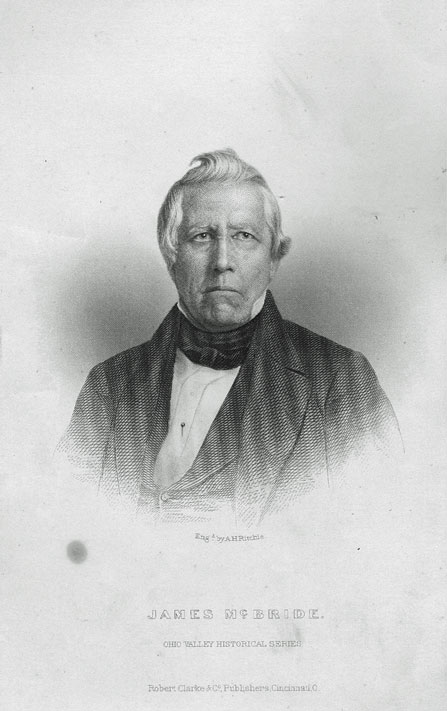
Fergus Anderson came of good stock. His father was Isaac Anderson, mentioned elsewhere in this book. Fergus was he second oldest son, and was born in Cincinnati June 14, 1797. He was married to Miss Mary Dick, daughter of Samuel Dick, an old associate pioneer of Isaac Anderson, June 28, 1821. Fergus was brought up to the business of farming, and after he was married set Al on a farm on Indian Creek, near the residence of hi father. In 1828 he was sent to the Legislature. He served two years, and was then elected to the senate, where he stayed the same length of time. In 1835 he was chosen a justice of the peace in Ross Township, in which office he served until he was elected associate judge of Butler County by the Legislature. This office he retained seven years, For many years he was also president of the board of trustees of Miami University, and a member of the county agricultural board. In all these varied capacities he served the public faithfully and well.
In middle life Mr. Anderson was a wealthy man, but he gave much money to his married sons, and two of them dying, many thousands of dollars went out of the home estate, and he finally found himself in embarrassed circumstances—principally through these means.
In disposition his principal characteristics were his kindness of heart and gentleness. Enemies he had none, while his friends, especially among the older generation now living, could be numbered by hundreds.
JAMES McBRIDE.
James McBride, the historian, was of Scotch descent. His grandfathers, on both the paternal and maternal side, were born in North Britain, not long after the incorporation of Scotland with England, and emigrated to. Pennsylvania about the time of the French and Indian war. His father was also James McBride. While still a young man he went to Kentucky, then the scene of perpetual Indian warfare, and fell a victim to the attacks of the red men. There was a trace leading from the mouth of the Licking to the site of the present city of Lexington, and while on this path he was cut off by the Indians in 1789, on the Dry Ridge. His wife, whose maiden name was McRoberts, had been left at home, while he was out on the frontier, and there she lived until her death, which occurred in September, 1808. Her residence was on the farm, near Conococheague Creek, where she had been born. She had but one child, the subject of this sketch.
James McBride, the son, was born November 2, 1788, on the farm above mentioned, a short distance from Greencastle, Franklin County, Pennsylvania. He received no set education, but improved what opportunities he had for reading, and, on coming to this county, .in the eighteenth year of his age, was discovered to possess a very large amount of useful knowledge. He had been well instructed in penmanship, and his neat and painstaking chirography can be traced in the public records of the county almost from the time of his coming until his death. His first employment, it is believed, was as clerk for John Reily, but he soon found other openings. Every one had the utmost confidence in him, and he was constantly in request. His patrimony was not large, but it enabled him sometimes to try new plans for bettering his fortune. Just before the war with Great. Britain, in the early part of this century, he engaged with Joseph Hough in a venture to New Orleans. Flour was bought and shipped to that port with a large profit, and thenceforth Mr. McBride was easy in his circumstances. He never attained riches.
In 1813 he was elected sheriff, and was again chosen in 1815. This office was then considered as being the chief one in the county, and it shows the confidence his fellow- citizens must have had in him, as he was but twenty-five when elected. While holding this office he was married to Hannah, daughter of Judge Robert Lytle, who dwelt a few miles from town, and with her he lived forty-five years, having three sons and two daughters.
Mr. McBride had scarcely removed to this county when he began his researches in the early history of this region. He foresaw its progress, and knew that where there was then only a wooded plain would soon be villages and cities. The pioneers were still alive who could recount the tale of the defeat of St. Clair, the triumphal march of Wayne, the building of the first houses, and the birth of the first children. Some of the older ones had been in the Revolutionary struggle, and yet older ones remembered the last long and tedious war we waged with France, ending with glorious victories in 1763. These stories were not wasted upon an inattentive ear. He listened to the narrations, and put down upon paper the material portions relating to the early settlement of the Miami country. He verified the relations by comparison with others, and then wrote out a rough draft for publication. This again was changed and altered until, in some cases, three drafts of the same narrative were extant at once. It is impossible to say how much he wrote, but there are probably now in existence, in his handwriting, not less than three thousand pages of manuscript bearing upon Butler County and the country adjacent. Among the most valuable of these is the work issued in 1869 by Robert Clarke & Co., of Cincinnati, under the title of "Pioneer Biography of Butler County." This is in two handsome octavo volumes, and contains sketches of nearly thirty pioneers, besides incidental allusions to more than a hundred others. By the indulgence of Mrs. Stembel, his daughter, and of Mr. Robert Clarke, we have used much of the matter in these pages, without indicating from what source it has been taken. It is safe to say that with these, and what we have been able since to glean, there will be no county in the State better informed of its beginning than Butler. Our " shepherd kings" are not mythical.
170 - HISTORY OF BUTLER COUNTY.
Besides these, Mr. McBride wrote a history of Hamilton, and one of Oxford, together with a sketch of the Miami University. These have never previously,been printed; but their substance will appear in these pages. No one can read what he has done without being struck with the thoroughness and solidity with which he did his work. He read many volumes to make his annotations, and each page of his writing must represent a day of labor. There are blanks left here and there to be filled up, and in some cases where chapter headings were placed the text had not been written. He hoped to be able to do this, but time was lacking. To the triennial catalogue of the Miami University there are copious additions, and there is included in his papers on the Miami University a list of the graduates, with their subsequent history. This must have taken a great deal of correspondence. He wrote an account of the Hamilton bridge, which was published by the stockholders ; he furnished the means, and wrote the book, describing Symmes's theory of concentric spheres ; and he occasionally contributed points of Ohio history both to Gist's Miscellany and the Hamilton, papers. Howe's History of Ohio was largely indebted to him.
But while he was writing what had happened, he was also attentive to gathering up those books and odds and ends of knowledge that would make the preparation of historical works easier to the future annalist. His library was in many branches of knowledge, embracing probably five thousand volumes, at a day when neither incomes nor libraries were so large as at present. He retained files of the Hamilton papers from the beginning, as well as of Niles' Register and the National Intelligencer. A few of these went to the State library, but the remainder are destroyed. He kept every pamphlet that reached him ; and it is not too much to say that, in this respect, the loss that was suffered by his death and their destruction is incalculable to the student of Western history. Beginning his researches in 1806, and continuing them for more than a half century, it is certain that the historical societies of the future, in Chicago, Cincinnati, and Cleveland, would be willing to pay their weight in silver for what is now lost. It should be remembered that, seventy-six years ago, Cincinnati, Pittsburg, and Louisville were inconsiderable villages, and St. Louis a hamlet. Mr. McBride's collection was probably the richest in the incunabula of the West, if we may borrow a term generally restricted to the fifteenth century, of any made or gathered in the United States. He had the same advantages that Jefferson had when he collected his library of works relating to America, with the exception that our pioneer retained only those which were locally valuable.
Mr. McBride was never happier than when in his library. He had a sincere love for truth, and wished himself to know what it was, even when he had no desire to write or otherwise express it. His books were his fountains of knowledge. He kept continually adding to them, and was equally assiduous in extracting their contents. He was always ready to lend his aid to other investigators, and to place them upon sound ground. He had a strong intellect and a love for letters, and he never seemed to grow tired of these investigations. The result was that, in the end, he had accumulated a vast stock of knowledge, and this without pretense or exciting remark.
As will be seen by our chapter on the mound-builders, kindly furnished by J. P. MacLean, the whole region hereabouts is dotted with the remains of a race who built earthworks and threw up barrows, and of whom no other relics now remain. Mr. McBride was the first observer in this county who gave these tumuli more than cursory attention. He opened some of them, and others he surveyed and described. The one on sections 4, 5, 8, and 9, St. Clair Township, was described in the transactions of the Ohio Historical and Philosophical Society by him. He spent much time in this pursuit, and, by patience and the use of money, finally succeeded in getting together the finest collection of prehistoric relics ever in this neighborhood. Many of these curiosities were the gifts of his neighbors, who knew his tastes. This cabinet is now in the- possession of George W. Vaux, of Philadelphia. Forty years ago Squier and Davis were in this vicinity, making surveys, drawings, and collections for a volume soon to be issued by the Smithsonian Institute, in Washington, and enlisted his aid and that of Mr. John W. Erwin in their behalf. Yet, although the " Ancient Monuments of the Mississippi Valley" owe largely to the assistance of these two gentlemen, who furnished near a hundred pages, they received no public acknowledgment, and the community at large believes these drawings, plans of survey, and notes were from the pen of the two editors.
We are apt to forget, in these days of easy locomotion and advanced education, what great benefits were reaped from our early colleges. They deserved all the encomiums lavished upon them by the early historians, although their staff of professors was small, their range of studies limited, and their teachers knew little but the classics. They kept the lamp of knowledge aflame throughout the country, and here and there trained up men who carried the advance of knowledge still further. In this task Miami University had a great share, and, of its board of governors, none took a greater or more intelligent interest than Mr. McBride. From the origin of the institution he was connected with it, and at the time of his death he was the president of its board of trustees. Without himself having attained a collegiate education, he appreciated its advantages. He was sedulous in attendance at the meetings of the trustees ; he was treasurer for a long time ; he aided on the building committees and elsewhere, and he invariably gave the faculty a full support. That institution acquired an early and great fame, and to no one scarcely can more credit be given than to Mr. McBride.
LEADERS OF THE HALF CENTURY - 171
We should not omit to mention the map drawn by him in 1836. This was published by himself and James B. Cameron, and engraved by Doolittle and Munson. It is a large copper-plate, five feet by four, and of the utmost accuracy. Every little stream is laid down upon it, and every farm, road, church, and school-house, and the meanderings of the Miami can by this be compared with its bed in the present day. No more truthful county map, we have authority for saying, was ever published in Ohio. Some of his manuscript maps are also in existence in the public offices. They are both handsome and accurate, and of marvelous perfection in the lettering.
After ceasing to be sheriff he was in repose several years, until he was urged by his fellow-citizens to become mayor of Hamilton. He showed in this office the same punctual diligence he displayed elsewhere, as is attested by his docket, still preserved, in which he recorded the cases brought before him. While in this position he aided in a codification of the municipal ordinances After the election of John Woods as auditor of state he went thither to assist him, rendering most valuable co-operation, and in 1846 was chosen clerk of the courts of Butler County, a position he held until 1852.
He was a taciturn and modest man, never frequenting public gatherings, and rarely conversing at any length except with those intimately connected with him. He was averse to display. He was very quiet and unobtrusive, and of sterling integrity. He could not push himself forward. He was charitable almost to a fault, and never let a person leave his door unaided. His probity was of the highest. He never sought to escape the consequences of an action in which he had been unfortunate, through misjudgment or misplaced confidence, but dealt as he would be done by. He was active in every thing that helped to benefit or improve his county or State, and took an interest in every thing that promised these results. He was a stockholder in the bridge, the hydraulic, and the railroad, because he thought they would benefit the town, and not because he thought they would put money in his pocket.
When he had attained the patriarchal age of threescore and ten his wife died. This was on the 23d of September, 1859. He seemed instantly to lose all interest in life, and prepared himself to depart. Ten days after he died, on the 3d of October, aged seventy years and eleven months, and leaving two sons and two daughters. Homer, his oldest son, had died long before, and those who survived were Horace, James, Laura, and Marietta. The last married William Sanders, and on her death left two daughters. Laura married Roger N. Stembel, a graduate of Miami University, who entered afterwards the navy, and was badly wounded at Island No. 10 on the Mississippi, where he was the captain of a gun-boat. He is now a commodore. Both of Mr. McBride's sons are dead.
JOHN CLEVES SYMMES.
John Cleves Symmes, the junior, commonly known as captain, to distinguish him from his uncle, Judge John Cleves Symmes, the leading patentee of the Miami lands, was Korn in Sussex County, New Jersey, on the 5th of November, 1780. He was the son of Timothy Symmes, a Revolutionary soldier, who was afterwards a judge in New Jersey, and who came out to this• region soon after his brother. He was twice married,—once to Abigail Tuthill, and once to Mary Harker. By the first marriage he had three children, and by the second six. John Cleves Symmes, the subject of this sketch, was the eldest of the latter. He received a good elementary education, and early developed a great taste for reading. This was indulged as far as possible, and he also carefully studied mathematics and the natural sciences.
On attaining the age of twenty-two, or on the 2d of April, 1802, he entered the American army as ensign, the lowest rank of commissioned officer. On the 1st of May, 1804, he was promoted to the rank of second lieutenant ; on July 29, 1807, to that of first lieutenant ; and on the 20th of January, 1812, he received a commission as captain. He continued to serve in that capacity during the war, and until the disbanding of the army in 1816.
Soon after he entered the army he was ordered to the South-west, and was stationed successively at Fort Coupee, Louisiana ; Fort Adams, fifty miles below Natchez, on the Mississippi, and at New Orleans.
While at Fort Adams he fought a duel with one of his comrades, as given in a letter to his brother Celadon, dated Fort Adams, June 28, 1807:
" I sit down to emit from the point of my pen such ideas as may chance to rise in my mind while I imagine myself narrating to you the pleasures and pains I have experienced since I last wrote. The proportion of the latter has far exceeded that of the former, although the six months I spent at Fort Coupee glided away like a pleasing dream, where happiness appeared within my reach ; and just as I was possessing it, I was aroused and hurried away to Orleans, where a viperlike enemy had been before me and made several others, who were actuated by hope of promotion and love of mischief.
" This subtle, designing enemy was my late surgeon mate, Dr. John Fowles, who insinuated that I had acted dishonorably in giving him a furlough with prospect of pay, and that I had insisted on his giving me his pay while absent, on account of having to take care of the sick for him ; on hearing which I immediately declared his allegation false, and that he should give me a certificate satisfactory or meet me in the field of honor.
" After I had stated the truth that he had built his story out of, declaring I had done nothing but what I was willing the world should know or that I could blame myself for, and pointed out the precedent I was guided by, I obtained with ease a furlough to go to Point Coupee to adjust some unsettled business I pretended to have
172 - HISTORY OF BUTLER COUNTY.
there. I went and humbled his (mean) soul as much as mine (but too generous then), and dictated a certificate, which he copied and signed. I then returned in triumph to Orleans, where those juniors, disappointed in the hope they at first had entertained of obtaining promotion by my resigning in a fright, or getting killed by the doctor, continued their nefarious cabals under the rose. But I smelt a rat, felt provoked, and strutted with more confidence than was usual to me at other times. On one of these lowering days I began a letter which I never finished. I here give you a paragraph of it : I lately read a French proverb indicating that a man without enemies was no great thing. I then wished for some. I now have my wish, and believe I shall profit thereby. They are a necessary stimulus, calculated to promote energy and perseverance. If I do not take pains to nourish them, I shall not to do them away, unless some one should be so bold as to emerge from under the rose, and refuse to apologize and return.
" A week or two after my return from Point Coupee, I was told by an old acquaintance, under cover of friendship, that my juniors in rank did not admit my character to be fairly cleared up, and had persuaded several to think with them. I made light of it to him, but advised with a field officer, who happened not to be characterized by decision. His response was evasive. I, therefore, of my own accord, made an official application to the general for a court of inquiry, to examine whether or not my conduct had been correct.
" The general, being much hurried with business at that time, neglected to order the court for several days, during which time I, in the course of duty, had occasion to see the standing order relative to police, which I had not yet seen. I, therefore, went, as I ought, to Lieutenant Marshall, who was adjutant, and, in his office, asked him to see the orderly book. lIe answered that it was more proper that I should examine the books of the company to which I was attached, and that I should not see them there. I then observed that I did not suppose but that he was a man of his word, and reminded him that he had formerly given a like answer and refusal on the same occasion, with a promise that, in case the sergeant had not recorded the orders (as I suggested), I might see them in his office ; upon which he blustered toward me, and demanded what I meant ; while I returned him that I meant as I said. He then declared that, since he had promised them, I might see them, and handed me the book, observing, at the same time, that I was not generally considered as a gentleman. At this time our passions were both raised. I quelled mine, and spoke deliberately to this effect, that I should not consult his opinion relative to what other people thought of me, but wished to know if he did not himself say I was not a gentleman. He answered yes, and that he did not consider me one. I continued that I had long observed the ill offices that he was inclined to do me, and that he wanted promotion (` Yes,' said he, I do '), and would be disappointed in the way he looked for it, but that I was still willing he should have a chance for it : ' Let us go out and take a shot.' (By this time, besides two officers sitting in the room, five or six had collected in front of the door, which stood open.) He declined, alleging that he did not consider me on a gentlemanly footing with him, alluding to what Dr. Fowles had said of me. I urged that, until I was arrested or officially charged with some misdemeanor, I stood on the same footing of every other officer, and that -I was not subject to be insulted with impunity. About this time be began to come down, and endeavored to make out that he had not disputed my gentility, but still refused a second invitation I gave him, alleging the same reason, but said that he would fight me after the court of inquiry (I expected) should acquit me. I consented to the proposition, provided it could not take place sooner, and then proceeded to read the orders I wanted to see, and he sat down to his breakfast. That day I mounted guard, and the next, when relieved, took a sleep after dinner, and went early to parade (I then quartered in town) without consulting any person. I had determined what to do, which was to fall in with Mr. Marshall when he had his sword on, and wring his nose. I did not get an opportunity until after parade was dismissed, when, walking to the barracks, I overtook him and requested to speak to him. He turned toward me; I accomplished my intention, and bringing my hand on the hilt of my sword, and taking one step backward, I involuntarily said, Draw and defend yourself.' He did not draw, but stepped toward me—to grapple, as I expected ; for he is a large man. I then held my sword horizontally before me, and told him not to advance, but draw and defend himself. He then, after an exclamation of surprise, made for his quarters, beckoning and calling me to follow, which I did to the front of his door, where I passed fore and aft, then went to a group of offrcers near, and related what I had done, observing that I expected that he would not now hesitate to take the field. Presently he came toward us, calling on me. I advanced to him. He then said that he would meet me, and proposed that our seconds should convene on the gallery as soon as possible. I consented, and glided to my quarters (if possible) like a man intoxicated with pleasurable passion. One of my messmates said I had been drinking wine. Lieutenant Clymer, a messmate, who had at that moment returned, after an absence of two weeks, immediately became my second ; met Mr. Marshall, and they agreed that we should meet on the commons at daylight next morning. Mr. Clymer prepared me excellent pistols and a surgeon to attend. We met at the appointed time, and, at the distance of ten paces, standing sideways, fired at the word. The one appointed to give it first asked, Are you ready?' We at the same instant answered, ' Yes.' He then said, ' Fire !' and we raised our arms together deliberately,
LEADERS OF THE HALF CENTURY - 173
from a hanging position. My intention was to aim at his hip ; his (I learn) at my breast. Consequently, I got the first fire, which drew his shot somewhat at random, though it must have passed within a line of the lower part of my belly, as it pierced through my pantaloons, shirt-tail, and the bone of my careless hanging wrist, close to the joint. He received my ball in his thigh, but where it glanced to the doctors can not find. It is said he is now walking about. I wanted to know if he desired another shot, and being informed in the negative, left my second and surgeon attending to him, and, with my handkerchief wrapped around my wound, went home and ate a hearty breakfast, not expecting to be confined or much afflicted with what appeared to the doctor, as well as myself, little more than a scratch. But many a long day and night I suffered for the error of not 'losing blood and dieting, as I ought to have done; 't was near two months before it healed, and two weeks of that time it was dangerously inflamed, and disjointed of itself, which is the cause of its looking or being somewhat awry and not working freely in the joint like the other. The pain produced fever, and that debility, which exposed me to a multitude of infirmities. The most obstinate and afflicting was a dysentery, which began with a dropsy, and continued with violence for six or seven weeks. I have now got shut of it ; but my feet and legs continue to bloat to a troublesome degree. The court of inquiry I applied for was ordered, agreeable to my request, and as soon as my wound began to mend I wrote an official notice to the recorder that I was ready to come before the court, if they would appoint a place to sit and give me notice ; and I repeatedly stated verbally the same to Captain Lockwood, who was president thereof, who alleged that he was under marching orders, and it was intimated to me by numbers that the proceedings would be a needless piece of precaution in me, as every one was convinced of my integrity and gentility. I, therefore, made no further application to be heard, especially as the members of the court were immediately scattered to different posts."
Captain Symmes never fully recovered the use of his wrist ; it was always stiff and a little awry. The wound which Lieutenant Marshall received disabled him so that he carried the effects of it through life. He was afterward befriended by Captain Symmes, who always spoke of this duel with regret.
At the time of the commencement of the war with Great Britain, in 1812, the first regiment of United States infantry, of which he was senior captain, was stationed at the mouth of the Missouri River, in the Territory of Missouri. Here they remained until 1814, when they were ordered to join the army of General Brown, on the northern frontier. After a long and fatiguing journey by land and water, they reached Canada on the 25th of July, the very day on which the battle of Bridgewater, or Lundy's Lane, was fought.
The battle commenced near sunset. The First Regiment, which was commanded by Lieutenant-colonel Robert C. Nicholas, had not joined the army at the time of the opening of the battle, but were about two miles in the rear. When the firing commenced, without waiting for or receiving orders from General Brown, the regiment was put in motion by Colonel Nicholas, and marched with all possible expedition to the scene of the conflict. When they arrived at the American camp they found General Ripley, to whom they had been ordered to report, had advanced with his brigade, and, without halting, they continued to press forward.
It was twilight when they reached the field ; they formed themselves within a short distance of the enemy's batteries, without meeting with any general officer or aid- de-camp to instruct them how they should join in the conflict. Ignorant of the situation of either army, except from the observations made in coming up, and unapprized of the position of General Ripley's brigade, Colonel Nicholas, when he found himself so near a British battery, which had opened fire upon his regiment, ordered the men to retire a short distance. While the attention of the battery was thus directed to the First Regiment, Colonel James Miller, leading his battalion, partly under the cover of the fence of a church-yard moved swiftly up the hill and attacked the artillerists almost before they were aware of their presence, and after a short but desperate hand-to-hand fight, in which he lost a number of his gallant men, he captured the whole park, consisting of seven brass cannon, ammunition-wagons, etc.
After the capture of this position, Colonel Nicholas was enabled to report to General Ripley, and was ordered to assume a position on the left of Colonel Miller's regiment. This order was promptly obeyed, and the position held till the close of the action.
General Brown, in his official report, makes honorable mention of the bravery of Captain Symmes in this battle.
On a partial recovery from his wounds, General Brown took command at Fort Erie, which was closely invested by the British, who were actively employed in surrounding it with batteries. On the 17th of September he resolved to make a sortie, which was accomplished with spirit and success ; the British were completely surprised, and, after a severe conflict of two hours, the three batteries, the whole line of intrenchments, and their block-houses were in the possession of the Americans. In this action Captain Symmes and his command captured one of the batteries. He led his men over the intrenchments, and spiked the first cannon with his own hand.
In 1816 Captain Symmes retired from the army, and took up his residence at St. Louis, where he engaged in furnishing supplies for the troops stationed on the Upper Mississippi, and in trading with the Fox Indians, for which he had a special license from Governor Clark, of Missouri Territory.
174 - HISTORY OF BUTLER COUNTY.
On Christmas day, 1808, Mr. Symmes married Mrs. Mary Anne Lockwood, widow of Captain Benjamin Lockwood, at Fort Adams. She had at that time a family of five daughters and one son. They were brought up and educated by Captain Symmes as his own family; they 'were sincerely attached to him, and grew up to maturity with his own children in perfect harmony. They were all married from his house but two, who remained single.
Captain Lockwood at the time of his death owned a section of land in Brown County, Ohio, on which Captain Symmes regularly paid the taxes, even to the neglect of his own. One of his own tracts, four thousand acres, in Licking County, which would have been a fortune to his children, was forfeited by this neglect. When these children arrived at maturity, he turned over this land, free and unincumbered, neither charging them for the money expended on it nor the care he had taken of it.
Captain Symmes's trading experience did not result in a pecuniary benefit to him ; so, in 1819, he removed from St. Louis, and settled at Newport, Kentucky, where he resided till 1824, when he removed to his farm, a section of land presented to ,him by his uncle and namesake, which had been previously improved, near Hamilton, Ohio.
While at St. Louis Captain Symmes promulgated his eccentric " Theory of Concentric Spheres, Polar Voids, and Open Poles." To these investigations relative to the figure of the earth he had devoted many years-, and had wrought himself up to a firm and conscientious belief that he had made the great discovery of the age, viz. : " That the earth as well as all the celestial orbicular bodies existing in the universe, visible and invisible, which partake in any degree of a planetary nature, from the greatest to the smallest, from the sun down to the most minute blazing meteor or falling star, are all constituted, in a greater or less degree, of a collection of spheres, more or less solid, concentric with each other, and more or less open at the poles ; each sphere being separated from its adjoining compeers by space replete with aerial fluids ; that every portion of infinite space, except what is occupied by spheres, is filled with an aerial elastic fluid, more subtile than common atmospheric air, and constituted of innumerable small concentric spheres, too minute to be visible to the organ of sight assisted by the most perfect microscope, and so elastic that they continually press on each other and change their relative situations as often as any piece of matter in space may change its position, thus causing a universal pressure, which is weakened by the intervention of other bodies in proportion,to the subtended angle of distance and dimension, necessarily causing the body to move toward the points of decreased pressure." (Symmes's Theory of Concentric Spheres, p. 25.)
In order to make his discoveries and purposes known, he issued the following circular, which, like a lady's letter, is most important for its postscript :
No. 1.
CIRCULAR.
Light gives light to light discover—ad infinitum.
ST. LOUIS (MISSOURI TERRITORY),
NORTH AMERICA, April 10, A. D. 1818.
To ALL THE WORLD,—
I declare the earth is hollow and habitable within ; containing a number of solid concentrick spheres, one within the other, and that it is open at the poles twelve or sixteen degrees. I pledge my life in support of this truth, and am ready to explore the hollow, if the world will support and aid me in the undertaking.
JNO. CLEVES SYMMES,
Of Ohio, late Captain of Infantry.
N. B.—I have ready for the press a Treatise on the Principles of Matter, wherein I show proofs of the above positions, account for various phenomena, and disclose Dr. Darwin's "Golden Secret."
My terms are the patronage of THIS and the NEW WORLDS.
I dedicate to my wife and her ten children.
I select Dr. S. L. Mitchill, Sir H. Davy, and Baron Alexander Von Humboldt as my protectors.
I ask one hundred brave companions, well equipped, to start from Siberia, in the Fall season, with reindeer and sleighs, on the ice of the frozen sea ; I engage we find a warm and rich land, stocked with thrifty vegetables and animals, if not men, on reaching one degree northward of latitude 82. We will return in the succeeding Spring,
J. C. S.
Captain Symmes addressed a copy of this circular to every learned institution and to every considerable town and village, as well as to numerous distinguished individuals, throughout the United States, and sent copies to several of the learned societies of Europe.
Its reception by the public can easily be imagined ; it was overwhelmed with ridicule as the production of a distempered imagination, or the result of partial insanity. It was for many years a fruitful source of jest with the newspapers.
The Academy of Science, of Paris, before which the circular was laid by Count Volney, decided that it was not worthy of consideration. The scientific papers of Europe generally treated it as a hoax, rather than believe that any sane man could issue such a circular or uphold such a theory.
Circulars and newspaper articles soon followed circular No. 1, and were kept up for years, despite of the ridicule which was poured on the unfortunate author from all sides. In 1820 Captain Symmes commenced lecturing on his theory ; first at Cincinnati, then at other large towns in the West. The novelty of the subject attracted large audiences ; but he failed to make converts who possessed wealth or influence enough to secure the means to test by exploration the truth of his theory. The Western Courier of November 27, 1822, indulges in a dream of what would happen two hundred and twenty-eight years from that time :
LEADERS OF THE HALF CENTURY - 175
"THE YEAR 2150 ANTICIPATED.
" Cincinnati, December 7, 2150.—The marble monument at Newport, which, in 1838, was erected by our ancestors to the memory of that great philanthropist and philosopher, John Cleves Symmes, fell to the ground on the 5th ; its base having been undermined and destroyed by the late unprecedented flood of Licking River.
" Thus the 'records of fame, when committed solely to such perishable materials, live but a few transitory ages, and ultimately fall in with the general decay ; but the memory of Symmes shall be as unfading and lasting as time itself. We need no frail stones to remind us of his name, who first separated truth from error, and banished ignorance from the world.
"Washington, December 11.—Two members of Congress from the State of California arrived yesterday in this city by the inland route. They inform us that the other (twenty-one) members from that State had proceeded through the canal at the Isthmus of Darien, to Mexico, where it was their intention to join the Mexican members, and charter a vessel for their conveyance to this city.
" The members from Chu-san, in the interior regions, via the North Polar opening, arrived on the 9th inst. ; those from Pestchee-le, via the South Pole, reached the United States on the 30th ult.
" New York, December 2.- By the late return of the marshal, it is ascertained that this city, which, for the last two centuries, has been termed mistress of the world, now contains two millions of inhabitants, exclusive of foreigners. Philadelphia, her only rival, is found to contain but one million, five hundred thousand."
In May, 1824, Mr. Symmes explained his theory at Hamilton, to a large audience with such convincing effect that, after the lecture, they "Resolved, That we esteem Symmes's Theory of the Earth deserving of serious examination, and worthy of the attention of the American people."
So much did the theory attract popular attention in the West, that the "Polar Expedition" was thought a fit object for a benefit at the Cincinnati Theater, which was given on March 29, 1824. Mr. Collins then recited an address, written for the occasion by Moses Brooks, in which, after recounting the great discoveries to be made, he wound up with-
" Has not Columbia one aspiring son,
By whom th' unfading laurel may be won?
Yes! History's pen may yet inscribe the name
Of SYMMES, to grace her future scroll of fame."
In 1822 he petitioned the Congress of the United States, setting forth his belief of the existence of a habitable and accessible concave to this globe, his desire to embark on a voyage of discovery to one or other of the polar regions, his belief in the great profit and honor his country would derive from such discovery, and praying that Congress would equip and fit out for the expedition two vessels of two hundred and fifty or three hundred tons burden, and grant such other aid as government might deem necessary to promote the object. This petition was presented in the Senate by Colonel Richard M. Johnson, a member from Kentucky, on the seventh day of March, 1822, when, after a few remarks, it was laid on the table.
In December, 1823, he forwarded a similar petition to both houses of Congress, which met a similar fate.
In January, 1824, he petitioned the General Assembly of the State of Ohio, praying that body to pass a resolution approbatory of his theory, and to recommend him to Congress for an outfit suitable to the enterprise. This memorial was presented by Micajah T. Williams, and, on motion, the further consideration thereof was indefinitely postponed.
In 1825 he applied through the American minister at the court of St. Petersburg for permission to accompany the polar expedition then fitting out by the Russian Government, which was readily granted by the chancellor, Count Romanzoff; but the want of means to procure a proper outfit hindered him from accepting the offer.
In one of the copies of the book which was issued to defend his theory, Captain Symmes left notes on the margin, which give as good an account of his theory as we have seen:
" I hoped, ere this, to have been supported in my new theory of the earth by many pupils, but find that most of those who have written are inclined to oppose me. I would prefer having an advocate to state my views, because, in proportion to their extent, I may subject myself to the imputation of extravagance or ostentation, especially as, while I write, I naturally feel elated with my discovery. I am, perhaps, better fitted for thinking than writing. Reared at the plow, I seldom used a pen, except in a commonplace book, until I changed my plowshare for a sword, at the age of twenty- two, not wherewith to earn a fortune (having already an ample farm by the liberality of my revered uncle, after whom I am named), but to merit and obtain distinction, and accumulate knowledge, which I had seldom tasted but in borrowed books. With respect to the latter, the world is now to judge of my success ; and in relation to the former, I at least may say I satisfied myself and fellow-soldiers, if not my country, not only at Bridgewater on our left and the sortie at Fort Erie in the van, but throughout my thirteen years' service, ending the war. I presume few have inquired more devotedly than myself into the reason and origin of all that occurred to view. I remember when at the age of eleven, in Jersey, while reading a large edition of Cook's Voyages,' my father, though himself a lover of learning, reproved me for spending so much of my time from work, and said I was a book-worm. About the same age I used to harangue my playmates in the street, .and describe how
176 - HISTORY OF BUTLER COUNTY.
the earth turned round ; but then, as now, however correct my positions, I got few or no advocates. I must not, however, say I get no advocates ; for I have several. I particularly boast of two ladies of bright and well- informed minds, on the banks of the Missouri, who are able and earnest advocates and devoted pupils. To them is due the credit of being the first to adopt what the world is so tardy in admitting. But Colonel Dixon, who has traded on Lake Winnepeg with the Indians, is, I presume, the most important pupil I have obtained ; for he has long been actively engaged in the North-west Company and fur-trade. He declared, in our first interviews, that I was certainly correct, and stated to me many important, otherwise inexplicable circumstances occurring high in the north, that were completely solved by my principle. He is regarded by such as have long known him at St. Louis as a gentleman of a very strong and well-informed mind. In addition to the passive concurrence of several men of thinking minds, among them a venerable member of the American Philosophical Society, in this neighborhood, I have been honored with the offers of several more enterprising spirits to accompany me on the expedition I propose; but as the conditions with regard to my outfit by the world are not yet complied with, I have not positively accepted of their services. I still hold my life pledged, however, for the general truth of my position and devotion to the exploration. I calculate on the good offices of Great Britain and France ; for they nurse and patronize the sciences with ardor. My wife boasts her descent from the latter, and I, through five ancestors since the first landing at Plymouth, trace mine from the former. From the emperor of Russia, so well known as a patron of scientific enterprise, I flatter myself with much support. I challenge any opposers of my doctrine to show as sound reasons why my theory is not correct as I can show it is. I refer those who seek for truth to Rees's Cyclopedia, and any other books wherein the quadrupeds, fish, and phenomena of high latitudes are treated of ; likewise those books that treat of Venus, Mars, and Saturn, where they will find many tests that, if duly considered, must go to prove my position. In the Cyclopedia, under the heads of Fishery," Arctic," Herring," Seal,' and all other migrating fishes, it is shown that most, or all of them, retire annually beyond the icy circle during the Winter, and return, increased in fat and numbers, in the Spring; and under the head Reindeer' it is stated that this animal passes annually near Hudson's Bay in columns of eight or ten thousand, from north to south, in the months of March and April, and return north in October, as stated under the head of Hudson's Bay.' I propose to follow the route taken by the reindeer northward in Siberia, where they depart every Autumn from the river Lena (as Professor Adams, ̊Ai St. Petersburg, states), because it is probable these deer choose the best season and nearest route to fertile and habitable lands, and because we can there obtain domestic reindeer and civilized guides or assistants. I propose returning either in the course of thirty or .forty days, or when the deer return in the Spring. It is presumable that man can live where deer thrive. I do not think there are no dangers attendant on such a trip, but believe the object will justify risk in all probable ones. In plate 17, Vol. XXXIII, Part II, of the Cyclopedia, the figure of Mars, with his equator toward us, exhibits his pole surrounded with single light circles, whose farther sides extend beyond the periphery of his disc. I hence conclude that his poles are open, and that the light reflected by the farther sides of the verges of the opening is refracted so as to appear extended beyond his disc by means of its coming to us through the atmosphere of the nearest verges. It is a well-known fact that refraction is greatest toward the poles of the earth, owing, probably to the dense atmosphere there. The apparent continuation of the margin of his true disc through these rings (if not an imaginary line dotted there), must be the farther verge of the second sphere within rising by refraction, apparently, as far out of the true periphery of his disc. I contend that the space within theo circumference of the arctic icy circles, if not hollow or greatly concave, could scarcely afford space or surface to maintain alive and in health all the fish known to come from thence annually, in the Spring, even if, without resorting to feeding upon each other, this food was inexhaustible and the whole circle water. But floating trees being often found far north of where we see any grow is an impressive circumstance to show it can not be all water, and the fact that those trees are generally such as abound in the tropics, together with several unknown species, shows that there is a hot climate beyond ; and the migration of the reindeer, too, shows that moss or other vegetables abound there, and, consequently, land. Pinkerton states that the Dutch, who, at different times, got detained by the ice in high latitudes, could find but few fish to eat in the season of Winter, which proves that the migrating fish do not Winter amongst or on this side the ice. I also refer to Dr. Darwin's notes on winds in his Botanic Garden '-which I never read until after I adopted my theory—where that great, although often extravagant, philosopher declared his belief that there was a great secret, yet to be explained, at the poles, and anticipated that the light of the present age would disclose it. The stone spheroid he found hollow, and somewhat disposed in concentric strata, and the concentric iron nodules he describes deserve to be considered. He states that the seeds of several tropical plants are often found in the seas high north, in a state so recent as to vegetate. I recommend the perusal of Mayor's and Pinkerton's Voyages, Pennant and Goldsmith on Animated Nature, and Hearne's and Mackenzie's Travels, wherein many tests of my position exist.
"Pinkerton show that beyond latitude 75̊ the north winds are often warm in Winter ; that in midwinter
LEADERS OF THE HALF CENTURY - 177
there falls, for several weeks, almost continued rain ; and that vegetables and game are more abundant at 80̊ than at 76̊. When my chain of reasoning, drawn from the nature of matter, first led me to the conclusion of hollow spheres and open poles, I merely intended broaching it as a question ; but when I found the planets of the heavens and the phenomena and natural history of the polar regions afforded proofs incontestable, I then declared the fact without reserve, and have been considered by many as a madman for my pains. Were I, however, in any degree to feel disconcerted by the playful though ill-timed witticisms of others, I should comfort myself in the reflection that, as soon as I shall succeed in the establishment of my theory, the more it has been decried the more I shall feel honored in the event. Innovations in science or art most commonly excite opposition. If additional reasons are required, I have an ample fund yet in store for the world."
Among his converts was a young lawyer, Mr. J. N. Reynolds, a graduate of Ohio University. With him Captain Symmes entered into an agreement for a lecturing tour through the Eastern States. They set out in September, 1825, accompanied by Anthony W. Lockwood, a stepson of Captain Symmes, and lectured in various towns in Ohio. In about a month Captain Symmes was forced to return home in consequence of ill-health. In January, 1826, he rejoined them at Pittsburg, and they proceeded eastward. Some difficulty soon occurred, however ; Reynolds became dissatisfied, and left them. Symmes, undaunted by this desertion, or the constant ridicule with which he was met, continued his tour to Philadelphia, New York, Boston, as far as Maine, and even into Canada, lecturing at the various towns through which he passed.
His health was by this time greatly impaired by his constant labors and excitement, and he was reluctantly obliged to give up lecturing. He retired for a time to his native place in New Jersey, where he remained the guest of an old friend of his father, until his health was sufficiently restored to enable him to travel homeward. When he reached Cincinnati, in February, 1829, he was so feeble that he had to be conveyed on a bed placed in a spring-wagon, to his home near Hamilton.' He continued gradually to sink, until released by death on the 29th of May, 1829.
His remains were committed to the grave the next day, in the old burying-ground at Hamilton, with military honors. They were covered with _a monument, erected by his son, Americus Symmes, a solid structure of freestone, surmounted with a hollow globe, open at the poles, bearing the following inscriptions :
On the west side-" Captain John C. Symmes, a native of New Jersey, died in May, 1829, aged forty-nine years and six months."
On the north side—" Captain John Cleves Symmes was a philosopher, and the originator of Spumes' Theory of Concentric Spheres and Polar Voids.' He contended that the earth is hollow and habitable within."
On the south side-" Captain John Cleves Symmes entered the army of the United States, as an ensign, in the year 1802. He afterward arose to the rank of captain, and performed daring feats of bravery in the battles of Lundy's Lane and sortie from Fort Erie."
On the abandonment of the burying-ground this monument was left standing, and is now the only one there. The globe has been broken off, and is now to be found in one of the neighboring door-yards.
Captain Symmes was a man of great simplicity and earnestness of character-a high-minded, honorable, honest, and exemplary man in every walk of life, and was beloved, trusted, and respected by all who knew him.
So fixed in his mind was the belief of the truth of his theory that for ten years, although laboring under great pecuniary embarrassments and buffeted by the ridicule and sarcasm of an opposing world, he persevered in his endeavors to interest others in it, so as to enable him to test its truth by a polar expedition ; but without success.
It should now be remembered to his credit that many of the facts and fancies (as they then appeared) which he brought forward in proof of his theory of open polar voids have since been fully corroborated by the observations of Drs. Kane and Hayes and Captain Hall, but applied by them to the more plausible theory of open polar seas.
Captain Symmes's widow survived him, and made her home most of the time with her oldest son, Americus, though she spent much of her time visiting other members of the family. She died August 5, 1864, at Mattoon, Illinois, while on a visit to her son, Dr. Wm. H. H. Symmes, who was at that time residing there.
They had five children : Louisiana, Americus, William Henry Harrison, Elizabeth, and John Cleves.
Americus Symmes is a strong believer in his father's theory, and has spent much time in elucidating it. A few years ago he published a book giving the additional facts which had been discovered since the death of his father.
PIERSON SAYRE.
The last of the soldiers of the Revolution who died in Butler County was Pierson Sayre. His lamp had burned to the very last, and had finally gone out from mere exhaustion. He was the son of Ezekiel Sayre, and was born at a place now known as Providence, New Jersey, on the 12th of September, 1761. He was too young to enter the service of his country at the beginning of her struggle with Great Britain, but before he had attained his growth as a man entered the army of heroes who had determined to defend their homes and firesides. He was but seventeen when he joined Lord Sterling's division as a private soldier. In no State did the soldiers have more hardships to endure than in New Jersey, and of these Sayre had his part for two years and a half. He was in
178 - HISTORY OF BUTLER COUNTY.
most of the battles fought during that time, and in particular was in the battle of Springfield. General Greene was his commander, and the troops bore themselves nobly. He frequently had an opportunity of seeing Washington, and half a century after the general's death loved to recount what he knew of him. Often he would paint from his recollection to those around him that majestic figure, that serene countenance, that power of command that seemed inseparable to him, and would describe his action under trying circumstances.
After Mr. Sayre left the army he went to New York City, where he learned the trade of a carpenter and joiner, as there was then a great demand in that city for persons of that calling. Four years before, the place had been set on fire by either British incendiaries or American patriots, it was never clearly known which, and a third part of the town was burned. With the return of peace in 1783, New York became again a center of trade and speculation, and many new houses were built, giving full employment to all. Of this Mr. Sayre had his part ; and in 1786, on the 29th of June, he married Miss Catherine Lewis, with whom he lived happily for fifty-two years, until her death in Hamilton on the 25th of December, 1838, at the age of seventy-five. He remained in New York until 1790, when he removed to the western, part of Pennsylvania, and settled in Uniontown, Fayette County, where he remained until 1809, when he came to this State. He was an important man in that community, and was sheriff for three years. He also took an active interest in the militia, and was at different times commissioned as lieutenant, captain, and major. The date of issuing the last was August 2, 1800, and it was signed by Governor McKean.
In 1809 Mr. Sayre, with his family, removed from Uniontown to Butler County, buying a farm and tavern- stand seven miles from Hamilton, on the road leading to Middletown. It was then known by the name of the " Cross Keys." It is worth remarking that nearly all the earliest places of entertainment hereabouts were indicated by emblematic signs, such as the Black Eagle, Blue Ball, Lamb and Shepherd, as they are even now made known in Europe and in parts of Pennsylvania. The " Cross Keys" had formerly had much custom, and was widely known. Many meetings of the pioneers had been held here in the days when it had been kept by Andrew Christy. Mr. Sayre conducted this place for a few years, when he "sold out to Abraham Miley, and removed to Cincinnati, where he kept a tavern near the corner of Walnut and Front Streets, at the sign of the " Green Tree." Mr. Sayre's father had preceded him on his removal to the West, settling in Cincinnati, in 1790, but afterward removing to Reading.
After going to Cincinnati, Pierson Sayre purchased a tract of land in Lemon Township, which, under another owner, was the site of the town of Monroe. In 1814 he came back to this county, purchasing of John Suther land lot No. 120, on Front Street, between Dayton and Stable Streets, but only remaining there a few months, when he removed to the Torrence tavern-stand, situated on the corner of Dayton and Water Streets. The building is now owned by Henry S. Earhart.
In October, 1817, he was elected sheriff of this county, and in October, 1819, was again chosen. Being withdrawn at the expiration of this time, in consequence of a constitutional limitation, he was succeeded by Dr. Samuel Millikin. In October, 1825, Mr. Sayre was again elected sheriff by a large majority. On the completion of this section of the Miami Canal he was appointed the first collector of tolls, having his office at the east end of the Hamilton basin. He held this position two years, or until April 1, 1830. In 1835 he was appointed toll-gatherer for the bridge across the river at this place, holding the position until April 1, 1839. He was then seventy- eight years old.
In the year 1820, while sheriff, he contracted with the Board of Commissioners to erect the two public offices in the court-house square, one on the east and the other on the west side of the court-house, and he completed this task to the satisfaction of the people. He also built the Female Academy, on the south side of the hydraulic race, finishing it in the year 1834. This is the building now used for city offices, and in which the fire occurred in the Spring of 1882. He also built several other houses.
Mr. Sayre, more than any other person who ever lived in this county, had an opportunity of witnessing the changes that time has wrought in our land. When he was born the population of the British colonies was but a little over two millions of souls ; at his death they were at least twenty-four millions. George the Second had bit recently died, and he saw at the head of political affairs George the Third, Washington, Adams, Jefferson, Madison, Monroe, John Quincy Adams, Jackson, Van Buren, Harrison, Tyler, Polk, and Taylor, besides the heroic governor, William Livingston, of New Jersey, and the worthies who presided over the Continental Congress. When he entered the army, Philadelphia, our largest city, was smaller than Dayton now is-; the inland towns were Albany and Lancaster, and he was married before Ohio had a single settler. This State had as great a population at his death as the whole country had when he was born. He had witnessed great changes in the Miami country. Bridges, roads, canal, and railroad, all were made while he was here, in his long residence of forty-three years.
He did not escape the drawbacks of age. His children had died before him and his wife ; his strength became weakness, and his mind worn out. For two years he required to be handled like an infant. He was a member of the Presbyterian Church for many years, and as a neighbor, father, and husband was universally esteemed. He was not an idle man, and was always ready
THE MEDICAL PROFESSION - 179
to assist others. He died on the 4th of April, 1852, and was buried in Greenwood, the funeral sermon being preached by the Rev. J. W. Scott, of Oxford.