
Representative Citizens
JOHN BRADFIELD was, for a long period, a resident of Barnesville, Ohio, and was ever in the foreground of its business life. In the matter of public improvements, he probably left a greater impress upon the city than any other person who has ever made it his home.
The birth of John Bradfield occurred in Yorkshire, England, in 1813, and in 1827 he accompanied his parents, John and Isabella Bradfield, to the United States. The little family remained for a short time in Baltimore, Maryland, but it was the father's intention to engage in farming, and with this object in view a suitable location was found in Belmont County, Ohio, within four miles of the growing town of Barnesville. Although he was ambitious to learn, he enjoyed few early advantages. His superior mental acquirements, so noticeable in after years, were gained through much reading and association with the world. Until 1838, he remained on the farm and then first engaged in the buying and shipping of tobacco. His initial ventures proved profitable, and with continued success he remained in the business for the three succeeding years. Then, with his ambition stimulated by enlarged opportunities, he conceived and carried out the idea of buying out the large firm of James Barnes & Sons, general merchants, and thus entered upon a business career in Barnesville, which resulted in the legitimate accumulation of a large fortune. From time to timehis sons were admitted to partnership, and the business was still further expanded, until the name of Bradfield became one of the leading ones in the tobacco trade throughout the State, and far beyond. After an honorable business career of more than 50 years, Mr. Bradfield retired from active labors in 1889, resigning his large interests to his capable sons, who have followed his business methods, as they have been the fortunate inheritors of much of his sagacity.
John Bradfield, during his busiest years, however, was constantly keeping in mind the development of Barnesville, and, as he was gifted with that foresight which enabled him to comprehend its needs fully, devoted himself, with his wealth and influence, in a public-spirited manner, to meet them. The First National Bank will long be a monument to his public interest and business enterprise. From the time of its organization, in 1864, until 1875, he was its president, and retired then on account of the pressure of other enterprises. This bank, in connection with the mercantile firm of which he was the head, built one of the finest business blocks to be found in any city of equal size in the State, and this will stand as another monument to his public spirit. Both gas and electric lighting received his attention, and with his influential backing became accomplished facts in Barnesville, contributing to its general prosperity. For many years he was the president of the gas company, retaining that of-
324 - CENTENNIAL HISTORY OF BELMONT COUNTY,
fice until his decease, at which time the company was under contract to furnish electric light for the city.
Mr. Bradfield was a man of business and not a politician, declining the flattering offers made to him, although few men were better equipped to hold positions of public responsibility. Mr. Bradfield lived an active life that brought him prominence, but it was in the line of business. He was ever a generous contributor to the various educational and charitable enterprises of Barnesville, and so employed his wealth that his name is recalled by his fellow citizens with feelings of the deepest esteem and veneration.
In 1843, Mr. Bradfield was united in marriage with Eliza Anna Shannon, who was a daughter of Thomas Shannon, and a niece of ex-Governor Shannon. To this union were born nine children, six of whom are prominent in the highest social circles of this city; Thomas and John W. Bradfield, widely-known merchants; G. E. Bradfield, cashier of the First National Bank; Charles Bradfield, a bookkeeper in the same institution; Mrs. Otho P. Norris, wife of the cashier of the People's National Bank; and Mrs. A. Rogers, wife of a prominent lumber dealer. All of these are most highly respected residents of Barnesville. The mother of this family passed away in 1889.
Although so much of his time was necessarily devoted to his great business, Mr. Bradfield never forgot the needs of the Presbyterian Church, of which both he and wife were devoted members. From its first beginnings, he was one of its supporters and was always ready with time, influence and means, to promote its good work. In the death of Mr. Bradfield, on October 10, 1893, the city of Barnesville parted with one of its most substantial, useful and prominent citizens.
HON, A. T. McKELVEY, a distinguished citizen of Belmont County, was born March 23, 1844, in the city of Belfast, Ireland.
Mr. McKelvey was brought by his parents to America when but five years of age and located in Wheeling, (West) Virginia, where he grew up to manhood.
Mr. McKelvey obtained a common school education, but withdrew from school at 15 years of age to enter the Western Union telegraph office, where he served as "messenger boy," while studying telegraphy. When but 20 years of age, he was advanced to the responsible position of manager of the Wheeling office. Wheeling was at that time the headquarters of the Army of West Virginia and all the important dispatches that were exchanged between the headquarters of the army in the field and the commanding general at Washington passed through his hands. Wherefore his duties were not only arduous and exacting, but, in relation to the government, of a highly confidential character.
Mr. McKelvey's health was greatly impaired by the close confinement and long hours of service which the stress of war entailed, and in 1890 he was obliged to resign his office and seek a restoration of health. To that end he purchased the fruit farm upon which he now resides.
Since 1875 Mr. McKelvey has been prominently identified with the agricultural interests of the county. For a number of years he has been identified with the Belmont County Agricultural Society, serving that organization as superintendent of the horticultural department for four years and president of the society for two years.
He was one of the charter members of the Belmont County Farmers' Club and has served that organization both as president and secretary. He was employed for many winters as a State speaker at "Farmers' Institutes" and has been a regular contributor to the agricultural press.
Mr. McKelvey was chosen to represent Belmont County in the General Assembly of Ohio in 1887, and upon the expiration of his first term was re-elected for a second term.
AND REPRESENTATIVE CITIZENS - 327
In 1891 he was appointed by Governor Campbell a delegate to represent Ohio in the. Western States Commercial College that convened in Kansas City April 15th.
He is also a member of the United States Military Telegraph Corps, having served the government in the capacity of military telegraph operator during the Civil War.
In church matters he has been an active worker in the Methodist Episcopal Church since 1870, having served in the capacity of Sunday school superintendent for 26 consecutive years.
Mr. McKelvey was married April 29, 1869, to Julia S. Irwin, of Wheeling, West Virginia, and the fruits of this marriage were five sons, the eldest of whom—William Thomson—has but recently passed away. The surviving children are Robert Irwin, Charles Leavitt, Clarence Burt and James Thoburn. Mrs. McKelvey is a lineal descendant of Jonathan Zane, one of the heroic defenders of Fort Henry.
WILLIAM H. BARLOW, proprietor of the Barnesville Cigar Company, is one of the leading business men of Barnesville. Ohio, having been identified with a number of its industries, and an important factor in the development of the city's resources. He is a son of Amos and Martha (Hunt) Barlow. Amos Barlow is one of the old, representative, business men of Barnesville, who is spending his declining years in comfortable retirement.
William H. Barlow acquired a good, common-school education, and at the age of 25 years embarked in the box manufacturing business, in which he continued until 1898. At that time he engaged in the cigar business, but retained his interest in the box concern until 1902, when he disposed of it to his brother-in-law, Mr. \Vise. That business is now conducted under the firm style of Wise & Dewees.
The Barnesville Cigar Company is the largest institution of its kind in the city, and one of the largest in the county. Mr. Barlow carries a stock worth $10,000, and manufactures high grade stogies, mould, hand made, long filler, Havana seed and Little Dutch cigars, pouch goods and private brands. In connection with the manufacturing plant, Mr. Barlow has a retail store. He conducts the business on lines which have gained both the custom of the public and the confidence of the trade. In 1902 he opened up a firstclass fancy grocery, in partnership with N. W. Bastain. This enterprise also promises to be a success, under the able management of Mr. Barlow.
On December 23, 1898, the subject of this sketch was united in marriage with Bertha Moore, the acomplished daughter of Samuel Moore, of Barnesville, and one bright, little son, Arthur, has been born to their union. Mr. Barlow and his wife are consistent members of the Methodist Church, and are prominent in social circles. Politically, the former affiliates with the Republican party, while his fraternal connections are with the Odd Fellows, of Barnesville, and the Elks, Lodge No. 28, of Wheeling.
JAMES F. ANDERSON, an attorney of Bellaire, Ohio, has, since 1871, been the publisher and editor of the "Independent," the oldest surviving newspaper in the city. He was born in Pultney township, Belmont County, and has always resided in the township and Bellaire.
In the Civil War he served as sergeant of Company I, 170th Reg,. Ohio Vol. Inf. In 1870 he was admitted to the Ohio bar. For the past 30 years he has taken an active part in politics, being a Republican. He has been a member of the county and city boards of school examiners.
In 1871 Mr. Anderson took charge of the "Independent," and has, except for an interval of about two years, conducted it since that time. He is interested in a number of the business enterprises of his locality, has been president of the Belmont Savings & Loan Company since its organization, and is president of the Board of Trade of Bellaire.
328 - CENTENNIAL HISTORY OF BELMONT COUNTY,
OTHO P. NORRIS, cashier of the People's National Bank of Barnesville, Ohio, has been connected with that institution since its organization in 1883, and during his long term of service he has made a record that has been unusually satisfactory to his directors. Mr. Norris was born on the 8th of March, 1859, in Belmont County, Ohio, and is one of a family of six children born to Dr. Otho Norris and his wife, Rachel (Barlow) Norris, both of whom are deceased.
Dr. Otho Norris was one of Belmont County's most promising physicians. His useful career was terminated by his death in 1859, and many of the older residents of the county recall to mind his useful deeds and lofty character.
Otho P. Norris spent his boyhood's days chiefly in Morristown, where he received his primary education. This was supplemented by a thorough course in Muskingum College, from which he was graduated in 1881. The following year was spent in Cincinnati, Ohio, and in 1882 he located in Barnesville, engaging at that time in the real estate and insurance business in the office of his brother, Perry E. Norris.
In 1883 he entered the People's National Bank as teller, and has been with that successful institution ever since, being elected cashier of the bank in 1895. It is pertinent in this connection to notice that more than a half million dollars have been added to the resources of the bank since he assumed the cashiership seven years ago, the addition being due largely to his energy, thorough equipment and experience.
November 16, 1887, our subject was united in marriage to Kate Shannon Bradfield, the accomplished daughter of the late John Bradfield, formerly one of Barnesville's most illustrious citizens, and whose biography appears elsewhere in this volume. Mr. and Mrs. Norris have one daughter, Anna B.
In fraternal circles our subject is identified with the Knights of Pythias, and in local educational affairs he has given freely of his services, having been closely identified withthe management of the public schools for many years. In politics he is a Republican, but he has never sought publicity in an official capacity.
CHARLES P. DOBBINS, a well-known wool and fur dealer of Barnesville, Ohio, has, for over 30 years, prominently identified himself with the business interests of the town. His present business undertaking, which he has conducted for several years, is the largest of its kind in Belmont County, and his successful management of its affairs has won him the confidence of the people far and near. He is a stockholder in the First National Bank, and has long served as a member of the board of directors of that institution. He is a product of healthy country life and a practical business atmosphere, and was born on a farm in Belmont County, Ohio, August 1, 1850, being a son of James and Lydia (Nichols) (Hatcher) Dobbins.
James Dobbins was a native of New Jersey, and was a well-known figure in Barnesville for many years. In early life, he learned the cooper's trade, which, together with agricultural occupations, he followed throughout his active life. Upon coming to Ohio, James Dobbins settled near Morristown, where he engaged in coopering and also in farming. After remaining there for some years, he settled in Warren township, near Barnesville, upon a farm, which he operated in connection with the coopering business, and achieved a fair amount of success. He later located near Somerton, Ohio, following the same occupations there. About 1842, he removed to Barnesville, where he spent the remainder of his life, dying May 30, 1883, at the advanced age of 86 years. In early manhood, he married Mrs. Lydia (Nichols) Hatcher, by whom he reared three children, as follows: Annie M., James A., and Charles P. Mrs. Dobbins' life came to a close February 27. 1892, at the age of 76 years.
Charles P. Dobbins was mainly reared in
AND REPRESENTATIVE CITIZENS - 329
Barnesville, Ohio, and in the town's public schools secured the educational training and developed the habits of industry which have so materially assisted him in his business life. At the early age of 10 years, he began work in a wool factory, where he remained for six year, in this period acquiring a good knowledge of the wool industry. Later, he went into a cooper shop, and learned the business with the intention of making it his life's work, but soon after he had established himself in a knowledge of the craft, new machinery was introduced into cooper shops that rendered his knowledge of the trade of little use to him. With this obstacle confronting him, he decided to turn his attention to the fur and wool business, in which he had previously acquired considerable knowledge. Accordingly, he opened an establishment for this industry in Barnesville, and had no difficulty in working up a good trade. From time to time he has enlarged his business, buying up large quantities of wool and pelts, which he shipped to the various markets, and, as stated before, he now operates one of the largest concerns of the kind in Belmont County. The success that has come to him is certainly well merited.
Mr. Dobbins married Amanda M. Blakemore, and this union has been blessed by two children—Laura M., who resides at home, and Willard B., who passed from this life December 29, 1900. Mr. Dobbins has always evinced a keen interest in public affairs. Though but 16 years of age when the Civil War broke out, he secured his father's permission to become a soldier, and enlisted in Company D, 185thReg., Ohio Vol. Inf., and served with distinction under Captain Rodecker, in the Army of Kentucky, with General Thomas. He received his honorable discharge in 1865. He has served six years as a member of the City Council and two terms as a member of the Board of Education, of which he is now serving as president. He is a stanch supporter of Republican principles and is quite influential in the ranks of that party. His wife and family are members of the Methodist Episcopal Church, of Barnesville. Fraternally, he is a valued member of the Independent Order of Odd Fellows.
WILLIAM WATERS HANLON, president and manager of the Hanlon-Sharps Company, one of the large and prosperous enterprises which have had their origin and development in Belmont County, is a leading citizen and a representative of Barnesville's best commercial and social life. The birth of Mr. Hanlon occurred at Malaga, Monroe County, Ohio, March 9, 1855, and he is one of two sons born to T. T. and Agnes (Waters) Hanlon, the latter being a daughter of George Waters, a native of Loudoun County, Virginia. Her death occurred in 1858, when William W. was about three years old, and his brother, Oliver O., was about 12 days old.
T. T. Hanlon was born December 17, 1828, in Jefferson County, Ohio, the eldest child of William and Elizabeth (Duval) Hanlon, the former of whom was born in Orange County, New York, and the latter in Wellsburg, West Virginia. William Hanlon was a shoemaker by trade, but later engaged in farming and teaching school. T. T. Hanlon learned the merchant-tailoring business and first located in Belmont County in 1849 and has been identified with Barnesville since the fall of 1862. In 1860 Mr. Hanlon contracted a second marriage with Elizabeth Hyde, of Boston, this county, and one daughter, Agnes Amelia—now Mrs. Walter Murray—was born to this union. Until 1874 Mr. Hanlon engaged in the mercantile business in Barnesville and later became interested in the paper jobbing trade, still later adding a printing house, the firm name of the business at its birth being T. T. Hanlon & Sons. In 1882 the firm established the "Barnesville Republican," with W. W. Hanlon as editor, and conducted it in connection with their general paper business. About 1885 the firm name underwent a change to that of
330 - CENTENNIAL HISTORY OF BELMONT COUNTY,
Hanlon Brothers & Company, which name held until a few years later, when William W. and Oliver O. Hanlon purchased all other interests and the firm then assumed the style of Hanlon Brothers' Paper Company.
When our subject, William W. Hanlon, was about six years of age, his parents located in Barnesville, and it was in this city that he received the larger portion of his education, although no small credit must be given to the printing business with which he soon became associated, and pursued studiously in various parts of the country for that ready and facile use of the English language which distinguished him in his newspaper work — many people claiming that the "Barnesville Republican," under his tireless leadership, was the best country weekly in the State. Mr. Hanlon has possessed a wonderful constitution; was ever hungry for work, claiming that it was better to "wear out than rust out," and that, be it work or play, it should be done "like thunder." He has always been a friend and patron of outdoor games—the good ones. He has also been a strong advocate for municipal growth, and Barnesville never had a better friend.
The firm of Hanlon Brothers' Paper Company was changed to that of Hanlon Brothers' Paper & Manufacturing Company in 1899, when W. E. Sharps, of Independence, West Virginia, bought a third interest in the business. The business prospered—"Genius is nine-tenths work." In May, 1902, the business was incorporated—with William W. Hanlon as president, W. E. Sharps as secretary and Oliver O. Hanlon as treasurer—as a stock company, with a capital of $100,000, and with a paid-up stock of $60,000. In the summer and fall of 1902, to meet the demands of their rapidly increasing trade, the company was obliged to enlarge the plant, and built one of the most complete establishments in the State of Ohio, equipped with all modern appliances and high-priced machinery for the expeditious and economical manufacture of envelopes, sheet and rollwrapping paper, paper sacks, calendars, office supplies, weatherproof signs, and advertising novelties. They also do special designing and engraving in certain departments. Their plant is one of the "busy marts" of the town, their "sign" the handsomest in the county, and their goods go all over the United States.
William W. Hanlon was married on September 12, 1879, to Anna M. Sullivan, daughter of Rev. J. C. Sullivan, and they are the parents of three grown sons: Frank F., Lieuy L. and Ralph R.—all of whom are connected with the above business, each holding a responsible position and "filling" it. The religious connection of the family is with the Methodist Church. Mr. Hanlon is one of the "four fathers" of the Belmont-Monroe Reunion Society, has been actively identified with secret orders, is widely known as an aggressive Republican, and is a member of Wheeling Lodge, No. 28, B. P. O. E.
WILLIAM MANN has for nearly 23 years been prominently identified with the business interests of Martin's Ferry, as the proprietor of one of the largest foundries in his vicinity. He gives employment to some 25 experienced workmen, and in this way alone has been of great service to his community. He inherited from good Scotch ancestors those qualities that help win success for a man at every step in life. Born at Coatbridge, Lanarkshire, Scotland, October 28, 1845, he is a son of James and Elizabeth (Walker) Mann.
James Mann was born in the shire of Fife, Scotland. In early life he settled in Coatbridge, where he secured a position with the Summerlee Iron Company, his work being that of contractor in the blacksmith and carpentry department. Eminently successful in this line, he remained with the firm for 25 years. In 1870 he and his family came to the United States. For some years he followed farming here, meeting with very good
AND REPRESENTATIVE CITIZENS - 331
results. Later he settled in Little Falls, Minnesota, where he spent his last days, dying there at the advanced age of 86 years. He married Elizabeth Walker, who was born in the shire of Fife, Scotland. She lived to the age of 76 and died in 1884. To Mr. and Mrs. Mann were born six children, five of whom are now living. Mr. Mann was a person of great integrity and won the respect of all who knew him. Both he and his wife belonged to the Presbyterian Church.
William Mann received his education tinder an instructor in his own home in Scotland, after the completion of which he served an apprenticeship of five years as a patternmaker in the Summerlee Iron Works. At the end of this period, being well qualified for any position in his line, he accepted a place in the Atlas Foundry and Machine Shops. So acceptably did he fill this position that in the course of six months he was made foreman. He continued as such for six years, acquiring a knowledge of business and an experience in dealing with men that was of inestimable value to him in after years. In 1870 he came to the United States, and soon after landing proceeded to Chicago, where he accepted a position with D. M. Ford & Company. Later he worked with Dixon, Marshall & Company of Pittsburg for three years. It was in 1874 that he settled in Martin's Ferry, where he soon engaged himself as a patternmaker for Culberton, Willey & Company, who established the foundry and machine shop in 1872. With this company he remained some six years, commanding the salary of a skilled workman. At the end of this period, in 1879, though possessed of but little means, he determined to go into business by himself, and leased the iron works, where he had recently been an employee. Conducting the business with care and skill, he was soon enabled to purchase the property, and he is now its sole owner. In his foundry and machine shops he is doing a good business—in fact, the largest of any similar concern in his vicinity. He is fully prepared, with all necessary facilities and appliances, for the manufacture of light and heavy castings of every description, and makes a specialty of rolling mill, steel plant and blast furnace work. The machinery is run by a 40-horse power steam engine. The iron castings that are made at Mr. Mann's foundry are unsurpassed anywhere in the country, while the prices are quite moderate. The trade extends throughout the Middle, Western and Southern States.
Mr. Mann married Janet McGilvray, who has proved a most estimable wife. Both he and she are active and substantial members of the Presbyterian Church. He is also active socially and musically, and exerts a good influence in his community.
THOMAS L. STRONG, vice-president and general manager of the Enterprise Enamel Company, of Bellaire, Ohio, is one of the enterprising and public-spirited young business men of this city. Mr. Strong was born at Frankfort, Kansas, although his parents, James H. and Jane (Bradford) Strong, were natives of Ohio.
William Strong, the grandfather of Thomas L., was well known in his day as a reliable cooper, his kegs being the first ones made use of by the Laughlin Nail Works, or the old Top Mill at Wheeling. Mr. Strong was then in partnership with Elijah Woods, and they made the kegs at Martin's Ferry and sent them across the river in skiffs. William Strong conducted the first coopering establishment in this locality. James H. Strong, his son, was born at Martin's Ferry and now resides at Bellaire. He lost his wife some years since. fn 1856, with his family, he moved to Kansas and there engaged in coopering and farming until his return to Belmont County in 1873.
Thomas L. Strong spent a three-year apprenticeship to the glass business, learning the trade thoroughly, and for 10 years was foreman in the engraving room of the Bel-
332 - CENTENNIAL HISTORY OF BELMONT COUNTY,
laire Goblet Company. His business ability was thus demonstrated and his appointment as general manager of the great and increasing Enterprise interests has proven very judicious. The Enterprise enameling plant was started in Bellaire and was operated in a small way by Theodore Rossbach and Carl L. Dorer, on the site of the present Enterprise plant, on Union street, between 17th and 18th streets. Through the active efforts of James F. DuBois, William Lipphardt and others were interested, and the business has been reorganized and placed on a sound basis and has increased to gigantic proportions. The first meeting of the board of di rectors was held December 13, 1897, the members being: William Lipphardt, president; F. H. Eick, vice-president; James F. DuBois, secretary and treasurer; Carl L. Dorer, vice-president; J. A. Green, Theodore Neff and Theodore Rossbach. In February, 1899, the works were temporarily shut down, but were soon reopened with Thomas L. Strong as general manager, and his influence was immediately felt in the impetus given to the business. The stockholders are almost exclusively citizens of Bellaire and vicinity and represent a large amount of capital. The present officers are: William Lipphardt, president ; Thomas L. Strong, vice-president and general manager, and R. C. Faris, secretary and treasurer. The board of directors is composed of such responsible citizens as: William Lipphardt, Thomas L. Strong, Theodore Neff (the first stockholder), C. L. Dorer, J. A. Green, William J. Howell and John R. Gow. The buildings have been erected since February, 1899, and now cover an area of two acres, the main building containing the offices, packing and store rooms. This building is three stories in height and its dimensions are 60 by 120 feet. The great furnace room, where the burning and baking is done, is of one story and is 120 by 78 feet in dimensions, and the one-story drying and shipping room is 120 by t00 feet in dimensions. In addition a new building was erected in 1902—a machinery department where the shaping of various products is done, and the constantly increasing business has rendered it necessary to build the following buildings, which are under construction: A machine shop, 70 by 108 feet; a stock building, 100 by 108 feet, and three dipping and drying rooms, 60 by 180 feet. This great industry employs 220 workmen and distributes a large amount of money. Its railroad facilities are excellent, having the Baltimore & Ohio Railroad tracks on one side and the Pennsylvania Railroad tracks on the other. The largely increasing trade of the Enterprise Enamel Company is handled through the large wholesale and jobbing house of Hibbard, Spencer, Bartlett & Company at Chicago, Illinois—that being the distributing point.
Mr. Strong was born with executive talent, but he deserves credit for the manner in which he has developed his faculties and handles the great business problems which come into his everyday life. His family consists of wife and daughter, who are connected with the Christian Church. Mr. Strong's fraternal relations are cordial with the Masonic bodies and he is a member of Bellaire Chapter.
HON. PAUL B. WORTHINGTON. One of the leading merchants and most prominent citizens of Barnesville, Ohio, is Paul B. Worthington, member of the General Assembly, who is also the owner of much valuable city property.
Mr. Worthington was born in Jefferson County, Ohio, December 2, 1862. He is a son of Dr. William M. and Eliza (Lynn) Worthington, and one of a family of three children born to them. Dr. William M. Worthington was reared in Ohio and be came a prominent citizen of Jefferson County in both professional and public life. During 1858-59 he served in the Ohio Legislature. He was identified with the Republican party. His death occurred in 1864.

AND REPRESENTATIVE CITIZENS - 335
His widow resides with her son, the subject of this sketch.
Mr. Worthington supplemented a good common-school education by a practical course in the Columbus Business College, from which he graduated in 1883. Immediately afterward he became interested with his brother in the hardware business in Holmes County. In 1885 he located in Barnesville and was employed as a salesman until 1889, when he embarked in the general merchant-tailoring business. Mr. Worthington enjoyed success from the start, and in 1895 erected his present fine quarters, known as the Worthington Block. Mr. Worthington's business has expanded with the spirit of the times, and he carries a complete stock of clothing, shoes and gent's furnishings, besides devoting a large portion of his store to the business of merchant tailoring. He has the most extensive business of the kind in the city.
In politics Mr. Worthington has always been active in the Republican party, and his worth was recognized by his election to the City Council for six years. He was elected to the Legislature in 1901 by a majority of 1,661 votes over his Democratic competitor, C. C. Cutshaw. Since taking his seat he has displayed a degree of good judgment often lacking in older legislators, and will fulfill the pledges made to his constituents. He will work hard for his section, keeping in view in the future, as he has in the past, the best interests of every part of the State.
On October 2, 1894, Mr. Worthington was married to Myra Kemp, the accomplished daughter of Dr. G. H. Kemp, one of the oldest physicians of the vicinity, and a member of one of the most highly honored families of Barnesville. Two children have been born to this union, namely. Helen Lynn and Katherine Kemp. Mrs. Worthington is a devoted member of the Christian Church. Mr. Worthington was reared in the Methodist Episcopal Church. He is fraternally associated with the Masons and Knights of Pythias. The subject of this sketch is generally regarded as one of the most enterprising young men of this city, and enjoys a deserved popularity.
ALFRED H. MITCHELL, senior member of the legal firm of A. H. & W. Mitchell, of St. Clairsville, Ohio, is one of the city's leading citizens and representative attorneys.
The birth of Mr. Mitchell took place in Richland township, Belmont County, Ohio, May 31, 1849, and he is a son of David and Anna (Hatcher) Mitchell, who settled in Belmont County in 1830.
Nathaniel Mitchell, his great-grandfather, was a soldier in the Revolutionary War, and for three years belonged to that cordon of officers who formed the body guard of General Washington. Nathaniel's son, James, was a farmer in Pennsylvania, in Washington County, where his son, David Mitchell, was born in 1805. In 1830 David Mitchell settled in Richland township, Belmont County, where he engaged in farming, and where his death occurred in 1892. He married Anna Hatcher, who lived to the age of 72 years. They had a family of seven children, as follows: Elizabeth, Johnston, Jesse P., Joshua, Alfred H., Wilson, and Emmett D. Elizabeth is the wife of T. W. Bentley, of Loydsville, Ohio. Johnston was killed in the battle of Jonesboro, Georgia, September 1, 1864. Jesse P. resides in Columbus, Ohio. Joshua died at an early age. Wilson, who was born in 1851, taught school for eight years, studied law, was admitted to the bar in 1877, and is the junior member of the legal firm mentioned above. He practiced until 1899, and was then made cashier of the Dollar Savings Bank, in which capacity he still serves. He married Ella Hewetson, and they have two sons, Alfred H., Jr., and David W. Emmett D. is a resident of Kinsley. Kansas.
Alfred H. Mitchell received an excellent common school education, and grew to man-
336 - CENTENNIAL HISTORY OF BELMONT COUNTY,
hood with those attributes which have developed an admirable type of man. For four years after completing his studies he taught school and at the same time studied his law books, under the supervision of Capt. Lorenzo Danford and E. E. Kennon, of St. Clairsville, with such effect that he was admitted to the Belmont County bar in September, 1871, and since that time has enjoyed a lucrative practice in St. Clairsville.
Mr. Mitchell was married September 23, 1875, to Mary A. Wilkinson, a daughter of William Wilkinson, of Smith township, Belmont County, and they have one son,—Herbert W. Mr. Mitchell has been recognized as one of the leading members of his profession, and served the county as prosecuting attorney from 1880 to 1885. His business enterprise has been shown in a number of instances, notably in assisting to found the Dollar Savings Bank, of St. Clairsville, which was organized in 1895. His political opinions are in accord with the Republian party. Fraternally, he is a Mason. Mr. Mitchell belongs to a high type of citizenship, and is thoroughly representative of the best element of the community. He is a man of honor and integrity, and one who serves the town and county to the best of his ability.
ISAAC N. CECIL, president of the City Council of Martin's Ferry and a substantial, prominent and representative citizen, was born in Marshall County, West Virginia, July 15, 1867. The parents of Mr. Cecil were Morrison and Mary (Wade) Cecil, the former of whom was born October 10, 1820, in Marshall County, and the latter in Wheeling, (West) Virginia. The occupation of Morrison Cecil was farming, and in 1884 he located in Martin's Ferry and for two years cultivated a part of the J. W. Seward farm. During the period of the Civil War he only participated in the struggle as a civilian. His religious interest was in the Methodist Church, which he liberally supported untilhis death, which occurred February 21, 1888. His wife survives him, aged about 61 years, and is a valued member of the Methodist Church and a respected and esteemed resident of Martin's Ferry. The first marriage of Morrison Cecil was with Jane Manning, and 13 children were born to this union, six of whom still survive. Nine children were born to the second marriage of Mr. Cecil, the names of those who survived infancy being as follows: Henry T., who is a resident of Martin's Ferry, employed in the sheet mill; James A., who is also employed in the sheet mill; Isaac N., of this sketch; Cora, who died at the age of 14 years; R. M., who is employed in the sheet mill; Rebecca (Mrs. Fred Eberling), of Martin's Ferry; Jeanette, who resides at home, and Hester, who died at the age of 19 months.
Isaac N. Cecil acquired his education in the country schools, and through boyhood assisted on the farm. His independent career began with a clerkship in a store at Marion, West Virginia, where he remained for three years. In 1886 he moved to Martin's Ferry, where he entered the rolling mill connected with the American Sheet Steel Company's Aetna plant, finishing his trade as sheet roller in 1892, since which time he has followed it.
Ever since attaining his majority, Mr. Cecil has been actively interested in politics and has been prominently identified with the Republican party. In 1899 he was elected to the City Council, was re-elected in 1901, and the value of his services was recognized by his election as president of the Council in 1902. Mr. Cecil is an influential member of the various committees and displays commendable zeal in pushing those enterprises which he feels confident will benefit the community.
On December 22, 1889, Mr. Cecil was united in marriage with Mary Davis, a native of Monmouthshire, England, born July 22, 1870, who came with her parents to America when 11 years of age. She was a daughter of Alfred and Charlotte Davis, the former of
AND REPRESENTATIVE CITIZENS - 337
whom died January 15, 1901, at the age of 63 years. Alfred Davis was a consistent member of the Baptist Church. Mrs. Davis is an honored resident of Aetnaville, and a devoted member of the Protestant Episcopal Church. Mrs. Cecil was one of a family of eight children, their names being as follows: Bessie, who married William Davis, died at the age of 32 years; William and Alfred, both employees of the rolling mill, reside at Martin's Ferry; Mary became Mrs. Cecil; Alberta married David Lewis, an employee in the rolling mill; Anna, who married Albert Haines, resides at Homestead, Pennsylvania; Lillie married W. A. Clark, a mill employee, and Augustus, who also is employed in the rolling mill in Martin's Ferry. Five children were born to Mr. and Mrs. Cecil, four of whom survive, namely: Clyde M., Alma B., Isaac N., Jr., and Alfred D. Little Anna H., born Sept. 10, 1896, died June 26, 1897. Mr. and Mrs. Cecil are members of the Methodist Church.
Fraternally, Mr. Cecil belongs to the Uniform Rank, K. of P.; to the I. O. O. F., and also to the Vigilant Hose Company, extended mention of which organization will be found on another page. Mr. Cecil has in many ways proved himself a useful citizen of Martin's Ferry. He belongs to the optimistic school and is confident that a great future awaits the city. If such be the case, Mr. Cecil will be no small factor in its accomplishment.
WILLIAM H. SEABRIGHT, proficient in the fulfillment of his duties as foreman of the Spence-Bagg Stove Company of Martin's Ferry, Belmont County, Ohio, has been with the company since 1896. He is a son of Charles and Louisa (Myers) Seabright, natives of Germany, and was born in Belmont County September 19, 1857.
The father of our subject was a stone contractor and bridge builder by trade. Much of the work of this kind done in Belmont County, such as filling and grading, and building of bridges of all kinds, has been the work of his hands, especially that on the Colerain Pike. Upon coming to the United States he settled first in Wheeling, where he followed the trade of a butcher until his removal to Martin's Ferry, after which he followed contracting and farming. He and his wife were married in the old country, and they were parents of eight children, seven of whom are still living today: Louis, Charles, Emma, William H., Minnie, Louisa, Lizzie and Albert, who died when seven years old.
Louis Seabright resides on the old home farm, and for years drove many teams and farmed as his father did before him. He owned a vineyard of seven acres and at one time sold the grapes as high as seven cents a pound. Charles Seabright resides in Martin's Ferry. Emma married William Helling, and also lives in Martin's Ferry, where Mr. Helling is in the coal business in connection with farming. Minnie became Mrs. Henry Rothermund. Louisa married Louis L. Scheehle, of Martin's Ferry. Lizzie married George Floto, a butcher.
The father of these children died June 28, 1891, at the age of 66 years, 6 months and 3 days, and his wife's demise took place when she was 63 years and 16 days old. They were members of the German Lutheran Church, and Mr. Seabright was a member of the Independent Order of Odd Fellows and the Knights of Pythias. He was a good man and was of a hard working, serious turn of mind.
The public schools of Martin's Ferry supplied our subject with his education. After leaving school he entered the Ohio City Mill as a puddler; the name of the mill has since been changed to the Laughlin Mill. Until the death of his father in 1891 he stayed at the mill, and then settled the estate and followed farming and gardening at a later date, previous to entering upon the responsibilities of his present position as foreman.
Mr. Seabright was united in marriage with Fredericka Daume, a daughter of Frederick and Fredericka Daume, both now residing in
338 - CENTENNIAL HISTORY OF BELMONT COUNTY,
Martin's Ferry. She is a native of Belmont County. They have three children—Albert William, Wilbert Carl and Dorothy L. The family are members of the German Lutheran Church and they live comfortably in their home at No. 306 North Fifth street.
Mr. and Mrs. Frederick Daume are still living at the respective ages of 72 and 70 years. They were married in Hanover, Germany, and landed in this country in 1859. Their home was first made in Wheeling, after which they located at Tiltonsville, and in 1872 settled in Martin's Ferry, where they have since resided. Their 10 children are all living, making a record to be proud of. The record follows: Hannah (Mrs. Charles Miller), of Wheeling; Edward, a real estate man of Pittsburg, Pennsylvania; Wilhelmina (Mrs. Charles Seabright), of Martin's Ferry, whose husband is a millwright at the American Tin Works; Fredericka (Mrs. William Seabright), wife of our subject; Mary (Mrs. Louis Frederick), of Wheeling; Aurelia (Mrs. Charles Rosel), whose husband is now deceased—she lives in Wheeling; Lewis, a real estate agent of Pittsburg, Pennsylvania; Louisa, the wife of Carl Becker, a glass manufacturer of Martin's Ferry; Frederick, employed in the shoe store of E. C. Boyd in Martin's Ferry, and Caroline, who still enjoys single blessedness. The German Lutheran Church is the preference of the family, and all but two are members of that denomination.
AMOS McBRIDE, who comes from one of the most worthy families of Belmont County, Ohio, is the leading blacksmith and wagonmaker of St. Clairsville, Ohio. He was born in Belmont County March to, 1855, and is a son of Jonathan and Mary (Harrison) McBride.
Jonathan McBride was born in Baltimore, Maryland, and came to Belmont County at an early day. He was a blacksmith and did all kinds of repairing. His death occurredin 1859, at the age of 49 years, 11 months and 10 days. He married Mary Harrison, who was born in England in 1811, and died in 1879. She came to this country with her parents in 1827. Her marriage with Mr. McBride resulted in eight children, namely: William H., who lives on a farm near St. Clairsville; Sirena, the wife of Franklin Ayers; Elizabeth, the wife of Henry Piper, a glazier and paperhanger; Robert H., a farmer, of McPherson County, Kansas; Daniel H., who is in the implement business in St. Clairsville; Benjamin S., who is engaged in the grocery business; Mary Ann, deceased; and Amos, the subject of this sketch. Mrs. McBride was a very religious woman, and for many years was an active worker in the Presbyterian Church, as there was no Episcopal Church in the community when she settled there.
Amos McBride attended the public schools of Belmont County, and learned the trade of a blacksmith and wagonmaker under his brother, Robert, and also under John Carlile. He began business for himself in 1876, doing general blacksmithing and wagon work. He often sends specimens of his work as far as Pittsburg and Wheeling, and has an extensive trade in the last-named city. He employs 20 men throughout the year, and his business is undoubtedly the largest of its kind in Belmont County. Mr. McBride is a very influential man, is possessed of unusually good business ability, and is ranked among the foremost citizens of the county.
The subject of this sketch was united in marriage, October 4, 1893, with Josie A. Humphrey, a native of St. Clairsville, and a daughter of Alexander Humphrey. Her father was a farmer in Belmont County for many years. Mrs. McBride's brother, Benjamin C. Humphrey, lives in St. Clairsville, as well as her sisters, Martha and Maggie. Mr. McBride and his wife have two children, namely: Mary Gray and' Benjamin A.
Mr. and Mrs. McBride are members of the Presbyterian Church. Mr. McBride is
AND REPRESENTATIVE CITIZENS - 339
a Mason, and a member of the blue lodge, in which he has held office. Mr. McBride has been twice a member of the City Council; being opposed to saloons, he was elected on the local option issue. He stands very high in the community, and is admired for his steadfastness of purpose and excellent principles.
JOSEPH W. DARRAH, M. D., a leading physician and surgeon of Martin's Ferry, Belmont County, Ohio, is also one of the city's most progressive and public-spirited citizens. Dr. Darrah was born in Belmont County, February 5, 1858, and is a son of William and Louisa I. K. (Finney) Darrah, both natives of Belmont County.
William Darrah was born June 11, 1835, in St. Clairsville, and is still an honored resident of the county. For many years he has been one of the leading members of the Presbyterian Church, as was also his wife, who was born in June, 1835, and died February 1, 1876. Our subject is the eldest of a family of five children, the others being: James A., a farmer of Belmont County; Lizzie May, who married William S, Tweed, of Steubenville, Ohio, and died at the age of 29 years; Walter H., a druggist at Indianapolis, Indiana; and Nevada A., who married Athelbert Pickens and resides at Scotch Ridge, in this county.
The early education of Dr. Darrah was secured in the public schools of the county, and then he began his medical reading under the late Dr. A. J. Alexander, of Scotch Ridge. Entering Western Reserve Medical College at Cleveland, Ohio, he graduated there in the class of 1882, and began practice at once at Mount Pleasant, Ohio, remaining there for one year. In 1883 he located at Martin's Ferry, Ohio, where he has remained ever since. For 15 years he has conducted a drug business in connection with an office practice, and has been very successful. Dr. C. B. Probst, secretary of the State Board of Health, made our subject health officer of this city, and his choice has been justified by the close care taken and the careful sanitary conditions maintained for the past seven years. But for the excellent condition in which the city was found, the late siege of smallpox might have become epidemic. Dr. Darrah is a valued member of the Ohio State Medical Association and is serving at present as a member of the School Board of Martin's Ferry.
It was Dr. Darrah who organized the volunteer fire department of Martin's Ferry and an associate order known as the Independent Racing Hose Team, this team being very successful in contests, having won 11 successive victories. They in fact hold the world's record, won at Sandusky, which demonstrated their ability to run 231 2/3 yards and lay 200 feet of hose, break connections and screw on nozzle ready to throw water, in 29 seconds. This record is sworn to by the three judges, three timers and three starters. This same company, on October 11, 1895, won the world's record and received the "Diamond Belt," worth $1,000, studded with diamonds and $250 worth of gold, which was competed for by companies from many States. This was received at the Cotton States Exposition at Atlanta, Georgia, The team has 20 members, all of them from Martin's Ferry. The feats of this team have advertised the city probably more than any one enterprise. They received a great ovation at Atlanta, and while there they organized the "Ohio Association of Atlanta." As no tippler is allowed in this company, their success may in part be attributed to their temperate habits. It has been in operation for 14 years, and during all this time our subject has been the foreman and leading spirit in it.
Dr. Darrah is president of the Martin's Ferry Board of Trade, which was organized in 1902. He was one of the incorporators and is a director of the German Savings Bank of Martin's Ferry, recently organized, and is justly regarded as one of the city's most energetic and prominent citizens.
340 - CENTENNIAL HISTORY OF BELMONT COUNTY,
The marriage of our subject took place March 11, 1880, to Mary Agnes Blackford, a native of Belmont County, being a daughter of Hamilton and Maria (Paden) Blackford. The two children of this union are: Ethel, a graduate of the Martin's Ferry High School in the class of 1901; and Lawrence A., a student at that institution, in the class of 1904. The family attend the Presbyterian Church. In Masonic circles the Doctor is well known, belonging to the blue lodge, F. & A. M.; Belmont Chapter, R. A. M., and Hope Commandery, No. 26, K. T., in which he is past commander. He has represented his lodge at Toledo and in the grand lodge at Springfield. Dr. Darrah enjoys fraternal associations and is devoted to their interests. He has been found at every meeting of the Northeastern Ohio Volunteer Firemen's Association except two, and is the president of the same. Few men in Martin's Ferry are better known, more popular or more generally esteemed.
JOHN W. VICKERS, sexton of the Riverview Cemetery at Martin's Ferry, comes of old Northumberland County, England, stock, although born in Meigs County, Ohio, June 4, 1858, a son of John W. and Sarah (Heslop) Vickers, both of whom were born in England.
John W. Vickers, the father of our subject, began as a child of five years to work in the mines, and he followed that occupation for some 60 years. With the Heslop family, he immigrated to the United States in 1844. He worked in the coal mines at Bridgeport, Ohio, and in the Laughlin Nail Mill as long as strength permitted. He died January 29, 1894, at the age of 71 years. In the Methodist Church he was highly esteemed, for his life career was one of probity; industry and usefulness. He was a prominent Odd Fellow for many years and belonged to Lincoln Lodge, No. 49, of Benwood, West Virginia. The mother of our subject died in March, 1859, and was sincerely mourned as a good, Christian woman,a devoted member of the Methodist Church. Her father died in Bridgeport at the age of 60 years; prior to coming to the United States he was a mine boss; he married his wife, Bettie Dixon, in England, and the children born to John and Bettie (Dixon) Heslop were the following: Richard, who died in England at the age of 21 years; Jane, who married Edward Southern, lived in Benwood, where her husband conducted the oldest hotel in the place, during the Civil War; Betsey, who married Ralph Robson, became the mother of 16 children, one of whom is Richard Heslop, of Bellaire; Margaret married George Anderson and both are deceased; Elizabeth, who became Mrs. Robson; Susan, who is Mrs. Robert Heslop, of Mason County, West Virginia; Sarah, who became the mother of our subject; John, who is deceased; and Cuthbert, who is deceased.
The six children born to the parents of the subject of this sketch were: John and Thomas, who died in infancy; Richard, who died at the age of six years; Elizabeth and Jane, both of whom died in childhood; and John W., our subject, the only survivor.
Mr. Vickers' education was acquired in Martin's Ferry. His mother died when he was but nine months old and he was taken to the home of his uncle, John Heslop, by whom he was reared until he was of age, and with whom he remained until he was 24 years old and founded a home of his own. At this time he was an iron worker in the Laughlin Nail Mill, where he continued to work until the manufacture of steel nails revolutionized the nail business. Mr. Vickers then was employed as boiler in the Aetna Iron Works and remained there from 1885 to 1892, when the great output of steel nails from the Carnegie Steel Works practically closed the business at the Aetna plant.
In 1893 Mr. Vickers was made assessor. At this time came the great business depression which caused many formerly prosperous men and firms to suffer. Mr. Vickers attended to the duties of his office and en-

AND REPRESENTATIVE CITIZENS - 343
gaged in every form of honorable work that came in his way. He served on the board of trustees of the cemetery one month and then was made clerk and secretary of the board, serving as such ever since. In 1898 he was elected a member of the School Board and was re-elected in 1891. For several years he has been a member of the Liberty Hose Company, No. 3, of the fire department.
On October 18, 1882, Mr. Vickers was married to Missouri White, the adopted daughter of George White, of Martin's Ferry, and to them seven children were born, as follows: Sarah; John, who died at the age of eight months; Frederick G., Edna May, Harry W., George Dewey, and Clarence C. Both Mr. and Mrs. Vickers are consistent members of the Methodist Church and are carefully rearing their children in the same faith. For 23 years Mr. Vickers has been an officer in the Odd Fellow lodge, and is now filling the position of past chief patriarch and is captain of the degree staff. He has always taken an intelligent interest in politics and supports the Republican party. Mr. Vickers is also connected with the Junior Order of United American Mechanics and is a past officer in the same. He is regarded as a man of worth in his community, honest and upright and thoroughly reliable in everything he undertakes. He has a wide circle of acquaintances and many friends.
HON. JESSE W. HOLLINGSWORTH, a gentleman who has attained high distinction as a member of the legal profession, is judge of the Court of Common Pleas of Belmont County, Ohio, and has been a prominent citizen of St. Clairsville for many years. He was born in Flushing, Ohio, August 8, 1849, and is a son of John Hollingsworth, a farmer and stock raiser.
After completing the prescribed course of study in the public schools, Judge Hollingsworth attended Mount Union College, at Alliance, Ohio, from which he was graduated in 1872. Having early in life determined upon a professional career, he entered the law office of Judge D. D. T. Cowen, under whose excellent preceptorship he diligently devoted his time to mastering legal principles, in the meantime gaining much practical experience, which proved of incalculable value to him in later years. He continued in this office for three years, and in October, 1875, was admitted to the bar. Between 1875 and 1882 he was engaged in various enterprises, and in the latter year he opened a law office and engaged in practice at Flushing, Ohio. In 1887 he received the Republican nomination for the office of county attorney, and was elected by a majority of 400, and in 1890 he was re-elected by a majority of 100 more. Upon the expiration of his term, he resumed the practice of law as a partner of James M. Rees, an association which continued until January, 1897, when Mr. Hollingsworth assumed the duties of judge of the Court of Common Pleas, to which office he was elected in 1896, by a majority of. 1,471 votes over his Democratic opponent. His comprehensive knowledge of law, his utter impartiality and high sense of justice render him an invaluable public servant. His popularity was again evidenced in 1901, when he was re-elected judge by a large majority for the term expiring in 1907. He has always been an enthusiastic worker for Republican success, believing the principles promulgated in the platforms of that party to be sound and just. He has frequently been sent as a delegate to State and county conventions, and in each campaign since 1885 has stumped the county in the interest of his party.
Fraternally, Judge Hollingsworth was made a Master Mason in Flushing Lodge No. 298; he is a member of Belmont Chapter, No. 30, R. A. M.; he was created a Sir Knight in Hope Commandery, No. 26, K. T., of which he has held the office of eminent commander; he is a member of the Uni-
344 - CENTENNIAL HISTORY OF BELMONT COUNTY,
form Rank, Knights of Pythias; and of the United Order of American Mechanics. With the attributes which bring distinction in public life, he combines simplicity in private life, and his true worth and sterling character have endeared him to the citizens of Belmont County to a remarkable degree.
THOMAS L. LEWIS, national vice-president of the United Mine Workers of America, is a man of powerful and original individuality, and in the labor circles in the country is known as one of the best organizers. He was born at Locust Gap, Pennsylvania, July 25, 1865, a son of Thomas and Mary J. (Jones) Lewis, both of whom were born in Wales.
The paternal grandparents of Mr. Lewis were Thomas and Margaret Lewis, natives of Wales, who reared a family of nine children, two of these still surviving. The grandmother died in Wales, and the grandfather at the age of 71 years married a second time and immigrated to America.
Thomas John Lewis, his son and the father of our subject, was born in South Wales, May 15, 1834, and died February 7, 1883. Until he was 18 years of age he followed farming, and then became a miner, continuing in that occupation through life. In his native country, on February 13, 1860, he married Mary J. Jones, and in 1864 they immigrated to America, locating first at Locust Gap, Pennsylvania, where they lived two years, and then moved to the coal regions of Luzerne County, Pennsylvania. In 1879 Mr. Lewis moved to Perry County, Ohio, and died at Shawnee, in the Hocking Valley coal district, at the age of 49 years, leaving his widow with 10 children, eight sons and two daughters, all of whom are still living. Mr. Lewis was a member of the Methodist Church and a man of industrious life and exemplary habits.
On October 7, 1889, the family removed to Martin's Ferry. With the assistance ofher two eldest sons, Mrs. Lewis had undertaken the task of rearing this large family to honorable and respected maturity, and nobly did she accomplish it. It would be a pleasant task for the biographer to place before the readers of this volume a record of the achievements of this most estimable woman. She has been permitted to see the reward of her sacrifices and self-denials in the establishment of this family of fatherless children in respected and, in some cases, in prominent positions in life. Her 14 children bore these names: William T., Margaret, Thomas L., Ann, Lewis C., John H., Margaret, Llewelyn (I), Llewelyn (2), David, Isaac, Mary J., Stephen and Elias. Of these, Margaret died an infant in Wales; Llewelyn (I), Daniel and Mary J. also died in infancy.
William T. Lewis, the eldest son of the family, who is now a successful attorney in Columbus, Ohio, for many years was very prominently connected with labor movements not only in Ohio and Pennsylvania, but through many of the other States. His ability brought him to the front in the earlier organizations, and during the period when he occupied the position of general master workman of District No. 135, Knights of Labor, he was chiefly instrumental in combining and bringing about the consolidation of mine-working societies into the union which is known to the world as the National Progressive Union of Mine Workers. He was selected as national secretary. On account of his peculiar fitness, he was selected to make a tour of this country in the interests of the miners, serving thus for six months. He then resigned in order to become a member of a commission formed to represent the miners' interests at the Paris Exposition. This was known as "The Scripps-McCrea League Expedition," and was composed of 40 representatives of American labor organizations, its object being to study, investigate and compare the conditions of laboring classes in England, France, Germany and Belgium, with those
AND REPRESENTATIVE CITIZENS - 345
of the United States. This commission was productive of satisfactory results. After his return in 1888, Mr. Lewis was admitted to the bar, having previously been thoroughly prepared. In 1892 he was appointed by Gov. William McKinley, labor commissioner in Ohio, and served in that capacity for four years, organizing labor forces later, in the interests of the Republican party, in Illinois, Indiana, Ohio, Michigan, a part of Wisconsin and a portion of Kentucky. In the same year that Mr. McKinley was defeated for Congress, Mr. Lewis suffered the same fate in the Thirteenth Congressional District.
Ann, the eldest living daughter of the mother of our subject, married Thomas W. Ashton and resides in Athens County, Ohio. Lewis C., John H., Isaac and Stephen are mill workers at Martin's Ferry. Llewelyn is vice-president of the Amalgamated Association of Iron, Steel & Tin-Plate Workers, of the 2nd District, and resides in Martin's Ferry. Margaret is Mrs. Thomas Johns, of Martin's Ferry. Elias, the youngest of the family, is a music teacher in Martin's Ferry.
In the lad of tender years, who earned his daily pittance in the mine and acquired his education at night, were to be found those attributes which have elevated Thomas L. Lewis to his present influential position. The steady application, the plodding industry, the assumption of responsibility,—all contributed to the formation of a self-reliant character. Seven fruitful months were passed at the Lebanon (Ohio) Normal University, but with that exception, Mr. Lewis had but the opportunities for educational advancement offered by the night schools. He continued to work in the mines until 1897, when he was elected secretary of the Ohio miners' organization. He filled that position until January, 1900. At that time he was elected to his present position as vice-president of the United Mine Workers of America. During 1896-97 he served as president of the Ohio Federation of Labor, which organization was composed of the various trades unions in Ohio. When the family removed to Martin's Ferry from Perry County, Mr. Lewis moved to Bridgeport. He has taken a deep interest in various enterprises of his city, and was elected to fill an unexpired term on the School Board, and later became a member of the City Council.
In his connection with labor troubles, Mr. Lewis has always favored intelligent reasoning between employers and employees, advocating strikes only as a last resort, advancing many sensible arguments in favor of his position, declaring that after a strike is organized both factions are more arbitrary, and it is then harder to come to terms of agreement, and that a compact finally reached under such conditions lacks permanence. In his efforts with the workers he has always exerted his best endeavors to avoid strikes, for so frequently they do not reach the trouble and are sure to beget hard feeling. In his responsible position Mr. Lewis is called upon to display qualities which but few men possess,—an organizing faculty combined with a calm judgment and wise discrimination which enables him to not only readily come to the root of a matter, but to be able to convince others. His personal magnetism is such that a leader of men requires. He enjoys the confidence not only of employees, but also the respect and esteem of those who employ.
On December 28, 1892, Mr. Lewis was united in marriage with Sarah Jenkins, a native of Wales, who came to America when a child with her parents, William and Mary Jenkins, the former of whom followed the trade of molder in Wales, but became interested in mining in America. Some 10 years were passed in Maryland, but in 1882 Mr. Jenkins removed with his family to Bridgeport, Ohio, and there both he and his wife died. Their family numbered nine children, as follows: Esau, Sarah, Hannah, William, David, Edith, Victoria, Mollie and a child, the eldest of the family, who died in Wales at the age of six years. Esau is an expert mill worker employed at Martin's Ferry and David resides with him and works
346 - CENTENNIAL HISTORY OF BELMONT COUNTY,
in the mill, as does William also. Hannah died in Maryland at the age of two years. Edith and Victoria reside at Plymouth, Pennsylvania, with an uncle, Rev. Jacob Davis, a Baptist minister. Since the death of her parents, Mollie resides with her sister, Mrs. Lewis. Mr. and Mrs. Lewis have a lovely home in Bridgeport, its chief and most valued adornments being two beautiful daughters, Mary E. and Margaret E. Mrs. Lewis is a member of the Baptist Church.
Mr. Lewis' fraternal connections are with Lodge No. 181, F. & A. M., of Bridgeport; the Foresters of America; the Knights of Pythias, Ohio City Lodge, No. 54; the Knights of the Golden Eagle; the Maccabees, and the Elks. In politics Mr. Lewis is a Republican. His life interest, however, is centered in his great work. Few men have known more of the inside life of a miner than he. Born and bred one, he knows their needs, their trials, their limitations and their just rights. His influence among them is far reaching, and it is reasonable to suppose that he cherishes the hope that the day is not far distant when the troubles between mine workers and mine employers will be things of the past.
JOHN W. TERRILL, ex-postmaster of Martin's Ferry, Belmont County, is now engaged in newspaper work at No. 512 West Washington street in that city. He was born in Cincinnati, Ohio, August 28, 1858, a son of George W. and Amanda (Hopkins) Terrill, the former a native of Pomeroy, Meigs County, Ohio, where his birth occurred February 11, 1831, and the latter a native of Florence, Pennsylvania, born May 11, 1837.
Our subject's father was united in marriage with Amanda Hopkins September 24, 1857, and they had eight children, John W. being the eldest. The others were: Walter, now of Homestead, Pennsylvania; Carrie(Mrs. Henry Kries), who resides with our subject's mother; Lida, a saleslady in the store of George E. Stifle, of Wheeling, for many years; George, still single, who resides with his mother and is a glass worker; Mollie, the wife of Irwin McKelvey, a son of A. T. McKelvey; Aldin, living at the old homestead, a steel worker by occupation; and Wilbur, also living at home, timekeeper at the steel works. The father of these children died September 15, 1891, but his widow still survives.
John W. Terrill, our subject, obtained his education in the schools of Covington, Kentucky, and subsequently engaged in work at the rolling mills at Wheeling and Martin's Ferry, and also in Pittsburg, his first position being secured at the last mentioned place, He was in the rolling mills until 1887 and then for some time followed painting, which trade he learned during the time he worked at the mills. After abandoning this, he took up newspaper work, and has continued along journalistic lines to the present time.
In 1890 Mr. Terrill became interested to some extent in politics, and his first office was clerk of Pease township, in which he served two terms,—from 1890 until 1894. During President Cleveland's administration he was appointed postmaster of Martin's Ferry, and served from 1894 until 1898, the last two years under President McKinley. Mr. Terrill always takes an interest in the actions of the Democratic party, with which his preference lies. Since 1898 he has been engaged in painting, and later in newspaper work to the present writing. He was a resident of Wheeling from 1870 until 1880, the date of his removal to Pittsburg, anti spent but two years in the latter city before making his home permanently in Martin's . Ferry, Ohio.
April 3. 1879, our subject was united in marriage with Margaret McHenry, a daughter of Josiah and Angeline (Coss) McHenry, and a granddaughter of David Coss. The McHenrys are one of the old families of
AND REPRESENTATIVE CITIZENS - 347
Belmont County, and were contemporary with the Zanes. Mr. McHenry was proprietor of the ferry for years after Mr. Martin had ceased to run it, and was marked as a man of integrity and ability. Mrs. Terrill's father was a native of West Virginia, and was for many years foreman and manager in the mills of Martin's Ferry. His wife was born in that city and both were honored by all in their community. They reared a family of six children, Mrs. Terrill being the eldest child.
Mr. and Mrs. Terrill have been blessed with nine children, namely: Nellie M., still at home; Mary Angie; a clerk in the Post Office; Chester W., a graduate of Parkview School, West Virginia, in the class of 1901; Jennie G.; Walter L., a painter; Percy M., a clerk; John Ross, Lida Marie and Margaret A. Mary Angie became a clerk in the Post Office during her father's term of office there, having just been graduated from the Martin's Ferry High School at the age of 16 years, completing both classical and scientific courses. At the present time she is money order clerk, and is efficient in her work. Walter L. is now engaged in the painting business. Percy M. is now a salesman in one of the stores of Pleasant Valley
Mrs. Terrill is a member of the Methodist Episcopal Church, and the family also attend that church. In fraternal circles Mr. Terrill has passed through all the chairs of the Knights of Pythias organization, and is one of the charter members of Welcome Lodge, A. O. U. W. Both our subject and his wife are widely known and well respected in Belmont County.
JOSEPH G. WILSON, M. D. Among the physicians and surgeons who so ably sustain the professional character of Belmont County, Ohio, is Dr. Joseph G. Wilson, who gave efficient medical service during the Spanish-American War. Since the war he has been residing at Colerain, where he is actively engaged in the practice of his profession.
The birth of Dr. Wilson took place June 23, 1874, in Guernsey County, Ohio. He is a son of Benjamin and Mary Wilson, the former of whom was born in Guernsey, and the latter in Columbiana County, Ohio. In 1875 Benjamin Wilson located in Belmont County, and now resides in Flushing, where he manages a dairy farm and supplies his locality with choice dairy products. He is about 52 years of age and his wife is slightly younger. They are members of the Society of Friends, and are most highly esteemed residents of their community. The four children comprising their family are the following: Joseph G., the subject of this biography; Mabel, who married Albertus Hoyle, an electrician, resides in Philadelphia, their three children being William, Benjamin and Eleanor; George J., who is connected with the Provident Life & Trust Company, of Philadelphia, married Sarah Hoffman, and their one child is George Hoffman; and John F., who is attending college.
Dr. Joseph G. Wilson was reared on the home farm and received his primary education in the Friends' Private School, at Flushing, and at the Friends' Boarding School at Barnesville, Ohio, after which he entered Westtown Boarding School, of Pennsylvania. He graduated from Westtown in 1894. In the same year he entered the Medical Department of the University of Pennsylvania, from which he was graduated in 1898. Six months were spent as resident physician in St. Christopher's Hospital for Children, in Philadelphia. After this and during the war with Spain, he entered the army, where he was made Acting Assistant Surgeon. After serving at the and Division Hospital at Camp Meade, he was transferred to Puerto Rico, with the 16th Reg., Penn. Vol. Inf., and remained with that regiment until it returned to the United States. He was then transferred to the United States General Hospital located at Ponce, Puerto Rico, and from there was
348 - CENTENNIAL HISTORY OF BELMONT COUNTY,
assigned to duty with the 7th Light Art., U. S. Army. He served with this command as Post Surgeon for nine months, being stationed at first at Ponce and later at San Juan. In June, 1899, Dr. Wilson resigned and returned to the United States, in order to engage in private practice.
On July 26, 1900, Dr. Wilson was united in marriage with Carmen Yriarte y Koppisch, at San Juan, Puerto Rico. Mrs. Wilson is a daughter of Rafael and. Hortensia Yriarte, the former of whom is a member of The J. T. Silva Banking & Commercial Company of Paris, and San Juan and Aguadilla, Puerto Rico. One little daughter, Martha, has been born to this union.
JOHN MILTON LEWIS. Among the leading citizens of Belmont County, Ohio. John Milton Lewis occupies a prominent position. As president of the First National Bank of Barnesville; as the founder, secretary and general manager of the Barnesville Window Glass Factory; as one of the promoters of many of the public-spirited enterprises of the city, and as an influential and social figure, Mr. Lewis has been conspicuously identified with the progress and development of Barnesville for the past 30 years.
Mr. Lewis comes of Welsh ancestry. His family record reaches far back into the past. From a history of Delaware County, Pennsylvania, compiled by George Smith, we learn:
"Henry Lewis emigrated to Philadelphia, Pennsylvania, from Wales in 1682, bringing with him his father, Evan Lewis, supposed to have been born in 1622, and his son, Henry Lewis. Henry (1) was known as the friend and correspondent of William Penn. He was foreman of the first grand jury that ever sat in Philadelphia."
Henry Lewis (I) settled on a tract of 600 acres of land in the northeast part of Haverford township, Delaware County,about six miles from what was then Philadelphia. This property has long since passed out of the hands of the family. It was once owned by the grandfather of Gen. George B. McClellan, and in 1878 by a Philadelphia merchant by the name of Ashurst. Henry Lewis (I) died in 1688. His three children were: Henry (2), Samuel and Elizabeth. Henry Lewis (2) married a daughter of Joseph Hays in 1693, and their five children were: Isaac, John, Elizabeth, Samuel and Jacob. John Lewis, son of Henry (2), married Catharine Roberts, daughter of Abel and Mary Roberts, at Radnor Monthly Meeting, near Philadelphia; Their seven children- were as follows: Abel, Mary, Samuel, Rachael, John, Evan and Elizabeth. Samuel Lewis of this family married Catharine Hoag and died in 1810. They had eight children, namely: Henry, Samuel, Jacob, John, Isaac, Jehu, Elizabeth and Beulah.
Jacob Lewis, the third son of Samuel and Catharine (Hoag) Lewis, was born in Berks County, Pennsylvania, October 12, 1760, and died October 8, 1829, at his home at Lewis' Mills, Belmont County, Ohio. Mary Lewis, wife of Jacob Lewis, was a daughter of Joshua Bundy and was born near New Bern, North Carolina, April 10, 1777, and died November 7, 1859. They had a family of seven children, namely: Hannah. Rachael, Ira, Abel, Reece, and two children, Evan and Mary, who died in infancy.
Abel Lewis, son of Jacob and Mary Lewis, and Lucinda M. Gregg, daughter of Stephen and Asenath Gregg, were married by Friends' ceremony in Plainfield Meeting House early in 1835. To them were born four children, namely: John Milton, Reece G., Stephen Albert and Juliet C., all of whom were born on a farm near Lewis' Mills, where all grew to maturity except Stephen Albert. who died December 20, 1861.
Abel Lewis was born in Mount Pleasant township, Jefferson County, Ohio, June 2, 1810. and died while on a visit at the home

AND REPRESENTATIVE CITIZENS - 351
of his daughter, Juliet C. Dove, in West Liberty, Iowa, on December 21, 1866. His remains were brought to his home at Barnesville, Ohio, and interred in the Southern Cemetery.
Lucinda M. Lewis, the mother of our subject, was born May 17, 1807, and died December 22, 1861, two days after the death of her son, Stephen Albert, and both lie buried at Plainfield, Ohio.
A second marriage of Abel Lewis took place on August 26, 1863, at Flushing, Ohio, by Friends' ceremony, to Hannah W. Hirst, who died October 22, 1886.
Rebecca B. Holloway, daughter of Samuel and Sarah Holloway, of Flushing, Ohio, was united in marriage to John Milton Lewis November 16, 1858.
Three children were born to this union: Alice Holloway, Estella Z. and Mary Sharp, all born in Belmont, Ohio, where our subject and his wife located after marriage, he engaging in the dry goods business.
From 1865 to 1871 Mr. Lewis was engaged in the wholesale grocery business in Philadelphia, and from 1871 to 1881 was in the same business in Barnesville, Ohio. In 1883 he, with others, organized the Barnesville Window Glass Company, with which he has been since connected in the capacity of secretary and general manager.
Mary Sharp Lewis, daughter of John Milton and Rebecca B. Lewis, was married to Robert Ross Watt, June 11, 1891. They have since lived in Barnesville and he, at present, is president of the Watt Mining Car Wheel Company.
HON. ISAAC H. GASTON, ex-judge of the Probate Court of Belmont County, Ohio, is not only a distinguished member of the bar, but also a leading and public-spirited citizen of St. Clairsville, Ohio, where his home is the center of a pleasant social and professional circle.
The Gaston family is a long established one in Belmont County, where it located as early as 1800. Dr. Alexander Gaston, the great-grandfather of Judge Gaston, and a native of Pennsylvania, came at that time to a farm situated in the vicinity of St. Clairsville, and died in 1825 at Morristown, Ohio. His son, Dr. Ephraim Gaston, was for the 40 years succeeding 1828 one of the most distinguished physicians of Belmont County. The parents of Judge Gaston were Samuel W. and Margaret F. (Hazlett) Gaston. Samuel W. Gaston was born in Morristown, in 1831. At an early age he engaged in teaching and also in the study of the law. In 1855 he located in St, Clairsville for practice. In 1856, he was elected clerk of the county courts, became well known in political life, and died in 1862. He married Margaret F. Hazlett, of Morristown, in 1857.
The birth of Judge Isaac H. Gaston took place July 6, 1858, in St. Clairsville. He attended the schools of Morristown, entered Washington and Jefferson College in 1876, and was graduated in the class of 1879. Soon afterward he began to study in the law office of the late Hon. L. Danford, and was admitted to the bar in 1882. His ability and thorough and complete knowledge of law made his election as judge of the Probate Court, in 1884, a very satisfactory selection to all parties, and his administration of the office was such as to insure a re-election in 1887. Since his retirement from the bench, Judge Gaston has given his attention to the practice of his profession in St. Clairsville and the vicinity, where he is widely and favorably known. The Judge is in active affiliation with the Republican party, of which he is considered a useful and influential member. The subject of this sketch is a member of the Masonic order, having been made a Mason in Ionic Lodge, No. 438, F. & A. M. He is also a member of St. Clairsville Chapter, No. 17, R. A. M.; Belmont Council, No. 54. R. & S. M.; Hope Commandery, No. 26, K. T.; Syrian Temple, A. A. O. N. M. S.; and Ohio Consistory, S. P. R. S.
352 - CENTENNIAL HISTORY OF BELMONT COUNTY,
JOSEPH WATT, who for a number of years was a leading manufacturer and prominent business man of Barnesville, Belmont County, Ohio, was born December 25, 1809, and died January 29, 1879. He was reared and schooled in Belmont County, and after 1862 his business interests were centered here.
In association with his son, the late James H. Watt, Joseph Watt entered upon a foundry business, on a small scale, which in later years developed into the great industry known all over the world as the Watt Mining Car Wheel Company. In 1868, a foundry was started at the southeast corner of South street and Broadway, Barnesville, in what was then known as the old hominy mill, the property of W. R. Moore. The proprietors of the concern were McKewen & Crozier. The plant was later transferred to a building situated on lot 86. After several changes, this plant was purchased by Allen Alexander, who operated it for a short time, and then sold it to J. H. Watt & Brothers. The Watt foundry was situated on the site of the present Eli Moore Opera House. As trade increased, it was enlarged, and after the company began the manufacture of a patent, self-oiling car wheel, larger accommodations became necessary. Accordingly, in 1890 and 1891, arose the great steel, stone and brick structure now known as the plant of the Watt Mining Car Wheel Company, that being the corporate title of the company. This plant employs 130 men, locally, and 20 others are constantly engaged on the outside, in the preparation of lumber. It is an establishment of great importance, not only to Belmont County, but also to the State, its products being in active demand all over the industrial world.
Joseph Watt married Maria Slack, and eight children were born to their union, namely: Mrs. M. W. Edgar; James H., deceased; John W.; Stewart R.; R. Ross; Rose; Jennie; and Mrs. B. F. Stewart, who passed from this life in May, 1899. The three surviving sons of this family are, practically, the owners of the Watt Mining Car Wheel Company. Mr. Watt's death was generally lamented, as he was held in high esteem in his community. He was known as an honorable business man and an upright and exemplary citizen, while his personal loss was deeply mourned by many devoted relatives and friends.
WILLIAM L. JUDKINS, M. D., a prominent physician of Barnesville, Ohio, who is associated in practice with his father, Dr. J. A. Judkins, was born in Barnesville. His mother, Marietta (Lewis) Judkins, was also born there. The medical profession has been an attractive one to the Judkins family, and the great-grandfather of the subject of this sketch, Dr. Carolus Judkins, was a pioneer settler in Barnesville, in 1809.
The birth of Dr. William L. Judkins took place November 9, 1868. He acquired his primary education in the common schools of his native city, and then entered Oberlin College, from which he graduated in 1891. His medical reading had been done under the tutorship of his father, who is a leading physician of Belmont County. After quitting Oberlin, he entered the medical department of the University of Pennsylvania, from which he graduated in 1894. He entered into partnership with his father, the firm name being J. A. Judkins & Son, and has shown every indication of becoming as noted in the profession as his father. Politically, he is one of the leading young Republicans of the city. Fraternaly, he is connected with the Knights of Pythias.
On September 12, 1899, Dr. Judkins married Blanche McKeever, a daughter of Elliot McKeever, of Moline, Illinois. One daughter, Esther, resulted from this union. Dr. Judkins takes an active interest in civic affairs, and since the spring of 1901 has been a member of the City Council. Both he and his wife are highly connected, and are leaders in the city's social life. Both are
AND REPRESENTATIVE CITIZENS - 353
every country. From time to time the buildings have ben enlarged to accommodate the growing demands, and now occupy a large space in one section of the city.
The first marriage of Mr. Watt took place in December, 1871, to Euretta Stewart, who died in July, 1880, leaving two children, Alma and Charles. The second marriage was celebrated in July, 1883, to Belle M. Blakemore, daughter of James Blakemore, one of Belmont County's leading citizens. Two children were born to this union, the one surviving being Earl B. Mrs. Watt is a valued member of the Methodist Church. Our subject's fraternal association is with the Knights of Pythias, and he is politically identified with the Republican party. The family moves in the best social life of the city, and Mr. Watt is regarded as one of its representative and useful men.
W. R. KING, one of the well-known farmers of Wayne township, Belmont County, and a citizen of prominence and public spirit, was born October 2, 1861, in Wayne township, a son of Ambrose G. King, one of the leading citizens of Belmont County.
W. R. King was reared to agricultural pursuits, and acquired an excellent common-school education. His services were given to his father on the home farm, until he reached his legal majority, when he took a trip to the West, and located in Bureau County, Illinois, for six years, being employed during this time among the Illinois farmers, who contracted for his services by the year. In 1890 he returned to his native State, and a short time later purchased a farm of 80 acres east of Newcastle, but later sold that property and bought his present farm in section 20, Wayne township, near the village of Filcher. This was considered a very desirable farm, being known as the Philip King farm, and was owned by William G. Budd. It comprises 160 acres and
valued members of the Methodist Episcopal Church.
JOHN W. WATT, vice-president and treasurer of the Watt Mining Car Wheel Company, of Barnesville, Ohio, a position of prominence and responsibility, was born in Louisville, Ohio , in December, 1843. Until the age of 13 years he resided with his parents in Harrietsville, at which time the family located at Malaga, Ohio, where the greater part of his education was secured. In 1864 he located in Barnesville, and engaged in teaming for a year in this city, entering the army for service in the Civil War in the spring of 1865. He enlisted in Company D, 185th Reg., Ohio Vol. Inf., and served until the latter part of September of the same year. After his honorable discharge, he returned to Barnesville.
In 1862 his father, the late Joseph Watt, with our subject's brother, the late James H. Watt, had started a foundry business, and after our subject's return from the army he also became a partner; in 1867 another brother, the well-known Stewart Watt, who is now the efficient general superintendent of the company, entered the firm, which then became J. H. Watt & Brothers. For 18 years this foundry engaged in the manufacture of stoves and castings, but in 1880 James H. and Stewart Watt introduced their patent self-oiling mining car wheel, which proved so great a success that two years later the company was formed which has since enlarged and expanded until its goods are of worldwide use. Upon the death of James H. Watt, in 1902, the Watt Mining Car Wheel Company was reorganized, with officers as follows: R. Ross Watt, president and general manager; John W. Watt, vice-president and treasurer; P. H. Laughlin, secretary; and Stewart Watt, superintendent. The above officers represent the largest manufacturing plant of its kind in the United States, one whose high standard of goods and business methods have invaded
354 - CENTENNIAL HISTORY OF BELMONT COUNTY,
is well adapted to both general farming and also stock raising, Mr. King making a specialty of sheep. Formerly he raised quantities of tobacco, but does not now make that a leading crop. The excellent improvements have been placed here by our subject, and he now owns one of the attractive as well as very valuable farms of the township. In method he is practical, and he has been eminently successful.
The first marriage of Mr. King was to Josephine Titlow, a daughter of John Titlow. She died in 1899, leaving two daughters, viz.: Dora Maud and Lettie Pearl. Mr. King married for his second wife Amanda Phillips, a daughter of John Strickling, of Monroe County, Ohio, and one child has been born to this union,—Lura May.
Mr. King is a stanch Republican, and in the spring of 1896 was elected township trustee, and served most acceptably for two terms, or six years. Fraternally he is a popular member of the Knights of Pythias of Jerusalem, Ohio. Mrs. King is a consistent member of the Christian Church and Mr. King contributes to its support and attends the services.
CONRAD RUMBACH has for the past 30 years been a business man of Bellaire, and has also exerted no small influence in the conduct of its public affairs, serving for some time as president of the City Council. About a year ago he severed his connection with the large wholesale wine house with which he had for some time been connected, and is now living practically retired.
Mr. Rumbach was born in Switzerland and there resided until he was 16 years of age. Preparatory to a business in life he learned during this period the printer's and typesetter's trade, which, by the way, he had but little occasion for use in later years. Upon leaving his native land he came directly to this country and located at Weston, Lewis County, West Virginia. After a short residence there, however, he secured a lucrative position with the Baltimore & Ohio Railroad Company and moved to Grafton, in the same State. Though succeeding in his work, he decided after some time to engage in business by himself, and opened a hotel and barroom in Grafton. He continued in this line for some years. Finally, disposing of this business, in 1872 he moved to Bellaire, Ohio, and there about a year later opened a billiard room and cafe. A knowledge of men and shrewd financial management enabled him to make this new enterprise a success in every way, and for 19 years he continued it. Then, in 1892, in company with S. Wimmer, he purchased the large building at No. 3219 Union street and engaged in the wholesale wine and liquor business. This enterprise was the largest and most profitable one he ever undertook, but in spite of this fact in June, 1901, he discontinued it, and retired from active participation in business. He has invested in real estate, which he rents to good advantage to various concerns, and is interested in other enterprises.
Some years ago Mr. Rumbach married Mercy Ryfe, of Switzerland. She died in 1901, and he has since married Mrs. Kittie Maul, a widow, who has one son—John B. Maul, now a clerk in the employ of the Cleveland & Pittsburg Railroad Company. The family reside at No. 222 33rd street.
As a man of marked business ability and decision of character, Mr. Rumbach has won the confidence of all who know him. He is also popular with his fellow citizens, and has served the Third Ward in the City Council for four years, being made president of that body in 1901. Fraternally he belongs to the K. of P., the B. P. O. E. and the Turners, and has been a prominent member of the I. O. O. F. for the past 22 years.
MATTHEW McDERMOTT, who is part owner and general manager of the McDermott Tool Works of Martin's Ferry, Ohio, is
AND REPRESENTATIVE CITIZENS - 355
a practical machinist as well as a very successful man of business. Mr. McDermott was born in Ireland, March 2, 1849, and in August of the same year was taken to, Canada by his parents, who located at Brantford, Ontario, 75 miles from Buffalo, New York.
From his earliest childhood our subject has been interested in machinery. His father, Peter McDermott, was a wheelwright by trade, and Matthew has doubtless inherited much of his father's skill. One brother of our subject is a miner in Australia, and another, Patrick, is a molder employed in Canada. In 1866 the family moved to Erie, Pennsylvania, and there our subject went to work in the locomotive shops, although previous to this he had been employed in Canada on the Grand Trunk Railway. Since he was 18 years old he has resided in the United States, and for the past 35 years has followed the forging business, a portion of the time being also interested in the oil business. In 1890, associating himself with his brother-in-law, E. H. McDermott, of McKean County, Pennsylvania, the present works were established for the manufacture of oil-drilling tools and forgings of every description, and for the making of dies for enamel work, etc., their output covering everything in their line. E. H. McDermott is no blood relative of our subject, although bearing the same family name. The building occupied was originally intended for the construction of threshing machines, but the whole property is now equally owned by the two McDermotts. It is located in very favorable quarters, with excellent railroad facilities, on First street, opposite the ferry landing, and it requires some 30 workmen, one-half of these being skilled forgers and machinists.
Our subject was married in Pennsylvania to Charlotte Saulsgiver, a lady of German descent. The seven children born to this union were as follows: Peter, who is the bookkeeper for tile firm: Edward, who is engaged in the shops of the McDermott Tool Works; Henry, Emmett, Gerald, Reginald and Winnifred, the one daughter of the family. The beautiful family home is situated at Tiltonville, a suburb of Martin's Ferry. The religious connection of the family is with the Roman Catholic Church.
Mr. McDermott belongs to the Catholic Mutual Benefit Association. He is known as a man of integrity and reliability, and his business success may be in a great measure attributed to these qualities. Since he has become manager of the works the trade has increased in a wonderful degree, making almost immediate enlargement a necessity. He is self-made and offers an example of what may be accomplished by the persistent effort of an industrious, self-respecting and energetic man.
JACOB RIDER of Martin's Ferry, Ohio, his antecedents, descendants and a short sketch of his life. George Rider, his great-grandfather, was born on the Rhine in Germany and died at the age of 106 years. Our subject's grandfather, John Rider, was born in Germany. He came to the colony of the infant United States before the Revolutionary War and settled on the Eastern Shore of Maryland. He removed to Northumberland County, Pennsylvania, where he wooed and married Margaret Engle. From Northumberland County they removed by wagon to Red Stone, now Brownsville, Pennsylvania, on the Monongahela River. Here they sold their horses and wagons and purchased a flatboat, on which they stored their goods and started to float down the Monongahela to the Ohio. The first stop they made was at Steubenville, where they remained a short time, while the husband went out through the country to select a home. Not being satisfied, they continued their way as far as Wheeling Creek, where they sold the boat and shipped their goods back to Steubenville, securing land near where the town of Richmond, Jefferson County, now stands. They remained there several years, then removed to Athens County, Ohio, where they
356 - CENTENNIAL HISTORY OF BELMONT COUNTY,
both died, the husband at 97 years and the wife at 96 years of age.
George Rider, the father of the subject of our sketch, was the third son of John and Margaret (Engle) Rider. He was born October 6, 1793, in Northumberland County, Pennsylvania, and was 13 years of age when his parents settled in Jefferson County, Ohio. He became an expert blacksmith and made edged tools of all kinds. At the age of .21 he married Catherine Culp, whose age was 20 years. Miss Culp was born July 19, 1794, in Preston County, (West) Virginia, and they began married life near Richmond, Jefferson County, Ohio. Mr. Rider served in the War of 1812 under General Harrison. He died in Jewett, Ohio, in his 87th year, and his wife died in her 86th year in Jefferson, Ohio. This couple were parents of to children, as follows: John, born March 13, 1815, who moved to California in 1852 and died in Sacramento in 1901; Jacob, the subject of this sketch, who was born July 25, 1816, in New Richmond, Jefferson County, Ohio, and was the first male child born in the village; Sarah, born November 25, 1819, died September 10, 1858; Margaret, born July 30, 1822, died January 16, 1901; David, born December 19, 1824, who is now a retired merchant at Jefferson, Harrison County, Ohio; Emanuel, born March 16, 1827, who is now a retired farmer living at Des Moines, Iowa; Thomas, born October 8, 1829, who is a farmer near Cadiz, Ohio; George, born November 24, 1832, who is now living in De Witt, Iowa; Andrew, born February 10, 1837, who is manager of the Ohio Cultivator Works at Bellevue, Ohio: and Lewis, born November 14, 1839, who is now living in Kirkville, Missouri.—one of his daughters is the wife of Dr. Still, a son of Dr. Still, the father of osteopathy.
Baltzer Culp, the maternal grandfather of Jacob Rider, was born in Germany and came to the United States before the Revolutionary War, during which struggle he served for several months as teamster under General Washington. He died in Jefferson County, Ohio, at the age of 93 years.
Jacob Rider began his apprenticeship at carpenter work when a lad of 15 and followed the trade in Steubenville and Wellsville until he moved to Martinsville (now known as Martin's Ferry), on Saturday, July 29, 1836, having come from Steubenville on the steamer "Post Boy." It was a boat about 20 feet wide, 60 feet long and one deck high. It was a sidewheeler and was at that time considered a very nice passenger boat. Martinsville was then a village consisting of First and Second streets, from Washington street to Walnut street. Thirty-six families constituted the population. He first began working for William J. Lewis, making furniture and coffins. He next worked for John Harris at the furniture business.
Jacob Rider and Lois E. Dunn were married September 7, 1837, and began housekeeping in a small frame house which stood on the west side of Second street, a short distance below where the Cleveland & Pittsburg Railroad passenger station now stands and across the street from the residence of Joseph L. Stephens, at present occupied by Samuel Heaton as a blacksmith shop. His home adjoined the residence of W. C. Howells, the birth place of the famous author, William Dean Howells. The Cleveland & Pittsburg Railroad Company purchased all the property on the west side of Second street from Locust street to Walnut street, and the buildings above mentioned were removed. Mr. Rider then purchased the property on which he now resides at the corner of Third and Locust streets. He built a workshop on part of the lot and followed his trade. making patterns, furniture and coffins until the beginning of the War of the Rebellion, when he removed with his family to Wheeling. There he engaged in the foundry business, and in 1862 made the pattern for the famous Burnside Heating Stove, which is now used in every State in the Union. Near the close of the war he returned to Martin's

AND REPRESENTATIVE CITIZENS - 359
Ferry, and in 1866 located at New Martinsville, West Virginia, where he engaged in the manufacture of shingles. He later returned to his old home in Martin's Ferry, where he has since resided. Mr. Rider with his wife in 1836 united with the Methodist Episcopal Church, of which he has since been a faithful member. He has been trustee of the church for more than 40 years and now enjoys the honor of being the only honorary member of the board the church ever created in Martin's Ferry. He has always been strictly temperate in his habits and is now enjoying the fruits of a perfect and clean life.
Lois E. (Dunn) Rider, the wife of Jacob Rider, was the daughter of Robert and Sarah Dunn, who came from Stamford, Connecticut, during the Revolutionary War and settled in Hancock County, (West) Virginia. Her father died at the age of 37 years and her mother at the age of 73 years. Mrs. Rider was born November 18, 1817, in Hancock County, Virginia, and died in Martin's Ferry, Ohio, December 14, 1896. She was the first child in her neighborhood to yield to the temptation of eating a tomato, then known as the "Jerusalem apple," and considered to be poisonous. Her parents were so badly frightened they sent for a physician, fearing she would die. The result of her experience soon spread abroad and others became bold enough to risk their lives in the same way. Tomatoes soon became one of the standard vegetables. Mrs. Rider was a woman of sterling qualities. She united with the Methodist Episcopal Church at an early age and was a very pious Christian woman. She was a great sufferer during the last 20 years of her life, and the last 15 years was a helpless paralytic, but bore her trouble with Christian fortitude. Mr. and Mrs. Rider were parents of five children, all living, as follows: John Stephen, born May 21, 1840, who is now engaged in the real estate business in Sterling, Rice County, Kansas; George Edwin, born December 14, 1847, who is engaged in the foundry business at Kansas City, Missouri; Rev. William Harper, born February 3, 1853, who is pastor of a Methodist Episcopal Church at Minneapolis, Minnesota; Sarah K., born July 11, 1855 who is the wife of Rev. C. B. Henthorne, presiding elder of the West Philadelphia District of the East Ohio Conference, and Eugene Henry, born November 18, 1858, who is secretary and treasurer of the Stanton Heater Company of Martin's Ferry, Ohio. Jacob and Lois E. (Dunn) Rider were grandparents of 19 children and great-grandparents of eight children.
ISAAC R. LANE, who represents the Baltimore & Ohio Railroad Company's interests in Barnesville, Ohio, is one of the city's representative men. He was born October 20, 1842, and is a son of Harrison and Rebecca (Cox) Lane. His great-grandfather was Thomas Lane, who died December 10, 1819, at the advanced age of 107 years, and his grandfather, Richard Lane, died in the same year, at the age of 42 years. His father was born in Maryland, July 14, 1812, and died October 1, 1875. In 1833, he was a citizen of Belmont County. On December 25, 1834, he married Rebecca Cox, the daughter of a widow, whose husband died in 1833. After the death of Mr. Cox, his widow with her son and four daughters moved to Barnesville and their first night spent in Warren township was one of misfortune. They stopped over night with Thomas Tannyhill, in a house west of the city, and there the son, Isaac, fell down stairs and was instantly killed.
The primary education of Mr. Lane was obtained in a little, old, brick school house in Barnesville. At the age of 16 years he entered the printing office of the "Barnesville Intelligencer," as a compositor, under George B. McClellan, who was a son-in-law of the late Jesse Judkins. On August 5, 1862, the young printer enlisted as a private in Company H, 94th Reg., Ohio Vol.
360 - CENTENNIAL HISTORY OF BELMONT COUNTY,
Inf., and saw hard service until the close of the war. At that time this regiment, which was a part of Gen. George H. Thomas' famous 14th Army Corps, was actively engaged in the Tennessee campaign, and participated in the battle of Chickamauga, together with the hardships at Chattanooga, where the brave soldiers stood fast until the Bragg siege was raised by the successful battles of Lookout Mountain and Missionary Ridge. The gallant 94th took part in Hooker's battle above the clouds, and left many of its brave men on the field. Mr. Lane also participated, in the summer of 1864, in the capture of Atlanta, and marched under Sherman to the sea. Resting for a short time at Savannah, the regiment's active work was resumed, and the march was continued through the swamps of the Carolinas, in constant rain; but, nevertheless, it safely reached Washington and took a conspicuous and deserved part in the final grand review. It was mustered out June 5, 1865, although out of the 1,000 brave men who had loyally marched away but three years before, only 238 men, battered and travel-worn, but honored, remained to tell of the horrors of war, and to congratulate each other on a safe return.
Since the close of the war, Mr. Lane has been chiefly engaged in the railroad service, and has held many positions of responsibility. For a time, he was in a railroad office at Bellaire; he was chief bookkeeper of a wholesale house; he was for a time in Columbus; and for several years he was secretary and treasurer of one of the large iron companies of Portsmouth, Ohio. Since 1878 he has been the trusted agent for the Baltimore & Ohio Railroad Company at Barnesville, and is held in the highest esteem by the officials of that great line.
On February 18, 1868, Mr. Lane was united in marriage with Mary A. Warfield, a daughter of the prominent citizen and noted surgeon, Dr. J. W. Warfield, who won distinction as surgeon of the 77th Reg., Ohio Vol. Inf., and was also made brigade and division surgeon. Four children were born to Mr. and Mrs. Lane, namely: Rufus H., Fred W., Jessie, and Isaac. Rufus H. entered the United States Naval Academy, in 1887, and graduated from that institution in the fall of 1881. He served through the Spanish-American War on Admiral Sampson's flagship, the "New York," and after the war was promoted to be a captain. He is now serving on the U. S. battleship "Kentucky," in Chinese and Japanese waters. Fred W. completed a course at the university at Wooster, Ohio, and graduated from the medical department of the University of Pennsylvania, in 1893. He is now one of the leading physicians and surgeons of Cambridge, Ohio. Jessie and Isaac have passed through the city schools. The family is connected with the Presbyterian Church. Mr. Lane has been a lifelong Republican in politics and is actively interested in the success of that party. He has taken part in many public enterprises and has served in many civic positions. For three years he was a trustee of the Belmont County Children's Home; for two years a member of the Barnesville City Council, and for six years the very useful president of the Board of Education. He was honored with an election as commander of G. A. R. Post No. 220, and was a delegate from Ohio to the national encampment held in 1886, in San Francisco.
Mr. Lane fulfills the ideal of a first-class citizen. In his business he is honorable and upright, in public life he is conscientious and painstaking, and in social life he takes a prominent position on account of his genial disposition and pleasing personality. The family is held in the highest esteem in Barnesville.
WILLIAM F. RICHMOND, who is successfully engaged in the real estate, loan and insurance business in Barnesville, Ohio, was born on June 9, 1867, in Zanesville, Ohio, and is one of a family of 13 children born to
AND REPRESENTATIVE CITIZENS - 361
his parents, Matthias and Anna (Taylor) Richmond. Matthias Richmond was a glass worker in Zanesville, and continued in that line as long as he lived.
William F. Richmond received an excellent common-school education in Zanesville, where he was engaged in business. Later he moved to Philadelphia, Pennsylvania, and on September 3, 1901, located in Barnesville. Mr. Richmond handles a great deal of valuable property in both city and country; buys, sells and exchanges, makes loans, and also represents many of the leading insurance companies. His honorable methods, as well as his close and careful attention to business, have gained him the confidence of the public, and he bids fair to become one of the leading men in his line in this part of the county.
In 1890 Mr. Richmond married Minnie A. Hammond, a daughter of Adam Hammond, both of whom are natives of Ohio. Two children have been born to this union—Loren and Elson. Mr. Richmond is a member of the Odd Fellows and Knights of Pythias, and is popular in both orders. He and wife are leading and valued members of the Methodist Church, and their active interest is shown in the benevolent and charitable work of that denomination.
Among the insurance companies which are represented by Mr. Richmond are those covering life, fire, accident, plate glass, boilers and live stock. He also acts for the Fidelity Bond Company. His pleasant and courteous manner makes many friends, while his expeditious and efficient mode of conducting his transactions has given him a high business standing in the city and vicinity.
JOSIAH W. DOUDNA, secretary and treasurer of the Eastern Ohio Glass Company, is one of the leading and representative citizens of Barnesville, Ohio. He has been prominently identified with the various progressive movements which have given thiscity a leading position in the county, and has contributed time, advice and means to the furtherance of permanent enterprises of benefit to the community.
The birth of Josiah W. Doudna occurred in Warren township, Belmont County, Ohio, in September, 1849. He was one of four children born to Joseph F. and Belinda (Hobern) Doudna. The father is one of the oldest farmers in the county. He is also a native of Belmont County, where he was born 78 years ago, and is still living in Warren township, a short distance from the city limits.
Josiah W. Doudna attended the common schools, and was afterward a pupil in the Friends' School at Westtown, Pennsylvania. For a number of years he was engaged in business in Barnesville, and was well and widely known in this connection. Progressive in spirit, it was Mr. Doudna who introduced the first telephone system into Barnesville, and later a company was formed, including E. F. Doudna, I. L. Smith and T. W. Branson. This company was organized in 1895 under the name of the Barnesville Telephone Company, and the enterprise has proved to be of the greatest benefit to the public and a financial success to the stockholders. For three years it was successfully conducted, but in February, 1898, the system passed into the control of the Bell Telephone Company. Three months later all of the apparatus of the former company was destroyed, a short distance from town, by fire. The new company provided another equipment, and in September, 1898, the long distance accommodation was established. Of this system Albert H. Doudna, a son of Josiah W., located at Bridgeport, is the general manager operating in Belmont County. At one time, in association with his brother, Edwin, the subject of this sketch was interested in several well-drilling machines. For a number of years Mr. Doudna has been one of the directors of the People's National Bank of Barnesville, and a member of the executive board of the Independent Glass
362 - CENTENNIAL HISTORY OF BELMONT COUNTY,
Company, of Pittsburg. The Eastern Ohio Glass Company, in which Mr. Doudna is secretary and treasurer, is one of the leading industries of Barnesville. It employs 225 men and has the largest and best equipped factory in this part of the State, and sends finished goods over a good part of the world. Their excellent quality and fine finish have made them desirable wherever introduced, and caused a great demand for them.
Mr. Doudna was married to Ruth Bundy, a niece of Hon. William Bundy, of Warren township, and a daughter of John Bundy, one of the oldest residents of Belmont County. Two sons and two daughters were born to this union. Mr. Doudna is social by nature and enjoys an active membership in the F. & A. M. and I. O. O. F. He belongs to and is State representative in the encampment in the latter, and is a member of the chapter and commandery of St. Clairsville in the former. His political affiliation is with the Republican party, although he has never consented to accept political office. The family is held in the highest esteem in Belmont County.
RICHARD HEALEY, manager and superintendent of the Barnesville Creamery, of Barnesville, Ohio, is one of the capable, self-reliant and successful young business men of this city, of which he has been a resident since 1895.
Mr. Healey was born in Butler, Indiana, on November 10, 1866, and is a son of John and Hannah (Irwin) Healey. John Healey was born in Massachusetts, January 1, 1838. In his earlier years he followed the coopering trade, but later became extensively interested in the timber business, and was thus engaged until his death, May 13, 1898. Hannah (Irwin) Healey died July 27, 1881.
Richard Healey was one of a family of three children born to his parents, and was reared and schooled in Ohio, his father having located at Lima and engaged in the manufacture of stoves when Richard was seven years old. As he grew to manhood he also became interested in the timber business, but later was employed by a creamery concern. He represented a large supply house on the road and traveled through the West. In 1898 he accepted his present responsible position with the Barnesville Creamery, and since that time the business has been increased many per cent. He is also interested in the commission business. Mr. Healey's knowledge is practical, and his methods and management have demonstrated his ability as superintendent. The average monthly business under Mr. Healey's charge amounts to from $1,800 to $2,000, and it is constantly growing-larger. All modern appliances are in use calculated to increase the value and quantity of the output, with a minimizing of expense, the consequence being that this industry is one of the best paying ones in the city.
The first marriage of Mr. Healey was to Sarah Abplanalp, in 1884, and one child, Margaret, was born to them. Mrs. Healey died July 28, 1895. In 1899 Mr. Healey was married to Mary Taylor, a daughter of J. A. Taylor. In fraternal affiliation Mr. Healey is a valued member of the Knights of Pythias and Independent Order of Foresters. He is prominently identified with the Democratic party. The religious connection of the family is with the Christian Church.
NATHAN M. BOSWELL, of the well-known marble and granite firm of Colpitts & Boswell, in the thriving city of Barnesville, Ohio, has been connected with this industry for years. Its junior member has done his share in establishing its present high reputation. The firm does a larger business than any other of its kind in the Ohio Valley.
Mr. Boswell was born June 9, 1864, and comes of one of the pioneer families of Barnesville, where he has spent the greater part of his life. His father, William Boswell,
AND REPRESENTATIVE CITIZENS - 363
born April 16, 1819, saw the place grow from a wilderness to a prosperous and flourishing village. He was reared in Belmont County, where upon reaching manhood he engaged in agriculture. He continued thus throughout his active career. He was an honest and hard working man, and won the respect and confidence of all who knew him. He made his home in the county until he died, in December, 1891. During his early manhood he married Hannah Briggs, and they had five children. Mrs. Boswell survived her husband two years, dying in 1893.
Nathan M. Boswell received the ordinary rearing of a farm boy, attended the district schools for a few months each year, and put in his spare time in hard manual labor. Upon reaching manhood he became interested in the marble and granite industry conducted by Colpitts Brothers, and established as early as 1875. August 12, 1887, he purchased a half interest in the business, and has since worked strenuously for its success. The firm attends not only to the cutting and preparing of marble and granite monuments, but also to the making of statuary, and in both lines has established an enviable reputation in point of excellence. It has always been noted for square dealing and honesty, and is held in the highest estimation wherever it is known.
In June, 1894, Mr. Boswell married Della Burson, daughter of James Burson, a prominent agriculturist, and they have had two children, Leah L. and William. The family occupy a high position socially, and belong to the Methodist Episcopal Church. Mr. Boswell has always evinced a keen interest in public affairs, and as a Republican is influenial in politics.
MOSES W. EDGAR, a veteran in the lumber business, to which his whole life has practically been devoted, is a highly esteemed citizen of Barnesville, Ohio. His interests have been identified with Warren township since January 31, 1867, when he became connected with the Watt Brothers, who are well known as manufacturers on a large scale, and whose business was then in its infancy. Mr.' Edgar took charge of their sawmill before they moved to their present quarters, and is still engaged in the same connection. He enjoys the reputation of being the oldest lumberman in the section, and as the purchasing agent of Watt Brothers is very valuable to the concern, being considered an expert on lumber questions.
Mr. Edgar, like his father, is a native of Greene County, Pennsylvania, where he was born June 20, 1838. His father, Moses Edgar, was a millwright by trade, and during his early manhood followed that occupation diligently and successfully in his native State. He afterward moved to Monroe County, Ohio, where he followed the same vocation for a time, but subsequently engaged extensively in agricultural pursuits. He and his wife had seven children. Both parents have been deceased many years, the beloved mother having passed away in 1870.
Moses W. Edgar, the subject of this narrative, while a small child was brought to Monroe County, Ohio, where he grew to manhood. His youth was spent upon his father's farm, and he attended the public schools of that county, where he obtained the rudiments of an education that has proved of great value to him. He has been twice married. His first union was contracted with Catherine Clegg, a daughter of Richard Clegg, a substantial citizen of Monroe County. Their union resulted in one child, Hester J., who is now the wife of J. Craft. On June 5, 1860, Mr. Edgar was called upon to bear the loss of his beloved companion.
In 1862 the subject of this sketch enlisted in the Union Army as a member of Company C, 116th Reg., Ohio Vol. Inf., under Col. J. Washburn and Capt. J. Mann. He participated in about 18 battles and numerous hot skirmishes, and received an honorable discharge in the summer of 1864, having served throughout with an unblemished
364 - CENTENNIAL HISTORY OF BELMONT COUNTY,
record. After the war Mr. Edgar returned to Barnesville and again engaged in the lumber business. In addition to his duties as purchasing agent for the large manufacturing concern with which he is connected, he owns a portable engine and sawmill and covers large contracts each season. In 1867 he married Sarah M. Watt, a daughter of the late Joseph Watt, and their union was blessed with six children, of whom two, Leona M. and William O., are deceased. Those living are Joseph E., Clara R., Ina M. and John Watt. Joseph E. is a member of the I. O.O. F. organization. He married Emma Wright. Clara R. married J. R. Shry, one of Barnesville's most enterprising and up-to-date merchant tailors. Her brother, John W., is also identified with the same line of business in Cambridge, Ohio. He affiliates with the Knights of the Golden Eagle. Ina M., the remaining sister, is the wife of J. R. Fitten, of Bellaire, Ohio.
Mr. Edgar is one of the most public spirited and substantial citizens of Barnesville. The Edgar family are well known throughout Belmont County and occupy a coveted position in social circles. They are active members of the Methodist Episcopal Church, in which Mr. Edgar has served as a class leader for several years. In politics he is a pronounced Republican, and at all times uses his influence for the success of his party. Mr. Edgar has led a busy and useful life and is rightly considered one of the mainstays of Barnesville.
FRANCIS MOORE is a well-known and highly respected citizen of Barnesville, Ohio, who conducts a first-class blacksmith shop in this city. He was born in Barnesville; August 7, 1856, and is a son of William R. and Mary E. (Hall) Moore.
William R. Moore, who died on March 3, 1875, belonged to that body of excellent mechanics which in the early days of the city did so much for its permanent development.
The names of John Francis, Robert Crozier, William Kline, Joseph Capstack, John McDonnell, J. P. Cox, James Sproat, George Hall, John Seals and William R. Moore, recall to the older citizens men of energy and brawn, who were not only good mechanics and blacksmiths, but were also among the best and most reliable citizens. In 1857 William R. Moore erected a hominy mill in Barnesville on the corner of South and Chestnut streets. For many years he operated this very successfully, and it was foIlowed in 1854 by a sawmill, which he located on South Chestnut street, and which, after years of successful operation, was bought by Hilles Brothers. At the outbreak of the Civil War, Mr. Moore was one of the loyal men who responded to the call for volunteers. He enlisted in Company C, 9th Reg., Ohio Vol. Cav., and served faithfully until 1865. His marriage to Mary E. Hall was blessed with the following children: Owen, who gave his young life to his country at the battle of Stone River; John W., Lurestine P., George and Francis.
Francis Moore was reared and schooled at Barnesville, but in early manhood started out for himself, turning his steps to the great Northwest. There he learned the blacksmith trade and was thus employed at Minneapolis, Minnesota. He followed the same occupation in the regular army, with which he was connected for two years, and during that time, under command of General Miles, participated in several engagements with the Indians. In 1881 he returned to his old Ohio home and opened up his present quarters, where he has been very successfully employed ever since. Mr. Moore is an expert horseshoer and is known for his special work in the shoeing of racetrack horses. His establishment is the leading one in Barnesville.
Mr. Moore was first joined in marriage in 1875 with Annie B. Hummer. His second marriage occurred in 1884, when he wedded Annie B. Kircher, who died, leaving one daughter, Etta K. Mr. Moore formed a third

AND REPRESENTATIVE CITIZENS - 367
union with Cora B. Rimer in 1893, which has resulted in no children.
In politics Mr. Moore is identified with the Democratic party, while his fraternal connection is with the Odd Fellows. Both Mr. and Mrs. Moore are highly respected by all who know them, and they have a wide circle of friends.
JOHN K. REED, an extensive farmer in Warren township, Belmont County, Ohio, and one of the substantial, prominent and representative citizens of the county, was born in Warren township, June 27, 1827, a son of James P. and Sarah (Kent) Reed.
The father of our subject, James P. Reed, was a on of John Reed, one of a family of eight children. John Reed, with his family, migrated to Belmont County, Ohio, from Loudoun County, Virginia, in 1802, settling so far in the timber that he was obliged to cut a road from Barnesville to his farm, four miles west of that settlement. He cleared up a farm of 133 acres in Warren township. and upon that tract James P. Reed was reared from the age of one year. He lived until 1886, aged 84 years, a man respected by his neighbors and much beloved by his family. The Reeds were indeed pioneers. coming to Warren township while it was nothing but a wilderness, with scarcely any sign of civilization in the way of highways, schools or churches. The mother of our subject also was a daughter of a pioneer.. William Kent, formerly of Wills Creek, Noble County, Ohio, where he was a large and successful farmer.
John K. Reed grew up on his father's farm and attended the district schools. From assisting his father he gradually began to accumulate land of his own to cultivate, and the large farm he now owns is one of the very best in Warren township. It contains 108 acres of well-improved land, partly located in sections 25 and 26, his comfortable residence being in the former. An air ofthrift pervades the place and gives testimony to the excellent methods pursued by the owner of these fertile acres and attractive buildings.
The first marriage of Mr. Reed was to Martha Price, a daughter of Nelson Price, in February, 1850, and three children were born to this union, the one survivor being Mrs. Dora J. Blakemore, whose husband is one of the progressive business men of Barnesville. The second marriage of Mr. Reed took place April 11, 1896, to Anna Griffen, the accomplished daughter of Douglas Griffen. Both Mr. and Mrs. Reed are consistent members of the Methodist Church, and, like his father, he is identified with the Democratic party. Mr. Reed is justly regarded as one of the county's most substantial citizens, and has been one of the directors of the People's National Bank of Barnesville ever since its organization. His character is one of integrity, and in all enterprises looking to the growth and development of Belmont County he has taken a deep interest.
JAMES H. DARRAH, a well-known citizen of Bellaire, Ohio, now identified with the steel business, was for many years connected with the Baltimore & Ohio Railroad service. He was born in 1837 in Richland township, two and one-half miles south of St. Clairsville, a son of William and Letitia (McFarland) Darrah.
William Darrah, the father of James H.. was a capable and energetic business man and is still remembered both for his integrity and for estimable personal characteristics. He was born in County Antrim, near Belfast, Ireland, and immigrated to the United States, landing at Baltimore, Maryland, prior to 1824, coming to Belmont County, Ohio, in the fall of 1832, during the administration of President Andrew Jackson, for whom he entertained feelings of admiration and from whom he imbibed Democratic principles to
368 - CENTENNIAL HISTORY OF BELMONT COUNTY,
which he adhered through life. He was a man of quick wit and shrewd knowledge of human nature. A little incident, remembered by those who heard its relation at a later date, occurred during his long voyage of five months across the Atlantic, which displayed in him a keen understanding of men and motives. A passenger discovered that he had been robbed; and to the council, called to formulate some plan by which to discover the thief, Mr. Darrah proposed that straws be prepared to the number of souls on board the vessel, and that each one should draw and that the one who obtained the longest straw should be deemed the thief. This unique plan decided the matter; the thief, in his anxiety to escape the longest straw, bit off a part of his own, making it the only short one in the bunch, for they were originally all of one length. Consequently, the thief was caught and ducked.
William Darrah was accompanied to America by his brother Robert and his sister Jane, the latter of whom married William Gow and resided near Martin's Ferry. Mr. Darrah removed his family to St. Clairsville about 1844, where he engaged for some time in a butchering business, and was later appointed postmaster by President Pierce through Governor Shannon, who was then Congressman, keeping the office in connection with a grocery business in which he continued until his retirement from activity, dying in November, 1870, aged 72 years. His wife, who was a native of Glasgow, Scotland, survived until August, 1872, dying at the age of 66 years. Mr. Darrah was a man of fine physical presence, weighing some 300 pounds, and of pleasant, genial disposition, capable of winning attached friends. By a former marriage he had two sons and a daughter born to him, while nine sons were born to his latter union with the mother of our subject. These were: John, deceased, the father of D. H. Darrah, ex-postmaster of Bellaire, of whom extended mention may be found in another part of this volume; Robert, who has been deceased some 20 years;
Walter, who resides at St. Clairsville; William, who resides at. Martin's Ferry; Barton, who died at the age of 65 years; James H.; David, of St. Clairsville; Wilson Shannon, who died at the age of five years, and Alexander, who resides at St. Clairsville.
James H. Darrah was about seven years of age when his parents located in St. Clairsville, and it was in this place that he was mainly educated. He assisted his father for six years in the post office, and from 1861 to 1865 he served as deputy sheriff, under Sheriff George H. Umstead, and then was made deputy auditor under R. M. Clark, who was auditor of Belmont County, remaining in this office for four years and eight months. In December, 1872, he removed to Bellaire, bringing his family to this city in January, 1873, since which time it has been their home. For the past 21 years they have resided in their comfortable residence at No. 3744 Belmont street, which Mr. Darrah erected about 1881. After coming to Bellaire, Mr. Darrah became a member of the clerical force of the Baltimore & Ohio Railroad and continued with that great corporation for 28 years. Since 1900 he has been connected with the steel works.
In 1863 Mr. Darrah was married to Lydia A. Taggart, who was born in Belmont County, a daughter of John and Nancy Taggart, the former of whom, a native of Belmont County, followed farming all his life and died August 18, 1895, aged 87 years, a son of a native of Tyrone, Ireland. Mrs. Taggart died in 1893, aged 81 years. Both were sadly missed, as they were highly esteemed by many friends and beloved by their surviving children. The record of the brothers and sisters of Mrs. Darrah is as follows: Joseph R., now a resident of St. Petersburg, Florida, who was at one time prominent in Illinois, where he served two terms as sheriff of his county; Catherine, who died in infancy; Atwell, who is deceased; James H., who is a grain dealer in Illinois; Mrs. Mary Morrison, of St. Clairsville, and Mrs. Agnes D. Roberts, deceased, her husband re-
AND REPRESENTATIVE CITIZENS - 369
siding in Minneapolis, Minnesota. Five children were born to Mr. and Mrs. Darrah, all of whom have passed away; Harry, Jesse, Charles and Florence dying in infancy, and Mary L., the eldest daughter, in December, 1899. She was a lady who was well known to the citizens of Bellaire, having served three years in the post office under D. W. Cooper and D. H. Darrah, and was universally loved for her amiable manner and beautiful womanly character.
In politics Mr. Darrah is a Democrat, although not an active politician. Both he and his wife belong to the First Presbyterian Church. It has been a pleasant custom of ' the members of the Darrah family in this locality to hold yearly reunions, and these gatherings have assembled for the past two years at Wheeling Park.
MRS. HARRIET B. PATTERSON, a well-known and most highly esteemed resident and property owner of Pease township, Belmont County, Ohio, was born at Bridgeport, Ohio, in 1839, a daughter of Dr. John G. and Mary (Howard) Affleck, and the widow of the late B. C. Patterson, who passed away at his home in Pease township in 1900 at the age of 73 years.
No history of Belmont County would be complete without mention of the Howard family, which for integrity, industry and high principles has not been excelled by any other. Horton Howard, the maternal grandfather of Mrs. Patterson, was born in England, and with his brother John, whose descendants still reside in Colerain township, Belmont County. came to America in 1796, after the close of the Revolutionary War, and, attracted by the mild climate and fertility of the soil, settled in North Carolina. There, however, they found slavery existing under conditions which made them look farther for permanent homes. Horton Howard was a Quaker preacher, plain and unassuming, a man of peace, and when he settled in Colerain township, about 1799, the few wandering Indians became his friends and the orchards he planted and the buildings he erected never suffered from their depredations. One of these orchards still produces fruit, and a substantial barn is utilized by the Starbuck family, which now own a large part of the land he first located, when he was one of the first settlers in Colerain township, Belmont County. He married Hannah Hastings, of Delaware, and they later moved to Columbus, Ohio, where he died in 1832, conducting a land office at that time, disposing of his large holdings. His children were: Mary, the mother of Mrs. Patterson, born in 1809, died in 1891; Mrs. Sarah Forrer; Horton, who at one time conducted a newspaper at St. Clairsville; Joseph; and John, who became a lawyer at Dayton, Ohio.
In 1837 Mary Howard was married to Dr. Affleck and they . located in Bridgeport, where the physician had a large practice and became an honor to his profession. He died there in 1877, aged 75 years. The four children born to Dr. and Mrs. Affleck were: Harriet B., who was born in 1839; Howard, born in 1840, who was killed at the battle of Shiloh during the Civil War, a youth of but 21 years; Edward, born August 23, 1843, a well-known railroad man, having been division agent of the Baltimore & Ohio Railroad for some years, is now engaged in the coal business at Toledo—he married Laura Walkup, of Columbus, and they have these children,—Howard. Florence, Rankin and Edward, Jr; and Mary, who was born in 1849, married J. Frank Sharp, of Bridgeport, and they now reside at Buffalo, New York.
On Sept. 30, 1858, Harriet B. Affleck was united in marriage with B. C. Patterson, who was born in Lancaster County, Pennsylvania, but came to Belmont County later than 1840. Two sons were born to this union, namely: John G., who resides near his mother, and in September, 1882. married Mary Heil, their children being Catherine, Harriet, Ralph, Marjorie and Mary Martha. Edward, the second son, resides with his
370 - CENTENNIAL HISTORY OF BELMONT COUNTY,
mother, and with his brother, John G., carries on a very successful market and fruit business. Mrs. Patterson was given this fine farm of 116 acres by her father, and has resided here for 42 years. She is a valued member of the Presbyterian Church of Kirkwood. In early years Mr. Patterson was a druggist. In politics he was a Republican, in private life a man of admirable traits, one who was devoted to his home and the welfare of his family.
MRS. MARTHA ASHENHURST, an esteemed resident of Pultney township, Belmont County, Ohio, is the widow of Rev. James Young Ashenhurst, who passed to his final rest in January, 1896.
Rev. Ashenhurst was born in Brown County, Ohio, in 1818, and first came to Belmont County in 1844, remaining several months. He was educated principally at Franklin College, and was ordained a minister of the Gospel in 1845. His first charge was the church at Roney's Point, Virginia, now in Ohio County, West Virginia. After eight years of faithful service at that point his next field of labor was at Dalton, Wayne County, Ohio, after which he was stationed at Hayesville, Ashland County, Ohio, and subsequently spent five years in Mecklenburg County, Virginia. He remained there until about 1877, when he retired from the ministry to the farm, where our subject now resides. The closing years of his life were spent in the pursuits of farm life and at his death he was sincerely mourned.
Mrs. Ashenhurst, whose maiden name was Martha Johnson, was born in Pultney township in 1822, and is a daughter of John and Jane (Gordon) Johnson, who were among the early settlers of Belmont County. The paternal grandfather of our subject, William Johnson, was an Irishman by birth, and after immigrating to this country located near Wheeling. (West) Virginia, where he lived until cut off by death. About 1795 he married Martha Giffen, who was of Scotch nativity, and they had two children, John and James.
John Johnson, the father of our subject, was born in Virginia in 1800. He continued to reside in that State until his mother married John Allen of Belmont County, Ohio, whither the family removed, locating on High Ridge, in Pultney township. He accumulated a large amount of land and in the early "fifties" he built the house now occupied by the subject of this narrative. There he resided until 1872, when he passed to his eternal rest. Three children were born to him and his wife, our subject being the eldest child. The others are James, who was born in 1823 and whose sketch also appears in this volume, and William, who was born in 1825 and came to his death in 1849 by drowning while bathing in Wheeling Creek.
The mother of our subject died in 1825, and the father was married twice after her death. In 1827 he was united with Nancy Pattison of West Virginia, and in 1854 he followed her to her grave also. Several years afterward he contracted a union with Mrs. Nancy (Nichol) McGaw, who died in 1899.
In 18447 our subject was united in marriage with Mr. Ashenhurst, and their union was blessed with nine children, as follows: John J., of New Wilmington, where he edits the "Globe": Mrs. Margaret Niece of Bellaire, Ohio; Mrs. Mary Dunns, also of New Wilmington; James O., a missionary among the Indians, located at Simnasho, Oregon; Etta, who is still at home; Mrs. Flora Golden of Moline, Illinois. Nannie and William J. died after reaching maturity, and Elizabeth died when but four months old.
Mrs. Ashenhurst owns a fine 200-acre farm, which she manages in a most capable manner. The politics of the family were in unison with the old line Whigs, later with the anti-slavery party. and then became Republican. and at the present time the family are Prohibitionists. They have a wide acquaintance throughout the county, and no
AND REPRESENTATIVE CITIZENS - 371
lady in the community is more favorably known than our subject, whose kindly acts have endeared her to many.
WILLIAM NICHOL, a representative farmer of Belmont County, Ohio, has a fine home in section 2, Pultney township, and devotes much time to stock raising. He is a descendant of one of the pioneer families of Belmont County, and was born April 24, 1830, on McMechen's Creek, near Stewartsville, in Richland township.
Thomas Nichol, the great-great-grandfather of our subject, was a native of County Derry, Ireland. He was a descendant of one of seven brothers who sought refuge in that country, fleeing from Scotland on account of religious persecutions. He married Isabelle Cooke, and their son, John Nichol, lived in the same home on Nichol's Hill. John Nichol married Martha Love. Their son, John Nichol, married Anna Woodburn, and with his wife immigrated to the United States in 1789. They first settled in Cumberland County, Pennsylvania, but subsequently removed to Westmoreland County in the same State. About the year 1800 they moved farther west and located in Colerain township, Belmont County, Ohio. Their son, William Nichol, Sr., was the father of our subject.
William Nichol, Sr., was born in 1789 and died in 1855. He married Harriet Mitchell, who was born in 1789 and died in 1870, many years after the death of her husband. Numerous children were born to this worthy couple, our subject being the youngest one of the six who lived to mature years. Other members of the family are: Thomas M., Nancy, John, Jemima Jane and Harriet. Thomas M. Nichol was born in 1817 and died in September, 1896, at Uniontown, Wheeling township. He married Margaret Creamer, whose death occurred a few months previous to that of her husband, during February of the same year. They reared a family of sixsons and one daughter, who for the most part have their residences in Wheeling township. Nancy Nichol was born in 1818, and June 1, 1898, marks the date of her death. She was twice married, and is survived by two sons and one daughter. Her first husband was William McGaw, and her second, John Johnson. John Nichol was born in 1820. His death took place in 1888. His widow, whose maiden name was Jean Robb, is still living, being at the present writing a resident of Monmouth, Illinois. Jemima Jane Nichol was born in 1825 and is also a resident of Monmouth, Illinois. She married James Boyd, deceased since 1878, and she has three daughters, all of whom are residents of Illinois. Harriet Nichol was born in June, 1827, and died quite recently, August 20, 1902. She was the wife of T. J. King of Richland township.
William Nichol was reared and educated in his native township, which continued to be his home until October, 1872, when he purchased his present home in Pultney township, previously known as the Kelsey farm. This farm is finely located and contains 115 acres. Mr. Nichol has added many substantial improvements to the place, and his home farm is conceded by many to be among the finest in the county. In addition, he owns another fine farm in Richland township, near Franklin station, which he leases.
September 16, 1858, our subject was united in marriage with Nancy Neff of Richland township, where her birth took place in 1839. Six children blessed this union, as follows: Isaiah, Minnie E., Mary N., Dorcas Anne, Elmer W. and Della Rhea. Isaiah was born July 10, 1859. He married Ella Alexander of St. Clairsville Junction, Ohio, and they have two children, Maggie Estella, born September 23, 1888, and Mary Alta, born September 14, 1890. Minnie E. was born August 6, 1862, and resides at home, as do also her sisters, Mary N., born in August, 1865, and Della Rhea, born February 7, '883. and her brother, Elmer W., who was born September 9, 1876. Dorcas Anne was
372 - CENTENNIAL HISTORY OF BELMONT COUNTY,
born October 13, 1870. She married Rev. E. M. Thompson of Crawfordsville, Iowa, and they have one child, Helen Frances, whose birth occurred January 20, 1901.
In politics Mr. Nichol is a firm Democrat and does all he can in a legitimate way to advance the interests of that party. He and his wife have the good will and respect of all who know them and are faithful members of the United Presbyterian Church.
JOHN COLPITTS, senior member of the firm of Colpitts & Boswell, stonecutters and marble and granite goods manufacturers, of Barnesville, Ohio, has by his energy, faithful work and square dealing, assisted in building up one of the largest and most successful industries of this kind in the Ohio Valley. The statuary and monuments sent out from the establishment cannot be surpassed for excellence of workmanship, and have won for the firm a reputation far and near. Mr. Colpitts' early start in this line has undoubtedly helped him greatly in making a success of his business. Born in England in 1851, a son of Thomas and Mary A. (Thornburn) Colpitts, he comes of a family of stonecutters.
Thomas Colpitts was especially proficient in this trade, having followed it almost continuously throughout his mature life. Born in England, he there received careful rearing somewhat beyond the ordinary. Early displaying artistic and mechanical ability, he was placed in a marble-cutter's shop and there learned the trade which he afterward made his life work. Upon reaching manhood he opened a shop of his own and carried on a successful business in his own country for some time. In 1856, however , desiring to better his fortunes, he came to the United States, and after a short residence in the East made his way to Ohio and located at Barnesville in 1859. Here he opened shop and engaged in the tombstone business Being an excellent workman, he establish&
a large trade, which he here continued for the rest of his life. He died in 1880. During his early manhood he married Mary A. Thornburn, and they had eight children. Mrs. Colpitts died in 1894.
John Colpitts was but five years old when his parents came to this country and eight years of age when they settled in Barnesville, and he is largely a product of this thriving city. Here he received his early mental training, and in his father's shop, which he entered in his youth, his preparation for the work which he has since so ably and continuously performed. In 1875 the industry with which he is connected was established and as it was in his line upon starting in life for himself, he purchased an interest in the business. The composition of the firm has since changed somewhat, and in 1887 Mr. Colpitts took in as a partner Nathan M. Boswell, with whom he has since continued in partnership. The business is a large one and n consists mainly of the manufacture of marble and granite monuments and ' fine statuary. Most exquisite work is turned out.
In 1888 Mr. Colpitts married Mary M. Bundy, daughter of Nathan Bundy, and they have had one child, Clifford B. The family are all active in religious circles and members of the Methodist Episcopal Church. Mr. Colpitts is a man whose word carries much weight in his community, and as a Democrat he is especially influential in local politics. He is a member of the I. O. O. F.
EDWARD T. PETTY, who is one of the oldest practicing attorneys of Barnesville; Ohio, and one of the leading men of the city, was born on September 26, 1843, in Noble (formerly Monroe) County, Ohio. He is a son of Jesse L. and Elizabeth (Thomas) Petty. The father was born in Virginia, located in Ohio in 1811, and followed an agricultural life until his death, in 1887. The mother passed away in 1883. They were the parents of seven children.

AND REPRESENTATIVE CITIZENS - 375
Edward T. Petty was reared on a farm and obtained his mental training in the common schools. When but 18 years of age he enlisted in the early part of 1861 in the noted 42nd Reg., Ohio Vol. Inf., which was under the command of the lamented President Garfield. Three years later, at the expiration of his term of service, he re-enlisted in the 5th United States Veteran Corps (Hancock's), with which he continued in all of its battles and campaigns until it was finally mustered out in the spring of 1866. Immediately following his army . experience Mr. Petty became a teacher and followed this profession for six years, in the meantime reading law. This resulted in his admission to the bar in the spring of 1877, and he began the practice of law in Barnesville, Ohio, in June, 1879. In 1884 Mr. Petty formed a legal partnership with Judge Smith, of St. Clairsville, the firm style being Petty & Smith. During the greater part of the continuance of this partnership Mr. Petty served as city attorney, and he firmly established himself as one of the able advocates of Belmont County.
Mr. Petty married Rebecca E. Miller, the accomplished daughter of Eliza Miller, of Muskingum County, Ohio. The offspring of this union was one son, who is now largely interested in the Guffy Oil Company in Texas; one daughter, who is the wife of J. M. O'Donnell, and two daughters, who are at home. In church relations the family are Methodists. Fraternally, Mr. Petty has long been connected with the Masonic bodies and with the Grand Army of the Republic since its organization. In politics he is a zealous Republican and a leader in his party.
STEWART WATT, general superintendent and one of the members of the firm comprising the Watt Mining Car Wheel Company, of Barnesville, Ohio, an inventor of ability and a successful man of business, is also a leading citizen in the public, religious and social life of the city of his choice, in which he owns one of the most beautiful, as well as hospitable, homes.
The birth of Mr. Watt took place in Harrietsville, Ohio, June 21, 1846, and he was reared and educated both in Noble and Monroe counties. Until he was 17 years old he remained at home, engaged in farm work, but in the spring of 1863 he came to Barnesville, where his father, the late Joseph Watt, and his brother, the late James H. Watt, were engaged in a foundry business, and entered as an employee, in 1867 becoming a partner, when the firm name became J. H. Watt & Brothers. A practical mechanic and a young man of inventive genius, his activity was constantly in the line of improvement, and in the invention of the self-oiling mining car wheel he not only gained reputation for himself and brother, James H. Watt, with whom he was associated, but also gave an impetus to the foundry business, which later was developed into the Watt Mining Car Wheel Company; he was then made superintendent of the works. James H. and Stewart Watt secured the first patent on November 2, 1880, and our subject immediately went upon the road, intro-during the car wheel into many States, with unexpected and flattering success. Upton his return he took charge of the shops of the foundry, and in his capable, efficient manner has regulated a business of enormous volume, which now has penetrated into almost every part of the globe and is a part of the invasion which foreign lands have begun to fear from American captains of industry and their products. Mr. Watt with his able brother, the late James H. Watt, was the patentee of 14 patents which are made use of in the construction of the car wheels in this foundry, some of which patents cover the English field.
In 1868 Mr. Watt was united in marriage with Anna M. Bundy, daughter of Ezekiel Bundy, one of the highly respected citizens of Warren township, and six children were born to this union, namely: Forrest H., who is employed as a manager in the foundry;
376 - CENTENNIAL HISTORY OF BELMONT COUNTY,
Daisy B., who married W. K. Pendleton, a noted minister of the Christian Church; William E. and Walter G., both of whom are in school; an infant that died a babe; and Olga M., whose death occurred on November 9, 1895, a beautiful young woman of 22 years, whose decease cast a shadow over the city's social circles. She was a graduate of the High School and was gifted in many ways, being particularly accomplished in the art of china painting, many exquisite samples of her work being treasured by relatives and friends. The religious connection of Mr. Watt and family is with the Presbyterian Church. He is advanced in Masonry and is a charter member of Warren Lodge, Knights of Pythias.
Mr. Watt has been too deeply absorbed in business to find time to accept offices of great responsibility, although his prominence in the Republican party and his eminent fitness are generally recognized, but he has served in the City Council for more than to years, during this time advocating strenuously the paving of the streets, he being the first member of the Council to present this subject before that body. He is the owner of considerable real estate in the city. and with his brother, James H., erected 20 houses; he has done much for the permanent improvement of Barnesville. At the death of James H. Watt our subject was made president of the Belmont-Monroe Reunion Association.
THOMAS S. ROSENGRANT, M. D. The medical profession is worthily represented in Barnesville, Ohio, by men of ability, great skill and trained experience, and prominent among these is Dr. Thomas S. Rosengrant, who was born in Oxford township, Guernsey County, Ohio, and was one of a family of seven children of George L. and Deborah (Wilkins) Rosengrant. The former was born and reared in Guernsey County, Ohio, where he became an extensivefarmer and where he still resides. The mother of Dr. Rosengrant died in 1881.
The early life of the Doctor was spent on his father's farm, where he was born January 25, 1857. Here, among rural surroundings, he attained manhood and acquired a good common-school education. This was supplemented by a course in Scio College, from which institution he graduated with great credit. His reading of medicine was followed under the direction of Dr. James E. Taylor, of Richmond, Indiana, preparatory to his entrance into Starling Medical College at Columbus, Ohio, from which he graduated in 1883. Dr. Rosengrant then took a post-graduate course in medicine and surgery at the Chicago Medical College and at the Medico-Chirurgical College of Philadelphia, Pennsylvania. He acquired experience by attending the hospitals of these cities, and. when prepared to begin his life work, settled in Barnesville, Ohio, July 9, 1900. Although his residence has been but a short one in this city. it has been one of encouragement and success, his capacity having been recognized both by the public and his brother practitioners.
Dr. Rosengrant married Ada E. Jones, a daughter of William Jones, of Belmont County. The Doctor is a member of the Knights of Pythias and the Odd Fellows, and is highly valued in his association with the Ohio State Medical Association and the American Medical Association. His political connection is with the Republican party, and he is actively interested in the success of its measures and the spread of its principles. With his wife he belongs to the Methodist Church, to which he liberally contributes. His offices are located in the Bradfield Block in Barnesville, one of the most convenient and appropriate situations for a rising young physician.
GEORGE A. COLPITTS, a leading attorney of Barnesville, Ohio, and one of its esteemed and representative citizens, was
AND REPRESENTATIVE CITIZENS - 377
born in Washington, D. C., in 1859, and was one of a family of eight children of Thomas and Mary A. (Thornburn) Colpitts.
Thomas Colpitts was born in England, and there learned the trade of stone carver. He also had the superintendence of extensive building operations, which he continued later in the United States, where he settled in 1857. Until 1859 he resided in Washington, D. C., and then moved to Barnesville, Ohio, where he resided until his death, in 1880. His widow survived him until 1896.
George A. Colpitts entered upon the study of law under the able instructions of W. R. Talbot, and in 1890 was admitted to the bar of Belmont County. He formed a partnership with Mr. Talbot, which continued for four years. During 1898. 1899 and 1900 Mr. Colpitts served the public in the capacity of city solicitor, having been elected by the Republican party, of which he is an active member. His fraternal associations are with the K. of P., the B. P. O. E. and the Masons.
With his two younger sisters Mr. Colpitts occupies a cozy and comfortable residence in Barnesville, where all are most highly esteemed. As a rising man the subject of this sketch is well known, and his interest is pronounced in regard to the promotion of enterprises which promise to benefit the city. He is well qualified as a lawyer and has a large and constantly increasing patronage.
CHARLES M. ROBITZER, the junior member of the firm of Williams & Robitzer, flour, feed, meal and grain millers, of Barnesville, Ohio, is one of the progressive, energetic and successful young business men of this city. The birth of Mr. Robitzer occurred January 5, 1875, in Kentucky. He is a son of Frederick and Louisa D. H. (Hinkey) Robitzer. Our subject's mother died the same year that he was born.
Frederick Robitzer was born in Germany and came when a young man in the early "fifties" to the United States, where he followed the trade of a painter. Landing in
New York, he went from there to Cincinnati and thence to Kentucky, and moved after the death of his wife to Terre Haute, Indiana, where he now resides. Mr. and Mrs. Robitzer had a family of eight children, five of whom survive.
Charles M. Robitzer was the youngest of his parents' family, and never knew a mother's tender care. His mental training was obtained in the common schools. He early developed business instincts, and in his endeavor to became a wage earner and to assist his father, learned the barber's trade. As he grew to manhood, however, his inclinations led him to become a millwright, and when the occasion presented itself he became deeply interested in the milling business.
In 1881 the firm of Carter, Beardmore & Wiesiner built a large flouring mill on lots 63 and 64 in Barnesville, which it operated for several years. Subsequently, the mill became the property of John Wiesiner, who disposed of it to Mr. Bonnell. On February 14. 1894, Mr. Bonnell lost the mill by fire. and afterward partially replaced it. W. H. Bentley and E. E. McKeever completed the work. The death of the latter in 1897 and of the former in 1898 placed the property in the hands of their respective widows, by whom it was leased for a short time to R. G. Hogue. On February 24, 1900, this property. known as the City Mill, was purchased by the young firm of Williams & Robitzer. Since that time the business has prospered and has continually advanced in importance. Much rebuilding and remodeling was necessary in order to place the plant in first-class condition, and new machinery was installed at a cost of $2,000. The entire plant has a valuation of from $12,000 to $15,000, and it has a capacity of 75 barrels per day. All modern methods of milling are in use, and the product is held to be entirely satisfactory by the citizens of Barnesville and the farmers in the vicinity. The business methods of the firm are also of an honest and fair character. and personally its members are men of integrity.
378 - CENTENNIAL HISTORY OF BELMONT COUNTY,
On June 3, 1902, Mr. Robitzer was united in marriage with Pearl I. Dye, the accomplished daughter of Thompson W. Dye, who is a well known mechanic. The subject of this sketch and his wife are valued members of the Presbyterian Church. Fraternally Mr. Robitzer is a Mason. Politically he acts with the Republican party.
THOMAS G. MOORE, postmaster of Barnesville, Ohio, is one of the best known and most highly esteemed citizens of the place, his long term of mail service having made him familiar to the community, while it has served to thoroughly educate him in every detail of the work. For many years Mr. Moore's chief interest has centered in the perfection of the postal system under his care.
The birth of Mr. Moore occurred in Warren township, Belmont County, and he is a son of Thomas G. and Mary (Staggs) Moore. The father was born in Kirkwood, Ohio, October 9, 1824. There he engaged in farming until his death, July 31, 1891. The mother survived until November 13, 1898.
The subject of this sketch attended the public schools and prepared himself for a business career by taking a thorough commercial course. While still a youth he was employed in the mail service on the Vandalia Railroad and continued thus for 18 months, when he resigned to accept a clerical position in a drug store in Barnesville, where he remained for three and a half years.
About this time Mr. Moore was appointed assistant postmaster at Barnesville, and continued in that capacity for 11 1/2 years. On May 4, 1900, he succeeded Postmaster Hillis, and has proven one of the most acceptable officials this city has ever had. He introduced rural mail delivery and has four employees under his supervision. Mr. Moore gives his whole time and attention to his office. His system has met with the approval of the citizens, and they esteem an official socareful and conscientious, rely upon his accuracy and enjoy the promptness with which the business is carried on.
Mr. Moore married Eva M. Marks, who is a daughter of Samuel Marks and a native of Ohio. The two children born to this union are Carrie M. and Ralph M. Mr. Moore is a member of the Odd Fellows. He is a stanch supporter of the Republican party.
J. W. GARBER, secretary and treasurer of the Enameled Steel Tile Company, of Bellaire, Ohio, has long been known in Belmont County for his efficient service in connection with railroad work. He was born and reared at Cambridge, Ohio, and his first work was done in the transportation and traffic departments of the Baltimore & Ohio Railroad. In 1886 he moved to Bellaire and accepted the position of night clerk, his close attention to business and his reliability promoting him rapidly through all the desks to that of chief clerk, cashier and agent.
In 1899 Mr. Garber was called to Martin's Ferry with the Cleveland, Lorain & Wheeling Railway, and he built up business at that point in the same capable manner that had made his work so satisfactory previously. When this road was consolidated with the Baltimore & Ohio our subject was proffered a responsible position at Uniontown, Pennsylvania, on the main line, but he declined and severed his relations on account of his pleasant home and many friends being in Bellaire. The enterprise with which Mr. Garber is so prominently associated is a comparatively new one in Bellaire, organized in June, 1902, by J. W. Garber, James F. DuBois, William H. Landkrohn, W. S. Heatherington and James F. Anderson, incorporators. The officers of the company are men of standing and worth in the community, namely: James F. DuBois, president; E. J. A. Drennen, of Martin's Ferry, vice-president; J. W. Garber, secretary and treasurer; William H. Landkrohn, manager of the factory and the
AND REPRESENTATIVE CITIZENS - 379
practical man of the plant. This business will be conducted for the manufacture of enameled steel tile, to take the place of the ordinary clay tile now in general use, and the number of beautiful designs thus made possible is almost unlimited. This is to be used for ceilings, wainscoting, hearths, mantels, etc. The ceiling tile will be manufactured 16 inches square and the manner of fastening together has been patented, and a wide business field is open in this line alone. It is claimed for this tile that it is non-crazing, fully as serviceable as the old tile and accepts a much more beautiful finish. The substantial building located between 27th and 28th and Water streets, known as the "old tobacco warehouse," has been purchased by the company and fitted with appropriate machinery, and work will probably be commenced in the fall of 1902. Many orders have already been received for their product. Mr. Garber was one of the promoters of this company, and the enterprise bids fair to become one of Bellaire's successful industries.
L. F. WILSON, who is widely known through Barnesville and Belmont County as a successful florist, has been located in this city since 1864. He is a native of Ohio, was born in Freeport, Harrison County, on January 29, 1858, and is one of a family of six children of William C, and Esther (Faucett) Wilson.
William C. Wilson was also born in Ohio, and was a resident of Freeport for many years. He moved to Barnesville about 1864. He was one of the charter members of the First National Bank, and served as its first . cashier. At one time he was also an extensive merchant in this city, and also while a resident of Freeport, Ohio. He was a highly regarded member of the Society of Friends at Barnesville. In 1852 he married Esther Faucett, a native of Columbiana County, Ohio, and a descendant of one of the prominent families of Salem. Mrs. Wilson died in 1886. His lamented death occurred in April, 1867. His marriage resulted in the following children: Charles, Frank D., L. F., Edward, Mary Jane, and one that died in infancy.
The early mental training of L. F. Wilson was acquired in the common schools of his native place and Barnesville. His interests have always centered in his present delightful business, in which he embarked on his own account in 1887. From small begin-flings he has built it up until his trade extends over a wide area, and his name in connection with his products is known very familiarly throughout Belmont County. With Mr. Wilson his business is an absorbing one, and in its pursuance he has devoted little time to outside matters. His present residence and greenhouses cover a space of four and a half acres, while his collection of rare and valuable plants in two of the rooms is valued at $2,000. His florist business includes all branches of the work, and he continually supplies the greater part of the critical flower buyers in Barnesville. A visit to his beautiful houses is a treat to lovers of flowers, and a pleasure to those who are even indifferent.
On October 19, 1887, Mr. Wilson was married to Flora M. Fowler, who is a daughter of James Fowler, a representative citizen of Barnesville. This union has resulted in three children,—Mary E., William F. and Anna G. Mr. Wilson affiliates with the Republican party, although not in the attitude of an office-seeker, and his fraternal association is with Warren Lodge, No. 76, Knights of Pythias. He is financially interested in the Home Building & Loan Association, and assists in every way in the development of Barnesville as an educational and business center, and as a city where the highest type of home life is possible. Mrs. Wilson is a member of the Methodist Church. She and her husband are held in high esteem. They number many warm friends in this city, and enjoy the opportunity to tender them a gracious hospitality.
380 - CENTENNIAL HISTORY OF BELMONT COUNTY.
ROBERT J. POLLOCK, one of the oldest and most substantial citizens of Wheeling township, Belmont County, Ohio, is a native of the Buckeye State, born in Short Creek township, Harrison County, on Christmas Day, 1824. His parents were John and Agnes (Hays) Pollock, the former of whom was born either in Washington or Beaver County, Pennsylvania, in 1795, a son of Samuel Pollock, probably of Scotch-Irish ancestry.
John Pollock immigrated to Ohio in 1827-28 and located in Union township, Belmont County, purchasing his land from James Marquis, who had made but little improvement upon it. Mr. Pollock was an energetic and industrious man, and in the course of time erected excellent buildings and cleared the land for cultivation. He had married Agnes Hays in Pennsylvania, and they became the parents of 14 children, as follows: Samuel, William, James (1st), Alexander, Robert J., Hannah J., Eleanor, John, James (2nd), Margaret, Mary, Calvin, Sarah R., and Agnes.
Robert J. Pollock has been a resident of Belmont County since he was four years old, and of Wheeling township since his 18th year, and has been identified with its growth and development, especially in agricultural lines. His education was obtained in the district schools of his locality and also at a select school at Loydsville. For a number of years, in his early business life, he engaged in the manufacture of threshing machines, which were regarded as invaluable at that time, although they were built without the present fanning attachment. This was in the early days of harvesting machinery. In 1850, one year after marriage, he began farming and stock-raising, and in both lines of agriculture has been eminently successful.
On December 5, 1849, Robert J. Pollock was married to Mary J. Rainey, daughter of William Rainey, of Wheeling township, who died on October 24, 1882, having beenthe devoted mother of seven children, namely: William R., John, Emma, Thomas A., Mary, James, and Agnes. William R., who is a farmer of Wheeling township, living near Shepherdstown, married first Jennie R. Neal and has one child. His second marriage was to Lizzie Watson. John is a prominent member of the bar of Belmont County, and resides in St. Clairsville, having one child. Emma married John L. Allen, has one child, and they reside near Crab Apple Church. Thomas A. married Belle Allen, and they reside near Fairpoint. Mary married James A. Ross, and they have three children and live near Bellefontaine, Logan County, Ohio. James married Mabel Henderson, daughter of T. J. Henderson, and they have four children. He owns a fine farm, but resides with his father, and is operating the latter's farm. Agnes is her father's housekeeper, leaving school at the death of her mother. Mr. Pollock has given his children excellent educational advantages and has reared them in a home of comfort and refinement, affording them literary and cultured surroundings. Few residences in the township more completely fill the idea of a comfortable home than that occupied by our subject. It is modern in all of its appointments, and is surrounded with attractive grounds and appointments which Mr. Pollock's ample means have provided. Of quiet, refined, intellectual tastes, he takes much enjoyment in his library and current literature, and while never a politician, is an interested observer of public issues. His first vote was cast for Stephen A. Douglas for president, and later for John C. Fremont. and now gives his support to the Republican party. He has served as director of the County Infirmary, but has refused other offices, although so well qualified to hold them. A strain of Scotch blood not only is observable in his keen gray eyes and rugged physique, but also in his adherence to the faith of the Presbyterian Church, in which he was reared. He is an elder in the

AND REPRESENTATIVE CITIZENS - 383
church and a most liberal supporter of the church's benevolent and charitable enterprises.
Although Mr. Pollock has passed his 75th birthday, it is only by the written record that it can be believed, his erect figure and alert movements, his interest and usefulness in his locality, his superior judgment in matters of business, all giving him the appearance of a man of not more than 50 years. It has been more than once remarked that his personal appearance reminds many of Salmon P. Chase, that distinguished son of Ohio, while others see in his mild and gentle face a notable resemblance to no less a personage than Horace Greeley. Few citizens of Belmont County more completely represent its best element.
JAMES H. WATT. It is possible for the careful student of political economy and human achievement to select in every community individuals who have risen above their fellows, not on account of environment, but rather in spite of it. Such was the case with the late James H. Watt. The indomitable spirit which conquered early disadvantages was the motive power which made of him the manufacturing magnate he finally became, and changed the obscure little village foundry into one of the great centers of activity in its line, with its products welcomed in every part of the civilized globe.
The birth of James H. Watt took place at Batesville, Noble County, Ohio, August 11, 1839. He grew to manhood in Noble and Monroe counties, Malaga being the scene of his most anxious efforts to fit himself for the vocation of teacher. In 1862, after teaching in the country schools, he accompanied his brother, Stewart, to Barnesville, Belmont County, and during the 39 years vouchsafed him of life thereafter he was identified with affairs in Bartlesville and vicinity, which in many cases materially affected the character and fortunes of some of her greatest enterprises.
In the year 1862, in association with his respected father, the late Joseph Watt, our subject started in a small way in a foundry business, in a small building located in Barnesville, on Church street. The business so modestly. started grew in strength and importance, and in 1865 the style was given to the public as the firm of J. H. Watt & Brother, John W. Watt having become a member. In 1867 this firm name was changed to J. H. Watt & Brothers, Stewart Watt then entering the firm. The business was inaugurated for the manufacture of stoves and castings, and the output continued thus for a period of 18 years. In 1880 a patent secured by James H. and Stewart Watt on a self-oiling mining car wheel (with 13 other patents) caused additional business and change in manufacture, resulting in 1882 in the formation of the Watt Mining Car Wheel Company, of which James H. Watt was made the president. The influx of outside trade, which the adoption of the above-named patent brought to the company, necessitated the enlargement of the buildings, and in 1890 and 1891 new buildings were erected, covering all the available space on the old site; as increased facilities were needed, a large tract of land was secured in the northeast part of the city, where a huge structure of stone, brick and steel represents the manufacturing plant of the company, which in 1862 could easily be accommodated in one dingy room. That this wonderful growth and development can be attributed to the master mind of James H. Watt, his brothers, the present owners and managers, are the first to declare. He was the oldest of a family of gifted business men, and his energy and business faculty, combined with a sureness of judgment and tenacity of purpose, guided the great enterprise through the shoals of its earlier existence into the calm waters of success. At his death the business was reorganized with the election of the following officers: R. Ross Watt, president and general manager; John W. Watt, vice-president and treasurer; P.
384 - CENTENNIAL HISTORY OF BELMONT COUNTY,
H. Laughlin, secretary, and Stewart Watt, superintendent. This company, which stands as a monument to the ability of the late James H. Watt, is the largest industry of its kind in the United States, and its products are in demand all over the world.
On December 30, 1875, James H. Watt was united in marriage with Elizabeth Adams, and this union was blessed with four children—Anna M., Mary, Clyde A. and H. Huston—who, with his widow, still survive. The death of Mr. Watt took place May 2, 1902, in Philadelphia, Pennsylvania. The obsequies were conducted according to the beautiful ritual of the Masonic fraternity, with which he had been connected for 34 years, and a touching testimonial to his place in the estimation of his employees and the public was given by the presence of the latter in great numbers, and also of the teachers and pupils of the High School, all anxious to show their grief for one whose efforts had so long been directed to the betterment of industrial conditions and educational advancement. Mr. Watt was also a Knight of Pythias, being a charter member of Warren Lodge and one of its interested promoters. Although his name had never been placed upon the rolls of the Presbyterian Church, his life was connected with that religious body by services in many positions and constant attendance. His advocacy was sincere and his. support to be relied upon for every measure of religion, education or worthy enterprise which came to his notice, and his private benefactions exceeded his public ones.
Although absorbed in the business which his great plant brought to him constantly, Mr. Watt was also interested in other enterprises which caused growth in his city. During the greater part of the time of its existence he was an active member of the Warren Gas & Oil Company, and served as its president for several years preceding the sale of its lands to the Union Gas Company. He aided in various ways in the development of the oil fields in this region and was interested in valuable holdings in the new field south of Barnesville. He was one of the organizers of the Barnesville Glass Company, of which he was a director for a number of years. He was also president of the Greenmount Cemetery Association for many years; this office he was holding at the time of his death. He served as the first president of the Barnesville Canning Company and was one of the chief investors in the establishing of the People's National Bank of Barnesville. Mr. Watt never sought public office, but served several terms in the City Council, his sound judgment and practical wisdom making him a valuable member of that body. He assisted greatly in organizing the Belmont-Monroe Reunion Association, was its first president, and much of its success was due to his efforts. The employees of the Watt Mining Car Wheel Company testify to his personal interest in them and their affairs, and acknowledge that mainly through his encouragement many of them own their own homes and are accumulating means. One trait of Mr. Watt still deserves mention in this all too brief memorial, and that was his memory of past favors and of the friends of his earlier years. No change in fortune or accession of riches changed a nature which was manly and true to the core.
JOHN MINTIER, of Wheeling township, Belmont County, is one of those enterprising men who have devoted their energies to the development of the agricultural resources of this section. For fully 40 years he has worked on his present attractive farm, each year making new improvements and introducing some progressive measure in his farming, so that his place is now one of the best paying pieces of property in the vicinity.
Mr. Mintier was born near the Pine Fork Church, in Jefferson County, Ohio, June 13, 1827, and when quite young moved with his parents to Hammondsville. There in the
AND REPRESENTATIVE CITIZENS - 385
public schools he procured his education, developing habits of industry and self-reliance, which have followed him through life. After leaving school there, he entered upon the active duties of life, remaining in the place until he was 26 years old. He then moved to Guernsey County, where for two years he continued his labors. Believing he might better his fortunes by making a decided change, he next moved to the State of Iowa, where he remained for five years, earning for himself and family a comfortable living, and laying by a little something for a rainy day. In 1862, however, he returned to Ohio, and here in Wheeling township, Belmont County, invested his savings in a farm which he considered a place worth having. Setting to work on it with energy and determination, he soon found he had not overestimated its value, as the land proved to be productive and the crops all that he could desire. He has from year to year opened new sections of it, and, as has been said, greatly improved it in many respects. He keeps himself well informed upon the latest methods of agriculture, and is considered one of the most progressive and at the same time practical farmers in the county. The farm embraces 102 1/2 acres and is well stocked.
September 15, 1853, Mr. Mintier married Mary J. Henderson, one of 14 children born to Mr. and Mrs. Andrew Henderson, of Belmont County. Mrs. Mintier is a cultivated woman, who received a good common school education, and before her marriage taught school for a couple of terms. By this union they have had seven children, one of whom, an infant daughter, died when only three days old. Robert H., born in Guernsey County, Ohio, in 1856, married Agnes Anderson, and, about 22 years ago, went to Los Angeles, California, where he has since been engaged as a contractor and carpenter. He has one child. Martha, born in 1857, was married in 1880 to William Stiles. She died in Guernsey County, Ohio, in 1889 John, born in 1859, now a resident of Shepherdstown and engaged in the management of the home' farm, married Lizzie Flowers and has one child. Park Nichol, born in 1861, now a resident of Bloomfield station, married Ella Hervey, and they have three children. Mary Elizabeth, born in 1865, who never married, is now deceased. William Alexander, born in 1869, graduated from Franklin College in 1895, and from the U. P. Theological Seminary, at Allegheny, Pennsylvania, in 1898, and officiated as pastor of a church in Cochranton, Crawford County, Pennsylvania, until 1902, and is now living near Pittsburg, Pennsylvania. He married Pearl McCune, and they have had two children. Mr. Mintier and his wife are members of the United Presbyterian Church. In politics he is a Republican.
THOMAS and WILLIAM CALVIN GILLESPIE, two of the most enterprising and wealthy agriculturists of Belmont County, now residing on a large and attractive farm in Wheeling township, are there by intelligence and skillful management carrying on a most successful industry. Making a specialty of raising sheep and thoroughbred cattle, they have in these lines met with the most gratifying results. Both were born on the farm next to the one on which they now reside, Thomas, November 25, 1847, and William Calvin, February 13. 1852. They are of Scotch-Irish descent and the sons of Robert and Eleanor (Barnes) Gillespie.
Thomas Gillespie, grandfather of William, was born in the north of Ireland in June. 1781. At an early date he came to America and settled in Pennsylvania. Later, however, he came to Ohio, and purchasing a 90-acre farm in Wheeling township, remained there for the rest of his life. He died September 20, 1849. In 1803, while living in Pennsylvania, he married Jane Love, and they had eight children.—George,
386 - CENTENNIAL HISTORY OF BELMONT COUNTY,
who lived near Woodsfield, in Monroe County, Ohio, and died there in 1880, married Louisa Henderson and they had nine children, six sons and three daughters. Belle, who died in 1887, married Thomas McFarland, a resident of Monroe County, Ohio, and they had seven children. Maria married James Ensley, who resides near Keene, in Coshocton County, Ohio, and they had six children. She died in 1890. Peggy (Margaret) married Thomas Culbertson, and resided in Guernsey County, near Washington, Ohio. They had three children. She is now deceased. John lived in Shepherdstown and died there in 1892. Jane, deceased, resided near Caldwell, in Noble County, Ohio, and was the wife of James Amos; they had four children. Louisa married William Barr and lived near Bellefontaine, in Logan County. Thomas married Belle Haverfield and resided in Jacobsburg, Belmont County, where he died in 1895. They had four children..
Robert Gillespie, father of William Calvin, was born on the Belmont County homestead in January, 1821. Following in the footsteps of his father, upon reaching manhood he made farming the business of his life, carrying on the industry in Belmont County. He married Eleanor Barnes, daughter of Peter Barnes, of Maryland. To Mr. and Mrs. Gillespie were born five children. Of these, Joseph, born May 12, 1859, died of diphtheria, then an epidemic in the county, November 12, 1861, at the age of 12 years. John L., born November 25, 1854, a farmer and stock raiser near Harrisville, Ohio. He married Louisa Green of Shepherdstown, daughter of John Green, and they have five children. Nancy J., born August 17, 1855, married George Lyle, a farmer and stock raiser of Harrison County, Ohio, residing near New Athens. They have six children.
Thomas and William Calvin Gillespie were both reared in Belmont County, and in the common schools of their neighborhood procured their education. Here by strict attention to business they became well grounded in the rudiments, and William, upon leaving school, was enabled to follow teaching. He was very successful in his professional work, and filled positions in Wheeling and Richland townships for a period of 12 years. Later the two brothers turned their attention to agriculture, carrying on the farm which they now possess and which was at one time owned by their grandfather immediately after his arrival from Pennsylvania. Here they have erected new buildings, and from time to time made other marked improvements. Besides this homestead, they own another large farm in the township where they now reside. Together the places embrace 312 acres, largely under cultivation, which the brothers are enabled to work to good advantage, engaging extensively in general farming. They make specialty of Shorthorn cattle, Jerseys, Red and Poland-China hogs, and Blacktop, Delaine, or Pennsylvania sheep. Raising sheep they have found especially profitable, and they now own about 400.
Thomas Gillespie has never married, but resides with his brother. March 7, 1891, William Calvin married Lizzie Williams. They have, however, no children. The two brothers have exhibited to a remarkable degree shrewd business management and much practical ability in their farming, and have amassed considerable property. They are well known throughout the county and are highly esteemed. In national affairs they vote the Democratic ticket; in State politics they are liberal. The early Gillespies were Swedenborgians; the present generation are old school Presbyterians.
ROBERT EMMET GIFFEN, who is now serving his second term as trustee of Richland township, Belmont County, Ohio, is industriously following the pursuits of agriculture on his farm two and a half miles northeast of St. Clairsville, where he operates a dairy in addition to the general work
AND REPRESENTATIVE CITIZENS - 387
of his vocation. Our subject is a son of Morrison and Margaret (Taggart) Giffen, and his birth occurred in 1847 in Richland township, Belmont County.
Morrison Giffen chose general farming for his life occupation, and was successful and prosperous in his career, continuing as a farmer until the termination of his life in 1885. He was a native of Ohio County, (West) Virginia, and was born in the year 1817. He remained in Ohio County until 1825, the date of his removal to Belmont County Ohio, where he took up his residence in Colerain township, and there spent many years of his life. In 1843 he left his place there, however, and became one of the residents of Richland township, where he spent the closing years of his life. Politically he was a member of the Democratic party, and took a decided interest in all local affairs. Both he and his beloved wife were members of the United Presbyterian Church, and were held in high esteem by all who knew them. Mrs. Giffen was Margaret Taggart before her marriage and was a daughter of James and Catherine (Stitt) Taggart. She was born in 1815, a native of Richland township, and her demise occurred in 1901. The children of this union were six in number and the names are as follows: Mary K., Elizabeth J., Robert E., our subject; James T., Sarah S., and John K. The eldest child, Mary K., became the wife of William N. Stillwell, but died in 1879. Elizabeth J. departed this life in 1874. James T. makes his home in Richland township. Sarah lives with our subject. John K. became a missionary, was sent first to Egypt in 1881, and in 1901 to the Soudan, where he is still working in the interests of the United Presbyterian Church.
The marriage of Robert E. Giffen took place in 1873, when he was united with Anna M. Bentley, a daughter of Solomon and Ellen (Thompson) Bentley, who was born in 1851, and was also a native of Richland township. Nine children have been born to this union,namely: John M., Bruce B., Elizabeth E., Sarah S., Margaret T., James K., Grace, Emma, and Maud. The family are devoted in their religious duties to the United Presbyterian Church.
In political affairs Mr. Giffen is a Prohibitionist, but has served the Democratic party well as township trustee; he has also been school director for some time, and gave evidence of sagacity and discretion in the fulfillment of his duties in that office. The farm which he possesses and manages with such good results consists of 153 acres of fine land; his specialty is the dairy, and with his fine Jersey cows he is enabled to make a large amountof butter, which he furnishes for the Wheeling market. His life is exceedingly busy, all his time being taken in attending to his duties as farmer.
JAMES THOMAS KNOX, a wealthy land owner of Richland township, Belmont County, Ohio, is a man of firm character, has always shown an interest in township and county affairs, and is now serving in the office of township trustee. He is a native of the farm adjoining his own, and was born in 1862, a son of William and Mary (King) Knox, the latter of Irish descent.
William Knox was an active citizen in his day and claimed Wheeling, West Virginia. as his native city. His arrival in Belmont County took place in the year 1862 and he immediately located in Richland township. purchased a farm there and followed agricultural pursuits the remainder of his days with marked success. He chose Mary King, a daughter of Andrew and Elizabeth (Blackwood) King, for his companion in life, and their union was blessed with 11 children, whose names will be given later. In politics Mr. Knox was a sincere Republican, and in his religious convictions he was a member of the United Presbyterian Church, as was also his wife. Both lived to advanced ages,
388 - CENTENNIAL HISTORY OF BELMONT COUNTY,
the death of the former taking place in the spring of 1902, at the age of 73. Mrs. Knox's demise occurred in 1898, at the age of 62 years.
Our subject's brothers and sisters are as follows: Rev. A. K. Knox, who is a minister of the Presbyterian Church at Mt. Vernon, Iowa; Jemima, the wife of Robert Alexander, of Quincy, Belmont County, Ohio; Lizzie (1), now deceased; John, Maggie, and Carrie, who live on the home place; Mary, who married Frank Myers and resides in Smith township; Calvin and Jennie, who are both deceased; and Lizzie, the widow of James A. Greenlees, living on the old Knox homestead.
Our subject was reared on the farm and obtained his education in the common schools. He chose farming as his vocation, naturally, and at the present time he is the owner of 145 acres of land on the home place and 18 acres adjoining it, all of which he keeps in first-rate order and in a state of high cultivation. He chose for his wife Anna May McMaster, and they were married in 1890. Mrs. Knox is a daughter of William and Isabel McMaster and was born in 1867, a native of Richland township. Their union has been blessed with one child, Carl, who was born in 1892. The family live on the farm about four miles south of St. Clairsville, and are very comfortably situated. In religious belief they are members of the United Presbyterian Church.
Mr. Knox has always been a Republican, and upon the death of John Stewart, who was then township trustee, he was elected to fill the vacancy, serving with such satisfaction to all that he was re-elected for a full term in the spring of 1902. Besides this he has been school director for some time, and gives his support willingly to all enterprises which have for their aim the welfare of his township or county. As a citizen of worth and value he receives the reward due him, through the respect and consideration of those in his community.
JAMES O. DIXON, who owns a small farm of 22 acres in Richland township, two miles southeast of St. Clairsville, has been living at his present abode since 1885 and is a man of ability, well-read and well-educated. His birth occurred in 1848 in Monroe County, and he is a son of Alexander and Rachel (McKelvey) Dixon, who now reside on the farm with him and his family.
Alexander Dixon was born in 1824, and led a useful career as a farmer for many years previous to making his home with our subject. His wife was a daughter of James and Nancy McKelvey, and was born in Wheeling township in 1822. They had six children, whose names are as follows: James O.; Jennie, who married Reuben Garber and lives in Martin's Ferry; Robert S., deceased; David A., living in Byesville, Guernsey County; Sarah A., also deceased; and William R., who was killed on the railroad in 1895. Mr. and Mrs Dixon are members of the Presbyterian Church, and our subject and his family also worship there. In fraternal circles Mr. Dixon is a member of the I. O. O. F. organization, and in politics he is a Democrat and votes a straight ticket.
James O. Dixon removed to Belmont County in 1865, and for a time was located near Belmont, but later changed his residence to the farm where he resides at present. He obtained a good education in his youth, became a teacher, and for 30 consecutive years taught school before engaging in farming. He is also interested in life insurance at this writing, and, altogether, is a very busy man.
In 1879 our subject was united in marriage with Monica King, a daughter of James and Margaret King, who was born near Glencoe, Richland township, in 1845. Their union was prolific of two children, Howard K., born in 1880, and Earl H., born in 1883, the former a teacher, and the latter, local editor on the "Martin's Ferry Times." In April, 1899, our subject was

AND REPRESENTATIVE CITIZENS - 391
called upon to mourn the loss of his beloved companion and wife, her death taking place at that time.
Fraternally Mr. Dixon affiliates with the Knights of Pythias, being a member of the St. Clairsville lodge. In politics he is an earnest Democrat in his views, and in 1880 was candidate for recorder. Mr. Dixon is a shrewd, capable business man.
REV. LOUIS W. SUEDMEYER, beloved pastor of St. Paul's Evangelical Lutheran Church at Bridgeport, Belmont County, Ohio, is a young man with every prospect of a bright and joyful future before him. He is a son of Louis W. and Christina (Hahne) Suedmeyer, the former a native of Missouri, while the latter claims Prussia as her native place. Our subject is also a native of Missouri, having been born in Franklin County, October 26, 1875.
Louis W. Suedmeyer, father of our subject, was very favorably regarded by the citizens of his community, but died at the early age of 22 years, leaving his wife and our subject to mourn his loss. The former is now the wife of Charles Kruse, and they have six children. Mr. Suedmeyer followed the occupation of farming, raising grain for the most part, and served his township as trustee for some time. He and his wife were both faithful members of the German Evangelical Lutheran Church. His wife is now living at Senate Grove in Missouri, having reached her 50th mile-stone May 23, 1902.
The primary education of our subject was secured in the public schools of his native place, and was followed by instruction at the proseminary of the Evangelical Lutheran Church at Elmhurst, Illinois. He was graduated from that school in 1898, and next became a student at the seminary of the Evangelical Lutheran Church at St. Louis, Missouri, and was graduated with the class of 1900, which was the jubilee class of the institution.
Mr. Suedmeyer's first charge was Bridge port, and there he has been faithfully performing his duty, both as a minister of the Gospel and also as a teacher. May 19, 1901, he was united in the holy bonds of matrimony with Angela Hotz, born in Brighton, Illinois, a daughter of the late Rev. J. J. Hotz. Rev. Mr. Hotz died at the age of 64 years, his death taking place April 17, 1898. For 34 years he was a minister of the same church as that to which our subject has given his support, and his many acts of kindness have not been forgotten by his people. His wife is still living, an honored resident of New Haven, Missouri.
The citizens of Bridgeport have a very kindly regard for Mr. Suedmeyer and welcome him most heartily to their homes Wherever known he has an excellent reputation for energy, uprightness and zeal in his good work, and his scholarly bearing and learning fit him for the place he now occupies in the lives and hearts of his people.
THOMAS L. LODGE, for many years engaged in farming, is now a member of the firm of Lodge & Hayes, merchants at Bannock, Belmont County, and is also serving his fifth year as postmaster at that place, having been commissioned to that office under the first McKinley administration. He is a son of Thomas and Rebecca J. (Smith) Lodge, and was born in Wheeling township in 1864.
Thomas Lodge was an influential man during his active years, and is now living on the old homestead in Wheeling township. He was born in 1823, a native of Loudoun County, Virginia, and his vocation was that of a farmer. He was united in marriage with Rebecca J. Smith, daughter of Joseph and Rebecca Smith; She was born in Richland township in 1830, and is still enjoying life at the old homestead. These parents had seven children,
392 - CENTENNIAL HISTORY OF BELMONT COUNTY,
namely: Joseph, living in Harrison County, Ohio; Nancy E., who married William G. Hayes, the partner of our subject in his store at Bannock; Emmet, deceased; Mary A.; William S., living at home; Thomas L.; Alice L. The first marriage of Thomas Lodge was contracted with Nancy Ellen Merritt, and they had three children: Sarah E., deceased; John M., of Wheeling township; and Abner, also deceased. Our subject's father and mother were both members of the Presbyterian Church, and in politics Mr. Lodge was a firm Republican. He served two terms as Infirmary director with credit, and his ability won the commendation of all.
Thomas L. Lodge followed farming for a number of years after attaining manhood's years, but for the past 12 years has been identified with mercantile life at Bannock, in partnership with his brother-in-law, William G. Hayes. He has a large patronage, which speaks well for the business and those who conduct it, and their stock is complete and is of the best of its kind obtainable. The proprietors are among the foremost citizens of Bannock, and have a reputation for strict integrity and fair dealing. Mr. Lodge finds various duties as postmaster to occupy his attention, but he is genial and accommodating and gives satisfaction to all concerned.
In 1890 Mr. Lodge was united in matrimony with Etta E. Wiley, a daughter of William and Esther Wiley, born in Richland township in 1868. Their family consists of five children, whose names are as follows: Cleon, Eldred W., Kenneth Leroy, Wilma Lucille, and Esther Estella. Cleon was born July 2, 1892, but is now deceased; Eldred W. was born December 29, 1897; Kenneth Leroy and Wilma Lucille are twins and their birth occurred May 16, 1899; Esther Estella's birth occurred January 2, 1902. The parents are members of the Presbyterian Church and are active workers in church affairs. In politics Mr. Lodge is a Republican and works for the good of his chosen party.
JAMES T. GIFFEN, one of the progressive farmers of Richland township, Belmont County, Ohio, is much interested in his profession and keeps his home place in order with care and exactness which characterizes all his actions. He is a son of Morrison and Margaret (Taggart) Giffen, and was born on his farm in 1849.
Our subject's father first saw the light of day in Ohio County, (West) Virginia, in 1817, and for many years he continued to reside there, busily employed as an agriculturist. In the year 1825 he removed, however, to Colerain township, Belmont County, where he spent a number of _years and lived peacefully until 1843, when he went to Richland township. The latter place continued to be his home until 1885, when he was taken away by death. He chose for the companion of his life Margaret Taggart, a daughter of James and Catherine (Stitt) Taggart, and their marriage was duly solemnized. Mrs. Giffen was born in 1815 in Richland township, and died in 1901. She was the mother of six children, two of whom are now deceased, and the names are as follows: Mary K.; Elizabeth J., whose death occurred in 1873; Robert Emmet; James T., our worthy subject; Sarah S., and John K., who is a missionary and was sent to Egypt in 1881, and to the Soudan in 1901, the latter place being his residence at the present time, where he works in the interest of the United Presbyterian Church. Mary K. married William N. Stillwell and her death took place in 1879. Robert Emmet is a farmer living two and a half miles northeast of St. Clairsville, where he owns 153 acres of land. He was united in marriage with Anna M. Bentley in 1878, and they have nine children, namely: John M., Bruce B., Eilzabeth E., Sarah S., Margaret T., James K.. Grace, Emma. and Maud. Sarah S. makes her home with Robert E.
Our subject's father and mother were United Presbyterians in their religious worship, and in this faith the family was reared.
AND REPRESENTATIVE CITIZENS - 393
In politics Mr. Giffen was a Democrat of firm opinions.
In 1879 the ceremony was performed which made Mr. Giffen and Ella Reid man and wife. Mrs. Giffen is the daughter of Edward and Mary Reid, and was born in August, 1856, on Wheeling Island, near Wheeling. This union was blessed with four children, who are as follows: Morrison R., deceased; Mary E., Jean M., and Jeannette L. Mary E. was born December, 1884, and graduated with the class of 1901 at St. Clairsville High School. She is now living at home. Jean M. and Jeannette L. are twins and were born April, 1891. The family are members and workers in the United Presbyterian Church, and their home surroundings are of a most pleasant nature.
Politically our subject belongs to the Democratic party, but does not hold office. He spends the greater part of his time on his farm, which consists of 116 acres and is located two miles north of St. Clairsville.
WILLIAM D. PORTERFIELD, a well-known educator of Belmont County, Ohio, was born on the farm on which he now resides, about four miles south of St. Clairsville, in 1861. He is a son of Andrew and grandson of James Porterfield. The grandfather, with his brother, John, came to Ohio from Pennsylvania at an early day, first settling in Jefferson County. He then came to Richland township and established the old family homestead.
Andrew Porterfield was also born on the old homestead in Richland township in 1819, and was a farmer and stock raiser by occupation. He was reared in the old Seceders' Church, and after the war united with the Presbyterian Church, of which he was for many years a trustee at Warnock. He was a member of St. Clairsville Lodge of Masons, and in politics was a Republican. He was one of the primitive Abolitionists, and his opinions on the slavery question determined his secession from the church. He died in 1884. He married Elizabeth Adeline Glasgow, who was born in Richland township in 1837, and is a daughter of John and Elizabeth (Blocher) Glasgow. Her father was born in Ireland and came to Belmont County about 1825, teaching school during a greater part of his life. Her mother was of Dutch stock, her parents being Marylanders. The mother of our subject was reared to the Methodist faith, but after marriage attended the Presbyterian Church with her husband. Two children were born to them: William D., and Mary E., wife of James B. Wilkinson, they residing on a portion of the homestead, which originally consisted of 170 acres.
William D. Porterfield attended the public schools of Richland township and the St. Clairsville High School. In August, 1882, he matriculated at Ohio Normal University at Ada, graduating with the degree of B. S. in 1885. He then taught school for six years at his home school, three years in the village of Glencoe, and was township superintendent for three years. He was the first township superintendent and introduced the plan of township organization and supervision of schools. He accepted the chairs of English and History in Franklin College in the fall of 1895, and filled the position acceptably for six years. Inducements were offered him to remain, but he had determined to withdraw. During the winters of 1901-02-03 he taught in the schools of St. Clairsville.
In 1886 Mr. Porterfield was united in marriage with Myrtle E. Bear, who was born near Dayton, Ohio, in 1866, and is a daughter of Henry and Ellen Bear. Her parents were natives of Pennsylvania, and the father was a farmer by occupation. They are parents of two children, as follows: Clarence V., born in 1888; and Henry A., born in 1891. Religiously, Mr. and Mrs. Porterfield are members of the Presbyterian Church at Warnock. He is a Republican in politics.
394 - CENTENNIAL HISTORY OF BELMONT COUNTY,
JOHN W. RILEY, a member of the firm of S. D. & J. W. Riley, extensive fruit growers, packers and shippers, resides on his farm just out of St. Clairsville, in Richland township. He was born in this, township in 1864, and is a son of Richard L. and Mary (Keyser) Riley. His grandfather, Richard Riley, was a bound apprentice in his early days, and running away from his master, located in Wheeling when that city was known as Fort Henry. He later came to Belmont County, Ohio, and settled in Mead township, where he died July 21, 1863, at the age of eighty-seven years.
Richard L. Riley, father of our subject, was born in Mead township in 1821, and died in 1883. He was a farmer and fruit grower, and was a very successful business man. Religiously, he was a member of the Presbyterian Church. He was a Democrat in politics. He married Mary Keyser, who was born near Quincy, Belmont County, in 1823, and died in 1889. She, too, was a member of the Presbyterian Church. She was an invalid at the time of the great cyclone of 1887, and with her two sons was in its midst. Our subject was struck by a falling evergreen tree and his ankle fractured, incapacitating him from any work for a period of six months. Six children were born to Richard L. Riley, and his wife, namely: Isaac M., deceased; Samuel D., who is in the fruit business with John W.; Richard J., superintendent of the Niehart gold and silver mine at Niehart, Montana: Elizabeth J., who married William L. Callin, of Wheeling, West Virginia; Nancy K., who is housekeeper for her brothers; and John W.
John W. Riley is a member of the firm of S. D. & J. W. Riley, fruit growers, and lives on a farm of 40 acres adjoining the west corporation line of St. Clairsville. This property is devoted mainly to the growth of a variety of fruit. He and his brothers and sisters own an undivided interest in the estate of his father, and also own a farm of 110 acres four and one-half miles east of St.
Clairsville. They have a very successful business, both being men of good ability, and are reckoned among the substantial citizens of the community.
John W. Riley is a member of St. Clairsville Lodge, No. 698, K. of P., and is county deputy of the order. He is a Democrat in politics, and in religious views is a Presbyterian.
FRANK O. BOWLES, a well-known merchant of Richland township, was born in Smith township. Belmont County, Ohio, in 1856, and is a son of George and Eliza Jane (Snyder) Bowles.
George Bowles was born in Belmont County, Ohio, in 1819, and was a carpenter and cabinetmaker by trade, following that occupation throughout his entire life. Religiously, he was a member of the M. E. Church. In politics he was a Republican. During the Civil War he enlisted, in the spring of 1862, at St. Clairsville in the 126th Reg., Ohio Vol. Inf., and during most of his service was a hospital nurse. He was mustered out in 1865, He died in 1884 and was buried at Wesley Chapel Cemetery, in Smith township. He married Eliza Jane Snyder, whose parents were natives of Maryland, where her father followed farming. She is now living with her son, G. H. Bowles, in Fairview, at the advanced age of seventy-eight years. She is a member of the M. E. Church. Mr. and Mrs. Bowles had the following children: Edna. deceased; Herschell, deceased; Ella, deceased; George Hogan, a merchant at Fairview, Guernsey County, and Frank O.
Frank O. Bowles is a merchant and has a very successful business. He carries a large stock of drugs and groceries, and is a manufacturer of cigars. In 1879 he was united in marriage with Annie S. Hutchison, who was born in Loydsville, Richland township, in 1863, and is a daughter of John and Amanda (Powell) Hutchison. They have five children, namely: George O., who was
AND REPRESENTATIVE CITIZENS - 395
born in 1881, and is now a school teacher; Claire C., born in 1883, is in the store with his father; Lela M., born in 1890; Edna F., born in 1892; and Charles, born in 1894. Our subject and his wife are members of the Methodist Episcopal Church, as are their children. Fraternally, he is a member of Hazen Lodge, F. & A. M., of Morristown. He is a Republican in politics.
JAMES H. MEEK, M. D., a practicing physician of Belmont County, Ohio, who has won the confidence and esteem of the citizens of Glencoe, both personally and professionally, was born in Richland township, this county, in 1862, a son of George and Elizabeth (Ault) Meek, both residents of Richland township.
George Meek, the father of Dr. Meek, has been a most highly esteemed citizen of this township through more than 75 years. He has been an agriculturist through his active life, but now lives retired, enjoying the ease won by his early industry. The mother of our subject was born in Smith township, about 1820, a daughter of Christopher Ault. Both she and husband are consistent members of the Methodist Church. Mr. Meek has been a life-long Democrat. They are the parents of ten children, namely: Wilmot C., deceased; Homer H., employed in a store in Trinidad, Colorado; Arlena, the wife of Edward Welsh, of Missouri; George C., an undertaker, in Pennsylvania: James H., of this sketch; Anna B., the wife of John P. Hess, of Minnesota; Edward D. and Ella M., at home; and Theresa and Elizabeth, deceased.
Dr. Meek acquired his primary education at the Oak Ridge district school, and began his medical study under Dr. J. A. Clark, of Glencoe. In 1895 he entered the Ohio Medical College, from which he graduated on April 5, 1898. His first location and practice were at Smithfield, in Jefferson County, Ohio, where he remained for eightmonths and then came to Glencoe, where he has been established ever since, building up a permanent and satisfactory practice. He is a member of the Belmont County Medical Association, and also belongs to the Masonic fraternity.
On August 29, 1900, Dr. Meek was married to Lizzie J. Thompson, a daughter of Thomas and Jemima Thompson, who was born in 1870, in Pease township, Belmont County. They had one bright little son, James C., who was born on November 5, 1901, but whom they lost on June 7, 1902. Both the Doctor and wife are members of the Methodist Church, and are prominent in social circles.
PETER W. HELPBRINGER, a prosperous farmer and also proprietor of the Helpbringer Mills of Richland township, Belmont County, Ohio, was born in Goshen township in 1846, and is a son of John and Tamzin (Wolf) Helpbringer.
John Helpbringer was born in Frederick County, Virginia, in 1809, and died in 1887. He came to Ohio, first locating in Guernsey County, and subsequently in Goshen township, Belmont County, in 1840. He then moved to Smith township, where he lived almost 40 years. He then lived with his son, Peter W., for three years, after which he made his home at the home of his daughter. Mrs. Ramsey, in Mead township, until his death. He was a farmer, and also operated the Helpbringer flour and saw mills for a period of twenty-five years. He was a Republican in politics, and in religious attachment was a member of the M. E. Church. He was united in marriage with Tamzin Wolf, a daughter of Peter and Clarissa Wolf. She was born in Frederick County, Virginia, in 1809, and died in 1888. Religiously, she was a member of the Methodist Episcopal Church. To this union were born seven children: William, who lives in Missouri; Joshua Lupton, who died in 1879;
396 - CENTENNIAL HISTORY OF BELMONT COUNTY,
Rebecca Ann, wife of Sterling Douglas, residing near Kelsey station, Smith township; John, deceased; Clara Virginia, wife of William E. Devoe, of Smith township; Peter W.; and Sarah A., wife of William Ramsay, of Mead township.
Peter W. Helpbringer is also a miller by trade and succeeded his father, upon the latter's retirement, as proprietor of the Helpbringer mills. He is also engaged in farming near Glencoe, his home farm consisting of 230 acres of valuable land, and he also owns 80 acres in Wayne township. His beautiful residence sits on an elevation and commands an excellent view of the surrounding country. He is a man of high principles, a good, loyal citizen, and commands the respect and highest esteem of his fellow men.
April 22, 1880, Mr. Helpbringer was united in the bonds of matrimony with Jane Louisa Neff, a daughter of Henry and Matilda Neff, who was born in Smith township in 180. They are parents of five children, as follows: Henry N., who died in July, 1881; Adelbert S.; Clara May; Ralph E., who died January 26, 1901; and James N. Mrs Helpbringer died February 7, 1901. Religiously, our subject is a member of the M. E. Church. He is a Republican in politics.
WILLIAM BOYD, a well-known farmer of Richland township, Belmont County, Ohio, who owns one of the most valuable estates in his locality, was born on the same, in 1842. His parents were William and Margaret (McFarland) Boyd, both of whom were born in County Tyrone, Ireland, the former in 1800 and the latter in 1801. Mrs. Boyd accompanied her parents to America when she was 12 years old, and died in 1884.
William Boyd, Sr., came to the United States in 1823 and located for two years at Pittsburg, Pennsylvania, where he followed his trade of weaving. In 1826 he came to Belmont County to establish himself upon afarm, selecting the tract which adjoins his son William's property. Here he reared his large family and engaged in agricultural pursuits through the balance of his active life, dying in 1891. Both he and his wife belonged to the United Presbyterian faith. Their children were as follows: James, deceased; Ann J., the widow of Joseph McKelvey, lives in Guernsey County; Margaret; Andrew McFarland, a resident of Bellaire; Isabella, deceased, the wife of Thomas Johnson, of Richland township; Katherine; Mary, deceased, who was the wife of Thomas Hutchinson; Samuel, deceased; and William, the youngest of nine children.
Mr. Boyd attended the district schools in his locality, and has devoted his life to agriculture. His fine farm comprises 170 acres and is located eight miles south of St. Clairsville, is well improved and well cultivated. In August, 1862, Mr. Boyd enlisted for service in the Civil War, entering Company B. 126th Reg., Ohio Vol. Inf., under command of Capt. William B. Kirk, and continued in the ranks until overtaken by sickness, in 1863, which caused his honorable discharge at Alexandria. Virginia.
In 1874 Mr. Boyd was married to Emily Brannen, who was born in Mead township in 1853. a daughter of Joseph and Harriet (Shahan) Brannen, and they have a family of five chidren, namely: Joseph B., born in 1876; Hattie H., born in 1888; Pearl, born in 1890; James E., born in 1892; and Emma M., born in 1896. In political sentiment Mr. Boyd is an active Republican, while in religious association he belongs to the United Presbyterian Church.
JAMES BATTELLE McMILLEN, M. D., a successful young physician of Somerton, Ohio, is rapidly coming to the front in his profession. He was born at Bethesda, Ohio. in 1872, and is a son of Francis and Mary (Scatterday) McMillen.
The McMillen family came originally from

AND REPRESENTATIVE CITIZENS - 399
Pennsylvania in the person of James McMillen, the grandfather, who was an early pioneer, settling at first in Pultney, but later in Richland township. In that township the Doctor's parents still live, his father a well preserved man of 77 years, who is a representative farmer of that locality. He supports the Republican party in politics, and he has long been a leading member of the Methodist Church. His wife was a daughter of Euclid and Deborah Scatterday, and was born in Belmont County. She is a valued member of the Methodist Church, and bears well her 70 years. A family of six children was born to these parents, namely, Sansom E., deceased; Euclid S., a manufacturer, at Bethesda; James B., of this sketch; Elizabeth A., and Homer R., at home.
Dr. McMillen attended the Richland township schools and the St. Clairsville High School and then engaged in teaching for a period of five years, in the meantime preparing for medical college. In 1897 he entered Starling Medical College, at Columbus, Ohio, and graduated with credit in April, 1901. He first entered into a partnership with Dr. J. W. Piper at Bethesda, and later came to Somerton, where he has practiced with success ever since. Dr. McMillen is well equipped for his profession, pays close attention to it and has gained the confidence of the community.
On June 25, 1902, Dr. McMillen was united in marriage with Alice B. Lentz, who was born in Richland township in 1875, a daughter of Simon and Annie Lentz. Both the Doctor and his wife are members of the Methodist Church. He is connected with the local orders of Knights of Pythias and Odd Fellows. In politics he is a stanch Republican.
REV. JOSEPH M. WEHRLE, pastor of St. John's Roman Catholic Church, at Bellaire, Ohio. a scholarly man of quiet tastes and useful life, is a well-beloved resident ofthis city, esteemed in the highest degree, both in his parish and among his fellowcitizens.
The birth of Father Wehrle took place at Newark, Licking County, Ohio, in 1865. He is a son of Col. Joseph Christian Wehrle, who died in 1890, aged 54 years, having been a loyal soldier and a prominent manufacturer of Ohio.
Col. Joseph Christian Wehrle was a native of Prussia, Germany, and came to America a poor boy of 13 years, accompanying his father, who followed the trade of nailsmith and blacksmith. During his youth it was Joseph's duty to peddle the nails which his father made by the old hand process, and this precluded any great amount of schooling. Later he learned the trade of molder, became successful in business and thoroughly identified himself with the interests of his adopted land. At the outbreak of the Civil War he raised a company in Licking County at his own expense, entered the service as its captain (the company being assigned to the 76th Reg., Ohio Vol. Inf.), received just promotion and served as one of General Sherman's colonels. In February, 1865, Colonel Wehrle married a daughter of Michael Morath, who at that time was a wealthy brewer, owning the largest brewery in the State of Ohio, or between Pittsburg and St. Louis.
After marriage Colonel Wehrle entered the wholesale liquor business, but later purchased a foundry at Newark, and entered into a partnership with John Moser. Beginning in a small way, they gradually enlarged the business, and needing more land, secured a tract of three or four acres upon which they erected an immense plant and engaged extensively in the manufacture of stoves and ranges. Later Colonel Wehrle purchased Mr. Moser's interest, and the business is now carried on by his two sons, William and Augustine. This plant is reputed to have the largest tonnage of any foundry in the country, and employs about 1,000 men. The two sisters of Father Wehrle are Mary, a resi-
400 - CENTENNIAL HISTORY OF BELMONT COUNTY,
dent of Columbus, and Cecelia, who lives at home.
Father Wehrle was not designed for the priesthood by his father, whose large business interests offered an inviting field for the youth's commercial and wordly advancement. His inclinations, however, were toward a religious life from early boyhood, and the unusual development of his mental faculties marked him for a life which the rush and clangor of business would not satisfy. His elementary education was acquired in the parochial schools at Newark, Ohio, and in 1879 he entered St. Vincent's College at Latrobe, Pennsylvania, graduating there in the commercial department in 1881, being one of 11 graduates in a class of 26, the high standard of scholarly excellence demanded by the course not being reached by the others. At this time one of his professors was the present noted Bishop Leo Haid, of North Carolina. It was at his father's request, who desired him to prepare for West Point, that he then entered the classical course at St. Vincent, and although he could not sympathize with his father in the latter's desire for him to adopt a military career, he so applied himself that he completed the thorough and comprehensive course of five years in three, graduating also at the head of his class in 1884, carrying off the highest honors. One of his well-known classmates was Father Hugh Ewing of Columbus, Ohio. Selecting the seminary, he there completed a course in philosophy in 1886, obtaining the degree of A. B. Having finally secured his father's consent, Father Wehrle took up the study of theology in preparation for the priesthood, and two years later graduated with the degree of M. A., but on account of his age was obliged to defer his ordination several months, this ceremony being performed August 15, 1889, at Newark, Ohio, by Bishop Watterson. He was at once placed in charge of a parish in Scioto County and located at Wheelersburg, where he remained until 1895. The succeeding year was spent in travel abroad, through Germany, France, Switzerland, Italy, Egypt and Palestine, returning in January, 1896. He was immediately placed in charge of St. John's Parish, at Bellaire, Ohio, which contained at that time 300 families. Since the labors of Father Wehrle began there has been a constant increase, until now the parish has more than 600 families, with a flourishing parochial school.
Few men in business life have attained to more prominence from humble beginnings than did the late Col. Joseph Christian Wehrle, who with ability made a career for himself which reflected credit upon himself, his family and his adopted State. He was an earnest and active member of the Republican party, and his chosen friends were such men as the late ex-President Hayes, Governor Foster and Chief Justice Woods, and was so highly regarded by the lamented President Garfield as to have been tendered by him the position of United States Minister to Germany.
THOMAS P. HARRIS, a well known and popular educator of Belmont County, Ohio, is a native son of the State, born in Cadiz in 1845, a son of Harmon and Mary G. (Woodrow) Harris.
The Harris family is of Maryland origin, in which State Harmon Harris was born in 1805. In 1836 he moved to Ohio and located in Harrison County, where he followed his trade of shoemaking and became a respected and esteemed citizen. In his political sympathy he was a Republican. For many years prior to his death, in 1881, he was a very active worker in the Methodist Church. His wife, Mary G. Woodrow, was born in 1806, in Lancaster County, Pennsylvania, and died in Harrison County, Ohio, in 1883. She was a woman of high character and a consistent member of the Methodist Church. A family of 12 children was born to these parents, evenly divided as to sons and daughters, as follows: Mary, John. Harmon, Isaac, Sarah, Margaret, William,
AND REPRESENTATIVE CITIZENS - 401
Martha, Thomas, Isabel, Jemima and Samuel.
Mr. Harris secured an excellent education and he has engaged in teaching all his life, attaining considerable prominence in the profession. He is a graduate of Franklin College, New Athens, Ohio, in the class of 1862. In 1876 he located in Belmont County, and has been a valued teacher in Somerton ever since, a man of progressive ideas, scholarly attainments and most pleasing and urbane manner. Under his care the schools of Somerton have prospered and rank with any in the county under the same conditions. In March, 1864, he enlisted for service in the Civil 'War in the Signal Corps and served until December, 1864, when he was mustered out of the service. This was one of the very loyal families, three of his brothers also serving in the army—William in the 69th Reg., Ohio Vol. Inf., Isaac in the 11th Reg., Ohio Vol. Cav., and Harmon in the 170th Reg., Ohio Vol. Inf.
In 1866 Mr. Harris was married to Caroline Butler, who was born in Belmont County in 1848. Four children have been born to this union, namely, Grace, deceased; Essie, the wife of John \V. Hobbs of Chicago Heights, Illinois; Martha and Earl. The religious connection of the family has always been with the Methodist Church.
Mr. Harris, in addition to his educational duties, serves as a pension attorney, and is a notary public. He is a man who stands high in public esteem and is one of Somerton's most worthy citizens. He has long been connected with the fraternal order of Knights of Pythias and has held the honorable position of post commander in the Grand Army post at Somerton.
FRANK R. SKINNER, a well-known and successful farmer of Somerset township. Belmont County, was born in this county and locality in 1847, a son of Kinsman and Isabel (Fowler) Skinner.
Kinsman Skinner was born in 1813 in Calvert County, Maryland, and died in Belmont County, Ohio, in 1889. In 1835 he came here and located in the vicinity of Barnesville, engaging in farming. Mr. Skinner was identified with the Democratic party. He was a member of the Methodist Church. His wife, Isabel Fowler, was born in 1814 in Calvert County, Maryland, and died in 1883, beloved in her family and valued in the Methodist Church. The eight children of this marriage were: Mary Ellen, who resides in Somerton; Elizabeth, who married Richard Skinner; James W., deceased, who was a member of Company C, both Reg., Ohio Vol. Inf., in the Civil War; John T., who resides in Somerset township, who was also a member of the same company and regiment; Frank R., of this sketch; Jane, who married Harry Thomas, resides near Lexington, Kentucky; Minerva, who resides at Somerton, and Hattie, who is the wife of John Hoge, of Barnesville.
The fine farm of Mr. Skinner is located on section 11, in Somerset township, and comprises 71 acres of most excellent land, under a fine state of cultivation and well improved. Mr. Skinner has devoted his life to agricultural pursuits and has been more than usually successful.
On November 30, 1869, Mr. Skinner was united in marriage with Hannah Finch, who was born in 1846 in Somerset township, a daughter of William Finch. A family of eight children was born to this union, as follows: Jessie, who married Charles Shaffer, resides in Somerset; Gussie, who married Clyde Buley, cashier in the Belmont Bank, resides in Somerton; Emma, who is a popular teacher; Mabel, who married James Bromhall, resides in Somerset township; Blanche, who married Dayton Hagan, resides in this township; Clara, who married John Starbuck, also resides in Somerset township; Guy P., who is employed in a wholesale establishment in Columbus, Ohio, and James, who still assists his father.
Like other members of the Skinner family, our subject is identified with the Demo-
402 - CENTENNIAL HISTORY OF BELMONT COUNTY,
cratic party. The religious connection of the family is with the Methodist Church, to the support of which Mr. Skinner is a liberal contributor.
JOSEPH K. SHOTWELL, a prosperous merchant and well-known citizen of Somerton, Belmont County, Ohio, belongs to one of the old established families of Warren township, where he was born in 1835.
Thomas Shotwell, the father of Joseph K., was born in 1796 in Greene County, Pennsylvania, and died in Ohio, September 20, 1878. In 1810 he came to Belmont County with his parents, Titus and Deborah Shotwell, who located in Warren township. They were quiet, industrious people, members of the Society of Friends, and became prosperous in their new home. Thomas was reared in the Quaker faith, but lost his birthright membership by marrying out of the Society without permission. Thomas combined farming with shoemaking, and became one of the substantial citizens of Warren township. He belonged to the most aggressive wing of the Abolition party, and did all in his power for the suppression of slavery. He was a most worthy man and died with the respect of the citizens of Somerton, where he had long resided.
The mother of our subject was Eleanor, Brown, daughter of James and Ann Brown, and she was born in 1795 in Fayette County, Pennsylvania, and died in Ohio in 1873. She was reared in the Presbyterian faith. Mr. and Mrs. Shotwell were the parents of ten children, as follows: Mary Ann, who is the widow of Edward S. Barnes, resides in Pittsburg; Susan, who is deceased; Jane, who is also deceased, was the wife of Joshua Barnes of Barnesville; Eliza E., who is the widow of James Fowler of Barnesville, Ohio, and now resides in St. Clairsville, Ohio; Sarah and William B., both of whom are deceased; Marian B., who is deceased, was the wife of John C. Bolon; Margaret A. and Isaac, both ofwhom are deceased, and Joseph K., who is the subject of this brief biography.
Joseph K. Shotwell grew to manhood in Warren township and learned the shoemaking trade under his father, following the same for seven years. In 1865 he embarked in the mercantile business and has practically conducted the same in Somerton ever since. In 1$81 he formed a partnership with the late Senator Solomon Hogue, which continued until 1896, since which time he has very successfully carried on the business alone.
In 1868 Mr. Shotwell was married to Arminda Leslie, daughter of Johnson Leslie, her death occurring in the following year. The second marriage of Mr. Shotwell was to Sarah J. Claudy, who was a daughter of Robert and Hannah Claudy; she was born in Temperanceville, Somerset township, in 1841, and died in 1894, leaving two. daughters. These are Julia B., who married Dr. W. S. Burcher, and they live in Demos, Belmont County,. Ohio, and Mary C., who is her father's capable housekeeper.
Mr. Shotwell, like his respected father, is thoroughly identified with the Republican party. Fraternally he belongs to Somerton Lodge, No. 618, Knights of Pythias.
JOHN A. NEFF, Sr., a prominent farmer and large land holder of Richland township, Belmont
County, Ohio, is well and favorably known as a business man and estimable citizen. The birth of
Mr. Neff took place in 1823 in the home in which he now lives, situated four miles southwest of
St. Clairsville. Henry Neff, the father of John A., was born in Allegany County, Maryland, and
died in Ohio in 1830 at the age of 51 years. In 1810 he came to Belmont County and located on
this farm which his son now owns, the west half of section 13, comprising acres. Henry Neff was
of German descent. He displayed his loyalty to his country during the War of 1812, serving during
its continuance and being with Hull at the
AND REPRESENTATIVE CITIZENS - 403
time of his surrender. After the closing of this incident in the country's history, he returned to his farm and resumed agricultural pursuits. He belonged to the Lutheran Church, as did his ancestors. In public affairs lie took some interest; was a Democrat in politics, and served as constable. The mother of our subject was Elizabeth Blocher, who was born in Cumberland, Maryland, and died in 1879 at the age of 80 years. She also was of German descent, and a consistent and worthy member of the Lutheran Church. These parents had three children, namely. George, John A, and Sarah Jane,—our subject being the only survivor.
John A. Neff worked in youth on his father's farm and attended the country schools and later learned the brickmaking trade. He has put up a number of kilns in the county and has made the bricks used by his neighbors in building, and also for school houses in the vicinity. For many years he has confined his energies to the operation and management of his large estate. In 1851 he married Elizabeth Giffen, who was born in Belmont County, Ohio, in 1830, a daughter of Alexander and Mary Giffen, and they %ad a family of seven children born to them, the survivors being: Harriet E., who married J. N. Frazier and lives at Martin's Ferry; Albert, who married Martha Girard, a daughter of William and Elizabeth Girard, has five children, Pearl O., Harry A., Dale E., Myrtle E. and John W., and is a blacksmith by trade, engaged also in farming on a place adjoining the homestead, and Emmet M., who resides on the homestead. Mr. Neff and family belong to the Methodist Church. He has been somewhat prominent in township affairs, has very acceptably filled the office of township trustee, and is identified with the Democratic party.
Mr. Neff has been identified with the Methodist Episcopal Church since 1844. He has served in the capacity of steward, class leader and superintendent of Sunday-school. When Rev. Mr. Foutz was assigned to the Morristown charge he was unable, on account of failing health, to maintain the attendance of the once-filled church of Morristown. The members gradually drifted into other churches, and in a short time it was evident that some one would have to exert an influence to keep the church together. Mr. Neff, being a class leader, took the matter in hand, held meetings in the Warnock school house, and finally when the latter privilege was denied, those members who had followed his leadership determined to build a church. The present Methodist Episcopal Church building of Warnock was the final result.
JAMES S. WILSON, postmaster of Somerton, Belmont County, Ohio, is a well-known and highly respected citizen. He was born in Somerton in 1867, a son of Thomas and Ellen (Strahl) Wilson, the former of whom was born in 1829 in Harrison County, Ohio, and now finds a pleasant and congenial home with his son.
Thomas Wilson is an honored survivor of the Civil War. In 1846 he came to Belmont County and answered the first call for troops in 1861, enlisting in the 62nd Reg., Ohio Vol. Inf. and faithfully served his country during the progress of the Civil War. He was wounded both on face and hands and for gallantry was promoted to the rank of captain. It is a matter of note that his wounds show that his face was to the foe. He has been honored by the local Grand Army post by being made commander. He has held a number of the township offices in the gift of the Republican party and is a highly estimated citizen. His wife, Ellen Strahl, was born in Belmont County, a daughter of Mahlon Strahl, and she died in 1886 at the age of 56 years. Their children were: John W., deceased; Mary, deceased; Jennie; Casper L., with the Pennsylvania Railroad in Bellaire; Dora, the wife of Dr. C. H. Wittenbrook of Woodsfield; Harry E., in business at Minneapolis, Minn., and James S., of Somerton.
404 - CENTENNIAL HISTORY OF BELMONT COUNTY,
Mr. Wilson, although still a young man has become proficient in a number of lines of business. After completing his common school education he learned the stone-mason trade in Somerton, and then spent four years in the creamery-business. Following this he accepted a clerkship with the firm of Hogue & Shotwell, and during the five years of his continuance there learned the principles of storekeeping, which he now puts into practice to some extent, conducting a general store in Somerton. He has always ardently supported the Republican party and received the appointment as postmaster of Somerton on August 10, 1897, and was reappointed in January, 1902. His service has given the greatest satisfaction to the patrons of the office and he is a much esteemed citizen.
In 1889 Mr. Wilson was married to Belle Pearson, who was born in Bellsville, Monroe County, in 1868, a daughter of William and Mary (Jackson) Pearson, also a sister of Hon. A. J. Pearson, of Woodsfield, Ohio. A daughter was born to this union in 1890, named Nora B. Mr. and Mrs. Wilson, like their parents, enjoy membership in the Methodist Church. Mr. Wilson is fraternally connected with the local lodge of Knights of Pythias.
NATHAN CATER, one of the prominent and successful farmers of Somerset township, Belmont County, Ohio, is a native of this township, where he was born in 1850, a son of John and Sarah (Smith) Cater.
The original home of the Cater family was in Maryland, and there John Cater was born in 1808. He died in 1864 at the age of 56 years. He came to Belmont County when a lad with his parents, his father taking up at that time the 80-acre farm on which Joseph N. Cater now resides. John Cater became a prominent and substantial farmer, was trustee of the township and a strong Whig in his political sympathy. His marriage was to Sarah Smith, who was a native of Pennsylvania and who died in 1878 at theage of 70 years. Her parents also moved to Belmont County when she was a child, and she grew to womanhood and married in Belmont County. Our subject's parents were both consistent members of the Methodist Church, and in that faith they reared their nine children, these being: William T., deceased; Elizabeth, deceased; Melissa, the wife of William H. Hobbs; John W. and Eliza, deceased; Charles W., deceased, was a member of the 60th Ohio Vol. Inf., and died at Camp Chase of an attack of measles in 1864; Frances E., the wife of O. P. Barnes, of Somerset township; Nathan, of this sketch, and Joseph N.
Mr. Cater owns a fine farm of 135 acres located in section 18 in Somerset township, which he has operated with great success, carrying on a general line of farming and some stock raising. In politics he is identified with the Democratic party, while he is active both in the Masonic fraternity and in the Knights of Pythias.
In 1879 Mr. Cater was united in marriage with Annette Bishop, who was born in 1850 and is also a native of Ohio. They have one son, Charles W. Both our subject and wife are consistent members of the Methodist Church. They belong to the best class of the' citizens of Somerset township and are known for their kind hospitality and sterling qualities.
FRANK S. MASON, justice of the peace at Bellaire, Ohio, is a man of upright character, and his worth is greatly appreciated by the citizens in his community. He is a true-hearted, conscientious gentleman, with a good, clean record, and has proved to be an honorable and efficient judge. His birth occurred in 1849 near Coal Run, Washington County, Ohio, and there he spent his youthful days and obtained his scholastic training.
Mr. Mason was joined in the bonds of matrimony with Miss Irena Davis, who is a descendant of one of the oldest families of Washington County. They have a family of four children and reside in their pretty mod-

AND REPRESENTATIVE CITIZENS - 407
ern residence at No. 2629 Belmont street. Our subject was but a boy when the Civil War broke out, but he nevertheless served eighteen months during the later years as a member of Company F, 63rd O. V. I. He was engaged in various occupations while living in Washington County, among them agricultural pursuits, but in 1881 he removed with his wife and family to Belmont County and chose Bellaire for his permanent home. His first occupation at that city was in coal mining, and this he continued until May, 1887, and at that date embarked in business for himself, setting up a grocery store in the First Ward on Belmont street. His store was well managed and nicely arranged, and he remained in the business until 1891, the year in which he was elected to his present office, justice of the peace.
As a justice he served with such satisfaction to all that he has been re-elected consecutively three times and is now serving his fourth term in that office. Mr. Mason has gained an enviable reputation as a pension and claim attorney, and has adjusted several thousand claims since taking up this line of work, in which he has met with more than ordinary success. Fraternally he is a valued member of the G. A. R., Knights of Pythias, Elks, American Mechanics, Turners and the Masonic order.
CARL L. DORER, secretary and treasurer of the C. L. Dorer Foundry Company, of Bellaire, Ohio, who for many years had charge of the mold-designing department at the Rodefer Glass Works, was born in January, 1854, at Triberg, Baden, Germany, being a son of the late Dr. F. S. Dorer, for many years a prominent physician. Both parents of our subject were also born in Germany, and both are deceased. A brother, William Dorer, the well-known jeweler at Bellaire, learned his trade in Dorchester, England, and opened up his business in Bellaire in 1890.
Our subject was reared in an excellent home, attended school at Triberg, secured an excellent mathematical training, and then performed his citizen duty to his country by entering the army at the age of 20 years, serving until he was 23. From his youth he had followed the glass business, becoming an expert designer and mold-maker. Securing a furlough of two years from the army, he decided to visit America, and in 1882 came to this country, locating at Pittsburg, Pennsylvania, where he engaged at his craft with Washington Beck for nine months. He then came to Bellaire and was employed by the Rodefer Brothers, and soon after was placed in charge of the mold shops. Later, in association with capitalists of Bellaire, he organized the C. L. Dorer Foundry Company, of which he is secretary and treasurer. He is also the originator of the Enterprise Enamel Company, which was first conducted under the firm name of Dorer & Rossbach for about 18 months, a stock company later being formed in which Mr. Dorer is interested. Other important organizations with which Mr. Dorer is connected are numerous. He is also president of the Octo Gold Company, chartered under the laws of West Virginia, owning and developing a fine prospective mine near Baker City, Oregon, of which company Charles Taney is secretary and treasurer, and J. M. Weeks and T. S. Riley are directors. Mr. Dorer, after a recent visit to and examination of this property, returned filled with enthusiasm for undoubted success in the near future.
Mr. Dorer married Julia Hess, born in Bellaire, Ohio, in 1860, being a daughter of Jacob and Catherine Hess, of Bellaire, who are among the pioneers of the city. Five children have been born to this union, namely: Vera, Carl, Richard, Mollie and Walter. Probably there is no home in the Eastern Ohio Valley more desirable in every way than that occupied by Mr. Dorer and family. It bears the name of Triberg, in honor of Mr. Dorer's birthplace, and is located on the crest of a commanding hill, overlooking the city, outside its corporate limits. Leading to it are steps from the turnpike road, and also a
408 - CENTENNIAL HISTORY OF BELMONT COUNTY.
driveway which gracefully winds to the top. One room is the original log cabin, erected on the spot by "Uncle" Jacob Heatherington and Captain Fink in 1846. This building has been covered with the' usual building material and added to until there are eight rooms, only the unusually thick walls giving an idea of the inner lining of logs. The surrounding grounds contain about seven acres, and at considerable expense have been finely graded and set out in orchard and vineyard, containing all the ordinary horticultural specimens of the locality. A system of water. works is supplied from an unfailing spring of pure water above, having a fall of 65 feet, while natural gas piping supplies fuel and light. This is an ideal home, and none in this vicinity can compare with Triberg Orchard.
In political sentiment Mr. Dorer favors the Republican party, while his social connections are with Bellaire Lodge, F. & A. M.; Black Prince Lodge, Knights of Pythias, and the Turners. Mr. Dorer is regarded as one of the representative men of Bellaire, and his support is sought in almost all public and many private enterprises, the good judgment he has shown and the success which he has attained in his own affairs justly inspiring his fellow-citizens with confidence. His genial, pleasant nature has surrounded him with a wide circle of personal friends.
R. L. BOWMAN, cashier of the Farmers' & Merchants' Bank of Bellaire, Ohio, a man of marked liberality and public spirit and a prominent and useful resident of Powhatan Point, is a native of the great State of Kentucky, born at the city of Lexington, in Fayette County, in 1863.
The parents of Mr. Bowman were Henry Clay and Lizzie (Reed) Bowman; the former, at the age of 80 years, is still a resident of Kentucky, where the latter died in the summer of 1901, aged 64 years. The Bowman family was originally of Virginia and belonged to the early pioneers in Kentucky, where the grandfather of our subject was born and where he died in 1878 at the age of 96 years. By a former marriage Henry C. Bowman had four children, and seven were born to his second union; the names of the eleven children are as follows: Anna Belle, who resides at home in Lexington with her sisters, Lou and Sallie, and brothers, Henry Clay, Jr., and William R.; Robert Lee of this sketch is the sixth member; Bush Hatfield, a resident of Perry, Oklahoma; Florence Stockwell; Andrew Reed, of Lexington; Catherine B. (Mrs. Banks), of Columbus, Georgia, and John B., also of Lexington.
R. L. Bowman is the only member of his family residing in Ohio. He was reared and educated in one of the select homes and excellent schools of Lexington, but since the age of 15 years has depended upon his own efforts. Mr. Bowman is a young man of superior mental equipment, and from being a successful teacher he became instructor in bookkeeping and penmanship at the University of Kentucky. Later he investigated business opportunities in the State of Texas, going there in 1884, and for 10 succeeding years was mainly engaged in the banking business both at San Antonio and Eagle Pass, filling a position as cashier at the latter place. In 1894 with his wife he came north and located in the pleasant neighborhood of Powhatan Point, where he engaged in farming and cattle raising, accepting his present responsible position in December, 1901.
In 1886 Mr. Bowman married Vene D. Dorsey, a daughter of Michael and Margaret (Potts) Dorsey, the latter of whom was born in 1832 in West Wheeling, Belmont County, but was reared and married in Marshall County, West Virginia, near Moundsville. Michael Dorsey was one of the best known and most active business men in his section of Belmont County, and was born November 17, 1806, at Martin's Ferry, and died October 25, 1897. His parents came from near Baltimore, Maryland, to Belmont County
AND REPRESENTATIVE CITIZENS - 409
about 1801. Michael engaged extensively in farming and stock raising, also in milling, and at one time owned about 800 acres of land. Since the Civil War he resided at Powhatan Point, and he built the Dover mill on Captina Creek and held the position of postmaster under President Jackson, whose political views he zealously supported through life. Michael Dorsey's children were: Florence, deceased; Cora, the wife of W. C. Bergundthal of Martin's Ferry; Brady, of Dawson City, Alaska, and Vene D. (Mrs. Bowman).
Mr. Bowman has served in a number of offices in the gift of the Democratic party, and he is president of the School Board of Powhatan. Both he and wife are leading members of the Methodist Church and are also prominent socially.
JOHN T. SKINNER, one of the substantial farmers and highly esteemed citizens of Somerset township, Belmont County, Ohio, is a native of this township, born here in 1845, and is a son of Kinsman Skinner, one of the old residents.
Mr. Skinner was reared on his father's farm and obtained his education in the common schools of his locality. In all public movements and important matters in Somerset township he has taken an active and prominent part, devoting his life mainly, however, to agricultural interests. On February 27, 1864, Mr. Skinner offered his services in the Civil War, entering Company C, 60th Reg., Ohio Vol. Inf., at Somerton, and took part in the battles of the Wilderness and Spottsylvania, receiving a gunshot wound at the latter engagement. He was permitted, however, to take part in the grand review at Washington and was mustered out of the service in that city on July 27, 1865. His was a loyal family, his older brother. James Skinner, also serving in the same company, participating in the same serious battles, and died some years after his return home.
After the close of the war Mr. Skinner resumed farming and has met with good success in the raising of sheep and other stock. His farm is well adapted to the production of fine crops and comprises 130 acres in section 15. Mr. Skinner also acts as agent for the Bradley Fertilizer Company, and is a director in the Belmont Insurance Association, having headquarters in Barnesville. This company is one of especial interest to farmers, as it insures farm property and stock.
On November 18, 1869, Mr. Skinner was married to Mary J. Wharton, a daughter of Samuel and Sarah A. (Cater) Wharton. Mrs. Skinner was born September 5, 1842, in Somerset township. She is a most estimable lady and a consistent member of the Methodist Church. The six children born to this union are: Luna, Mella, Violet, the widow of Camm Thomas of Somerton; Herman, a teacher; Lola and Mary.
In politics Mr. Skinner is identified with the Democratic party, and he has faithfully served in a number of the township offices, being trustee, treasurer and assessor, and a member of the Board of Education. Fraternally he belongs to the Knights of Pythias and has been post commander of the G.A.R.
JOHN H. SAMPSON, a well-known and highly esteemed farmer and merchant of Atlas, Somerset township, Belmont County, Ohio, was born in 1854 in (West) Virginia, his ancestors having long been prominent in that State.
The father of our subject, George Sampson, was born in Marshall County, West Virginia, and died in Monroe County in April, 1902, at the age of 77 years. In 1862 he came to Barnesville, but a year later removed to Monroe County and there engaged in farming. In his early political life he was identified with the Democratic party, but later affiliated with the Republicans. He married Marjorie Thomas, who was born in Monroe County, Ohio, and who died in 1894.
410 - CENTENNIAL HISTORY OF BELMONT COUNTY,
at the age of 72 years. She was a valued member of the Methodist Church. A family of seven children was born to Mr. and Mrs. Sampson, as follows: Rachel, deceased; Ellen, the wife of Joseph Hickenbottom; Elizabeth, the wife of Hugh Williams of Wood County, West Virginia; John H., of this sketch; Susan, the wife of Milton Adams, of Denver, Colorado; Marjorie, the wife of James Sullivan of Belmont County, and Eliza, the wife of George Gatcher of Monroe County.
John H. Sampson was reared on a farm and obtained an excellent common school education. Since 1893 he has been engaged in the mercantile business at Atlas and also engages in farming. He is well known as a man of reliability and substance and is active in all movements which promise to be of benefit to his community.
In 1876 he was married to Julia Wells, who was born in Monroe County in 1858, a daughter of Apollo and Sarah Wells. Three children have been born to this union, namely, William F., of Atlas; Ella, the wife of Ray Carter, of Belmont County, and Clyde, who is with his father in the store. Mr. Sampson is an active member of the Republican party. The family belong to the Christian Church.
MILES T. CARNES, the popular grocer and jobber in fruits and vegetables, conducts a store in Bellaire at No. 427 37th street, at the corner of Jefferson street. He was born in Columbiana County, Ohio, in September. 1859, and is a son of Jacob and Mary E. (Tiernan) Carries.
Jacob Carnes was a boy when he moved to Columbiana County with his parents, locating near Wellsville. He followed farming many years, but after his removal to Bridgeport engaged in the grocery business until 1879 or 1880, when he was succeeded in the business by his son. He now resides near Alliance, Ohio. He married Mary E. Tiernan, who was born at Carrollton, Ohio, and died in 1895. To them were born four children, as follows: Miles T., Frank F., who lives near Alliance, Ohio; Mrs. S. P. Wells, who lives near Alliance and with whom her father makes his home, and Mrs. A. C. Branum, of Kirkwood.
Miles T. Carnes was five years old when his parents moved to Wheeling Island, where the soldiers were then camped out, and then went with them to Bridgeport, and from the time he was 11 years of age assisted his father in the grocery store, finally succeeding him in 1879 or 1880. He established himself in business in Bellaire in 1886, and in spite of adversity through fires and lack of capital, he has attained a high degree of success. He branched out in the produce business soon after locating here, oftentimes walking to Wheeling to order goods for early sale in Bellaire. For many years during the season from May 1st to September 1st of each year he has made trips up the river every Monday and Thursday for produce and has done an extensive business. He does not depend upon the local supply, but buys from Wheeling, Marietta, Pittsburg and Cleveland, and has the reputation of having the first and last goods in season. He has a complete line of staple, but particularly of fancy, groceries, carrying nothing but the finest. He is a man of untiring energy and enterprise, and his fellow citizens value him and his efforts at their true worth.
Mr. Carnes was united in marriage with Amelia Oberman of Wheeling and they have eight children, the four oldest having been born at Bridgeport and the others at Bellaire. They are as follows: Margie, who has conducted the store largely during the absence of her father for the last five years; Mary, who graduated in 1899, was a cadet during 1901 and is now a teacher in the city schools; J. Will, who was born July 22, 1883, is clerk for the Cleveland & Pittsburg R. R. in the freight office and is making marked advancement ; Regina, who is attending school and also assists in the work at the store; Elizabeth, Ross, Roy, deceased, and
AND REPRESENTATIVE CITIZENS - 411
Ralph, also deceased. Mr. Carnes is a Republican in politics and has served as councilman from the Fourth Ward. Fraternally he is a member of Black Prince Lodge, K. of P.; is charter member and was trustee of the Uniform Rank, K. of P., and a member of the K. O. T. M. of Bridgeport. His wife and children are members of the Presbyterian Church, of which he has served as trustee and treasurer.
ROBERT W. FARIS, chief clerk at the Bellaire plant of the National Steel Company, was born at Wheeling, West Virginia, in 1859, a son of Joseph A. and Mary E. (Pratt) Faris, who are residents of Wheeling Island, their pleasant home being located at No. 44 Kentucky street. Joseph Faris was born and reared in Belmont County and has reached the age of 70 years. His wife was born in Wheeling 65 years ago. Mr. Faris followed the trade of marble cutting in his younger years at Wheeling, and served through the war with a fine record as a member of the 1st West Virginia Infantry, but since the close of the Civil War has been employed in portrait painting, being a talented artist. Occasionally he also does a little work at his trade, although feeble health precludes any steady employment.
Robert W. Faris of this sketch is one of the family of ten children born to his parents, six of whom still survive, namely. Joseph A., Jr.. who is engaged with the West Virginia Printing Company; Frank M., who is employed in the National Exchange Bank of Wheeling; Fred F., who is a member of the architectural firm of Giesey & Faris, with offices in the Masonic Temple, Wheeling; Thomas H., who is employed in the office of the City Water Board at Wheeling, and Mary E., who resides at home.
Our subject was educated in the Belmont County schools, and his first active work was with the Wheeling Hinge Company, later entering the old Star Foundry, belonging to Mr. Fisher, and there learned the machinist's trade. In 1884 he came to Bellaire and for nine years was employed in the freight office of the Pennsylvania Railroad Company with J. A. Greenfield. Following this service he entered the office of the National Steel Company, and his efficiency moved him from one position to another until he was made chief clerk.
The marriage of Mr. Faris was to Maggie M. Minamyer, a native of Belmont County and a sister to Rev. Albert B. Minamyer, a clergyman of the Presbyterian Church. A family of four sons and two daughters has been born to Mr. and Mrs. Faris, viz., Robert B., Morgan M., Charles N., Frank C., Mary Elizabeth and Mildred L. The family home is located at No. 3245 Washington street, Bellaire, where Mr. Faris takes his greatest comfort and welcomes his friends. In politics he is identified with the Republican party. The religious association of the family is with the Presbyterian Church.
ELISHA B. STEER, a well-known representative farmer of Belmont County, Ohio, residing on his fine farm of 94 acres, located on section 7, range 3, Colerain township, was born on a farm which adjoins his own on the south on June 2, 1850. His parents were Israel and Rebecca (Bracken) Steer, more extended mention of whom will be found in another part of this volume.
Our subject was educated in the local public schools and at Mount Pleasant, Ohio, assisting his father in the latter's farming operations much of the time. When about 25 years of age he began his own agricultural career and has been very successful, raising the usual products of this locality, making wheat a specialty. In growing this grain Mr. Steer has demonstrated that proper knowledge of soil, seed and fertilizer has much to do with its yield in Ohio, his own being very satisfactory. He has raised over 50 bushels of wheat to the acre, and as this is an unusual yield for Belmont County, much credit must
412 - CENTENNIAL HISTORY OF BELMONT COUNTY,
be given for his intelligent methods of cultivation.
On May 22, 1876, Mr. Steer was married to Ellen C. Gilbert, a native of Pennsylvania, and a daughter of George and Hannah (Cope) Gilbert, both of whom are deceased, the former dying in 1872. Five children have been born to Mr. and Mrs. Steer, as follows: Louisa, wife of Wallis J. Bundy; Alfred G., a graduate of Westtown Friends' Boarding School, who has been for four years with a Philadelphia firm engaged in the sale of dairy machinery; Wilmer I., a graduate of Bliss Business College in 1902, is employed as head bookkeeper for the Belmont Telephone Company of Bridgeport, Ohio, and Alice R. and Florence H., at home. Mr. Steer has been a prominent factor in educational advancement in his township, serving as school director and promoting educational enterprises to the best of his ability. His interesting family is one to do credit to the county and all are most highly esteemed and all are birthright members of the Society of Friends, of which Mr. Steer is a recognized minister.
Mr. Steer is not only one of the best farmers of Belmont County, but he is highly respected in business and social relationships, ranking with the leading and reliable men of this section.
JOHN R. ROBINSON, who was for many years prominently identified with the steel and iron interests of Wheeling, West Virginia, was born in Philadelphia, Pennsylvania, October 21, 1829, and is a son of Henry Robinson.
Henry Robinson was born in England and came to this country as a young man. He was a physician and surgeon by profession and during his lifetime traveled extensively in this country. His wife was born by the River Tweed in Scotland and came to this country during her girlhood.
John R. Robinson was reared mainly in New York City, and when a boy came to Pittsburg, where he met the young lady who was to be his wife in after years. He returned to New York and remained until he was nineteen years of age, when he again located in Pittsburg, being married the year following to Sarah Jane Oxley, who was of English-Irish parentage, but born in Scotland. He entered the rolling mill in that city and later continued in that work in Wheeling. He was engaged in the Belmont Mill, then with Norton, Bailey & Company, and late' with Bailey, Woodward & Company. He made the first heat of iron ever made in the LaBelle Mills in that city, and later was twice made manager of the plant. He went to Harrisburg, Pa., and managed the Chesapeake Iron Works during 1870 and 1871, then returned to the LaBelle as manager. He bought a farm in Pultney township, Belmont County, Ohio, upon which he located with his family. He continued in the steel business until 1891, since which time he has been retired and has made his home with his daughter, Mrs. Cordelia Nelson, of Pultney township.
Mr. Robinson and his wife became parents of ten children, as follows: Janet, George O., Edgar Sutton, Elmer, Irving, Winfield Scott, William Wright, Clarence, Cordelia A. and Sadie. Janet married and moved to Mississippi, where she died. George O. was formerly superintendent of the Bellaire Brick Works. Edgar Sutton, a Presbyterian minister at Oxford, Ohio, has been in the ministry since 25 years of age, receiving his education at Washington-Jefferson College; he married a daughter of Captain Smith of Mead township and has four children, Dora, who is in an educational institution in North Carolina, Alice, who is an artist, Edna and Andrew. Elmer, who was a druggist at Bellaire, married a daughter of Captain Smith; both he and his wife are dead, and their two children, John and Eleanor, reside with their grandfather, Capt. Andrew Smith. Irving died at the age of eight months. Winfield Scott, deceased, was a dentist and practiced for a time at

AND REPRESENTATIVE CITIZENS - 415
Bridgeport, Ohio, and later at Trinidad, Colorado, then returned home and died about 1885. William Wright, secretary of the Elwood Glass Company of Indiana, married a. Miss Adams of Belmont County, and they have one child. Clarence is a brick contractor of Bellaire, Ohio. Cordelia A., wife of R. Smiley Nelson, a dairyman of Pultney township, has four children, John Gordon, Sarah G., Estella May and Rachel Elizabeth. Sadie is the wife of John Futhey, a dairyman of Mead township,—they have five children, John, Robert, Hannah, Sarah and James. In politics our subject has always been a Republican, casting his first vote for John C. Fremont. Fraternally he was at one time a member of the I. O. O. F. He and his family are members of the Presbyterian Church.
EDGAR A. BERRY, a prominent farmer of Pease township, Belmont County, Ohio, was born on a part of the farm which he now owns and occupies in 1844, and is a representative of one of the old and most respected families of this part of the State.
Thomas Berry, the grandfather of our subject, was born in Pennsylvania, and came to Belmont County about 1802-03 and located on a portion of what now constitutes one of the largest, as well as one of the most valuable grain, stock and fruit farms of the county. This land in the early days of settlement belonged to Thomas Berry, Horton Howard, Abigail Cope and Stafford Melton. The children of Thomas Berry were: Cyrus, Samuel, Jesse, Reece, Jordan, Hannah, Asenath and Eliza. Cyrus lived on a farm in Morgan County for many years. Jordan lived and died on the home farm. The former has been dead for 50 years, and the latter since 1865. In 1866 Jesse went to the West.
Reece Berry, the father of our subject, was born on his father's farm in 1817, and always resided at the old home, and at the time of his brother Jordan's death purchased the Tatter's portion of the estate. Reece Berry wasa farmer and was also a professional thresher, having one of the best outfits in his locality. His death occurred in 1891, after a useful life in which he had served his township as trustee, and identified himself with the Republican party. His wife, who before marriage was Julia Anna Jobe, was born in Jefferson County, Ohio, near Trenton, and also resided at Farmington, in Belmont County. She died in 1894, in her 71st year, most sincerely mourned by friends and neighbors. The three children born to this marriage were: Edgar A., Rachel R., who resides at Colerain, and owns one of the fine farms of Pease township, and Laura B., who is the wife of Theodore Clark, residing in Colerain, and also owning a valuable farm in that township.
Edgar A. Berry was reared and educated in Pease township and has been connected with agricultural pursuits all his life. He owns some 320 acres of land, divided into several farms, 170 being in the home tract, 90 acres in one farm and 60 acres in another, all of them being improved with substantial buildings, fruitful orchards and attractive surroundings. These farms are rented to responsible parties, although Mr. Berry attends to the management of the home place. In 1876 he erected a handsome dwelling house which he remodeled in 1890, making of it a 10-room house, and fitted it in a most comfortable and convenient manner.
In 1876 Mr. Berry was married to Mary A. Dungan, who was born and reared near Colerain. She was a daughter of B. Ellis and Sarah (Fox) Dungan, both deceased, members of old established families in the county. The four children of this union are: Mamie. Eugene E., Blanche and Ethel. Mr. Berry actively supports the Republican party, and from 1880 to 1888 was its choice for township trustee. His interests in agricultural matters made him a member of the Grange, but he belongs to no other organization. The religious membership of the family is in the Society of Friends. They belong to the most highly esteemed residents of the township,
416 - CENTENNIAL HISTORY OF BELMONT COUNTY,
and few men are more thoroughly respected or relied upon than Edgar A. Berry. His pleasant home, situated on a bluff overlooking Colerain and a wide extent of country, is not only admired by the family friends for its beautiful location, but also for the kind hospitality and genuine courtesy dispensed under its roof.
J. W. JONES, senior member of the prominent general contracting firm of Jones & McGraw, of Bellaire, Ohio, and one of the leading and representative residents of the city, was born in Moundsville, Marshall County, West Virginia, where he was reared to agricultural pursuits and acquired a good common-school education. Coming to Bellaire to select an avocation, he chose that of carriage-making, which he followed for some three years, later entering the planing mill of Carroll & Armstrong. This mill was subsequently burned and was replaced by the present mill of DuBois & McCoy. Our subject worked for a few months in Wheeling for the firm of Armstrong & Cohen, and then entered the firm of DuBois & McCoy in Bellaire and continued there until 1885.
In the latter year Mr. Jones took a trip to the West, making it both a business and social journey, and looked over the country at and in the vicinity of Leavenworth, Kansas, and Platte City, Missouri, but found no attractions in the way of business opportunities to excel those offered by Bellaire, Ohio. Returning to this city, he entered into contracting about 1888 and formed a partnership with J. H. McGraw, the firm being exclusively building contractors, and for the past few years has done more work in that line than all others combined. They constantly employ from 16 to 30 men and on large contracts many more, some of their work being the most extensive and substantial ever done in this city. Among the handsome and stately residences which this firm has erected in Bellaire may be noted those of James T. Kelley, J. C. Tallman, William Siddall and
Harry McDonald. In the building of the Fifth Ward Hose House, the Carroll Building and the remodeling of the Buckeye Building, their work deserved and received universal commendation. This firm erected with very noticeable and creditable celerity the building known as the Columbia Theater, upon which work was commenced December 1, and was opened for business early in March, notwithstanding inclement weather during the greater part of the time. The contractors employed in this work as many as 60 men at one time, and its completeness and appearance has done much to still further emphasize their just claim as leading contractors. Another of the attractive examples of the work of the firm is the modern and comfortable residence of Mr. Jones, located at No. 3752 Tallman avenue, in which he has established his business office also.
The marriage of Mr. Jones was to a daughter of ex-Mayor Strahl of Bellaire, and the three children born to this union were Edith, Nellie and Frank. The eldest daughter married William Siddall, who is master mechanic at the steel works: they have one daughter, Ella, and reside on Harrison' street in Bellaire. In politics Mr. Jones is identified with the Republican party, and he is fraternally connected with the Knights of Pythias, Arlington Division, No. 92, Uniform Rank. In religious views he is attached to the Methodist Church. Mr. Jones is widely known in Bellaire, it having been his home since 1873, and is held in high esteem as an upright, public spirited man and a leading representative of one of the most important lines of industry in the city.
W. S. BARTON, a very prominent and most highly esteemed citizen of Colerain township, located on section 4, was born on the old Barton homestead in Belmont County on November 12, 1842, a son of Judge Jesse and Catherine (Mulvaney) Barton.
AND REPRESENTATIVE CITIZENS - 417
Judge Jesse Barton, for many years an honored magistrate in Belmont County, was born in Chester County, Pennsylvania, on the site which is now occupied by the city of Chester, on Christmas Day, 1804, and came to Belmont County in 1814. He became prominent both in agricultural .and political life, and under the old law served as judge from 1844 to 1852, and also served a term of three years as county commissioner. He was the active Democratic leader in Colerain township, and was known all over the county and through the State. His death occurred on August 3, 1887, and his burial was conducted by the Belmont Lodge. F. & A. M., of which he had long been a valued member. His remains lie in the old family cemetery on his farm. He was also active in religious matters, was one of the organizers of the Presbyterian Church at Farmington, and for many years was one of the elders of that body. In 1827 he married Catherine Mulvaney, who was born in Pennsylvania in 1804, and died in February, 1846, aged about 42 years. A family of 12 children were born to Judge Barton and wife, as follows: Abner, John P., James, Abram, Robert, William J., W. S., Nathaniel, Andrew P., Elizabeth, Sarah and Mary. Abner Barton was born January 5, 1828, and died at Gold Valley, Butte County, California, on June 14, 1894, aged 64 years. He was a member of Governor Shannon's party that sailed around Cape Horn in 1848-49 and arrived in San Francisco when but a few houses marked what now is a great and flourishing city. He engaged in mining and ranching. John P. Barton died March 20, 1890, in his 61st year. James Barton resides in Nebraska. Abram Barton was killed near Harrisville, Ohio. being thrown against a tree by an unmanageable horse. He was a successful teacher. Robert Barton resides on the old homestead. He is a jeweler by trade and was associated with Mr. Bishop, in Wheeling, for a number of years, but has been on the farm for the past 25 years, and with him resides his brother, William. Nathaniel Barton died in1847, a child of four years, and Andrew P. died in 1846, at the age of three months. Elizabeth Hannah was born January 24, 1836, and died September 2, 1888. She married J. W. Moore and left two sons, Jesse and Robert W., the former of whom is a conductor on the Pan Handle road and the latter occupies a similar position on the Baltimore & Ohio Railroad. She had many friends who deeply mourned her death, an amiable spirit and kind, Christian disposition making her a universal favorite. In her religious life she became attached to the Congregational Church. Sarah is the widow of Eli Seibert and resides at Harrisville, Ohio, Catherine Mary died December 7, 1870, aged 31 years.
Our subject was educated primarily at the home public schools and completed his education in Philadelphia, after which he joined the geological survey, connected with General McGee, chief government officer, who was establishing the boundaries now accepted as those of the State of Colorado, which occupied three years. He then went to Arkansas and became connected with the Iron Mountain, Little Rock & Fort Smith Railroad, and was employed as assistant division engineer in the construction of those roads. He operated the first train ever run along the Arkansas Valley. Five adventurous and useful years were passed by, Mr. Barton in that locality. About 1873 he returned to Belmont County and soon became interested in farming, and has followed agricultural pursuits ever since. He has become one of the prominent, worthy and substantial farmers of the county. With his brothers he owns the land on which the town of Barton stands, which now possesses in the neighborhood of 2,000 residents, is a most excellent coal mining point, the mines being operated by different companies of Pittsburg. The town was named in memory of our subject's father, by C., L. & W. Railway Company, when it was first built.
Mr. Barton is well known as a Democratic politician, and wields a wide influence in fa-
418 - CENTENNIAL HISTORY OF BELMONT COUNTY,
vor of his party. However, although he may have many political antagonists, there are none to assail his personal character, for few citizens are more generally esteemed.
The first marriage of Mr. Barton was to Rebecca J. Hawthorn, a daughter of David and Margaret (Majors) Hawthorn, on October 15, 1874, and to this union was born one daughter, Mabel H., who is a nurse in the Wheeling Hospital. Her mother died December 21, 1876, at the early age of 24 years. Since her 15th year she had been a consistent member of the Presbyterian Church, and was noted for her modesty and her amiable, unselfish disposition. The second marriage of Mr. Barton took place March 6, 1884, to Jennie Cope, a lady of culture and pleasing presence, and a favorite among a large circle of acquaintances. She was born in Ohio, a daughter of George and Sallie (Massey) Cope, the former of whom died in 1875, at the age of 55 years, and the latter in 1846, at the age of 48 years. The father belonged to the Hicksite Friends, and the mother to the Presbyterian Church. The) reared a family of seven children, as follows: Alexis, who resides in East Liverpool, Ohio; Charles, who resides in Sacramento, California; Mrs. Barton, the wife of the subject of this sketch; Albert, who resides near Sacramento; Oliver, who lives in San Francisco: Belle, who married Samuel P. Vickars, of Colerain; and Carrie, who is Mrs. Morris P. Vickars, of the same locality. The children born to Mr. and Mrs. Barton were the following: Robert C., Flora Blanche, Jessie M., Beatrice, and Charles H. Robert C. Barton was born on New Year's Day, 1886. Flora Blanche was born March 20, 1887, and died November 23, 1891, of membranous croup, her death casting a deep shadow over the lives of those who survived. Jessie M. was born August 10, 1888, Beatrice on August 13, 1893, and Charles H. on January 9, 1896.
Both Mr. and Mrs. Barton take a most commendable interest not only in their ownfamily and its welfare, but also in the neighborhood, and seem to feel a kindly interest in all with whom they are thrown. For years their hospitable home has been a favorite rendezvous for the young people, and here Mr. and Mrs. Barton are as young as the rest, their sympathy with youth and enjoyment of the innocent pleasures making them not only delightful hosts, but also exerting a refining influence upon all. Esteem does not properly represent the feeling entertained for these good people in their neighborhood, for it is a combination of affection and reverence.
The Barton family is of old and honorable ancestry. Its founder, Thomas Barton, came to America from the north of Ireland as early as the beginning of the 18th century. His life had been a seafaring one, commanding his own ship, but he left the water and settled on a farm in the vicinity of Chester, Pennsylvania. Thomas and wife, Sarah, were interred in the Barton Cemetery in Chester. This Thomas Barton was our subject's great-great-great-grandfather. His son, Edward Barton, was born in 1729 and died in 1806. He married Mary Archer, a native of Sweden, and they are both buried at Chester. James Barton owned a tract comprising 700 acres of land in the vicinity of the town of Chester. Of his son, James Barton (2), but little is known, except that he had a son, Abner, who became our subject's grandfather. Abner Barton came to Belmont County, Ohio, in the early part of the 19th century, and his farm was the one which required the first deed recorded in Belmont County, and the record may still be read, on page 1, volume A, its location being described as a part of section 24 and a part of section 19. in Colerain township, Belmont County. Abner Barton died December 26, 1827, at the age of 70 years. His wife. Sarah Pyle, survived until April 27, 1865, lacking but a few days of completing a century of life.
AND REPRESENTATIVE CITIZENS - 419
ALEXANDER NEFF, who has extensive business interests in Pultney township, Belmont County, Ohio, is also largely engaged in agricultural pursuits, being located on a fine farm near Neff's siding and post office. He is a native of this township, the date of his birth being February 11, 1848, and is a son of Andrew and Jane (Alexander) Neff.
Andrew Neff was born in 1808 and died in 1852. He was a large farmer and stockman and at the time of his death owned some 800 acres of land. He married Jane Alexander, a daughter of Robert Alexander, the Alexanders being one of the first families of Pultney township. She was born in 1814 and died in 1883. Our subject is one of three sons, his two brothers being: John W., who is largely interested in the lumber business and is located on a farm near Neff's; and Andrew J., who owns and resides upon the old home farm in Pultney township.
Alexander Neff was reared and resided on his father's farm until 1883, when he purchased the farm of James Dixon, the first white child born in Pultney township, and here he has since made his home. He owns about 430 acres of land, all of which is devoted to general farming and stock raising. He has erected a comfortable home and good, substantial out-buildings, and has made all the important improvements upon the place. In addition to farming he is engaged in merchandising and in the lumber and coal business. He is president of the Standard Stone & Brick Company, and president of the Neff Coal Mining Company, of which John W. Neff is vice-president, A. J. Neff treasurer, and Franklin Neff, secretary. In April, 1901, Alexander Neff sold the Standard mine to the Empire Coal Company, which operates it as the Empire No. 6. The Neff Coal Mining Company owns about 1,500 acres of coal land. The lumber business of Mr. Neff includes the handling of brick, plaster and all other building materials, doing a large amount of contract work. In all his different enterprises he handles from 20 to 40 men. *He is vice-president of the Enterprise Telephone Company, and of the Ohio Valley Milling Company. His office is now at Neff's, but will soon be moved to St. Clairsville Junction.
Mr. Neff was united in marriage with Elizabeth J. Wallace, of Utica, Licking County, Ohio. In politics he is a Democrat. He has been an elder in Coal Brook Presbyterian Church since 1875. He is a man of the highest type and enjoys the friendship of everyone.
JOSEPH BARNES, a prosperous farmer of Pease township, Belmont County, Ohio, was born on his present home farm, September 1, 1830, and is a son of Joseph and Mary (Kennard) Barnes.
Joseph Barnes, the father, was born in Maryland and was a son of John Barnes, who came to Belmont County early in the 19th century and located on the home farm, which was then wild government land. He built the brick part of the present home, and a most substantial log barn, which was unfortunately destroyed by a fire in June, 1902, having been in continuous use. The grandfather died before the birth of our subject, and the father died when our subject was nine years old. Mary Kennard, wife of Joseph Barnes, Sr., was born and reared in Maryland and died in the "fifties." Seven children were born to them, three sons and four daughters, of which number two died young. They were as follows: Joseph; J. W., a retired shoe merchant of Iowa City, Iowa; Mina M.. who married Samuel Berry, has been dead many years; Lucinda, who died at Loydsville, Belmont County. was wife of Samuel Vickers, deceased; Elizabeth died in her teens; Mary died in infancy, and Levi K., who died in 1892. The last named resided on a farm with our subject, owning it jointly. Levi K. Barnes married Elizabeth Dungan, of Harrison County, Ohio, and she lives on the farm with her family of six children. Her children are: Mary Ella, widow of J. W.
420 - CENTENNIAL HISTORY OF BELMONT COUNTY,
Fowler, of Martin's Ferry; Margaret D., who married J. Ross Pickens and lives in Denver, Colorado; Ulysses G., who resides on the farm, married Elizabeth Pickens; Jessie V., and Ada L.
Joseph Barnes has never been married. He and his brother originally owned 154 acres, and to this he has added 12 1/2 acres, all of which is devoted 'to general farming. He is a stanch Republican in politics. He was reared as a member of the Society of Friends, but now is a Presbyterian.
JAMES JOHNSON, deceased, who during his life was a prosperous farmer in Pultney township, Belmont County, Ohio, was born November 29, 1823, and died in 1892. He was a son of John and Jane (Gordon) Johnson and grandson of William and Martha (Giffen) Johnson.
William Johnson was a native of Ireland, and located on Short Creek near Wheeling, (West) Virginia, where he lived until the time of his death. About 1795 he was united in marriage with Martha Giffen, of Scotch nativity, and they had two sons, John and James. John Johnson, subject's father, was born in Virginia in 1800, and resided in his native place until his mother married John Allen, of Belmont County, Ohio, whither the family removed. They located on a farm on High Ridge, in Pultney township, and in time John Johnson accumulated a large amount of land.
John Johnson first married Jane Gordon, the mother of our subject; she was a native of Maryland. Three children blessed their union: Martha, widow of Rev. J. Y. Ashenhurst; James, our subject, and William, who was accidentally drowned in Wheeling Creek while bathing. The mother of these children died in 1825, and several years later their father was united in marriage with Nancy Pattison, of West Virginia. She died in 1854, and a second time subject's father mourned the loss of a companion. About1859 he contracted a third marriage, this time with Mrs. Nancy (Nichol) McGaw, who died in 1899.
James Johnson spent his early life attending school, and later followed the fortunes of a farmer. December 31, 1850, he married Nancy Gordon, who was born in Belmont County March 16, 1829, being a daughter of James and Martha (Nichol) Gordon. Mrs. Johnson still survives her husband. Her mother was a native of Ireland and was brought to this country by her parents when young. James Gordon was born in Maryland, and his father was a native of Scotland.
Mrs. Johnson still conducts the farm on High Ridge, in Pultney township, where her husband's death took place. The farm contains 180 acres and is well improved, containing a comfortable house and good buildings. She is the mother of six children, most of whom reside in the same township. Their names are William A., James G., Martha J., John A., A. Ross, and Elmer N. William A. Johnson resides on the home farm with his mother. He married Sarah Sophia Cook, who was born in Oskaloosa, Iowa. While still a child she removed with her parents to Washington County, Pennsylvania ,and later came to Belmont County, Ohio, where the past 35 years of her life have been spent. She and her husband have seven children, namely: James Harry, Anna May, a twin sister to Nannie Belle, the latter being deceased; John Cook, deceased; Elmer Roy, Leslie Gordon, and George Orville.
James G. Johnson resides principally at home. Martha J. married James Wise, of Pultney township, and they have two children, Philip and Nancy Laura. John A. Johnson also resides in Pultney township. He has been twice married. His first wife was Mary McCloy, a Pennsylvanian by birth. She died in 1899, and John A. contracted a second marriage, this time with Margaret Patterson. A. Ross Johnson is a resident of Linesville, Pennsylvania. He also has been twice married. His first wife was Margaret Johnson, and after her demise Hannah

AND REPRESENTATIVE CITIZENS - 423
Johnson became his wife. Elmer W: Johnson died at the age of 27 years.
Mrs. Johnson deserves great credit for her judicial management of the farm, and she is one of the most highly esteemed ladies in the community.
A. J. McFARLAND, M. D., one of the most honored citizens of Belmont County, Ohio, is esteemed in his home at St. Clairsville, both for his ability as physician and surgeon, and for those attributes which go to make a kind neighbor and a trustworthy friend.
Dr. McFarland was born in Colerain township, Belmont County, and is the eldest of the family of 11 children of William and Elizabeth (Henderson) McFarland. All his grandparents were of Scotch descent.
William McFarland was born in Ireland, and was brought, when one year old, to America, by his parents, Robert and Elizabeth (Ferguson) McFarland, who settled in Washington County, Pennsylvania. Robert McFarland was a brickmason and stonemason, and a builder of chimneys. He worked at his trade in Washington County until his son, William, was about nine years of age, and then moved to Belmont County, Ohio. His only brother, Andrew McFarland, was murdered near Belfast, Ireland. Robert lived to the age of 93 years.
William McFarland, the father of Dr. McFarland, was a farmer and owned an estate located near New Athens, in Harrison County, Ohio. where he died at the age of 87 years. The family was a long-lived one, his sister Mary having lived to the age of 80 years, when she died in the home of her brother, William. The mother of the Doctor was a native of Washington County, Pennsylvania. Both father and mother belonged to that branch of the Presbyterian Church which in their day was known as "Seceders." They were most worthy, Christian people, and reared a family which reflected credit upon them, and also upon the country which a number of the sons assistedin its hour of need. The names of the children born to William and Elizabeth McFarland were as follows : A. J.; Mary ; Martha and Elizabeth; James; William H.; Margaret; Nancy J.; Robert; and Sarah. Mary is the widow of James McLane, who served during the Civil War, located in Kansas, and died there in 1883. Martha and Elizabeth were twins. The former died childless, although she reared several of the children of Elizabeth, who was the wife of Rev. John Patterson. James, a minister, rendered four years of service to his country during the Civil War, and died while traveling through Arizona in a railway car. Rev. William H., D. D., also served four years in the army during the Civil War, and had charge of a congregation at Cambridge, Ohio, for 40 years. He is now building up another congregation in Cambridge, and erecting a church. Margaret is a resident of Cadiz, Ohio, and is the widow of Rev. James McCready, whose death occurred as the result of a wound received at the battle of the Wilderness. Nancy J. lives with her sister, Mrs. McCready. Robert, who is a farmer near New Athens, in Harrison County, was also a soldier during the Civil War. Sarah resides with her sister, Mrs. McCready, at Cadiz.
Dr. McFarland obtained a very fair preparatory education and then entered Franklin College, where he remained about three years. For three years, he had private medical instruction from Dr. William Mills, of New Athens, and then came under the care of the distinguished Dr. Hullihen, of Wheeling, West Virginia, who, at that time, had a surgical reputation which was hardly excelled by that of any other practitioner in the world. So eminent was he considered, that he was honored by the city of London, England, with the flattering offer of a position as its chief surgeon. His answer was typical of the man : "Wheeling received me when I was without surgical reputation or fame, and Wheeling will keep me until I die." It was under this noted specialist that Dr. McFarland entered upon his medical and surgical career in the Wheeling Hospital,
424 - CENTENNIAL HISTORY OF BELMONT COUNTY,
where his ability was recognized by his assignment to the care of an important ward. Dr. McFarland worked here faithfully until his marriage, and then decided to engage in farming, the demands of his profession having even then made inroads upon his health. In 1859 he settled on the farm and remained there until 1880, although during this time he was obliged to practice to some extent, as patients insisted upon his attention. In 1864, Dr. McFarland, following the example set by other loyal members of his family, enlisted and was sent to Washington City. There he was immediately detailed as a nurse and was very soon made an army surgeon, in which capacity he acted at Mansfield, and later at Fort Sumner. At the latter point he was placed in charge of over 500 patients. The stress and strain were too much for a physician so conscientious as Doctor McFarland, and he appealed to General Augur for release. He was then given the exclusive care of 100 patients, in serving whom the faithful practitioner .himself almost broke down. Dr. McFarland suffered a sunstroke on the day of the burning of Chambersburg, Pennsylvania, by the Confederates, having been much exposed in his work, and from that time he has been, more or less, incapacitated by a form of heart trouble. On this account Dr. McFarland has not practiced as actively as he otherwise would have done, and restricts his efforts to the limit of his strength. Dr. McFarland returned home September 9, 1864, in time to attend the funeral of his brother-in-law, Mr. McCready. Until July, 1880, he remained on the farm, and then moved to St. Clairsville, which has been his residence ever since. He still owns a small farm which he operates for the pleasure it gives him, and also does a little practice, as before mentioned. In his earlier days his capacity for work was wonderful, and his war record speaks volumes not only for his skill, ability and endurance, but also for the qualities which endeared him to the sufferers to whom he so faithfully ministered.
Dr. McFarland was first married to Margaret Smith, who died in 1873, while visitingher sister in Iowa. The three children of this union were Lizzie G., Luella M. and William S. Lizzie G. is now Mrs. William E. Clark, of this neighborhood, whose children are Margaret, Frances, Samuel Mc., Nannie, Cora and Eleanor. Luella M. is the wife of Thomas A. Clark, a cousin of William E. Clark, and they have one child, William J. William S. is a college graduate and a leading physician at Wellsville, Ohio, who married Lutetia Darrow. In 1875 Dr. McFarland was united in marriage with the widow of Captain Richard M. Lyons, who was killed at the battle of the Wilderness. She is a daughter of Moses Coe, and is of Welsh descent. Both the Doctor and his estimable wife are leading members of the United Presbyterian. Church at St. Clairsville, in which he was an elder during a number of years. His interest in the Sunday-school has been active and constant, and he has served as a teacher and in other capacities for a long period.
During late years the Doctor has not taken a very active part in politics, although in his earlier life he was a leader of prominence. He has been urged to accept many responsible positions, and was even proposed as a Congressional candidate, but declined the honor: He holds the respect and confidence of the public, and enjoys the personal affection of those who have been permitted to know him intimately.
WILLIAM McCUNE, for many years a prosperous farmer of Pease township, Belmont County, Ohio, now living in practical retirement, was born in 1836 in the southeast corner of Jefferson County, near the Belmont County line. He is a son of Thomas and Martha (Dunlap) McCune, and is the only one of the family residing in this county. His mother died when he was very young, and his father did in 1848. His greatuncle, Colonel McCune, served in the Revolutionary War.
William McCune was reared on a farm and has followed farming all his life. For
AND REPRESENTATIVE CITIZENS - 425
11 years prior to 1901 he conducted a dairy business and then sold out. He and his wife live alone upon the farm, which is largely leased to tenants.
In January, 1858, Mr. McCune married Elvira Alexander, who was born in the house now occupied by our subject in 1839, and is a daughter .of Peter and Catherine (Mitchell) Alexander, and granddaughter of Judge James Alexander. Peter Alexander was born on the farm adjoining that of Mr. McCune on the west, on the Burlington Pike. He died in August, 1862, at the age of 57 years. He conducted a store in St. Clairsville for some years prior to 1832, when he located on the farm and built the house in which our subject and his wife now live. The house was all hand work, and is in an excellent state of preservation. He also purchased another farm adjoining, which he rented, and during his lifetime accumulated considerable wealth. His wife lived to reach the age of 76 years, dying in 1885. They were parents of the following children: Albert James, who died young; Elphenor, who had traveled largely in business, died at Miles City, Nebraska; Ross died young; Josephine C., who died at the age of 14 years; Elvira, wife of Mr. McCune; Adelaide (McKim), a widow, residing in Kansas City, Missouri; James, who served in Holmes' Battery during the Civil War, in which he was wounded, now resides at the National Military Home at Danville, Illinois; Martha Melissa (Munslow) resides at Knoxville, a suburb of Pittsburg; and Mary (Irwin), of Nevada City, California.
Three children have been born to Mr. and Mrs. McCune, namely: Mary Catherine, Elwood Clyde and Pearl Amsden. Mary Catherine, who died in April, 1885, was the wife of Dr. Aleck McManus, who died in April, 1886. They left one son, Roy E., who is traveling representative for the Ohio Valley Savings & Loan Association, of Wheeling. Elwood Clyde, who died at Beatty's Memorial Hall, Allegheny City, in April, 1885, was preparing for the ministry in the Presbyterian Church and would have graduated in two weeks. Pearl Amsden is the wife of Rev. William Mintier, a United Presbyterian minister, by whom she has two children: Wilma McCune and Wendell Reid, aged four and two years, respectively. Politically our subject is a Democrat; he served in office as pike commissioner, and it was largely through his efforts that the Burlington Pike was constructed. He is an elder in the Presbyterian Church, of which he has been a member all his life.
JOHN COSS, a successful farmer and well-known resident of Pease township, Belmont County, Ohio, was born at Shepherdstown, Ohio, in 1821, and is a son of Abram and Margaret (Barkus) Coss.
The father of Abram Coss came from Germany and located in Ohio early in the 19th century, dying here in 1842. He was probably a farmer, as all his sons followed that occupation. He was father of the following children: Abram, Jacob, Benjamin, David, Adam, James, and Daniel.
Abram Coss resided in Belmont County during his entire life, dying in Pease township, near the farm of our subject, at the age of 45 years. He married Margaret Barkus, who died at Martinsville, and to them were born the following offspring: William, who is 85 years of age and lives at Maynard; Matthias, who died in 1900; John; Ebenezer, deceased; and Benjamin, who resides in Pease township.
John Coss was reared in Belmont County, where he has always lived. He lived at home until he became of age, and then started out for himself. He purchased his present home from Clark Moore about 1875, the latter having acquired it from Mr. McWilliams. He has about 93 acres in section 25, which he devotes to general farming, it being under the management of his son. In 1893 he built his present home, which is neat and
426 - CENTENNIAL HISTORY OF BELMONT COUNTY,
attractive in appearance and comfortable in its arrangement. The old brick house was built by Mr. McWilliams, the brick having been burned on the farm.
Mr. Coss was united in marriage with Isabelle Walters, of Colerain, who died in 1894, having given birth to the following children: Alfred, who resides near Mt. Pleasant and has one chid, Roxy; Ella, wife of David McKim; Margaret, wife of George W. Craven, of Dillon, Ohio; Robert, who resides with his father; George; John, who manages his father's farm; Annie, wife of Fred Coss, of Martinsville; Rachel, wife of Elmer Lawrence, of Steubenville; and Elizabeth, wife of George Cunningham, living in Illinois. Politically, Mr. Coss is a Democrat. Religiously, he is a member of the M. E. Church and attends services at Martinsville.
JOSEPH W. HEATHERINGTON, chief engineer of the city water works of Bellaire, Belmont County, Ohio, was born in 1850 and is a son of Ralph and Margaret (Dixon) Heatherington.
John Heatherington, grandfather of our subject, with his son, John, Jr., came from Durham County, England, to Philadelphia, Pennsylvania, in 1829. The remainder of the family arrived at Philadelphia, July 10, 1830. They came to Wheeling in 1832 and there followed lead mining for a time, after which they went down the Ohio and up the Mississippi River to Galena, Illinois, where John Heatherington died at the age of 45 years. He was an expert at locating coal mines, known in England as "blossom finder." He had five sons and four daughters, as follows: John, deceased; William, deceased; Jacob, who resides in South Bellaire; Ralph, father of our subject; Edward, deceased; Jane, deceased; Rebecca, deceased: Isabel, deceased; and Mary, a widow, residing with her two daughters in Southern California.
Ralph Heatherington was born July 13,1817, and came to this country with his parents. During the year 1833 he worked for Captain Fink, and later went to Illinois when the family moved thither. All of the Heatherington family were coal miners but Edward, who followed tailoring and moved to Iowa, where his sons still reside. The latter and two sons served in the Union Army during the Civil War. Ralph returned to Bellaire from Illinois in 1846 and formed a partnership with a Mr. Erick, later conducting alone the mines now known as the Schick mines. He opened numerous mines for others and actively managed them, among them being the old Sullivan and the Barnard Mine. He was a man of great physical strength and lived to reach the age of 78 years, dying July 26, 1895. He married Margaret Dixon, a daughter of George Dixon, a former coal and river man of Bridgeport, for whom he ran on boats for a time. She survived her husband until April, 1898, when she died at the age of 79 years. Six children blessed their union, as follows: Mrs. Stephen Hipkins, of Martin's Ferry; George, who has been in the lumber business at St. Paul, Minnesota, since 1881; Joseph W.; Mrs. Virginia Burkle, of Martin's Ferry; Mrs. Della Rigsby, of Belmont County; and Mrs. Emma Dessell, of Pittsburg.
Joseph W. Heatherington started at the machinist's trade in 1867 in the old C. & O. shops, and subsequently followed his trade at different places. For a period of 18 years he was employed in the steel plant, and since 1893 has been chief engineer of the Bellaire Water Works. He has rendered the most satisfactory service in that capacity, and is unexcelled as a skilled mechanic and engineer.
Mr. Heatherington was joined in marriage with Miranda Blackburn, who was born at Wheeling and is a daughter of O. T. Blackburn. They have six children: Oliver, a painter, who is married and has four children; Minnie (Krieder), of Bellaire; Howard, who is engaged at the Novelty Stamping Works; Margaret, who lives at home; Rus-
AND REPRESENTATIVE CITIZENS - 427
sell, and Ralph. Our subject resides with his family at No. 4554 Jefferson Street. In politics he is a Republican and served as a member of the water board from 1887 to 1890, and is now serving his sixth year as member of the Board of Education, of which he is president. Fraternally, he is a member of the Odd Fellow lodge and encampment, and the Knights of the Maccabees. In religious faith he is a Presbyterian.
HARRY E. DEMENT, editor and proprietor of The Barnesville Republican, and also a police justice, is one of the city's well-known and prominent citizens. The birth of Mr. Dement occurred in Barnesville. Ohio, May 21, 1867, and the is one of a family of 11 children born to William H. and Elizabeth ( Jones) Dement.
His great-grandfather came from Calais, France, as a soldier in LaFayette's army. The grandfather of our subject laid out the town of Calais, Ohio, naming it for his father's birthplace in France.
The father of our subject was born in Calais, where he was engaged for many years as a merchant, later becoming interested in the buying and selling of stock. He moved from Calais to Iowa and later to Barnesville, embarking in the hotel business, and there his death occurred in 1887. His widow survives and resides with her children.
Mr. Dement acquired his education in the public schools. When 13 years old, he engaged in cigar-making. continuing in the same until 1890. at which time he entered into the printing business. In 1899 he became the owner of The Barnesville Republican, which is now one of the influential journals of Belmont County, with a circulation of 1,900 copies. This newspaper was established by Hanlon Brothers & Company. and its first issue made its appearance on June 14, 1883. It is a five-column, quarto, and as its name indicates is Republican in its politics, although as now conducted it caters more especially to the general interestsof the community. The paper has changed hands several times, its original owner disposing of it to C. C. Carroll, who conducted it until he received a government position, when it was purchased by its present able and wideawake proprietor.
Mr. Dement served very acceptably as city clerk from 1890 to 1902, and in the spring of the latter year was appointed police justice by Mayor White. He is highly regarded as a reliable citizen, while his party is well satisfied to have him at the head of so important a journal as The Republican. He wields a facile pen and believes in outspoken Republicanism, but at the same time has the best interests of his section at heart and uses the power of the press to promote worthy enterprises.
Mr. Dement was married in Barnesville to Frona F. Mayberry, a daughter of Edward Mayberry, and the two children born to this union are named Robert and Mary. Mr. Dement is a member of the Jr. O. U. A. M. and the Knights of the Golden Eagle, in both of which the is actively interested. With his family he belongs to the Methodist Church, and is a liberal contributor to its support. Few men in Barnesville are better known or more highly regarded, for his whole life has been spent here, and he enjoys the esteem of a wide circle of both public and personal friends.
ALVA A. WISE has an attractive 95-acre farm in Pultney township. He was born in Pultney township in 1841, and is a son of William A. \Vise, who was for many years a well-to-do blacksmith of that place.
William A. Wise came from York County. Pennsylvania, as early as 1830, locating in Belmont County, where he remained for some time. Later he returned to Pennsylvania, but soon afterward decided to take up his abode in Ohio. He disposed of most of his belongings, and taking the rest with him, drove with a horse and wagon across the county to Belmont County, where in
428 - CENTENNIAL HISTORY OF BELMONT COUNTY,
Pultney township he located, upon the farm now occupied by R. S. Nelson, the dairyman. Here he opened a blacksmith shop, and followed that trade with marked success for the rest of his active life. He died July 7, 1886. At an early date he married Jane A. Wise, of Pultney township, a woman who proved an excellent helpmeet throughout his life. She died January 3, 1896. By this marriage there were eight children: Margaret Jane married George Thompson, and they had one daughter, now Mrs. George O. Robinson, who is mentioned elsewhere in this volume,—both Mr. and Mrs. Thompson are now deceased, she dying in 1856 and he in 1862; Kezia married Robert McAllister, and they reside on a farm near that of Alva A.; John H., a farmer, married and resided for two years in Gallia County, and later in Delaware County, where he died February 25, 1895; Mary Ann married a Mr. Wallace, a farmer and miller of Wallace's Mill; Alva A. is mentioned below; Angeline, the widow of J. W. Sheets, resides in Bellaire; William, a steel worker, is living on Gravel Hill, at Bellaire; and Arminta E., who married D. A. Shields, lives near Delaware, in Delaware County, Ohio. A niece of Alva A., now the wife of George O. Robinson, was reared in the Wise family.
Alva A. Wise received the ordinary rearing and education of a farmer's boy and grew to manhood on the family homestead in Pultney township. He remained under the home roof until he was 24 years old, and assisted in the farm management. Upon leaving home he purchased of Dr. Livingstone the fine farm where he now resides. This property had long been in the possession of the Livingstone family, who were probably its original owners. Under Mr. Wise's capable management it has been greatly improved. He has erected a new house, barn and other buildings, and has set out a large orchard. He is making a thorough success of his work, and realizes good profits from the industry.
Mr. Wise married Retta Cunningham, a daughter of George Cunningham, a farmer of Belmont County. As a Republican Mr. Wise is active in local affairs, and has served his township very efficiently as trustee. For nearly 40 years he has been an esteemed member of the Presbyterian Church.
CYRUS H, STRAHL, a respected citizen of Bellaire, Ohio, is agent for the Baltimore & Ohio Railroad Company, with which he has been identified since 1870. He was born at Somerton, Belmont County, December 28, 1838, and is a son of Joel and Ann W. (Bailey) Strahl. His mother was a daughter of Charity Bailey, whose family was one of the early ones in Belmont County. His father was born and reared at Somerton, but lived at Bellaire at the time of his death. Our subject is the oldest of four children, the others being: Charles L., car inspector of the B. & O. R. R. at Bellaire; Joel Edward, a printer in the employ of a large publishing house at Allegheny, Pennsylvania: and Ella, wife of contractor J. NV. Jones, of Bellaire.
Cyrus H. Strahl was one year old when his parents removed with him to Monroe County, Ohio, where he resided until 14 years of age, then moved to Martin's Ferry in 1852. In 1854 he located in Bellaire, which has been his home most of the time since. In the Civil War he enlisted in the 43d Reg., Ohio Vol. Inf., and served for 19 months, and later reenlisted for the too days' service in Company I. 170th Reg., O. N. G., in 1864. In 1870 he entered the transportation department of the Baltimore & Ohio Railroad Company in a minor clerkship, passed successively through the various clerical positions of this territory, and during 1889 and 1890 was chief clerk at Wheeling. He was cashier at Bellaire, Ohio, during the years 1890-1891, and transfer agent at Benwood from June 19, 1893, when the station was opened, until August 10, 1900, when he as-

AND REPRESENTATIVE CITIZENS - 431
sumed the duties of agent at Bellaire, and has since held that position.
Mr. Strahl was united in marriage with Clarissa Jane Terry, of Mt. Vernon, Ohio, and resides now at No. 3564 Guernsey Street. They have two children: Charlie F., who is transfer agent at Benwood, having succeeded our subject in that position; and Annie, wife of Louis J. Breshar, of Everett, State of Washington. Fraternally, our subject is a member of Bellaire Lodge, No. 267, F. & A. M.; Bellaire Chapter, No. 107, R. A. M.; and Hope Commandery, No. 26, K. T., of St. Clairsville. His son, Charlie F., is a 32nd degree Mason, a member of Syrian Temple, A. A. O. N. M. S., and Scottish Rite, of Cincinnati. Religiously, Mr. Strahl was reared a Quaker, but is inclined to be liberal.
W. A. NICHOL, a well known jeweler, of St. Clairsville, Ohio, was born in that city, February 20, 1879, and is a son of Clark C. and Mary (Campbell) Nichol.
All that is known of the ancestry of the Nichol family, in the direct line of the subject of this biography, is recorded as follows : Thomas Nichol, of County Derry, Ireland, was one of seven brothers who came from Scotland at a time, of persecution. He married Isabelle Cooke, and their son, John, who married Martha Love, lived in the same home, which was known as Nichol's Hill.
John Nichol (2), son of John and Martha (Love) Nichol, was born in 1763, and was the great-great-grandparent of W. A. Nichol. He married Anna Woodburn, who was born in County Derry, Ireland, in 1763, and was a daughter of William Woodburn, of Churchtown, County Derry. This marriage was solemnized by the Rev. Mr. Brizzle, July 9, 1784, and the union resulted in the birth of 14 children, the oldest child,—Mary,—having been born May 11, 1785, and Thomas, the youngest child, having been born May 6, 1805. John Nichol and his wife came to this country in 1789. They first settled in Cumberland, andlater, in Westmoreland, Pennsylvania. They came to Belmont County, Ohio, in 1800, where John died in 1829, and his wife in 1857. Their fourth child, and oldest son, William Nichol, was born in 1789, and died in 1885. His wife Harriet Mitchell, was born in 1789, and died in 1870. They were the great-grandparents of the subject of this sketch, and had eight children. Hon. Thomas M. Nichol, the oldest of these eight children, and the grandfather of W. A. Nichol, was a well known man of his day. He married Margaret Creamer, and they had eight children, the oldest being Clark C. Nichol, the father of W. A. This remarkable family, the descendants of John and Anna (Woodburn) Nichol, assembled at the St. Clairsville Fair Grounds in 1889, to celebrate the one hundredth anniversary of the arrival of the Nichol family in America. At the time of the reunion, there had been 94 grandchildren, 57 of whom were living; 366 great-grandchildren, 300 of whom were living; 428 great-great-grandchildren, 388 of whom were living, and 32 great-great-great-grandchildren, all of whom were at that date alive. The above shows a grand total of 935, a most remarkable record.
Clark C. Nichol was born in Belmont County, near Uniontown, and has been a farmer of this county for a number of years. He served as school director for 25 years, and was a prominent factor in educational circles. He married Mary Campbell, also a native of Belmont County. She has three brothers,—William, of Lucas County, Iowa; John, of Harrison County, Ohio, and George, of Belmont County, Ohio, all of whom are engaged in farming. The subject of this sketch is one of three children, the others being: Jessie, who died February 27, 1892; and Lulu, who is attending school.
W. A. Nichol attended the public schools of his native town, and then learned the jeweler's business. He clerked in a jewelry store for two months, and then bought a half interest. Later he purchased the entire business of the late George Brown, which was established in 1841. He has met with splendid success,
432 - CENTENNIAL HISTORY OF BELMONT COUNTY,
and carries a full and handsome line of jewelry and jewelers' supplies. Mr. Nichol is greatly interested in the welfare of the people in his community, and is always 'ready to assist in any public enterprise. He stands high both in a mercantile and social way, and is one of the rising young business men of St. Clairsville. Mr. Nichol was united in marriage June 4, 1902, to Blanche Hartley, of St. Clairsville, Ohio. Mr. Nichol is a member of the United Presbyterian Church, of St. Clairsville.
GEORGE C. McKELVEY, the well-known dairyman at Bellaire, Ohio, is also a farmer of recognized ability, residing at the present time on his place, formerly known as the Jeffers farm, four miles west of Bellaire.
Our subject was born in Mead township, Belmont County, in 1870, and is a son of George and Mahala (Stonebreaker) McKelvey. His mother was also a native of Belmont County and descended from one of the early families of this section. Her demise took place in 1889. Our subject's father was a native of County Tyrone, Ireland, and in company with several brothers, all young men, immigrated to America. He commenced life in the United States as a day laborer on the National Pike, the great gateway between the East and the West, and to whose existence is due the early development of the State of Ohio.
Some time later, in partnership with a brother, George McKelvey purchased a farm in Mead township. In 1876 he removed with his family to Monroe County, Ohio, where he purchased two farms, and spent the remainder of his life in that vicinity. He died in 1891 at the age of 81 years. He and his wife had 12 children. Several members of this family are now deceased. Mrs. Lizzie Clegg, the twin sister of our subject, resides in Monroe County, and two other sisters; Mrs. Mary Walton and Mrs. Isabella Sykes, are residents of the same county. Two other sisters, Mrs. Emily Holmes and
Mrs. Nancy Iams, live in West Virginia. One sister resides near Sistersville and one other in Richie County, West Virginia.
George C. McKelvey, from his sixth to his twentieth birthday, lived in Monroe County, where he was educated. He had exceptional advantages in that line, and was the recipient of a normal school education. After leaving school he taught four years, having received his first certificate when but 16 years old. He has been twice married. His first union was contracted with Miss Nettie McMahon, of Monroe County, who died in 1889, leaving one child, Forrest. The present Mrs, McKelvey was, prior to her marriage with our subject, the widow of K. F. Jeffers. To the second marriage have been born two children, Earl and Lucille.
About four years ago Mr. McKelvey opened a dairy business in Bellaire, and has been very successful in this business. He has a large patronage, and quality rather than quantity is his prime consideration. He also carries on general farming and stock raising. His farm is well improved, having a comfortable residence and many other substantial buildings. Socially, our subject is a member of Ionic Lodge, F. & A. M., and also Bellaire Chapter, R. A. M. He is a member of Mt. Zion M. E. Church. In politics he has always been a stanch Democrat, and was his party's selection as a candidate for sheriff of Belmont County, and in a county which usually goes Republican by 2,000 votes he was defeated by only 615 votes. He is well fitted for any position to which he aspires.
SAMUEL H. McGREGOR lives near Bellaire, in Pultney township, Belmont County, Ohio. He was born December 2, 1843, and is a son of Alexander and Eliza (Harris) McGregor, whose marriage took place in 1837. His mother was born in Wheeling in 1814, and died in 1885. His father was born July 6, 1804, and died in
AND REPRESENTATIVE CITIZENS - 433
1851. Alexander McGregor was a son of James McGregor, who was a native of Scotland.
The paternal grandfather of our subject, while yet a tailor's apprentice, was pressed into the British Navy. Upon the arrival of the ship at Baltimore, he deserted his majesty's service and became an American citizen. He married a Miss Gordon and located near Baltimore, Maryland, on a farm which he purchased, and he was the founder of the McGregor family in America. In 1817 he moved his family to Ohio by wagon, and purchased a farm on Rock Hill, in Belmont County, the same farm being now owned by members of the Giffin family. In 1819 he purchased another farm from Samuel Clark, the written deed for the same being now in the possession of our subject, who is the proud owner of this ancestral farm, which passed from grandfather to father and in succession to our subject. This deed bears the date of August 10, 1819, and upon this farm the grandfather passed the remainder of his life. Our subject's father also passed his closing years there.
Alexander McGregor, the father, was one of a family of three sons, all of whom are now deceased. His brother James was born in 1789 and died in 1879. He served in the War of 1812, and received as his portion the farm now owned mainly by J. W. Giffin. Robert, the younger of the sons, never married, and died in Bellaire in 1863.
Our subject was third in a family of seven children. The others are Reuben J., Sarah E,. R. E., J. M., Margaret, and Alexander, the latter two having died young. Reuben J. never married, and died June 8, 1879, at Manitowoc, Wisconsin, while holding a government position as inspector of harbor improvements. He was a graduate of Washington College, Pennsylvania. Sarah E. is the widow of Andrew Neff. She has three children, the eldest being married, and she resides with our subject. R. E. was for many years a hardware merchant at Windom, Minnesota, and died in February, 1894.
J. M. was formerly a druggist in Bellaire. He is now a resident of Windom, Minnesota, where for 12 years he was cashier of a bank.. He is now retired from active life, and he has four children.
The substantial brick residence of our subject was erected by his father, but many improvements have been added by Mr. McGregor, who built his fine large barn in 1891. His home farm contains 124 acres and originally consisted of an additional 100 acres, which has recently been sold for coal and railroad purposes. The home farm has practically been conducted by him since early manhood, and for some time he also operated a coal mine on his premises, but this mine was sold some time ago. Mr. McGregor is a stanch Republican and has served in various township offices. He is not a member of any church organization, but is a regular attendant of the Coal Brook Presbyterian Church and contributes liberally towards its support.
GEORGE JEPSON, a leading merchant of St. Clairsville, Belmont County, Ohio, was born August 28, 1839, and is a son of John and Hannah (Hunt) Jepson, both natives of Lancastershire, England.
John Jepson was born in 1794, and with his family came to America in 1825. He settled in Utica, New York, where he followed his trade as a weaver until 1835. He then came to Belmont County, where he was engaged in farming until 1844. He then started a grocery store in St. Clairsville which he conducted until 1880. His death occurred in 1884.
George Jepson worked in his father's store until 1862. when he enlisted in Company B, 98th Reg. Ohio Vol. Inf. After serving three months, he was detached for duty in the adjutant general's office, where he remained until his discharge June 1, 1865, at Washington, D. C. Upon his return home, Mr. Jepson resumed the grocery business at St. Clairsville, where he has since continued, with uninter-
434 - CENTENNIAL HISTORY OF BELMONT COUNTY,
rupted succcess. He is one of the most substantial business men of the community.
In 1871, Mr. Jepson was united in marriage with Rebecca E. Grove, by whom he has two children,—Nellie and Lucy. Mr. Jepson has been president of the First National Bank of St. Clairsville for three years. He has also been a director in that institution over 25 years. The subject of this sketch is a member of Drummond Post, No. 203, G. A. R. His family unite in worshiping at the First Presbyterian Church; of St. Clairsville.
JOHN STARBUCK, one of the most prominent farmers of Belmont County, whose large and commodious brick residence in Colerain township stands about one-eighth of a mile from the post office, has for the past 47 years been a resident of this township and for the last 27 years an occupant of his present abode. Of his thrift and intelligent management his attractive and highly improved farm speaks for itself. He is one of the old citizens of the county, having been born in Somerset township April 11, 1827, and he is a son of John and Ann (Lapping) Starbuck.
George Starbuck, grandfather of our subject, was one of those hardy pioneers who opened up to settlers the new State of Ohio. Coming to Belmont County with his wife and children in 1808, he settled upon a farm near Barnesville, where he afterward made his home. A man of force and determination, he bore his share of the battles with wild beasts and obstructing forests, and assisted greatly in making the place a safe and passable region. His wife, whose Christian name was Elizabeth, also helped bear the privations of the rude pioneer life. Mr. Starbuck died on the farm.
John Starbuck, son of George and father of John, whose name heads this sketch, was born in 1797, came to this county in 1808, and here for the most part made his home.
He followed farming throughout his mature life, at which he was very successful. Living to the age of 67, he died on the family homestead in 1864. His wife, Ann Lapping, died in 1853 at the age of about 53 years. By his marriage there were 11 children—Samuel, a farmer of Belmont County; William, who fought under Sherman in the Civil War, now a farmer in Somerset township; Ruth Ann, who married George Coffland of Loydsville, Ohio; three sons who died, as follows,—George, at the age of about 19 years; Hezekiah, from an accident at the age of 10 years, and Robert, at the age of 12 years. Thomas, a soldier in the 62nd Reg., Ohio Vol. Inf., was taken prisoner at Fort Wagner, and sent to Andersonville, where it is thought he died of starvation at the age of 21 ; Daniel, who died at the age of 40; Elizabeth, who died in her 20th year, and Elisha and the other child, who died when young. Mr. and Mrs. Starbuck were both faithful and consistent members of the Society of Friends.
John Starbuck of this sketch procured his early education in the schools of Jefferson and Belmont counties, and later attended Mount Pleasant College. Well equipped for the work, at the age of 21 he began teaching and for two years carried on his professional pursuits in winter and followed farming in summer. In 1855 he came to Colerain township and settling upon a farm, engaged in agriculture for himself. By strict attention to his work and" careful management he made the place pay well and in time became possessed of considerable means. In 1875 he purchased his present farm, a well improved tract of 126 acres, part of which is underlaid with coal from which he has derived material benefit. Here he carries on general farming and conducts a large dairy, making good profits by shipping the milk to Wheeling. The house is a large brick one, which was built in 1825, and has been kept in good repairs. It is a 13-room structure with an excellent cellar divided into three apartments.
August 23, 1854, Mr. Starbuck married
AND REPRESENTATIVE CITIZENS - 435
Sarah Bunday, who was born in Belmont County, daughter of Benjamin and Delitha (Bailey) Bunday. To Mr. and Mrs. Starbuck have been born 10 children: Benjamin F., Allison, Marietta, Anna, Eva B., Thomas, Lorena, Lizzie, Alice and Eunice. Benjamin F., now a farmer in Harrison County, married Sarah Millhouse, and after her death, which occurred March 19, 1885, Anna Lewellen became his wife. By the first marriage there were three children—Edith, who died at the age of 18 years, Albert and Lewis, who since the death of his mother has resided with his Grandfather and Grandmother Starbuck. By the second marriage there were four children—Martha, Mary, Emily and Jesse. Allison, whose wife officiates as pastor of the Methodist Episcopal Church, is the owner of a greenhouse. He married Florence Savage, but they have had no children. Marietta, a resident of Colerain township, married Benjamin Cope, and they have had nine children—Amy, Anna, John, Caroline, Charlotte, Helen (now deceased), Darlington, Byron and Chalkley. Anna, who has never married, has been professor in an Indian school in New York for the last three years. Eva B., who married Aaron Edkin, is matron of this same school, which is under the management of the Society of Friends, and her husband acts as superintendent. Thomas, a farmer, married Abbie Hall, and they have one child—Mabel. Lorena, who has won for herself an excellent reputation for scholarship, methods and disciplinary powers, has for the past seven years served as an instructor in a Friends' school in Iowa. Lizzie, now residing at home, has taught in Iowa for some time, and Alice has been a teacher in Kansas. Eunice is the youngest child.
Mr. Starbuck is a man of influence in his community, and in 1890 served as land appraiser, filling the office with marked ability. As a Republican he is one of the leaders in local politics. He and his family belong to the Society of Friends.
Benjamin Bunday, father of Mrs. Starbuck, was originally of North Carolina, and died in Ohio in 1875 at the age of 82. He married Delitha Bailey, who when a child came from Virginia to Ohio. She died in her 71st year in 1870. Both were good Christians and members of the Society of Friends. By this marriage there were 13 children—Jesse, now a resident of Kansas; Josiah, who died at the age of 66 years; Mary Ann, and Martha, who died young; William, a resident of Colerain township; Sarah, who is mentioned above; Edmund, a prominent farmer of this county; Rachel, who married Mason Thomas and resides in Barnesville; Ann, who married Robert Hampton and lives in Iowa; David, now deceased, married Esther Milligan, who now resides in Colerain; Matilda and Jane died young, and Charles is living in Barnesville.
RAYMOND A. TALLMAN, deputy clerk of the Probate Court at St. Clairsville, Ohio. was born in Washington County, Kansas, April 8, 1872, and is a son of James F. and Mary E. (Wilson) Tallman.
James F. Tallman was born March 30, 1844, and received his mental training in St. Clairsville. He studied law under his father, the late Peter Tallman. who was a practitioner of Belmont County. James F. Tallman practiced law for some time in Washington County, Kansas, and then moved to Belmont County, where he served as Probate judge for two terms.—from 1891 to 1897. He is now living in Chicago, Illinois. His wife, Mary E. (Wilson) Tallman, was born in Fulton County, Illinois, October 19. 1845. They reared five children, namely : Mabel E., of Chicago ; Raymond A.; Adeline, who lives at home; Peter, who died at the age of 22 years ; and Mary J., who is also at home. Mr. and Mrs. Tallman are remembered by a large circle of friends in St. Clairsville, where for many years they were active in social and business circles.
Raymond A. Tallman received his mental training in the schools of St. Clairsville, where
436 - CENTENNIAL HISTORY OF BELMONT COUNTY,
he graduated in the class of 1891. After leaving school he accepted the position of deputy clerk of the Probate Court, and has since then continued to serve in that capacity, being six years of the time in office with his father. The other five years he has served under judge Smith. His long continuance in this position is conclusive proof of service well rendered, and as he is young in years, his future is one of promise.
On July 25, 1894, Mr. Tallman was married to Lucy V. Hartley, a native of West Virginia, and a daughter of C. E. Hartley, of that State. Mr. and Mrs. Tallman have three children,—Madge, Louis R. and Dorothy L. Mrs. Tallman is a member of the Methodist Church. Mr. Tallman stands high in the community, both in a business and social way, and is highly esteemed by all who know him.
HON. C. W. CARROLL, who is postmaster of St. Clairsville, Ohio, and exjudge of the Probate Court, was born in this city, in the house in which he lives, on April 8, 1834. He is a son of Carroll C. and Eleanor K. (Alvord) Carroll, both of whom were natives of Connecticut.
The late Carrroll C. Carroll came to St. Clairsville in the early part of the 19th century. By profession he was a lawyer; he won many legal triumphs in Belmont County, and during his younger years was county prosecutor. His death occurred on Christmas morning in 1858, at the age of 52 years. In St. Clairsville the event turned this day of happiness into one of sorrow, not only to his family, but to the entire community, for he was a most worthy, scholarly and estimable man. He was one of the pioneers of Belmont County and assisted very materially in its higher development. His wife, who remarried Rev. John Moffat, of Wheeling, West Virginia, died in St. Louis, Missouri; she was a most devoted member of the Presbyterian Church. Four children were born to them, of whom the eldest is the subject of this sketch. The others were as follows : Clara C., who is the widow of Henry Balcom,and resides in Winona, Minnesota ; Eunice, who is the widow of John Crangle, and also resides at Winona; and Joel W., who was born in 1838, and died August 12, 1876,—by profession he was a druggist. In 1863, when troops were called for at the time of the battle of Gettysburg, he enlisted in a Philadelphia regiment. He married Elizabeth Woods, of Bellaire, Ohio, who survives him.
Judge Carroll was afforded excellent educational advantages by his father, who sent him first to Franklin College, at New Athens, Ohio, and later, to Washington College, in Pennsylvania. Answering the call of President Lincoln for 75,000 men, the subject of this sketch first entered Company K, 17th Reg. Ohio Vol. Inf., organized under the three months' call, and re-enlisted, in September, 1861, in Company E, 15th Reg. Ohio Vol. Inf., in which he gallantly served for three and a half years. He was then commissioned lieutenant-colonel in the 184th Reg. Ohio Vol. Inf., and served until the close of the war.
Judge Carroll is one of the men who served from the beginning to the end of the Civil War, upholding his country's honor on every occasion at the risk of his life. His first term of service was in the Army of the Ohio, and his second was in the Army of the Cumberland. He participated in the battle of Shiloh and all the battles in which the command took part,—such as Stone River, Chickamauga, Chattanooga, Missionary Ridge and Lookout Mountain, and closed with the battles at Franklin and Nashville. He was at one period under constant fire, day and night, for three months. His entrance was as a humble private, but his promotion was rapid. He became second lieutenant in the 17th Ohio Regiment; then first lieutenant, and later, captain, in the 15th Ohio Regiment; and lastly, lieutenant-colonel in the 184th Ohio Regiment. During this long and severe service he was never taken prisoner and received no wounds. His place in march or battle was never vacant on account of sickness, and in fact he was a typical soldier, whose usefulness was proven on many occasions.
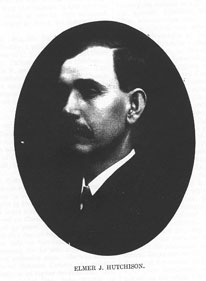
AND REPRESENTATIVE CITIZENS - 439
Since his years of discretion, Judge Carroll has been interested in the law, and learned its underlying principles with his father. In 1854 he was admitted to practice, and this he resumed on his return from the army. In 1866 he was elected Probate judge, and served for nine years, having been re-elected three times. On December 12, 1899, he was appointed postmaster at St. Clairsville, since which time he has been the popular incumbent of that position.
On May 16, 1860, Judge Carroll was married to Mary B. West, who was a native of Belmont County, and a daughter of the late Dr. Henry West, who for many years was a leading physician of the county. The five children born to this union were as follows : Carlo C., who is employed in the Union Pacific Railroad office at Kansas City, married Carrie Asher, of said city, and has one daughter, Marguerite; Henry W., who is an employee of the Armours at Kansas City, and married Jessie Morton ; Clara, who married George W. Dunn, managing editor of the Columbus Citizen, of Columbus, Ohio, and has four children, Carroll, Mary L., John and George; Clinton, who is a locomotive engineer on the Union Pacific Railroad ; and Eleanor, who is the wife of Arthur S. Kuder, a commercial traveler, who resides at Columbus, and has one son, Harold B.
In Masonic circles, Judge Carroll has long been a very prominent figure, belonging to the blue lodge, chapter, council and commandery, in each of which he has held high official positions. He is a charter member of the G. A. R., Drummond Post, No. 203, in which he has filleted the office of commander.
ELMER J. HUTCHISON, a well known business man of Barnesville, has, since 1895, been sole proprietor of one of the largest industries in the place,—the Barnesville Box Factory. Under his wise and conservative management the business has made rapid progress. That he has been able in so short a time to accomplish a great work is largely due to the fact that he previously had years of valuable mercantile experience, and has inherited from good ancestors both mental and physical power. Born in Barnesville, March 2, 1855, he is a son of Asbury and Eliza J. (Taylor) Hutchison.
Asbury Hutchison belongs to one of the oldest and most respectable families of Barnesville, and was born there in 1821. During his youth he learned the trade of a carpenter, which upon reaching manhood he followed as a means of livelihood. The rapid growth of his own community, and of other places in the vicinity, furnished him with plenty of work and enabled him to command the highest wages. With a steadfast purpose, he continued the pursuit of his trade throughout his active life, laying by, from year to year, something for a time of need. Becoming possessed of considerable means he discontinued his labors a few years ago and is now living a life of leisure. His wife, Eliza J. (Taylor) Hutchison, died in June, 1890.
Elmer J. Hutchison obtained his mental training in the public schools of Barnesville, and afterward developed habits of self-reliance and close attention to business, which have so prominently characterized his mature life. Ambitious to advance himself, at the age of 21 years he went to Chicago and secured a position as private secretary to the traffic manager of the Baltimore & Ohio Railroad Company. Giving excellent satisfaction, he remained there for many years, acquiring much valuable knowledge of various lines of business. Later he was commissioner of the Merchants' Association. Ill health, however, in the course of time obliged him to sever that connection. About this time, March 1, 1892, he purchased an interest in the box industry in Barnesville, conducted by Talbot & Brothers and H. Campbell, where he remained as a partner for about three years. On January 1, 1895, he became the sole owner of the box factory, which he has since managed with such gratifying results. This business is one of the largest of its kind in the vicinity, is backed by a-cap-
440 - CENTENNIAL HISTORY OF BELMONT COUNTY,
ital of $7,500 and its output is valued at $15,000 per annum. It furnishes regular employment to 20 skilled workmen, and is of much benefit to the place.
Mr. Hutchison married Lucy Talbott, a daughter of John D. Talbott, a real estate dealer of Barnesville, and they have had four children,—William A., Edwin J., Mary M., and Dorothy A. In religious belief the family are Methodists, and the children have been reared in that faith. Mr. Hutchison's remarkable success in business has won for him the popular confidence in his section. Socially he is highly esteemed, and affiliates with the F. & A. M. As a Republican, in politics, his word carries weight in local affairs.
DR. JOSEPH HEWETSON, deceased. This address of Dr. J. M. McConahey on the death of Dr. Hewetson is taken from "The Transactions of the Belmont County Medical Society," printed in 1855.
Mr. President and Fellow Members :
As a general thing, the death of a fellow being produces but a momentary impression in the mind of the living ; it excites but little sympathy, viewed as the fulfillment of a law of necessity, resting upon all terrestrial created beings. He is dead, a word familiar to all, from its daily use, is passed round the circle of the deceased's acquaintance, and it matters but little whether that circle be large or small, the sound dies away, and with it the name and memory of the individual are forgotten. And as the ravages of the destroyer increase, in a given time, the impression produced seems to decrease in the same ratio, as may be seen during and after the prevalence of a desolating epidemic.
Oblivion is sought and cherished, and the desire to forget the past increases, as death, the king of terrors, adds to the number of his subjects. This, while it should admonish the living to hold themselves in readiness to obey the same power, should not be called unfeeling or ungrateful, but the development of a wise and essentially necessary principle of ournatural organization. But, when man dies, do his works die with him? When he ceases to breathe, when his spirit returns to God who gave it, and his body to its primitive elements, do his influences cease? If so, he lives to no purpose. If so, life is not worth protection. On the contrary, does not every individual exert an influence, either active or passive in its nature, which in a certain sense is indestructible, and continues its effects to an indefinite extent? But he whose life has formed a link in the great chain of progression, which characterizes the generation in which he lived, may be laid in the grave, his name forgotten by the living, yet he has left behind him that which will live and teach by its formative influences, when time has reduced to dust the granite or the marble which marked the place of his repose. On the present occasion, we are under more than common obligations, associated together for laudable purposes, which are designed to accomplish both a general and a special good, and he whose death we deplore, was amongst the projectors of our association. He was with us from the beginning, teaching by his learning and experience, imparting to his fellow members the fruits of many years' labor and research. But he has passed from amongst us and lies, forgotten by the world, in the dark and narrow house, "where the wicked cease from troubling and the weary find rest." But with us he lives in memory—and will ever hold a hallowed place in the archives of this association.
Of the first periods of the life of Joseph Hewetson, the subject of this sketch, or his ancestry, we have nothing very definite. We learn, however, that his father, John Hewetson, was a farmer; and that his spit was born August 18, 1804, upon the tenement occupied by his ancestors for more than three generations, some of them living to the advanced age of too years. This was near Thorn Hill, Dumfriesshire, Scotland.
Joseph's elementary education was commenced at the parish school, situated near his father's residence. How long he remained there, we are not able to say. We next find
AND REPRESENTATIVE CITIZENS - 441
him, without dates, at Thorn Hill, which was probably a grammar school of such character as to prepare youth for entering college. We here lose sight of him until 1820, making him 16 years of age, we find him admitted to the senior humanity class, in the college of Edinburgh, for the session of 1820.
Accompanying his tickets, we find the certificate of Prof. James Pillans to his unexceptionably good conduct, his regular attendance and performance of all the written exercises prescribed.
The requirements of these time-honored institutions of learning being of such character, that the persons admitted to their college class would, in this country, be considered on advanced standing, the tickets of Prof. George Dunbar admitted him to the junior Greek class, November 16, 1820. Accompanying Professor Dunbar's tickets, are certificates, showing his regular attendance and his unexceptionable moral character, industrious habits and satisfactory proficiency up to October, 1824. But that his knowledge of the Latin and Greek languages was above the ordinary standard cannot be doubted, as he retained his acquaintance with them to a degree rarely equalled amongst professional men, whose pursuits do not necessarily require their frequent use as reference. We ascertain from his papers that while prosecuting his collegiate course he combined with his classical studies the lectures of Prof. John Barclay on anatomy and surgery. His tickets and certificates show that during his collegiate course he attended four courses on these professional branches, under the teachings of Professor Barclay. Certificates also from the same professor, of his unexceptionable moral character, habits of industry and the most satisfactory proficiency in these professional branches. And in all the departments of surgery and medicine, tickets and certificates of his proficiency, morals and upright course, given by the respective professors of the various departments, are found with his papers. viz : anatomy, surgery and pharmacy, chemistry, materia medica and obstetrics, theory and practice of medicine, institutes ofmedicine, principles, practice and operations of surgery, dietetics, &c. Also for practical anatomy in Dublin (Ireland) for a full term. We find also tickets of admission to the Royal Infirmary of Dumfries and Galloway, as assistant house surgeon for one year; also admission for one year to the Royal Infirmary of Edinburgh, in the capacity of assistant house surgeon; and from the principal of each of these institutions certificates of approval as to moral deportment and professional skill in discharging the duties and obligations devolving upon one engaged in these highly responsible stations.
The names of the following professors are found upon his tickets and certificates : Pillans, Dunbar, Barclay, Milligan, Hope, Russel, Duncan, Allen, Thompson, Campbell and Spaulding. His diploma bears date 1826, given by the faculty of the Edinburgh college and signed by 11 of the royal professors. How long after receiving his diploma before he opened an office is not known to us. The first account we have of his opening an office is in a village near his father's residence, called, we believe, Monihive. There, it seems, he commenced his professional career in Dumfriesshire. But he did not remain in this location very long; but, of the cause of his change, we have no account. From there he removed to the town of Wigton, Wigtonshire, Scotland, where he remained in the practice of his profession until the spring of 1833.
Here he became acquainted with the present Mrs. Hewetson, who was his first patron at Wigton. She had been under treatment for spinal disease about 12 months prior to his locating in this town. They were married April 12, 1830. There are no incidents of special importance connected with his practice here. One circumstance, however, may be named, as characteristic of the man, and one which evinced but a natural trait, as those acquainted with him know to have been strictly observed in all his intercourse, both professional and relative in the transactions of life, showing a firm adherence to principle, and an unwillingness to yield to influences un-
442 - CENTENNIAL HISTORY OF BELMONT COUNTY,
founded on principle, whether those influences were calculated to operate for or against his own personal interest.
In the excitement connected with the passage of the reform bill by the British parliament, he and but one more of all the voters of the town of Wigton cast their votes for a particular candidate. Party spirit ran high and there were feelings indulged which threatened to affect adversely his pecuniary and professional interests. In this state of political turmoil and proscriptive feeling, a deputation came from a neighboring town where the vote had been thrown as strongly in favor of the Doctor's candidate, as in his own locality it had been against him. That deputation solicited his removal, making specious promises of reward, for his political opinions and firm adherence to these, under circumstances most discouraging in their nature. A wide field for developing his professional skill, with lucrative patronage sufficient to afford a rich reward, was held out. But they were mistaken in the man. His opinions were fixed in the belief, that the duty of medical men was to stand upon their professional merit alone, and under no circumstances to compromise the honor and dignity of the profession, for mere, pecuniary or selfish considerations. Possessing these views and feelings, he declined accepting the the offer. Time and sober reflection allayed the excitement, and having their confidence previously as a medical man, things returned to their old channels, without materially affecting his professional interest. But in consequence of an attack of acute disease resulting in a fixed chronic affection, he conceived the notion of quitting the practice of his profession. And always being favorably impressed with the simple and unmolesting beauties of agricultural life, determined to adopt it; and with this conclusion, the notion of emigrating to America was matured. Accordingly, in the spring of 1833, he with his wife and two sons sailed in the ship "Britannia" from Liverpool. His original destination was for the then far West, by way of Pittsburg, where a portion of
Mrs. Hewetson's relatives were then residing. But from the opinions formed, of the portion of country through which they had passed, the design of going further west was for the present abandoned. They removed from Pittsburg to Washington County, Pennsylvania. The season being too far advanced to favor a commencement of agricultural pursuits, and not feeling satisfied to live unemployed, he concluded, for the time being, to resume the practice of medicine, until he could settle upon his future course and permanent location, where he could commence his contemplated occupation as a farmer. He continued to practice until the spring of 1835. In April of that year he removed to Belmont County and settled upon a farm near St. Clairsville, fully determined to abandon his professional pursuit, believing that his health would thereby he improved, and life more fully enjoyed. Soon after this, quite a number of cases of smallpox appeared in the vicinity of his residence. Some discussion, as to the true character or grade of the disease, amongst the attending physicians, was in existence; and, they not being able to agree, he was consulted, more perhaps from his supposed acquaintance with the disease, from its more general prevalence in the old country than in this, than from any knowledge of his professional skill or medical education. Another circumstance, as related by his neighbors, probably tended more to involve him again in practice than the one above. A neighbor. as I understand it, while attending a threshing machine had his hand and arm badly mutilated, by being drawn into some part of the machinery. A physician was called, and upon examining the limb seemed at a loss what to do. Dr. Hewetson having repaired to the house on hearing of the injury, and seeing what was needed, immediately amputated the arm. Whether the first occurrence, as related by Mrs. Hewetson, or the second, as related by a neighbor, became the cause of turning public attention towards him as a physician, is not known, but from this time he was gradually drawn into practice and his contemplated retirement broken up. His bodily
AND REPRESENTATIVE CITIZENS - 443
strength was frequently overtaxed by long rides, as a great amount of his practice consisted in consultation, both as a surgeon and physician.
There was in his nature no mercenary feeling to urge him to sacrifice ease and jeopardize health, neither was there any of the pinchings of poverty impelling him. His kind and generous nature, and the cheerfulness with which he ministered to the sufferings and wants of the poor, both with his means and his skill, would contradict the former, and against the latter he had ample competence. That class of persons, whose circumstances in life rendered them unable to afford even a small remuneration, received alike his kind and careful attentions, with those more fortunate; and in some instances I have known him to neglect the calls of the latter, for the benefit of the former. As a physician he was kind and evinced a most scrupulous regard for the feelings of his patients, but never allowed his feelings or interest to conceal his honest opinions as to the probable results when interrogated by relatives.
In his investigations at the bedside, he was minute. even in cases seemingly trivial, and where it might be thought a mere passing notice sufficient. As a diagnostician but few if any, having but the facilities of a country practice, excelled him, and his success in the treatment of disease was fully acknowledged by all his brethren, and happily appreciated by a widespread community who had been the recipients of his medical skill.
As a surgeon, but few opportunities in the country are afforded in this department of the profession, but a sufficient number of operations were performed by him to give him the credit due to a safe and cautious surgeon. It is more than likely he excelled in this department as it was to it he gave special attention in his studies, and which was his legitimate practice in his native country. As a counsellor, he was extensively known and his course as such was one of conscientious candor towards patient and attendant, carefully observing the strictest rules of professional etiquette, unlesswaived by request; and where in the discharge of duty he had nothing to recommend or disprove, nothing afforded him more pleasure than an entire concurrence with the attendant, thus giving fresh confidence to the patient and his friends, and if the attendant be young, inspiring him to greater efforts to acquit himself with honor and honesty in the responsibilities of his calling. When solicited by friends or patients for his opinions respecting the final result of the case, his views of duty constrained him to answer their inquiries candidly, whether for or against their recovery. This course, we are all aware, is condemned by many, but he viewed it criminal to deal in evasion or dissimulation where honesty is of the most vital importance to the inquirer, and especially should this be the case where implicit confidence is placed in the opinions and candor of the physicians.
His manner was frank and courteous to all those with whom he had intercourse. His manner was to speak evil of none in the profession, while he excercised the right of preference; his opinions with regard to others rested with himself. If the envious insidiously assailed him, he suffered it to pass unnoticed ; conscious of the uprightness of his course, he was willing to let the world form its own conclusions, satisfied that persons so unfortunately constituted as to suffer envy to lead them into trouble had at all times within them the elements of misery and discontent. But we have stated in this sketch his earnest desire and determination to retire from the profession; we have also stated the cause to be loss of health. In July, 1830, he was attacked with acute rheumatism which held him to January, 1831. It was very severe in its character, and affecting the system generally. After some time it affected the heart producing in this organ hypertrophy and valvular disease, and which no doubt contributed much to bring about a premature close of his useful life. After various fruitless efforts at relief, he proposed to his medical advisers bloodletting, to an extent beyond what they were willing to risk, but he expressed it as the only hope of relief in his
444 - CENTENNIAL HISTORY OF BELMONT COUNTY,
case. Willing to assume the responsibility of the measure, he was accordingly bled profusely by which he was greatly relieved and he gradually improved from this time; and it was always his opinion that, if the same treatment had been resorted to in the commencement of the cardiac affection, organic disease might have been obviated. In this, there is scarcely a doubt but that he was correct.
The bleeding must have been carried to an almost unprecedented extent, as it became necessary to fan him incessantly for three days afterwards, he was so faint. In giving a description of the feelings produced by this treatment, in conversing with a friend, for three days he stated the feeling to be such as would be experienced by lying on the back, and the feet raised up from the bed, to an angle of 45 degrees. This sensation was owing probably to the great and sudden reduction of the volume of the circulation affecting the contractile power of the heart, which had been overtaxed for so long a time, and in consequence of this an almost entire suspension of the circulation in the inferior extremities. He slowly, but steadily improved, and resumed business as strength returned. Nothing more is said of this affection until 1840, when there was a severe return of rheumatism, which no doubt aggravated and rendered more hopeless his cardiac disease. A friend tells me that, in 1842, he remembers well the Doctor's emaciated and feeble condition; says he has never seen in his face or cheeks so great a flaccidity at any time since. As the warm and settled condition of the weather came on in the spring of 1842, his improvement was more rapid, and again he resumed practice—which he had given up for near two years, having practiced none, except a few consultations, and in these he was under the necessity of frequently stopping by the way, to rest for a considerable time, to prevent complete prostration and a return to his bed. He wore a seaton over the region of the heart from this time, about one year, 1843 to 1844, at the same time attending to business as far as his debilitated condition would admit. His health was measurably restored and continued so until about two years since, when evidence of the progress of disease began to manifest itself. Of the true state of his case he was fully conscious, and expressed the conviction that if there should even be some mitigation of his disease, nothing permanent could be expected. He was (he said) at all times liable to be injured sympathetically, and although a man of strong nerve, and mind above mediocrity,, he was at times unwilling to examine the chest of a patient similarly affected, or to treat diseases of the heart or chest, because of the injurious effect it had upon himself. But for the last four months of his life, there was a serious and rapid failure, resulting in that complication which terminated in death. But he died at his post, and in the service of his profession. The last time he left his room was on a visit or consultation, some eight of to miles distant, at the same time feeling it unsafe to travel alone, and unable to drive his own carriage. This was eight weeks previous to his death. And even when confined to his bed, and up to within a few days of his death, his quiet was disturbed, his train of thought turned aside from his own concerns, to see some one asking his medical opinions, willing to share his small amount of precious time yet to come, in mitigating the sufferings of others. He tolerated it until within a brief period of his dissolution. He was fully aware that "the end of earth" to him was near at hand. A medical friend, wishing to encourage him, said: "You may recover again a comfortable degree of health, and, by proper care, live to old age." He replied : "Although I have always admired your judgment, I am compelled to differ with you in the present case. I am satisfied I will not recover. If," said he, "it were the Almighty's will, I should like to live a while longer, that I might more fully serve my Creator than I have done." Although his disease was one always connected with despondency and depression of spirits to a greater degree than almost any other, notwithstanding his sufferings were extreme, a degree of patience and quiet acquiescence was evinced by him, not often seen. But
AND REPRESENTATIVE CITIZENS - 445
he was an humble and consistent Christian. The truth of this was portrayed in his daily walk and conversation. Its doctrines were inculcated in his family. Its spirit was evinced in the practice of his profession, at all times relying upon and invoking the blessing and guidance of that power which erreth not. His religious views were Calvinistic. In Scotland, he was a member of the Established Church; his connection in this country was first with the Associate Presbyterian Church under the ministry of Rev. Joseph Clokey. After the removal of Rev. Mr. Clokey from his pastoral charge, he connected himself with the Associate Reform Presbyterian Congregation of St. Clairsville, under the care of Rev. Alexander Young. He was a firm believer in the doctrines of the Gospel as a revelation from God. He felt and took an active interest in the affairs of the congregation of which he was a member, and his prudence and zeal in reference to these interests will make his loss severely felt. His natural diffidence made him more retiring in his religious observances than many Christions would think justifiable. With his family alone he filled a Christian father's place, and as a physician felt that his success depended upon the direction and blessing of God. "Diffident as he was, I have." says Rev. Mr. Young, "known him, at the desire of his patients, conduct prayer on their behalf. In his illness it was a pleasure to he reminded of the truths and hopes of the Gospel." His wife often read to him from the Scriptures, and friends and neighbors enjoyed the privilege of engaging in prayer with him and for him at his request. A mind as well informed, and a conscience as sensitive as his, could not look forward without realizing the importance of eternal things nor backward without much cause of regret. In Christ alone can the penitent one find peace. Mr. Young says : "Circumstances beyond my control deprived me of the privilege of seeing him during the last four days of his life. This I shall ever regret, esteeming and loving him as I did. I would have been profited by seeing the tokens of regard shown in the feelings ofthose to whom he was a beloved physician. Men do not live usefully and remain unappreciated in this world. We may be misunderstood, we may misunderstand others, but there is something in that well doing for Christ's sake, in what sphere soever it may be undertaken, so akin to the nature of God himself, and so in harmony with all his purposes of love, that his own arrangements hinder it from being lost." And though death may cause the good man to tremble, how striking the contrast when compared with one whose course has been entirely on the other side. The motto of our friend was duty, his life was spent in its active and conscientious discharge. His hopes were founded upon a rock, against which the storms and trials of time may beat in vain. He is conscious that the shades of death are gathering round him, but the presence and the promises of Him in whom he has confided forsake him not. He leaves the world, calm and serene as the approach of twilight on a summer's eve.
'While he of the opposite course can see but little in the review of life but selfishness, can find no balm along the path of his labors wherewith to soothe the sorrows, or allay the fears of his dying hour. If he look forward, death inevitable meets his view, and as the ebbing pulse declares its near approach, hope that has been his 'support from the cradle until now quits the scene and leaves him to complete despair. Although in the discharge of duty from Christian motives, we toil hard and wait long, yet the reward will come, we will have tokens of it here, and if we die as friends of Christ, weeping friends as they stand round our grave feel that while the departed may inconceivably gain, the world and the church sustain a loss, and they cry : "Help, Lord, for the Godly man ceaseth, for the faithful fail from among the children of men." And as the professional excellence of the world is taken away, whether of ours or any other profession, may we, as a society, be led to seek that good part which shall never be taken from us.
446 - CENTENNIAL HISTORY OF BELMONT COUNTY,
LAWSON E. EMERSON, a lawyer by profession and a prominent resident of St. Clairsville, Ohio, is clerk of the Supreme Court of Ohio. He was born in Goshen township, Belmont County, Ohio, in 1863, and is a son of William and Jane (Wright) Emerson.
William Emerson was born in County Armagh, Ireland, in 1819. Coming to America, in 1837, he remained here two years, and then went back to Ireland, to settle up the estate of his father. Upon his return to America, he was accompanied by his brother, John. He located in Belmont County, Ohio, and for three years was employed by Ira Lewis, at an annual salary of $85. He subsequently bought a farm in Goshen township, and was engaged in farming and stock raising all his life. His death occurred January 8, 1900. His first wife was Jane Danforth, a daughter of Ambro Danforth, of Washington township, Belmont County. She died at an early age, leaving three children,— Maria (Wright); Mercy L. (Turner) ; and Thomas W., who is an attorney at Ouray, Colorado. Mr. Emerson married, secondly, Jane Wright, a daughter of Edward Wright, of Goshen township, and they have four children, namely: Mary; John, who died at the age of three years ; Lawson E. ; and Charles E., superintendent of the Denver (Colorado) Street Railway Company. William Emerson was originally a Whig, in politics, and later a Republican.
Lawson E. Emerson received his mental training in the Bethesda public schools and the Barnesville High School, after which he took a teacher's course at Valparaiso, Indiana. At the age of 18 years, he began teaching, and continued thus for seven years, in Warren and Goshen townships. He then began to read law at St. Clairsville, first, with his brother, Thomas W. Emerson, and later with Capt. L. Danford. Subsequently, he completed a two years' course in the Cincinnati Law School, and was graduated June 4, 1889. His brother moved to Colorado in June of that year, and the subject of this sketch settled up his business. In January, 1890, he was appointed deputy county clerk under H. M. Davis, andserved as such through two terms. In 1895, he was nominated by acclamation for the office of county clerk, and elected by a majority of 1,100 votes. He was re-elected in 1898, his majority being increased to 1,814 votes. He was solicited by prominent attorneys to run for a third term, but refused, and became a candidate for clerk of the Supreme Court of Ohio. He was nominated on the first ballot from among to candidates, was elected, and assumed the duties of his office, in Columbus, on January 1, 1902. Mr. Emerson is a man of sterling worth and the strictest integrity, and stands very high, wherever known.
Lawson E. Emerson was married, in 1892, to Laura Ferren, a daughter of James Ferren, of St. Clairsville, and they have two sons,—Wayne Kennon, who was born in 1893; and William Glen, born in 1895. Fraternally, Mr. Emerson is a member of Lodge No. 109, K. of P.; Blue Lodge No. 16, F. & A. M.; Chapter No. 54, R. A. M.; Commandery No. 26, K. T. ; and Columbus Lodge, A. A. O. N. M. S. He is a charter member of Lodge No. 419, B. P. O. E.
JOHN K. McFARLAND, who is efficiently serving as recorder of Belmont County, Ohio, is one of the most prominent and enterprising citizens of St. Clairsville. He was born in Union township, Belmont County, February 19, 1871, and is a son of William G. and Cynthia W. (Kennon) McFarland.
William G. McFarland was born in Guernsey County, Ohio, and in 1871, after marriage, moved to Union township, Belmont County. Here he followed farming until 1901, since which time he has lived in Warren township. He married Cynthia W. Kennon, a native of Belmont County, and a daughter of Abner Kennon. They had but one child, John K.
John K. McFarland received his mental training in the public schools, and lived on the farm until the fall of 1896. He then moved to St. Clairsville, to accept the appointment of deputy county recorder, under A. S. Taylor.

AND REPRESENTATIVE CITIZENS - 449
Mr. Taylor died in office, and Mr. McFarland was appointed by the county commissioners to fill the unexpired term. The satisfactory discharge of his duties resulted in his nomination by the Republican party, and his election to the office of county recorder, in 1900.
In 1895 Mr. McFarland was united in marriage with Gertrude Taylor; they have had three children,—Mary, Kennon and Charles. Fraternally, the subject of this sketch is a Mason, and a member of Lodge No. 419, B. P. O. E.
A. KLOTZ. Among the prominent and representative citizens of Bellaire, Ohio, this well-known merchant and banker takes a leading position, identified as he is with many of the most important business enterprises, educational projects and public-spirited movements of the city.
The birth of Mr. Klotz occurred in France June 13, 1846; he is a son of Moses Klotz, who was a butcher by trade, with whom our subject worked for some years after finishing school, so thoroughly learning the business that he was able to pursue it for himself in the city of Paris, where he continued until February, 1868. This has been one of the elements of Mr. Klotz's success, to do thoroughly and well whatever came under his notice. After the death of the father in 1867, the family scattered, a number of them coming to America. There were 12 children in all, six of whom still survive, these being, exclusive of our subject : Mrs. Charles Mayer, of. Cincinnati, whose husband was a partner with Mr. Klotz at Bellaire, from 1868 to 1885, but is now living retired ; Mrs. A. L. Rice, whose husband was formerly in the wholesale millinery business at Wheeling, but is now engaged in the slate business at Slatington, Pennsylvania; Elise, who resides with Mrs. Rice; Samuel, who was formerly engaged at Bellaire in the gents' furnishing business, in 1884 went to Piscoe, Peru, where he is engaged in exporting ; and one sister who still resides in France.
Some members of Mr. Klotz's family hadlocated in Wheeling, West Virginia, and hither our subject came in September, 1868, with no capital except ability, industry and good habits, and from such a foundation Mr. Klotz has built up his fortunes. Engaging with his brother-in-law in the gents' furnishing business at Bellaire, Ohio, under the firm name of Mayer & Klotz, the young man soon demonstrated his business acumen and in 1885 purchased Mr. Mayer's interest and ever since has been the largest dealer in his line in the city. In 1877 the business was moved to its present location at No. 3211 Union street, where three floors are utilized; the building contains the only passenger elevator in use in the city. Mr. Klotz has greatly enlarged the scope of his business, which now embraces a full line of dry goods, carpets, ready-made clothes, and gents' furnishing goods, requiring the assistance of 10 capable salesmen and much outside help. The equipments are all of a modern character, the cash-carrier system is in use, and the business is carried on with dispatch and accuracy which is very gratifying to its many patrons.
Mr. Klotz has been identified with many of the leading business interests of the city, notably the Dollar Savings Bank of which he is president, in which he has been interested from the start and served a number of years' as its vice-president; he is also vice-president of the Novelty Stamping Company, and has long been connected with the Enterprise Enamel Company, a very successful business venture.
The marriage of Mr. Klotz was to a daughter of E. C. Morris, who is the retired proprietor of the Globe House, of Bellaire. One son, Charles L., was born to this union, who is a very able young business man; at the age of 17 years he was conducting a successful livery business at Bellaire, and is now engaged in the grocery business at Altoona, Pennsylvania. Since 1870, Mr. Klotz has been a Mason, and belongs to Ionic Lodge, F. & A. M., and Bellaire Chapter, R. A. M. He has always shown a liberal public spirit, has participated in the public affairs of the community and has been liberal along both private and religious lines.
450 - CENTENNIAL HISTORY OF BELMONT COUNTY,
On the Board of Trade he has been active for many years and for the past to years has served the city on the Board of Health. In his business career he has made many friends, but they are more than equaled by those who esteem him in private life.
JACOB RIETZ, a prominent merchant at the corner of 37th and Noble streets, is one of the oldest grocers who has carried on a continuous business in the city of Bellaire, having started here in 1878. During all this time his business dealings have been marked by the strictest honesty and highest integrity. In directing affairs of the city he has been honored with a place in the Council and in other ways favored by his fellow citizens. He was born in Germany in 1841 and is a son of Jacob Rietz, Sr.
The elder Mr. Rietz came to this country from Germany in 1846, and coming directly to Ohio, settled upon a farm in Washington County, near Lowell. For ten years he carried on a flourishing industry, deriving from his labors large profits. At the end of this time, possessed of considerable means, he went to Lowell and opened a sawmill, of which he also made a success. He died in 1894 at the age of 79 years. He had three children, two sons and one daughter.
Jacob Rietz, Jr., was about five years old when his parents came to this country, and received his education mainly in the common schools of Washington County. In early life he entered his father's mill in Lowell and there worked for some time. With an eye to something better, however, in 1874 he came to Bellaire and secured a position in the B. & O. R. R. shops. Giving good satisfaction, he remained here for three years. Then, seeing a good opening for a grocery store in the growing community, and having laid aside a small sum of money, he secured a building and put in a moderate stock of goods. Wise management and good service enabled him to succeed, and he continued the business, increasing from time to time his stock of goods to keep apace with the growing demands of the community. In 1883 he erected the store where he has since carried on his trade. It is a large double building, and he uses the rear as a residence. He keeps in his store a complete line of staple and fancy groceries, and also handles produce and general provisions. His trade is a large one and highly profitable.
Mr. Rietz married a Miss Schramm of Washington County, Ohio, who has two brothers now residing in Bellaire. To Mr. and Mrs. Rietz have been born three children. Albert, now in business with his father, is married and has one child. Lena married Charles Kaiser, of Bellaire, and they have four children. William has a position in the Dollar Savings Bank of Bellaire.
Mr. Rietz is especially influential in the public affairs of his city and has served the Fourth Ward for six years in the City Council. In politics he is usually a Democrat, but somewhat independent. Fraternally he affiliates with the I. O. O. F. He belongs to the German Reform Church.
HARRY C. FUHR, the popular Fifth Ward councilman of Bellaire, and a man of attainments, is now filling the position of superintendent of the Bellaire Steel Works of the National Steel Company. Both by education and inherent ability he has been prepared for this work, as is shown by the perfect regularity and attention to details with which everything in his (the electrical) department is managed. With nothing but his own resources and a vast stock of energy to rely upon, he has attained his present position. Born in Wheeling, \Vest Virginia, he is a son of Mr. and Mrs. Charles Fuhr.
Charles Fuhr, now deceased, was a baker by trade and followed that occupation in Wheeling for many years. His wife is still living in that place.
Harry C. Fuhr was but three months old
AND REPRESENTATIVE CITIZENS -451
when his father died, and was reared in Wheeling under the careful guidance of his mother. He secured his early education in the public schools of the Eighth Ward, from which he graduated. Later he took a course in electrical engineering at Scranton, Pennsylvania, which he completed at the very early age of 17. After a short stay in his native city looking about for an opening, he secured a lucrative position with the General Electric Company, the headquarters of which are at Lynn, Massachusetts. Thorough knowledge of his work and strict attention to business secured him at once the confidence of his employers, and he remained with the company for three years, traveling through the East and putting in electric plants. The general satisfaction which he gave while with this firm and his experience with it enabled him to rise in his profession, and in 1895 he secured the superintendency of the electrical department of the Bellaire Steel Works of the National Steel Company. Here he has 18 men constantly under his charge. He is popular both with his employees and with the company. Under his supervision the first electric mining machine in Belmont County was placed in position.
After severing his connection with the General Electric Company at Lynn, Massachusetts, Mr. Fuhr returned to Wheeling, where he married a Miss Rigner of that place. They have had two children—Irvin H. C., who is now seven years old, and Wayne Charles, now an infant. The family reside at 4482 Jefferson street, but Mr. Fuhr is about to erect a splendid new residence on Harrison street.
Mr. Fuhr is a well educated man, reads and writes German with accuracy and speaks it fluently. As a Republican he has been exceedingly active in politics both in Wheeling and Bellaire. In 1900 he was elected a member of the City Council from the Fifth Ward, and the efficient way in which he is performing his duties promise excellent chances for re-election. He is colonel of the
Eleventh Regiment, Uniform Rank, Knights of Pythias. He is a member of Black Prince Lodge, No. 19, of Wheeling, and of the D. O. K. K. He has served four years in the West Virginia National Guards, and is a member of the A. O. U. W.
JOHN D. HAYS, treasurer of Belmont County and a prominent resident of St. Clairsville, Ohio, was born in Wheeling township, Belmont County, in 1857. He is a son of Henderson and Catherine (Downing) Hays.
Henderson Hays was born in Allegheny County, Pennsylvania, March 29, 1821, and was the eldest son of William and Elizabeth (Irwin) Hays. By the death of his parents he was thrown upon his own resources at the early age of 12 years. He resided in his native county until a short time after his first marriage, when he moved to Wheeling township, and there following farming until his death. In 1842, he married Olivia Coulter, who died in 1852, having given birth to the following children: Euphemia E., who was born in 1845. and married John Caldwell in 1872; Cynthia A., who was born in 1846, and was married in 1876, to John Gillespy; and Mary T., who was born in 1848, and was married, in 1874, to R. E. Dool. Henderson Hays formed a second union in 1854, with Catherine Downing, a daughter of John and Eleanor (Lee) Downing, both natives of Ohio. Five children were born to them, namely : William G., born in 1855, who resides at Bannock, Ohio; John the subject of this sketch; Irwin L., born in 1858, who resides at Bannock, Ohio; Olivia who was born in 1862, and died in 1863; and Lena M., born in 1867, who was married, in 1889, to Rev. Thomas E. Holliday, both of whom are now missionaries in India. Mr. Hays died January 1, 1890, and Mrs. Hays, who was born March 21, 1827, now resides in St. Clairsville.
John D. Hays was reared and schooled in his native township, and followed farming until 1894. In that year, having been ap-
452 - CENTENNIAL HISTORY OF BELMONT COUNTY,
pointed deputy county treasurer, he necessarily moved to St. Clairsville, where he discharged the duties of that office for two successive terms. In 1901, before his term of office had expired, he was nominated by acclamation for county treasurer, and his election followed in November of that year. He is a man of recognized ability, and is held in high esteem.
Mr. Hays is a member of Flushing Lodge, F. & A. M.; Chapter, No. 54, R. A. M.; and Hope Commandery, No. 26, K. T.
SEBASTIAN WIMMER, now residing at his pleasant home at the corner of 31st and Union streets, is one of the wealthy retired business men of Bellaire, having for many years conducted a sample room and cafe in the place, and later, in partnership with Conrad Rumbach, engaged in the wholesale liquor business. He is now deriving a large income from his investments in various flourishing industries in the place, among them the Enterprise Enameling Works, the C. L. Dorer Foundry and the Belllaire Bottle Works.
Mr. Wimmer's success in life is entirely due to his own well directed efforts, coming as he does of poor parentage. He was born in Bavaria, Germany, in 1857, and is the son of a common, hard-working miner. At the early age of fourteen, in 1871 young Sebastian came to this country and settled in Wheeling, West Virginia, where, preparatory to a life work he learned the cigar-makers trade. This line of work, however, he made but little use of, turning it to account merely as a stepping-stone to something better. By 1873 he had managed to get a little something ahead, and, coming to Bellaire, opened a sample room and cafe. After this he made money fast and continued the business for many years. In 1892 he formed his partnership with Conrad Rumbach and engaged in the wholesale liquor business. So rapidly did he accumulate wealth in this industry that in 1901, thoughnot far advanced in years, he decided to discontinue the business and lead a less strenuous life. As fast as he has been able to lay aside money he has always invested it where it would bring in large returns, and he now owns stock in three of the largest concerns in the city, which are mentioned above, and is a director of the C. L. Dorer Foundry Company.
Mr. Wimmer married Miss Madden, who was born in Bellaire, being a daughter of John Madden, a stonemason and contractor, who has long resided in the place. Mr. and Mrs. Wimmer have three children, two daughters and a son, all of whom are living at home.
Mr. Wimmer has long been influential in local affairs, and has served for four years as a member of the City Council. In politics he is a Democrat, but takes issue against free silver. Fraternally he affiliates with the Turners and B. P. O. E., and in religious sentiment he is a Roman Catholic.
MADISON ALDREDGE, formerly a well known resident of Martin's Ferry, and auditor of Belmont County, Ohio, and now residing in St. Clairsville, Ohio, was born at Martin's Ferry in 1858, and is a son of Madison M. and M. A. (Chaffin) Aldredge.
Madison M. Aldredge was born in Eastern Virginia in 1816. At an early age he became a mechanic and continued thus for many years. He was for a considerable period a government storekeeper. He moved from Eastern Virginia to Wheeling, (West) Virginia, in 1846, and resided there until 1861, with the exception of a short time in 1850. when he lived in Martin's Ferry. In 1861, he took up his residence in Martin's Ferry, and lived there until his death, which occurred in 1890. He was united in marriage with Miss M. A. Chaffin of Wheeling, who was born in 1822, and died in 1895. They reared the following children : Stanton and Sanford, deceased ; Madison ; and Edgar of Moline, Illinois.
AND REPRESENTATIVE CITIZENS - 453
Madison Aldredge was reared and schooled at Martin's Ferry, and there learned the trade of a pattern-maker, which he followed until the fall of 1895. In that year he was elected auditor of Belmont County. He assumed his official duties in October, 1896, and his manner of discharging them won for him the approval and support of the people, as was evidenced by his re-election in the fall of 1898.
Mr. Aldredge was united in marriage with Dora E. Moore, of Bellaire, Ohio, and they are parents of the following children: Ewer P.; Edna M.; Hattie G.; Madison, Jr.; and Frank. In politics, Mr. Aldredge is unswerving in his adherence to the principles of the Republican party. Fraternally, he is a member of Lodge No. 486, F. & A. M.; Chapter No. 54, R. A. M.; Hope Commandery No. 26, K. T.; Aladdin Temple. A. A. O. N. M. S.; and Lodge No. 54. K. of P.
DR. SAMUEL L. WEST is a prominent physician of Belmont County, Ohio, and a resident of St. Clairsville, where he was born February 23, 1860. He is a son of Dr. Henry West, who was born in Jefferson County, Ohio, near the Belmont County line, in 1810.
Dr. Henry West received his medical training in the Ohio Medical College, in Cincinnati, Ohio, and began his practice at Bridgeport, in Belmont County. In 1840, he removed to St. Clairsville, where he continued in practice until his death, in 1887. He was married three times, and Dr. Samuel L. West was a son of his second wife, Agnes Parker, who died in 1867, leaving four children, as follows : Lura, the wife of R. R. Barrett, of Moundsville, West Virginia; Dr. James P., of Bellaire, Ohio; Dr. Samuel L., the subject of this sketch, and Henry, deceased. The first wife of Dr. Henry West was, before marriage, Adaline Kirkwood, by whom he had the following children: Mary B. (Carroll) ; Joseph H.; Sarah (Askew) ; John E.; Benjamin F.; William K.; and Adaline K. (Lane). Dr. Henry West's third marriage was with Mary Jane Douglas, by whom he had five children, as follows : Ella D. (Enoch) ; Agnes (West) ; Simon B.; Homer S.; and Honor B. (Shaw).
Dr. Samuel L. West received his primary education in St. Clairsville, where he attended the High School. He studied pharmacy there, and was engaged in a drug store for six years. He then took up the study of medicine at the Ohio Medical College, in Cincinnati, and was graduated with the class of 1883. He immediately began the practice of his profession at St. Clairsville, where he still follows it. He has a large and lucrative practice, and is ranked among the foremost physicians of Belmont County. He has a thorough knowledge of the science of medicine, and is worthy of the confidence placed in his ability.
The subject of this sketch was married, July 18, 1902, to Lulu M. Hutt, of Waverly, Pike County, Ohio.
Dr. West is a member and ex-vice president of the Belmont County Medical Society. Fraternally, he is a member of the Knights of Pythias.
FRED WASSMAN, JR., is manager of the firm styled Fred Wassman & Son, which conducts the flourishing shoe store at No. 3267 Belmont street, Bellaire.
Fred Wassman, Sr., was born in Wheeling, West Virginia, and is a son of Mr. and Mrs. Fred Wassman, both natives of Germany. The elder Mr. Wassman and wife came to this country before marriage and settled at Wheeling, where they were married. Though practically without capital, having a good trade upon which to rely, he soon afterward opened in the Eighth Ward of that city a boot and shoe store, which he conducted with success for many years. About 1870, however, he disposed of this business and moved to Bellaire, where he erected a large building—the one now occupied by Seller's music store and the Wassman tailor shop—and there he opened another boot and shoe store, and also engaged in some manufacturing. The last named industry, though having realized from
454 - CENTENNIAL HISTORY OF BELMONT COUNTY,
it large profits, he discontinued in 1885, and turned his attention exclusively to the mercantile business. In 1891 he erected the large and elegant building on Belmont street where the business is now being conducted and a year later moved there. A wise financier, successful in his line, he always derived from his business a large income, part of which he invested in city property. At the time of his death, which occurred in 1900, in his 71st year, he owned besides his shoe store four other large shops on Belmont street extending to the Carroll corner. Mr. Wassman and his wife had six children, whom they reared, all but one of whom were born in Wheeling—Louisa, who married a Mr. Braunlich; Minnie, Fred, Jr., William, who is married and is a merchant and tailor in Bellaire; Charles, who is also married, and who is cashier of the Baltimore & Ohio R. R. at Bellaire, and Carrie. The family now re"side in the building partly occupied by the store. Mr. Wassman was a man of pronounced political views and affiliated with the Democrats. Fraternally he belonged to the I. O. O. F.
Fred Wassman, Jr., has for some time been connected with the shoe store which he is now, with the help of his sisters, Minnie and Carrie, so ably conducting. The building in which he is carrying on his business is a large three-story structure, 33 by 110 feet, and his store is on the first floor. The Bell Telephone office is on the second floor, and the Masonic Hall on the third. Mr. Wassman handles the best grade of goods, a thoroughly up-to-date stock, and the largest probably of its kind in the city. His show window is certainly the most attractive and draws a large and paying custom. As a business man he stands high in his community, and by his honesty and square dealing, as well as marked ability, he has won the confidence of all who know him.
Besides attending to his store, Mr. Wassman finds time for the performance of public and social duties, and he served the Third Ward very efficiently for four years as a member of the City Council. In politics he is a Democrat. Fraternally he affiliates with the K. of P.; Uniform Rank, K. of P.; the B. P. O. E. and the F. & A. M., Lodge No. 267, of Bellaire. Though the parents were Lutherans, Mr. Wassman and his brothers and sisters are Presbyterians.
JOHN GIFFIN, a representative farmer and most highly esteemed citizen of Pultney township, Belmont County, Ohio, who is also a survivor of the Civil War, was born in Pease township, on High Ridge, April 26, 1842, a son of Robert and Sarah (Hinkle) Giffin, and a brother of Hugh Giffin, in whose sketch in this volume appears extended mention of the Giffin family, which originated in Scotland and was founded in Virginia 116 years ago.
Mr. Giffin was reared on the home farm and secured his education in the district schools of Pease township. His life has been an agricultural one, broken into by a service of five months in the army in Company A, 170th Ohio Vol. Inf., during the Civil War, and he now recalls those experiences as a member of Branum Post, G. A. R., No. 221.
In 1866 Mr. Giffin married Margaret C. McAllister, who is a sister to the wife of Hugh Giffin. After marriage our subject and wife resided on High Ridge until 1878, and then moved to Franklin station, Richland township. where Mr. Giffin was engaged for three years in farming, returning then to Pease township, where he operated very successfully for 16 years the place known as the Alexander farm. The tract known as the Nelson farm was then for sale, and this Mr. Giffin bought and farmed it for five years, selling then in order to purchase his present most desirable farm located in section 2, Pultney township, to which the family removed in April, 1902.
The children born to Mr. and Mrs. Giffin were nine in number, namely, Andrew Chal-

AND REPRESENTATIVE CITIZENS - 457
mer, who died at the age of seven months; Joseph A., who resides in Pease township, married Emma Wise and has two children, Carl and Russell; Anna M., who is the wife of Charles Wise, resides on the Keyser farm and they have three children, Nellie F., Florence and Theodore; Frank Merwood, who married Gertrude Cunningham, resides near Bellaire, their children being Lelah, Frank, Ralph and Edith, deceased; Lizzie D., Martin Wilbur, Everett J., Calvin Earl and Margaret Helen, all at home, making a pleasant, happy family circle.
Until 1880 Mr. Giffin voted the Democratic ticket, but since that time he has actively supported the Republican party. While a resident of Richland township he served acceptably as township trustee and is now president of the Pultney township school board. Mr. Giffin's fraternal membership is in the order of Knights of Pythias. His ancestors have all been earnest workers in the Presbyterian Church, and in that faith he was reared by a careful and pious mother. He is an elder in the Rock Hill Church and is clerk of the session. Mr. Giffin is a public spirited man.
CHARLES ARNOLD, one of Bellaire's eminent and valuable citizens, is a member of the drug firm of Charles Arnold & Company, whose first-class establishment is at No. 3123 Union street. Mr. Arnold has been connected with this drug business since July 5, 1892. having purchased at that time the store of D. H. Darrah, which had been established for a number of years. A full line of the best pure drugs is carried, in addition to the numerous large and small articles usually found in a store of the kind; the compounding of prescriptions constitutes a large part of the firm's business.
Mr. Arnold is a son of Adam and Barbara (Rice) Arnold. was born in 1867 near Beallsville. Monroe County, Ohio, and spent his youthful days in that vicinity. Adam Arnold was born in Fulda, Hesse-Darmstadt, Germany, and immigrated to the United States while still a boy, proceeding to Wheeling, ( West) Virginia, upon his arrival in this country. He spent only a short time in that city, however, going from there to Bellaire, where by diligence and study he mastered the English language. Removing from Bellaire in 1852, he worked in the southern part of Belmont County at various places and finally went to Monroe County and began farming there. In this he met with the best of success and at times he also superintended the loading of coal barges, and made trips on the river.
Adam Arnold was united in marriage with Barbara Rice, a daughter of John Rice, one of the pioneer settlers of Belmont County. She was a native of Bavaria, Germany, and her death, as well as that of Mr. Arnold, took place in 1895. They had a large family, consisting of 12 children, of whom 10 are still survivors and are widely separated by their respective homes. One child resides at Whatcom, Washington; one daughter lives in Butler, Pennsylvania, and one in Pittsburg; two daughters and one son are still inmates of the old homestead in Monroe County; a son, George Arnold, is an attorney-at-law in Bellaire, having his office over the Post Office. He is accounted one of the most able and eloquent barristers of the city and has a good general practice. His birth took place February 5, 1863, in Monroe County ; after his early education, he studied law at Woodsfield, Ohio, in the office of Hunter & Mallory, being admitted to the bar in June, 1890. At that date he came to Belmont County, became a teacher and followed that profession for 10 years, beginning the practice of law in 1900. His marriage with Louisa C. Zink, of Monroe County, was prolific of three children, namely, Minnie N., Paul E. and Esther A. The family now reside at Powhatan Point, York township, Belmont County, of which town Mr. Arnold is the present mayor. He supports the Democratic party in politics and has served creditably as justice of the peace in Pultney township. Fraternally he affiliates with the Knights of Pythias, being a member of Black Prince Lodge of Bellaire.
458 - CENTENNIAL HISTORY OF BELMONT COUNTY,
Our subject was reared upon his father's farm and attended public school at Beallsville, Ohio, afterward taking a course at the normal school in that city, also. He then became a school teacher and pursued that calling for three years in Monroe County. In 1888 he entered the University of Michigan at Ann Arbor, and two years later completed the course in pharmacy. In 1890 and 1891 he was employed as a pharmacy clerk at Ravenswood, West Virginia, and in 1892 he purchased his present business from Mr. Darrah. In his business career he has shown good judgment and marked ability ; he has become popular among his fellow citizens and has secured a good patronage.
Mr. Arnold is a member of and worker in the Methodist Episcopal Church of Bellaire, and in fraternal circles affiliates with Black Prince Lodge, No. 57, K. of P., and Arlington Division, No. 92, Uniform Rank, K. of P., both of Bellaire.
MRS. MARY E. CLEMENS. One of the beautiful, historic old residences of Belmont County, Ohio, is located in Pease township, near Blaine, and is owned and occupied by Mrs. Mary E. Clemens, who inherited it from her well-known father, the late Joshua Burley. This residence was probably built by the Patterson family, as early as 1827, and it, with the surrounding farm and the stone mill, came into Mr. Burley's possession from the Ogleby estate in 1867.
The birth of Mrs. Clemens took place in Marshall County, West Virginia, then Virginia, a daughter of Joshua and Catherine (Rosebury) Burley, the former of whom was born in Marshall County, Virginia, in 1814, and died in Pease township, Belmont County, Ohio, in 1883. His father was one of the first sheriffs of Marshall County and Joshua served for a long period as his deputy, and later succeeded to the office, which he held for two terms. Mr. Burley was also a capitalist, and was one of the most substantial men of his township. As noted, he purchased the farm now occupied by his daughter, in March, 1867, and as this property lay in the proposed path of the C., L. & W. Railway, his granting of the right of way proved very profitable to him. The company, with other considerations, gave him an engine for his grist-mill, it formerly having been operated by water power. Mr. Burley did not live long to enjoy his pleasant country home; moving upon it in 1880, he died in 1883. He married Catherine Rosebury, who was born in 1813 in Waynesburg, Pennsylvania, and died in 1888. Joshua Burley and wife had four children, namely: Mary E., who became Mrs. Clemens; James L., who lived on the farm and operated the mill for some years, but now resides at Mountain Lake Park, Maryland, a civil engineer by profession; Frank, who is engaged in business at Bridgeport, Ohio, and Sarah, who married Robert Sweeney, an uncle of the present Mayor A. T. Sweeney, of Wheeling. Both of them, with their infant child, are deceased. Mrs. Clemens' brother. James L.. is a man of large business interests and is engaged in platting property at Lock Lynn, Maryland, having done the same previously at Mountain Lake Park. When he first went there he lived in a tent, while now it has been made a delightful resort. Mr. Burley's wife died a number of years ago, leaving him six sons, three of whom have since died.
On January 30, 1867, Mary E. Burley was married to Jeremiah Clemens, who was born at Wheeling, and died January 16, 1894, aged 53 years. In politics he was a Republican, and his religious membership was with the Methodist Church. He was a charter member of the Knights of Honor lodge of Wheeling, and for a number of years was its financial reporter. In August, 1868, Mr. and Mrs. Clemens moved to Muscatine, Iowa, where the former opened up a grocery business, but two years later returned to Wheeling, where for 12 years he conducted a prosperous shoe business on the corner of Main and 11th streets. When Mr. Burley
AND REPRESENTATIVE CITIZENS - 459
bought the farm he sold his business and retired to the country and remained there, caring for his wife's parents until their death. He was a man of most estimable character and numbered among his intimate friends many of the leading men of this locality. The three children born to our subject and husband are: Burley, aged 31 years, engaged in the wholesale liquor business at Moundsville, West Virginia, married Mrs. Charles Weaver, formerly Emma Shoemaker, of Woodsfield, Ohio; Frank B., aged 29 years, engaged in the Laughlin Mill, resides with his mother, and Otie, aged 20 years, married William Britton, and they also reside with Mrs. Clemens and have one child, Jessie Hollingsworth, who was named for Judge Hollingsworth, of Belmont County, this distinguished jurist being a close personal friend of both the child's grandfather and great-grandfather.
WILLIAM A. ALLEN, one of the successful farmers, large land owners and prominent citizens of Belmont County, is located in the southwest corner of Pease township. on a well appointed and finely cultivated farm of 500 acres.
Mr. Allen is a native of both Pease township and Belmont County, and was born in 1858. He is a son of John and Sarah (Greenlee) Allen, the former of whom was also born in Pease township, in 1814, and died in 1886. John Allen, the grandfather, was one of the pioneers who settled Belmont County and secured a large tract of land, at the time of his decease owning about 1,000 acres in Pease and Pultney townships. Here he carried on large farming operations and engaged extensively in sheep raising. Grandfather Allen was born in Scotland, but married a Miss Giffin in America and reared two sons and three daughters. These were: John. William, Margaret, Isabel, and Martha. John and his son William, the subject of this sketch, now occupy his farm, which lies in Pease and Pultney townships. Margaret married a Mr. Hinkle. Martha married a Mr. Greenlee. All are now deceased.
John Allen, son of John, also engaged extensively in farming and stock raising, and amassed an ample fortune. In political belief he was a Democrat. In 1848 he married Sarah Greenlee, who was born in Belmont County in 1822, and died in 1861. She was the mother of seven children, of whom only two lived to reach maturity, our subject and a sister, Martha J., who married F. D. Bailey, and resided at St. Clairsville until her death in 1884. The others were: James, John, Lizzie Bell, and an unnamed infant.
William A.. Allen has always resided on the home place, which is excellently improved and one of the most valuable estates in the county. He engages in general farming, operating his farm with great success, being a thorough agriculturist. In politics Mr. Allen has always been identified with the Democratic party.
The lady who became the wife of William A. Allen was a Miss Annie Warrell, who was born in Washington County, Pennsylvania. A son and daughter complete the home circle, Sarah Janet and William A., Jr. Mr. Allen and family are valued and consistent members of High Ridge United Presbyterian Church.
H. GREELEY BRANUM, successfully engaged in business as a wholesale grocer in Bridgeport, Belmont County, Ohio, was formerly a member of the well known firm of A. Branum & Sons. He is a son of Alexander and Lydia (Lash) Branum, the former a native of Toronto. Canada, and the latter of Belmont County, Ohio.
Alexander Branum did much to benefit his fellowmen, and was widely known and respected in Belmont County, whither he removed in 1840, from his home in Canada. He followed the business of a contractor and builder for many years and his first work was in Wheeling where he was employed in the Top Mill. He
460 - CENTENNIAL HISTORY OF BELMONT COUNTY,
afterward worked at the Kinsey Mill for some time, and built many buildings over West Virginia and Belmont County, Ohio, until April 9, 1852, he became a member of the firm of Harden & Branum, wholesale grocers. They continued under this name until 1855 or 56, when Mr. Harden went west and the partnership was dissolved. Mr. Branum then formed a partnership with Samuel Junkins and William Alexander, which firm did a successful business until 1871. He then rented the present building and established a new business with his two sons, H. G. Branum and A. C. Branum as partners, continuing until 1883. At this time he sold his interest to his sons and retired from active business life, enjoying his rest until the date of his death, December, 1886, aged seventy years. As a contractor and builder he was everywhere recognized as a skilled workman; as a merchant he had wonderfully good business sagacity; as a citizen he was always earnest and active in his work, honorable and popular. He was one of the founders of the Belmont County Bank, which subsequently became the First National Bank of Bridgeport, Ohio. He always took an interest in young men and boys, and gave them much good advice. His many little acts of kindness in this regard are yet well-remembered though he has long since passed away. In his religious belief he was a Swedenborgian, as is also his wife. who is now eighty-three years of age, a resident of Bridgeport at the old homestead. She and her husband had eight children ; namely, John M.; Mrs. Robinson Frank; A. P.; H. Greeley, our subject; A. C. ; P. D. ; Velma; and Anna. In July, 1862. John M. Branum enlisted in the 98th Reg. Ohio Volunteer Infantry, at the breaking out of the Civil War, leaving his studies at Hopedale, in order to serve his country. He served until March 19, 1865, when he was killed at Bentonville, North Carolina, this being one of the last battles of the war. A. P. is also deceased, having departed this life at the age of twenty-six years. P. D. Branum is one of the firm of Dillworth Bros. Co., wholesale grocers of Pittsburg, Pennsylvania. Velma Branum is now Mrs. F. A. Mayberry, and is a resident of Tiffin, Ohio, where her husband is connected with a boot and shoe company. Anna married A. J. Smith, manager of the West Virginia Glass Co. at Martin's Ferry, Ohio.
Our subject is a native of St. Clairsville, Ohio, and received the greater part of his education in the schools of Wheeling and in Belmont County. He is a most successful business man and has been in business since boyhood. He is a member of the M. E. Church in his religious opinions; in politics he has very little interest, voting for the man who, in his opinion, is most capable to fill the position or office.
Mr. Branum was united in marriage with Nannie Rhodes in 1874. She was a native of Bridgeport, and they had one child, Charles H., who departed this life, December 21, 1899, at the early age of twenty-five years and seven days. His loss was deeply mourned as he was a young man of much promise, and an excellent salesman.
HUGH GIFFIN. There resides in a pleasant home on one of the fertile and well-improved farms of Pultney township, Belmont County, an esteemed citizen in the person of Hugh Giffin, who is a representative of a family which was established 116 years ago in the vicinity of Wheeling, (\Vest) Virginia. Its founders came as pioneers from Scotland, bringing with them the robust health and thrifty habits of that land, and not only increased in numbers, but prospered in worldly affairs in proportion.
The birth of Hugh Giffin occurred on October 19, 1834, at High Ridge, Pease township, and he was a son of Robert and Sarah (Hinkle) Giffin, both of whom were natives of Belmont County, Ohio. the former of Pease township and the latter of Pultney township. The mother was a daughter of Christopher Hinkle, who was a soldier in the War of 1812 from Ohio, in which State he located, coming from Pennsylvania prior to 1800. His death took place about 1860, his life having been devoted to farming and
AND REPRESENTATIVE CITIZENS - 461
milling. Mrs. Giffin was born September 21, 1807, and died in 1894. Robert Giffin, the father of Hugh, was born in 1804, and his father was a native of Roney's Point, Virginia. After marriage Robert Giffin first settled in Pultney and later lived in Pease township, but in the spring of 1851 they moved to a farm located on Moss Run, near McMechen's Creek, where they resided until death. Mr. Giffin died in 1868. The children born to Robert Giffin and wife were the following: George, who resides in Bridgeport; Mrs. Sarah Donley, who resides near Quincy, in Pultney township, on McMechen's Creek; Christopher, who is a farmer and truck gardener, who resides near Garfield school house, in Pease township; Daniel, who died in 1855 in the West; Hugh, of this sketch: Robert, who is a brickmason of Bridgeport, Ohio; William, who is a farmer of Moss Run, in Pultney township; Rebecca, who is the wife of William Church, of Bridgeport; John, of whom mention is made elsewhere in this work: Mary Jane, who is the wife of Gilbert Neelon; Susan, who married V. McFarland. moved to Oregon about 1872 and died there in 1888, and James A., who is a truck farmer of Pultney township, on Moss Run. The first born was Mary, who lived to be but two years old.
Hugh Giffin attended the district schools in his boyhood, and was early taught the duties pertaining to life on a farm. Until 1877 he resided on High Ridge, but then purchased and located on his present farm, in section 31, Pultney township, a property which was formerly known as the James Tarbet farm. Here Mr. Giffin has successfully carried on general farming and dairying for 23 years, becoming in the meantime one of the most highly respected as well as most substantial men of his township. He was reared in the Democratic faith and is still identified with that party. For generations the Giffins have been pillars of Presbyterianism, and for the past 36 years our subject has been a trustee of the Rock Hill Presbyterian Church. His grandfathers were the organizers and the first elders of the old High Ridge Church.
In 1858 Mr. Giffin was united in marriage with Isabelle McAllister, who was born in Pultney township and was a daughter of John and Elizabeth McAllister. This marriage has resulted in the birth of nine children, who, with their children, make up one of the happiest family circles in Pultney township. The youngest child has reached the age of 32 years, and the grandchildren number 28, and with Mr. and Mrs. Giffin as the center, make up one of the most vigorous and intelligent aggregations of kindred in this part of the county. Our subject and estimable wife had the pleasure of seeing them all gathered together around the home board on a recent occasion, when it was decided and later carried out to have the family group photographed at Bellaire.
The children born to Mr. and Mrs. Hugh Giffin are the following: Sarah A. married John Finney, son of James Finney, and they reside near St. Clairsville; John Wallace has a fine home near his parents and carries on a dairy business, and is the father of these children. Ella, Myrtle, Margaret, Laura, Josephine and Ernest; George D. resides at Fairmont, West Virginia, married Ida B. Blackburn and has four children, Isabel, Hugh, Louis and Elizabeth; Albert James resides near his father, married Mary B. Hopkins and has two children, Edna and Harold; Robert Milton also resides near his father, married Mary Jane Keys and has two children, Bessie and Edith; Ross L. resides in Steubenville, Ohio, married Maggie Kinney and they have four children, John, Howard, Catherine Isabelle and Margaret Edna: Fannie Luella married George Pierson, and they reside at the home and have three children, Mary Lucille. Herbert M. and R. Francis: Nannie Bell married Edgar E. Wise, of Pultney township, and they have two children, Luther A. and Elsie May, and Mary Olive married William Garner and they reside on the Frank Bell farm, near St. Clairsville.
462 - CENTENNIAL HISTORY OF BELMONT COUNTY,
FRY BROTHERS, the present proprietors of one of the foremost business houses in Bellaire, Ohio, are men of unusual business propensities. The firm is composed of William H. and James L. Fry and their business was established in 1894, since which time it has so largely increased as to make it necessary to have a different building, causing the erection of the fine new structure at the corner of 18th and Belmont streets. It is 37 feet by 64 feet and is three stories high, the first floor being devoted exclusively to the business, while the other floors are used for residence. Throughout the building may be found the latest modern improvements, such as electric lights, etc., and a Bell 'phone, No. 1,002. Their stock consists of all kinds of staple and fancy groceries, the best brands of flour, and provisions, country produce, hay, grain and mill feed, much of which is solicited by 'phone. They employ from four to five men to take care of their large trade, which extends not only throughout Bellaire, but through the suburbs and in many towns all over the county.
William H. Fry was born in Greene County, Pennsylvania, and is a son of Isaac and Louisa Fry, residents of the First Ward, Bellaire, who came to Belmont County in February, 1872. The father is now retired from active business life, but followed the coal mining business until about six years ago. William H. Fry received his education in the Bellaire schools, and when but 17 began his business career by clerking in a grocery store, being employed first by Samuel Moore and later by J. A. Green, with whom he remained five or six years. At that time he knew the business thoroughly and embarked in the same for himself, taking his brother, James L., in with him as a partner, and they have continued since then, working their way to the position they now occupy.
William H. Fry chose Emma L. Long for his wife. She was a native of Belmont County, and they have six children and reside on 18th street. The names of these children are as follows: Thelma, Gracie, Katie, Clyde, Orma, and Earl.
James L. Fry was united in matrimony with Emma Schramm, of Belmont County, and they have one son, Ray. In political opinions the brothers are strong adherents of the Republican party, and in fraternal circles they are members of the Knights of the Golden Eagle and the O. U. A. M., James L. being a member of the Knights of Pythias also. They are both members of the Methodist Episcopal Church.
CARTER BROTHERS is a leading firm of Bellaire, Ohio, in the wholesale and retail line, dealing in grain, hay, feed and seeds, and having commodious quarters at No. 3454 Belmont street. The firm is composed of Robert J. and William H. Carter, who are equally active in the management of the business, which was established in July, 1892. They are practically the only seed dealers in the county, and carry a complete assortment. Their attitude to the trade is cordial and friendly, while they maintain excellent relations with the public generally, their methods as well as the quality of their goods having gained them this satisfactory standing.
In 1900 they erected the present large building, which covers a lot 33 by 120 feet and is three stories in height. Two hands are employed and a number of teams are needed for delivering and hauling. The business has made a very prosperous advance during the years since it was started, and is the largest as well as the most reliable in this locality.
William H. Carter was born in 1853, in Wheeling, (West) Virginia, a son of John Carter, who, with his wife, came from County Meath, Ireland, about 1850, locating first at Wheeling. Robert J. Carter was born in 1864 at Bellaire, where his father, John Carter, was an early brick manufact-

AND REPRESENTATIVE CITIZENS - 465
urer, his plant occupying the present site of the Cleveland, Lorain & Wheeling Railway depot. The one living daughter born to Mr. Carter is Mrs. Annie Carrick, the widow of M. J. Carrick,—she resides in Bellaire.
The Carter brothers first engaged in the manufature of brick, with their father, after they had finished the common school course, and later established and conducted for five years, from 1887 to 1892, the Carter Dairy, disposing of the same upon entering into their present enterprise. Both are yet unmarried and reside in pleasant apartments on the upper floors of their building. In politics they are Democrats, but pay much more attention to the proper and successful conduct of their business than they do to political activity. They were reared in the Roman Catholic Church and are regular in their attendance upon its services. Both are solid, sensible, reliable business men, whose success means just so much more prosperity to their city, as they are interested in all that assists in its growth and development.
JAMES SYKES ELY, M. D., is one of the most prominent physicians and citizens of Belmont County, Ohio. He is one of the organizers, and the present president, of the Barnesville People's National Bank. He is also one of the founders of the Barnesville Gas Company, and the owner of valuable property interests. Dr. Ely was born August 22, 1832, and is a son of Jacob and Sarah (Brown) Ely, of Harford County, Maryland.
In 1832, Jacob Ely removed his family to Morristown, Ohio. There he followed his trade of carpenter and cabinet-maker until 1838. At that date he removed to Loydsville and embarked there in a general mercantile business which he followed through the balance of his life. Both parents were members of the Society of Friends.
Dr. Ely was educated principally in the local schools, attending a seminary for a short time,and was but 17 years of age when he began the study of the profession in which he has become so prominent. His first preceptor was Dr. C. Schooley, then of Loydsville, and later, of Martin's Ferry, and he completed the entire course in three years under this skilled physician. He finished his medical studies too early, however, to permit of practicing, as the public would hardly place confidence in one so young. Until he was judged old enough, the talented young physician engaged in teaching, but in 1856 he located in the village of Somerton, Ohio. In 1862, he attended a course of lectures at the Ohio Medical College, and graduated in the following June. He was commissioned as assistant-surgeon of the 126th Reg., Ohio Vol. Inf., November 14, 1862. He joined the regiment at Cumberland, Maryland, and when the Federal forces were driven out of Martinsburg, he volunteered to remain and care for the suffering Union soldiers. Consequently, he fell into the hands of the enemy, from whom he received good treatment and was soon paroled. While at Martinsburg, two corps of General Lee's army passed through en route to Gettysburg, and as a matter of curiosity he counted 256 pieces of artillery in their train. On their return through Martinsburg, he also noted that none of the artillery passed through. On February 8, 1864, Dr. Ely received a commission as surgeon of the 126th Reg. Ohio Vol. Inf., and on April 21, 1864, he received a commission from the President as assistant surgeon, United States Volunteers. The Wilderness campaign was, however, then imminent, and the Doctor withheld his acceptance and remained with his regiment. Later, he was assigned to the operating staff of his brigade, and here his work was incessant, and was of such a nature, that young physicians of today, with modern antiseptics and discoveries at hand, are forced to look with profound admiration on the successful surgeons of the Civil War.
Upon the arrival of his regiment at Cold Harbor, Dr. Ely reported at the headquarters of the Army of the Potomac, and was mustered in as assistant surgeon of United States